WORKING FOR A HEALTHY FUTURE


Estimating Dermal Exposure to
Chemicals


John Cherrie


INSTITUTE OF OCCUPATIONAL MEDICINE . Edinburgh . UK               www.iom-world.org
Outline…

•    Consider what we mean by dermal
     exposure
•    How do chemicals enter the body?
•    Available measurement methods
•    Modelling exposure
    •   DREAM
•    Efforts to improve models
    •   The GuLF study
    •   DART


                                        1
Growing interest in dermal exposure…


                              Publications in
                              Scopus by year


                                                2
Exposure…

•    Ideally, we would like to know there is an
     exposure-response relationship

•    For inhalation exposure
    •   Concentration x Duration (mg/m3.hr)
•    Uptake
    •   Cumulative exposure x Breathing rate (mg)


•    What should we use for dermal exposure?

                                                    3
Dermal uptake…

J = kpdC
    - where kp is the permeability
      constant


Important factors:
•     Concentration of contaminant
•     Mass on skin
•     Area exposed
                                     From Wikipedia.com
•     Duration of exposure
                                                          4
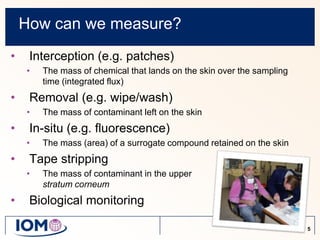
How can we measure?
•    Interception (e.g. patches)
    •   The mass of chemical that lands on the skin over the sampling
        time (integrated flux)
•    Removal (e.g. wipe/wash)
    •   The mass of contaminant left on the skin
•    In-situ (e.g. fluorescence)
    •   The mass (area) of a surrogate compound retained on the skin
•    Tape stripping
    •   The mass of contaminant in the upper                layers of the
        stratum corneum
•    Biological monitoring

                                                                            5
Dermal exposure to metals…
EASE


       CaCO3   Zn   Pb             Sb                     Ni

                         Source: http://www.herag.net /        6
European and International Standards

•    CEN/TC 137 - Assessment of workplace exposure
     to chemical and biological agents
     •   Workplace exposure - Strategy for the evaluation of
         dermal exposure (CEN/TR 15278:2006)
     •   Workplace exposure - Measurement of dermal exposure
         - Principles and methods (CEN/TS 15279:2006)
•    ISO TC146 SC2 WG8 - Assessment of
     contamination of skin and surfaces from airborne
     chemicals
     •   TR 14294 – accepted 3rd May 2011


                                                           7
Biologically-relevant samplers…
•    An interception sampler that mimics the skin
     •   with a diffusion membrane, ideally chosen with similar uptake
         characteristics to the skin
     •   adsorbent material
     •   impervious backing
•    Prototype IOM dermal
       sampler
•    NIOSH POD
     •   5-layer Passive
         Organic Dermal
         sampler

                  Lindsay FE, Semple S, Robertson A, Cherrie JW. (2006) Development of a
                  biologically relevant dermal sampler. Annals of Occupational             8
                  Hygiene;50(1):85-94.
Problems with the IOM sampler…

•    A range of membranes tested but none
     completely suitable
     •   All more permeable than skin
•    Adsorbent more easily saturated than we
     would have wished
•    Need to correct for air concentration


                                               9
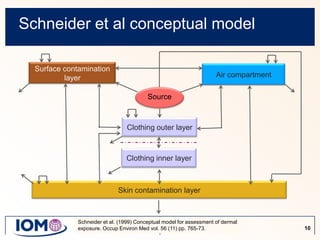
Schneider et al conceptual model

  Surface contamination
          layer                                                       Air compartment

                                          Source


                                 Clothing outer layer


                                 Clothing inner layer


                              Skin contamination layer


              Schneider et al. (1999) Conceptual model for assessment of dermal
              exposure. Occup Environ Med vol. 56 (11) pp. 765-73.                      10
Vermeulen et al (2000)

•    Identified the exposure pathways in rubber
     manufacturing
•    They measured…
     •   Air concentration – both near and far-field
     •   Dermal loading
•    They showed that…
     •   Hand (wrist) contamination was on average highest
     •   Strong correlation between hand (wrist) and whole
         body contamination


               Vermeulen R, Heideman J, Bos RP, Kromhout H. (2000) Identification of dermal
               exposure pathways in the rubber manufacturing industry. Ann Occup              11
               Hyg.;44(7):533-541.
Different process – different pathways


     Curing            Pre-treatment


                                         12
DREAM…

•   Based on Schneider et al model
•   Estimates from descriptive task information
•   Assessments are reproducible between
    assessors
•   Estimates exposure in
    “Dream Units” - DU
•   Validation study showed
    reasonable correlation with
    measurement data

             van Wendel de Joode et al. (2005) Occup Environ; 62(9): 623-32.
             van Wendel de Joode et al. (2005) J Expo Anal Environ Epidemiol; 15(1): 111-   13
             120.
The GuLF Study…

•    A large epidemiological study to investigate
     potential health risks for clean-up workers involved
     with the Deepwater Horizon oil spill
•    Using an updated version of DREAM for dermal
     exposure assessment
•    Need to assess exposure to
    •   Residues, (e.g. VOCs, PAHs, BTEX)
    •   Dispersants (e.g. 2-butoxyethanol,
        propylene glycol)


                                                        14
DREAM

Exposure Assessors estimate exposure from each of
the three pathways of dermal exposure:
   • Emission
   • Surface Contact
   • Deposition

          Number of        Skin area      Substance
       exposure events     exposed      characteristics


                                                     15
Personal protective equipment…
•    Studies of exposure often show a high degree of
     protection.
     •   Creely & Cherrie found >99% reduction in contaminant inside
         gloves
•    Available biomonitoring studies suggest gloves are
     less effective
•    Scheepers and colleagues found…
     •   With polyethylene gloves median reduction of 51% excretion
         of 1-hydroxypyrene in urine
     •   Vinyl gloves and Tyvek sleeves showed a 97% reduction in
         skin contamination with pyrene and benzo(a)pyrene and a
         lowering in urinary excretion of 1-hydroxypyrene by 57%


                Creely KS, Cherrie JW. Ann OccupHyg 2001;45:137–43.
                                                                              16
                Scheeperset al.Scan J Work, Environ Health 2009;35:212–221.
Asphalt exposure…


                    17
Adaption of DREAM for PPE…

•    We argue that the biomonitoring data are more
     reliable indicators of protection


                                                     18
DART…

•   Dermal Advanced                                              Dermal exposure
                                                                    database

    REACH Tool from
                          DART deterministic
    the ART Consortium         model
                                                                Similarity module to

•   Combine mechanistic                                             select data


    model (DREAM?)
                                               Bayesian process
    and                                         to combine data
                                               and model output

•   Exposure data
    using
•   A Bayesian process                         Exposure estimates
                                               for risk assessment


                                                                                       19
News…

•   The WHO IPCS will publish
    an Environmental Health
    Criteria Monograph (EHC) on
    Dermal Exposurelater this
    year.
•   This is a companion to the
    earlier volume on Dermal
    Absorption, published 2006.


                                  20
Questions and thanks…

My collaborators…
Melanie Gorman Ng1, Mark Stenzel2, Richard Kwok3,
Berna van Wendel de Joode4,
Patricia Stewart5
1 IOM, Centre for Human Exposure
    Science
2 Exposure Assessment                   The work was partly funded by…
    Applications, LLC
3 National Institute of Environmental
    Health Sciences
4 Universidad Nacional de Costa
    Rica
5 Stewart Exposure Assessments,
    LLC


                                                                   21

Estimating dermal exposure

  • 1.
    WORKING FOR AHEALTHY FUTURE Estimating Dermal Exposure to Chemicals John Cherrie INSTITUTE OF OCCUPATIONAL MEDICINE . Edinburgh . UK www.iom-world.org
  • 2.
    Outline… • Consider what we mean by dermal exposure • How do chemicals enter the body? • Available measurement methods • Modelling exposure • DREAM • Efforts to improve models • The GuLF study • DART 1
  • 3.
    Growing interest indermal exposure… Publications in Scopus by year 2
  • 4.
    Exposure… • Ideally, we would like to know there is an exposure-response relationship • For inhalation exposure • Concentration x Duration (mg/m3.hr) • Uptake • Cumulative exposure x Breathing rate (mg) • What should we use for dermal exposure? 3
  • 5.
    Dermal uptake… J =kpdC - where kp is the permeability constant Important factors: • Concentration of contaminant • Mass on skin • Area exposed From Wikipedia.com • Duration of exposure 4
  • 6.
    How can wemeasure? • Interception (e.g. patches) • The mass of chemical that lands on the skin over the sampling time (integrated flux) • Removal (e.g. wipe/wash) • The mass of contaminant left on the skin • In-situ (e.g. fluorescence) • The mass (area) of a surrogate compound retained on the skin • Tape stripping • The mass of contaminant in the upper layers of the stratum corneum • Biological monitoring 5
  • 7.
    Dermal exposure tometals… EASE CaCO3 Zn Pb Sb Ni Source: http://www.herag.net / 6
  • 8.
    European and InternationalStandards • CEN/TC 137 - Assessment of workplace exposure to chemical and biological agents • Workplace exposure - Strategy for the evaluation of dermal exposure (CEN/TR 15278:2006) • Workplace exposure - Measurement of dermal exposure - Principles and methods (CEN/TS 15279:2006) • ISO TC146 SC2 WG8 - Assessment of contamination of skin and surfaces from airborne chemicals • TR 14294 – accepted 3rd May 2011 7
  • 9.
    Biologically-relevant samplers… • An interception sampler that mimics the skin • with a diffusion membrane, ideally chosen with similar uptake characteristics to the skin • adsorbent material • impervious backing • Prototype IOM dermal sampler • NIOSH POD • 5-layer Passive Organic Dermal sampler Lindsay FE, Semple S, Robertson A, Cherrie JW. (2006) Development of a biologically relevant dermal sampler. Annals of Occupational 8 Hygiene;50(1):85-94.
  • 10.
    Problems with theIOM sampler… • A range of membranes tested but none completely suitable • All more permeable than skin • Adsorbent more easily saturated than we would have wished • Need to correct for air concentration 9
  • 11.
    Schneider et alconceptual model Surface contamination layer Air compartment Source Clothing outer layer Clothing inner layer Skin contamination layer Schneider et al. (1999) Conceptual model for assessment of dermal exposure. Occup Environ Med vol. 56 (11) pp. 765-73. 10
  • 12.
    Vermeulen et al(2000) • Identified the exposure pathways in rubber manufacturing • They measured… • Air concentration – both near and far-field • Dermal loading • They showed that… • Hand (wrist) contamination was on average highest • Strong correlation between hand (wrist) and whole body contamination Vermeulen R, Heideman J, Bos RP, Kromhout H. (2000) Identification of dermal exposure pathways in the rubber manufacturing industry. Ann Occup 11 Hyg.;44(7):533-541.
  • 13.
    Different process –different pathways Curing Pre-treatment 12
  • 14.
    DREAM… • Based on Schneider et al model • Estimates from descriptive task information • Assessments are reproducible between assessors • Estimates exposure in “Dream Units” - DU • Validation study showed reasonable correlation with measurement data van Wendel de Joode et al. (2005) Occup Environ; 62(9): 623-32. van Wendel de Joode et al. (2005) J Expo Anal Environ Epidemiol; 15(1): 111- 13 120.
  • 15.
    The GuLF Study… • A large epidemiological study to investigate potential health risks for clean-up workers involved with the Deepwater Horizon oil spill • Using an updated version of DREAM for dermal exposure assessment • Need to assess exposure to • Residues, (e.g. VOCs, PAHs, BTEX) • Dispersants (e.g. 2-butoxyethanol, propylene glycol) 14
  • 16.
    DREAM Exposure Assessors estimateexposure from each of the three pathways of dermal exposure: • Emission • Surface Contact • Deposition Number of Skin area Substance exposure events exposed characteristics 15
  • 17.
    Personal protective equipment… • Studies of exposure often show a high degree of protection. • Creely & Cherrie found >99% reduction in contaminant inside gloves • Available biomonitoring studies suggest gloves are less effective • Scheepers and colleagues found… • With polyethylene gloves median reduction of 51% excretion of 1-hydroxypyrene in urine • Vinyl gloves and Tyvek sleeves showed a 97% reduction in skin contamination with pyrene and benzo(a)pyrene and a lowering in urinary excretion of 1-hydroxypyrene by 57% Creely KS, Cherrie JW. Ann OccupHyg 2001;45:137–43. 16 Scheeperset al.Scan J Work, Environ Health 2009;35:212–221.
  • 18.
  • 19.
    Adaption of DREAMfor PPE… • We argue that the biomonitoring data are more reliable indicators of protection 18
  • 20.
    DART… • Dermal Advanced Dermal exposure database REACH Tool from DART deterministic the ART Consortium model Similarity module to • Combine mechanistic select data model (DREAM?) Bayesian process and to combine data and model output • Exposure data using • A Bayesian process Exposure estimates for risk assessment 19
  • 21.
    News… • The WHO IPCS will publish an Environmental Health Criteria Monograph (EHC) on Dermal Exposurelater this year. • This is a companion to the earlier volume on Dermal Absorption, published 2006. 20
  • 22.
    Questions and thanks… Mycollaborators… Melanie Gorman Ng1, Mark Stenzel2, Richard Kwok3, Berna van Wendel de Joode4, Patricia Stewart5 1 IOM, Centre for Human Exposure Science 2 Exposure Assessment The work was partly funded by… Applications, LLC 3 National Institute of Environmental Health Sciences 4 Universidad Nacional de Costa Rica 5 Stewart Exposure Assessments, LLC 21