











From technical debt to
technical health
Copyright © 2016 Declan Whelan
Declan Whelan
Agile coach, developer
From technical debt to
technical health
Copyright © 2016 Declan Whelan
Declan Whelan
Agile coach, developer
Tom Grant
Senior consultant,
Net Objectives
Thanks Tom!
The good news
Software development encounters
fewer constraints than other forms
of invention:
• No physical constraints
• Lower material costs
• Fewer regulations
• Near instantaneous market delivery
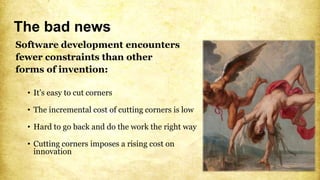
The bad news
Software development encounters
fewer constraints than other
forms of invention:
• It’s easy to cut corners
• The incremental cost of cutting corners is low
• Hard to go back and do the work the right way
• Cutting corners imposes a rising cost on
innovation
We’re tempted to cut corners
And we eventually
pay for our sins
D
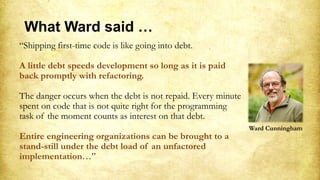
“Shipping first-time code is like going into debt.
A little debt speeds development so long as it is paid
back promptly with refactoring.
The danger occurs when the debt is not repaid. Every minute
spent on code that is not quite right for the programming
task of the moment counts as interest on that debt.
Entire engineering organizations can be brought to a
stand-still under the debt load of an unfactored
implementation…”
Ward Cunningham
What Ward said …
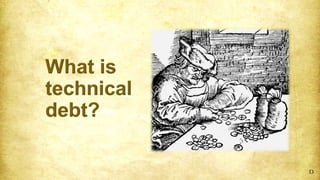
A textbook definition
The increased difficulty in writing new
code, or maintaining code, that is the
natural result of…
• Shortcuts
• Bad coding practices
• Hacks
• Other times when we wish, in hindsight,
we had coded more carefully
From Brian Foote:
A BIG BALL OF MUD …
a haphazardly structured, sprawling,
sloppy, duct-tape and bailing wire,
spaghetti code jungle.
http://www.laputan.org/mud/
A practical definition
Stuff in
the code
that slows
us down!
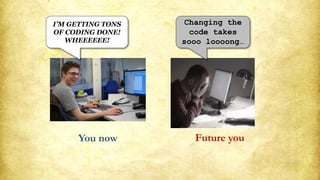
You now Future you
I’M GETTING TONS
OF CODING DONE!
WHEEEEEE!
Changing the
code takes
sooo loooong…
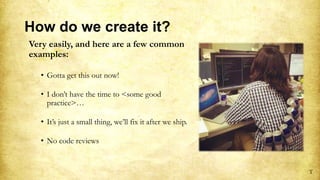
How do we create it?
Very easily, and here are a few common
examples:
• Gotta get this out now!
• I don’t have the time to <some good
practice>…
• It’s just a small thing, we’ll fix it after we ship.
• No code reviews
T
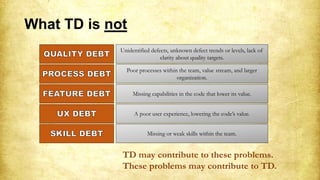
What TD is not
Unidentified defects, unknown defect trends or levels, lack of
clarity about quality targets.
Poor processes within the team, value stream, and larger
organization.
Missing capabilities in the code that lower its value.
A poor user experience, lowering the code’s value.
Missing or weak skills within the team.
TD may contribute to these problems.
These problems may contribute to TD.
D
On the individual
• Harder to add new software value
• Harder to fix problems
• Harder to work in any part of the code
• Harder to get motivated about working
in the code
• I hear Company X is hiring…
• Is this the career I wanted?
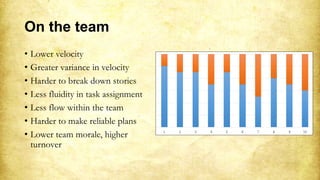
On the team
• Lower velocity
• Greater variance in velocity
• Harder to break down stories
• Less fluidity in task assignment
• Less flow within the team
• Harder to make reliable plans
• Lower team morale, higher
turnover
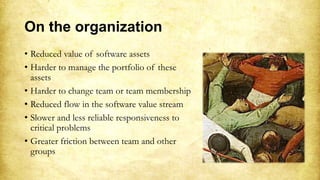
On the organization
• Reduced value of software assets
• Harder to manage the portfolio of these
assets
• Harder to change team or team membership
• Reduced flow in the software value stream
• Slower and less reliable responsiveness to
critical problems
• Greater friction between team and other
groups
T
Technical debt gets out of control
quickly
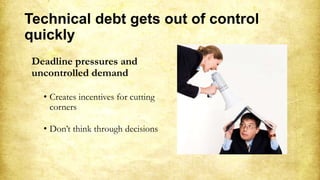
Deadline pressures and
uncontrolled demand
• Creates incentives for cutting
corners
• Don’t think through decisions
Technical debt gets out of control
quickly
Unmeasured impact
• Hard for non-technical people
to grasp importance
• If no time to avoid technical
debt, there’s no time to assess it
• Often lack data, especially about
deep patterns
Technical debt gets out of control
quickly
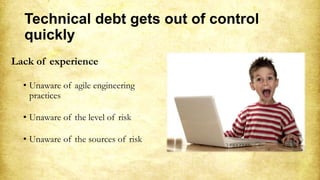
Lack of experience
• Unaware of agile engineering
practices
• Unaware of the level of risk
• Unaware of the sources of risk
Technical debt gets out of control
quickly
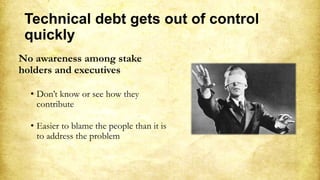
No awareness among stake
holders and executives
• Don’t know or see how they
contribute
• Easier to blame the people than it is
to address the problem
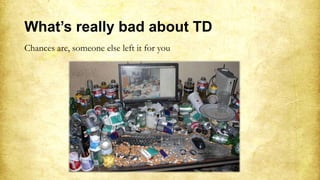
What’s really bad about TD
Chances are, someone else left it for you
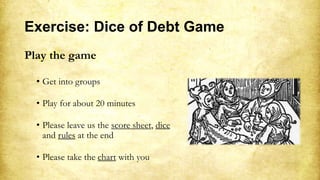
Exercise: Dice of Debt Game
Play the game
• Get into groups
• Play for about 20 minutes
• Please leave us the score sheet, dice
and rules at the end
• Please take the chart with you
Discuss with people at your table
• Based on the game, what is the best strategy for
dealing with technical debt?
• Is the strategy you used in the game at all similar
to the strategy you follow in real life?
• Do you have a better strategy?
• What is standing in your way?
D
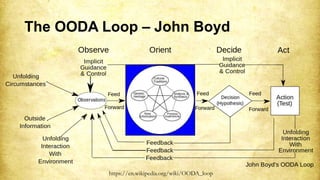
The OODA Loop – John Boyd
https://en.wikipedia.org/wiki/OODA_loop
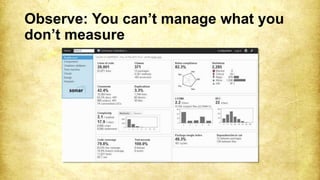
Observe: You can’t manage what you
don’t measure
Observe: Measure technical debt
• Individual sources: the code
• Cyclomatic complexity
• Duplicate code
• Size of methods and classes
• Aggregate effects: team & organization
• Velocity
• Team happiness
• % of capacity lost to TD
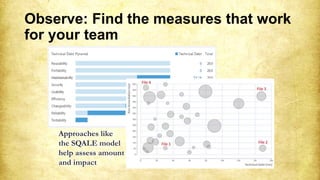
Observe: Find the measures that work
for your team
Approaches like
the SQALE model
help assess amount
and impact
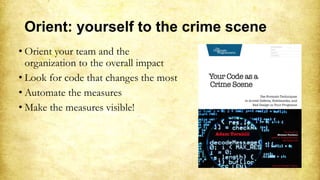
Orient: yourself to the crime scene
• Orient your team and the
organization to the overall impact
• Look for code that changes the most
• Automate the measures
• Make the measures visible!
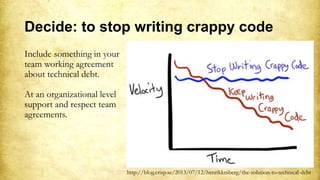
Decide: to stop writing crappy code
Include something in your
team working agreement
about technical debt.
At an organizational level
support and respect team
agreements.
http://blog.crisp.se/2013/07/12/henrikkniberg/the-solution-to-technical-debt
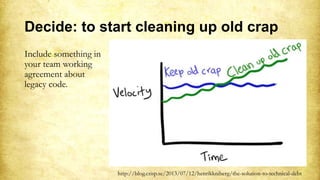
Decide: to start cleaning up old crap
Include something in
your team working
agreement about
legacy code.
http://blog.crisp.se/2013/07/12/henrikkniberg/the-solution-to-technical-debt
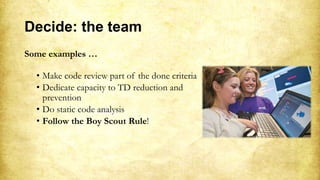
Decide: the team
Some examples …
• Make code review part of the done criteria
• Dedicate capacity to TD reduction and
prevention
• Do static code analysis
• Follow the Boy Scout Rule!
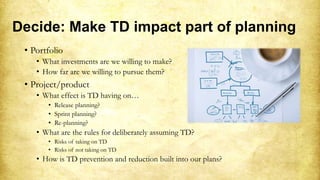
Decide: Make TD impact part of planning
• Portfolio
• What investments are we willing to make?
• How far are we willing to pursue them?
• Project/product
• What effect is TD having on…
• Release planning?
• Sprint planning?
• Re-planning?
• What are the rules for deliberately assuming TD?
• Risks of taking on TD
• Risks of not taking on TD
• How is TD prevention and reduction built into our plans?
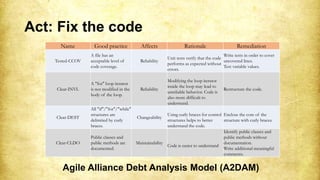
Act: Fix the code
Name Good practice Affects Rationale Remediation
Tested-CCOV
A file has an
acceptable level of
code coverage.
Reliability
Unit tests verify that the code
performs as expected without
errors.
Write tests in order to cover
uncovered lines.
Test variable values.
Clear-INVL
A "for" loop iterator
is not modified in the
body of the loop.
Reliability
Modifying the loop iterator
inside the loop may lead to
unreliable behavior. Code is
also more difficult to
understand.
Restructure the code.
Clear-DEST
All "if"/"for"/"while"
structures are
delimited by curly
braces.
Changeability
Using curly braces for control
structures helps to better
understand the code.
Enclose the core of the
structure with curly braces.
Clear-CLDO
Public classes and
public methods are
documented.
Maintainability
Code is easier to understand
Identify public classes and
public methods without
documentation.
Write additional meaningful
comments.
Agile Alliance Debt Analysis Model (A2DAM)
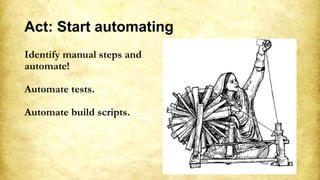
Act: Start automating
Identify manual steps and
automate!
Automate tests.
Automate build scripts.
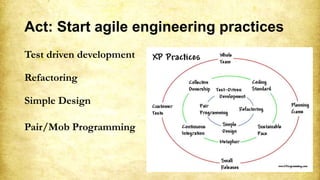
Act: Start agile engineering practices
Test driven development
Refactoring
Simple Design
Pair/Mob Programming
Systems Thinking
94% of the belong to the system
(responsibility of management), 6%
are special cause.
— W. Edwards Deming
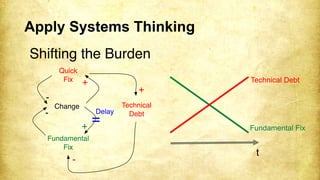
Apply Systems Thinking
Fundamental Fix
Technical Debt
t
Apply Systems Thinking (5 minutes)
• At your table brainstorm factors that contribute to technical debt. Some
things to consider:
• Hiring practices
• Outsourcing
• Staffing up for projects
• Project deadlines
• Etc.
• Rank then from biggest to smallest impact.
Apply Systems Thinking
At your table brainstorm actions that would help move towards technical
health:
• Observe: what measures could you make?
• Orient: how could you make that information relevant?
• Decide: how can you make better decisions supporting technical
health?
• Act: what can you actually do in the next 2 weeks?
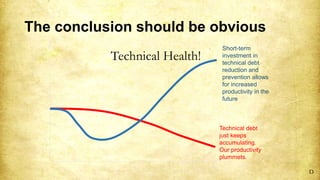
The conclusion should be obvious
Short-term
investment in
technical debt
reduction and
prevention allows
for increased
productivity in the
future
Technical debt
just keeps
accumulating.
Our productivity
plummets.
D
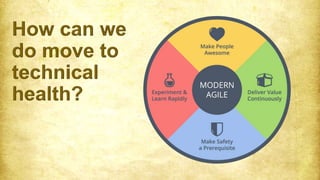
Technical Health!
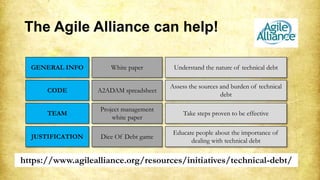
The Agile Alliance can help!
https://www.agilealliance.org/resources/initiatives/technical-debt/
GENERAL INFO White paper
CODE A2ADAM spreadsheet
TEAM
Project management
white paper
JUSTIFICATION Dice Of Debt game
Understand the nature of technical debt
Assess the sources and burden of technical
debt
Take steps proven to be effective
Educate people about the importance of
dealing with technical debt
From Technical Debt to Technical Health

From Technical Debt to Technical Health

  • 1.
    From technical debtto technical health Copyright © 2016 Declan Whelan Declan Whelan Agile coach, developer
  • 2.
    From technical debtto technical health Copyright © 2016 Declan Whelan Declan Whelan Agile coach, developer
  • 3.
    Tom Grant Senior consultant, NetObjectives Thanks Tom!
  • 5.
    The good news Softwaredevelopment encounters fewer constraints than other forms of invention: • No physical constraints • Lower material costs • Fewer regulations • Near instantaneous market delivery
  • 6.
    The bad news Softwaredevelopment encounters fewer constraints than other forms of invention: • It’s easy to cut corners • The incremental cost of cutting corners is low • Hard to go back and do the work the right way • Cutting corners imposes a rising cost on innovation
  • 7.
    We’re tempted tocut corners And we eventually pay for our sins
  • 8.
  • 9.
    “Shipping first-time codeis like going into debt. A little debt speeds development so long as it is paid back promptly with refactoring. The danger occurs when the debt is not repaid. Every minute spent on code that is not quite right for the programming task of the moment counts as interest on that debt. Entire engineering organizations can be brought to a stand-still under the debt load of an unfactored implementation…” Ward Cunningham What Ward said …
  • 10.
    A textbook definition Theincreased difficulty in writing new code, or maintaining code, that is the natural result of… • Shortcuts • Bad coding practices • Hacks • Other times when we wish, in hindsight, we had coded more carefully
  • 11.
    From Brian Foote: ABIG BALL OF MUD … a haphazardly structured, sprawling, sloppy, duct-tape and bailing wire, spaghetti code jungle. http://www.laputan.org/mud/
  • 12.
    A practical definition Stuffin the code that slows us down!
  • 13.
    You now Futureyou I’M GETTING TONS OF CODING DONE! WHEEEEEE! Changing the code takes sooo loooong…
  • 14.
    How do wecreate it? Very easily, and here are a few common examples: • Gotta get this out now! • I don’t have the time to <some good practice>… • It’s just a small thing, we’ll fix it after we ship. • No code reviews T
  • 15.
    What TD isnot Unidentified defects, unknown defect trends or levels, lack of clarity about quality targets. Poor processes within the team, value stream, and larger organization. Missing capabilities in the code that lower its value. A poor user experience, lowering the code’s value. Missing or weak skills within the team. TD may contribute to these problems. These problems may contribute to TD.
  • 16.
  • 17.
    On the individual •Harder to add new software value • Harder to fix problems • Harder to work in any part of the code • Harder to get motivated about working in the code • I hear Company X is hiring… • Is this the career I wanted?
  • 18.
    On the team •Lower velocity • Greater variance in velocity • Harder to break down stories • Less fluidity in task assignment • Less flow within the team • Harder to make reliable plans • Lower team morale, higher turnover
  • 19.
    On the organization •Reduced value of software assets • Harder to manage the portfolio of these assets • Harder to change team or team membership • Reduced flow in the software value stream • Slower and less reliable responsiveness to critical problems • Greater friction between team and other groups
  • 20.
  • 21.
    Technical debt getsout of control quickly Deadline pressures and uncontrolled demand • Creates incentives for cutting corners • Don’t think through decisions
  • 22.
    Technical debt getsout of control quickly Unmeasured impact • Hard for non-technical people to grasp importance • If no time to avoid technical debt, there’s no time to assess it • Often lack data, especially about deep patterns
  • 23.
    Technical debt getsout of control quickly Lack of experience • Unaware of agile engineering practices • Unaware of the level of risk • Unaware of the sources of risk
  • 24.
    Technical debt getsout of control quickly No awareness among stake holders and executives • Don’t know or see how they contribute • Easier to blame the people than it is to address the problem
  • 25.
    What’s really badabout TD Chances are, someone else left it for you
  • 27.
    Exercise: Dice ofDebt Game Play the game • Get into groups • Play for about 20 minutes • Please leave us the score sheet, dice and rules at the end • Please take the chart with you
  • 28.
    Discuss with peopleat your table • Based on the game, what is the best strategy for dealing with technical debt? • Is the strategy you used in the game at all similar to the strategy you follow in real life? • Do you have a better strategy? • What is standing in your way? D
  • 30.
    The OODA Loop– John Boyd https://en.wikipedia.org/wiki/OODA_loop
  • 31.
    Observe: You can’tmanage what you don’t measure
  • 32.
    Observe: Measure technicaldebt • Individual sources: the code • Cyclomatic complexity • Duplicate code • Size of methods and classes • Aggregate effects: team & organization • Velocity • Team happiness • % of capacity lost to TD
  • 33.
    Observe: Find themeasures that work for your team Approaches like the SQALE model help assess amount and impact
  • 34.
    Orient: yourself tothe crime scene • Orient your team and the organization to the overall impact • Look for code that changes the most • Automate the measures • Make the measures visible!
  • 35.
    Decide: to stopwriting crappy code Include something in your team working agreement about technical debt. At an organizational level support and respect team agreements. http://blog.crisp.se/2013/07/12/henrikkniberg/the-solution-to-technical-debt
  • 36.
    Decide: to startcleaning up old crap Include something in your team working agreement about legacy code. http://blog.crisp.se/2013/07/12/henrikkniberg/the-solution-to-technical-debt
  • 37.
    Decide: the team Someexamples … • Make code review part of the done criteria • Dedicate capacity to TD reduction and prevention • Do static code analysis • Follow the Boy Scout Rule!
  • 38.
    Decide: Make TDimpact part of planning • Portfolio • What investments are we willing to make? • How far are we willing to pursue them? • Project/product • What effect is TD having on… • Release planning? • Sprint planning? • Re-planning? • What are the rules for deliberately assuming TD? • Risks of taking on TD • Risks of not taking on TD • How is TD prevention and reduction built into our plans?
  • 39.
    Act: Fix thecode Name Good practice Affects Rationale Remediation Tested-CCOV A file has an acceptable level of code coverage. Reliability Unit tests verify that the code performs as expected without errors. Write tests in order to cover uncovered lines. Test variable values. Clear-INVL A "for" loop iterator is not modified in the body of the loop. Reliability Modifying the loop iterator inside the loop may lead to unreliable behavior. Code is also more difficult to understand. Restructure the code. Clear-DEST All "if"/"for"/"while" structures are delimited by curly braces. Changeability Using curly braces for control structures helps to better understand the code. Enclose the core of the structure with curly braces. Clear-CLDO Public classes and public methods are documented. Maintainability Code is easier to understand Identify public classes and public methods without documentation. Write additional meaningful comments. Agile Alliance Debt Analysis Model (A2DAM)
  • 40.
    Act: Start automating Identifymanual steps and automate! Automate tests. Automate build scripts.
  • 41.
    Act: Start agileengineering practices Test driven development Refactoring Simple Design Pair/Mob Programming
  • 42.
    Systems Thinking 94% ofthe belong to the system (responsibility of management), 6% are special cause. — W. Edwards Deming
  • 43.
  • 44.
    Apply Systems Thinking(5 minutes) • At your table brainstorm factors that contribute to technical debt. Some things to consider: • Hiring practices • Outsourcing • Staffing up for projects • Project deadlines • Etc. • Rank then from biggest to smallest impact.
  • 45.
    Apply Systems Thinking Atyour table brainstorm actions that would help move towards technical health: • Observe: what measures could you make? • Orient: how could you make that information relevant? • Decide: how can you make better decisions supporting technical health? • Act: what can you actually do in the next 2 weeks?
  • 46.
    The conclusion shouldbe obvious Short-term investment in technical debt reduction and prevention allows for increased productivity in the future Technical debt just keeps accumulating. Our productivity plummets. D Technical Health!
  • 47.
    The Agile Alliancecan help! https://www.agilealliance.org/resources/initiatives/technical-debt/ GENERAL INFO White paper CODE A2ADAM spreadsheet TEAM Project management white paper JUSTIFICATION Dice Of Debt game Understand the nature of technical debt Assess the sources and burden of technical debt Take steps proven to be effective Educate people about the importance of dealing with technical debt