A stack operates on the Last-In, First-Out (LIFO) principle—imagine a stack of plates where you can only access the top plate. The last item you place on the stack is the first one you can remove.
Essential Data Structures:
Stacks,Queues, Linked
Lists, and Trees
Master the fundamental building blocks that power modern software
engineering and algorithmic problem-solving.
3.
Stack: The LIFOPrinciple
A stack operates on the Last-In, First-Out (LIFO) principle—imagine a stack of
plates where you can only access the top plate. The last item you place on the
stack is the first one you can remove.
Core Operations
Push: Add an element to the top of the stack
Pop: Remove and return the top element
Peek: View the top element without removing it
isEmpty: Check if the stack is empty
Think of a PEZ candy dispenser—you push candies in from the top
and pop them out from the same end, one at a time.
4.
Array Implementation ofStack
01
Initialize Array
Create a fixed-size array and set a top index pointer to -1
(indicating empty stack)
02
Push Operation
Increment top pointer and insert the new element at array[top]
03
Pop Operation
Retrieve element at array[top], then decrement the top pointer
04
Check Boundaries
Verify stack isn't full before push (overflow) or empty before
pop (underflow)
Performance
All operations execute in constant time O(1), making stacks
extremely efficient for sequential access patterns.
Trade-offs
Fixed capacity can cause overflow if exceeded or waste
memory if underutilized. Dynamic resizing adds complexity.
5.
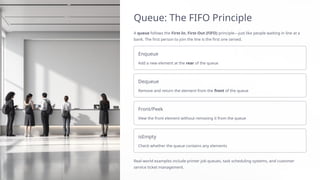
Queue: The FIFOPrinciple
A queue follows the First-In, First-Out (FIFO) principle—just like people waiting in line at a
bank. The first person to join the line is the first one served.
Enqueue
Add a new element at the rear of the queue
Dequeue
Remove and return the element from the front of the queue
Front/Peek
View the front element without removing it from the queue
isEmpty
Check whether the queue contains any elements
Real-world examples include printer job queues, task scheduling systems, and customer
service ticket management.
6.
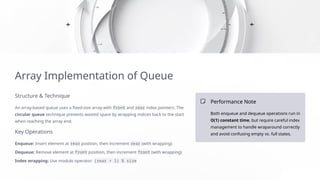
Array Implementation ofQueue
Structure & Technique
An array-based queue uses a fixed-size array with front and rear index pointers. The
circular queue technique prevents wasted space by wrapping indices back to the start
when reaching the array end.
Key Operations
Enqueue: Insert element at rear position, then increment rear (with wrapping)
Dequeue: Remove element at front position, then increment front (with wrapping)
Index wrapping: Use modulo operator: (rear + 1) % size
Performance Note
Both enqueue and dequeue operations run in
O(1) constant time, but require careful index
management to handle wraparound correctly
and avoid confusing empty vs. full states.
7.
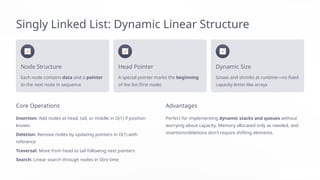
Singly Linked List:Dynamic Linear Structure
Node Structure
Each node contains data and a pointer
to the next node in sequence
Head Pointer
A special pointer marks the beginning
of the list (first node)
Dynamic Size
Grows and shrinks at runtime—no fixed
capacity limits like arrays
Core Operations
Insertion: Add nodes at head, tail, or middle in O(1) if position
known
Deletion: Remove nodes by updating pointers in O(1) with
reference
Traversal: Move from head to tail following next pointers
Search: Linear search through nodes in O(n) time
Advantages
Perfect for implementing dynamic stacks and queues without
worrying about capacity. Memory allocated only as needed, and
insertions/deletions don't require shifting elements.
8.
Doubly Linked List:Two-Way Navigation
A doubly linked list enhances the singly linked structure by adding a previous pointer to each node, enabling
bidirectional traversal.
Node Structure
Contains data, next pointer, and prev pointer
Forward & Backward
Navigate in both directions seamlessly through the list
Efficient Modifications
Insert or delete from either end or middle with ease
Real-World Applications
Undo/Redo: Text editors maintain action history
Browser History: Navigate back and forward through
pages
Music Playlists: Skip forward or backward through
songs
LRU Cache: Efficiently manage recently used items
Trade-offs
Requires extra memory for the additional pointer per
node, but gains significant flexibility in operations and
traversal patterns.
9.
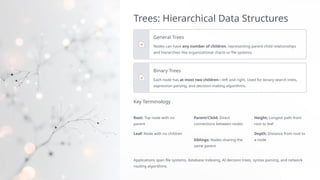
Trees: Hierarchical DataStructures
General Trees
Nodes can have any number of children, representing parent-child relationships
and hierarchies like organizational charts or file systems.
Binary Trees
Each node has at most two children—left and right. Used for binary search trees,
expression parsing, and decision-making algorithms.
Key Terminology
Root: Top node with no
parent
Leaf: Node with no children
Parent/Child: Direct
connections between nodes
Siblings: Nodes sharing the
same parent
Height: Longest path from
root to leaf
Depth: Distance from root to
a node
Applications span file systems, database indexing, AI decision trees, syntax parsing, and network
routing algorithms.
10.
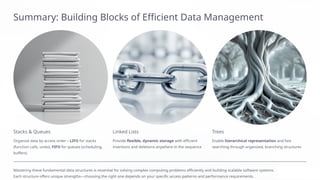
Summary: Building Blocksof Efficient Data Management
Stacks & Queues
Organize data by access order—LIFO for stacks
(function calls, undo), FIFO for queues (scheduling,
buffers)
Linked Lists
Provide flexible, dynamic storage with efficient
insertions and deletions anywhere in the sequence
Trees
Enable hierarchical representation and fast
searching through organized, branching structures
Mastering these fundamental data structures is essential for solving complex computing problems efficiently and building scalable software systems.
Each structure offers unique strengths—choosing the right one depends on your specific access patterns and performance requirements.


![Array Implementation of Stack
01
Initialize Array
Create a fixed-size array and set a top index pointer to -1
(indicating empty stack)
02
Push Operation
Increment top pointer and insert the new element at array[top]
03
Pop Operation
Retrieve element at array[top], then decrement the top pointer
04
Check Boundaries
Verify stack isn't full before push (overflow) or empty before
pop (underflow)
Performance
All operations execute in constant time O(1), making stacks
extremely efficient for sequential access patterns.
Trade-offs
Fixed capacity can cause overflow if exceeded or waste
memory if underutilized. Dynamic resizing adds complexity.](https://image.slidesharecdn.com/essential-data-structures-stacks-queues-linked-lists-and-trees-251219094024-e32fe444/85/Essential-Data-Structures-Stacks-Queues-Linked-Lists-and-Trees-pptx-4-320.jpg)



![Polymer [ बहुलक ] Chemistry Notes PDF - Irfanullah Mehar - JJ Sir Chemistry.pdf](https://cdn.slidesharecdn.com/ss_thumbnails/polymerchemistrynotespdf-irfanullahmehar-jjsirchemistry-260210172118-3f9b37f7-thumbnail.jpg?width=640&height=640&fit=bounds)


