Understanding the Concepts and Applications of Stack and Queue
A stack of plates in a cupboard is like a stack data structure — you place new plates on top and remove the top plate first.
A line of people at a ticket counter is like a queue — the person who comes first gets served first.
Understanding the Concepts and Applications of Stack and Queue
1.
Stacks and Queues:
FundamentalData
Structures
Understanding linear data structures is essential for efficient algorithm
design and system implementation. Stacks and queues are foundational
structures that organize data in specific sequences to optimize access
and manipulation.
This presentation provides an overview of stacks and queues, exploring
their core concepts, representation methods, key operations, and
practical real-world applications. By grasping these structures, you can
solve diverse programming challenges more effectively.
2.
Stack: Introduction andRepresentation
Definition
A stack is a LIFO (Last-In, First-Out) data structure where
the most recently added element is the first to be removed,
much like a stack of plates.
Representation
• Array-based Implementation: Uses a fixed-size
contiguous memory block, efficient but limited capacity
• Linked List Implementation: Uses nodes linked by
pointers, allowing dynamic resizing as needed
3.
Stack: Operations
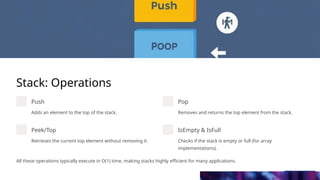
Push
Adds anelement to the top of the stack.
Pop
Removes and returns the top element from the stack.
Peek/Top
Retrieves the current top element without removing it.
IsEmpty & IsFull
Checks if the stack is empty or full (for array
implementations).
All these operations typically execute in O(1) time, making stacks highly efficient for many applications.
4.
Stack: Applications
Expression Evaluation
Usedin parsing and converting infix expressions to postfix for easier
computation.
Function Call Management
Manages active function calls and returns via the call stack.
Undo/Redo
Enables stepping backward and forward through user actions in software.
Backtracking
Helps algorithms explore possible paths by reverting to previous states.
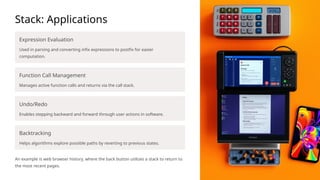
An example is web browser history, where the back button utilizes a stack to return to
the most recent pages.
5.
Queue: Introduction andRepresentation
Definition
A queue is a FIFO (First-In, First-Out) data structure where
the earliest added element is the first to be removed,
similar to a waiting line.
Representation
• Array-based Implementation: Usually fixed size using
circular queues to maximize space
• Linked List Implementation: Dynamic size with linked
nodes for ease of growth
• Priority Queue: Elements are ordered by priority rather
than arrival time
6.
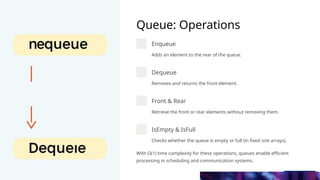
Queue: Operations
Enqueue
Adds anelement to the rear of the queue.
Dequeue
Removes and returns the front element.
Front & Rear
Retrieve the front or rear elements without removing them.
IsEmpty & IsFull
Checks whether the queue is empty or full (in fixed size arrays).
With O(1) time complexity for these operations, queues enable efficient
processing in scheduling and communication systems.
7.
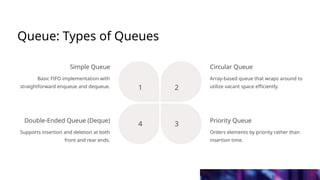
Queue: Types ofQueues
Simple Queue
Basic FIFO implementation with
straightforward enqueue and dequeue. 1
Circular Queue
Array-based queue that wraps around to
utilize vacant space efficiently.
2
Priority Queue
Orders elements by priority rather than
insertion time.
3
Double-Ended Queue (Deque)
Supports insertion and deletion at both
front and rear ends.
4
8.
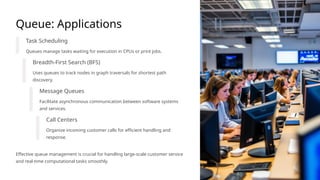
Queue: Applications
Task Scheduling
Queuesmanage tasks waiting for execution in CPUs or print jobs.
Breadth-First Search (BFS)
Uses queues to track nodes in graph traversals for shortest path
discovery.
Message Queues
Facilitate asynchronous communication between software systems
and services.
Call Centers
Organize incoming customer calls for efficient handling and
response.
Effective queue management is crucial for handling large-scale customer service
and real-time computational tasks smoothly.