DEVICE MANAGEMENT
Basic Functions of Device Management:
Keeps track of the status of all devices, which requires special mechanisms. Eg. Unit Control
Block (UCB).
Deciding on policy to determine who gets a device, for how long, and when. There are three
basic techniques for implementing the policies of device management:
 Dedicated- a technique whereby a device is assigned to a single process.
 Shared- a technique whereby a device is shared by many processes.
 Virtual- a technique whereby one physical device is simulated on another physical device.
Allocation- physically assigning a device to process.
De allocation may be done on either a process or a job level.
Techniques for Device Management:
Three major techniques are used for managing and allocating devices:
(1) dedicated, (2) shared, and (3) virtual.
Dedicated Devices:
A dedicated device is allocated to a job for the job’s entire duration. Some devices lend
themselves to this form of allocation.
It is difficult, for example, to share a card reader, tape, or printer.
Shared Devices:
Some devices such as disks, drums and most other Direct Access Storage Devices
(DASD) may be shared concurrently by several processes.
Several processes can read from a single disk at essentially the same time.
Process request is to be satisfied first based on (1) a priority list or (2) the objective of achieving
improved system output.
Virtual Devices:
Some devices that would normally have to be dedicated (e.g., card readers) may be converted
into shared devices through techniques such as spooling.
For example, spooling program can read and copy all card input onto a disk at high
speed.
Generalized Strategies:
Some professionals have attempted to generalize device management even more than is done
here.
For example, the call side of spooling is similar to the file system and buffering bears striking
similarity to spooling.
DEVICE CHARACTERISTICS – HARDWARE CONSIDERATIONS
Peripheral devices can be generalized into two major groups:
(1) input or output devices and (2) storage devices.
Input or Output Devices:
Input Device:
An input device is one by which the computer “senses” or “feels” the outside world.
These devices may be mechanisms such as thermometers or radar devices.
Output Device:
An output device is one by which the computer “affects” or “controls” the outside
world. It may be mechanisms such as temperature control knob or a radar direction control.
Storage Devices:
A storage device is a mechanism by which the computer may store information (a
procedure commonly called writing) in such a way that this information may be retrieved at a
later time (reading). Tij=time to access item j, given last access was to item i.
Differentiation of storage devices based on the variation of access time (Tij): 1 Serial Access
where Tij has a large variance(e.g., tape)
2Completely Direct Access where Tij is constant (e.g., core)
3Direct Access where Tij has only a small variance (e.g., drum)
SERIAL ACCESS DEVICES:
A serial access storage device can be characterized as one that relies on strictly
physical sequential positioning and accessing of information.
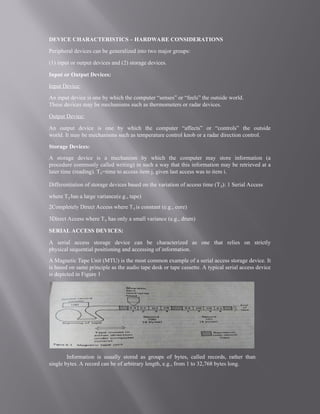
A Magnetic Tape Unit (MTU) is the most common example of a serial access storage device. It
is based on same principle as the audio tape desk or tape cassette. A typical serial access device
is depicted in Figure 1
Information is usually stored as groups of bytes, called records, rather than
single bytes. A record can be of arbitrary length, e.g., from 1 to 32,768 bytes long.
Each record can be identified by its physical position on the tape; the first record is 1,
the second is 2, and so on. In order to help establish groupings of records on a tape, there is a
special record type called a tape mark.
Typical characteristics of tape units are:
Density- 1600 bytes per inch(19,200 bytes per foot) Speed- 200 inches per second (16
2/3 feet per second)
Length- 2400 feet long(i.e., capacity is about 46,000,000 bytes) Maximum access = 2
minutes
Random (average) access = 1 minute
Serial access (at one record read the next) ~ 4ms
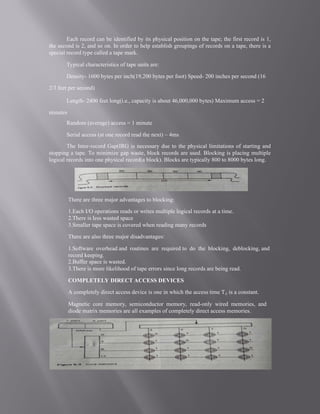
The Inter-record Gap(IRG is necessary due to the physical limitations of starting and
stopping a tape. To minimize gap waste, block records are used. Blocking is placing multiple
logical records into one physical record(a block). Blocks are typically 800 to 8000 bytes long.
There are three major advantages to blocking:
1.Each I/O operations reads or writes multiple logical records at a time.
2.There is less wasted space
3.Smaller tape space is covered when reading many records
There are also three major disadvantages:
1.Software overhead and routines are required to do the blocking, deblocking, and
record keeping.
2.Buffer space is wasted.
3.There is more likelihood of tape errors since long records are being read.
COMPLETELY DIRECT ACCESS DEVICES
A completely direct access device is one in which the access time Tij is a constant.
Magnetic core memory, semiconductor memory, read-only wired memories, and
diode matrix memories are all examples of completely direct access memories.
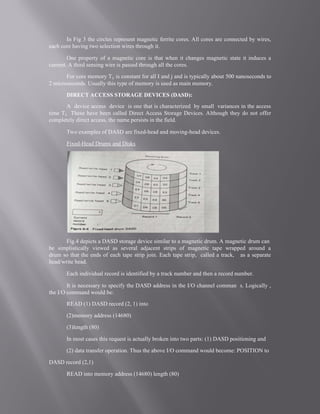
In Fig 3 the circles represent magnetic ferrite cores. All cores are connected by wires,
each core having two selection wires through it.
One property of a magnetic core is that when it changes magnetic state it induces a
current. A third sensing wire is passed through all the cores.
For core memory Tij is constant for all I and j and is typically about 500 nanoseconds to
2 microseconds. Usually this type of memory is used as main memory.
DIRECT ACCESS STORAGE DEVICES (DASD):
A device access device is one that is characterized by small variances in the access
time Tij. These have been called Direct Access Storage Devices. Although they do not offer
completely direct access, the name persists in the field.
Two examples of DASD are fixed-head and moving-head devices.
Fixed-Head Drums and Disks
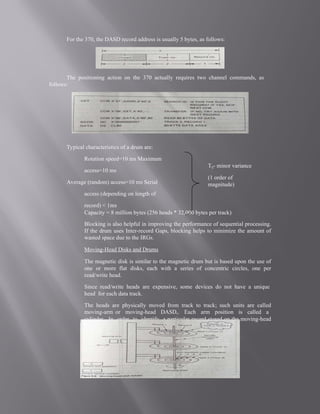
Fig.4 depicts a DASD storage device similar to a magnetic drum. A magnetic drum can
be simplistically viewed as several adjacent strips of magnetic tape wrapped around a
drum so that the ends of each tape strip join. Each tape strip, called a track, as a separate
head/write head.
Each individual record is identified by a track number and then a record number.
It is necessary to specify the DASD address in the I/O channel comman s. Logically ,
the I/O command would be:
READ (1) DASD record (2, 1) into
(2)memory address (14680)
(3)length (80)
In most cases this request is actually broken into two parts: (1) DASD positioning and
(2) data transfer operation. Thus the above I/O command would become: POSITION to
DASD record (2,1)
READ into memory address (14680) length (80)
For the 370, the DASD record address is usually 5 bytes, as follows:
The positioning action on the 370 actually requires two channel commands, as
follows:
Typical characteristics of a drum are:
Rotation speed=10 ms Maximum
access=10 ms
Average (random) access=10 ms Serial
access (depending on length of
record) < 1ms
Capacity = 8 million bytes (256 heads * 32,000 bytes per track)
Blocking is also helpful in improving the performance of sequential processing.
If the drum uses Inter-record Gaps, blocking helps to minimize the amount of
wasted space due to the IRGs.
Moving-Head Disks and Drums
The magnetic disk is similar to the magnetic drum but is based upon the use of
one or more flat disks, each with a series of concentric circles, one per
read/write head.
Since read/write heads are expensive, some devices do not have a unique
head for each data track.
The heads are physically moved from track to track; such units are called
moving-arm or moving-head DASDs. Each arm position is called a
cylinder. In order to identify a particular record stored on the moving-head
DASD shown in Figure.5
Tij- minor variance
(1 order of
magnitude)
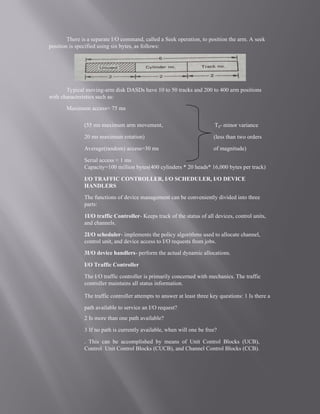
There is a separate I/O command, called a Seek operation, to position the arm. A seek
position is specified using six bytes, as follows:
Typical moving-arm disk DASDs have 10 to 50 tracks and 200 to 400 arm positions
with characteristics such as:
Maximum access= 75 ms
(55 ms maximum arm movement,
20 ms maximum rotation)
Average(random) access=30 ms
Serial access < 1 ms
Tij- minor variance
(less than two orders
of magnitude)
Capacity=100 million bytes(400 cylinders * 20 heads* 16,000 bytes per track)
I/O TRAFFIC CONTROLLER, I/O SCHEDULER, I/O DEVICE
HANDLERS
The functions of device management can be conveniently divided into three
parts:
1I/O traffic Controller- Keeps track of the status of all devices, control units,
and channels.
2I/O scheduler- implements the policy algorithms used to allocate channel,
control unit, and device access to I/O requests from jobs.
3I/O device handlers- perform the actual dynamic allocations.
I/O Traffic Controller
The I/O traffic controller is primarily concerned with mechanics. The traffic
controller maintains all status information.
The traffic controller attempts to answer at least three key questions: 1 Is there a
path available to service an I/O request?
2 Is more than one path available?
3 If no path is currently available, when will one be free?
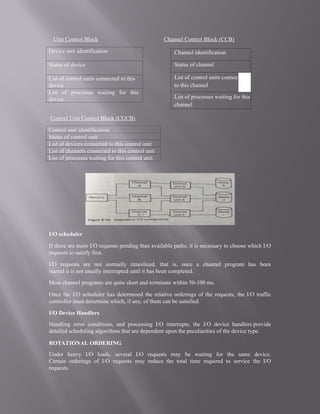
. This can be accomplished by means of Unit Control Blocks (UCB),
Control Unit Control Blocks (CUCB), and Channel Control Blocks (CCB).
Unit Control Block
Control Unit Control Block (CUCB)
I/O scheduler
If there are more I/O requests pending than available paths; it is necessary to choose which I/O
requests to satisfy first.
I/O requests are not normally timesliced, that is, once a channel program has been
started it is not usually interrupted until it has been completed.
Most channel programs are quite short and terminate within 50-100 ms.
Once the I/O scheduler has determined the relative orderings of the requests, the I/O traffic
controller must determine which, if any, of them can be satisfied.
I/O Device Handlers
Handling error conditions, and processing I/O interrupts, the I/O device handlers provide
detailed scheduling algorithms that are dependent upon the peculiarities of the device type.
ROTATIONAL ORDERING
Under heavy I/O loads, several I/O requests may be waiting for the same device.
Certain orderings of I/O requests may reduce the total time required to service the I/O
requests.
Channel Control Block (CCB)
Device unit identification
Status of device
List of control units connected to this
device
List of processes waiting for this
device
Control unit identification
Status of control unit
List of devices connected to this control unit
List of channels connected to this control unit
List of processes waiting for this control unit
Channel identification
Status of channel
List of control units connected
to this channel
List of processes waiting for this
channel
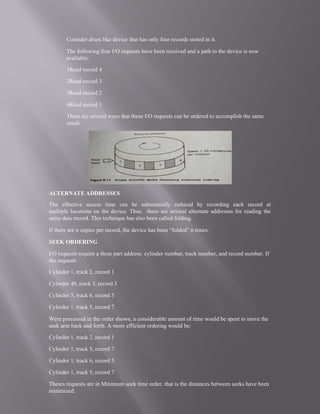
Consider drum like device that has only four records stored in it.
The following four I/O requests have been received and a path to the device is now
available:
1Read record 4
2Read record 3
3Read record 2
4Read record 1
There are several ways that these I/O requests can be ordered to accomplish the same
result.
ALTERNATE ADDRESSES
The effective access time can be substantially reduced by recording each record at
multiple locations on the device. Thus, there are several alternate addresses for reading the
same data record. This technique has also been called folding.
If there are n copies per record, the device has been “folded” n times.
SEEK ORDERING
I/O requests require a three part address: cylinder number, track number, and record number. If
the requests
Cylinder 1, track 2, record 1
Cylinder 40, track 3, record 3
Cylinder 5, track 6, record 5
Cylinder 1, track 5, record 7
Were processed in the order shown, a considerable amount of time would be spent to move the
seek arm back and forth. A more efficient ordering would be:
Cylinder 1, track 2, record 1
Cylinder 1, track 5, record 7
Cylinder 1, track 6, record 5
Cylinder 1, track 5, record 7
Theses requests are in Minimum seek time order, that is the distances between seeks have been
minimized.

Operating Systems - Device management concept

  • 1.
    DEVICE MANAGEMENT Basic Functionsof Device Management: Keeps track of the status of all devices, which requires special mechanisms. Eg. Unit Control Block (UCB). Deciding on policy to determine who gets a device, for how long, and when. There are three basic techniques for implementing the policies of device management:  Dedicated- a technique whereby a device is assigned to a single process.  Shared- a technique whereby a device is shared by many processes.  Virtual- a technique whereby one physical device is simulated on another physical device. Allocation- physically assigning a device to process. De allocation may be done on either a process or a job level. Techniques for Device Management: Three major techniques are used for managing and allocating devices: (1) dedicated, (2) shared, and (3) virtual. Dedicated Devices: A dedicated device is allocated to a job for the job’s entire duration. Some devices lend themselves to this form of allocation. It is difficult, for example, to share a card reader, tape, or printer. Shared Devices: Some devices such as disks, drums and most other Direct Access Storage Devices (DASD) may be shared concurrently by several processes. Several processes can read from a single disk at essentially the same time. Process request is to be satisfied first based on (1) a priority list or (2) the objective of achieving improved system output. Virtual Devices: Some devices that would normally have to be dedicated (e.g., card readers) may be converted into shared devices through techniques such as spooling. For example, spooling program can read and copy all card input onto a disk at high speed. Generalized Strategies: Some professionals have attempted to generalize device management even more than is done here. For example, the call side of spooling is similar to the file system and buffering bears striking similarity to spooling.
  • 2.
    DEVICE CHARACTERISTICS –HARDWARE CONSIDERATIONS Peripheral devices can be generalized into two major groups: (1) input or output devices and (2) storage devices. Input or Output Devices: Input Device: An input device is one by which the computer “senses” or “feels” the outside world. These devices may be mechanisms such as thermometers or radar devices. Output Device: An output device is one by which the computer “affects” or “controls” the outside world. It may be mechanisms such as temperature control knob or a radar direction control. Storage Devices: A storage device is a mechanism by which the computer may store information (a procedure commonly called writing) in such a way that this information may be retrieved at a later time (reading). Tij=time to access item j, given last access was to item i. Differentiation of storage devices based on the variation of access time (Tij): 1 Serial Access where Tij has a large variance(e.g., tape) 2Completely Direct Access where Tij is constant (e.g., core) 3Direct Access where Tij has only a small variance (e.g., drum) SERIAL ACCESS DEVICES: A serial access storage device can be characterized as one that relies on strictly physical sequential positioning and accessing of information. A Magnetic Tape Unit (MTU) is the most common example of a serial access storage device. It is based on same principle as the audio tape desk or tape cassette. A typical serial access device is depicted in Figure 1 Information is usually stored as groups of bytes, called records, rather than single bytes. A record can be of arbitrary length, e.g., from 1 to 32,768 bytes long.
  • 3.
    Each record canbe identified by its physical position on the tape; the first record is 1, the second is 2, and so on. In order to help establish groupings of records on a tape, there is a special record type called a tape mark. Typical characteristics of tape units are: Density- 1600 bytes per inch(19,200 bytes per foot) Speed- 200 inches per second (16 2/3 feet per second) Length- 2400 feet long(i.e., capacity is about 46,000,000 bytes) Maximum access = 2 minutes Random (average) access = 1 minute Serial access (at one record read the next) ~ 4ms The Inter-record Gap(IRG is necessary due to the physical limitations of starting and stopping a tape. To minimize gap waste, block records are used. Blocking is placing multiple logical records into one physical record(a block). Blocks are typically 800 to 8000 bytes long. There are three major advantages to blocking: 1.Each I/O operations reads or writes multiple logical records at a time. 2.There is less wasted space 3.Smaller tape space is covered when reading many records There are also three major disadvantages: 1.Software overhead and routines are required to do the blocking, deblocking, and record keeping. 2.Buffer space is wasted. 3.There is more likelihood of tape errors since long records are being read. COMPLETELY DIRECT ACCESS DEVICES A completely direct access device is one in which the access time Tij is a constant. Magnetic core memory, semiconductor memory, read-only wired memories, and diode matrix memories are all examples of completely direct access memories.
  • 4.
    In Fig 3the circles represent magnetic ferrite cores. All cores are connected by wires, each core having two selection wires through it. One property of a magnetic core is that when it changes magnetic state it induces a current. A third sensing wire is passed through all the cores. For core memory Tij is constant for all I and j and is typically about 500 nanoseconds to 2 microseconds. Usually this type of memory is used as main memory. DIRECT ACCESS STORAGE DEVICES (DASD): A device access device is one that is characterized by small variances in the access time Tij. These have been called Direct Access Storage Devices. Although they do not offer completely direct access, the name persists in the field. Two examples of DASD are fixed-head and moving-head devices. Fixed-Head Drums and Disks Fig.4 depicts a DASD storage device similar to a magnetic drum. A magnetic drum can be simplistically viewed as several adjacent strips of magnetic tape wrapped around a drum so that the ends of each tape strip join. Each tape strip, called a track, as a separate head/write head. Each individual record is identified by a track number and then a record number. It is necessary to specify the DASD address in the I/O channel comman s. Logically , the I/O command would be: READ (1) DASD record (2, 1) into (2)memory address (14680) (3)length (80) In most cases this request is actually broken into two parts: (1) DASD positioning and (2) data transfer operation. Thus the above I/O command would become: POSITION to DASD record (2,1) READ into memory address (14680) length (80)
  • 5.
    For the 370,the DASD record address is usually 5 bytes, as follows: The positioning action on the 370 actually requires two channel commands, as follows: Typical characteristics of a drum are: Rotation speed=10 ms Maximum access=10 ms Average (random) access=10 ms Serial access (depending on length of record) < 1ms Capacity = 8 million bytes (256 heads * 32,000 bytes per track) Blocking is also helpful in improving the performance of sequential processing. If the drum uses Inter-record Gaps, blocking helps to minimize the amount of wasted space due to the IRGs. Moving-Head Disks and Drums The magnetic disk is similar to the magnetic drum but is based upon the use of one or more flat disks, each with a series of concentric circles, one per read/write head. Since read/write heads are expensive, some devices do not have a unique head for each data track. The heads are physically moved from track to track; such units are called moving-arm or moving-head DASDs. Each arm position is called a cylinder. In order to identify a particular record stored on the moving-head DASD shown in Figure.5 Tij- minor variance (1 order of magnitude)
  • 6.
    There is aseparate I/O command, called a Seek operation, to position the arm. A seek position is specified using six bytes, as follows: Typical moving-arm disk DASDs have 10 to 50 tracks and 200 to 400 arm positions with characteristics such as: Maximum access= 75 ms (55 ms maximum arm movement, 20 ms maximum rotation) Average(random) access=30 ms Serial access < 1 ms Tij- minor variance (less than two orders of magnitude) Capacity=100 million bytes(400 cylinders * 20 heads* 16,000 bytes per track) I/O TRAFFIC CONTROLLER, I/O SCHEDULER, I/O DEVICE HANDLERS The functions of device management can be conveniently divided into three parts: 1I/O traffic Controller- Keeps track of the status of all devices, control units, and channels. 2I/O scheduler- implements the policy algorithms used to allocate channel, control unit, and device access to I/O requests from jobs. 3I/O device handlers- perform the actual dynamic allocations. I/O Traffic Controller The I/O traffic controller is primarily concerned with mechanics. The traffic controller maintains all status information. The traffic controller attempts to answer at least three key questions: 1 Is there a path available to service an I/O request? 2 Is more than one path available? 3 If no path is currently available, when will one be free? . This can be accomplished by means of Unit Control Blocks (UCB), Control Unit Control Blocks (CUCB), and Channel Control Blocks (CCB).
  • 7.
    Unit Control Block ControlUnit Control Block (CUCB) I/O scheduler If there are more I/O requests pending than available paths; it is necessary to choose which I/O requests to satisfy first. I/O requests are not normally timesliced, that is, once a channel program has been started it is not usually interrupted until it has been completed. Most channel programs are quite short and terminate within 50-100 ms. Once the I/O scheduler has determined the relative orderings of the requests, the I/O traffic controller must determine which, if any, of them can be satisfied. I/O Device Handlers Handling error conditions, and processing I/O interrupts, the I/O device handlers provide detailed scheduling algorithms that are dependent upon the peculiarities of the device type. ROTATIONAL ORDERING Under heavy I/O loads, several I/O requests may be waiting for the same device. Certain orderings of I/O requests may reduce the total time required to service the I/O requests. Channel Control Block (CCB) Device unit identification Status of device List of control units connected to this device List of processes waiting for this device Control unit identification Status of control unit List of devices connected to this control unit List of channels connected to this control unit List of processes waiting for this control unit Channel identification Status of channel List of control units connected to this channel List of processes waiting for this channel
  • 8.
    Consider drum likedevice that has only four records stored in it. The following four I/O requests have been received and a path to the device is now available: 1Read record 4 2Read record 3 3Read record 2 4Read record 1 There are several ways that these I/O requests can be ordered to accomplish the same result. ALTERNATE ADDRESSES The effective access time can be substantially reduced by recording each record at multiple locations on the device. Thus, there are several alternate addresses for reading the same data record. This technique has also been called folding. If there are n copies per record, the device has been “folded” n times. SEEK ORDERING I/O requests require a three part address: cylinder number, track number, and record number. If the requests Cylinder 1, track 2, record 1 Cylinder 40, track 3, record 3 Cylinder 5, track 6, record 5 Cylinder 1, track 5, record 7 Were processed in the order shown, a considerable amount of time would be spent to move the seek arm back and forth. A more efficient ordering would be: Cylinder 1, track 2, record 1 Cylinder 1, track 5, record 7 Cylinder 1, track 6, record 5 Cylinder 1, track 5, record 7 Theses requests are in Minimum seek time order, that is the distances between seeks have been minimized.