Basics of C Programming History • Structure • Data Types • Operators • Decisions
1.
Basics of CProgramming
History • Structure • Data Types •
Operators • Decisions
S.Prabhadevi,
Assistant Professor,
Department of Computer science,
Sri Sarada Niketan College of Science for
Women, Karur.
2.
Slide 2: Historyof C
● Developed by Dennis Ritchie at Bell Labs (1972)
● Evolved from B and BCPL
● Designed to develop the UNIX operating system
● Influenced many modern languages: C++, Java, C#, Python
3.
Slide 3: Importanceof C
● Fast, efficient, and powerful
● Portable across systems
● Ideal for system programming and OS development
● Standard language for embedded systems
● Foundation for many higher-level languages
4.
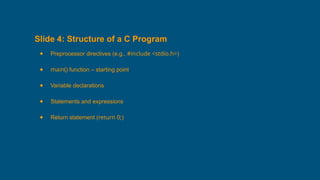
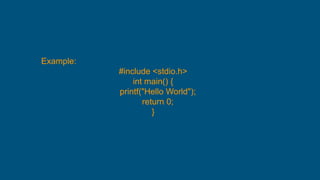
Slide 4: Structureof a C Program
● Preprocessor directives (e.g., #include <stdio.h>)
● main() function – starting point
● Variable declarations
● Statements and expressions
● Return statement (return 0;)
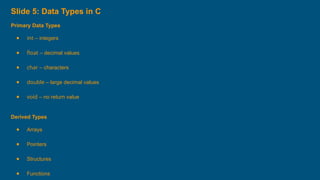
Slide 5: DataTypes in C
Primary Data Types
● int – integers
● float – decimal values
● char – characters
● double – large decimal values
● void – no return value
Derived Types
● Arrays
● Pointers
● Structures
● Functions
7.
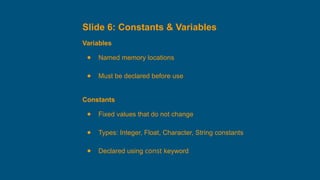
Slide 6: Constants& Variables
Variables
● Named memory locations
● Must be declared before use
Constants
● Fixed values that do not change
● Types: Integer, Float, Character, String constants
● Declared using const keyword



![Polymer [ बहुलक ] Chemistry Notes PDF - Irfanullah Mehar - JJ Sir Chemistry.pdf](https://cdn.slidesharecdn.com/ss_thumbnails/polymerchemistrynotespdf-irfanullahmehar-jjsirchemistry-260210172118-3f9b37f7-thumbnail.jpg?width=640&height=640&fit=bounds)
