PAPER 1: SECTION A
-DIRECTED WRITING-
a) GUIDELINES
b) MISTAKES TO AVOID
c) FORMATS
Prepared by
Sir Firdaus
a) Directed Writing Guidelines
a.i - Writing out your response:
1. Use all the content points.
2. As you write, cross out the points that you
have used to ensure you have not left out
any points.
3. If possible, use the content points in the
same order in which they are given.
4. Write each point in a complete sentence by
adding articles, verbs, pronouns, prepositions
etc.
5. Do not simply combine a few content points
in one sentence.
6. Write at least two to three sentences to
expand or elaborate each given point.
7. Avoid paraphrasing the points as this might
lead to distortion of meaning.
8. Include an Introduction and a Conclusion.
9. Make sure your paragraphs are well-
organised.
10.Check your writing for grammar, spelling
and punctuation mistakes.
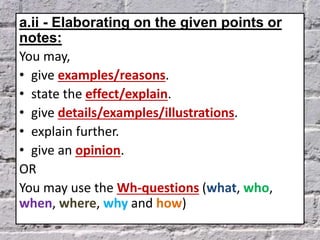
a.ii - Elaborating on the given points or
notes:
You may,
• give examples/reasons.
• state the effect/explain.
• give details/examples/illustrations.
• explain further.
• give an opinion.
OR
You may use the Wh-questions (what, who,
when, where, why and how)
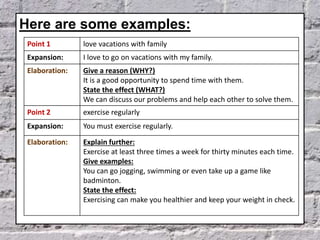
Here are some examples:
Point 1 love vacations with family
Expansion: I love to go on vacations with my family.
Elaboration: Give a reason (WHY?)
It is a good opportunity to spend time with them.
State the effect (WHAT?)
We can discuss our problems and help each other to solve them.
Point 2 exercise regularly
Expansion: You must exercise regularly.
Elaboration: Explain further:
Exercise at least three times a week for thirty minutes each time.
Give examples:
You can go jogging, swimming or even take up a game like
badminton.
State the effect:
Exercising can make you healthier and keep your weight in check.
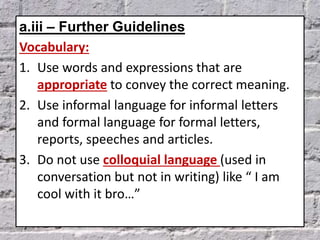
a.iii – Further Guidelines
Vocabulary:
1. Use words and expressions that are
appropriate to convey the correct meaning.
2. Use informal language for informal letters
and formal language for formal letters,
reports, speeches and articles.
3. Do not use colloquial language (used in
conversation but not in writing) like “ I am
cool with it bro…”
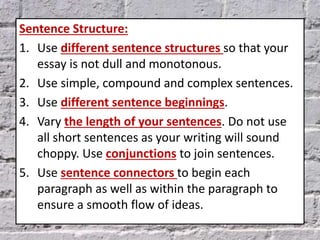
Sentence Structure:
1. Use different sentence structures so that your
essay is not dull and monotonous.
2. Use simple, compound and complex sentences.
3. Use different sentence beginnings.
4. Vary the length of your sentences. Do not use
all short sentences as your writing will sound
choppy. Use conjunctions to join sentences.
5. Use sentence connectors to begin each
paragraph as well as within the paragraph to
ensure a smooth flow of ideas.
Presentation:
1. Organise your essay well. Decide which
points are to go in which paragraph.
2. Study which points can be combined as it is
not necessary to write one point in one
paragraph.
3. Have an appropriate Introduction and
Conclusion.
4. Provide a suitable title if required to do so.
5. Link your paragraphs well.
b) Mistakes To Avoid
1. You have 12 content points to elaborate on. So
do not write more than that as you will not get
extra marks.
2. Do not just string the words in the notes given
to make them look like a sentence. Marks will
not be given for stringing.
3. You are advised not to elaborate too much on
each point. This is because you only have 45
minutes to answer this question. So you do not
want to end up with less than 1 hour for
continuous writing (50 marks)
4. Use British English and not American English.
5. Stay away from slang such as ‘gonna’,
‘wanna’, ‘freaking tired’, ‘cool man’, etc.
6. Avoid casual words like ‘dude’, chill’ etc.
7. Do not use SMS-style of writing. For example,
do not use ‘u’ instead of ‘you’, ‘r’ instead of
‘are’ and ‘4’ instead of ‘for’, etc.
8. Contractions should be avoided in formal
writing except for informal letters or
dialogues, for examples, don’t-do not, can’t-
can not, I’m-I am etc.
10.Read your essay once you have finished
writing to check for errors. Every error is
underlined. More errors underlined would
mean lower marks for language.
Your essay should
not be too long for
two main reasons
You will have less
time for Section B
(continuous writing)
You will make more
mistakes
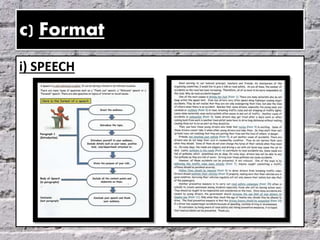
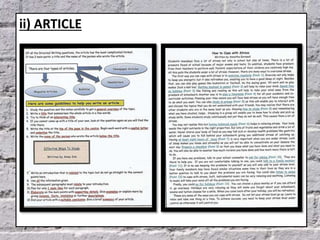
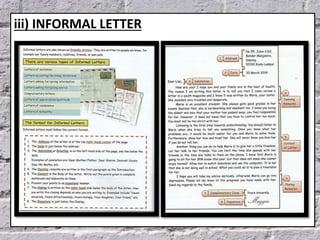
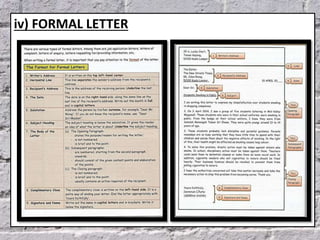
c) Format
i) SPEECH
ii) ARTICLE
iii) INFORMAL LETTER
iv) FORMAL LETTER
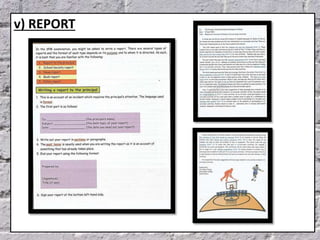
v) REPORT

SPM Paper 1 - Directed Writing

  • 1.
    PAPER 1: SECTIONA -DIRECTED WRITING- a) GUIDELINES b) MISTAKES TO AVOID c) FORMATS Prepared by Sir Firdaus
  • 2.
    a) Directed WritingGuidelines a.i - Writing out your response: 1. Use all the content points. 2. As you write, cross out the points that you have used to ensure you have not left out any points. 3. If possible, use the content points in the same order in which they are given. 4. Write each point in a complete sentence by adding articles, verbs, pronouns, prepositions etc.
  • 3.
    5. Do notsimply combine a few content points in one sentence. 6. Write at least two to three sentences to expand or elaborate each given point. 7. Avoid paraphrasing the points as this might lead to distortion of meaning. 8. Include an Introduction and a Conclusion. 9. Make sure your paragraphs are well- organised. 10.Check your writing for grammar, spelling and punctuation mistakes.
  • 4.
    a.ii - Elaboratingon the given points or notes: You may, • give examples/reasons. • state the effect/explain. • give details/examples/illustrations. • explain further. • give an opinion. OR You may use the Wh-questions (what, who, when, where, why and how)
  • 5.
    Here are someexamples: Point 1 love vacations with family Expansion: I love to go on vacations with my family. Elaboration: Give a reason (WHY?) It is a good opportunity to spend time with them. State the effect (WHAT?) We can discuss our problems and help each other to solve them. Point 2 exercise regularly Expansion: You must exercise regularly. Elaboration: Explain further: Exercise at least three times a week for thirty minutes each time. Give examples: You can go jogging, swimming or even take up a game like badminton. State the effect: Exercising can make you healthier and keep your weight in check.
  • 6.
    a.iii – FurtherGuidelines Vocabulary: 1. Use words and expressions that are appropriate to convey the correct meaning. 2. Use informal language for informal letters and formal language for formal letters, reports, speeches and articles. 3. Do not use colloquial language (used in conversation but not in writing) like “ I am cool with it bro…”
  • 7.
    Sentence Structure: 1. Usedifferent sentence structures so that your essay is not dull and monotonous. 2. Use simple, compound and complex sentences. 3. Use different sentence beginnings. 4. Vary the length of your sentences. Do not use all short sentences as your writing will sound choppy. Use conjunctions to join sentences. 5. Use sentence connectors to begin each paragraph as well as within the paragraph to ensure a smooth flow of ideas.
  • 8.
    Presentation: 1. Organise youressay well. Decide which points are to go in which paragraph. 2. Study which points can be combined as it is not necessary to write one point in one paragraph. 3. Have an appropriate Introduction and Conclusion. 4. Provide a suitable title if required to do so. 5. Link your paragraphs well.
  • 9.
    b) Mistakes ToAvoid 1. You have 12 content points to elaborate on. So do not write more than that as you will not get extra marks. 2. Do not just string the words in the notes given to make them look like a sentence. Marks will not be given for stringing. 3. You are advised not to elaborate too much on each point. This is because you only have 45 minutes to answer this question. So you do not want to end up with less than 1 hour for continuous writing (50 marks)
  • 10.
    4. Use BritishEnglish and not American English. 5. Stay away from slang such as ‘gonna’, ‘wanna’, ‘freaking tired’, ‘cool man’, etc. 6. Avoid casual words like ‘dude’, chill’ etc. 7. Do not use SMS-style of writing. For example, do not use ‘u’ instead of ‘you’, ‘r’ instead of ‘are’ and ‘4’ instead of ‘for’, etc. 8. Contractions should be avoided in formal writing except for informal letters or dialogues, for examples, don’t-do not, can’t- can not, I’m-I am etc.
  • 11.
    10.Read your essayonce you have finished writing to check for errors. Every error is underlined. More errors underlined would mean lower marks for language. Your essay should not be too long for two main reasons You will have less time for Section B (continuous writing) You will make more mistakes
  • 12.
  • 13.
  • 14.
  • 15.
  • 16.