Fabio Delfino
Essay G
Do you think that the lifestyle of the inhabitants of your
town or city reflects behavior that is in line with the
concept of sustainable development? In your opinion,
what should be improved?
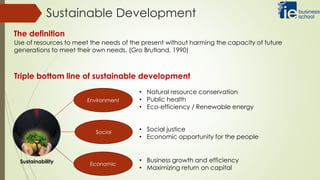
Sustainable Development
Use of resources to meet the needs of the present without harming the capacity of future
generations to meet their own needs. (Gro Brutland, 1990)
Environment
Social
Economic
The definition
Triple bottom line of sustainable development
Sustainability
• Natural resource conservation
• Public health
• Eco-efficiency / Renewable energy
• Social justice
• Economic opportunity for the people
• Business growth and efficiency
• Maximizing return on capital
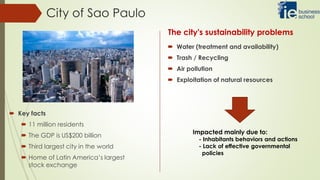
City of Sao Paulo
 Water (treatment and availability)
 Trash / Recycling
 Air pollution
 Exploitation of natural resources
 Key facts
 11 million residents
 The GDP is US$200 billion
 Third largest city in the world
 Home of Latin America’s largest
stock exchange
The city's sustainability problems
Impacted mainly due to:
- Inhabitants behaviors and actions
- Lack of effective governmental
policies
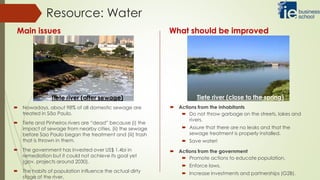
 Nowadays, about 98% of all domestic sewage are
treated in São Paulo.
 Tiete and Pinheiros rivers are “dead” because (i) the
impact of sewage from nearby cities, (ii) the sewage
before Sao Paulo began the treatment and (iii) trash
that is thrown in them.
 The government has invested over US$ 1.4bi in
remediation but it could not achieve its goal yet
(gov. projects around 2030).
 The habits of population influence the actual dirty
stage of the river.
Resource: Water
Main issues What should be improved
Tiete river (after sewage) Tiete river (close to the spring)
 Actions from the inhabitants
 Do not throw garbage on the streets, lakes and
rivers.
 Assure that there are no leaks and that the
sewage treatment is properly installed.
 Save water!
 Actions from the government
 Promote actions to educate population.
 Enforce laws.
 Increase investments and partnerships (G2B).
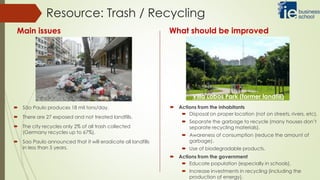
 São Paulo produces 18 mil tons/day.
 There are 27 exposed and not treated landfills.
 The city recycles only 2% of all trash collected
(Germany recycles up to 67%).
 Sao Paulo announced that it will eradicate all landfills
in less than 5 years.
Resource: Trash / Recycling
Main issues What should be improved
Villa Lobos Park (former landfill)
 Actions from the inhabitants
 Disposal on proper location (not on streets, rivers, etc).
 Separate the garbage to recycle (many houses don’t
separate recycling materials).
 Awareness of consumption (reduce the amount of
garbage).
 Use of biodegradable products.
 Actions from the government
 Educate population (especially in schools).
 Increase investments in recycling (including the
production of energy).
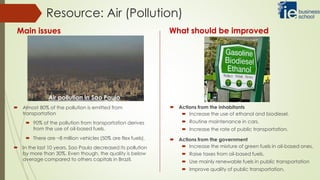
 Almost 80% of the pollution is emitted from
transportation
 90% of the pollution from transportation derives
from the use of oil-based fuels.
 There are ~8 million vehicles (50% are flex fuels).
 In the last 10 years, Sao Paulo decreased its pollution
by more than 30%. Even though, the quality is below
average compared to others capitals in Brazil.
Resource: Air (Pollution)
Main issues What should be improved
Air pollution in Sao Paulo
 Actions from the inhabitants
 Increase the use of ethanol and biodiesel.
 Routine maintenance in cars.
 Increase the rate of public transportation.
 Actions from the government
 Increase the mixture of green fuels in oil-based ones.
 Raise taxes from oil-based fuels.
 Use mainly renewable fuels in public transportation
 Improve quality of public transportation.
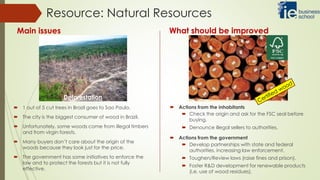
 1 out of 5 cut trees in Brazil goes to Sao Paulo.
 The city is the biggest consumer of wood in Brazil.
 Unfortunately, some woods come from illegal timbers
and from virgin forests.
 Many buyers don’t care about the origin of the
woods because they look just for the price.
 The government has some initiatives to enforce the
law and to protect the forests but it is not fully
effective.
Resource: Natural Resources
Main issues What should be improved
Deforestation
 Actions from the inhabitants
 Check the origin and ask for the FSC seal before
buying.
 Denounce illegal sellers to authorities.
 Actions from the government
 Develop partnerships with state and federal
authorities, increasing law enforcement.
 Toughen/Review laws (raise fines and prison).
 Foster R&D development for renewable products
(i.e. use of wood residues).
Conclusion
 The path to sustainable development will take some time to be fully
achieved.
 Much has to be done in order to reach respectable patterns:
education of population (sustainable awareness), reduction of waste
and use of renewable and biodegradable products.
 Nevertheless, I believe that most children are growing up with this
concept of caring for the planet and each other. In the next years we
will have a big shift in our manner of living, creating a world with better
standards.
 Eventually, human beings will live together with the nature,
respecting it and promoting sustainable development.

Essay G

  • 1.
    Fabio Delfino Essay G Doyou think that the lifestyle of the inhabitants of your town or city reflects behavior that is in line with the concept of sustainable development? In your opinion, what should be improved?
  • 2.
    Sustainable Development Use ofresources to meet the needs of the present without harming the capacity of future generations to meet their own needs. (Gro Brutland, 1990) Environment Social Economic The definition Triple bottom line of sustainable development Sustainability • Natural resource conservation • Public health • Eco-efficiency / Renewable energy • Social justice • Economic opportunity for the people • Business growth and efficiency • Maximizing return on capital
  • 3.
    City of SaoPaulo  Water (treatment and availability)  Trash / Recycling  Air pollution  Exploitation of natural resources  Key facts  11 million residents  The GDP is US$200 billion  Third largest city in the world  Home of Latin America’s largest stock exchange The city's sustainability problems Impacted mainly due to: - Inhabitants behaviors and actions - Lack of effective governmental policies
  • 4.
     Nowadays, about98% of all domestic sewage are treated in São Paulo.  Tiete and Pinheiros rivers are “dead” because (i) the impact of sewage from nearby cities, (ii) the sewage before Sao Paulo began the treatment and (iii) trash that is thrown in them.  The government has invested over US$ 1.4bi in remediation but it could not achieve its goal yet (gov. projects around 2030).  The habits of population influence the actual dirty stage of the river. Resource: Water Main issues What should be improved Tiete river (after sewage) Tiete river (close to the spring)  Actions from the inhabitants  Do not throw garbage on the streets, lakes and rivers.  Assure that there are no leaks and that the sewage treatment is properly installed.  Save water!  Actions from the government  Promote actions to educate population.  Enforce laws.  Increase investments and partnerships (G2B).
  • 5.
     São Pauloproduces 18 mil tons/day.  There are 27 exposed and not treated landfills.  The city recycles only 2% of all trash collected (Germany recycles up to 67%).  Sao Paulo announced that it will eradicate all landfills in less than 5 years. Resource: Trash / Recycling Main issues What should be improved Villa Lobos Park (former landfill)  Actions from the inhabitants  Disposal on proper location (not on streets, rivers, etc).  Separate the garbage to recycle (many houses don’t separate recycling materials).  Awareness of consumption (reduce the amount of garbage).  Use of biodegradable products.  Actions from the government  Educate population (especially in schools).  Increase investments in recycling (including the production of energy).
  • 6.
     Almost 80%of the pollution is emitted from transportation  90% of the pollution from transportation derives from the use of oil-based fuels.  There are ~8 million vehicles (50% are flex fuels).  In the last 10 years, Sao Paulo decreased its pollution by more than 30%. Even though, the quality is below average compared to others capitals in Brazil. Resource: Air (Pollution) Main issues What should be improved Air pollution in Sao Paulo  Actions from the inhabitants  Increase the use of ethanol and biodiesel.  Routine maintenance in cars.  Increase the rate of public transportation.  Actions from the government  Increase the mixture of green fuels in oil-based ones.  Raise taxes from oil-based fuels.  Use mainly renewable fuels in public transportation  Improve quality of public transportation.
  • 7.
     1 outof 5 cut trees in Brazil goes to Sao Paulo.  The city is the biggest consumer of wood in Brazil.  Unfortunately, some woods come from illegal timbers and from virgin forests.  Many buyers don’t care about the origin of the woods because they look just for the price.  The government has some initiatives to enforce the law and to protect the forests but it is not fully effective. Resource: Natural Resources Main issues What should be improved Deforestation  Actions from the inhabitants  Check the origin and ask for the FSC seal before buying.  Denounce illegal sellers to authorities.  Actions from the government  Develop partnerships with state and federal authorities, increasing law enforcement.  Toughen/Review laws (raise fines and prison).  Foster R&D development for renewable products (i.e. use of wood residues).
  • 8.
    Conclusion  The pathto sustainable development will take some time to be fully achieved.  Much has to be done in order to reach respectable patterns: education of population (sustainable awareness), reduction of waste and use of renewable and biodegradable products.  Nevertheless, I believe that most children are growing up with this concept of caring for the planet and each other. In the next years we will have a big shift in our manner of living, creating a world with better standards.  Eventually, human beings will live together with the nature, respecting it and promoting sustainable development.