











urban
open
space
Content
Why this lecture?
Who am I?
12 benefits of urban open space.
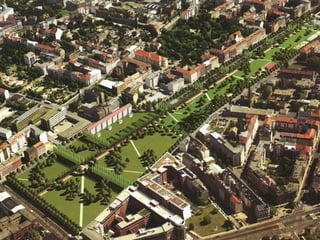
Example Frankfurt.
4 other examples worldwide.
Forecast Cali.
Why this lecture?
Universidad Javeriana Cali. 04.03.2014. 10 – 12.00
am.
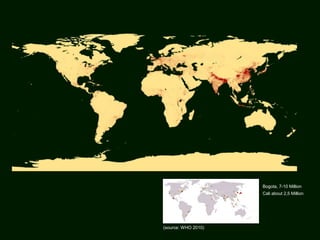
The future of our planet will be decided in the Cities.
•2% of earths surface are Cities.
•50% of earths people live already in Cities.
•These people consume 75% of worlds energy and produce 80% of worldwide CO2-emision.
•2050 about 75% of earths people will live in Cities. (Although some Cities in Europe are shrinking).
(source: WHO 2010)
Bogota, 7-10 Million
Cali about 2,5 Million
(source: WHO 2010)
It is the responsibility of us – this generation, this leaaders – what
will
happen with our cities, our civilisation, our cultures, our planet.
•What we decide today…
•What we do today…
•What we do NOT do today… decides the future of human race. (source: WHO 2010)
For this reason we are all here today. Aren‘t we?
Who am I?
Ulla Schuch.
My dedication.
Our planet. People. Proceedings. Capabilities.
My life‘s work.
Protect and develop the cababilities inside nature and people.
My academic education.
Dipl. agr. Ing. Justus-Liebig-University, Gießen.
„Umweltsicherung und Entwicklung von Räumen“.
Protection and development of open spaces.
cand. Dr. arch. Technische Hochschule, Darmstadt.
„Grenzlinien und ihre Bedeutung für die Gestaltung von Landschaft“.
Borders and their importance for open spaces.
My professional career.
Planning office „!Ulla Schuch“, Fa. Lebenbauen, Frankfurt.
Designing gardens, landscapes and open urban spaces in many places around the world.
www.lebenbauen.de www.ullaschuch.de
Teaching at University of Applied Sciences, Frankfurt.
International Mastercourse „Urban agglomerations“(M.Sc.), subject: urban open spaces.
Also: Mastercourse „BaSys“ (M.Sc.), subject: urban open spaces.
Also: Studium Generale „Projektmanagement“.
www.fh-frankfurt.de
My daily work now.
Investigation:
Guadua, Permagardens, Urban open spaces worldwide.
Publications:
2005 „workshop garten“. Publisher DVA (now Randomhouse)
2014 „Archetypen“. Publisher Randomhouse
2015 Co-editor as NGO board-member of Schule fürs Leben „Constructing with Guadua“.
Publisher nn.
Social work:
Managing board of NGO Schule fürs Leben.
Project management Germany „GUADUal10“
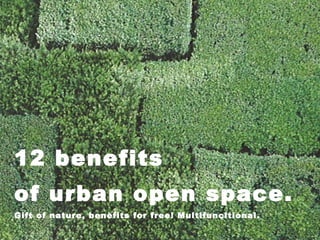
12 benefits
of urban open space.
Gift of nature, benefits for free! Multifuncitional.
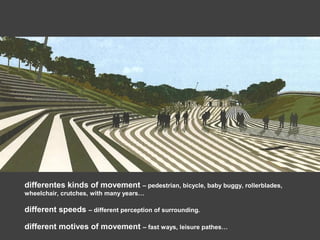
benefit 1 connect
differentes kinds of movement – pedestrian, bicycle, baby buggy, rollerblades,
wheelchair, crutches, with many years…
different speeds – different perception of surrounding.
different motives of movement – fast ways, leisure pathes…
benefit 2 stay
„stay“ includes many things to do:
to shop, to meet, to buy, to sell, to talk, to show, to watch, to move,
to play, to relax, to calm down, to feel free, to pray, to party, to work,
to celebrate…
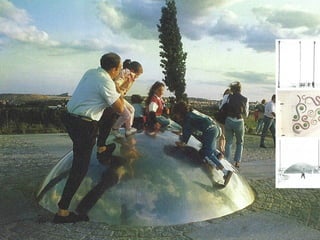
benefit 3 show culture = produce identity
???
Culture/Identity is about …
… language, history, art, climate, origin, religion, music, politics,
society, enviroment, food
What is the special culture and identity for Cali?
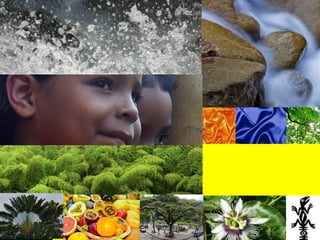
Let us find 7 words as colours, thougts, emotions, sensations, activities, perceptions….
which seems to be typical for Cali.
benefit 4 give orientation
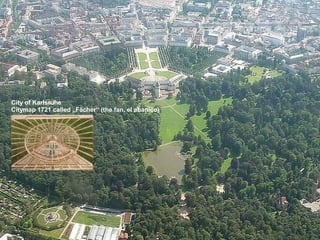
City of Karlsruhe
Citymap 1721 called „Fächer“ (the fan, el abanico)
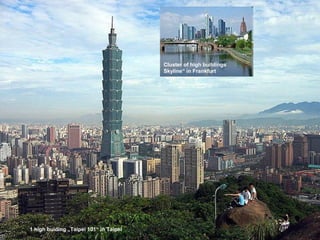
1 high buiding „Taipei 101“ in Taipei
Cluster of high buildings
Skyline“ in Frankfurt
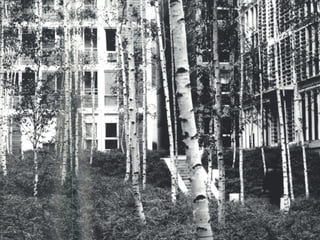
benefit 5 produce O2
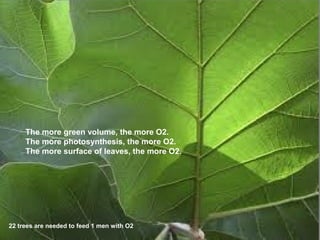
The more green volume, the more O2.
The more photosynthesis, the more O2.
The more surface of leaves, the more O2.
22 trees are needed to feed 1 men with O2
Only one thing to produce O2: Plants! Living plants.
(Exception: also bacteria and algae)
O2 is a result of the photosynthesis of plants. Only working daytime.
Cars using combustion engine do also need O2, they compete against humans for O2.
The bigger the surface of leaves the bigger this benefit.
So it is not only about how big the area of planting, it refers also to the volume of plants
and the densitiy of leaves. And also some species of plants have higher rates of photo-
synthesis than others. And as depending also on sunlight, this benefit depends on where
you are on planet Earth.
benefit 6 reduce noise
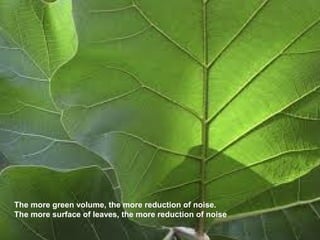
The more green volume, the more reduction of noise.
The more surface of leaves, the more reduction of noise
Best things to reduce noise:
1. Plants!
2. All kind of structures in surfaces.
Structures boost the surface: the surface of a glazed football is much smaller than the
surface of a scraggy football. The bigger the surface, the bigger this benefit.
Please notice my recommendation:
1. avoid noise, 2.avoid noise, 3. avoid noise, 4. reduce noise.
benefit 7 reduce dust
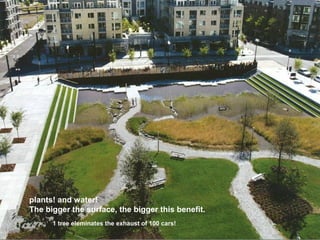
plants! and water!
The bigger the surface, the bigger this benefit.
1 tree eleminates the exhaust of 100 cars!
Dust is worse for health than thougt for many years.
Health is a personal quality. But also a question of money for a city/nation.
Please notice my recommendation:
1. avoid dust, 2. avoid dust, 3. avoid dust, 4. reduce dust.
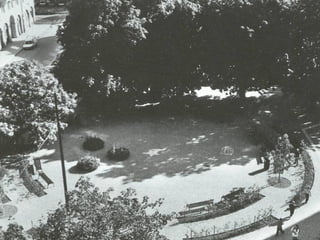
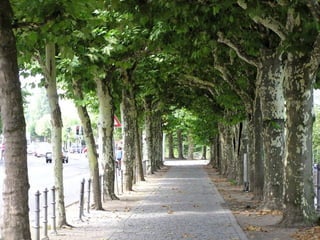
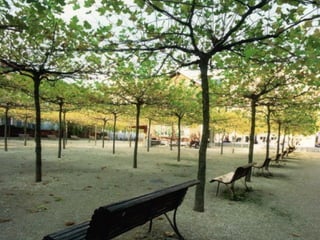
benefit 8 provide shadow
Not only trees can provide shadow.
Also houses, constructions, textiles do.
Keep in mind:
different climates
different positions to equator
Azimut
different habits to manage the sun
- personal habits eg. age, skincolour
- cultural habits eg. clothes
benefit 9 provide sunlight
Humans need sunlight for to survife.
It is not only for beauty or luxury.
Vitamin D is produced by sunlight.
benefit 10 provide food
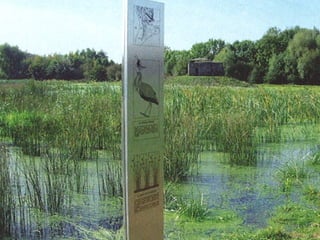
Water. Plants . (Animals.)
The origin of food.
The handeling of rainwater.
Vegetarian food only? Biologigal food only?.
To remember us: Humans are part of nature.
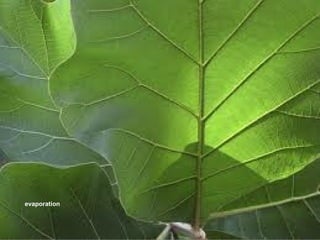
benefit 11 provide propper bioclimate
evaporation
Cold air – production and movement
O2 – production and movement
Humidity in air – production and movement
Balance of temperature - nighttime, daytime / city-land
Propper temperature – anytime to cold, to hot
Never rains in California – oportunity to be outside inspite of climate
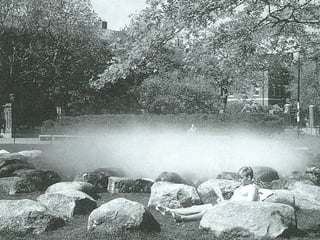
benefit 12 trigger human senses
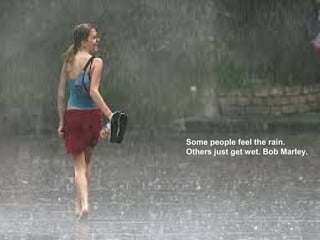
Some people feel the rain.
Others just get wet. Bob Marley.
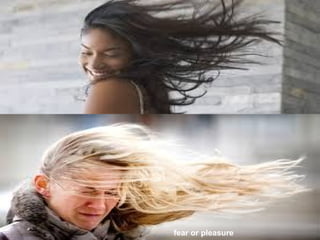
fear or pleasure
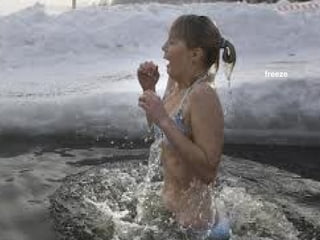
freeze
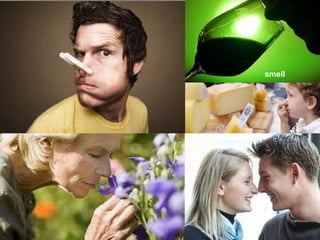
smell
interact with environment
allow myself to be touched
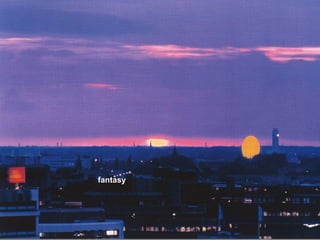
fantasy
sense
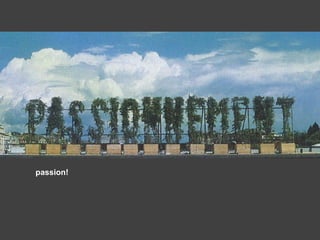
passion!
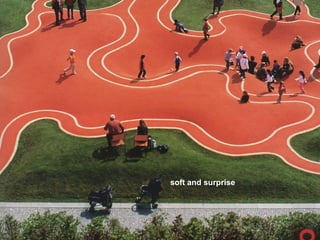
soft and surprise
How many senses do we have?
What are they worth for? What is their value for us?
Senses and identidy – how are these two related?
Senses and culture – how are these two related?
Senses and quality of live – how are these two related?
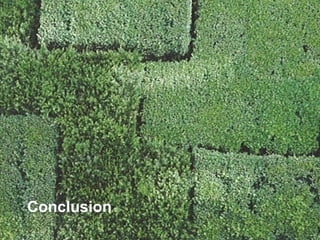
Conclusion
7 things to do
1. maximize green!
2. maximize water!
3. maximize flow!
4. maximize network!
5. maximize links!
6. maximize sensuality!
7. maximize life!
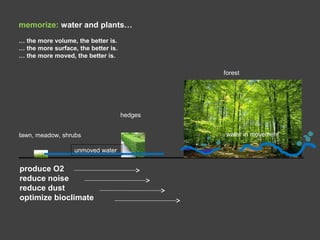
produce O2
reduce noise
reduce dust
optimize bioclimate
lawn, meadow, shrubs
hedges
forest
unmoved water
water in movement
memorize: water and plants…
… the more volume, the better is.
… the more surface, the better is.
… the more moved, the better is.
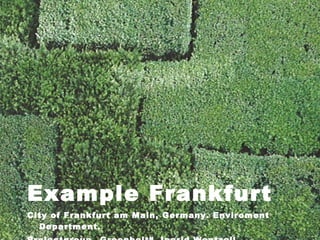
Example Frankfurt
City of Frankfurt am Main, Germany. Enviroment
Department.
Stadt Frankfurt am Main – Environment Department
83
Contents
 History of Frankfurt’s GreenBelt
 Landscapes of Frankfurt’s GreenBelt
 Unique Features of Frankfurts GreenBelt
 Education and Public Relations
 GreenBelt People
 Finance
 Outlook: GreenBelt Frankfurt 2030
Stadt Frankfurt am Main – UmweltamtStadt Frankfurt am Main – Umweltamt
History of Frankfurt’s GreenBelt
Stadt Frankfurt am Main – Environment Department
85
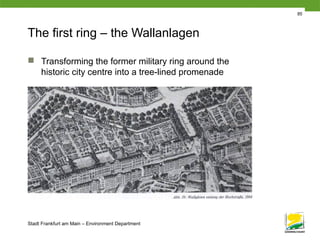
The first ring – the Wallanlagen
 Transforming the former military ring around the
historic city centre into a tree-lined promenade
Stadt Frankfurt am Main – Environment Department
86
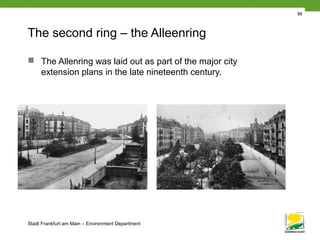
The second ring – the Alleenring
 The Allenring was laid out as part of the major city
extension plans in the late nineteenth century.
Stadt Frankfurt am Main – Environment Department
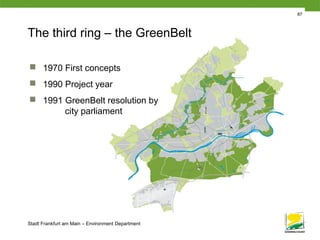
The third ring – the GreenBelt
 1970 First concepts
 1990 Project year
 1991 GreenBelt resolution by
city parliament
87
Stadt Frankfurt am Main – Environment Department
88
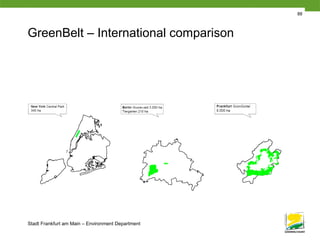
GreenBelt – International comparison
Stadt Frankfurt am Main – UmweltamtStadt Frankfurt am Main – Umweltamt
Landscapes of Frankfurt´s
GreenBelt
Stadt Frankfurt am Main – Environment Department
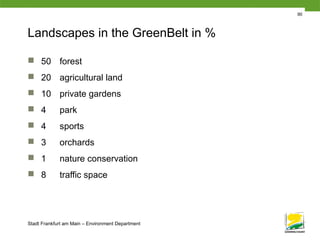
Landscapes in the GreenBelt in %
 50 forest
 20 agricultural land
 10 private gardens
 4 park
 4 sports
 3 orchards
 1 nature conservation
 8 traffic space
90
Stadt Frankfurt am Main – Environment Department
91
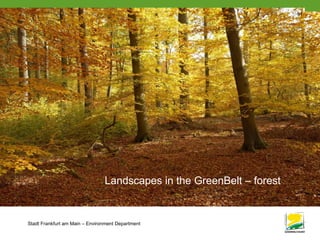
Landscapes in the GreenBelt – forest
Stadt Frankfurt am Main – Environment Department
92
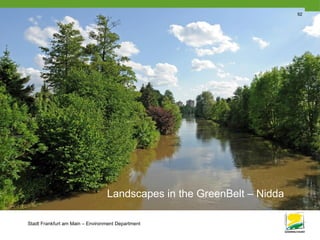
Landscapes in the GreenBelt – Nidda
Stadt Frankfurt am Main – Environment Department
93
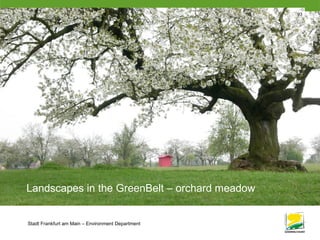
Landscapes in the GreenBelt – orchard meadow
Stadt Frankfurt am Main – Environment Department
94
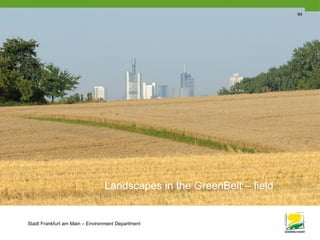
Landscapes in the GreenBelt – field
Stadt Frankfurt am Main – Environment Department
95
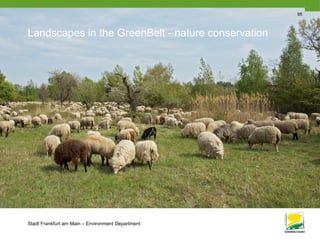
Landscapes in the GreenBelt - nature conservation
Stadt Frankfurt am Main – Environment Department
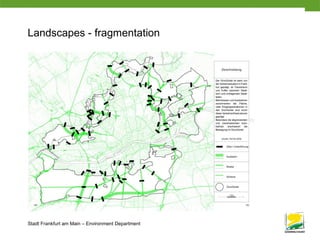
Landscapes - fragmentation
Stadt Frankfurt am Main – Environment Department
97
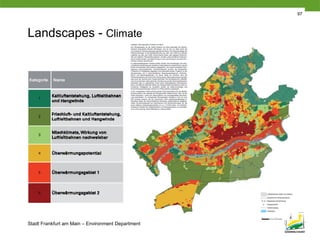
Landscapes - Climate
Stadt Frankfurt am Main – UmweltamtStadt Frankfurt am Main – Umweltamt
Unique features
Stadt Frankfurt am Main – Environment Department
99
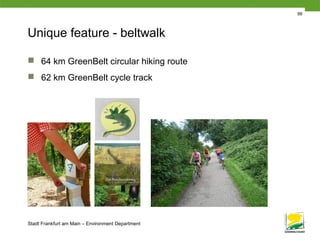
Unique feature - beltwalk
 64 km GreenBelt circular hiking route
 62 km GreenBelt cycle track
Stadt Frankfurt am Main – Environment Department
100
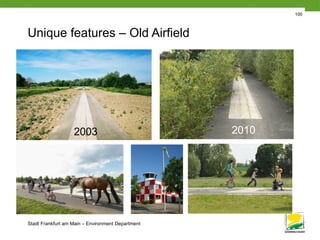
Unique features – Old Airfield
2003 2010
Stadt Frankfurt am Main – Environment Department
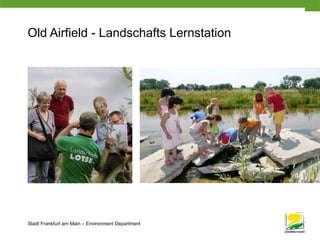
Old Airfield - Landschafts Lernstation
Stadt Frankfurt am Main – Environment Department
102
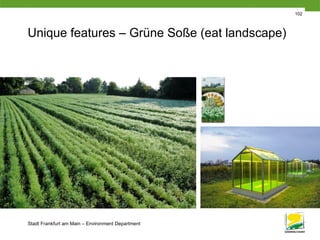
Unique features – Grüne Soße (eat landscape)
Stadt Frankfurt am Main – Environment Department
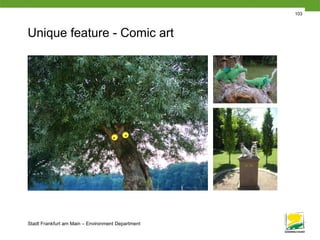
Unique feature - Comic art
103
Stadt Frankfurt am Main – UmweltamtStadt Frankfurt am Main – Umweltamt
Public Relations + Education
Stadt Frankfurt am Main – Environment Department
105
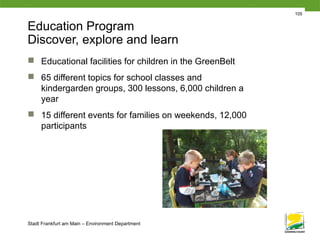
Education Program
Discover, explore and learn
 Educational facilities for children in the GreenBelt
 65 different topics for school classes and
kindergarden groups, 300 lessons, 6,000 children a
year
 15 different events for families on weekends, 12,000
participants
Stadt Frankfurt am Main – Environment Department
106
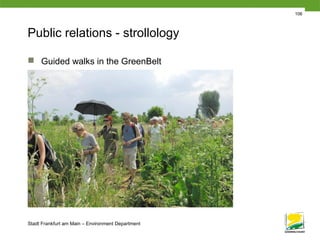
Public relations - strollology
 Guided walks in the GreenBelt
_COP7074
Stadt Frankfurt am Main – Environment Department
107
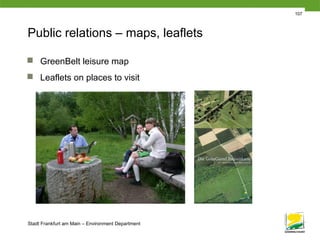
Public relations – maps, leaflets
 GreenBelt leisure map
 Leaflets on places to visit
Stadt Frankfurt am Main – UmweltamtStadt Frankfurt am Main – Umweltamt
GreenBelt people
Stadt Frankfurt am Main – Environment Department
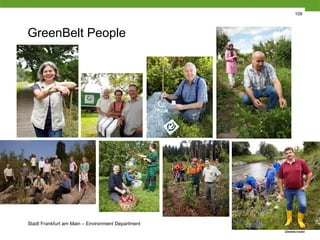
GreenBelt People
109
Stadt Frankfurt am Main – UmweltamtStadt Frankfurt am Main – Umweltamt
Finance
Stadt Frankfurt am Main – Environment Department
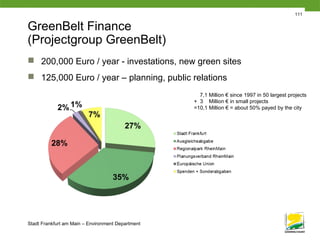
GreenBelt Finance
(Projectgroup GreenBelt)
 200,000 Euro / year - investations, new green sites
 125,000 Euro / year – planning, public relations
111
7,1 Million € since 1997 in 50 largest projects
+ 3 Million € in small projects
=10,1 Million € = about 50% payed by the city
Stadt Frankfurt am Main – UmweltamtStadt Frankfurt am Main – Umweltamt
Outlook
GreenBelt Frankfurt 2030
Stadt Frankfurt am Main – Environment Department
113
GreenBelt Frankfurt 2030
Study made by Projektbüro Friedrich von Borries, Berlin
Available as pdf in www.grüngürtel.de
Guidelines for the next years
 Linking
 Accenturating
 Activating
Stadt Frankfurt am Main – Environment Department
114
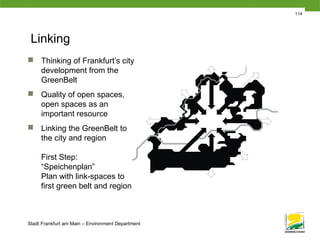
Linking
 Thinking of Frankfurt’s city
development from the
GreenBelt
 Quality of open spaces,
open spaces as an
important resource
 Linking the GreenBelt to
the city and region
First Step:
“Speichenplan”
Plan with link-spaces to
first green belt and region
Stadt Frankfurt am Main – Environment Department
115
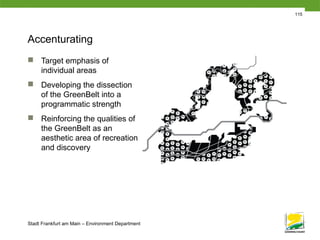
Accenturating
 Target emphasis of
individual areas
 Developing the dissection
of the GreenBelt into a
programmatic strength
 Reinforcing the qualities of
the GreenBelt as an
aesthetic area of recreation
and discovery
Stadt Frankfurt am Main – Environment Department
116
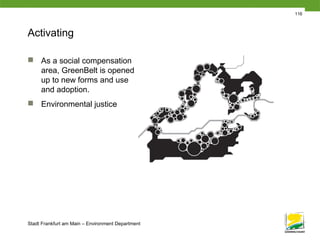
Activating
 As a social compensation
area, GreenBelt is opened
up to new forms and use
and adoption.
 Environmental justice
Stadt Frankfurt am Main – Environment Department
117
www.gruenguertel.de
Thank you !
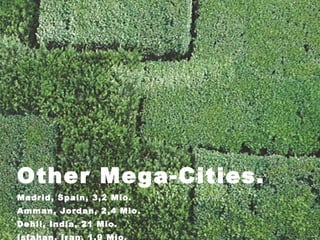
Other Mega-Cities.
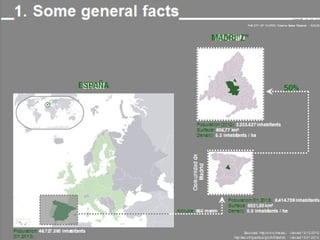
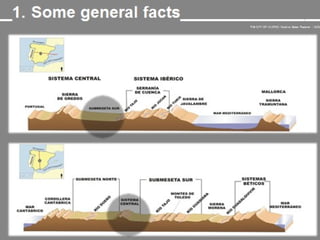
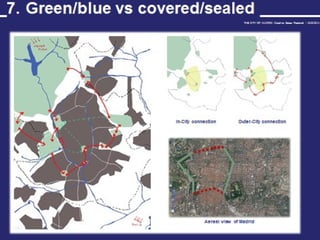
Madrid, Spain, 3,2 Mio.
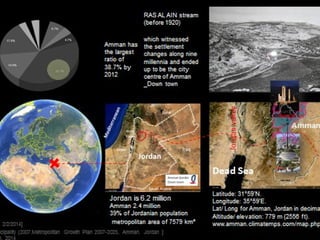
Amman, Jordan, 2,4 Mio.
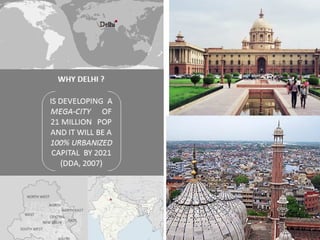
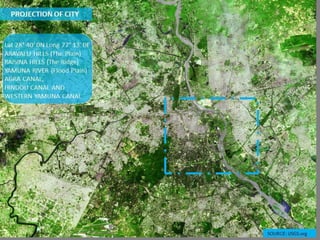
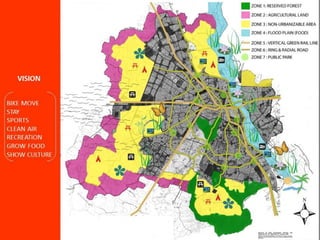
Dehli, India, 21 Mio.
Madrid, Spain.
3,2 Mio inhabitants.
Carolina Zarbas. Master-Student 2013/2014
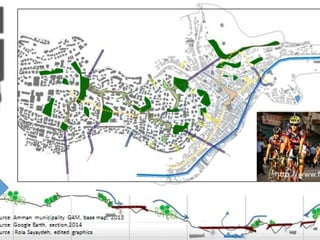
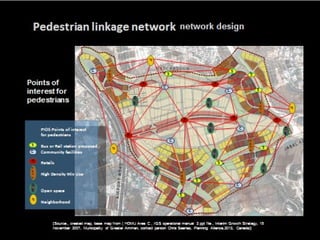
Amman, Jordan.
2,4 Mio inhabitants.
Rola Sayaydeh. Master-Student 2013/2014
Dehli, India.
21 Mio inhabitants.
Irungbam Rajiv Singh. Master-Student 2013/2014
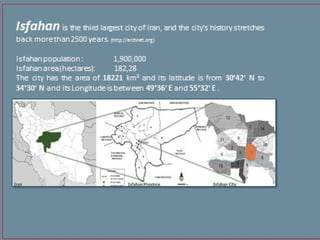
Isfahan, Iran.
1,9 Mio inhabitants. 2.500 years old!!
Mina Mansourian, Master-Student 2013/2014
Forecast Cali
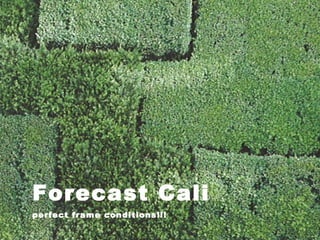
perfect frame conditions!!!
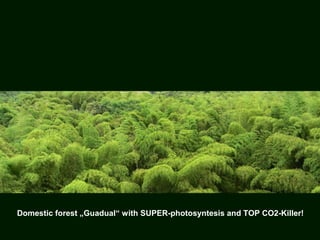
Domestic forest „Guadual“ with SUPER-photosyntesis and TOP CO2-Killer!
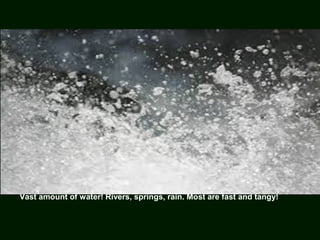
Vast amount of water! Rivers, springs, rain. Most are fast and tangy!
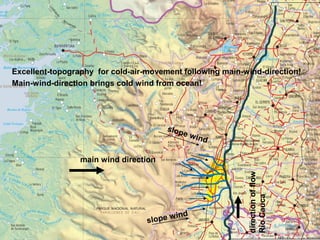
main wind direction
directionofflow
RioCauca
slope wind
slope wind
Excellent-topography for cold-air-movement following main-wind-direction!
Main-wind-direction brings cold wind from ocean!
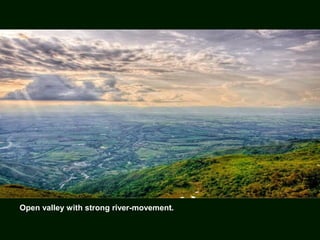
Open valley with strong river-movement.
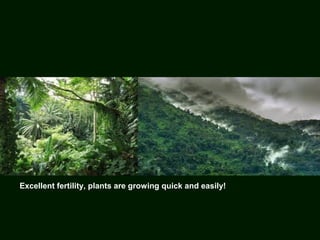
Excellent fertility, plants are growing quick and easily!
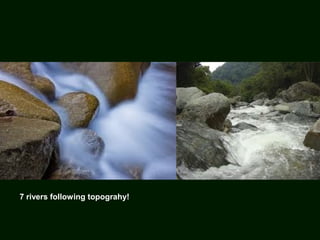
7 rivers following topograhy!
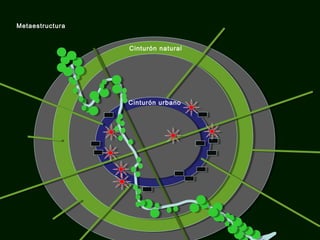
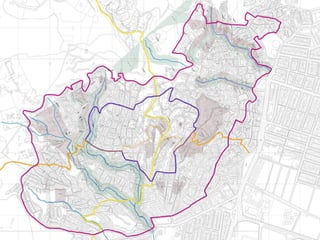
Proposal 1. „2 cinturónes por Siloé“
Design by Ulla Schuch und Eva Bender, Landscapearchitects.
Cooperation with NGO Fanalca & SIDOC Cali
grünplan_bestand
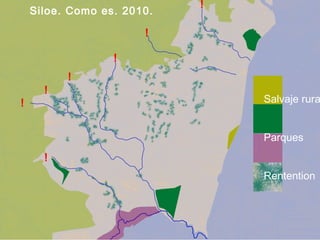
Salvaje rura
Parques
Rentention
!
!
!
!
!
!
!
Siloe. Como es. 2010.
Cinturón urbano
Cinturón natural
Metaestructura
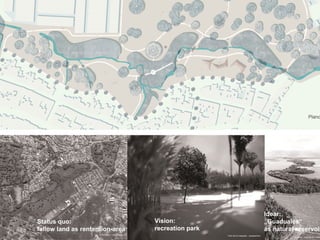
Proposal 2: Park „El Embalse“ Siloé.
Diploma thesis Dipl. Ing. Eva Bender, Landscapearchitect.
Also: Volunteer „weltwärts“ with Schule fürs Leben
Status quo:
fallow land as rentention-area
Idear:
„Guaduales“
as natural reservoir
Vision:
recreation park
Proposal 3: International meeting
International Workshop in September 2014 in Bogota.
3-days-excursion to Cali. Profs and students from around the world.
Don‘t hesitate to ask for further information and teamwork.
It would be a pleasure to share competence, experience and n
ulla.schuch@lebenbauen.de
Thank You!

Espacio Libre Urbano - Conferencia 04-03-2014 PUJ

  • 1.
  • 2.
    Content Why this lecture? Whoam I? 12 benefits of urban open space. Example Frankfurt. 4 other examples worldwide. Forecast Cali.
  • 3.
    Why this lecture? UniversidadJaveriana Cali. 04.03.2014. 10 – 12.00 am.
  • 4.
    The future ofour planet will be decided in the Cities. •2% of earths surface are Cities. •50% of earths people live already in Cities. •These people consume 75% of worlds energy and produce 80% of worldwide CO2-emision. •2050 about 75% of earths people will live in Cities. (Although some Cities in Europe are shrinking). (source: WHO 2010)
  • 5.
    Bogota, 7-10 Million Caliabout 2,5 Million (source: WHO 2010)
  • 6.
    It is theresponsibility of us – this generation, this leaaders – what will happen with our cities, our civilisation, our cultures, our planet. •What we decide today… •What we do today… •What we do NOT do today… decides the future of human race. (source: WHO 2010) For this reason we are all here today. Aren‘t we?
  • 7.
  • 8.
    My dedication. Our planet.People. Proceedings. Capabilities.
  • 9.
    My life‘s work. Protectand develop the cababilities inside nature and people.
  • 10.
    My academic education. Dipl.agr. Ing. Justus-Liebig-University, Gießen. „Umweltsicherung und Entwicklung von Räumen“. Protection and development of open spaces. cand. Dr. arch. Technische Hochschule, Darmstadt. „Grenzlinien und ihre Bedeutung für die Gestaltung von Landschaft“. Borders and their importance for open spaces.
  • 11.
    My professional career. Planningoffice „!Ulla Schuch“, Fa. Lebenbauen, Frankfurt. Designing gardens, landscapes and open urban spaces in many places around the world. www.lebenbauen.de www.ullaschuch.de Teaching at University of Applied Sciences, Frankfurt. International Mastercourse „Urban agglomerations“(M.Sc.), subject: urban open spaces. Also: Mastercourse „BaSys“ (M.Sc.), subject: urban open spaces. Also: Studium Generale „Projektmanagement“. www.fh-frankfurt.de
  • 12.
    My daily worknow. Investigation: Guadua, Permagardens, Urban open spaces worldwide. Publications: 2005 „workshop garten“. Publisher DVA (now Randomhouse) 2014 „Archetypen“. Publisher Randomhouse 2015 Co-editor as NGO board-member of Schule fürs Leben „Constructing with Guadua“. Publisher nn. Social work: Managing board of NGO Schule fürs Leben. Project management Germany „GUADUal10“
  • 13.
    12 benefits of urbanopen space. Gift of nature, benefits for free! Multifuncitional.
  • 14.
  • 21.
    differentes kinds ofmovement – pedestrian, bicycle, baby buggy, rollerblades, wheelchair, crutches, with many years… different speeds – different perception of surrounding. different motives of movement – fast ways, leisure pathes…
  • 22.
  • 29.
    „stay“ includes manythings to do: to shop, to meet, to buy, to sell, to talk, to show, to watch, to move, to play, to relax, to calm down, to feel free, to pray, to party, to work, to celebrate…
  • 30.
    benefit 3 showculture = produce identity
  • 31.
  • 32.
    Culture/Identity is about… … language, history, art, climate, origin, religion, music, politics, society, enviroment, food What is the special culture and identity for Cali? Let us find 7 words as colours, thougts, emotions, sensations, activities, perceptions…. which seems to be typical for Cali.
  • 33.
    benefit 4 giveorientation
  • 39.
    City of Karlsruhe Citymap1721 called „Fächer“ (the fan, el abanico)
  • 40.
    1 high buiding„Taipei 101“ in Taipei Cluster of high buildings Skyline“ in Frankfurt
  • 41.
  • 42.
    The more greenvolume, the more O2. The more photosynthesis, the more O2. The more surface of leaves, the more O2. 22 trees are needed to feed 1 men with O2
  • 43.
    Only one thingto produce O2: Plants! Living plants. (Exception: also bacteria and algae) O2 is a result of the photosynthesis of plants. Only working daytime. Cars using combustion engine do also need O2, they compete against humans for O2. The bigger the surface of leaves the bigger this benefit. So it is not only about how big the area of planting, it refers also to the volume of plants and the densitiy of leaves. And also some species of plants have higher rates of photo- synthesis than others. And as depending also on sunlight, this benefit depends on where you are on planet Earth.
  • 44.
  • 45.
    The more greenvolume, the more reduction of noise. The more surface of leaves, the more reduction of noise
  • 46.
    Best things toreduce noise: 1. Plants! 2. All kind of structures in surfaces. Structures boost the surface: the surface of a glazed football is much smaller than the surface of a scraggy football. The bigger the surface, the bigger this benefit. Please notice my recommendation: 1. avoid noise, 2.avoid noise, 3. avoid noise, 4. reduce noise.
  • 47.
  • 48.
    plants! and water! Thebigger the surface, the bigger this benefit. 1 tree eleminates the exhaust of 100 cars!
  • 49.
    Dust is worsefor health than thougt for many years. Health is a personal quality. But also a question of money for a city/nation. Please notice my recommendation: 1. avoid dust, 2. avoid dust, 3. avoid dust, 4. reduce dust.
  • 50.
  • 55.
    Not only treescan provide shadow. Also houses, constructions, textiles do. Keep in mind: different climates different positions to equator Azimut different habits to manage the sun - personal habits eg. age, skincolour - cultural habits eg. clothes
  • 56.
  • 57.
    Humans need sunlightfor to survife. It is not only for beauty or luxury. Vitamin D is produced by sunlight.
  • 58.
  • 60.
    Water. Plants .(Animals.) The origin of food. The handeling of rainwater. Vegetarian food only? Biologigal food only?. To remember us: Humans are part of nature.
  • 61.
    benefit 11 providepropper bioclimate
  • 65.
  • 67.
    Cold air –production and movement O2 – production and movement Humidity in air – production and movement Balance of temperature - nighttime, daytime / city-land Propper temperature – anytime to cold, to hot Never rains in California – oportunity to be outside inspite of climate
  • 68.
    benefit 12 triggerhuman senses
  • 69.
    Some people feelthe rain. Others just get wet. Bob Marley.
  • 70.
  • 71.
  • 72.
  • 73.
    interact with environment allowmyself to be touched
  • 74.
  • 75.
  • 76.
  • 77.
  • 78.
    How many sensesdo we have? What are they worth for? What is their value for us? Senses and identidy – how are these two related? Senses and culture – how are these two related? Senses and quality of live – how are these two related?
  • 79.
  • 80.
    7 things todo 1. maximize green! 2. maximize water! 3. maximize flow! 4. maximize network! 5. maximize links! 6. maximize sensuality! 7. maximize life!
  • 81.
    produce O2 reduce noise reducedust optimize bioclimate lawn, meadow, shrubs hedges forest unmoved water water in movement memorize: water and plants… … the more volume, the better is. … the more surface, the better is. … the more moved, the better is.
  • 82.
    Example Frankfurt City ofFrankfurt am Main, Germany. Enviroment Department.
  • 83.
    Stadt Frankfurt amMain – Environment Department 83 Contents  History of Frankfurt’s GreenBelt  Landscapes of Frankfurt’s GreenBelt  Unique Features of Frankfurts GreenBelt  Education and Public Relations  GreenBelt People  Finance  Outlook: GreenBelt Frankfurt 2030
  • 84.
    Stadt Frankfurt amMain – UmweltamtStadt Frankfurt am Main – Umweltamt History of Frankfurt’s GreenBelt
  • 85.
    Stadt Frankfurt amMain – Environment Department 85 The first ring – the Wallanlagen  Transforming the former military ring around the historic city centre into a tree-lined promenade
  • 86.
    Stadt Frankfurt amMain – Environment Department 86 The second ring – the Alleenring  The Allenring was laid out as part of the major city extension plans in the late nineteenth century.
  • 87.
    Stadt Frankfurt amMain – Environment Department The third ring – the GreenBelt  1970 First concepts  1990 Project year  1991 GreenBelt resolution by city parliament 87
  • 88.
    Stadt Frankfurt amMain – Environment Department 88 GreenBelt – International comparison
  • 89.
    Stadt Frankfurt amMain – UmweltamtStadt Frankfurt am Main – Umweltamt Landscapes of Frankfurt´s GreenBelt
  • 90.
    Stadt Frankfurt amMain – Environment Department Landscapes in the GreenBelt in %  50 forest  20 agricultural land  10 private gardens  4 park  4 sports  3 orchards  1 nature conservation  8 traffic space 90
  • 91.
    Stadt Frankfurt amMain – Environment Department 91 Landscapes in the GreenBelt – forest
  • 92.
    Stadt Frankfurt amMain – Environment Department 92 Landscapes in the GreenBelt – Nidda
  • 93.
    Stadt Frankfurt amMain – Environment Department 93 Landscapes in the GreenBelt – orchard meadow
  • 94.
    Stadt Frankfurt amMain – Environment Department 94 Landscapes in the GreenBelt – field
  • 95.
    Stadt Frankfurt amMain – Environment Department 95 Landscapes in the GreenBelt - nature conservation
  • 96.
    Stadt Frankfurt amMain – Environment Department Landscapes - fragmentation
  • 97.
    Stadt Frankfurt amMain – Environment Department 97 Landscapes - Climate
  • 98.
    Stadt Frankfurt amMain – UmweltamtStadt Frankfurt am Main – Umweltamt Unique features
  • 99.
    Stadt Frankfurt amMain – Environment Department 99 Unique feature - beltwalk  64 km GreenBelt circular hiking route  62 km GreenBelt cycle track
  • 100.
    Stadt Frankfurt amMain – Environment Department 100 Unique features – Old Airfield 2003 2010
  • 101.
    Stadt Frankfurt amMain – Environment Department Old Airfield - Landschafts Lernstation
  • 102.
    Stadt Frankfurt amMain – Environment Department 102 Unique features – Grüne Soße (eat landscape)
  • 103.
    Stadt Frankfurt amMain – Environment Department Unique feature - Comic art 103
  • 104.
    Stadt Frankfurt amMain – UmweltamtStadt Frankfurt am Main – Umweltamt Public Relations + Education
  • 105.
    Stadt Frankfurt amMain – Environment Department 105 Education Program Discover, explore and learn  Educational facilities for children in the GreenBelt  65 different topics for school classes and kindergarden groups, 300 lessons, 6,000 children a year  15 different events for families on weekends, 12,000 participants
  • 106.
    Stadt Frankfurt amMain – Environment Department 106 Public relations - strollology  Guided walks in the GreenBelt _COP7074
  • 107.
    Stadt Frankfurt amMain – Environment Department 107 Public relations – maps, leaflets  GreenBelt leisure map  Leaflets on places to visit
  • 108.
    Stadt Frankfurt amMain – UmweltamtStadt Frankfurt am Main – Umweltamt GreenBelt people
  • 109.
    Stadt Frankfurt amMain – Environment Department GreenBelt People 109
  • 110.
    Stadt Frankfurt amMain – UmweltamtStadt Frankfurt am Main – Umweltamt Finance
  • 111.
    Stadt Frankfurt amMain – Environment Department GreenBelt Finance (Projectgroup GreenBelt)  200,000 Euro / year - investations, new green sites  125,000 Euro / year – planning, public relations 111 7,1 Million € since 1997 in 50 largest projects + 3 Million € in small projects =10,1 Million € = about 50% payed by the city
  • 112.
    Stadt Frankfurt amMain – UmweltamtStadt Frankfurt am Main – Umweltamt Outlook GreenBelt Frankfurt 2030
  • 113.
    Stadt Frankfurt amMain – Environment Department 113 GreenBelt Frankfurt 2030 Study made by Projektbüro Friedrich von Borries, Berlin Available as pdf in www.grüngürtel.de Guidelines for the next years  Linking  Accenturating  Activating
  • 114.
    Stadt Frankfurt amMain – Environment Department 114 Linking  Thinking of Frankfurt’s city development from the GreenBelt  Quality of open spaces, open spaces as an important resource  Linking the GreenBelt to the city and region First Step: “Speichenplan” Plan with link-spaces to first green belt and region
  • 115.
    Stadt Frankfurt amMain – Environment Department 115 Accenturating  Target emphasis of individual areas  Developing the dissection of the GreenBelt into a programmatic strength  Reinforcing the qualities of the GreenBelt as an aesthetic area of recreation and discovery
  • 116.
    Stadt Frankfurt amMain – Environment Department 116 Activating  As a social compensation area, GreenBelt is opened up to new forms and use and adoption.  Environmental justice
  • 117.
    Stadt Frankfurt amMain – Environment Department 117 www.gruenguertel.de Thank you !
  • 118.
    Other Mega-Cities. Madrid, Spain,3,2 Mio. Amman, Jordan, 2,4 Mio. Dehli, India, 21 Mio.
  • 119.
    Madrid, Spain. 3,2 Mioinhabitants. Carolina Zarbas. Master-Student 2013/2014
  • 123.
    Amman, Jordan. 2,4 Mioinhabitants. Rola Sayaydeh. Master-Student 2013/2014
  • 127.
    Dehli, India. 21 Mioinhabitants. Irungbam Rajiv Singh. Master-Student 2013/2014
  • 131.
    Isfahan, Iran. 1,9 Mioinhabitants. 2.500 years old!! Mina Mansourian, Master-Student 2013/2014
  • 135.
  • 136.
    Domestic forest „Guadual“with SUPER-photosyntesis and TOP CO2-Killer!
  • 137.
    Vast amount ofwater! Rivers, springs, rain. Most are fast and tangy!
  • 138.
    main wind direction directionofflow RioCauca slopewind slope wind Excellent-topography for cold-air-movement following main-wind-direction! Main-wind-direction brings cold wind from ocean!
  • 139.
    Open valley withstrong river-movement.
  • 140.
    Excellent fertility, plantsare growing quick and easily!
  • 141.
  • 143.
    Proposal 1. „2cinturónes por Siloé“ Design by Ulla Schuch und Eva Bender, Landscapearchitects. Cooperation with NGO Fanalca & SIDOC Cali
  • 144.
  • 145.
  • 147.
    Proposal 2: Park„El Embalse“ Siloé. Diploma thesis Dipl. Ing. Eva Bender, Landscapearchitect. Also: Volunteer „weltwärts“ with Schule fürs Leben
  • 148.
    Status quo: fallow landas rentention-area Idear: „Guaduales“ as natural reservoir Vision: recreation park
  • 149.
    Proposal 3: Internationalmeeting International Workshop in September 2014 in Bogota. 3-days-excursion to Cali. Profs and students from around the world.
  • 150.
    Don‘t hesitate toask for further information and teamwork. It would be a pleasure to share competence, experience and n ulla.schuch@lebenbauen.de Thank You!