PILLAR 5
HARMONIZATION OF METHODS, MEASUREMENTS AND
INDICATOR FOR THE SUSTAINABLE MANAGEMENT AND
PROTECTION OF SOIL RESOURCES
Hakkı Emrah Erdogan
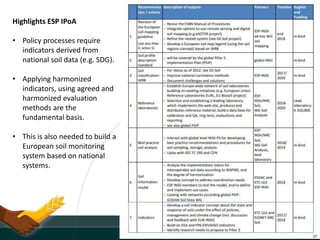
Highlights ESP IPoA
• Policy processes require
indicators derived from
national soil data (e.g. SDG).
• Applying harmonized
indicators, using agreed and
harmonized evaluation
methods are the
fundamental basis.
• This is also needed to build a
European soil monitoring
system based on national
systems.
The Pilar 5 main objective is to develop an over-arching
mechanism for globally consistent and comparable
harmonized monitoring for soil related policies.
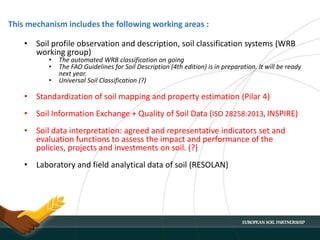
This mechanism includes the following working areas :
• Soil profile observation and description, soil classification systems (WRB
working group)
• The automated WRB classification on going
• The FAO Guidelines for Soil Description (4th edition) is in preparation. It will be ready
next year.
• Universal Soil Classification (?)
• Standardization of soil mapping and property estimation (Pilar 4)
• Soil Information Exchange + Quality of Soil Data (ISO 28258:2013, INSPIRE)
• Soil data interpretation: agreed and representative indicators set and
evaluation functions to assess the impact and performance of the
policies, projects and investments on soil. (?)
• Laboratory and field analytical data of soil (RESOLAN)
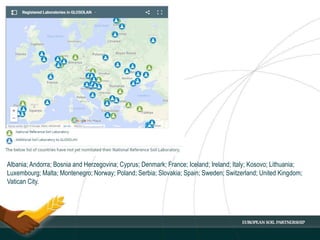
Albania; Andorra; Bosnia and Herzegovina; Cyprus; Denmark; France; Iceland; Ireland; Italy; Kosovo; Lithuania;
Luxembourg; Malta; Montenegro; Norway; Poland; Serbia; Slovakia; Spain; Sweden; Switzerland; United Kingdom;
Vatican City.
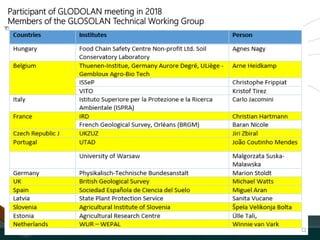
Participant of GLODOLAN meeting in 2018
Members of the GLOSOLAN Technical Working Group
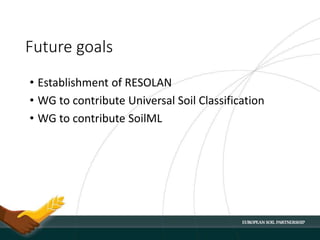
Future goals
• Establishment of RESOLAN
• WG to contribute Universal Soil Classification
• WG to contribute SoilML
Thank you for your attenion
We need your collaboration !

ESP work progress on Pillar 5

  • 1.
    PILLAR 5 HARMONIZATION OFMETHODS, MEASUREMENTS AND INDICATOR FOR THE SUSTAINABLE MANAGEMENT AND PROTECTION OF SOIL RESOURCES Hakkı Emrah Erdogan
  • 2.
    Highlights ESP IPoA •Policy processes require indicators derived from national soil data (e.g. SDG). • Applying harmonized indicators, using agreed and harmonized evaluation methods are the fundamental basis. • This is also needed to build a European soil monitoring system based on national systems.
  • 3.
    The Pilar 5main objective is to develop an over-arching mechanism for globally consistent and comparable harmonized monitoring for soil related policies.
  • 4.
    This mechanism includesthe following working areas : • Soil profile observation and description, soil classification systems (WRB working group) • The automated WRB classification on going • The FAO Guidelines for Soil Description (4th edition) is in preparation. It will be ready next year. • Universal Soil Classification (?) • Standardization of soil mapping and property estimation (Pilar 4) • Soil Information Exchange + Quality of Soil Data (ISO 28258:2013, INSPIRE) • Soil data interpretation: agreed and representative indicators set and evaluation functions to assess the impact and performance of the policies, projects and investments on soil. (?) • Laboratory and field analytical data of soil (RESOLAN)
  • 5.
    Albania; Andorra; Bosniaand Herzegovina; Cyprus; Denmark; France; Iceland; Ireland; Italy; Kosovo; Lithuania; Luxembourg; Malta; Montenegro; Norway; Poland; Serbia; Slovakia; Spain; Sweden; Switzerland; United Kingdom; Vatican City.
  • 6.
    Participant of GLODOLANmeeting in 2018 Members of the GLOSOLAN Technical Working Group
  • 7.
    Future goals • Establishmentof RESOLAN • WG to contribute Universal Soil Classification • WG to contribute SoilML
  • 8.
    Thank you foryour attenion We need your collaboration !