©lx
ESET Cyber Security Awareness
BY
CLOUD LINK & SECURITY
ENTERPRISES
©lx
LAXMAN GIRI
TECHNICAL SUPPORT OFFICER
Cloud Link & Security
Enterprises
laxman@cloudlink.com.np
support@cloudlink.com.np
9801134486
©lx
Objectives
• Introduction on Cyber Security
• Awareness on Cyber Crime, it’s report & punishment in
Nepal
• Intro on Leading Threats
• The Risk Factors
• Identifying Security Compromises
• Best Practices to Avoid Threats
• Where to report Cyber Crime ?
©lx
Introduction
• The Internet is growing rapidly. It has given rise to new
opportunities in every field we can think of like
entertainment, business & education.
• There’re two sides to a coin. Internet also has it’s own
disadvantage, i.e. Cyber crime.
©lx
A Cybercrime is an act of creating, distributing, altering,
stealing, misusing and destroying data and information
through the computer and network connection devices
without the use of physical force and against the will or
interest of the victim.
It is a types of computer crime and consider as illegal activity.
What is Cybercrime ?
©lx
We can categorize cyber crime in two ways.
1.The computer as a target: Using a computer to attacks
others computer. Under this Hacking, virus and worms
attack, Dos and DDOS attack falls.
2.The computer as a weapon: using a computer to commit
real world crime. E.g. Cyber terrorism, Credit card fraud and
pornography, Cyber bullying.
©lx
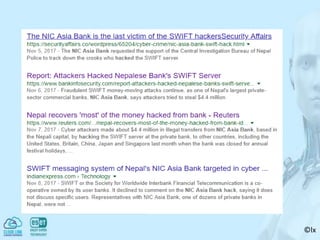
Major cyber crime reported in Nepal are
Type of Cyber Crime Report in Nepal
-DOS attack
-Unauthorized access/Hacking,
-Phishing
-Threatening through Email
-Cyber Defamation through Social Network
-Fake profile making
-Website Hacking
-Wanna -Cry, a crypto-ransomware.
©lx
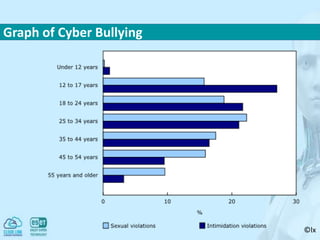
Graph of Cyber Bullying
©lx
• Any tasks of deleting, stealing and altering the computer sources;
publishing illegal materials, breaking privacy etc have been described
as cybercrime. Anyone doing such activities will be brought under
judiciary inquiry.
• The law states that government has right to punish cyber criminals.
• They may be sentenced up to two years of imprisonment or fine up
to Rs two lakh or both.
• If anyone found publishing wrong information in websites, then one
have to pay NRs one lakh or five years of imprisonment or both.
• Anyone helping in such crimes will be given the half punishment
compared to the criminal.
Cybercrime Punishment in Nepal:
©lx
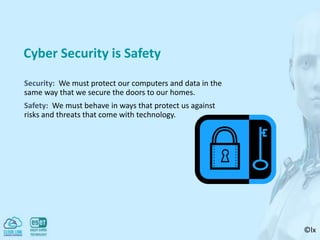
Cyber Security is Safety
Security: We must protect our computers and data in the
same way that we secure the doors to our homes.
Safety: We must behave in ways that protect us against
risks and threats that come with technology.
©lx
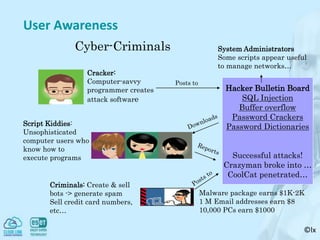
User Awareness
Cracker:
Computer-savvy
programmer creates
attack software
Script Kiddies:
Unsophisticated
computer users who
know how to
execute programs
Hacker Bulletin Board
SQL Injection
Buffer overflow
Password Crackers
Password Dictionaries
Successful attacks!
Crazyman broke into …
CoolCat penetrated…
Criminals: Create & sell
bots -> generate spam
Sell credit card numbers,
etc…
System Administrators
Some scripts appear useful
to manage networks…
Malware package earns $1K-2K
1 M Email addresses earn $8
10,000 PCs earn $1000
Posts to
©lx
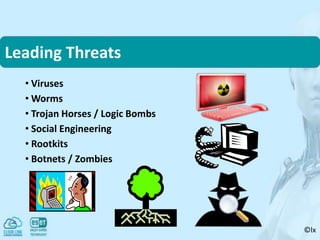
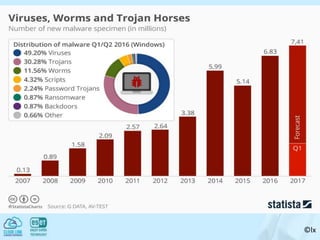
• Viruses
• Worms
• Trojan Horses / Logic Bombs
• Social Engineering
• Rootkits
• Botnets / Zombies
Leading Threats
©lx
©lx
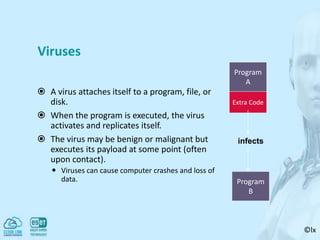
Viruses
 A virus attaches itself to a program, file, or
disk.
 When the program is executed, the virus
activates and replicates itself.
 The virus may be benign or malignant but
executes its payload at some point (often
upon contact).
 Viruses can cause computer crashes and loss of
data.
Program
A
Extra Code
Program
B
infects
©lx
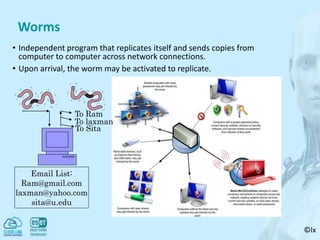
Worms
• Independent program that replicates itself and sends copies from
computer to computer across network connections.
• Upon arrival, the worm may be activated to replicate.
To Ram
To laxman
To Sita
Email List:
Ram@gmail.com
laxman@yahoo.com
sita@u.edu
©lx
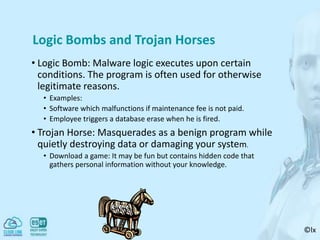
Logic Bombs and Trojan Horses
• Logic Bomb: Malware logic executes upon certain
conditions. The program is often used for otherwise
legitimate reasons.
• Examples:
• Software which malfunctions if maintenance fee is not paid.
• Employee triggers a database erase when he is fired.
• Trojan Horse: Masquerades as a benign program while
quietly destroying data or damaging your system.
• Download a game: It may be fun but contains hidden code that
gathers personal information without your knowledge.
©lx
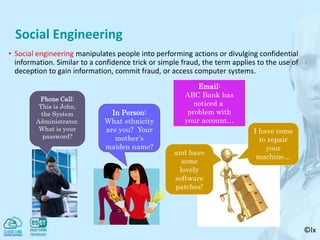
Social Engineering
• Social engineering manipulates people into performing actions or divulging confidential
information. Similar to a confidence trick or simple fraud, the term applies to the use of
deception to gain information, commit fraud, or access computer systems.
Phone Call:
This is John,
the System
Administrator.
What is your
password?
Email:
ABC Bank has
noticed a
problem with
your account…
In Person:
What ethnicity
are you? Your
mother’s
maiden name?
and have
some
lovely
software
patches!
I have come
to repair
your
machine…
©lx
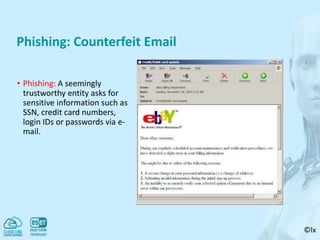
Phishing: Counterfeit Email
• Phishing: A seemingly
trustworthy entity asks for
sensitive information such as
SSN, credit card numbers,
login IDs or passwords via e-
mail.
©lx
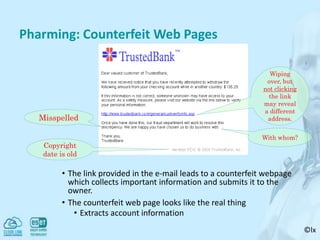
Pharming: Counterfeit Web Pages
• The link provided in the e-mail leads to a counterfeit webpage
which collects important information and submits it to the
owner.
• The counterfeit web page looks like the real thing
• Extracts account information
Misspelled
Wiping
over, but
not clicking
the link
may reveal
a different
address.
With whom?
Copyright
date is old
©lx
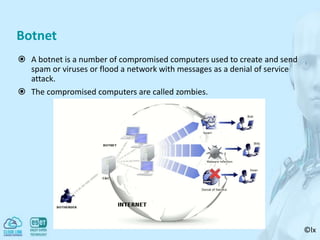
Botnet
 A botnet is a number of compromised computers used to create and send
spam or viruses or flood a network with messages as a denial of service
attack.
 The compromised computers are called zombies.
©lx
QUESTION
If a public Wi-Fi network (such as in an airport or café) requires a
password to access, is it generally safe to use that network for sensitive
activities such as online banking, login Facebook etc?
1. Yes, it is safe
2. No, it is not safe
3. Not sure
©lx
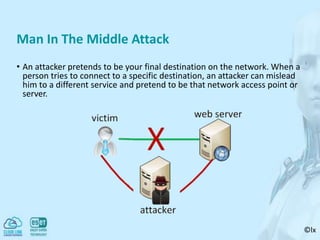
Man In The Middle Attack
• An attacker pretends to be your final destination on the network. When a
person tries to connect to a specific destination, an attacker can mislead
him to a different service and pretend to be that network access point or
server.
©lx
According to the Himalayan Times , As many as
560 cases of cybercrime have been registered
in the first six months of the current fiscal year,
said the Metropolitan Crime Division in Teku.
©lx
©lx
©lx
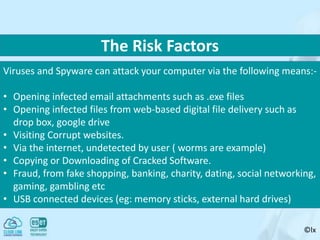
Viruses and Spyware can attack your computer via the following means:-
• Opening infected email attachments such as .exe files
• Opening infected files from web-based digital file delivery such as
drop box, google drive
• Visiting Corrupt websites.
• Via the internet, undetected by user ( worms are example)
• Copying or Downloading of Cracked Software.
• Fraud, from fake shopping, banking, charity, dating, social networking,
gaming, gambling etc
• USB connected devices (eg: memory sticks, external hard drives)
The Risk Factors
©lx
QUESTION
Which of the following is an example of a “phishing” attack?
1. Sending someone an email that contains a malicious link that is disguised to
look like an email from someone the person knows
2. Creating a fake website that looks nearly identical to a real website in order
to trick users into entering their login information
3. Sending someone a text message that contains a malicious link that is
disguised to look like a notification that the person has won a contest
4. All of the above
5. Not sure
©lx
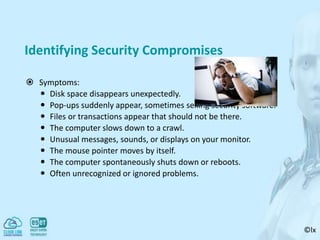
Identifying Security Compromises
 Symptoms:
 Disk space disappears unexpectedly.
 Pop-ups suddenly appear, sometimes selling security software.
 Files or transactions appear that should not be there.
 The computer slows down to a crawl.
 Unusual messages, sounds, or displays on your monitor.
 The mouse pointer moves by itself.
 The computer spontaneously shuts down or reboots.
 Often unrecognized or ignored problems.
©lx
Malware detection
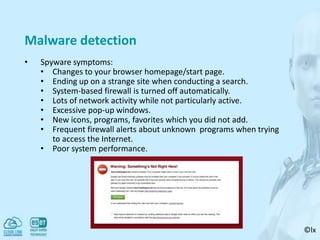
• Spyware symptoms:
• Changes to your browser homepage/start page.
• Ending up on a strange site when conducting a search.
• System-based firewall is turned off automatically.
• Lots of network activity while not particularly active.
• Excessive pop-up windows.
• New icons, programs, favorites which you did not add.
• Frequent firewall alerts about unknown programs when trying
to access the Internet.
• Poor system performance.
©lx
QUESTION
“Private browsing” is a feature in many internet browsers that lets users access
web pages without any information (like browsing history) being stored by the
browser. Can internet service providers see the online activities of their
subscribers when those subscribers are using private browsing?
1. Yes
2. No
3. Not sure
©lx
©lx
User Account Controls
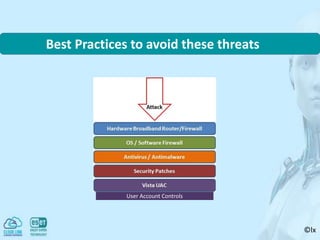
Best Practices to avoid these threats
©lx
Avoid Social Engineering
and Malicious Software
• Do not open email attachments unless you are expecting the email
with the attachment and you trust the sender.
• Do not click on links in emails unless you are absolutely sure of
their validity.
• Only visit and/or download software from web pages you trust.
©lx
Avoid Stupid Hacker Tricks
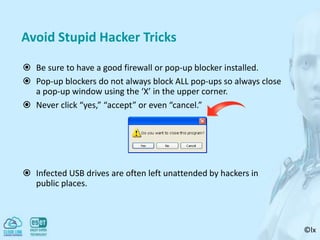
 Be sure to have a good firewall or pop-up blocker installed.
 Pop-up blockers do not always block ALL pop-ups so always close
a pop-up window using the ‘X’ in the upper corner.
 Never click “yes,” “accept” or even “cancel.”
 Infected USB drives are often left unattended by hackers in
public places.
©lx
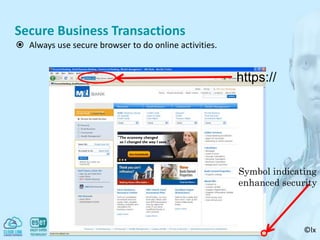
Secure Business Transactions
 Always use secure browser to do online activities.
https://
Symbol indicating
enhanced security
©lx
Tips:-
Frequently delete temp files, cookies, history, saved passwords etc.
©lx
©lx
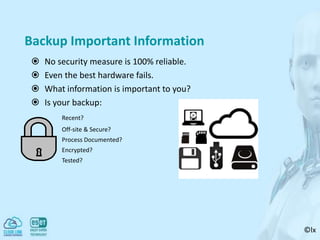
Backup Important Information
 No security measure is 100% reliable.
 Even the best hardware fails.
 What information is important to you?
 Is your backup:
Recent?
Off-site & Secure?
Process Documented?
Encrypted?
Tested?
©lx
QUESTION
Which of the following four passwords is the most secure?
1. Boat123
2. WTh!5Z
3. into*48
4. 123456
5. Not sure
©lx
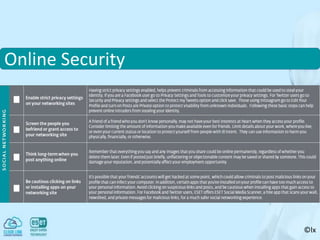
Online Security
©lx
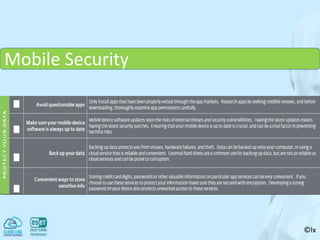
Mobile Security
©lx
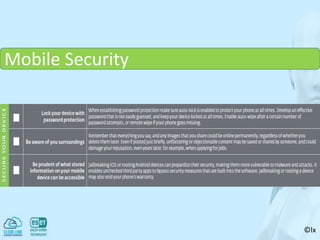
Mobile Security
©lx
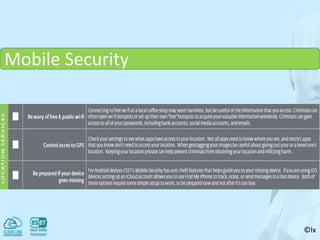
Mobile Security
©lx
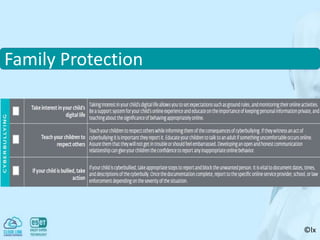
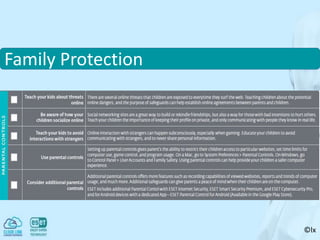
Family Protection
©lx
Family Protection
©lx
QUESTION
What does the “https://” at the beginning of a URL denote, as opposed to "http://" (without the
“s”)?
1. That the site has special high definition
2. That information entered into the site is encrypted
3. That the site is the newest version available
4. That the site is not accessible to certain computers
5. None of the above
6. Not sure
©lx
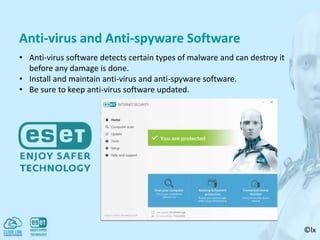
Anti-virus and Anti-spyware Software
• Anti-virus software detects certain types of malware and can destroy it
before any damage is done.
• Install and maintain anti-virus and anti-spyware software.
• Be sure to keep anti-virus software updated.
©lx
METROPOLITAN CRIME DIVISION
TEKU, KATHMANDU
email : ecrime@nepalpolice.gov.np,
Report Cyber Crime to : ecrime@nepalpolice.gov.np
Landline : + 977 9851283032
Landline : + 977 1 5521554 - Lalitpur Branch
Other contacts :
4253099 - Division chief
4219937 - Asst. Chief
4251265 - Asst. Chief
©lx
Q/A
Follow Us on Facebook
• https://www.facebook.com /cloudlinknepal/
• https://www.facebook.com/esetnepal2017/
• Visit Our Website For more Information
www.cloudlink.com.np
Contact:-
01-4264545
Mobile:- 9801134486
Viber:- 9860072622

Eset cybersecurity awareness (laxman giri)

  • 1.
    ©lx ESET Cyber SecurityAwareness BY CLOUD LINK & SECURITY ENTERPRISES
  • 2.
    ©lx LAXMAN GIRI TECHNICAL SUPPORTOFFICER Cloud Link & Security Enterprises laxman@cloudlink.com.np support@cloudlink.com.np 9801134486
  • 3.
    ©lx Objectives • Introduction onCyber Security • Awareness on Cyber Crime, it’s report & punishment in Nepal • Intro on Leading Threats • The Risk Factors • Identifying Security Compromises • Best Practices to Avoid Threats • Where to report Cyber Crime ?
  • 4.
    ©lx Introduction • The Internetis growing rapidly. It has given rise to new opportunities in every field we can think of like entertainment, business & education. • There’re two sides to a coin. Internet also has it’s own disadvantage, i.e. Cyber crime.
  • 5.
    ©lx A Cybercrime isan act of creating, distributing, altering, stealing, misusing and destroying data and information through the computer and network connection devices without the use of physical force and against the will or interest of the victim. It is a types of computer crime and consider as illegal activity. What is Cybercrime ?
  • 6.
    ©lx We can categorizecyber crime in two ways. 1.The computer as a target: Using a computer to attacks others computer. Under this Hacking, virus and worms attack, Dos and DDOS attack falls. 2.The computer as a weapon: using a computer to commit real world crime. E.g. Cyber terrorism, Credit card fraud and pornography, Cyber bullying.
  • 7.
    ©lx Major cyber crimereported in Nepal are Type of Cyber Crime Report in Nepal -DOS attack -Unauthorized access/Hacking, -Phishing -Threatening through Email -Cyber Defamation through Social Network -Fake profile making -Website Hacking -Wanna -Cry, a crypto-ransomware.
  • 8.
  • 9.
    ©lx • Any tasksof deleting, stealing and altering the computer sources; publishing illegal materials, breaking privacy etc have been described as cybercrime. Anyone doing such activities will be brought under judiciary inquiry. • The law states that government has right to punish cyber criminals. • They may be sentenced up to two years of imprisonment or fine up to Rs two lakh or both. • If anyone found publishing wrong information in websites, then one have to pay NRs one lakh or five years of imprisonment or both. • Anyone helping in such crimes will be given the half punishment compared to the criminal. Cybercrime Punishment in Nepal:
  • 10.
    ©lx Cyber Security isSafety Security: We must protect our computers and data in the same way that we secure the doors to our homes. Safety: We must behave in ways that protect us against risks and threats that come with technology.
  • 11.
    ©lx User Awareness Cracker: Computer-savvy programmer creates attacksoftware Script Kiddies: Unsophisticated computer users who know how to execute programs Hacker Bulletin Board SQL Injection Buffer overflow Password Crackers Password Dictionaries Successful attacks! Crazyman broke into … CoolCat penetrated… Criminals: Create & sell bots -> generate spam Sell credit card numbers, etc… System Administrators Some scripts appear useful to manage networks… Malware package earns $1K-2K 1 M Email addresses earn $8 10,000 PCs earn $1000 Posts to
  • 12.
    ©lx • Viruses • Worms •Trojan Horses / Logic Bombs • Social Engineering • Rootkits • Botnets / Zombies Leading Threats
  • 13.
  • 14.
    ©lx Viruses  A virusattaches itself to a program, file, or disk.  When the program is executed, the virus activates and replicates itself.  The virus may be benign or malignant but executes its payload at some point (often upon contact).  Viruses can cause computer crashes and loss of data. Program A Extra Code Program B infects
  • 15.
    ©lx Worms • Independent programthat replicates itself and sends copies from computer to computer across network connections. • Upon arrival, the worm may be activated to replicate. To Ram To laxman To Sita Email List: Ram@gmail.com laxman@yahoo.com sita@u.edu
  • 16.
    ©lx Logic Bombs andTrojan Horses • Logic Bomb: Malware logic executes upon certain conditions. The program is often used for otherwise legitimate reasons. • Examples: • Software which malfunctions if maintenance fee is not paid. • Employee triggers a database erase when he is fired. • Trojan Horse: Masquerades as a benign program while quietly destroying data or damaging your system. • Download a game: It may be fun but contains hidden code that gathers personal information without your knowledge.
  • 17.
    ©lx Social Engineering • Socialengineering manipulates people into performing actions or divulging confidential information. Similar to a confidence trick or simple fraud, the term applies to the use of deception to gain information, commit fraud, or access computer systems. Phone Call: This is John, the System Administrator. What is your password? Email: ABC Bank has noticed a problem with your account… In Person: What ethnicity are you? Your mother’s maiden name? and have some lovely software patches! I have come to repair your machine…
  • 18.
    ©lx Phishing: Counterfeit Email •Phishing: A seemingly trustworthy entity asks for sensitive information such as SSN, credit card numbers, login IDs or passwords via e- mail.
  • 19.
    ©lx Pharming: Counterfeit WebPages • The link provided in the e-mail leads to a counterfeit webpage which collects important information and submits it to the owner. • The counterfeit web page looks like the real thing • Extracts account information Misspelled Wiping over, but not clicking the link may reveal a different address. With whom? Copyright date is old
  • 20.
    ©lx Botnet  A botnetis a number of compromised computers used to create and send spam or viruses or flood a network with messages as a denial of service attack.  The compromised computers are called zombies.
  • 21.
    ©lx QUESTION If a publicWi-Fi network (such as in an airport or café) requires a password to access, is it generally safe to use that network for sensitive activities such as online banking, login Facebook etc? 1. Yes, it is safe 2. No, it is not safe 3. Not sure
  • 22.
    ©lx Man In TheMiddle Attack • An attacker pretends to be your final destination on the network. When a person tries to connect to a specific destination, an attacker can mislead him to a different service and pretend to be that network access point or server.
  • 23.
    ©lx According to theHimalayan Times , As many as 560 cases of cybercrime have been registered in the first six months of the current fiscal year, said the Metropolitan Crime Division in Teku.
  • 24.
  • 25.
  • 26.
    ©lx Viruses and Spywarecan attack your computer via the following means:- • Opening infected email attachments such as .exe files • Opening infected files from web-based digital file delivery such as drop box, google drive • Visiting Corrupt websites. • Via the internet, undetected by user ( worms are example) • Copying or Downloading of Cracked Software. • Fraud, from fake shopping, banking, charity, dating, social networking, gaming, gambling etc • USB connected devices (eg: memory sticks, external hard drives) The Risk Factors
  • 27.
    ©lx QUESTION Which of thefollowing is an example of a “phishing” attack? 1. Sending someone an email that contains a malicious link that is disguised to look like an email from someone the person knows 2. Creating a fake website that looks nearly identical to a real website in order to trick users into entering their login information 3. Sending someone a text message that contains a malicious link that is disguised to look like a notification that the person has won a contest 4. All of the above 5. Not sure
  • 28.
    ©lx Identifying Security Compromises Symptoms:  Disk space disappears unexpectedly.  Pop-ups suddenly appear, sometimes selling security software.  Files or transactions appear that should not be there.  The computer slows down to a crawl.  Unusual messages, sounds, or displays on your monitor.  The mouse pointer moves by itself.  The computer spontaneously shuts down or reboots.  Often unrecognized or ignored problems.
  • 29.
    ©lx Malware detection • Spywaresymptoms: • Changes to your browser homepage/start page. • Ending up on a strange site when conducting a search. • System-based firewall is turned off automatically. • Lots of network activity while not particularly active. • Excessive pop-up windows. • New icons, programs, favorites which you did not add. • Frequent firewall alerts about unknown programs when trying to access the Internet. • Poor system performance.
  • 30.
    ©lx QUESTION “Private browsing” isa feature in many internet browsers that lets users access web pages without any information (like browsing history) being stored by the browser. Can internet service providers see the online activities of their subscribers when those subscribers are using private browsing? 1. Yes 2. No 3. Not sure
  • 31.
  • 32.
    ©lx User Account Controls BestPractices to avoid these threats
  • 33.
    ©lx Avoid Social Engineering andMalicious Software • Do not open email attachments unless you are expecting the email with the attachment and you trust the sender. • Do not click on links in emails unless you are absolutely sure of their validity. • Only visit and/or download software from web pages you trust.
  • 34.
    ©lx Avoid Stupid HackerTricks  Be sure to have a good firewall or pop-up blocker installed.  Pop-up blockers do not always block ALL pop-ups so always close a pop-up window using the ‘X’ in the upper corner.  Never click “yes,” “accept” or even “cancel.”  Infected USB drives are often left unattended by hackers in public places.
  • 35.
    ©lx Secure Business Transactions Always use secure browser to do online activities. https:// Symbol indicating enhanced security
  • 36.
    ©lx Tips:- Frequently delete tempfiles, cookies, history, saved passwords etc.
  • 37.
  • 38.
    ©lx Backup Important Information No security measure is 100% reliable.  Even the best hardware fails.  What information is important to you?  Is your backup: Recent? Off-site & Secure? Process Documented? Encrypted? Tested?
  • 39.
    ©lx QUESTION Which of thefollowing four passwords is the most secure? 1. Boat123 2. WTh!5Z 3. into*48 4. 123456 5. Not sure
  • 40.
  • 41.
  • 42.
  • 43.
  • 44.
  • 45.
  • 46.
    ©lx QUESTION What does the“https://” at the beginning of a URL denote, as opposed to "http://" (without the “s”)? 1. That the site has special high definition 2. That information entered into the site is encrypted 3. That the site is the newest version available 4. That the site is not accessible to certain computers 5. None of the above 6. Not sure
  • 47.
    ©lx Anti-virus and Anti-spywareSoftware • Anti-virus software detects certain types of malware and can destroy it before any damage is done. • Install and maintain anti-virus and anti-spyware software. • Be sure to keep anti-virus software updated.
  • 48.
    ©lx METROPOLITAN CRIME DIVISION TEKU,KATHMANDU email : ecrime@nepalpolice.gov.np, Report Cyber Crime to : ecrime@nepalpolice.gov.np Landline : + 977 9851283032 Landline : + 977 1 5521554 - Lalitpur Branch Other contacts : 4253099 - Division chief 4219937 - Asst. Chief 4251265 - Asst. Chief
  • 49.
    ©lx Q/A Follow Us onFacebook • https://www.facebook.com /cloudlinknepal/ • https://www.facebook.com/esetnepal2017/ • Visit Our Website For more Information www.cloudlink.com.np Contact:- 01-4264545 Mobile:- 9801134486 Viber:- 9860072622

Editor's Notes

  • #31 Private browsing prevents a user’s internet browser from storing certain kinds of files on his or her device. However, internet service providers can still see all of the details of the user's web traffic.