E-Science and Archaeology Stuart Dunn Centre for e-Research, King’s College London Dept. of Archaeology Research Seminar 7th February 2008
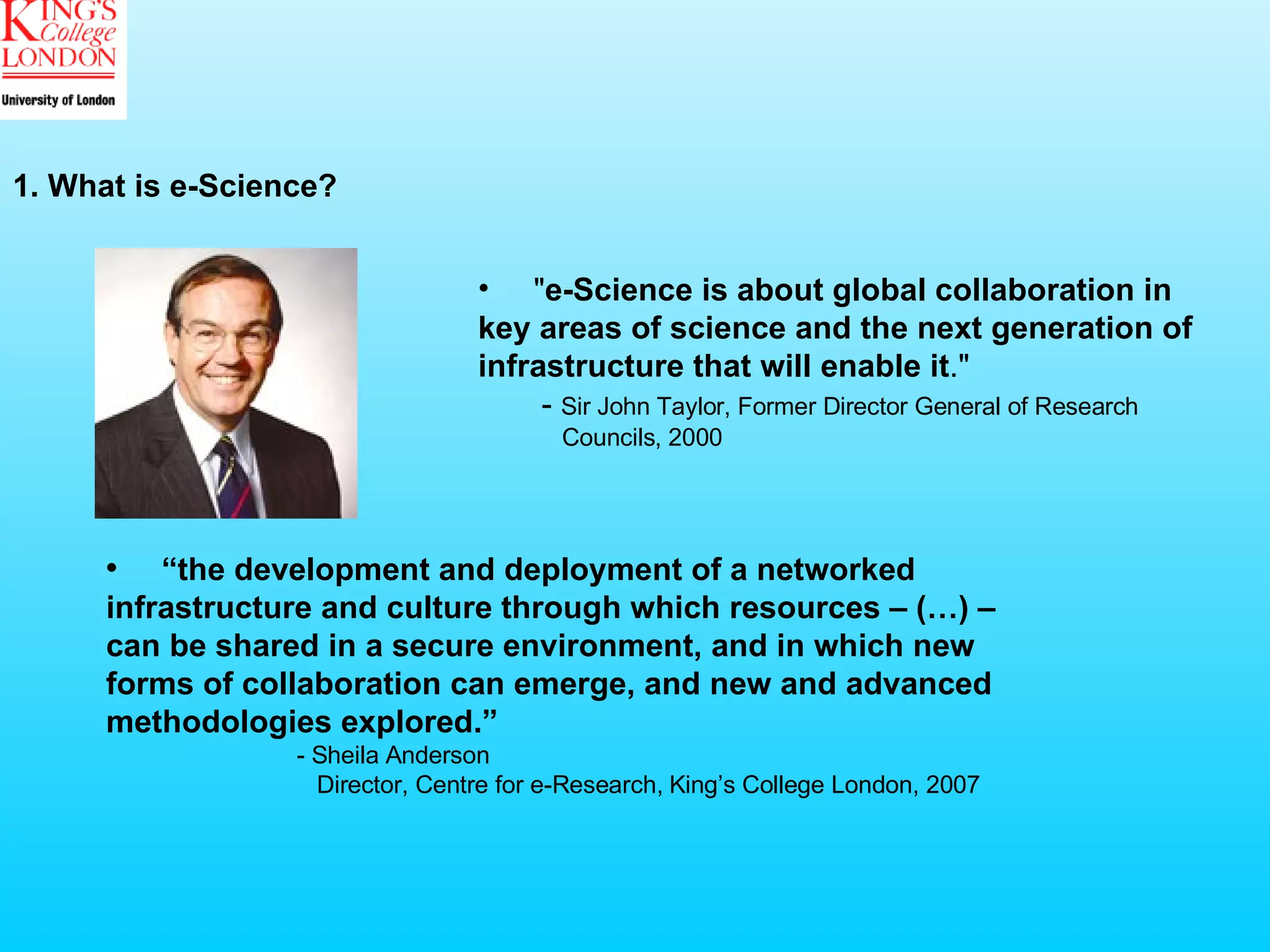
1. What is e-Science? " e-Science is about global collaboration in key areas of science and the next generation of infrastructure that will enable it ."  -  Sir John Taylor, Former Director General of Research    Councils, 2000 “ the development and deployment of a networked infrastructure and culture through which resources – (…) – can be shared in a secure environment, and in which new forms of collaboration can emerge, and new and advanced methodologies explored.” - Sheila Anderson   Director, Centre for e-Research, King’s College London, 2007
1. What is e-Science?
Using  networks  to connect resources  Grids to allow virtual computing across “admin domains” Virtual digital libraries, virtual museums, virtual observatories Technology that was first adopted in sciences… Building bridges People Data Computation People Data Computation
 
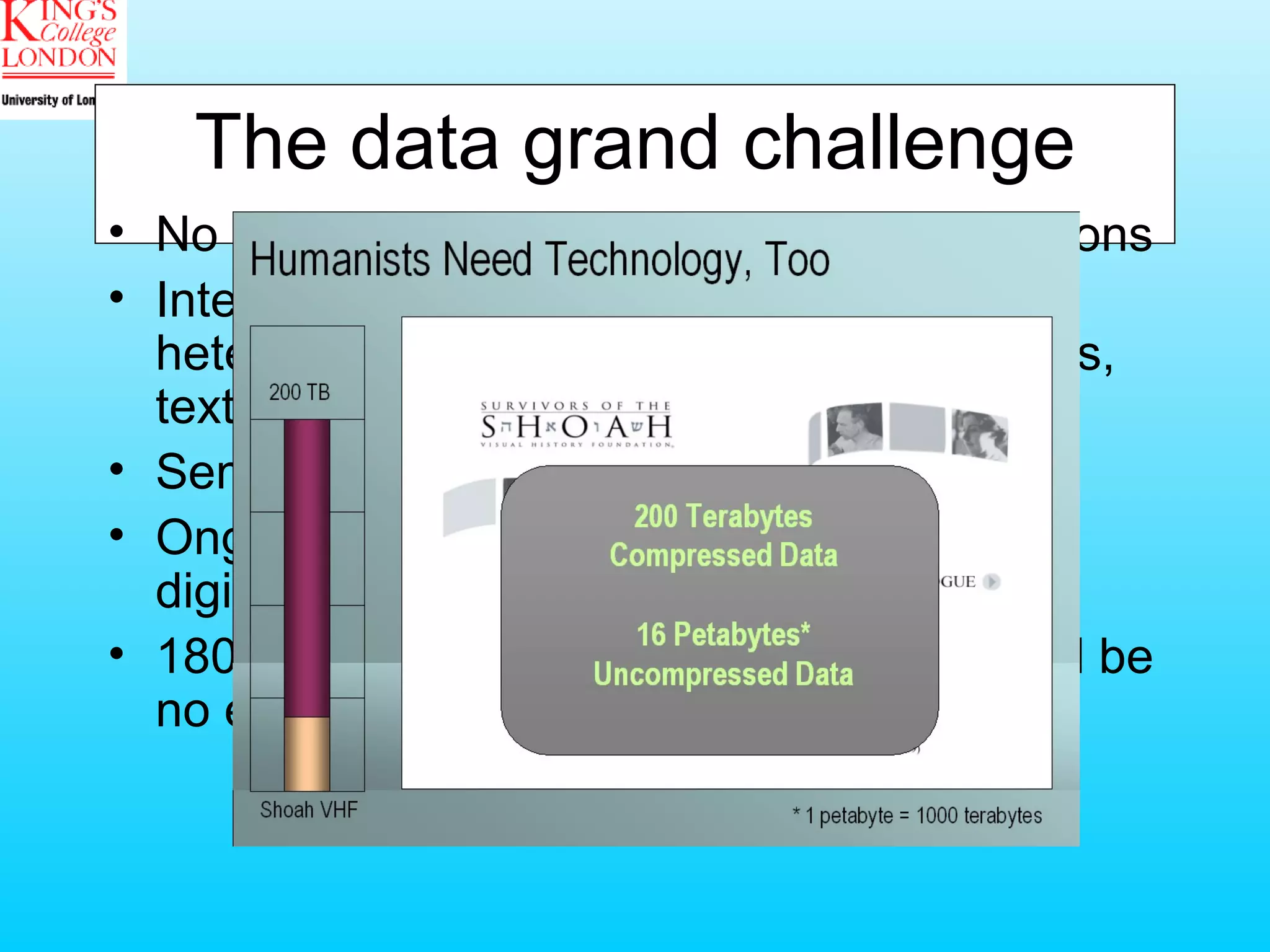
The data grand challenge No large data set from automated simulations Intense human effort to better understand heterogeneous resources such as artworks, texts, artefacts Semantics Ongoing growth of corpora due to major digitisation projects (OCR, OMR, etc.) 180 terabyte Shoa foundation archives will be no exception in the future
1. What is e-Science? … BUT
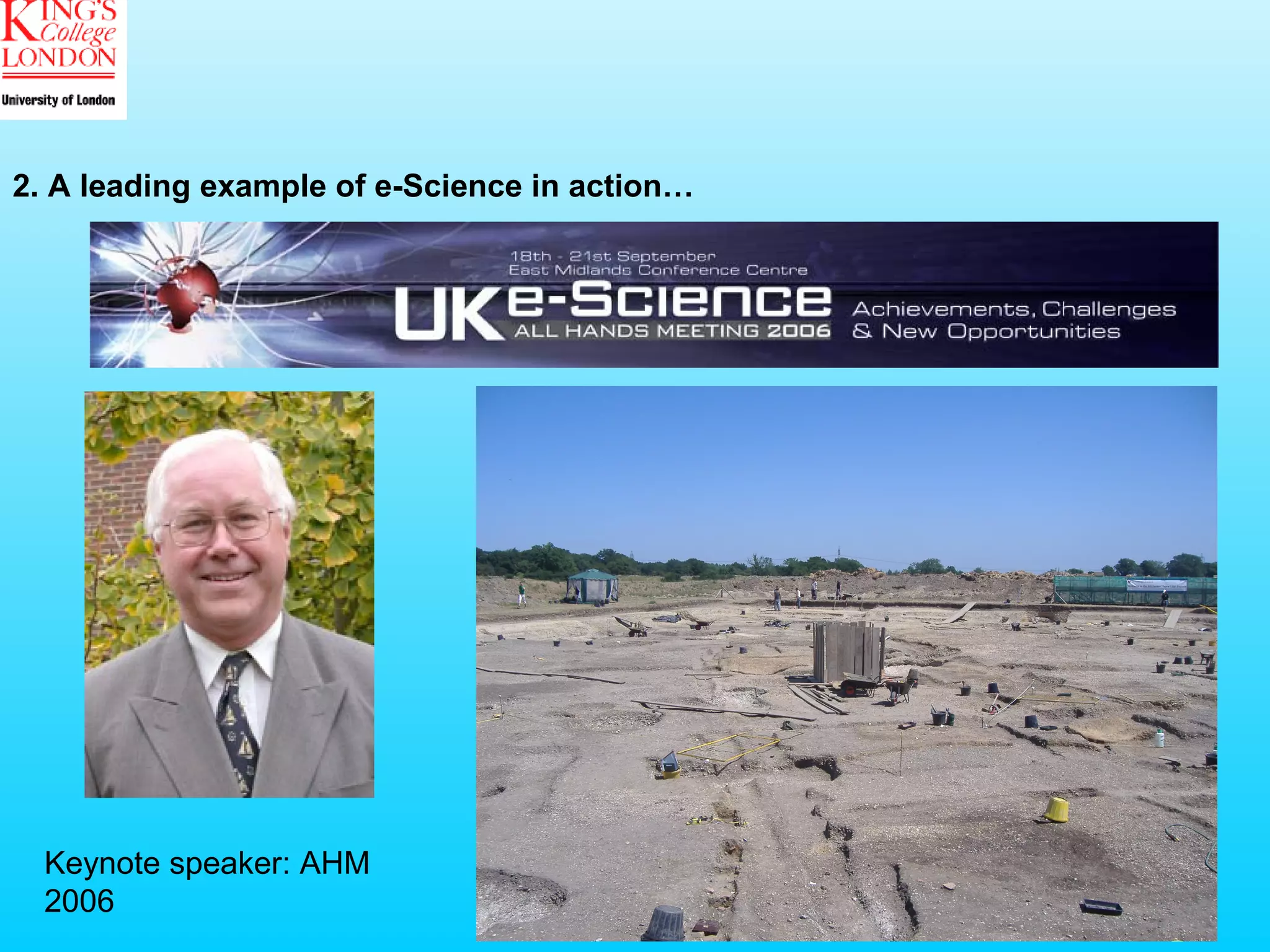
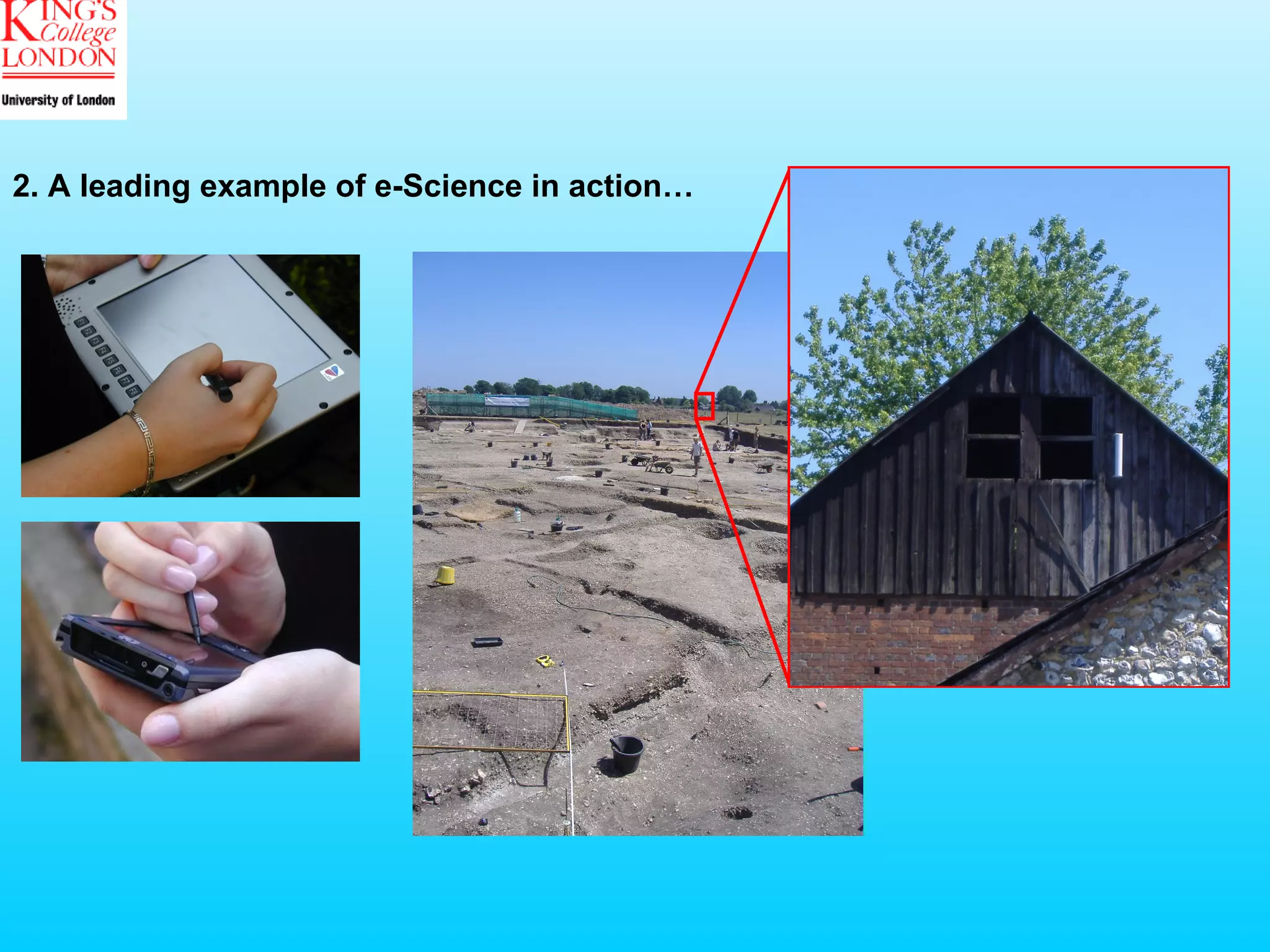
2. A leading example of e-Science in action…  Keynote speaker: AHM 2006
2. A leading example of e-Science in action…
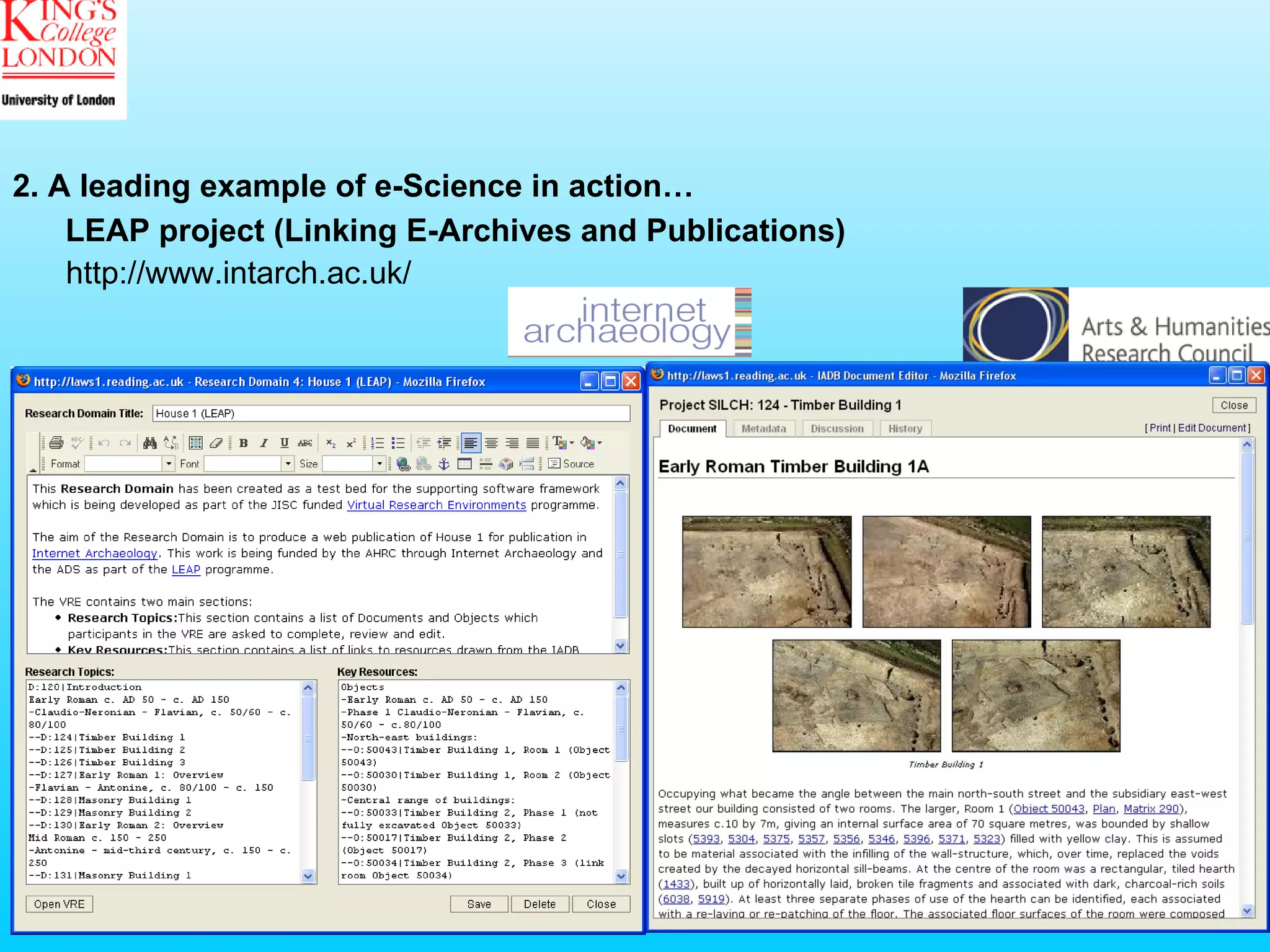
LEAP project (Linking E-Archives and Publications) http://www.intarch.ac.uk/ 2. A leading example of e-Science in action…
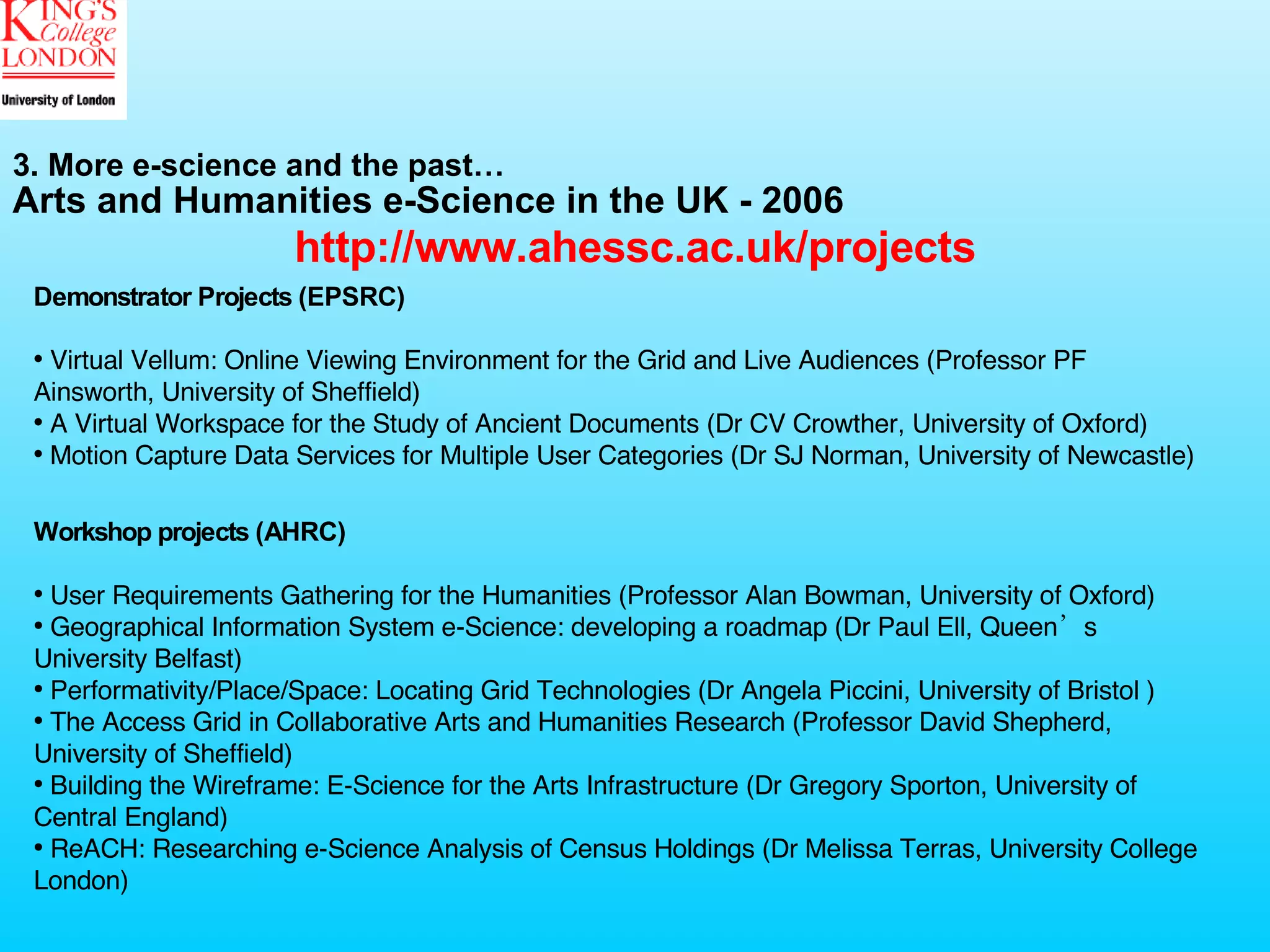
Arts and Humanities e-Science in the UK - 2006 Workshop projects (AHRC) User Requirements Gathering for the Humanities (Professor Alan Bowman, University of Oxford)  Geographical Information System e-Science: developing a roadmap (Dr Paul Ell, Queen’s University Belfast)  Performativity/Place/Space: Locating Grid Technologies (Dr Angela Piccini, University of Bristol ) The Access Grid in Collaborative Arts and Humanities Research (Professor David Shepherd, University of Sheffield)  Building the Wireframe: E-Science for the Arts Infrastructure (Dr Gregory Sporton, University of Central England) ReACH: Researching e-Science Analysis of Census Holdings (Dr Melissa Terras, University College London)  Demonstrator Projects (EPSRC) Virtual Vellum: Online Viewing Environment for the Grid and Live Audiences (Professor PF Ainsworth, University of Sheffield) A Virtual Workspace for the Study of Ancient Documents (Dr CV Crowther, University of Oxford)  Motion Capture Data Services for Multiple User Categories (Dr SJ Norman, University of Newcastle) http://www.ahessc.ac.uk/projects 3. More e-science and the past…
Arts and Humanities e-Science in the UK - 2007  Helen Bailey : Relocating Choreographic Process: The impact of Grid technologies and collaborative memory on the documentation of practice-led research in dance  Alan Bowman:  Image, Text, Interpretation: e-Science, Technology and Documents  Tim Crawford : Purcell Plus: Exploring an eScience Methodology for Musicologists  Vincent Gaffney : Medieval Warfare on the Grid: The Case of Manzikert   Sally MacDonald , E-Curator: 3D colour scans for remote object identification and assessment  Julian Richards , Archaeotools: Data mining, facetted classification and E-archaeology   monica schraefel,  musicSpace: Using and Evaluating e-Science Design Methods and Technologies to Improve Access to Heterogeneous Music Resources for Musicology http://www.ahessc.ac.uk/research-projects 3. More e-science and the past…
Medieval Warfare on the Grid: The Case of Manzikert Geospatial methods and agent-based approach 3. More e-science and the past…
3. More e-science and the past…
 
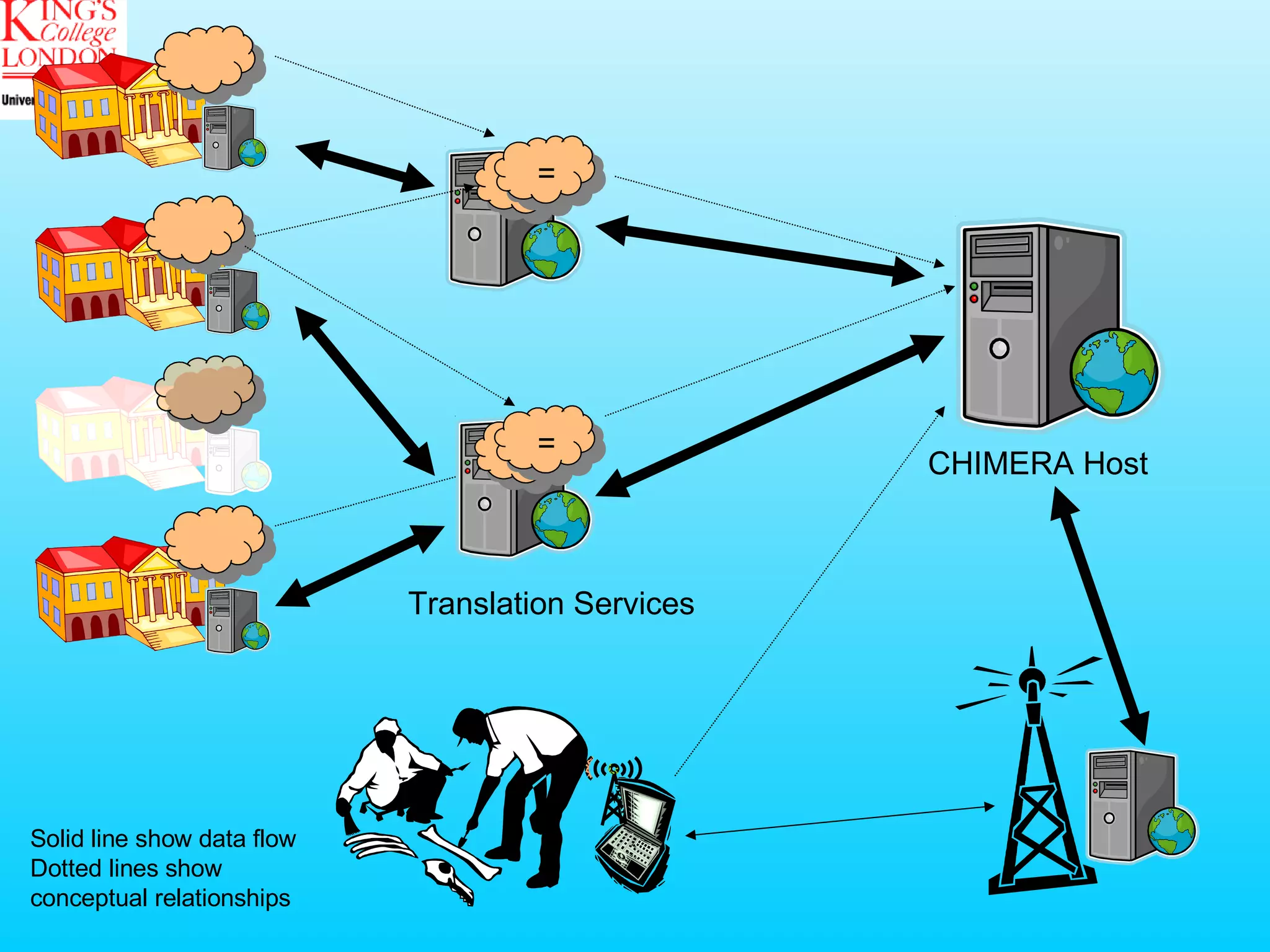
3. More e-science and the past… CHIMERA: Collaborative Harvesting of Information from Museums, E-Records and Archives
CHIMERA Host Solid line show data flow Dotted lines show  conceptual relationships  Translation Services = =
 
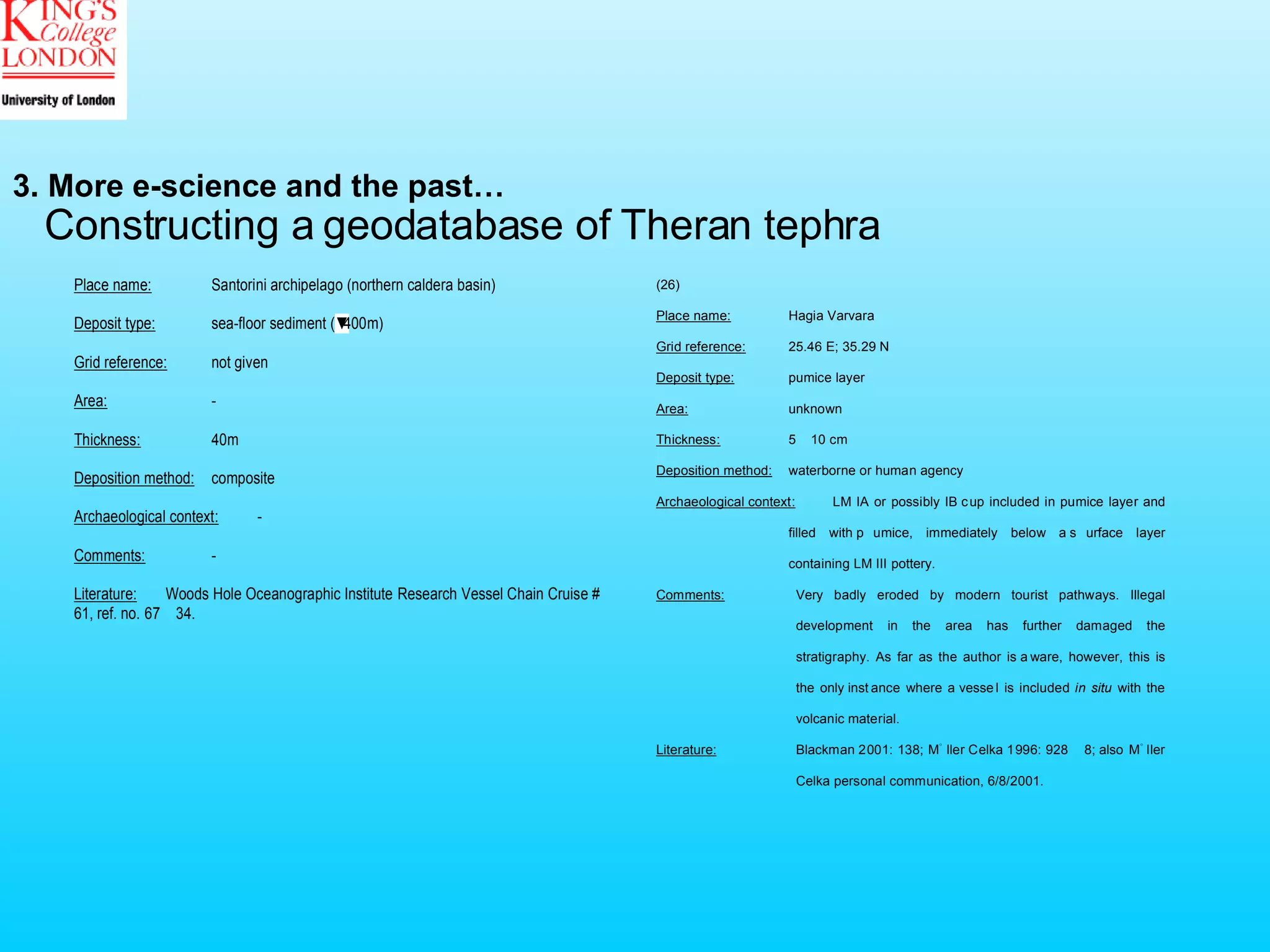
Constructing a geodatabase of Theran tephra 3. More e-science and the past…
Constructing a geodatabase of Theran tephra: problems Accuracy and (versus) precision Georeferencing from heterogeneous formats 3. More e-science and the past…
Constructing a geodatabase of Theran tephra: problems Accuracy and (versus) precision Georeferencing from heterogeneous formats and sources  Assessing deposition process Harmonizing points, sections and stratigraphies Georeferencing places formal,  based on lat/long or other mathematical expressions Informal , based on placenames, and/or where no formal mathematical identifier is present 3. More e-science and the past… 24.87 34.87
Human/social Technical/computational

'E-Science and Archaeology'

  • 1.
    E-Science and ArchaeologyStuart Dunn Centre for e-Research, King’s College London Dept. of Archaeology Research Seminar 7th February 2008
  • 2.
    1. What ise-Science? " e-Science is about global collaboration in key areas of science and the next generation of infrastructure that will enable it ." - Sir John Taylor, Former Director General of Research Councils, 2000 “ the development and deployment of a networked infrastructure and culture through which resources – (…) – can be shared in a secure environment, and in which new forms of collaboration can emerge, and new and advanced methodologies explored.” - Sheila Anderson Director, Centre for e-Research, King’s College London, 2007
  • 3.
    1. What ise-Science?
  • 4.
    Using networks to connect resources Grids to allow virtual computing across “admin domains” Virtual digital libraries, virtual museums, virtual observatories Technology that was first adopted in sciences… Building bridges People Data Computation People Data Computation
  • 5.
  • 6.
    The data grandchallenge No large data set from automated simulations Intense human effort to better understand heterogeneous resources such as artworks, texts, artefacts Semantics Ongoing growth of corpora due to major digitisation projects (OCR, OMR, etc.) 180 terabyte Shoa foundation archives will be no exception in the future
  • 7.
    1. What ise-Science? … BUT
  • 8.
    2. A leadingexample of e-Science in action… Keynote speaker: AHM 2006
  • 9.
    2. A leadingexample of e-Science in action…
  • 10.
    2. A leadingexample of e-Science in action…
  • 11.
    LEAP project (LinkingE-Archives and Publications) http://www.intarch.ac.uk/ 2. A leading example of e-Science in action…
  • 12.
    Arts and Humanitiese-Science in the UK - 2006 Workshop projects (AHRC) User Requirements Gathering for the Humanities (Professor Alan Bowman, University of Oxford) Geographical Information System e-Science: developing a roadmap (Dr Paul Ell, Queen’s University Belfast) Performativity/Place/Space: Locating Grid Technologies (Dr Angela Piccini, University of Bristol ) The Access Grid in Collaborative Arts and Humanities Research (Professor David Shepherd, University of Sheffield) Building the Wireframe: E-Science for the Arts Infrastructure (Dr Gregory Sporton, University of Central England) ReACH: Researching e-Science Analysis of Census Holdings (Dr Melissa Terras, University College London) Demonstrator Projects (EPSRC) Virtual Vellum: Online Viewing Environment for the Grid and Live Audiences (Professor PF Ainsworth, University of Sheffield) A Virtual Workspace for the Study of Ancient Documents (Dr CV Crowther, University of Oxford) Motion Capture Data Services for Multiple User Categories (Dr SJ Norman, University of Newcastle) http://www.ahessc.ac.uk/projects 3. More e-science and the past…
  • 13.
    Arts and Humanitiese-Science in the UK - 2007  Helen Bailey : Relocating Choreographic Process: The impact of Grid technologies and collaborative memory on the documentation of practice-led research in dance  Alan Bowman: Image, Text, Interpretation: e-Science, Technology and Documents  Tim Crawford : Purcell Plus: Exploring an eScience Methodology for Musicologists  Vincent Gaffney : Medieval Warfare on the Grid: The Case of Manzikert  Sally MacDonald , E-Curator: 3D colour scans for remote object identification and assessment  Julian Richards , Archaeotools: Data mining, facetted classification and E-archaeology  monica schraefel, musicSpace: Using and Evaluating e-Science Design Methods and Technologies to Improve Access to Heterogeneous Music Resources for Musicology http://www.ahessc.ac.uk/research-projects 3. More e-science and the past…
  • 14.
    Medieval Warfare onthe Grid: The Case of Manzikert Geospatial methods and agent-based approach 3. More e-science and the past…
  • 15.
    3. More e-scienceand the past…
  • 16.
  • 17.
    3. More e-scienceand the past… CHIMERA: Collaborative Harvesting of Information from Museums, E-Records and Archives
  • 18.
    CHIMERA Host Solidline show data flow Dotted lines show conceptual relationships Translation Services = =
  • 19.
  • 20.
    Constructing a geodatabaseof Theran tephra 3. More e-science and the past…
  • 21.
    Constructing a geodatabaseof Theran tephra 3. More e-science and the past…
  • 22.
    Constructing a geodatabaseof Theran tephra 3. More e-science and the past…
  • 23.
    Constructing a geodatabaseof Theran tephra: problems Accuracy and (versus) precision Georeferencing from heterogeneous formats 3. More e-science and the past…
  • 24.
    Constructing a geodatabaseof Theran tephra: problems Accuracy and (versus) precision Georeferencing from heterogeneous formats and sources Assessing deposition process Harmonizing points, sections and stratigraphies Georeferencing places formal, based on lat/long or other mathematical expressions Informal , based on placenames, and/or where no formal mathematical identifier is present 3. More e-science and the past… 24.87 34.87
  • 25.