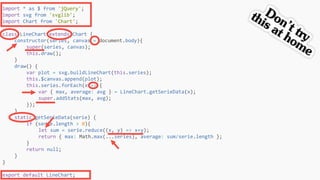



import * as $ from 'jQuery';
import svg from 'svglib';
import Chart from 'Chart';
class LineChart extends Chart {
constructor(series, canvas = document.body){
super(series, canvas);
this.draw();
}
draw() {
var plot = svg.buildLineChart(this.series);
this.$canvas.append(plot);
this.series.forEach(x => {
var { max, average: avg } = LineChart.getSerieData(x);
super.addStats(max, avg);
});
}
static getSerieData(serie) {
if (serie.length > 0){
let sum = serie.reduce((x, y) => x+y);
return { max: Math.max(...series), average: sum/serie.length };
}
return null;
}
}
export default LineChart;
ECMAScript 2015
Overview
ECMAScript 6
@brunoscopelliti
in the browser and on the server, too
in a not too far future …
Object Literals Shorthand
It’s just syntactic sugar for Object literals.
var v = 42, propertyName = "count";
function fn() { console.log(v); };
// the old way
var obj = { v: v, fn: fn, fn2: function() { /*...*/ } };
obj[propertyName] = 10;
// es6 shorthand O/
var obj = {
v,
fn,
fn2() { /*...*/ },
[propertyName]: 10
}
Destructuring
Allows to extract values from object and array using patterns.
// ... and support default values
var [name, extension = ""] = "LICENSE".split(".");
console.log(extension) // ""
// it works with array too!
var [name, extension] = "me.jpeg".split(".");
console.log(extension); // jpeg
// destructuring + object literal shorthand
var { v, fn } = obj;
console.log(v); // 42
var { v: value, fn: log } = obj;
console.log(value); // 42
Rest & Spread Operator
The Spread operator turns an array into consecutive arguments in a function call. The Rest
operator binds trailing parameters to an array.
var arr = [1, 2]; arr.concat([3, 4]); // [1, 2, [3, 4]] FAIL! ಥ_ಥ
[3, 4].forEach(function(x) { arr.push(x) }); // [1, 2, 3, 4] At least it works ¯_(ツ)_/¯
// spread to the rescue!
arr.concat(...[3, 4]); // [1, 2, 3, 4] 0/
// rest
var [winner, ...theOthers] = ["a", "b", "c"];
console.log(theOthers instanceof Array); // true
console.log(theOthers.length); // 2
Super-powered functions
Varargs and default parameters.
// default value for function’s arguments
repeat("yo"); // yoyo
function repeat(msg, time = 2) {
return msg.repeat(time);
}
// rest parameters
function resize(width, height, ...elems){ console.log(elems); }
resize(100, 100, "#box", "#photo"); // ["#box", "#photo"]
function fn(...args){ console.log(args); }
fn(); // []
fn(42, "bho!"); // [42, "bho!"]
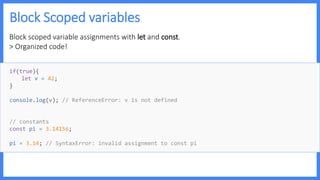
Block Scoped variables
Block scoped variable assignments with let and const.
> Organized code!
if(true){
let v = 42;
}
console.log(v); // ReferenceError: v is not defined
// constants
const pi = 3.14156;
pi = 3.14; // SyntaxError: invalid assignment to const pi
Arrow Functions
Function shorthand with arrow syntax, and more…
[1,2,3].reduce(function(a, b) { return a+b; });
// the syntax
[1,2,3].reduce((a,b) => { console.log("oO"); return a+b; }); // 6
// and even shorter
[1,2,3].reduce((a,b) => a+b);
Arrow Functions
… arrow functions share the same context with their surrounding code;
the context can’t be modified via call, apply nor bind.
var team = {
n: "Justice League",
people: ["Batman", "..."],
logMember() {
// arrows have the same context (this) of their surrounding code.
this.people.forEach(p => console.log(p + " is member of the " + this.n));
}
}
team.logMember(); // Batman is member of the Justice League
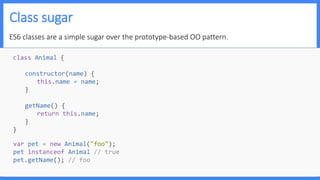
Class sugar
ES6 classes are a simple sugar over the prototype-based OO pattern.
class Animal {
constructor(name) {
this.name = name;
}
getName() {
return this.name;
}
}
var pet = new Animal("foo");
pet instanceof Animal // true
pet.getName(); // foo
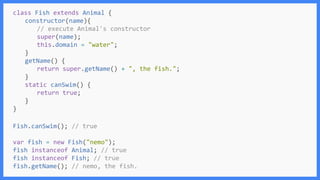
Fish.canSwim(); // true
var fish = new Fish("nemo");
fish instanceof Animal; // true
fish instanceof Fish; // true
fish.getName(); // nemo, the fish.
class Fish extends Animal {
constructor(name){
// execute Animal's constructor
super(name);
this.domain = "water";
}
getName() {
return super.getName() + ", the fish.";
}
static canSwim() {
return true;
}
}
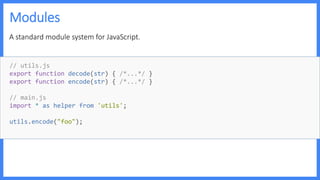
Modules
A standard module system for JavaScript.
// utils.js
export function decode(str) { /*...*/ }
export function encode(str) { /*...*/ }
// main.js
import * as helper from 'utils';
utils.encode("foo");
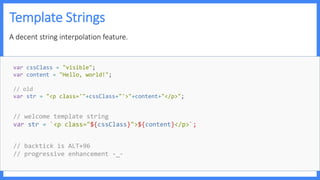
Template Strings
A decent string interpolation feature.
// welcome template string
var str = `<p class="${cssClass}">${content}</p>`;
// backtick is ALT+96
// progressive enhancement -_-
var cssClass = "visible";
var content = "Hello, world!";
// old
var str = "<p class='"+cssClass+"'>"+content+"</p>";
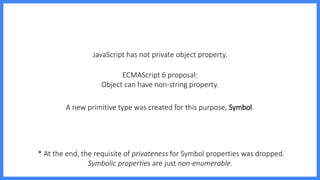
JavaScript has not private object property.
ECMAScript 6 proposal:
Object can have non-string property.
* At the end, the requisite of privateness for Symbol properties was dropped.
Symbolic properties are just non-enumerable.
A new primitive type was created for this purpose, Symbol.
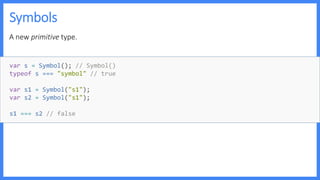
Symbols
A new primitive type.
var s = Symbol(); // Symbol()
typeof s === "symbol" // true
var s1 = Symbol("s1");
var s2 = Symbol("s1");
s1 === s2 // false
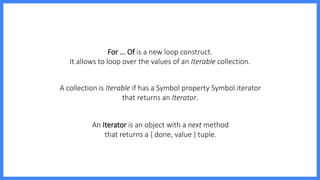
For ... Of is a new loop construct.
It allows to loop over the values of an Iterable collection.
A collection is Iterable if has a Symbol property Symbol.iterator
that returns an Iterator.
An Iterator is an object with a next method
that returns a { done, value } tuple.
Iterators & For ... Of loop
For ... Of loop over values of an iterable collection.
var collection = ["a", "b", "c", "d", "e", "f", "g"];
for(value of collection){
console.log(value);
}
// "a", "b", "c", "d", "e", "f", "g"
// custom iteration
collection[Symbol.iterator] = function() {
var index = 0;
return {
next: () => {
if (index < this.length) {
let obj = { done: false, value: this[index] };
index = index + 2;
return obj;
} else {
return { done: true };
}
}
}
}
for(value of collection){ console.log(value); }
// "a", "c", "e", "g"
Generator Functions
Are functions which can be interrupted, and then resumed, used to create Iterators.
The yield operator is used to interrupt the execution.
The generator execution resumes when the iterator’s next method is called.
collection[Symbol.iterator] = function* () {
for (let i=0; i<this.length; i++) {
if (i%2 === 0) yield this[i];
}
};
for(value of collection){ console.log(value); }
// "a", "c", "e", "g"
Set
An ordered collection with no duplicates.
* Set has a rich prototype that expose method to work with the set instance.
var arr = [1, 2, 2, 3, 3, 3, 4];
var set = new Set(arr);
set; // Set {1, 2, 3, 4}
Map
An ordered collection of {key, value} tuples, without duplicated keys.
* Map has a rich prototype that expose method to work with the map instance.
var arr = [ [1, "first"], [1, "one"], [2, "two"] ];
var map = new Map(arr);
map; // Map { 1: "one", 2: "two" }
Proxies
Allows to intercept, and re-implement, operations executed over an object.
var obj = { v: 42 };
var traps = {
set(target, propKey, value, receiver) {
console.log('SET '+propKey+'='+value);
target[propKey] = value;
}
};
var proxy = new Proxy(obj, traps);
proxy.v = 0;
// SET v=0
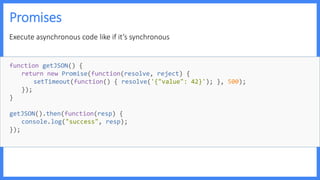
Promises
Execute asynchronous code like if it’s synchronous
function getJSON() {
return new Promise(function(resolve, reject) {
setTimeout(function() { resolve('{"value": 42}'); }, 500);
});
}
getJSON().then(function(resp) {
console.log("success", resp);
});
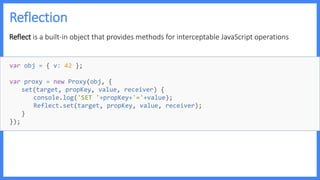
Reflection
Reflect is a built-in object that provides methods for interceptable JavaScript operations
var obj = { v: 42 };
var proxy = new Proxy(obj, {
set(target, propKey, value, receiver) {
console.log('SET '+propKey+'='+value);
Reflect.set(target, propKey, value, receiver);
}
});
Did you like this?
... what about the browser support?
//kangax.github.io/compat-table/es6/
2015:
This is no more a problem!
var team = {
name: "Justice League",
members: [
{ name: "Batman", gender: "M" },
{ name: "Wonder woman", gender: "F" }
],
add(...members) {
this.members.push(...members)
},
remove(name) {
let memberIndex = this.members.findIndex(x => x.name
=== name);
if (memberIndex >= 0){
this.members.splice(memberIndex, 1);
}
},
log(gender = "M") {
this.members
.filter(x => x.gender === gender)
.forEach(h => console.log(`${h.name} is member of the
${this.name}`)); }
}
team.add({ name: "Gipsy", gender: "F" });
team.add({ name: "Flash", gender: "M" }, { name: "Green
Lantern", gender: "M" });
team.remove("Batman")
team.log("M");
team.log("F");
var team = {
name: "Justice League",
members: [
{ name: "Batman", gender: "M" },
{ name: "Wonder woman", gender: "F" }
],
add: function add() {
var _members, _len = arguments.length;
for (var members = _len, _key = 0; _key < _len; _key++){
members[_key] = arguments[_key];
}
(_members = this.members).push.apply(_members, members);
},
remove: function remove(name) {
var memberIndex = this.members.findIndex(function (x){
return x.name === name;
});
if (memberIndex >= 0) {
this.members.splice(memberIndex, 1);
}
},
log: function log() {
var _this = this;
var gender = arguments[0] === undefined ? "M" :
arguments[0];
this.members
.filter(function (x) { return x.gender === gender; })
.forEach(function (h) { return console.log("" + h.name
+ " is member of the " + _this.name); });
}
};
Grazie!

ES6 Overview

  • 1.
    import * as$ from 'jQuery'; import svg from 'svglib'; import Chart from 'Chart'; class LineChart extends Chart { constructor(series, canvas = document.body){ super(series, canvas); this.draw(); } draw() { var plot = svg.buildLineChart(this.series); this.$canvas.append(plot); this.series.forEach(x => { var { max, average: avg } = LineChart.getSerieData(x); super.addStats(max, avg); }); } static getSerieData(serie) { if (serie.length > 0){ let sum = serie.reduce((x, y) => x+y); return { max: Math.max(...series), average: sum/serie.length }; } return null; } } export default LineChart;
  • 2.
  • 3.
    in the browserand on the server, too in a not too far future …
  • 5.
    Object Literals Shorthand It’sjust syntactic sugar for Object literals. var v = 42, propertyName = "count"; function fn() { console.log(v); }; // the old way var obj = { v: v, fn: fn, fn2: function() { /*...*/ } }; obj[propertyName] = 10; // es6 shorthand O/ var obj = { v, fn, fn2() { /*...*/ }, [propertyName]: 10 }
  • 6.
    Destructuring Allows to extractvalues from object and array using patterns. // ... and support default values var [name, extension = ""] = "LICENSE".split("."); console.log(extension) // "" // it works with array too! var [name, extension] = "me.jpeg".split("."); console.log(extension); // jpeg // destructuring + object literal shorthand var { v, fn } = obj; console.log(v); // 42 var { v: value, fn: log } = obj; console.log(value); // 42
  • 7.
    Rest & SpreadOperator The Spread operator turns an array into consecutive arguments in a function call. The Rest operator binds trailing parameters to an array. var arr = [1, 2]; arr.concat([3, 4]); // [1, 2, [3, 4]] FAIL! ಥ_ಥ [3, 4].forEach(function(x) { arr.push(x) }); // [1, 2, 3, 4] At least it works ¯_(ツ)_/¯ // spread to the rescue! arr.concat(...[3, 4]); // [1, 2, 3, 4] 0/ // rest var [winner, ...theOthers] = ["a", "b", "c"]; console.log(theOthers instanceof Array); // true console.log(theOthers.length); // 2
  • 8.
    Super-powered functions Varargs anddefault parameters. // default value for function’s arguments repeat("yo"); // yoyo function repeat(msg, time = 2) { return msg.repeat(time); } // rest parameters function resize(width, height, ...elems){ console.log(elems); } resize(100, 100, "#box", "#photo"); // ["#box", "#photo"] function fn(...args){ console.log(args); } fn(); // [] fn(42, "bho!"); // [42, "bho!"]
  • 9.
    Block Scoped variables Blockscoped variable assignments with let and const. > Organized code! if(true){ let v = 42; } console.log(v); // ReferenceError: v is not defined // constants const pi = 3.14156; pi = 3.14; // SyntaxError: invalid assignment to const pi
  • 10.
    Arrow Functions Function shorthandwith arrow syntax, and more… [1,2,3].reduce(function(a, b) { return a+b; }); // the syntax [1,2,3].reduce((a,b) => { console.log("oO"); return a+b; }); // 6 // and even shorter [1,2,3].reduce((a,b) => a+b);
  • 11.
    Arrow Functions … arrowfunctions share the same context with their surrounding code; the context can’t be modified via call, apply nor bind. var team = { n: "Justice League", people: ["Batman", "..."], logMember() { // arrows have the same context (this) of their surrounding code. this.people.forEach(p => console.log(p + " is member of the " + this.n)); } } team.logMember(); // Batman is member of the Justice League
  • 12.
    Class sugar ES6 classesare a simple sugar over the prototype-based OO pattern. class Animal { constructor(name) { this.name = name; } getName() { return this.name; } } var pet = new Animal("foo"); pet instanceof Animal // true pet.getName(); // foo
  • 13.
    Fish.canSwim(); // true varfish = new Fish("nemo"); fish instanceof Animal; // true fish instanceof Fish; // true fish.getName(); // nemo, the fish. class Fish extends Animal { constructor(name){ // execute Animal's constructor super(name); this.domain = "water"; } getName() { return super.getName() + ", the fish."; } static canSwim() { return true; } }
  • 14.
    Modules A standard modulesystem for JavaScript. // utils.js export function decode(str) { /*...*/ } export function encode(str) { /*...*/ } // main.js import * as helper from 'utils'; utils.encode("foo");
  • 15.
    Template Strings A decentstring interpolation feature. // welcome template string var str = `<p class="${cssClass}">${content}</p>`; // backtick is ALT+96 // progressive enhancement -_- var cssClass = "visible"; var content = "Hello, world!"; // old var str = "<p class='"+cssClass+"'>"+content+"</p>";
  • 16.
    JavaScript has notprivate object property. ECMAScript 6 proposal: Object can have non-string property. * At the end, the requisite of privateness for Symbol properties was dropped. Symbolic properties are just non-enumerable. A new primitive type was created for this purpose, Symbol.
  • 17.
    Symbols A new primitivetype. var s = Symbol(); // Symbol() typeof s === "symbol" // true var s1 = Symbol("s1"); var s2 = Symbol("s1"); s1 === s2 // false
  • 18.
    For ... Ofis a new loop construct. It allows to loop over the values of an Iterable collection. A collection is Iterable if has a Symbol property Symbol.iterator that returns an Iterator. An Iterator is an object with a next method that returns a { done, value } tuple.
  • 19.
    Iterators & For... Of loop For ... Of loop over values of an iterable collection. var collection = ["a", "b", "c", "d", "e", "f", "g"]; for(value of collection){ console.log(value); } // "a", "b", "c", "d", "e", "f", "g"
  • 20.
    // custom iteration collection[Symbol.iterator]= function() { var index = 0; return { next: () => { if (index < this.length) { let obj = { done: false, value: this[index] }; index = index + 2; return obj; } else { return { done: true }; } } } } for(value of collection){ console.log(value); } // "a", "c", "e", "g"
  • 21.
    Generator Functions Are functionswhich can be interrupted, and then resumed, used to create Iterators. The yield operator is used to interrupt the execution. The generator execution resumes when the iterator’s next method is called. collection[Symbol.iterator] = function* () { for (let i=0; i<this.length; i++) { if (i%2 === 0) yield this[i]; } }; for(value of collection){ console.log(value); } // "a", "c", "e", "g"
  • 22.
    Set An ordered collectionwith no duplicates. * Set has a rich prototype that expose method to work with the set instance. var arr = [1, 2, 2, 3, 3, 3, 4]; var set = new Set(arr); set; // Set {1, 2, 3, 4}
  • 23.
    Map An ordered collectionof {key, value} tuples, without duplicated keys. * Map has a rich prototype that expose method to work with the map instance. var arr = [ [1, "first"], [1, "one"], [2, "two"] ]; var map = new Map(arr); map; // Map { 1: "one", 2: "two" }
  • 24.
    Proxies Allows to intercept,and re-implement, operations executed over an object. var obj = { v: 42 }; var traps = { set(target, propKey, value, receiver) { console.log('SET '+propKey+'='+value); target[propKey] = value; } }; var proxy = new Proxy(obj, traps); proxy.v = 0; // SET v=0
  • 25.
    Promises Execute asynchronous codelike if it’s synchronous function getJSON() { return new Promise(function(resolve, reject) { setTimeout(function() { resolve('{"value": 42}'); }, 500); }); } getJSON().then(function(resp) { console.log("success", resp); });
  • 26.
    Reflection Reflect is abuilt-in object that provides methods for interceptable JavaScript operations var obj = { v: 42 }; var proxy = new Proxy(obj, { set(target, propKey, value, receiver) { console.log('SET '+propKey+'='+value); Reflect.set(target, propKey, value, receiver); } });
  • 27.
  • 29.
    ... what aboutthe browser support? //kangax.github.io/compat-table/es6/
  • 32.
    2015: This is nomore a problem!
  • 34.
    var team ={ name: "Justice League", members: [ { name: "Batman", gender: "M" }, { name: "Wonder woman", gender: "F" } ], add(...members) { this.members.push(...members) }, remove(name) { let memberIndex = this.members.findIndex(x => x.name === name); if (memberIndex >= 0){ this.members.splice(memberIndex, 1); } }, log(gender = "M") { this.members .filter(x => x.gender === gender) .forEach(h => console.log(`${h.name} is member of the ${this.name}`)); } } team.add({ name: "Gipsy", gender: "F" }); team.add({ name: "Flash", gender: "M" }, { name: "Green Lantern", gender: "M" }); team.remove("Batman") team.log("M"); team.log("F"); var team = { name: "Justice League", members: [ { name: "Batman", gender: "M" }, { name: "Wonder woman", gender: "F" } ], add: function add() { var _members, _len = arguments.length; for (var members = _len, _key = 0; _key < _len; _key++){ members[_key] = arguments[_key]; } (_members = this.members).push.apply(_members, members); }, remove: function remove(name) { var memberIndex = this.members.findIndex(function (x){ return x.name === name; }); if (memberIndex >= 0) { this.members.splice(memberIndex, 1); } }, log: function log() { var _this = this; var gender = arguments[0] === undefined ? "M" : arguments[0]; this.members .filter(function (x) { return x.gender === gender; }) .forEach(function (h) { return console.log("" + h.name + " is member of the " + _this.name); }); } };
  • 36.