Silicon Valley Code Camp
Amazing New Features
In JavaScript
Manoj Kumar
Agenda
•Scope of Variables
•Parameters: default/rest/spread
•Destructuring
•Object Literals
•Arrow functions
•Iterators & Generators
•Promises & Proxies
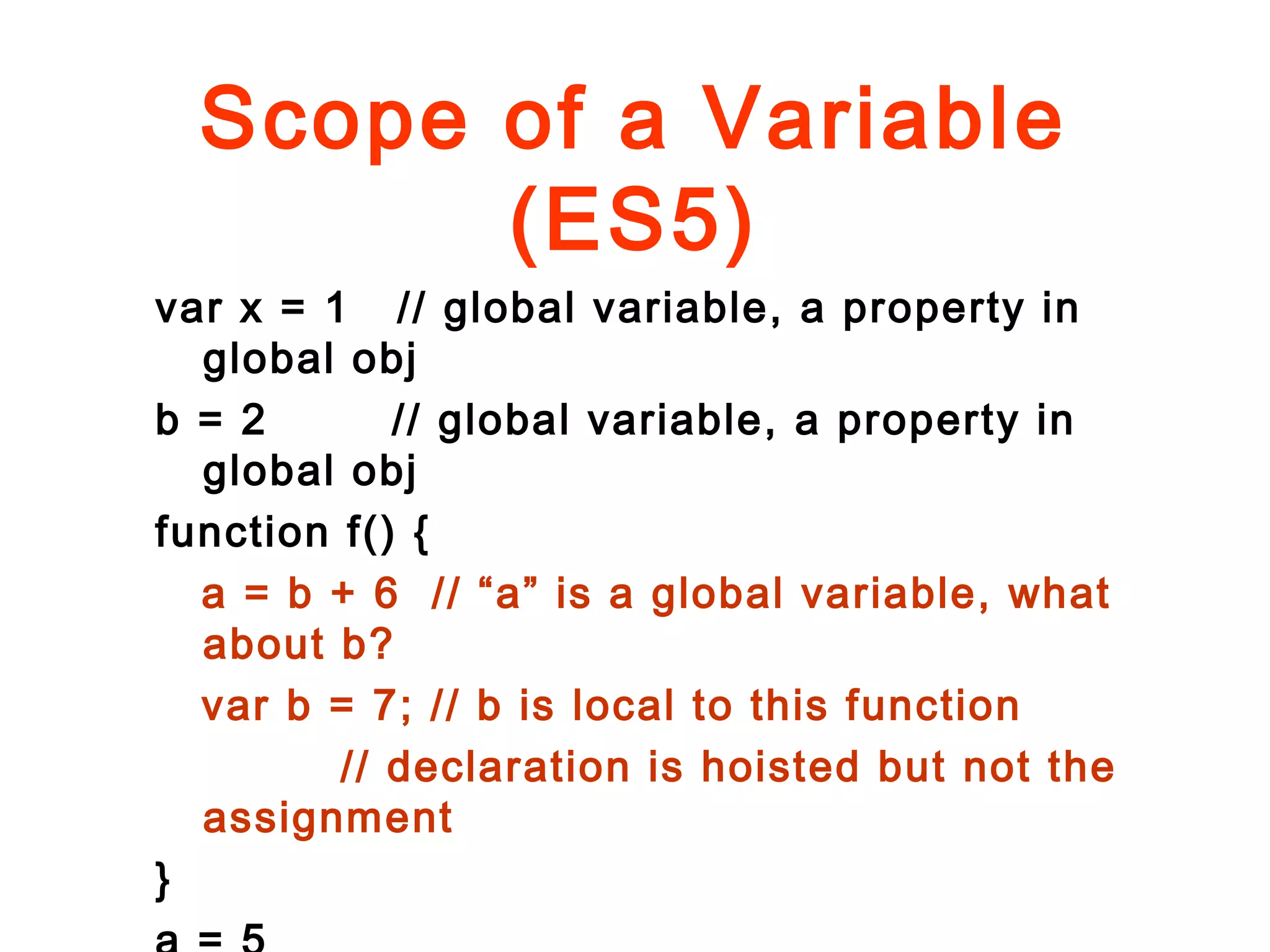
Scope of a Variable
(ES5)
var x = 1 // global variable, a property in
global obj
b = 2 // global variable, a property in
global obj
function f() {
a = b + 6 // “a” is a global variable, what
about b?
var b = 7; // b is local to this function
// declaration is hoisted but not the
assignment
}
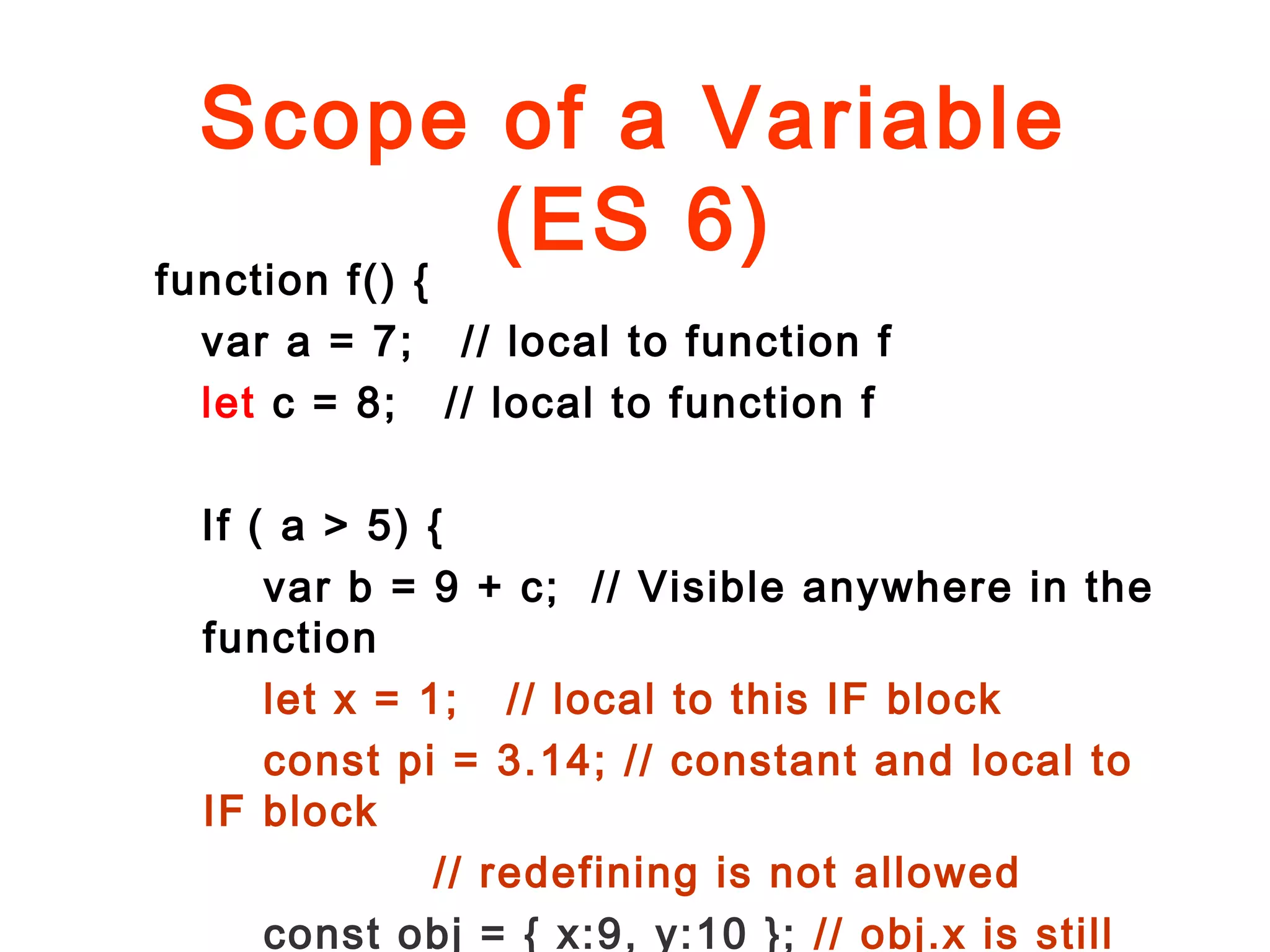
Scope of a Variable
(ES 6)
function f() {
var a = 7; // local to function f
let c = 8; // local to function f
If ( a > 5) {
var b = 9 + c; // Visible anywhere in the
function
let x = 1; // local to this IF block
const pi = 3.14; // constant and local to
IF block
// redefining is not allowed
const obj = { x:9, y:10 }; // obj.x is still
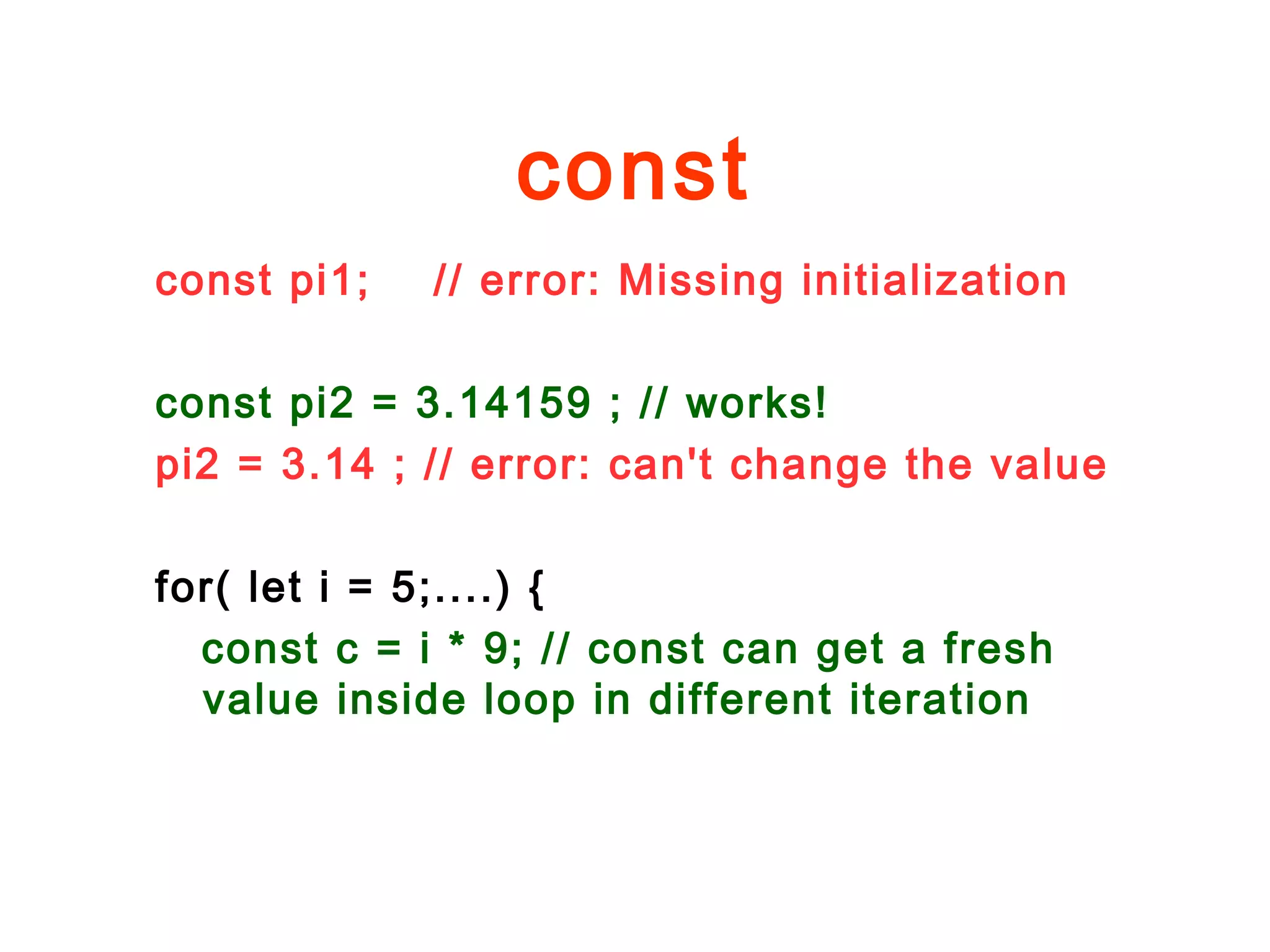
const
const pi1; // error: Missing initialization
const pi2 = 3.14159 ; // works!
pi2 = 3.14 ; // error: can't change the value
for( let i = 5;....) {
const c = i * 9; // const can get a fresh
value inside loop in different iteration
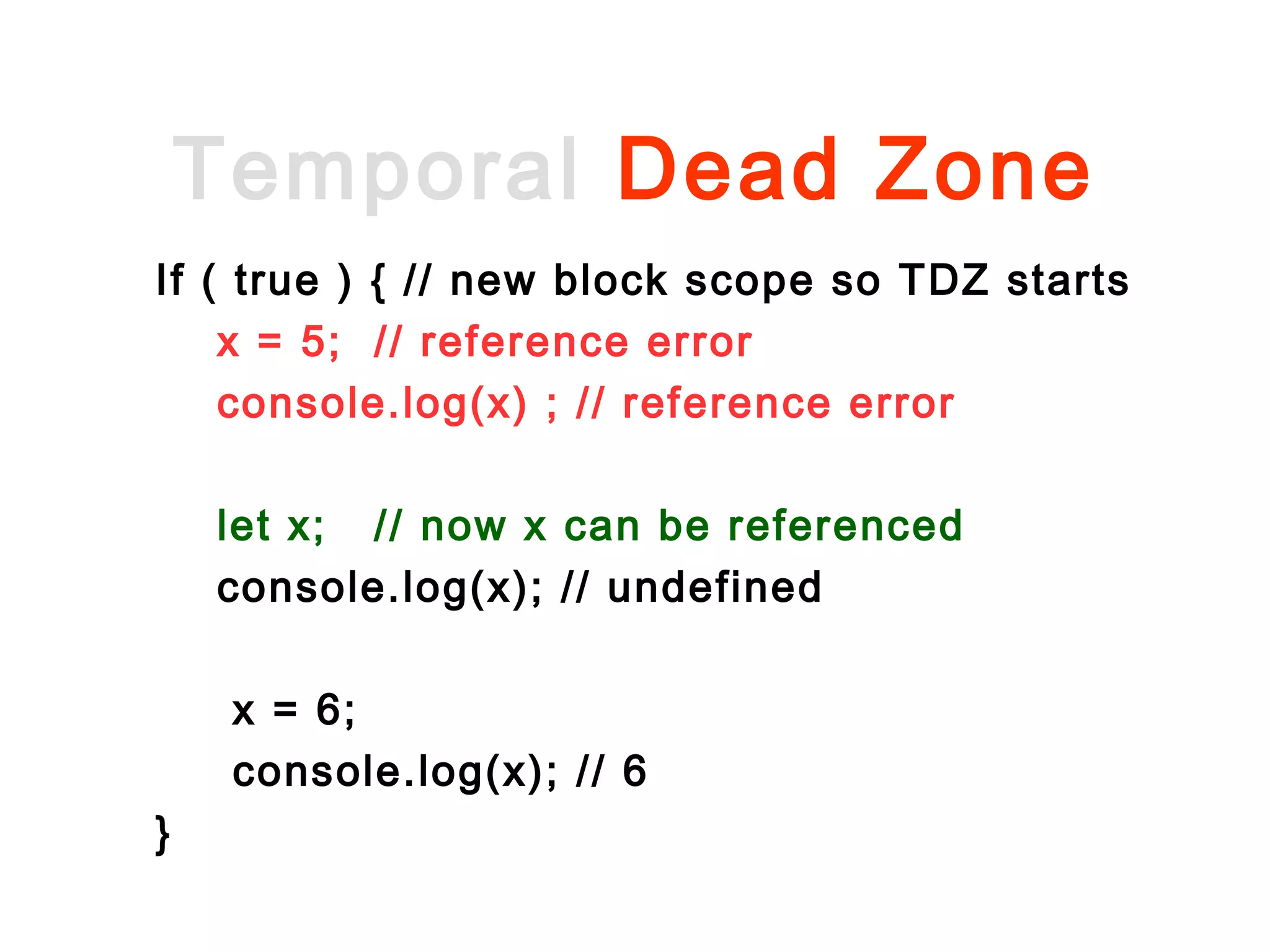
Temporal Dead Zone
Let x = 6;
If ( true ) { // new block scope so TDZ starts
console.log(x) ; // reference error (outer x
not visible)
x = 5; // reference error
let x; // now x can be referenced
console.log(x); // undefined
x = 6;
console.log(x); // 6
}
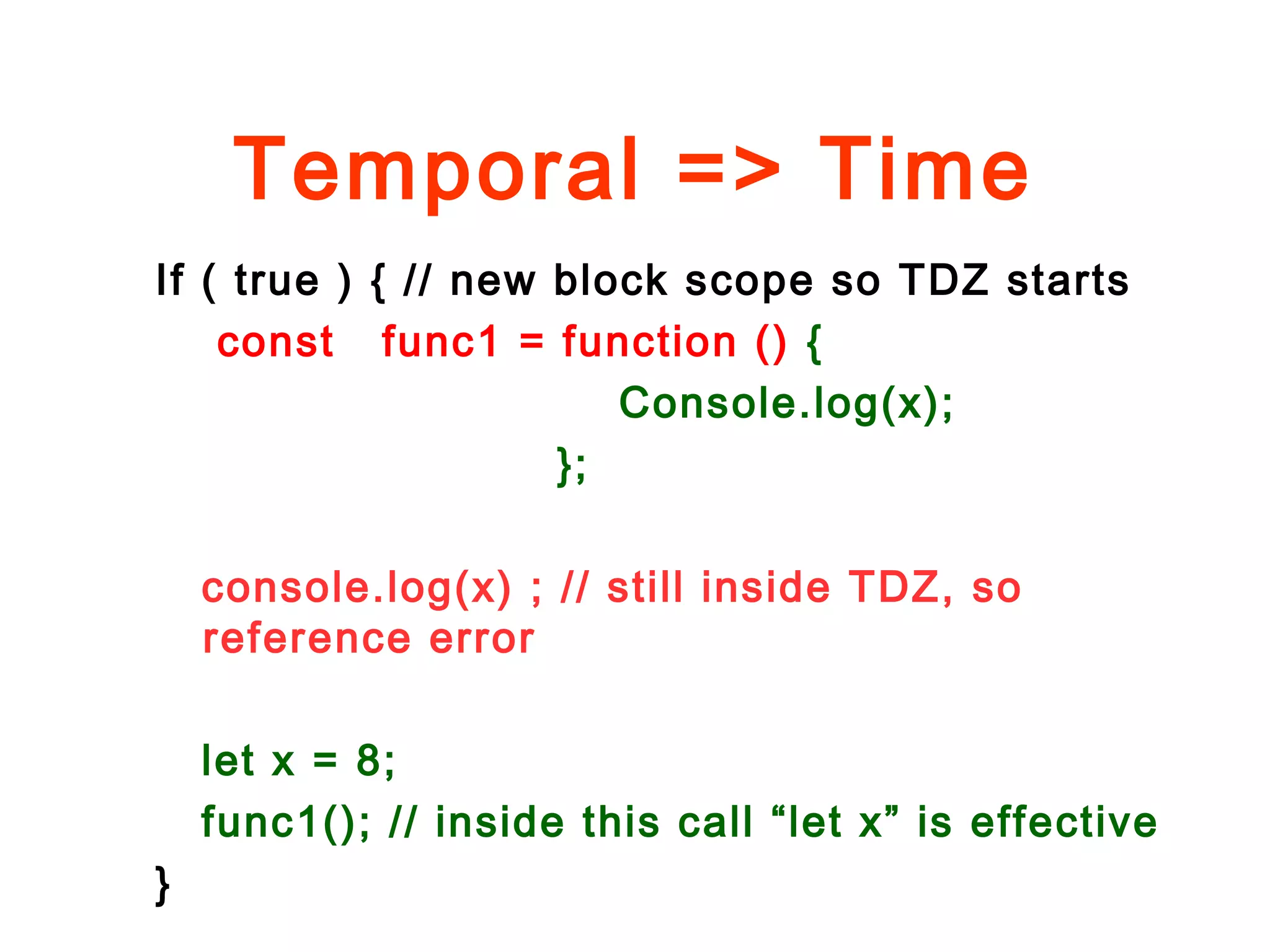
Temporal => Time
If ( true ) { // new block scope so TDZ starts
const func1 = function () {
Console.log(x);
};
console.log(x) ; // still inside TDZ, so
reference error
let x = 8;
func1(); // inside this call “let x” is effective
}
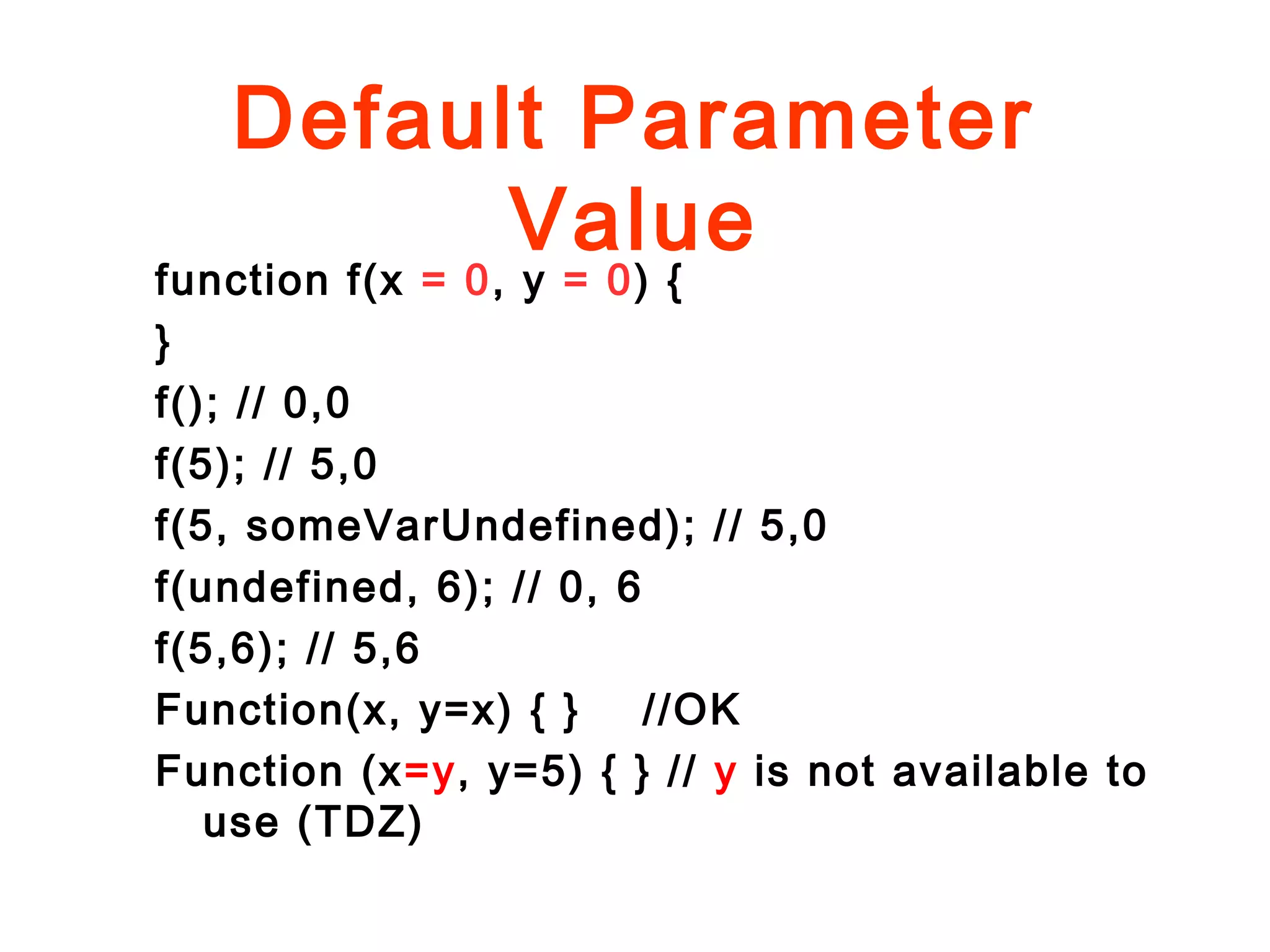
Default Parameter
Value
function f(x = 0, y = 0) {
}
f(); // 0,0
f(5); // 5,0
f(5, someVarUndefined); // 5,0
f(undefined, 6); // 0, 6
f(5,6); // 5,6
Function(x, y=x) { } //OK
Function (x=y, y=5) { } // y is not available to
use (TDZ)
Rest of the Parameters
function func(x, y, ...others) {
//others[0..n] contains rest of the
parameters
}
func(5,6); // 5,6, others.length==0
func(5,6, 7); // 5,6, others.length==1,
others[0] === 7
Func(5,6, 7,8,9); // 5,6,
others.length==3,
others[0..2] are 7,8,9
Spread Operator
Math.max(2, 5, 6, 8);
Math.max( …[2, 5, 6, 8] )
Same as
Math.max.apply(null, [2,5,6,8])
[1, ...[2,3], 4]
=>
[1, 2, 3, 4]
Destructuring
let [x, y] = [5, 8]; // x === 5, y ===8
var [a, , [b], c] = [5, null, [6]];
// a === 5 && b === 6 && c === undefined
[a, b] = [b, a]
var [a, b, c] = "xy"; // think “xy” as [“x”, “y”]
// a === "x" && b === "y" && c === undefined
Destructuring
{ first: f, last: l } = { first: 'Manoj', last:
'Kumar' }
// f === 'Manoj' && l === 'Kumar'
let { x: x } = { x: 1, y: 2 }; // x = 1
let [ x, ...y ] = 'abc'; // x = 'a'; y = [ 'b', 'c' ]
let [ x, y ] = new Set( [ 'a', 'b' ] ); // x = 'a'; y
= 'b’;
[ ] = { }; // TypeError, empty objects are not
iterable
[ ] = undefined; // TypeError, not iterable
[ ] = null; // TypeError, not iterable
let [x] = [ ]; // x = undefined
Object Literals
obj = {
red : 255, blue : 127, [ “green” ] : 255
};
red = 255;
blue = 127;
green = 255;
obj = {
red : red, blue : blue, green: green
};
obj = { red, blue, green } // ES 6
Computed Property
let prop = "red";
green = 255;
obj = {
[ prop ] : 255, // [“red”] : 255 or red
: 255
[ "b" + "lue" ] : 127,
green
};
<eot/>
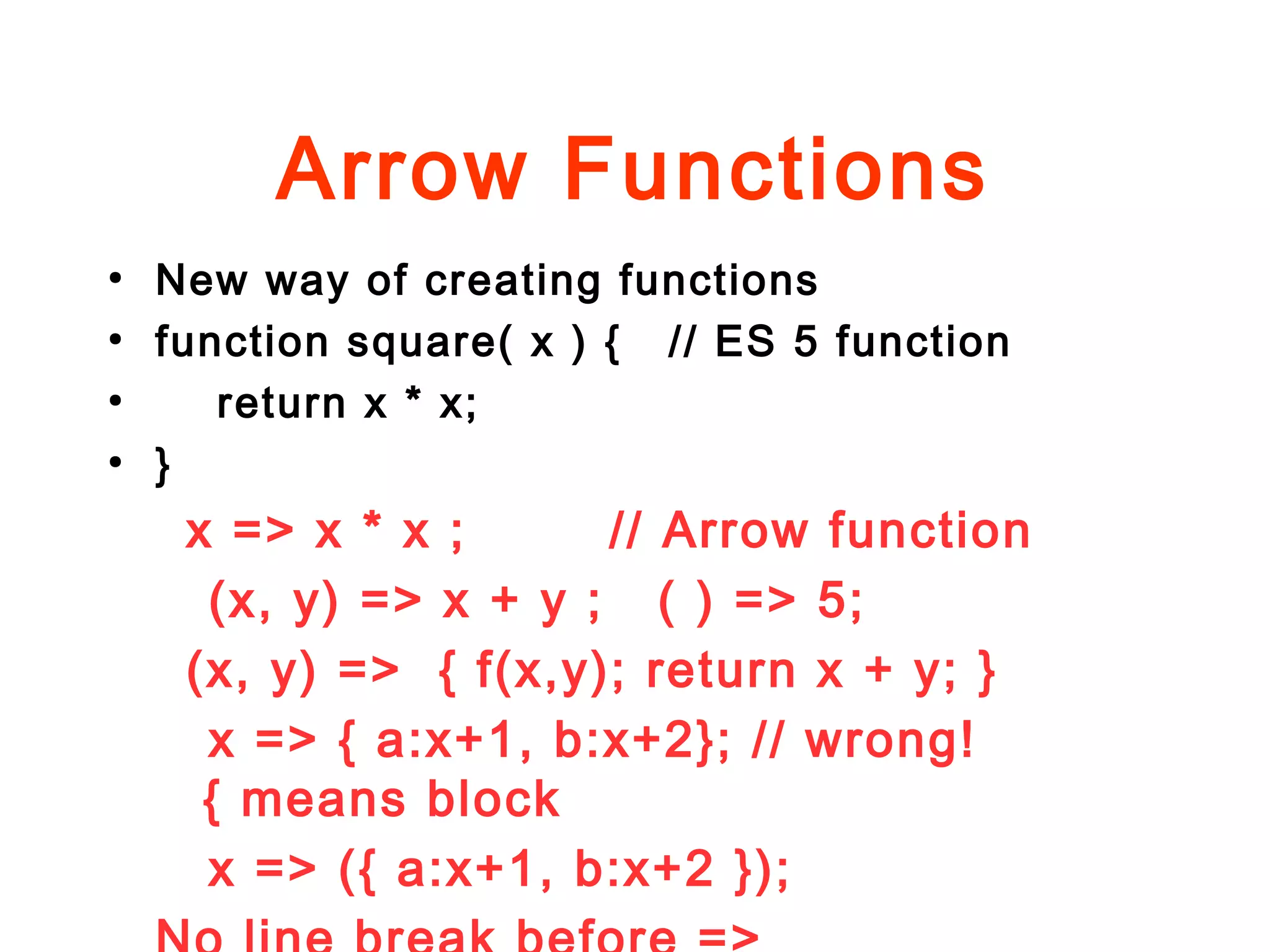
Arrow Functions
●
New way of creating functions
●
function square( x ) { // ES 5 function
●
return x * x;
●
}
x => x * x ; // Arrow function
(x, y) => x + y ; ( ) => 5;
(x, y) => { f(x,y); return x + y; }
x => { a:x+1, b:x+2}; // wrong!
{ means block
x => ({ a:x+1, b:x+2 });
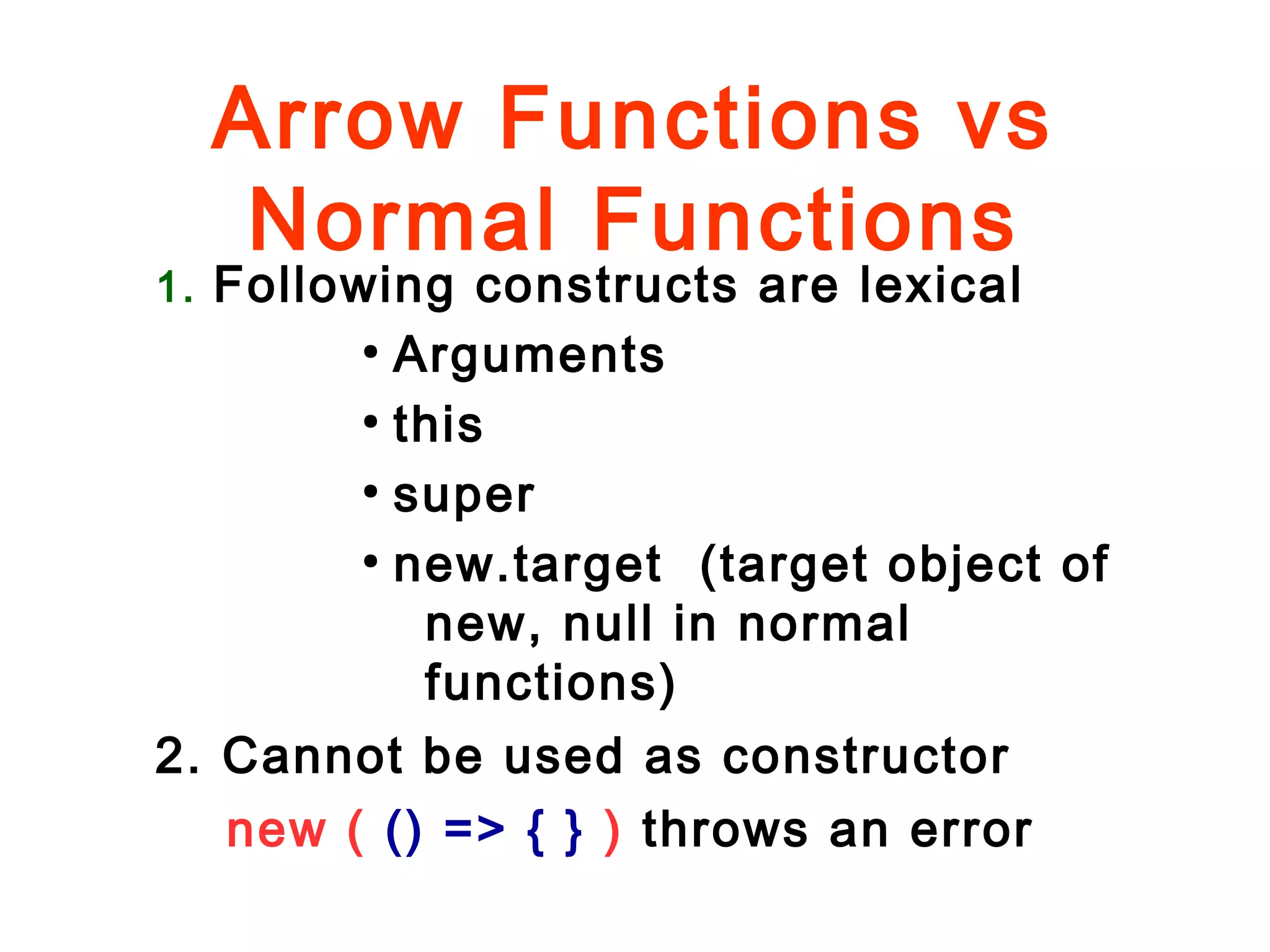
Arrow Functions vs
Normal Functions
1. Following constructs are lexical
●
Arguments
●
this
●
super
●
new.target (target object of
new, null in normal
functions)
2. Cannot be used as constructor
new ( () => { } ) throws an error
Symbol
obj.red = 255;
obj[“red”] === 255; // ES5
const my_prop = Symbol(); // ES6
obj[my_prop] = 127; // ES6
Obj = {
[my_prop] : 127
};
const red = Symbol('my_red')
red.toString() === 'Symbol(my_red)'
Symbol() != Symbol()
Symbol( 'red' ) != Symbol( 'red' )
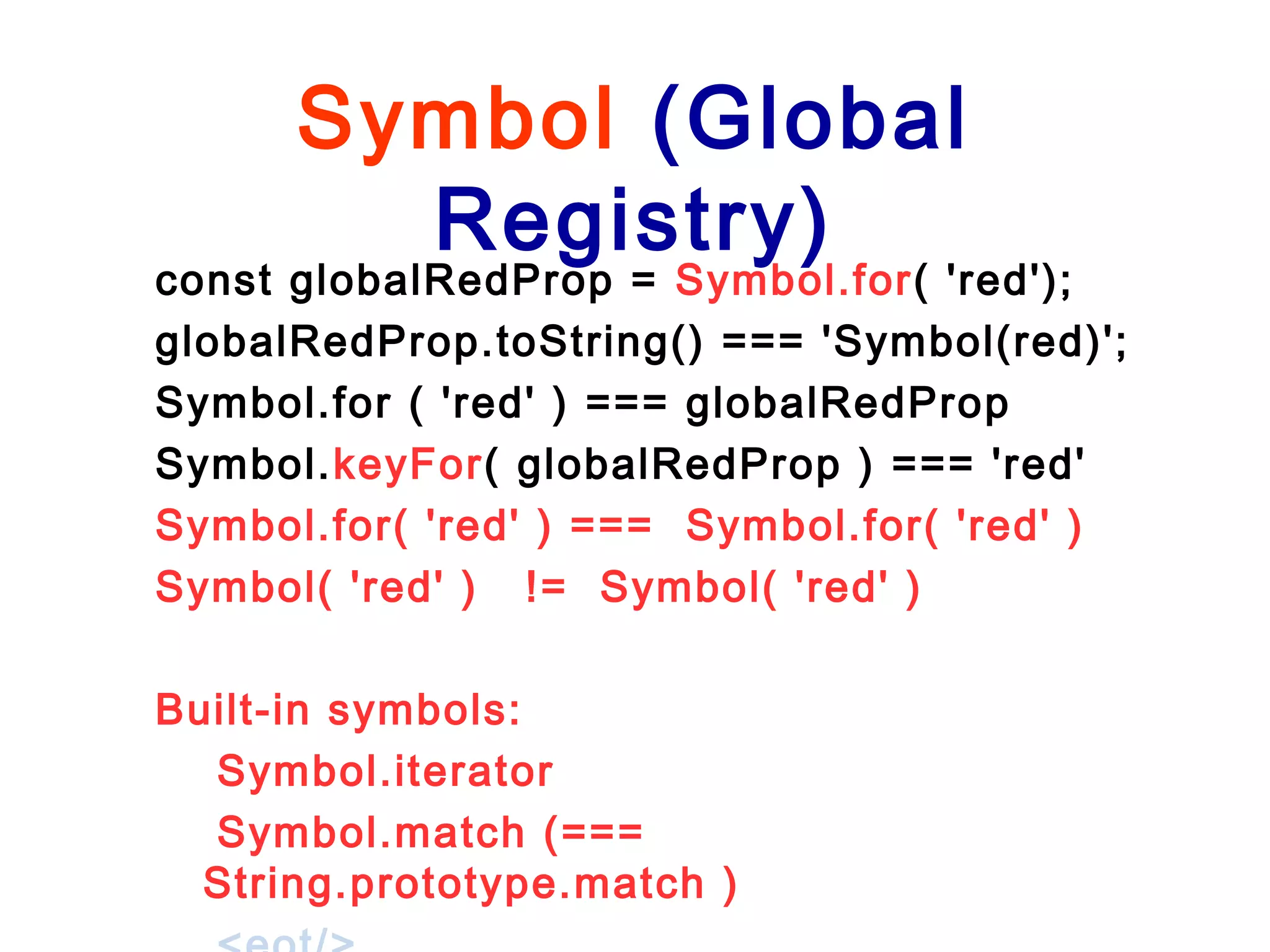
Symbol (Global
Registry)
const globalRedProp = Symbol.for( 'red');
globalRedProp.toString() === 'Symbol(red)';
Symbol.for ( 'red' ) === globalRedProp
Symbol.keyFor( globalRedProp ) === 'red'
Symbol.for( 'red' ) === Symbol.for( 'red' )
Symbol( 'red' ) != Symbol( 'red' )
Built-in symbols:
Symbol.iterator
Symbol.match (===
String.prototype.match )
Iterators
Iterable object makes its element accessible
in for-of loops and spread operators
for (let x of ['a', 'b', 'c']) { // arrays are
iterable
console.log(x);
}
Iterable Objects:
●
Arrays
●
Strings
●
Maps
●
Sets
●
Iterable
How to make any object iterable?
●
Implement a method Symbol.iterator
●
That returns Iterator object
IterableObject = {
[Symbol.iterator] ( ) {
// create an iterator object and
return
}
}
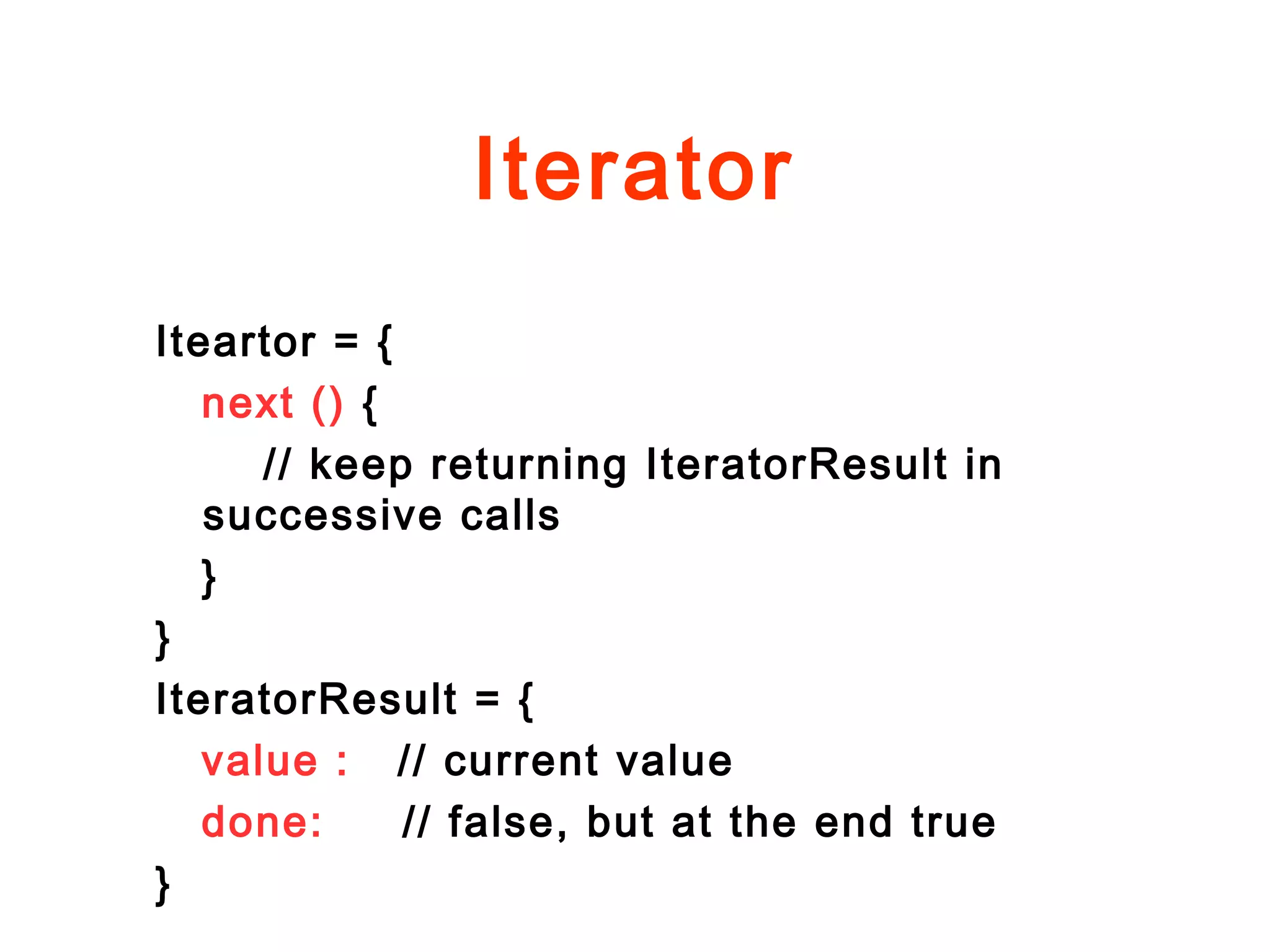
Iterator
Iteartor = {
next () {
// keep returning IteratorResult in
successive calls
}
}
IteratorResult = {
value : // current value
done: // false, but at the end true
}
let iterable = {
[Symbol.iterator]() {
let step = 0;
let iterator = {
next() {
if (step <= 2) step++;
switch (step) {
case 1: return { value: 'hello', done:
false };
case 2: return { value: 'world', done:
false };
default: return { value: undefined,
done: true };
}
}
};
return iterator;
}
Iterable
Let iterator = iterable [ Symbol.iterator ] ( ) ;
Iterator.next() === { value : 'hello', done:
false }
Iterator.next() === { value : 'world', done:
false }
Iterator.next() === { value : undefined, done:
true }
While (true) {
let result = iterator.next();
if ( result.done ) break;
Iterable in for-of
for (let x of iterable) {
console.log(x);
}
for ( let [k,v] of map)
for ( let x of Array.from(arrayLike))
//length, 0:, 1:..
for ( let [k,v] of array.entries())
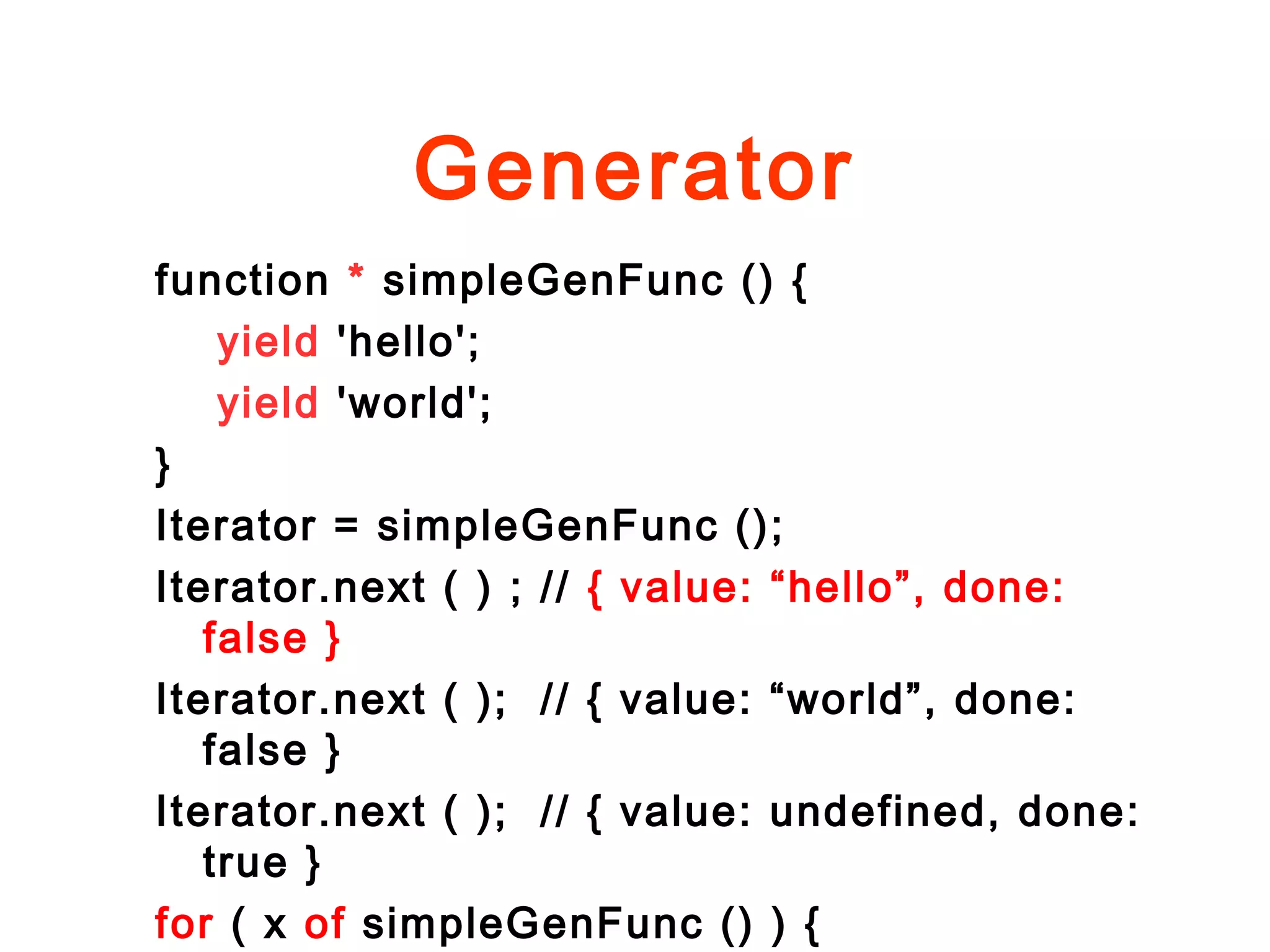
Generator
function * simpleGenFunc () {
yield 'hello';
yield 'world';
}
Iterator = simpleGenFunc ();
Iterator.next ( ) ; // { value: “hello”, done:
false }
Iterator.next ( ); // { value: “world”, done:
false }
Iterator.next ( ); // { value: undefined, done:
true }
for ( x of simpleGenFunc () ) {
Generator
let arr = [ ...simpleGenFunc ( ) ]; // [ 'hello',
'world']
let [ x, y ] = simpleGenFunc ( );
x === 'hello'
y === 'world'
Generator
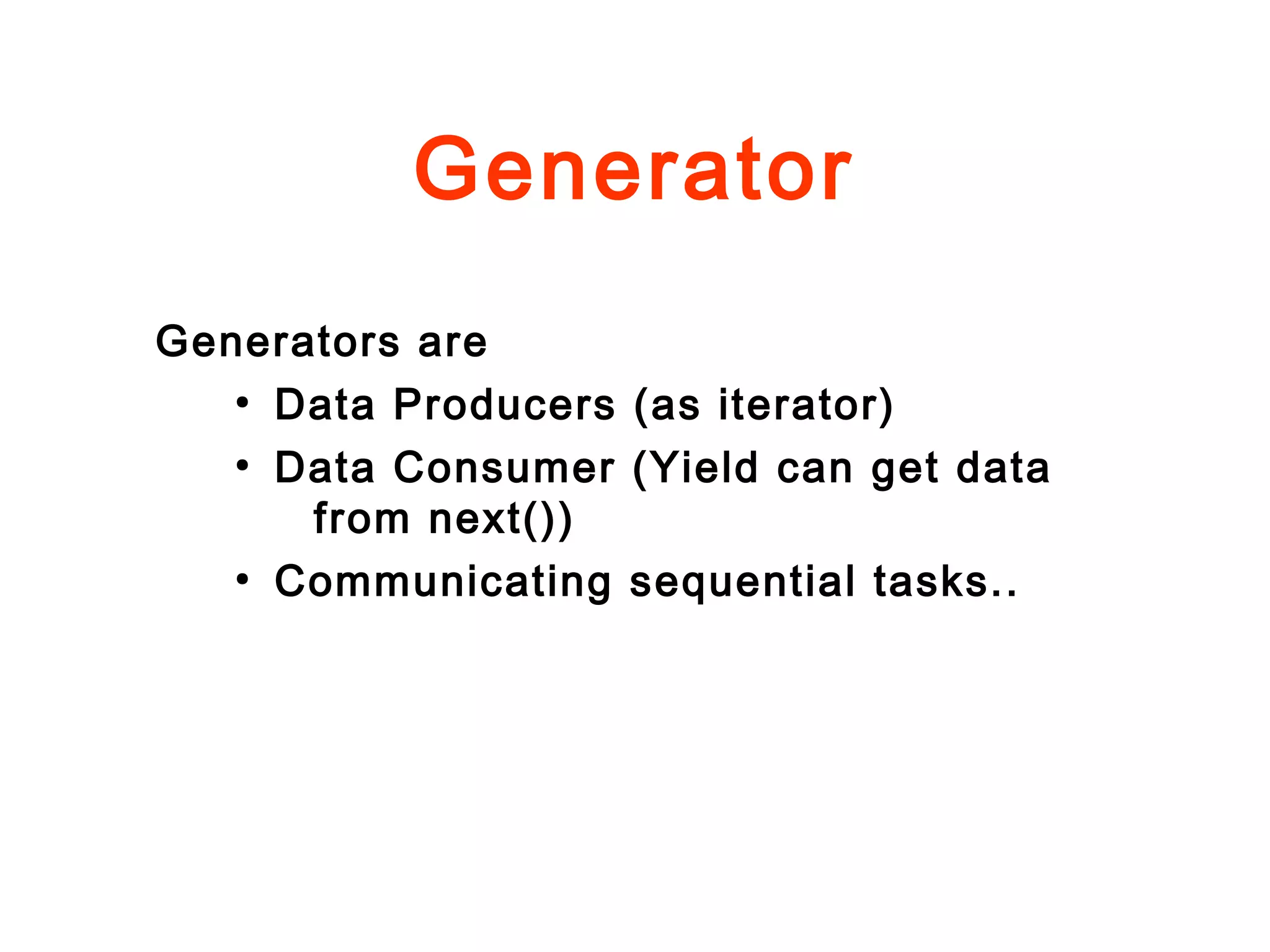
Generators are
●
Data Producers (as iterator)
●
Data Consumer (Yield can get data
from next())
●
Communicating sequential tasks..
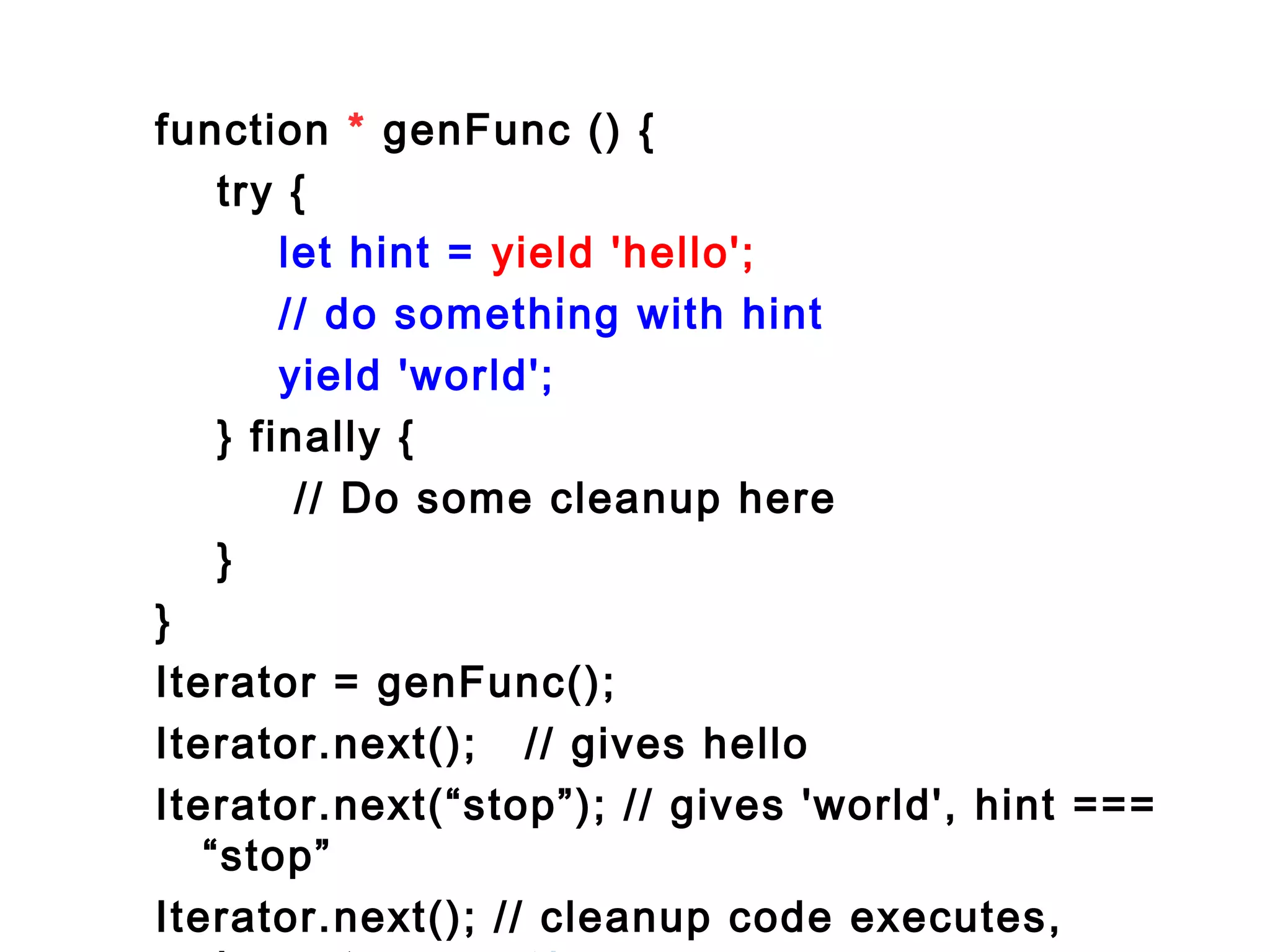
function * genFunc () {
try {
let hint = yield 'hello';
// do something with hint
yield 'world';
} finally {
// Do some cleanup here
}
}
Iterator = genFunc();
Iterator.next(); // gives hello
Iterator.next(“stop”); // gives 'world', hint ===
“stop”
Iterator.next(); // cleanup code executes,
Promise
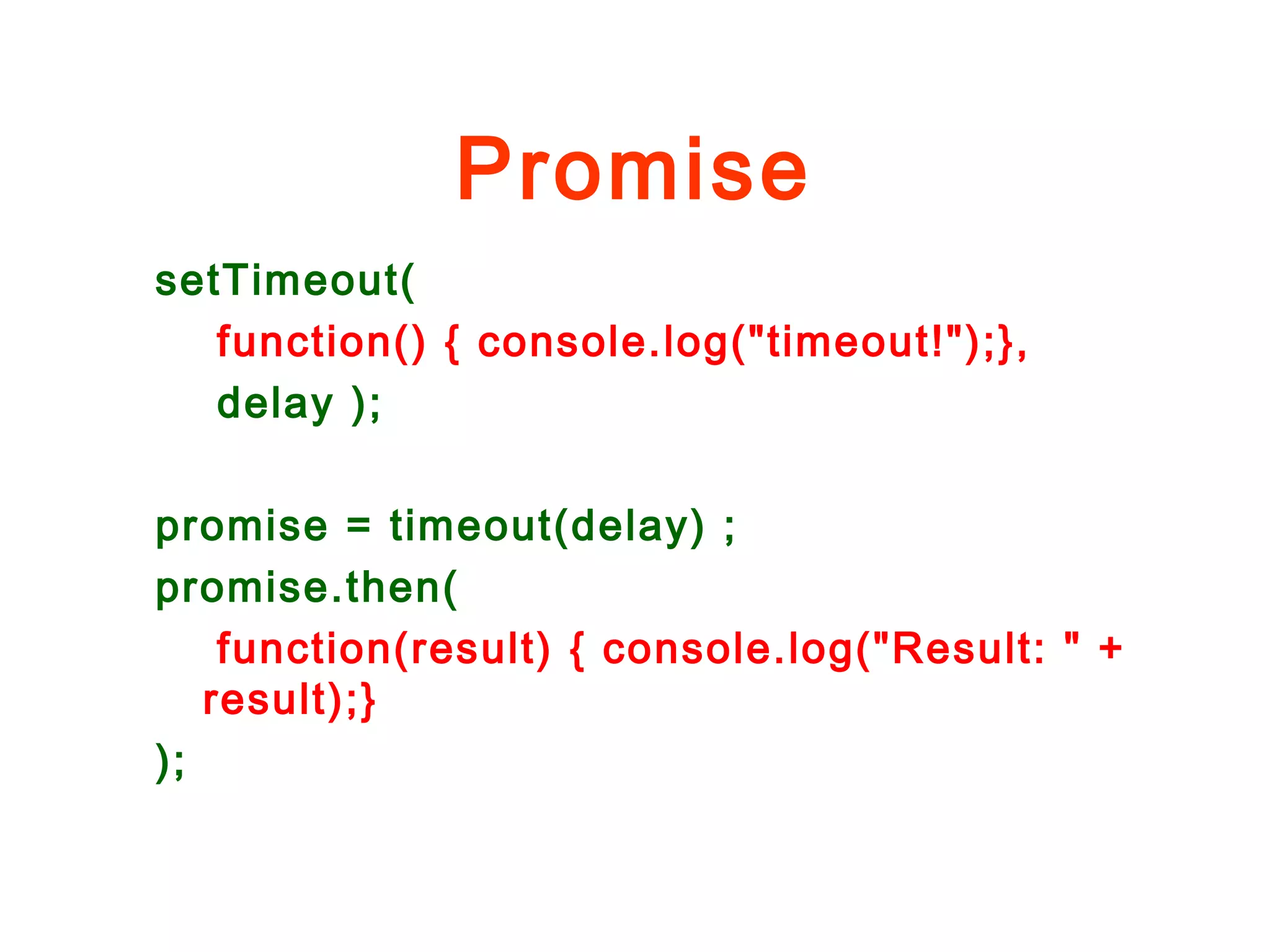
setTimeout(
function() { console.log("timeout!");},
delay );
promise = timeout(delay) ;
promise.then(
function(result) { console.log("Result: " +
result);}
);
Promise
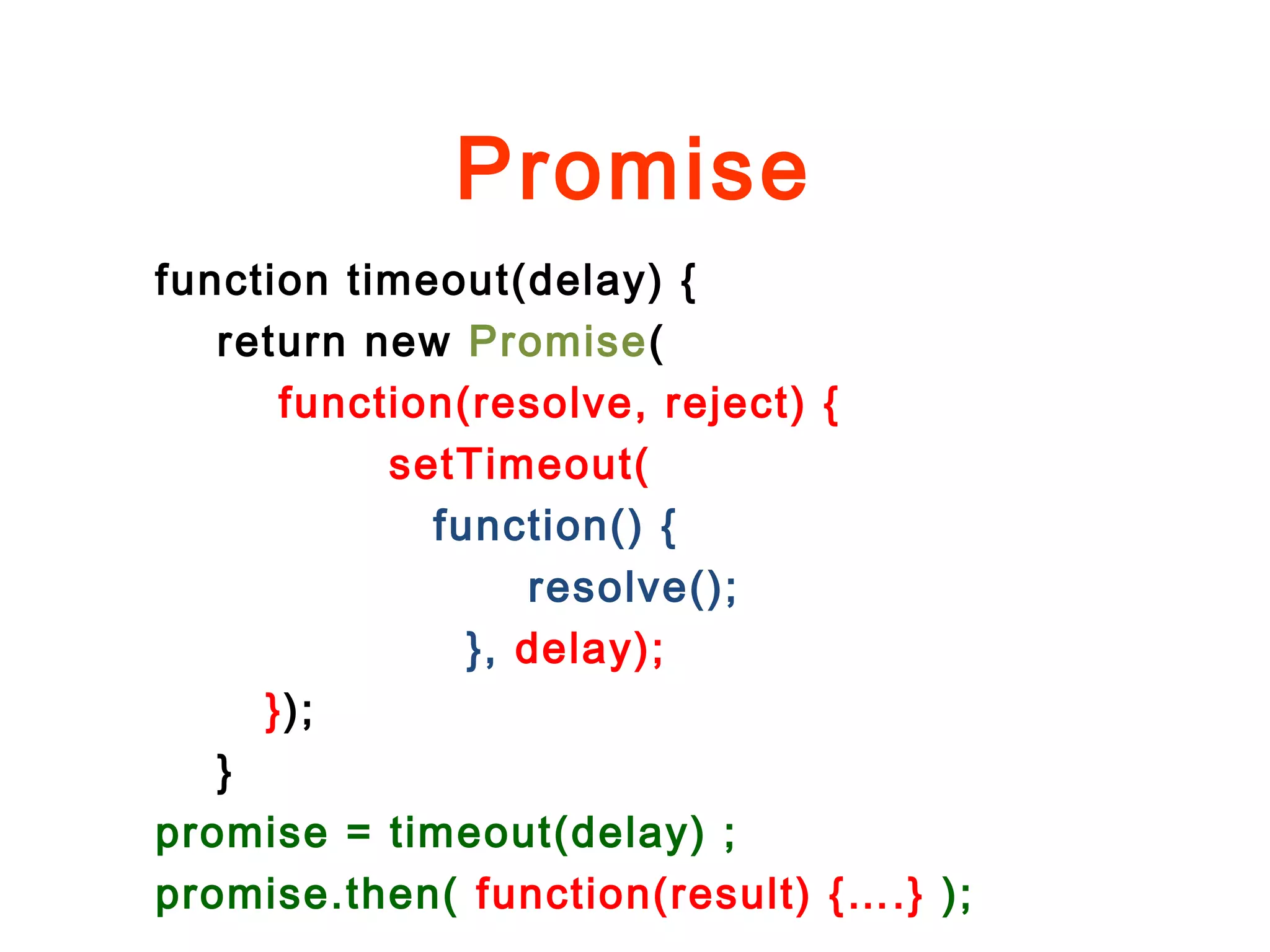
function timeout(delay) {
return new Promise(
function(resolve, reject) {
setTimeout(
function() {
resolve();
}, delay);
});
}
promise = timeout(delay) ;
promise.then( function(result) {….} );
Promise
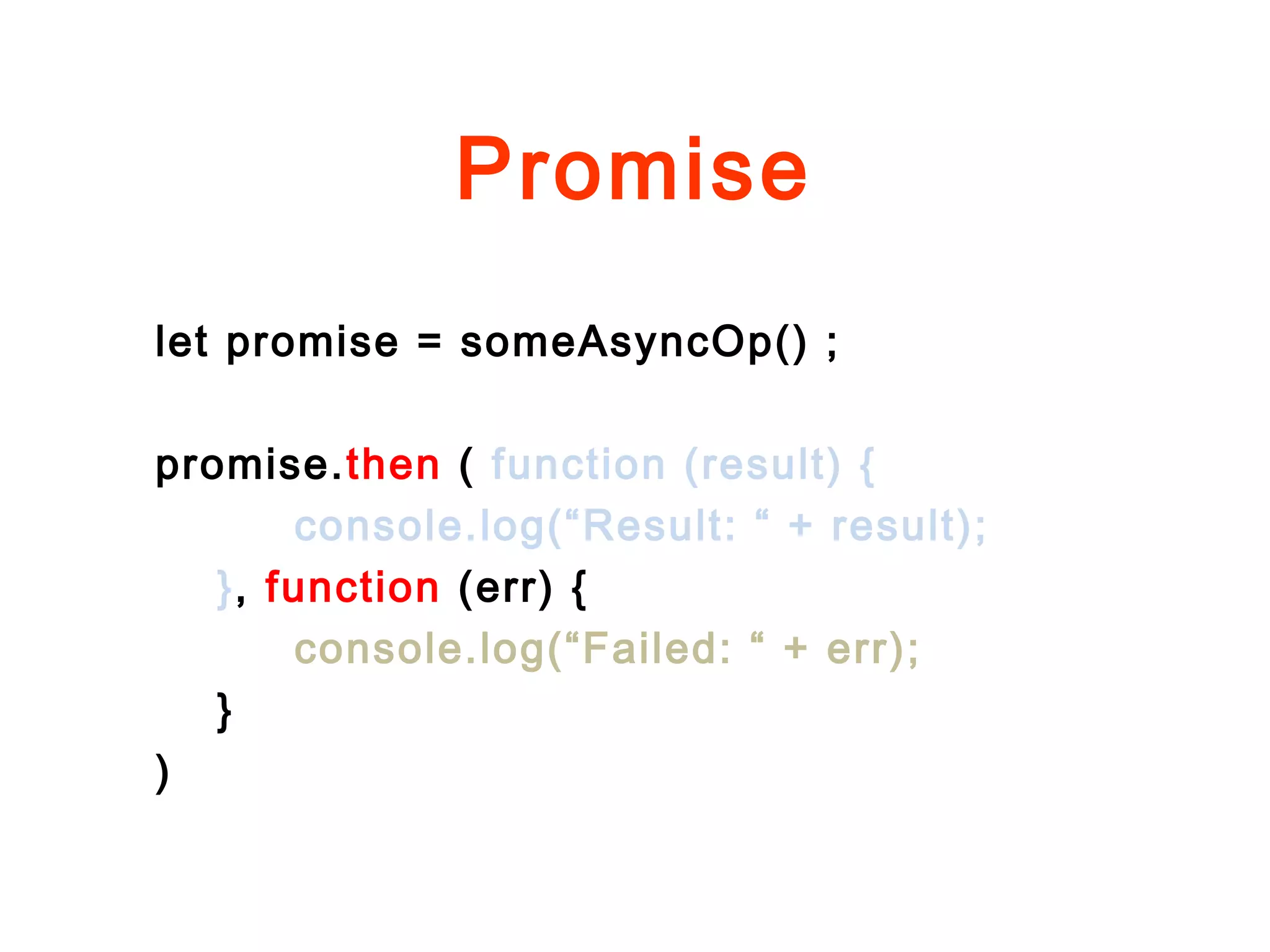
let promise = someAsyncOp() ;
promise.then ( function (result) {
console.log(“Result: “ + result);
}, function (err) {
console.log(“Failed: “ + err);
}
)
Promise
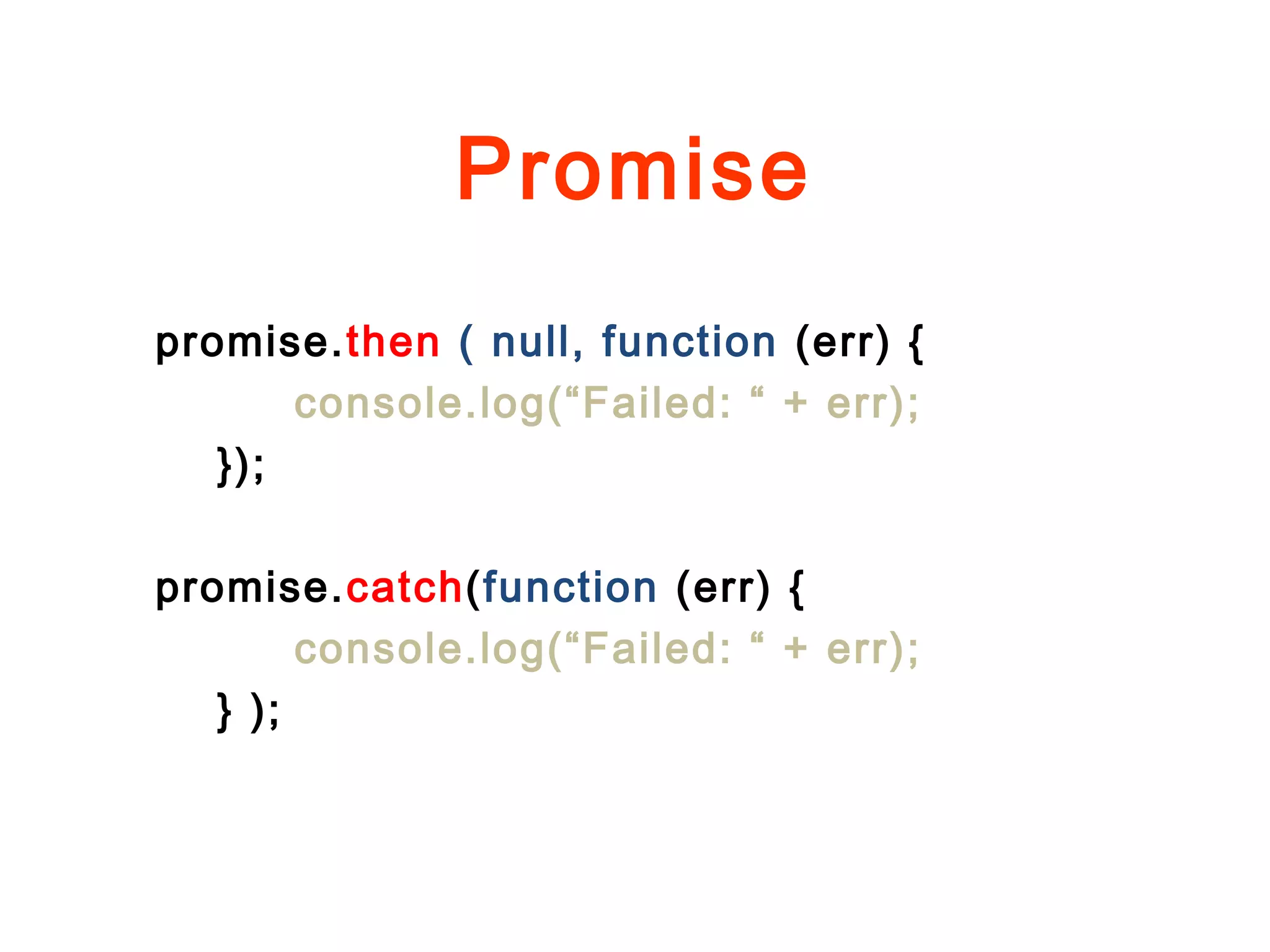
promise.then ( null, function (err) {
console.log(“Failed: “ + err);
});
promise.catch(function (err) {
console.log(“Failed: “ + err);
} );
Promise
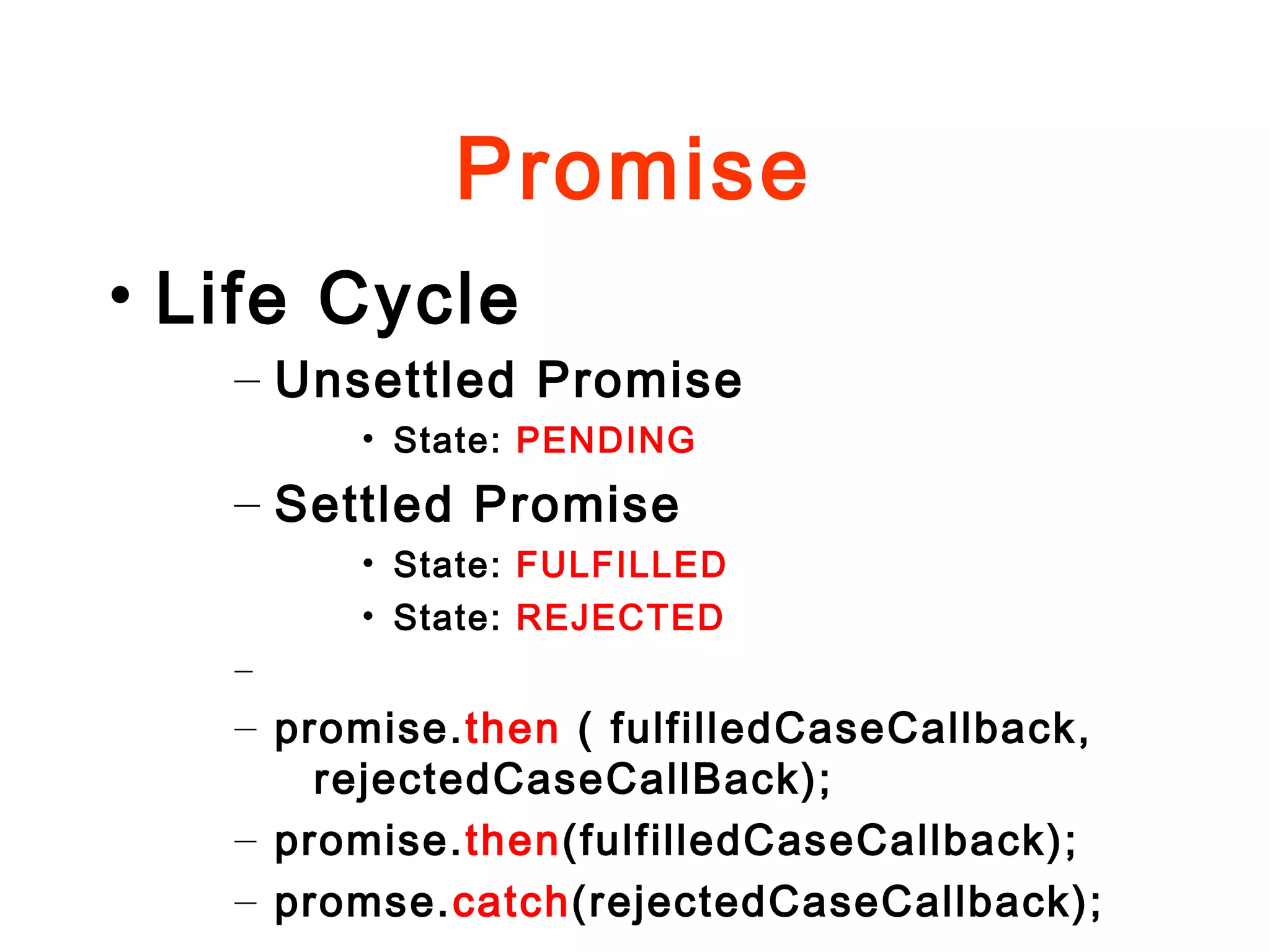
• Life Cycle
– Unsettled Promise
• State: PENDING
– Settled Promise
• State: FULFILLED
• State: REJECTED
–
– promise.then ( fulfilledCaseCallback,
rejectedCaseCallBack);
– promise.then(fulfilledCaseCallback);
– promse.catch(rejectedCaseCallback);
Promise
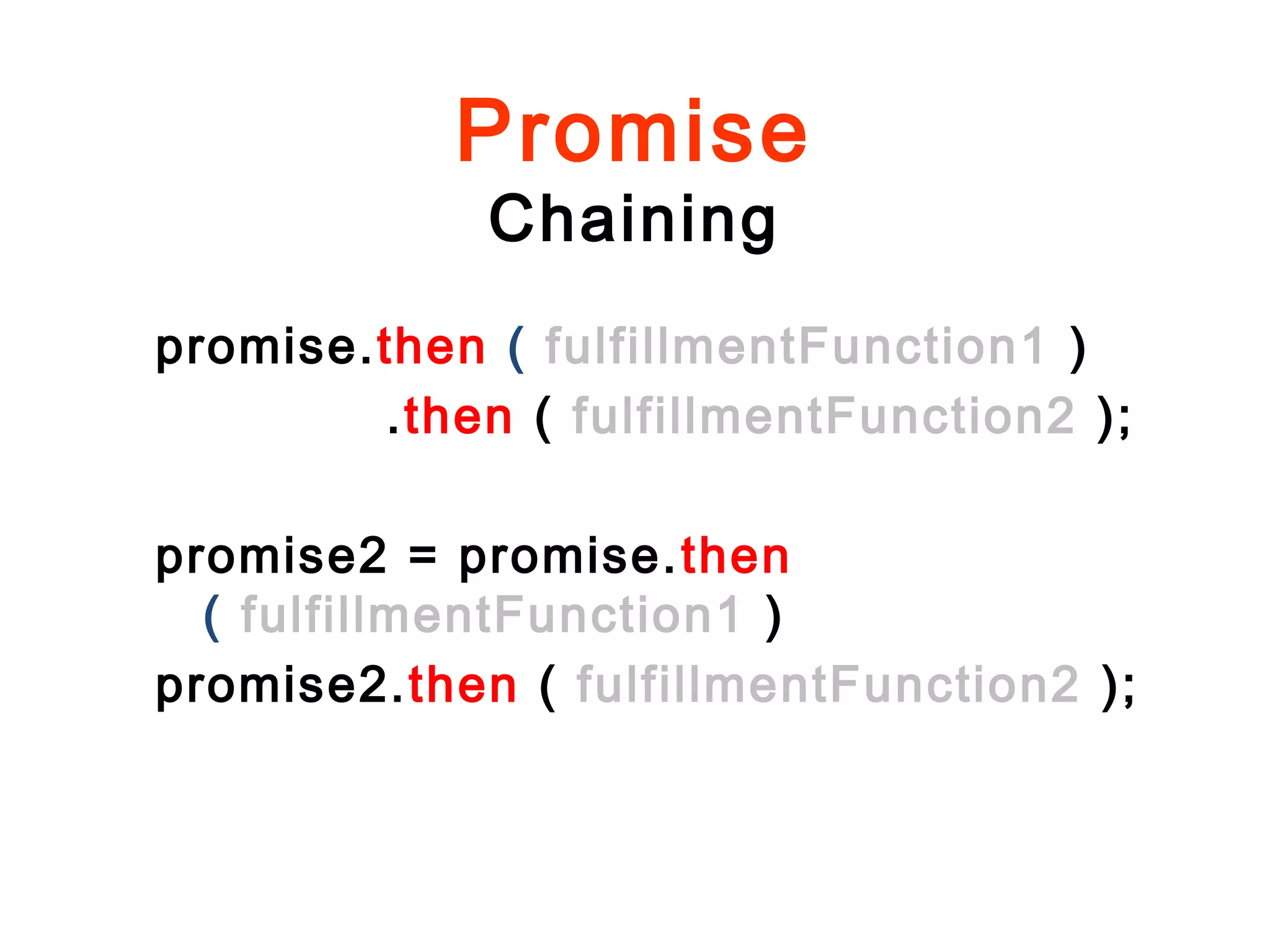
Chaining
promise.then ( fulfillmentFunction1 )
.then ( fulfillmentFunction2 );
promise2 = promise.then
( fulfillmentFunction1 )
promise2.then ( fulfillmentFunction2 );
Promise
Promise.all([promise1, promise2])
.then(function(results) {
// Both resolved
})
.catch(function(error) {
// One rejected
});
Promise
Promise.race([promise1, promise2])
.then(function(results) {
// one got resolved
})
.catch(function(error) {
// First settlement was in rejection
});
<eot/>
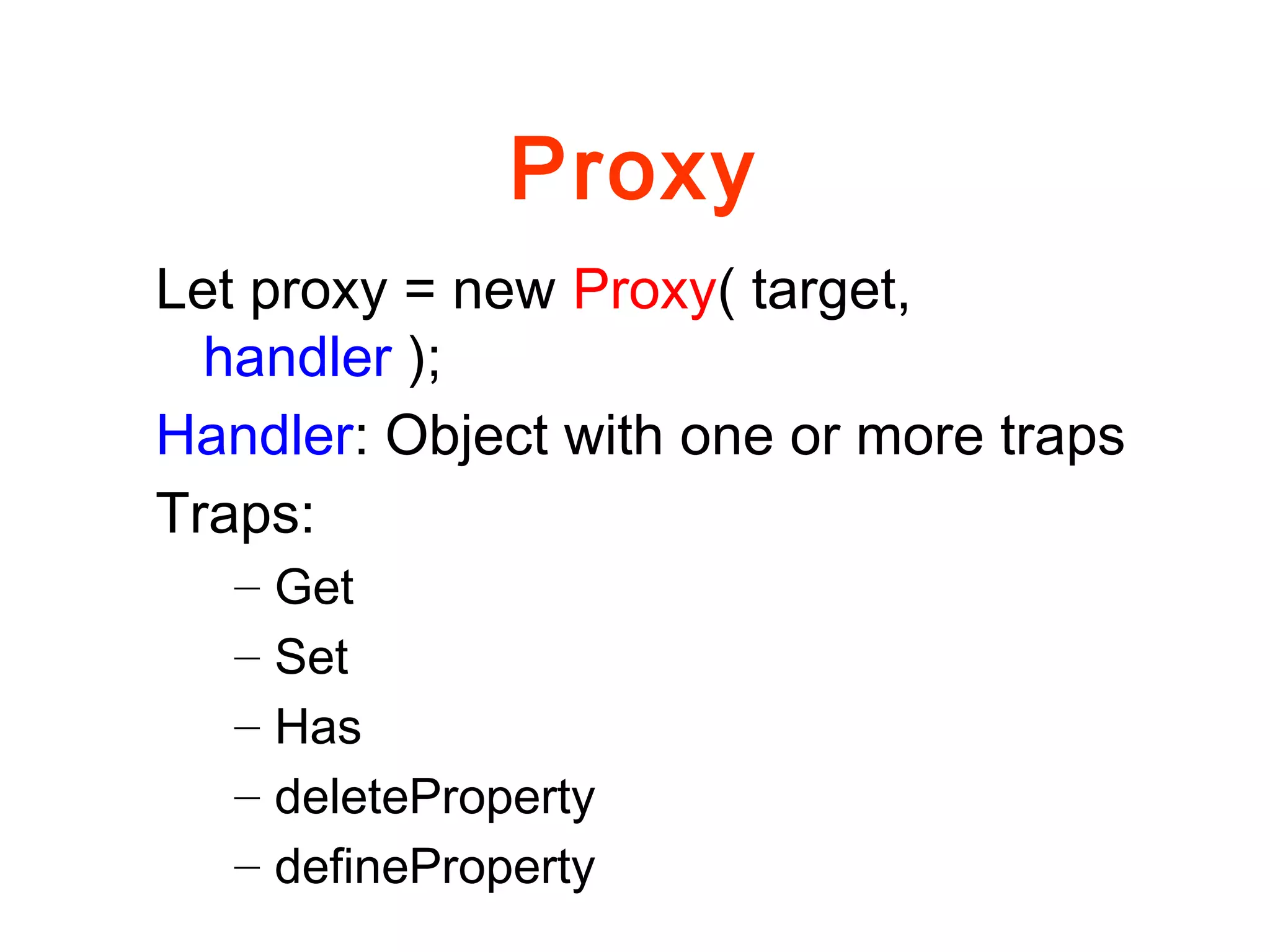
Proxy
Let proxy = new Proxy( target,
handler );
Handler: Object with one or more traps
Traps:
– Get
– Set
– Has
– deleteProperty
– defineProperty
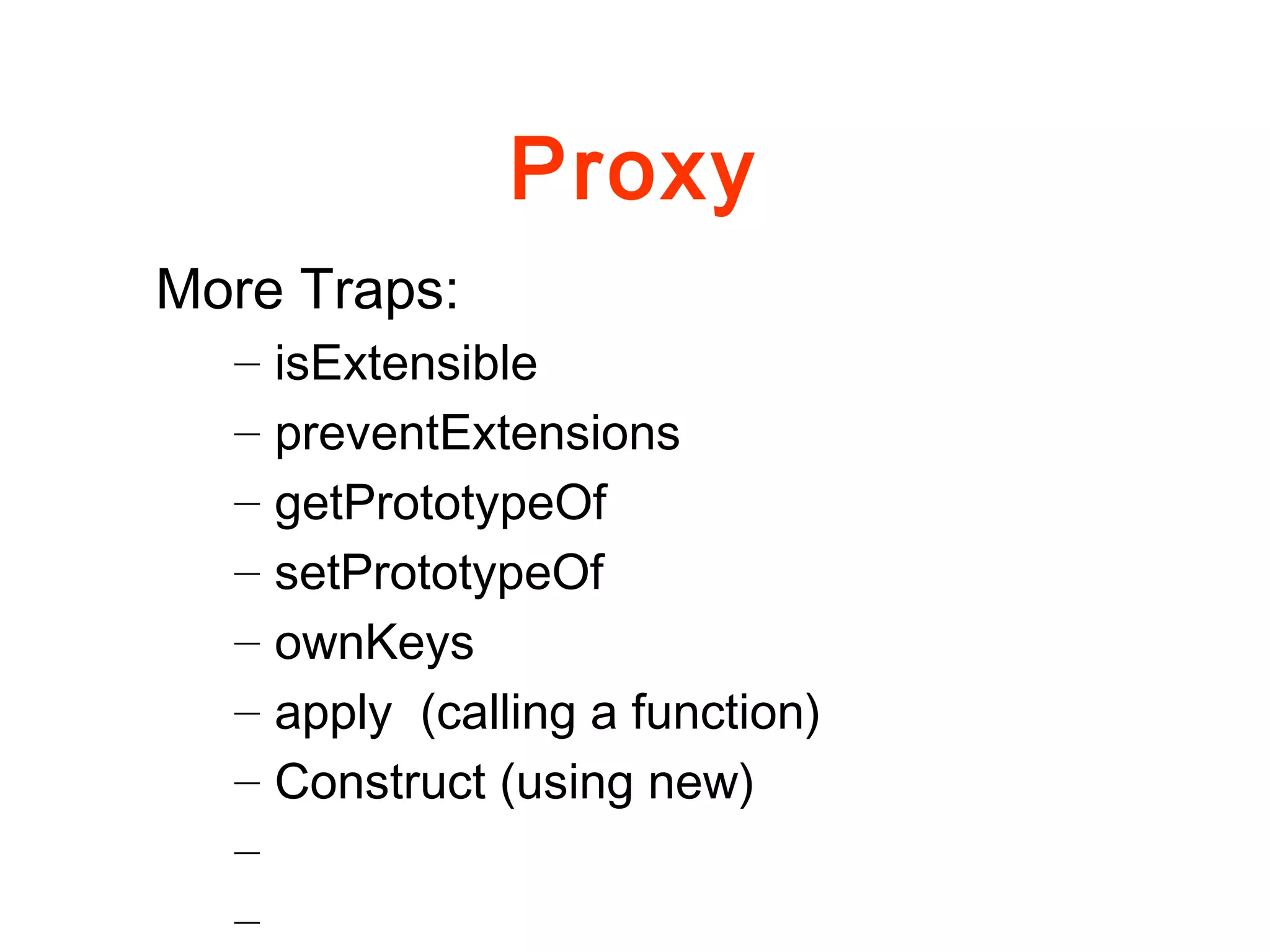
Proxy
More Traps:
– isExtensible
– preventExtensions
– getPrototypeOf
– setPrototypeOf
– ownKeys
– apply (calling a function)
– Construct (using new)
–
–
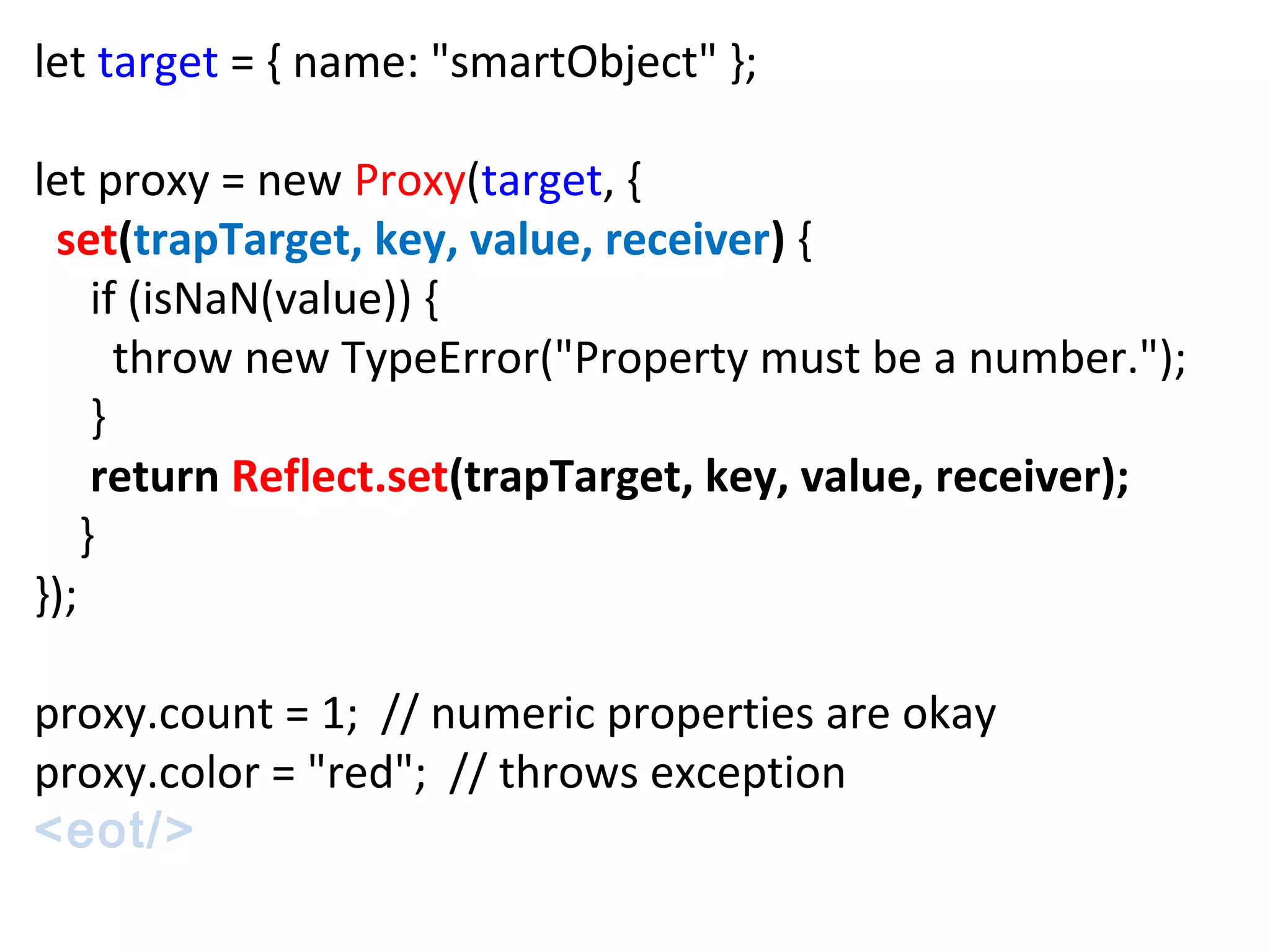
let target = { name: "smartObject" };
let proxy = new Proxy(target, {
set(trapTarget, key, value, receiver) {
if (isNaN(value)) {
throw new TypeError("Property must be a number.");
}
return Reflect.set(trapTarget, key, value, receiver);
}
});
proxy.count = 1; // numeric properties are okay
proxy.color = "red"; // throws exception
<eot/>
References
• ecmascript 6 compatibility table
– https://kangax.github.io/compat-table/es6/
• http://exploringjs.com/es6/index.html
– Thanks to the author for tons of examples!
• leanpub.com/understandinges6
• JavaScript: The Good Parts
– Douglas Crockford
• Effective JavaScript
Thank You!
Please provide your feedback :)
Feedback from earlier sessions:
Speaker started with the concepts that were
way too simple and then at the end it became
way too complex.
Slides from Older Presentations
•You may not find things in sequence in rest
of the slides
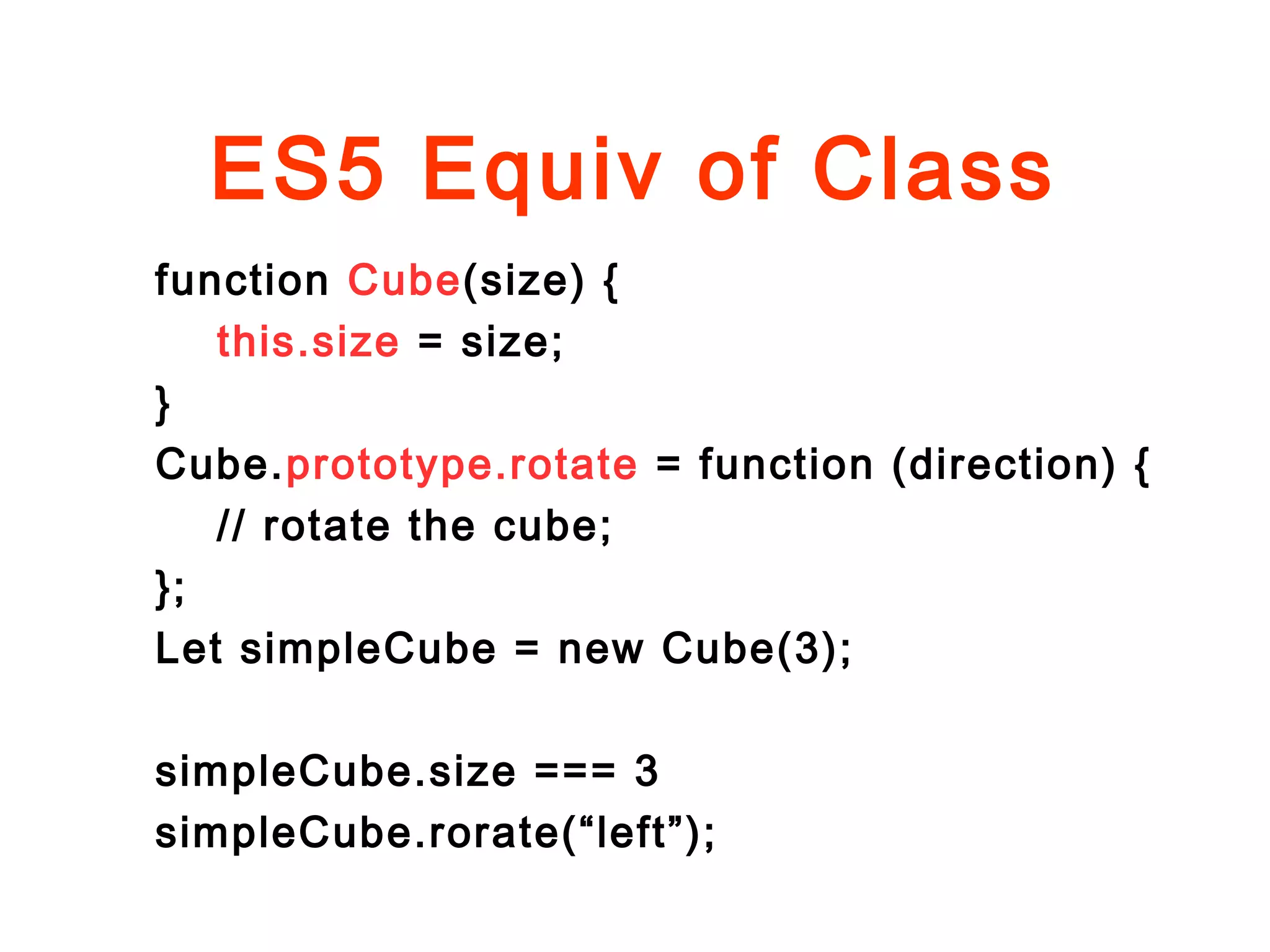
ES5 Equiv of Class
function Cube(size) {
this.size = size;
}
Cube.prototype.rotate = function (direction) {
// rotate the cube;
};
Let simpleCube = new Cube(3);
simpleCube.size === 3
simpleCube.rorate(“left”);
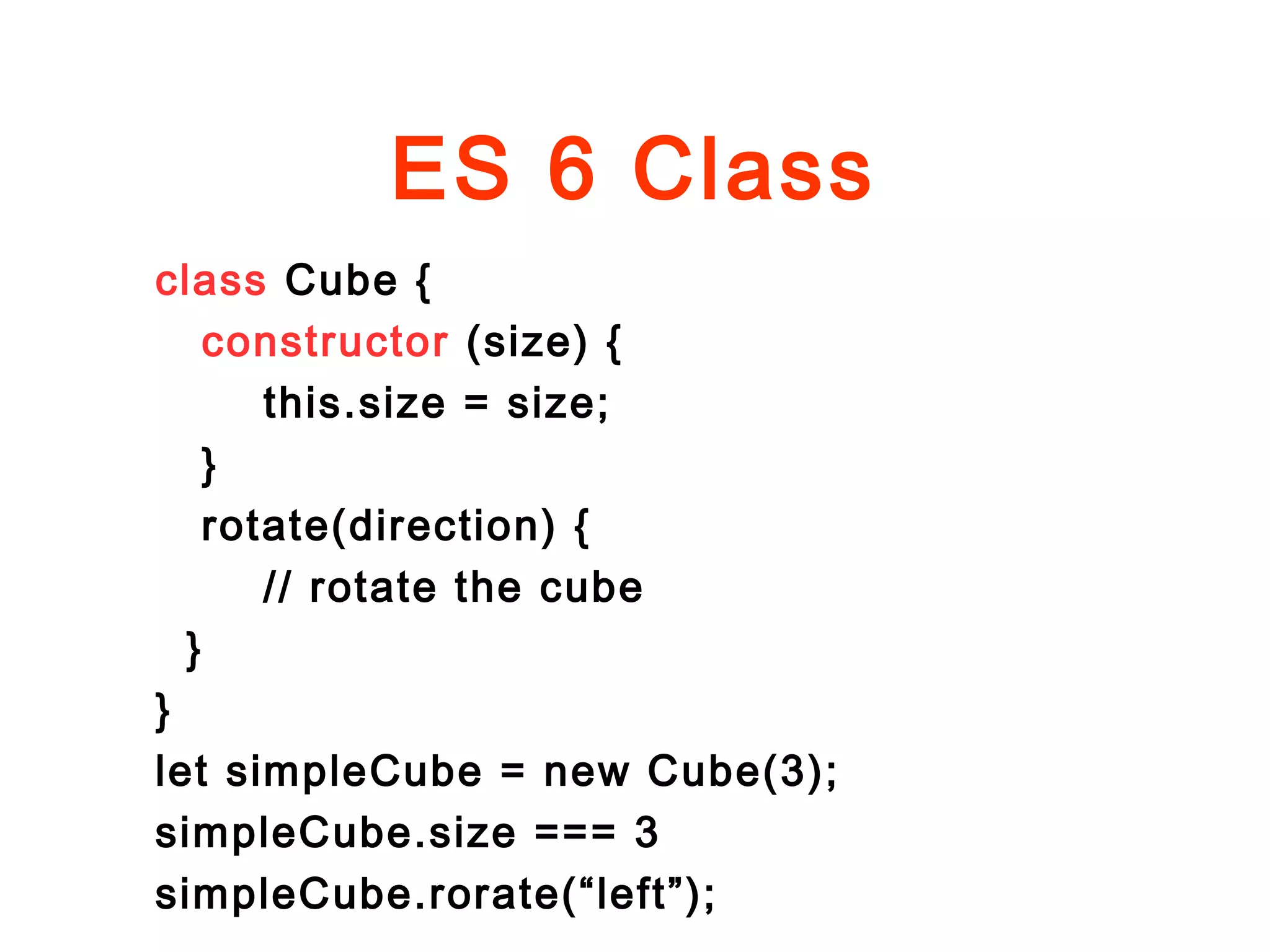
ES 6 Class
class Cube {
constructor (size) {
this.size = size;
}
rotate(direction) {
// rotate the cube
}
}
let simpleCube = new Cube(3);
simpleCube.size === 3
simpleCube.rorate(“left”);
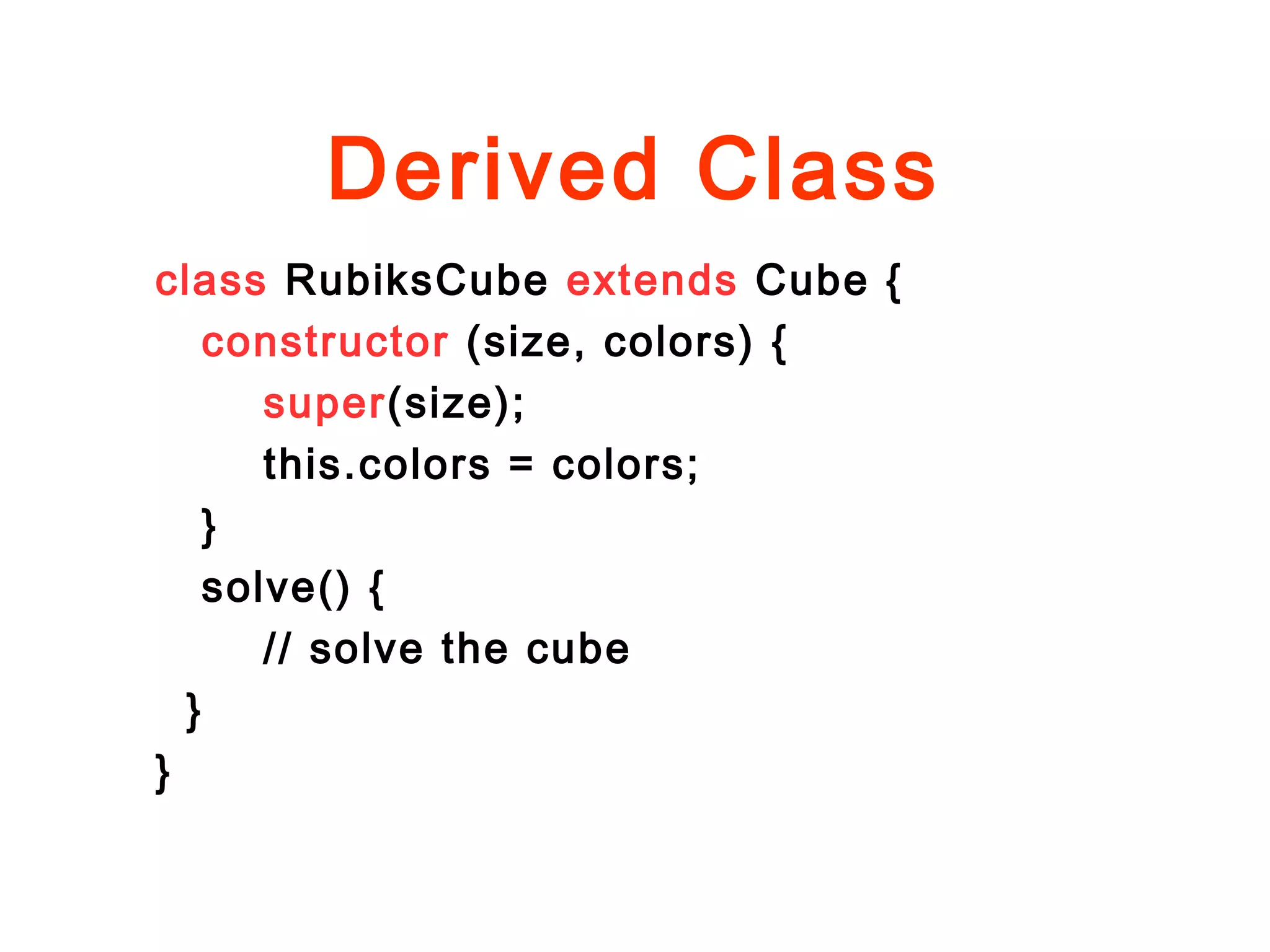
Derived Class
class RubiksCube extends Cube {
constructor (size, colors) {
super(size);
this.colors = colors;
}
solve() {
// solve the cube
}
}
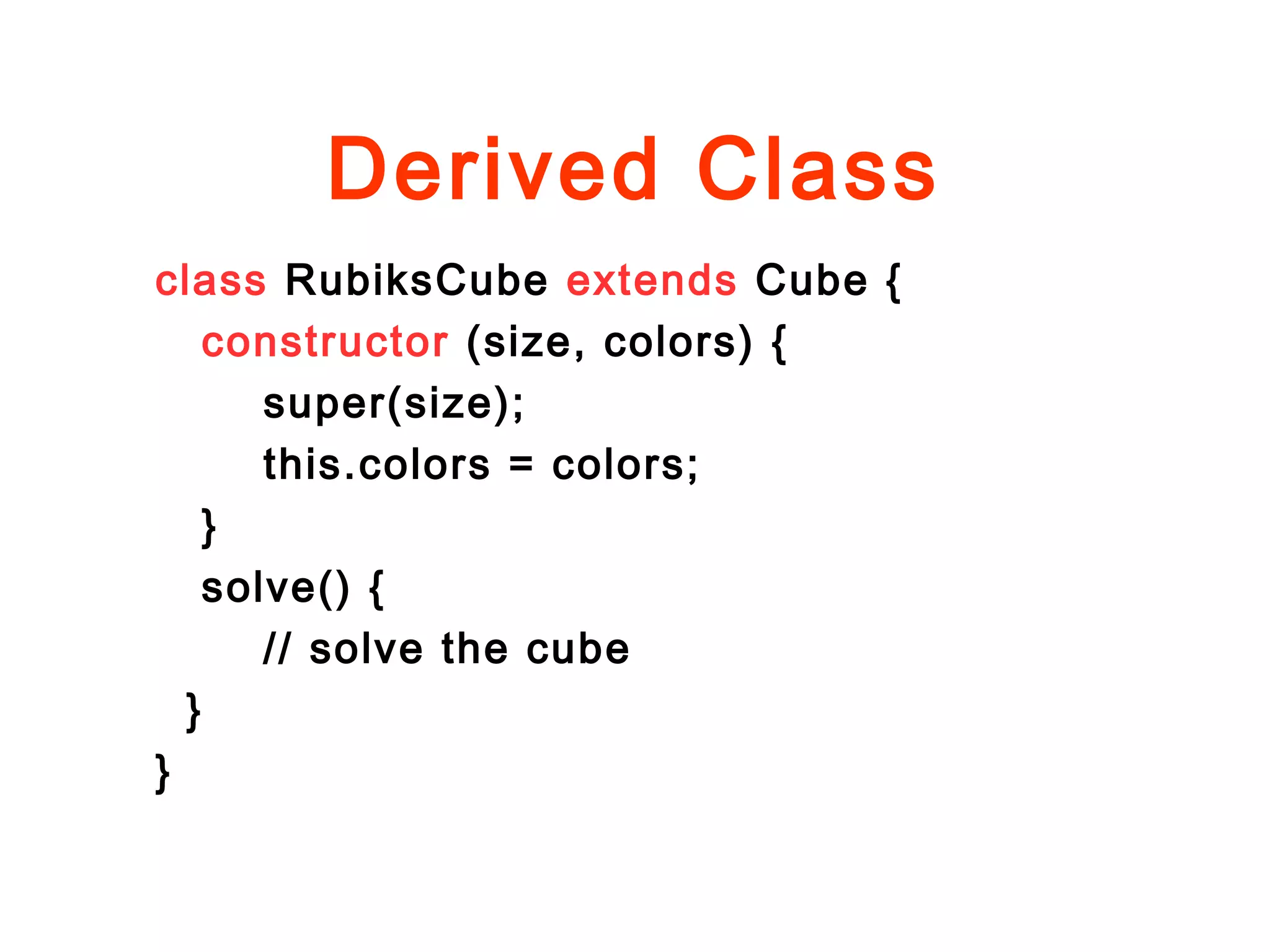
Derived Class
class RubiksCube extends Cube {
constructor (size, colors) {
super(size);
this.colors = colors;
}
solve() {
// solve the cube
}
}
class BinaryTree {
constructor(value, left=null, right=null) {
this.value = value;
this.left = left;
this.right = right;
}
* [ Symbol.iterator ] ( ) {
yield this.value;
If ( this.left ) {
yield* this.left;
}
If ( this.right ) {
yield* this.right;
}
}
}
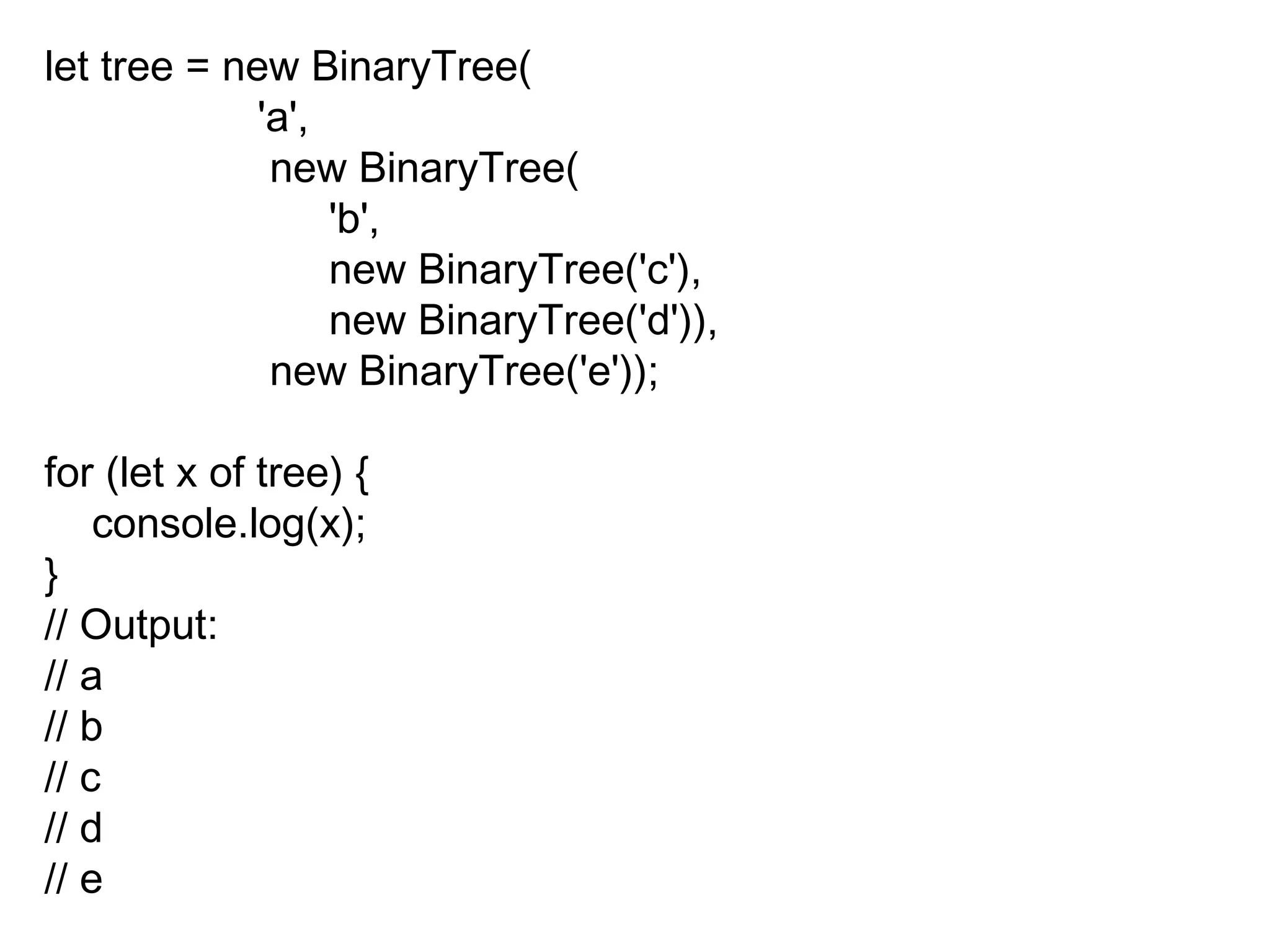
let tree = new BinaryTree(
'a',
new BinaryTree(
'b',
new BinaryTree('c'),
new BinaryTree('d')),
new BinaryTree('e'));
for (let x of tree) {
console.log(x);
}
// Output:
// a
// b
// c
// d
// e
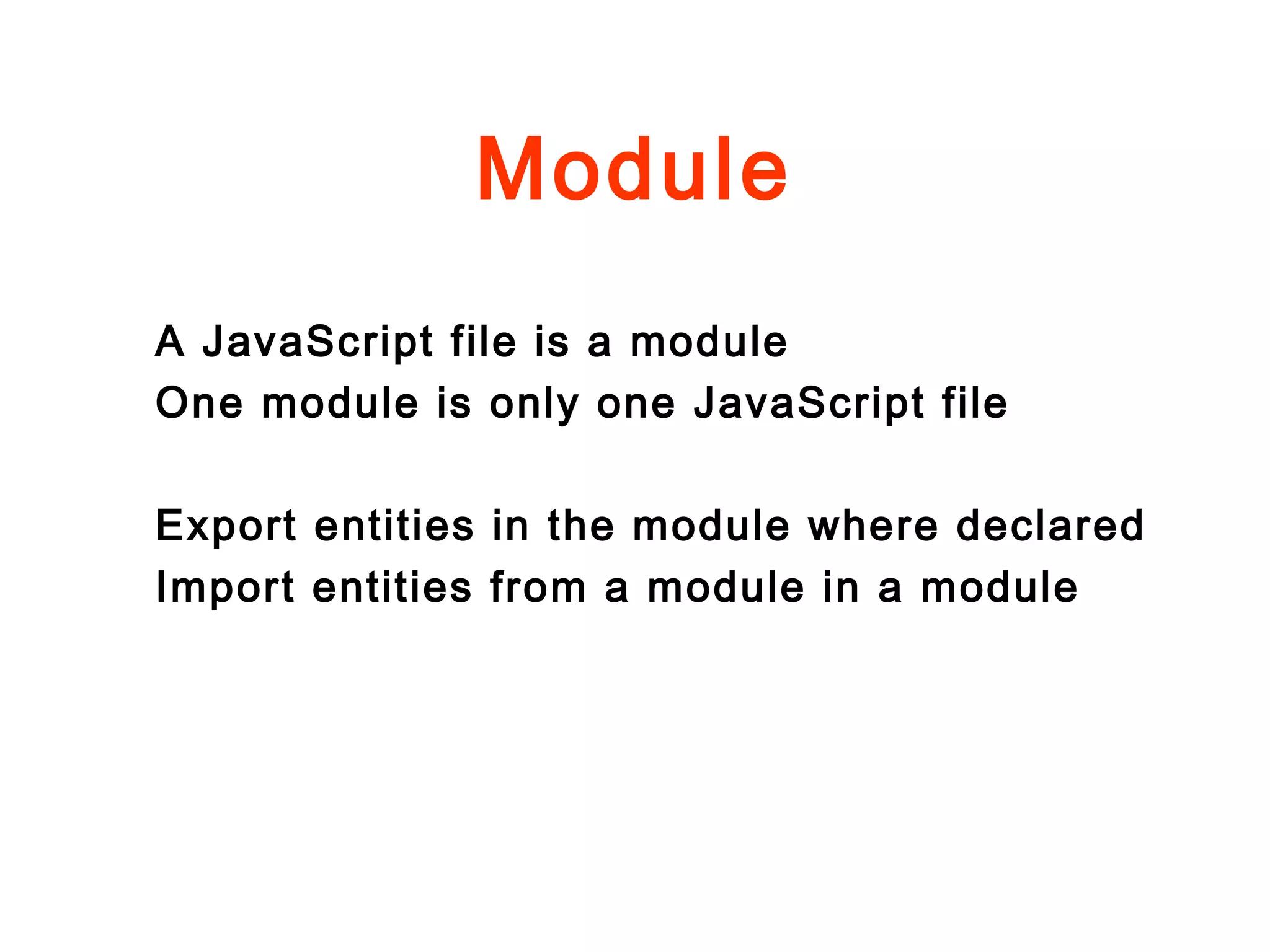
Module
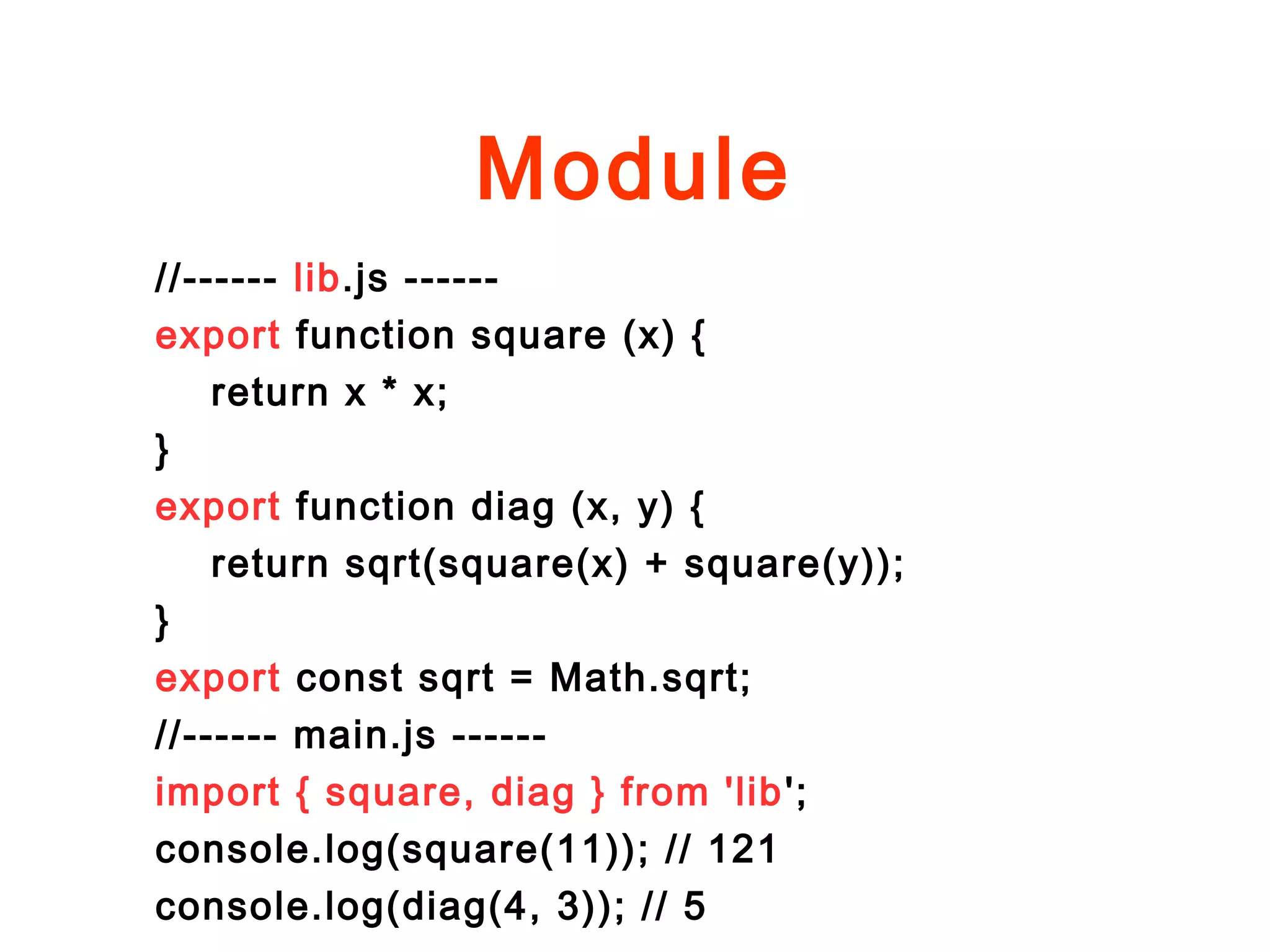
A JavaScript file is a module
One module is only one JavaScript file
Export entities in the module where declared
Import entities from a module in a module
Module
//------ lib.js ------
export function square (x) {
return x * x;
}
export function diag (x, y) {
return sqrt(square(x) + square(y));
}
export const sqrt = Math.sqrt;
//------ main.js ------
import { square, diag } from 'lib';
console.log(square(11)); // 121
console.log(diag(4, 3)); // 5
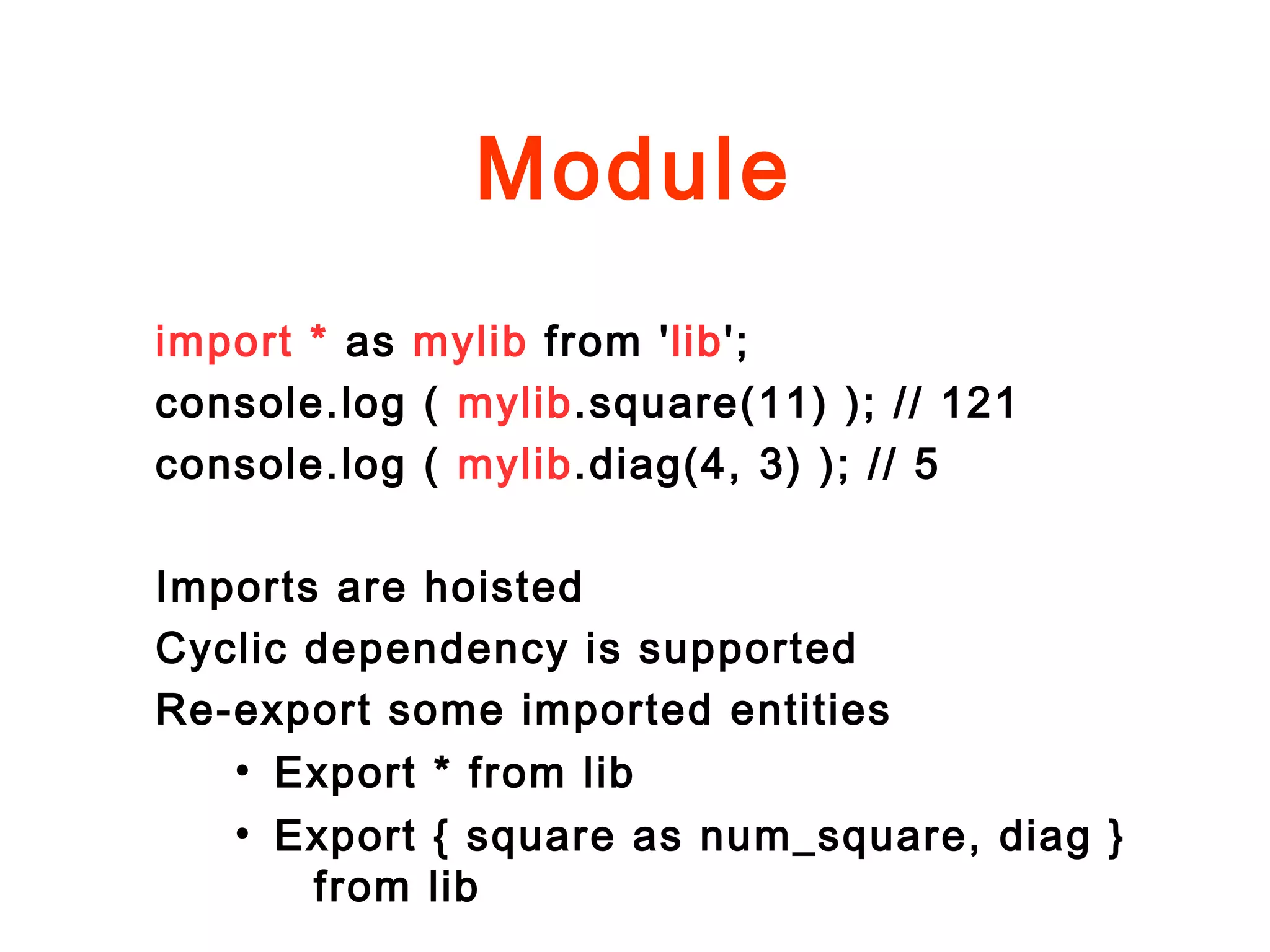
Module
import * as mylib from 'lib';
console.log ( mylib.square(11) ); // 121
console.log ( mylib.diag(4, 3) ); // 5
Imports are hoisted
Cyclic dependency is supported
Re-export some imported entities
●
Export * from lib
●
Export { square as num_square, diag }
from lib
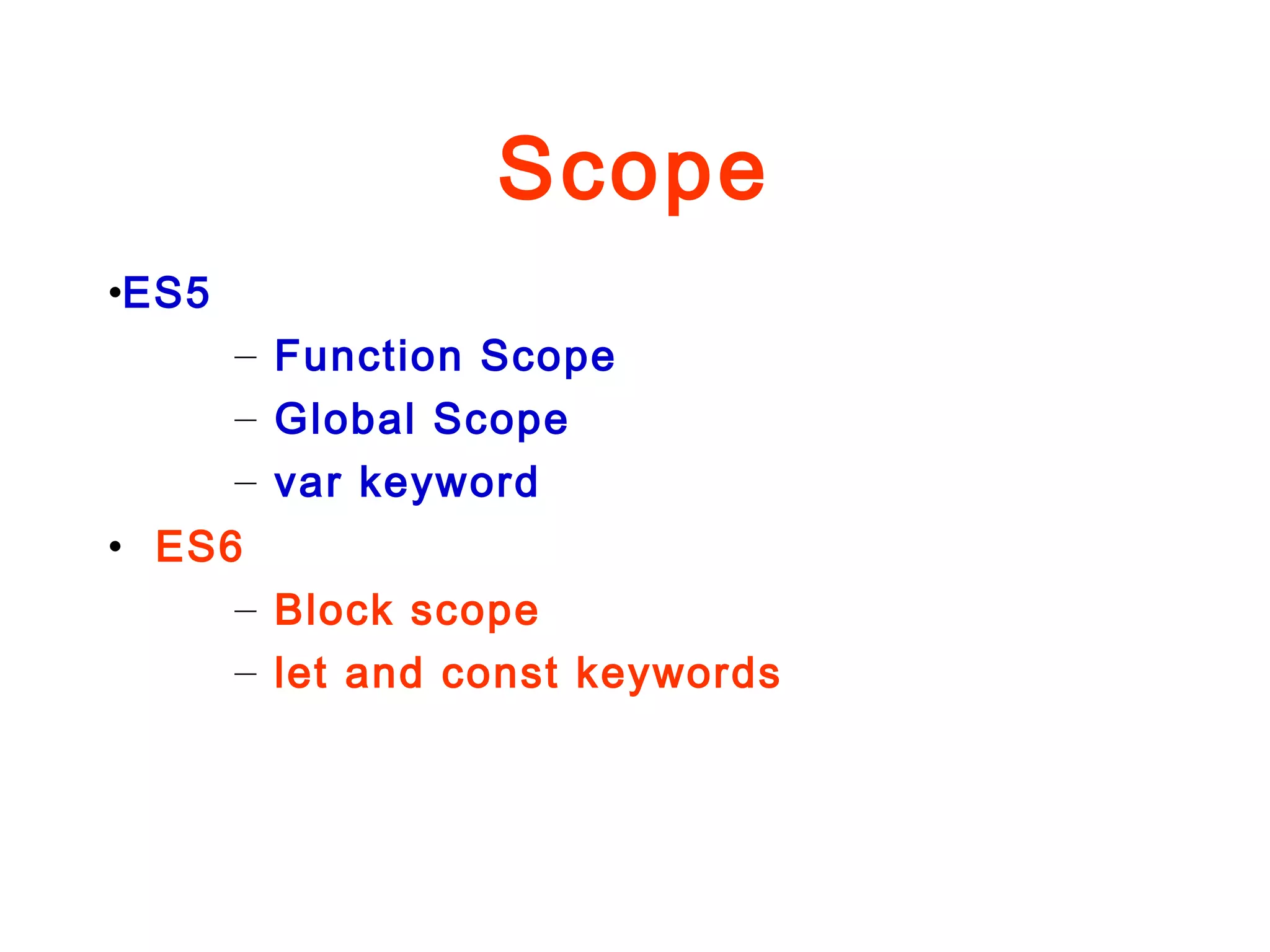
Scope
•ES5
– Function Scope
– Global Scope
– var keyword
• ES6
– Block scope
– let and const keywords
Scope of a Variable
(ES 6)●
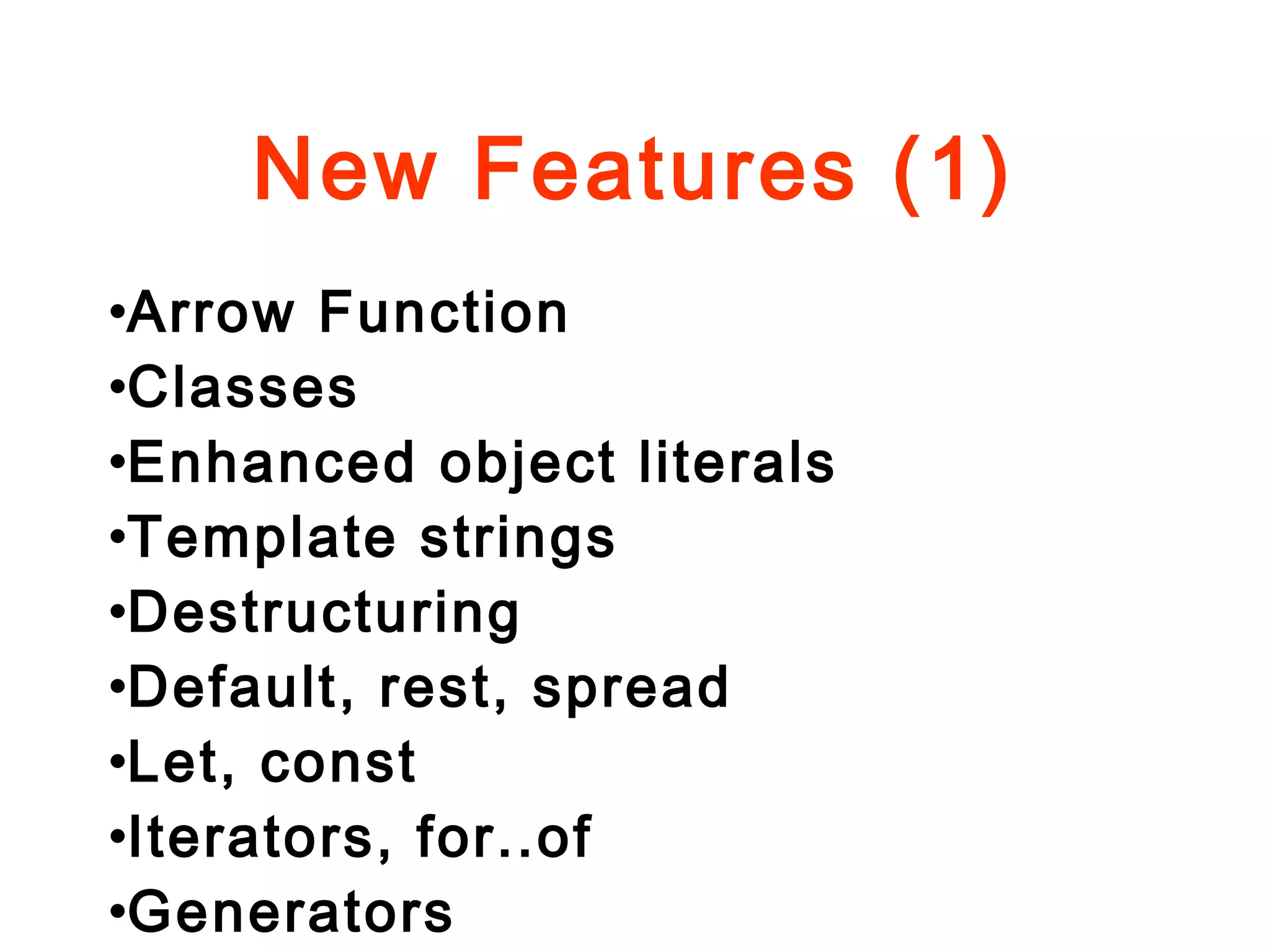
New Features (1)
•Arrow Function
•Classes
•Enhanced object literals
•Template strings
•Destructuring
•Default, rest, spread
•Let, const
•Iterators, for..of
•Generators
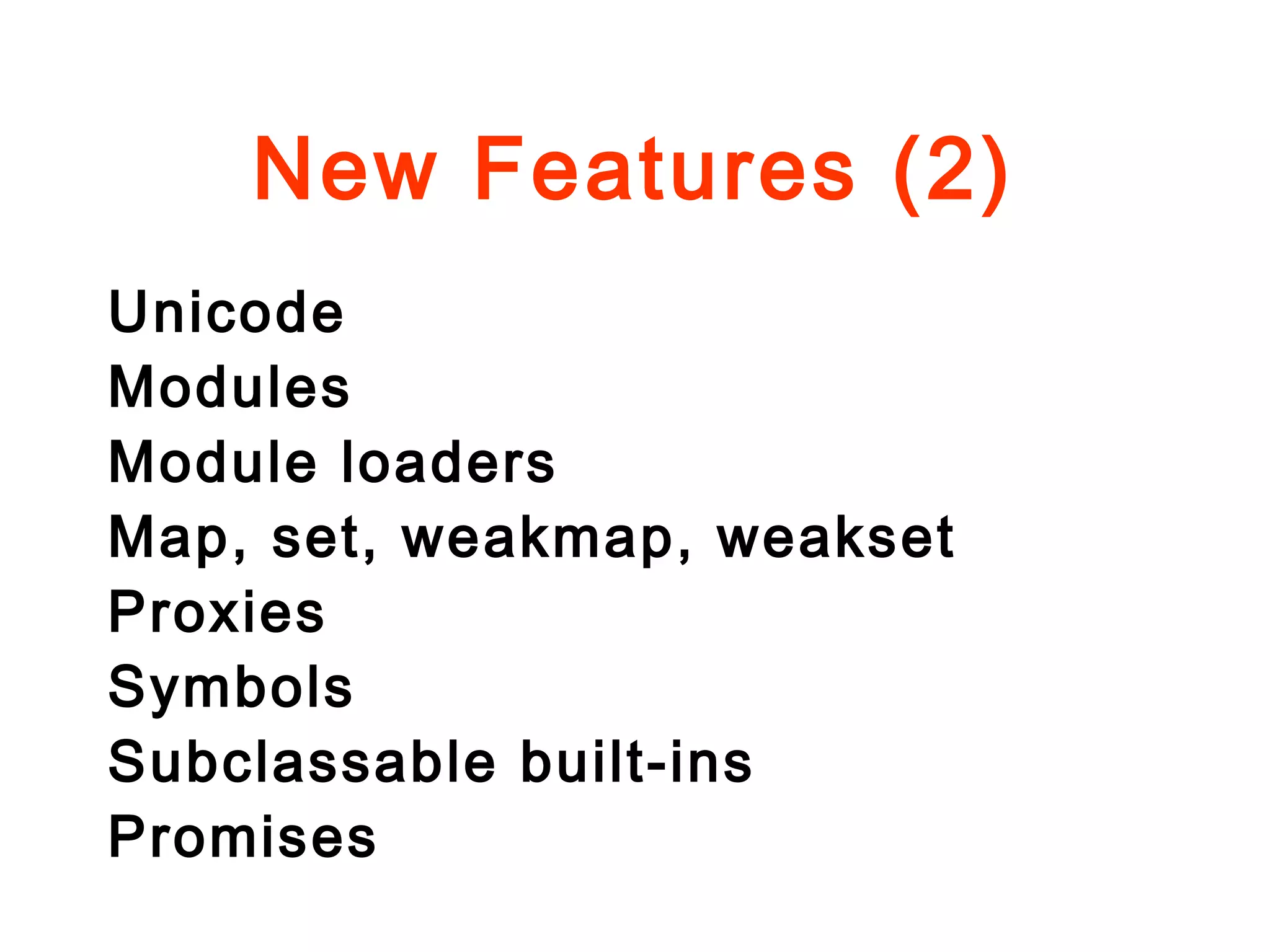
New Features (2)
Unicode
Modules
Module loaders
Map, set, weakmap, weakset
Proxies
Symbols
Subclassable built-ins
Promises
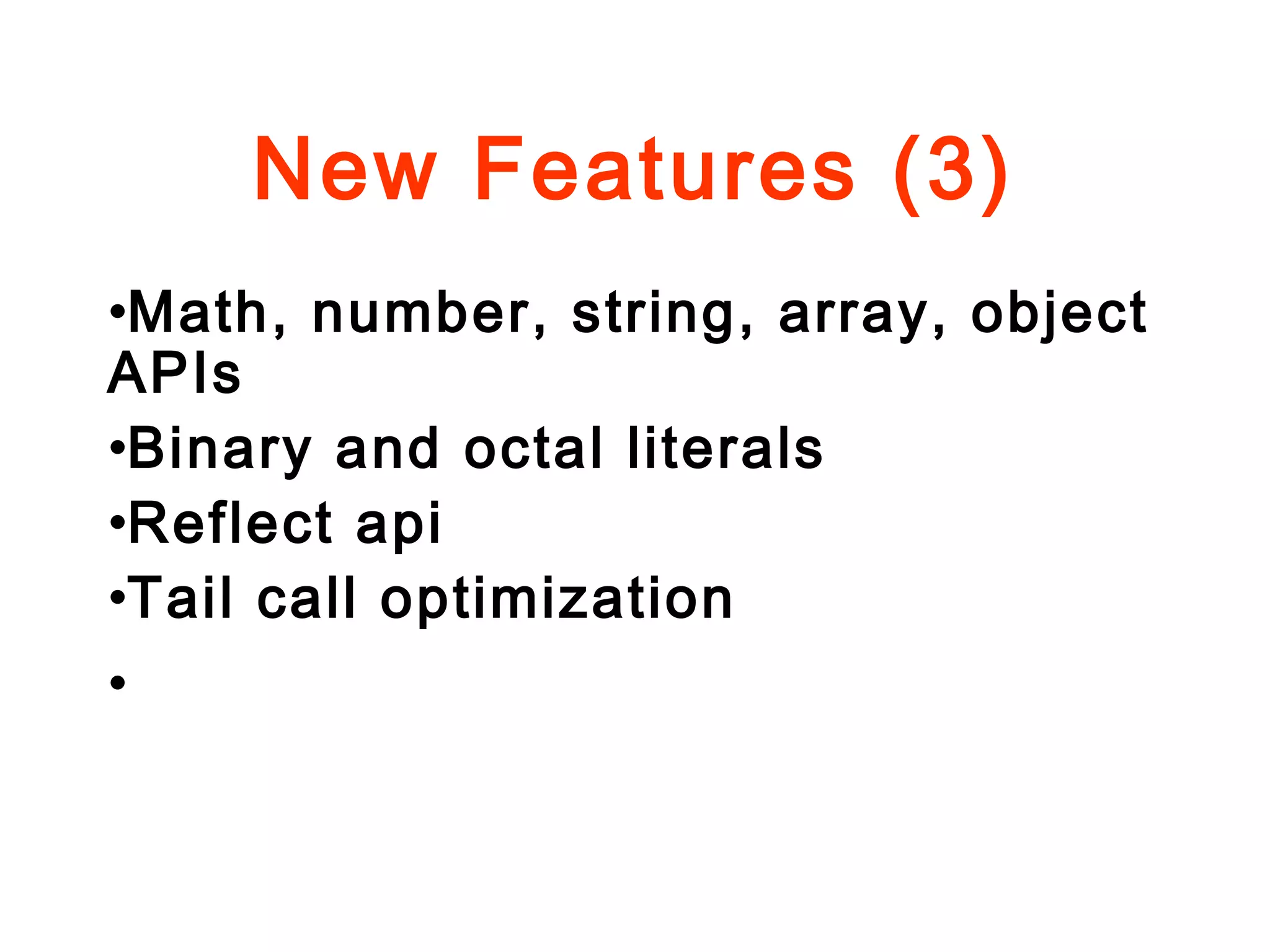
New Features (3)
•Math, number, string, array, object
APIs
•Binary and octal literals
•Reflect api
•Tail call optimization
•
Silicon Valley Code Camp
2014
Learn JavaScript
by
Modeling Rubik’s Cube
Manoj Kumar
Agenda
•Scripting Language
•Crash course in Rubik’s Cube
•Code Walk-through
•Modeling
•Finding moves
Scripting Language
•Is a Programming Language
–To manipulate
–To customize
–To automate
–an existing system
•ECMAScript
–Web Scripting Language
–To work with web browser
ECMA Script
•Object Based
–Object: Collection of properties
– Property
• Type : Number, Boolean, String, Array,
Function & other objects
• Attributes
•Value, Writable, Configurable, Enumerable
•Functional
•Based on
–Java, C
–Self (Prototype)
–Scheme (Functional)
Types
•Primitive Value Types
–Number
–String
–Boolean
–Null
–Undefined
•Object
•Array
•Function
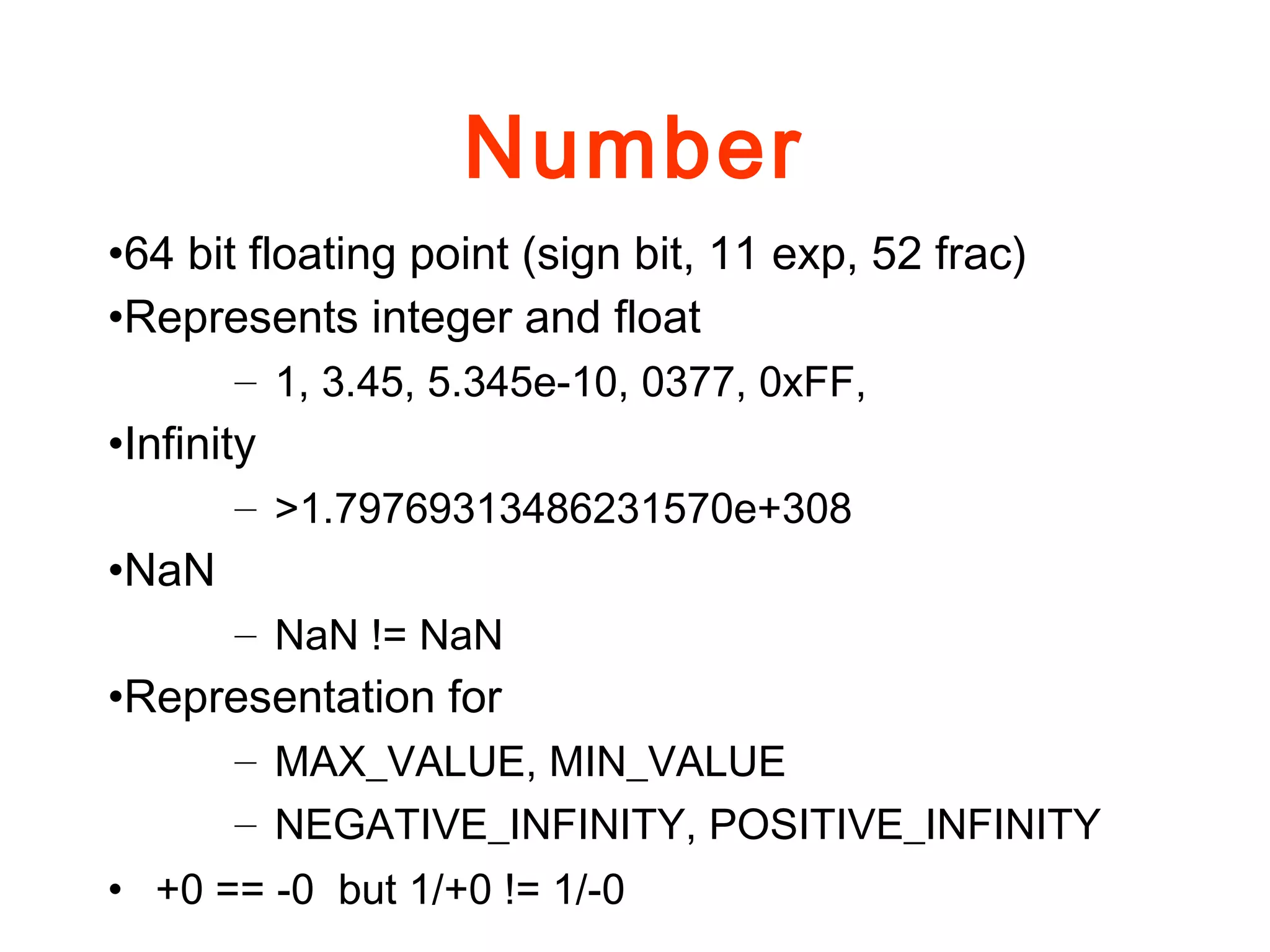
Number
•64 bit floating point (sign bit, 11 exp, 52 frac)
•Represents integer and float
– 1, 3.45, 5.345e-10, 0377, 0xFF,
•Infinity
– >1.79769313486231570e+308
•NaN
– NaN != NaN
•Representation for
– MAX_VALUE, MIN_VALUE
– NEGATIVE_INFINITY, POSITIVE_INFINITY
• +0 == -0 but 1/+0 != 1/-0
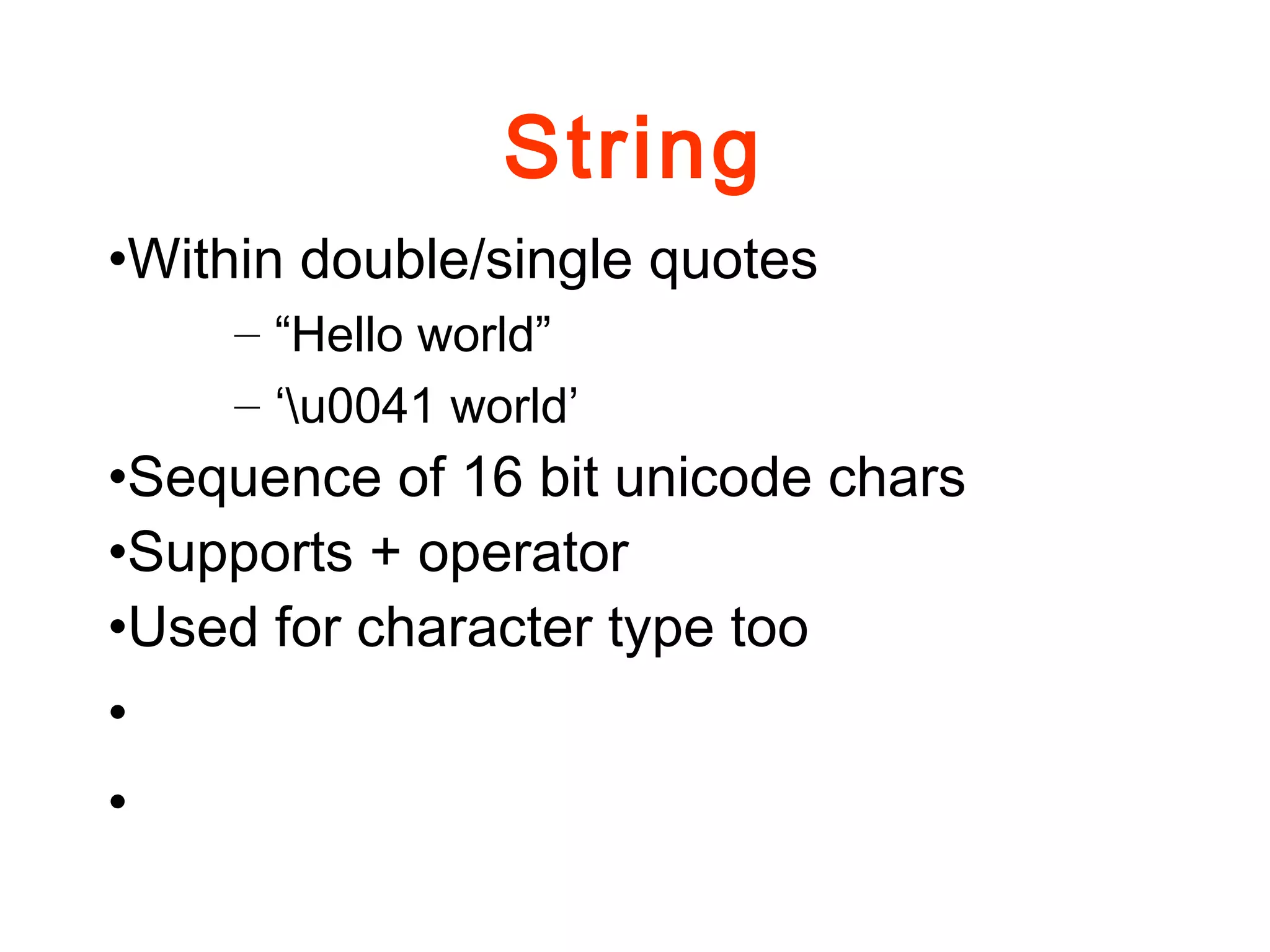
String
•Within double/single quotes
– “Hello world”
– ‘u0041 world’
•Sequence of 16 bit unicode chars
•Supports + operator
•Used for character type too
•
•
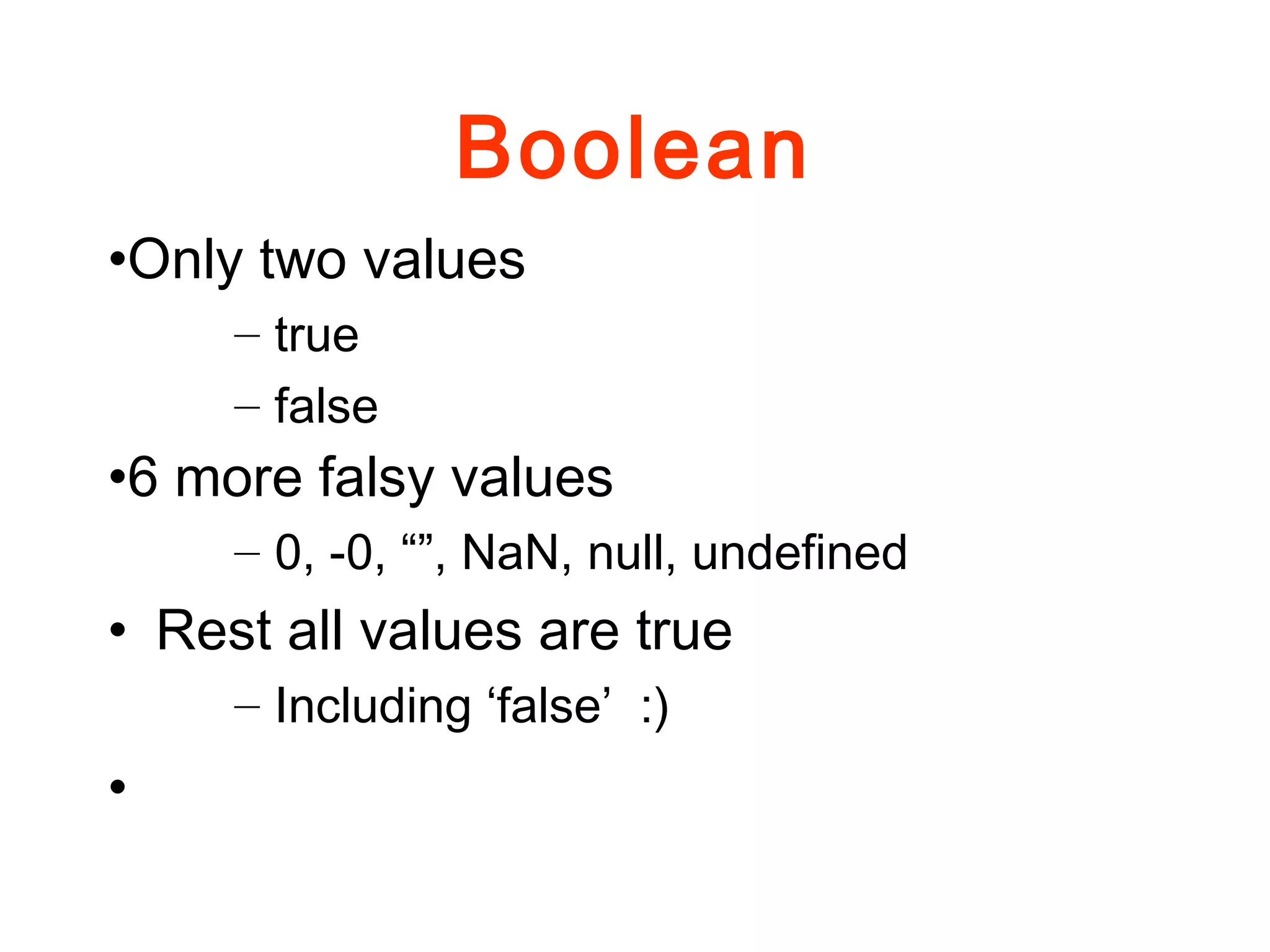
Boolean
•Only two values
– true
– false
•6 more falsy values
– 0, -0, “”, NaN, null, undefined
• Rest all values are true
– Including ‘false’ :)
•
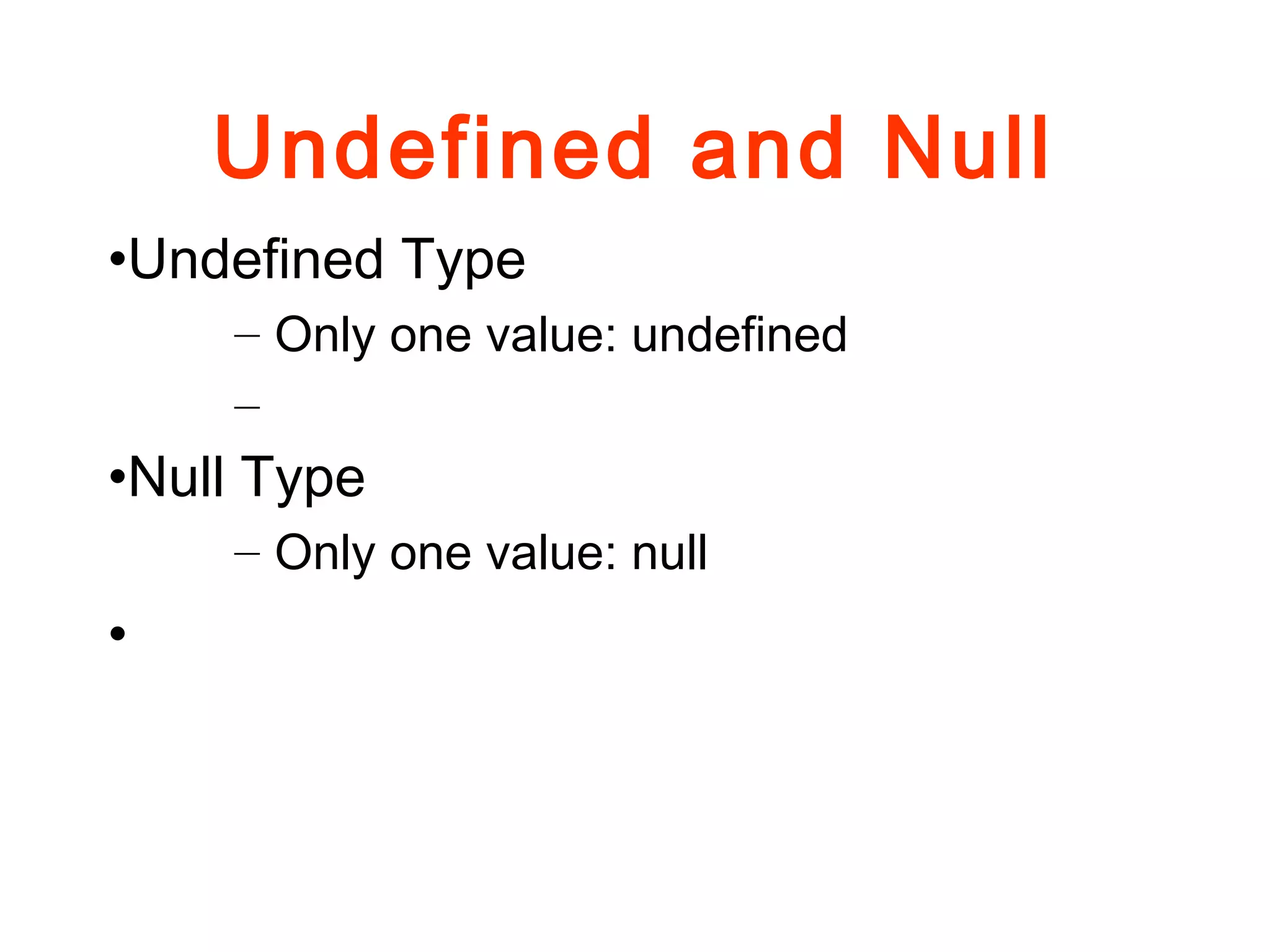
Undefined and Null
•Undefined Type
– Only one value: undefined
–
•Null Type
– Only one value: null
•
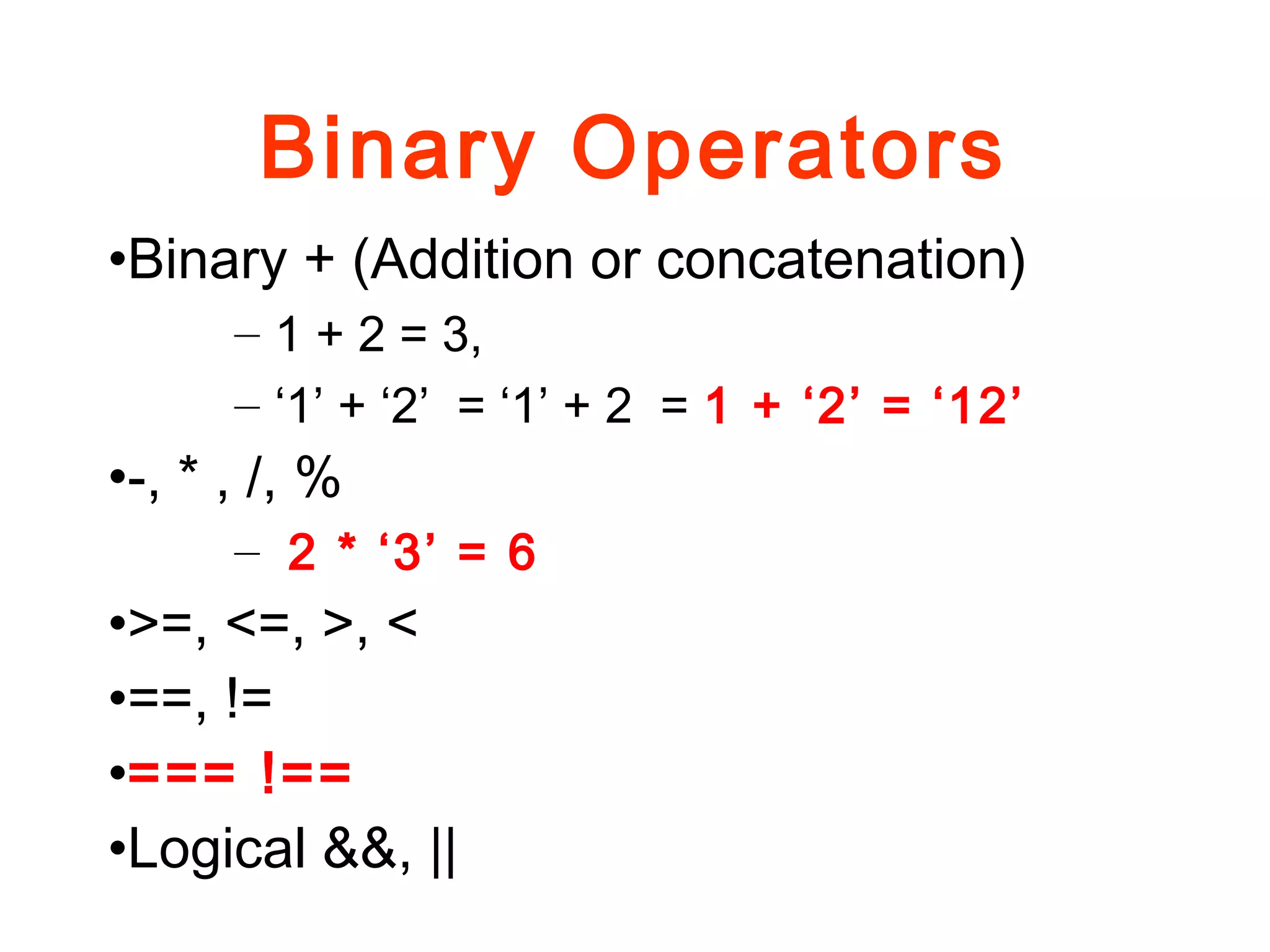
Binary Operators
•Binary + (Addition or concatenation)
– 1 + 2 = 3,
– ‘1’ + ‘2’ = ‘1’ + 2 = 1 + ‘2’ = ‘12’
•-, * , /, %
– 2 * ‘3’ = 6
•>=, <=, >, <
•==, !=
•=== !==
•Logical &&, ||
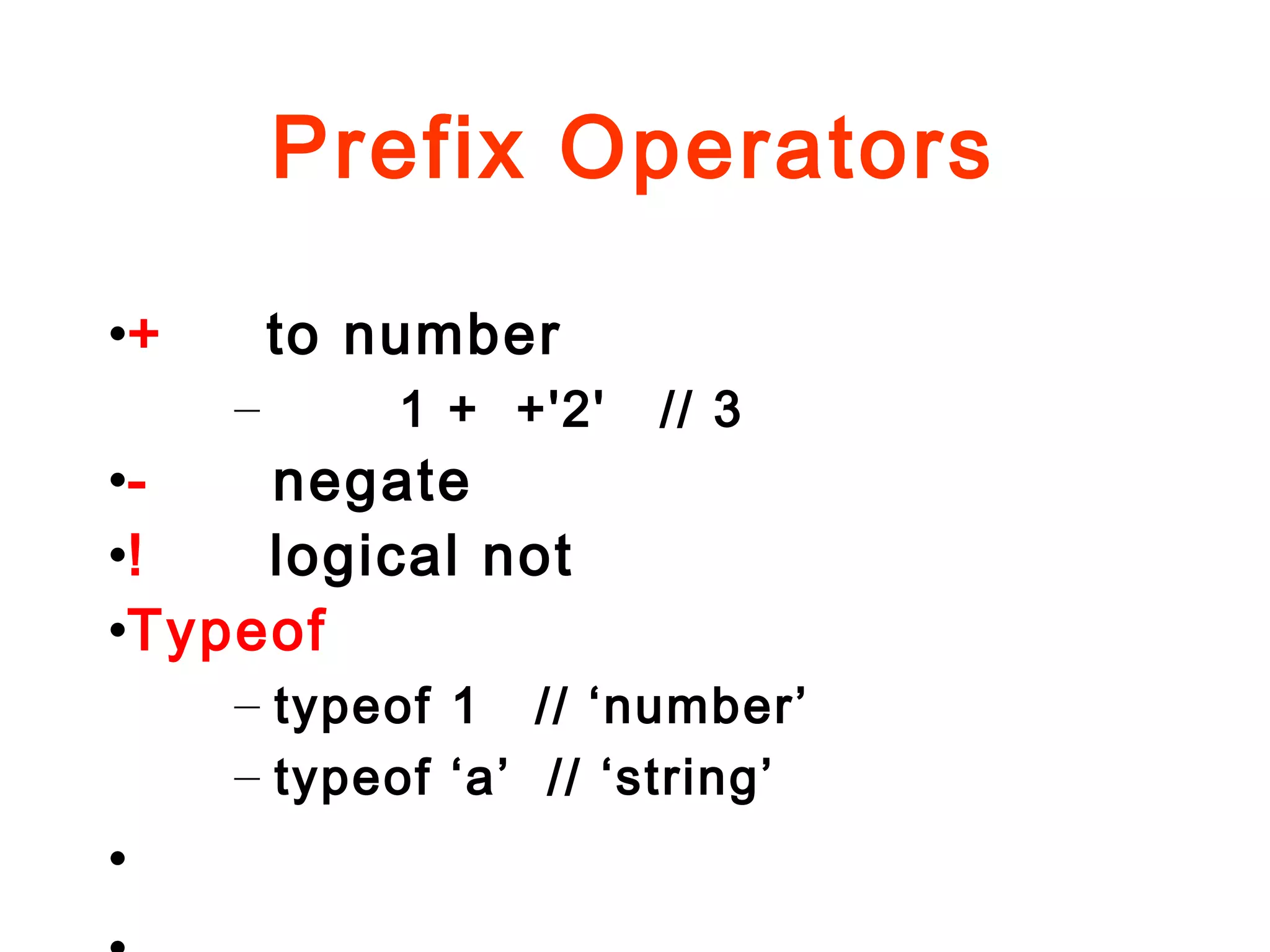
Prefix Operators
•+ to number
– 1 + +'2' // 3
•- negate
•! logical not
•Typeof
– typeof 1 // ‘number’
– typeof ‘a’ // ‘string’
•
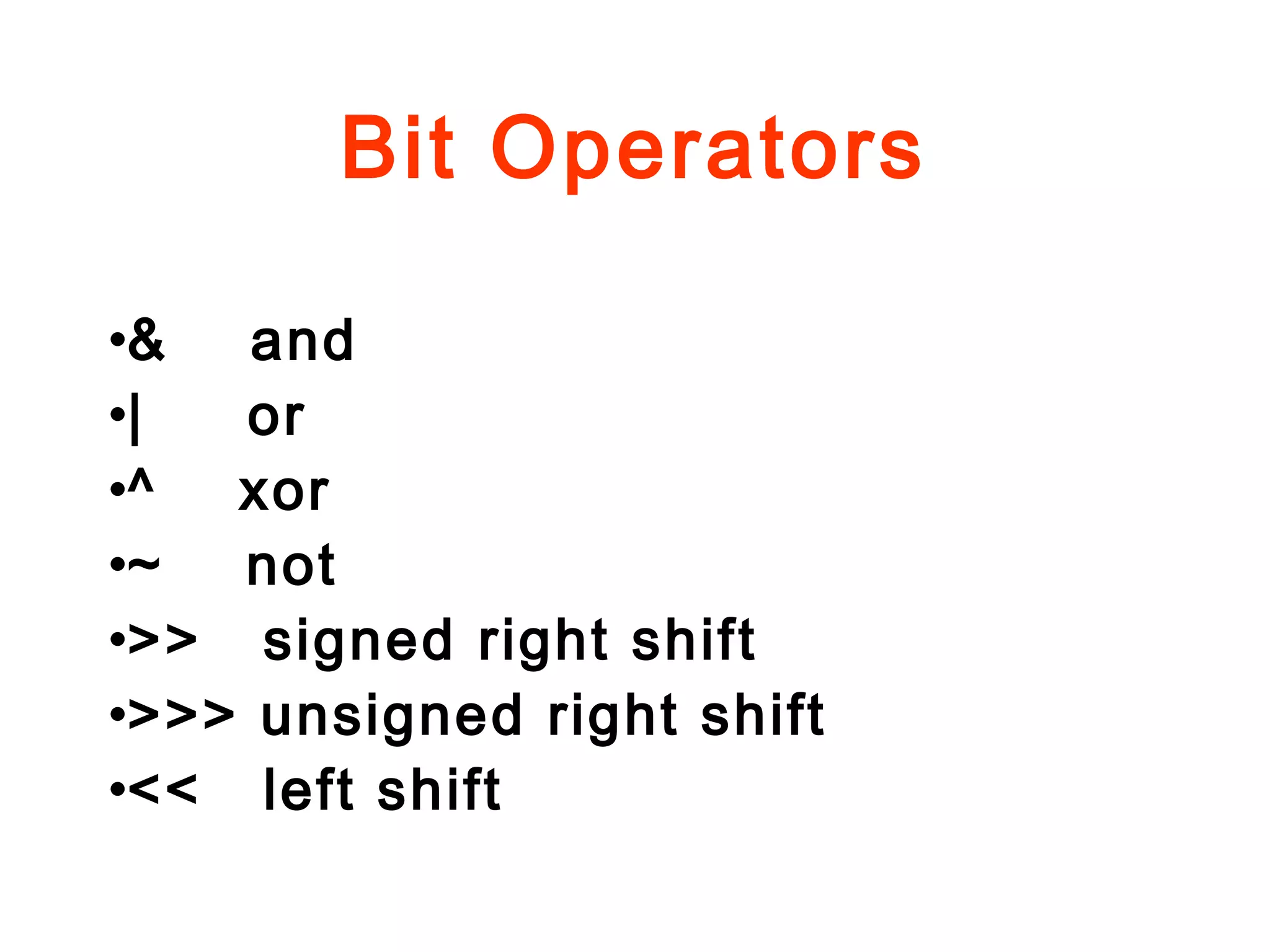
Bit Operators
•& and
•| or
•^ xor
•~ not
•>> signed right shift
•>>> unsigned right shift
•<< left shift
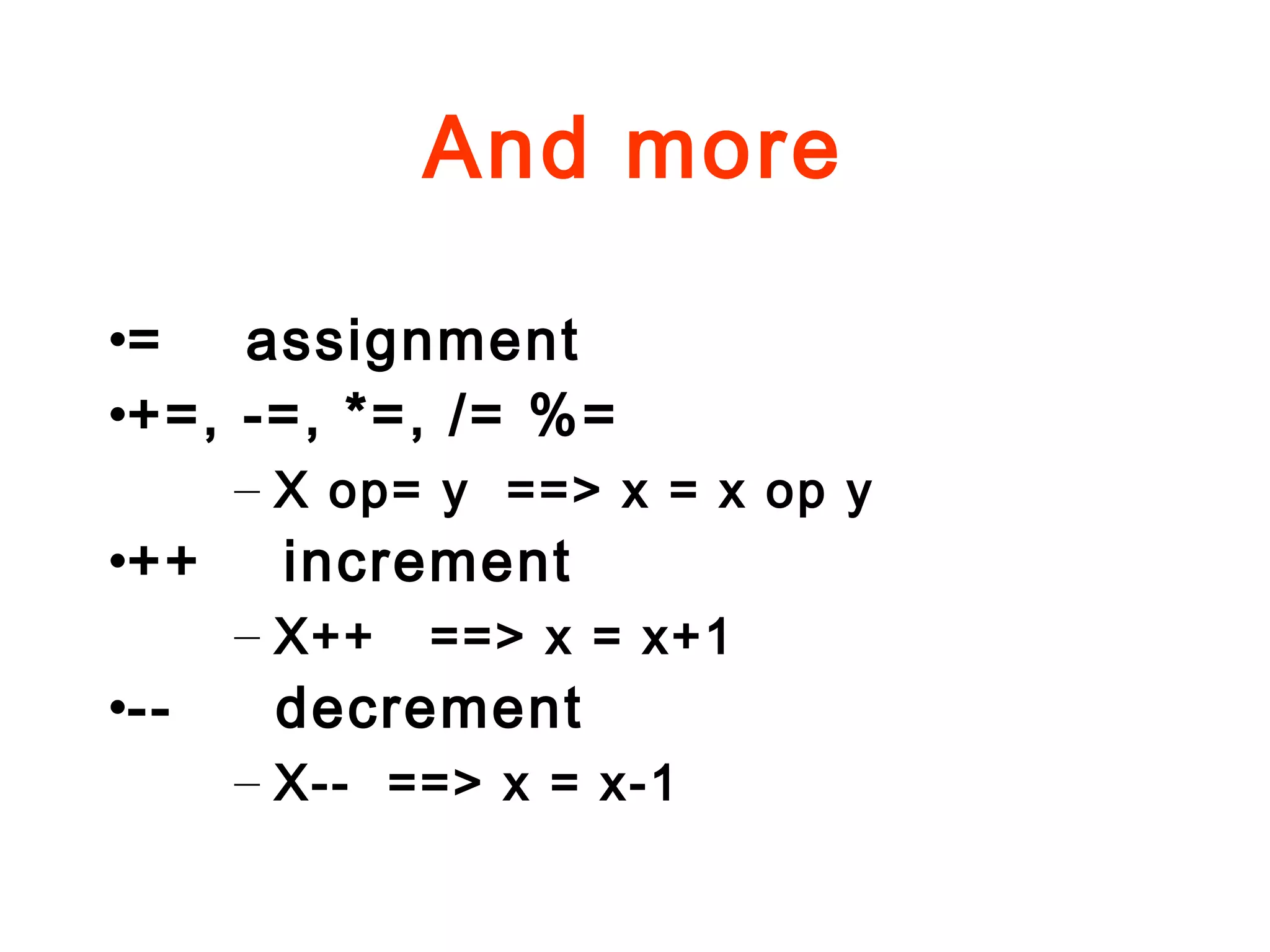
And more
•= assignment
•+=, -=, *=, /= %=
– X op= y ==> x = x op y
•++ increment
– X++ ==> x = x+1
•-- decrement
– X-- ==> x = x-1
A Simple Object
point = { x : 100, y : 200 };
point.x // 100
point[‘x’] // 100
point.y = 300;
ap = { “x-coord” : 100, “y-coord” : 200 };
ap.x-coord // Error, - means subtraction
ap[“x-coord”] // 100
ap[“X-coord”] // undefined, (note the upper
case X)
Arrays
var x = [5, 3];
x.length => 2
x.push(7) ===> add a new element
x[20] = 9 ===> 3 to 19 elements are empty
delete x[1] == remove one element
x.splice(beginIndex, noOfElemToRemove)
typeof x ==> ‘object’ .. not a good design
x.constructor == Array
concat, join, pop, reverse, slice, shift, sort
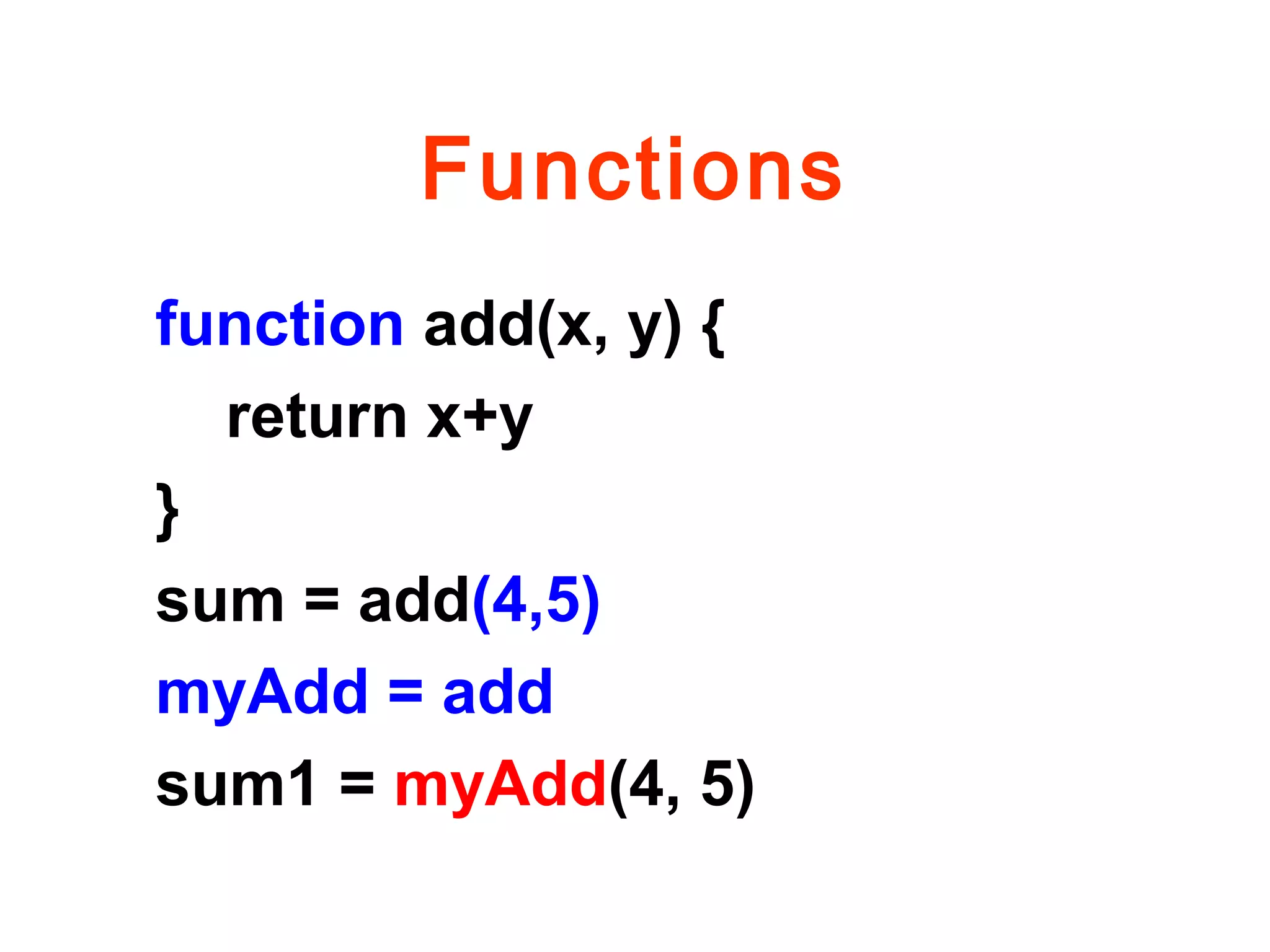
Functions
function add(x, y) {
return x+y
}
sum = add(4,5)
myAdd = add
sum1 = myAdd(4, 5)
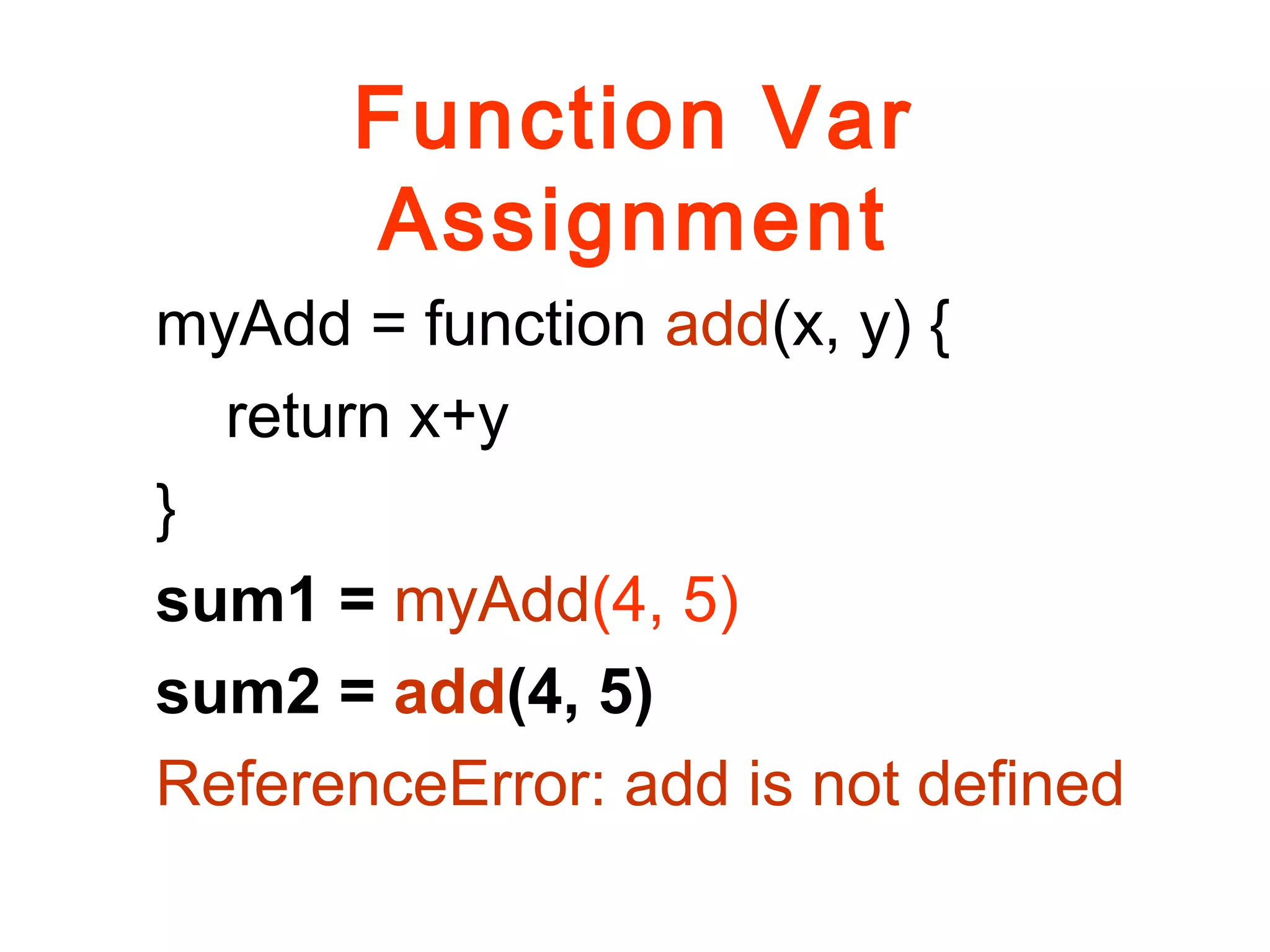
Function Var
Assignment
myAdd = function add(x, y) {
return x+y
}
sum1 = myAdd(4, 5)
sum2 = add(4, 5)
ReferenceError: add is not defined
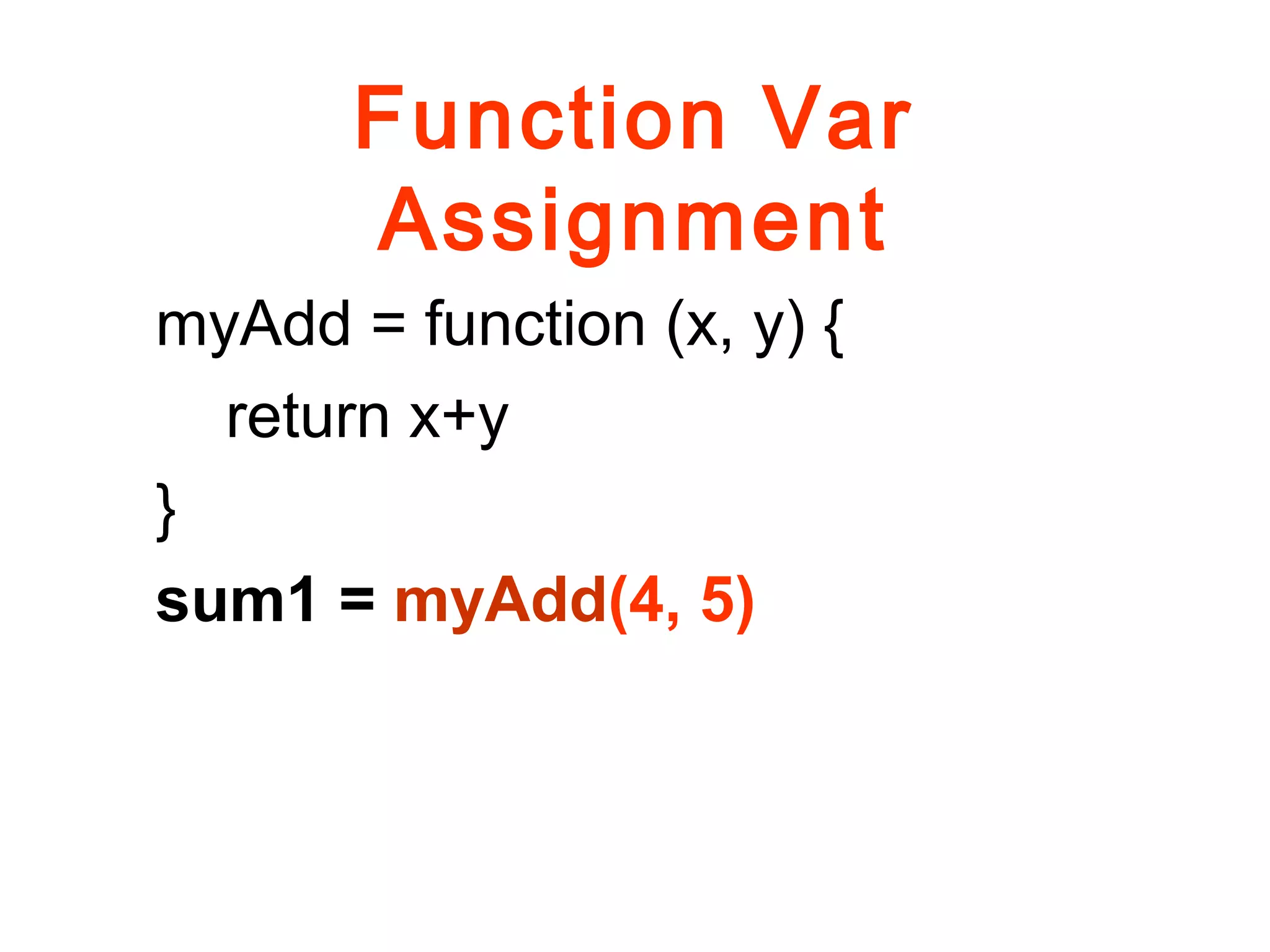
Function Var
Assignment
myAdd = function (x, y) {
return x+y
}
sum1 = myAdd(4, 5)
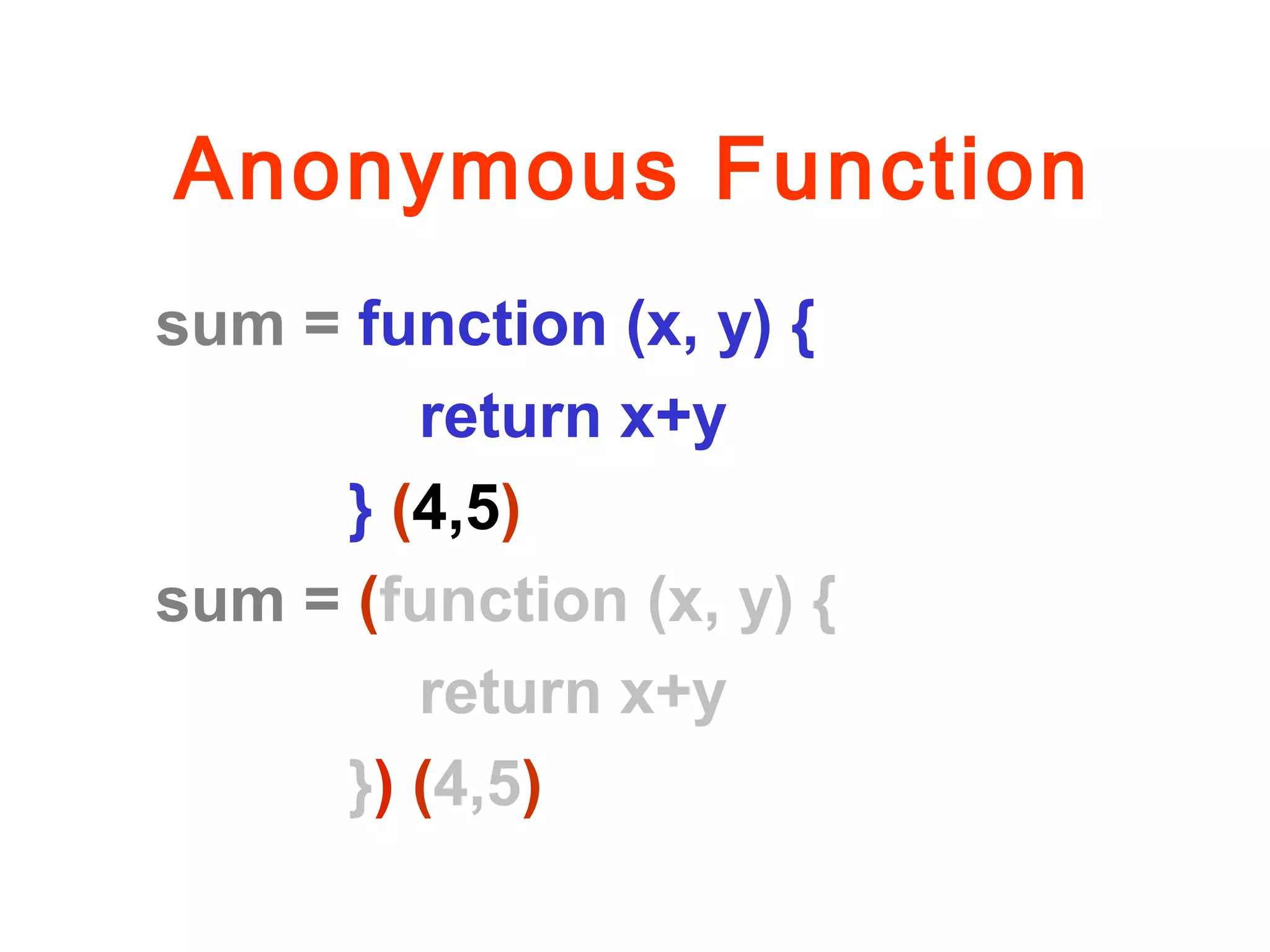
Anonymous Function
sum = function (x, y) {
return x+y
} (4,5)
sum = (function (x, y) {
return x+y
}) (4,5)
Arguments
function add( ) {
var sum = 0
for( var i = 0; i < arguments.length; i++) {
sum += arguments[i]
}
return sum
}
add(4, 5) => 9
add(4,5,3) => 12
add() => 0
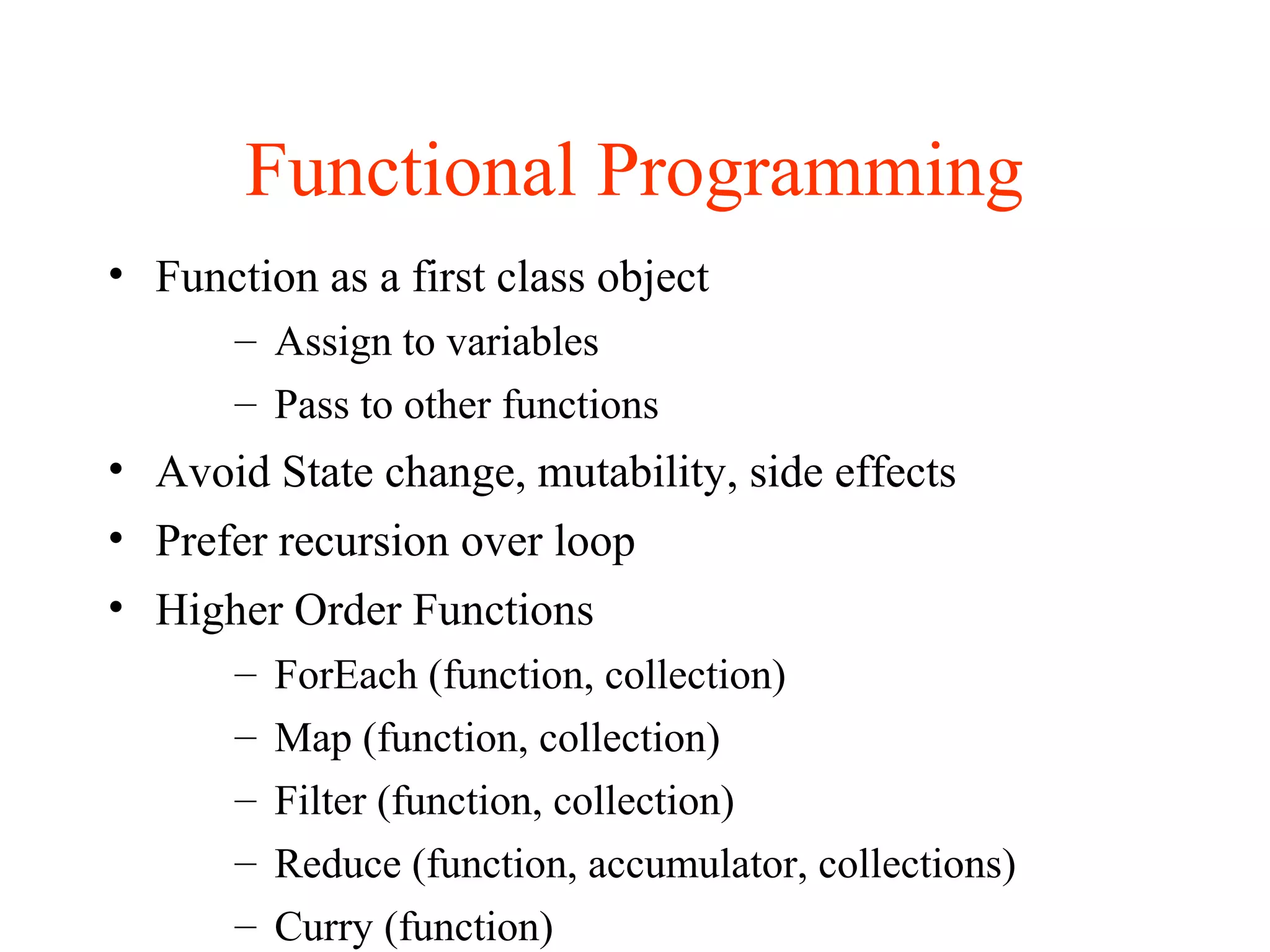
Functional Programming
• Function as a first class object
– Assign to variables
– Pass to other functions
• Avoid State change, mutability, side effects
• Prefer recursion over loop
• Higher Order Functions
– ForEach (function, collection)
– Map (function, collection)
– Filter (function, collection)
– Reduce (function, accumulator, collections)
– Curry (function)
Code Walkthrough
Model Rubik’s Cube
with
Arrays and Functions
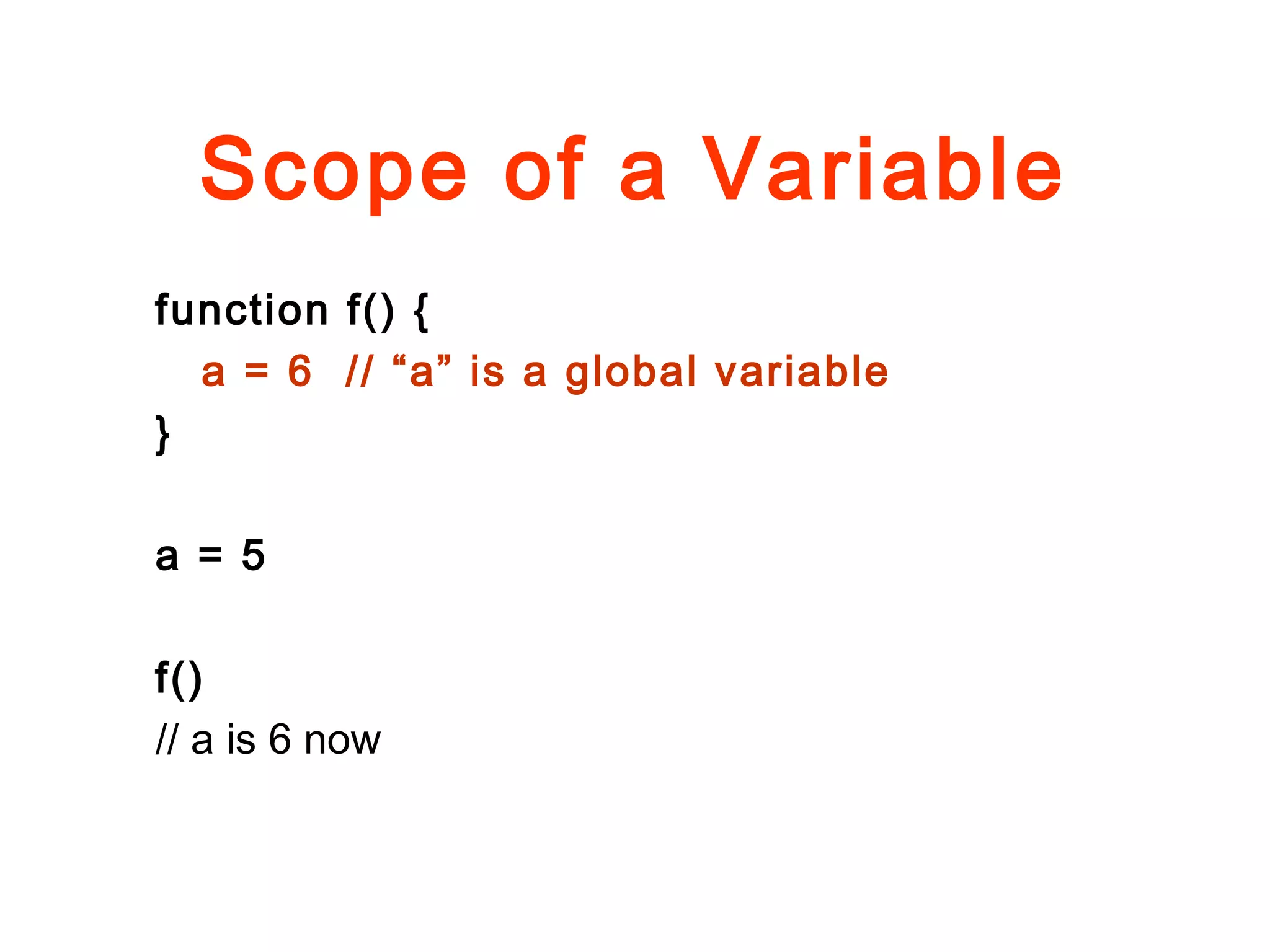
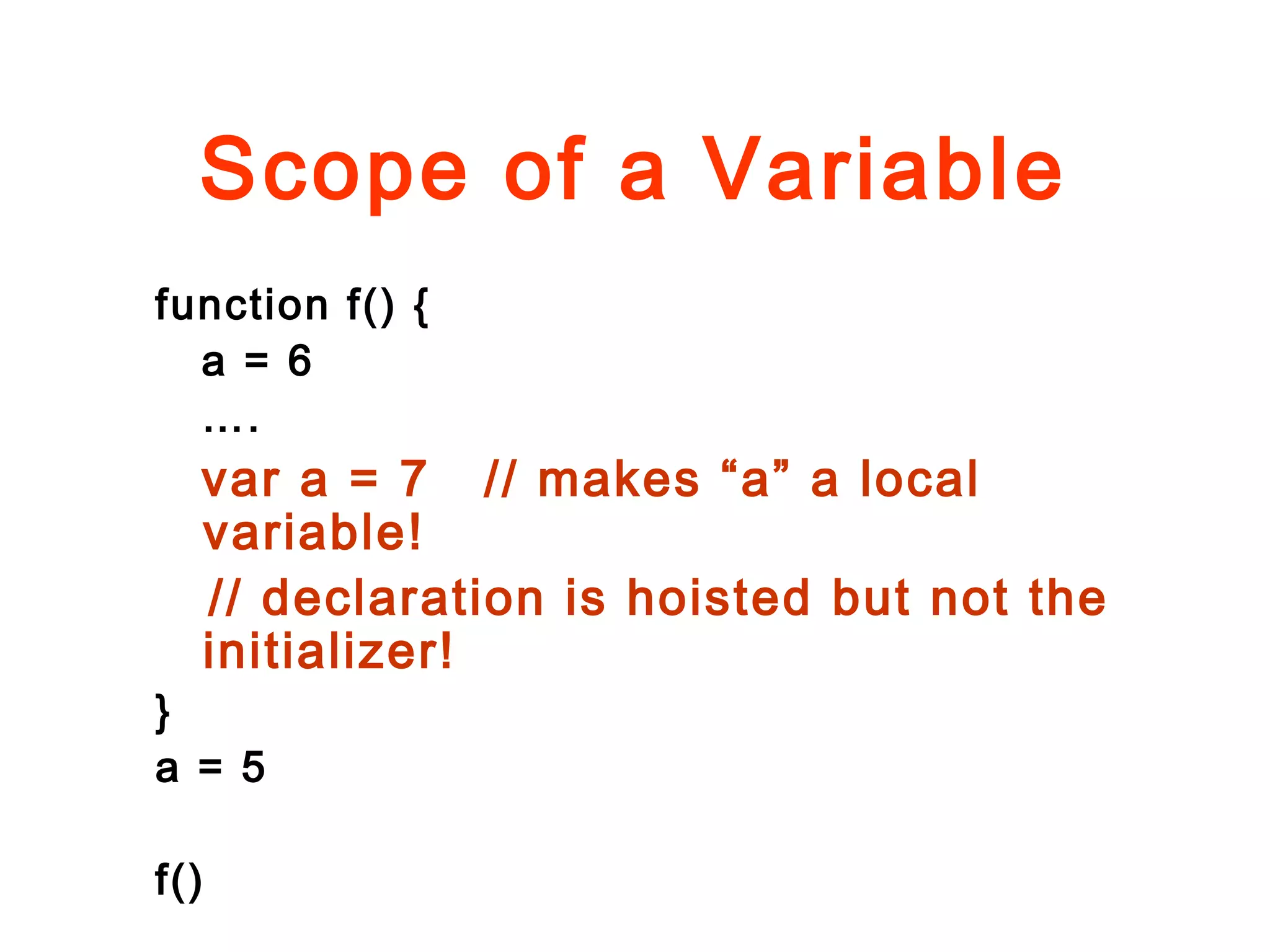
Scope of a Variable
function f() {
a = 6 // “a” is a global variable
}
a = 5
f()
// a is 6 now
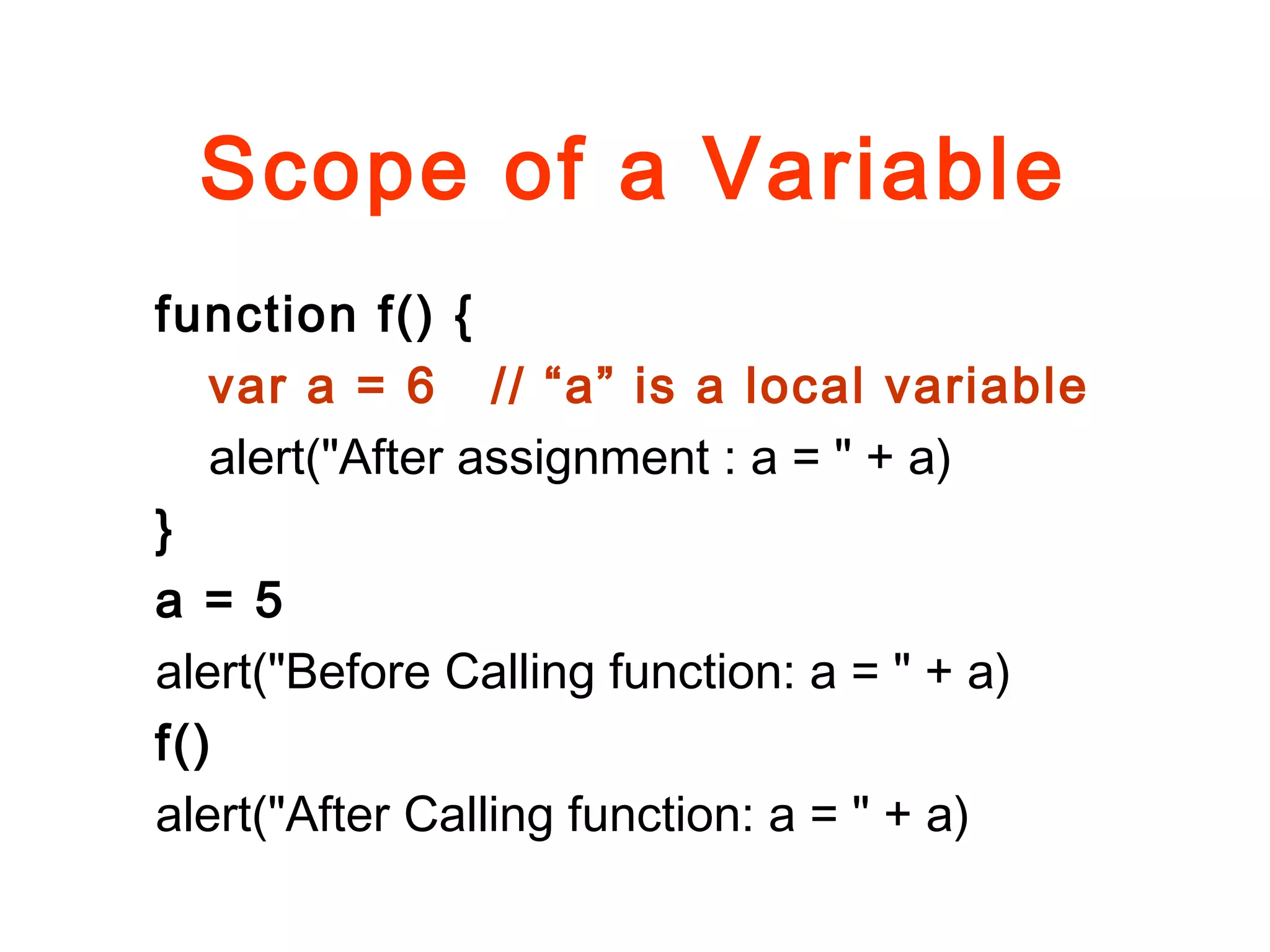
Scope of a Variable
function f() {
var a = 6 // “a” is a local variable
alert("After assignment : a = " + a)
}
a = 5
alert("Before Calling function: a = " + a)
f()
alert("After Calling function: a = " + a)
Scope of a Variable
function f() {
a = 6
….
var a = 7 // makes “a” a local
variable!
// declaration is hoisted but not the
initializer!
}
a = 5
f()
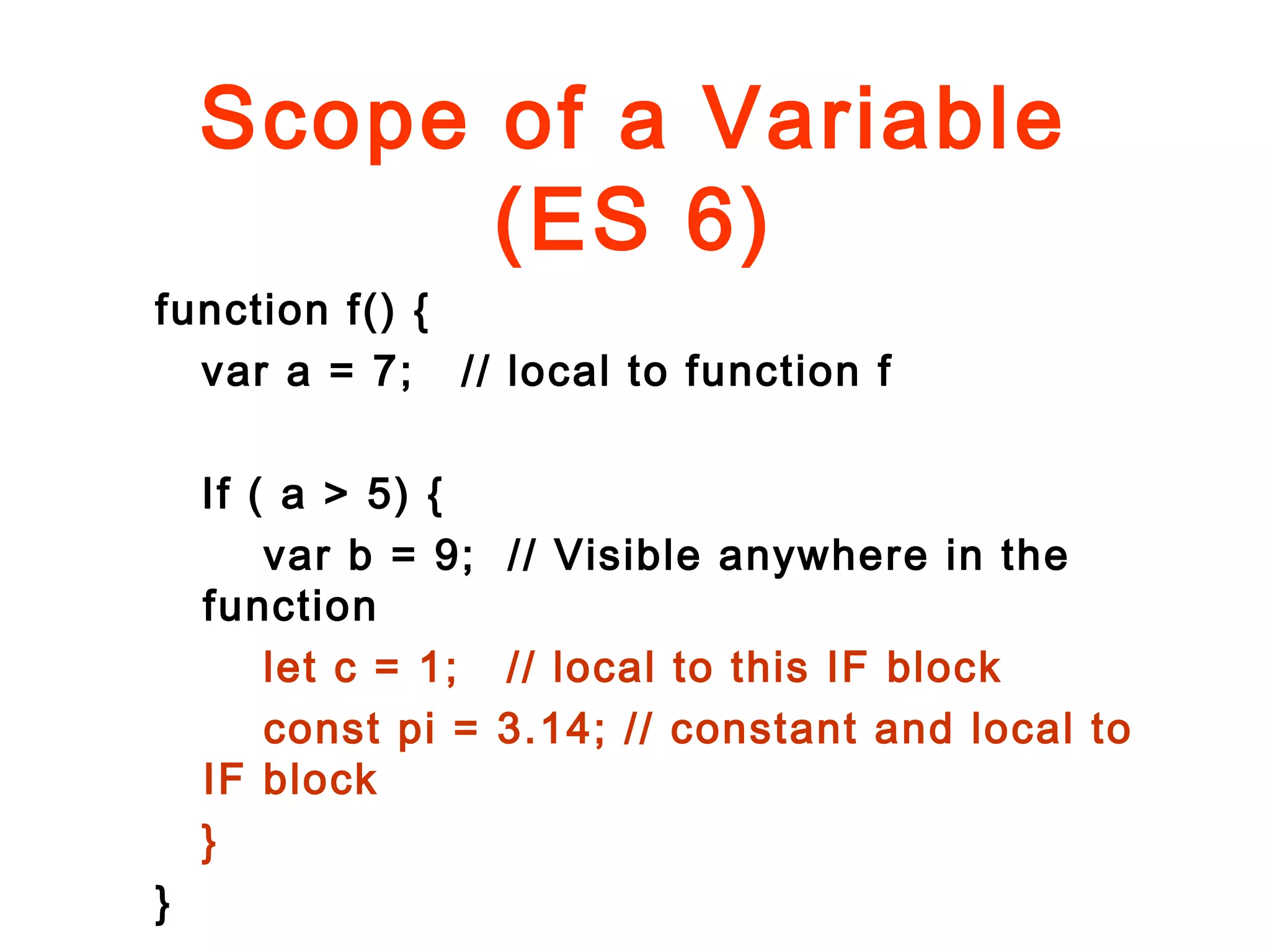
Scope of a Variable
(ES 6)
function f() {
var a = 7; // local to function f
If ( a > 5) {
var b = 9; // Visible anywhere in the
function
let c = 1; // local to this IF block
const pi = 3.14; // constant and local to
IF block
}
}
loop variable with var
// Objective
// funcs [ 0 ] = function( ) { return 0; } ;
// funcs [ 1 ] = function( ) { return 1; } ;
// funcs [ 2 ] = function( ) { return 2; } ;
let funcs = [ ];
for (var i=0; i < 3; i++) {
funcs.push( function() { return i;} );
}
funcs[0]() ; // 3
funcs[1]() ; // 3
funcs[2]() ; // 3
loop variable with var
Funcs = [ ];
functionCreator(n) {
return function() { return n;}
}
}
for (var i=0; i < 3; i++) {
funcs.push( functionCreator(i));
}
funcs[0]() ; // 0
funcs[1]() ; // 1
funcs[2]() ; // 2
loop variable with var
for (var i=0; i < 3; i++) {
funcs.push(
function(n) {
return function() { return n;}
}(i)
);
}
funcs[0]() ; // 0
funcs[1]() ; // 1
funcs[2]() ; // 2
loop variable with let
let funcs = [ ];
for (let i=0; i < 3; i++) {
// new binding of “ i ” is created in every
iteration
funcs.push( function() { return i;} );
}
funcs[0]() ; // 0
funcs[1]() ; // 1
funcs[2]() ; // 2
<eot/>
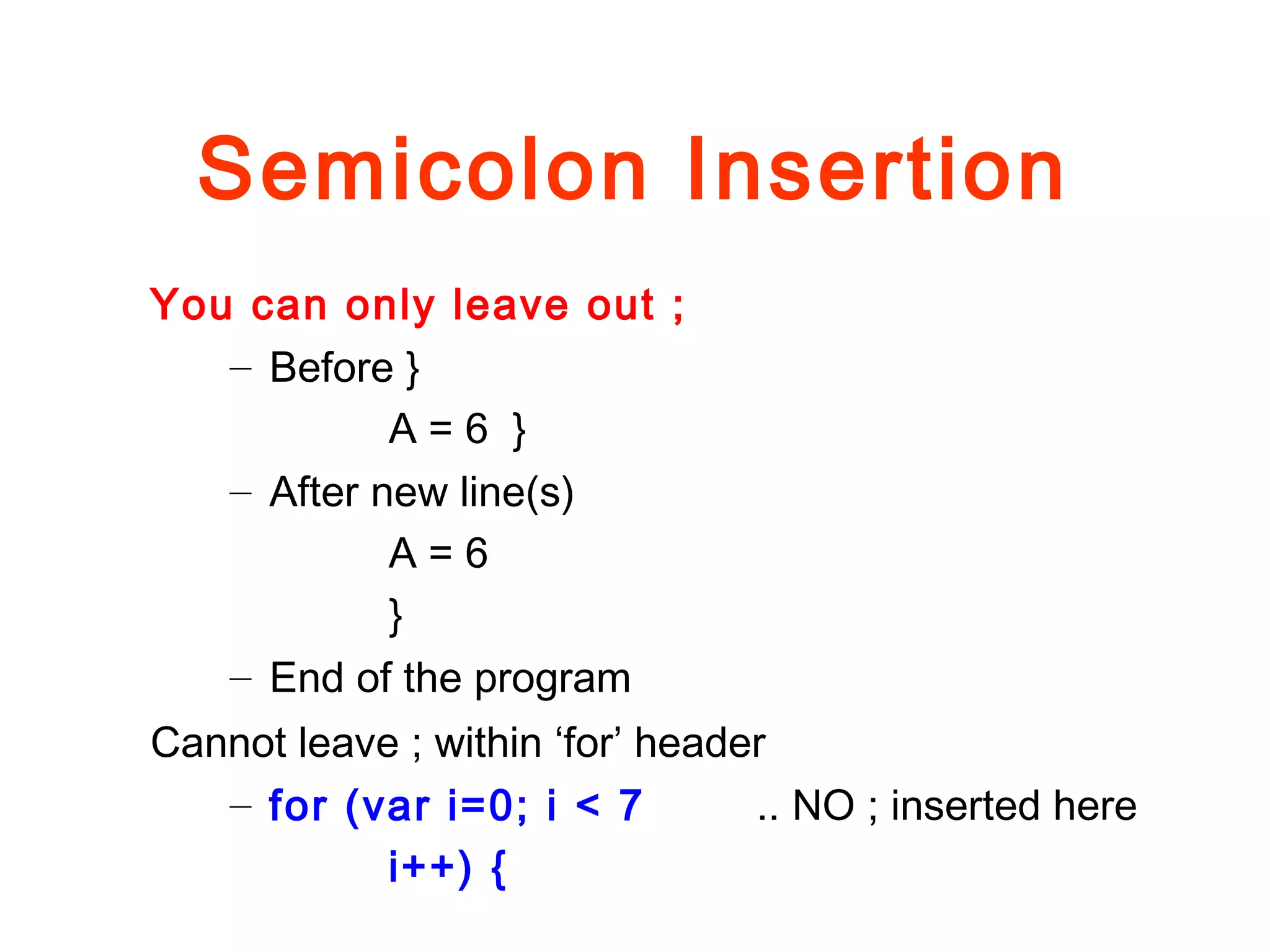
Semicolon Insertion
You can only leave out ;
– Before }
A = 6 }
– After new line(s)
A = 6
}
– End of the program
Cannot leave ; within ‘for’ header
– for (var i=0; i < 7 .. NO ; inserted here
i++) {
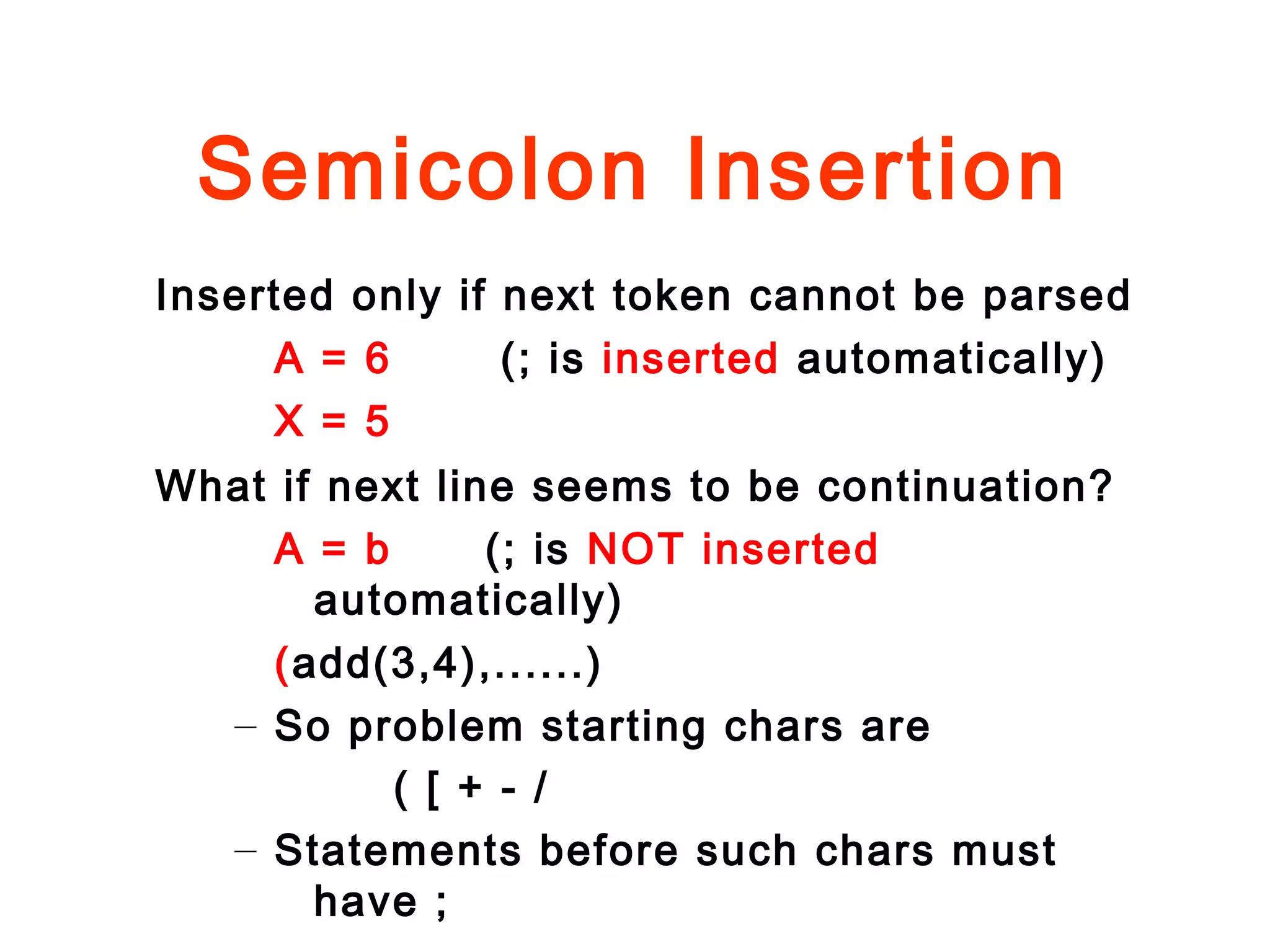
Semicolon Insertion
Inserted only if next token cannot be parsed
A = 6 (; is inserted automatically)
X = 5
What if next line seems to be continuation?
A = b (; is NOT inserted
automatically)
(add(3,4),......)
– So problem starting chars are
( [ + - /
– Statements before such chars must
have ;
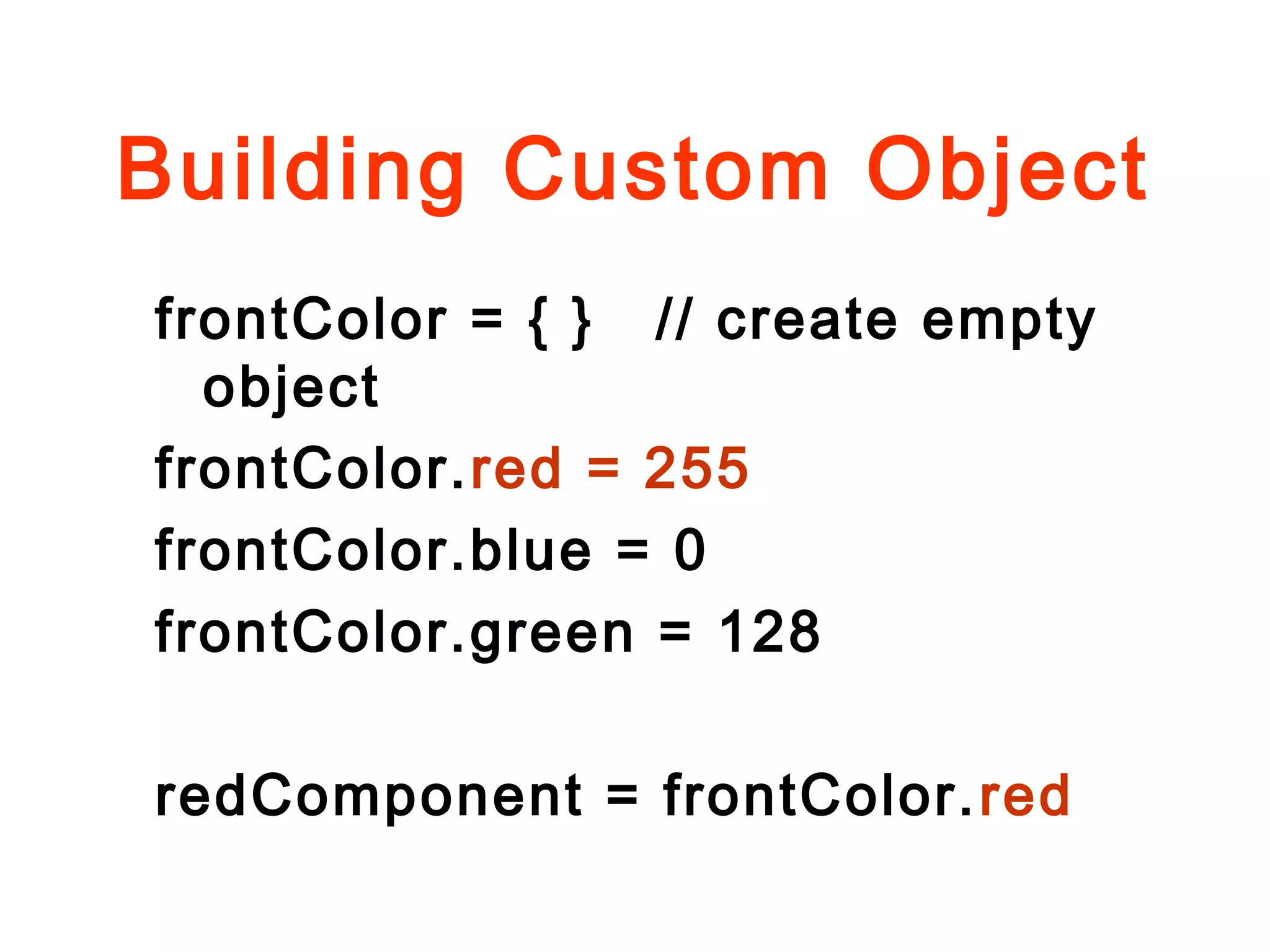
Building Custom Object
frontColor = { } // create empty
object
frontColor.red = 255
frontColor.blue = 0
frontColor.green = 128
redComponent = frontColor.red
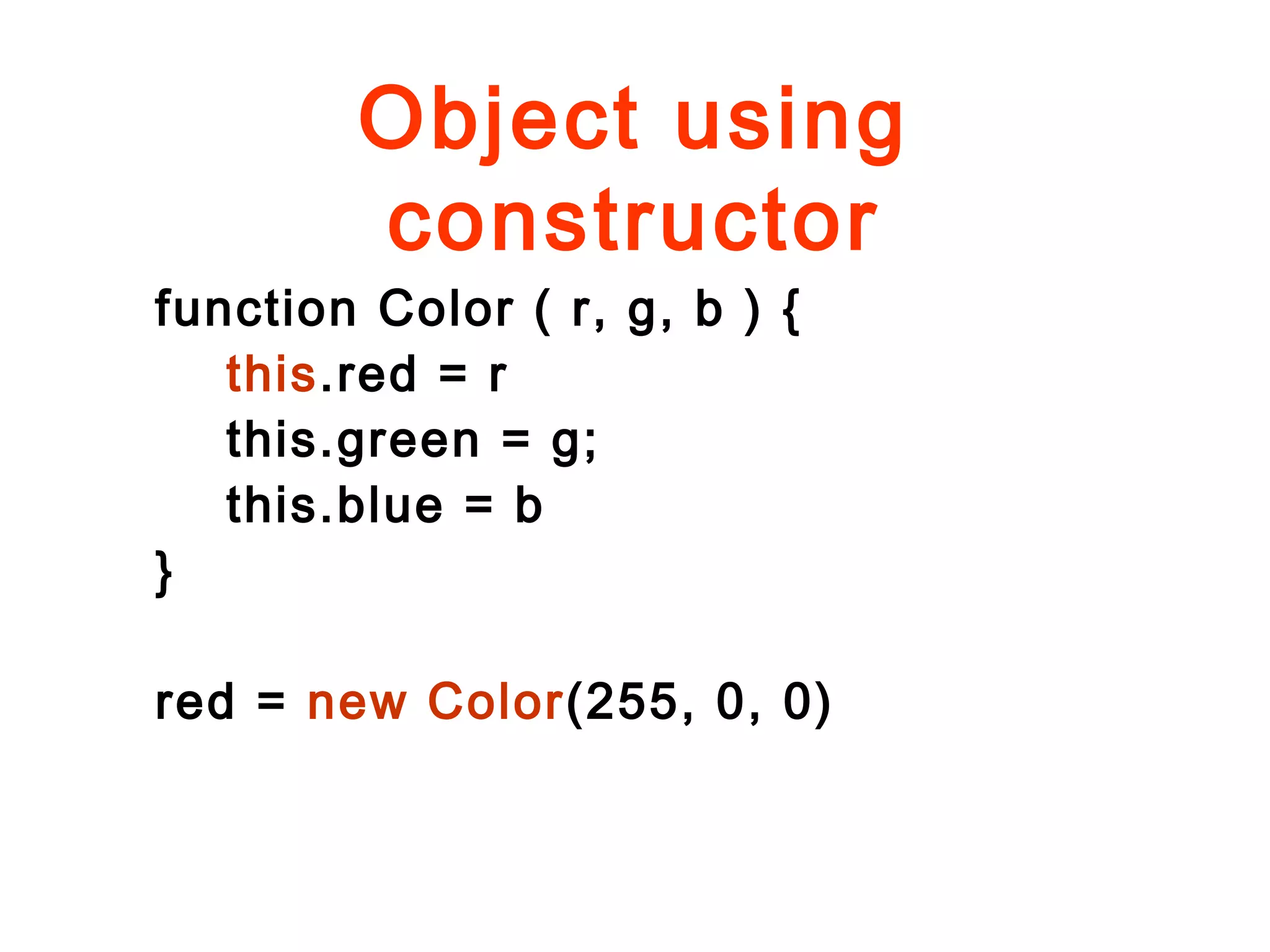
Object using
constructor
function Color ( r, g, b ) {
this.red = r
this.green = g;
this.blue = b
}
red = new Color(255, 0, 0)
Object Using
Constructor
function Color ( r, g, b ) {
this.red = r
this.green = g;
this.blue = b
}
myColor = { }
myColor.red // undefined
Color.apply( myColor, [255, 65,
127] )
Color.call( myColor, 255, 65, 127 )
myColor.red // 255
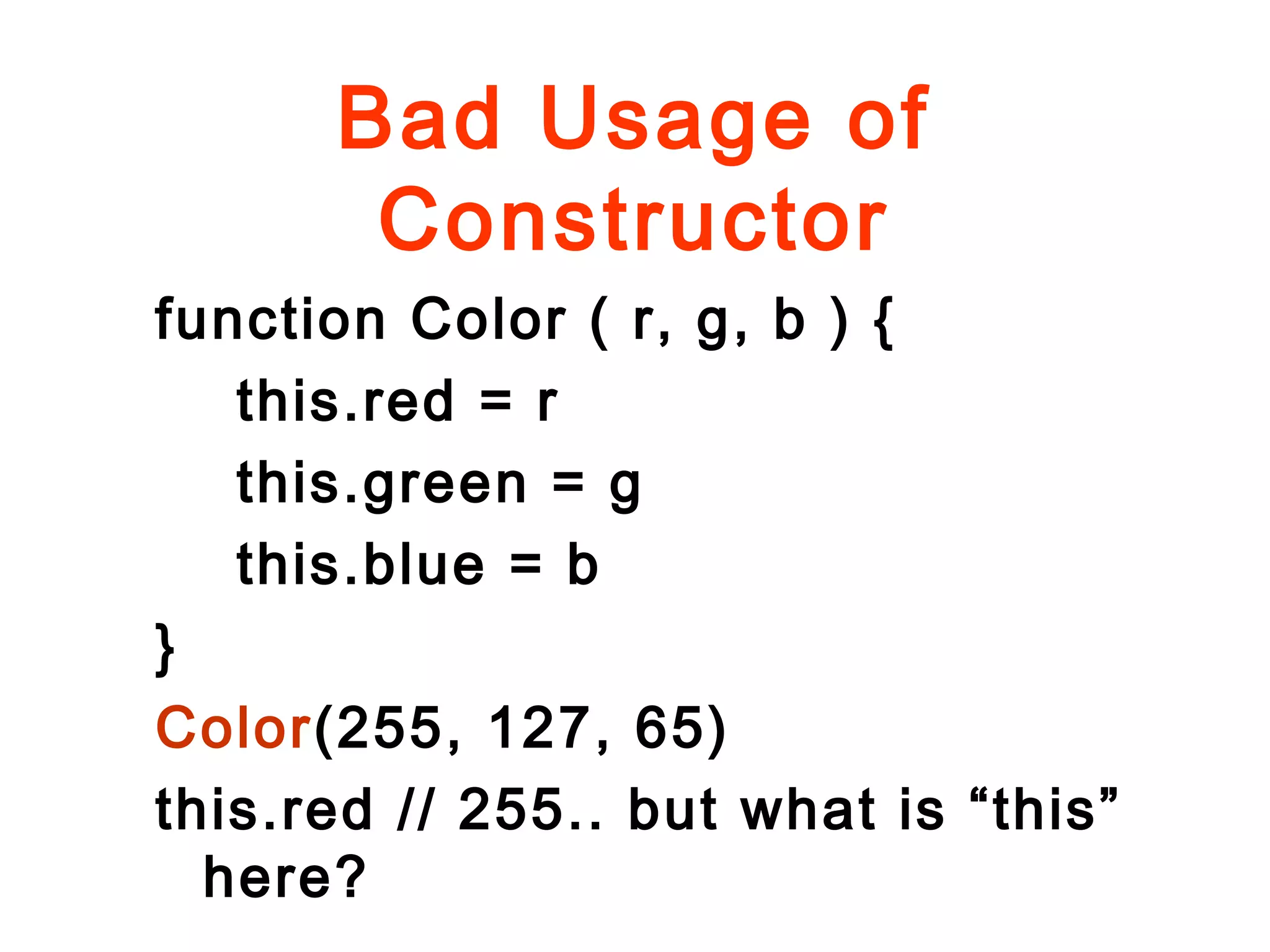
Bad Usage of
Constructor
function Color ( r, g, b ) {
this.red = r
this.green = g
this.blue = b
}
Color(255, 127, 65)
this.red // 255.. but what is “this”
here?
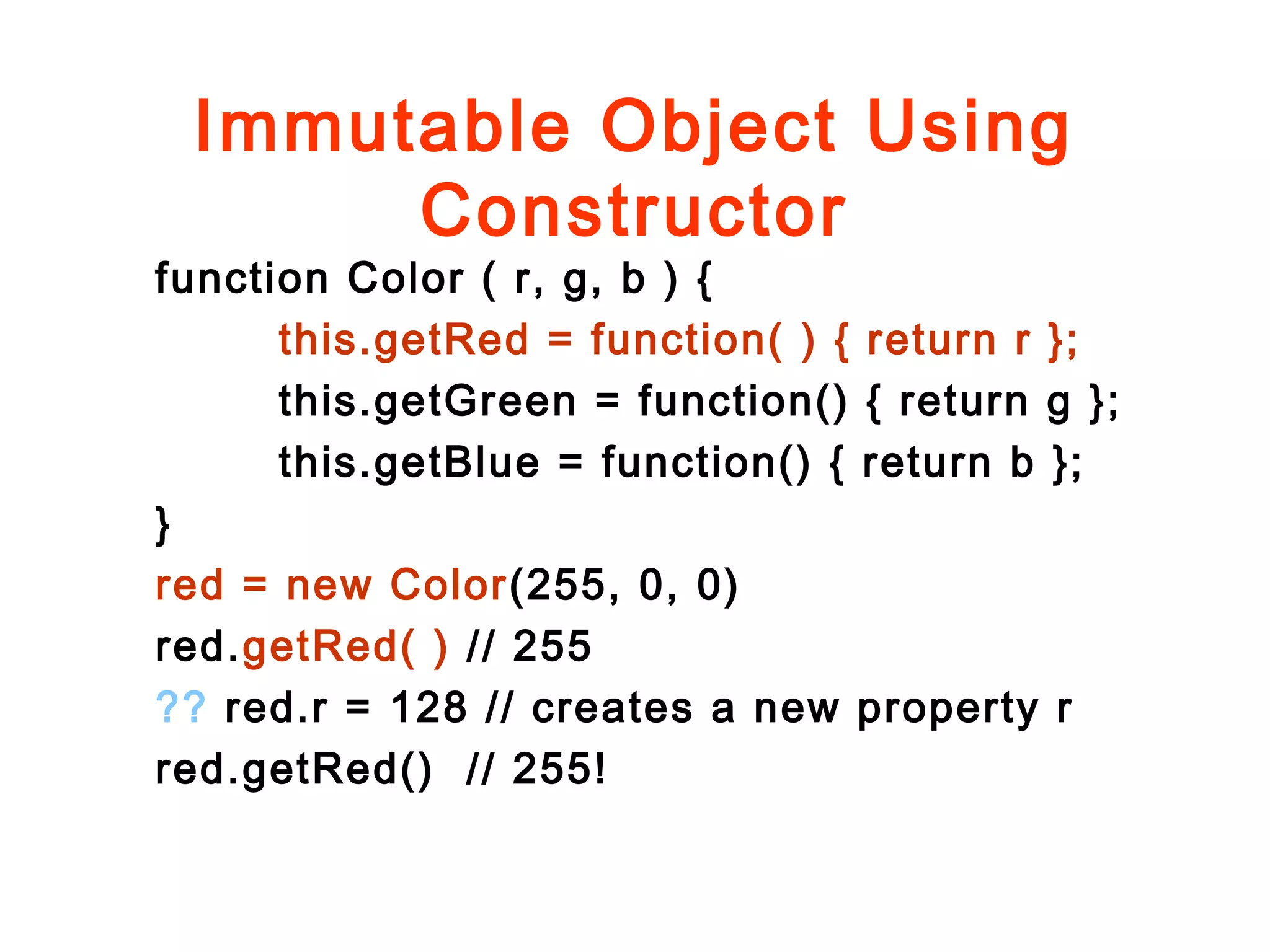
Immutable Object Using
Constructor
function Color ( r, g, b ) {
this.getRed = function( ) { return r };
this.getGreen = function() { return g };
this.getBlue = function() { return b };
}
red = new Color(255, 0, 0)
red.getRed( ) // 255
?? red.r = 128 // creates a new property r
red.getRed() // 255!
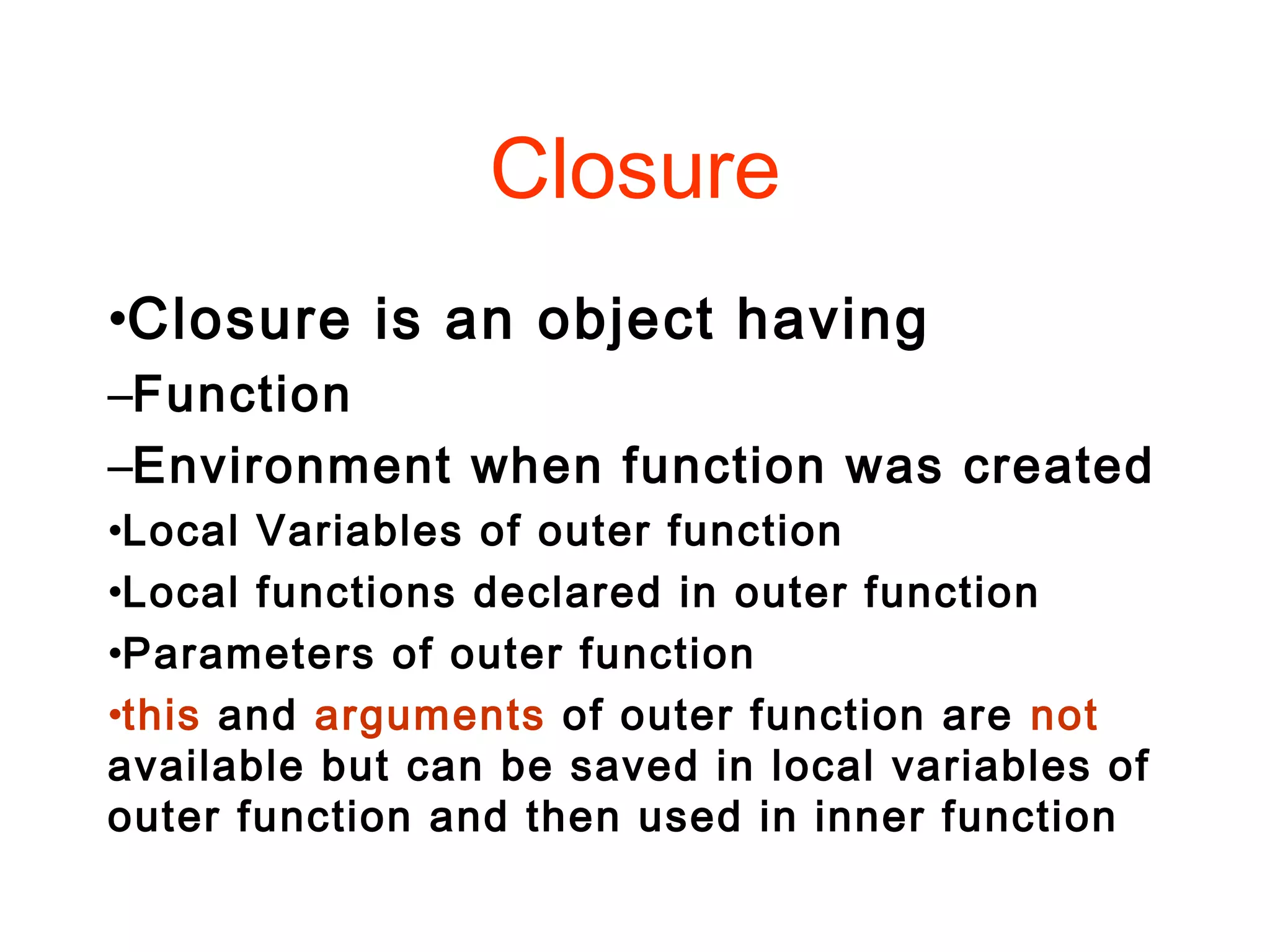
Closure
•Closure is an object having
–Function
–Environment when function was created
•Local Variables of outer function
•Local functions declared in outer function
•Parameters of outer function
•this and arguments of outer function are not
available but can be saved in local variables of
outer function and then used in inner function
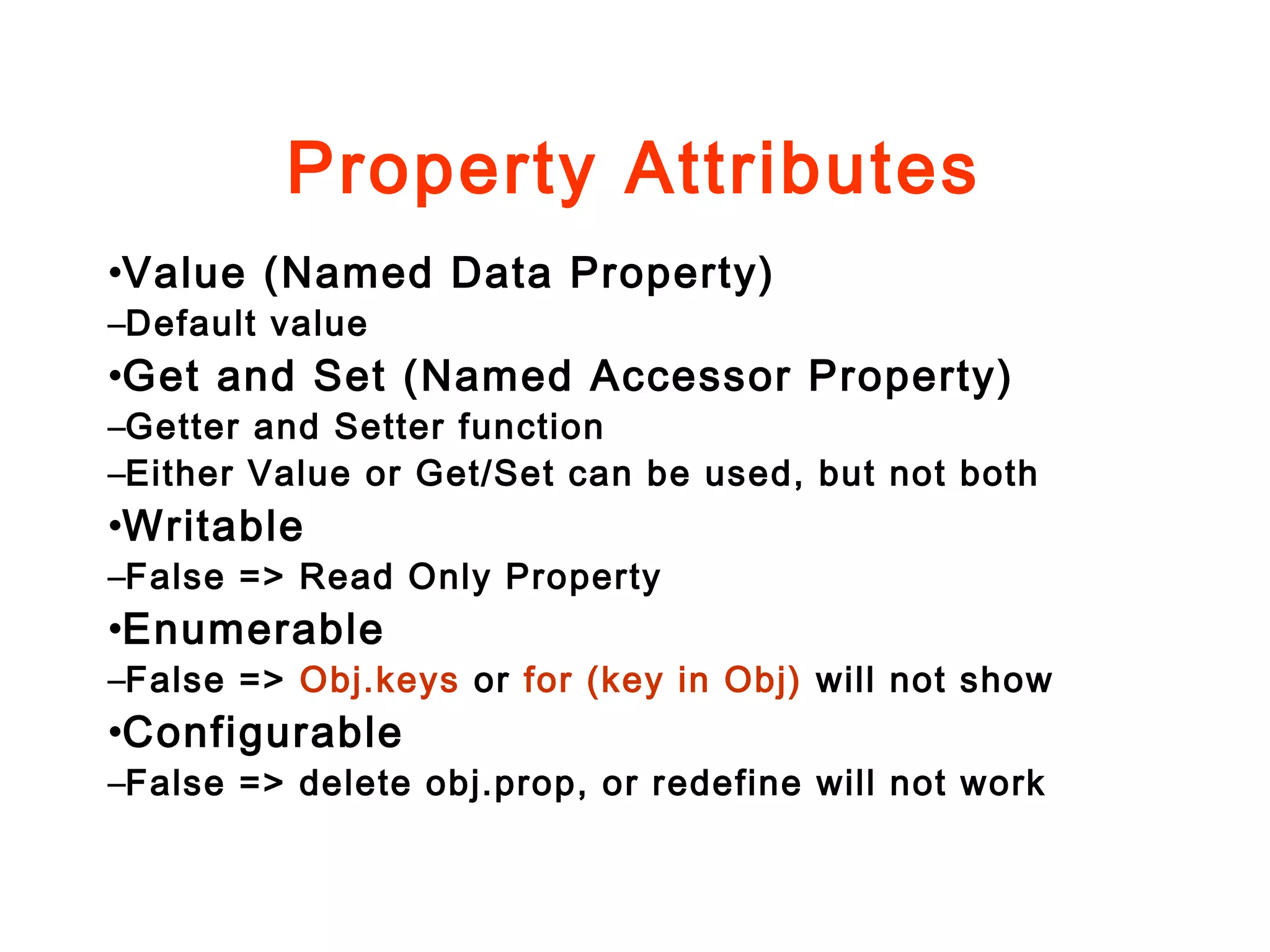
Property Attributes
•Value (Named Data Property)
–Default value
•Get and Set (Named Accessor Property)
–Getter and Setter function
–Either Value or Get/Set can be used, but not both
•Writable
–False => Read Only Property
•Enumerable
–False => Obj.keys or for (key in Obj) will not show
•Configurable
–False => delete obj.prop, or redefine will not work
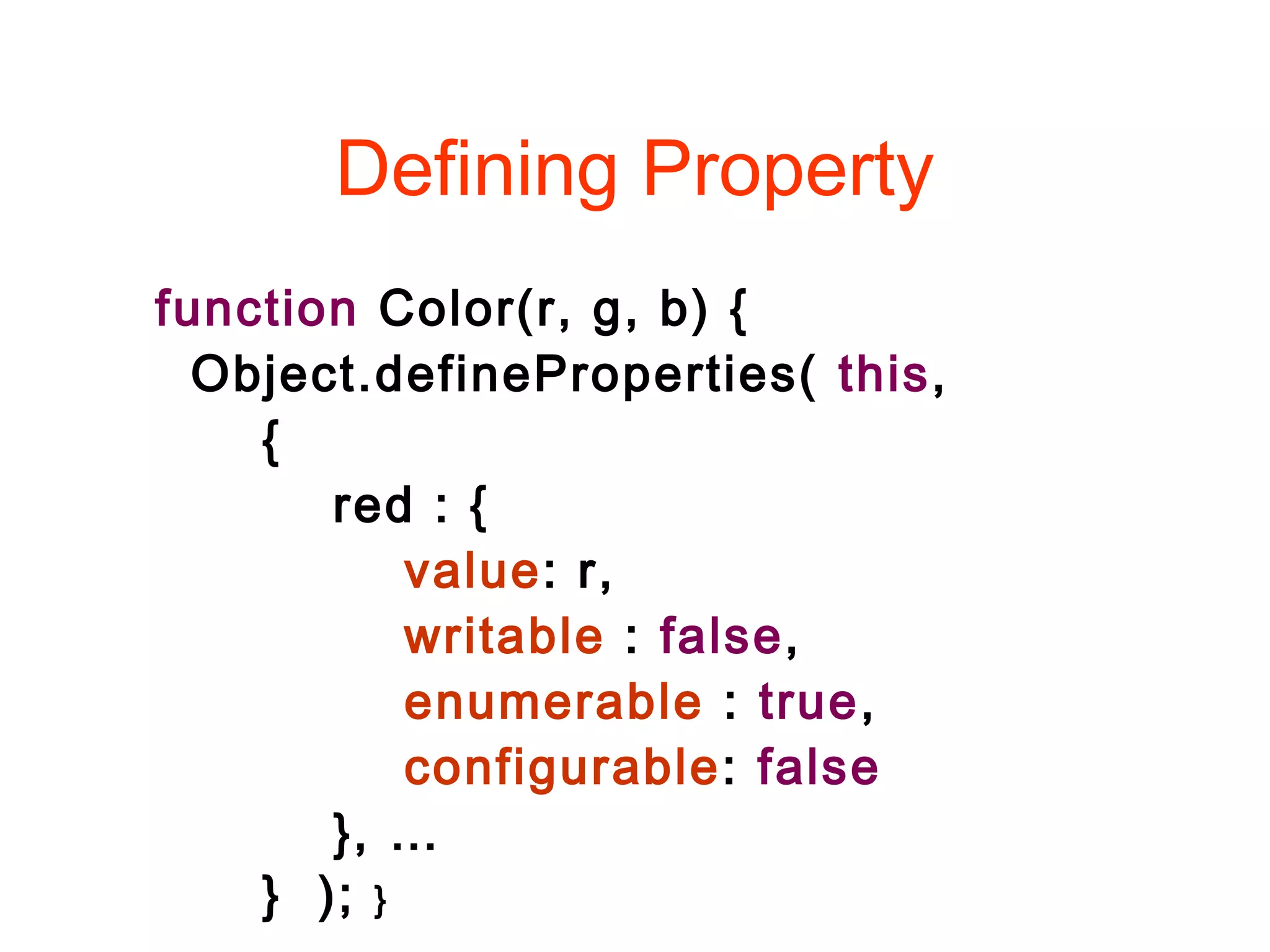
Defining Property
function Color(r, g, b) {
Object.defineProperties( this,
{
red : {
value: r,
writable : false,
enumerable : true,
configurable: false
}, …
} ); }
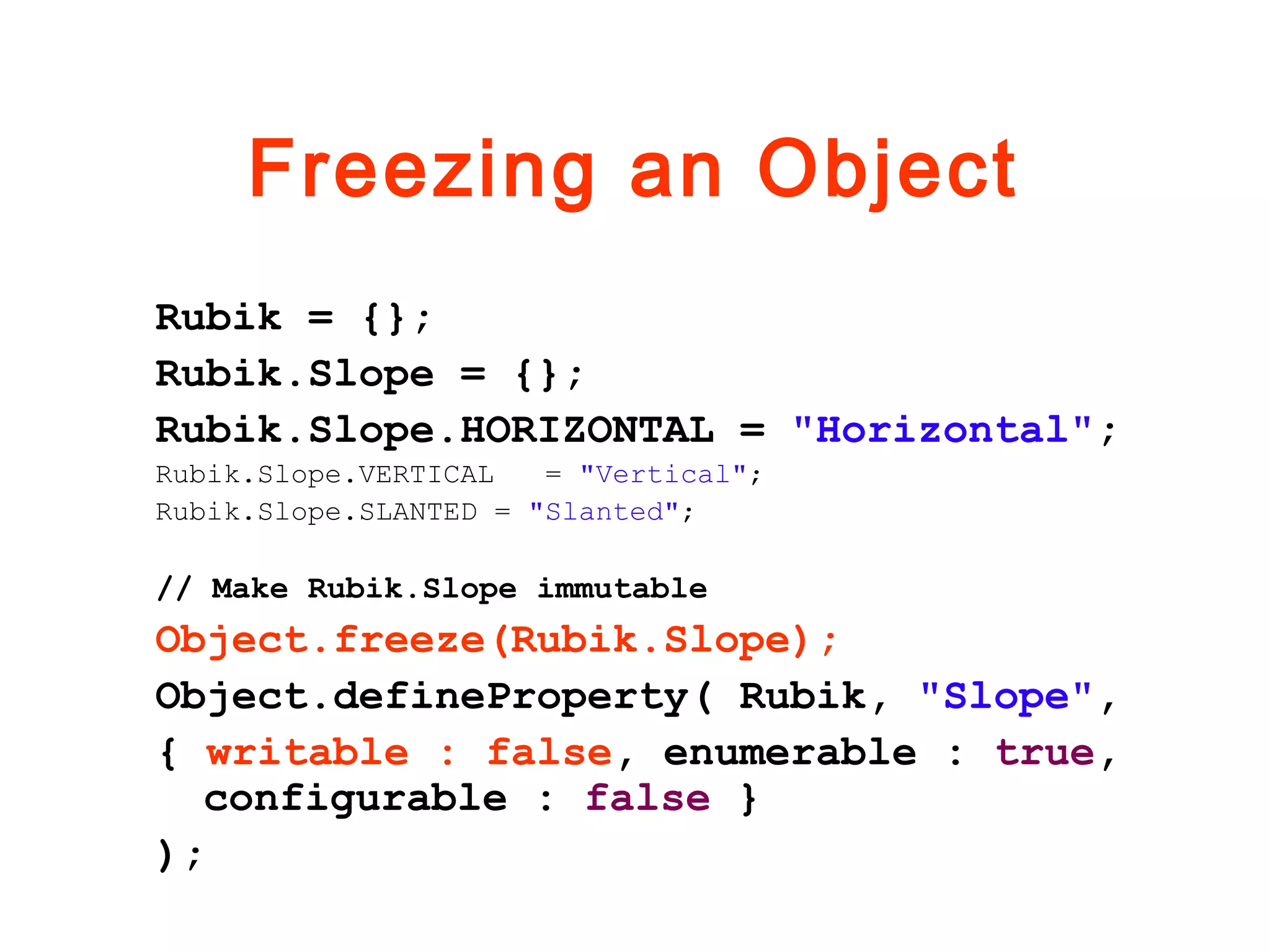
Freezing an Object
Rubik = {};
Rubik.Slope = {};
Rubik.Slope.HORIZONTAL = "Horizontal";
Rubik.Slope.VERTICAL = "Vertical";
Rubik.Slope.SLANTED = "Slanted";
// Make Rubik.Slope immutable
Object.freeze(Rubik.Slope);
Object.defineProperty( Rubik, "Slope",
{ writable : false, enumerable : true,
configurable : false }
);
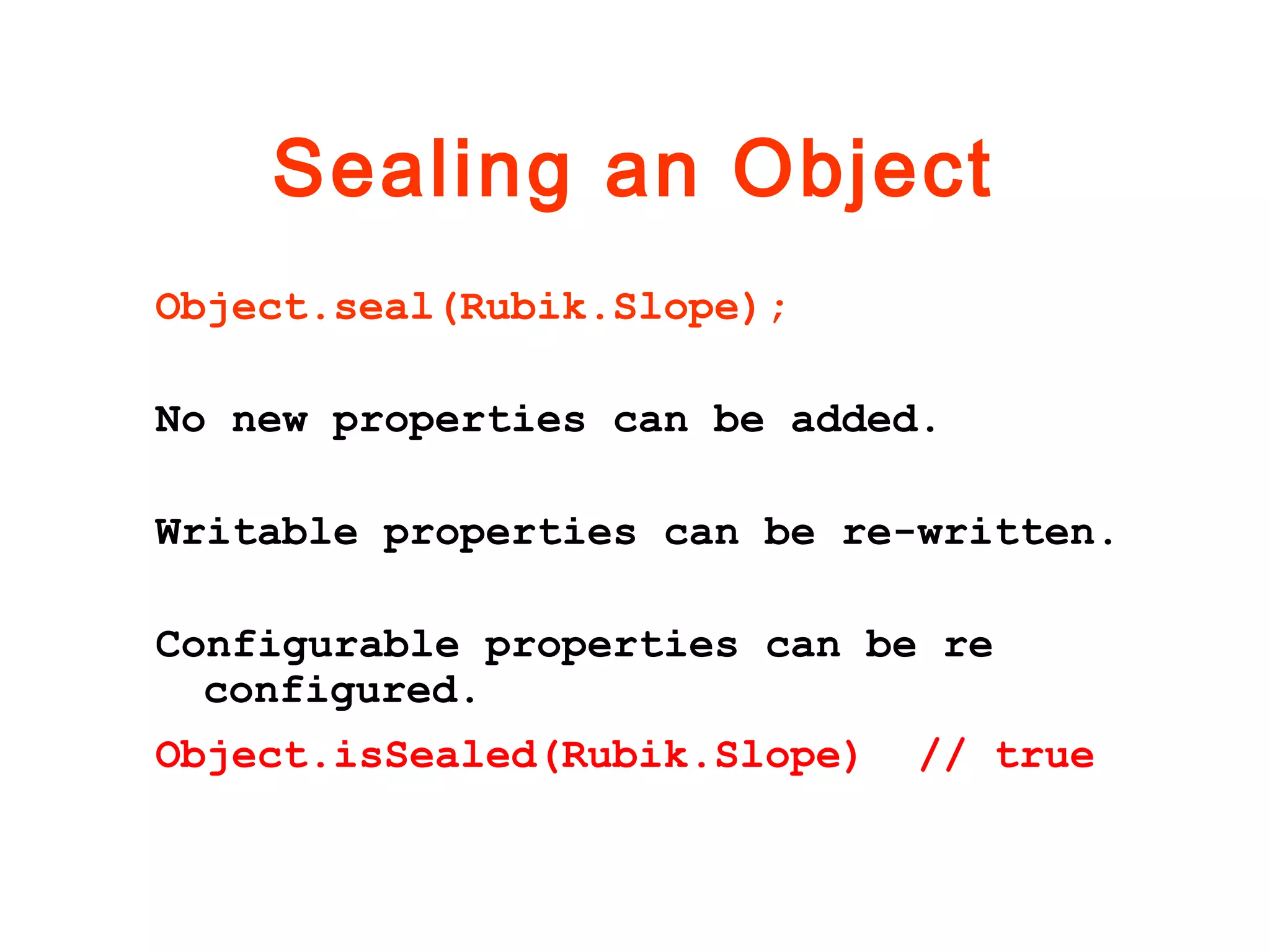
Sealing an Object
Object.seal(Rubik.Slope);
No new properties can be added.
Writable properties can be re-written.
Configurable properties can be re
configured.
Object.isSealed(Rubik.Slope) // true
ES 6 (Harmony) Features
• Block Scoping: let and const
• Destructuring
– [a, b] = [b, a]
• Default Parameter
• Rest and spread parameters
– function(p1, ...restAllParams)
– calling(p1,
...restAllParamsInArray)
• Module Rubik { export function ..}
• Import MyRubik as Rubik
• Class, extends and super
Code Walkthrough
Model Rubik’s Cube
with
Objects
Next step..
• DOM
• JQuery
• Java Script Design Patterns
• Coding Style/Documentation
• Books to read:
– JavaScript – The Good Parts
– Effective JavaScript
Q & A
• Source Code
– GitHub
• This presentation is available on SVCC
•
•
• kr_manoj@yahoo.com
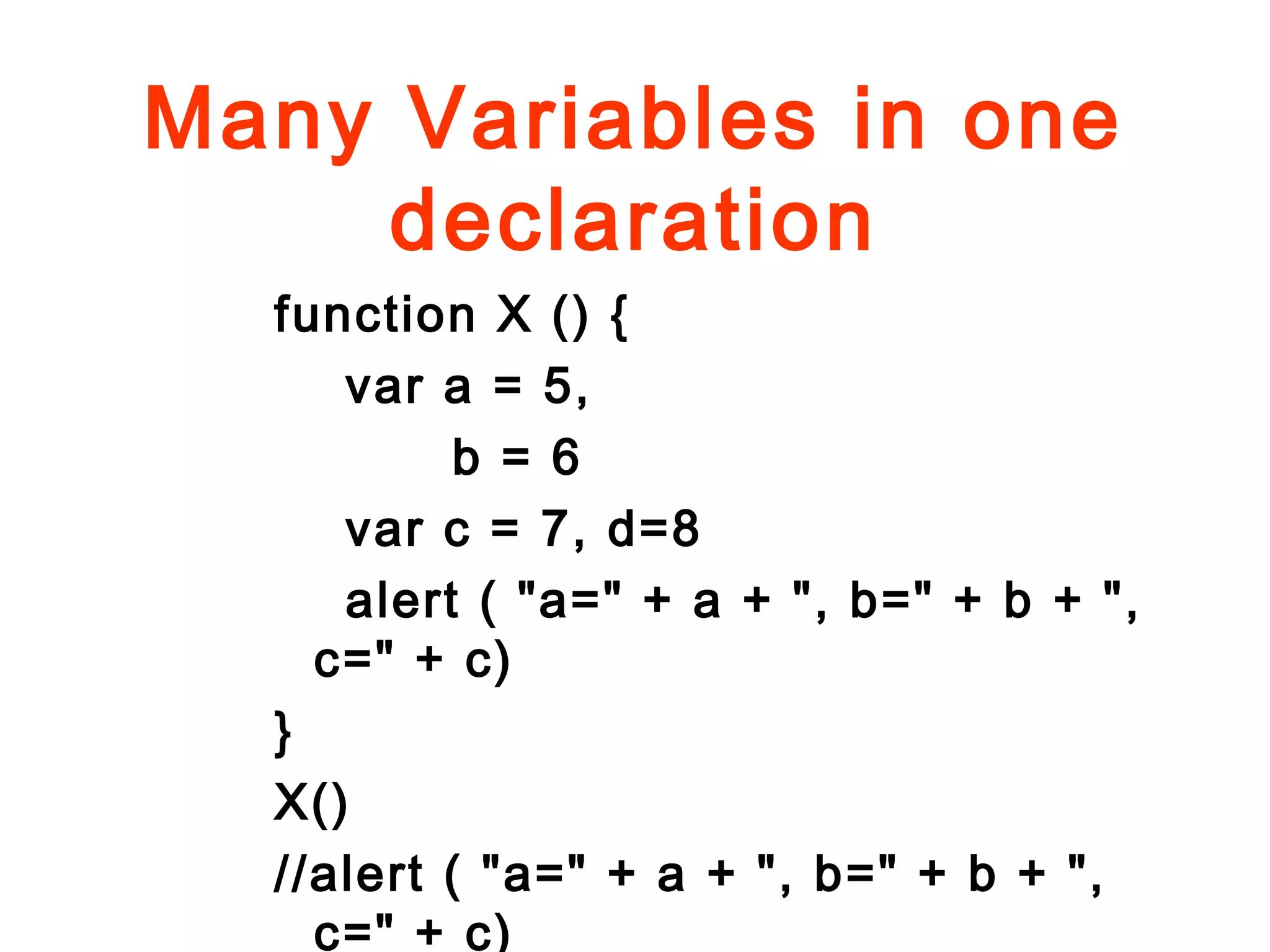
Many Variables in one
declaration
function X () {
var a = 5,
b = 6
var c = 7, d=8
alert ( "a=" + a + ", b=" + b + ",
c=" + c)
}
X()
//alert ( "a=" + a + ", b=" + b + ",
c=" + c)
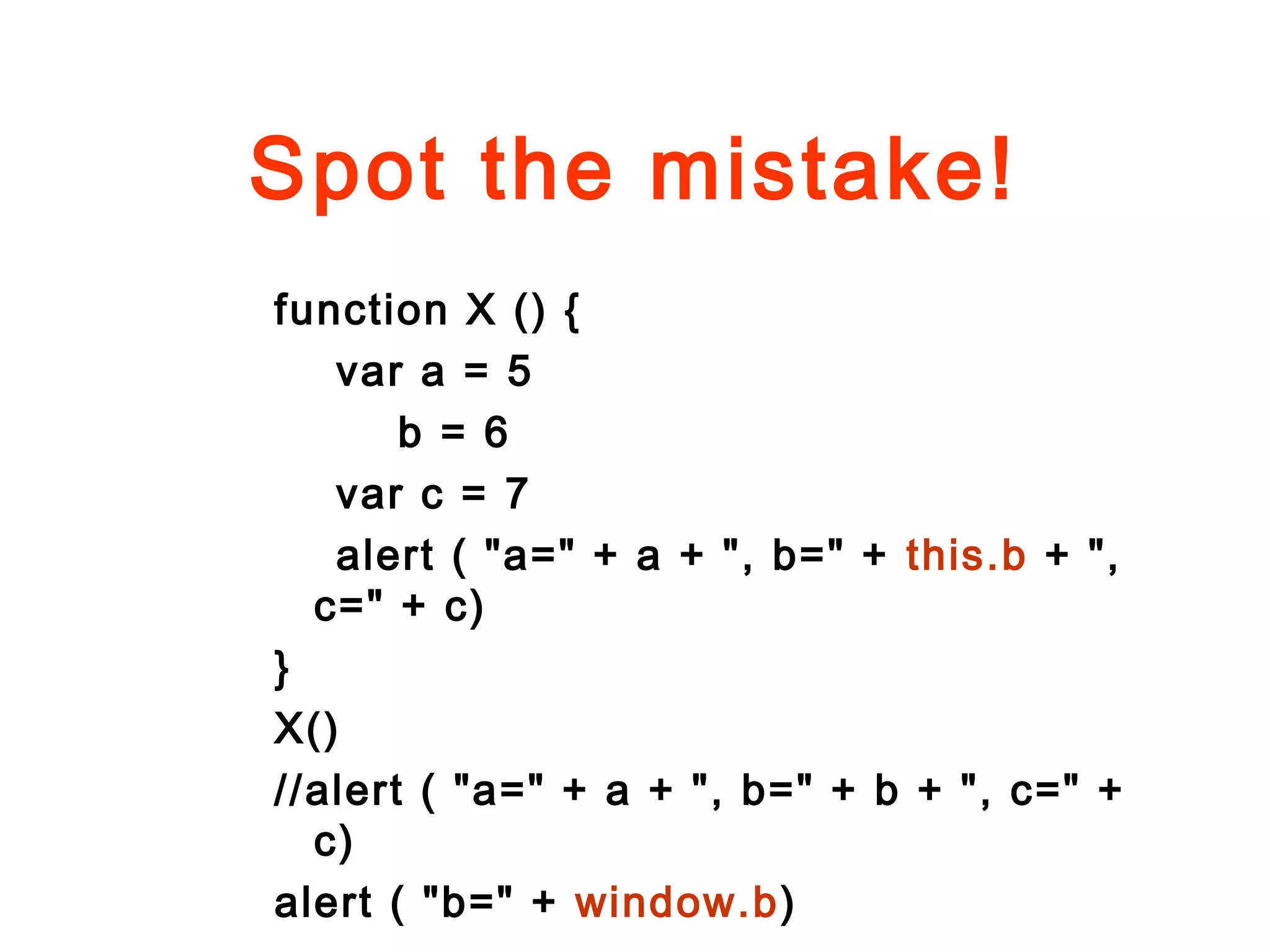
Spot the mistake!
function X () {
var a = 5
b = 6
var c = 7
alert ( "a=" + a + ", b=" + this.b + ",
c=" + c)
}
X()
//alert ( "a=" + a + ", b=" + b + ", c=" +
c)
alert ( "b=" + window.b)
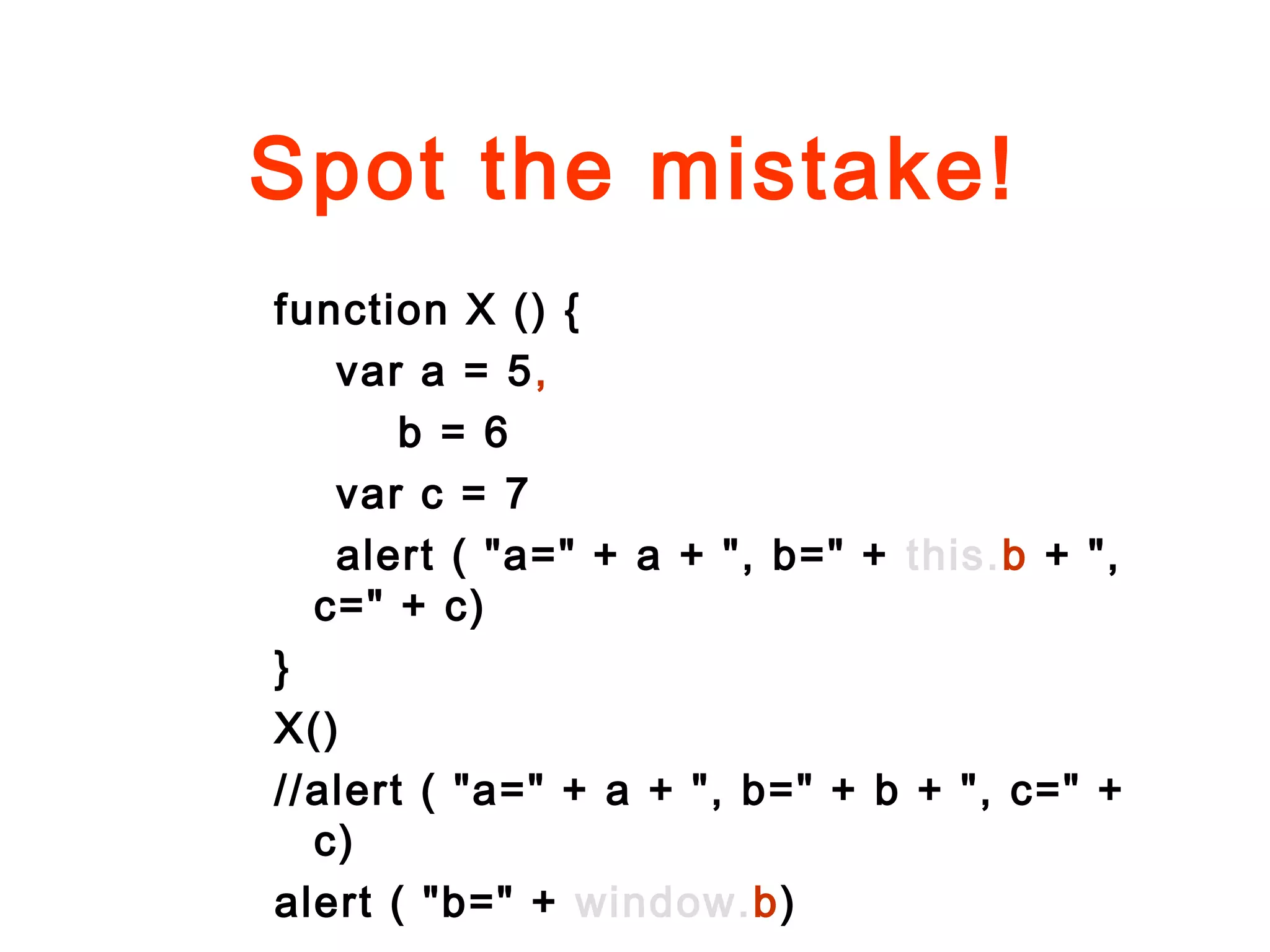
Spot the mistake!
function X () {
var a = 5,
b = 6
var c = 7
alert ( "a=" + a + ", b=" + this.b + ",
c=" + c)
}
X()
//alert ( "a=" + a + ", b=" + b + ", c=" +
c)
alert ( "b=" + window.b)
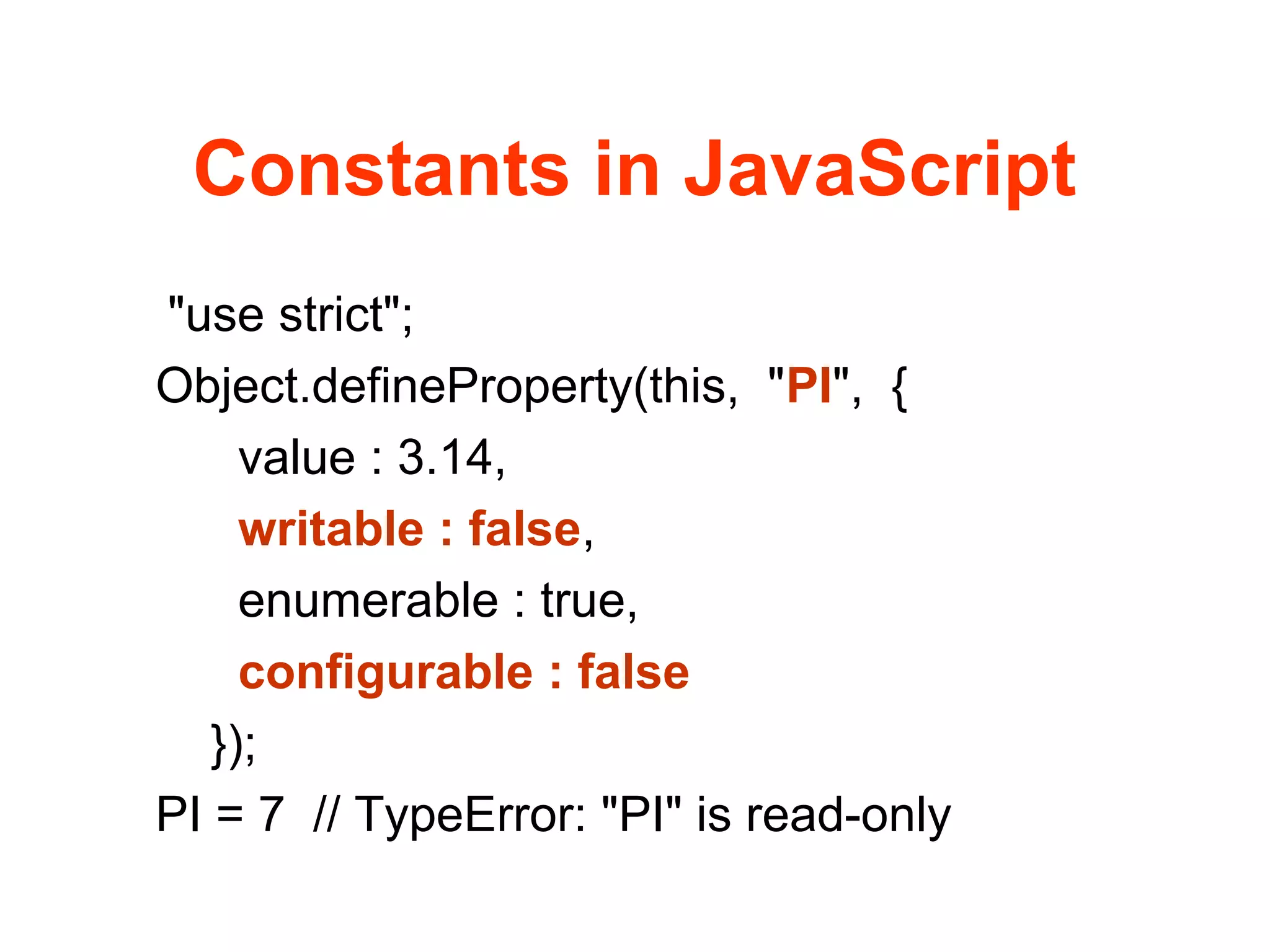
Constants in JavaScript
"use strict";
Object.defineProperty(this, "PI", {
value : 3.14,
writable : false,
enumerable : true,
configurable : false
});
PI = 7 // TypeError: "PI" is read-only
Constants in JavaScript
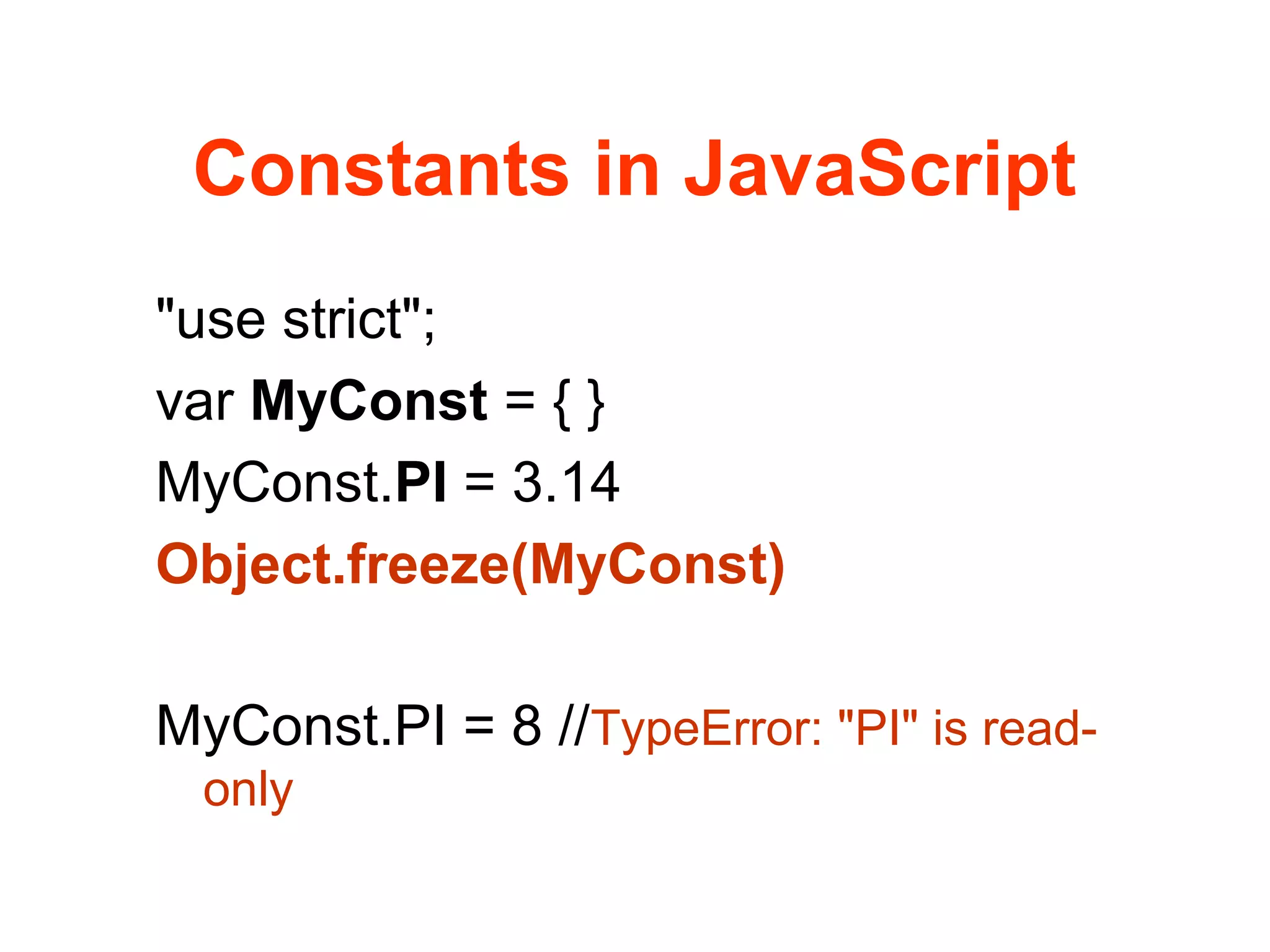
"use strict";
var MyConst = { }
MyConst.PI = 3.14
Object.freeze(MyConst)
MyConst.PI = 8 //TypeError: "PI" is read-
only
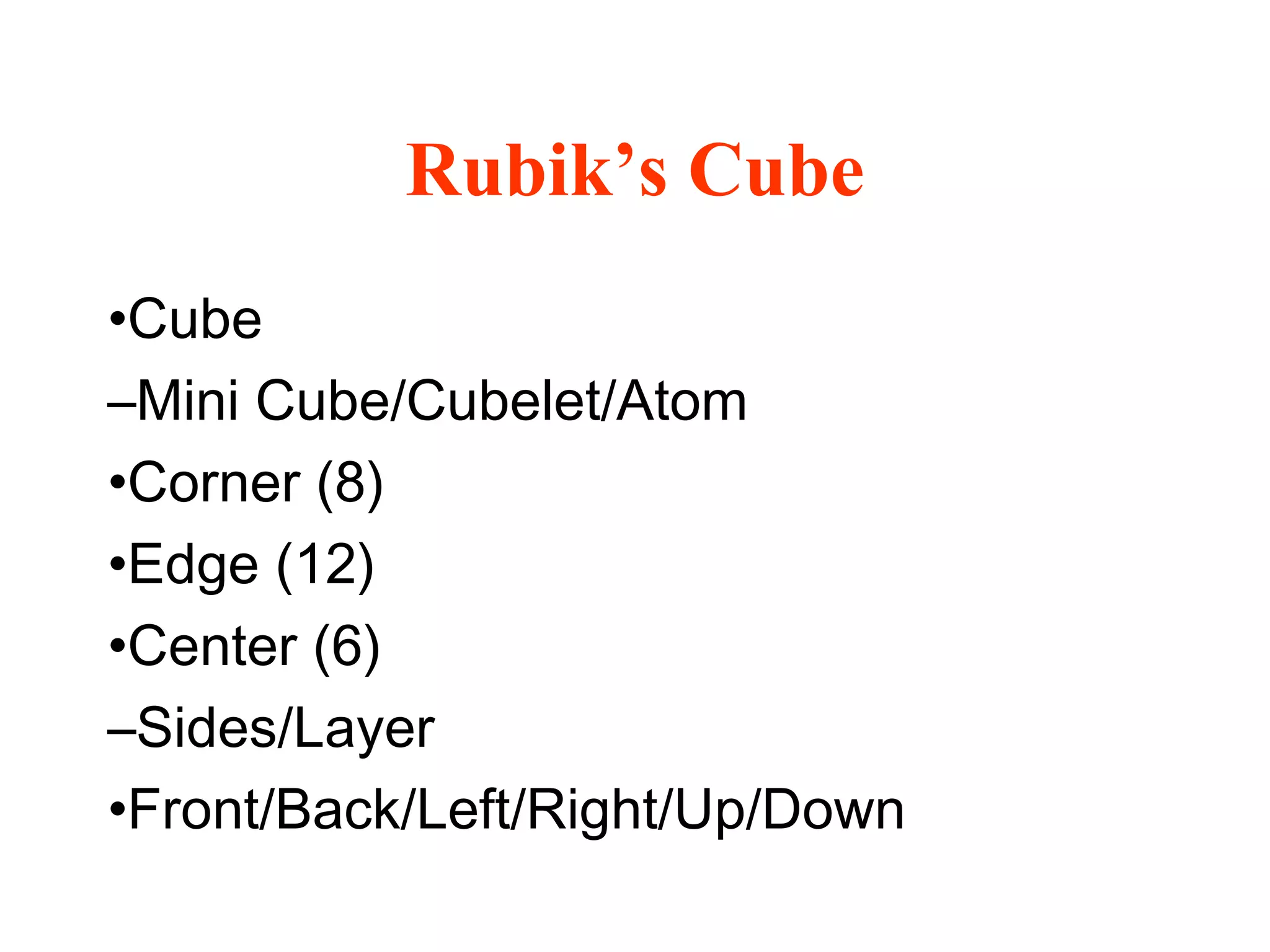
Rubik’s Cube
•Cube
–Mini Cube/Cubelet/Atom
•Corner (8)
•Edge (12)
•Center (6)
–Sides/Layer
•Front/Back/Left/Right/Up/Down
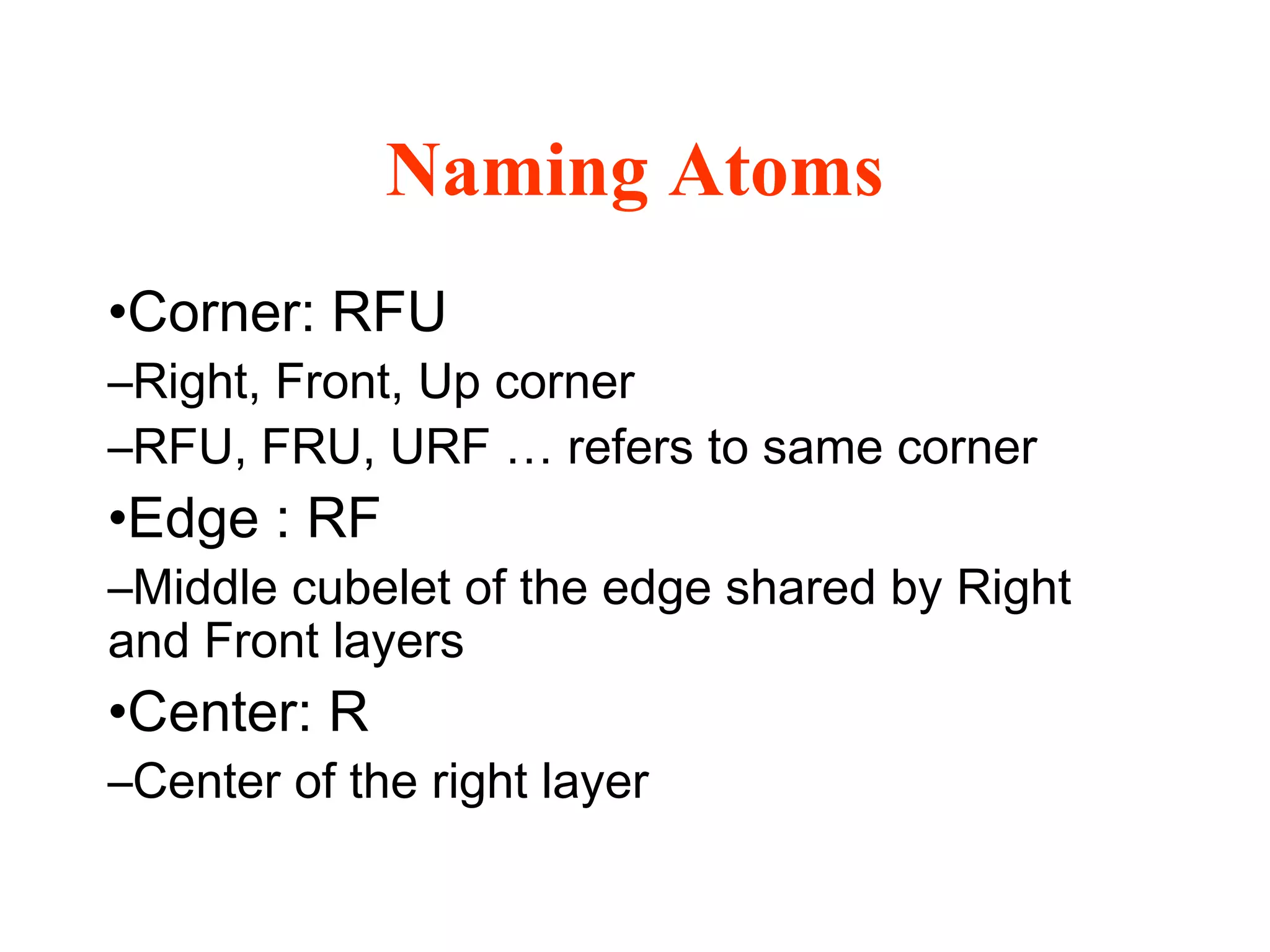
Naming Atoms
•Corner: RFU
–Right, Front, Up corner
–RFU, FRU, URF … refers to same corner
•Edge : RF
–Middle cubelet of the edge shared by Right
and Front layers
•Center: R
–Center of the right layer
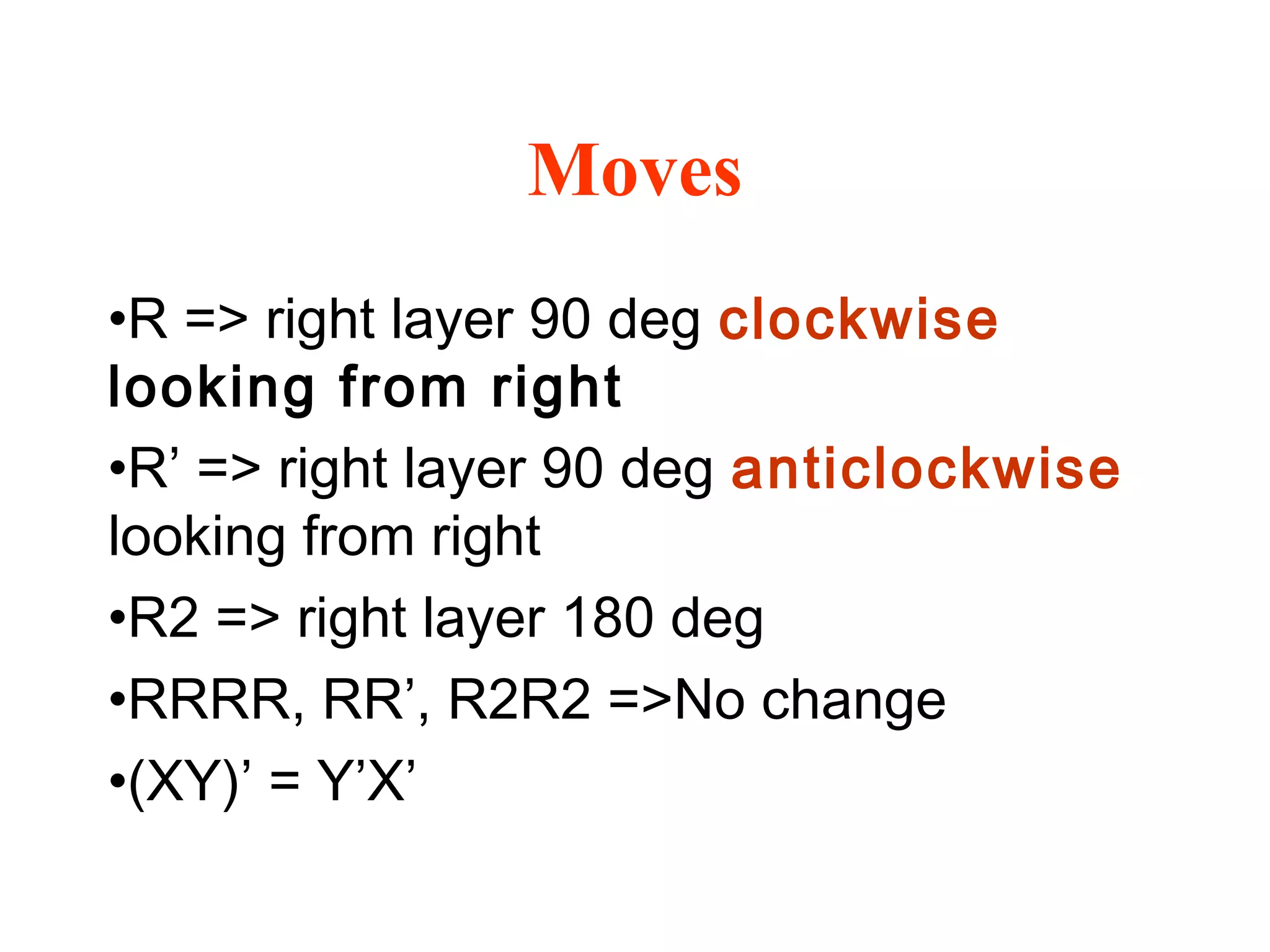
Moves
•R => right layer 90 deg clockwise
looking from right
•R’ => right layer 90 deg anticlockwise
looking from right
•R2 => right layer 180 deg
•RRRR, RR’, R2R2 =>No change
•(XY)’ = Y’X’
Effect of a Move
•Rotating front layer clockwise
( F) ==>
[ fru -> fdr -> fld -> ful -> fru ]
[ fr -> fd -> fl -> fu -> fr ]
•FRU ->FDR
–Corner FRU has moved to FDR
–Right side color of FRU has gone to Down side of
FDR
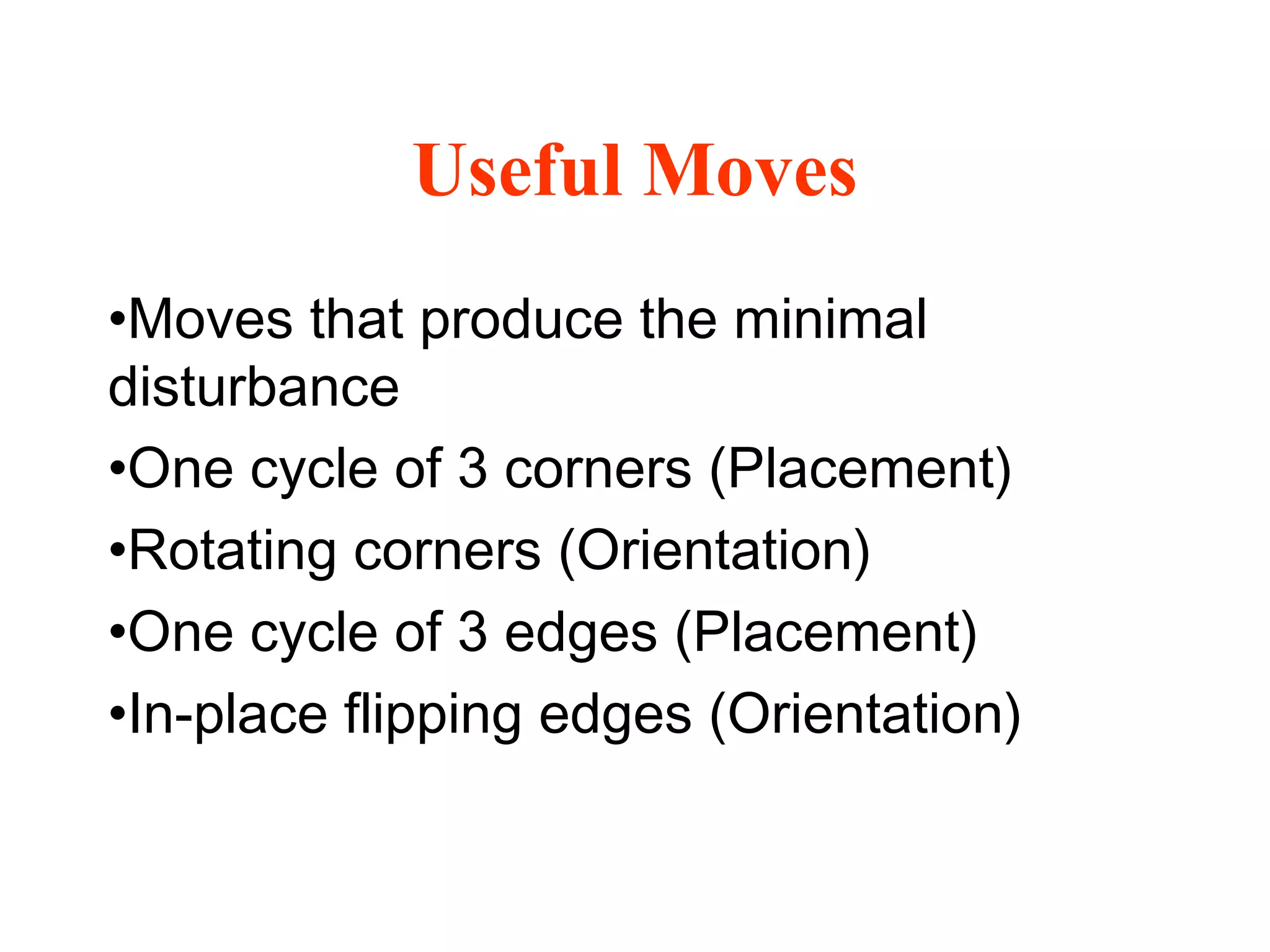
Useful Moves
•Moves that produce the minimal
disturbance
•One cycle of 3 corners (Placement)
•Rotating corners (Orientation)
•One cycle of 3 edges (Placement)
•In-place flipping edges (Orientation)
Basic Corners Moves
•One cycle of 3 corners
–(R'D'LD RD'L'D) => [ fru -> drf -> ful -> fru ]
–(RF'L'F R'F'LF) => [ fru -> lfu -> drf -> fru ]
•Rotate corner at its own place
(R'D'LD RD'L'D RF'L'FR'F'LF) ==>
[ dfr -> rdf ]
[ flu -> luf ]
Basic Edges Moves
•One cycle of 3 edges
(V'F2VF2) ==> [ fu -> bu -> fd -> fu
]
(V'F'VFFV'F'V) ==> [ fr -> fl -> df -> fr ]
•Flipping edges in its own positions
(RFBU2F2U'FUFU2B'R'F') ==>
[ fr -> rf ]
[ fu -> uf ]
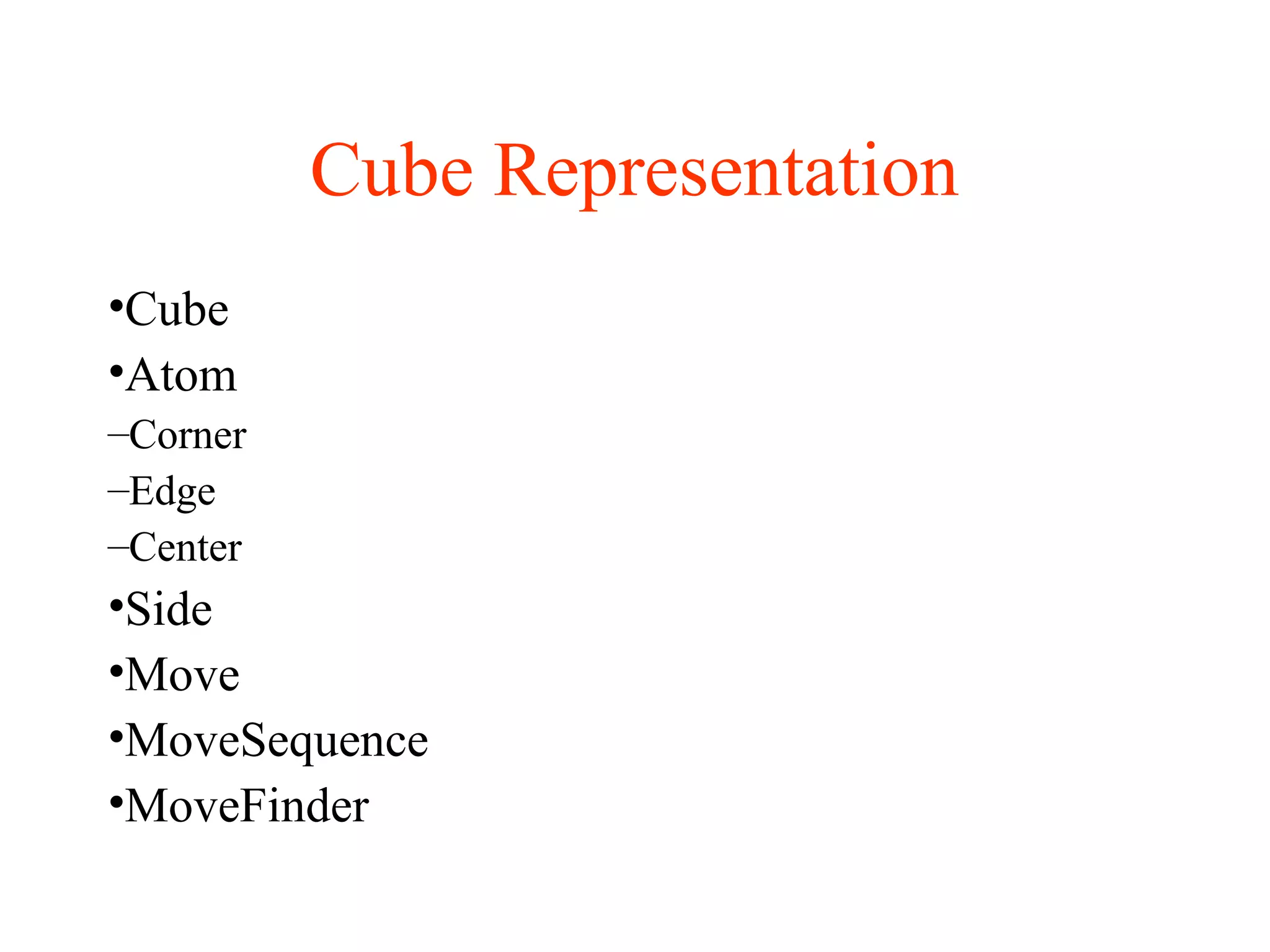
Cube Representation
•Cube
•Atom
–Corner
–Edge
–Center
•Side
•Move
•MoveSequence
•MoveFinder
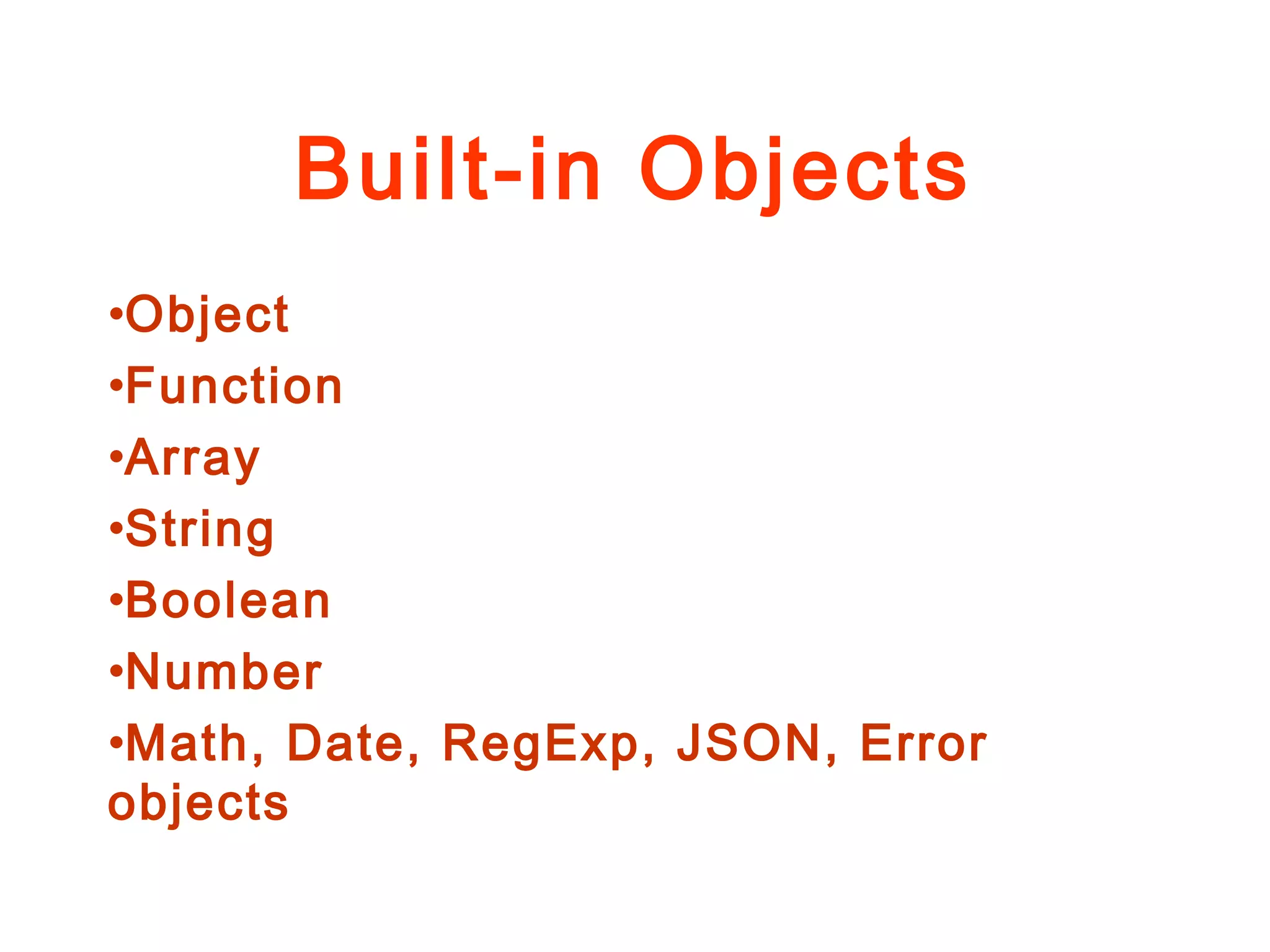
Built-in Objects
•Object
•Function
•Array
•String
•Boolean
•Number
•Math, Date, RegExp, JSON, Error
objects
Call and Apply
•add(4, 5, 2 ,3)
•add.call(null, 4, 5, 2, 3)
•add.apply(null, [4, 5, 2, 3])
•add.apply(undefined, [4, 5, 2, 3])
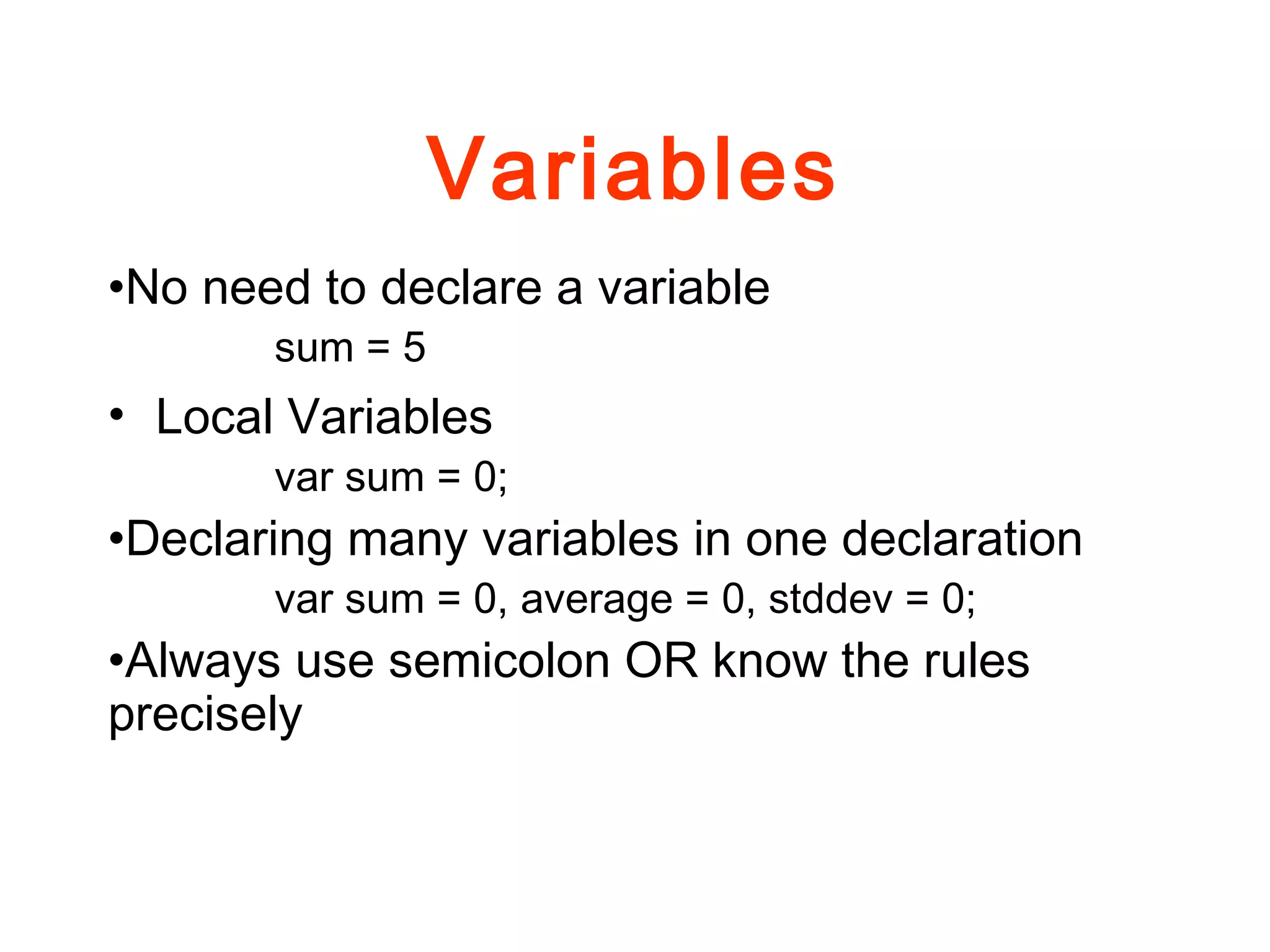
Variables
•No need to declare a variable
sum = 5
• Local Variables
var sum = 0;
•Declaring many variables in one declaration
var sum = 0, average = 0, stddev = 0;
•Always use semicolon OR know the rules
precisely
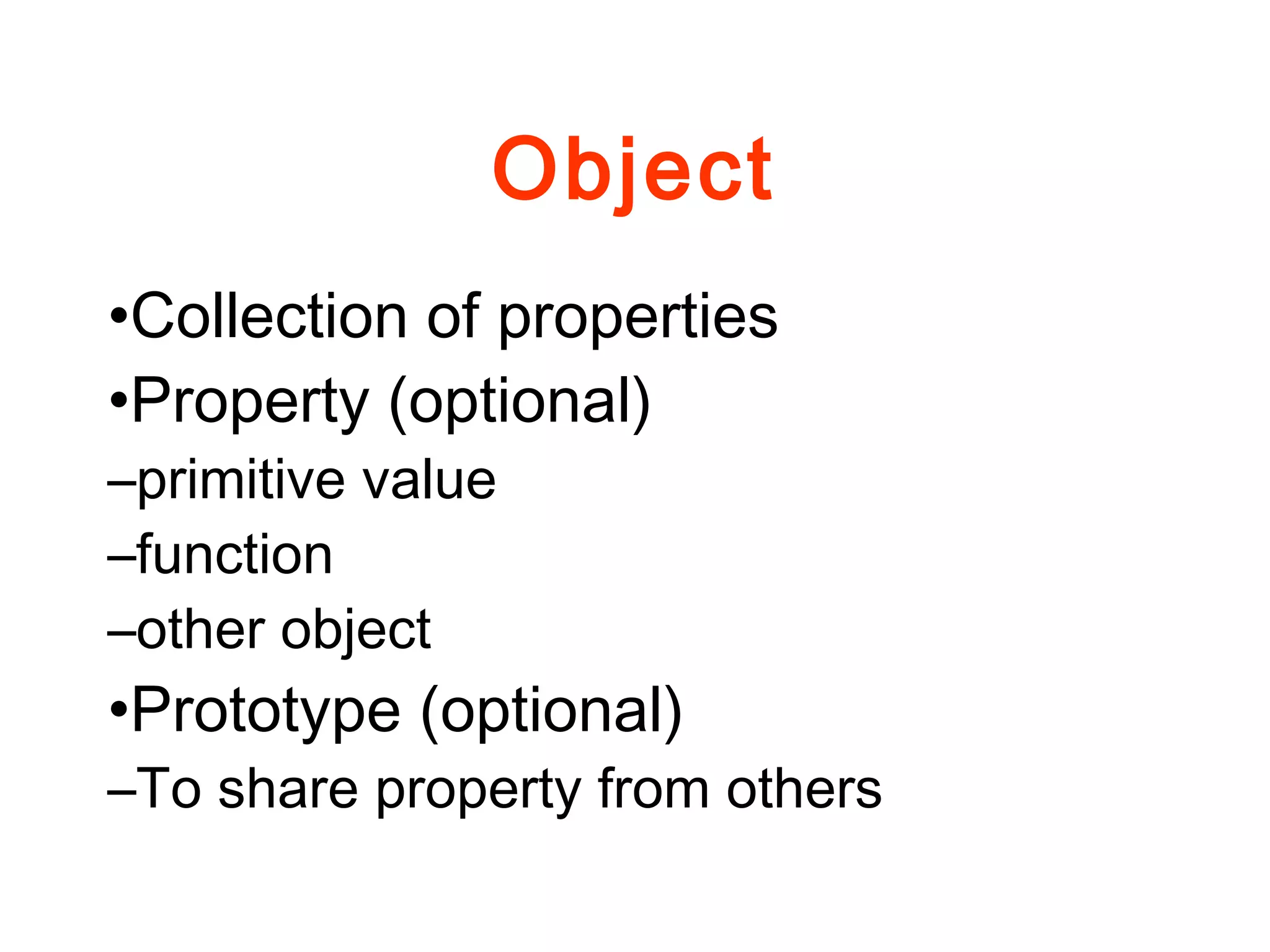
Object
•Collection of properties
•Property (optional)
–primitive value
–function
–other object
•Prototype (optional)
–To share property from others
Literal Object
frontColor = {
red : 255
blue : 0
green : 128
}
redComponent = frontColor.red
greenComponent = frontColor [ “green”
]
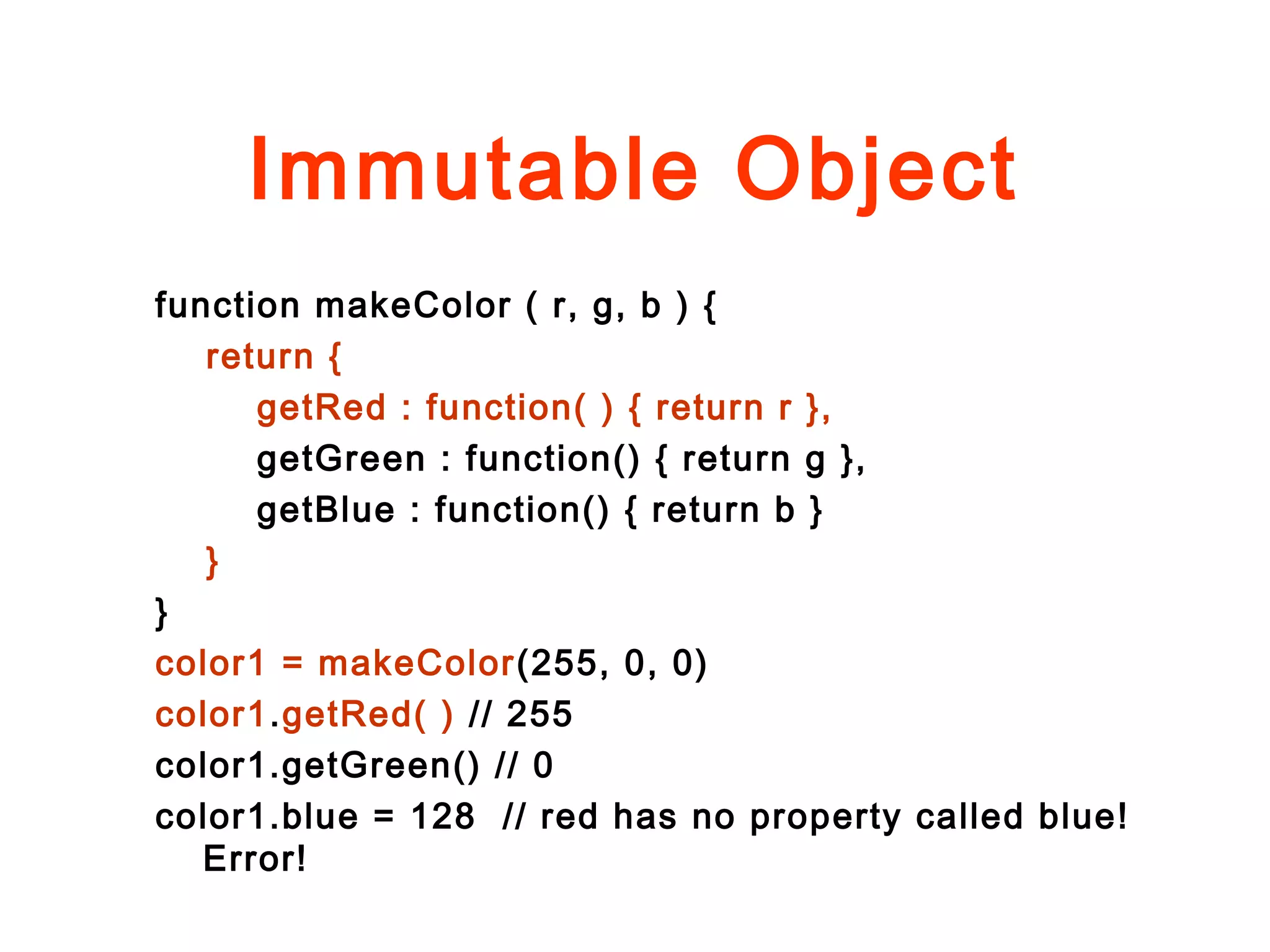
Immutable Object
function makeColor ( r, g, b ) {
return {
getRed : function( ) { return r },
getGreen : function() { return g },
getBlue : function() { return b }
}
}
color1 = makeColor(255, 0, 0)
color1.getRed( ) // 255
color1.getGreen() // 0
color1.blue = 128 // red has no property called blue!
Error!
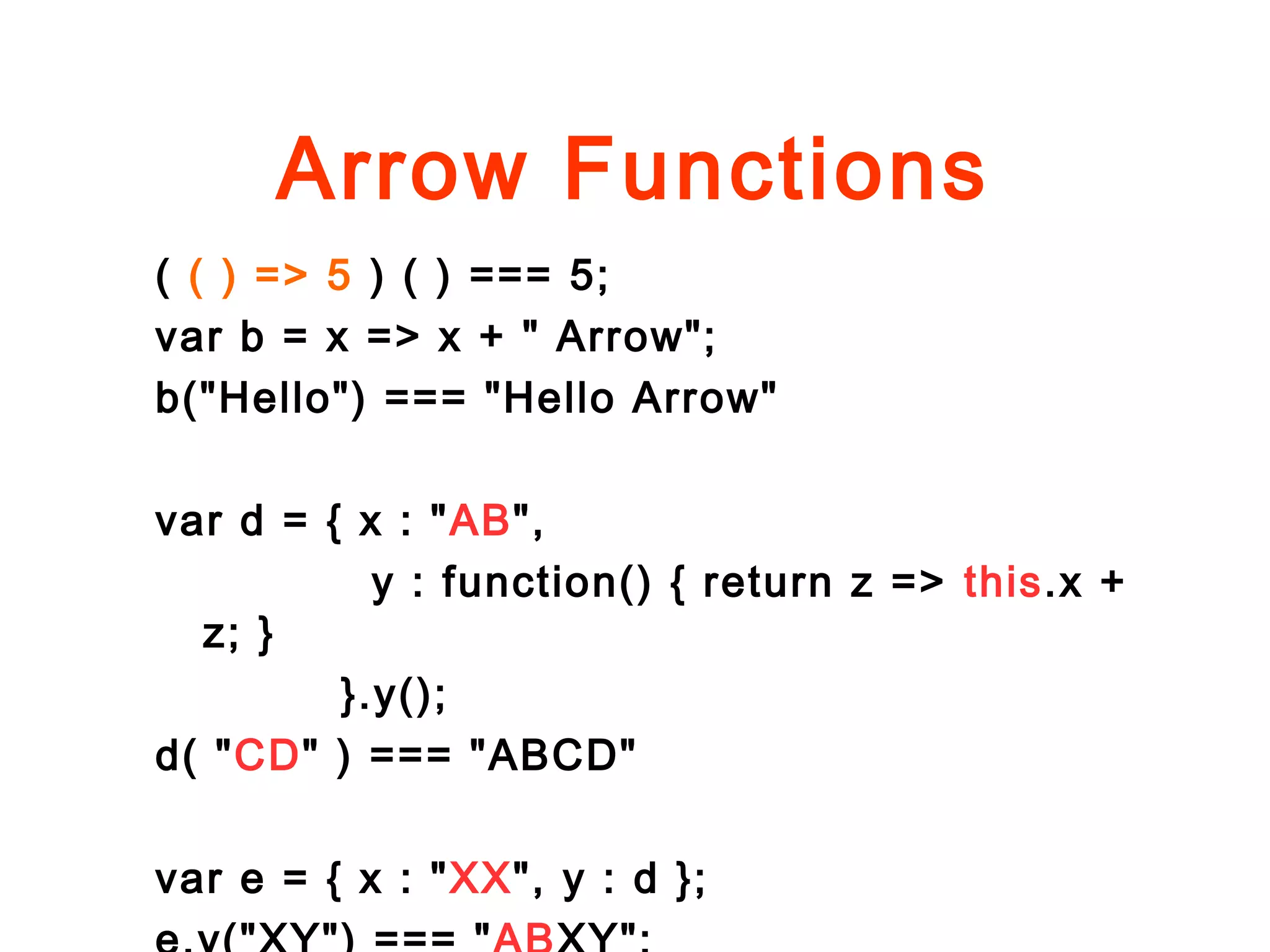
Arrow Functions
( ( ) => 5 ) ( ) === 5;
var b = x => x + " Arrow";
b("Hello") === "Hello Arrow"
var d = { x : "AB",
y : function() { return z => this.x +
z; }
}.y();
d( "CD" ) === "ABCD"
var e = { x : "XX", y : d };
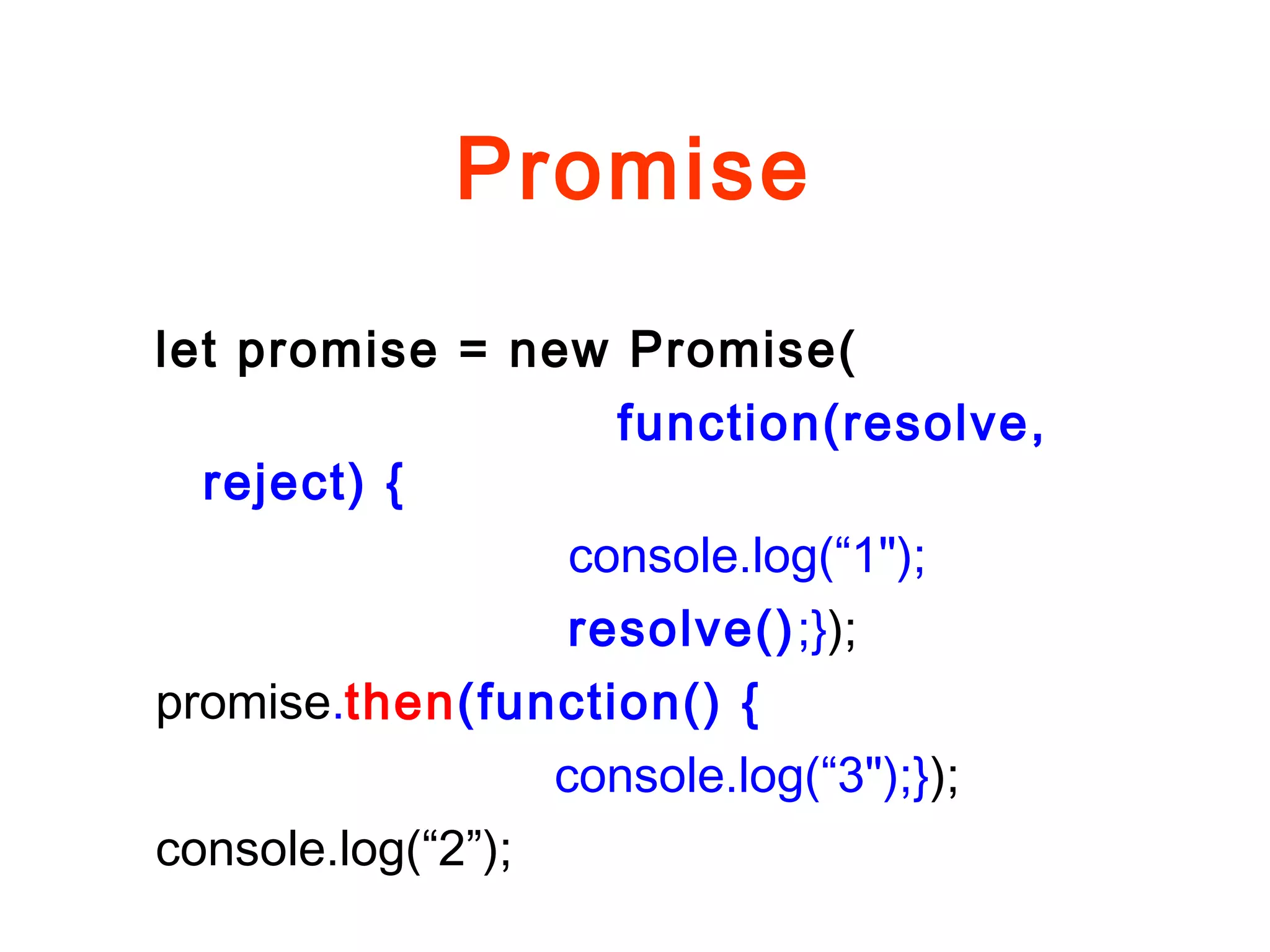
Promise
let promise = new Promise(
function(resolve,
reject) {
console.log(“1");
resolve();});
promise.then(function() {
console.log(“3");});
console.log(“2”);
You actually don't understand a
concept.
You just get used to it!
And you brain makes you believe
you got it!
Very important for our
technical/mental health.
References
• ECMAScript Support Matrix
– http://pointedears.de/scripts/test/es-matrix/
• http://www.slideshare.net/Solution4Future/javascript-17363650
• https://developer.mozilla.org/en-US/docs/Web/JavaScript/Reference
•
• https://code.google.com/p/traceur-compiler/wiki/L
•
ES6 PPT FOR 2016

ES6 PPT FOR 2016

  • 1.
    Silicon Valley CodeCamp Amazing New Features In JavaScript Manoj Kumar
  • 2.
    Agenda •Scope of Variables •Parameters:default/rest/spread •Destructuring •Object Literals •Arrow functions •Iterators & Generators •Promises & Proxies
  • 3.
    Scope of aVariable (ES5) var x = 1 // global variable, a property in global obj b = 2 // global variable, a property in global obj function f() { a = b + 6 // “a” is a global variable, what about b? var b = 7; // b is local to this function // declaration is hoisted but not the assignment }
  • 4.
    Scope of aVariable (ES 6) function f() { var a = 7; // local to function f let c = 8; // local to function f If ( a > 5) { var b = 9 + c; // Visible anywhere in the function let x = 1; // local to this IF block const pi = 3.14; // constant and local to IF block // redefining is not allowed const obj = { x:9, y:10 }; // obj.x is still
  • 5.
    const const pi1; //error: Missing initialization const pi2 = 3.14159 ; // works! pi2 = 3.14 ; // error: can't change the value for( let i = 5;....) { const c = i * 9; // const can get a fresh value inside loop in different iteration
  • 6.
    Temporal Dead Zone Letx = 6; If ( true ) { // new block scope so TDZ starts console.log(x) ; // reference error (outer x not visible) x = 5; // reference error let x; // now x can be referenced console.log(x); // undefined x = 6; console.log(x); // 6 }
  • 7.
    Temporal => Time If( true ) { // new block scope so TDZ starts const func1 = function () { Console.log(x); }; console.log(x) ; // still inside TDZ, so reference error let x = 8; func1(); // inside this call “let x” is effective }
  • 8.
    Default Parameter Value function f(x= 0, y = 0) { } f(); // 0,0 f(5); // 5,0 f(5, someVarUndefined); // 5,0 f(undefined, 6); // 0, 6 f(5,6); // 5,6 Function(x, y=x) { } //OK Function (x=y, y=5) { } // y is not available to use (TDZ)
  • 9.
    Rest of theParameters function func(x, y, ...others) { //others[0..n] contains rest of the parameters } func(5,6); // 5,6, others.length==0 func(5,6, 7); // 5,6, others.length==1, others[0] === 7 Func(5,6, 7,8,9); // 5,6, others.length==3, others[0..2] are 7,8,9
  • 10.
    Spread Operator Math.max(2, 5,6, 8); Math.max( …[2, 5, 6, 8] ) Same as Math.max.apply(null, [2,5,6,8]) [1, ...[2,3], 4] => [1, 2, 3, 4]
  • 11.
    Destructuring let [x, y]= [5, 8]; // x === 5, y ===8 var [a, , [b], c] = [5, null, [6]]; // a === 5 && b === 6 && c === undefined [a, b] = [b, a] var [a, b, c] = "xy"; // think “xy” as [“x”, “y”] // a === "x" && b === "y" && c === undefined
  • 12.
    Destructuring { first: f,last: l } = { first: 'Manoj', last: 'Kumar' } // f === 'Manoj' && l === 'Kumar' let { x: x } = { x: 1, y: 2 }; // x = 1 let [ x, ...y ] = 'abc'; // x = 'a'; y = [ 'b', 'c' ] let [ x, y ] = new Set( [ 'a', 'b' ] ); // x = 'a'; y = 'b’; [ ] = { }; // TypeError, empty objects are not iterable [ ] = undefined; // TypeError, not iterable [ ] = null; // TypeError, not iterable let [x] = [ ]; // x = undefined
  • 13.
    Object Literals obj ={ red : 255, blue : 127, [ “green” ] : 255 }; red = 255; blue = 127; green = 255; obj = { red : red, blue : blue, green: green }; obj = { red, blue, green } // ES 6
  • 14.
    Computed Property let prop= "red"; green = 255; obj = { [ prop ] : 255, // [“red”] : 255 or red : 255 [ "b" + "lue" ] : 127, green }; <eot/>
  • 15.
    Arrow Functions ● New wayof creating functions ● function square( x ) { // ES 5 function ● return x * x; ● } x => x * x ; // Arrow function (x, y) => x + y ; ( ) => 5; (x, y) => { f(x,y); return x + y; } x => { a:x+1, b:x+2}; // wrong! { means block x => ({ a:x+1, b:x+2 });
  • 16.
    Arrow Functions vs NormalFunctions 1. Following constructs are lexical ● Arguments ● this ● super ● new.target (target object of new, null in normal functions) 2. Cannot be used as constructor new ( () => { } ) throws an error
  • 17.
    Symbol obj.red = 255; obj[“red”]=== 255; // ES5 const my_prop = Symbol(); // ES6 obj[my_prop] = 127; // ES6 Obj = { [my_prop] : 127 }; const red = Symbol('my_red') red.toString() === 'Symbol(my_red)' Symbol() != Symbol() Symbol( 'red' ) != Symbol( 'red' )
  • 18.
    Symbol (Global Registry) const globalRedProp= Symbol.for( 'red'); globalRedProp.toString() === 'Symbol(red)'; Symbol.for ( 'red' ) === globalRedProp Symbol.keyFor( globalRedProp ) === 'red' Symbol.for( 'red' ) === Symbol.for( 'red' ) Symbol( 'red' ) != Symbol( 'red' ) Built-in symbols: Symbol.iterator Symbol.match (=== String.prototype.match )
  • 19.
    Iterators Iterable object makesits element accessible in for-of loops and spread operators for (let x of ['a', 'b', 'c']) { // arrays are iterable console.log(x); } Iterable Objects: ● Arrays ● Strings ● Maps ● Sets ●
  • 20.
    Iterable How to makeany object iterable? ● Implement a method Symbol.iterator ● That returns Iterator object IterableObject = { [Symbol.iterator] ( ) { // create an iterator object and return } }
  • 21.
    Iterator Iteartor = { next() { // keep returning IteratorResult in successive calls } } IteratorResult = { value : // current value done: // false, but at the end true }
  • 22.
    let iterable ={ [Symbol.iterator]() { let step = 0; let iterator = { next() { if (step <= 2) step++; switch (step) { case 1: return { value: 'hello', done: false }; case 2: return { value: 'world', done: false }; default: return { value: undefined, done: true }; } } }; return iterator; }
  • 23.
    Iterable Let iterator =iterable [ Symbol.iterator ] ( ) ; Iterator.next() === { value : 'hello', done: false } Iterator.next() === { value : 'world', done: false } Iterator.next() === { value : undefined, done: true } While (true) { let result = iterator.next(); if ( result.done ) break;
  • 24.
    Iterable in for-of for(let x of iterable) { console.log(x); } for ( let [k,v] of map) for ( let x of Array.from(arrayLike)) //length, 0:, 1:.. for ( let [k,v] of array.entries())
  • 25.
    Generator function * simpleGenFunc() { yield 'hello'; yield 'world'; } Iterator = simpleGenFunc (); Iterator.next ( ) ; // { value: “hello”, done: false } Iterator.next ( ); // { value: “world”, done: false } Iterator.next ( ); // { value: undefined, done: true } for ( x of simpleGenFunc () ) {
  • 26.
    Generator let arr =[ ...simpleGenFunc ( ) ]; // [ 'hello', 'world'] let [ x, y ] = simpleGenFunc ( ); x === 'hello' y === 'world'
  • 27.
    Generator Generators are ● Data Producers(as iterator) ● Data Consumer (Yield can get data from next()) ● Communicating sequential tasks..
  • 28.
    function * genFunc() { try { let hint = yield 'hello'; // do something with hint yield 'world'; } finally { // Do some cleanup here } } Iterator = genFunc(); Iterator.next(); // gives hello Iterator.next(“stop”); // gives 'world', hint === “stop” Iterator.next(); // cleanup code executes,
  • 29.
    Promise setTimeout( function() { console.log("timeout!");}, delay); promise = timeout(delay) ; promise.then( function(result) { console.log("Result: " + result);} );
  • 30.
    Promise function timeout(delay) { returnnew Promise( function(resolve, reject) { setTimeout( function() { resolve(); }, delay); }); } promise = timeout(delay) ; promise.then( function(result) {….} );
  • 31.
    Promise let promise =someAsyncOp() ; promise.then ( function (result) { console.log(“Result: “ + result); }, function (err) { console.log(“Failed: “ + err); } )
  • 32.
    Promise promise.then ( null,function (err) { console.log(“Failed: “ + err); }); promise.catch(function (err) { console.log(“Failed: “ + err); } );
  • 33.
    Promise • Life Cycle –Unsettled Promise • State: PENDING – Settled Promise • State: FULFILLED • State: REJECTED – – promise.then ( fulfilledCaseCallback, rejectedCaseCallBack); – promise.then(fulfilledCaseCallback); – promse.catch(rejectedCaseCallback);
  • 34.
    Promise Chaining promise.then ( fulfillmentFunction1) .then ( fulfillmentFunction2 ); promise2 = promise.then ( fulfillmentFunction1 ) promise2.then ( fulfillmentFunction2 );
  • 35.
    Promise Promise.all([promise1, promise2]) .then(function(results) { //Both resolved }) .catch(function(error) { // One rejected });
  • 36.
    Promise Promise.race([promise1, promise2]) .then(function(results) { //one got resolved }) .catch(function(error) { // First settlement was in rejection }); <eot/>
  • 37.
    Proxy Let proxy =new Proxy( target, handler ); Handler: Object with one or more traps Traps: – Get – Set – Has – deleteProperty – defineProperty
  • 38.
    Proxy More Traps: – isExtensible –preventExtensions – getPrototypeOf – setPrototypeOf – ownKeys – apply (calling a function) – Construct (using new) – –
  • 39.
    let target ={ name: "smartObject" }; let proxy = new Proxy(target, { set(trapTarget, key, value, receiver) { if (isNaN(value)) { throw new TypeError("Property must be a number."); } return Reflect.set(trapTarget, key, value, receiver); } }); proxy.count = 1; // numeric properties are okay proxy.color = "red"; // throws exception <eot/>
  • 40.
    References • ecmascript 6compatibility table – https://kangax.github.io/compat-table/es6/ • http://exploringjs.com/es6/index.html – Thanks to the author for tons of examples! • leanpub.com/understandinges6 • JavaScript: The Good Parts – Douglas Crockford • Effective JavaScript
  • 41.
    Thank You! Please provideyour feedback :) Feedback from earlier sessions: Speaker started with the concepts that were way too simple and then at the end it became way too complex.
  • 43.
    Slides from OlderPresentations •You may not find things in sequence in rest of the slides
  • 44.
    ES5 Equiv ofClass function Cube(size) { this.size = size; } Cube.prototype.rotate = function (direction) { // rotate the cube; }; Let simpleCube = new Cube(3); simpleCube.size === 3 simpleCube.rorate(“left”);
  • 45.
    ES 6 Class classCube { constructor (size) { this.size = size; } rotate(direction) { // rotate the cube } } let simpleCube = new Cube(3); simpleCube.size === 3 simpleCube.rorate(“left”);
  • 46.
    Derived Class class RubiksCubeextends Cube { constructor (size, colors) { super(size); this.colors = colors; } solve() { // solve the cube } }
  • 47.
    Derived Class class RubiksCubeextends Cube { constructor (size, colors) { super(size); this.colors = colors; } solve() { // solve the cube } }
  • 48.
    class BinaryTree { constructor(value,left=null, right=null) { this.value = value; this.left = left; this.right = right; } * [ Symbol.iterator ] ( ) { yield this.value; If ( this.left ) { yield* this.left; } If ( this.right ) { yield* this.right; } } }
  • 49.
    let tree =new BinaryTree( 'a', new BinaryTree( 'b', new BinaryTree('c'), new BinaryTree('d')), new BinaryTree('e')); for (let x of tree) { console.log(x); } // Output: // a // b // c // d // e
  • 50.
    Module A JavaScript fileis a module One module is only one JavaScript file Export entities in the module where declared Import entities from a module in a module
  • 51.
    Module //------ lib.js ------ exportfunction square (x) { return x * x; } export function diag (x, y) { return sqrt(square(x) + square(y)); } export const sqrt = Math.sqrt; //------ main.js ------ import { square, diag } from 'lib'; console.log(square(11)); // 121 console.log(diag(4, 3)); // 5
  • 52.
    Module import * asmylib from 'lib'; console.log ( mylib.square(11) ); // 121 console.log ( mylib.diag(4, 3) ); // 5 Imports are hoisted Cyclic dependency is supported Re-export some imported entities ● Export * from lib ● Export { square as num_square, diag } from lib
  • 53.
    Scope •ES5 – Function Scope –Global Scope – var keyword • ES6 – Block scope – let and const keywords
  • 54.
    Scope of aVariable (ES 6)●
  • 55.
    New Features (1) •ArrowFunction •Classes •Enhanced object literals •Template strings •Destructuring •Default, rest, spread •Let, const •Iterators, for..of •Generators
  • 56.
    New Features (2) Unicode Modules Moduleloaders Map, set, weakmap, weakset Proxies Symbols Subclassable built-ins Promises
  • 57.
    New Features (3) •Math,number, string, array, object APIs •Binary and octal literals •Reflect api •Tail call optimization •
  • 58.
    Silicon Valley CodeCamp 2014 Learn JavaScript by Modeling Rubik’s Cube Manoj Kumar
  • 59.
    Agenda •Scripting Language •Crash coursein Rubik’s Cube •Code Walk-through •Modeling •Finding moves
  • 60.
    Scripting Language •Is aProgramming Language –To manipulate –To customize –To automate –an existing system •ECMAScript –Web Scripting Language –To work with web browser
  • 61.
    ECMA Script •Object Based –Object:Collection of properties – Property • Type : Number, Boolean, String, Array, Function & other objects • Attributes •Value, Writable, Configurable, Enumerable •Functional •Based on –Java, C –Self (Prototype) –Scheme (Functional)
  • 62.
  • 63.
    Number •64 bit floatingpoint (sign bit, 11 exp, 52 frac) •Represents integer and float – 1, 3.45, 5.345e-10, 0377, 0xFF, •Infinity – >1.79769313486231570e+308 •NaN – NaN != NaN •Representation for – MAX_VALUE, MIN_VALUE – NEGATIVE_INFINITY, POSITIVE_INFINITY • +0 == -0 but 1/+0 != 1/-0
  • 64.
    String •Within double/single quotes –“Hello world” – ‘u0041 world’ •Sequence of 16 bit unicode chars •Supports + operator •Used for character type too • •
  • 65.
    Boolean •Only two values –true – false •6 more falsy values – 0, -0, “”, NaN, null, undefined • Rest all values are true – Including ‘false’ :) •
  • 66.
    Undefined and Null •UndefinedType – Only one value: undefined – •Null Type – Only one value: null •
  • 67.
    Binary Operators •Binary +(Addition or concatenation) – 1 + 2 = 3, – ‘1’ + ‘2’ = ‘1’ + 2 = 1 + ‘2’ = ‘12’ •-, * , /, % – 2 * ‘3’ = 6 •>=, <=, >, < •==, != •=== !== •Logical &&, ||
  • 68.
    Prefix Operators •+ tonumber – 1 + +'2' // 3 •- negate •! logical not •Typeof – typeof 1 // ‘number’ – typeof ‘a’ // ‘string’ •
  • 69.
    Bit Operators •& and •|or •^ xor •~ not •>> signed right shift •>>> unsigned right shift •<< left shift
  • 70.
    And more •= assignment •+=,-=, *=, /= %= – X op= y ==> x = x op y •++ increment – X++ ==> x = x+1 •-- decrement – X-- ==> x = x-1
  • 71.
    A Simple Object point= { x : 100, y : 200 }; point.x // 100 point[‘x’] // 100 point.y = 300; ap = { “x-coord” : 100, “y-coord” : 200 }; ap.x-coord // Error, - means subtraction ap[“x-coord”] // 100 ap[“X-coord”] // undefined, (note the upper case X)
  • 72.
    Arrays var x =[5, 3]; x.length => 2 x.push(7) ===> add a new element x[20] = 9 ===> 3 to 19 elements are empty delete x[1] == remove one element x.splice(beginIndex, noOfElemToRemove) typeof x ==> ‘object’ .. not a good design x.constructor == Array concat, join, pop, reverse, slice, shift, sort
  • 74.
    Functions function add(x, y){ return x+y } sum = add(4,5) myAdd = add sum1 = myAdd(4, 5)
  • 75.
    Function Var Assignment myAdd =function add(x, y) { return x+y } sum1 = myAdd(4, 5) sum2 = add(4, 5) ReferenceError: add is not defined
  • 76.
    Function Var Assignment myAdd =function (x, y) { return x+y } sum1 = myAdd(4, 5)
  • 77.
    Anonymous Function sum =function (x, y) { return x+y } (4,5) sum = (function (x, y) { return x+y }) (4,5)
  • 78.
    Arguments function add( ){ var sum = 0 for( var i = 0; i < arguments.length; i++) { sum += arguments[i] } return sum } add(4, 5) => 9 add(4,5,3) => 12 add() => 0
  • 79.
    Functional Programming • Functionas a first class object – Assign to variables – Pass to other functions • Avoid State change, mutability, side effects • Prefer recursion over loop • Higher Order Functions – ForEach (function, collection) – Map (function, collection) – Filter (function, collection) – Reduce (function, accumulator, collections) – Curry (function)
  • 80.
    Code Walkthrough Model Rubik’sCube with Arrays and Functions
  • 81.
    Scope of aVariable function f() { a = 6 // “a” is a global variable } a = 5 f() // a is 6 now
  • 82.
    Scope of aVariable function f() { var a = 6 // “a” is a local variable alert("After assignment : a = " + a) } a = 5 alert("Before Calling function: a = " + a) f() alert("After Calling function: a = " + a)
  • 83.
    Scope of aVariable function f() { a = 6 …. var a = 7 // makes “a” a local variable! // declaration is hoisted but not the initializer! } a = 5 f()
  • 84.
    Scope of aVariable (ES 6) function f() { var a = 7; // local to function f If ( a > 5) { var b = 9; // Visible anywhere in the function let c = 1; // local to this IF block const pi = 3.14; // constant and local to IF block } }
  • 85.
    loop variable withvar // Objective // funcs [ 0 ] = function( ) { return 0; } ; // funcs [ 1 ] = function( ) { return 1; } ; // funcs [ 2 ] = function( ) { return 2; } ; let funcs = [ ]; for (var i=0; i < 3; i++) { funcs.push( function() { return i;} ); } funcs[0]() ; // 3 funcs[1]() ; // 3 funcs[2]() ; // 3
  • 86.
    loop variable withvar Funcs = [ ]; functionCreator(n) { return function() { return n;} } } for (var i=0; i < 3; i++) { funcs.push( functionCreator(i)); } funcs[0]() ; // 0 funcs[1]() ; // 1 funcs[2]() ; // 2
  • 87.
    loop variable withvar for (var i=0; i < 3; i++) { funcs.push( function(n) { return function() { return n;} }(i) ); } funcs[0]() ; // 0 funcs[1]() ; // 1 funcs[2]() ; // 2
  • 88.
    loop variable withlet let funcs = [ ]; for (let i=0; i < 3; i++) { // new binding of “ i ” is created in every iteration funcs.push( function() { return i;} ); } funcs[0]() ; // 0 funcs[1]() ; // 1 funcs[2]() ; // 2 <eot/>
  • 89.
    Semicolon Insertion You canonly leave out ; – Before } A = 6 } – After new line(s) A = 6 } – End of the program Cannot leave ; within ‘for’ header – for (var i=0; i < 7 .. NO ; inserted here i++) {
  • 90.
    Semicolon Insertion Inserted onlyif next token cannot be parsed A = 6 (; is inserted automatically) X = 5 What if next line seems to be continuation? A = b (; is NOT inserted automatically) (add(3,4),......) – So problem starting chars are ( [ + - / – Statements before such chars must have ;
  • 91.
    Building Custom Object frontColor= { } // create empty object frontColor.red = 255 frontColor.blue = 0 frontColor.green = 128 redComponent = frontColor.red
  • 92.
    Object using constructor function Color( r, g, b ) { this.red = r this.green = g; this.blue = b } red = new Color(255, 0, 0)
  • 93.
    Object Using Constructor function Color( r, g, b ) { this.red = r this.green = g; this.blue = b } myColor = { } myColor.red // undefined Color.apply( myColor, [255, 65, 127] ) Color.call( myColor, 255, 65, 127 ) myColor.red // 255
  • 94.
    Bad Usage of Constructor functionColor ( r, g, b ) { this.red = r this.green = g this.blue = b } Color(255, 127, 65) this.red // 255.. but what is “this” here?
  • 95.
    Immutable Object Using Constructor functionColor ( r, g, b ) { this.getRed = function( ) { return r }; this.getGreen = function() { return g }; this.getBlue = function() { return b }; } red = new Color(255, 0, 0) red.getRed( ) // 255 ?? red.r = 128 // creates a new property r red.getRed() // 255!
  • 96.
    Closure •Closure is anobject having –Function –Environment when function was created •Local Variables of outer function •Local functions declared in outer function •Parameters of outer function •this and arguments of outer function are not available but can be saved in local variables of outer function and then used in inner function
  • 97.
    Property Attributes •Value (NamedData Property) –Default value •Get and Set (Named Accessor Property) –Getter and Setter function –Either Value or Get/Set can be used, but not both •Writable –False => Read Only Property •Enumerable –False => Obj.keys or for (key in Obj) will not show •Configurable –False => delete obj.prop, or redefine will not work
  • 98.
    Defining Property function Color(r,g, b) { Object.defineProperties( this, { red : { value: r, writable : false, enumerable : true, configurable: false }, … } ); }
  • 99.
    Freezing an Object Rubik= {}; Rubik.Slope = {}; Rubik.Slope.HORIZONTAL = "Horizontal"; Rubik.Slope.VERTICAL = "Vertical"; Rubik.Slope.SLANTED = "Slanted"; // Make Rubik.Slope immutable Object.freeze(Rubik.Slope); Object.defineProperty( Rubik, "Slope", { writable : false, enumerable : true, configurable : false } );
  • 100.
    Sealing an Object Object.seal(Rubik.Slope); Nonew properties can be added. Writable properties can be re-written. Configurable properties can be re configured. Object.isSealed(Rubik.Slope) // true
  • 101.
    ES 6 (Harmony)Features • Block Scoping: let and const • Destructuring – [a, b] = [b, a] • Default Parameter • Rest and spread parameters – function(p1, ...restAllParams) – calling(p1, ...restAllParamsInArray) • Module Rubik { export function ..} • Import MyRubik as Rubik • Class, extends and super
  • 102.
  • 103.
    Next step.. • DOM •JQuery • Java Script Design Patterns • Coding Style/Documentation • Books to read: – JavaScript – The Good Parts – Effective JavaScript
  • 104.
    Q & A •Source Code – GitHub • This presentation is available on SVCC • • • kr_manoj@yahoo.com
  • 105.
    Many Variables inone declaration function X () { var a = 5, b = 6 var c = 7, d=8 alert ( "a=" + a + ", b=" + b + ", c=" + c) } X() //alert ( "a=" + a + ", b=" + b + ", c=" + c)
  • 106.
    Spot the mistake! functionX () { var a = 5 b = 6 var c = 7 alert ( "a=" + a + ", b=" + this.b + ", c=" + c) } X() //alert ( "a=" + a + ", b=" + b + ", c=" + c) alert ( "b=" + window.b)
  • 107.
    Spot the mistake! functionX () { var a = 5, b = 6 var c = 7 alert ( "a=" + a + ", b=" + this.b + ", c=" + c) } X() //alert ( "a=" + a + ", b=" + b + ", c=" + c) alert ( "b=" + window.b)
  • 108.
    Constants in JavaScript "usestrict"; Object.defineProperty(this, "PI", { value : 3.14, writable : false, enumerable : true, configurable : false }); PI = 7 // TypeError: "PI" is read-only
  • 109.
    Constants in JavaScript "usestrict"; var MyConst = { } MyConst.PI = 3.14 Object.freeze(MyConst) MyConst.PI = 8 //TypeError: "PI" is read- only
  • 110.
    Rubik’s Cube •Cube –Mini Cube/Cubelet/Atom •Corner(8) •Edge (12) •Center (6) –Sides/Layer •Front/Back/Left/Right/Up/Down
  • 111.
    Naming Atoms •Corner: RFU –Right,Front, Up corner –RFU, FRU, URF … refers to same corner •Edge : RF –Middle cubelet of the edge shared by Right and Front layers •Center: R –Center of the right layer
  • 112.
    Moves •R => rightlayer 90 deg clockwise looking from right •R’ => right layer 90 deg anticlockwise looking from right •R2 => right layer 180 deg •RRRR, RR’, R2R2 =>No change •(XY)’ = Y’X’
  • 113.
    Effect of aMove •Rotating front layer clockwise ( F) ==> [ fru -> fdr -> fld -> ful -> fru ] [ fr -> fd -> fl -> fu -> fr ] •FRU ->FDR –Corner FRU has moved to FDR –Right side color of FRU has gone to Down side of FDR
  • 114.
    Useful Moves •Moves thatproduce the minimal disturbance •One cycle of 3 corners (Placement) •Rotating corners (Orientation) •One cycle of 3 edges (Placement) •In-place flipping edges (Orientation)
  • 115.
    Basic Corners Moves •Onecycle of 3 corners –(R'D'LD RD'L'D) => [ fru -> drf -> ful -> fru ] –(RF'L'F R'F'LF) => [ fru -> lfu -> drf -> fru ] •Rotate corner at its own place (R'D'LD RD'L'D RF'L'FR'F'LF) ==> [ dfr -> rdf ] [ flu -> luf ]
  • 116.
    Basic Edges Moves •Onecycle of 3 edges (V'F2VF2) ==> [ fu -> bu -> fd -> fu ] (V'F'VFFV'F'V) ==> [ fr -> fl -> df -> fr ] •Flipping edges in its own positions (RFBU2F2U'FUFU2B'R'F') ==> [ fr -> rf ] [ fu -> uf ]
  • 117.
  • 118.
  • 119.
    Call and Apply •add(4,5, 2 ,3) •add.call(null, 4, 5, 2, 3) •add.apply(null, [4, 5, 2, 3]) •add.apply(undefined, [4, 5, 2, 3])
  • 120.
    Variables •No need todeclare a variable sum = 5 • Local Variables var sum = 0; •Declaring many variables in one declaration var sum = 0, average = 0, stddev = 0; •Always use semicolon OR know the rules precisely
  • 121.
    Object •Collection of properties •Property(optional) –primitive value –function –other object •Prototype (optional) –To share property from others
  • 122.
    Literal Object frontColor ={ red : 255 blue : 0 green : 128 } redComponent = frontColor.red greenComponent = frontColor [ “green” ]
  • 123.
    Immutable Object function makeColor( r, g, b ) { return { getRed : function( ) { return r }, getGreen : function() { return g }, getBlue : function() { return b } } } color1 = makeColor(255, 0, 0) color1.getRed( ) // 255 color1.getGreen() // 0 color1.blue = 128 // red has no property called blue! Error!
  • 124.
    Arrow Functions ( () => 5 ) ( ) === 5; var b = x => x + " Arrow"; b("Hello") === "Hello Arrow" var d = { x : "AB", y : function() { return z => this.x + z; } }.y(); d( "CD" ) === "ABCD" var e = { x : "XX", y : d };
  • 125.
    Promise let promise =new Promise( function(resolve, reject) { console.log(“1"); resolve();}); promise.then(function() { console.log(“3");}); console.log(“2”);
  • 126.
    You actually don'tunderstand a concept. You just get used to it! And you brain makes you believe you got it! Very important for our technical/mental health.
  • 127.
    References • ECMAScript SupportMatrix – http://pointedears.de/scripts/test/es-matrix/ • http://www.slideshare.net/Solution4Future/javascript-17363650 • https://developer.mozilla.org/en-US/docs/Web/JavaScript/Reference •
  • 128.