Topic 5
Learning from errors to prevent harm
Patient Safety Curriculum Guide
1
Learning objective
Patient Safety Curriculum Guide
2
Understand the nature of error and how health-
care providers can learn from errors to improve
patient safety
Knowledge requirement
Patient Safety Curriculum Guide
3
Explain the terms:
 Error
 Violation
 Near miss
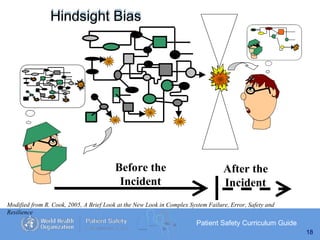
 Hindsight bias
Performance requirements:
Patient Safety Curriculum Guide
4
 Know the ways to learn from errors
 Participate in the analysis of an adverse
event
 Practise strategies to reduce errors
Error
Patient Safety Curriculum Guide
5
 A simple definition is:
“Doing the wrong thing when meaning to do
the right thing.”
Bill Runciman
 A more formal definition is:
“Planned sequences of mental or physical
activities that fail to achieve their intended
outcomes, when these failures cannot be
attributed to the intervention of some chance
agency.”
James Reason
Note: violation
Patient Safety Curriculum Guide
6
A deliberate deviation from an accepted
protocol or standard of care
Errors and outcomes
Patient Safety Curriculum Guide
7
 Errors and outcomes are not inextricably linked:
• Harm can befall a patient in the form of a
complication of care without an error having
occurred
• Many errors occur that have no consequence
for the patient as they are recognized before
harm occurs
Human factors principles
remind us that:
Patient Safety Curriculum Guide
8
 Error is the inevitable downside of having a brain!
 One definition of “human error” is “human nature”
Human beings make mistakes
Patient Safety Curriculum Guide
9
Regardless of their experience, intelligence, motivation
or vigilance, people make mistakes
Activity:
Think about and then discuss with your colleagues
any “silly mistakes” you have made recently when
you were not in your place of work or study - and why
you think they happened
The health-care context is problematic
Patient Safety Curriculum Guide
10
 When errors occur in the workplace the consequences
can be a problem for the patient…
…. a situation that is relatively unique to health
care
 In all other respects there is nothing unique about
“health-care” errors…
... they are no different from the human factors
problems that exist in settings outside health care
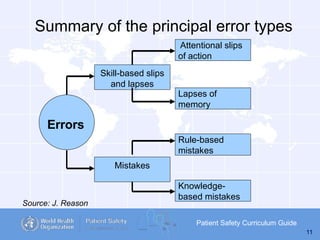
Source: J. Reason
Errors
Skill-based slips
and lapses
Attentional slips
of action
Lapses of
memory
Rule-based
mistakes
Knowledge-
based mistakes
Mistakes
…………
Patient Safety Curriculum Guide
11
Summary of the principal error types
Situations associated with an
increased risk of error
Patient Safety Curriculum Guide
12
 Inexperience*
 Time pressures
 Inadequate checking
 Poor procedures
 Inadequate information
* Especially if combined with lack of supervision
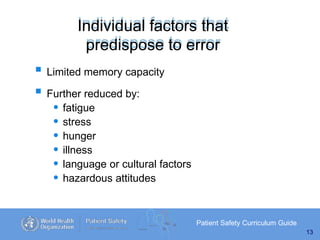
Individual factors that
predispose to error
Patient Safety Curriculum Guide
13
 Limited memory capacity
 Further reduced by:
• fatigue
• stress
• hunger
• illness
• language or cultural factors
• hazardous attitudes
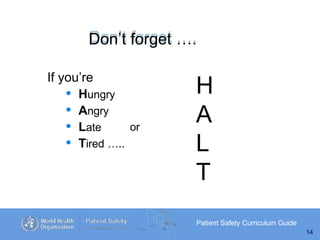
Don’t forget ….
Patient Safety Curriculum Guide
14
If you’re
• Hungry
• Angry
• Late
• Tired …..
or
H
A
L
T
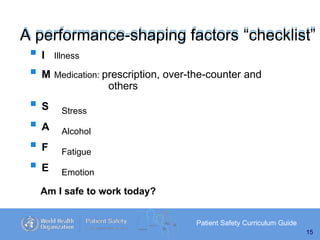
A performance-shaping factors “checklist”
Patient Safety Curriculum Guide
15
 I Illness
 M Medication: prescription, over-the-counter and
others
 S
 A
 F
 E
Stress
Alcohol
Fatigue
Emotion
Am I safe to work today?
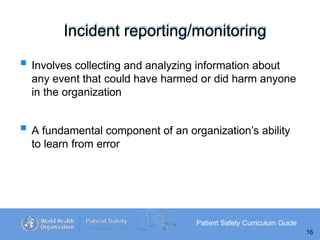
Incident reporting/monitoring
Patient Safety Curriculum Guide
16
 Involves collecting and analyzing information about
any event that could have harmed or did harm anyone
in the organization
 A fundamental component of an organization’s ability
to learn from error
Removing error traps
Patient Safety Curriculum Guide
17
 A primary function of an incident reporting system is
to identify recurring problem areas - known as “error
traps” (J.Reason)
 Identifying and removing these traps is one of the
main functions of error management
Modified from R. Cook, 2005, A Brief Look at the New Look in Complex System Failure, Error, Safety and
Resilience
Before the
Incident
After the
Incident
Hindsight Bias
Patient Safety Curriculum Guide
18
Culture: a workable definition
'Shared values (what is important)
and beliefs (how things work) that
interact with an organization’s
structure and control systems to
produce behavioural
norms (the way we do things
around here)'
James
Reason
Patient Safety Curriculum Guide
19
Culture in the workplace
Patient Safety Curriculum Guide
20
 It is hard to “change the world” as a junior health-care
professional
 But …
…you can be on the look out for ways to improve the
“system”
… you can contribute to the culture in your work
environment
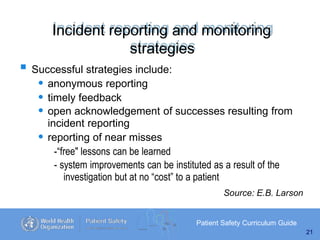
Incident reporting and monitoring
strategies
Patient Safety Curriculum Guide
21
 Successful strategies include:
• anonymous reporting
• timely feedback
• open acknowledgement of successes resulting from
incident reporting
• reporting of near misses
-“free" lessons can be learned
- system improvements can be instituted as a result of the
investigation but at no “cost” to a patient
Source: E.B. Larson
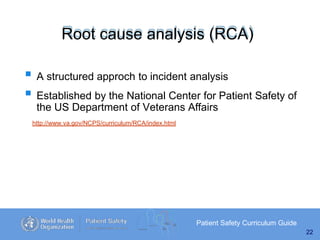
Root cause analysis (RCA)
Patient Safety Curriculum Guide
22
 A structured approch to incident analysis
 Established by the National Center for Patient Safety of
the US Department of Veterans Affairs
http://www.va.gov/NCPS/curriculum/RCA/index.html
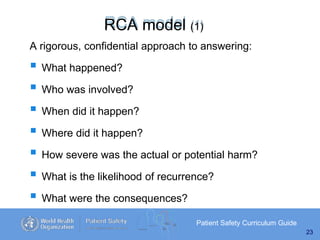
RCA model (1)
Patient Safety Curriculum Guide
23
A rigorous, confidential approach to answering:
 What happened?
 Who was involved?
 When did it happen?
 Where did it happen?
 How severe was the actual or potential harm?
 What is the likelihood of recurrence?
 What were the consequences?
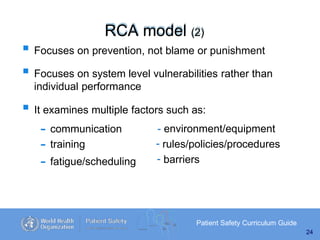
RCA model (2)
 Focuses on prevention, not blame or punishment
 Focuses on system level vulnerabilities rather than
individual performance
 It examines multiple factors such as:
Patient Safety Curriculum Guide
24
- communication
- training
- fatigue/scheduling
- environment/equipment
- rules/policies/procedures
- barriers
Personal error
reduction strategies
Patient Safety Curriculum Guide
25
 Know yourself: eat well, sleep well, look after yourself
 Know your environment
 Know your task(s)
 Preparation and planning; “What if …?”
 Build “checks” into your routine
 Ask if you don’t know!
Mental preparedness
Patient Safety Curriculum Guide
26
 Assume that errors can and will occur
 Identify those circumstances most likely to breed
error
 Have contingencies in place to cope with problems,
interruptions and distractions
 Mentally rehearse complex procedures
James Reason
Summary
Patient Safety Curriculum Guide
27
 Health-care error is a complex issue, but error itself is an
inevitable part of the human condition
 Learning from error is more productive if it is considered at
an organizational level
 Root cause analysis is a highly structured system
approach to incident analysis

MARCH 18 AND 22 - LEARNING FROM ERRORS TO PREVENT HARM.pptx

  • 1.
    Topic 5 Learning fromerrors to prevent harm Patient Safety Curriculum Guide 1
  • 2.
    Learning objective Patient SafetyCurriculum Guide 2 Understand the nature of error and how health- care providers can learn from errors to improve patient safety
  • 3.
    Knowledge requirement Patient SafetyCurriculum Guide 3 Explain the terms:  Error  Violation  Near miss  Hindsight bias
  • 4.
    Performance requirements: Patient SafetyCurriculum Guide 4  Know the ways to learn from errors  Participate in the analysis of an adverse event  Practise strategies to reduce errors
  • 5.
    Error Patient Safety CurriculumGuide 5  A simple definition is: “Doing the wrong thing when meaning to do the right thing.” Bill Runciman  A more formal definition is: “Planned sequences of mental or physical activities that fail to achieve their intended outcomes, when these failures cannot be attributed to the intervention of some chance agency.” James Reason
  • 6.
    Note: violation Patient SafetyCurriculum Guide 6 A deliberate deviation from an accepted protocol or standard of care
  • 7.
    Errors and outcomes PatientSafety Curriculum Guide 7  Errors and outcomes are not inextricably linked: • Harm can befall a patient in the form of a complication of care without an error having occurred • Many errors occur that have no consequence for the patient as they are recognized before harm occurs
  • 8.
    Human factors principles remindus that: Patient Safety Curriculum Guide 8  Error is the inevitable downside of having a brain!  One definition of “human error” is “human nature”
  • 9.
    Human beings makemistakes Patient Safety Curriculum Guide 9 Regardless of their experience, intelligence, motivation or vigilance, people make mistakes Activity: Think about and then discuss with your colleagues any “silly mistakes” you have made recently when you were not in your place of work or study - and why you think they happened
  • 10.
    The health-care contextis problematic Patient Safety Curriculum Guide 10  When errors occur in the workplace the consequences can be a problem for the patient… …. a situation that is relatively unique to health care  In all other respects there is nothing unique about “health-care” errors… ... they are no different from the human factors problems that exist in settings outside health care
  • 11.
    Source: J. Reason Errors Skill-basedslips and lapses Attentional slips of action Lapses of memory Rule-based mistakes Knowledge- based mistakes Mistakes ………… Patient Safety Curriculum Guide 11 Summary of the principal error types
  • 12.
    Situations associated withan increased risk of error Patient Safety Curriculum Guide 12  Inexperience*  Time pressures  Inadequate checking  Poor procedures  Inadequate information * Especially if combined with lack of supervision
  • 13.
    Individual factors that predisposeto error Patient Safety Curriculum Guide 13  Limited memory capacity  Further reduced by: • fatigue • stress • hunger • illness • language or cultural factors • hazardous attitudes
  • 14.
    Don’t forget …. PatientSafety Curriculum Guide 14 If you’re • Hungry • Angry • Late • Tired ….. or H A L T
  • 15.
    A performance-shaping factors“checklist” Patient Safety Curriculum Guide 15  I Illness  M Medication: prescription, over-the-counter and others  S  A  F  E Stress Alcohol Fatigue Emotion Am I safe to work today?
  • 16.
    Incident reporting/monitoring Patient SafetyCurriculum Guide 16  Involves collecting and analyzing information about any event that could have harmed or did harm anyone in the organization  A fundamental component of an organization’s ability to learn from error
  • 17.
    Removing error traps PatientSafety Curriculum Guide 17  A primary function of an incident reporting system is to identify recurring problem areas - known as “error traps” (J.Reason)  Identifying and removing these traps is one of the main functions of error management
  • 18.
    Modified from R.Cook, 2005, A Brief Look at the New Look in Complex System Failure, Error, Safety and Resilience Before the Incident After the Incident Hindsight Bias Patient Safety Curriculum Guide 18
  • 19.
    Culture: a workabledefinition 'Shared values (what is important) and beliefs (how things work) that interact with an organization’s structure and control systems to produce behavioural norms (the way we do things around here)' James Reason Patient Safety Curriculum Guide 19
  • 20.
    Culture in theworkplace Patient Safety Curriculum Guide 20  It is hard to “change the world” as a junior health-care professional  But … …you can be on the look out for ways to improve the “system” … you can contribute to the culture in your work environment
  • 21.
    Incident reporting andmonitoring strategies Patient Safety Curriculum Guide 21  Successful strategies include: • anonymous reporting • timely feedback • open acknowledgement of successes resulting from incident reporting • reporting of near misses -“free" lessons can be learned - system improvements can be instituted as a result of the investigation but at no “cost” to a patient Source: E.B. Larson
  • 22.
    Root cause analysis(RCA) Patient Safety Curriculum Guide 22  A structured approch to incident analysis  Established by the National Center for Patient Safety of the US Department of Veterans Affairs http://www.va.gov/NCPS/curriculum/RCA/index.html
  • 23.
    RCA model (1) PatientSafety Curriculum Guide 23 A rigorous, confidential approach to answering:  What happened?  Who was involved?  When did it happen?  Where did it happen?  How severe was the actual or potential harm?  What is the likelihood of recurrence?  What were the consequences?
  • 24.
    RCA model (2) Focuses on prevention, not blame or punishment  Focuses on system level vulnerabilities rather than individual performance  It examines multiple factors such as: Patient Safety Curriculum Guide 24 - communication - training - fatigue/scheduling - environment/equipment - rules/policies/procedures - barriers
  • 25.
    Personal error reduction strategies PatientSafety Curriculum Guide 25  Know yourself: eat well, sleep well, look after yourself  Know your environment  Know your task(s)  Preparation and planning; “What if …?”  Build “checks” into your routine  Ask if you don’t know!
  • 26.
    Mental preparedness Patient SafetyCurriculum Guide 26  Assume that errors can and will occur  Identify those circumstances most likely to breed error  Have contingencies in place to cope with problems, interruptions and distractions  Mentally rehearse complex procedures James Reason
  • 27.
    Summary Patient Safety CurriculumGuide 27  Health-care error is a complex issue, but error itself is an inevitable part of the human condition  Learning from error is more productive if it is considered at an organizational level  Root cause analysis is a highly structured system approach to incident analysis