Error Analysis and 
Minimisation 
Abhiram Mullapudi 
CB.EN.U4CIE11038 
08-09-2014 Seminar CHY 259 1
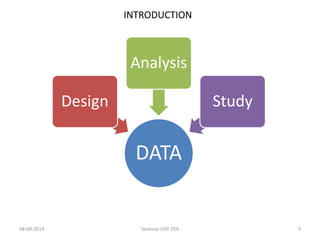
INTRODUCTION 
DATA 
Design 
Analysis 
Study 
08-09-2014 Seminar CHY 259 2
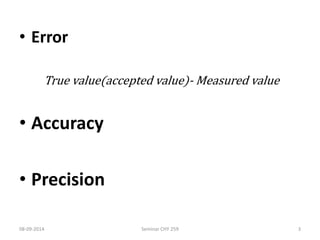
• Error 
True value(accepted value)- Measured value 
• Accuracy 
• Precision 
08-09-2014 Seminar CHY 259 3
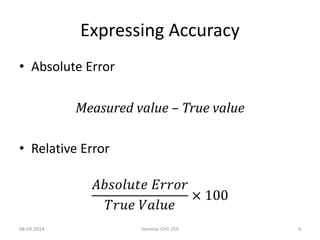
Expressing Accuracy 
• Absolute Error 
Measured value – True value 
• Relative Error 
퐴푏푠표푙푢푡푒 퐸푟푟표푟 
푇푟푢푒 푉푎푙푢푒 
× 100 
08-09-2014 Seminar CHY 259 4
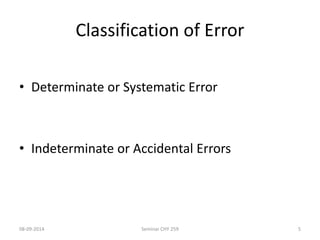
Classification of Error 
• Determinate or Systematic Error 
• Indeterminate or Accidental Errors 
08-09-2014 Seminar CHY 259 5
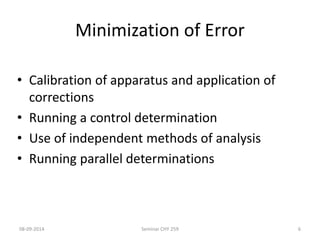
Minimization of Error 
• Calibration of apparatus and application of 
corrections 
• Running a control determination 
• Use of independent methods of analysis 
• Running parallel determinations 
08-09-2014 Seminar CHY 259 6
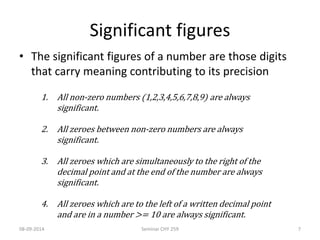
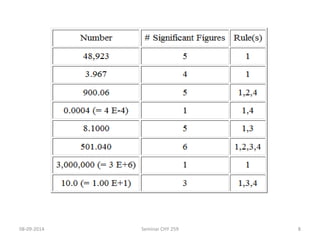
Significant figures 
• The significant figures of a number are those digits 
that carry meaning contributing to its precision 
1. All non-zero numbers (1,2,3,4,5,6,7,8,9) are always 
significant. 
2. All zeroes between non-zero numbers are always 
significant. 
3. All zeroes which are simultaneously to the right of the 
decimal point and at the end of the number are always 
significant. 
4. All zeroes which are to the left of a written decimal point 
and are in a number >= 10 are always significant. 
08-09-2014 Seminar CHY 259 7
08-09-2014 Seminar CHY 259 8
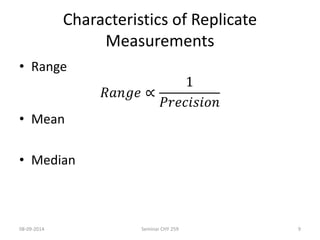
Characteristics of Replicate 
Measurements 
• Range 
푅푎푛푔푒 ∝ 
1 
푃푟푒푐푖푠푖표푛 
• Mean 
• Median 
08-09-2014 Seminar CHY 259 9
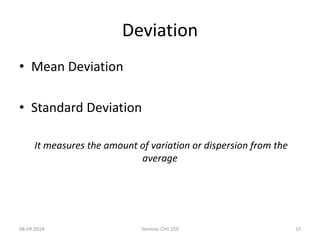
Deviation 
• Mean Deviation 
• Standard Deviation 
It measures the amount of variation or dispersion from the 
average 
08-09-2014 Seminar CHY 259 10
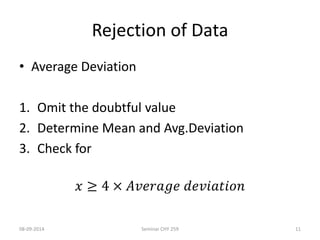
Rejection of Data 
• Average Deviation 
1. Omit the doubtful value 
2. Determine Mean and Avg.Deviation 
3. Check for 
푥 ≥ 4 × 퐴푣푒푟푎푔푒 푑푒푣푖푎푡푖표푛 
08-09-2014 Seminar CHY 259 11
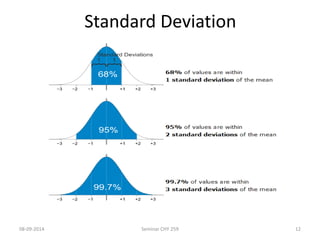
Standard Deviation 
08-09-2014 Seminar CHY 259 12
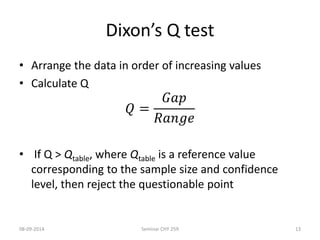
Dixon’s Q test 
• Arrange the data in order of increasing values 
• Calculate Q 
푄 = 
퐺푎푝 
푅푎푛푔푒 
• If Q > Qtable, where Qtable is a reference value 
corresponding to the sample size and confidence 
level, then reject the questionable point 
08-09-2014 Seminar CHY 259 13
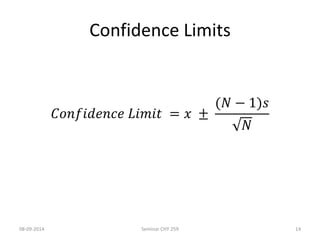
Confidence Limits 
퐶표푛푓푖푑푒푛푐푒 퐿푖푚푖푡 = 푥 ± 
(푁 − 1)푠 
푁 
08-09-2014 Seminar CHY 259 14
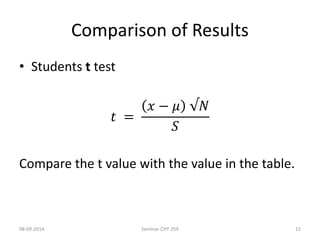
Comparison of Results 
• Students t test 
푡 = 
푥 − 휇 √푁 
푆 
Compare the t value with the value in the table. 
08-09-2014 Seminar CHY 259 15
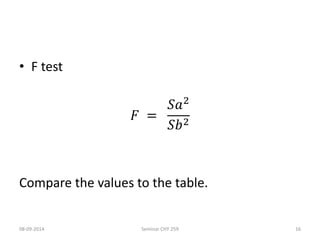
• F test 
퐹 = 
푆푎2 
푆푏2 
Compare the values to the table. 
08-09-2014 Seminar CHY 259 16
Thank you. 
08-09-2014 Seminar CHY 259 17

Error analysis

  • 1.
    Error Analysis and Minimisation Abhiram Mullapudi CB.EN.U4CIE11038 08-09-2014 Seminar CHY 259 1
  • 2.
    INTRODUCTION DATA Design Analysis Study 08-09-2014 Seminar CHY 259 2
  • 3.
    • Error Truevalue(accepted value)- Measured value • Accuracy • Precision 08-09-2014 Seminar CHY 259 3
  • 4.
    Expressing Accuracy •Absolute Error Measured value – True value • Relative Error 퐴푏푠표푙푢푡푒 퐸푟푟표푟 푇푟푢푒 푉푎푙푢푒 × 100 08-09-2014 Seminar CHY 259 4
  • 5.
    Classification of Error • Determinate or Systematic Error • Indeterminate or Accidental Errors 08-09-2014 Seminar CHY 259 5
  • 6.
    Minimization of Error • Calibration of apparatus and application of corrections • Running a control determination • Use of independent methods of analysis • Running parallel determinations 08-09-2014 Seminar CHY 259 6
  • 7.
    Significant figures •The significant figures of a number are those digits that carry meaning contributing to its precision 1. All non-zero numbers (1,2,3,4,5,6,7,8,9) are always significant. 2. All zeroes between non-zero numbers are always significant. 3. All zeroes which are simultaneously to the right of the decimal point and at the end of the number are always significant. 4. All zeroes which are to the left of a written decimal point and are in a number >= 10 are always significant. 08-09-2014 Seminar CHY 259 7
  • 8.
  • 9.
    Characteristics of Replicate Measurements • Range 푅푎푛푔푒 ∝ 1 푃푟푒푐푖푠푖표푛 • Mean • Median 08-09-2014 Seminar CHY 259 9
  • 10.
    Deviation • MeanDeviation • Standard Deviation It measures the amount of variation or dispersion from the average 08-09-2014 Seminar CHY 259 10
  • 11.
    Rejection of Data • Average Deviation 1. Omit the doubtful value 2. Determine Mean and Avg.Deviation 3. Check for 푥 ≥ 4 × 퐴푣푒푟푎푔푒 푑푒푣푖푎푡푖표푛 08-09-2014 Seminar CHY 259 11
  • 12.
  • 13.
    Dixon’s Q test • Arrange the data in order of increasing values • Calculate Q 푄 = 퐺푎푝 푅푎푛푔푒 • If Q > Qtable, where Qtable is a reference value corresponding to the sample size and confidence level, then reject the questionable point 08-09-2014 Seminar CHY 259 13
  • 14.
    Confidence Limits 퐶표푛푓푖푑푒푛푐푒퐿푖푚푖푡 = 푥 ± (푁 − 1)푠 푁 08-09-2014 Seminar CHY 259 14
  • 15.
    Comparison of Results • Students t test 푡 = 푥 − 휇 √푁 푆 Compare the t value with the value in the table. 08-09-2014 Seminar CHY 259 15
  • 16.
    • F test 퐹 = 푆푎2 푆푏2 Compare the values to the table. 08-09-2014 Seminar CHY 259 16
  • 17.
    Thank you. 08-09-2014Seminar CHY 259 17

Editor's Notes

  • #3 The seminar focuses upon the analysis of this errors and the methodologies that can be employed to minimize them.
  • #4 Precision: The reproducibility of the measured value Accuracy: The closeness of the measured value
  • #5 Absolute Error : dependent on sigh
  • #10 Precision k