Erratic Spelling and the ESOL Learner


                      Liz Shapiro
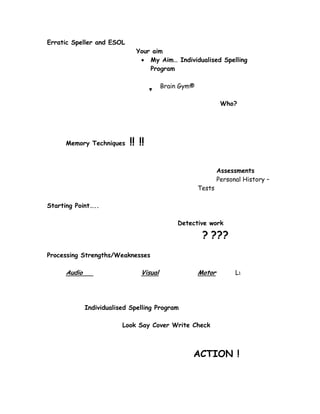
Erratic Speller and ESOL
                               Your aim
                                • My Aim… Individualised Spelling
                                   Program

                                         Brain Gym®

                                                               Who?


      Memory Techniques     !! !!

                                                              Assessments
                                                              Personal History –
                                                      Tests

Starting Point…..

                                              Detective work

                                                       ? ???
Processing Strengths/Weaknesses

      Audio                     Visual                Motor         L1


              Individualised Spelling Program

                          Look Say Cover Write Check


                                                  ACTION !
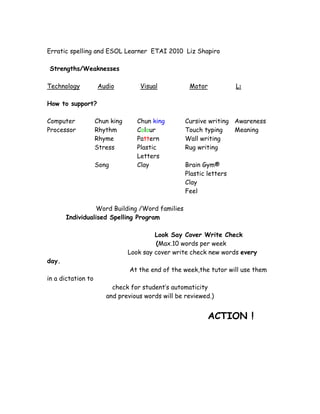
Erratic spelling and ESOL Learner ETAI 2010 Liz Shapiro

 Strengths/Weaknesses

Technology          Audio           Visual          Motor           L1

How to support?

Computer            Chun king      Chun king      Cursive writing Awareness
Processor           Rhythm         Colour         Touch typing    Meaning
                    Rhyme          Pattern        Wall writing
                    Stress         Plastic        Rug writing
                                   Letters
                    Song           Clay           Brain Gym®
                                                  Plastic letters
                                                  Clay
                                                  Feel

                 Word Building /Word families
       Individualised Spelling Program

                                         Look Say Cover Write Check
                                         (Max.10 words per week
                                Look say cover write check new words every
day.
                                At the end of the week,the tutor will use them
in a dictation to
                         check for student’s automaticity
                       and previous words will be reviewed.)


                                                            ACTION !
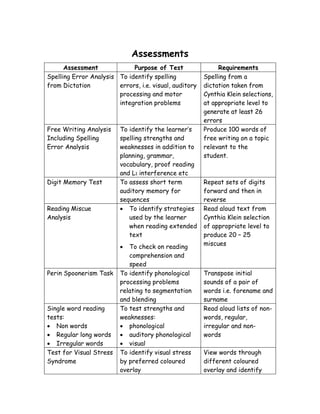
Assessments
      Assessment             Purpose of Test                 Requirements
Spelling Error Analysis To identify spelling            Spelling from a
from Dictation          errors, i.e. visual, auditory   dictation taken from
                        processing and motor            Cynthia Klein selections,
                        integration problems            at appropriate level to
                                                        generate at least 26
                                                        errors
Free Writing Analysis    To identify the learner’s      Produce 100 words of
Including Spelling       spelling strengths and         free writing on a topic
Error Analysis           weaknesses in addition to      relevant to the
                         planning, grammar,             student.
                         vocabulary, proof reading
                         and L1 interference etc
Digit Memory Test        To assess short term           Repeat sets of digits
                         auditory memory for            forward and then in
                         sequences                      reverse
Reading Miscue           • To identify strategies       Read aloud text from
Analysis                    used by the learner         Cynthia Klein selection
                            when reading extended       of appropriate level to
                            text                        produce 20 – 25
                                                        miscues
                         •  To check on reading
                            comprehension and
                            speed
Perin Spoonerism Task    To identify phonological       Transpose initial
                         processing problems            sounds of a pair of
                         relating to segmentation       words i.e. forename and
                         and blending                   surname
Single word reading      To test strengths and          Read aloud lists of non-
tests:                   weaknesses:                    words, regular,
• Non words              • phonological                 irregular and non-
• Regular long words     • auditory phonological        words
• Irregular words        • visual
Test for Visual Stress   To identify visual stress      View words through
Syndrome                 by preferred coloured          different coloured
                         overlay                        overlay and identify
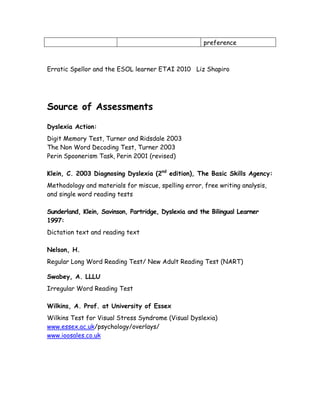
preference


Erratic Spellor and the ESOL learner ETAI 2010 Liz Shapiro


Source of Assessments

Dyslexia Action:
Digit Memory Test, Turner and Ridsdale 2003
The Non Word Decoding Test, Turner 2003
Perin Spoonerism Task, Perin 2001 (revised)

Klein, C. 2003 Diagnosing Dyslexia (2nd edition), The Basic Skills Agency:
Methodology and materials for miscue, spelling error, free writing analysis,
and single word reading tests

Sunderland, Klein, Savinson, Partridge, Dyslexia and the Bilingual Learner
1997:
Dictation text and reading text

Nelson, H.
Regular Long Word Reading Test/ New Adult Reading Test (NART)

Swabey, A. LLLU
Irregular Word Reading Test

Wilkins, A. Prof. at University of Essex
Wilkins Test for Visual Stress Syndrome (Visual Dyslexia)
www.essex.ac.uk/psychology/overlays/
www.ioosales.co.uk
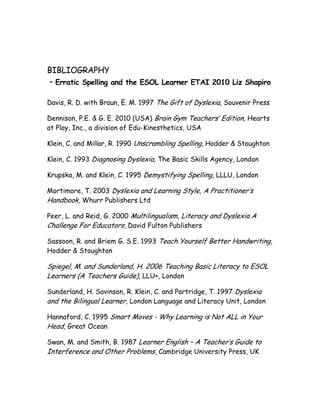
BIBLIOGRAPHY
– Erratic Spelling and the ESOL Learner ETAI 2010 Liz Shapiro

Davis, R. D. with Braun, E. M. 1997 The Gift of Dyslexia, Souvenir Press

Dennison, P.E. & G. E. 2010 (USA) Brain Gym Teachers’ Edition, Hearts
at Play, Inc., a division of Edu-Kinesthetics, USA

Klein, C. and Millar, R. 1990 Unscrambling Spelling, Hodder & Stoughton

Klein, C. 1993 Diagnosing Dyslexia, The Basic Skills Agency, London

Krupska, M. and Klein, C. 1995 Demystifying Spelling, LLLU, London

Mortimore, T. 2003 Dyslexia and Learning Style, A Practitioner’s
Handbook, Whurr Publishers Ltd

Peer, L. and Reid, G. 2000 Multilingualism, Literacy and Dyslexia A
Challenge For Educators, David Fulton Publishers

Sassoon, R. and Briem G. S.E. 1993 Teach Yourself Better Handwriting,
Hodder & Stoughton

Spiegel, M. and Sunderland, H. 2006 Teaching Basic Literacy to ESOL
Learners (A Teachers Guide), LLU+, London

Sunderland, H. Savinson, R. Klein, C. and Partridge, T. 1997 Dyslexia
and the Bilingual Learner, London Language and Literacy Unit, London

Hannaford, C. 1995 Smart Moves - Why Learning is Not ALL in Your
Head, Great Ocean

Swan, M. and Smith, B. 1987 Learner English – A Teacher’s Guide to
Interference and Other Problems, Cambridge University Press, UK
Erratic Spelling and the ESOL Learner ETAI 2010 Liz Shapiro

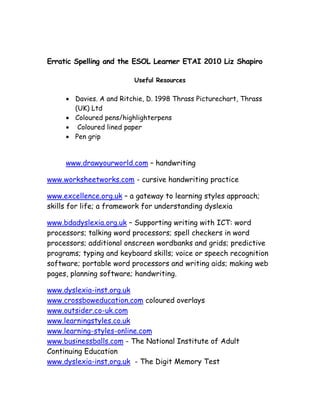
                         Useful Resources

     • Davies. A and Ritchie, D. 1998 Thrass Picturechart, Thrass
       (UK) Ltd
     • Coloured pens/highlighterpens
     • Coloured lined paper
     • Pen grip


     www.drawyourworld.com – handwriting

www.worksheetworks.com - cursive handwriting practice

www.excellence.org.uk – a gateway to learning styles approach;
skills for life; a framework for understanding dyslexia

www.bdadyslexia.org.uk – Supporting writing with ICT: word
processors; talking word processors; spell checkers in word
processors; additional onscreen wordbanks and grids; predictive
programs; typing and keyboard skills; voice or speech recognition
software; portable word processors and writing aids; making web
pages, planning software; handwriting.

www.dyslexia-inst.org.uk
www.crossboweducation.com coloured overlays
www.outsider.co-uk.com
www.learningstyles.co.uk
www.learning-styles-online.com
www.businessballs.com - The National Institute of Adult
Continuing Education
www.dyslexia-inst.org.uk - The Digit Memory Test
Erratic Spelling and the ESOL Learner

Erratic Spelling and the ESOL Learner

  • 1.
    Erratic Spelling andthe ESOL Learner Liz Shapiro
  • 2.
    Erratic Speller andESOL Your aim • My Aim… Individualised Spelling Program Brain Gym® Who? Memory Techniques !! !! Assessments Personal History – Tests Starting Point….. Detective work ? ??? Processing Strengths/Weaknesses Audio Visual Motor L1 Individualised Spelling Program Look Say Cover Write Check ACTION !
  • 3.
    Erratic spelling andESOL Learner ETAI 2010 Liz Shapiro Strengths/Weaknesses Technology Audio Visual Motor L1 How to support? Computer Chun king Chun king Cursive writing Awareness Processor Rhythm Colour Touch typing Meaning Rhyme Pattern Wall writing Stress Plastic Rug writing Letters Song Clay Brain Gym® Plastic letters Clay Feel Word Building /Word families Individualised Spelling Program Look Say Cover Write Check (Max.10 words per week Look say cover write check new words every day. At the end of the week,the tutor will use them in a dictation to check for student’s automaticity and previous words will be reviewed.) ACTION !
  • 4.
    Assessments Assessment Purpose of Test Requirements Spelling Error Analysis To identify spelling Spelling from a from Dictation errors, i.e. visual, auditory dictation taken from processing and motor Cynthia Klein selections, integration problems at appropriate level to generate at least 26 errors Free Writing Analysis To identify the learner’s Produce 100 words of Including Spelling spelling strengths and free writing on a topic Error Analysis weaknesses in addition to relevant to the planning, grammar, student. vocabulary, proof reading and L1 interference etc Digit Memory Test To assess short term Repeat sets of digits auditory memory for forward and then in sequences reverse Reading Miscue • To identify strategies Read aloud text from Analysis used by the learner Cynthia Klein selection when reading extended of appropriate level to text produce 20 – 25 miscues • To check on reading comprehension and speed Perin Spoonerism Task To identify phonological Transpose initial processing problems sounds of a pair of relating to segmentation words i.e. forename and and blending surname Single word reading To test strengths and Read aloud lists of non- tests: weaknesses: words, regular, • Non words • phonological irregular and non- • Regular long words • auditory phonological words • Irregular words • visual Test for Visual Stress To identify visual stress View words through Syndrome by preferred coloured different coloured overlay overlay and identify
  • 5.
    preference Erratic Spellor andthe ESOL learner ETAI 2010 Liz Shapiro Source of Assessments Dyslexia Action: Digit Memory Test, Turner and Ridsdale 2003 The Non Word Decoding Test, Turner 2003 Perin Spoonerism Task, Perin 2001 (revised) Klein, C. 2003 Diagnosing Dyslexia (2nd edition), The Basic Skills Agency: Methodology and materials for miscue, spelling error, free writing analysis, and single word reading tests Sunderland, Klein, Savinson, Partridge, Dyslexia and the Bilingual Learner 1997: Dictation text and reading text Nelson, H. Regular Long Word Reading Test/ New Adult Reading Test (NART) Swabey, A. LLLU Irregular Word Reading Test Wilkins, A. Prof. at University of Essex Wilkins Test for Visual Stress Syndrome (Visual Dyslexia) www.essex.ac.uk/psychology/overlays/ www.ioosales.co.uk
  • 6.
    BIBLIOGRAPHY – Erratic Spellingand the ESOL Learner ETAI 2010 Liz Shapiro Davis, R. D. with Braun, E. M. 1997 The Gift of Dyslexia, Souvenir Press Dennison, P.E. & G. E. 2010 (USA) Brain Gym Teachers’ Edition, Hearts at Play, Inc., a division of Edu-Kinesthetics, USA Klein, C. and Millar, R. 1990 Unscrambling Spelling, Hodder & Stoughton Klein, C. 1993 Diagnosing Dyslexia, The Basic Skills Agency, London Krupska, M. and Klein, C. 1995 Demystifying Spelling, LLLU, London Mortimore, T. 2003 Dyslexia and Learning Style, A Practitioner’s Handbook, Whurr Publishers Ltd Peer, L. and Reid, G. 2000 Multilingualism, Literacy and Dyslexia A Challenge For Educators, David Fulton Publishers Sassoon, R. and Briem G. S.E. 1993 Teach Yourself Better Handwriting, Hodder & Stoughton Spiegel, M. and Sunderland, H. 2006 Teaching Basic Literacy to ESOL Learners (A Teachers Guide), LLU+, London Sunderland, H. Savinson, R. Klein, C. and Partridge, T. 1997 Dyslexia and the Bilingual Learner, London Language and Literacy Unit, London Hannaford, C. 1995 Smart Moves - Why Learning is Not ALL in Your Head, Great Ocean Swan, M. and Smith, B. 1987 Learner English – A Teacher’s Guide to Interference and Other Problems, Cambridge University Press, UK
  • 7.
    Erratic Spelling andthe ESOL Learner ETAI 2010 Liz Shapiro Useful Resources • Davies. A and Ritchie, D. 1998 Thrass Picturechart, Thrass (UK) Ltd • Coloured pens/highlighterpens • Coloured lined paper • Pen grip www.drawyourworld.com – handwriting www.worksheetworks.com - cursive handwriting practice www.excellence.org.uk – a gateway to learning styles approach; skills for life; a framework for understanding dyslexia www.bdadyslexia.org.uk – Supporting writing with ICT: word processors; talking word processors; spell checkers in word processors; additional onscreen wordbanks and grids; predictive programs; typing and keyboard skills; voice or speech recognition software; portable word processors and writing aids; making web pages, planning software; handwriting. www.dyslexia-inst.org.uk www.crossboweducation.com coloured overlays www.outsider.co-uk.com www.learningstyles.co.uk www.learning-styles-online.com www.businessballs.com - The National Institute of Adult Continuing Education www.dyslexia-inst.org.uk - The Digit Memory Test