ERP IMPLEMENTATION FAILURE LEADS TO
BANKRUPTCY OF $ 4B COMPANY
Presented by
Mr Sanket Shingala (I – 15-18-17)
Mr. Manish Tripathi ( I – 15-18-19)
Thakur Institute of Management Studies
&
Research
(Saturday, 19 August 2017)
1
FoxMeyer Drug Company, Inc.
• Founded in 1903
• Based in Carrollton, Texas, USA
• Distributes pharmaceutical products, and
health and beauty aids
• Fifth largest drug wholesaler in the United
States (1995)
• Annual sales of about 5 billion US$
• Daily shipments of over 500,000 items 2
FoxMeyer Drug Company, Inc.
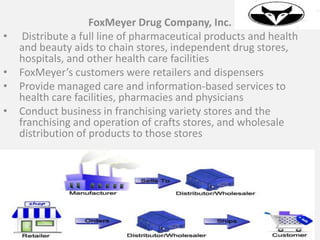
• Distribute a full line of pharmaceutical products and health
and beauty aids to chain stores, independent drug stores,
hospitals, and other health care facilities
• FoxMeyer’s customers were retailers and dispensers
• Provide managed care and information-based services to
health care facilities, pharmacies and physicians
• Conduct business in franchising variety stores and the
franchising and operation of crafts stores, and wholesale
distribution of products to those stores
3
DISTRIBUTION
• The company had 25 distribution centers located
throughout USA
• It conducted business mainly through two
operating units: FoxMeyer Corp. and Ben Franklin
Retail Stores, Inc.
• The former was engaged in the distribution to the
individual units and chain stores and in the
provision of managed care and information-
based services
• The latter was engaged in franchising and
wholesaling to the franchised stores
BUSINESS STRATEGY
Cost Leadership
• Cost efficient operations e.g. automating the
physical warehouses
• Efficient inventory management and
implementation of cost cutting program
• Effective Information System Management, e.g.
providing customers with electronic data entry
5
BUSINESS STRATEGY
Differentiation
• Provide innovative services,
mostly computer based
• Focus on quality
• Complement distribution activities
with marketing programs and
computer-based services
• Maintain local responsiveness and
national coverage
• Strengthen sales and marketing
efforts at new customers by
expanding value added services.
• Expand private labels, generic
brands and specialty distribution
programs.
6
COMPETITION
7
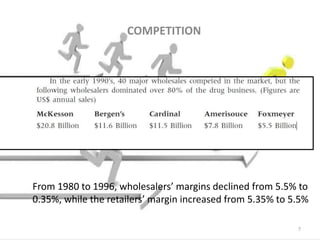
From 1980 to 1996, wholesalers’ margins declined from 5.5% to
0.35%, while the retailers’ margin increased from 5.35% to 5.5%
FOXMEYER’S BOLD DECISION TO USE ERP
• Due to the intense competition, FoxMeyer was in
a great need of a solution that would have helped
it to make a complex supply chain decisions and
meet the increased cost pressure head on
• Based on a supply chain analysis, it was decided
that an ERP would offer a perfect solution for
FoxMeyer to provide real time information and
automate and integrate inventory systems
• ERP was expected to eliminate unnecessary
activities, establish appropriate inventory levels
and provide responsive customer services 8
THE SELECTION OF SAP
• In 1992, the company decided to hire Arthur
Andersen consulting company
• SAP was the largest ERP software vendor at that time
• FoxMeyer selected both a top consultant and the most
widely used software to assure successful
implementation
• FoxMeyer also purchased warehouse-automation from
Pinnacle, and planned to integrate and implement the
two systems
• The Delta III project began in 1993
• Implementation of the Delta III project took place
during 1994 and 1995.
9
THE IMPLEMENTATION OF SAP R/3
• This multi-million dollar project covered the entire
supply chain—warehouses, inventory control,
customer service, marketing, strategic planning,
information system, shipping and handling
• SAP R/3 was the first information system launched
in the pharmaceutical industry that utilized
extensive technology coupled with automation of
warehouse functions
• The ERP system was projected to save FoxMeyer
US$40m per year
10
THE IMPLEMENTATION OF SAP R/3
• The implementation cost for SAP was budgeted in
1994 at US$65m
• The budget included:
● US$4.8m client/server computer system from
Hewlett Packard,
● US$4M SAP software,
● several millions of dollars for consulting fees for
Andersen Consulting, and
● US$18m for a new 340,000 square-foot
computerized warehouse in Washington Court House,
Ohio, where computerized robots filled orders received
from hospitals and pharmacies
11
THE IMPLEMENTATION JOURNEY
• In the summer of 1994, FoxMeyer signed a large
distribution contract that required it to add 6
warehouses
• SAP and Anderson scheduled the implementation at
these warehouses for January and February 1995
• Then they planned to implement R/3 at the remaining
17 old warehouses
• However, in November 1994, SAP informed FoxMeyer
that R/3 could only be implemented at the new
warehouses. The other warehouses had a volume of
invoices larger than the system was able to process
• The R/3 system at the new warehouses was able to
handle 10,000 transactions per day, while the legacy
system was able to handle 420,000 transactions per
day 12
THE IMPLEMENTATION JOURNEY
• FoxMeyer started the R/3 on time in the new facilities
and customers orders were filled
• However, due to data errors, the customers sales
histories were inaccurate
• On top of that the physical move of inventory was
done carelessly
• Therefore, the benefits from forecasting inventory
needs was limited
• FoxMeyer had to spend about US$16m correcting
errors in orders during the first 6 weeks after the
opening of the new warehouse
• Thus, FoxMeyer realized only half the projected
savings 13
THE IMPLEMENTATION JOURNEY
• The final implementation bill was more than
US$100m
• The R/3’s performance was still unacceptable
• It was completed late, went over budget, and
failed to deliver the expected benefits
• For a company in a low-margin business with a
heavy debt burden, the shortfalls were
overwhelming
• Took a US$34m loan to cover uncollectable
shipping and inventory costs in 1996
14
THE END RESULT
• FoxMeyer was forced to file for bankruptcy
• The company that had been worth $40B prior to the
project
• In November 1996, McKesson Corp., FoxMeyer’s
largest rival, acquired FoxMeyer for only US$80m
• In 1998, the bankruptcy trustee of FoxMeyer launched
two separate, US$500m each, lawsuits against SAP and
Andersen Consulting
• FoxMeyer's trustee also sued the company's outside
auditor, Deloitte & Touche LLP, which had failed to
warn FoxMeyer management about the seriousness of
its financial problems and failing to stop $750 M
refinancing deal 15
16
REASONS FOR FAILURE
Planning
#1 Poor selection of the Software
• SAP R/3 was originally designed for manufacturing
companies and not for wholesalers, especially those doing
large number of transactions. R/3 has never been used by a
distributor until that time
• It lacked many requirements needed for successful
wholesale distribution.
• SAP R/3 was inflexible software, and any modification
required time and financial investment
• R/3 was unable to handle the large number of orders.
FoxMeyer filled orders from thousands of pharmacies, each
of which have had hundreds of items, totalling up to
500,000 orders per day
• The legacy system handled 420,000 orders per day, but SAP
only processed 10,000 orders daily ( 2.4% of that of the
legacy system) 17
Planning
#2 No consideration of other consultants’ advice
• FoxMeyer did not listen to other consultants’
advice in the early stage of the project
• A Chicago-based consultant firm warned FoxMeyer
that SAP would not be able to deliver what
FoxMeyer needed
• FoxMeyer selected SAP mainly because of it
reputation
18
Planning
#3 Lack of contingency planning
• There was no contingency planning to deal with
changes in the business operations
• For example, a major customer, Phar-Mor Inc.
that accounted for more than 15% of FoxMeyer’s
business, declared bankruptcy shortly after
FoxMeyer’s launched SAP.
• Much of the Phar-Mor business was gone to
competitors
19
Planning
#4 No end user involvement
• The project was done using a top-down approach
• The planning were performed by FoxMeyer’s
upper management, Andersen Consulting and few
technical people
• Only few end users participated in the analysis,
and design process
• So there was a communication gap between the
users and the system planners
20
Implementation
#5 No restructuring of the business process
• SAP was not fully integrated because FoxMeyer was
incapable of reengineering their business processes in
order to make the software more efficient
• FoxMeyer signed a 5-year, US$5 billion contract with a new
customer, University Health System Consortium in July
1994, on the assumption that a projected US$40m in
benefits from the SAP implementation would be
materialized.
• They placed a higher priority on meeting that customer’s
need than on making the SAP implementation success
• The delivery was scheduled to start in early 1995, but
FoxMeyer pushed the implementation deadline forward 90
days to meet their customers needs
• Thus, FoxMeyer sacrificed the needed business
reengineering processes. 21
Implementation
#6 Insufficient testing
• Due to the rushed schedule, some modules
testing was skipped
• Besides, the system was not properly tested to
identify its shortcoming in handling large amounts
of orders
• There was inadequate testing and insufficient
time to debug the system to ensure its
functionality
22
Implementation
#7 Over-ambitious project scope
• The project team members and information
system staff were unfamiliar with the R/3
hardware, systems software and application
software
• The project scope was enlarged with simultaneous
implementation of a $18m computerized
warehouse project
• Some technical problems of great complication
and were not managed well by the IS people, so
additional expenditures and time were incurred 23
Implementation
#8 Dominance of IT specialists’ personal interest
• Since the project was new for the wholesaling industry, the IT
specialists wanted to learn the system and secure their
employment in the SAP technology business
• They placed their personal interest of getting experience in
SAP implementation over the company’s interest in getting
suitable software technology
• So some system problems were hidden and not reported to
management until it was too late
24
Implementation
#9 Poor Management support
• Initially management were
supportive and committed to the
project
• However, once the
implementation started,
management was reluctant to
acknowledge the system
problems
• Management failed to
understand the complexity and
risks in the process and agreed to
have 90 days early
implementation although the
system was not fully tested
• Management failed to recognize
the timelines and resources
required in the implementation
process
25
Implementation
#10 Lack of end-user cooperation
• The user requirements were not fully addressed and there was no training for
end users
• Employees had no chance to express their priorities and business needs
• Workers especially at the warehouses were threatened by the implementation
• The automated warehouse created many problems
• Employee morale was low because of the layoffs
• They knew their jobs were soon to be eliminated
• As the end users were not fully involved, they felt they didn’t have the
ownership for the project and did not work closely with the IT specialists to
solve problems
26
27

Erp failure-foxmeyer

  • 1.
    ERP IMPLEMENTATION FAILURELEADS TO BANKRUPTCY OF $ 4B COMPANY Presented by Mr Sanket Shingala (I – 15-18-17) Mr. Manish Tripathi ( I – 15-18-19) Thakur Institute of Management Studies & Research (Saturday, 19 August 2017) 1
  • 2.
    FoxMeyer Drug Company,Inc. • Founded in 1903 • Based in Carrollton, Texas, USA • Distributes pharmaceutical products, and health and beauty aids • Fifth largest drug wholesaler in the United States (1995) • Annual sales of about 5 billion US$ • Daily shipments of over 500,000 items 2
  • 3.
    FoxMeyer Drug Company,Inc. • Distribute a full line of pharmaceutical products and health and beauty aids to chain stores, independent drug stores, hospitals, and other health care facilities • FoxMeyer’s customers were retailers and dispensers • Provide managed care and information-based services to health care facilities, pharmacies and physicians • Conduct business in franchising variety stores and the franchising and operation of crafts stores, and wholesale distribution of products to those stores 3
  • 4.
    DISTRIBUTION • The companyhad 25 distribution centers located throughout USA • It conducted business mainly through two operating units: FoxMeyer Corp. and Ben Franklin Retail Stores, Inc. • The former was engaged in the distribution to the individual units and chain stores and in the provision of managed care and information- based services • The latter was engaged in franchising and wholesaling to the franchised stores
  • 5.
    BUSINESS STRATEGY Cost Leadership •Cost efficient operations e.g. automating the physical warehouses • Efficient inventory management and implementation of cost cutting program • Effective Information System Management, e.g. providing customers with electronic data entry 5
  • 6.
    BUSINESS STRATEGY Differentiation • Provideinnovative services, mostly computer based • Focus on quality • Complement distribution activities with marketing programs and computer-based services • Maintain local responsiveness and national coverage • Strengthen sales and marketing efforts at new customers by expanding value added services. • Expand private labels, generic brands and specialty distribution programs. 6
  • 7.
    COMPETITION 7 From 1980 to1996, wholesalers’ margins declined from 5.5% to 0.35%, while the retailers’ margin increased from 5.35% to 5.5%
  • 8.
    FOXMEYER’S BOLD DECISIONTO USE ERP • Due to the intense competition, FoxMeyer was in a great need of a solution that would have helped it to make a complex supply chain decisions and meet the increased cost pressure head on • Based on a supply chain analysis, it was decided that an ERP would offer a perfect solution for FoxMeyer to provide real time information and automate and integrate inventory systems • ERP was expected to eliminate unnecessary activities, establish appropriate inventory levels and provide responsive customer services 8
  • 9.
    THE SELECTION OFSAP • In 1992, the company decided to hire Arthur Andersen consulting company • SAP was the largest ERP software vendor at that time • FoxMeyer selected both a top consultant and the most widely used software to assure successful implementation • FoxMeyer also purchased warehouse-automation from Pinnacle, and planned to integrate and implement the two systems • The Delta III project began in 1993 • Implementation of the Delta III project took place during 1994 and 1995. 9
  • 10.
    THE IMPLEMENTATION OFSAP R/3 • This multi-million dollar project covered the entire supply chain—warehouses, inventory control, customer service, marketing, strategic planning, information system, shipping and handling • SAP R/3 was the first information system launched in the pharmaceutical industry that utilized extensive technology coupled with automation of warehouse functions • The ERP system was projected to save FoxMeyer US$40m per year 10
  • 11.
    THE IMPLEMENTATION OFSAP R/3 • The implementation cost for SAP was budgeted in 1994 at US$65m • The budget included: ● US$4.8m client/server computer system from Hewlett Packard, ● US$4M SAP software, ● several millions of dollars for consulting fees for Andersen Consulting, and ● US$18m for a new 340,000 square-foot computerized warehouse in Washington Court House, Ohio, where computerized robots filled orders received from hospitals and pharmacies 11
  • 12.
    THE IMPLEMENTATION JOURNEY •In the summer of 1994, FoxMeyer signed a large distribution contract that required it to add 6 warehouses • SAP and Anderson scheduled the implementation at these warehouses for January and February 1995 • Then they planned to implement R/3 at the remaining 17 old warehouses • However, in November 1994, SAP informed FoxMeyer that R/3 could only be implemented at the new warehouses. The other warehouses had a volume of invoices larger than the system was able to process • The R/3 system at the new warehouses was able to handle 10,000 transactions per day, while the legacy system was able to handle 420,000 transactions per day 12
  • 13.
    THE IMPLEMENTATION JOURNEY •FoxMeyer started the R/3 on time in the new facilities and customers orders were filled • However, due to data errors, the customers sales histories were inaccurate • On top of that the physical move of inventory was done carelessly • Therefore, the benefits from forecasting inventory needs was limited • FoxMeyer had to spend about US$16m correcting errors in orders during the first 6 weeks after the opening of the new warehouse • Thus, FoxMeyer realized only half the projected savings 13
  • 14.
    THE IMPLEMENTATION JOURNEY •The final implementation bill was more than US$100m • The R/3’s performance was still unacceptable • It was completed late, went over budget, and failed to deliver the expected benefits • For a company in a low-margin business with a heavy debt burden, the shortfalls were overwhelming • Took a US$34m loan to cover uncollectable shipping and inventory costs in 1996 14
  • 15.
    THE END RESULT •FoxMeyer was forced to file for bankruptcy • The company that had been worth $40B prior to the project • In November 1996, McKesson Corp., FoxMeyer’s largest rival, acquired FoxMeyer for only US$80m • In 1998, the bankruptcy trustee of FoxMeyer launched two separate, US$500m each, lawsuits against SAP and Andersen Consulting • FoxMeyer's trustee also sued the company's outside auditor, Deloitte & Touche LLP, which had failed to warn FoxMeyer management about the seriousness of its financial problems and failing to stop $750 M refinancing deal 15
  • 16.
  • 17.
    Planning #1 Poor selectionof the Software • SAP R/3 was originally designed for manufacturing companies and not for wholesalers, especially those doing large number of transactions. R/3 has never been used by a distributor until that time • It lacked many requirements needed for successful wholesale distribution. • SAP R/3 was inflexible software, and any modification required time and financial investment • R/3 was unable to handle the large number of orders. FoxMeyer filled orders from thousands of pharmacies, each of which have had hundreds of items, totalling up to 500,000 orders per day • The legacy system handled 420,000 orders per day, but SAP only processed 10,000 orders daily ( 2.4% of that of the legacy system) 17
  • 18.
    Planning #2 No considerationof other consultants’ advice • FoxMeyer did not listen to other consultants’ advice in the early stage of the project • A Chicago-based consultant firm warned FoxMeyer that SAP would not be able to deliver what FoxMeyer needed • FoxMeyer selected SAP mainly because of it reputation 18
  • 19.
    Planning #3 Lack ofcontingency planning • There was no contingency planning to deal with changes in the business operations • For example, a major customer, Phar-Mor Inc. that accounted for more than 15% of FoxMeyer’s business, declared bankruptcy shortly after FoxMeyer’s launched SAP. • Much of the Phar-Mor business was gone to competitors 19
  • 20.
    Planning #4 No enduser involvement • The project was done using a top-down approach • The planning were performed by FoxMeyer’s upper management, Andersen Consulting and few technical people • Only few end users participated in the analysis, and design process • So there was a communication gap between the users and the system planners 20
  • 21.
    Implementation #5 No restructuringof the business process • SAP was not fully integrated because FoxMeyer was incapable of reengineering their business processes in order to make the software more efficient • FoxMeyer signed a 5-year, US$5 billion contract with a new customer, University Health System Consortium in July 1994, on the assumption that a projected US$40m in benefits from the SAP implementation would be materialized. • They placed a higher priority on meeting that customer’s need than on making the SAP implementation success • The delivery was scheduled to start in early 1995, but FoxMeyer pushed the implementation deadline forward 90 days to meet their customers needs • Thus, FoxMeyer sacrificed the needed business reengineering processes. 21
  • 22.
    Implementation #6 Insufficient testing •Due to the rushed schedule, some modules testing was skipped • Besides, the system was not properly tested to identify its shortcoming in handling large amounts of orders • There was inadequate testing and insufficient time to debug the system to ensure its functionality 22
  • 23.
    Implementation #7 Over-ambitious projectscope • The project team members and information system staff were unfamiliar with the R/3 hardware, systems software and application software • The project scope was enlarged with simultaneous implementation of a $18m computerized warehouse project • Some technical problems of great complication and were not managed well by the IS people, so additional expenditures and time were incurred 23
  • 24.
    Implementation #8 Dominance ofIT specialists’ personal interest • Since the project was new for the wholesaling industry, the IT specialists wanted to learn the system and secure their employment in the SAP technology business • They placed their personal interest of getting experience in SAP implementation over the company’s interest in getting suitable software technology • So some system problems were hidden and not reported to management until it was too late 24
  • 25.
    Implementation #9 Poor Managementsupport • Initially management were supportive and committed to the project • However, once the implementation started, management was reluctant to acknowledge the system problems • Management failed to understand the complexity and risks in the process and agreed to have 90 days early implementation although the system was not fully tested • Management failed to recognize the timelines and resources required in the implementation process 25
  • 26.
    Implementation #10 Lack ofend-user cooperation • The user requirements were not fully addressed and there was no training for end users • Employees had no chance to express their priorities and business needs • Workers especially at the warehouses were threatened by the implementation • The automated warehouse created many problems • Employee morale was low because of the layoffs • They knew their jobs were soon to be eliminated • As the end users were not fully involved, they felt they didn’t have the ownership for the project and did not work closely with the IT specialists to solve problems 26
  • 27.