Set It and Forget it?
March 17, 2022 10:00-11:30 PM EST
Stephanie Doellinger, OCLC
Matthew Ragucci, Wiley
Andrée Rathemacher, University of Rhode Island
Librarian, Publisher, and
Vendor Perspectives on
Why You Should Choose
KBART Automation
Image source: https://unsplash.com/photos/cApC7v7Dwwo
Agenda
• Introduction & Background
• Publisher Perspective
• Library Perspective
• Vendor Perspective
• Questions
Introductions &
Background
Stephanie Doellinger
Senior Metadata Operations Manager CI & KB
OCLC
NISO KBART Automation
• KBART Automation Working Group began in 2017
• Focused on Automated Exchange of Title Lists and
Library Holdings
• June 18, 2019 recommendation published
• http://www.niso.org/publications/niso-rp-26-
2019-kbart-automation
NISO KBART Automation Phase 1
Purpose of Phase 1
• Facilitates the automatic transfer and retrieval of holdings data
between content providers and institutional knowledge bases, with
the goal of automatically and regularly updating institutional
holdings via an API.
• Includes recommendations for both eBook and Journals
• Reduces workload on library staff and reduces human error
• Increased usage for content providers, increasing customer
satisfaction
• Eliminating the need to re-develop automation procedures for
each content provider separately for knowledge bases
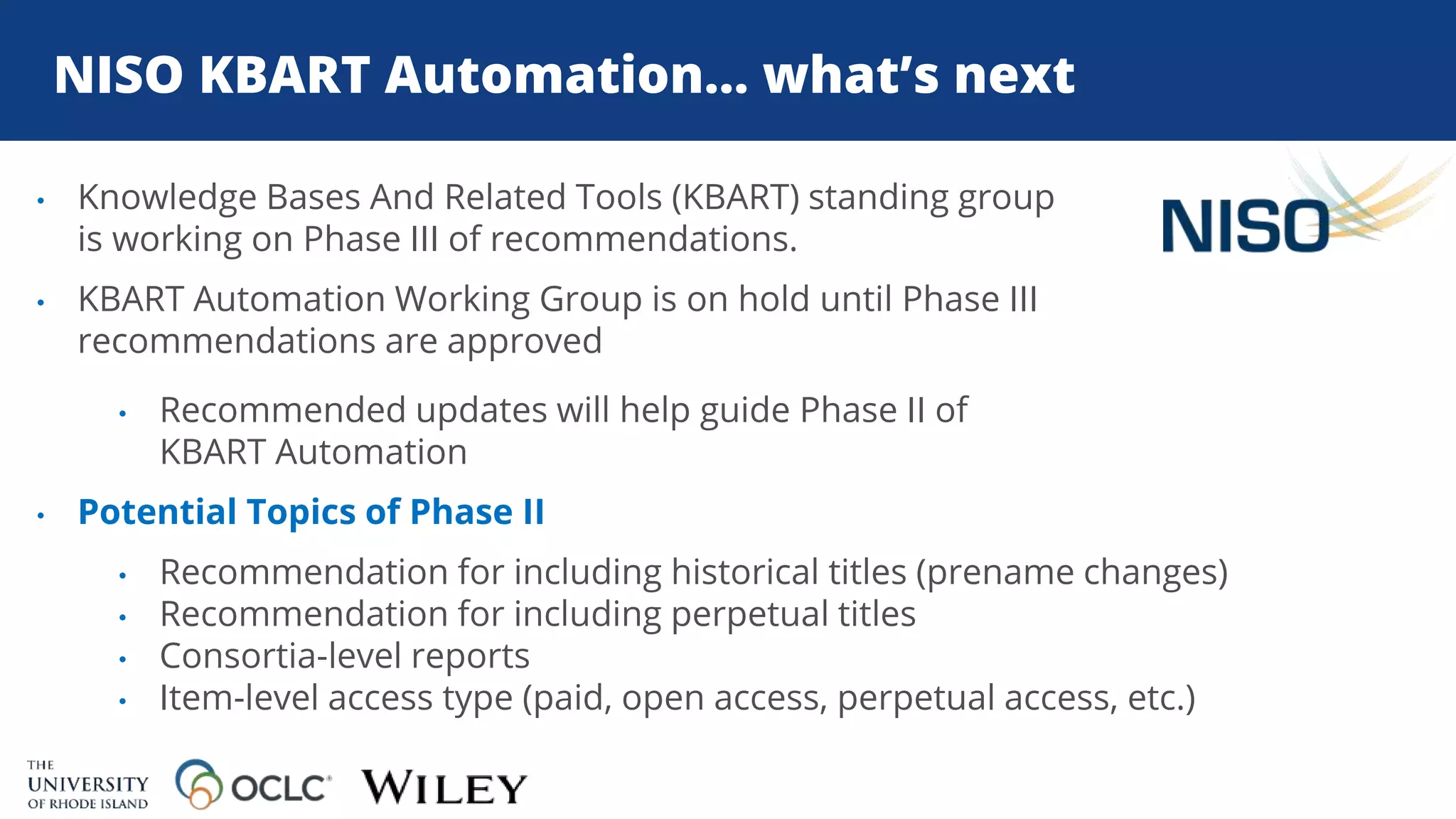
NISO KBART Automation… what’s next
• Knowledge Bases And Related Tools (KBART) standing group
is working on Phase III of recommendations.
• KBART Automation Working Group is on hold until Phase III
recommendations are approved
• Recommended updates will help guide Phase II of
KBART Automation
• Potential Topics of Phase II
• Recommendation for including historical titles (prename changes)
• Recommendation for including perpetual titles
• Consortia-level reports
• Item-level access type (paid, open access, perpetual access, etc.)
Publisher
Perspective
Matthew Ragucci
Associate Director of B2B Product Marketing
Wiley
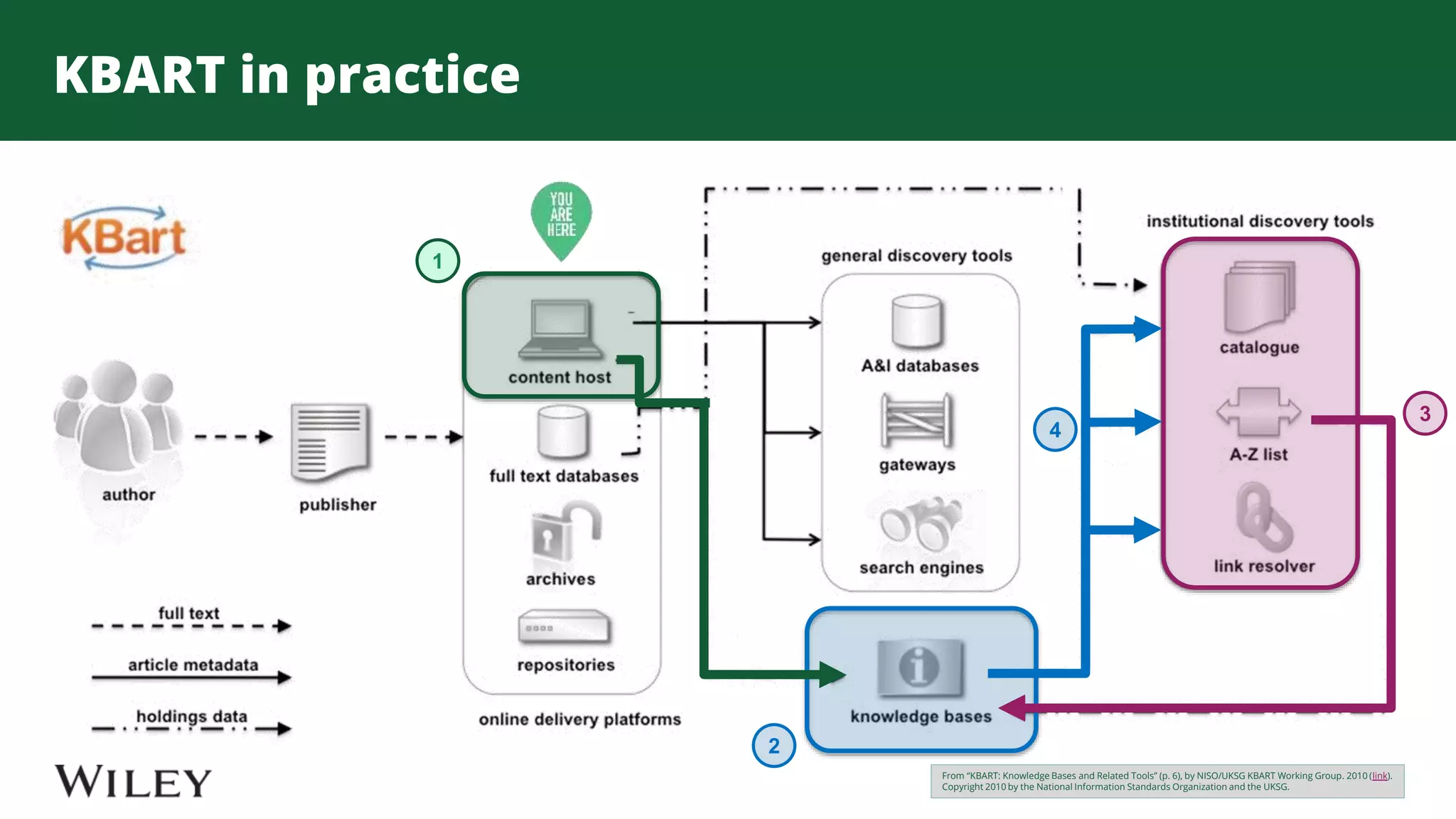
KBART in practice
From “KBART: Knowledge Bases and Related Tools” (p. 6), by NISO/UKSG KBART Working Group. 2010 (link).
Copyright 2010 by the National Information Standards Organization and the UKSG.
1
2
3
4
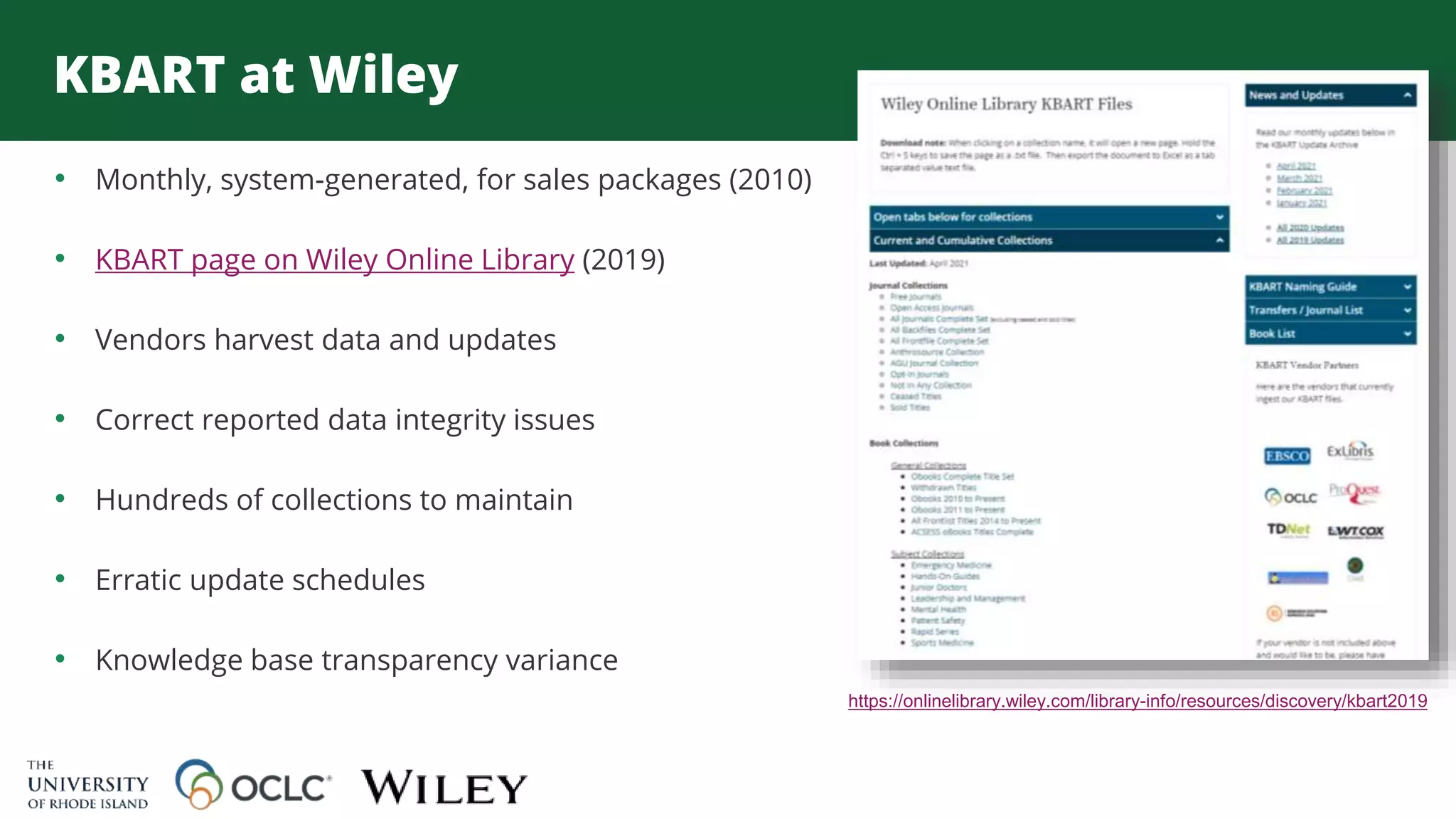
KBART at Wiley
• Monthly, system-generated, for sales packages (2010)
• KBART page on Wiley Online Library (2019)
• Vendors harvest data and updates
• Correct reported data integrity issues
• Hundreds of collections to maintain
• Erratic update schedules
• Knowledge base transparency variance
https://onlinelibrary.wiley.com/library-info/resources/discovery/kbart2019
Why KBART Automation?
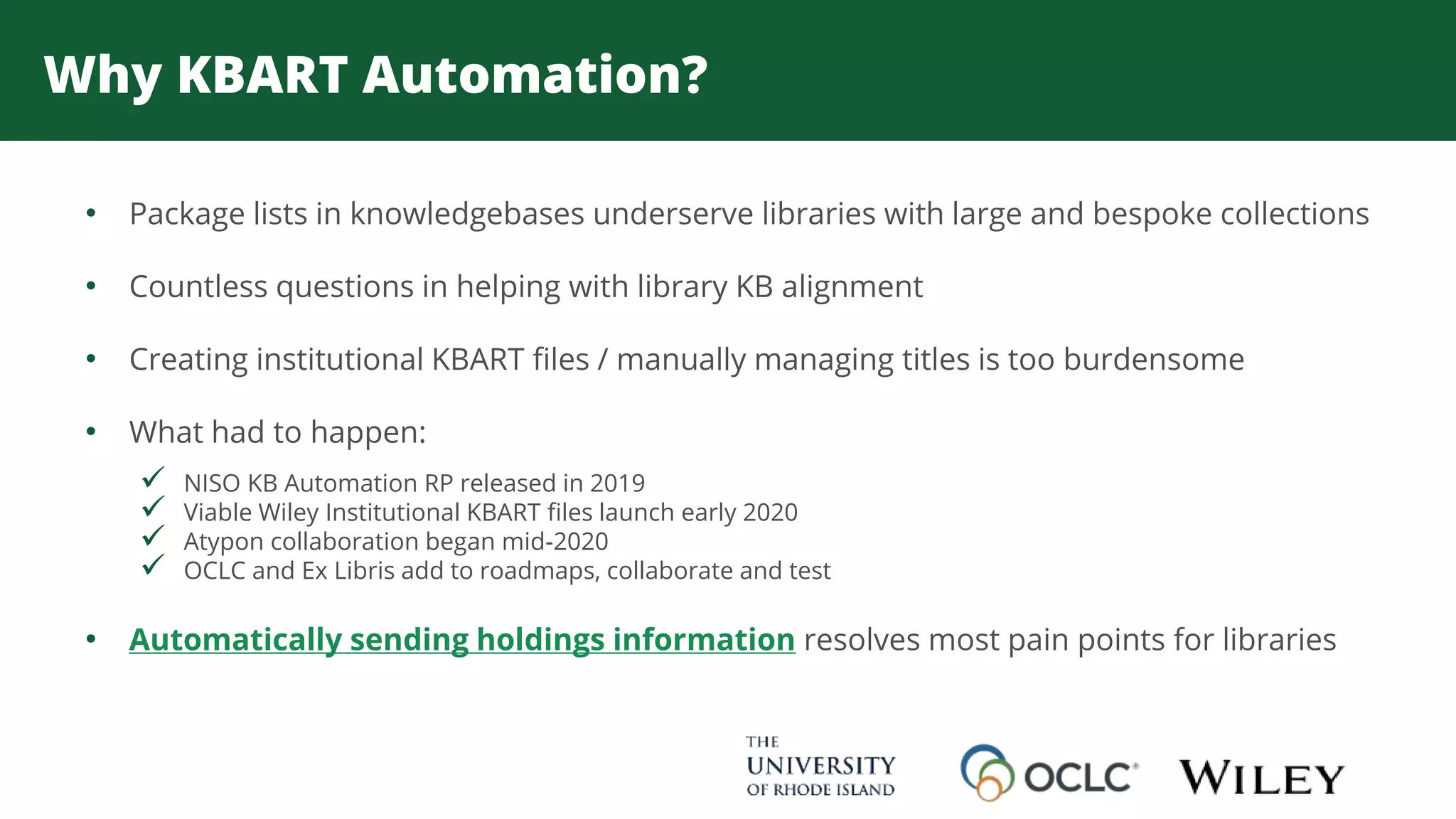
• Package lists in knowledgebases underserve libraries with large and bespoke collections
• Countless questions in helping with library KB alignment
• Creating institutional KBART files / manually managing titles is too burdensome
• What had to happen:
 NISO KB Automation RP released in 2019
 Viable Wiley Institutional KBART files launch early 2020
 Atypon collaboration began mid-2020
 OCLC and Ex Libris add to roadmaps, collaborate and test
• Automatically sending holdings information resolves most pain points for libraries
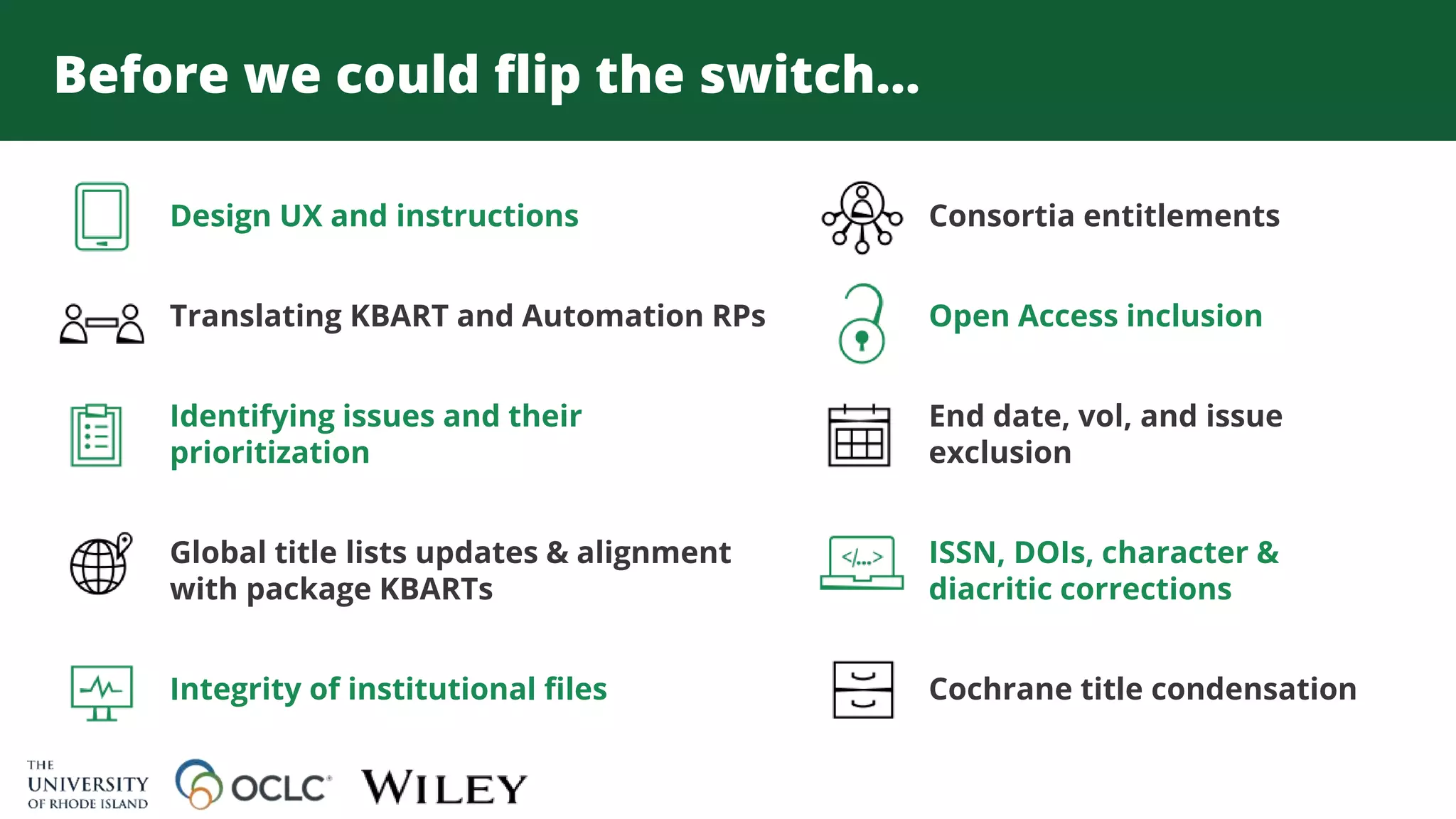
Before we could flip the switch…
Design UX and instructions
Translating KBART and Automation RPs
Identifying issues and their
prioritization
Global title lists updates & alignment
with package KBARTs
Integrity of institutional files
Consortia entitlements
Open Access inclusion
End date, vol, and issue
exclusion
ISSN, DOIs, character &
diacritic corrections
Cochrane title condensation
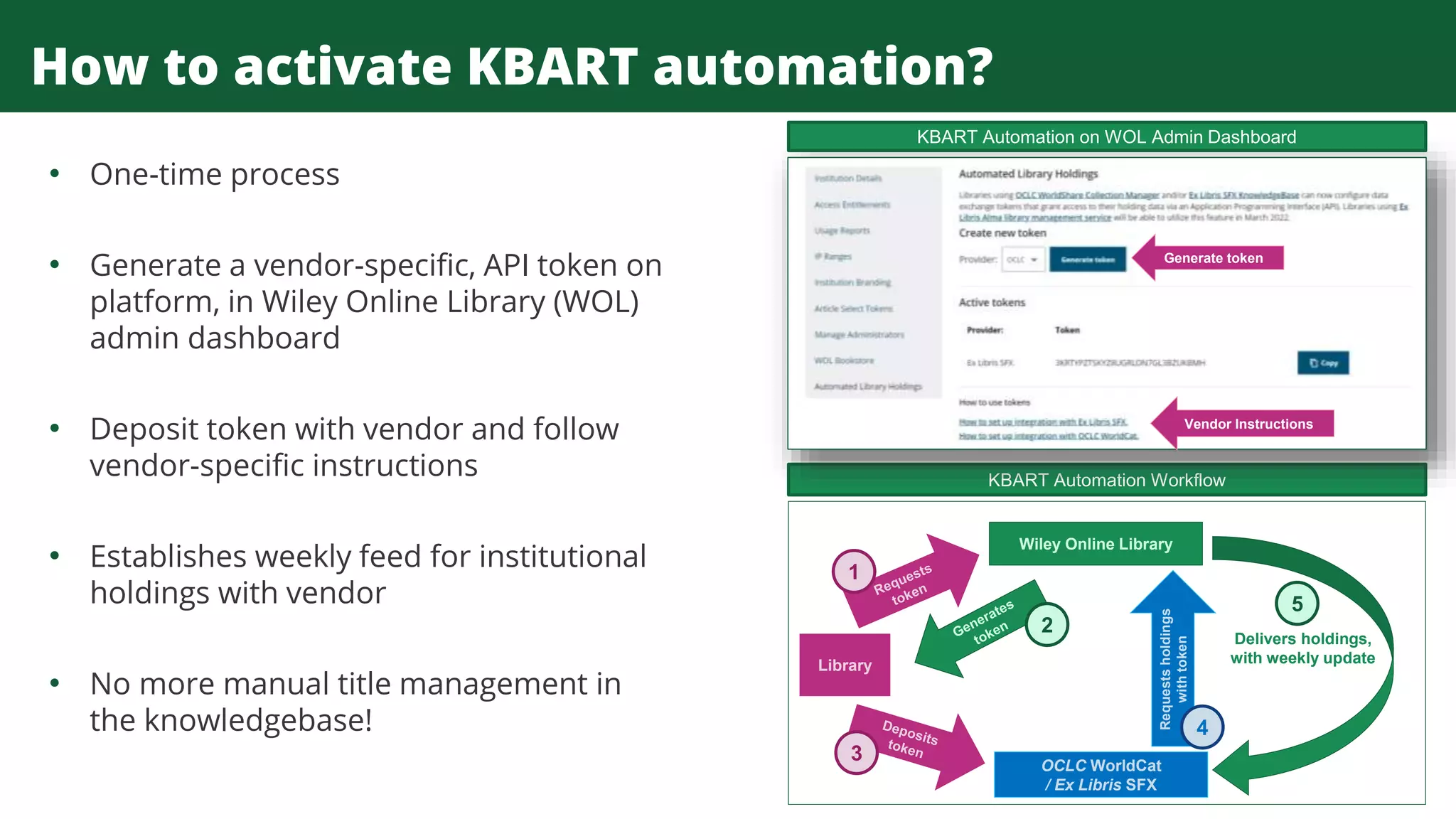
How to activate KBART automation?
• One-time process
• Generate a vendor-specific, API token on
platform, in Wiley Online Library (WOL)
admin dashboard
• Deposit token with vendor and follow
vendor-specific instructions
• Establishes weekly feed for institutional
holdings with vendor
• No more manual title management in
the knowledgebase!
Library
Wiley Online Library
OCLC WorldCat
/ Ex Libris SFX
Delivers holdings,
with weekly update
Requests
holdings
with
token
KBART Automation Workflow
KBART Automation on WOL Admin Dashboard
Generate token
Vendor Instructions
1
2
3
4
5
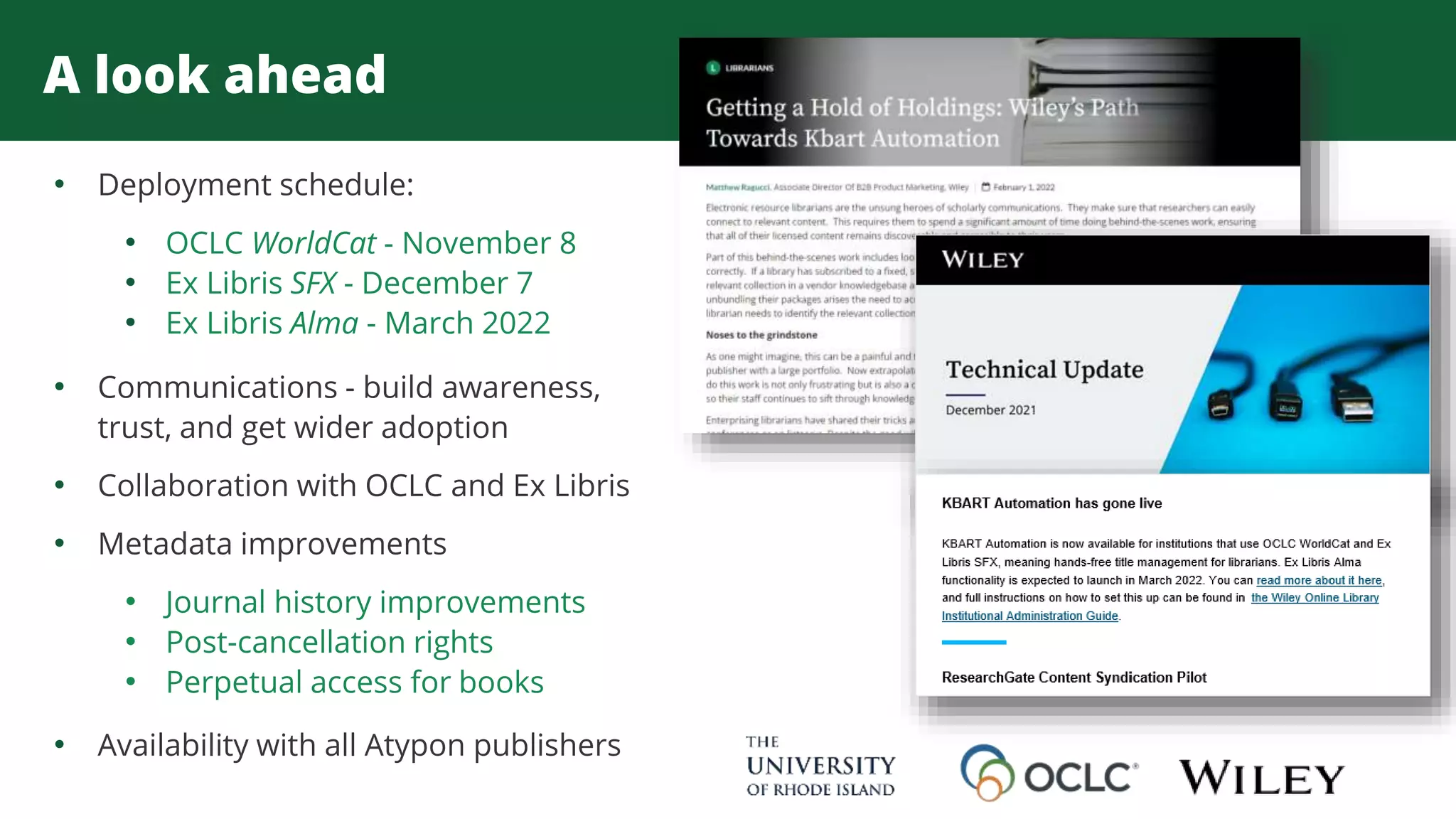
A look ahead
• Deployment schedule:
• OCLC WorldCat - November 8
• Ex Libris SFX - December 7
• Ex Libris Alma - March 2022
• Communications - build awareness,
trust, and get wider adoption
• Collaboration with OCLC and Ex Libris
• Metadata improvements
• Journal history improvements
• Post-cancellation rights
• Perpetual access for books
• Availability with all Atypon publishers
Library
Perspective
Andrée Rathemacher
Head, Acquisitions
University of Rhode Island
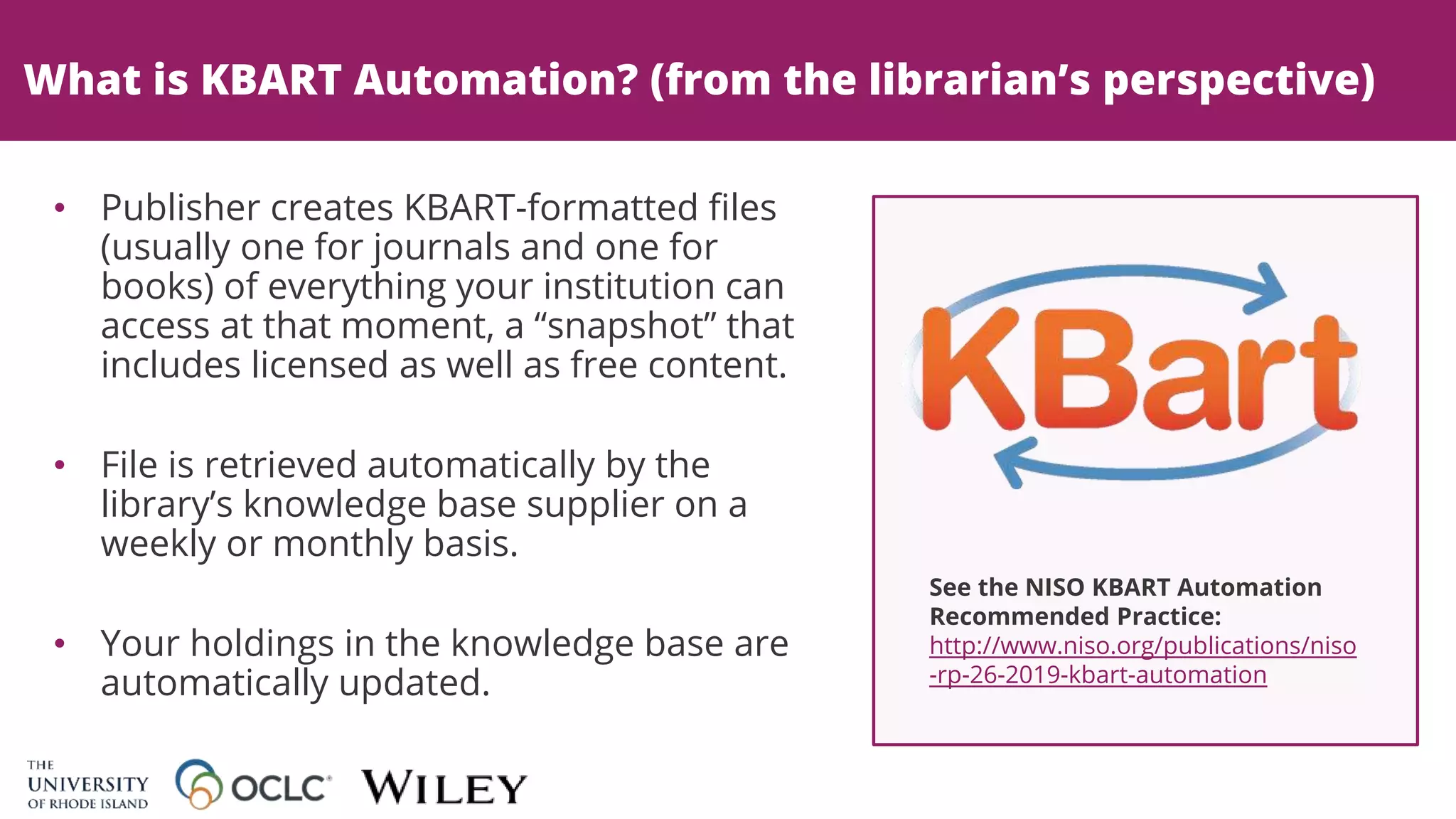
What is KBART Automation? (from the librarian’s perspective)
See the NISO KBART Automation
Recommended Practice:
http://www.niso.org/publications/niso
-rp-26-2019-kbart-automation
• Publisher creates KBART-formatted files
(usually one for journals and one for
books) of everything your institution can
access at that moment, a “snapshot” that
includes licensed as well as free content.
• File is retrieved automatically by the
library’s knowledge base supplier on a
weekly or monthly basis.
• Your holdings in the knowledge base are
automatically updated.
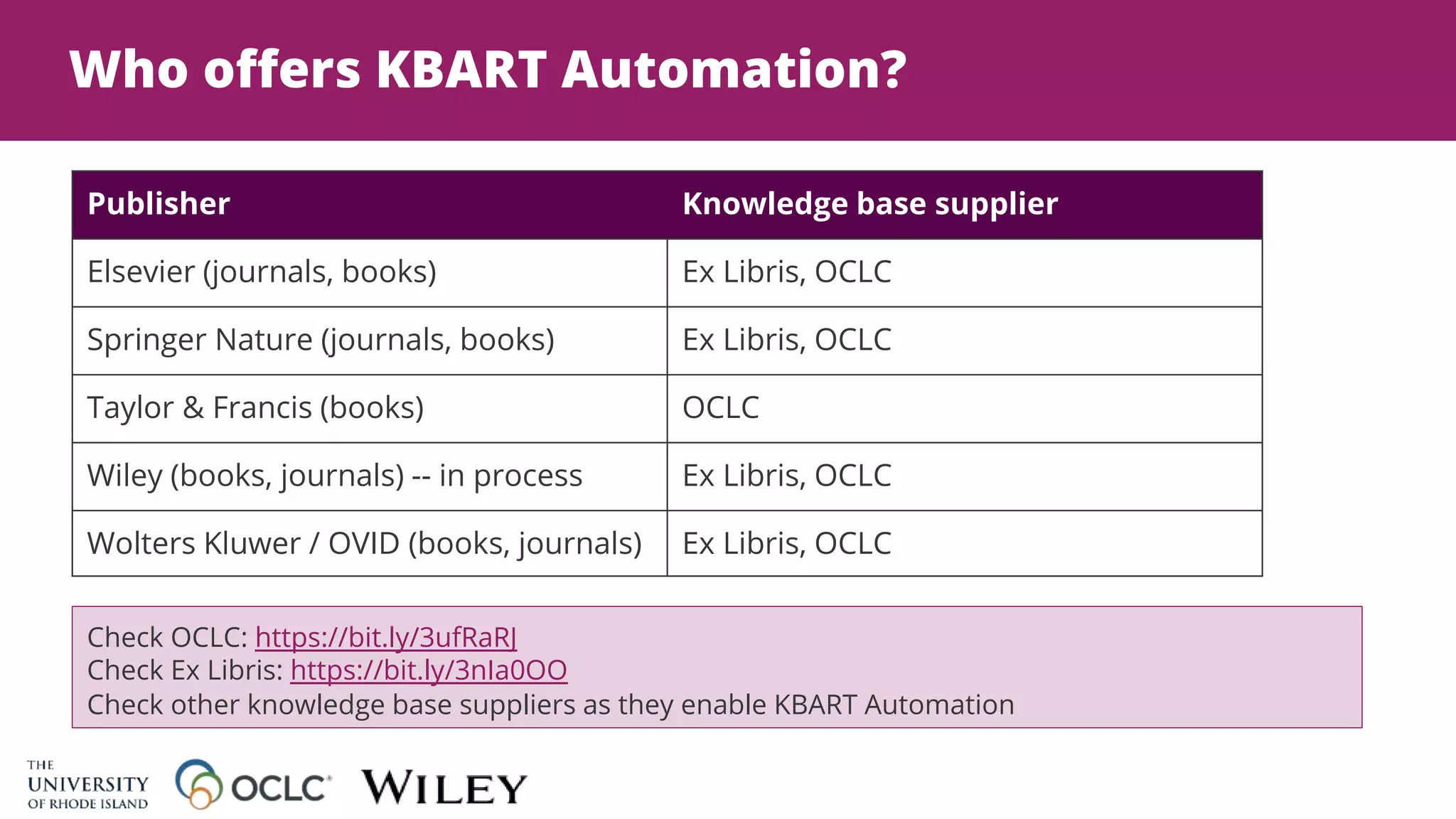
Who offers KBART Automation?
Check OCLC: https://bit.ly/3ufRaRJ
Check Ex Libris: https://bit.ly/3nIa0OO
Check other knowledge base suppliers as they enable KBART Automation
Publisher Knowledge base supplier
Elsevier (journals, books) Ex Libris, OCLC
Springer Nature (journals, books) Ex Libris, OCLC
Taylor & Francis (books) OCLC
Wiley (books, journals) -- in process Ex Libris, OCLC
Wolters Kluwer / OVID (books, journals) Ex Libris, OCLC
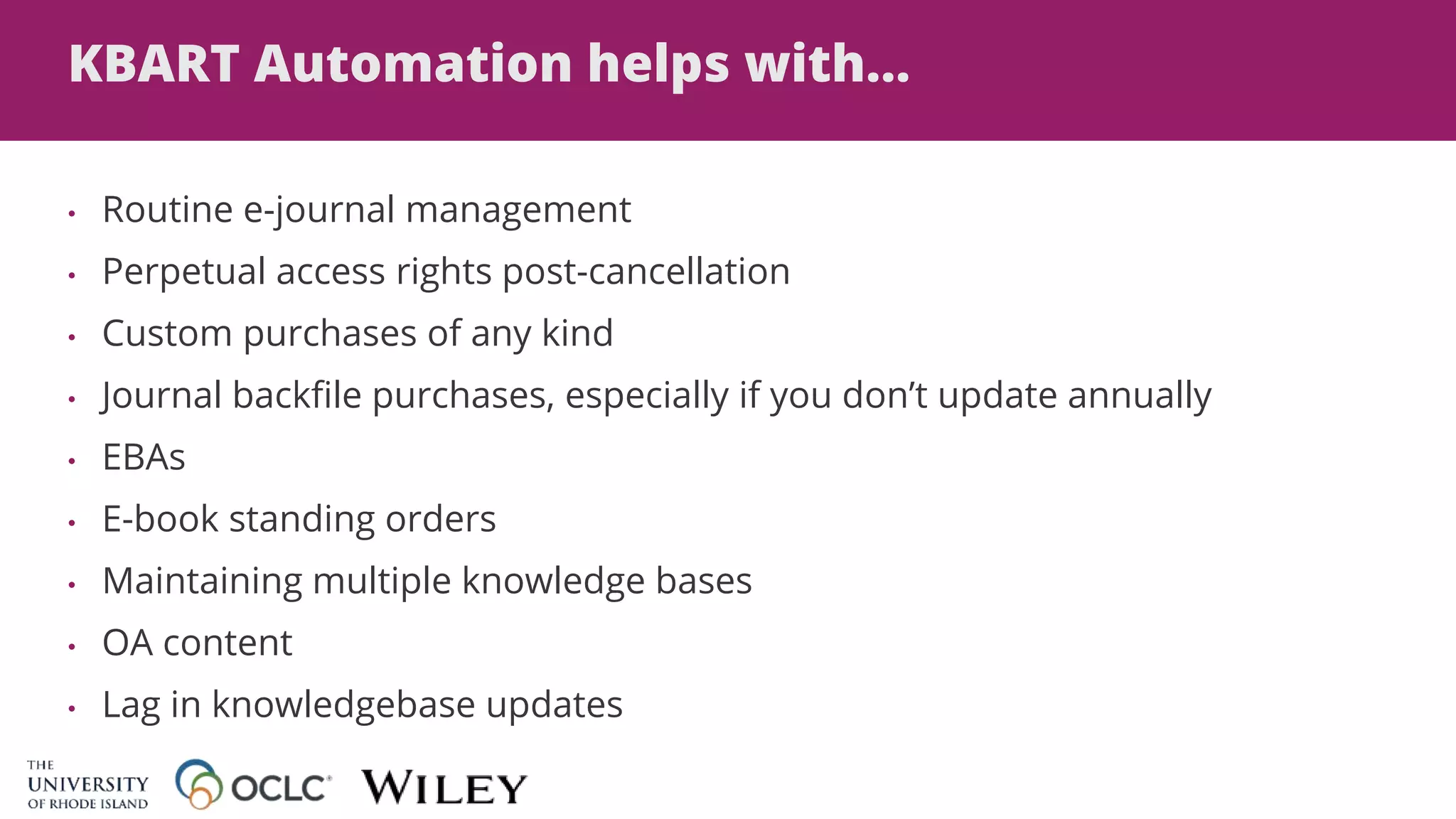
KBART Automation helps with...
• Routine e-journal management
• Perpetual access rights post-cancellation
• Custom purchases of any kind
• Journal backfile purchases, especially if you don’t update annually
• EBAs
• E-book standing orders
• Maintaining multiple knowledge bases
• OA content
• Lag in knowledgebase updates
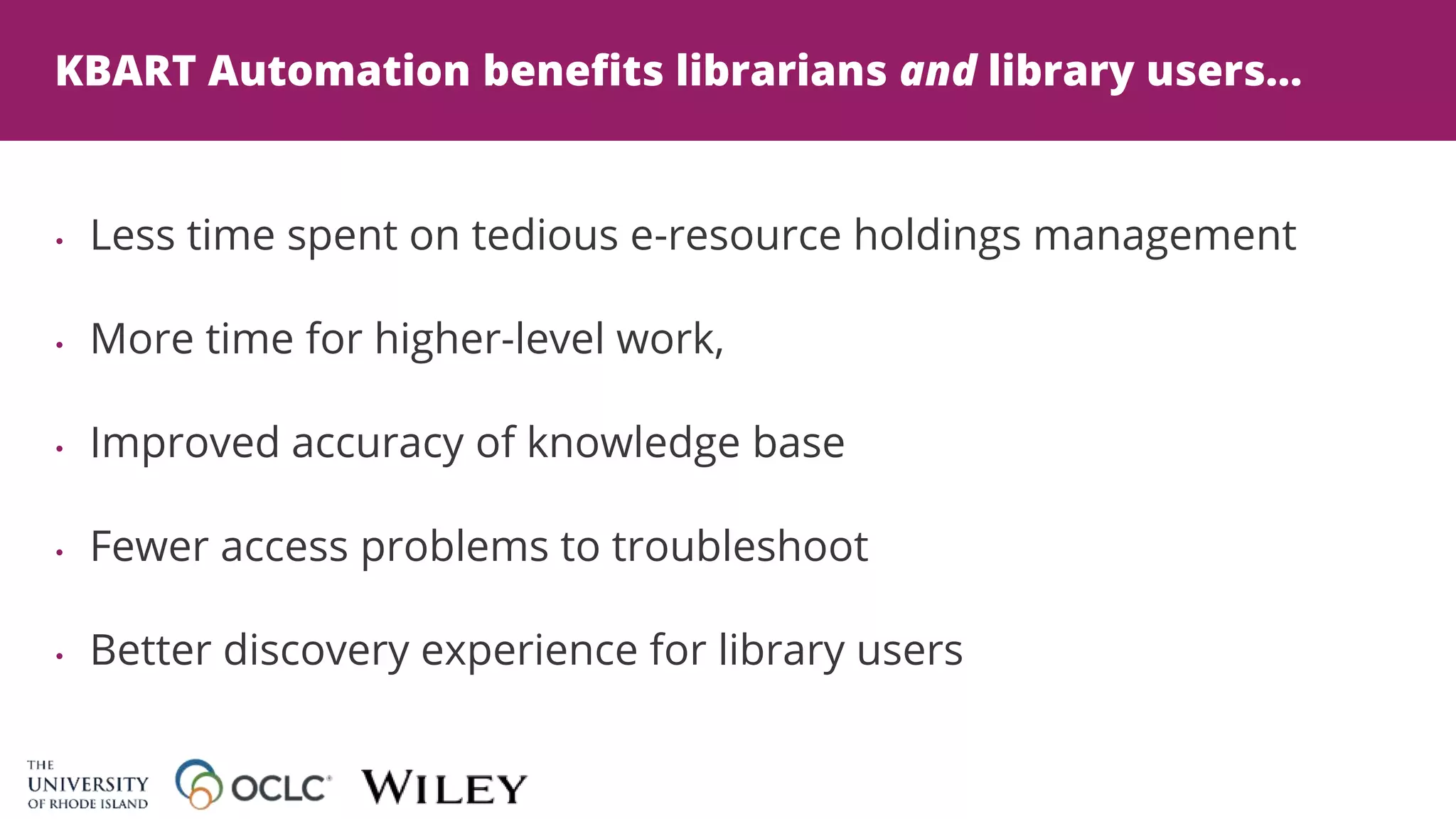
KBART Automation benefits librarians and library users...
• Less time spent on tedious e-resource holdings management
• More time for higher-level work,
• Improved accuracy of knowledge base
• Fewer access problems to troubleshoot
• Better discovery experience for library users
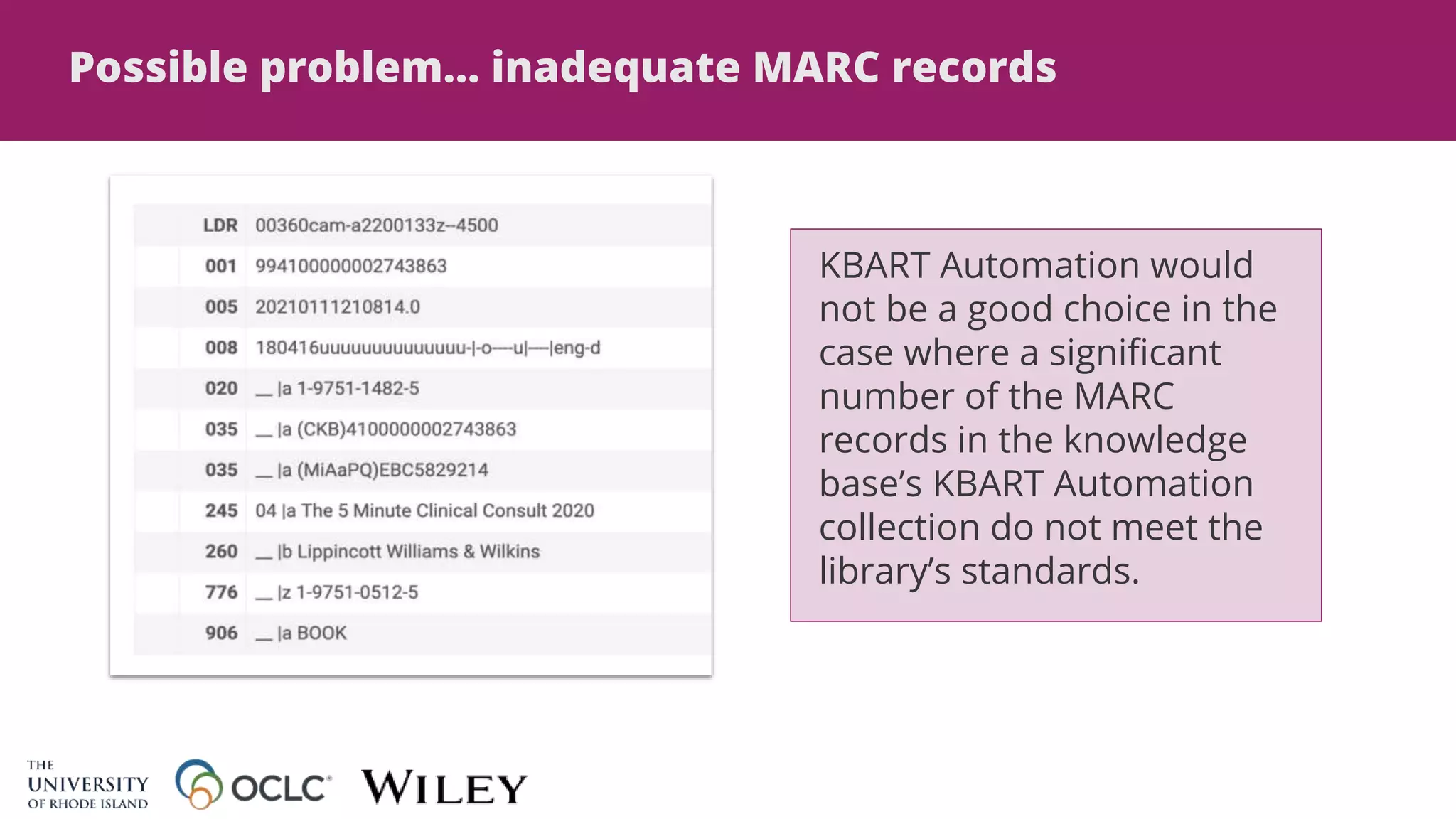
Possible problem… inadequate MARC records
KBART Automation would
not be a good choice in the
case where a significant
number of the MARC
records in the knowledge
base’s KBART Automation
collection do not meet the
library’s standards.
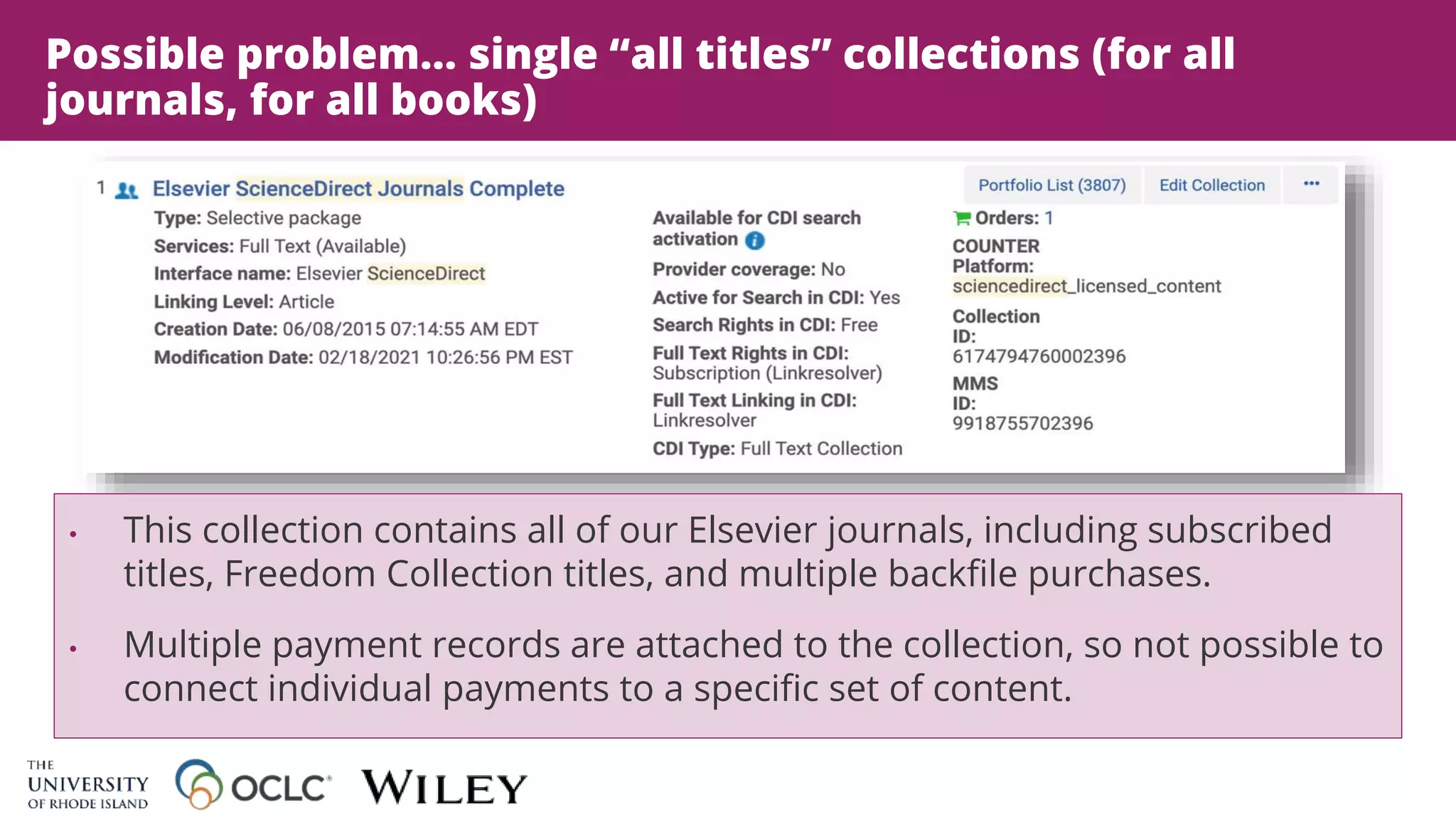
Possible problem… single “all titles” collections (for all
journals, for all books)
• This collection contains all of our Elsevier journals, including subscribed
titles, Freedom Collection titles, and multiple backfile purchases.
• Multiple payment records are attached to the collection, so not possible to
connect individual payments to a specific set of content.
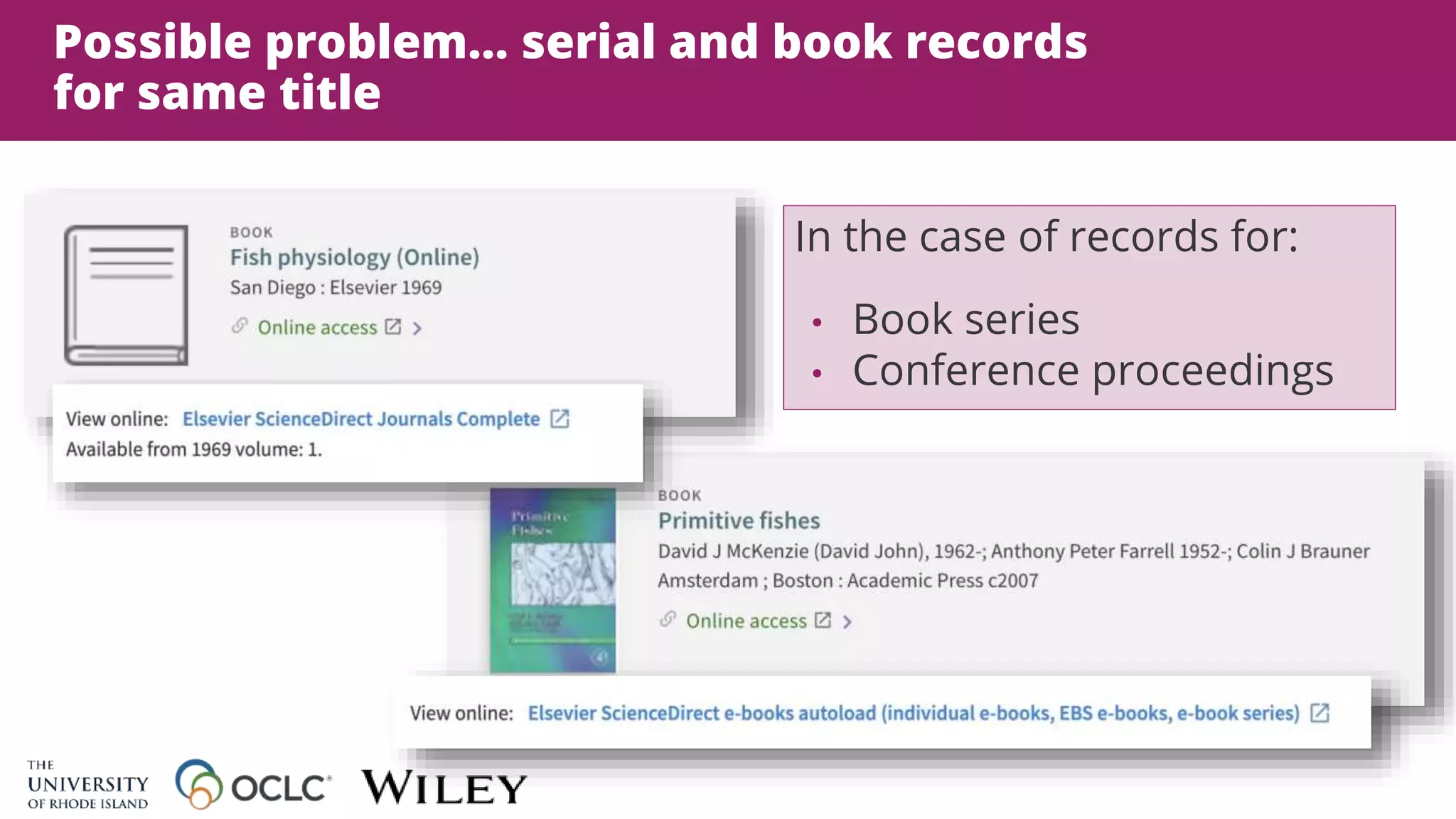
Possible problem… serial and book records
for same title
In the case of records for:
• Book series
• Conference proceedings
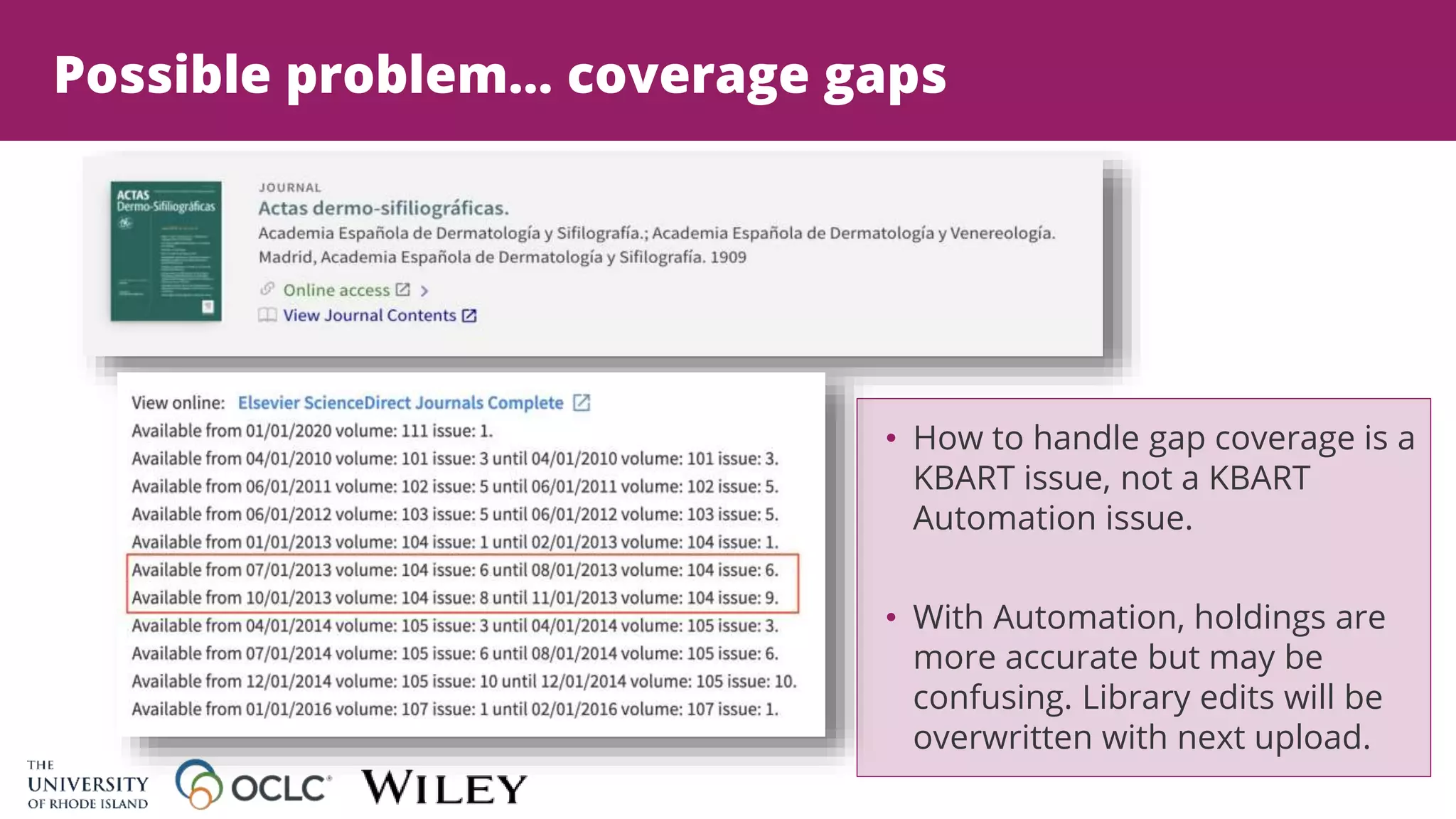
Possible problem… coverage gaps
• How to handle gap coverage is a
KBART issue, not a KBART
Automation issue.
• With Automation, holdings are
more accurate but may be
confusing. Library edits will be
overwritten with next upload.
Possible problem… reliance on publisher
system data
• Are publisher records on the library’s entitlements accurate?
• If KBART Automation removes a holding in error, so that it no
longer appears in the library’s discovery system, will the mistake
be noticed?
Vendor
Perspective
Stephanie Doellinger
Senior Metadata Operations Manager CI & KB
OCLC
Where we started
• Needed to support programs such as Demand Driven Acquisition and Evidence
Based Acquisition purchase models.
 Automation addresses speed of updates
 Automation addresses accuracy of holdings, MARC records and URLs in
Discovery services
• Saves staff time on collection management with shift in e-resource management
 Publisher tracks when an item is purchased
 KBART automated holding feeds supplies updates directly to vendors
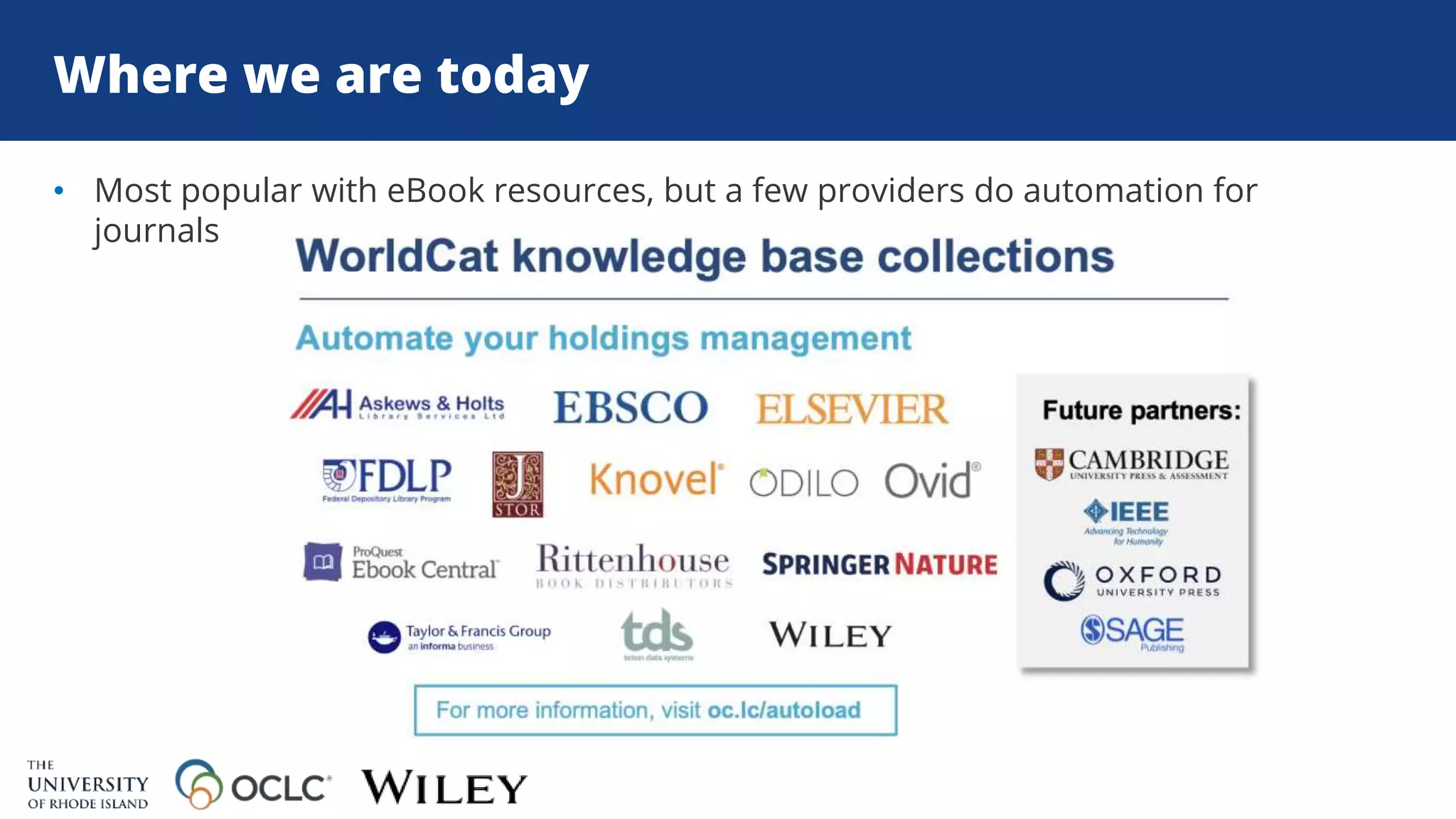
Where we are today
• Most popular with eBook resources, but a few providers do automation for
journals
KBART Automation and knowledge bases
• KBART Automation recommendation should eliminate the need to re-
develop automation procedures for each content provider separately:
• Each provider onboarded is still a project
• They are similar, but not cookie cutter
• Helps reduce support calls related holdings inaccuracy issues
• In most cases API access is available for global KBART title list and
automated holdings feeds
Most common automation questions
• The most common asked question regarding
automated holdings:
1. Where are the historical titles (prename changes)?
2. Where are my perpetual titles?
3. Will it select the collections my library has
purchased?
• How do I ensure I have enabled correct
collections?
4. Can I have two feeds one for my library and one for
my consortia?
How automation improves accuracy
• Prerequisite publisher must have good
quality global KBART files, updated
consistently
• Publisher must generate accurate KBART
automated holdings routinely. Preferred
weekly
• API’s have improved the speed and accuracy
of updates for KBART automation
• Correctness is vital, OCLC does pilot test
runs prior to going live
• If feeds are not accurate, they are not
enabled by libraries
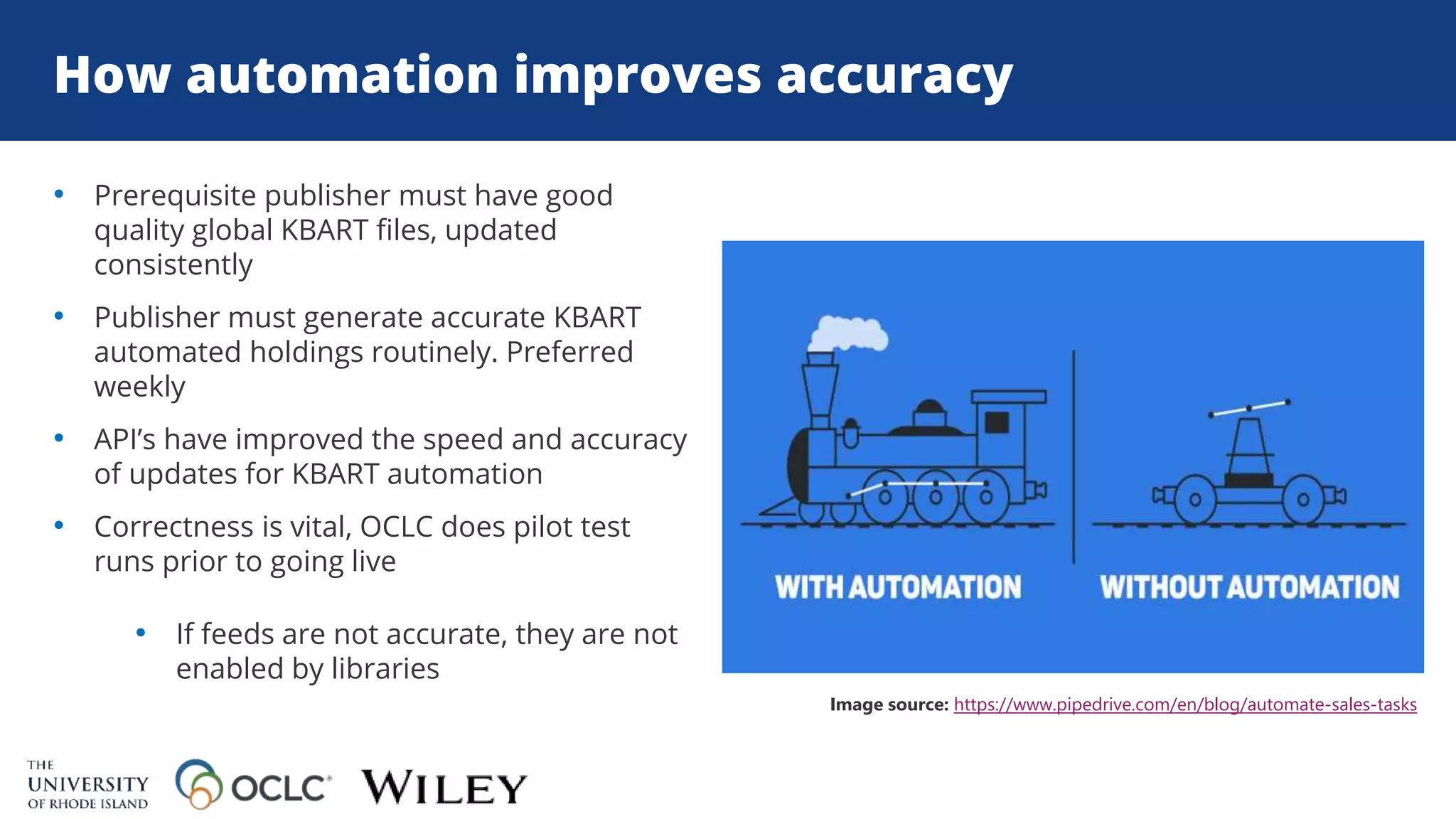
Image source: https://www.pipedrive.com/en/blog/automate-sales-tasks
OCLC & Wiley Automated holding feeds
• OCLC is working closely with Wiley to ensure the
KBART automation feed will meet accuracy
needs during and after go live
• OCLC and Wiley want a successful launch to
ensure the automated feeds are wildly adapted.
Questions?
Stephanie Doellinger
doellins@oclc.org
Andrée Rathemacher
andree@uri.edu
Matthew Ragucci
mragucci@wiley.com

ER&L 2022 - Set It and Forget It: Librarian, Publisher, and Vendor Perspectives on Why You Should Choose KBART Automation

  • 1.
    Set It andForget it? March 17, 2022 10:00-11:30 PM EST Stephanie Doellinger, OCLC Matthew Ragucci, Wiley Andrée Rathemacher, University of Rhode Island Librarian, Publisher, and Vendor Perspectives on Why You Should Choose KBART Automation Image source: https://unsplash.com/photos/cApC7v7Dwwo
  • 2.
    Agenda • Introduction &Background • Publisher Perspective • Library Perspective • Vendor Perspective • Questions
  • 3.
    Introductions & Background Stephanie Doellinger SeniorMetadata Operations Manager CI & KB OCLC
  • 4.
    NISO KBART Automation •KBART Automation Working Group began in 2017 • Focused on Automated Exchange of Title Lists and Library Holdings • June 18, 2019 recommendation published • http://www.niso.org/publications/niso-rp-26- 2019-kbart-automation
  • 5.
    NISO KBART AutomationPhase 1 Purpose of Phase 1 • Facilitates the automatic transfer and retrieval of holdings data between content providers and institutional knowledge bases, with the goal of automatically and regularly updating institutional holdings via an API. • Includes recommendations for both eBook and Journals • Reduces workload on library staff and reduces human error • Increased usage for content providers, increasing customer satisfaction • Eliminating the need to re-develop automation procedures for each content provider separately for knowledge bases
  • 6.
    NISO KBART Automation…what’s next • Knowledge Bases And Related Tools (KBART) standing group is working on Phase III of recommendations. • KBART Automation Working Group is on hold until Phase III recommendations are approved • Recommended updates will help guide Phase II of KBART Automation • Potential Topics of Phase II • Recommendation for including historical titles (prename changes) • Recommendation for including perpetual titles • Consortia-level reports • Item-level access type (paid, open access, perpetual access, etc.)
  • 7.
  • 8.
    KBART in practice From“KBART: Knowledge Bases and Related Tools” (p. 6), by NISO/UKSG KBART Working Group. 2010 (link). Copyright 2010 by the National Information Standards Organization and the UKSG. 1 2 3 4
  • 9.
    KBART at Wiley •Monthly, system-generated, for sales packages (2010) • KBART page on Wiley Online Library (2019) • Vendors harvest data and updates • Correct reported data integrity issues • Hundreds of collections to maintain • Erratic update schedules • Knowledge base transparency variance https://onlinelibrary.wiley.com/library-info/resources/discovery/kbart2019
  • 10.
    Why KBART Automation? •Package lists in knowledgebases underserve libraries with large and bespoke collections • Countless questions in helping with library KB alignment • Creating institutional KBART files / manually managing titles is too burdensome • What had to happen:  NISO KB Automation RP released in 2019  Viable Wiley Institutional KBART files launch early 2020  Atypon collaboration began mid-2020  OCLC and Ex Libris add to roadmaps, collaborate and test • Automatically sending holdings information resolves most pain points for libraries
  • 11.
    Before we couldflip the switch… Design UX and instructions Translating KBART and Automation RPs Identifying issues and their prioritization Global title lists updates & alignment with package KBARTs Integrity of institutional files Consortia entitlements Open Access inclusion End date, vol, and issue exclusion ISSN, DOIs, character & diacritic corrections Cochrane title condensation
  • 12.
    How to activateKBART automation? • One-time process • Generate a vendor-specific, API token on platform, in Wiley Online Library (WOL) admin dashboard • Deposit token with vendor and follow vendor-specific instructions • Establishes weekly feed for institutional holdings with vendor • No more manual title management in the knowledgebase! Library Wiley Online Library OCLC WorldCat / Ex Libris SFX Delivers holdings, with weekly update Requests holdings with token KBART Automation Workflow KBART Automation on WOL Admin Dashboard Generate token Vendor Instructions 1 2 3 4 5
  • 13.
    A look ahead •Deployment schedule: • OCLC WorldCat - November 8 • Ex Libris SFX - December 7 • Ex Libris Alma - March 2022 • Communications - build awareness, trust, and get wider adoption • Collaboration with OCLC and Ex Libris • Metadata improvements • Journal history improvements • Post-cancellation rights • Perpetual access for books • Availability with all Atypon publishers
  • 14.
  • 15.
    What is KBARTAutomation? (from the librarian’s perspective) See the NISO KBART Automation Recommended Practice: http://www.niso.org/publications/niso -rp-26-2019-kbart-automation • Publisher creates KBART-formatted files (usually one for journals and one for books) of everything your institution can access at that moment, a “snapshot” that includes licensed as well as free content. • File is retrieved automatically by the library’s knowledge base supplier on a weekly or monthly basis. • Your holdings in the knowledge base are automatically updated.
  • 16.
    Who offers KBARTAutomation? Check OCLC: https://bit.ly/3ufRaRJ Check Ex Libris: https://bit.ly/3nIa0OO Check other knowledge base suppliers as they enable KBART Automation Publisher Knowledge base supplier Elsevier (journals, books) Ex Libris, OCLC Springer Nature (journals, books) Ex Libris, OCLC Taylor & Francis (books) OCLC Wiley (books, journals) -- in process Ex Libris, OCLC Wolters Kluwer / OVID (books, journals) Ex Libris, OCLC
  • 17.
    KBART Automation helpswith... • Routine e-journal management • Perpetual access rights post-cancellation • Custom purchases of any kind • Journal backfile purchases, especially if you don’t update annually • EBAs • E-book standing orders • Maintaining multiple knowledge bases • OA content • Lag in knowledgebase updates
  • 18.
    KBART Automation benefitslibrarians and library users... • Less time spent on tedious e-resource holdings management • More time for higher-level work, • Improved accuracy of knowledge base • Fewer access problems to troubleshoot • Better discovery experience for library users
  • 19.
    Possible problem… inadequateMARC records KBART Automation would not be a good choice in the case where a significant number of the MARC records in the knowledge base’s KBART Automation collection do not meet the library’s standards.
  • 20.
    Possible problem… single“all titles” collections (for all journals, for all books) • This collection contains all of our Elsevier journals, including subscribed titles, Freedom Collection titles, and multiple backfile purchases. • Multiple payment records are attached to the collection, so not possible to connect individual payments to a specific set of content.
  • 21.
    Possible problem… serialand book records for same title In the case of records for: • Book series • Conference proceedings
  • 22.
    Possible problem… coveragegaps • How to handle gap coverage is a KBART issue, not a KBART Automation issue. • With Automation, holdings are more accurate but may be confusing. Library edits will be overwritten with next upload.
  • 23.
    Possible problem… relianceon publisher system data • Are publisher records on the library’s entitlements accurate? • If KBART Automation removes a holding in error, so that it no longer appears in the library’s discovery system, will the mistake be noticed?
  • 24.
  • 25.
    Where we started •Needed to support programs such as Demand Driven Acquisition and Evidence Based Acquisition purchase models.  Automation addresses speed of updates  Automation addresses accuracy of holdings, MARC records and URLs in Discovery services • Saves staff time on collection management with shift in e-resource management  Publisher tracks when an item is purchased  KBART automated holding feeds supplies updates directly to vendors
  • 26.
    Where we aretoday • Most popular with eBook resources, but a few providers do automation for journals
  • 27.
    KBART Automation andknowledge bases • KBART Automation recommendation should eliminate the need to re- develop automation procedures for each content provider separately: • Each provider onboarded is still a project • They are similar, but not cookie cutter • Helps reduce support calls related holdings inaccuracy issues • In most cases API access is available for global KBART title list and automated holdings feeds
  • 28.
    Most common automationquestions • The most common asked question regarding automated holdings: 1. Where are the historical titles (prename changes)? 2. Where are my perpetual titles? 3. Will it select the collections my library has purchased? • How do I ensure I have enabled correct collections? 4. Can I have two feeds one for my library and one for my consortia?
  • 29.
    How automation improvesaccuracy • Prerequisite publisher must have good quality global KBART files, updated consistently • Publisher must generate accurate KBART automated holdings routinely. Preferred weekly • API’s have improved the speed and accuracy of updates for KBART automation • Correctness is vital, OCLC does pilot test runs prior to going live • If feeds are not accurate, they are not enabled by libraries Image source: https://www.pipedrive.com/en/blog/automate-sales-tasks
  • 30.
    OCLC & WileyAutomated holding feeds • OCLC is working closely with Wiley to ensure the KBART automation feed will meet accuracy needs during and after go live • OCLC and Wiley want a successful launch to ensure the automated feeds are wildly adapted.
  • 31.