XXKBARTok        ?K            ?KNOWLEDGE BASES AND RELATED TOOLS: A NISO/UKSG RECOMMENDED PRACTICEJason Price, PhD Claremont Colleges/SCELCKBART Working Group MemberNASIG June 6 2010Palm Springs, CA
Why you should you back this horse?Jarrett Campbell from Cary, NC, USA
VitalsWho – Publishers, Aggregators, KB vendors, Libraries What – a universally acceptable holdings data format Where – throughout the supply chain & at the UKSG info hub http://www.uksg.org/kbartWhen – NowPhase 1 Report –  Jan 2010  http://bit.ly/kbartRPEndorsement Phase -- June 2010 Why – Better access for users through accurate holdings data How can you help?For librariansFor publishers
Who is behind KBART?  Standards organizationsUKSG and NISOThe working group members, representing:Knowledge Base vendors ExLibris, Serials Solutions, EbscoContent aggregatorsPublishersSubscription AgentsLibraries & ConsortiaFull list -- http://www.uksg.org/kbart/members
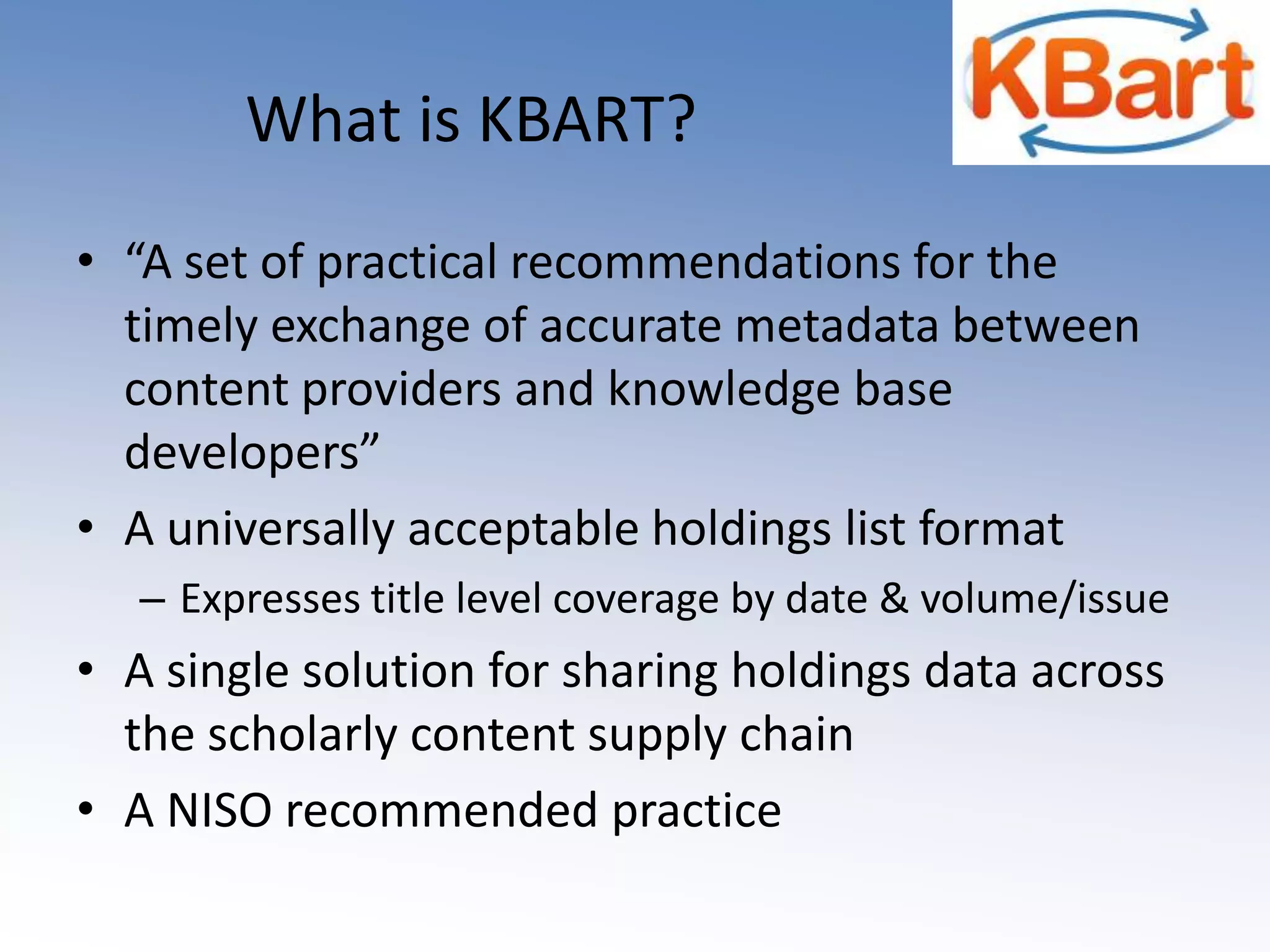
What is KBART? “A set of practical recommendations for the timely exchange of accurate metadata between content providers and knowledge base developers”A universally acceptable holdings list formatExpresses title level coverage by date & volume/issueA single solution for sharing holdings data across the scholarly content supply chainA NISO recommended practice
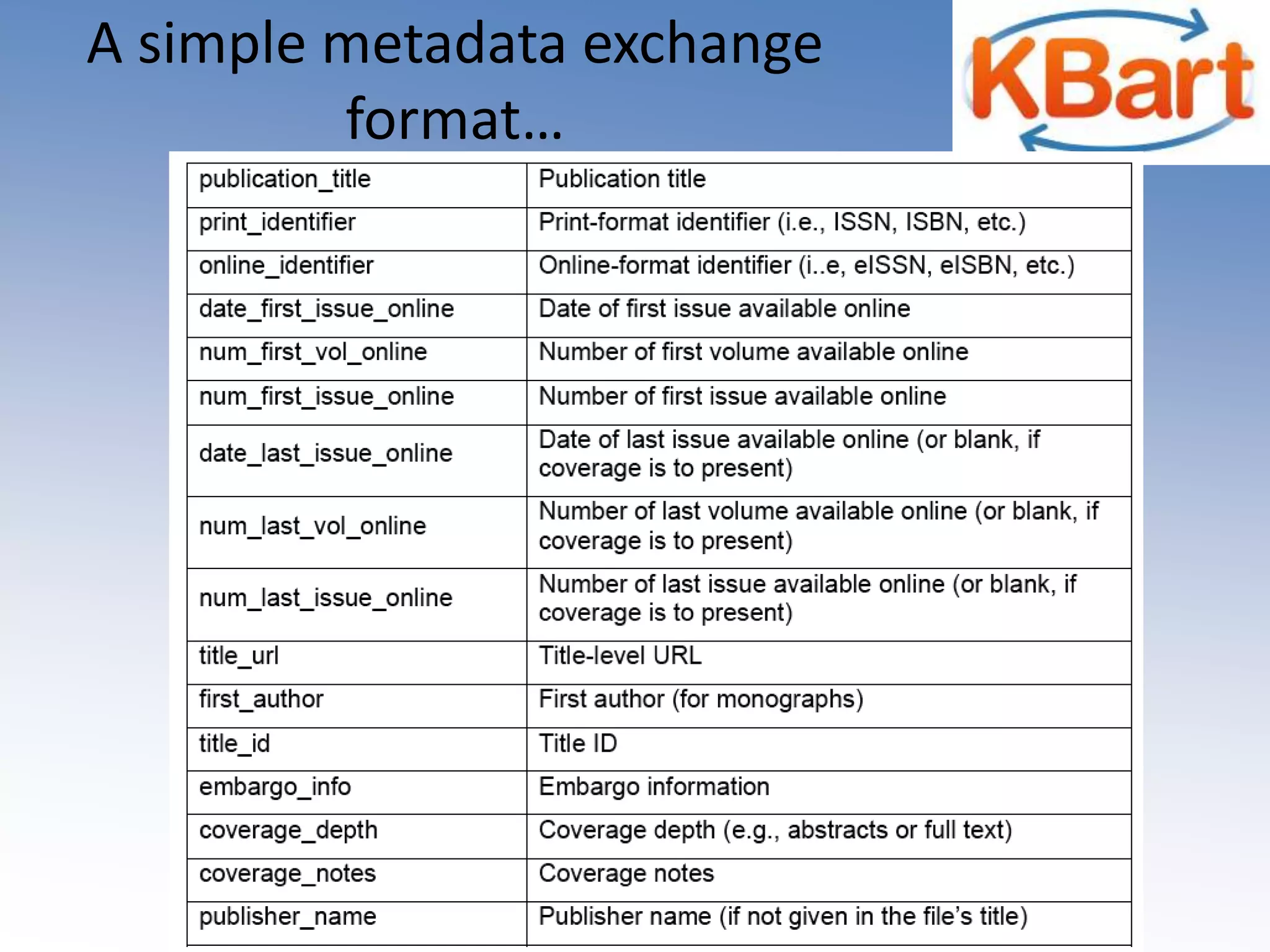
A simple metadata exchange format…
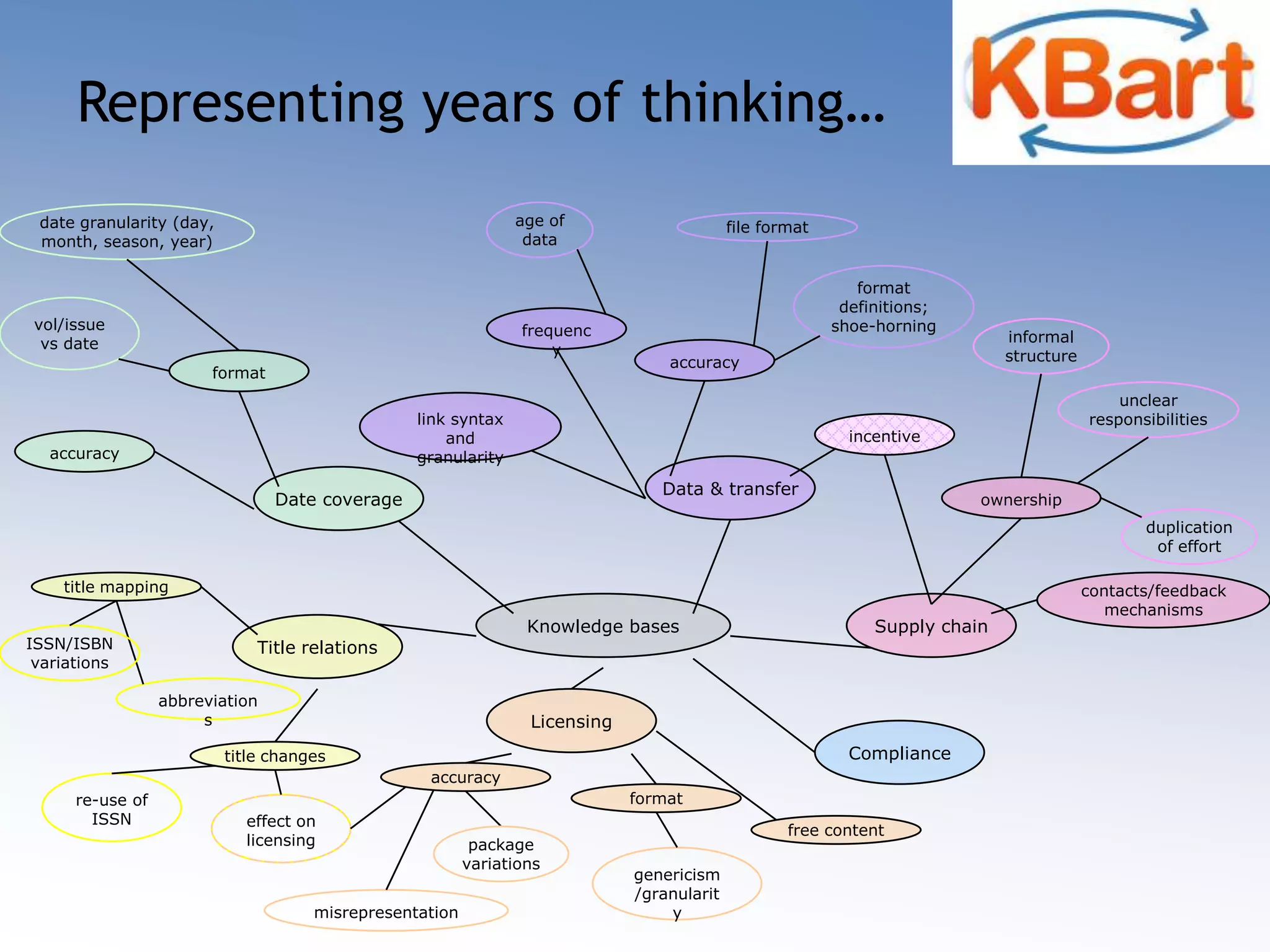
age of datadate granularity (day, month, season, year)file format format definitions;shoe-horningvol/issue vs datefrequencyinformal structureaccuracyformatunclear responsibilitieslink syntax and granularityincentiveaccuracyData & transferDate coverageownershipduplication of efforttitle mappingcontacts/feedback mechanismsSupply chainTitle relationsISSN/ISBN variationsabbreviationsLicensingCompliancetitle changesaccuracyre-use of ISSNformateffect on licensingfree contentpackage variationsgenericism/granularitymisrepresentationRepresenting years of thinking…Knowledge bases
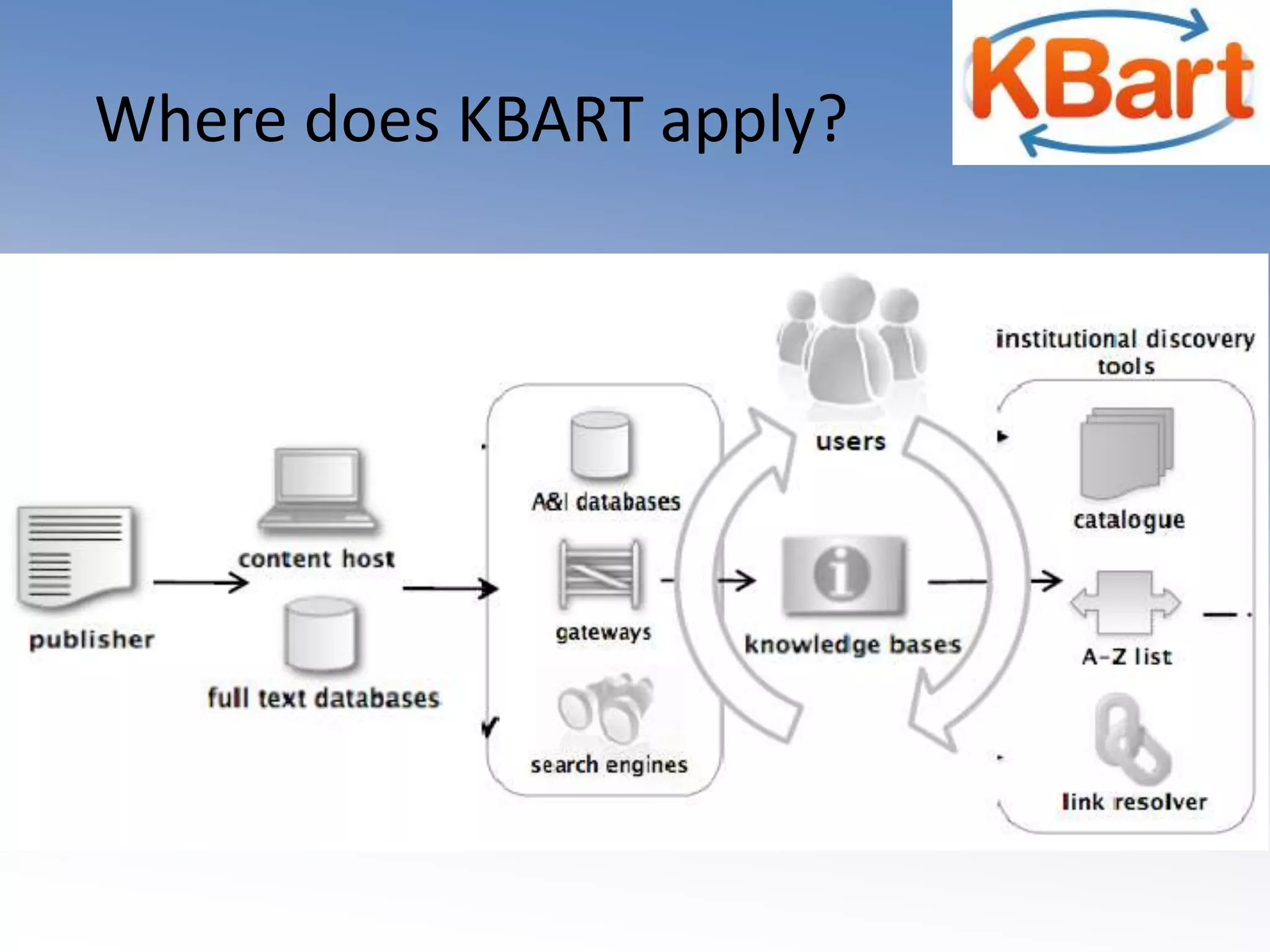
Where does KBART apply?
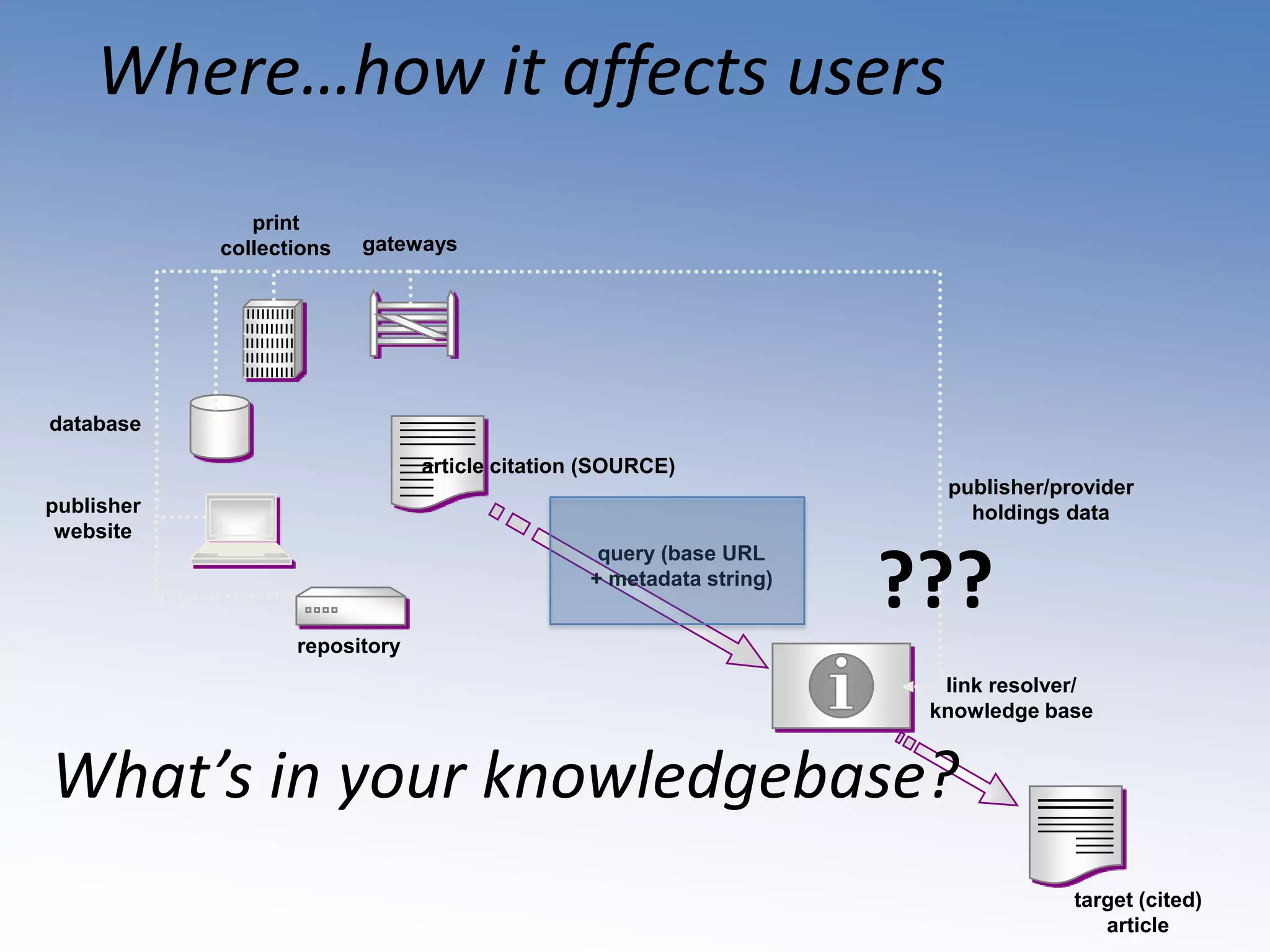
Where…how it affects usersprintcollectionsgatewaysdatabasearticle citation (SOURCE)publisher/providerholdings datapublisherwebsitequery (base URL+ metadata string)repositorylink resolver/knowledge basetarget (cited)article													???What’s in your knowledgebase?
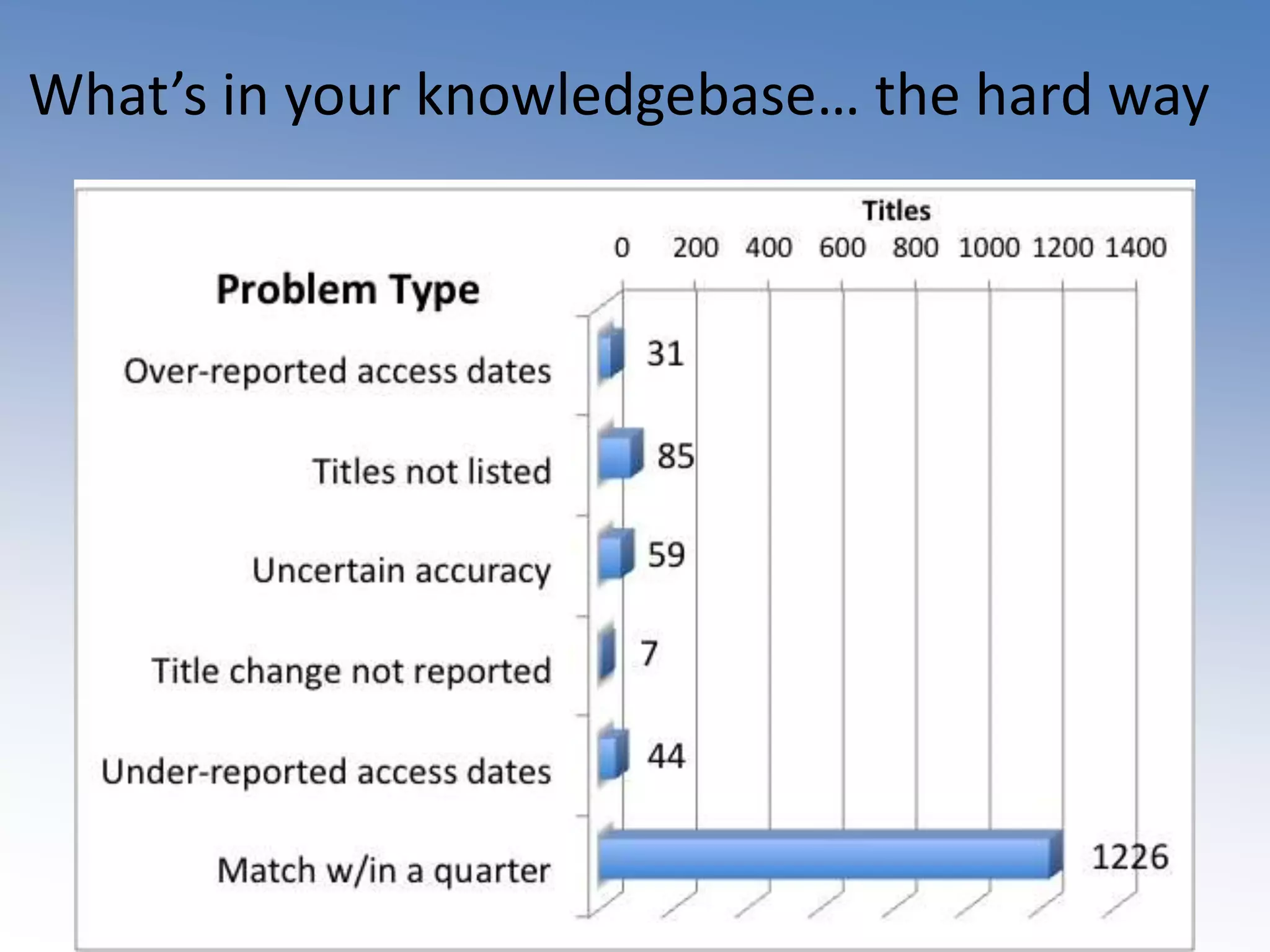
What’s in your knowledgebase… the hard way
Why KBART?Maintenance of accurate package content coverage dataSupports openUrl Link ResolversSupports ejournal MARC record delivery servicesEnables automated updating by KB providersAddresses common holding list inadequaciesRe-use of ISSNs Embargo period ambiguitiesInconsistent date/enumeration formats
Desired impact on our workAn end to our role as translators
No more badgering publishers to send complete access lists(List of necessary elements is standardized)No more teasing out title changes to make the #’s match(Best practice is to include former titles & ISSNs) No more waiting for the KB data team to translate data (Standardized format leads to automated ingest)No more out-of-date access lists (Regular updates direct from publisher to knowledge base)
How Librarians can helpLobby publishers to adopt the KBART practicesLEARN about what KBART is and what it does INSIST on ‘knowing’ what you are buying!Require delivery of a usable holdings list before you payInitially & annually going forwardWhen the list is inadequate, point them to KBARTOnly your insistence will make it happenENABLE publisher sales staff to make the case to their companyFOLLOW UP with continued requests as necessary
Applying KBART in practiceTwo case scenarios – AIP & ABP JournalsAmerican Institute of Physics self-initiated, complete, accurateDriving expansion to other formats (conference proceedings)A Big Publisher
Recognizes the problem
Need to establish priority of the change
Needs to get HOSTING SERVICE to program ability to produce
Takes persistence from dozens of customers with a mantra:
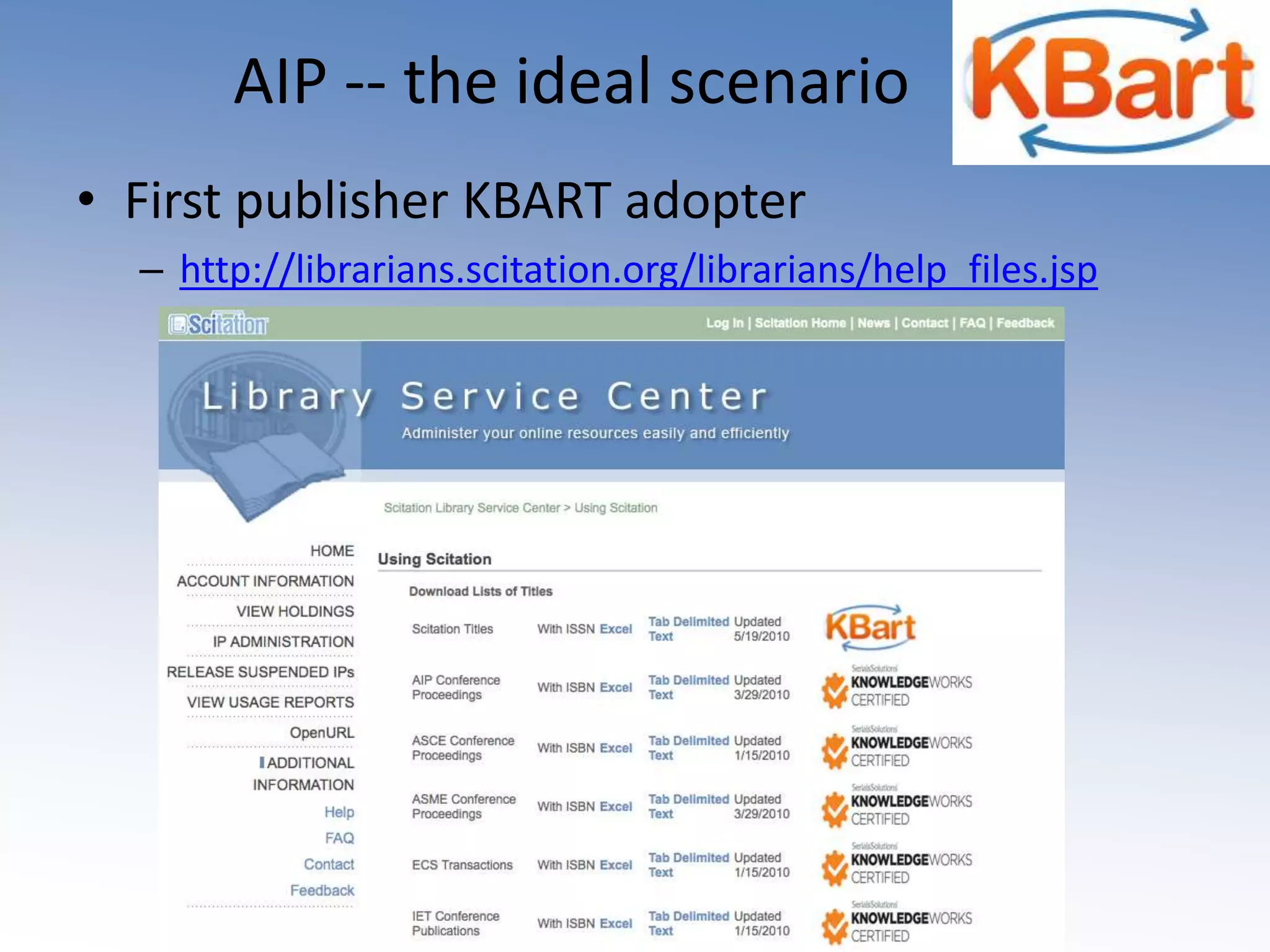
We need good data. Make it speak KBART!AIP -- the ideal scenarioFirst publisher KBART adopterhttp://librarians.scitation.org/librarians/help_files.jsp
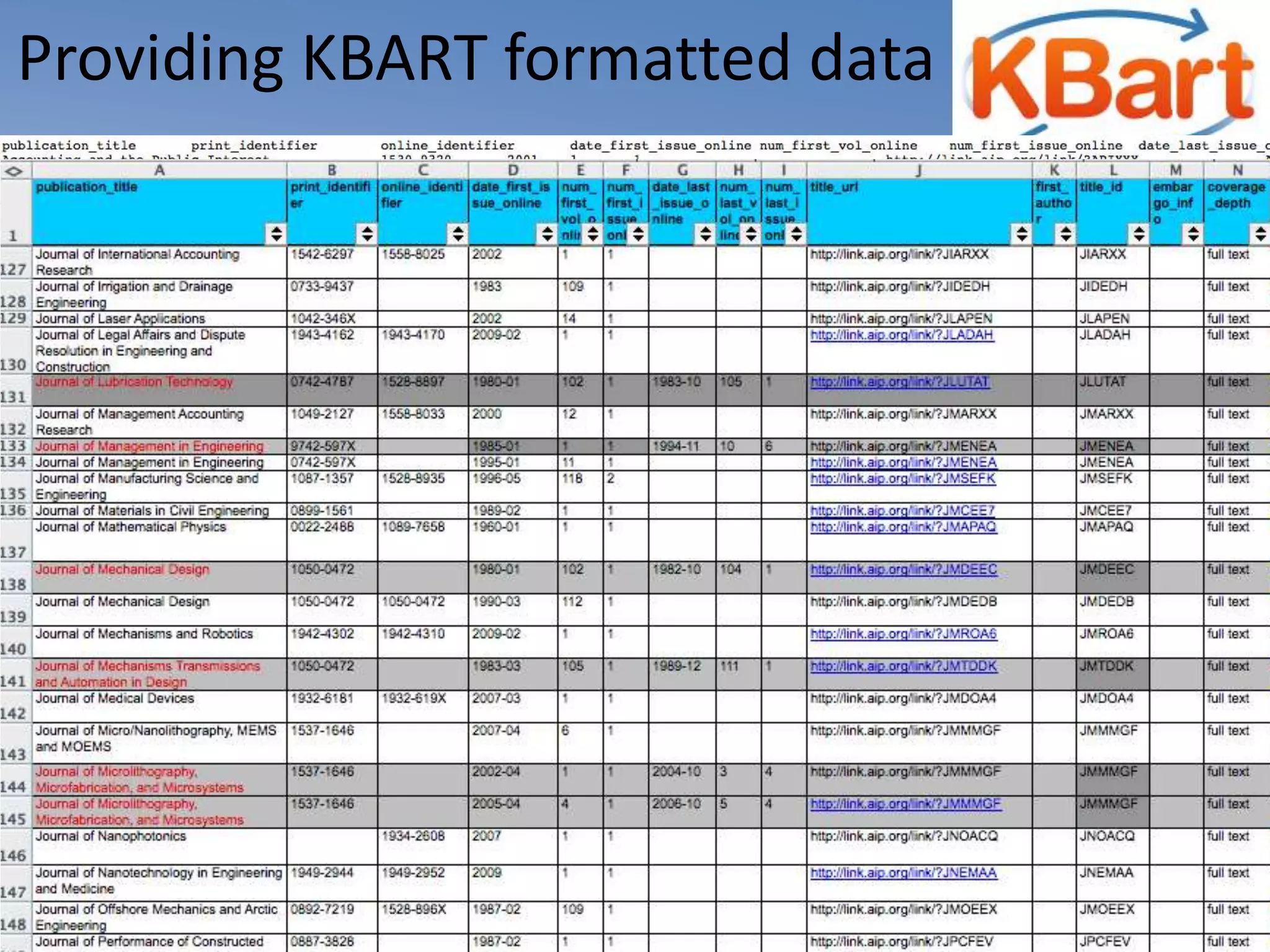
Providing KBART formatted data

Kbartnasig2010june final

  • 1.
    XXKBARTok ?K ?KNOWLEDGE BASES AND RELATED TOOLS: A NISO/UKSG RECOMMENDED PRACTICEJason Price, PhD Claremont Colleges/SCELCKBART Working Group MemberNASIG June 6 2010Palm Springs, CA
  • 2.
    Why you shouldyou back this horse?Jarrett Campbell from Cary, NC, USA
  • 3.
    VitalsWho – Publishers,Aggregators, KB vendors, Libraries What – a universally acceptable holdings data format Where – throughout the supply chain & at the UKSG info hub http://www.uksg.org/kbartWhen – NowPhase 1 Report – Jan 2010 http://bit.ly/kbartRPEndorsement Phase -- June 2010 Why – Better access for users through accurate holdings data How can you help?For librariansFor publishers
  • 4.
    Who is behindKBART? Standards organizationsUKSG and NISOThe working group members, representing:Knowledge Base vendors ExLibris, Serials Solutions, EbscoContent aggregatorsPublishersSubscription AgentsLibraries & ConsortiaFull list -- http://www.uksg.org/kbart/members
  • 5.
    What is KBART?“A set of practical recommendations for the timely exchange of accurate metadata between content providers and knowledge base developers”A universally acceptable holdings list formatExpresses title level coverage by date & volume/issueA single solution for sharing holdings data across the scholarly content supply chainA NISO recommended practice
  • 6.
    A simple metadataexchange format…
  • 7.
    age of datadategranularity (day, month, season, year)file format format definitions;shoe-horningvol/issue vs datefrequencyinformal structureaccuracyformatunclear responsibilitieslink syntax and granularityincentiveaccuracyData & transferDate coverageownershipduplication of efforttitle mappingcontacts/feedback mechanismsSupply chainTitle relationsISSN/ISBN variationsabbreviationsLicensingCompliancetitle changesaccuracyre-use of ISSNformateffect on licensingfree contentpackage variationsgenericism/granularitymisrepresentationRepresenting years of thinking…Knowledge bases
  • 8.
  • 9.
    Where…how it affectsusersprintcollectionsgatewaysdatabasearticle citation (SOURCE)publisher/providerholdings datapublisherwebsitequery (base URL+ metadata string)repositorylink resolver/knowledge basetarget (cited)article ???What’s in your knowledgebase?
  • 10.
    What’s in yourknowledgebase… the hard way
  • 11.
    Why KBART?Maintenance ofaccurate package content coverage dataSupports openUrl Link ResolversSupports ejournal MARC record delivery servicesEnables automated updating by KB providersAddresses common holding list inadequaciesRe-use of ISSNs Embargo period ambiguitiesInconsistent date/enumeration formats
  • 12.
    Desired impact onour workAn end to our role as translators
  • 13.
    No more badgeringpublishers to send complete access lists(List of necessary elements is standardized)No more teasing out title changes to make the #’s match(Best practice is to include former titles & ISSNs) No more waiting for the KB data team to translate data (Standardized format leads to automated ingest)No more out-of-date access lists (Regular updates direct from publisher to knowledge base)
  • 14.
    How Librarians canhelpLobby publishers to adopt the KBART practicesLEARN about what KBART is and what it does INSIST on ‘knowing’ what you are buying!Require delivery of a usable holdings list before you payInitially & annually going forwardWhen the list is inadequate, point them to KBARTOnly your insistence will make it happenENABLE publisher sales staff to make the case to their companyFOLLOW UP with continued requests as necessary
  • 15.
    Applying KBART inpracticeTwo case scenarios – AIP & ABP JournalsAmerican Institute of Physics self-initiated, complete, accurateDriving expansion to other formats (conference proceedings)A Big Publisher
  • 16.
  • 17.
    Need to establishpriority of the change
  • 18.
    Needs to getHOSTING SERVICE to program ability to produce
  • 19.
    Takes persistence fromdozens of customers with a mantra:
  • 20.
    We need gooddata. Make it speak KBART!AIP -- the ideal scenarioFirst publisher KBART adopterhttp://librarians.scitation.org/librarians/help_files.jsp
  • 21.
  • 22.
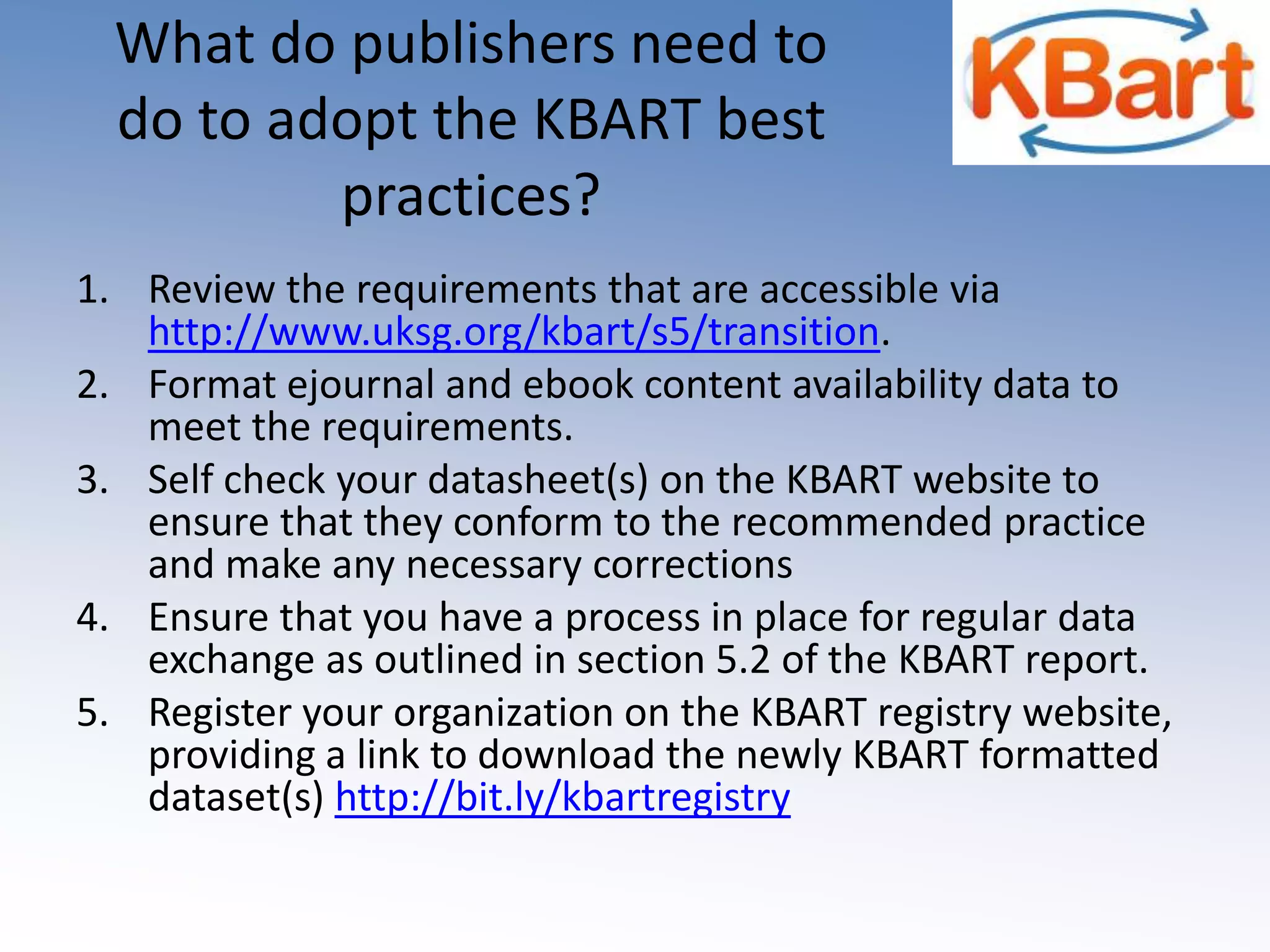
    What do publishersneed to do to adopt the KBART best practices?Review the requirements that are accessible via http://www.uksg.org/kbart/s5/transition.Format ejournal and ebook content availability data to meet the requirements.Self check your datasheet(s) on the KBART website to ensure that they conform to the recommended practice and make any necessary correctionsEnsure that you have a process in place for regular data exchange as outlined in section 5.2 of the KBART report.Register your organization on the KBART registry website, providing a link to download the newly KBART formatted dataset(s) http://bit.ly/kbartregistry
  • 23.
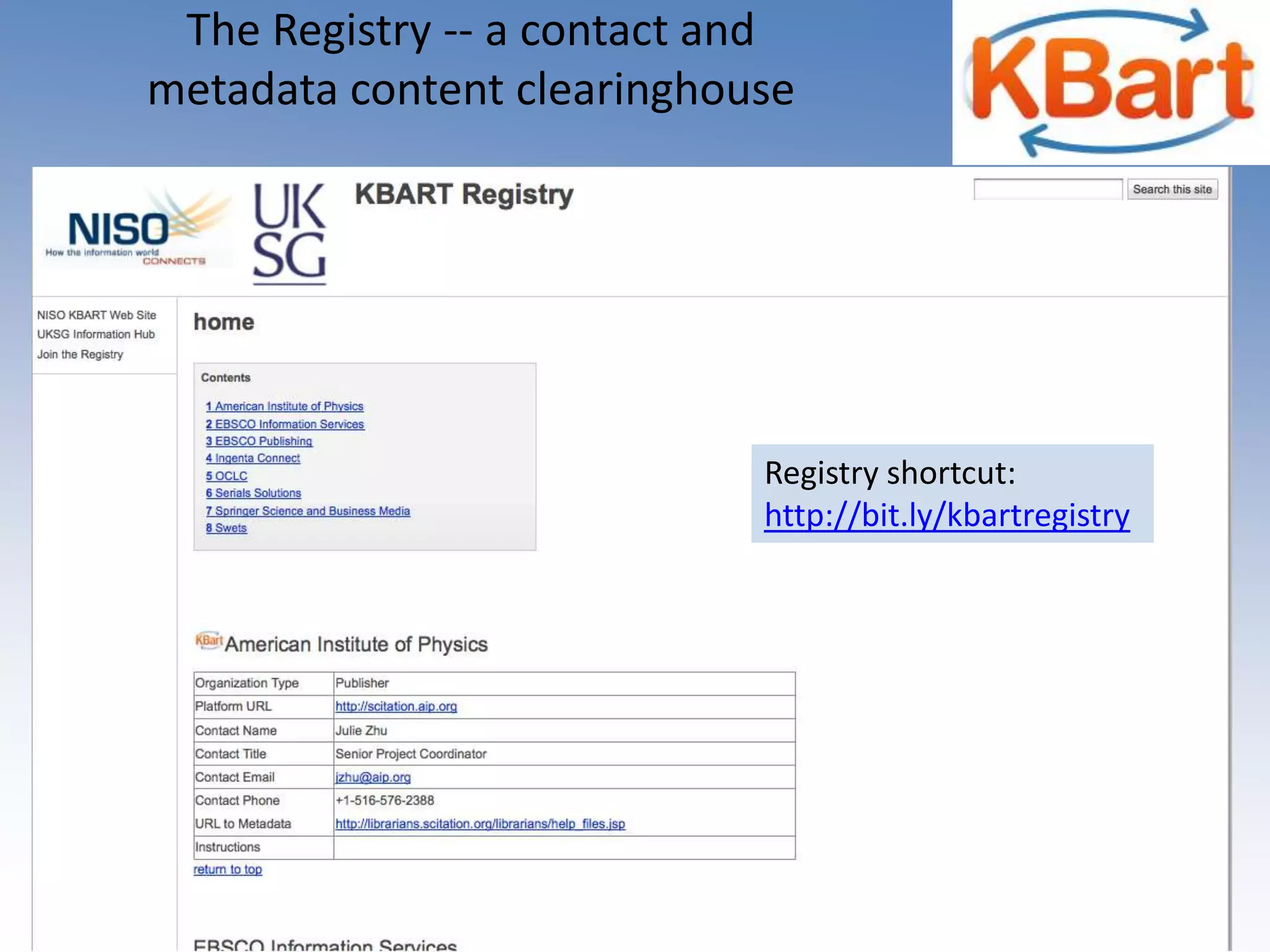
    The Registry --a contact and metadata content clearinghouseRegistry shortcut:http://bit.ly/kbartregistry
  • 24.
    Knowledgebase management beforeKBARTProactive reconciliation of an ejournal package listGeneral Process – library, consortium or KB vendor
  • 25.
    Request updated accesslist from publisher
  • 26.
  • 27.
    Translate publisher listto match KB list
  • 28.
    Number of titlesnever matches
  • 29.
    Perform ISSN matchwith MS Access
  • 30.
    Watch for &integrate title changes, mergers, acquisitions and losses
  • 31.
    Watch for publisher-reuseof ISSNs/title combinations
  • 32.
    Identify date discrepanciesmanually (inconsistent formats)
  • 33.
    Decide when its‘good enough’ and go live/distribute new list
  • 34.
    Lather, Rinse, RepeatOurvision…after KBARTPhase 1 – Universally accepted standardized publisher metadata, regularly distributed AND available on demandPhase 2 – Broad adoption, More content type coveragePhase 3? – Consortia & Institution level holdings metadata distribution based on what’s actually accessible from a particular IP(this last is more my dream)
  • 35.