NISO-ODI (Open Discovery Initiative)
Standards Update
Parvathi ‘Bobbi’ Patham, Discovery Services Manager
Springer Nature, June 25th, Friday 11.00 A.M. To 12.30 P.M. EST
Agenda
 Open Discovery Initiative - Overview
 ODI Recommended Practice
 Your Role: Librarians, Content Providers, Discovery
Service Vendors
Open Discovery Initiative - Overview
What is Open Discovery Initiative?
 A technical recommendation for data exchange including data formats,
method of delivery, usage reporting, frequency of updates and rights of use.
 A way for libraries to assess content providers’ participation in discovery
services.
 A model by which content providers work with discovery service vendors via
fair and unbiased indexing and linking.
 It is a way to disclose and assess open discovery conformance for content
providers, discovery providers, and libraries.
Open Discovery Initiative Goal
 Define ways for libraries to assess the level of content provider participation
and for discovery services to affirm how they use that content.
 Help streamline the process by which content providers work with discovery
service vendors.
 Define models for “fair” linking from discovery services to publishers’
content.
 Determine what usage statistics should be collected for libraries and for
content providers.
Value Propositions / Benefits
Libraries/Users
Finding relevant content is simpler when it’s all in one platform.
ODI makes it easier to understand which resources are included
in discovery services.
Content Providers
Participation in discovery services makes content more valuable
and discoverable, increasing usage and decreasing the likelihood of cancellations.
Discovery Providers
Participation in ODI increases transparency, improving customer satisfaction
and retention.
2014 ODI Recommended Practice
1. Technical recommendations for content providers and discovery provider for
data exchange including data formats, method of delivery, usage reporting,
frequency of updates and rights of use.
2. A model by which content providers work with discovery service vendors via
fair and unbiased indexing and linking.
3. A way to assess conformance by content providers and discovery providers.
ODI Standing Committee
2014 - Present
• Promote educational opportunities about adoption of these
recommended practices, including how discovery systems fundamentally
work.
• Provide support for content providers and discovery providers during
adoption.
• Provide a forum for ongoing discussion related to all aspects of discovery
platforms for all stakeholders (content providers, discovery providers, libraries).
• Determine timing for next steps for ongoing work.
•
ODI – Recommended Practice
We Are All In This Together
• Discovery Service Providers, Content Providers, and Libraries
are all part of the ODI Process
• All 3 groups need to provide input
• Each group has an impact on the other, nothing happens in a
vacuum
• Like any good stool, needs all 3 parts
• Communication needs to happen between/among each group
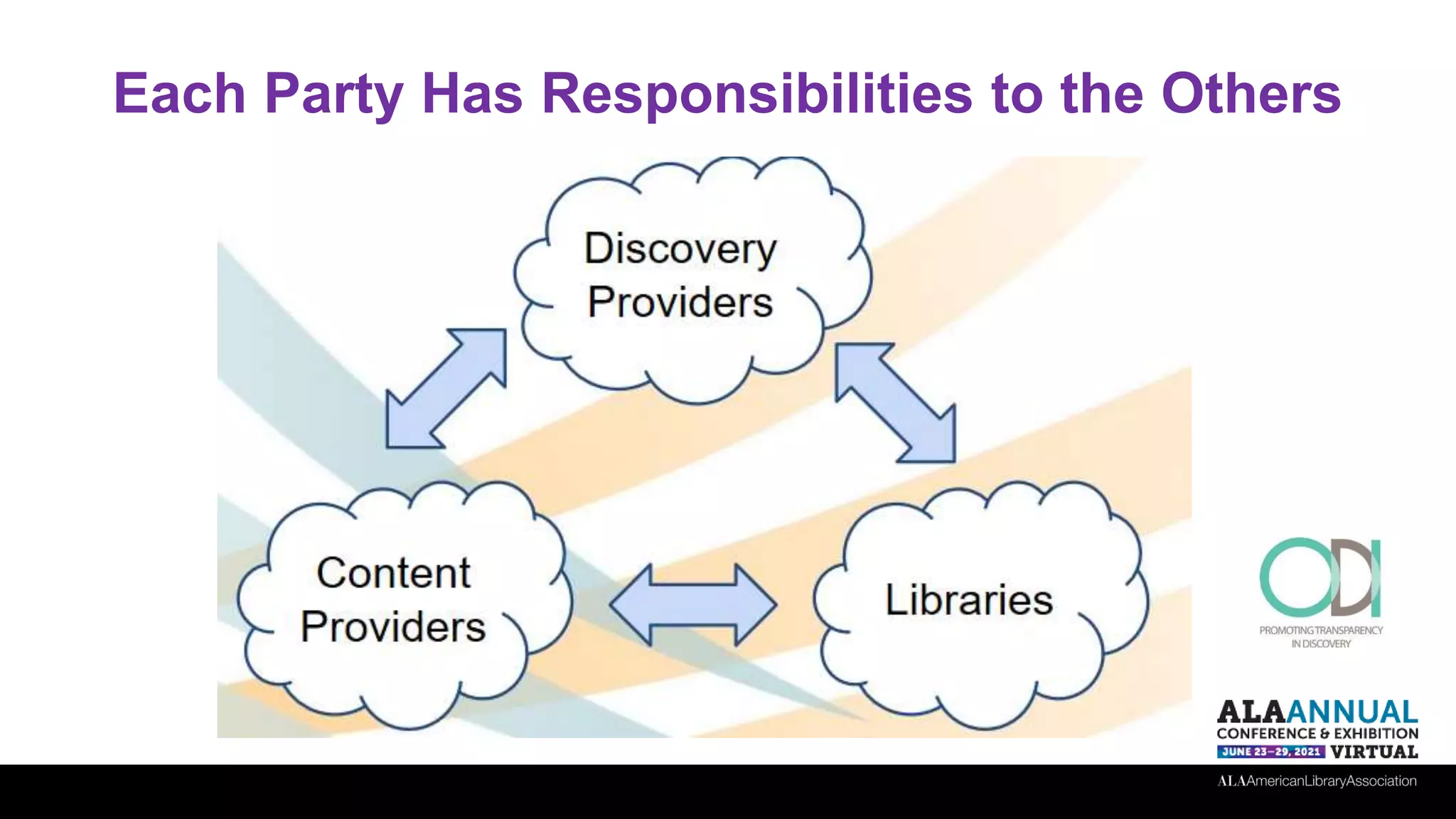
Each Party Has Responsibilities to the Others
Libraries
• Ensure that they have followed discovery provider’s
configuration guidelines.
• Ensure that all desired content is activated
• Follow up with vendor partners on their conformance
• Establish training for library staff and end users
• Complete and publish a library conformance statement
Content Providers
 Make core metadata and content available for indexing in
discovery
 Inform libraries of what metadata is shared to discovery
providers.
 Fair linking -- provide sufficient metadata to enable an
OpenURL to be successfully resolved.
 Provide clear support channels for libraries & discovery
providers
 to enable troubleshooting.
Discovery Providers
 Provide clear and comprehensive coverage reporting
 Provide content listings to libraries & content providers
 By “market product” (database)
 By individual title (journal)
 Describe fair linking practices
 COUNTER-compliant usage reporting
 Open Access indicators
 Enable content providers to opt out of merged records
 Describe use of metadata in ranking algorithms
 Provide support for content providers & libraries to enable troubleshooting
Key Updates with 2020 Version
 Metadata Elements (3.2.1): Now just one set of metadata (consolidation
of “core” and “enriched” from v.1).
 Fair Linking (3.2.3, 3.3.2): Recommend metadata for OpenURLs and
provision of non-proprietary direct links.
 Open Access (3.3.5): Parties should use “free to read” metadata.
 Authentication (3.3.6): Guidelines to ensure that only mutual subscribers
can access metadata & full text where appropriate.
 Coverage Lists (3.3.7): When DSPs offer alternative coverage of CP
content, that should be clearly noted.
Key Updates with 2020 Version – Contd.
 Statistical Reporting (3.3.4): Report usage in line with current COUNTER
standard, which includes discovery usage reports.
 Record Display (3.3.8): CPs can request not to merge their records &
display credit for their metadata in DSP record.
 Ranking Algorithm Disclosure (3.3.9): DSPs should explain the general
fundamentals of how metadata is used.
 Best Practices for Libraries (3.4): NEW Highlights items libraries should
conform with, making them equal partners.
Your Role: Librarians, Content Providers,
Discovery Service Vendors
Librarian Role
 Understand the system
 Document all configuration decisions
 Assign staff to oversee specific areas of configuration
 Confirm that subscribed content is enabled in discovery
 Review all system upgrades even if they are performed by vendor
 Develop training to meet different users’ needs (including library staff!)
Discovery Provider Role
 Transparency of what is included in Discovery System
 Metadata made available to both libraries and content providers
 Collection level
 Title level
 Metadata provided in downloadable form
 Fair linking
 Metrics
 Open Access
Content Provider Role
 Core metadata: essential to user experience, particularly
advanced users.
 Metadata shared: essential to librarians providing support to
users.
 Fair linking: essential for libraries to choose which platform to
link to.
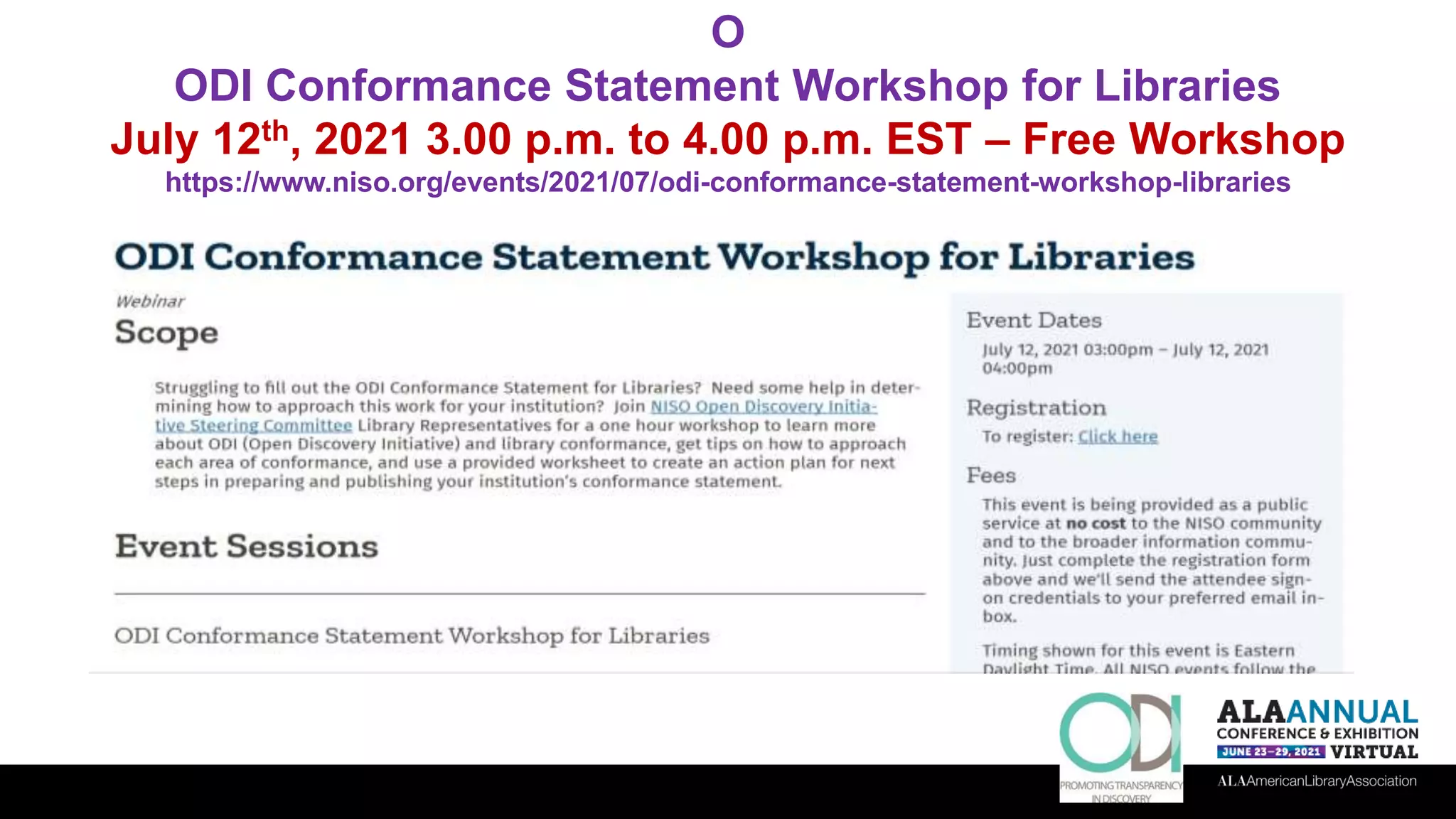
O
ODI Conformance Statement Workshop for Libraries
July 12th, 2021 3.00 p.m. to 4.00 p.m. EST – Free Workshop
https://www.niso.org/events/2021/07/odi-conformance-statement-workshop-libraries
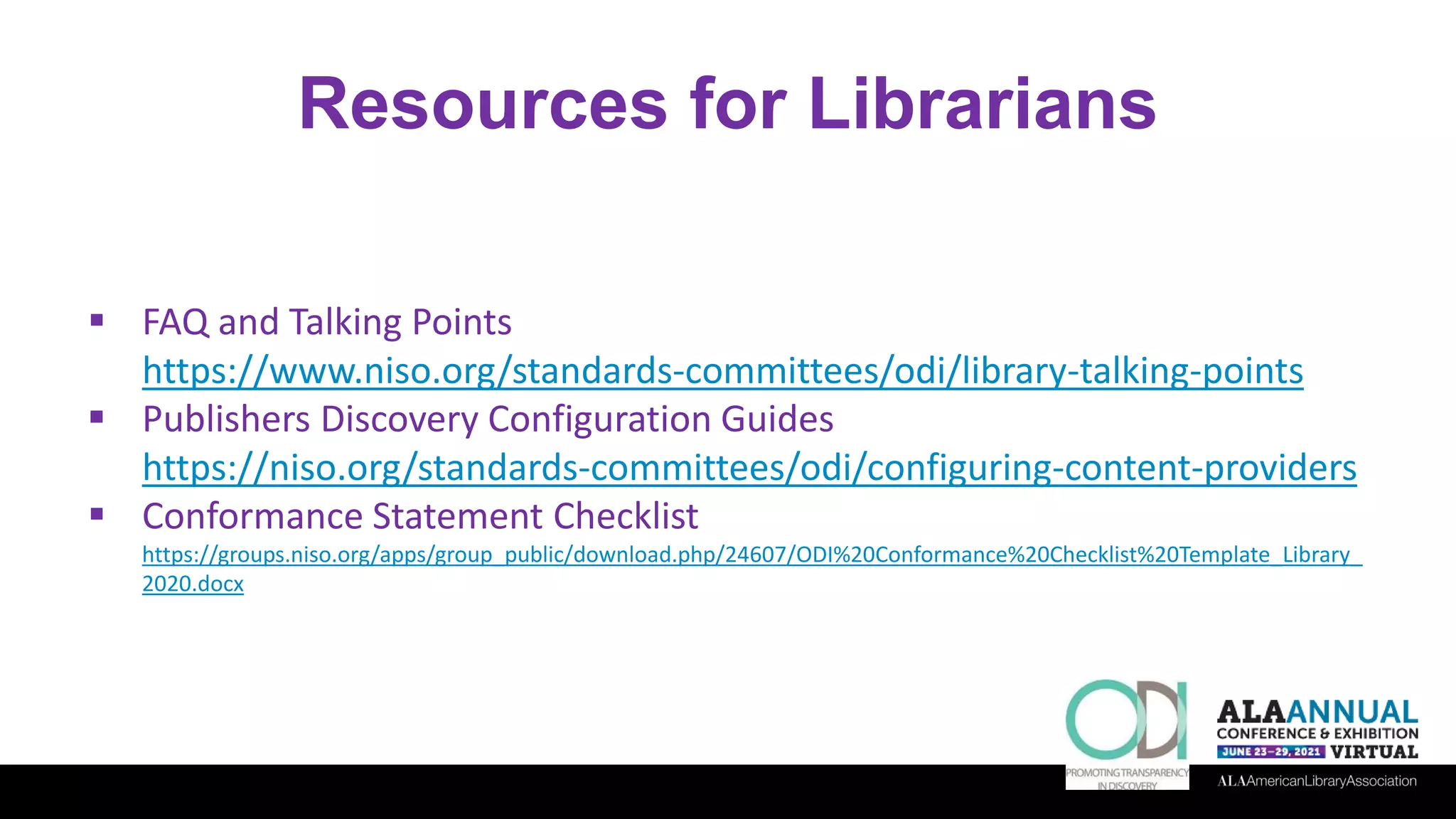
Resources for Librarians
 FAQ and Talking Points
https://www.niso.org/standards-committees/odi/library-talking-points
 Publishers Discovery Configuration Guides
https://niso.org/standards-committees/odi/configuring-content-providers
 Conformance Statement Checklist
https://groups.niso.org/apps/group_public/download.php/24607/ODI%20Conformance%20Checklist%20Template_Library_
2020.docx
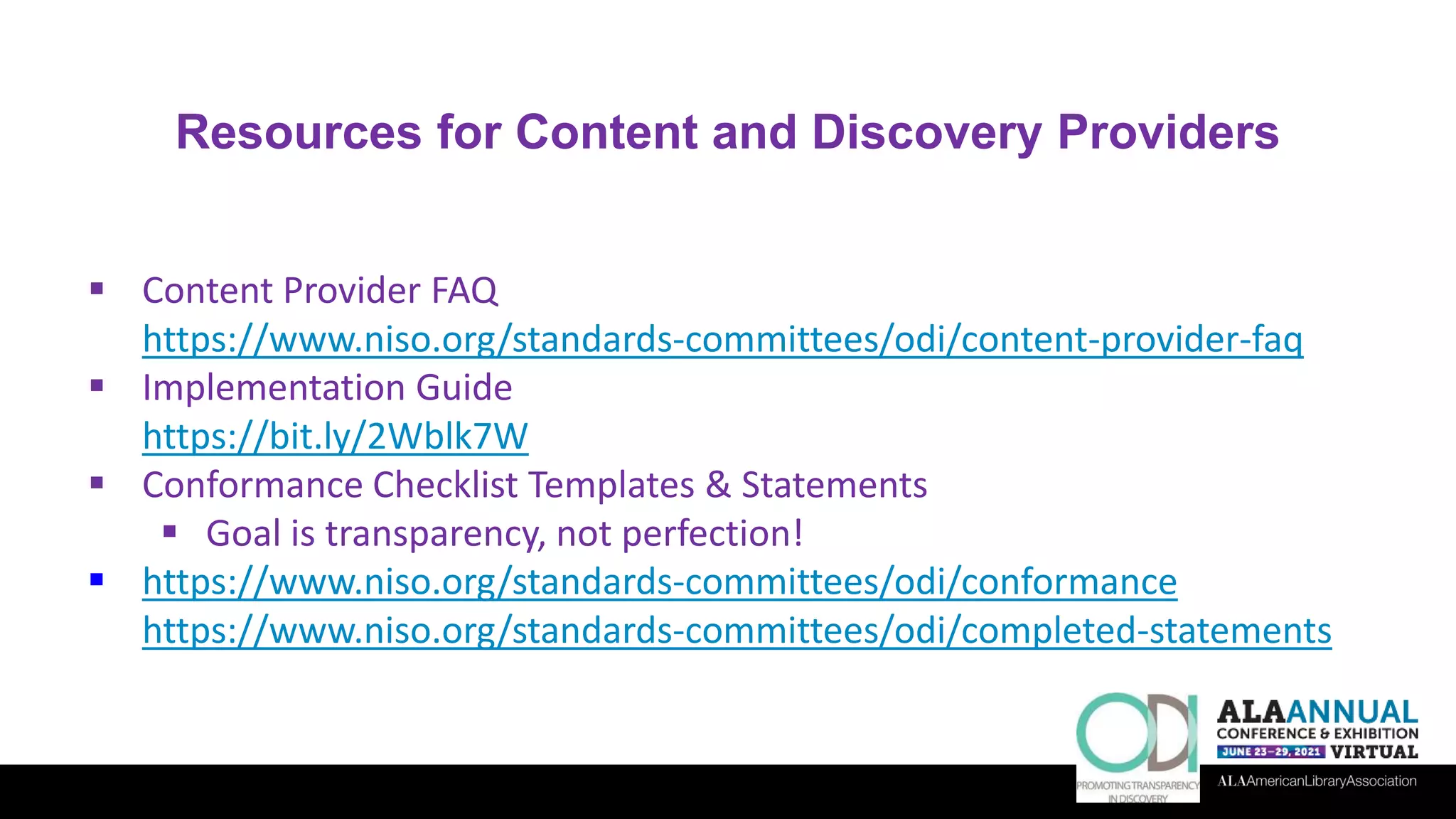
Resources for Content and Discovery Providers
 Content Provider FAQ
https://www.niso.org/standards-committees/odi/content-provider-faq
 Implementation Guide
https://bit.ly/2Wblk7W
 Conformance Checklist Templates & Statements
 Goal is transparency, not perfection!
 https://www.niso.org/standards-committees/odi/conformance
https://www.niso.org/standards-committees/odi/completed-statements
What can you do next?
 Read the updated ODI Recommended Practice
 Download the conformance checklist template for your organization
and complete it:
 Conformance checklist for Discovery Service Providers
 Conformance checklist for Content Providers
 Conformance checklist for Libraries
 Publish your organization’s conformance statement and let ODI
know its URL by emailing odi@niso.org.
Thank you!
https://www.niso.org/standards-
committees/odi
odi@niso.org

Patham "NISO-ODI (Open Discovery Initiative) Standards Update"

  • 1.
    NISO-ODI (Open DiscoveryInitiative) Standards Update Parvathi ‘Bobbi’ Patham, Discovery Services Manager Springer Nature, June 25th, Friday 11.00 A.M. To 12.30 P.M. EST
  • 2.
    Agenda  Open DiscoveryInitiative - Overview  ODI Recommended Practice  Your Role: Librarians, Content Providers, Discovery Service Vendors
  • 3.
  • 4.
    What is OpenDiscovery Initiative?  A technical recommendation for data exchange including data formats, method of delivery, usage reporting, frequency of updates and rights of use.  A way for libraries to assess content providers’ participation in discovery services.  A model by which content providers work with discovery service vendors via fair and unbiased indexing and linking.  It is a way to disclose and assess open discovery conformance for content providers, discovery providers, and libraries.
  • 5.
    Open Discovery InitiativeGoal  Define ways for libraries to assess the level of content provider participation and for discovery services to affirm how they use that content.  Help streamline the process by which content providers work with discovery service vendors.  Define models for “fair” linking from discovery services to publishers’ content.  Determine what usage statistics should be collected for libraries and for content providers.
  • 6.
    Value Propositions /Benefits Libraries/Users Finding relevant content is simpler when it’s all in one platform. ODI makes it easier to understand which resources are included in discovery services. Content Providers Participation in discovery services makes content more valuable and discoverable, increasing usage and decreasing the likelihood of cancellations. Discovery Providers Participation in ODI increases transparency, improving customer satisfaction and retention.
  • 7.
    2014 ODI RecommendedPractice 1. Technical recommendations for content providers and discovery provider for data exchange including data formats, method of delivery, usage reporting, frequency of updates and rights of use. 2. A model by which content providers work with discovery service vendors via fair and unbiased indexing and linking. 3. A way to assess conformance by content providers and discovery providers.
  • 8.
    ODI Standing Committee 2014- Present • Promote educational opportunities about adoption of these recommended practices, including how discovery systems fundamentally work. • Provide support for content providers and discovery providers during adoption. • Provide a forum for ongoing discussion related to all aspects of discovery platforms for all stakeholders (content providers, discovery providers, libraries). • Determine timing for next steps for ongoing work. •
  • 10.
  • 11.
    We Are AllIn This Together • Discovery Service Providers, Content Providers, and Libraries are all part of the ODI Process • All 3 groups need to provide input • Each group has an impact on the other, nothing happens in a vacuum • Like any good stool, needs all 3 parts • Communication needs to happen between/among each group
  • 12.
    Each Party HasResponsibilities to the Others
  • 13.
    Libraries • Ensure thatthey have followed discovery provider’s configuration guidelines. • Ensure that all desired content is activated • Follow up with vendor partners on their conformance • Establish training for library staff and end users • Complete and publish a library conformance statement
  • 14.
    Content Providers  Makecore metadata and content available for indexing in discovery  Inform libraries of what metadata is shared to discovery providers.  Fair linking -- provide sufficient metadata to enable an OpenURL to be successfully resolved.  Provide clear support channels for libraries & discovery providers  to enable troubleshooting.
  • 15.
    Discovery Providers  Provideclear and comprehensive coverage reporting  Provide content listings to libraries & content providers  By “market product” (database)  By individual title (journal)  Describe fair linking practices  COUNTER-compliant usage reporting  Open Access indicators  Enable content providers to opt out of merged records  Describe use of metadata in ranking algorithms  Provide support for content providers & libraries to enable troubleshooting
  • 16.
    Key Updates with2020 Version  Metadata Elements (3.2.1): Now just one set of metadata (consolidation of “core” and “enriched” from v.1).  Fair Linking (3.2.3, 3.3.2): Recommend metadata for OpenURLs and provision of non-proprietary direct links.  Open Access (3.3.5): Parties should use “free to read” metadata.  Authentication (3.3.6): Guidelines to ensure that only mutual subscribers can access metadata & full text where appropriate.  Coverage Lists (3.3.7): When DSPs offer alternative coverage of CP content, that should be clearly noted.
  • 17.
    Key Updates with2020 Version – Contd.  Statistical Reporting (3.3.4): Report usage in line with current COUNTER standard, which includes discovery usage reports.  Record Display (3.3.8): CPs can request not to merge their records & display credit for their metadata in DSP record.  Ranking Algorithm Disclosure (3.3.9): DSPs should explain the general fundamentals of how metadata is used.  Best Practices for Libraries (3.4): NEW Highlights items libraries should conform with, making them equal partners.
  • 18.
    Your Role: Librarians,Content Providers, Discovery Service Vendors
  • 19.
    Librarian Role  Understandthe system  Document all configuration decisions  Assign staff to oversee specific areas of configuration  Confirm that subscribed content is enabled in discovery  Review all system upgrades even if they are performed by vendor  Develop training to meet different users’ needs (including library staff!)
  • 20.
    Discovery Provider Role Transparency of what is included in Discovery System  Metadata made available to both libraries and content providers  Collection level  Title level  Metadata provided in downloadable form  Fair linking  Metrics  Open Access
  • 21.
    Content Provider Role Core metadata: essential to user experience, particularly advanced users.  Metadata shared: essential to librarians providing support to users.  Fair linking: essential for libraries to choose which platform to link to.
  • 22.
    O ODI Conformance StatementWorkshop for Libraries July 12th, 2021 3.00 p.m. to 4.00 p.m. EST – Free Workshop https://www.niso.org/events/2021/07/odi-conformance-statement-workshop-libraries
  • 23.
    Resources for Librarians FAQ and Talking Points https://www.niso.org/standards-committees/odi/library-talking-points  Publishers Discovery Configuration Guides https://niso.org/standards-committees/odi/configuring-content-providers  Conformance Statement Checklist https://groups.niso.org/apps/group_public/download.php/24607/ODI%20Conformance%20Checklist%20Template_Library_ 2020.docx
  • 24.
    Resources for Contentand Discovery Providers  Content Provider FAQ https://www.niso.org/standards-committees/odi/content-provider-faq  Implementation Guide https://bit.ly/2Wblk7W  Conformance Checklist Templates & Statements  Goal is transparency, not perfection!  https://www.niso.org/standards-committees/odi/conformance https://www.niso.org/standards-committees/odi/completed-statements
  • 25.
    What can youdo next?  Read the updated ODI Recommended Practice  Download the conformance checklist template for your organization and complete it:  Conformance checklist for Discovery Service Providers  Conformance checklist for Content Providers  Conformance checklist for Libraries  Publish your organization’s conformance statement and let ODI know its URL by emailing odi@niso.org.
  • 26.

Editor's Notes

  • #4 This section is meant to be more high-level, aspirational -- what each of the 3 parties gets out of and gives to, ODI.