٠Erik Erikson's Theory on Personality Development٠٠.pdf
1.
Erik Erikson’s Theoryon Personality Development
Nawres Basim Mohammed
TUMS
COMMUNITY OF HEALTH DEPARTMENT
2.
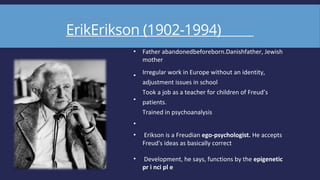
ErikErikson (1902-1994)
•
•
•
•
•
•
Father abandonedbeforeborn.Danishfather,Jewish
mother
Irregular work in Europe without an identity,
adjustment issues in school
Took a job as a teacher for children of Freud’s
patients.
Trained in psychoanalysis
Erikson is a Freudian ego-psychologist. He accepts
Freud's ideas as basically correct
Development, he says, functions by the epigenetic
pr i nci pl e
3.
Epigenetic Principles
•
•
•
•
•
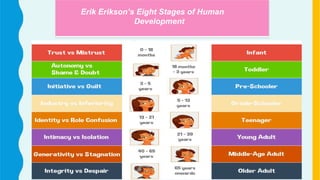
This principlesays that we develop through a predetermined unfolding of our personalities
in eight stages.
Our progress through each stage is in part determined by our success, or lack of success, in
all the previous stages.
Each stage involves certain developmental tasks that are psychosocial in nature.
Each stage has a certain optimal time as well.
If a stage is managed well, we carry away a certain virtue or psychosocial strength which
will help us through the rest of the stages of our lives. On the other hand, if we don't do so
well, we may develop maladaptation's and malignancies, as well as endanger all our future
development.
Concept of mutuality suggests parents also develop with the arrival of their children.
•
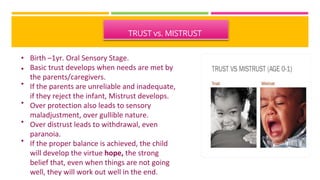
TRUST vs. MISTRUST
•
•
•
•
•
•
Birth–1yr. Oral Sensory Stage.
Basic trust develops when needs are met by
the parents/caregivers.
If the parents are unreliable and inadequate,
if they reject the infant, Mistrust develops.
Over protection also leads to sensory
maladjustment, over gullible nature.
Over distrust leads to withdrawal, even
paranoia.
If the proper balance is achieved, the child
will develop the virtue hope, the strong
belief that, even when things are not going
well, they will work out well in the end.
6.
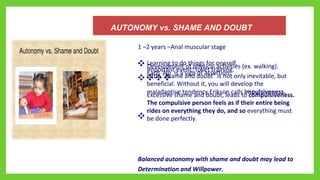
AUTONOMY vs. SHAMEAND DOUBT
1 –2 years –Anal muscular stage
❖
❖❖❖❖
Learning to do things for oneself.
Development of physical activities (ex. walking).
Important event: toilet training.
Each ‘No’ is a sign of assertion.
Little "shame and doubt" is not only inevitable, but
beneficial. Without it, you will develop the
maladaptive tendency Erikson calls impulsiveness.
Excessive shame and doubt, leads to compulsiveness.
The compulsive person feels as if their entire being
rides on everything they do, and so everything must
be done perfectly.
❖
Balanced autonomy with shame and doubt may lead to
Determination and Willpower.
7.
INITIATIVE vs. GUILT
➢
➢
➢
➢
➢
3–5 years -Oedipal-locomotor stage.
New sense of purposefulness emerges.
Eagerness to tackle new tasks, join activities with
peers .
Playing plays crucial role.
Takes up moral and gender roles by following the
parents and deviations related consequences
(Punishments) create guilt.
Too much Initiative may lead to Ruthlessness –
executing plans without caring who are disturbed.
Too much guilt means, Inhibition -"nothing ventured,
nothing lost" and, particularly, nothing to feel guilty
about-Frigidity.
➢
➢
Balanced approach leads to Purpose -the capacity for
action despite a clear understanding of limitations.
8.
COMPETENCE/ INDUSTRY vs.INFERIORITY
o
o
o
o
o
o
6 years –puberty.
Child completes tasks themselves –sense of success.
Comparison with others and Failure of competency
leading to sense of inferiority.
Too much industry leads to narrow virtuosity. Loosing
life of a kid, for e.g. child actor, child musicians etc.
Excessive inferiority leads to inertia –complete lack of
confidence to venture anything.
A happier thing is to develop the right balance of
industry and inferiority –that is, mostly industry with
just a touch of inferiority to keep us sensibly humble.
Then we have the virtue called competency.
9.
IDENTITY vs. ROLECONFUSION
➢
➢
➢
Teens –early 20s .
Constructing identity means defining who you are, what you
value, which directions you choose to pursue in life.
Feeling restricted by the society, lack of guidance etcmight
lead to identity confusion and one may become
d i recti o n l ess.
society should provide clear rites of passage, certain
accomplishments and rituals that help to distinguish the
adult from the child.
Over valued Identification leads to Fanaticism –‘my way only
way’.
Repudiation happens when one is lost and just blindly
follow others to be included in a larger group.
➢
➢
➢
Balanced approach leads to Fidelity : Integration with the
community by being who you are
10.
Intimacy vs Isolation
20s–40s
Young adults develop intimate relationships
Conflict is to make permanent commitment or not
Isolation is a result of unresolved conflict –fear of
loosing self by being with another
Promiscuity –Frequent intimate relationships
Exclusion -Tendency to isolate oneself from love,
community,
andcompanionshipwithoutloosingoneself
friendship, and
Balancedapproachleadstolove–genuinecommitment
11.
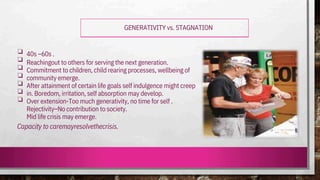
GENERATIVITY vs. STAGNATION
40s–60s .
Reachingout to others for serving the next generation.
Commitment to children, child rearing processes, wellbeing of
community emerge.
After attainment of certain life goals self indulgence might creep
in. Boredom, irritation, self absorption may develop.
Over extension-Too much generativity, no time for self .
Rejectivity–No contribution to society.
Mid life crisis may emerge.
❑
❑
❑
❑
❑
❑
❑
Capacity to caremayresolvethecrisis.
12.
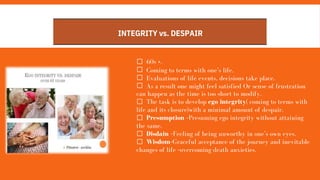
INTEGRITY vs. DESPAIR
60s+.
Coming to terms with one’s life.
Evaluations of life events, decisions take place.
As a result one might feel satisfied Or sense of frustration
can happen as the time is too short to modify.
The task is to develop ego integrity( coming to terms with
life and its closure)with a minimal amount of despair.
Presumption –Presuming ego integrity without attaining
the same.
Disdain –Feeling of being unworthy in one’s own eyes.
Wisdom–Graceful acceptance of the journey and inevitable
changes of life –overcoming death anxieties.
13.
CRITIQUE OF PSYCHOSOCIALTHEORY
❖
❖
❖
❖
❖
Strengths
One of first developmental theories to focus on
development across the lifespan
Logical progression of life stages
Weakness
The theory does not explain why development occurs
14.
REFERENCE :
Cole, M.& Cole, S.R. (1989). The Developmentof Children.NewYork: W.H. Freeman & Co.
Erikson, E.H. (1950). Childhood and Society. New York: Norton.
Erikson, E.H. (1958). Young Man Luther. New York: Norton.
Erikson, E.H. (1964). Insight and Responsibility. New York: Norton.
Erikson, E.H. (1968). Identity: Youth and Crisis. New York: Norton.
Erikson, E.H. (1974). Dimensions of a New Identity .New York: Norton.
Erikson, E.H. (1975). Life History and the Historical Moment. New York: Norton.
Marcia, J.E. (1980). Identity in adolescence. In J.Andelson (Ed.), Handbook of adolescent psychology. New
York: Wiley.
Schultz D.P. & Schultz S.E. (1987). A History of Modern Psychology. Orlando, FL: Harcourt-Brace.
Waterman, A.S. (1985). Identity in the context of adolescent psychology. In A.S. Waterman (Ed.), Identity
in adolescence: Progress and contents: (New directions for child development, No.30). San Francisco:
Jossey-Bass.
Woolfolk, A.E. (1987). Educational Psychology, (3rded.). New Jersey: Simon and Schuster.




































![The developmental stages_of_erik_erikson[1]](https://cdn.slidesharecdn.com/ss_thumbnails/thedevelopmentalstagesoferikerikson1-120429075414-phpapp01-thumbnail.jpg?width=640&height=640&fit=bounds)


