Presented by: Jack McCarthy, Principal Revenue Leverage, LLC UMBC Erickson School Sales and Marketing Course April 20-23, 2010  The Art and Science of Attracting, Selecting, Developing and Retaining Great Sales Talent
Program Outline Establish a Plan for Talent Hiring Practices and Tools Developmental Opportunities  Break-out Group / Experiential Learning Exercise Q and A
A Plan for Sales Talent Consider the cost of ineffective sales talent Talent as a priority…or not Making consistent investments in developing talent Reducing turnover or increasing top talent retention Managing underperforming talent Delegating occupancy to one person Sales as a Team sport Start today by reassessing your talent What is the plan?
Hiring Practices and Tools The three step process… Pre-Interview Questionnaire and Situational Analysis/Sales Action Plan Interview, interview…and interview some more  Predictive Index
Pre-interview Questionnaire Purpose:   Prepares interviewer by matching written words to verbal presentation, qualifying the lead up front, and matching skill and knowledge to the résumés. Measures what the PI does not. Skills & Knowledge Interests Literacy/Language Skill Behavior
Pre-interview Questionnaire Describe what you do in your current role.  (Get specific answers)  What is the typical day? (Really? How so? Tell me more?) What makes you passionate about selling senior living services? (Ask for examples)  How are your results measured? (Ask for examples)  What part of your current role is a challenge and how do you handle it? (Ask for specific examples)  Tell me about how your job search is going. Do you think you a good fit for this job and why? (Line up skills with business needs)  What is your ideal job?  (Probe to how they see the future)
Sales Action Plan Quiz Purpose:   identifies that the candidate understands what and how to sell, level of professionalism, and presentation, computer and written communication skills. Intelligence Application of Skill & Knowledge Reinforces experience and professionalism or not!
Sales Action Plan / Situational Analysis Instructions – Please develop a sales action plan based on the following scenario.  Use the attached SMART goal form provided to communicate corrective measures that you recommend. Situation –  70 units of assisted living plus 20 units of memory care, open for 5 years.  85% occupied and never been higher.  Department head team is stable with the 3 rd  ED and 3 rd  sales person since opening. Residents and families are happy.  Generating 5 news leads a week with 8 hot, 189 warm and 243 cold leads.  Three of the 4 competitors are full. Building, location and price are all favorable or even with the competition. Tour to move in ratio is 20% Lead to tour ratio is 50% Professional referrals are 25% of the new leads
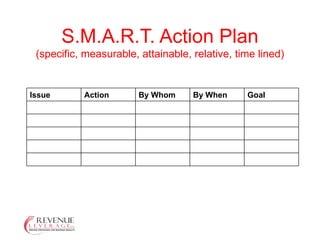
S.M.A.R.T. Action Plan (specific, measurable, attainable, relative, time lined) Issue Action By Whom By When Goal
Interview, interview, interview… Purpose: A three tier interview process to help identify a persons consistency and reliability and sincerity in presenting their value add to the business. (The Blue File) Pre-screening interview Initial interview with the supervisor Interview with peer group Final interview with the supervisors supervisor
Predictive Index   Index A Fact Based and Proven System to Support Your Business Goals
What is Predictive Index? In-house management tool that identifies human behaviors Enables managers to hire, manage and develop their people to peak productivity Effective team building tool Directly links behavior to results Inexpensive under $50 Easy to do – it takes 10 minutes do complete on line with the product back to you in another 10 minutes PI Checklist - simple, quick adjective list, 5 - 10 minutes to complete, 60 languages PRO Job Analysis - job specific behavior profiles
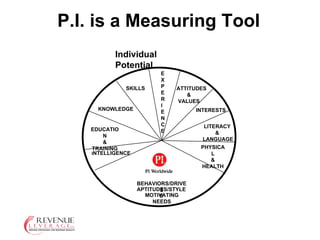
P.I. is a Measuring Tool Individual Potential BEHAVIORS/DRIVES MOTIVATING NEEDS APTITUDES/STYLES E X P E R I E N C E ATTITUDES & VALUES INTERESTS LITERACY  &  LANGUAGE PHYSICAL & HEALTH I NTELLIGENCE EDUCATION & TRAINING KNOWLEDGE SKILLS
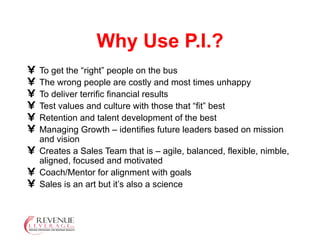
Why Use P.I.? To get the “right” people on the bus The wrong people are costly and most times unhappy To deliver terrific financial results Test values and culture with those that “fit” best Retention and talent development of the best Managing Growth – identifies future leaders based on mission and vision Creates a Sales Team that is – agile, balanced, flexible, nimble, aligned, focused and motivated Coach/Mentor for alignment with goals Sales is an art but it’s also a science
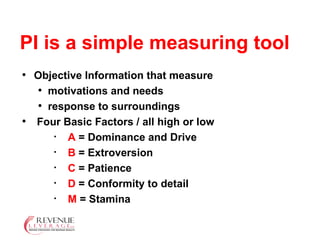
PI is a simple measuring tool Objective Information that measure motivations and needs response to surroundings Four Basic Factors / all high or low A  = Dominance and Drive B  = Extroversion C  = Patience D  = Conformity to detail M  = Stamina
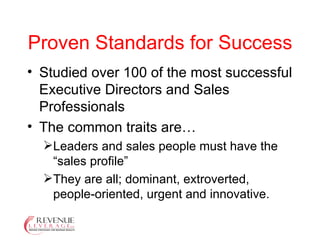
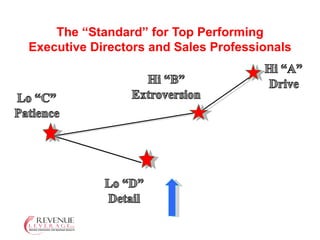
Proven Standards for Success  Studied over 100 of the most successful Executive Directors and Sales Professionals  The common traits are… Leaders and sales people must have the “sales profile” They are all; dominant, extroverted, people-oriented, urgent and innovative.
The “Standard” for Top Performing Executive Directors and Sales Professionals
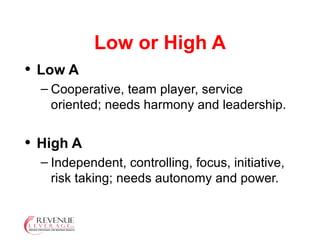
Low or High A Low A  Cooperative, team player, service oriented; needs harmony and leadership. High A  Independent, controlling, focus, initiative, risk taking; needs autonomy and power.
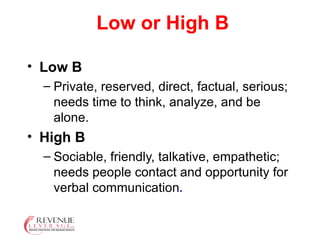
Low or High B Low B  Private, reserved, direct, factual, serious; needs time to think, analyze, and be alone. High B  Sociable, friendly, talkative, empathetic; needs people contact and opportunity for verbal communication .
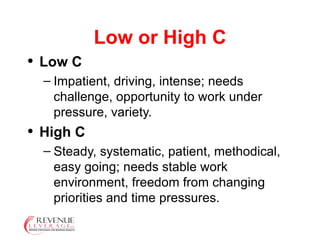
Low or High C Low C  Impatient, driving, intense; needs challenge, opportunity to work under pressure, variety. High C  Steady, systematic, patient, methodical, easy going; needs stable work environment, freedom from changing priorities and time pressures.
Low D or High D Low D  Flexible, adaptable, non-conformist; needs freedom from restrictive or controlling environment. High D  Careful, thorough, conscientious, detail oriented; needs clear understanding of policies and procedures and regular affirmation of high quality work.
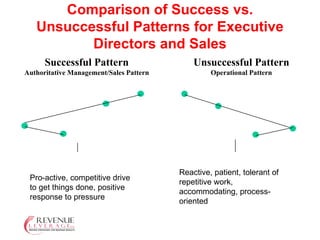
Comparison of Success vs. Unsuccessful Patterns for Executive Directors and Sales   Unsuccessful Pattern Operational Pattern Successful Pattern Authoritative Management/Sales Pattern Pro-active, competitive drive to get things done, positive response to pressure Reactive, patient, tolerant of repetitive work, accommodating, process-oriented
P.I. is a legal, valid tool Satisfies EEOC Guidelines – Adverse Impact Studies:  1991- Gender, Race  1997-Age  Construct Validity Studies, 1983, 1996, 1999. Over 300 Criterion Related Validity Studies
Break Out Group Exercise
Q and A

Erickson School April 2010 J Mc Carthy

  • 1.
    Presented by: JackMcCarthy, Principal Revenue Leverage, LLC UMBC Erickson School Sales and Marketing Course April 20-23, 2010 The Art and Science of Attracting, Selecting, Developing and Retaining Great Sales Talent
  • 2.
    Program Outline Establisha Plan for Talent Hiring Practices and Tools Developmental Opportunities Break-out Group / Experiential Learning Exercise Q and A
  • 3.
    A Plan forSales Talent Consider the cost of ineffective sales talent Talent as a priority…or not Making consistent investments in developing talent Reducing turnover or increasing top talent retention Managing underperforming talent Delegating occupancy to one person Sales as a Team sport Start today by reassessing your talent What is the plan?
  • 4.
    Hiring Practices andTools The three step process… Pre-Interview Questionnaire and Situational Analysis/Sales Action Plan Interview, interview…and interview some more Predictive Index
  • 5.
    Pre-interview Questionnaire Purpose: Prepares interviewer by matching written words to verbal presentation, qualifying the lead up front, and matching skill and knowledge to the résumés. Measures what the PI does not. Skills & Knowledge Interests Literacy/Language Skill Behavior
  • 6.
    Pre-interview Questionnaire Describewhat you do in your current role. (Get specific answers) What is the typical day? (Really? How so? Tell me more?) What makes you passionate about selling senior living services? (Ask for examples) How are your results measured? (Ask for examples) What part of your current role is a challenge and how do you handle it? (Ask for specific examples) Tell me about how your job search is going. Do you think you a good fit for this job and why? (Line up skills with business needs) What is your ideal job? (Probe to how they see the future)
  • 7.
    Sales Action PlanQuiz Purpose: identifies that the candidate understands what and how to sell, level of professionalism, and presentation, computer and written communication skills. Intelligence Application of Skill & Knowledge Reinforces experience and professionalism or not!
  • 8.
    Sales Action Plan/ Situational Analysis Instructions – Please develop a sales action plan based on the following scenario. Use the attached SMART goal form provided to communicate corrective measures that you recommend. Situation – 70 units of assisted living plus 20 units of memory care, open for 5 years. 85% occupied and never been higher. Department head team is stable with the 3 rd ED and 3 rd sales person since opening. Residents and families are happy. Generating 5 news leads a week with 8 hot, 189 warm and 243 cold leads. Three of the 4 competitors are full. Building, location and price are all favorable or even with the competition. Tour to move in ratio is 20% Lead to tour ratio is 50% Professional referrals are 25% of the new leads
  • 9.
    S.M.A.R.T. Action Plan(specific, measurable, attainable, relative, time lined) Issue Action By Whom By When Goal
  • 10.
    Interview, interview, interview…Purpose: A three tier interview process to help identify a persons consistency and reliability and sincerity in presenting their value add to the business. (The Blue File) Pre-screening interview Initial interview with the supervisor Interview with peer group Final interview with the supervisors supervisor
  • 11.
    Predictive Index Index A Fact Based and Proven System to Support Your Business Goals
  • 12.
    What is PredictiveIndex? In-house management tool that identifies human behaviors Enables managers to hire, manage and develop their people to peak productivity Effective team building tool Directly links behavior to results Inexpensive under $50 Easy to do – it takes 10 minutes do complete on line with the product back to you in another 10 minutes PI Checklist - simple, quick adjective list, 5 - 10 minutes to complete, 60 languages PRO Job Analysis - job specific behavior profiles
  • 13.
    P.I. is aMeasuring Tool Individual Potential BEHAVIORS/DRIVES MOTIVATING NEEDS APTITUDES/STYLES E X P E R I E N C E ATTITUDES & VALUES INTERESTS LITERACY & LANGUAGE PHYSICAL & HEALTH I NTELLIGENCE EDUCATION & TRAINING KNOWLEDGE SKILLS
  • 14.
    Why Use P.I.?To get the “right” people on the bus The wrong people are costly and most times unhappy To deliver terrific financial results Test values and culture with those that “fit” best Retention and talent development of the best Managing Growth – identifies future leaders based on mission and vision Creates a Sales Team that is – agile, balanced, flexible, nimble, aligned, focused and motivated Coach/Mentor for alignment with goals Sales is an art but it’s also a science
  • 15.
    PI is asimple measuring tool Objective Information that measure motivations and needs response to surroundings Four Basic Factors / all high or low A = Dominance and Drive B = Extroversion C = Patience D = Conformity to detail M = Stamina
  • 16.
    Proven Standards forSuccess Studied over 100 of the most successful Executive Directors and Sales Professionals The common traits are… Leaders and sales people must have the “sales profile” They are all; dominant, extroverted, people-oriented, urgent and innovative.
  • 17.
    The “Standard” forTop Performing Executive Directors and Sales Professionals
  • 18.
    Low or HighA Low A Cooperative, team player, service oriented; needs harmony and leadership. High A Independent, controlling, focus, initiative, risk taking; needs autonomy and power.
  • 19.
    Low or HighB Low B Private, reserved, direct, factual, serious; needs time to think, analyze, and be alone. High B Sociable, friendly, talkative, empathetic; needs people contact and opportunity for verbal communication .
  • 20.
    Low or HighC Low C Impatient, driving, intense; needs challenge, opportunity to work under pressure, variety. High C Steady, systematic, patient, methodical, easy going; needs stable work environment, freedom from changing priorities and time pressures.
  • 21.
    Low D orHigh D Low D Flexible, adaptable, non-conformist; needs freedom from restrictive or controlling environment. High D Careful, thorough, conscientious, detail oriented; needs clear understanding of policies and procedures and regular affirmation of high quality work.
  • 22.
    Comparison of Successvs. Unsuccessful Patterns for Executive Directors and Sales Unsuccessful Pattern Operational Pattern Successful Pattern Authoritative Management/Sales Pattern Pro-active, competitive drive to get things done, positive response to pressure Reactive, patient, tolerant of repetitive work, accommodating, process-oriented
  • 23.
    P.I. is alegal, valid tool Satisfies EEOC Guidelines – Adverse Impact Studies: 1991- Gender, Race 1997-Age Construct Validity Studies, 1983, 1996, 1999. Over 300 Criterion Related Validity Studies
  • 24.
  • 25.