Individual Development Plans: How to Fix an Underachieving Best Practice Dawn G. Lennon, principal Big Picture Consulting SHRM LV Conference—2009
Proposition HR needs to: Lead a culture of growth  owned by employees and supported by the organization Reality: If employees don’t develop, they compromise reward and advancement
The Value of IDPs Develop employee capabilities Position employees for advancement Develop a “bench” for vacancies Enable competitiveness Attract and retain employees
IDPs What’s the Problem?-- Part 1 Org. doesn’t forecast or communicate needs Supervisors: unable to assess employee capabilities don’t anticipate openings often block movement have few resources to invest assume employee development is their job
IDPs What’s the Problem?-- Part 2 IDPs are often annual performance goal items Employees: want the organization to direct them expect supervisors to provide opportunities expect the organization to pay or release time expect the promise of some career reward don’t understand their role or obligations don’t own their own growth
How It Works Now? Supervisor asks: What’s your individual development plan? Employees says: “Training” Supervisors says: “There’s no money for training? Employee thinks: “Now what” Supervisors says: “What are your career interests?” Employee looks at the supervisor as if he/she has 4 heads
The Result No one’s invested in IDPs  No perceived pay off No affect on appraisal Supervisors blow it off Employees feel cheated Little growth is achieved
The Problem: Individual development is misunderstood. Is Not A pre-determined path A list of courses taken Attendance at conferences A gift from the org. Entitlement Is   About adding capabilities Being successful in your job Focusing on improvement Investing time and energy You
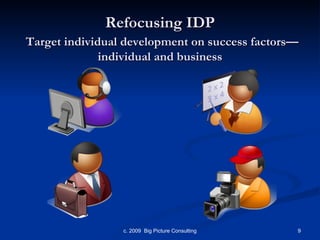
Refocusing IDP   Target individual development on success factors—individual and business
Make It Relevant Individual development gets you to be fully capable of:  getting the job done  meeting unforeseen expectations holding steady under fire
Drive IDP in a Fresh Way Decouple IDP from old ways Give it a new brand—a fresh metaphor Talk about the impact of employee skills on business performance Align advancement/reward with capabilities
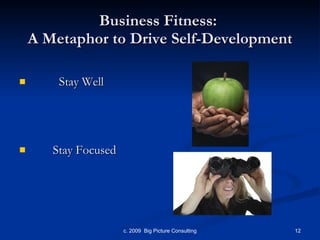
Business Fitness:  A Metaphor to Drive Self-Development Stay Well Stay Focused
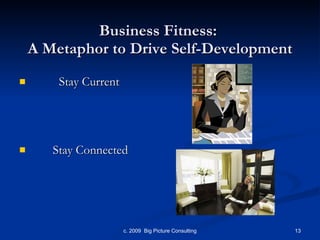
Business Fitness:  A Metaphor to Drive Self-Development Stay Current Stay Connected
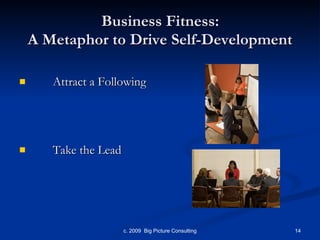
Business Fitness:  A Metaphor to Drive Self-Development Attract a Following Take the Lead
Business Fitness:  A Metaphor to Drive Self-Development Implement New Ideas Worthwhile IDPs attach growth efforts with work results.
Put the Employee in Charge Communicate that employee success is a function of the: Quality of their work Their choices The way they conduct themselves Their skills, knowledge, and experience Their motivation, energy, and commitment
Ground IDPs Give supervisors the right questions to ask, like How effective/successful are you in your job? What can you do to become more effective/successful? Require the submission of an ID  plan   each year Put responsibility for growth on the employee; hold them accountable
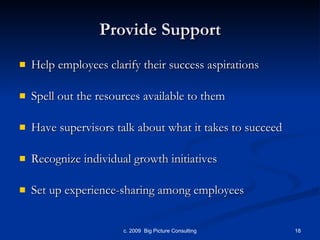
Provide Support Help employees clarify their success aspirations Spell out the resources available to them  Have supervisors talk about what it takes to succeed Recognize individual growth initiatives Set up experience-sharing among employees
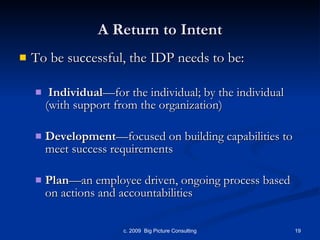
A Return to Intent To be successful, the IDP needs to be: Individual —for the individual; by the individual (with support from the organization) Development —focused on building capabilities to meet success requirements  Plan —an employee driven, ongoing process based on actions and accountabilities

Individual Development Plans 2009

  • 1.
    Individual Development Plans:How to Fix an Underachieving Best Practice Dawn G. Lennon, principal Big Picture Consulting SHRM LV Conference—2009
  • 2.
    Proposition HR needsto: Lead a culture of growth owned by employees and supported by the organization Reality: If employees don’t develop, they compromise reward and advancement
  • 3.
    The Value ofIDPs Develop employee capabilities Position employees for advancement Develop a “bench” for vacancies Enable competitiveness Attract and retain employees
  • 4.
    IDPs What’s theProblem?-- Part 1 Org. doesn’t forecast or communicate needs Supervisors: unable to assess employee capabilities don’t anticipate openings often block movement have few resources to invest assume employee development is their job
  • 5.
    IDPs What’s theProblem?-- Part 2 IDPs are often annual performance goal items Employees: want the organization to direct them expect supervisors to provide opportunities expect the organization to pay or release time expect the promise of some career reward don’t understand their role or obligations don’t own their own growth
  • 6.
    How It WorksNow? Supervisor asks: What’s your individual development plan? Employees says: “Training” Supervisors says: “There’s no money for training? Employee thinks: “Now what” Supervisors says: “What are your career interests?” Employee looks at the supervisor as if he/she has 4 heads
  • 7.
    The Result Noone’s invested in IDPs No perceived pay off No affect on appraisal Supervisors blow it off Employees feel cheated Little growth is achieved
  • 8.
    The Problem: Individualdevelopment is misunderstood. Is Not A pre-determined path A list of courses taken Attendance at conferences A gift from the org. Entitlement Is About adding capabilities Being successful in your job Focusing on improvement Investing time and energy You
  • 9.
    Refocusing IDP Target individual development on success factors—individual and business
  • 10.
    Make It RelevantIndividual development gets you to be fully capable of: getting the job done meeting unforeseen expectations holding steady under fire
  • 11.
    Drive IDP ina Fresh Way Decouple IDP from old ways Give it a new brand—a fresh metaphor Talk about the impact of employee skills on business performance Align advancement/reward with capabilities
  • 12.
    Business Fitness: A Metaphor to Drive Self-Development Stay Well Stay Focused
  • 13.
    Business Fitness: A Metaphor to Drive Self-Development Stay Current Stay Connected
  • 14.
    Business Fitness: A Metaphor to Drive Self-Development Attract a Following Take the Lead
  • 15.
    Business Fitness: A Metaphor to Drive Self-Development Implement New Ideas Worthwhile IDPs attach growth efforts with work results.
  • 16.
    Put the Employeein Charge Communicate that employee success is a function of the: Quality of their work Their choices The way they conduct themselves Their skills, knowledge, and experience Their motivation, energy, and commitment
  • 17.
    Ground IDPs Givesupervisors the right questions to ask, like How effective/successful are you in your job? What can you do to become more effective/successful? Require the submission of an ID plan each year Put responsibility for growth on the employee; hold them accountable
  • 18.
    Provide Support Helpemployees clarify their success aspirations Spell out the resources available to them Have supervisors talk about what it takes to succeed Recognize individual growth initiatives Set up experience-sharing among employees
  • 19.
    A Return toIntent To be successful, the IDP needs to be: Individual —for the individual; by the individual (with support from the organization) Development —focused on building capabilities to meet success requirements Plan —an employee driven, ongoing process based on actions and accountabilities