Inclusive innovation – policy
challenges and potentials
Prof Stephen Roper
Stephen.roper@wbs.ac.uk
ERC – the background
• Established Jan 2013 with a mission to deepen our understanding
of ‘what drives SME innovation, productivity and growth’.
• ERC is a UK hub for SME Research with a strong team of c. 20
researchers (pt/ft) drawn from 6 University business schools
(Warwick, Aston, Imperial, Birmingham, Queen’s Belfast and
Strathclyde) and led by Stephen Roper, Mark Hart and Vicki Belt.
• Funding is from ESRC, BEIS, Innovate UK and the British Business
Bank. ESRC backing is key for independence and academic quality.
Government funders ensure ERC research is strongly policy/practice
focussed. Impact and engagement agenda is paramount
• ERC operates as a ‘virtual centre’ with researchers concentrated in
Aston and Warwick and a ‘flying faculty’ model .
2
Inclusive Innovation
3
Two interpretations of ‘Inclusive
innovation’ can be…
• 1. Inclusive innovation is ‘innovation to promote social and economic inclusivity’
– Key focus here is on innovation which promotes social and economic inclusion for
disadvantaged groups or marginalised communities
– This can have both social and productivity benefits
– In development economics this is the most common interpretation of ‘inclusive
innovation’
• 2. Inclusive innovation is ‘innovation to promote broadly-based productivity
improvement’
– Here the focus is on innovation to promote performance improvements among less
productive firms or sectors
– This involves adoption or diffusion of innovations (not new to the market
innovations)
• ‘… the principal force for convergence – the diffusion of knowledge – is only
partly natural and spontaneous. It also depends in large part on educational
policies, access to training and to the acquisition of appropriate skills, and
associated institutions’ (Piketty, 2014, p. 22).
• I will deal with both aspects here
4
So my agenda …
• Start by noting that productivity and innovation vary
widely by industry, firm size and locality. And, these
disparities seem to be growing
• Current innovation policy may be increasing these
disparities. And, recent changes in policy may have
exaggerated this effect. Is this what we want? (It may
be!)
• Is there another approach? Introducing distribution
sensitive innovation policies
5
The challenge…. significant and growing
disparities
6
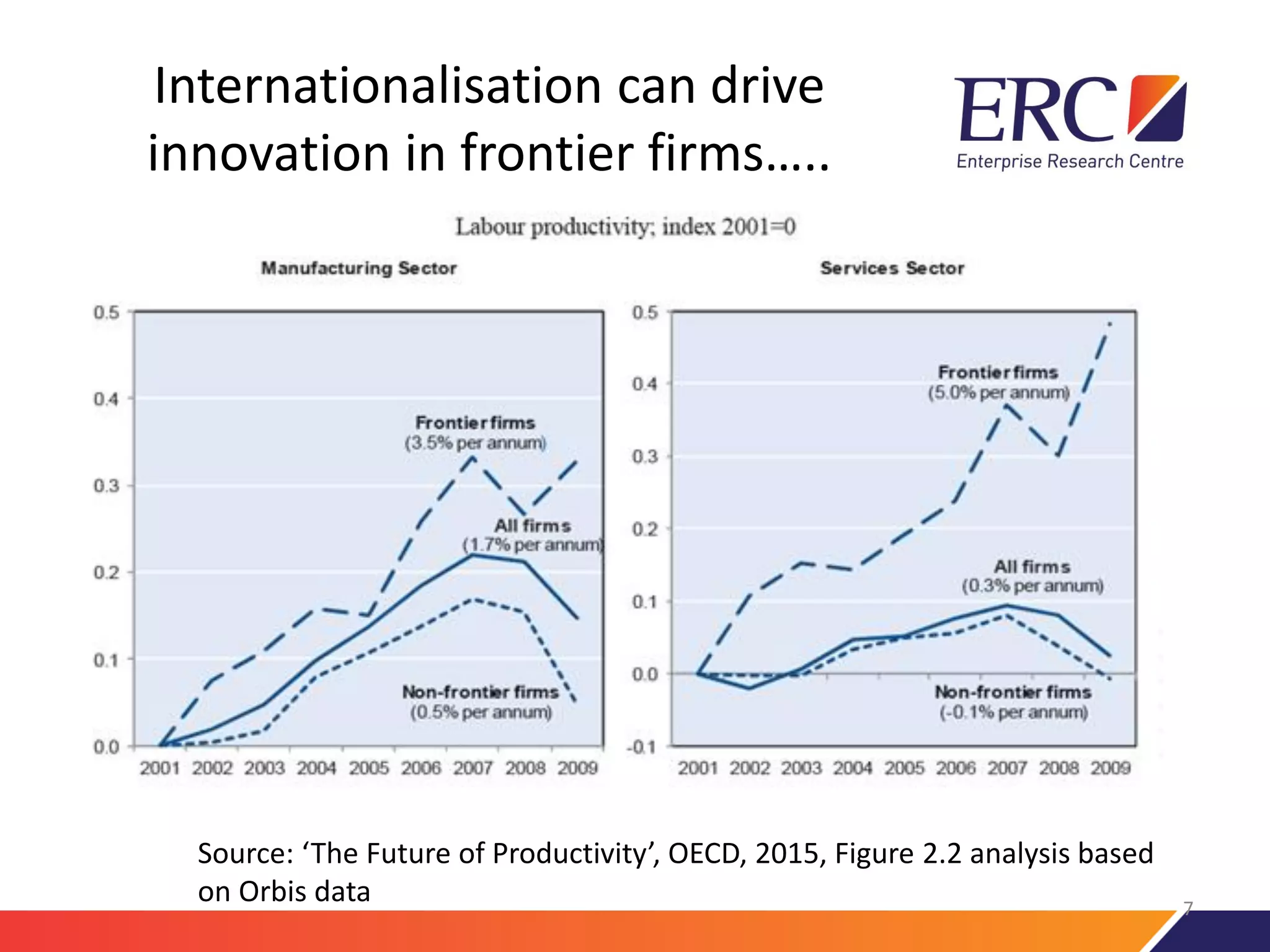
Internationalisation can drive
innovation in frontier firms…..
7
Source: ‘The Future of Productivity’, OECD, 2015, Figure 2.2 analysis based
on Orbis data
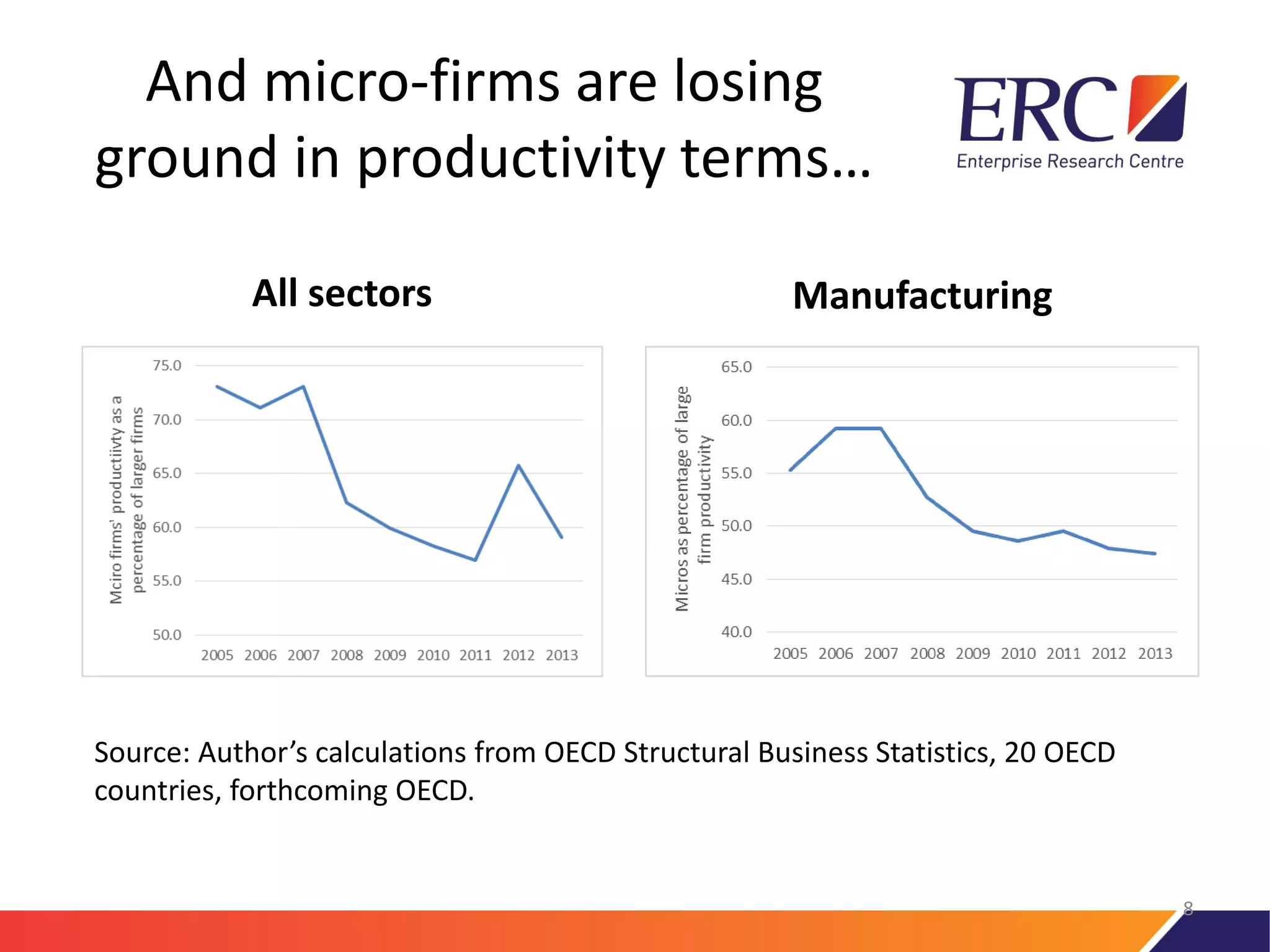
And micro-firms are losing
ground in productivity terms…
All sectors Manufacturing
8
Source: Author’s calculations from OECD Structural Business Statistics, 20 OECD
countries, forthcoming OECD.
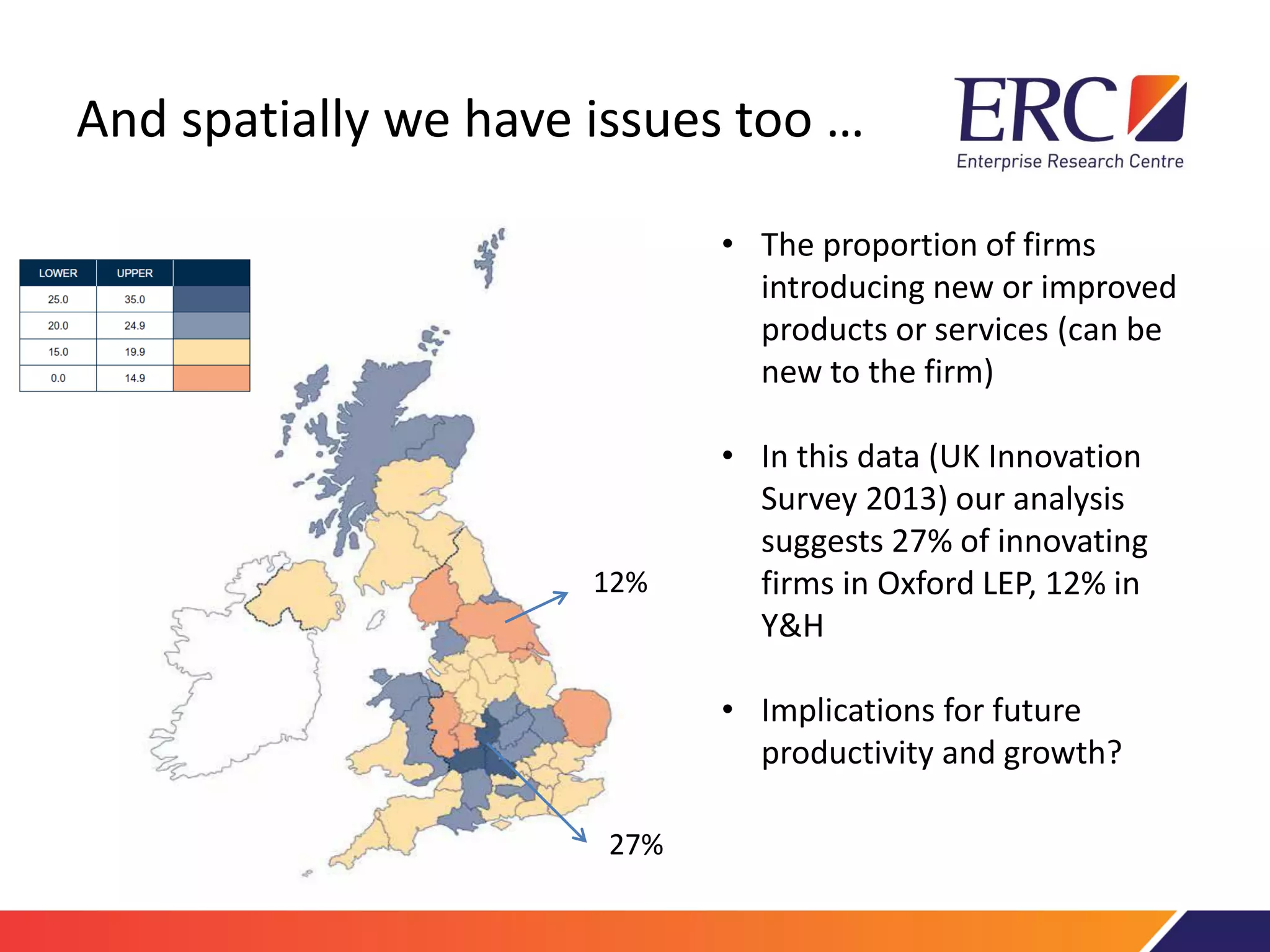
• The proportion of firms
introducing new or improved
products or services (can be
new to the firm)
• In this data (UK Innovation
Survey 2013) our analysis
suggests 27% of innovating
firms in Oxford LEP, 12% in
Y&H
• Implications for future
productivity and growth?
27%
12%
And spatially we have issues too …
The influence of current policy …
10
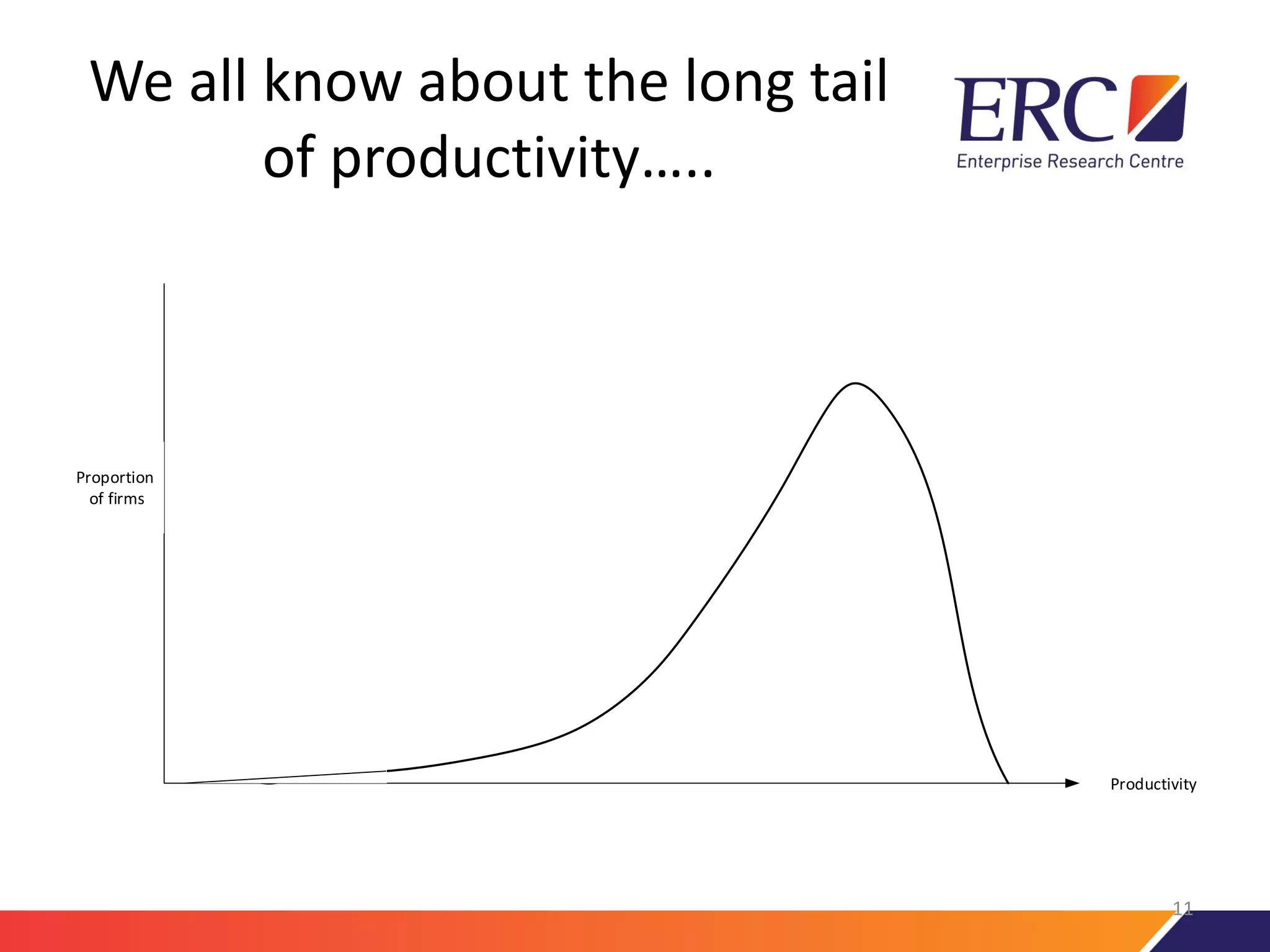
We all know about the long tail
of productivity…..
Productivity
Proportion
of firms
11
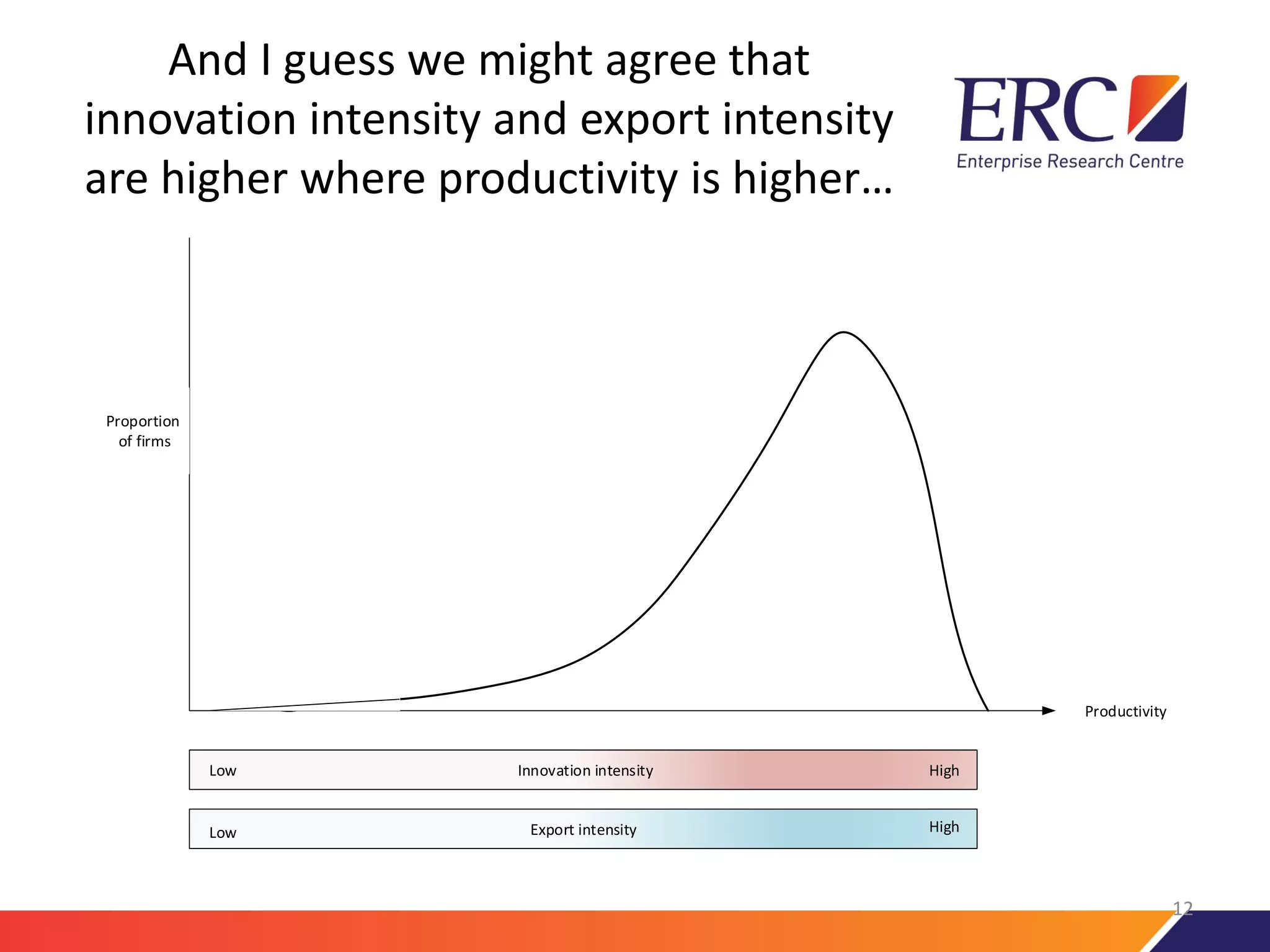
And I guess we might agree that
innovation intensity and export intensity
are higher where productivity is higher…
Innovation intensity
Export intensity
Low
Low
High
High
Productivity
Proportion
of firms
12
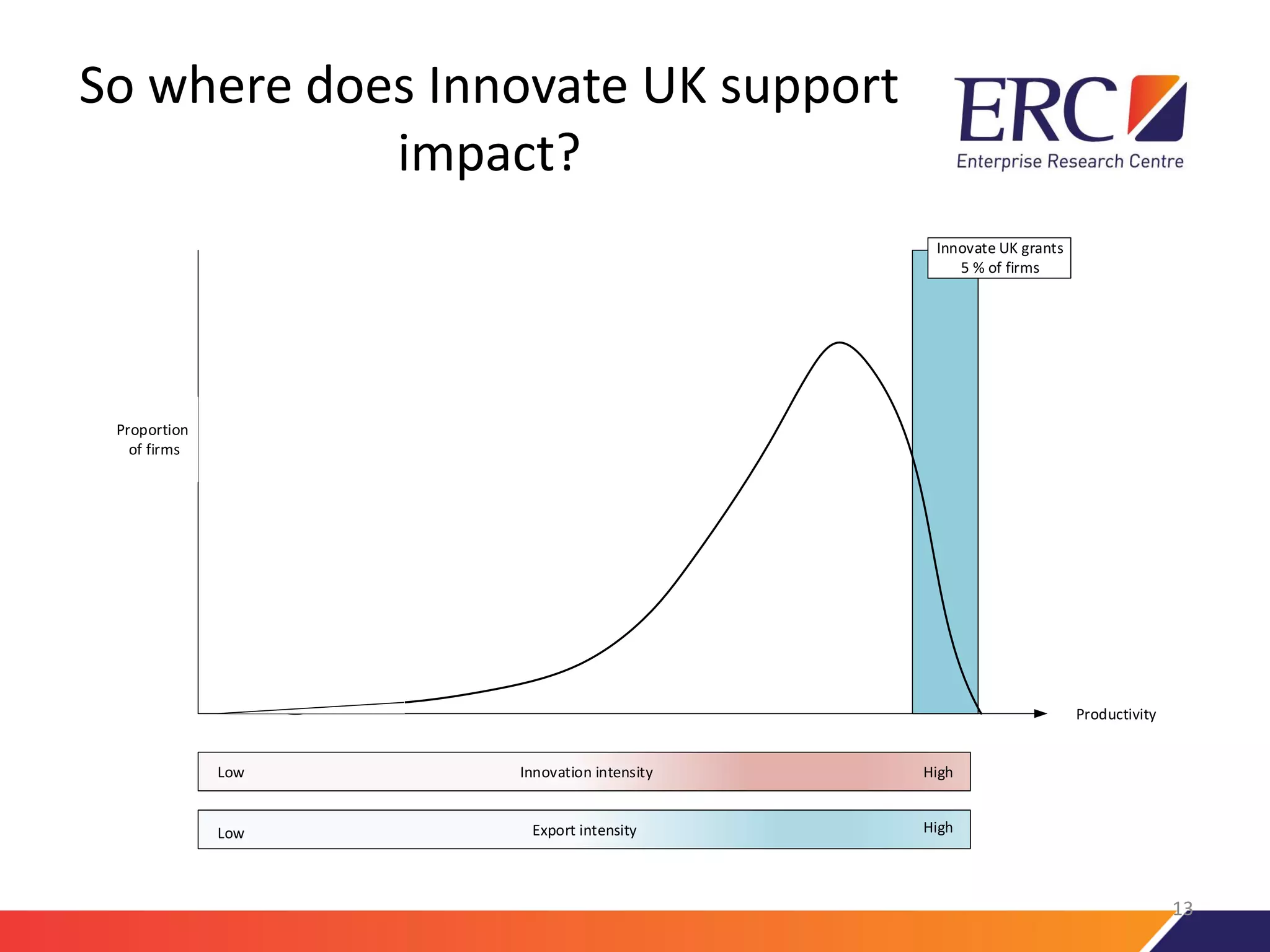
So where does Innovate UK support
impact?
Innovation intensity
Export intensity
Low
Low
High
High
Productivity
Proportion
of firms
Innovate UK grants
5 % of firms
13
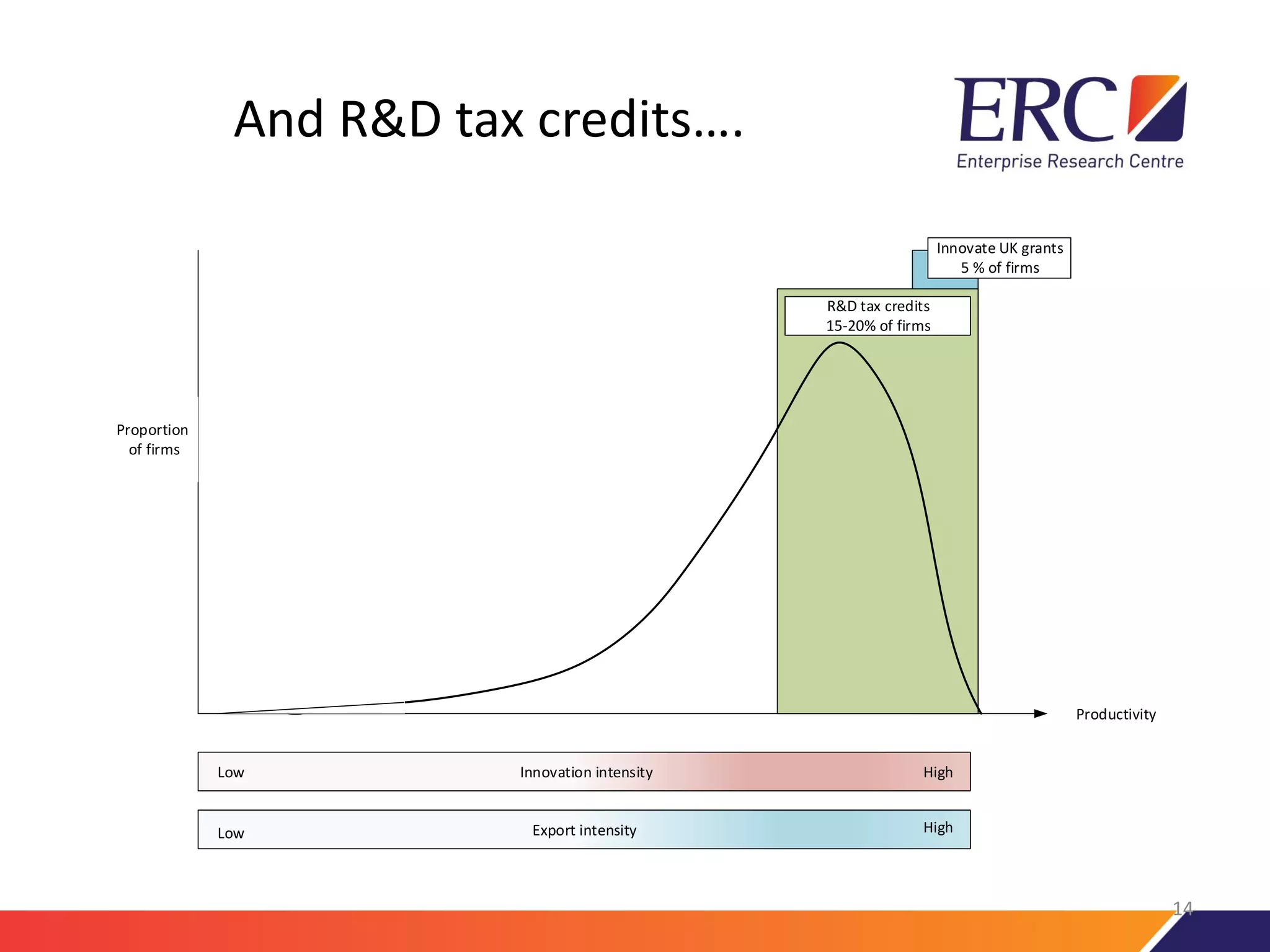
And R&D tax credits….
Innovation intensity
Export intensity
Low
Low
High
High
Productivity
Proportion
of firms
R&D tax credits
15-20% of firms
Innovate UK grants
5 % of firms
14
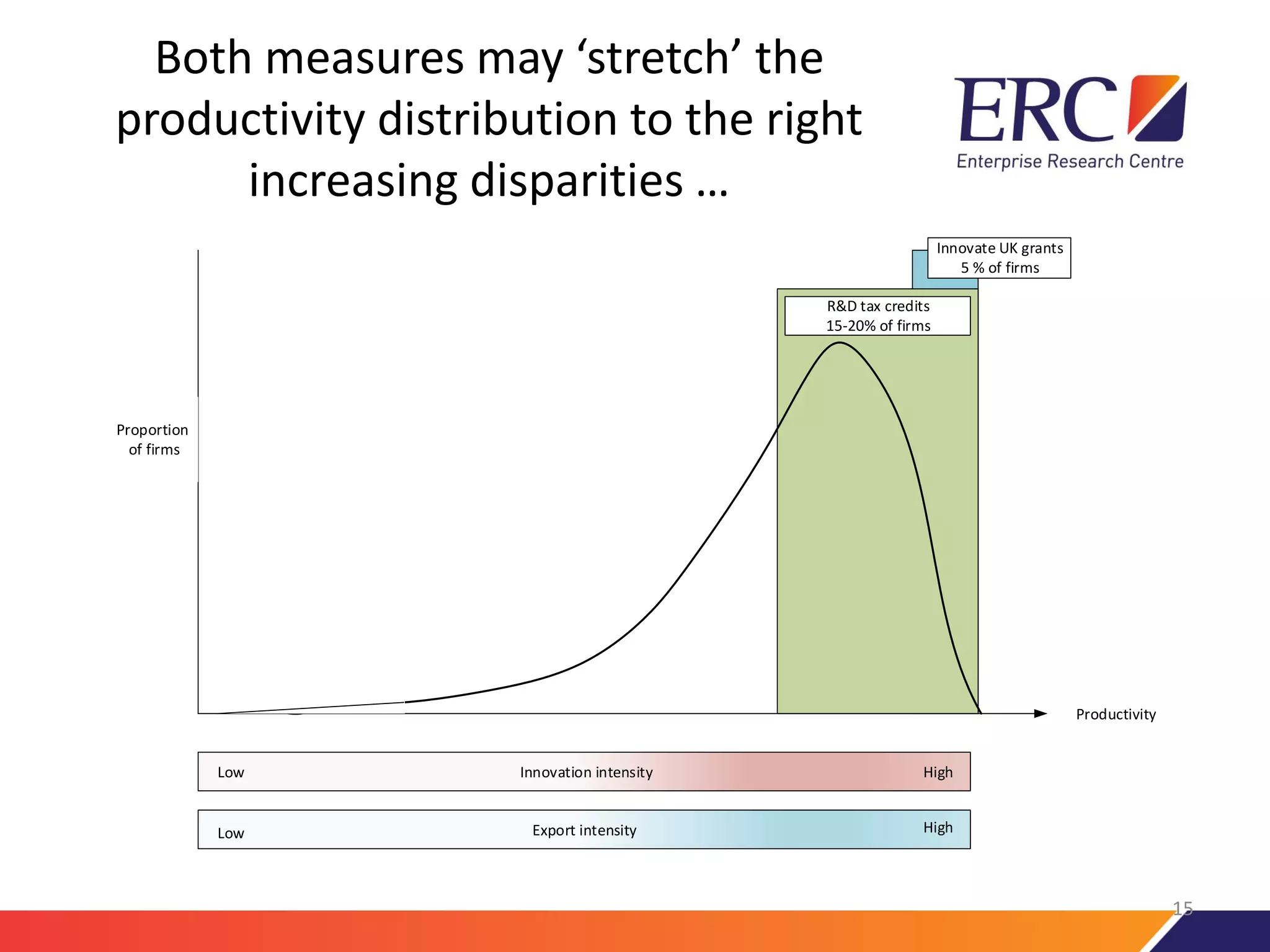
Both measures may ‘stretch’ the
productivity distribution to the right
increasing disparities …
Innovation intensity
Export intensity
Low
Low
High
High
Productivity
Proportion
of firms
R&D tax credits
15-20% of firms
Innovate UK grants
5 % of firms
15
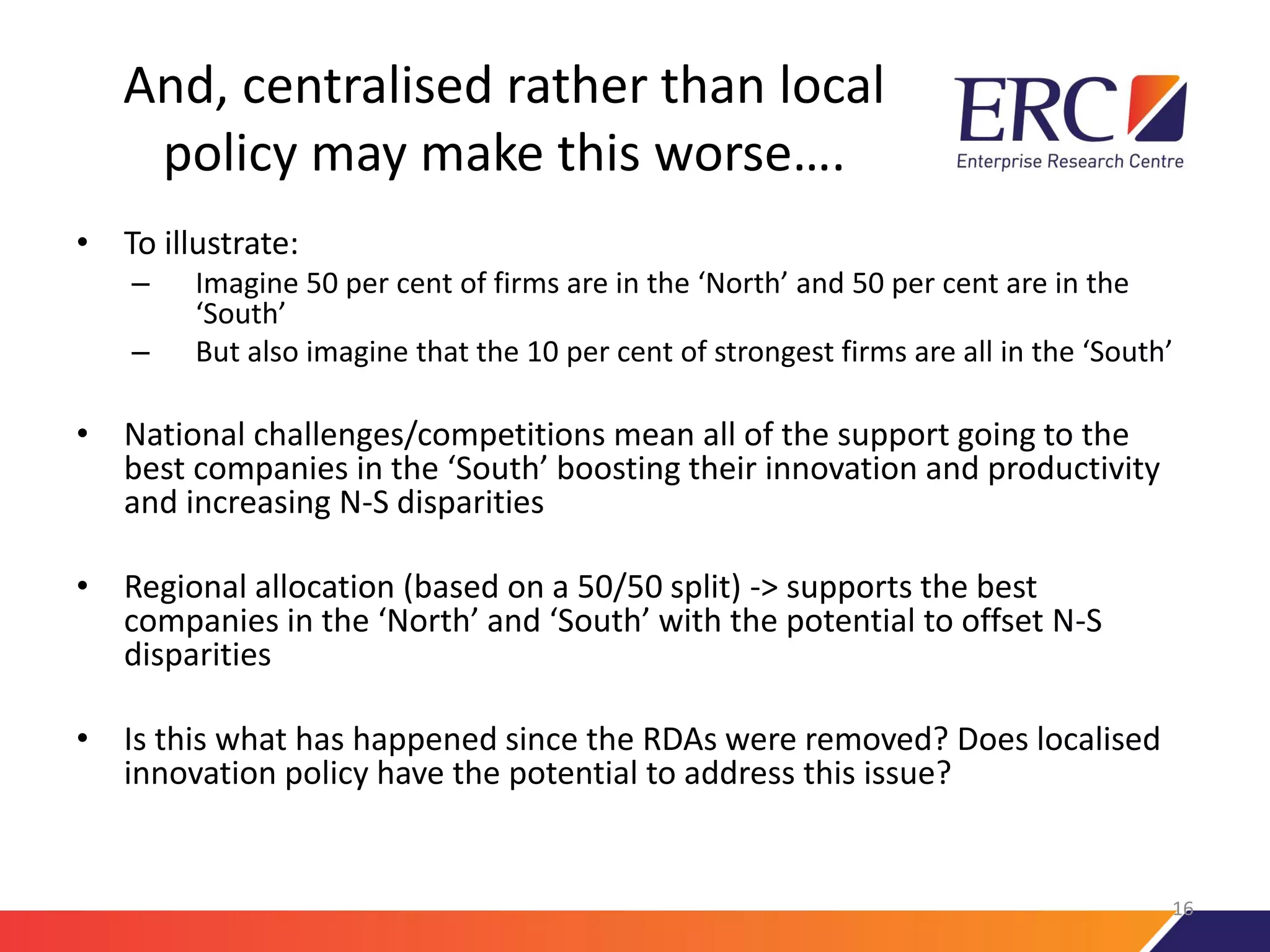
And, centralised rather than local
policy may make this worse….
• To illustrate:
– Imagine 50 per cent of firms are in the ‘North’ and 50 per cent are in the
‘South’
– But also imagine that the 10 per cent of strongest firms are all in the ‘South’
• National challenges/competitions mean all of the support going to the
best companies in the ‘South’ boosting their innovation and productivity
and increasing N-S disparities
• Regional allocation (based on a 50/50 split) -> supports the best
companies in the ‘North’ and ‘South’ with the potential to offset N-S
disparities
• Is this what has happened since the RDAs were removed? Does localised
innovation policy have the potential to address this issue?
16
What does more inclusive
innovation policy look like?
17
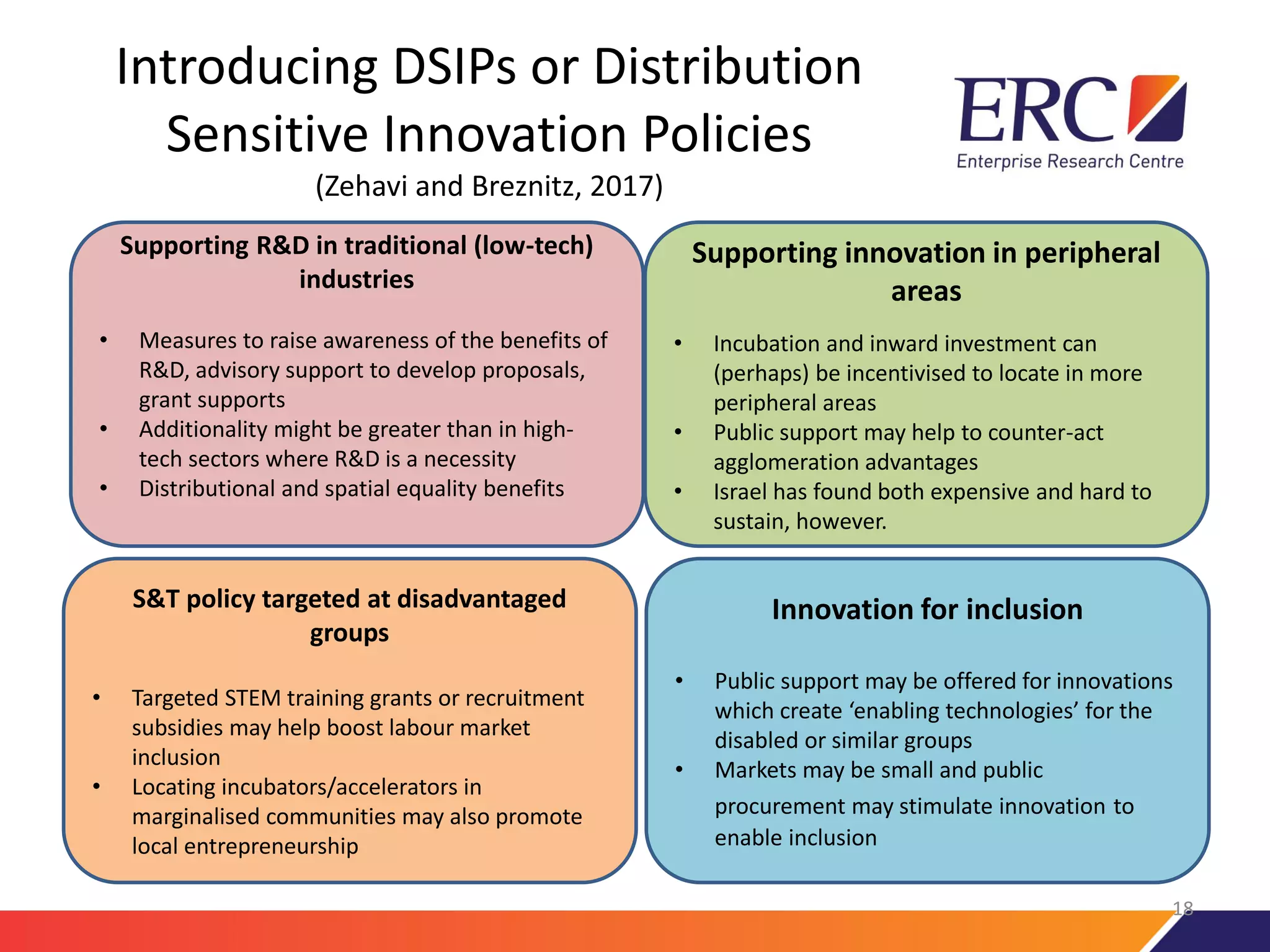
Introducing DSIPs or Distribution
Sensitive Innovation Policies
(Zehavi and Breznitz, 2017)
18
Supporting R&D in traditional (low-tech)
industries
• Measures to raise awareness of the benefits of
R&D, advisory support to develop proposals,
grant supports
• Additionality might be greater than in high-
tech sectors where R&D is a necessity
• Distributional and spatial equality benefits
Supporting innovation in peripheral
areas
• Incubation and inward investment can
(perhaps) be incentivised to locate in more
peripheral areas
• Public support may help to counter-act
agglomeration advantages
• Israel has found both expensive and hard to
sustain, however.
S&T policy targeted at disadvantaged
groups
• Targeted STEM training grants or recruitment
subsidies may help boost labour market
inclusion
• Locating incubators/accelerators in
marginalised communities may also promote
local entrepreneurship
Innovation for inclusion
• Public support may be offered for innovations
which create ‘enabling technologies’ for the
disabled or similar groups
• Markets may be small and public
procurement may stimulate innovation to
enable inclusion
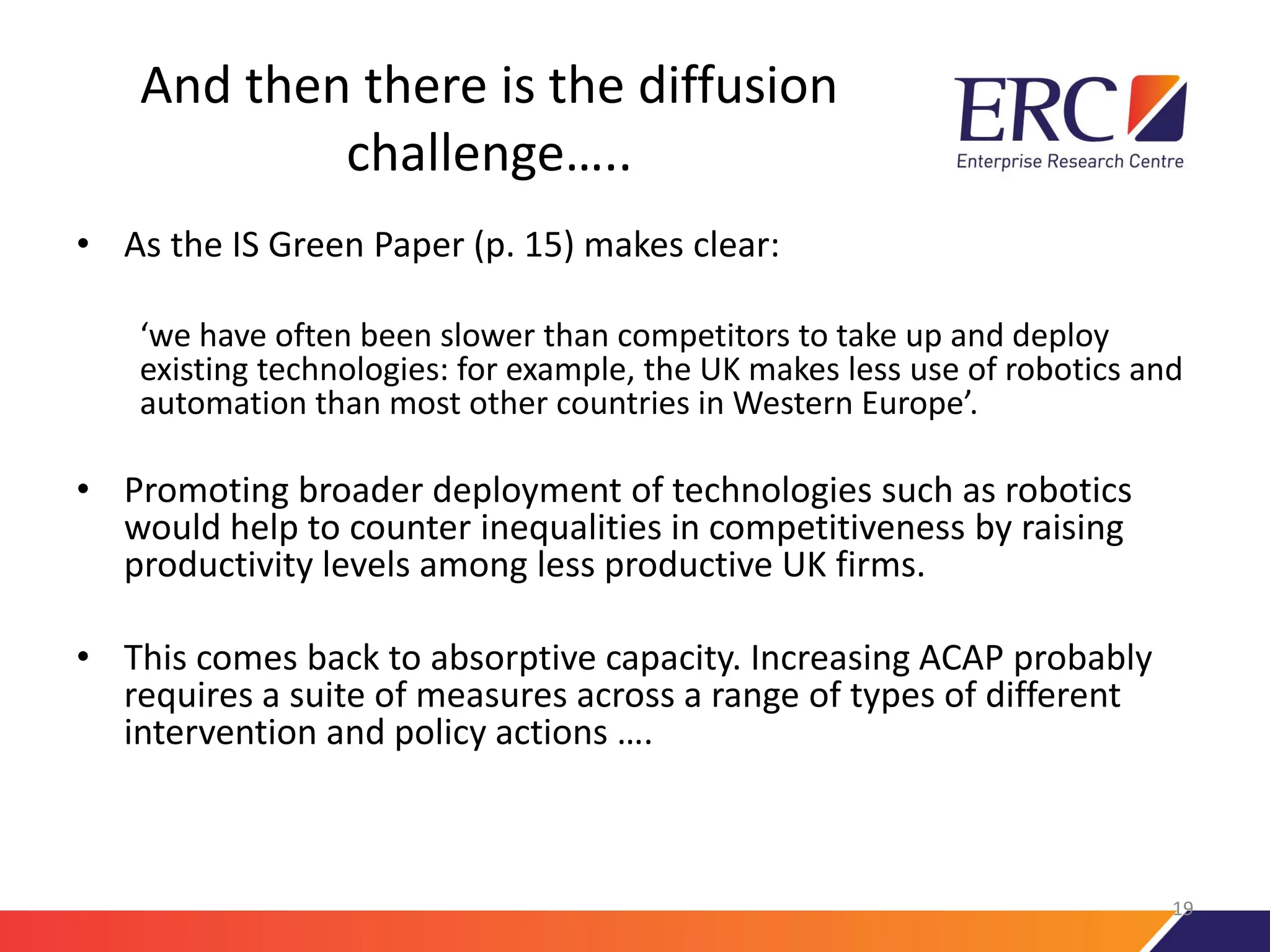
And then there is the diffusion
challenge…..
• As the IS Green Paper (p. 15) makes clear:
‘we have often been slower than competitors to take up and deploy
existing technologies: for example, the UK makes less use of robotics and
automation than most other countries in Western Europe’.
• Promoting broader deployment of technologies such as robotics
would help to counter inequalities in competitiveness by raising
productivity levels among less productive UK firms.
• This comes back to absorptive capacity. Increasing ACAP probably
requires a suite of measures across a range of types of different
intervention and policy actions ….
19
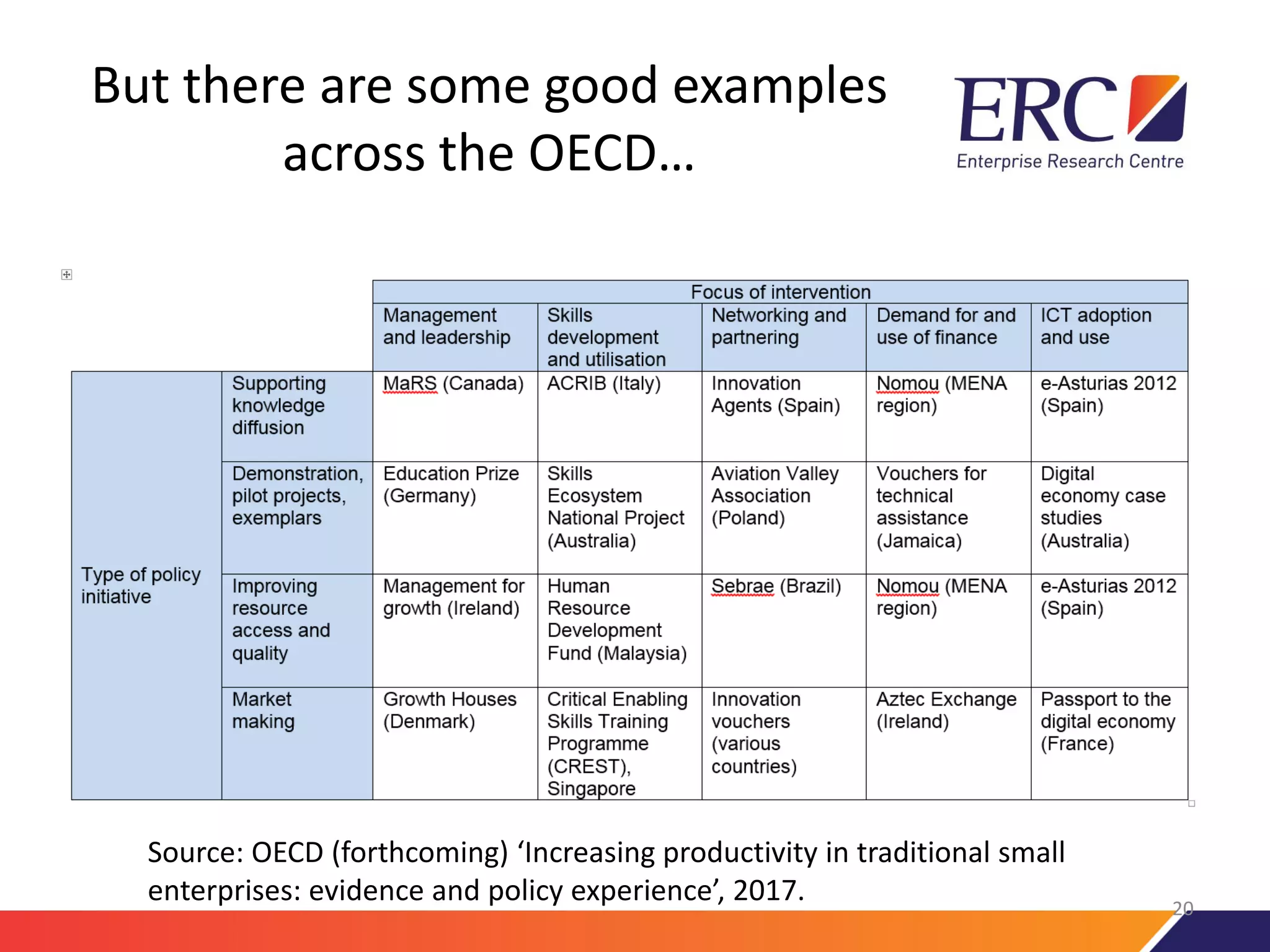
But there are some good examples
across the OECD…
20
Source: OECD (forthcoming) ‘Increasing productivity in traditional small
enterprises: evidence and policy experience’, 2017.
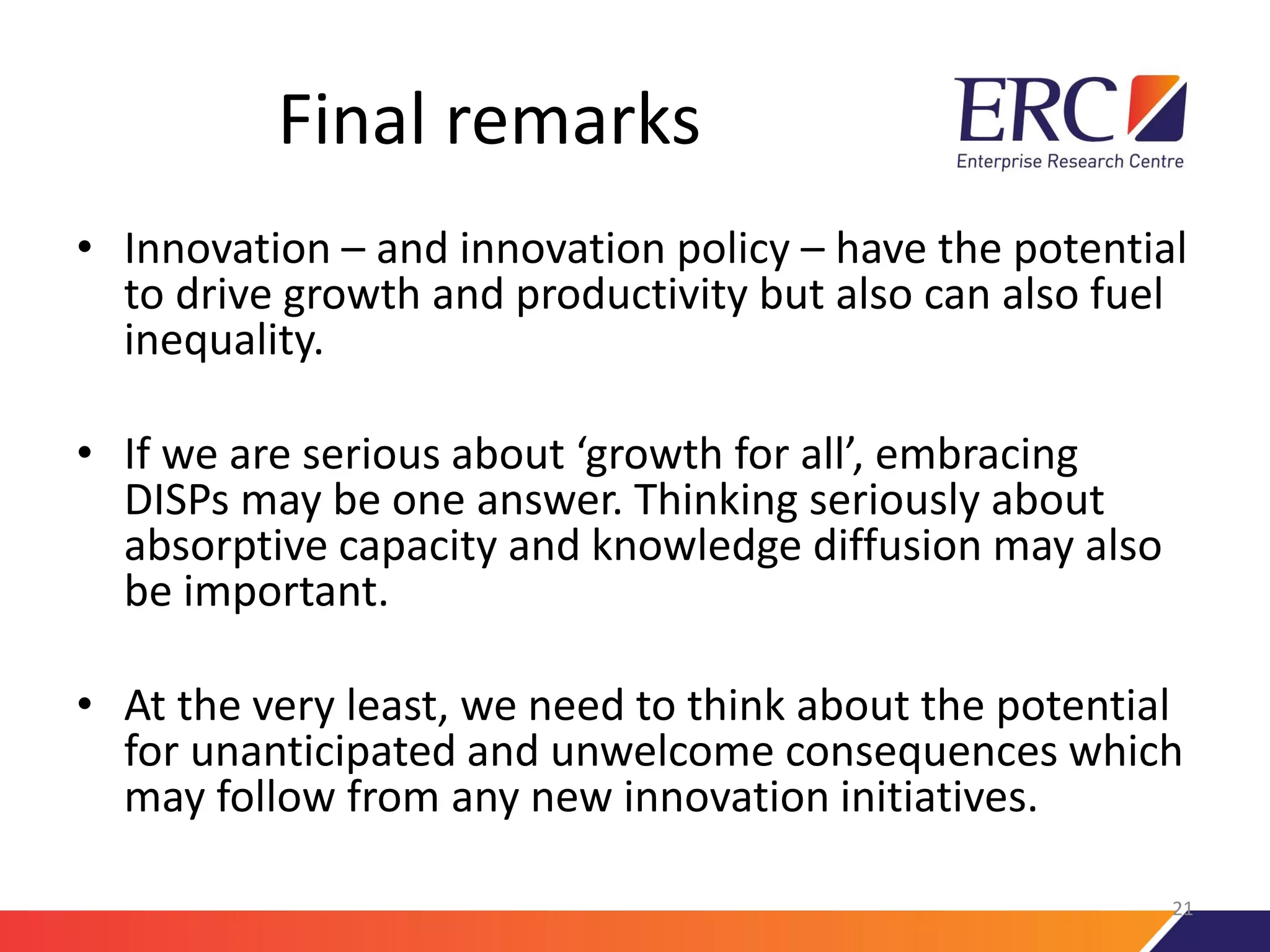
Final remarks
• Innovation – and innovation policy – have the potential
to drive growth and productivity but also can also fuel
inequality.
• If we are serious about ‘growth for all’, embracing
DISPs may be one answer. Thinking seriously about
absorptive capacity and knowledge diffusion may also
be important.
• At the very least, we need to think about the potential
for unanticipated and unwelcome consequences which
may follow from any new innovation initiatives.
21
Contact us:
• If you would like any more information about the ERC and any of its
activities please contact us: Stephen Roper (stephen.roper@wbs.ac.uk),
Mark Hart (mark.hart@aston.ac.uk) or Vicki Belt (vicki.belt@wbs.ac.uk).
More details about the activities of the ERC and our latest events can be
found at:
www.enterpriseresearch.ac.uk

ERC, BEIS Local growth presentation Stephen Roper . 13.03.2017

  • 1.
    Inclusive innovation –policy challenges and potentials Prof Stephen Roper Stephen.roper@wbs.ac.uk
  • 2.
    ERC – thebackground • Established Jan 2013 with a mission to deepen our understanding of ‘what drives SME innovation, productivity and growth’. • ERC is a UK hub for SME Research with a strong team of c. 20 researchers (pt/ft) drawn from 6 University business schools (Warwick, Aston, Imperial, Birmingham, Queen’s Belfast and Strathclyde) and led by Stephen Roper, Mark Hart and Vicki Belt. • Funding is from ESRC, BEIS, Innovate UK and the British Business Bank. ESRC backing is key for independence and academic quality. Government funders ensure ERC research is strongly policy/practice focussed. Impact and engagement agenda is paramount • ERC operates as a ‘virtual centre’ with researchers concentrated in Aston and Warwick and a ‘flying faculty’ model . 2
  • 3.
  • 4.
    Two interpretations of‘Inclusive innovation’ can be… • 1. Inclusive innovation is ‘innovation to promote social and economic inclusivity’ – Key focus here is on innovation which promotes social and economic inclusion for disadvantaged groups or marginalised communities – This can have both social and productivity benefits – In development economics this is the most common interpretation of ‘inclusive innovation’ • 2. Inclusive innovation is ‘innovation to promote broadly-based productivity improvement’ – Here the focus is on innovation to promote performance improvements among less productive firms or sectors – This involves adoption or diffusion of innovations (not new to the market innovations) • ‘… the principal force for convergence – the diffusion of knowledge – is only partly natural and spontaneous. It also depends in large part on educational policies, access to training and to the acquisition of appropriate skills, and associated institutions’ (Piketty, 2014, p. 22). • I will deal with both aspects here 4
  • 5.
    So my agenda… • Start by noting that productivity and innovation vary widely by industry, firm size and locality. And, these disparities seem to be growing • Current innovation policy may be increasing these disparities. And, recent changes in policy may have exaggerated this effect. Is this what we want? (It may be!) • Is there another approach? Introducing distribution sensitive innovation policies 5
  • 6.
    The challenge…. significantand growing disparities 6
  • 7.
    Internationalisation can drive innovationin frontier firms….. 7 Source: ‘The Future of Productivity’, OECD, 2015, Figure 2.2 analysis based on Orbis data
  • 8.
    And micro-firms arelosing ground in productivity terms… All sectors Manufacturing 8 Source: Author’s calculations from OECD Structural Business Statistics, 20 OECD countries, forthcoming OECD.
  • 9.
    • The proportionof firms introducing new or improved products or services (can be new to the firm) • In this data (UK Innovation Survey 2013) our analysis suggests 27% of innovating firms in Oxford LEP, 12% in Y&H • Implications for future productivity and growth? 27% 12% And spatially we have issues too …
  • 10.
    The influence ofcurrent policy … 10
  • 11.
    We all knowabout the long tail of productivity….. Productivity Proportion of firms 11
  • 12.
    And I guesswe might agree that innovation intensity and export intensity are higher where productivity is higher… Innovation intensity Export intensity Low Low High High Productivity Proportion of firms 12
  • 13.
    So where doesInnovate UK support impact? Innovation intensity Export intensity Low Low High High Productivity Proportion of firms Innovate UK grants 5 % of firms 13
  • 14.
    And R&D taxcredits…. Innovation intensity Export intensity Low Low High High Productivity Proportion of firms R&D tax credits 15-20% of firms Innovate UK grants 5 % of firms 14
  • 15.
    Both measures may‘stretch’ the productivity distribution to the right increasing disparities … Innovation intensity Export intensity Low Low High High Productivity Proportion of firms R&D tax credits 15-20% of firms Innovate UK grants 5 % of firms 15
  • 16.
    And, centralised ratherthan local policy may make this worse…. • To illustrate: – Imagine 50 per cent of firms are in the ‘North’ and 50 per cent are in the ‘South’ – But also imagine that the 10 per cent of strongest firms are all in the ‘South’ • National challenges/competitions mean all of the support going to the best companies in the ‘South’ boosting their innovation and productivity and increasing N-S disparities • Regional allocation (based on a 50/50 split) -> supports the best companies in the ‘North’ and ‘South’ with the potential to offset N-S disparities • Is this what has happened since the RDAs were removed? Does localised innovation policy have the potential to address this issue? 16
  • 17.
    What does moreinclusive innovation policy look like? 17
  • 18.
    Introducing DSIPs orDistribution Sensitive Innovation Policies (Zehavi and Breznitz, 2017) 18 Supporting R&D in traditional (low-tech) industries • Measures to raise awareness of the benefits of R&D, advisory support to develop proposals, grant supports • Additionality might be greater than in high- tech sectors where R&D is a necessity • Distributional and spatial equality benefits Supporting innovation in peripheral areas • Incubation and inward investment can (perhaps) be incentivised to locate in more peripheral areas • Public support may help to counter-act agglomeration advantages • Israel has found both expensive and hard to sustain, however. S&T policy targeted at disadvantaged groups • Targeted STEM training grants or recruitment subsidies may help boost labour market inclusion • Locating incubators/accelerators in marginalised communities may also promote local entrepreneurship Innovation for inclusion • Public support may be offered for innovations which create ‘enabling technologies’ for the disabled or similar groups • Markets may be small and public procurement may stimulate innovation to enable inclusion
  • 19.
    And then thereis the diffusion challenge….. • As the IS Green Paper (p. 15) makes clear: ‘we have often been slower than competitors to take up and deploy existing technologies: for example, the UK makes less use of robotics and automation than most other countries in Western Europe’. • Promoting broader deployment of technologies such as robotics would help to counter inequalities in competitiveness by raising productivity levels among less productive UK firms. • This comes back to absorptive capacity. Increasing ACAP probably requires a suite of measures across a range of types of different intervention and policy actions …. 19
  • 20.
    But there aresome good examples across the OECD… 20 Source: OECD (forthcoming) ‘Increasing productivity in traditional small enterprises: evidence and policy experience’, 2017.
  • 21.
    Final remarks • Innovation– and innovation policy – have the potential to drive growth and productivity but also can also fuel inequality. • If we are serious about ‘growth for all’, embracing DISPs may be one answer. Thinking seriously about absorptive capacity and knowledge diffusion may also be important. • At the very least, we need to think about the potential for unanticipated and unwelcome consequences which may follow from any new innovation initiatives. 21
  • 22.
    Contact us: • Ifyou would like any more information about the ERC and any of its activities please contact us: Stephen Roper (stephen.roper@wbs.ac.uk), Mark Hart (mark.hart@aston.ac.uk) or Vicki Belt (vicki.belt@wbs.ac.uk). More details about the activities of the ERC and our latest events can be found at: www.enterpriseresearch.ac.uk