Professor Mark Hart
ERC
BEIS Workshop 13th March 2017
Overview
• The importance of ‘high-growth’ firms (or ‘scale-ups’) is now
regularly acknowledged in almost all national and local policy
strategic plans, and the recent Industrial Strategy Green Paper
is no exception - so timely to pause for some evidential
reflection!!
• ERC’s Local Growth Dashboard - need to understand the
various types of firms that are growing and where they are
concentrated - greater granularity in growth metrics better
informs the development of local and regional economic
policy
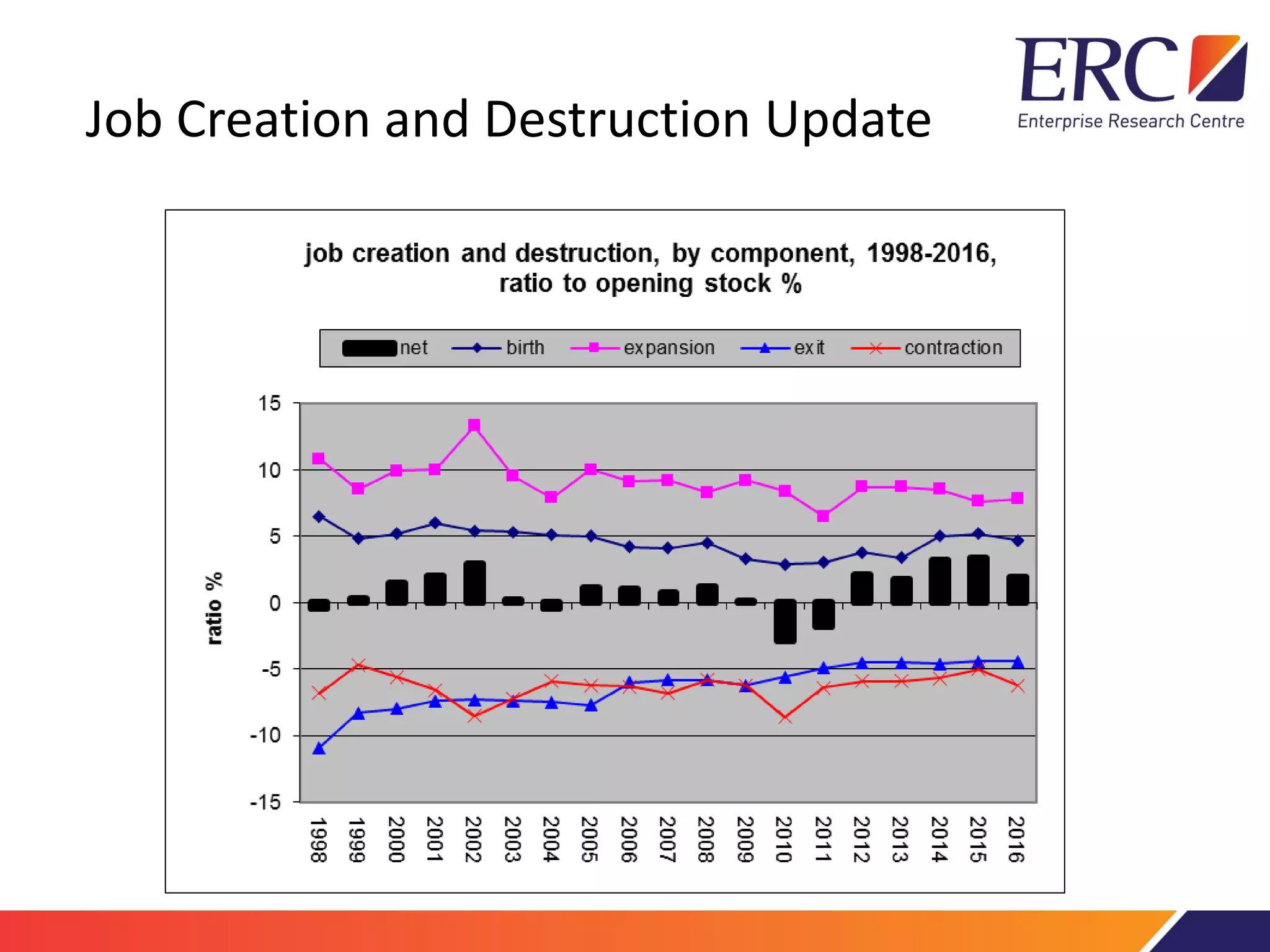
Job Creation and Destruction Update
High Performing Firms – defintions?
• The OECD High-Growth Firm (HGF) measure was a pragmatic
solution to a practical problem. It was designed to assist in
identifying the small group of firms which contributed
disproportionately to job creation.
• This statistic could be used to inform national policy and to
make comparisons across countries, since it could be readily
replicated using business register data.
• Anyadike-Danes et al., (2009) and NESTA (2009) reported on
the metric for the first time for the UK – recently updated by
NESTA in December 2016
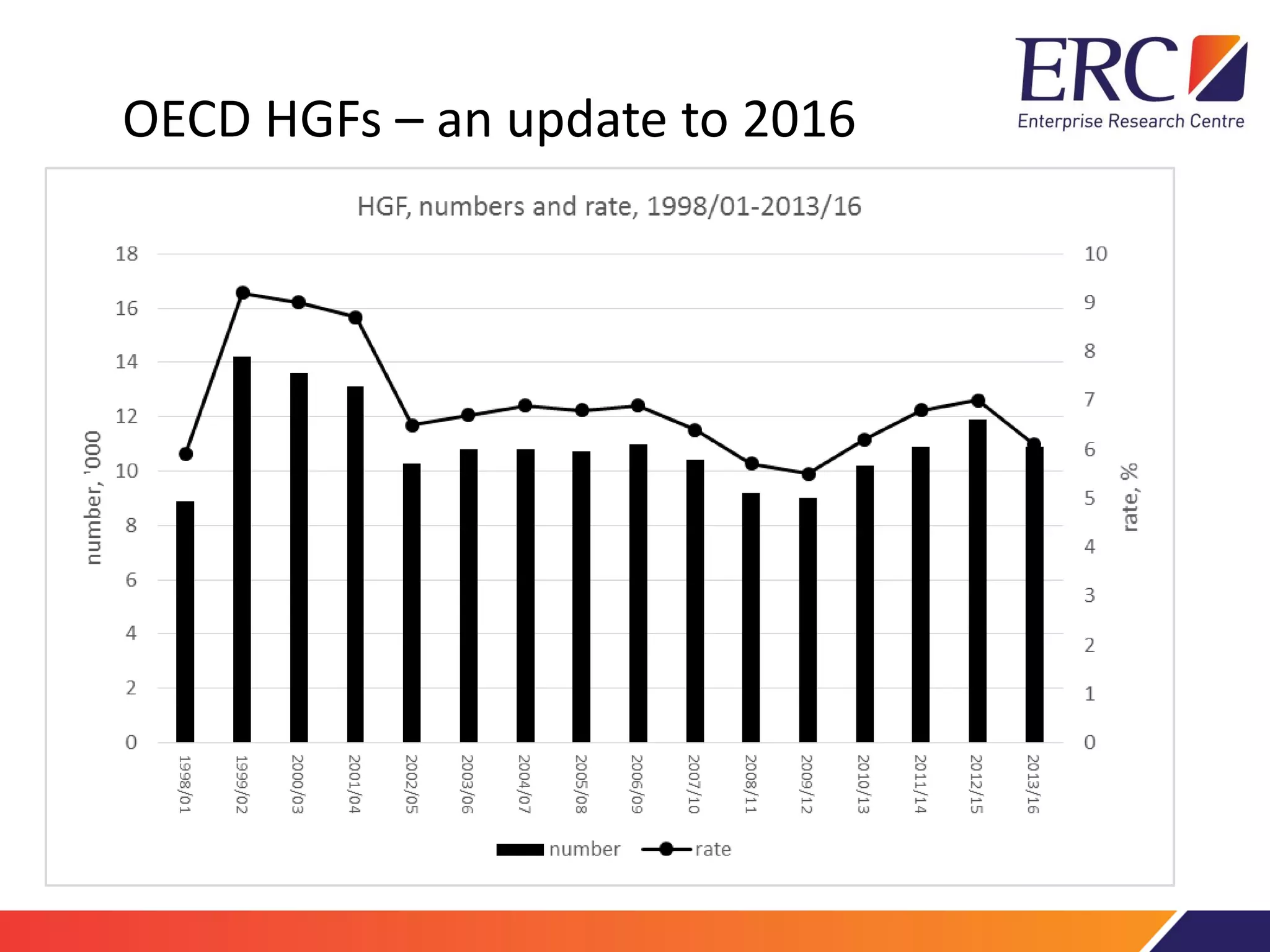
OECD HGFs – an update to 2016
The Problem with the OECD Definition
• The decade since the measure was first published has
seen increasing dissatisfaction amongst the academics
and policymakers seeking to make use of it.
• There are two important criticisms:
– First, it focuses attention on relatively short ‘bursts’ of growth
rendering invisible the reality of growth for the majority of
businesses.
– Second, it does not in fact capture some important members of
its target group the ‘relatively small proportion of firms that
contribute disproportionately to job creation’.
Moving on…. a longitudinal
perspective
• New analysis of job creation in the UK, using data on a cohort
of start-ups born in 1998 to identify three different groups of
high performing firms:
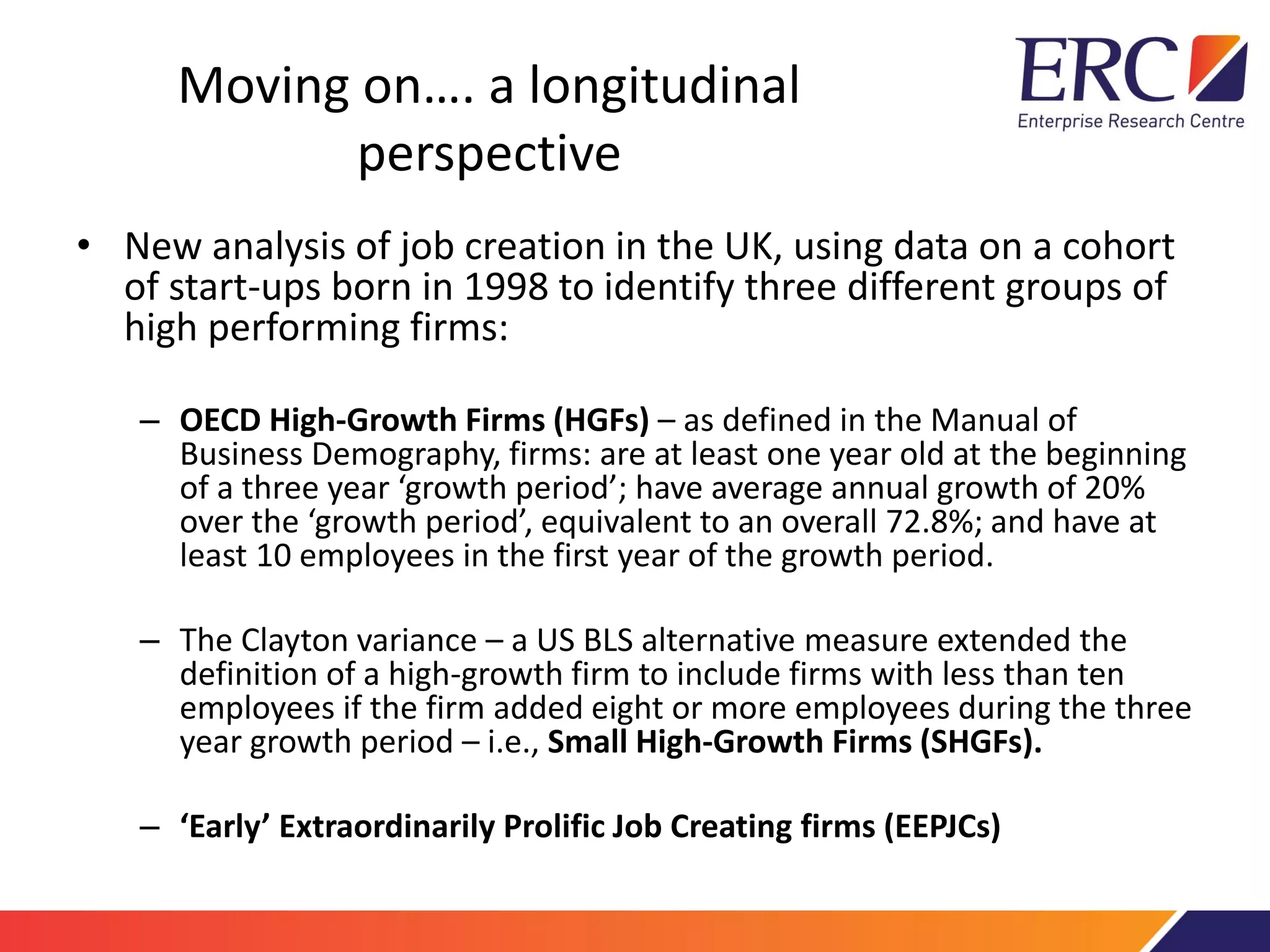
– OECD High-Growth Firms (HGFs) – as defined in the Manual of
Business Demography, firms: are at least one year old at the beginning
of a three year ‘growth period’; have average annual growth of 20%
over the ‘growth period’, equivalent to an overall 72.8%; and have at
least 10 employees in the first year of the growth period.
– The Clayton variance – a US BLS alternative measure extended the
definition of a high-growth firm to include firms with less than ten
employees if the firm added eight or more employees during the three
year growth period – i.e., Small High-Growth Firms (SHGFs).
– ‘Early’ Extraordinarily Prolific Job Creating firms (EEPJCs)
‘Early’ Extraordinarily Prolific Job
Creating firms (EEPJCs)
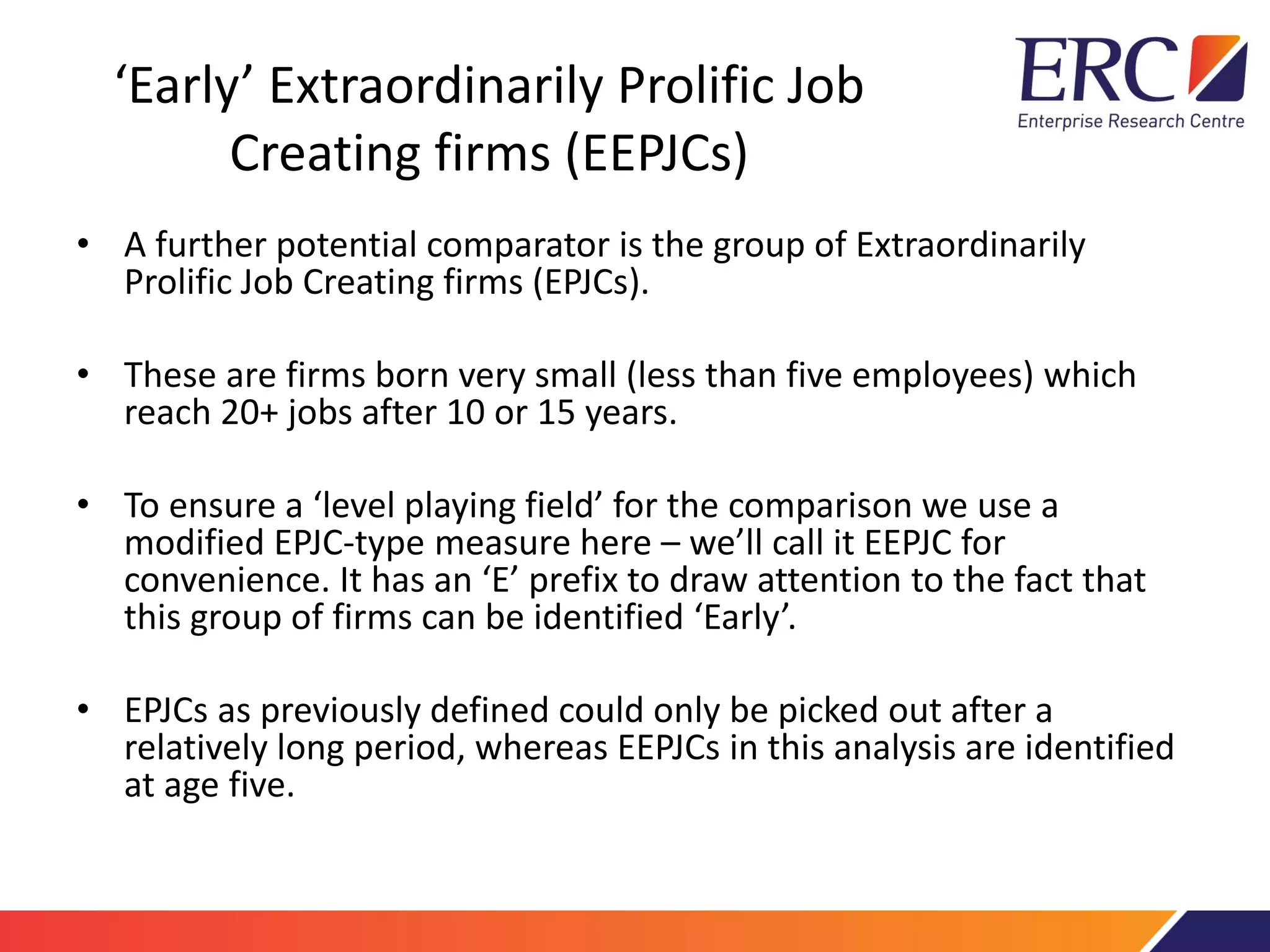
• A further potential comparator is the group of Extraordinarily
Prolific Job Creating firms (EPJCs).
• These are firms born very small (less than five employees) which
reach 20+ jobs after 10 or 15 years.
• To ensure a ‘level playing field’ for the comparison we use a
modified EPJC-type measure here – we’ll call it EEPJC for
convenience. It has an ‘E’ prefix to draw attention to the fact that
this group of firms can be identified ‘Early’.
• EPJCs as previously defined could only be picked out after a
relatively long period, whereas EEPJCs in this analysis are identified
at age five.
Job Creation, Growth and Survival of
High Performing Firms: 1998-2013
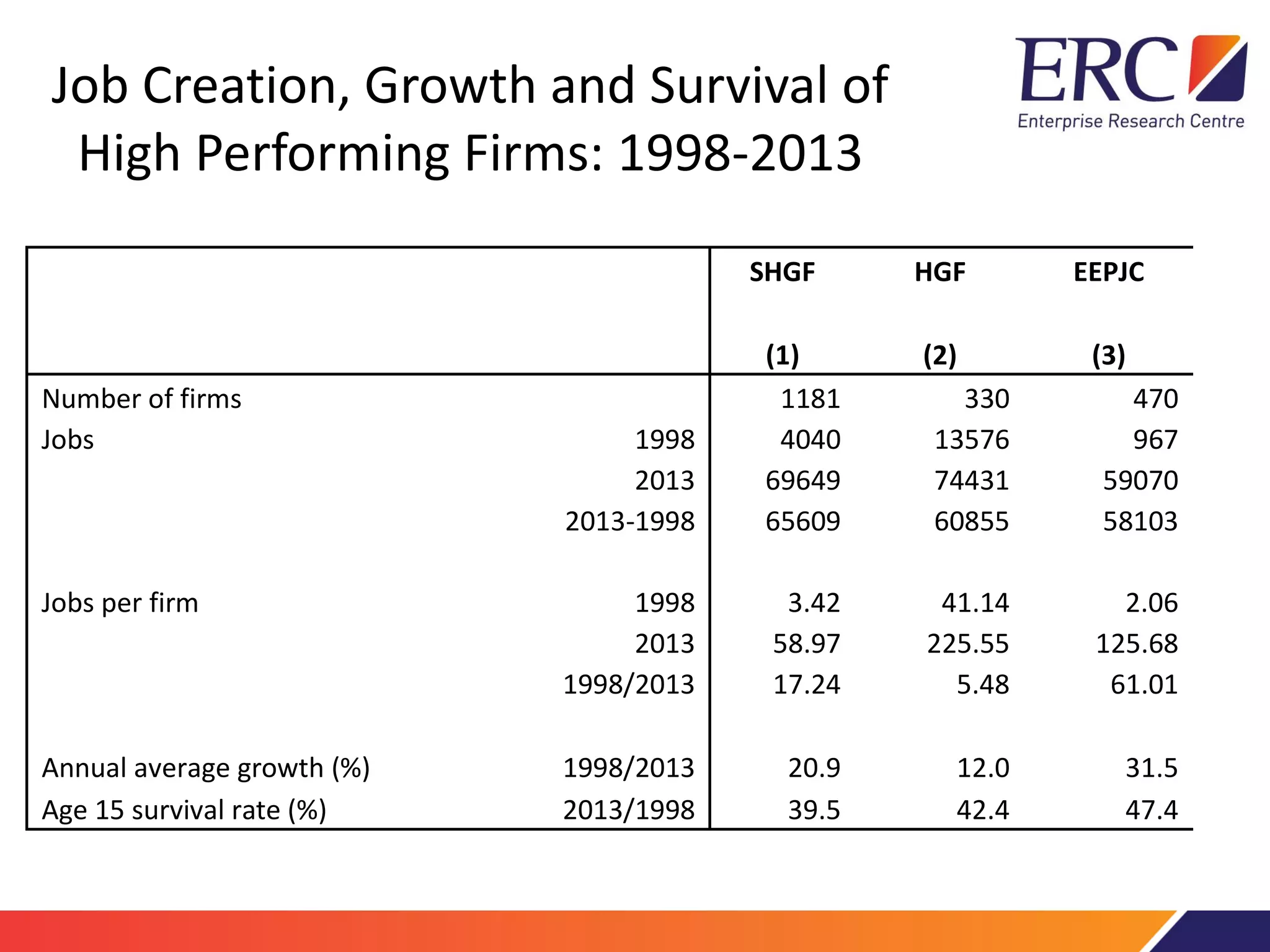
SHGF HGF EEPJC
(1) (2) (3)
Number of firms 1181 330 470
Jobs 1998 4040 13576 967
2013 69649 74431 59070
2013-1998 65609 60855 58103
Jobs per firm 1998 3.42 41.14 2.06
2013 58.97 225.55 125.68
1998/2013 17.24 5.48 61.01
Annual average growth (%) 1998/2013 20.9 12.0 31.5
Age 15 survival rate (%) 2013/1998 39.5 42.4 47.4
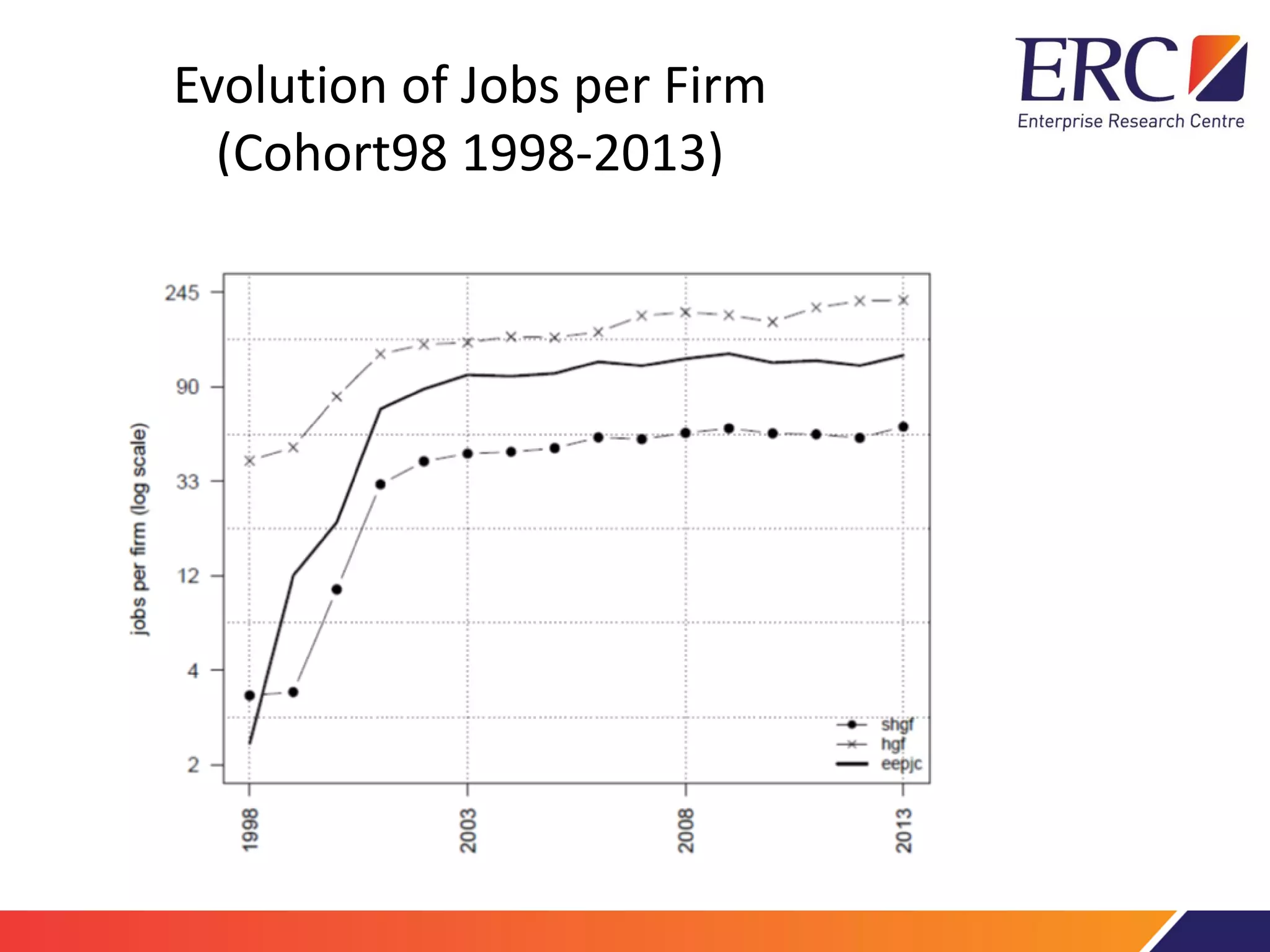
Evolution of Jobs per Firm
(Cohort98 1998-2013)
Stylised Facts – HGFs; SHGFs and EEPJCs
• Jobs: on average SHGFs grew from 3.4 jobs per firm in 1998 to 59 jobs per
firm in 2013, expanding by a factor of 17, equivalent to average annual
growth of around 20% per year over 15 years. EEPJCs are on average are
always larger than SHGFs, and by age three EEPJCs have already reached
70 jobs per firm.
• Growth Rate: average annual growth of the HGFs from birth to age 15 at
12.0% is only a little more than half the rate recorded by SHGFs. EEPJCs
have an average rate of job growth close to 30%, so in growth terms they
outperform SHGFs.
• Survival: for EEPJCs the survival rate is 47%, marginally better than that for
SHGFs (and HGFs).
Summary
• From a policymakers perspective each of these groups of firms has
advantages and disadvantages when we compare across the three
dimensions considered here, that is: the contribution to job
creation; growth; and survival.
• It is interesting to observe that the OECD HGFs (the commonest
definition of a ‘high-growth’ firm in almost all policy discussions) do
not create the most jobs, they grow more slowly and have a lower
survival rate than one or other of the two comparator groups of
high performing firms.
• The other important finding is that the bulk of the job growth in all
three groups takes place in the first five years after start-up. These
two conclusions are of crucial importance for the development of
an industrial strategy built upon the pillar of ‘business growth and
investment’.
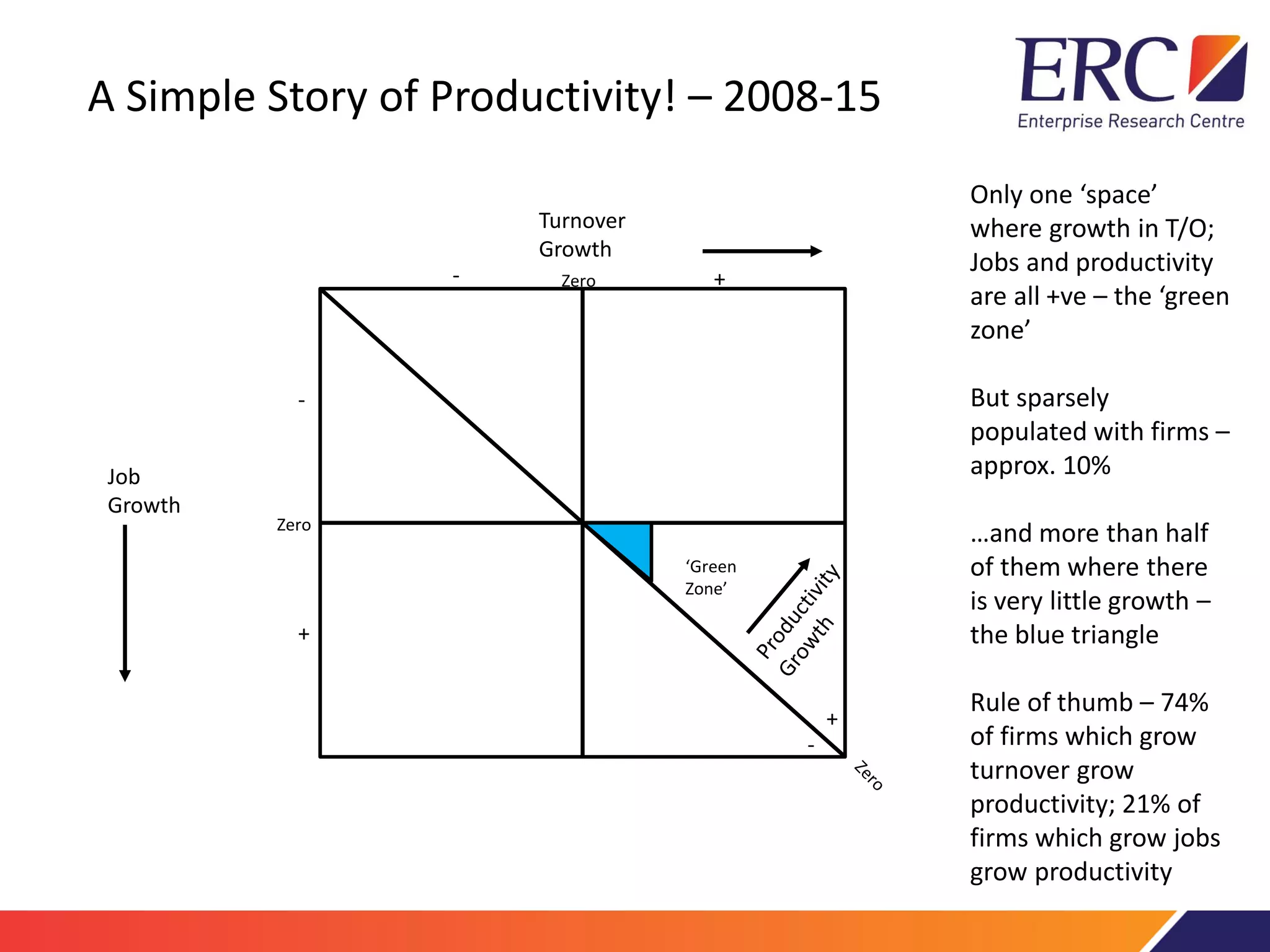
A Simple Story of Productivity! – 2008-15
Turnover
Growth
Job
Growth
Zero
Zero
‘Green
Zone’
+
+
+
-
-
-
Only one ‘space’
where growth in T/O;
Jobs and productivity
are all +ve – the ‘green
zone’
But sparsely
populated with firms –
approx. 10%
…and more than half
of them where there
is very little growth –
the blue triangle
Rule of thumb – 74%
of firms which grow
turnover grow
productivity; 21% of
firms which grow jobs
grow productivity
Productivity and OECD High-Growth Firms?
• Only 20% of 10+ employee firms in the ‘green zone’ are HGFs (T/O
definition)
• Only 5% of 10+ employee firms in the ‘green zone’ are HGFs (Jobs
definition)
• So from a productivity perspective HGFs are not an important group of
firms – sits alongside their relative poorer performance on jobs!!
ERC’S Local
Growth
Dashboard –
Focus on
Geography of
Growing Firms
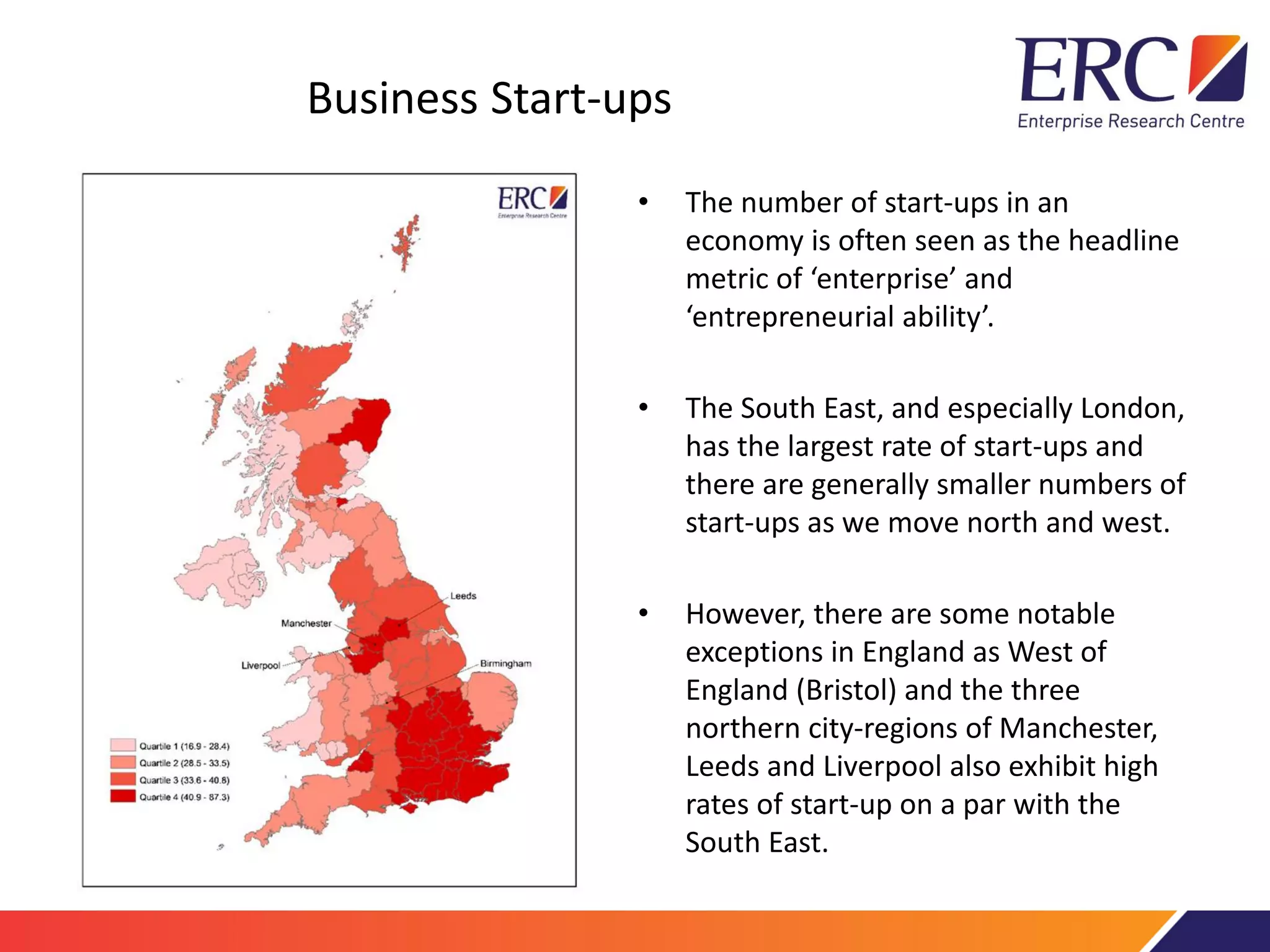
Business Start-ups
• The number of start-ups in an
economy is often seen as the headline
metric of ‘enterprise’ and
‘entrepreneurial ability’.
• The South East, and especially London,
has the largest rate of start-ups and
there are generally smaller numbers of
start-ups as we move north and west.
• However, there are some notable
exceptions in England as West of
England (Bristol) and the three
northern city-regions of Manchester,
Leeds and Liverpool also exhibit high
rates of start-up on a par with the
South East.
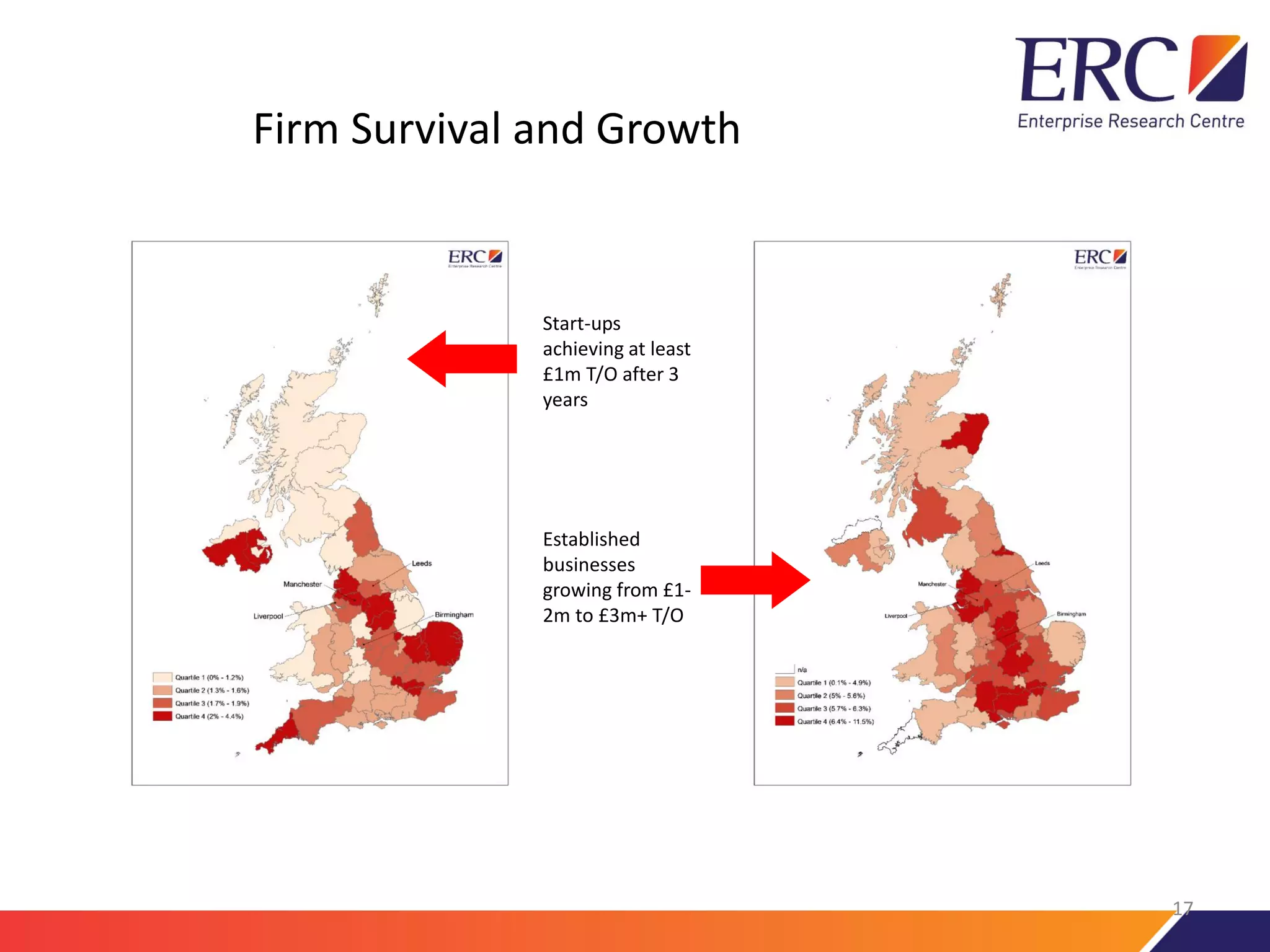
Firm Survival and Growth
17
Start-ups
achieving at least
£1m T/O after 3
years
Established
businesses
growing from £1-
2m to £3m+ T/O
Fast-Growing Firms (2012-15)
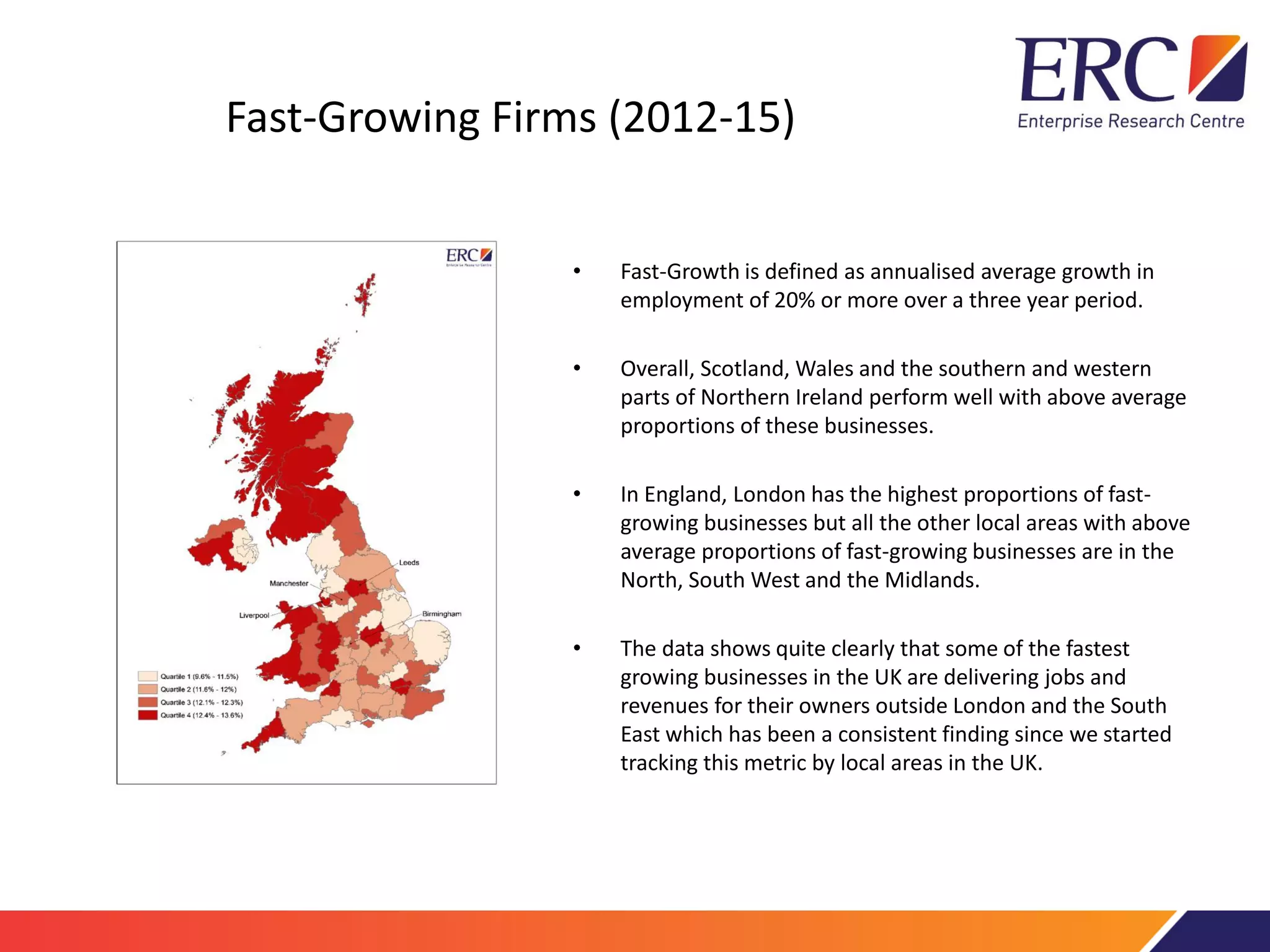
• Fast-Growth is defined as annualised average growth in
employment of 20% or more over a three year period.
• Overall, Scotland, Wales and the southern and western
parts of Northern Ireland perform well with above average
proportions of these businesses.
• In England, London has the highest proportions of fast-
growing businesses but all the other local areas with above
average proportions of fast-growing businesses are in the
North, South West and the Midlands.
• The data shows quite clearly that some of the fastest
growing businesses in the UK are delivering jobs and
revenues for their owners outside London and the South
East which has been a consistent finding since we started
tracking this metric by local areas in the UK.
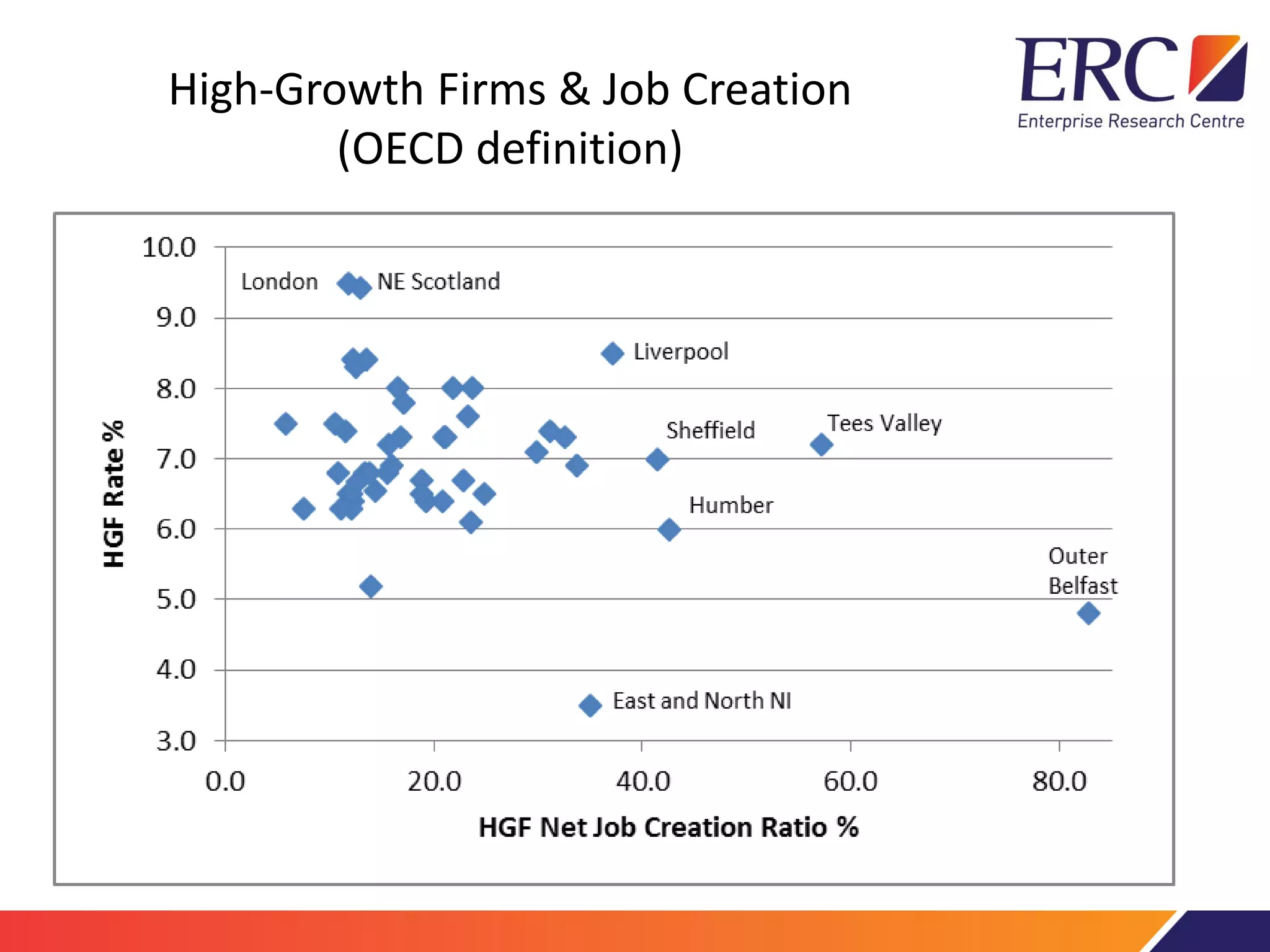
High-Growth Firms & Job Creation
(OECD definition)
Driving Business Support
Interventions
• Analysis does confirm the value of locally differentiated policies
reflecting the local realities of business dynamics – being reflected in
SEPs and funding deals??
• Something long recognised in Scotland, Wales and Northern Ireland
but constantly being re-worked in England!
Creating a Growth Pipeline
• A single-minded preoccupation with ‘scale-ups’ defined as the OECD HGFs is
not a sensible focus for policy-makers - not only is it somewhat artificially
defined, it has the disadvantage, as we have seen, of rendering invisible the
reality of growth for the majority of businesses
• And now we know they are less important for jobs and productivity growth
than one might have imagined!
• It would be more informative to concentrate on the importance of creating a
growth pipeline at local level and monitoring its development over time.
Thank you!
Questions and comments?
More information at http://enterpriseresearch.ac.uk/
Contact us about this research: Mark Hart mark.hart@aston.ac.uk
This work reflects the joint effort by the research team of the ERC,
including Michael Anyadike-Danes, Karen Bonner and Mark Hart.
This work contains statistical data from ONS which is Crown Copyright. The use of these data does not imply the
endorsement of the data owner or the UK Data Service at the UK Data Archive in relation to the interpretation or analysis of
the data. This work uses research datasets which may not exactly reproduce National Statistics aggregates.

ERC BEIS Local growth presentation. Mark Hart . 13.03.2017

  • 1.
    Professor Mark Hart ERC BEISWorkshop 13th March 2017
  • 2.
    Overview • The importanceof ‘high-growth’ firms (or ‘scale-ups’) is now regularly acknowledged in almost all national and local policy strategic plans, and the recent Industrial Strategy Green Paper is no exception - so timely to pause for some evidential reflection!! • ERC’s Local Growth Dashboard - need to understand the various types of firms that are growing and where they are concentrated - greater granularity in growth metrics better informs the development of local and regional economic policy
  • 3.
    Job Creation andDestruction Update
  • 4.
    High Performing Firms– defintions? • The OECD High-Growth Firm (HGF) measure was a pragmatic solution to a practical problem. It was designed to assist in identifying the small group of firms which contributed disproportionately to job creation. • This statistic could be used to inform national policy and to make comparisons across countries, since it could be readily replicated using business register data. • Anyadike-Danes et al., (2009) and NESTA (2009) reported on the metric for the first time for the UK – recently updated by NESTA in December 2016
  • 5.
    OECD HGFs –an update to 2016
  • 6.
    The Problem withthe OECD Definition • The decade since the measure was first published has seen increasing dissatisfaction amongst the academics and policymakers seeking to make use of it. • There are two important criticisms: – First, it focuses attention on relatively short ‘bursts’ of growth rendering invisible the reality of growth for the majority of businesses. – Second, it does not in fact capture some important members of its target group the ‘relatively small proportion of firms that contribute disproportionately to job creation’.
  • 7.
    Moving on…. alongitudinal perspective • New analysis of job creation in the UK, using data on a cohort of start-ups born in 1998 to identify three different groups of high performing firms: – OECD High-Growth Firms (HGFs) – as defined in the Manual of Business Demography, firms: are at least one year old at the beginning of a three year ‘growth period’; have average annual growth of 20% over the ‘growth period’, equivalent to an overall 72.8%; and have at least 10 employees in the first year of the growth period. – The Clayton variance – a US BLS alternative measure extended the definition of a high-growth firm to include firms with less than ten employees if the firm added eight or more employees during the three year growth period – i.e., Small High-Growth Firms (SHGFs). – ‘Early’ Extraordinarily Prolific Job Creating firms (EEPJCs)
  • 8.
    ‘Early’ Extraordinarily ProlificJob Creating firms (EEPJCs) • A further potential comparator is the group of Extraordinarily Prolific Job Creating firms (EPJCs). • These are firms born very small (less than five employees) which reach 20+ jobs after 10 or 15 years. • To ensure a ‘level playing field’ for the comparison we use a modified EPJC-type measure here – we’ll call it EEPJC for convenience. It has an ‘E’ prefix to draw attention to the fact that this group of firms can be identified ‘Early’. • EPJCs as previously defined could only be picked out after a relatively long period, whereas EEPJCs in this analysis are identified at age five.
  • 9.
    Job Creation, Growthand Survival of High Performing Firms: 1998-2013 SHGF HGF EEPJC (1) (2) (3) Number of firms 1181 330 470 Jobs 1998 4040 13576 967 2013 69649 74431 59070 2013-1998 65609 60855 58103 Jobs per firm 1998 3.42 41.14 2.06 2013 58.97 225.55 125.68 1998/2013 17.24 5.48 61.01 Annual average growth (%) 1998/2013 20.9 12.0 31.5 Age 15 survival rate (%) 2013/1998 39.5 42.4 47.4
  • 10.
    Evolution of Jobsper Firm (Cohort98 1998-2013)
  • 11.
    Stylised Facts –HGFs; SHGFs and EEPJCs • Jobs: on average SHGFs grew from 3.4 jobs per firm in 1998 to 59 jobs per firm in 2013, expanding by a factor of 17, equivalent to average annual growth of around 20% per year over 15 years. EEPJCs are on average are always larger than SHGFs, and by age three EEPJCs have already reached 70 jobs per firm. • Growth Rate: average annual growth of the HGFs from birth to age 15 at 12.0% is only a little more than half the rate recorded by SHGFs. EEPJCs have an average rate of job growth close to 30%, so in growth terms they outperform SHGFs. • Survival: for EEPJCs the survival rate is 47%, marginally better than that for SHGFs (and HGFs).
  • 12.
    Summary • From apolicymakers perspective each of these groups of firms has advantages and disadvantages when we compare across the three dimensions considered here, that is: the contribution to job creation; growth; and survival. • It is interesting to observe that the OECD HGFs (the commonest definition of a ‘high-growth’ firm in almost all policy discussions) do not create the most jobs, they grow more slowly and have a lower survival rate than one or other of the two comparator groups of high performing firms. • The other important finding is that the bulk of the job growth in all three groups takes place in the first five years after start-up. These two conclusions are of crucial importance for the development of an industrial strategy built upon the pillar of ‘business growth and investment’.
  • 13.
    A Simple Storyof Productivity! – 2008-15 Turnover Growth Job Growth Zero Zero ‘Green Zone’ + + + - - - Only one ‘space’ where growth in T/O; Jobs and productivity are all +ve – the ‘green zone’ But sparsely populated with firms – approx. 10% …and more than half of them where there is very little growth – the blue triangle Rule of thumb – 74% of firms which grow turnover grow productivity; 21% of firms which grow jobs grow productivity
  • 14.
    Productivity and OECDHigh-Growth Firms? • Only 20% of 10+ employee firms in the ‘green zone’ are HGFs (T/O definition) • Only 5% of 10+ employee firms in the ‘green zone’ are HGFs (Jobs definition) • So from a productivity perspective HGFs are not an important group of firms – sits alongside their relative poorer performance on jobs!!
  • 15.
    ERC’S Local Growth Dashboard – Focuson Geography of Growing Firms
  • 16.
    Business Start-ups • Thenumber of start-ups in an economy is often seen as the headline metric of ‘enterprise’ and ‘entrepreneurial ability’. • The South East, and especially London, has the largest rate of start-ups and there are generally smaller numbers of start-ups as we move north and west. • However, there are some notable exceptions in England as West of England (Bristol) and the three northern city-regions of Manchester, Leeds and Liverpool also exhibit high rates of start-up on a par with the South East.
  • 17.
    Firm Survival andGrowth 17 Start-ups achieving at least £1m T/O after 3 years Established businesses growing from £1- 2m to £3m+ T/O
  • 18.
    Fast-Growing Firms (2012-15) •Fast-Growth is defined as annualised average growth in employment of 20% or more over a three year period. • Overall, Scotland, Wales and the southern and western parts of Northern Ireland perform well with above average proportions of these businesses. • In England, London has the highest proportions of fast- growing businesses but all the other local areas with above average proportions of fast-growing businesses are in the North, South West and the Midlands. • The data shows quite clearly that some of the fastest growing businesses in the UK are delivering jobs and revenues for their owners outside London and the South East which has been a consistent finding since we started tracking this metric by local areas in the UK.
  • 19.
    High-Growth Firms &Job Creation (OECD definition)
  • 20.
    Driving Business Support Interventions •Analysis does confirm the value of locally differentiated policies reflecting the local realities of business dynamics – being reflected in SEPs and funding deals?? • Something long recognised in Scotland, Wales and Northern Ireland but constantly being re-worked in England!
  • 21.
    Creating a GrowthPipeline • A single-minded preoccupation with ‘scale-ups’ defined as the OECD HGFs is not a sensible focus for policy-makers - not only is it somewhat artificially defined, it has the disadvantage, as we have seen, of rendering invisible the reality of growth for the majority of businesses • And now we know they are less important for jobs and productivity growth than one might have imagined! • It would be more informative to concentrate on the importance of creating a growth pipeline at local level and monitoring its development over time.
  • 22.
    Thank you! Questions andcomments? More information at http://enterpriseresearch.ac.uk/ Contact us about this research: Mark Hart mark.hart@aston.ac.uk This work reflects the joint effort by the research team of the ERC, including Michael Anyadike-Danes, Karen Bonner and Mark Hart. This work contains statistical data from ONS which is Crown Copyright. The use of these data does not imply the endorsement of the data owner or the UK Data Service at the UK Data Archive in relation to the interpretation or analysis of the data. This work uses research datasets which may not exactly reproduce National Statistics aggregates.