AreejTorla areej@iium.edu.my
 Section 340(2)
1. Fraud/fraudulent misrepresentation
2. Registration obtained by forgery
3. Registration obtained by insufficient or void
instrument
4. Unlawfully acquired title or interest
 Must prove 3 elements of fraud:
1. “Actual fraud”
2. The RP whose title is to be defeated must be
party or privy to the fraud.
3. Intention to cheat.
 “dishonesty – a willful and conscious
disregard and violation of the rights of other
persons”
– Waimiha Sawmilling Co. Ltd [1923] NZLR 1137
 FederalCourt: there must be actual fraud to
defeat a person of his title or interest.
 Cited Assetts v Mere Roihi:
 “fraud in actions seeking to affect a
registered title means actual fraud, a
dishonesty of some sort, not what is called
constructive or equitable fraud”
 Developer sold houses to purchasers.
Charged the land to appl. Defaulted in
payment.
 Appl applied for an order for sale of the land.
 Purchasers opposed. Argued that appl had
failed to make inquiries before executing the
charge.
 If the appl had make proper inquiries, they
would have found out that the houses on the
land had been sold to the purchasers.
 High Court: Appl had constructive notice of
the purchasers interest in the land.
 Its demand for sale of the land constituted
fraud on the purchasers.
 However, Fed Court: there must be actual
fraudto defeat title or interest.
 Requirement laid down in section 340(2)(a).
 In Assets v Mere Roihi, Privy Council:
 “The fraud must be brought home to the
person whose registered title is impeached or
to his agents”.
 Tara, RP, lived on the land with husband
Devan and 5 children
 Devan’s brother, Dr. Das, obtained a loan
from Hong Kong and Shanghai bank in
Singapore to obtain a loan for his computer
medical centre.
 Dr Das consulted Devan who persuadedTara
to put up the land as security for the loan.
 Jagindar, a lawyer, was a guarantor for the
loan. He and his friends, Suppiah and Arul,
went toTara’s house and asked her to signed
a few documents.
 They misrepresented toTara that the security
was to be effected by a transfer.
 Without knowing it,Tara had transferred her
land to Suppiah and 18 days later he
transferred it to Arul.
 Later, the land was transferred to a developer
company belonging to Datuk Jagindar.
 The land was subdivided and sold to various
purchasers.
 Held:
 There was fraud to defeat Suppiah’s title,
Arul’s title and the developer company’s title.
 However, the purchasers titles could not be
defeated since they were bona fide
purchasers for value without notice of the
fraud.
 Goh HooiYin v Lim
 “it is not enough to show that the transfer
had the effect of depriving the plaintiff of a
known existing right.
It must be demonstrated that the transfer was
executed with the intention of cheating the
plaintiff of such right…”
 --beyond reasonable doubt
 (Saminathan v Pappa)
 Note: onus to prove forgery is only on a
balance of probability
 Other cases on fraud:
 OweThen Kooi 1990 1 MLJ 234
 Nallammal v Karuppanan 1993 4 CLJ 454
 Forgery is the creation of a false written
document or alteration of a genuine one,
with the intent to defraud.
 Although it is a species of fraud, under the
NLC, forgery is not the same as fraud.
 The requirements are different.
 No need to prove that the RP is party or privy
to the forgery.
 Forgery relates to the instrument of transfer.
 Forgery invalidates the instrument of dealing.
 Focus is on the instrument, and not act of the
parties.
 The instrument becomes a defective
instrument of dealing.
 Court of Appeal:
 “A registration obtained by forgery is of no
effect…it is clear that there can be no
registration without an instrument. Hence, one
of the ways in which to defeat a registration is by
impugning the very instrument of transfer by
means of which the registered proprietor
obtained his title. If the instrument was forged
or by other reason was insufficient or void, the
title of the registered proprietor may be set
aside.”
 Mrs. Messer (the RP) executed a POA to her
husband, Mr. Messer, with power to transfer
the land.
 Both of them left the country and left the title
in the custody of a solicitor, Mr. Creswell.
 Creswell forged Mr. Messer’s signature and
transferred the land to a Mr. Cameron (a
fictitious person).
 Creswell posed as an agent of Messer and
presented the transfer for registration.
 The transfer was registered.
 He then posed as an agent for ‘Mr. Cameron’,
who was now the RP, and created a mortgage
over the land.
 When Mrs. Messer returned, Creswell
absconded.
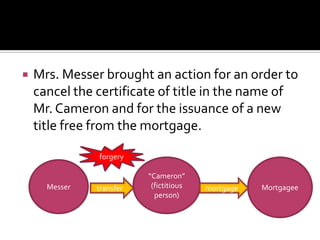
 Mrs. Messer brought an action for an order to
cancel the certificate of title in the name of
Mr. Cameron and for the issuance of a new
title free from the mortgage.
Messer
“Cameron”
(fictitious
person)
Mortgageetransfer mortgage
forgery
 Issue:
 Whether Mrs. Messer could defeat the
mortgage on the grounds of forgery.
 Held:
 The mortgage was invalid due to forgery
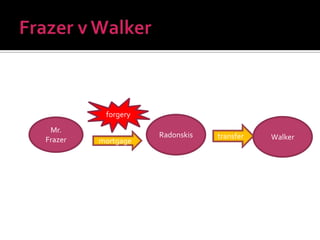
Mr.
Frazer
Radonskis Walkermortgage
transfer
forgery
 The Court held in favour of immediate
indefeasibility
 The title of the Radonskis was an indefeasible
title from the time of registration.
 Even though the mortgage was a void
document at common law, it did not affect
the indefeasibility of their title.
 The Court’s decision in Frazer vWalker did not
overrule Gibbs v Messer but distinguished it
on the basis that Gibbs v Messer involved a
fictitious person.
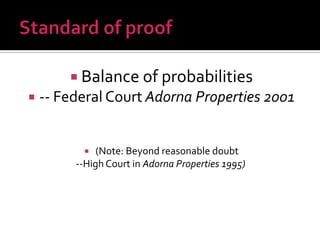
 Balance of probabilities
 -- Federal Court Adorna Properties 2001
 (Note: Beyond reasonable doubt
--High Court in Adorna Properties 1995)
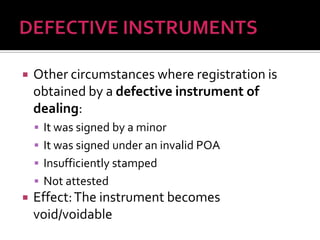
 Other circumstances where registration is
obtained by a defective instrument of
dealing:
 It was signed by a minor
 It was signed under an invalid POA
 Insufficiently stamped
 Not attested
 Effect:The instrument becomes
void/voidable
 If immediate indefeasibility applies,
registration cures the defect.
 The new RP obtains an indefeasible title even
though a defective instrument was used.
 If deferred indefeasibility applies, the title of
the RP is open to attack (defeasible) until it is
transferred to a subsequent transferee who is
a bona fide purchaser for value without
notice of the defect.
 The Registrar had rejected the instrument of
transfer as it was signed by the transferor
under an invalid power of attorney.
 The transferee (appellant) appealed claiming
to be entitled to indefeasibility.
 The appeal was dismissed.
 There was nothing registered in favour of the
appellant.
 This case shows that Malaysia applies
deferred indefeasibility.
 Even if the transfer had been registered, the
court would still hold that the appellant’s title
is defeasible due to the invalid POA.
 Two instruments of transfer executed by a
minor.
 Held: the transfers are void
 Court:
 An instrument of dealing signed pursuant to
an invalid or insufficient power of attorney is
reagrded as an ‘insufficient or void
instrument’.
 Charge registered in breach of a restriction in
interest.
 Court: title of the chargee was defeasible.

LAND LAW 1 INDEFEASIBILITY PART 2 2014

  • 1.
  • 3.
     Section 340(2) 1.Fraud/fraudulent misrepresentation 2. Registration obtained by forgery 3. Registration obtained by insufficient or void instrument 4. Unlawfully acquired title or interest
  • 4.
     Must prove3 elements of fraud: 1. “Actual fraud” 2. The RP whose title is to be defeated must be party or privy to the fraud. 3. Intention to cheat.
  • 5.
     “dishonesty –a willful and conscious disregard and violation of the rights of other persons” – Waimiha Sawmilling Co. Ltd [1923] NZLR 1137
  • 6.
     FederalCourt: theremust be actual fraud to defeat a person of his title or interest.  Cited Assetts v Mere Roihi:  “fraud in actions seeking to affect a registered title means actual fraud, a dishonesty of some sort, not what is called constructive or equitable fraud”
  • 7.
     Developer soldhouses to purchasers. Charged the land to appl. Defaulted in payment.  Appl applied for an order for sale of the land.  Purchasers opposed. Argued that appl had failed to make inquiries before executing the charge.  If the appl had make proper inquiries, they would have found out that the houses on the land had been sold to the purchasers.
  • 8.
     High Court:Appl had constructive notice of the purchasers interest in the land.  Its demand for sale of the land constituted fraud on the purchasers.  However, Fed Court: there must be actual fraudto defeat title or interest.
  • 9.
     Requirement laiddown in section 340(2)(a).  In Assets v Mere Roihi, Privy Council:  “The fraud must be brought home to the person whose registered title is impeached or to his agents”.
  • 10.
     Tara, RP,lived on the land with husband Devan and 5 children  Devan’s brother, Dr. Das, obtained a loan from Hong Kong and Shanghai bank in Singapore to obtain a loan for his computer medical centre.  Dr Das consulted Devan who persuadedTara to put up the land as security for the loan.
  • 11.
     Jagindar, alawyer, was a guarantor for the loan. He and his friends, Suppiah and Arul, went toTara’s house and asked her to signed a few documents.  They misrepresented toTara that the security was to be effected by a transfer.
  • 12.
     Without knowingit,Tara had transferred her land to Suppiah and 18 days later he transferred it to Arul.  Later, the land was transferred to a developer company belonging to Datuk Jagindar.  The land was subdivided and sold to various purchasers.
  • 13.
     Held:  Therewas fraud to defeat Suppiah’s title, Arul’s title and the developer company’s title.  However, the purchasers titles could not be defeated since they were bona fide purchasers for value without notice of the fraud.
  • 14.
     Goh HooiYinv Lim  “it is not enough to show that the transfer had the effect of depriving the plaintiff of a known existing right. It must be demonstrated that the transfer was executed with the intention of cheating the plaintiff of such right…”
  • 15.
     --beyond reasonabledoubt  (Saminathan v Pappa)  Note: onus to prove forgery is only on a balance of probability
  • 16.
     Other caseson fraud:  OweThen Kooi 1990 1 MLJ 234  Nallammal v Karuppanan 1993 4 CLJ 454
  • 17.
     Forgery isthe creation of a false written document or alteration of a genuine one, with the intent to defraud.  Although it is a species of fraud, under the NLC, forgery is not the same as fraud.  The requirements are different.  No need to prove that the RP is party or privy to the forgery.
  • 18.
     Forgery relatesto the instrument of transfer.  Forgery invalidates the instrument of dealing.  Focus is on the instrument, and not act of the parties.  The instrument becomes a defective instrument of dealing.
  • 19.
     Court ofAppeal:  “A registration obtained by forgery is of no effect…it is clear that there can be no registration without an instrument. Hence, one of the ways in which to defeat a registration is by impugning the very instrument of transfer by means of which the registered proprietor obtained his title. If the instrument was forged or by other reason was insufficient or void, the title of the registered proprietor may be set aside.”
  • 20.
     Mrs. Messer(the RP) executed a POA to her husband, Mr. Messer, with power to transfer the land.  Both of them left the country and left the title in the custody of a solicitor, Mr. Creswell.  Creswell forged Mr. Messer’s signature and transferred the land to a Mr. Cameron (a fictitious person).
  • 21.
     Creswell posedas an agent of Messer and presented the transfer for registration.  The transfer was registered.  He then posed as an agent for ‘Mr. Cameron’, who was now the RP, and created a mortgage over the land.  When Mrs. Messer returned, Creswell absconded.
  • 22.
     Mrs. Messerbrought an action for an order to cancel the certificate of title in the name of Mr. Cameron and for the issuance of a new title free from the mortgage. Messer “Cameron” (fictitious person) Mortgageetransfer mortgage forgery
  • 23.
     Issue:  WhetherMrs. Messer could defeat the mortgage on the grounds of forgery.  Held:  The mortgage was invalid due to forgery
  • 24.
  • 25.
     The Courtheld in favour of immediate indefeasibility  The title of the Radonskis was an indefeasible title from the time of registration.  Even though the mortgage was a void document at common law, it did not affect the indefeasibility of their title.
  • 26.
     The Court’sdecision in Frazer vWalker did not overrule Gibbs v Messer but distinguished it on the basis that Gibbs v Messer involved a fictitious person.
  • 27.
     Balance ofprobabilities  -- Federal Court Adorna Properties 2001  (Note: Beyond reasonable doubt --High Court in Adorna Properties 1995)
  • 28.
     Other circumstanceswhere registration is obtained by a defective instrument of dealing:  It was signed by a minor  It was signed under an invalid POA  Insufficiently stamped  Not attested  Effect:The instrument becomes void/voidable
  • 29.
     If immediateindefeasibility applies, registration cures the defect.  The new RP obtains an indefeasible title even though a defective instrument was used.  If deferred indefeasibility applies, the title of the RP is open to attack (defeasible) until it is transferred to a subsequent transferee who is a bona fide purchaser for value without notice of the defect.
  • 30.
     The Registrarhad rejected the instrument of transfer as it was signed by the transferor under an invalid power of attorney.  The transferee (appellant) appealed claiming to be entitled to indefeasibility.  The appeal was dismissed.  There was nothing registered in favour of the appellant.
  • 31.
     This caseshows that Malaysia applies deferred indefeasibility.  Even if the transfer had been registered, the court would still hold that the appellant’s title is defeasible due to the invalid POA.
  • 32.
     Two instrumentsof transfer executed by a minor.  Held: the transfers are void
  • 33.
     Court:  Aninstrument of dealing signed pursuant to an invalid or insufficient power of attorney is reagrded as an ‘insufficient or void instrument’.
  • 34.
     Charge registeredin breach of a restriction in interest.  Court: title of the chargee was defeasible.