



Confidential – © 2016 Equinix Inc. Equinix.com 1
Peering at Equinix
Why location choice matters
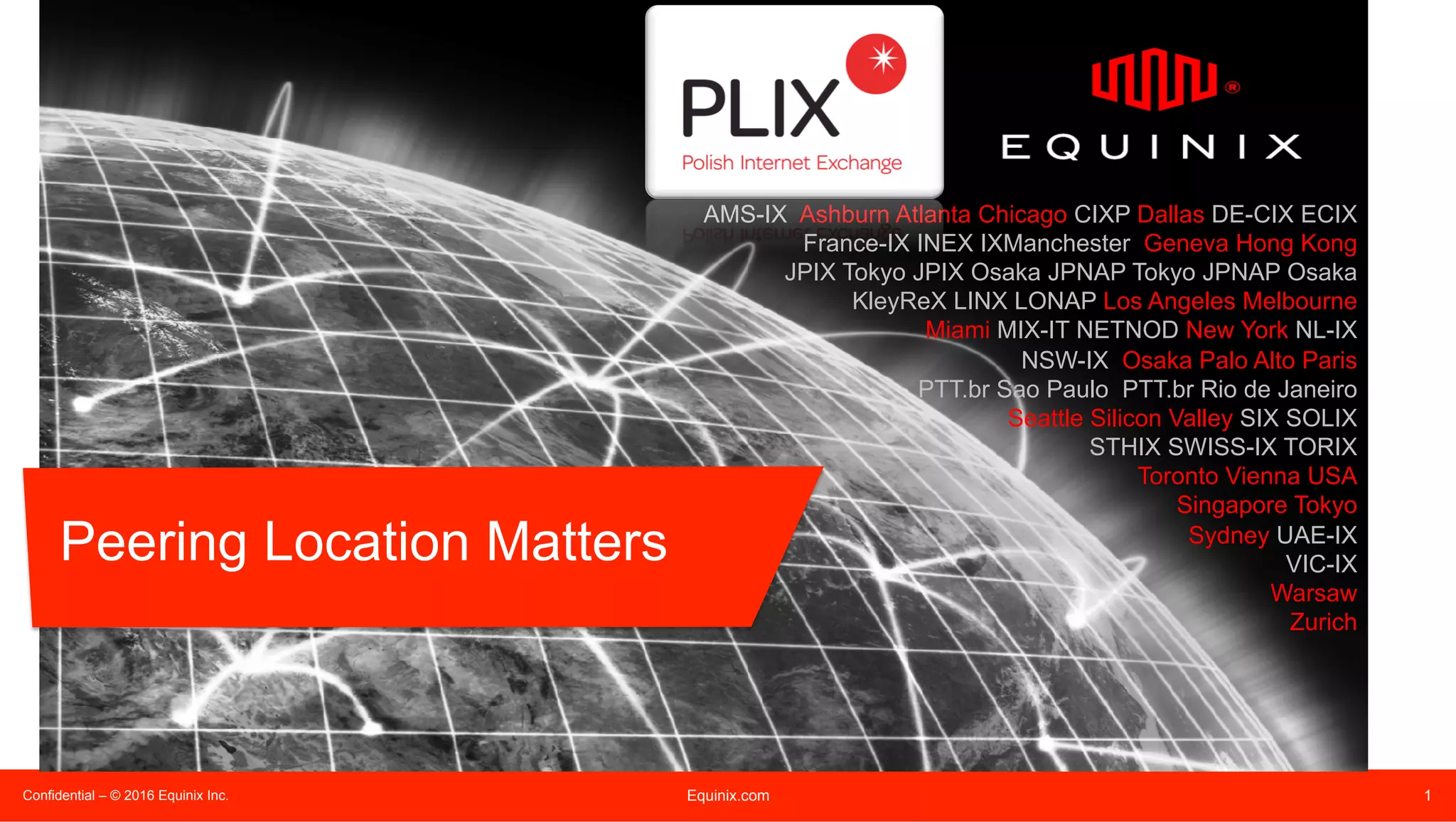
AMS-IX • Ashburn • Atlanta • Chicago • CIXP • Dallas • DE-CIX • ECIX • France-IX • INEX •
IXManchester • Geneva • Hong Kong • JPIX Tokyo • JPIX Osaka • JPNAP Tokyo • JPNAP
Osaka • KleyReX • LINX • LONAP • Los Angeles • Melbourne • Miami • MIX-IT • NETNOD •
New York • NL-IX • NSW-IX • Osaka • Palo Alto • Paris • PTT.br Sao Paulo • PTT.br Rio de
Janeiro • Seattle • Silicon Valley • SIX • SOLIX • STHIX • SWISS-IX • TORIX • Toronto •
Vienna (U.S.) • Singapore • Tokyo • Sydney • UAE-IX • VIC-IX • Warsaw • Zurich
Confidential – © 2016 Equinix Inc. Equinix.com 2
2
CONTENTS
1. About Equinix
2. The Five Essentials of Peering Planning
i. Plan for 20+% future traffic growth annually
ii. Include peering as part of IP traffic growth strategy
iii. Plan for a blend of transit, public and private peering
according to traffic volumes
iv. Understand the cost and flexibility implications of
campus peering vs. distributed peering
v. Plan for private peering traffic to outgrow public peering
traffic.
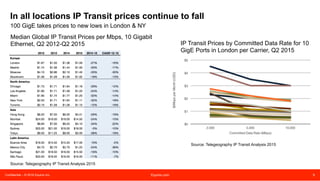
3. In the Beginning There Was IP Transit
4. Summing It All Up
2
Confidential – © 2016 Equinix Inc. Equinix.com 3
DC
NY
CH
DA
SV, PA-IX
LINX, LONAP, NL-IX DE-CIX, KLEYREX, ECIX, NL-IX
SG
SY, NSW-IX
PTT.BR SP
MI
TY, JPIX, JP-NAP
TO, TORIXSE. SIX
HKUAE-IX
ME, VIC-IX
PTT.BR RJ
OS, JPIX, JP-NAPATLA
GRX
GRX
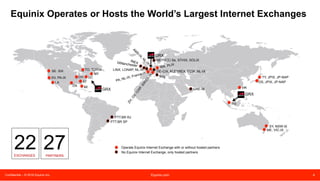
Equinix operates or hosts the world’s largest Internet Exchanges
22EXCHANGES
27PARTNERS
GRX
NETNOD Se, STHIX, SOLIX
Confidential – © 2016 Equinix Inc. Equinix.com 4
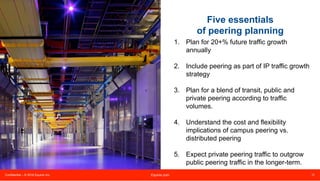
Five essentials
of peering planning
1. Plan for 20+% future traffic growth annually
2. Include peering as part of IP traffic growth
strategy
3. Plan for a blend of transit, public and private
peering according to traffic volumes
4. Understand the cost and flexibility implications
of campus peering vs. distributed peering
5. Plan for private peering traffic to outgrow
public peering traffic
Confidential – © 2016 Equinix Inc. Equinix.com 5
Peering Essential #1
Confidential – © 2016 Equinix Inc. Equinix.com 6
Plan for 20+% future traffic growth annually
Failure to plan for future growth can result in lower network performance, higher costs, and negative
customer impact
51,168
62,476
75,739
91,260
109,705
131,553
2013 2014 2015 2016 2017 2018
Global IP Traffic Forecast*
(PB per month)
* Source: Cisco Visual Networking Index: 2014
• Global IP traffic growth is forecast to grow
at 21% CAGR through 2018*
• Growth in peak traffic is increasing faster
than average traffic – peak traffic will grow
3.4x vs. average traffic at 2.8x between
2013 and 2018*
• Typical consumer broadband speeds will
grow almost 3x between 2013 and 2018 –
from 16Mbps to 42Mbps*
Peering Essential #1
Confidential – © 2016 Equinix Inc. Equinix.com 7
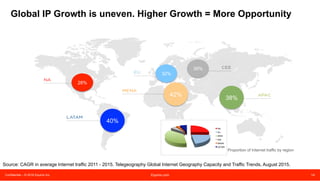
Proportion of Internet traffic by region
Global IP growth is uneven. Higher Growth = More Opportunity
Source: CAGR in average Internet traffic 2011 - 2015. Telegeography Global Internet Geography Capacity and Traffic Trends, August 2015.
NA
28%
LATAM
40%
MENA
EU
CEE
42%
32%
39%
APAC
38%
Confidential – © 2016 Equinix Inc. Equinix.com 8
Peering Essential #2
Confidential – © 2016 Equinix Inc. Equinix.com 9
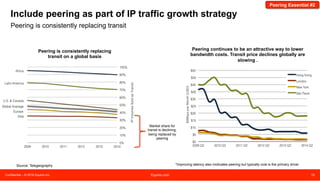
Include peering as part of IP traffic growth strategy
Peering is consistently replacing transit
Source: Telegeography
Peering Essential #2
Peering is consistently replacing
transit on a global basis
Peering continues to be an attractive way to lower
bandwidth costs. Transit price declines globally are
slowing .
Market share for
transit is declining,
being replaced by
peering
*Improving latency also motivates peering but typically cost is the primary driver
Confidential – © 2016 Equinix Inc. Equinix.com 10
Peering Essential #3
Confidential – © 2016 Equinix Inc. Equinix.com 11
Internet Exchange
IP Transit
Private Peering
Plan for a blend of transit, public and private peering according to
traffic volumes
Confidential – © 2016 Equinix Inc. Equinix.com 12
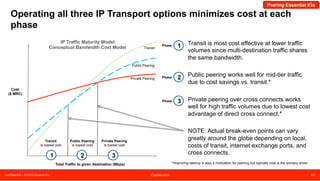
Operating all three IP Transport options minimizes
cost at each phase
Cost
($ MRC)
Total Traffic to given destination (Mbps)
Transit
Private Peering
Public Peering
Private Peering
is lowest cost
Public Peering
is lowest cost
Transit
is lowest cost
• Transit is most cost effective at lower traffic
volumes since multi-destination traffic shares
the same bandwidth
• Public peering works well for mid-tier traffic
due to cost savings vs. transit*
• Private peering over cross connects works
well for high traffic volumes due to lowest
cost advantage of direct cross connect*
NOTE: Actual break-even points can vary
greatly around the globe depending on local,
costs of transit, internet exchange ports, and
cross connects
IP Traffic Maturity Model
Conceptual Bandwidth Cost Model
Peering Essential #3a
1 2 3
1
2
3
*Improving latency is also a motivation for peering but typically cost is the primary driver
Phase
Phase
Phase
Confidential – © 2016 Equinix Inc. Equinix.com 13
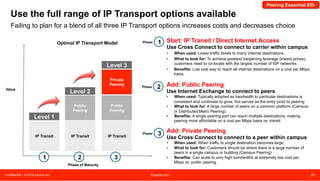
Use the full range of IP Transport options available
Peering Essential #3b
Failing to plan for a blend of all three IP Transport options increases costs and decreases choice
Value
Phase of Maturity
Optimal IP Transport Model
Level 1
Level 2
Level 3
IP Transit IP Transit IP Transit
Public
Peering
Add: Public Peering
Use Internet Exchange to connect to peers
• When used: Typically adopted as bandwidth to particular destinations is
consistent and continues to grow, this serves as the entry point to peering
• What to look for: A large number of peers on a common platform (Campus
or Distributed Metro Peering).
• Benefits: A single peering port can reach multiple destinations, making
peering more affordable on a cost per Mbps basis vs. transit
Add: Private Peering
Use Cross Connect to connect to a peer within campus
• When used: When traffic to single destination becomes large
• What to look for: Customers should be where there is a large number of
peers in a single campus or building (Campus Peering)
• Benefits: Can scale to very high bandwidths at extremely low cost per
Mbps vs. public peering
Start: IP Transit / Direct Internet Access
Use Cross Connect to connect to carrier within campus
• When used: Lower traffic levels to many Internet destinations.
• What to look for: To achieve greatest bargaining leverage (lowest prices),
customers need to co-locate with the largest number of ISP networks.
• Benefits: Low cost way to reach all internet destinations on a cost per Mbps
basis.
1
2
3
Public
Peering
Private
Peering
1 2 3
Phase
Phase
Phase
Confidential – © 2016 Equinix Inc. Equinix.com 14
Peering Essential #4
Confidential – © 2016 Equinix Inc. Equinix.com 15
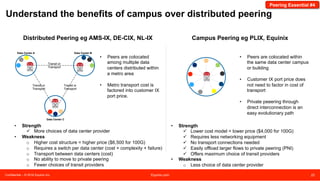
Understand the cost and flexibility of campus vs.
distributed peering
Distributed Peering
Transit or
Transport
Transit or
Transport
Transit or
Transport
Campus Peering
• Peers are colocated
among multiple data
centers distributed within
a metro area
• Metro transport cost is
factored into customer IX
port price
• Peers are colocated within the
same data center campus or
building
• Customer IX port price does
not need to factor in cost of
transport
• Strength
 More choices of data center provider
• Weakness
o Higher cost structure = higher price ($6,500 for 100G)
o Requires a switch per data center (cost + complexity + failure)
o Transport between data centers (cost)
o No ability to move to private peering
o Fewer choices of transit providers
• Strength
 Lower cost model = lower price ($4,000 for 100G)
 Requires less networking equipment
 No transport connections needed
 Easily offload larger flows to private peering (PNI)
 Offers maximum choice of transit providers
• Weakness
o Less choice of data center provider
Peering Essential #4
Data Center A Data Center B
Data Center C
Confidential – © 2016 Equinix Inc. Equinix.com 16
Peering Essential #5
Confidential – © 2016 Equinix Inc. Equinix.com 17
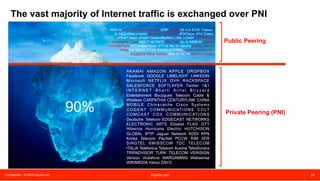
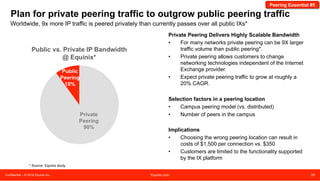
Plan for private peering traffic to outgrow public peering traffic
Private
Peering
90%
Public
Peering
10%
Public vs. Private IP Bandwidth
@ Equinix*
Private Peering Delivers Highly Scalable Bandwidth
• For many networks private peering can be 9X larger
traffic volume than public peering*
• Private peering allows customers to change
networking technologies independent of the Internet
Exchange provider
• Expect private peering traffic to grow at roughly a
20% CAGR
Selection factors in a peering location
• Campus peering model (vs. distributed)
• Number of peers in the campus
Implications
• Choosing the wrong peering location can result in
costs of $1,500 per connection vs. $350
• Customers are limited to the functionality supported
by the IX platform
* Source: Equinix study
Peering Essential #5
Worldwide, 9x more IP traffic is peered privately than currently passes over all public IXs*
Confidential – © 2016 Equinix Inc. Equinix.com 18
So why Equinix for peering?
Equinix hosts the largest private peering ecosystems worldwide
Confidential – © 2016 Equinix Inc. Equinix.com 19
IP Transit
IN THE BEGINNING
THERE WAS
Confidential – © 2016 Equinix Inc. Equinix.com 20
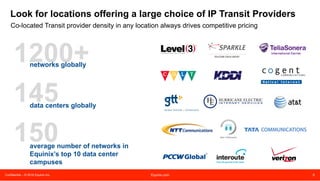
1000+
Equinix has a massive ecosystem of IP Transit Providers
average number of networks in
Equinix’s top 10 data center
campuses
100+
150
networks globally
data centers globally
Equinix offers access to hundreds of Transit providers offering low-end competitive pricing
Confidential – © 2016 Equinix Inc. Equinix.com 21
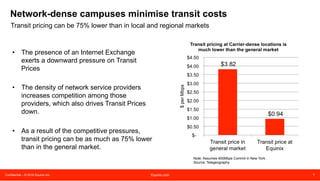
Equinix’s network-dense campuses minimizes transit costs
Note: Assumes 400Mbps Commit in New York.
Source: Telegeography
$3.82
$0.94
$-
$0.50
$1.00
$1.50
$2.00
$2.50
$3.00
$3.50
$4.00
$4.50
Transit price in
general market
Transit price at
Equinix
$perMbps
Transit pricing at Equinix is much lower than
the general market
• The density of network service providers
that Equinix has built increases competition
among those providers.
• The presence of key Internet Exchanges
exerts a downward pressure on Transit
Prices
• As a result of the competitive pressures,
transit pricing for Equinix customers can be
as much as 75% less than in the general
market.
Transit at Equinix can be 75% lower than the general market
Confidential – © 2016 Equinix Inc. Equinix.com 22
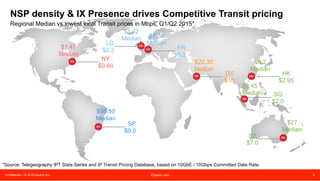
Regional Median vs lowest local Transit prices in Mbps, Q1/Q2 2015*.
Network density & IX Presence drives Competitive Transit pricing
*Source: Telegeography IPT Stats Series and IP Transit Pricing Database, based on 10GbE / 10Gbps Committed Data Rate.
NY
$0.66
FR
$0.3
LD
$0.3
SP
$9.0
DX
$10
SG
$2.0
SY
$7.0
$1.47
Median
$1.39
Median
$1.42
Median
$22.30
Median
$6.45
Median
HK
$2.95
$6.2
Median
$27
Median
$56.50
Median
Confidential – © 2016 Equinix Inc. Equinix.com 23
Summing it all up...
Confidential – © 2016 Equinix Inc. Equinix.com 24
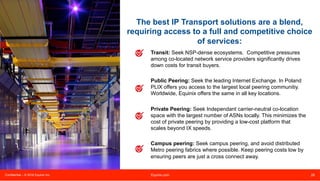
Transit: By bringing together over 1,150 network carriers globally,
Equinix creates the most dense network ecosystems. The
resulting competitive pressures among them significantly drives
down costs for transit buyers.
Public Peering: Equinix operates or partners the leading Internet
Exchanges worldwide, giving you access to the largest peering
communities in all key locations.
Private Peering: Equinix hosts the largest number of ASNs in
independant carrier-neutral co-location space. This minimizes the
cost of private peering by providing a low-cost platform that
scales beyond IX speeds.
Campus peering: Equinix has the largest set of global peering
campuses in the world which keeps peering costs low by making
peers typically just a cross connect away.
The best IP Transport solutions are a blend,
requiring access to a full and competitive
choice of services:
Confidential – © 2016 Equinix Inc. Equinix.com 25
Public Peering—
Internet Exchange
Access to EIX Internet Exchange or partner IX.
Public Peering offers low price aggregated
peering and QoS.
Private Peering—
Cross Connect
Access to 1,150+ Networks + ASNs via cross
connect. For larger throughput BGP sessions,
Private Peering offers lowest costs, highest QoS
and Security.
IP Transit—
Cross Connect
IP Transit may be the only option or might be a
cost-reduction strategy in EU and USA. QoS is
“best effort”. Equinix hosts all key global
competitive IP Transit providers, offering
maximum choice of IP transport options.
Public Internet
Public Internet
Mobile Network
Operator
IBX
Campus
Metro
Cloud Services
Cloud Provider
IT ServicesCDM Network &
Services
Mobile
Services
Network
Operator
A full and competitive choice of services
Confidential – © 2016 Equinix Inc. Equinix.com 26
Whatever the best and most competitive IP
Transport strategy for your organization…
Public or Private Peering or Transit
…Equinix offers it worldwide
Confidential – © 2016 Equinix Inc. Equinix.com 27
Case Studies and Selected Peering Member List
Confidential – © 2016 Equinix Inc. Equinix.com 28
Netflix leverages Equinix 100G IX to deliver reliable video globally
“As video usage continues to grow exponentially on the Internet, its robustness
relies on continual improvement of public Internet Exchange Platforms such as the
Equinix Internet Exchange. The massive scalability that a 100G-capable platform
provides leads to greater efficiency and helps us continue to deliver a great Netflix
experience to our members around the world.”
David Temkin
Director of Global Networks
Confidential – © 2016 Equinix Inc. Equinix.com 29
Hurricane Electric leverages public and private peering across
Equinix’s global footprint
“As the world’s largest IPv6 network, Hurricane Electric is focused on providing our
customers with the highest quality transit service at the lowest price across North
America, Asia, and Europe. To keep our costs low and reduce network latency,
Hurricane makes extensive use of Equinix’s globally deployed campus peering
environments which allows us to interconnect with companies we need to, either through
their Internet Exchange platform or through private interconnection.”
Mike Leber
President
Confidential – © 2016 Equinix Inc. Equinix.com 30
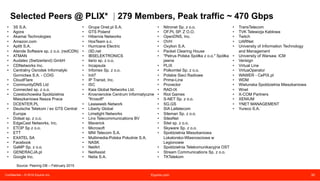
Selected Peers @ Equinix*
• Adobe Systems
• Akamai Technologies
• Amazon.com
• Apple Inc
• Bell Canada
• Blue Coat Systems, Inc
• BrightRoll, Inc.
• Broadview Networks
• BT
• CDNetworks Inc.
• Charter Communications
• Cisco Systems, Inc.
• CloudFlare
• DataPipe
• Deutsche Telekom
• Dropbox
• eBay Inc.
• EdgeCast Networks, Inc.
• Etisalat
• Facebook
• Foursquare
• Frontier Communications
• Frontier Networks
• GlobeNet
• Google Inc.
• GTT Communications
• Hibernia Networks
• Hurricane Electric
• Integra Telecom
• Intercloud
• Internap (formerly Voxel)
• Interoute
• IX Reach - IIX
• KPN
• Limelight Networks
• Linkedin
• Microsoft
• Netflix
• Neustar
• NTT Communications
• Orange Business Services
• OVH
• Pacnet
• Pandora Media, Inc
• PCCW Global
• Peak Web Hosting
• PEER 1 Hosting
• PenTeleData
• Priceline.com
• Quantcast
• Rackspace
• Rocket Fuel Inc.
• Rogers Cable
• Salesforce.com
• Shaw Cablesystems
• Sirius Telecom
• SoftLayer Technologies, Inc.
• Suddenlink Communications
• Swisscom
• Telecom Italia Sparkle
• Telekom Malaysia Berhad
• Transtelco
• TransTelecom
• TripAdvisor LLC
• tw telecom
• Twitter, Inc.
• US Signal
• Ustream, Inc.
• Valve Corporation
• Verisign
• Verizon Cloud
• Vodafone GlobalNet
• Walmart.com
• WebEx Communications
• Wikimedia Foundation
• Windstream Communications
• XMission
• XO Communications
• Yahoo!
• Zayo
• Zynga Game Network, Inc.
Source: Peering DB – June 2015
Confidential – © 2016 Equinix Inc. Equinix.com 31

Equinix peering location matters 2016_feb_24

  • 1.
    Confidential – ©2016 Equinix Inc. Equinix.com 1 Peering at Equinix Why location choice matters AMS-IX • Ashburn • Atlanta • Chicago • CIXP • Dallas • DE-CIX • ECIX • France-IX • INEX • IXManchester • Geneva • Hong Kong • JPIX Tokyo • JPIX Osaka • JPNAP Tokyo • JPNAP Osaka • KleyReX • LINX • LONAP • Los Angeles • Melbourne • Miami • MIX-IT • NETNOD • New York • NL-IX • NSW-IX • Osaka • Palo Alto • Paris • PTT.br Sao Paulo • PTT.br Rio de Janeiro • Seattle • Silicon Valley • SIX • SOLIX • STHIX • SWISS-IX • TORIX • Toronto • Vienna (U.S.) • Singapore • Tokyo • Sydney • UAE-IX • VIC-IX • Warsaw • Zurich
  • 2.
    Confidential – ©2016 Equinix Inc. Equinix.com 2 2 CONTENTS 1. About Equinix 2. The Five Essentials of Peering Planning i. Plan for 20+% future traffic growth annually ii. Include peering as part of IP traffic growth strategy iii. Plan for a blend of transit, public and private peering according to traffic volumes iv. Understand the cost and flexibility implications of campus peering vs. distributed peering v. Plan for private peering traffic to outgrow public peering traffic. 3. In the Beginning There Was IP Transit 4. Summing It All Up 2
  • 3.
    Confidential – ©2016 Equinix Inc. Equinix.com 3 DC NY CH DA SV, PA-IX LINX, LONAP, NL-IX DE-CIX, KLEYREX, ECIX, NL-IX SG SY, NSW-IX PTT.BR SP MI TY, JPIX, JP-NAP TO, TORIXSE. SIX HKUAE-IX ME, VIC-IX PTT.BR RJ OS, JPIX, JP-NAPATLA GRX GRX Equinix operates or hosts the world’s largest Internet Exchanges 22EXCHANGES 27PARTNERS GRX NETNOD Se, STHIX, SOLIX
  • 4.
    Confidential – ©2016 Equinix Inc. Equinix.com 4 Five essentials of peering planning 1. Plan for 20+% future traffic growth annually 2. Include peering as part of IP traffic growth strategy 3. Plan for a blend of transit, public and private peering according to traffic volumes 4. Understand the cost and flexibility implications of campus peering vs. distributed peering 5. Plan for private peering traffic to outgrow public peering traffic
  • 5.
    Confidential – ©2016 Equinix Inc. Equinix.com 5 Peering Essential #1
  • 6.
    Confidential – ©2016 Equinix Inc. Equinix.com 6 Plan for 20+% future traffic growth annually Failure to plan for future growth can result in lower network performance, higher costs, and negative customer impact 51,168 62,476 75,739 91,260 109,705 131,553 2013 2014 2015 2016 2017 2018 Global IP Traffic Forecast* (PB per month) * Source: Cisco Visual Networking Index: 2014 • Global IP traffic growth is forecast to grow at 21% CAGR through 2018* • Growth in peak traffic is increasing faster than average traffic – peak traffic will grow 3.4x vs. average traffic at 2.8x between 2013 and 2018* • Typical consumer broadband speeds will grow almost 3x between 2013 and 2018 – from 16Mbps to 42Mbps* Peering Essential #1
  • 7.
    Confidential – ©2016 Equinix Inc. Equinix.com 7 Proportion of Internet traffic by region Global IP growth is uneven. Higher Growth = More Opportunity Source: CAGR in average Internet traffic 2011 - 2015. Telegeography Global Internet Geography Capacity and Traffic Trends, August 2015. NA 28% LATAM 40% MENA EU CEE 42% 32% 39% APAC 38%
  • 8.
    Confidential – ©2016 Equinix Inc. Equinix.com 8 Peering Essential #2
  • 9.
    Confidential – ©2016 Equinix Inc. Equinix.com 9 Include peering as part of IP traffic growth strategy Peering is consistently replacing transit Source: Telegeography Peering Essential #2 Peering is consistently replacing transit on a global basis Peering continues to be an attractive way to lower bandwidth costs. Transit price declines globally are slowing . Market share for transit is declining, being replaced by peering *Improving latency also motivates peering but typically cost is the primary driver
  • 10.
    Confidential – ©2016 Equinix Inc. Equinix.com 10 Peering Essential #3
  • 11.
    Confidential – ©2016 Equinix Inc. Equinix.com 11 Internet Exchange IP Transit Private Peering Plan for a blend of transit, public and private peering according to traffic volumes
  • 12.
    Confidential – ©2016 Equinix Inc. Equinix.com 12 Operating all three IP Transport options minimizes cost at each phase Cost ($ MRC) Total Traffic to given destination (Mbps) Transit Private Peering Public Peering Private Peering is lowest cost Public Peering is lowest cost Transit is lowest cost • Transit is most cost effective at lower traffic volumes since multi-destination traffic shares the same bandwidth • Public peering works well for mid-tier traffic due to cost savings vs. transit* • Private peering over cross connects works well for high traffic volumes due to lowest cost advantage of direct cross connect* NOTE: Actual break-even points can vary greatly around the globe depending on local, costs of transit, internet exchange ports, and cross connects IP Traffic Maturity Model Conceptual Bandwidth Cost Model Peering Essential #3a 1 2 3 1 2 3 *Improving latency is also a motivation for peering but typically cost is the primary driver Phase Phase Phase
  • 13.
    Confidential – ©2016 Equinix Inc. Equinix.com 13 Use the full range of IP Transport options available Peering Essential #3b Failing to plan for a blend of all three IP Transport options increases costs and decreases choice Value Phase of Maturity Optimal IP Transport Model Level 1 Level 2 Level 3 IP Transit IP Transit IP Transit Public Peering Add: Public Peering Use Internet Exchange to connect to peers • When used: Typically adopted as bandwidth to particular destinations is consistent and continues to grow, this serves as the entry point to peering • What to look for: A large number of peers on a common platform (Campus or Distributed Metro Peering). • Benefits: A single peering port can reach multiple destinations, making peering more affordable on a cost per Mbps basis vs. transit Add: Private Peering Use Cross Connect to connect to a peer within campus • When used: When traffic to single destination becomes large • What to look for: Customers should be where there is a large number of peers in a single campus or building (Campus Peering) • Benefits: Can scale to very high bandwidths at extremely low cost per Mbps vs. public peering Start: IP Transit / Direct Internet Access Use Cross Connect to connect to carrier within campus • When used: Lower traffic levels to many Internet destinations. • What to look for: To achieve greatest bargaining leverage (lowest prices), customers need to co-locate with the largest number of ISP networks. • Benefits: Low cost way to reach all internet destinations on a cost per Mbps basis. 1 2 3 Public Peering Private Peering 1 2 3 Phase Phase Phase
  • 14.
    Confidential – ©2016 Equinix Inc. Equinix.com 14 Peering Essential #4
  • 15.
    Confidential – ©2016 Equinix Inc. Equinix.com 15 Understand the cost and flexibility of campus vs. distributed peering Distributed Peering Transit or Transport Transit or Transport Transit or Transport Campus Peering • Peers are colocated among multiple data centers distributed within a metro area • Metro transport cost is factored into customer IX port price • Peers are colocated within the same data center campus or building • Customer IX port price does not need to factor in cost of transport • Strength  More choices of data center provider • Weakness o Higher cost structure = higher price ($6,500 for 100G) o Requires a switch per data center (cost + complexity + failure) o Transport between data centers (cost) o No ability to move to private peering o Fewer choices of transit providers • Strength  Lower cost model = lower price ($4,000 for 100G)  Requires less networking equipment  No transport connections needed  Easily offload larger flows to private peering (PNI)  Offers maximum choice of transit providers • Weakness o Less choice of data center provider Peering Essential #4 Data Center A Data Center B Data Center C
  • 16.
    Confidential – ©2016 Equinix Inc. Equinix.com 16 Peering Essential #5
  • 17.
    Confidential – ©2016 Equinix Inc. Equinix.com 17 Plan for private peering traffic to outgrow public peering traffic Private Peering 90% Public Peering 10% Public vs. Private IP Bandwidth @ Equinix* Private Peering Delivers Highly Scalable Bandwidth • For many networks private peering can be 9X larger traffic volume than public peering* • Private peering allows customers to change networking technologies independent of the Internet Exchange provider • Expect private peering traffic to grow at roughly a 20% CAGR Selection factors in a peering location • Campus peering model (vs. distributed) • Number of peers in the campus Implications • Choosing the wrong peering location can result in costs of $1,500 per connection vs. $350 • Customers are limited to the functionality supported by the IX platform * Source: Equinix study Peering Essential #5 Worldwide, 9x more IP traffic is peered privately than currently passes over all public IXs*
  • 18.
    Confidential – ©2016 Equinix Inc. Equinix.com 18 So why Equinix for peering? Equinix hosts the largest private peering ecosystems worldwide
  • 19.
    Confidential – ©2016 Equinix Inc. Equinix.com 19 IP Transit IN THE BEGINNING THERE WAS
  • 20.
    Confidential – ©2016 Equinix Inc. Equinix.com 20 1000+ Equinix has a massive ecosystem of IP Transit Providers average number of networks in Equinix’s top 10 data center campuses 100+ 150 networks globally data centers globally Equinix offers access to hundreds of Transit providers offering low-end competitive pricing
  • 21.
    Confidential – ©2016 Equinix Inc. Equinix.com 21 Equinix’s network-dense campuses minimizes transit costs Note: Assumes 400Mbps Commit in New York. Source: Telegeography $3.82 $0.94 $- $0.50 $1.00 $1.50 $2.00 $2.50 $3.00 $3.50 $4.00 $4.50 Transit price in general market Transit price at Equinix $perMbps Transit pricing at Equinix is much lower than the general market • The density of network service providers that Equinix has built increases competition among those providers. • The presence of key Internet Exchanges exerts a downward pressure on Transit Prices • As a result of the competitive pressures, transit pricing for Equinix customers can be as much as 75% less than in the general market. Transit at Equinix can be 75% lower than the general market
  • 22.
    Confidential – ©2016 Equinix Inc. Equinix.com 22 Regional Median vs lowest local Transit prices in Mbps, Q1/Q2 2015*. Network density & IX Presence drives Competitive Transit pricing *Source: Telegeography IPT Stats Series and IP Transit Pricing Database, based on 10GbE / 10Gbps Committed Data Rate. NY $0.66 FR $0.3 LD $0.3 SP $9.0 DX $10 SG $2.0 SY $7.0 $1.47 Median $1.39 Median $1.42 Median $22.30 Median $6.45 Median HK $2.95 $6.2 Median $27 Median $56.50 Median
  • 23.
    Confidential – ©2016 Equinix Inc. Equinix.com 23 Summing it all up...
  • 24.
    Confidential – ©2016 Equinix Inc. Equinix.com 24 Transit: By bringing together over 1,150 network carriers globally, Equinix creates the most dense network ecosystems. The resulting competitive pressures among them significantly drives down costs for transit buyers. Public Peering: Equinix operates or partners the leading Internet Exchanges worldwide, giving you access to the largest peering communities in all key locations. Private Peering: Equinix hosts the largest number of ASNs in independant carrier-neutral co-location space. This minimizes the cost of private peering by providing a low-cost platform that scales beyond IX speeds. Campus peering: Equinix has the largest set of global peering campuses in the world which keeps peering costs low by making peers typically just a cross connect away. The best IP Transport solutions are a blend, requiring access to a full and competitive choice of services:
  • 25.
    Confidential – ©2016 Equinix Inc. Equinix.com 25 Public Peering— Internet Exchange Access to EIX Internet Exchange or partner IX. Public Peering offers low price aggregated peering and QoS. Private Peering— Cross Connect Access to 1,150+ Networks + ASNs via cross connect. For larger throughput BGP sessions, Private Peering offers lowest costs, highest QoS and Security. IP Transit— Cross Connect IP Transit may be the only option or might be a cost-reduction strategy in EU and USA. QoS is “best effort”. Equinix hosts all key global competitive IP Transit providers, offering maximum choice of IP transport options. Public Internet Public Internet Mobile Network Operator IBX Campus Metro Cloud Services Cloud Provider IT ServicesCDM Network & Services Mobile Services Network Operator A full and competitive choice of services
  • 26.
    Confidential – ©2016 Equinix Inc. Equinix.com 26 Whatever the best and most competitive IP Transport strategy for your organization… Public or Private Peering or Transit …Equinix offers it worldwide
  • 27.
    Confidential – ©2016 Equinix Inc. Equinix.com 27 Case Studies and Selected Peering Member List
  • 28.
    Confidential – ©2016 Equinix Inc. Equinix.com 28 Netflix leverages Equinix 100G IX to deliver reliable video globally “As video usage continues to grow exponentially on the Internet, its robustness relies on continual improvement of public Internet Exchange Platforms such as the Equinix Internet Exchange. The massive scalability that a 100G-capable platform provides leads to greater efficiency and helps us continue to deliver a great Netflix experience to our members around the world.” David Temkin Director of Global Networks
  • 29.
    Confidential – ©2016 Equinix Inc. Equinix.com 29 Hurricane Electric leverages public and private peering across Equinix’s global footprint “As the world’s largest IPv6 network, Hurricane Electric is focused on providing our customers with the highest quality transit service at the lowest price across North America, Asia, and Europe. To keep our costs low and reduce network latency, Hurricane makes extensive use of Equinix’s globally deployed campus peering environments which allows us to interconnect with companies we need to, either through their Internet Exchange platform or through private interconnection.” Mike Leber President
  • 30.
    Confidential – ©2016 Equinix Inc. Equinix.com 30 Selected Peers @ Equinix* • Adobe Systems • Akamai Technologies • Amazon.com • Apple Inc • Bell Canada • Blue Coat Systems, Inc • BrightRoll, Inc. • Broadview Networks • BT • CDNetworks Inc. • Charter Communications • Cisco Systems, Inc. • CloudFlare • DataPipe • Deutsche Telekom • Dropbox • eBay Inc. • EdgeCast Networks, Inc. • Etisalat • Facebook • Foursquare • Frontier Communications • Frontier Networks • GlobeNet • Google Inc. • GTT Communications • Hibernia Networks • Hurricane Electric • Integra Telecom • Intercloud • Internap (formerly Voxel) • Interoute • IX Reach - IIX • KPN • Limelight Networks • Linkedin • Microsoft • Netflix • Neustar • NTT Communications • Orange Business Services • OVH • Pacnet • Pandora Media, Inc • PCCW Global • Peak Web Hosting • PEER 1 Hosting • PenTeleData • Priceline.com • Quantcast • Rackspace • Rocket Fuel Inc. • Rogers Cable • Salesforce.com • Shaw Cablesystems • Sirius Telecom • SoftLayer Technologies, Inc. • Suddenlink Communications • Swisscom • Telecom Italia Sparkle • Telekom Malaysia Berhad • Transtelco • TransTelecom • TripAdvisor LLC • tw telecom • Twitter, Inc. • US Signal • Ustream, Inc. • Valve Corporation • Verisign • Verizon Cloud • Vodafone GlobalNet • Walmart.com • WebEx Communications • Wikimedia Foundation • Windstream Communications • XMission • XO Communications • Yahoo! • Zayo • Zynga Game Network, Inc. Source: Peering DB – June 2015
  • 31.
    Confidential – ©2016 Equinix Inc. Equinix.com 31

Editor's Notes

  • #4  Access to the WORLD'S LARGEST INTERNET EXCHANGES (PUBLIC PEERING)
  • #8 APAC, MENA, LATAM and Africa are important areas representing future business opportunity due to huge populations and dramatic increase in Internet use. APAC IP traffic already exceeds USA & EU. LATAM will do so in 5- 7 years at current growth. [they have the population/demand, etc.]
  • #11 .
  • #19 THE LARGEST COLLECTION OF DIRECTLY PEERED ASNs (PRIVATE PEERING) in strategically located IBXs and Campuses.
  • #21  Access to all the world's most COMPETITIVE IP TRANSIT PROVIDERS
  • #24 The good news? Equinix is all about unlocking global markets and creating mutually supportive ecosystems that eliminate a lot of that complexity. And we do that by offering more choice, access, and opportunity.
  • #26 How do you deal with increasing IP traffic, falling Transit prices, restricted peering and huge regional variations? Is cost, performance or control the key factor for you? Deciding which of these three options is optimal is easy as an Equinix customer —Equinix provides every option under one roof. Bottom line: Equinix is home of the true IP ecosystem.