This presentation is
based on a report by
KASPERSKY by the
name of the “
EQUATION GROUP:
QUESTIONS AND
ANSWERS”
What is Equation Group ?
The Equation group is a highly sophisticated
threat actor that has been engaged in multiple
Computer Network Exploitation operations dating
back to 2001, and perhaps as early as 1996.
The Equation group uses multiple malware
platforms, some of which surpass the well-
known “Regin” threat in complexity and
sophistication.
Why called Equation
Group ?
In general, the Equation group uses a specific
implementation of the RC5 encryption algorithm
throughout their malware. Some of the most recent
modules use RC6, RC4 and AES too, in addition to other
cryptographic functions and hashes.
Called Equation group because of the love seen
for encryption algorithms and obfuscation
strategies and the sophisticated methods used
throughout their operations.
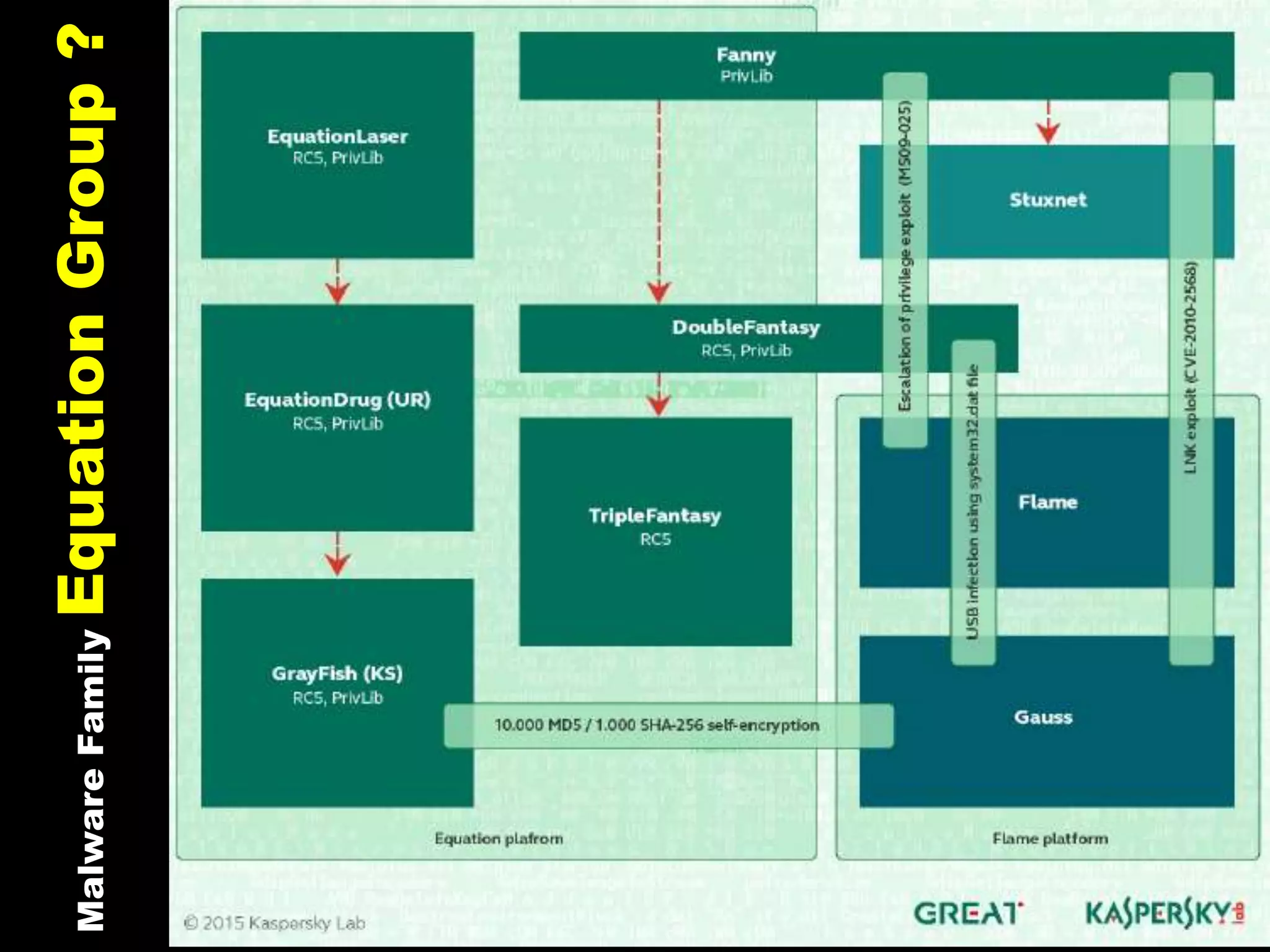
MalwareFamilyEquationGroup?
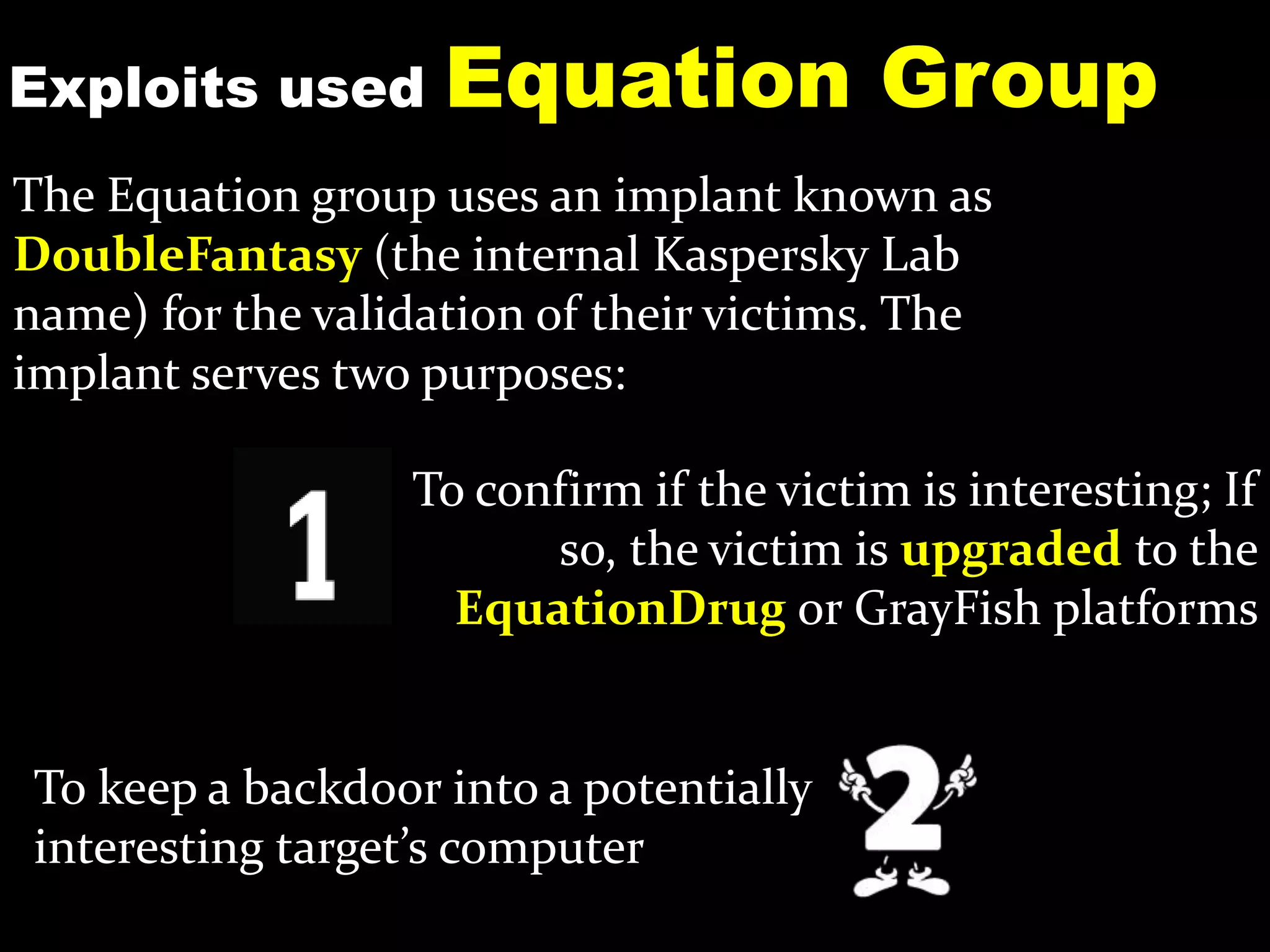
Exploits used Equation Group
To keep a backdoor into a potentially
interesting target’s computer
The Equation group uses an implant known as
DoubleFantasy (the internal Kaspersky Lab
name) for the validation of their victims. The
implant serves two purposes:
To confirm if the victim is interesting; If
so, the victim is upgraded to the
EquationDrug or GrayFish platforms
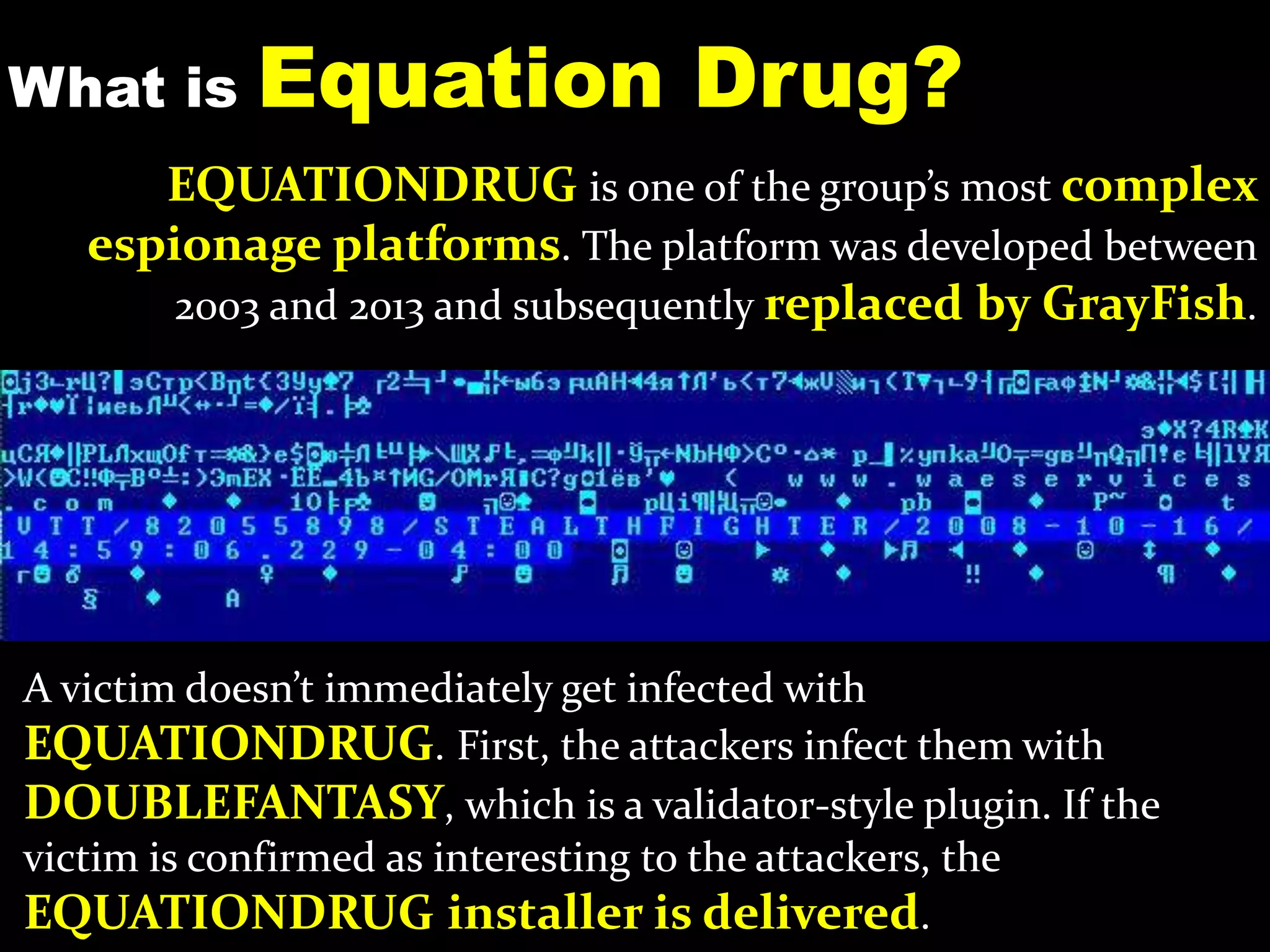
What is Equation Drug?
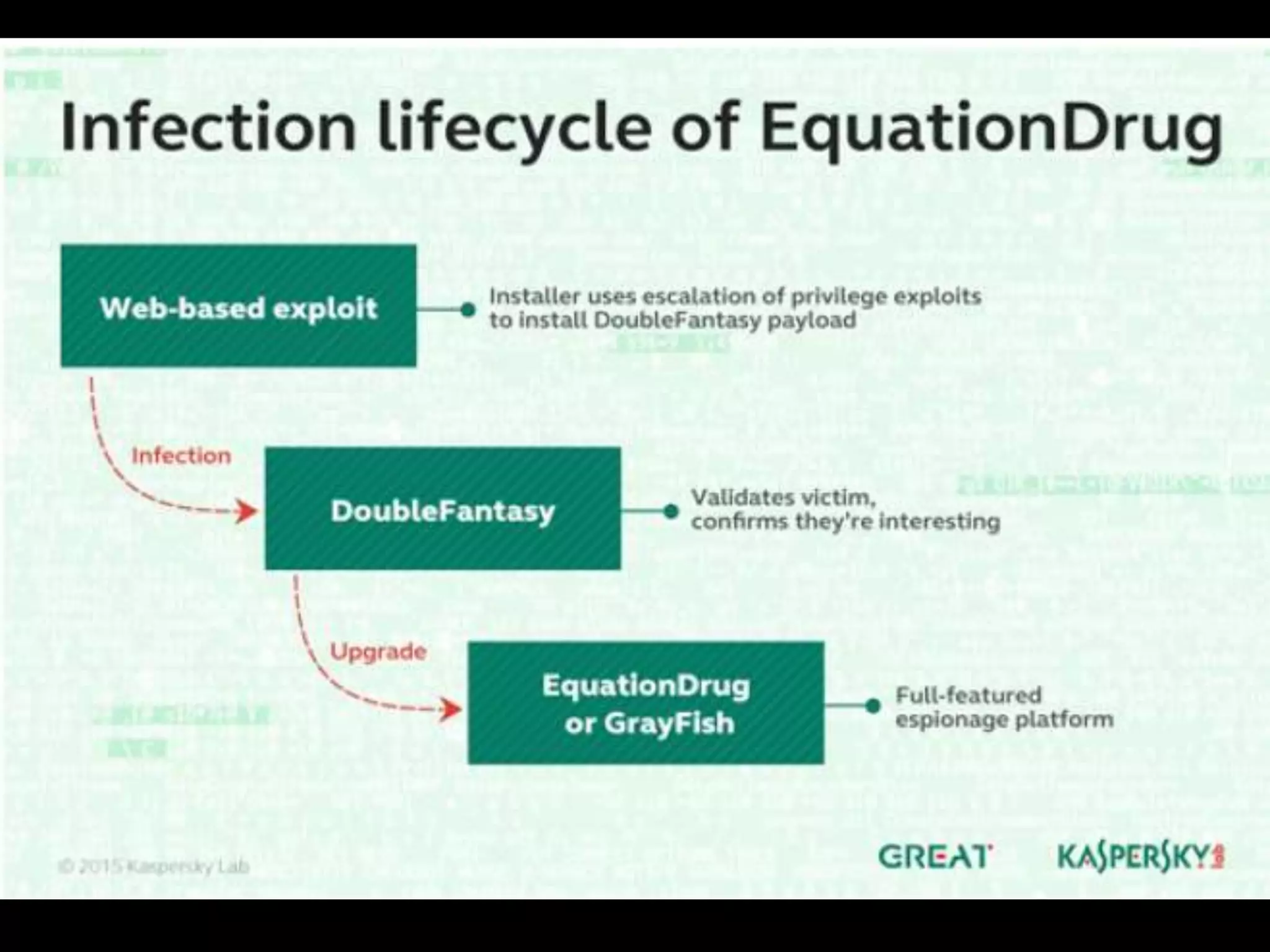
A victim doesn’t immediately get infected with
EQUATIONDRUG. First, the attackers infect them with
DOUBLEFANTASY, which is a validator-style plugin. If the
victim is confirmed as interesting to the attackers, the
EQUATIONDRUG installer is delivered.
EQUATIONDRUG is one of the group’s most complex
espionage platforms. The platform was developed between
2003 and 2013 and subsequently replaced by GrayFish.
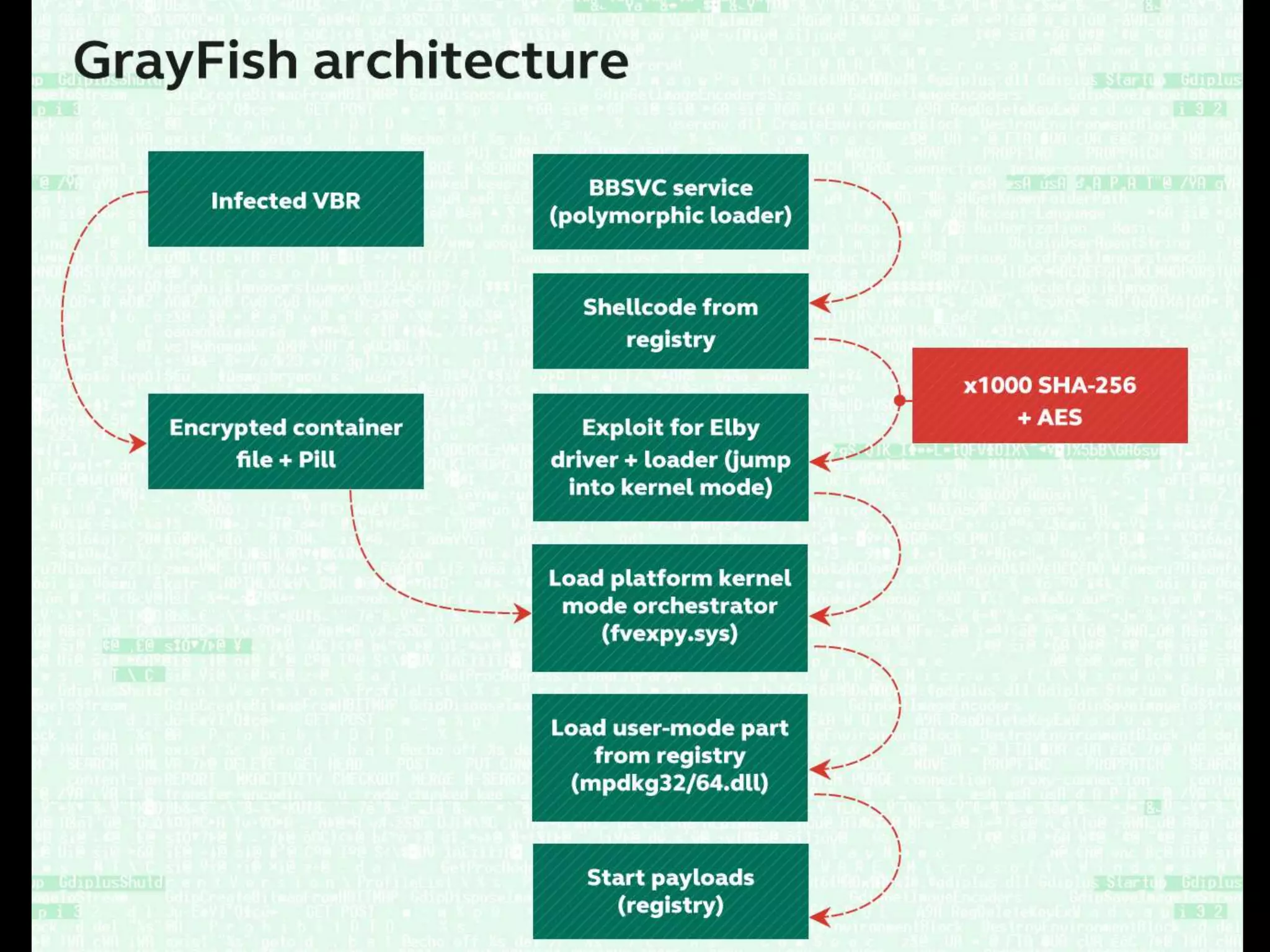
What is GRAYFISH ?
GRAYFISH is the most modern and sophisticated
malware implant from the Equation group.
It is designed to provide “invisible”
persistence mechanism, hidden storage and
malicious command execution inside the
Windows operating system.
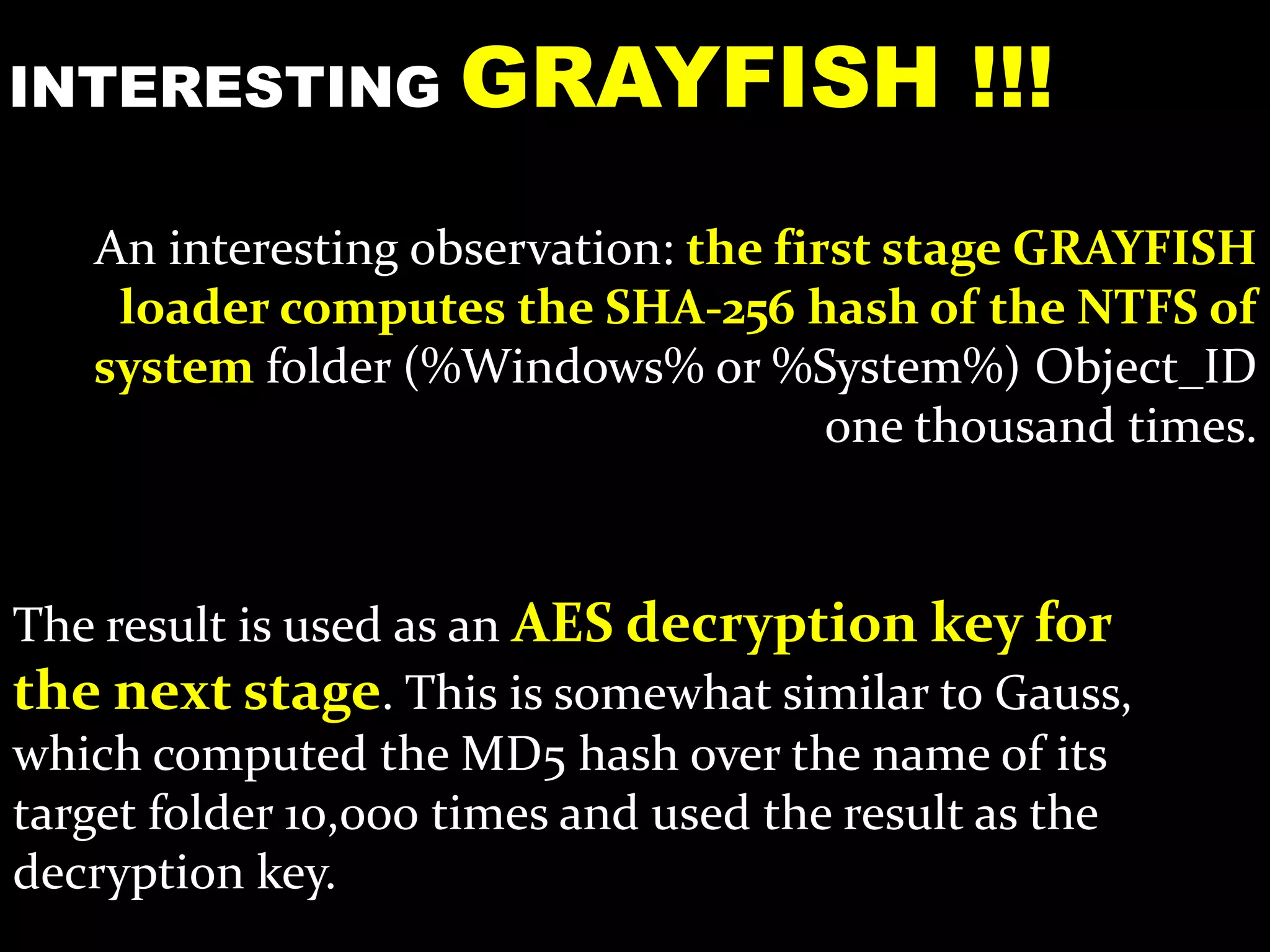
An interesting observation: the first stage GRAYFISH
loader computes the SHA-256 hash of the NTFS of
system folder (%Windows% or %System%) Object_ID
one thousand times.
INTERESTING GRAYFISH !!!
The result is used as an AES decryption key for
the next stage. This is somewhat similar to Gauss,
which computed the MD5 hash over the name of its
target folder 10,000 times and used the result as the
decryption key.
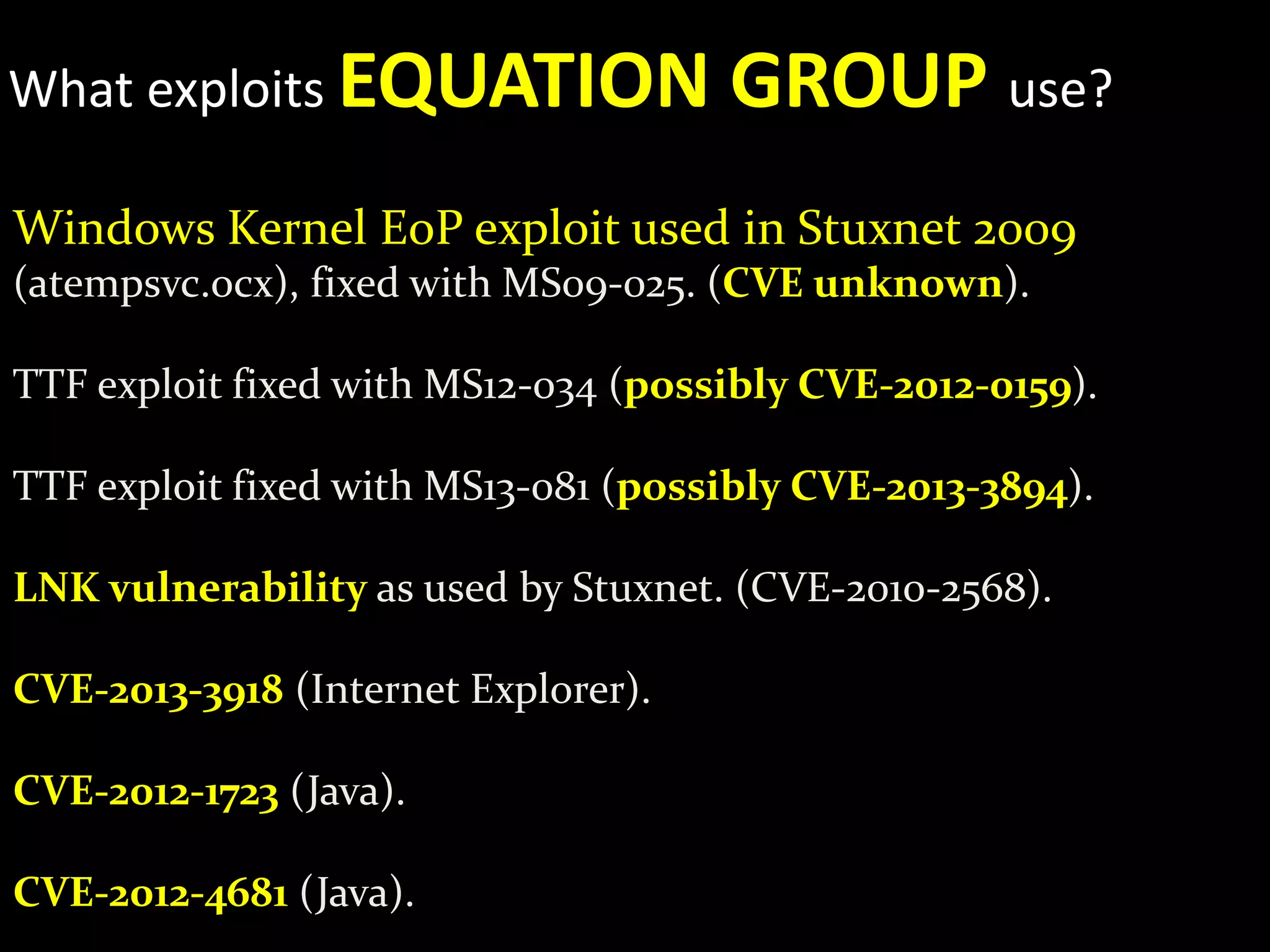
What exploits EQUATION GROUP use?
Windows Kernel EoP exploit used in Stuxnet 2009
(atempsvc.ocx), fixed with MS09-025. (CVE unknown).
TTF exploit fixed with MS12-034 (possibly CVE-2012-0159).
TTF exploit fixed with MS13-081 (possibly CVE-2013-3894).
LNK vulnerability as used by Stuxnet. (CVE-2010-2568).
CVE-2013-3918 (Internet Explorer).
CVE-2012-1723 (Java).
CVE-2012-4681 (Java).
How Do Victims Get Infected By
EQUATION Group Malware?
Equation group uses Multiple Techniques include:
Self-replicating (worm) code – Fanny
Physical media, CD-ROMs
USB sticks + exploits
Web-based exploits
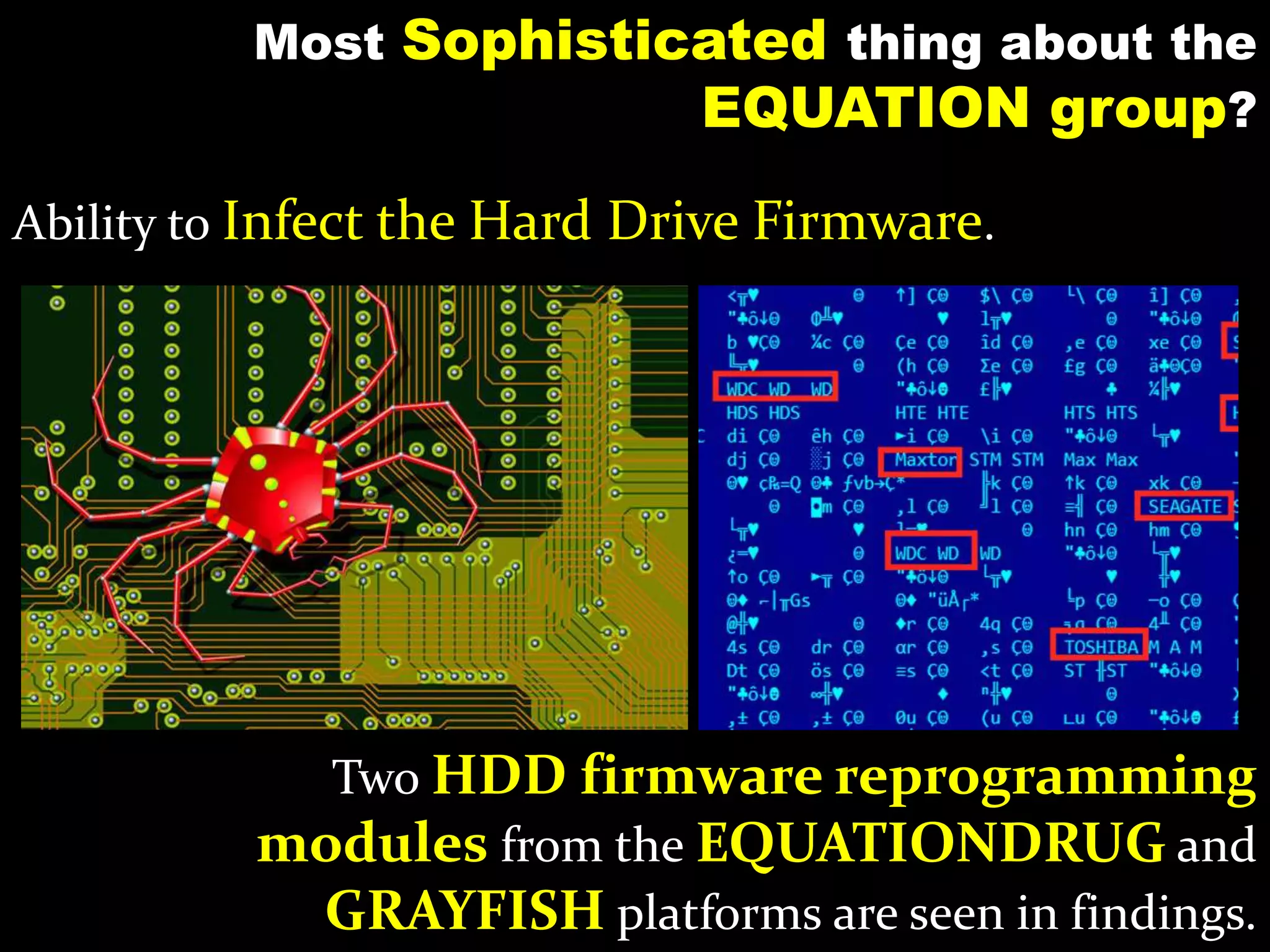
Most Sophisticated thing about the
EQUATION group?
Ability to Infect the Hard Drive Firmware.
Two HDD firmware reprogramming
modules from the EQUATIONDRUG and
GRAYFISH platforms are seen in findings.
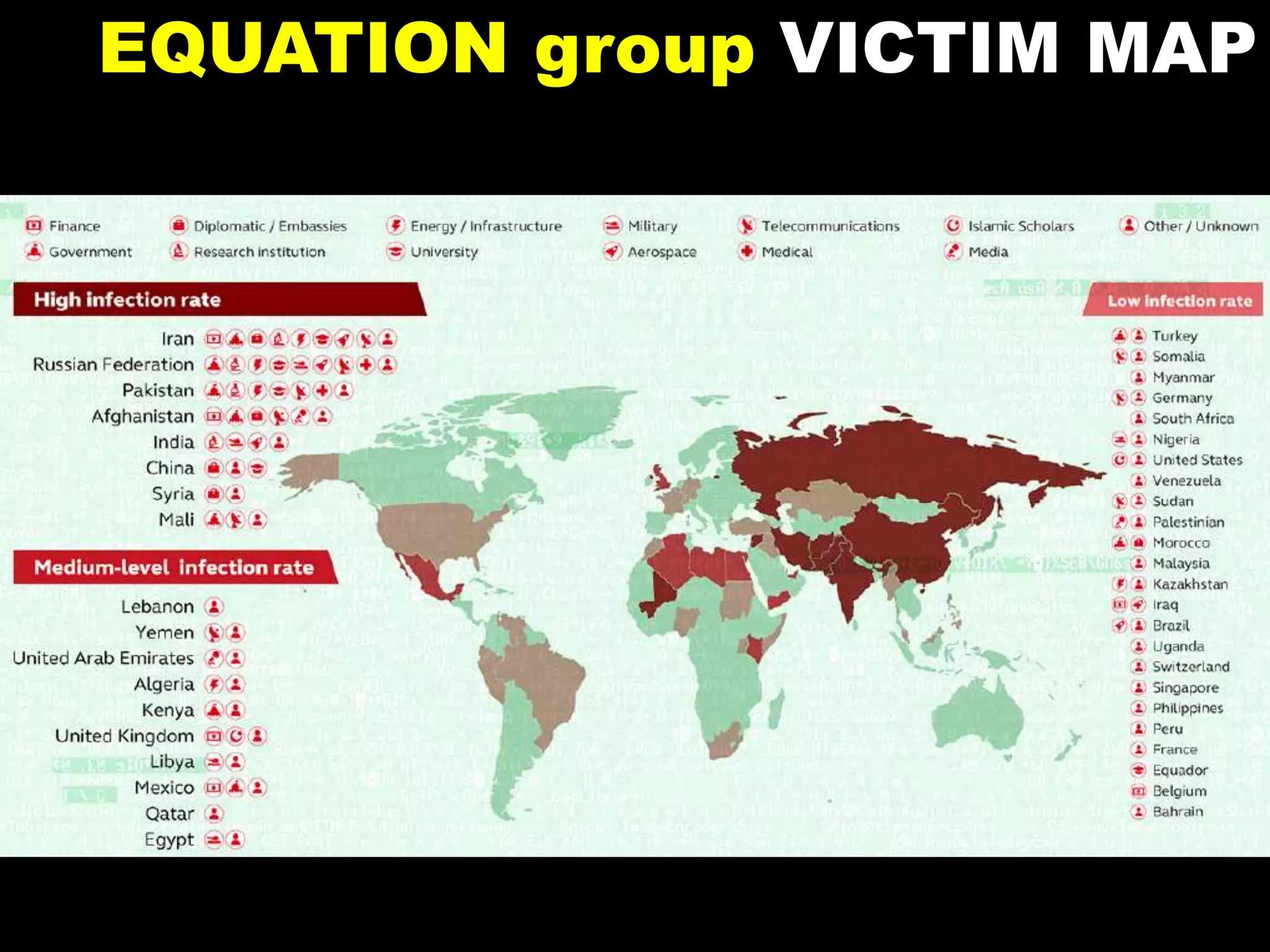
EQUATION group VICTIM MAP
Non-Windows Malware from
the Equation group?
“ All the malware we have collected so far is designed to work
on Microsoft’s Windows operating system. However, there are
signs that non-Windows malware does exist. For instance, one
of the sinkholed C&C domains is currently receiving
connections from a large pool of victims in China that appear
to be Mac OS X computers (based on the user-agent).“
C&C Infrastructure : Equation
Group
All C&C domains appear to have been registered
through the same two major registrars,
using “Domains By Proxy” to mask the
registrant’s information.
Vast C&C infrastructure that includes more than 300
domains and more than 100 servers.
Servers hosted in multiple countries, including the
US, UK, Italy, Germany, Netherlands,
Panama, Costa Rica, Malaysia, Colombia
and Czech Republic.
Contact me :
anupam605@gmail.com
http://about.me/anupam.tiwari
https://www.youtube.com/user/a
nupam50/videos

Equation Group : Advanced Secretive Computer Espionage Group

  • 2.
    This presentation is basedon a report by KASPERSKY by the name of the “ EQUATION GROUP: QUESTIONS AND ANSWERS”
  • 3.
    What is EquationGroup ? The Equation group is a highly sophisticated threat actor that has been engaged in multiple Computer Network Exploitation operations dating back to 2001, and perhaps as early as 1996. The Equation group uses multiple malware platforms, some of which surpass the well- known “Regin” threat in complexity and sophistication.
  • 4.
    Why called Equation Group? In general, the Equation group uses a specific implementation of the RC5 encryption algorithm throughout their malware. Some of the most recent modules use RC6, RC4 and AES too, in addition to other cryptographic functions and hashes. Called Equation group because of the love seen for encryption algorithms and obfuscation strategies and the sophisticated methods used throughout their operations.
  • 5.
  • 6.
    Exploits used EquationGroup To keep a backdoor into a potentially interesting target’s computer The Equation group uses an implant known as DoubleFantasy (the internal Kaspersky Lab name) for the validation of their victims. The implant serves two purposes: To confirm if the victim is interesting; If so, the victim is upgraded to the EquationDrug or GrayFish platforms
  • 7.
    What is EquationDrug? A victim doesn’t immediately get infected with EQUATIONDRUG. First, the attackers infect them with DOUBLEFANTASY, which is a validator-style plugin. If the victim is confirmed as interesting to the attackers, the EQUATIONDRUG installer is delivered. EQUATIONDRUG is one of the group’s most complex espionage platforms. The platform was developed between 2003 and 2013 and subsequently replaced by GrayFish.
  • 9.
    What is GRAYFISH? GRAYFISH is the most modern and sophisticated malware implant from the Equation group. It is designed to provide “invisible” persistence mechanism, hidden storage and malicious command execution inside the Windows operating system.
  • 11.
    An interesting observation:the first stage GRAYFISH loader computes the SHA-256 hash of the NTFS of system folder (%Windows% or %System%) Object_ID one thousand times. INTERESTING GRAYFISH !!! The result is used as an AES decryption key for the next stage. This is somewhat similar to Gauss, which computed the MD5 hash over the name of its target folder 10,000 times and used the result as the decryption key.
  • 12.
    What exploits EQUATIONGROUP use? Windows Kernel EoP exploit used in Stuxnet 2009 (atempsvc.ocx), fixed with MS09-025. (CVE unknown). TTF exploit fixed with MS12-034 (possibly CVE-2012-0159). TTF exploit fixed with MS13-081 (possibly CVE-2013-3894). LNK vulnerability as used by Stuxnet. (CVE-2010-2568). CVE-2013-3918 (Internet Explorer). CVE-2012-1723 (Java). CVE-2012-4681 (Java).
  • 13.
    How Do VictimsGet Infected By EQUATION Group Malware? Equation group uses Multiple Techniques include: Self-replicating (worm) code – Fanny Physical media, CD-ROMs USB sticks + exploits Web-based exploits
  • 14.
    Most Sophisticated thingabout the EQUATION group? Ability to Infect the Hard Drive Firmware. Two HDD firmware reprogramming modules from the EQUATIONDRUG and GRAYFISH platforms are seen in findings.
  • 15.
  • 16.
    Non-Windows Malware from theEquation group? “ All the malware we have collected so far is designed to work on Microsoft’s Windows operating system. However, there are signs that non-Windows malware does exist. For instance, one of the sinkholed C&C domains is currently receiving connections from a large pool of victims in China that appear to be Mac OS X computers (based on the user-agent).“
  • 17.
    C&C Infrastructure :Equation Group All C&C domains appear to have been registered through the same two major registrars, using “Domains By Proxy” to mask the registrant’s information. Vast C&C infrastructure that includes more than 300 domains and more than 100 servers. Servers hosted in multiple countries, including the US, UK, Italy, Germany, Netherlands, Panama, Costa Rica, Malaysia, Colombia and Czech Republic.
  • 18.