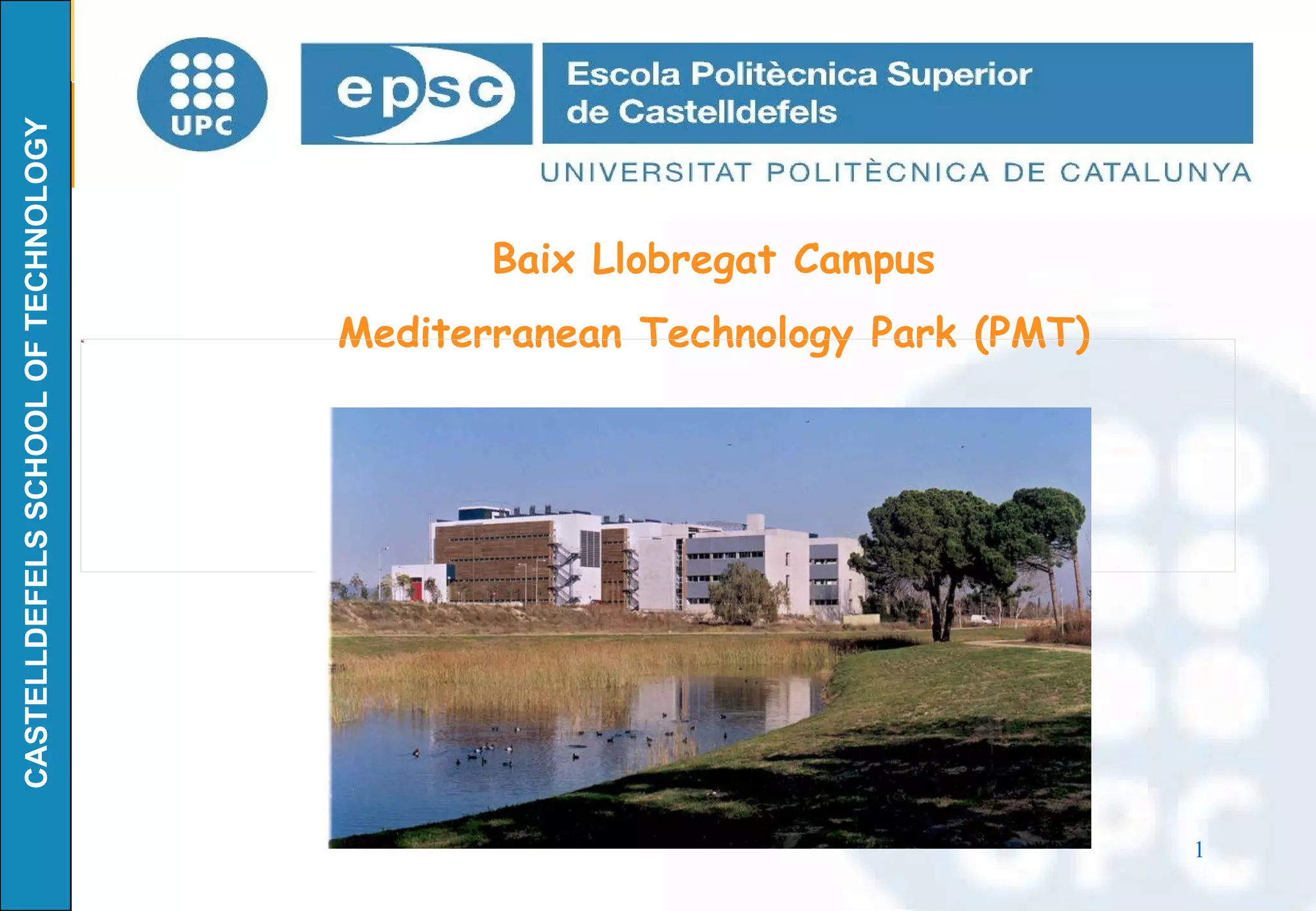
Baix Llobregat Campus Mediterranean Technology Park (PMT)
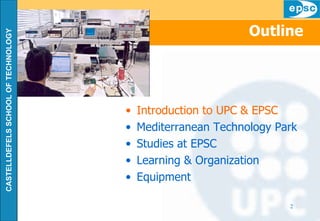
Outline Introduction to UPC & EPSC Mediterranean Technology Park Studies at EPSC Learning & Organization Equipment
UPC   Public University with a matrix based structure: 15 teaching centers and 38 departments Several Campus (Barcelona, Manresa, Terrassa, Sant Cugat, Vilanova i la Geltrú and  Baix Llobregat ) 2.400  teachers and 30.000 students. High quality teaching in Engineering and Architecture. 46 degrees and diplomas, 47 PhD programms, postgraduate studies. 98% of graduates start their first job 2 months after graduation.
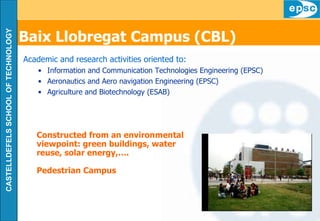
Baix Llobregat Campus (CBL)   Academic and research activities oriented to: Information and Communication Technologies Engineering (EPSC) Aeronautics and Aero navigation Engineering (EPSC) Agriculture and Biotechnology (ESAB) Constructed from an environmental viewpoint: green buildings, water reuse, solar energy,…. Pedestrian Campus
Created in 1991 Recognised quality : the first public university in Spain to obtain the  ISO 9001:1994  quality certification on Design of the Education Programme and the Organization and Development of Educational Activities. Accredited each year by external evaluators. Excellence in Bachelor : Awarded in 1996 with the most significant award given by the catalan government to academic institutions: the  “ Jaume Vicens Vives ” for the structure of the bachelor in telecommunications. Excellence in Master:  Awarded in 2004 with the  Jaume Vicens Vives  award for the quality and organization of the Master degree in Telecommunication Engineering structured with Cooperative and Project Based Learning (PBL).  Excellence in Aeronautics : Awarded with the  Flyer 2005  given by the national association of aeronautics engineers for the structure and quality of the bachelor of aeronautics engineering syllabus. EPSC: An overview
European Higher Education Area:  participating actively in a pilot funded project supported by the catalan government, to adapt Telecommunication studies (Bachelor degree) since 2004. Assesment to other schools : during the academic year 2005/2006 more than 70 universities have visited (or invited) us in order to know about our teaching & learning methodology and activities. Highly demanded by students : EPSC is the UPC school that has experienced a faster grown since  2000 (from 400 to 1400 students, 160 professors and 40 other staff)
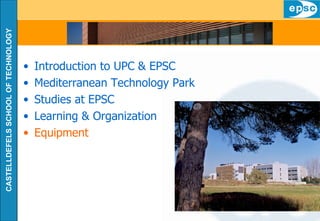
Introduction to UPC & EPSC Mediterranean Technology Park Studies at EPSC Learning & Organization Equipment
PMT The project to create the Mediterranean Technology Park (UPC & Catalan Government) originated from the   desire to promote in the same geographical area: Research & Development & I nnovation Highly specialized training Technology and human capital transfer Promotion of company initiatives Links among the university, research centers and enterprises
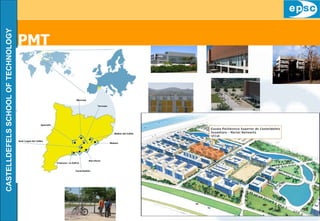
PMT
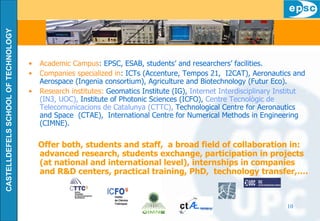
Academic Campus : EPSC, ESAB, students’ and researchers’ facilities. Companies specialized in : ICTs (Accenture, Tempos 21,  I2CAT), Aeronautics and Aerospace (Ingenia consortium), Agriculture and Biotechnology (Futur Eco). Research institutes:  Geomatics Institute (IG),  Internet Interdisciplinary Institut (IN3, UOC),  Institute of Photonic Sciences (ICFO),  Centre Tecnològic de Telecomunicacions de Catalunya (CTTC),  Technological Centre for Aeronautics and Space  (CTAE),  International Centre for Numerical Methods in Engineering (CIMNE). Offer both, students and staff,  a broad field of collaboration in: advanced research, students exchange, participation in projects (at national and international level), internships in companies and R&D centers, practical training, PhD,  technology transfer,….
Introduction to UPC & EPSC Mediterranean Technology Park Studies at EPSC Learning & Organization Equipment
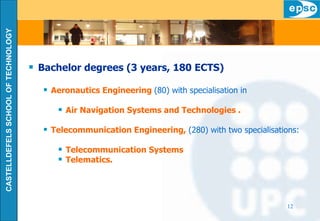
Bachelor degrees (3 years, 180 ECTS) Aeronautics Engineering  (80) with specialisation in Air Navigation Systems and Technologies . Telecommunication Engineering,  (280) with two specialisations: Telecommunication Systems Telematics.
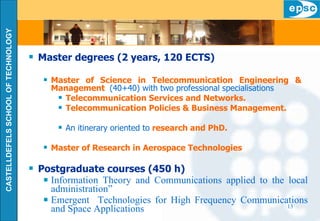
Master degrees (2 years, 120 ECTS) Master of Science in Telecommunication Engineering &  Management   (40+40) with two professional specialisations Telecommunication Services and Networks. Telecommunication Policies & Business Management. An itinerary oriented to  research and PhD. Master of Research in Aerospace Technologies Postgraduate courses (450 h) Information Theory and Communications applied to the local administration” Emergent  Technologies for High Frequency Communications and Space Applications
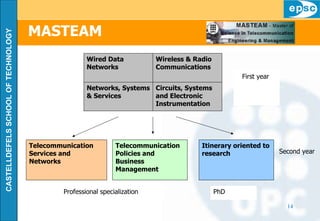
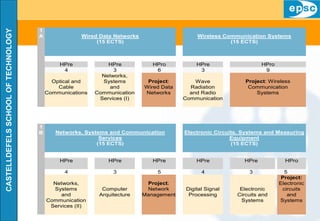
MASTEAM Wired Data Networks Wireless & Radio Communications Networks, Systems & Services Circuits, Systems and Electronic Instrumentation Telecommunication  Services and Networks Telecommunication Policies and Business Management Itinerary oriented to research PhD Professional specialization First year  Second year
 
Introduction to UPC & EPSC Mediterranean Technology Park Studies at EPSC Learning & Organization Equipment
Small groups :  40 students in lectures,  20 in laboratories Promotes experimental lessons an use of laboratories  Continuous assessment system exams < 50% of final qualification Labs, projects, problems, works,... Practical training included in syllabus More than 250 students per year, around 450 h/student, contacts with more than 180 companies. Facilities & resources for  innovative students  to create their company.
Innovation methodologies in learning Project Based Learning (PBL) Focus on: team working multidisciplinarity Oral and written skills. Students exchange
25% of graduate students participate in exchange programs Agreements with  15 spanish universities, 18 european univ (TUW, KTH, Aalborg, Delft, IST, PoliTo, Newi, Braunschweig, Limmerick ) 2 Latino américa universities (ITec Monterrey, Sto Tomas). Facilities to establish new agreements and to host foreign students. Student exchange
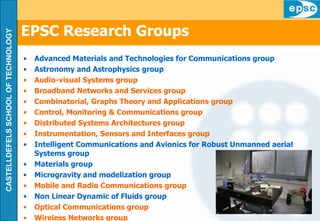
EPSC Research Groups Advanced Materials and Technologies for Communications group Astronomy and Astrophysics group Audio-visual Systems group Broadband Networks and Services group Combinatorial, Graphs Theory and Applications group Control, Monitoring & Communications group Distributed Systems Architectures group Instrumentation, Sensors and Interfaces group Intelligent Communications and Avionics for Robust Unmanned aerial Systems group Materials group Microgravity and modelization group Mobile and Radio Communications group Non Linear Dynamic of Fluids group Optical Communications group Wireless Networks group
Introduction to UPC & EPSC Mediterranean Technology Park Studies at EPSC Learning & Organization Equipment
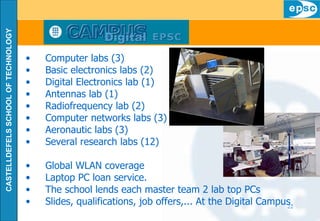
Computer labs (3) Basic electronics labs (2) Digital Electronics lab (1) Antennas lab (1) Radiofrequency lab (2) Computer networks labs (3) Aeronautic labs (3) Several research labs (12) Global WLAN coverage Laptop PC loan service. The school lends each master team 2 lab top PCs Slides, qualifications, job offers,... At the Digital Campus
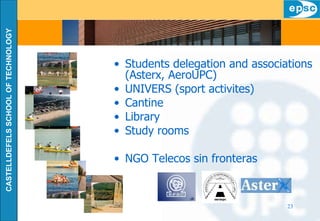
Students delegation and associations (Asterx, AeroUPC) UNIVERS (sport activites) Cantine Library Study rooms NGO Telecos sin fronteras
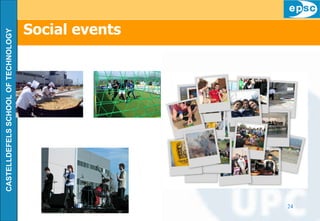
Social events
surf through our web.   www.epsc.upc.edu Questions ? Hope to see you at EPSC!

EPSC School Introduction

  • 1.
    Baix Llobregat CampusMediterranean Technology Park (PMT)
  • 2.
    Outline Introduction toUPC & EPSC Mediterranean Technology Park Studies at EPSC Learning & Organization Equipment
  • 3.
    UPC Public University with a matrix based structure: 15 teaching centers and 38 departments Several Campus (Barcelona, Manresa, Terrassa, Sant Cugat, Vilanova i la Geltrú and Baix Llobregat ) 2.400 teachers and 30.000 students. High quality teaching in Engineering and Architecture. 46 degrees and diplomas, 47 PhD programms, postgraduate studies. 98% of graduates start their first job 2 months after graduation.
  • 4.
    Baix Llobregat Campus(CBL) Academic and research activities oriented to: Information and Communication Technologies Engineering (EPSC) Aeronautics and Aero navigation Engineering (EPSC) Agriculture and Biotechnology (ESAB) Constructed from an environmental viewpoint: green buildings, water reuse, solar energy,…. Pedestrian Campus
  • 5.
    Created in 1991Recognised quality : the first public university in Spain to obtain the ISO 9001:1994 quality certification on Design of the Education Programme and the Organization and Development of Educational Activities. Accredited each year by external evaluators. Excellence in Bachelor : Awarded in 1996 with the most significant award given by the catalan government to academic institutions: the “ Jaume Vicens Vives ” for the structure of the bachelor in telecommunications. Excellence in Master: Awarded in 2004 with the Jaume Vicens Vives award for the quality and organization of the Master degree in Telecommunication Engineering structured with Cooperative and Project Based Learning (PBL). Excellence in Aeronautics : Awarded with the Flyer 2005 given by the national association of aeronautics engineers for the structure and quality of the bachelor of aeronautics engineering syllabus. EPSC: An overview
  • 6.
    European Higher EducationArea: participating actively in a pilot funded project supported by the catalan government, to adapt Telecommunication studies (Bachelor degree) since 2004. Assesment to other schools : during the academic year 2005/2006 more than 70 universities have visited (or invited) us in order to know about our teaching & learning methodology and activities. Highly demanded by students : EPSC is the UPC school that has experienced a faster grown since 2000 (from 400 to 1400 students, 160 professors and 40 other staff)
  • 7.
    Introduction to UPC& EPSC Mediterranean Technology Park Studies at EPSC Learning & Organization Equipment
  • 8.
    PMT The projectto create the Mediterranean Technology Park (UPC & Catalan Government) originated from the desire to promote in the same geographical area: Research & Development & I nnovation Highly specialized training Technology and human capital transfer Promotion of company initiatives Links among the university, research centers and enterprises
  • 9.
  • 10.
    Academic Campus :EPSC, ESAB, students’ and researchers’ facilities. Companies specialized in : ICTs (Accenture, Tempos 21, I2CAT), Aeronautics and Aerospace (Ingenia consortium), Agriculture and Biotechnology (Futur Eco). Research institutes: Geomatics Institute (IG), Internet Interdisciplinary Institut (IN3, UOC), Institute of Photonic Sciences (ICFO), Centre Tecnològic de Telecomunicacions de Catalunya (CTTC), Technological Centre for Aeronautics and Space (CTAE), International Centre for Numerical Methods in Engineering (CIMNE). Offer both, students and staff, a broad field of collaboration in: advanced research, students exchange, participation in projects (at national and international level), internships in companies and R&D centers, practical training, PhD, technology transfer,….
  • 11.
    Introduction to UPC& EPSC Mediterranean Technology Park Studies at EPSC Learning & Organization Equipment
  • 12.
    Bachelor degrees (3years, 180 ECTS) Aeronautics Engineering (80) with specialisation in Air Navigation Systems and Technologies . Telecommunication Engineering, (280) with two specialisations: Telecommunication Systems Telematics.
  • 13.
    Master degrees (2years, 120 ECTS) Master of Science in Telecommunication Engineering & Management (40+40) with two professional specialisations Telecommunication Services and Networks. Telecommunication Policies & Business Management. An itinerary oriented to research and PhD. Master of Research in Aerospace Technologies Postgraduate courses (450 h) Information Theory and Communications applied to the local administration” Emergent Technologies for High Frequency Communications and Space Applications
  • 14.
    MASTEAM Wired DataNetworks Wireless & Radio Communications Networks, Systems & Services Circuits, Systems and Electronic Instrumentation Telecommunication Services and Networks Telecommunication Policies and Business Management Itinerary oriented to research PhD Professional specialization First year Second year
  • 15.
  • 16.
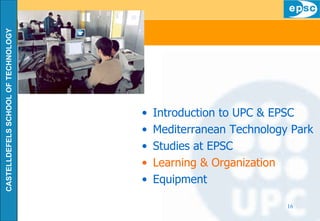
    Introduction to UPC& EPSC Mediterranean Technology Park Studies at EPSC Learning & Organization Equipment
  • 17.
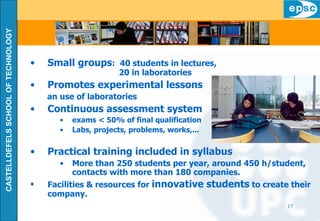
    Small groups : 40 students in lectures, 20 in laboratories Promotes experimental lessons an use of laboratories Continuous assessment system exams < 50% of final qualification Labs, projects, problems, works,... Practical training included in syllabus More than 250 students per year, around 450 h/student, contacts with more than 180 companies. Facilities & resources for innovative students to create their company.
  • 18.
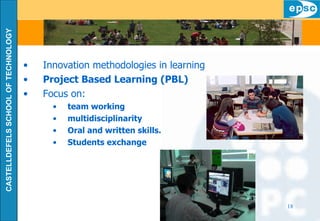
    Innovation methodologies inlearning Project Based Learning (PBL) Focus on: team working multidisciplinarity Oral and written skills. Students exchange
  • 19.
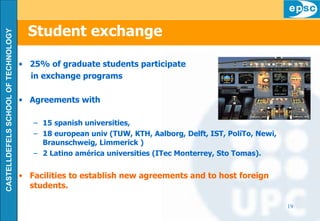
    25% of graduatestudents participate in exchange programs Agreements with 15 spanish universities, 18 european univ (TUW, KTH, Aalborg, Delft, IST, PoliTo, Newi, Braunschweig, Limmerick ) 2 Latino américa universities (ITec Monterrey, Sto Tomas). Facilities to establish new agreements and to host foreign students. Student exchange
  • 20.
    EPSC Research GroupsAdvanced Materials and Technologies for Communications group Astronomy and Astrophysics group Audio-visual Systems group Broadband Networks and Services group Combinatorial, Graphs Theory and Applications group Control, Monitoring & Communications group Distributed Systems Architectures group Instrumentation, Sensors and Interfaces group Intelligent Communications and Avionics for Robust Unmanned aerial Systems group Materials group Microgravity and modelization group Mobile and Radio Communications group Non Linear Dynamic of Fluids group Optical Communications group Wireless Networks group
  • 21.
    Introduction to UPC& EPSC Mediterranean Technology Park Studies at EPSC Learning & Organization Equipment
  • 22.
    Computer labs (3)Basic electronics labs (2) Digital Electronics lab (1) Antennas lab (1) Radiofrequency lab (2) Computer networks labs (3) Aeronautic labs (3) Several research labs (12) Global WLAN coverage Laptop PC loan service. The school lends each master team 2 lab top PCs Slides, qualifications, job offers,... At the Digital Campus
  • 23.
    Students delegation andassociations (Asterx, AeroUPC) UNIVERS (sport activites) Cantine Library Study rooms NGO Telecos sin fronteras
  • 24.
  • 25.
    surf through ourweb. www.epsc.upc.edu Questions ? Hope to see you at EPSC!