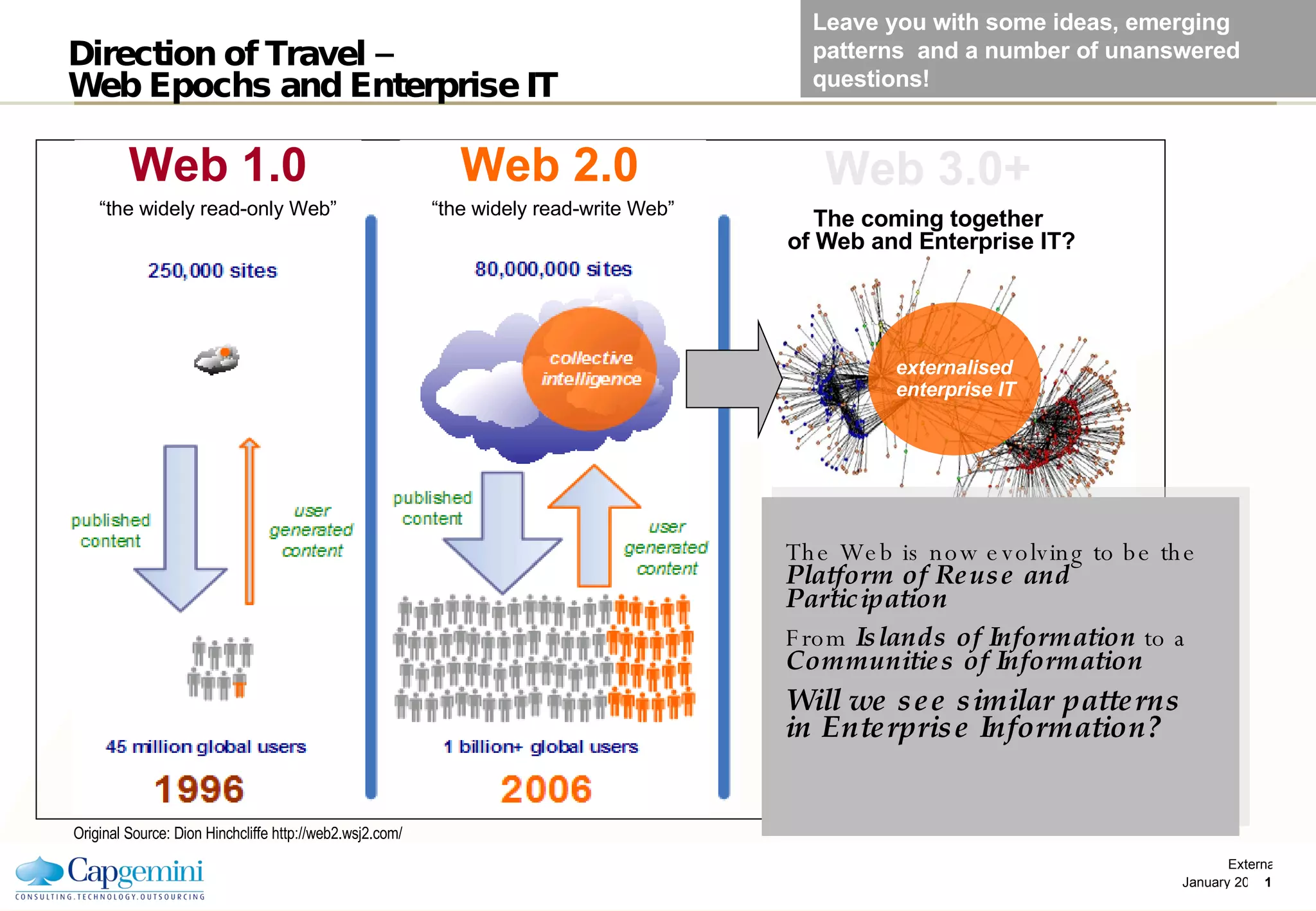

Direction of Travel –  Web Epochs and Enterprise IT The Web is now evolving to be the  Platform of Reuse and Participation From  Islands of Information  to a  Communities of Information Will we see similar patterns in Enterprise Information? Original Source: Dion Hinchcliffe http://web2.wsj2.com/  Web 3.0+   The coming together  of Web and Enterprise IT? Web 2.0   “ the widely read-write Web” Web 1.0 “ the widely read-only Web” Leave you with some ideas, emerging patterns  and a number of unanswered questions! externalised enterprise IT
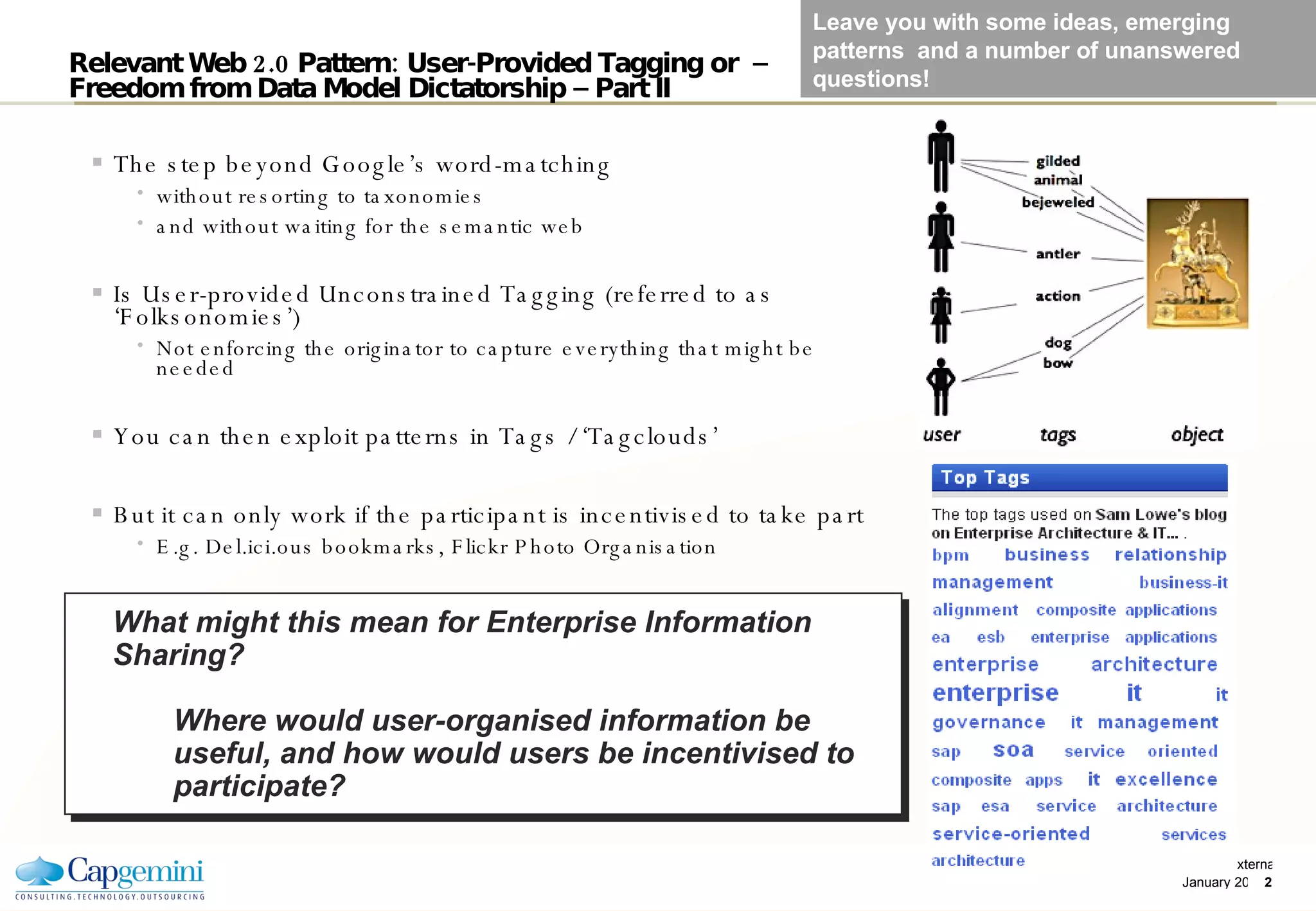
Relevant Web 2.0 Pattern: User-Provided Tagging or  –  Freedom from Data Model Dictatorship – Part II The step beyond Google’s word-matching without resorting to taxonomies  and without waiting for the semantic web Is User-provided Unconstrained Tagging (referred to as ‘Folksonomies’)‏ Not enforcing the originator to capture everything that might be needed You can then exploit patterns in Tags / ‘Tagclouds’ But it can only work if the participant is incentivised to take part  E.g. Del.ici.ous bookmarks, Flickr Photo Organisation What might this mean for Enterprise Information Sharing? Where would user-organised information be useful, and how would users be incentivised to participate? Leave you with some ideas, emerging patterns  and a number of unanswered questions!
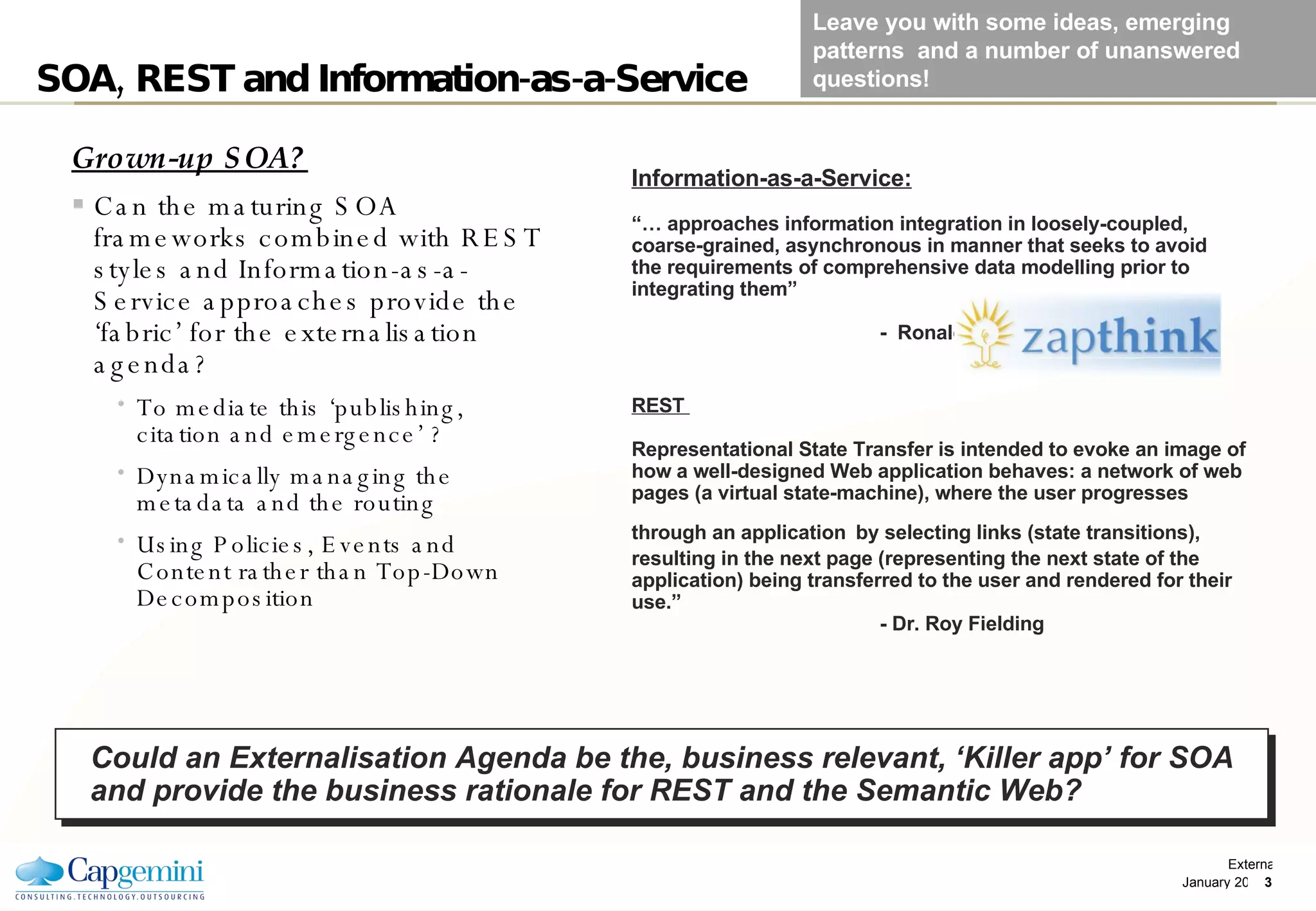
SOA, REST and Information-as-a-Service Grown-up SOA? Can the maturing SOA frameworks combined with REST styles and Information-as-a-Service approaches provide the ‘fabric’ for the externalisation agenda? To mediate this ‘publishing, citation and emergence’ ?  Dynamically managing the metadata and the routing Using Policies, Events and Content rather than Top-Down Decomposition Information-as-a-Service: “…  approaches information integration in loosely-coupled, coarse-grained, asynchronous in manner that seeks to avoid the requirements of comprehensive data modelling prior to integrating them”   -  Ronald Schmelzer REST  Representational State Transfer is intended to evoke an image of how a well-designed Web application behaves: a network of web pages (a virtual state-machine), where the user progresses through an application   by selecting links (state transitions), resulting in the next page (representing the next state of the application) being transferred to the user and rendered for their use.”    - Dr. Roy Fielding  Could an Externalisation Agenda be the, business relevant, ‘Killer app’ for SOA and provide the business rationale for REST and the Semantic Web? Leave you with some ideas, emerging patterns  and a number of unanswered questions!
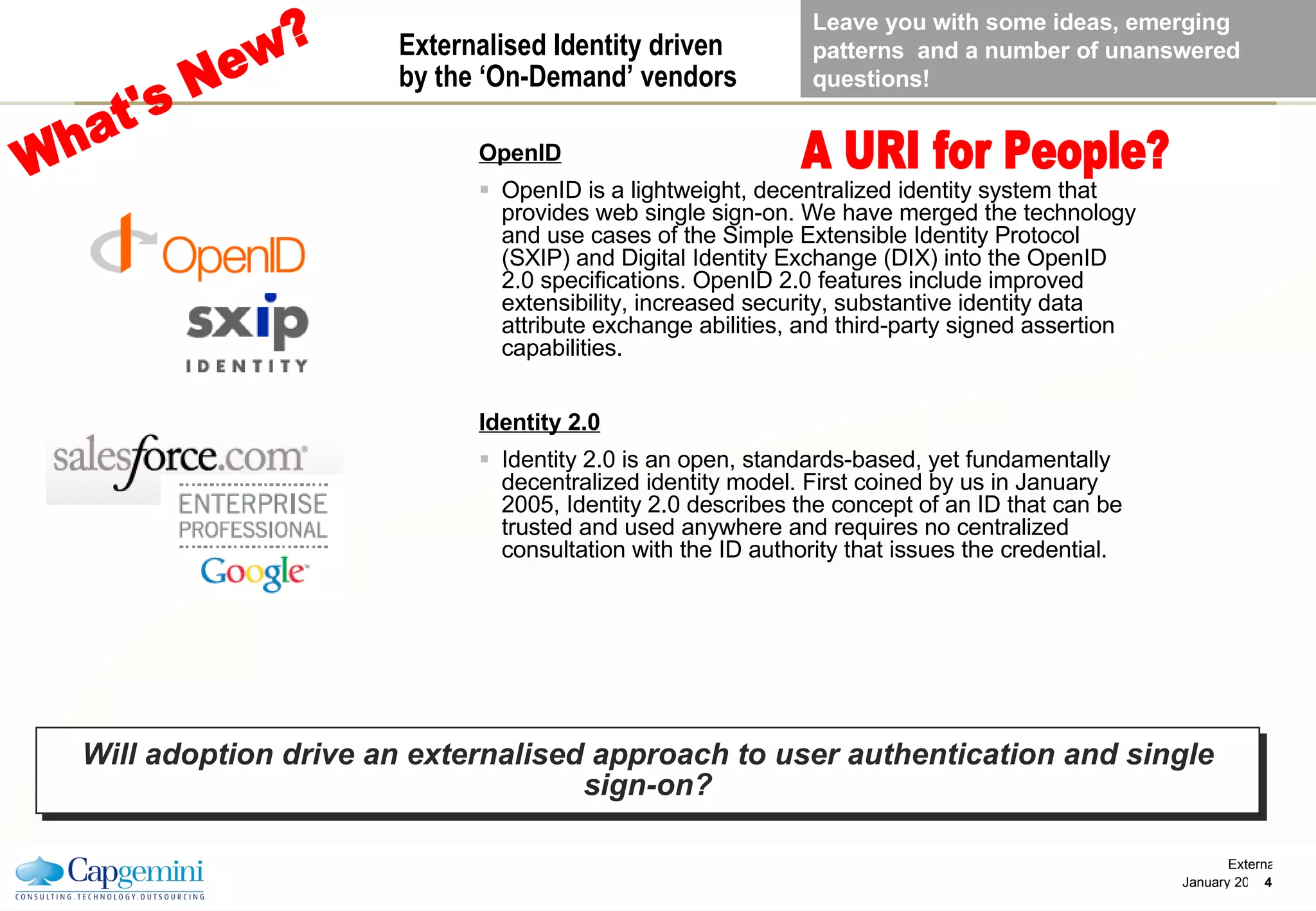
Externalised Identity driven  by the ‘On-Demand’ vendors OpenID OpenID is a lightweight, decentralized identity system that provides web single sign-on. We have merged the technology and use cases of the Simple Extensible Identity Protocol (SXIP) and Digital Identity Exchange (DIX) into the OpenID 2.0 specifications. OpenID 2.0 features include improved extensibility, increased security, substantive identity data attribute exchange abilities, and third-party signed assertion capabilities. Identity 2.0 Identity 2.0 is an open, standards-based, yet fundamentally decentralized identity model. First coined by us in January 2005, Identity 2.0 describes the concept of an ID that can be trusted and used anywhere and requires no centralized consultation with the ID authority that issues the credential. Will adoption drive an externalised approach to user authentication and single sign-on? What's New? A URI for People? Leave you with some ideas, emerging patterns  and a number of unanswered questions!
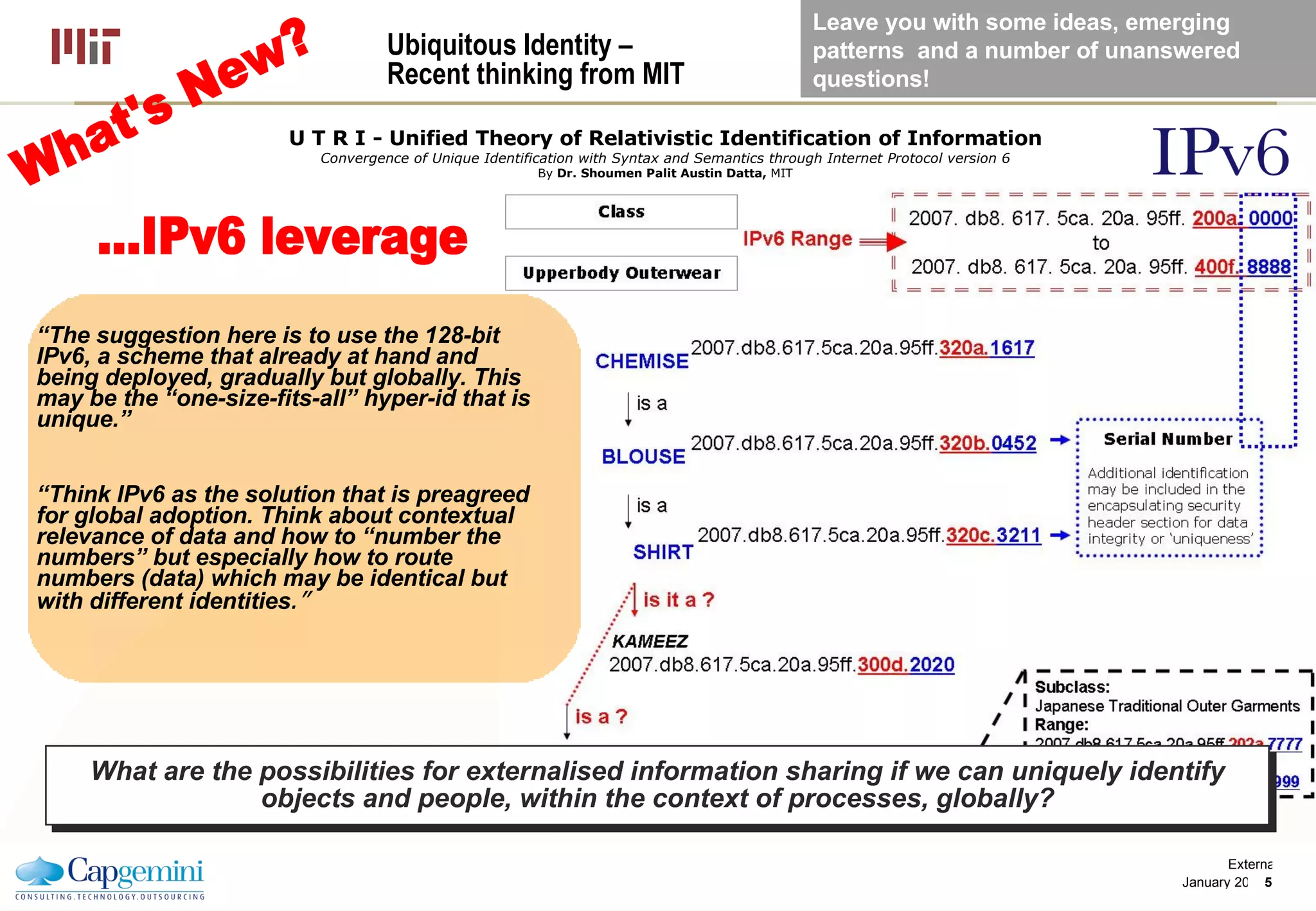
Ubiquitous Identity – Recent thinking from MIT  “ The suggestion here is to use the 128-bit IPv6, a scheme that already at hand and being deployed, gradually but globally. This may be the “one-size-fits-all” hyper-id that is unique.” “ Think IPv6 as the solution that is preagreed for global adoption. Think about contextual relevance of data and how to “number the numbers” but especially how to route numbers (data) which may be identical but with different identities .”   U T R I - Unified Theory of Relativistic Identification of Information Convergence of Unique Identification with Syntax and Semantics through Internet Protocol version 6 By  Dr. Shoumen Palit Austin Datta,  MIT What are the possibilities for externalised information sharing if we can uniquely identify objects and people, within the context of processes, globally? ...IPv6 leverage What's New? Leave you with some ideas, emerging patterns  and a number of unanswered questions!
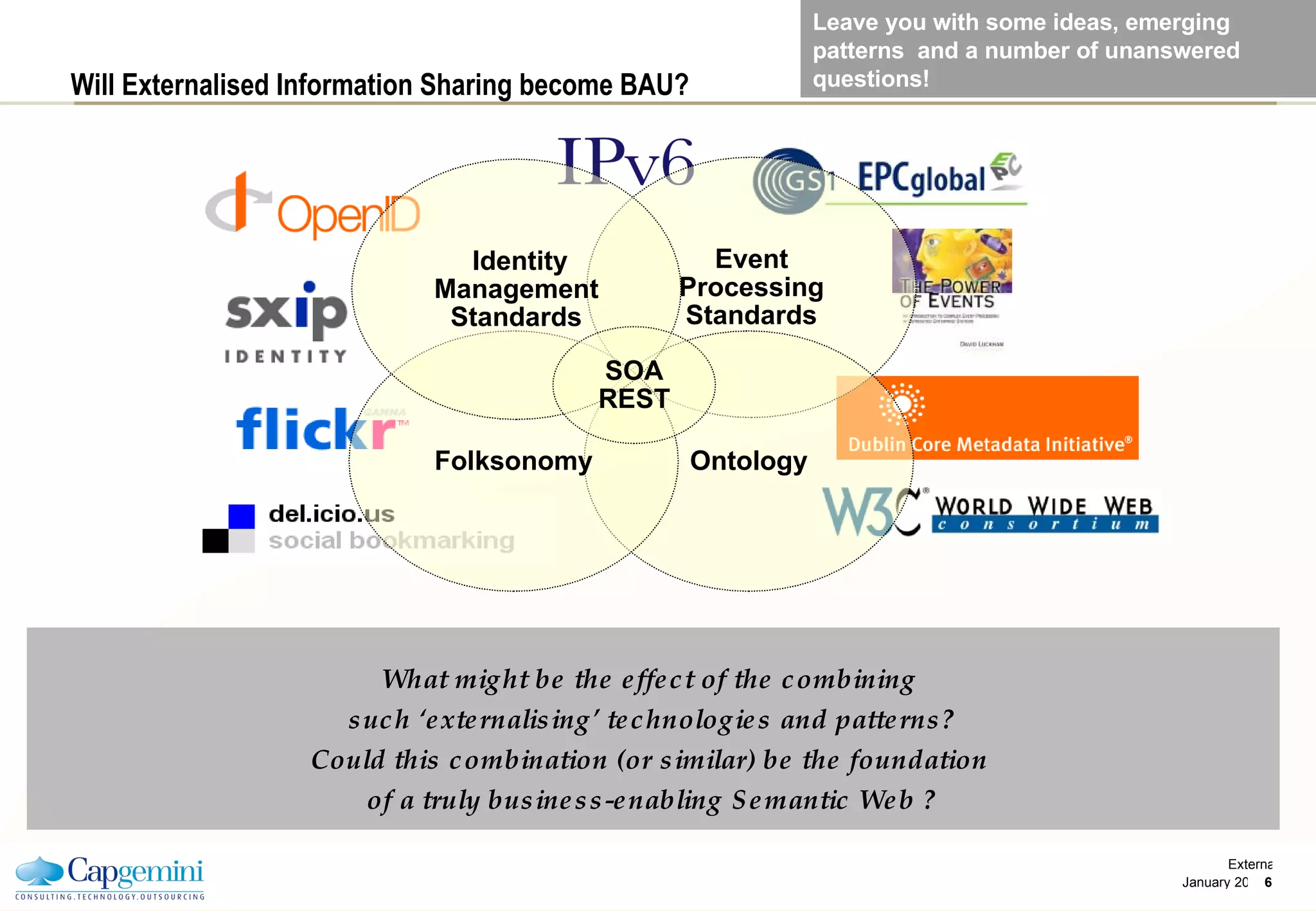
Will Externalised Information Sharing become BAU? Event Processing Standards Ontology Folksonomy What might be the effect of the combining  such ‘externalising’ technologies and patterns? Could this combination (or similar) be the foundation  of a truly business-enabling Semantic Web ? Identity Management Standards SOA REST Leave you with some ideas, emerging patterns  and a number of unanswered questions!
Thank You
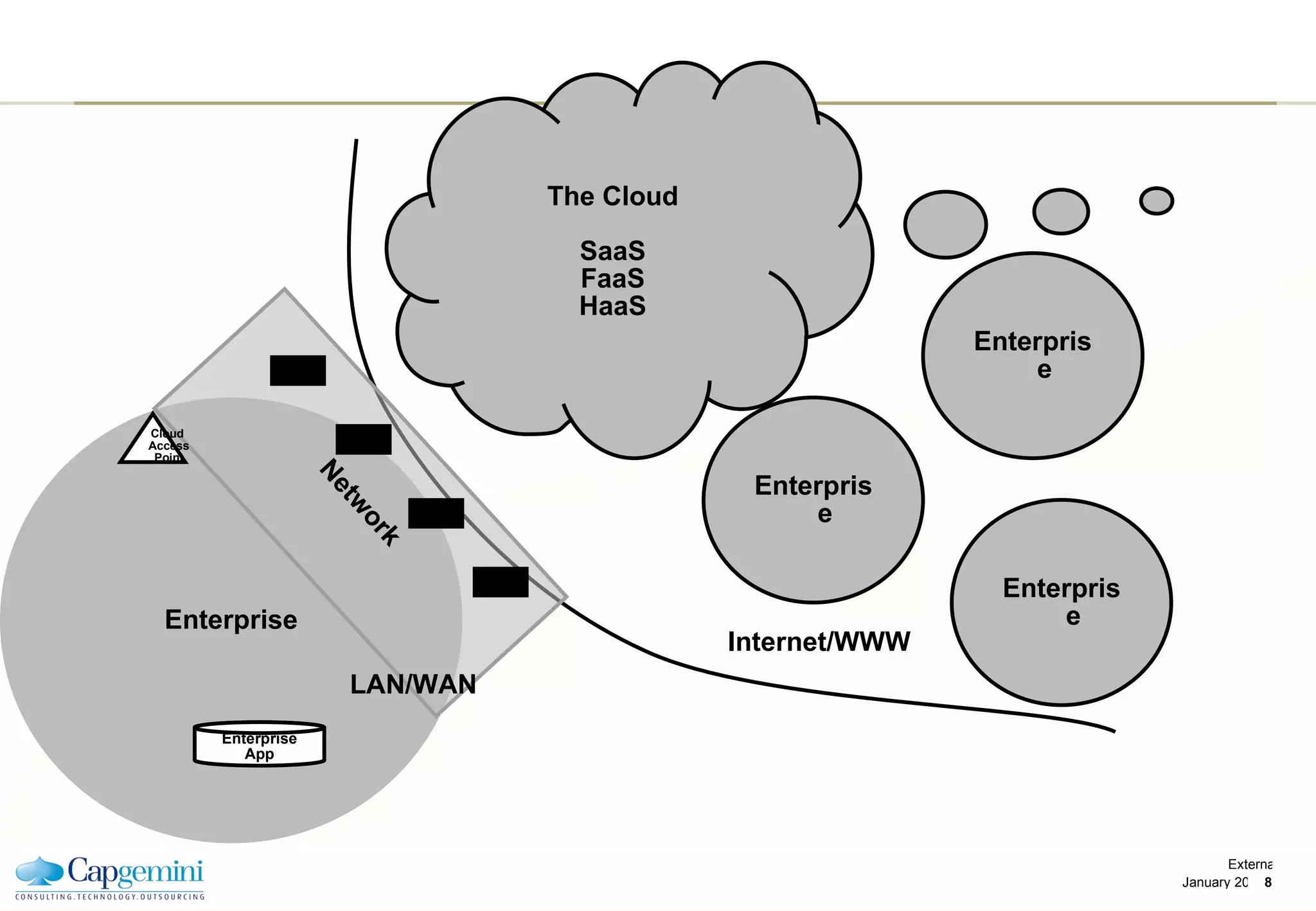
Enterprise The Cloud SaaS FaaS HaaS Enterprise Network Enterprise Enterprise LAN/WAN Internet/WWW Enterprise App Cloud  Access Point
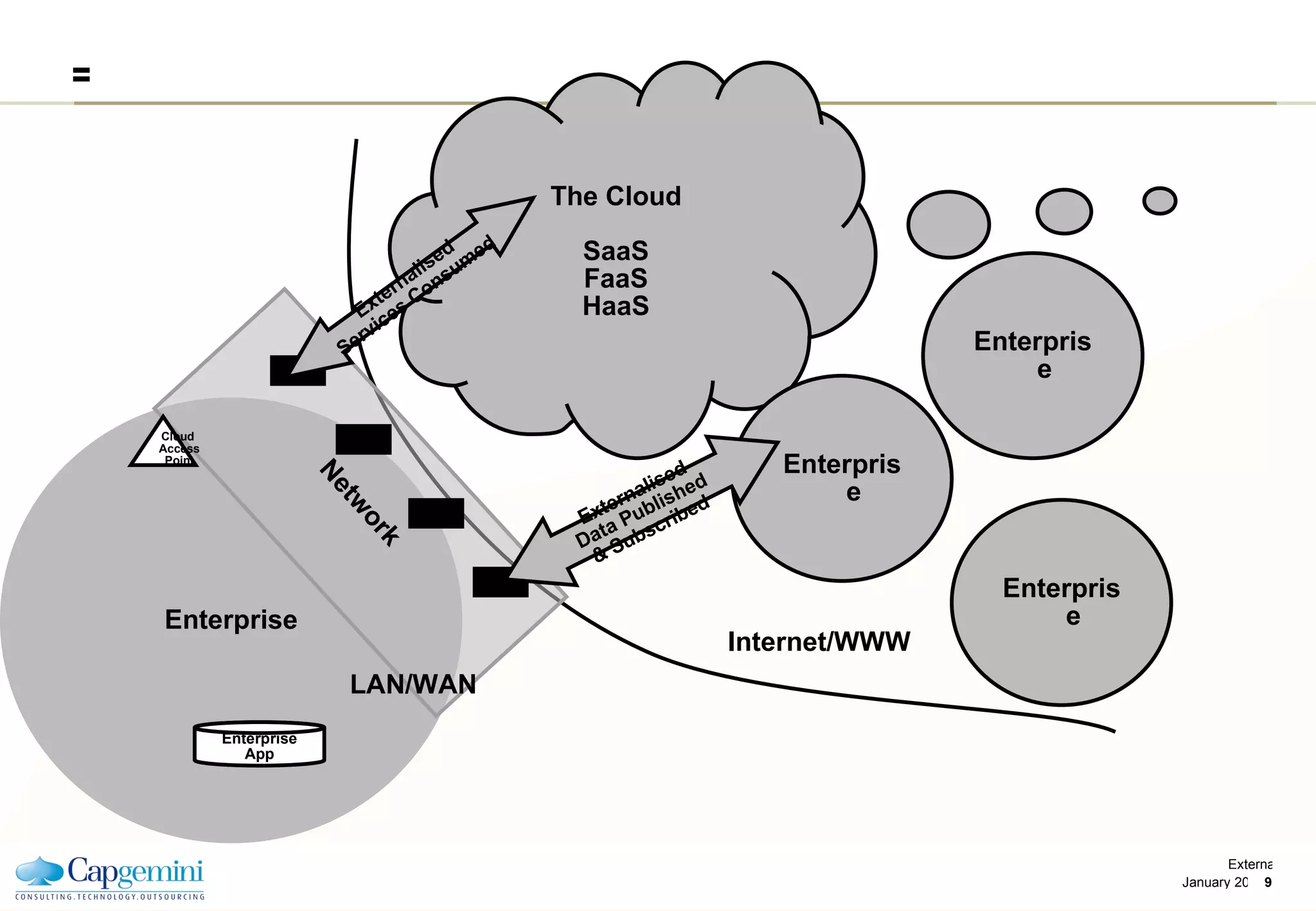
= Enterprise The Cloud SaaS FaaS HaaS Enterprise Network Enterprise Enterprise LAN/WAN Internet/WWW Enterprise App Cloud  Access Point Externalised Data Published & Subscribed Externalised Services Consumed

Epochs Web 1 2 3 V3 0b

  • 1.
    Direction of Travel– Web Epochs and Enterprise IT The Web is now evolving to be the Platform of Reuse and Participation From Islands of Information to a Communities of Information Will we see similar patterns in Enterprise Information? Original Source: Dion Hinchcliffe http://web2.wsj2.com/ Web 3.0+ The coming together of Web and Enterprise IT? Web 2.0 “ the widely read-write Web” Web 1.0 “ the widely read-only Web” Leave you with some ideas, emerging patterns and a number of unanswered questions! externalised enterprise IT
  • 2.
    Relevant Web 2.0Pattern: User-Provided Tagging or – Freedom from Data Model Dictatorship – Part II The step beyond Google’s word-matching without resorting to taxonomies and without waiting for the semantic web Is User-provided Unconstrained Tagging (referred to as ‘Folksonomies’)‏ Not enforcing the originator to capture everything that might be needed You can then exploit patterns in Tags / ‘Tagclouds’ But it can only work if the participant is incentivised to take part E.g. Del.ici.ous bookmarks, Flickr Photo Organisation What might this mean for Enterprise Information Sharing? Where would user-organised information be useful, and how would users be incentivised to participate? Leave you with some ideas, emerging patterns and a number of unanswered questions!
  • 3.
    SOA, REST andInformation-as-a-Service Grown-up SOA? Can the maturing SOA frameworks combined with REST styles and Information-as-a-Service approaches provide the ‘fabric’ for the externalisation agenda? To mediate this ‘publishing, citation and emergence’ ? Dynamically managing the metadata and the routing Using Policies, Events and Content rather than Top-Down Decomposition Information-as-a-Service: “… approaches information integration in loosely-coupled, coarse-grained, asynchronous in manner that seeks to avoid the requirements of comprehensive data modelling prior to integrating them” - Ronald Schmelzer REST Representational State Transfer is intended to evoke an image of how a well-designed Web application behaves: a network of web pages (a virtual state-machine), where the user progresses through an application by selecting links (state transitions), resulting in the next page (representing the next state of the application) being transferred to the user and rendered for their use.”  - Dr. Roy Fielding Could an Externalisation Agenda be the, business relevant, ‘Killer app’ for SOA and provide the business rationale for REST and the Semantic Web? Leave you with some ideas, emerging patterns and a number of unanswered questions!
  • 4.
    Externalised Identity driven by the ‘On-Demand’ vendors OpenID OpenID is a lightweight, decentralized identity system that provides web single sign-on. We have merged the technology and use cases of the Simple Extensible Identity Protocol (SXIP) and Digital Identity Exchange (DIX) into the OpenID 2.0 specifications. OpenID 2.0 features include improved extensibility, increased security, substantive identity data attribute exchange abilities, and third-party signed assertion capabilities. Identity 2.0 Identity 2.0 is an open, standards-based, yet fundamentally decentralized identity model. First coined by us in January 2005, Identity 2.0 describes the concept of an ID that can be trusted and used anywhere and requires no centralized consultation with the ID authority that issues the credential. Will adoption drive an externalised approach to user authentication and single sign-on? What's New? A URI for People? Leave you with some ideas, emerging patterns and a number of unanswered questions!
  • 5.
    Ubiquitous Identity –Recent thinking from MIT “ The suggestion here is to use the 128-bit IPv6, a scheme that already at hand and being deployed, gradually but globally. This may be the “one-size-fits-all” hyper-id that is unique.” “ Think IPv6 as the solution that is preagreed for global adoption. Think about contextual relevance of data and how to “number the numbers” but especially how to route numbers (data) which may be identical but with different identities .” U T R I - Unified Theory of Relativistic Identification of Information Convergence of Unique Identification with Syntax and Semantics through Internet Protocol version 6 By Dr. Shoumen Palit Austin Datta, MIT What are the possibilities for externalised information sharing if we can uniquely identify objects and people, within the context of processes, globally? ...IPv6 leverage What's New? Leave you with some ideas, emerging patterns and a number of unanswered questions!
  • 6.
    Will Externalised InformationSharing become BAU? Event Processing Standards Ontology Folksonomy What might be the effect of the combining such ‘externalising’ technologies and patterns? Could this combination (or similar) be the foundation of a truly business-enabling Semantic Web ? Identity Management Standards SOA REST Leave you with some ideas, emerging patterns and a number of unanswered questions!
  • 7.
  • 8.
    Enterprise The CloudSaaS FaaS HaaS Enterprise Network Enterprise Enterprise LAN/WAN Internet/WWW Enterprise App Cloud Access Point
  • 9.
    = Enterprise TheCloud SaaS FaaS HaaS Enterprise Network Enterprise Enterprise LAN/WAN Internet/WWW Enterprise App Cloud Access Point Externalised Data Published & Subscribed Externalised Services Consumed

Editor's Notes

  • #2 Web was mass access to information by HTML, Netscape et al Search (E.g. Yahoo), News (E.g. BBC), eCommerce (E.g. early Amazon), Consumer Self-Service (E.g. eBanking)‏ In the Enterprise world this inspired “Internet-enabled Client-Server” Extending the DB Architectures of the day with Web approaches & Techs Driving new Semi-Structured Data Content/Catalogue Mngmnt, Intranets etc