MANAGING UP
EPIP Webinar
January 6, 2016
EPIP Host: Biz Ghormley
EPIP Speakers: Monisha Kapila
2
Emerging Practitioners in
Philanthropy (EPIP) is a
national network of
foundation professionals,
social entrepreneurs and
other change makers who
strive for excellence in the
practice of philanthropy.
3
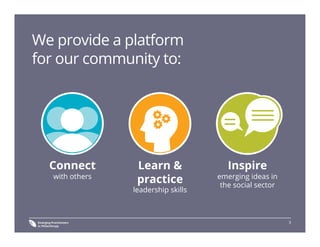
We provide a platform
for our community to:
Connect
with others
Learn &
practice
leadership skills
Inspire
emerging ideas in
the social sector
Get in touch!
Please reach out with any questions or to
learn more about membership!
Biz Ghormley
biz@epip.org
Membership & Operations Manager
What’s Next?
• Next EPIP Webinar!
• Microaggressions’ Effect on You: Set your healing
and self-care toolbox with Lupita Gonzalez
• Wednesday, January 20, 3:00pm ET
• All Events
• epip.org/events
Housekeeping
•  Use the question box for technical difficulties and
content questions for Q&A
•  Use #EPIPwebinar to follow the conversation on social
media
•  This webinar will be recorded
•  Complete the post-webinar survey!
Speakers
• Monisha Kapila
MANAGING UP
E P I P We b i n a r
Monisha Kapila | Founder and CEO | January 6, 2016
2
AGENDA
Introduction
Rules for Managing Up
Promise Cycle
1
2
3
Q&A4
INTRODUCTION1
4
ABOUT PROINSPIRE
ProInspire develops leaders at all levels for organizations addressing the
world’s greatest challenges
We have
three key
focus areas:
Supporting individuals to increase
their potential for social impact
Ensuring that nonprofits have leaders
with skills to effectively drive results
Influencing the sector to invest in talent
and leadership to achieve social impact
ProInspire named one of 7 Nonprofits to Watch in 2015
5
OUR FLAGSHIP PROGRAMS
ProInspire Fellowship
Recruits outstanding
young business
professionals to work
full-time for nonprofits
Result: New talent
pipeline brings critical
skills to nonprofits
Managing for Success
Prepares new nonprofit
managers with key
management skills
Result: Nonprofit
managers more
effectively drive results
Custom Programs
Equip organization
leaders and teams with
the tools necessary to
drive social impact
Result: Nonprofit
organizations are better
positioned to achieve
their mission
6
WHY DOES MANAGING UP MATTER?
Satisfaction at work
depends, in large part,
on the quality of your
relationship with your
boss
No. 1 reason people
leave their jobs is
because of their
manager
1 2
7
YOUR EXPERIENCE
How would you describe your manager?
•  Best manager I have ever worked for
•  Good manager, but not great
•  Not great manager, but tolerable
•  Worst manager I have ever worked for
•  Can't respond right now
8
MANAGING UP IS YOUR RESPONSIBILITY
To have any chance of building a
reasonable relationship with a boss, you
must recognize that you’re solely
responsible for the quality of that
relationship.
“ “
Michael Feiner
RULES FOR MANAGING UP2
10
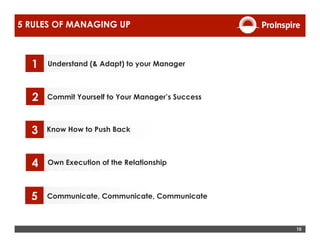
5 RULES OF MANAGING UP
1
4
2
5
Understand (& Adapt) to your Manager
3
Own Execution of the Relationship
Commit Yourself to Your Manager’s Success
Communicate, Communicate, Communicate
Know How to Push Back
11
UNDERSTAND (& ADAPT) TO YOUR MANAGER
1
2
3
4
5
•  What are his/her expectations of you?
•  How do they prefer to receive
information?
•  How do they process information?
•  What motivates him/her?
•  What are triggers/ fears/ambitions?
12
COMMIT YOURSELF TO YOUR MANAGER’S SUCCESS
1
2
3
4
5
Respect the
office, even if you
don’t respect who
sits in it.
•  Law of Professional Commitment - choosing
the interests of your manager versus your own
feelings or short-term interests
•  Even if your boss treats you poorly, act
professionally and serve the organization’s
best interest
•  Find the right balance – You may not agree
with everything but pushing back is not always
the solution.
“
“
13
KNOW HOW TO PUSH BACK
1
2
3
4
5Bosses are often in the dark about perceptions regarding their leadership,
agenda, or decisions
Set the ground rules early and
re-establish them often:
Use a questioning approach to
push back
•  “I would like to speak with you
honestly”
•  “I may disagree but it’s
because I’m concerned about
our success and our
performance.”
•  “Another option we may want
to consider…”
•  “Before we move forward
maybe we should talk about…”
14
OWN EXECUTION OF THE RELATIONSHIP
1
2
3
4
5
Take responsibility for scheduling (and
rescheduling) time with your manager
Make good use of your manager’s time.
1
2
Be dependable and build credibility.3
Communicate risks and barriers.4
15
COMMUNICATE !
1
2
3
4
5
1
People typically underestimate what their managers
need to know—and what they do know
2
Be up-front about good and bad news in a timely
manner
3
Keep your manager informed using a suitable
communication style
4 Ask thoughtful questions that demonstrate your
thinking process
16
WHAT IS ONE RULE YOU CAN APPLY TODAY?
1
4
2
5
Understand (& Adapt) to your Manager
3
Own Execution of the Relationship
Commit Yourself to Your Manager’s Success
Communicate, Communicate, Communicate
Know How to Push Back
PROMISE CYCLE3
18
CREATING THE RELATIONSHIPS WE WANT
1 Making an effective request
2 Obtaining a “valid” response
3 Carrying out designated actions
4 Communicating status and declaring completion
5 Assessing finished results
6 Closing the cycle
The Promise Cycle creates a culture of commitment and
accountability
19
ELEMENTS OF EFFECTIVE REQUESTS
Committed
Speaker
Committed
Listener
Future
Action &
Conditions
of
Satisfaction
Mood of the
Request
1 2 3 4
Be succinct in your
request, and begin
with “I have a
request….” to give
the listener a verbal
cue.
Give full attention
and be ready to
receive the
request
State clearly and
in exact detail
what you want
and the necessary
conditions to
achieve success.
The right
conversation in the
wrong mood
space will be
ineffective.
20
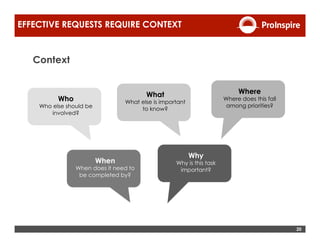
EFFECTIVE REQUESTS REQUIRE CONTEXT
Who
Who else should be
involved?
What
What else is important
to know?
Where
Where does this fall
among priorities?
When
When does it need to
be completed by?
Why
Why is this task
important?
Context
21
RESPONDING TO REQUESTS
Had someone say
“yes” to a request
you made and then
not come through
because they were
too busy?
How many of
you have
Have felt pressured
into saying “yes” to
a request one of
your supervisors
have made to you?
22
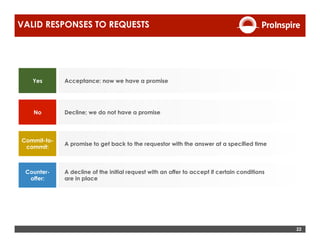
VALID RESPONSES TO REQUESTS
Yes
No
Commit-to-
commit:
Counter-
offer:
Acceptance; now we have a promise
Decline; we do not have a promise
A promise to get back to the requestor with the answer at a specified time
A decline of the initial request with an offer to accept if certain conditions
are in place
23
ACCEPTANCE OF A REQUEST MEANS THERE IS A
PROMISE
PROMISES, COMMITMENTS, AND AGREEMENTS:
When a request or offer is followed by a declaration of “yes”.
Trust
Relationships
Success
Self Esteem
Break Keep
AGREEMENTS
No-win Win-win
24
WHEN PROMISES ARE NOT MET
1
2
It’s not possible to keep 100% of the
promises/commitments/
agreements we make.
DON’T ignore a broken promise. Openly
acknowledge what has occurred.
3Broken promises can erode relationships.
Q&A4

EPIP_ProInspire_webinar_managing up

  • 1.
    MANAGING UP EPIP Webinar January6, 2016 EPIP Host: Biz Ghormley EPIP Speakers: Monisha Kapila
  • 2.
    2 Emerging Practitioners in Philanthropy(EPIP) is a national network of foundation professionals, social entrepreneurs and other change makers who strive for excellence in the practice of philanthropy.
  • 3.
    3 We provide aplatform for our community to: Connect with others Learn & practice leadership skills Inspire emerging ideas in the social sector
  • 4.
    Get in touch! Pleasereach out with any questions or to learn more about membership! Biz Ghormley biz@epip.org Membership & Operations Manager
  • 5.
    What’s Next? • Next EPIPWebinar! • Microaggressions’ Effect on You: Set your healing and self-care toolbox with Lupita Gonzalez • Wednesday, January 20, 3:00pm ET • All Events • epip.org/events
  • 6.
    Housekeeping •  Use thequestion box for technical difficulties and content questions for Q&A •  Use #EPIPwebinar to follow the conversation on social media •  This webinar will be recorded •  Complete the post-webinar survey!
  • 7.
  • 8.
    MANAGING UP E PI P We b i n a r Monisha Kapila | Founder and CEO | January 6, 2016
  • 9.
    2 AGENDA Introduction Rules for ManagingUp Promise Cycle 1 2 3 Q&A4
  • 10.
  • 11.
    4 ABOUT PROINSPIRE ProInspire developsleaders at all levels for organizations addressing the world’s greatest challenges We have three key focus areas: Supporting individuals to increase their potential for social impact Ensuring that nonprofits have leaders with skills to effectively drive results Influencing the sector to invest in talent and leadership to achieve social impact ProInspire named one of 7 Nonprofits to Watch in 2015
  • 12.
    5 OUR FLAGSHIP PROGRAMS ProInspireFellowship Recruits outstanding young business professionals to work full-time for nonprofits Result: New talent pipeline brings critical skills to nonprofits Managing for Success Prepares new nonprofit managers with key management skills Result: Nonprofit managers more effectively drive results Custom Programs Equip organization leaders and teams with the tools necessary to drive social impact Result: Nonprofit organizations are better positioned to achieve their mission
  • 13.
    6 WHY DOES MANAGINGUP MATTER? Satisfaction at work depends, in large part, on the quality of your relationship with your boss No. 1 reason people leave their jobs is because of their manager 1 2
  • 14.
    7 YOUR EXPERIENCE How wouldyou describe your manager? •  Best manager I have ever worked for •  Good manager, but not great •  Not great manager, but tolerable •  Worst manager I have ever worked for •  Can't respond right now
  • 15.
    8 MANAGING UP ISYOUR RESPONSIBILITY To have any chance of building a reasonable relationship with a boss, you must recognize that you’re solely responsible for the quality of that relationship. “ “ Michael Feiner
  • 16.
  • 17.
    10 5 RULES OFMANAGING UP 1 4 2 5 Understand (& Adapt) to your Manager 3 Own Execution of the Relationship Commit Yourself to Your Manager’s Success Communicate, Communicate, Communicate Know How to Push Back
  • 18.
    11 UNDERSTAND (& ADAPT)TO YOUR MANAGER 1 2 3 4 5 •  What are his/her expectations of you? •  How do they prefer to receive information? •  How do they process information? •  What motivates him/her? •  What are triggers/ fears/ambitions?
  • 19.
    12 COMMIT YOURSELF TOYOUR MANAGER’S SUCCESS 1 2 3 4 5 Respect the office, even if you don’t respect who sits in it. •  Law of Professional Commitment - choosing the interests of your manager versus your own feelings or short-term interests •  Even if your boss treats you poorly, act professionally and serve the organization’s best interest •  Find the right balance – You may not agree with everything but pushing back is not always the solution. “ “
  • 20.
    13 KNOW HOW TOPUSH BACK 1 2 3 4 5Bosses are often in the dark about perceptions regarding their leadership, agenda, or decisions Set the ground rules early and re-establish them often: Use a questioning approach to push back •  “I would like to speak with you honestly” •  “I may disagree but it’s because I’m concerned about our success and our performance.” •  “Another option we may want to consider…” •  “Before we move forward maybe we should talk about…”
  • 21.
    14 OWN EXECUTION OFTHE RELATIONSHIP 1 2 3 4 5 Take responsibility for scheduling (and rescheduling) time with your manager Make good use of your manager’s time. 1 2 Be dependable and build credibility.3 Communicate risks and barriers.4
  • 22.
    15 COMMUNICATE ! 1 2 3 4 5 1 People typicallyunderestimate what their managers need to know—and what they do know 2 Be up-front about good and bad news in a timely manner 3 Keep your manager informed using a suitable communication style 4 Ask thoughtful questions that demonstrate your thinking process
  • 23.
    16 WHAT IS ONERULE YOU CAN APPLY TODAY? 1 4 2 5 Understand (& Adapt) to your Manager 3 Own Execution of the Relationship Commit Yourself to Your Manager’s Success Communicate, Communicate, Communicate Know How to Push Back
  • 24.
  • 25.
    18 CREATING THE RELATIONSHIPSWE WANT 1 Making an effective request 2 Obtaining a “valid” response 3 Carrying out designated actions 4 Communicating status and declaring completion 5 Assessing finished results 6 Closing the cycle The Promise Cycle creates a culture of commitment and accountability
  • 26.
    19 ELEMENTS OF EFFECTIVEREQUESTS Committed Speaker Committed Listener Future Action & Conditions of Satisfaction Mood of the Request 1 2 3 4 Be succinct in your request, and begin with “I have a request….” to give the listener a verbal cue. Give full attention and be ready to receive the request State clearly and in exact detail what you want and the necessary conditions to achieve success. The right conversation in the wrong mood space will be ineffective.
  • 27.
    20 EFFECTIVE REQUESTS REQUIRECONTEXT Who Who else should be involved? What What else is important to know? Where Where does this fall among priorities? When When does it need to be completed by? Why Why is this task important? Context
  • 28.
    21 RESPONDING TO REQUESTS Hadsomeone say “yes” to a request you made and then not come through because they were too busy? How many of you have Have felt pressured into saying “yes” to a request one of your supervisors have made to you?
  • 29.
    22 VALID RESPONSES TOREQUESTS Yes No Commit-to- commit: Counter- offer: Acceptance; now we have a promise Decline; we do not have a promise A promise to get back to the requestor with the answer at a specified time A decline of the initial request with an offer to accept if certain conditions are in place
  • 30.
    23 ACCEPTANCE OF AREQUEST MEANS THERE IS A PROMISE PROMISES, COMMITMENTS, AND AGREEMENTS: When a request or offer is followed by a declaration of “yes”. Trust Relationships Success Self Esteem Break Keep AGREEMENTS No-win Win-win
  • 31.
    24 WHEN PROMISES ARENOT MET 1 2 It’s not possible to keep 100% of the promises/commitments/ agreements we make. DON’T ignore a broken promise. Openly acknowledge what has occurred. 3Broken promises can erode relationships.
  • 32.