All About Epics
The Six Elements of an Epic Poem
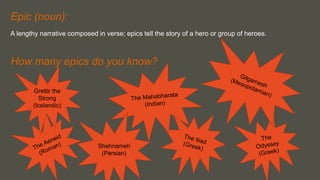
Epic (noun):
A lengthy narrative composed in verse; epics tell the story of a hero or group of heroes.
How many epics do you know?
Shahnameh
(Persian)
Grettir the
Strong
(Icelandic)
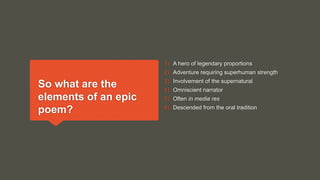
So what are the
elements of an epic
poem?
1) A hero of legendary proportions
2) Adventure requiring superhuman strength
3) Involvement of the supernatural
4) Omniscient narrator
5) Often in media res
6) Descended from the oral tradition
Generally male
The hero of an epic poem is well-known
throughout his own world; he is often famous for
his deeds
 The hero’s actions determine the fate of many
The hero has a connection or relationship with
the gods. He is either a demigod or under their
protection or curse.
A Hero of Legendary
Proportions
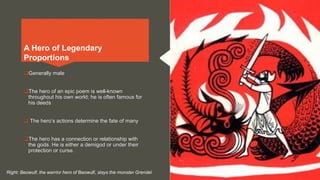
Right: Beowulf, the warrior hero of Beowulf, slays the monster Grendel
An Adventure of
Superhuman Strength
 The heroes are legends because they are
exaggerations of the normal human. They
have greater strength, piety, valor, etc.
 The hero’s exaggerated trait is a
reflection of his society’s values
 Think back on what we have learned
about tall tales and legends. How can we
apply what we have learned to the study
of epic poetry?
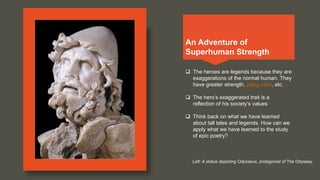
Left: A statue depicting Odysseus, protagonist of The Odyssey.
Involvement of the Supernatural
 There are a good many different elements that
may appear in an epic. Gods and goddesses,
angels and demons, and immortality are among
the most common.
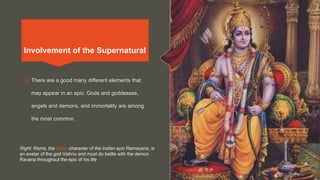
Right: Rama, the titular character of the Indian epic Ramayana, is
an avatar of the god Vishnu and must do battle with the demon
Ravana throughout the epic of his life
Involvement of the Supernatural
Omniscient Narrator
 Omniscience refers to a narrator that is
god-like in his/her knowledge; an
omniscient narrator sees all and knows all
 Narrators are objective – they do not
insert an opinion as to the goings on in
the story
 Narrative style is distinctive in epics
because of the use of repetition in
phrasing, long monologues, and
extensive use of similes
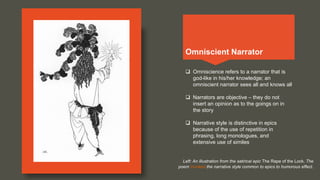
Left: An illustration from the satirical epic The Rape of the Lock. The
poem invoked the narrative style common to epics to humorous effect.
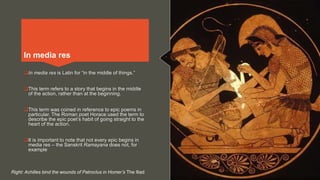
In media res is Latin for “in the middle of things.”
This term refers to a story that begins in the middle
of the action, rather than at the beginning.
This term was coined in reference to epic poems in
particular. The Roman poet Horace used the term to
describe the epic poet’s habit of going straight to the
heart of the action.
It is important to note that not every epic begins in
media res – the Sanskrit Ramayana does not, for
example
In media res
Right: Achilles bind the wounds of Patroclus in Homer’s The Iliad
Descended from the Oral
Tradition
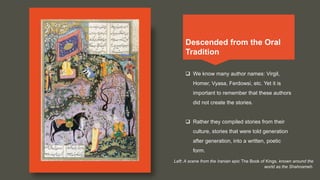
 We know many author names: Virgil,
Homer, Vyasa, Ferdowsi, etc. Yet it is
important to remember that these authors
did not create the stories.
 Rather they compiled stories from their
culture, stories that were told generation
after generation, into a written, poetic
form.
Left: A scene from the Iranian epic The Book of Kings, known around the
world as the Shahnameh.

Epic poems

  • 1.
    All About Epics TheSix Elements of an Epic Poem
  • 2.
    Epic (noun): A lengthynarrative composed in verse; epics tell the story of a hero or group of heroes. How many epics do you know? Shahnameh (Persian) Grettir the Strong (Icelandic)
  • 3.
    So what arethe elements of an epic poem? 1) A hero of legendary proportions 2) Adventure requiring superhuman strength 3) Involvement of the supernatural 4) Omniscient narrator 5) Often in media res 6) Descended from the oral tradition
  • 4.
    Generally male The heroof an epic poem is well-known throughout his own world; he is often famous for his deeds  The hero’s actions determine the fate of many The hero has a connection or relationship with the gods. He is either a demigod or under their protection or curse. A Hero of Legendary Proportions Right: Beowulf, the warrior hero of Beowulf, slays the monster Grendel
  • 5.
    An Adventure of SuperhumanStrength  The heroes are legends because they are exaggerations of the normal human. They have greater strength, piety, valor, etc.  The hero’s exaggerated trait is a reflection of his society’s values  Think back on what we have learned about tall tales and legends. How can we apply what we have learned to the study of epic poetry? Left: A statue depicting Odysseus, protagonist of The Odyssey.
  • 6.
    Involvement of theSupernatural  There are a good many different elements that may appear in an epic. Gods and goddesses, angels and demons, and immortality are among the most common. Right: Rama, the titular character of the Indian epic Ramayana, is an avatar of the god Vishnu and must do battle with the demon Ravana throughout the epic of his life Involvement of the Supernatural
  • 7.
    Omniscient Narrator  Omnisciencerefers to a narrator that is god-like in his/her knowledge; an omniscient narrator sees all and knows all  Narrators are objective – they do not insert an opinion as to the goings on in the story  Narrative style is distinctive in epics because of the use of repetition in phrasing, long monologues, and extensive use of similes Left: An illustration from the satirical epic The Rape of the Lock. The poem invoked the narrative style common to epics to humorous effect.
  • 8.
    In media resis Latin for “in the middle of things.” This term refers to a story that begins in the middle of the action, rather than at the beginning. This term was coined in reference to epic poems in particular. The Roman poet Horace used the term to describe the epic poet’s habit of going straight to the heart of the action. It is important to note that not every epic begins in media res – the Sanskrit Ramayana does not, for example In media res Right: Achilles bind the wounds of Patroclus in Homer’s The Iliad
  • 9.
    Descended from theOral Tradition  We know many author names: Virgil, Homer, Vyasa, Ferdowsi, etc. Yet it is important to remember that these authors did not create the stories.  Rather they compiled stories from their culture, stories that were told generation after generation, into a written, poetic form. Left: A scene from the Iranian epic The Book of Kings, known around the world as the Shahnameh.

Editor's Notes

  • #6 Piety: Religious devotion; goodness, faithfulness, obedience to a god Valor: Courage and bravery
  • #7 Titular: The person or thing from whom the name of an artistic work is taken
  • #8 Invoked: to call forth; to remind