Prevention and Early Detection of
Prostate Cancer: A Global View
Vitaly Smelov
International Agency for Research on Cancer, WHO
PROSTATE CANCER (PCA) EPIDEMIOLOGY
World WHO Europe region
Data source: GLOBOCAN 2012 © International Agency for Research on Cancer 2017
I
IIIII
V
Data source: GLOBOCAN 2012 © International Agency for Research on Cancer 2017
WHO Europe
Region
2012 2035 Demographic
change
Estimated
increase
Incidence 419,915 603,506 183,591 +44%
Mortality 101,419 156,765 55,346 +55%
World 2012 2035 Demographic
change
Estimated
increase
Incidence 1,094,916 2,093,718 998,802 +91%
Mortality 307,481 633,328 325,847 +106%
WHO EUROPE REGION
PCA 2012-2013: AN ESTIMATED INCREASE
WORLD
WORLD POPULATION GROWTH: 9.7 BILLION BY 2050
UN, UNFPA
AVERAGE ANNUAL RATE OF POPULATION CHANGE
Higher Lower
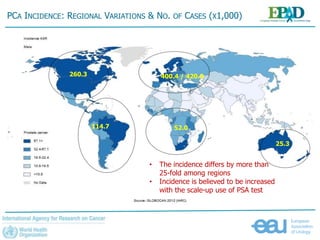
PCA INCIDENCE: REGIONAL VARIATIONS & NO. OF CASES (X1,000)
25.3
400.4 / 420.0
52.0
260.3
114.7
• The incidence differs by more than
25-fold among regions
• Incidence is believed to be increased
with the scale-up use of PSA test
PCA MORTALITY: REGIONAL VARIATIONS & NO. OF DEATHS (X1,000)
48.7
37.8
92.3 / 101.4
15.9
• Mortality mainly affects
less developed countries (accessibility)
• Also, race and diet habits are among
speculated risk factors for geographic diversity
TOTAL EXPENDITURE ON HEALTH (% GDP, 2014) & PCA SCREENING
WHO National Health Accounts database, 2011
COUNTRIES WITH REPORTED PCA SCREENING TRIALS AND PROGRAMS
*
*
• PLCO - the Prostate, Lung, Colorectal and Ovarian Cancer Screening Trial;
• ERSPC - the European Randomized Study of Screening in Prostate Cancer;
• PCa screening trials;
• National PCa screening program
*
**
*
*
*
*
*
*
*
*
*
*
*
*
INEQUALITY IN PCA SURVIVAL
Europe Africa World
Data source: GLOBOCAN 2012 © International Agency for Research on Cancer 2017
PCA MORTALITY / INCIDENCE RATIO
*Selected by Dr Vitaly Smelov
In blue: EU countries
Region Country* Mortality Incidence Mortality/Incidence
Africa S. Africa 26.35 67.90 39
Africa Morocco 12.90 18.50 70
Africa Uganda 38.75 48.16 80
Africa Tanzania 27.90 34.60 81
Asia S. Korea 4.56 30.34 15
Asia China 2.48 5.29 47
Asia Iran 6.19 12.56 49
Asia India 2.68 4.16 64
C. America Costa Rica 18.08 67.47 27
C. America Mexico 11.31 27.30 41
C. America Honduras 13.84 22.69 61
Europe European Union 10.90 70.04 16
Europe France 10.01 98.01 10
Europe Belgium 11.00 90.90 12
Europe Netherlands 13.54 83.41 16
Europe United Kingldom 13.10 73.20 18
Europe Latvia 18.00 82.69 22
Europe Belarus 13.00 34.42 38
Europe Ukraine 9.70 24.70 39
Europe Romania 9.70 24.20 40
Europe Russia 12.42 30.06 41
Europe Kazakhstan 8.57 14.94 57
Europe Uzbekistan 1.51 2.04 74
N. America USA 9.80 98.20 10
N. America Canada 9.40 88.90 11
S. America Brazil 18.63 76.22 24
S. America Colombia 15.05 51.35 29
S. America Chilie 17.07 52.40 33
S. America Argentina 15.70 44.09 36
S. America Peru 14.93 30.35 49
S. America Bolivia 15.71 25.92 61
WHO
EUROPE
REGION
AFRICA
S. AMERICA
Data source: GLOBOCAN 2012 © International Agency for Research on Cancer 2017
HICS VS LMICS SITUATION DIFFERS BUT IT IS A GLOBAL PROBLEM
High-income countries (HICs):
• Incidence is very high (problems with detecting too many cases)
- lack of standardized screening protocol
• But the extended treatment facilities allow to increase survival rates
• Decision-making responsibility lies on clinician
Low- and middle-income countries (LMICs):
• Incidence is less than in HICs but will increase (population growth, aging, migration
patterns, life style changes)
• Will we have a future epidemic?
• Current mortality is close to incidence (problems with treatment)
- limited facilities and skilled personnel
PRIMARY PCA PREVENTION
Adapted from: dos Santos Silva; Cancer Epidemiology: Principles and Methods, 1999
Aims to prevent the onset of disease:
• i) by reducing exposure to risk factors, ii) or increasing men resistance to them
? • Risk factors unknown or unclear
• Possible role of diet habits?
• (Co-)role of infections?
• Life style?
• Preventive measures unknown
“No definitive recommendation can
be provided for specific preventive
or dietary measures to reduce the
risk of developing PCa” (EAU)
?
?
SECONDARY PCA PREVENTION
Adapted from: dos Santos Silva; Cancer Epidemiology: Principles and Methods, 1999
?
?
Aims to reduce mortality from PCa through early detection (2 approaches) and
treatment. Mainly based on screening programs: Opportunistic vs Organised
• Symptoms?
PCa is mostly asymptomatic
• No reliable enough test(s)
• Triage test: biopsy to be replaced
• Screening:
Opportunistic vs organized?
Quality and costs?
• Resources?
• Strategies for LMICs?
Screening:
before symptoms
appear by applying
a test to healthy
populations
Early diagnosis:
through the very
first symptoms in
patients
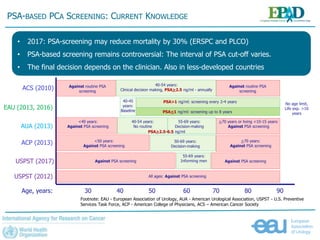
PSA-BASED PCA SCREENING: CURRENT KNOWLEDGE
30 40 50 60 70 80 90Age, years:
USPST (2012)
ACP (2013)
AUA (2013)
EAU (2013, 2016)
Footnote: EAU - European Association of Urology, AUA - American Urological Association, USPST - U.S. Preventive
Services Task Force, ACP - American College of Physicians, ACS – American Cancer Society
All ages: Against PSA screening
>70 years:
Against PSA screening
<50 years:
Against PSA screening
>70 years or living <10-15 years:
Against PSA screening
<40 years:
Against PSA screening
40-54 years:
No routine
40-45
years:
Baseline
No age limit,
Life exp. >10
years
PSA>1 ng/ml: screening every 2-4 years
PSA<1 ng/ml: screening up to 8 years
55-69 years:
Decision-making
USPST (2017) Against PSA screening
55-69 years:
Informing men Against PSA screening
ACS (2010) Against routine PSA
screening
Against routine PSA
screening
40-54 years:
Clinical decision making, PSA>2.5 ng/ml - annually
• 2017: PSA-screening may reduce mortality by 30% (ERSPC and PLCO)
• PSA-based screening remains controversial: The interval of PSA cut-off varies.
• The final decision depends on the clinician. Also in less-developed countries
50-69 years:
Decision-making
PSA>2.5-6.5 ng/ml
PSA-BASED PCA SCREENING: SITUATION IN COUNTRIES
• It may be feasible to establish a PSA-based screening program
• Down-staging and reduction in 1 year mortality after diagnosis
• A PSA screening round: over-diagnosis  over-treatment?  men’s QoL??
• It needs proper QA and sustainability
Ishkinin et al, Iran J Public Health 2017
Distribution by ages of newly
diagnosis PCa in 2014-2015:
Distribution by stages of newly
diagnosis PCa (%) in 2001-2015:
Incidence = 8.57 and Mortality = 14.94 (per 100,000); M/I = 57% (2012)
TERTIARY PCA PREVENTION
Adapted from: dos Santos Silva; Cancer Epidemiology: Principles and Methods, 1999
?
?
Aims to improve prognosis and quality of life (QoL) of the affected men by offering
the best available treatment and rehabilitation
• Accessibility??
• Who is paying: Public or Private funding?
• Different strategies for different countries?
• Strategies for LMICs??
• Current inequality in survival
• The knowledge on PCa risk factors is insufficient
• Specific preventive measures are lacking
• Current early detection suffers from the lack of accurate screening tests
• Over-diagnosis  over-treatment  QoL  increased public health costs
UNANSWERED QUESTIONS
• Further search for risk factors and potential preventive measures
• Better understanding the rationale for geographic and population differences
• Development of risk prediction tools, including individual-risk based
• Evaluating novel reliable and less costly biomarkers (e.g., urine-based)
• Improve treatment facilities
- develop treatment schemes suitable for different settings
• Promote evidence-based decision towards PCa prevention
(burden of diseases, cost-effectiveness of prevention strategies)
• Ensure adherence to treatment protocols by patients and clinicians
• Propose preventive strategies for low- and middle-income countries
PCA PREVENTION FUTURE RESEARCH
• PCa is a global health problem
• The European region and the EU have the knowledge and expertise to
contribute to decrease PCa burden worldwide
• Worldwide, patients will benefit from strengthening scientific collaboration
• Multidisciplinary Meeting on Prostate Cancer Research in IARC, 2018:
- to proper discuss research agenda on PCa prevention, screening
and early detection and brainstorm on strategies for LMICs
GLOBAL PCA AGENDA

EPAD 2017 - Vitaly Smelov

  • 1.
    Prevention and EarlyDetection of Prostate Cancer: A Global View Vitaly Smelov International Agency for Research on Cancer, WHO
  • 2.
    PROSTATE CANCER (PCA)EPIDEMIOLOGY World WHO Europe region Data source: GLOBOCAN 2012 © International Agency for Research on Cancer 2017 I IIIII V
  • 3.
    Data source: GLOBOCAN2012 © International Agency for Research on Cancer 2017 WHO Europe Region 2012 2035 Demographic change Estimated increase Incidence 419,915 603,506 183,591 +44% Mortality 101,419 156,765 55,346 +55% World 2012 2035 Demographic change Estimated increase Incidence 1,094,916 2,093,718 998,802 +91% Mortality 307,481 633,328 325,847 +106% WHO EUROPE REGION PCA 2012-2013: AN ESTIMATED INCREASE WORLD
  • 4.
    WORLD POPULATION GROWTH:9.7 BILLION BY 2050 UN, UNFPA AVERAGE ANNUAL RATE OF POPULATION CHANGE Higher Lower
  • 5.
    PCA INCIDENCE: REGIONALVARIATIONS & NO. OF CASES (X1,000) 25.3 400.4 / 420.0 52.0 260.3 114.7 • The incidence differs by more than 25-fold among regions • Incidence is believed to be increased with the scale-up use of PSA test
  • 6.
    PCA MORTALITY: REGIONALVARIATIONS & NO. OF DEATHS (X1,000) 48.7 37.8 92.3 / 101.4 15.9 • Mortality mainly affects less developed countries (accessibility) • Also, race and diet habits are among speculated risk factors for geographic diversity
  • 7.
    TOTAL EXPENDITURE ONHEALTH (% GDP, 2014) & PCA SCREENING WHO National Health Accounts database, 2011 COUNTRIES WITH REPORTED PCA SCREENING TRIALS AND PROGRAMS * * • PLCO - the Prostate, Lung, Colorectal and Ovarian Cancer Screening Trial; • ERSPC - the European Randomized Study of Screening in Prostate Cancer; • PCa screening trials; • National PCa screening program * ** * * * * * * * * * * * *
  • 8.
    INEQUALITY IN PCASURVIVAL Europe Africa World Data source: GLOBOCAN 2012 © International Agency for Research on Cancer 2017
  • 9.
    PCA MORTALITY /INCIDENCE RATIO *Selected by Dr Vitaly Smelov In blue: EU countries Region Country* Mortality Incidence Mortality/Incidence Africa S. Africa 26.35 67.90 39 Africa Morocco 12.90 18.50 70 Africa Uganda 38.75 48.16 80 Africa Tanzania 27.90 34.60 81 Asia S. Korea 4.56 30.34 15 Asia China 2.48 5.29 47 Asia Iran 6.19 12.56 49 Asia India 2.68 4.16 64 C. America Costa Rica 18.08 67.47 27 C. America Mexico 11.31 27.30 41 C. America Honduras 13.84 22.69 61 Europe European Union 10.90 70.04 16 Europe France 10.01 98.01 10 Europe Belgium 11.00 90.90 12 Europe Netherlands 13.54 83.41 16 Europe United Kingldom 13.10 73.20 18 Europe Latvia 18.00 82.69 22 Europe Belarus 13.00 34.42 38 Europe Ukraine 9.70 24.70 39 Europe Romania 9.70 24.20 40 Europe Russia 12.42 30.06 41 Europe Kazakhstan 8.57 14.94 57 Europe Uzbekistan 1.51 2.04 74 N. America USA 9.80 98.20 10 N. America Canada 9.40 88.90 11 S. America Brazil 18.63 76.22 24 S. America Colombia 15.05 51.35 29 S. America Chilie 17.07 52.40 33 S. America Argentina 15.70 44.09 36 S. America Peru 14.93 30.35 49 S. America Bolivia 15.71 25.92 61 WHO EUROPE REGION AFRICA S. AMERICA Data source: GLOBOCAN 2012 © International Agency for Research on Cancer 2017
  • 10.
    HICS VS LMICSSITUATION DIFFERS BUT IT IS A GLOBAL PROBLEM High-income countries (HICs): • Incidence is very high (problems with detecting too many cases) - lack of standardized screening protocol • But the extended treatment facilities allow to increase survival rates • Decision-making responsibility lies on clinician Low- and middle-income countries (LMICs): • Incidence is less than in HICs but will increase (population growth, aging, migration patterns, life style changes) • Will we have a future epidemic? • Current mortality is close to incidence (problems with treatment) - limited facilities and skilled personnel
  • 11.
    PRIMARY PCA PREVENTION Adaptedfrom: dos Santos Silva; Cancer Epidemiology: Principles and Methods, 1999 Aims to prevent the onset of disease: • i) by reducing exposure to risk factors, ii) or increasing men resistance to them ? • Risk factors unknown or unclear • Possible role of diet habits? • (Co-)role of infections? • Life style? • Preventive measures unknown “No definitive recommendation can be provided for specific preventive or dietary measures to reduce the risk of developing PCa” (EAU) ? ?
  • 12.
    SECONDARY PCA PREVENTION Adaptedfrom: dos Santos Silva; Cancer Epidemiology: Principles and Methods, 1999 ? ? Aims to reduce mortality from PCa through early detection (2 approaches) and treatment. Mainly based on screening programs: Opportunistic vs Organised • Symptoms? PCa is mostly asymptomatic • No reliable enough test(s) • Triage test: biopsy to be replaced • Screening: Opportunistic vs organized? Quality and costs? • Resources? • Strategies for LMICs? Screening: before symptoms appear by applying a test to healthy populations Early diagnosis: through the very first symptoms in patients
  • 13.
    PSA-BASED PCA SCREENING:CURRENT KNOWLEDGE 30 40 50 60 70 80 90Age, years: USPST (2012) ACP (2013) AUA (2013) EAU (2013, 2016) Footnote: EAU - European Association of Urology, AUA - American Urological Association, USPST - U.S. Preventive Services Task Force, ACP - American College of Physicians, ACS – American Cancer Society All ages: Against PSA screening >70 years: Against PSA screening <50 years: Against PSA screening >70 years or living <10-15 years: Against PSA screening <40 years: Against PSA screening 40-54 years: No routine 40-45 years: Baseline No age limit, Life exp. >10 years PSA>1 ng/ml: screening every 2-4 years PSA<1 ng/ml: screening up to 8 years 55-69 years: Decision-making USPST (2017) Against PSA screening 55-69 years: Informing men Against PSA screening ACS (2010) Against routine PSA screening Against routine PSA screening 40-54 years: Clinical decision making, PSA>2.5 ng/ml - annually • 2017: PSA-screening may reduce mortality by 30% (ERSPC and PLCO) • PSA-based screening remains controversial: The interval of PSA cut-off varies. • The final decision depends on the clinician. Also in less-developed countries 50-69 years: Decision-making PSA>2.5-6.5 ng/ml
  • 14.
    PSA-BASED PCA SCREENING:SITUATION IN COUNTRIES • It may be feasible to establish a PSA-based screening program • Down-staging and reduction in 1 year mortality after diagnosis • A PSA screening round: over-diagnosis  over-treatment?  men’s QoL?? • It needs proper QA and sustainability Ishkinin et al, Iran J Public Health 2017 Distribution by ages of newly diagnosis PCa in 2014-2015: Distribution by stages of newly diagnosis PCa (%) in 2001-2015: Incidence = 8.57 and Mortality = 14.94 (per 100,000); M/I = 57% (2012)
  • 15.
    TERTIARY PCA PREVENTION Adaptedfrom: dos Santos Silva; Cancer Epidemiology: Principles and Methods, 1999 ? ? Aims to improve prognosis and quality of life (QoL) of the affected men by offering the best available treatment and rehabilitation • Accessibility?? • Who is paying: Public or Private funding? • Different strategies for different countries? • Strategies for LMICs?? • Current inequality in survival
  • 16.
    • The knowledgeon PCa risk factors is insufficient • Specific preventive measures are lacking • Current early detection suffers from the lack of accurate screening tests • Over-diagnosis  over-treatment  QoL  increased public health costs UNANSWERED QUESTIONS
  • 17.
    • Further searchfor risk factors and potential preventive measures • Better understanding the rationale for geographic and population differences • Development of risk prediction tools, including individual-risk based • Evaluating novel reliable and less costly biomarkers (e.g., urine-based) • Improve treatment facilities - develop treatment schemes suitable for different settings • Promote evidence-based decision towards PCa prevention (burden of diseases, cost-effectiveness of prevention strategies) • Ensure adherence to treatment protocols by patients and clinicians • Propose preventive strategies for low- and middle-income countries PCA PREVENTION FUTURE RESEARCH
  • 18.
    • PCa isa global health problem • The European region and the EU have the knowledge and expertise to contribute to decrease PCa burden worldwide • Worldwide, patients will benefit from strengthening scientific collaboration • Multidisciplinary Meeting on Prostate Cancer Research in IARC, 2018: - to proper discuss research agenda on PCa prevention, screening and early detection and brainstorm on strategies for LMICs GLOBAL PCA AGENDA