Prostate Cancer screening from a patient’s perspective
Paul Enders
Europa Uomo and member
EAU Prostate Cancer Guidelines Panel
Screening
• Screening: systematic examination of
asymptomatic men (at risk), initiated by health
authorities
• Early detection is initiated by the patient and/or
his physician.
Screening
• Objective of screening and early detection is to reduce
PCa caused mortality and to reduce the risk of
developing advanced and metastatic PCa, which may
be related to a dramatic loss in quality of life.
• Europe-wide, men should be aware of the
importance of early detection.
Screening, Points of Criticism
Screening and early detection tests under controversial
discussions
• Not efficient
• Too much over-diagnosis
• Too much overtreatment
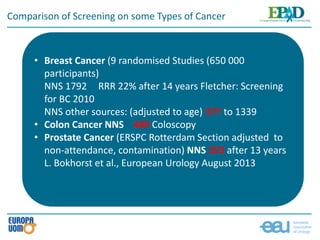
Comparison of Screening on some Types of Cancer
• Breast Cancer (9 randomised Studies (650 000
participants)
NNS 1792 RRR 22% after 14 years Fletcher: Screening
for BC 2010
NNS other sources: (adjusted to age) 377 to 1339
• Colon Cancer NNS 489 Coloscopy
• Prostate Cancer (ERSPC Rotterdam Section adjusted to
non-attendance, contamination) NNS 293 after 13 years
L. Bokhorst et al., European Urology August 2013
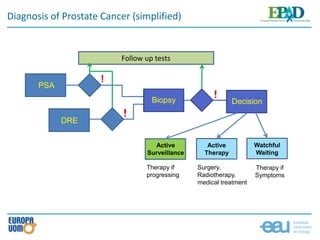
Diagnosis of Prostate Cancer (simplified)
PSA
Tastunter-
suchungDRE
Biopsy Decision
Follow up tests
!
Active
Surveillance
Active
Therapy
Watchful
Waiting
Surgery,
Radiotherapy,
medical treatment
Therapy if
progressing
Therapy if
Symptoms
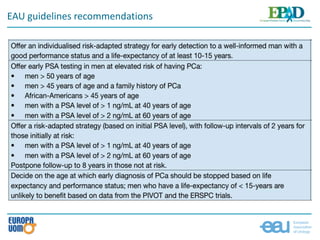
EAU guidelines recommendations
Screening, early detection
Early detection:
• An early detected tumour
may be cured.
• Treatment with less
undesirable side effects is
possible
• Low risk tumours need no
prompt treatment or no
treatment at all. (Active
Surveillance)
• Risk of overtreatment
No early detection:
• Tumour detected by
symptoms, curative treatment
no longer possible.
• Tumours, curable were missed
• An advanced tumour may
reduce quality of life
• No concern by diagnosis of an
insignificant tumour
• Better differentiation between low risk an high risk PCa.
• Improve reliability of biopsy results (imaging).
• Reduce the remaining risk of AS.
EU should promote early detection
diagnosis of men at risk based on the most
recent EAU guidelines for screening and
early detection.
Still to be done
TV discussion: Question to an journalist, arguing against
screening and refusing for himself early detection testing:
Assumed, you were diagnosed with an advanced prostate
cancer no longer curable.
Would you regret, that you have not had
early detection tests?
An interesting question
Would you regret, that you have not had
early detection tests?
Think about your answer to this question.
Thank you for listening!
Thank you for listening !

EPAD 2017 - Paul Enders

  • 1.
    Prostate Cancer screeningfrom a patient’s perspective Paul Enders Europa Uomo and member EAU Prostate Cancer Guidelines Panel
  • 2.
    Screening • Screening: systematicexamination of asymptomatic men (at risk), initiated by health authorities • Early detection is initiated by the patient and/or his physician.
  • 3.
    Screening • Objective ofscreening and early detection is to reduce PCa caused mortality and to reduce the risk of developing advanced and metastatic PCa, which may be related to a dramatic loss in quality of life. • Europe-wide, men should be aware of the importance of early detection.
  • 4.
    Screening, Points ofCriticism Screening and early detection tests under controversial discussions • Not efficient • Too much over-diagnosis • Too much overtreatment
  • 5.
    Comparison of Screeningon some Types of Cancer • Breast Cancer (9 randomised Studies (650 000 participants) NNS 1792 RRR 22% after 14 years Fletcher: Screening for BC 2010 NNS other sources: (adjusted to age) 377 to 1339 • Colon Cancer NNS 489 Coloscopy • Prostate Cancer (ERSPC Rotterdam Section adjusted to non-attendance, contamination) NNS 293 after 13 years L. Bokhorst et al., European Urology August 2013
  • 6.
    Diagnosis of ProstateCancer (simplified) PSA Tastunter- suchungDRE Biopsy Decision Follow up tests ! Active Surveillance Active Therapy Watchful Waiting Surgery, Radiotherapy, medical treatment Therapy if progressing Therapy if Symptoms
  • 7.
  • 8.
    Screening, early detection Earlydetection: • An early detected tumour may be cured. • Treatment with less undesirable side effects is possible • Low risk tumours need no prompt treatment or no treatment at all. (Active Surveillance) • Risk of overtreatment No early detection: • Tumour detected by symptoms, curative treatment no longer possible. • Tumours, curable were missed • An advanced tumour may reduce quality of life • No concern by diagnosis of an insignificant tumour
  • 9.
    • Better differentiationbetween low risk an high risk PCa. • Improve reliability of biopsy results (imaging). • Reduce the remaining risk of AS. EU should promote early detection diagnosis of men at risk based on the most recent EAU guidelines for screening and early detection. Still to be done
  • 10.
    TV discussion: Questionto an journalist, arguing against screening and refusing for himself early detection testing: Assumed, you were diagnosed with an advanced prostate cancer no longer curable. Would you regret, that you have not had early detection tests? An interesting question
  • 11.
    Would you regret,that you have not had early detection tests? Think about your answer to this question. Thank you for listening!
  • 12.
    Thank you forlistening !