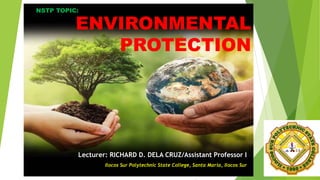
ENVIRONMENTAL
PROTECTION
Lecturer: RICHARD D. DELA CRUZ/Assistant Professor I
Ilocos Sur Polytechnic State College, Santa Maria, Ilocos Sur
NSTP TOPIC:
ENVIRONMENTAL
EDUCATION
ENVIRONMENTAL
PROTECTION
ENVIRONMENTAL
LAW
Refers to organized efforts to teach about how natural
environments function and, particularly, how human
beings can manage their behavior and ecosystem in
order to live sustainably.
It is a practice of protecting the natural environment
on individuals, organizational or governmental levels
for the benefit of both the natural environment and
humans.
It is a laws that regulate the impact of human
activities on the environment. Environment law
covers a broad range of activities that affect air, water,
land, flora or fauna.
ENVIRONMENTAL
LAW
It includes laws that relate to:
• Protection of animal and
plants
• Planning for the use and
development of land
• Mining, exploration and
extractive industries
• Forestry
• Pollution
• Fisheries
• Land and fire management
• Agriculture and farming
• Waste management
• Climate change and
emissions
• Water resource management
(rivers, oceans and wetlands)
• Chemicals and pesticides
• Weeds and invasive species
• Marine life
• Conservation of natural and
cultural heritage
The general functions of most
environmental laws are to:
 Set offences and penalties for
causing harm to the environment
which is not authorised
 Assess, control or stop certain
activities (such as land use and
development) before they are
carried out
 Set policies and standards for
how activities will be controlled
and how environmental decisions
and approvals will be made.
 Enable members of the public to
take part in environmental
decision-making.
 Create regulatory structures for
environmental management,
such as regulatory agencies (e.g.
the Department of Lands,
Planning and Environment)
 Create specialist courts and
tribunals (e.g. the Lands,
Planning and Mining Tribunal
Presidential
Decree No.
1586 or the
Environmental
Impact
Statement
System
PHILIPPINE
ENVIRONMENTAL
LAWS
RA 9512 or the
Environmental
Awareness and
Education Act
of 2008
RA 9275 or the
Philippine
Clean Water
Act of 2004
RA 8749 or the
Philippine
Clean Air Act
of 1999
RA 6969 or the
Toxic
Substances and
Hazardous and
Nuclear Waste
Control Act of
1990
RA 9003 or the
Ecological
Solid Waste
Management
Act of 2000
Focus of Environmental Education on:
 Awareness and sensitivity about the
environment and environmental challenges.
 Knowledge and understanding about the
environment and environmental challenges
 Attitude concern for the environment and
help to maintain environmental quality
 Skills to mitigate the environmental problems
 Participation for exercising existing
knowledge environmental related programs.
Law promoting
Environmental
Education
AN ACT TO PROMOTE ENVIRONMENTAL
AWARENESS THROUGH
ENVIRONMENTAL EDUCATION AND FOR
OTHER PURPOSES
REPUBLIC ACT 9512
To aid the implementation of different
environmental protection laws and build
capacities other undertakings are:
Training, Seminars, Workshops
Development and production of education materials
Teacher education courses
Other Features
Environmental Education and Activities are
part of the National Service Training Program
(NSTP) under the Civic Welfare Training
Service (CWTS) component
Philippine
Environment
Law
Presidential Decree No.
1586 Environmental
Impact Statement System
Basic DENR policy governing
the implementation of the
Philippine EIS System is:
“to attain and maintain a rational
and orderly balance between
economic growth and environmental
protection”
ENVIRONMENTAL IMPACT ASSESSMENT
(EIA)
ECC – document issued by the DENR/EMB after a
positive review of an ECC application, certifying
that based on the representations of the
proponent, the proposed project or undertaking
will not cause significant negative environmental
impact.
CNC – a certification issued by the EMB certifying
that, based on the submitted project
description, the project is not covered by the EIS
System and is not required to secure an ECC.
ENVIRONMENTAL IMPACT ASSESSMENT
(EIA)
ECP – project or program that has high
potential for significant negative
environmental impact.
ECA – area delineated as environmentally
sensitive such that significant environmental
impacts are expected if certain types of
proposed projects or programs are located,
developed or implemented.
LIST OF ECPs
As declared by proclamation No. 2146 (1981)
• Heavy Industries – Non-ferrous Metal Industries,
Iron and Steel Mills, Petroleum and Petro-
chemical industries including Oil and Gas,
Smelting Plants.
• Resource Extractive Industries – Major Mining and
Quarrying Projects, Forestry Projects (logging,
major wood processing projects, introduction of
fauna (exotic animals) in public and private
forests, forest occupancy, extraction of mangrove
products, grazing, Fishery Projects (dikes for/and
fishpond development projects)
LIST OF ECPs
As declared by proclamation No. 2146 (1981)
• Infrastructure Projects – Major Dams, Major
Power Plants (fossil-fuelled, hydroelectric or
geothermal), Major Reclamation Projects, Major
Roads and Bridges.
ENVIRONMENTAL IMPACT ASSESSMENT
(EIA)
ECC – document issued by the DENR/EMB after a
positive review of an ECC application, certifying
that based on the representations of the proponent,
the proposed project or undertaking will not cause
significant negative environmental impact.
CNC – a certification issued by the EMB certifying
that, based on the submitted project description,
the project is not covered by the EIS System and is
not required to secure an ECC.
Philippine
Environment
Law
SALIENT FEATURES OF THE
CLEAN WATER ACT OF 2004
Water Problems, Threats & Issues in the
Philippines
 Pollution discharges
1. Agricultural wastewaters
2. Domestic sewage
3. Industrial effluents
4. Ship-based residuals
5. Floating garbage
6. Toxic chemicals/hazardous wastes
Philippine Water Realities
 58% of wells tested by EMB-DENR were
contaminated with coliform.
50 rivers are considered biologically dead.
Philippine Water Realities
Main contributors of organic
water pollutants are
domestics ( ≅
50%);agricultural (>35%) and
industrial (15%) wastewaters.
Do you know that there is a law that
protects the Philippines water quality?
 Yes, the Philippines Clean Water Act
of 2004 (R.A.9275) aims to protect
the country’s water bodies from
pollution from land-based sources
(industries and commercial
establishment, agriculture and
community/household activities).
What does the Clean Water Act
provides for?
 CWA provides for a comprehensive and
integrated strategy to prevent and
minimize pollution through a multi-sectoral
and participatory approach involving all the
stakeholders.
How will WATER QUALITY be MANAGED?
Management of water quality will be
based on watershed, river basin or
water resources region.
Management will be localized.
Multisectoral governing boards
will be established to manage
water quality issues within
their jurisdiction.
What are the PROHIBITED ACTS in CWA?
 Depositing material of any kind which
could cause water pollution (e.g.
medical wastes)
 Discharging, injecting or allowing to
seep into the earth any substance that
would pollute groundwater
(toxic/hazardous substances)
 Operating facilities that discharge
regulated water pollutants without the
valid required permits or after the
permit was revoked for any violation
PROHIBITED ACTS
 Refusal to allow entry, inspection and monitoring
as well as access to reports and records by the
DENR in accordance with the CWA.
 Refusal or failure to submit reports to the DENR
in accordance with the CWA.
 Directly using booster pumps in the distribution
system or tampering with the water supply in
such a way to alter or impair the water quality.
Waste Water Discharge Permit
REQUIREMENTS
A. For new/modified establishments:
1. Engineer’s Report;
2. A copy of the results of sampling analysis of the
establishment’s wastewater characteristics for 4
quarters for the previous year;
3. A copy of the Certificate of Accreditation of the
PCO;
4. Official Receipt for the payment of the fixed fee;
5. A copy of the Environmental Compliance
Certificate (ECC) or Certificate of Non-Coverage
(CNC).
Philippine
Environment
Law
RA 8749
PHILIPPINE CLEAN AIR ACT
OF 2009
This law formulates a holistic national
program of air pollution management
that shall be implemented by the
government.
It focuses primarily on pollution
prevention rather than on control and
provide for a comprehensive
management program for air pollution.
What are the Classification of Pollution
Sources?
Stationary source
- Any building or immobile
structure, facility or
installation which emits or
may emit any air pollutant.
Examples are industrial firms and the smoke stacks of
power plants, hotels and other establishments.
Classification of Pollution Sources
 Mobile source
- Any vehicle/machine propelled
by or through oxidation or
reduction reactions including
combustion of carbon-based or
other fuel, that emit air
pollutants as a reaction products.
Examples are: cars, trucks, vans, buses, jeepneys,
tricycles and motorcycles.
Classification of Pollution Sources
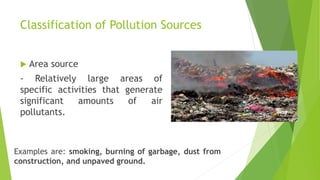
 Area source
- Relatively large areas of
specific activities that generate
significant amounts of air
pollutants.
Examples are: smoking, burning of garbage, dust from
construction, and unpaved ground.
Other Pollutants
 Ozone-Depleting Substances – are man-made
compounds containing chlorine and bromine
that have the potential to react with ozone
molecules in the stratosphere.
 Greenhouse Gases – these are naturally found
in the atmosphere and they trap heat close to
the Earth’s surface.
 Persistent Organic Pollutants
 Radioactive Emissions
What Can We Do to Support the Clean
Air Act?
 Plant trees.
 As much as possible, walk or ride your bicycle
instead of taking motorized transport.
 Report smoke belchers to the MMDA, LTO, and
other appropriate local government units and
organizations.
 Spread the word about the ban on smoking in
public places.
 Talk to people on what they can do about stopping
air pollution.
Philippine
Environment
Law
RA 9003
Ecological Solid Waste
Management Act of 2000
What is Ecological Solid Waste
Management?
 Refers to the systematic activities which provides for:
• Segregation at source
• Segregation transport
• Storage
• Transfer
• Processing
• Treatment and disposal
• And all other waste management which do not
harm the environment
THE NATIONAL SOLID WASTE
MANAGEMENT COMMISSION (NSWMC)
 Prescribe policies to achieve the objectives
of the Act
 Composed of 17 members:
• 14 members from the government sector
• 3 members from the private sector
NSWMC Members
(Government Sector – 14)
1. DENR (Chair)
2. DILG
3. DOST
4. DPWH
5. DOH
6. DTI
7. DA
8. MMDA
9. LPP
10.LCP
11.LMP
12.Liga ng mga Barangays
13.TESDA
14.PIA
NSWMC Members
(Private Sector-3)
1. A representative from the Non-Government
Organization (NGOs) whose principal purpose is to
promote recycling and the protection of air and
water quality;
2. A representative from the Recycling Industry
(present Vice Chairman);
3. A representative from the Manufacturing or
Packaging Industry;
INSTITUTIONAL STRUCTURE
NSWMC
(Policy Making)
DENR-EMB-NSWMC/S
(Technical Support &
Enforcement)
LGUs
(Implementation)
Waste Generators
RA 9003
CONCEPTUAL FRAMEWORK OF RA 9003
MANDATORY!
SEGRAGATION AT SOURCE
What are the impacts of improper waste
management?
1. Pollution of air and water:
Contamination of rivers and lakes;
Methane (emission from decaying
garbage).
Causes global warming (21X more potent
than carbon dioxide).
The Philippines has not been spared of the
weather-related disturbances and disasters.
The past typhoons have been unusually heavy
and have brought devastation to our country
and our people.
What are the impacts of improper waste
management?
2. Diseases:
Rats, cockroaches, and flies-typhoid
fever, meningitis, diarrhea, tuberculosis,
anthrax, worms, typhoid fever, dysentery,
jaundice, etc.
What are the impacts of improper waste
management?
3. Flooding:
Clogging of the drainage system.
Situation of rivers and creeks
What are the impacts of improper waste
management?
4. Unpleasant surroundings:
Foul odor
Loss of tourism potential
Philippine
Environment
Law
RA 6969
TOXIC SUBSTANCES AND
HAZARDOUS AND NUCLEAR
WASTES CONTROL ACT OF 1990
What are the objectives of RA 6969
 To protect the public and the environment
from the risk or potential dangers in the
use or exposure to chemicals from long
term damage brought about by careless
handling or disposal of hazardous wastes
 To regulate the use, movement and disposal
of chemical, hazardous and nuclear wastes
in the Philippines
If this little girl is
exposed to lead
The lead is
stored in her
bones as she
grows
When she becomes a
pregnant adult, the
lead moves from her
bones exposing her
fetus to lead.
Characteristics of Hazardous Waste
TOXICITY:
Poisonous (acute)
Carcinogenic, teratogenic, or
mutagenic effect on human and
other organism (chronic)
Substance is threat to water supplies
Characteristics of Hazardous Waste
IGNITABILITY:
Can create fire under certain
condition;
Friction sensitive substances like
solvents;
Causes or enhances fire
Characteristics of Hazardous Waste
CORROSIVITY:
Acidic or basic capable of corroding
metals;
By chemical action, can cause
severe damage when in contact with
living tissue.
Characteristics of Hazardous Waste
REACTIVITY:
Unstable under normal conditions and
readily undergo violent changes without
denoting;
React violently with water and create
spontaneously explosive mixtures of
toxic gases, vapors, and fumes; and
Capable of detonating (explosion)
Environmental Policy
Refers to the commitment of an
organization to the laws,
regulations, and other policy
mechanisms concerning
environmental issues and
sustainability.
Presidential Decree 1151
Philippine Environmental Policy
Governs the general policies on the
pursuits of a better quality of life for
the present and future generations
and mandates undertaking the
environmental impact assessments
for all projects which may
significantly affect the environment.
Presidential Decree 1152
Philippine Environment Code
To achieve and maintain such levels of
air quality as to protect public health
and to prevent to the greatest extent
practicable, injury and/or damage to
plant and animal life and property,
and promote the social and economic
development of the country.
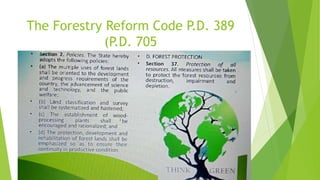
The Forestry Reform Code P.D. 389
(P.D. 705
Water Code of the Philippines (P.D.
1067)
The code covers underground
water, water above the ground,
water in the atmosphere and the
waters of the sea within the
territorial jurisdiction of the
Philippines.
Water Code of the Philippines (P.D.
1067)
 The water Code has the following objectives:
• To establish the basic principles and framework relating to the
appropriation, control and conservation of water resources to
achieve the optimum development and rational utilization of these
resources;
• To define the extent of the rights and obligation of water users
and owners including the protection and regulation of such rights;
• To adopt a basic law governing the ownership, appropriation,
utilization, exploitation, development, conservation and
protection of water resources and rights to land related thereto;
and
• To identify the administrative agencies which will enforce the law
PRESIDENTIAL DECREE No. 948
National Pollution Control Decree of 1976
CHAIN SAW ACT (2002)
RA 9175
ANIMAL WELFARE ACT OF 1998
RA 8485
Philippine Mining Act of 1995
RA 7942
Philippine Mining Act of 1995
RA 7942
The overall outcome and
thrust of the successful
implementation of these
environmental laws and
policies will be a region
that feels an increased
connection and
cooperative spirit in
forging societies based
on the principles of
ecological, social and
economic sustainability
THANK YOU VERY MUCH FOR LISTENING!!!

Environmental-Protection.pptx

  • 1.
    ENVIRONMENTAL PROTECTION Lecturer: RICHARD D.DELA CRUZ/Assistant Professor I Ilocos Sur Polytechnic State College, Santa Maria, Ilocos Sur NSTP TOPIC:
  • 2.
    ENVIRONMENTAL EDUCATION ENVIRONMENTAL PROTECTION ENVIRONMENTAL LAW Refers to organizedefforts to teach about how natural environments function and, particularly, how human beings can manage their behavior and ecosystem in order to live sustainably. It is a practice of protecting the natural environment on individuals, organizational or governmental levels for the benefit of both the natural environment and humans. It is a laws that regulate the impact of human activities on the environment. Environment law covers a broad range of activities that affect air, water, land, flora or fauna.
  • 3.
    ENVIRONMENTAL LAW It includes lawsthat relate to: • Protection of animal and plants • Planning for the use and development of land • Mining, exploration and extractive industries • Forestry • Pollution • Fisheries • Land and fire management • Agriculture and farming • Waste management • Climate change and emissions • Water resource management (rivers, oceans and wetlands) • Chemicals and pesticides • Weeds and invasive species • Marine life • Conservation of natural and cultural heritage
  • 4.
    The general functionsof most environmental laws are to:  Set offences and penalties for causing harm to the environment which is not authorised  Assess, control or stop certain activities (such as land use and development) before they are carried out  Set policies and standards for how activities will be controlled and how environmental decisions and approvals will be made.  Enable members of the public to take part in environmental decision-making.  Create regulatory structures for environmental management, such as regulatory agencies (e.g. the Department of Lands, Planning and Environment)  Create specialist courts and tribunals (e.g. the Lands, Planning and Mining Tribunal
  • 5.
    Presidential Decree No. 1586 orthe Environmental Impact Statement System PHILIPPINE ENVIRONMENTAL LAWS RA 9512 or the Environmental Awareness and Education Act of 2008 RA 9275 or the Philippine Clean Water Act of 2004 RA 8749 or the Philippine Clean Air Act of 1999 RA 6969 or the Toxic Substances and Hazardous and Nuclear Waste Control Act of 1990 RA 9003 or the Ecological Solid Waste Management Act of 2000
  • 6.
    Focus of EnvironmentalEducation on:  Awareness and sensitivity about the environment and environmental challenges.  Knowledge and understanding about the environment and environmental challenges  Attitude concern for the environment and help to maintain environmental quality  Skills to mitigate the environmental problems  Participation for exercising existing knowledge environmental related programs.
  • 7.
    Law promoting Environmental Education AN ACTTO PROMOTE ENVIRONMENTAL AWARENESS THROUGH ENVIRONMENTAL EDUCATION AND FOR OTHER PURPOSES REPUBLIC ACT 9512
  • 8.
    To aid theimplementation of different environmental protection laws and build capacities other undertakings are: Training, Seminars, Workshops Development and production of education materials Teacher education courses
  • 9.
    Other Features Environmental Educationand Activities are part of the National Service Training Program (NSTP) under the Civic Welfare Training Service (CWTS) component
  • 10.
    Philippine Environment Law Presidential Decree No. 1586Environmental Impact Statement System
  • 11.
    Basic DENR policygoverning the implementation of the Philippine EIS System is: “to attain and maintain a rational and orderly balance between economic growth and environmental protection”
  • 12.
    ENVIRONMENTAL IMPACT ASSESSMENT (EIA) ECC– document issued by the DENR/EMB after a positive review of an ECC application, certifying that based on the representations of the proponent, the proposed project or undertaking will not cause significant negative environmental impact. CNC – a certification issued by the EMB certifying that, based on the submitted project description, the project is not covered by the EIS System and is not required to secure an ECC.
  • 13.
    ENVIRONMENTAL IMPACT ASSESSMENT (EIA) ECP– project or program that has high potential for significant negative environmental impact. ECA – area delineated as environmentally sensitive such that significant environmental impacts are expected if certain types of proposed projects or programs are located, developed or implemented.
  • 14.
    LIST OF ECPs Asdeclared by proclamation No. 2146 (1981) • Heavy Industries – Non-ferrous Metal Industries, Iron and Steel Mills, Petroleum and Petro- chemical industries including Oil and Gas, Smelting Plants. • Resource Extractive Industries – Major Mining and Quarrying Projects, Forestry Projects (logging, major wood processing projects, introduction of fauna (exotic animals) in public and private forests, forest occupancy, extraction of mangrove products, grazing, Fishery Projects (dikes for/and fishpond development projects)
  • 15.
    LIST OF ECPs Asdeclared by proclamation No. 2146 (1981) • Infrastructure Projects – Major Dams, Major Power Plants (fossil-fuelled, hydroelectric or geothermal), Major Reclamation Projects, Major Roads and Bridges.
  • 16.
    ENVIRONMENTAL IMPACT ASSESSMENT (EIA) ECC– document issued by the DENR/EMB after a positive review of an ECC application, certifying that based on the representations of the proponent, the proposed project or undertaking will not cause significant negative environmental impact. CNC – a certification issued by the EMB certifying that, based on the submitted project description, the project is not covered by the EIS System and is not required to secure an ECC.
  • 17.
  • 18.
    Water Problems, Threats& Issues in the Philippines  Pollution discharges 1. Agricultural wastewaters 2. Domestic sewage 3. Industrial effluents 4. Ship-based residuals 5. Floating garbage 6. Toxic chemicals/hazardous wastes
  • 19.
    Philippine Water Realities 58% of wells tested by EMB-DENR were contaminated with coliform. 50 rivers are considered biologically dead.
  • 20.
    Philippine Water Realities Maincontributors of organic water pollutants are domestics ( ≅ 50%);agricultural (>35%) and industrial (15%) wastewaters.
  • 21.
    Do you knowthat there is a law that protects the Philippines water quality?  Yes, the Philippines Clean Water Act of 2004 (R.A.9275) aims to protect the country’s water bodies from pollution from land-based sources (industries and commercial establishment, agriculture and community/household activities).
  • 22.
    What does theClean Water Act provides for?  CWA provides for a comprehensive and integrated strategy to prevent and minimize pollution through a multi-sectoral and participatory approach involving all the stakeholders.
  • 23.
    How will WATERQUALITY be MANAGED? Management of water quality will be based on watershed, river basin or water resources region. Management will be localized. Multisectoral governing boards will be established to manage water quality issues within their jurisdiction.
  • 24.
    What are thePROHIBITED ACTS in CWA?  Depositing material of any kind which could cause water pollution (e.g. medical wastes)  Discharging, injecting or allowing to seep into the earth any substance that would pollute groundwater (toxic/hazardous substances)  Operating facilities that discharge regulated water pollutants without the valid required permits or after the permit was revoked for any violation
  • 25.
    PROHIBITED ACTS  Refusalto allow entry, inspection and monitoring as well as access to reports and records by the DENR in accordance with the CWA.  Refusal or failure to submit reports to the DENR in accordance with the CWA.  Directly using booster pumps in the distribution system or tampering with the water supply in such a way to alter or impair the water quality.
  • 26.
    Waste Water DischargePermit REQUIREMENTS A. For new/modified establishments: 1. Engineer’s Report; 2. A copy of the results of sampling analysis of the establishment’s wastewater characteristics for 4 quarters for the previous year; 3. A copy of the Certificate of Accreditation of the PCO; 4. Official Receipt for the payment of the fixed fee; 5. A copy of the Environmental Compliance Certificate (ECC) or Certificate of Non-Coverage (CNC).
  • 27.
  • 28.
    This law formulatesa holistic national program of air pollution management that shall be implemented by the government. It focuses primarily on pollution prevention rather than on control and provide for a comprehensive management program for air pollution.
  • 29.
    What are theClassification of Pollution Sources? Stationary source - Any building or immobile structure, facility or installation which emits or may emit any air pollutant. Examples are industrial firms and the smoke stacks of power plants, hotels and other establishments.
  • 30.
    Classification of PollutionSources  Mobile source - Any vehicle/machine propelled by or through oxidation or reduction reactions including combustion of carbon-based or other fuel, that emit air pollutants as a reaction products. Examples are: cars, trucks, vans, buses, jeepneys, tricycles and motorcycles.
  • 31.
    Classification of PollutionSources  Area source - Relatively large areas of specific activities that generate significant amounts of air pollutants. Examples are: smoking, burning of garbage, dust from construction, and unpaved ground.
  • 32.
    Other Pollutants  Ozone-DepletingSubstances – are man-made compounds containing chlorine and bromine that have the potential to react with ozone molecules in the stratosphere.  Greenhouse Gases – these are naturally found in the atmosphere and they trap heat close to the Earth’s surface.  Persistent Organic Pollutants  Radioactive Emissions
  • 33.
    What Can WeDo to Support the Clean Air Act?  Plant trees.  As much as possible, walk or ride your bicycle instead of taking motorized transport.  Report smoke belchers to the MMDA, LTO, and other appropriate local government units and organizations.  Spread the word about the ban on smoking in public places.  Talk to people on what they can do about stopping air pollution.
  • 34.
  • 35.
    What is EcologicalSolid Waste Management?  Refers to the systematic activities which provides for: • Segregation at source • Segregation transport • Storage • Transfer • Processing • Treatment and disposal • And all other waste management which do not harm the environment
  • 36.
    THE NATIONAL SOLIDWASTE MANAGEMENT COMMISSION (NSWMC)  Prescribe policies to achieve the objectives of the Act  Composed of 17 members: • 14 members from the government sector • 3 members from the private sector
  • 37.
    NSWMC Members (Government Sector– 14) 1. DENR (Chair) 2. DILG 3. DOST 4. DPWH 5. DOH 6. DTI 7. DA 8. MMDA 9. LPP 10.LCP 11.LMP 12.Liga ng mga Barangays 13.TESDA 14.PIA
  • 38.
    NSWMC Members (Private Sector-3) 1.A representative from the Non-Government Organization (NGOs) whose principal purpose is to promote recycling and the protection of air and water quality; 2. A representative from the Recycling Industry (present Vice Chairman); 3. A representative from the Manufacturing or Packaging Industry;
  • 39.
    INSTITUTIONAL STRUCTURE NSWMC (Policy Making) DENR-EMB-NSWMC/S (TechnicalSupport & Enforcement) LGUs (Implementation) Waste Generators RA 9003
  • 40.
  • 41.
  • 49.
    What are theimpacts of improper waste management? 1. Pollution of air and water: Contamination of rivers and lakes; Methane (emission from decaying garbage). Causes global warming (21X more potent than carbon dioxide).
  • 51.
    The Philippines hasnot been spared of the weather-related disturbances and disasters. The past typhoons have been unusually heavy and have brought devastation to our country and our people.
  • 52.
    What are theimpacts of improper waste management? 2. Diseases: Rats, cockroaches, and flies-typhoid fever, meningitis, diarrhea, tuberculosis, anthrax, worms, typhoid fever, dysentery, jaundice, etc.
  • 53.
    What are theimpacts of improper waste management? 3. Flooding: Clogging of the drainage system. Situation of rivers and creeks
  • 54.
    What are theimpacts of improper waste management? 4. Unpleasant surroundings: Foul odor Loss of tourism potential
  • 56.
    Philippine Environment Law RA 6969 TOXIC SUBSTANCESAND HAZARDOUS AND NUCLEAR WASTES CONTROL ACT OF 1990
  • 57.
    What are theobjectives of RA 6969  To protect the public and the environment from the risk or potential dangers in the use or exposure to chemicals from long term damage brought about by careless handling or disposal of hazardous wastes  To regulate the use, movement and disposal of chemical, hazardous and nuclear wastes in the Philippines
  • 62.
    If this littlegirl is exposed to lead The lead is stored in her bones as she grows When she becomes a pregnant adult, the lead moves from her bones exposing her fetus to lead.
  • 65.
    Characteristics of HazardousWaste TOXICITY: Poisonous (acute) Carcinogenic, teratogenic, or mutagenic effect on human and other organism (chronic) Substance is threat to water supplies
  • 66.
    Characteristics of HazardousWaste IGNITABILITY: Can create fire under certain condition; Friction sensitive substances like solvents; Causes or enhances fire
  • 67.
    Characteristics of HazardousWaste CORROSIVITY: Acidic or basic capable of corroding metals; By chemical action, can cause severe damage when in contact with living tissue.
  • 68.
    Characteristics of HazardousWaste REACTIVITY: Unstable under normal conditions and readily undergo violent changes without denoting; React violently with water and create spontaneously explosive mixtures of toxic gases, vapors, and fumes; and Capable of detonating (explosion)
  • 71.
    Environmental Policy Refers tothe commitment of an organization to the laws, regulations, and other policy mechanisms concerning environmental issues and sustainability.
  • 72.
    Presidential Decree 1151 PhilippineEnvironmental Policy Governs the general policies on the pursuits of a better quality of life for the present and future generations and mandates undertaking the environmental impact assessments for all projects which may significantly affect the environment.
  • 73.
    Presidential Decree 1152 PhilippineEnvironment Code To achieve and maintain such levels of air quality as to protect public health and to prevent to the greatest extent practicable, injury and/or damage to plant and animal life and property, and promote the social and economic development of the country.
  • 74.
    The Forestry ReformCode P.D. 389 (P.D. 705
  • 75.
    Water Code ofthe Philippines (P.D. 1067) The code covers underground water, water above the ground, water in the atmosphere and the waters of the sea within the territorial jurisdiction of the Philippines.
  • 76.
    Water Code ofthe Philippines (P.D. 1067)  The water Code has the following objectives: • To establish the basic principles and framework relating to the appropriation, control and conservation of water resources to achieve the optimum development and rational utilization of these resources; • To define the extent of the rights and obligation of water users and owners including the protection and regulation of such rights; • To adopt a basic law governing the ownership, appropriation, utilization, exploitation, development, conservation and protection of water resources and rights to land related thereto; and • To identify the administrative agencies which will enforce the law
  • 77.
    PRESIDENTIAL DECREE No.948 National Pollution Control Decree of 1976
  • 78.
    CHAIN SAW ACT(2002) RA 9175
  • 79.
    ANIMAL WELFARE ACTOF 1998 RA 8485
  • 80.
    Philippine Mining Actof 1995 RA 7942
  • 81.
    Philippine Mining Actof 1995 RA 7942
  • 82.
    The overall outcomeand thrust of the successful implementation of these environmental laws and policies will be a region that feels an increased connection and cooperative spirit in forging societies based on the principles of ecological, social and economic sustainability
  • 83.
    THANK YOU VERYMUCH FOR LISTENING!!!