Part I
INTRODUCTION
2 | SOCCSKSARGEN Regional Development Plan 2017-2022
| i
Earlier this year, we launched the
Philippine Development Plan (PDP)
2017-2022 through the initiative of the
National Economic and Development
Authority (NEDA). The PDP serves as
our medium-term blueprint towards
attaining a better and more secure life
for our people in the next 25 years.
To complement the PDP, we are now
launching the Regional Development
Plans (RDPs) 2017-2022. This will
provide direction in policy formulation
for the next six years as we steer private
and public investments to the regions.
Weintendtoplaceregionaldevelopment
at the center of our socioeconomic development strategy. By creating more jobs,
improving social services, encouraging innovation and connecting the countryside
growth centers, we will reduce poverty and accelerate development in rural areas.
The RDPs will also prioritize accelerating infrastructure development, protecting
our natural resources, addressing criminality and illegal drugs, and ensure peace
and security in the regions.
I commend the Regional Development Councils for aligning their respective
regional plans to our PDP through fruitful collaboration with local government
units and the private sector. I am confident that through the RDPs, we can realize
our goal of laying a solid foundation for stronger and more resilient nation for future
generations.
Foreword
RODRIGO ROA DUTERTE
President
Republic of the Philippines
MANILA
May 2017
ii | SOCCSKSARGEN Regional Development Plan 2017-2022
| iii
With regional and local development
being one of the main thrusts of
President Rodrigo R. Duterte’s
socioeconomic development agenda,
the Philippine Development Plan (PDP)
2017-2022, the first medium-term
plan anchored on a long-term vision
(AmBisyon Natin 2040), was specifically
designed to cultivate growth and reduce
inequality between the regions. This can
be achieved by directing development
to key areas throughout the country and
connecting these growth centers to rural
areas.
As such, the Regional Development
Plans (RDPs), as accompanying
documents to the PDP, will be an important tool in guiding both public and private
investments that will catalyze growth in the regions. It will also serve as our blueprint
in laying down the three main pillars of Malasakit, Pagbabago, at Patuloy na Pag-
unlad that will help us build a secure, comfortable, and strongly rooted life for all
Filipinos by 2040.
I would like to express my gratitude to the Regional Development Councils
(RDCs) for their leadership in the crafting of the RDPs, and in coordinating
various development efforts in the regions. Finally, we seek the support of our local
government units, regional institutions, and private institutions to support the
realization of our plans as we venture towards the creation of prosperous, peaceful
and resilient communities.
Message
Republic of the Philippines
NATIONAL ECONOMIC AND DEVELOPMENT AUTHORITY
ERNESTO M. PERNIA
Secretary of Socioeconomic Planning
iv | SOCCSKSARGEN Regional Development Plan 2017-2022
| v
The Regional Development Plan
(RDP) 2017-2022, translates the 0
to 10 Socioeconomic Agenda of the
Duterte Administration into specific
regional strategies that shall guide
SOCCSKSARGEN’s development
directions in the next six years. The RDP
also espouses the pillars of the Philippine
Development Plan (PDP) 2017-2022
which are Malasakit (Enhancing the
Social Fabric), Pagbabago (Inequality-
Reducing Transformation) and Patuloy
na Pag-unlad (Increasing Growth
Potential). The SOCCSKSARGEN RDP
likewise serves as a foundation plan
for the next three (3) administrations
(e.g., 2023-2028, 2029-2034, 2035-2040)
toward the fulfillment of AmBisyon Natin 2040.
The plan formulation process commenced upon the approval of the RDP Guidelines
through RDC XII Resolution No. 66, Series of 2016. This was followed by the
designation of the RDC XII Sectoral Committees as Regional Planning Committees
(RPC), responsible for drafting, refining and endorsing specific chapters assigned
to these bodies. Thereafter, several workshops were conducted to come-up with the
draft RDP for the RDC XII Full Council’s approval. During its 54th Regular Meeting,
RDC XII passed Resolution No. 77, Series of 2016, approving the SOCCSKSARGEN
RDP, 2017-2022. On 20 January 2017, the four (4) RPC Chairpersons convened
to further ensure internal consistency among the plan’s 21 chapters. Similarly,
the RDP underwent a peer review process to check Region XII’s role vis-à-vis the
development of Mindanao, as well as SOCCKSARGEN’s contribution to national
development goals.
Republic of the Philippines
NATIONAL ECONOMIC AND DEVELOPMENT AUTHORITY
SOCCSKSARGEN Region
Message
vi | SOCCSKSARGEN Regional Development Plan 2017-2022
From the assessment phase to its finalization, the RDP is a development blueprint
fostered by stakeholders’ participation and ownership, transparency, and relevance
to pro-actively address development issues and challenges through its dynamic
outcomes to attain poverty reduction with inclusive growth by the end of the
planning period.
In behalf of the RDC XII, let me express our gratitude to all development
partners for tirelessly participating in all planning activities. It is expected that all
government entities, the private sector, civil society organizations, academe and the
general public shall promote the RDP’s strategies to achieve the potentials of the
SOCCSKSARGEN Region.
RONNEL C. RIVERA
Chairperson, RDC XII, and
Mayor, General Santos City
15 March 2017
| vii
Republic of the Philippines
NATIONAL ECONOMIC AND DEVELOPMENT AUTHORITY
SOCCSKSARGEN Region
Message
The SOCCSKSARGEN Regional
Development Plan (RDP), 2017-2022
was formulated to serve as the region’s
blueprint to achieve its goals of inclusive
growth and poverty reduction. The
said Plan is aligned with the Philippine
Development Plan (PDP), 2017-2022
and supports the 0 to 10 Socioeconomic
Agenda of President Rodrigo R. Duterte.
It is likewise anchored on the country’s
commitment to the Sustainable
Development Goals (SDGs) of the
United Nations.
The Regional Development Council (RDC) XII, through its four (4) Sectoral
Committees, namely: Macro-Economy, Development Administration and
Finance Committee (MEDAFC), Economic Development Committee (EDC),
Regional Social Development Committee (RSDC), and Infrastructure and Utilities
Development Committee (InfraCom) served as the planning committees which
conducted an assessment of each sector’s performance in the previous medium-
term (2011-2016) and formulated strategies toward achievement of targets and
commitments for the period 2017-2022.
The Regional Strategic Framework for the next six years shall focus on the
administration’s theme of Malasakit, Pagbabago at Patuloy na Pag-unlad with due
consideration of promoting accelerated infrastructure development, peace and
security, safe and resilient population, green and healthy environment in Region
XII. All development efforts shall be undertaken with the end view of contributing
towards AmBisyon Natin 2040.
viii | SOCCSKSARGEN Regional Development Plan 2017-2022
The updated RDP is crafted after series of thorough and rigorous workshops and
consultations with various stakeholders in the region. On behalf of the NEDA
Regional Office XII, the RDC XII Secretariat, I wish to convey my deepest gratitude
and appreciation to all individuals and entities who contributed in the completion
of the Plan.
Mabuhay!
ARTURO G. VALERO, Ph.D
Vice-Chairperson, RDC XII and
Regional Director, NEDA XII
08 March 2017
| ix
Table of Contents
CHAPTER
NO.
TITLE PAGE
1 The Long View 3
2 Global and Regional Trends and Prospects 9
3
Overlay of Economic Growth, Demographic Trends and Physical
Characteristics
17
4 The Regional Strategic Framework 2017-2022 23
5 Ensuring People-Centered, Clean, and Efficient Governance 29
6 Pursuing Swift and Fair Administration of Justice 37
7 Promoting Philippine Culture and Values 45
8 Expanding Economic Opportunities in Agriculture, Forestry and Fishery 53
9
Expanding Economic Opportunities in Industry and Service Through
Trabaho at Negosyo
63
10 Accelerating Human Capital Development 77
11 Reducing Vulnerabilities of Individuals and Families 91
12 Building Safe and Secure Communities 97
13 Reaching for the Demographic Dividend 105
14 Vigorously Advancing Science, Technology, and Innovation 111
15 Ensuring Sound Macroeconomic Policy 119
16 Levelling the Playing Field through a Regional Competition Policy 127
17 Attaining Just and Lasting Peace 133
18 Ensuring Security, Public Order and Safety 141
19 Accelerated Infrastructure Development 153
20 Ensuring Ecological Integrity, Clean and Healthy Environment 177
21 Plan Implementation and Monitoring 187
x | SOCCSKSARGEN Regional Development Plan 2017-2022
List of Tables
TABLE
NO.
TITLE PAGE
1 Gross Regional Domestic Product (GRDP) Growth Rate (%), 2009-2015 13
2 Growth Target (%), Gross Regional Domestic Product (GRDP), 2017-2022 14
3
Population SOCCSKSARGEN, 2015 and Population Growth Rate, 2010-
2015 and 2000-2010, By Province/City
14
4 Employment Indicators, Region XII, 2014 and 2015 15
5
Employed Persons by Major Occupation Group, SOCCSKSARGEN, 2011-
2015, (In thousands)
15
6 Poverty Incidence among Families, Region XII, 2009, 2012 and 2015 16
7 Results Matrix for Governance 34-35
8 The 3-Pronged Harmonized Rehabilitation Program, Region XII 40
9 Results Matrix for Pursuing Swift and Fair Administration of Justice 43
10 Rice Production, Region XII, 2011-2015 (MT) 56
11 Area Harvested, Region XII, 2011-2015 (Ha) 56
12 Corn Production, Region XII, 2011-2015 57
13 Harvested, Region XII, 2011-2015 (In Hectares) 57
14 Productivity of High Value Commercial Crops, 2011-2015 57
15 Actual Livestock and Poultry Production (In MT), Region XII, 2011-2015 58
16 Actual Fish Production, Region XII, 2011-2015 58
17 Actual Livestock and Poultry Production (In MT), Region XII, 2011-2015 59
18
Results Matrix for Expanding Economic Opportunities in Agriculture,
Forestry, and Fisheries, 2017-2022
62
19 Tuna Catch (MT), Region XII 68
20 Investments and Exports Target, 2017-2022 70
21 MSMEs Indicators and Targets, 2017-2022 71
22 Visitor Arrivals by Type, Region XII, 2012-2015 72
23 Hotel Occupancy Rates, Region XII, 2012-2015 72
24 Number of DOT XII Accredited Establishments, 2011-2015, Region XII 72
25 Cooperatives Development, Region XII, 2011-2015 73
26
Results Matrix for Expanding Economic Opportunities in Industry and
Services (I&S), 2017 – 2022
74-75
27 Core TVET Indicators, Accomplishments 2011-2015 81
28 Higher Education Core Indicators Accomplishments, 2011-2015 82
29 Persons Assessed and Certified, Region XII, 2017-2022 83
30 Core Basic Education Indicators, Accomplishments 2011-2015 85
31 Core Health Indicators, Accomplishments 2011-2016 86
32 Results Matrix to Improve Nutrition and Health (Core Indicators) 88
33
Results Matrix to Ensure Lifelong Learning Opportunities for All (Core
Indicators)
89
| xi
List of Tables
TABLE
NO.
TITLE PAGE
34 Plan Targets to Increase Income Earning Ability (Core Indicators) 89-90
35 Core Social Protection Indicators 94
36 Results Matrix to Reduce Vulnerabilities of Individuals and Families. 96
37
Results Matrix for the National Shelter Program Direct Housing Assistance,
2017-2022
101
38 Age Dependency of the Population (In %), 2000 and 2010 107
39 Total Population and Urban Population by Province, 2010 108
40
Results Matrix for the plan period 2017-2022 to maximize the demographic
dividend.
110
41 Science and Technology Development Indicators, 2011-2016 114
42
Results Matrix to Leverage Science, Technology, and Innovation, 2017-
2022
116
43 Local Revenue Collection, 2011-2015, Region XII 122
44 Banking Institutions in Region XII, As of 2015 123
45 Number of Municipalities without Banks, by Province, Region XII, 2015 123
46 Banking and Financial System, Region XII, 2015 124
47
Results Matrix to Sustain a Sound, Stable, and Supportive Macroeconomic
Environment, 2017-2022
126
48
Results Matrix to Level the Playing Field through a National Competition
Policy, 2017-2022
130
49 Total Number and Cost of PAMANA Projects, 2011-2016 136
50 Results Matrix to Attain Just and Lasting Peace 2017-2022 140
51 Crime Solution/Crime Clearance Efficiency, 2011-2016 144
52 Crime Solution/Crime Clearance Efficiency, 2011-2016 144
53 Results Matrix to Ensure Security, Public Order and Safety, 2017-2022 150-151
54 Roads and Bridges, 2011-2016 156
55 Status of Kilos Abante Programs/Projects (KAPP), As of December 2016 156
56 Major Programs/Projects/Activities Implemented, As of December 2016 162
57 Status of Flood Control Projects in the Four Major Sub-basins in Region XII 165
58 CMTS and Broadband Coverage, as of June 2016 170
59 Percentage of CMTS and Broadband Coverage, as of June 2016 171
60 Health-Related Infrastructure, 2011-2016 172
61 Priority Projects of Region XII 173-174
62
Results Matrix to Accelerate Infrastructure Development (Roads and
Bridges), 2017-2022
174
63
Results Matrix to Accelerate Infrastructure Development (Port), 2017-
2022
175
64
Results Matrix to Accelerate Infrastructure Development (Airport), 2017-
2022
175
xii | SOCCSKSARGEN Regional Development Plan 2017-2022
List of Tables
List of Figures
FIGURE
NO.
TITLE PAGE
1 Administrative Map, SOCCSKSARGEN Region 12
2 The Regional Spatial Development Strategy 2015-2045 20
3 Regional Strategic Framework 2017-2022 29
4 Agriculture, Forestry and Fishery Gross Value Added Growth Rate (%) 55
5 Growth of Actual Fish Production, 2011-2015, In Percent 59
6 Growth Rate of Industry Gross Value Added (In Percent), 2011-2015 65
7 Investments and Exports, Region XII, Region XII, 2011-2015 66
8 Service Gross Value Added by Subsector, Region XII, 2009-2015 71
9 Enrolment, 2011-2016 80
10 Kilos Abante Programs/Projects (KAPP), Roads 157
11 Existing Seaport Project in Region XII, 2016 158
12 Existing Airport Improvement Projects, Region XII, 2016 160
13 Malitubog-Maridagao Irrigation Project (MMIP) II 163
14 Status/Updates on Malitubog-Maridagao Irrigation Project (MMIP) II 163
15 Status/Updates on Malitubog-Maridagao Irrigation Project (MMIP) II (2) 164
16 Status/Updates on Malitubog-Maridagao Irrigation Project (MMIP) II (3) 164
17 Flood Control Projects along Rio Grande De Mindanao 166
18 Flood Control Projects along Ala River 166
TABLE
NO.
TITLE PAGE
65
Results Matrix to Accelerate Infrastructure Development (Irrigation),
2017-2022
175
66
Results Matrix to Accelerate Infrastructure Development (Health-Related
Infrastructure), 2017-2022
175
67
Results Matrix to Accelerate Infrastructure Development (Information and
Communication), 2017-2022
176
68
Results Matrix to Accelerate Infrastructure Development (Energy Supply),
2017-2022
176
69
Results Matrix to Ensure Ecological Integrity, Clean and Healthy
Environment, 2017-2022
182-183
| xiii
Acronyms
4 Ps Pantawid Pamilyang Pilipino Program
µg/Ncm Microgram per normal cubic meter
AAGR Average Annual Growth Rate
ADB Asian Development Bank
ADSDPP Ancestral Domains Sustainable Development and Protection Plans
AEC ASEAN Economic Community
AEW Agricultural Extension Worker
AFP Armed Forces of the Philippines
AHD Adolescent Health and Development
AHFF Agriculture, Hunting, Fishery and Forestry
AHJAG Ad-hoc Joint Advisory Group
AHMP Accelerated Hunger Mitigation Program
AIP Annual Investment Program
ALS Alternative Learning System
AO Administrative Order
AOR Area of Responsibility
ARMM Autonomous Region in Muslim Mindanao
ARTA Anti-Red Tape Act
ASEAN Association of South East Asian Nations
BAS Bureau of Agricultural Statistics
BBL Bangsamoro Basic Law
BESRA Basic Education Sector Reform Agenda
BFAR Bureau of Fisheries and Aquatic Resources
BFP Bureau of Fire Protection
BIMP-EAGA Brunei, Indonesia, Malaysia, Philippines-East ASEAN Growth Area
BIR Bureau of Internal Revenue
BJMP Bureau of Jail Management and Penology
BOC Bureau of Customs
BOD Biochemical Oxygen Demand
BPAT Barangay Peacekeeping Action Teams
BPLS Business Permits and Licensing System
BPO Business Process Outsourcing
BSP Bangko Sentral ng Pilipinas
BuB Bottom Up Budgeting
CAAP Civil Aviation Authority of the Philippines
CAB Comprehensive Agreement on the Bangsamoro
CADT Certificate of Ancestral Domain Title
CALT Certificate of Land Title
CAPE Consultancy for Agricultural Productivity Enhancement Program
CARHRIHL
Comprehensive Agreement on Respect for Human Rights and International
Humanitarian Law
CARP Comprehensive Agrarian Reform Program
CARPER Comprehensive Agrarian Reform Program Extension with Reforms
CASS-OTS Civil Aviation Security Service- Office for Transportation Security
xiv | SOCCSKSARGEN Regional Development Plan 2017-2022
CBFM Community-based Forest Management
CBMS Community-Based Monitoring System
CCA Climate Change Adaptation
CCB Contact Center ng Bayan
CCCH Ceasefire Committee on the Cessation of Hostilities
CCPO Cotabato City Police Office
CCSPC Cotabato City State Polytechnic College
CCT Conditional Cash Transfer
CDD Community Driven Development
CDF Control Dump Facility
CDP Comprehensive Development Plan
CEP Certified Establishment Program
CFCST Cotabato Foundation College for Science and Technology
CFL Compact Fluorescent Lamps
CHED Commission on Higher Education
CIS Communal Irrigation System
CK Cotabato City-Kidapawan
CLUP Comprehensive Land Use Plan
CMTS Cellular Mobile Telephone System
COA Commission on Audit
COP Culture of Peace
COTELCO Cotabato Electric Cooperative, Inc.
CPPO Cotabato Provincial Police Office
CPT Cleaner Production Technology
CSC Civil Service Commission
CSEE Career Service Executive Examination
CSO Civil Society Organization
CURE Comprehensive and Unified Response to Eliminate Red Tape
CY Calendar Year
DA Department of Agriculture
DAR Department of Agrarian Reform
DBM Department of Budget and Management
DENR Department of Environment and Natural Resources
DepED Department of Education
DFS Diversified Farming System
DICT Department of Information and Communications Technology
DILG Department of the Interior and Local Government
DO Dissolved Oxygen
DOE Department of Energy
DOF-BLGF Department of Finance – Bureau of Local Government Finance
DOH Department of Health
DOJ Department of Justice
DOLE Department of Labor and Employment
DOST Department of Science and Technology
Acronyms
| xv
DOT Department of Tourism
DOTC Department of Transportation and Communications
DPWH Department of Public Works and Highways
DRR Disaster Risk Reduction
DRRM Disaster Risk Reduction Management
DRRMCs Disaster Risk Reduction Management Councils/Committees
DRRMO Disaster Risk Reduction Management Office
DSWD Department of Social Welfare Development
DTI Department of Trade and Industry
DU Distribution Unit
EC Electric Cooperative
ECB Engineering Construction Battalion
ECC Environmental Compliance Certificate
ELA Executive Legislative Agenda
EMPs Ecotourism Management Plans
EMS Emergency Medical Service
EO Executive Order
EOD Explosive and Ordnance Division
EPIRA Electric Power Industry Reform Act
EPP Export Pathways Program
FAB Framework Agreement on Bangsamoro
FAPs Foreign Assisted Projects
FLUPs Forest Land Use Plans
FMS Force Multiplier System
FPIC Free Prior and Informed Consent
FS Feasibility Study
GAA General Appropriations Act
GAD Gender and Equality
GAP Good Agricultural Practices
G-EPS Government Electronic Procurement System
GFI Government Financing Institution
GHG Greenhouse Gas
GID Governance and Institutions Development
GIS Geographic Information System
GOCC Government-Owned and Controlled Corporation
GPH Government of the Philippines
GRDP Gross Regional Domestic Product
GSCPO General Santos City Police Office
GVA Gross Value Added
ha Hectare
HD-CCTV High Definition Closed Circuit Television
HDMF Home Development Mutual Fund
HFEP Health Facilities Enhancement Program
HH Household
Acronyms
xvi | SOCCSKSARGEN Regional Development Plan 2017-2022
HLURB Housing and Land Use Regulatory Board
HR Human Resource
HRDC Health Research and Development Consortium
HRDMP Human Resource Development Management Plan
HUC Highly Urbanized City
HUDCC Housing and Urban Development Coordinating Council
HVCCs High Value Commercial Crops
IAs Irrigators’ Associations
ICC Independent Chartered City
ICC Indigenous Cultural Community
ICERD International Covention on the Elimination of Racial Discrimination
ICON Information Coordinating Network
ICRC International Committee of the Red Cross
ICT Information and Communication Technology
IDPs Internally Displaced Persons
IEC Information, Education and Communication
IFC International Finance Corporation
IFMA Integrated Forest Management Agreement
IGS Isulan-General Santos
IHL International Human Rights Law
IMR Infant Mortality Rate
IPMR Indigenous Peoples Mandatory Representative
IPRA Indigenous People’s Rights Act
IPs Indigenous Peoples
IPS Indigenous Political Structure
IPSP Internal Peace and Security Plan
IRA Internal Revenue Allotment
ISO International Standard Organization
ISP Internet Service Provider
ISPF International Ship and Port Facility
IWMP Integrated Watershed Management Plan
JAGS-CT Jose Abad Santos-Glan-Sarangani Cooperation Triangle
KALAHI-CIDSS
Kapit-Bisig Laban sa Kahirapan – Comprehensive Integrated Delivery of
Social Services
kg Kilogram
km Kilometer
KRA Key Result Area
kV kilo Volt
LCCAP Local Climate Change Action Plan
LCMS Legal Case Monitoring System
LDRRMPs Local Disaster Risk Reduction Management Plans
LED Light Emitting Diode
LGPMS Local Government Performance Monitoring System
LGU Local Government Unit
Acronyms
| xvii
LHB Local Housing Board
lm Linear meter
LMAG Lebak-Maasim-Alabel-Glan
LPRAT Local Poverty Reduction Action Team
LRA Land Registration Authority
LSDP Local Shelter Development Plan
LSPs Local Shelter Plans
LTO Land Transportation Office
MALMAR Malitubog-Maridagao
MASA MASID Mamamayang Ayaw sa Anomalya, Mamamayang Ayaw sa Illigal na Droga
MBLT Marine Battalion Landing Team
MCLET Municipal Coastal Law Enforcement Team
MCTC Municipal Circuit Trial Court
MDG Millennium Development Goal
MFI Micro Finance Institution
MFPC Multi-sectoral Forest Protection Committee
MGB Mines and Geo-sciences Bureau
MILF Moro Islamic Liberation Front
MinDA Mindanao Development Authority
MMIP Malitubog-Maridagao Irrigation Project
MMR Maternal Mortality Rate
MOA Memorandum of Agreement
MPEX Manufacturing Productivity Extension Program
MPN Most probable number
MPS Municipal Police Stations
MRB Mindanao River Basin
MRBDMP Mindanao River Basin Development Master Plan
MRF Material Recovery Facility
MSMEs Micro Small and Medium Enterprises
MT Metric Ton
MTC Municipal Trial Court
MTCCs Municipal Trial Court in Cities
MTEF Medium-Term Expenditure Framework
MVA Mega Volt Ampere
MVUC Motor Vehicle Users’ Charge
MW Mega Watt
NAPOLCOM National Police Commission
NAT National Achievement Test
NC National Certificate
NCD Newcastle Disease
NCIP National Commission on Indigenous Peoples
NCPW National Crime Prevention Week
NCSPC North Cotabato Seed Production Center
ND No data
Acronyms
xviii | SOCCSKSARGEN Regional Development Plan 2017-2022
Acronyms
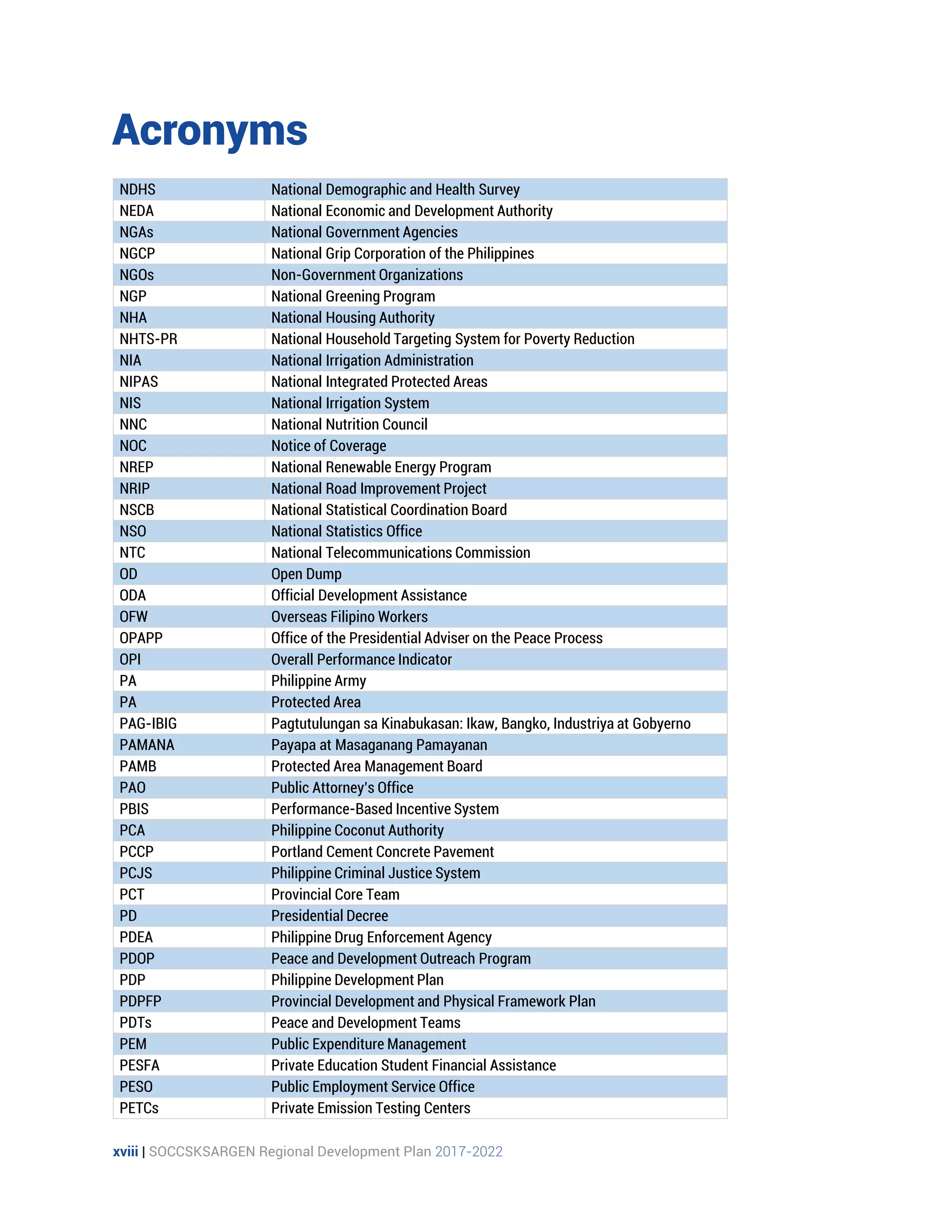
NDHS National Demographic and Health Survey
NEDA National Economic and Development Authority
NGAs National Government Agencies
NGCP National Grip Corporation of the Philippines
NGOs Non-Government Organizations
NGP National Greening Program
NHA National Housing Authority
NHTS-PR National Household Targeting System for Poverty Reduction
NIA National Irrigation Administration
NIPAS National Integrated Protected Areas
NIS National Irrigation System
NNC National Nutrition Council
NOC Notice of Coverage
NREP National Renewable Energy Program
NRIP National Road Improvement Project
NSCB National Statistical Coordination Board
NSO National Statistics Office
NTC National Telecommunications Commission
OD Open Dump
ODA Official Development Assistance
OFW Overseas Filipino Workers
OPAPP Office of the Presidential Adviser on the Peace Process
OPI Overall Performance Indicator
PA Philippine Army
PA Protected Area
PAG-IBIG Pagtutulungan sa Kinabukasan: Ikaw, Bangko, Industriya at Gobyerno
PAMANA Payapa at Masaganang Pamayanan
PAMB Protected Area Management Board
PAO Public Attorney’s Office
PBIS Performance-Based Incentive System
PCA Philippine Coconut Authority
PCCP Portland Cement Concrete Pavement
PCJS Philippine Criminal Justice System
PCT Provincial Core Team
PD Presidential Decree
PDEA Philippine Drug Enforcement Agency
PDOP Peace and Development Outreach Program
PDP Philippine Development Plan
PDPFP Provincial Development and Physical Framework Plan
PDTs Peace and Development Teams
PEM Public Expenditure Management
PESFA Private Education Student Financial Assistance
PESO Public Employment Service Office
PETCs Private Emission Testing Centers
| xix
Acronyms
PFM Public Financial Management
PFMAT Public Financial Management Assessment Tool
pH Potential of hydrogen
PHIC Philippine Health Insurance Corporation
PhilGEPS Philippine Government Electronic Procurement System
Php Philippine Pesos
PIA Philippine Information Agency
PLPEM Provincial/Local Planning and Expenditure Management
PM10 Particulate Matter less than 10 microns in diameter
PNP Philippine National Police
PNP-SAF Philippine National Police-Special Action Force
POPCEN Census of Population
POPDEV Population Development
POs People’s Organizations
PPA Philippine Ports Authority
PPA-DOJ Parole and Probation Administration-Department of Justice
PPDCI Philippine Palm Oil Development Council, Inc.
PPE Personal Protective Equipment
PPP Public-Private Partnership
PRAISE Program on Awards and Incentives for Service Excellence
PRAT Poverty Reduction Action Team
PRC Professional Regulation Commission
PRIME-HRM
Program to Institutionalize Meritocracy and Excellence in Human
Resources Management
PRO Police Regional Office
PSA Philippine Statistics Authority
PSR Private Sector Representative
PSS Problem-Solving Session
PWD Person With Disability
RA Republic Act
RAP-LGU Resettlement Assistance Program to LGUs
RATE Run After Tax Evader
RBPMS Result-Based Performance Management System
RCS Report Card Survey
RDC Regional Development Council
RDI Research and Development Institute
RDP Regional Development Plan
RE Renewable Energy
RGC Regional Government Center
RoRo Roll on-Roll off
RPFP Responsible Parenthood and Family Planning
RPMC Regional Project Monitoring Committee
RPMES Regional Project Monitoring and Evaluation System
RPRH Responsible Parenthood and Reproductive Health
xx | SOCCSKSARGEN Regional Development Plan 2017-2022
Acronyms
RPTC Real Property Tax Collection
RSDF Regional Spatial Development Strategy
RTC Regional Trials Court
SAIDS Sustainable Agri-Industrial Development
SALN Statement of Assets, Liabilities and Networth
SCPC Student Crime Prevention Committee
SCPPO South Cotabato Provincial Police Office
SDEP Service Delivery Excellence Program
SETUP Small Enterprises Technology Upgrading System
SGLG Seal of Good Local Governance
SIFMA Socialized Integrated Forest Management Agreement
SKPPO Sultan Kudarat Provincial Police Office
SKSU Sultan Kudarat State University
SLF Sanitary Landfill
SLGR State of Local Governance Report
SME Small and Medium Enterprise
SMERA SME Roving Academy
SMI Sagittarius Mines Incorporated
SOCCSKSARGEN
South Cotabato, Cotabato Province, Cotabato City, Sultan Kudarat,
Sarangani, General Santos
SOCOTECO South Cotabato Electric Cooperative
SOV Search for Outstanding Volunteers
SPES Special Program for the Employment of Students
SPMS Strategic Performance Monitoring System
SPPO Sarangani Provincial Police Office
SRIP Small River Impounding Project
SSF Shared Service Facility
SSL Salary Standardization Law
SUCs State Universities and Colleges
SUKELCO Sultan Kudarat Electric Cooperative
SWM Solid Waste Management
TB Tuberculosis
TC Therapeutic Community
TCLP Therapeutic Community Ladderized Program
TESDA Technical Education and Skills Development Authority
TGPOs TVET Guidance and Placemant Offices
TICK Technology of Information and Communication in Koronadal
TIEZA Tourism Infrastructure and Enterprise Zone Authority
TOT Training for Trainors
TSS Total Suspended Solids
TVET Technical-Vocational Education and Training
TWSP Training for Work Scholarship Program
UHC-AHA Universal Health Care - Aquino Health Agenda
UNDRIP United Nations Declaration on the Rights of the IPs
| xxi
Acronyms
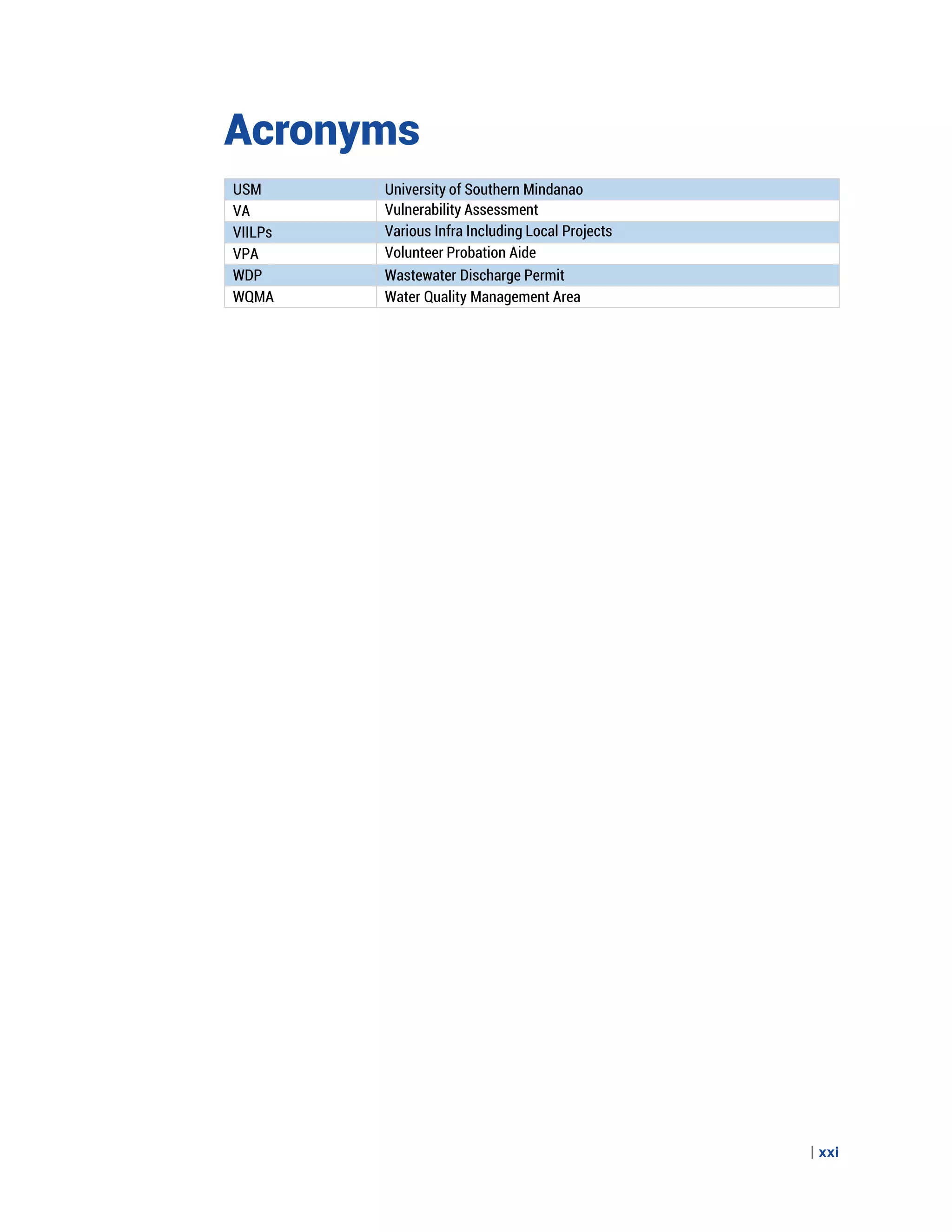
USM University of Southern Mindanao
VA Vulnerability Assessment
VIILPs Various Infra Including Local Projects
VPA Volunteer Probation Aide
WDP Wastewater Discharge Permit
WQMA Water Quality Management Area
xxii | SOCCSKSARGEN Regional Development Plan 2017-2022
Chapter 1 The Long View | 3
4 | SOCCSKSARGEN Regional Development Plan 2017-2022
Chapter 1 The Long View | 5
Chapter 1
The Long View
It is the aspiration of the Filipinos, particularly those from SOCCSKSARGEN Region
to have a long-term vision for the region to become a prosperous, predominantly
middle class society where no one is poor. The challenge is how every Filipino
can afford to have a “matatag, maginhawa at panatag na buhay by 2040.” The
region will have people who are healthy and live long lives, educated, smart and
innovative, with a high-trust society where families flourish in culturally diverse,
vibrant, and resilient communities.
The Long-Term
Vision: AmBisyon
Natin 2040
The SOCCSKSARGEN Regional
Development Plan (RDP) 2017-2022
supports the PDP 2017-2022 which is
anchored on the President’s 0 to 10-point
Socioeconomic Agenda and the objectives
of the 2030 Sustainable Development Goals
(SDGs) geared towards the country’s long-
term vision on AmBisyon Natin 2040.
The following development principles
were considered in the formulation of
SOCCSKSARGENRDP:GoodGovernance;
Convergence; Sustainable Development;
Gender and Development; Population and
Development;Volunteerism;andResiliency.
The goals of inclusive growth and poverty
reduction shall be pursued within the
auspices of good governance characterized
by well-intentioned people who are
participatory, accountable, transparent,
responsive, effective and efficient, equitable,
follow the rule of law, and consensus
oriented.
The Convergence Initiative shall involve
engaging the private sector, civil society, and
academe in the monitoring and evaluation
of interventions in the pursuit towards
sustainable development for poverty
reduction, food security, biodiversity
conservation, and climate change mitigation
and adaptation.
Sustainable Development is the organizing
principle for meeting human development
goals, while at the same time, sustaining
the ability of natural systems to provide the
natural resources and ecosystem services
upon which the economy and society
depend.
Gender and Development (GAD) is the
development perspective and process that
is participatory and empowering, equitable,
sustainable, free from violence, respectful
of human rights, supportive of self-
determination, and actualization of human
potentials.
Population and Development analyzes
the patterns of population growth that are
linked to challenges faced by the people
including poverty reduction and the
immediate actions that can be undertaken
to deal with growth while ensuring a
sustainable future for the region’s populace.
Volunteerism shall be the core modality in
harnessing citizen engagement to increase
public participation in government affairs
and promote a consultative process in policy
and decision-making.
To prevent and reduce hazard exposure
6 | SOCCSKSARGEN Regional Development Plan 2017-2022
Regional
Development Goal
The overarching goal of the region’s
development is to reduce poverty and
to share equitably the gains of economic
growth with the most disadvantaged sector.
The attainment of the region’s goal shall be
anchored on the following major strategies:
1.	 Transforming agriculture into a
competitive agribusiness industry;
2.	 Ensuring that all school-age population
are given equal opportunities to basic,
higher and technical-vocational
education;
3.	 Improving existing dilapidated hospital
buildings, upgrading facilities and
equipment, and engaging more health
workers;
4.	 Building resiliency of communities and
reducing vulnerabilities of individuals
and families;
5.	 Accelerating build-up of resilient
infrastructure facilities integrating
DRR-CCA measures;
6.	 Improving public financial
management;
7.	 Institutionalizing the Restorative Justice
Program, enhancing the three-pronged
harmonized rehabilitation program
and the Volunteer Probation Assistance
(VPA) Program;
8.	 Sustaining and supporting the peace
initiatives of the government; and
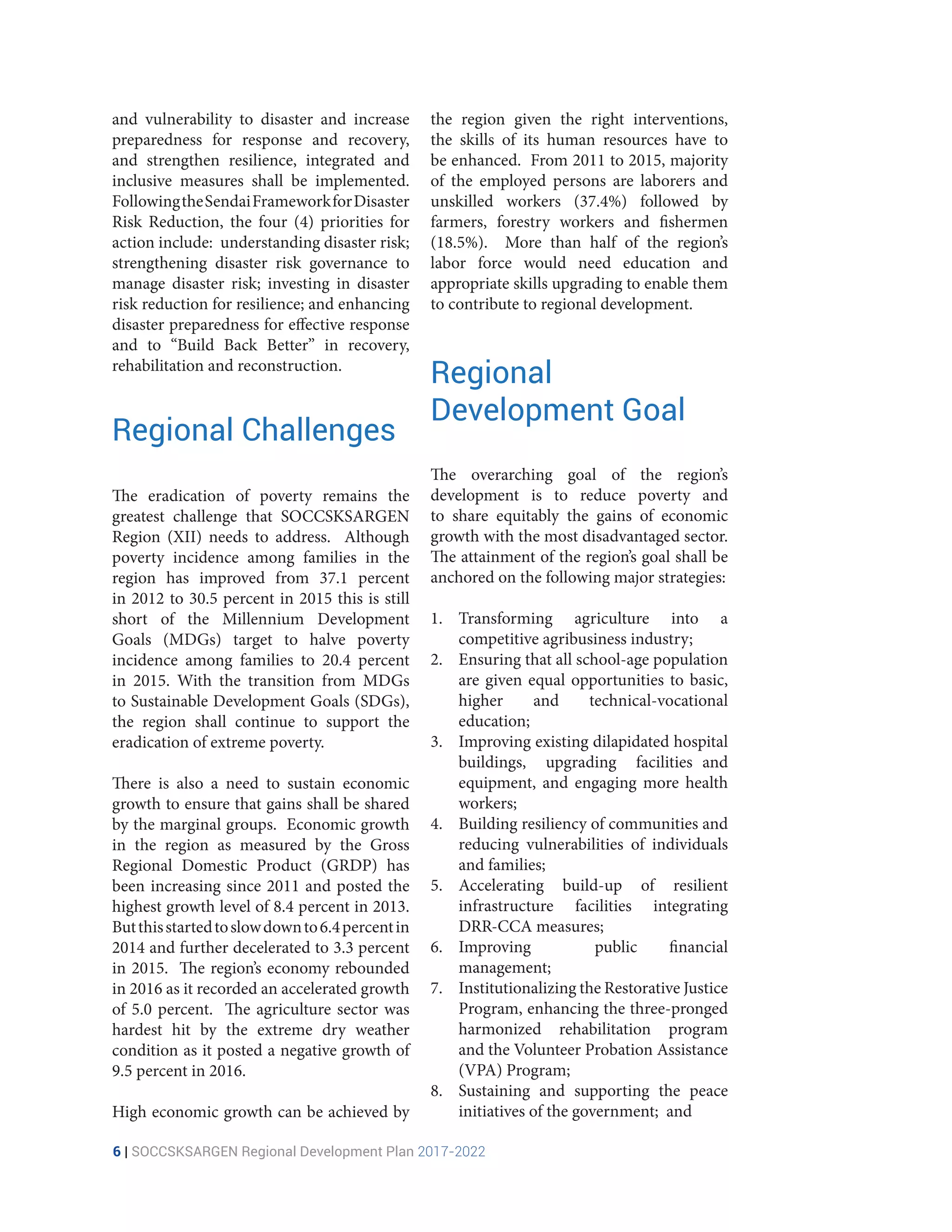
and vulnerability to disaster and increase
preparedness for response and recovery,
and strengthen resilience, integrated and
inclusive measures shall be implemented.
FollowingtheSendaiFrameworkforDisaster
Risk Reduction, the four (4) priorities for
action include: understanding disaster risk;
strengthening disaster risk governance to
manage disaster risk; investing in disaster
risk reduction for resilience; and enhancing
disaster preparedness for effective response
and to “Build Back Better” in recovery,
rehabilitation and reconstruction.
Regional Challenges
The eradication of poverty remains the
greatest challenge that SOCCSKSARGEN
Region (XII) needs to address. Although
poverty incidence among families in the
region has improved from 37.1 percent
in 2012 to 30.5 percent in 2015 this is still
short of the Millennium Development
Goals (MDGs) target to halve poverty
incidence among families to 20.4 percent
in 2015. With the transition from MDGs
to Sustainable Development Goals (SDGs),
the region shall continue to support the
eradication of extreme poverty.
There is also a need to sustain economic
growth to ensure that gains shall be shared
by the marginal groups. Economic growth
in the region as measured by the Gross
Regional Domestic Product (GRDP) has
been increasing since 2011 and posted the
highest growth level of 8.4 percent in 2013.
Butthisstartedtoslowdownto6.4percentin
2014 and further decelerated to 3.3 percent
in 2015. The region’s economy rebounded
in 2016 as it recorded an accelerated growth
of 5.0 percent. The agriculture sector was
hardest hit by the extreme dry weather
condition as it posted a negative growth of
9.5 percent in 2016.
High economic growth can be achieved by
the region given the right interventions,
the skills of its human resources have to
be enhanced. From 2011 to 2015, majority
of the employed persons are laborers and
unskilled workers (37.4%) followed by
farmers, forestry workers and fishermen
(18.5%). More than half of the region’s
labor force would need education and
appropriate skills upgrading to enable them
to contribute to regional development.
Chapter 1 The Long View | 7
promoted and innovation encouraged.
Aggressive efforts will be pursued to
ensure that a family will be of a size that
can be adequately cared for. This will
be complemented by measures to delay
childbearing and lengthen the space
between births.
Underpinning the foregoing strategies
is an enabling and supportive economic
environment. Growth will be supported
by maintaining macroeconomic stability,
putting in place a strategic trade and fiscal
policy, and enhancing access to financial
services. The tax system will be made
more efficient and a regional competition
policy will be localized and implemented
to ensure a level playing field. The
foundations for sustainable development
will have a physical environment that is
characterized by a balanced and strategic
development of infrastructure while
ensuring ecological integrity and a clean
and healthy environment. It is also about
building resiliency against disasters, as well
as improving access to basic services and
livelihood opportunities. Equally important
is ensuring national security against internal
and external threats, and restoring public
order and safety. There will be earnest
efforts to secure lasting peace through the
resumption of peace talks and pursuing
economic justice.
9.	 Harmonizing land uses from ridge-
to-reef by integrating forest land use
plans, watershed management plans,
protected areas management plans,
and other related forestry plans into
the LGUs’ CLUP and diversifying
livelihood sources of upland farmers
through multi-storey agroforestry and
partnership with private investors and
forest products processors.
Desired Outcome
By 2022, SOCCSKSARGEN Region seeks
to create a strong foundation for a more
inclusive growth, a high-trust society,
and a globally competitive knowledge
economy. This vision will be achieved by
adopting the key strategies of enhancing
the social fabric, reducing inequality, and
increasing the potential growth of the
economy. These strategies will be sustained
by a strong foundation in national security,
infrastructure development, building
resiliency, and ecological integrity.
Enhancing the social fabric aims at getting
back the peoples’ trust by making public
institutions citizen-centered, efficient and
clean. The administration of justice will be
swift and fair. Actions will be undertaken
to increase awareness of the region’s cultural
diversity and its value.
Reducing inequality focuses on expanding
economic opportunities and increasing
access to these opportunities directed at
economic groups that lag behind to allow
the people to feel the change. For the
disadvantaged individuals, it is reducing
vulnerability, enhancing social protection,
and improving human capital emphasizing
health, nutrition, and education.
Increasing potential growth will be made
possible by advancing to a knowledge
economy. Technology adoption will be
8 | SOCCSKSARGEN Regional Development Plan 2017-2022
Chapter 2 Global and Regional Trends and Prospects | 9
10 | SOCCSKSARGEN Regional Development Plan 2017-2022
Chapter 2 Global and Regional Trends and Prospects | 11
SOCCSKSARGEN is endowed with
resources that can enable it to attain
higher growth levels. Given the provision
of needed infrastructure support and the
conducive environment, it can attract
more investments that can generate more
jobs. The following are among the region’s
comparative advantages:
The strategic location of Region XII in
Mindanao and Brunei-Indonesia-Malaysia-
Philippines East Asia Growth Area (BIMP-
EAGA) facilitates the trading and export of
goods and eases the mobility of people in
the area.
.
Chapter 2
Global and Regional Trends and
Prospects
The region is endowed with extensive
coastlines, valleys and mountain ranges,
and is well-known for its river systems since
it is the catch basin of Mindanao. The area
is one of the typhoon-free regions in the
entire country. Its vast fertile agricultural
lands and rich fishery and aquatic resources
could push the region to higher growth
levels in agriculture and fishery production,
high-value crops, and other resource-
based industries. The region is among the
country’s leading producers of palay and
corn. It is the top producer of high value
crops like coffee, banana, pineapple, and,
oil palm. It leads in livestock inventory and
it is the tuna capital of the Philippines as it
hosts 80 percent of the tuna industry in the
country.
The region maintains world-class
infrastructure facilities, such as the
General Santos International Airport and
Seaport. About 80 percent of the country’s
Comparative
Advantage of
SOCCSKSARGEN
Region
SOCCSKSARGEN (Region XII) is located at the heart of Mindanao. The region
spans the geographical zone covering major portions of the Mindanao River Basin
and Buayan-Malungon River Basin areas comprising the provinces of Cotabato
(North), Sultan Kudarat, and South Cotabato, extending to the large coastal areas
of the southern tip of Mindanao containing the province of Sarangani and the
city of General Santos. It covers a total land area of 19,035.39 square kilometers
or 16.6 percent of the total land area of Mindanao. Of its total land area, about
7,906.38 square kilometers are alienable and disposable lands and 11,129.01
square kilometers are forestlands.
In 2001, Executive Order 36 reorganized the administrative regions in Mindanao
and reconstituted Region XII into four provinces (North Cotabato, South
Cotabato, Sarangani, and Sultan Kudarat) and five cities (Cotabato, General
Santos, Kidapawan, Koronadal, and Tacurong). The region is composed of 45
municipalities and 1,195 barangays. In 2004, Executive Order 304 was enacted
designating Koronadal City as the regional government center.
12 | SOCCSKSARGEN Regional Development Plan 2017-2022
tuna canneries are located at the General
Santos Fishport Complex. The Malitubog-
Maridagao River Irrigation System services
around 5,500 hectares of rice fields in the
provinces of Cotabato and Maguindanao
in the Autonomous Region in Muslim
Mindanao. The Mt. Apo Geothermal Plant
in Kidapawan City, Cotabato Province and
the Coal-Fired Power Plant in Maasim,
Sarangani provide reliable and efficient
energy sources for the Mindanao Grid.
Figure 1: Administrative Map, SOCCSKSARGEN Region
Source of data: DENR NAMRIA
Chapter 2 Global and Regional Trends and Prospects | 13
The continued operation of the Halal
Laboratory in Cotabato City and the
completion of another Halal Laboratory in
Koronadal City could make the region a
source of Halal-certified products for export
to the Halal markets in Southeast Asia and
the Middle East.
The region is home to indigenous tribes or
the First People whose ways of living are
unique practices of dances, accessories,
and cloth weaving. The region also boasts
of several ecotourism destinations, such
as Lake Sebu, Mt. Apo, and the Gumasa
beaches, historic caves, and bird and bat
sanctuaries. Key ecotourism destinations
on nature, sun, beach and dive are expected
to provide livelihood opportunities
The GRDP grew at a positive rate albeit
fluctuating. In 2009-2010, the GRDP
slightly grew by 2.2 percent. It continued
to increase and reached the highest level
of 8.4 percent in 2012-2013, but started to
decelerate at 6.2 percent in 2013-2014, and
further slowed down to 3.3 percent in 2014-
2015. An improvement was recorded as the
regional economy expanded by 5.0 percent
in 2015-2016.
For the period 2015-2016, the Industry
sector posted the highest growth at 13.5
percent, followed by the Services sector at
7.4 percent. The Agriculture sector recorded
a negative 3.5 percent, which is slower than
the rate in 2014-2015 at negative 9.5 percent.
The Industry sector had the highest growth
posting 13.5 percent in 2016 higher than
for communities hosting these natural
splendors.
Metallic mineral reserves, such as gold,
copper, and iron are found in the provinces
of Cotabato, Sultan Kudarat, and South
Cotabato. Minerals development in the
region shall be pursued within the auspices
of sustainable development, particularly the
Tampakan world-class copper deposit.
Supporting the region’s development
direction is a pool of knowledgeable and
skilled population though still needing
further training to meet the current and
future industrialization requirements of the
regional economy.
the growth reported in 2015 at 2.6 percent.
The main sources of growth in the Industry
sector came from the construction and
electricity, gas and water subsectors that
showed 25.8 percent and 25.3 percent
growth, respectively.
In terms of contribution to the regional
economy, the Services sector accounted for
the biggest share at 40.3 percent in 2016,
slightly higher than its 39.4 percent share in
2015. The share of Industry also expanded
to 36.9 percent in 2016 compared to the
previous year’s 34.1 percent. The share
of Agriculture continued to decline as it
contributed 22.9 percent to the region’s total
economic output in 2016, lower than its
26.5 percent share in 2015.
Source of data: PSA XII
Table 1:	 Gross Regional Domestic Product (GRDP) Actual Growth Rate (%), 2009-2015
Gross Regional Domestic Product (GRDP)
INDUSTRY
GROUP
2009-
2010
2010-
2011
2011-
2012
2012-
2013
2013-
2014
2014-
2015
2015-
2016
Agriculture 0.4 1.8 5.4 3.5 4.5 (2.2) (3.5)
Industry 3.0 10.0 10.8 11.6 7.1 2.1 13.5
Service 3.1 4.3 8.1 9.4 6.7 8.4 7.4
GRDP 2.2 5.3 8.1 8.4 6.2 3.3 5.0
14 | SOCCSKSARGEN Regional Development Plan 2017-2022
Table 2:	Gross Regional Domestic Product (GRDP) Growth Target (%), 2017-2022
Source of data: NEDA XII
The 2015 Census of Population (POPCEN
2015) showed that the population of Region
XII (SOCCSKSARGEN) as of August 1,
2015 stood at 4,545,276. This was higher
by 435,705 compared with the population
of 4.11 million in 2010 and by 1,323,107
compared to the population of 3.22 million
in 2000. The total population of Region
XII accounted for about 4.5 percent of the
Philippine population in 2015. Between
2010 and 2015, the region’s population grew
at an average annual rate of 1.94 percent. By
comparison, the rate at which the region’s
population grew during the period 2000 to
2010 was higher at 2.46 percent.
Among the four provinces comprising
the region, Cotabato (North Cotabato)
recorded the biggest population in 2015
with 1.38 million, followed by South
Cotabato (excluding General Santos
City) with 915,000, and Sultan Kudarat
with 812,000. Sarangani had the smallest
population with 544,000. General Santos
City (Dadiangas), the only highly urbanized
city in the region posted a population of
594,000. Cotabato City, on the other hand,
had a population of 299,000. This city is an
independent component city in Region XII
whose province, Maguindanao, is under the
regional jurisdiction of the Autonomous
Region in Muslim Mindanao (ARMM).
The rest of the cities of Region XII had the
following population, namely: Koronadal
City with 175,000, Kidapawan City with
140,000, and Tacurong with 98,000.
Table 3:	 Population, 2015 and Population Growth Rate, 2010-2015 and 2000-2010, 		
	 SOCCSKSARGEN, By Province/City
Source of data: PSA XII
The implementation of interventions
under the Responsible Parenthood and
Reproduction Health (RPRH) program is
expected to further reduce the population
growth rate of the region by the end of the
plan period.
Demographic trends
PROVINCE/CITY 2015 POPULATION 2010-2015 2000-2010
Philippines 100,981,437 1.72 1.90
Region XII 4,545,276 1.94 2.46
Cotabato (North) 1,379,747 2.27 2.49
Sarangani 544,261 1.67 1.97
South Cotabato 915,289 1.94 1.82
Sultan Kudarat 812,095 1.60 2.45
General Santos City 594,446 1.91 2.71
Cotabato City 299,438 1.86 5.19
GVA/
SECTOR
2016 2017 2018 2019 2020 2021 2022
L H L H L H L H L H L H L H
GRDP 5.4 6.0 6.1 6.6 6.7 7.2 7.2 7.7 7.8 8.3 8.3 8.8 8.9 9.4
Agriculture 1.0 2.0 2.0 2.5 2.5 3.0 3.0 3.5 3.5 4.0 4.0 4.5 4.5 5.0
Industry 7.0 7.5 7.5 8.0 8.0 8.5 8.5 9.0 9.0 9.5 9.5 10.0 10.0 10.5
Services 7.0 7.5 7.5 8.0 8.0 8.5 8.5 9.0 9.0 9.5 9.5 10.0 10.0 10.5
Chapter 2 Global and Regional Trends and Prospects | 15
Given the region’s average annual growth
rate of 1.94 percent between 2010-2015, its
population is expected to double in 36 years.
The total population 15 years and over
increased from 2,678 thousand in 2011 to
2,971 thousand in 2016; however labor force
participation rate posted a declining trend
from 67.5 percent in 2011 to 64.1 percent
in 2016. Meanwhile, the underemployment
rate has increased from 17.5 percent in 2011
to 23.8 percent in 2016.
Table 4:	 Employment Indicators, Region XII, 2011, 2014 - 2016
Source of data: PSA XII
Table 5:	 Employed Persons by Major Occupation Group, Region XII, 2011-2015, (in 		
	 thousands)
Note: Details may not add up due to rounding.
Source of data: PSA XII
Employment
MAJOR OCCUPATION GROUP 2011 2012 2013 2014 2015
Region XII – SOCCSKSARGEN 1,682 1,682 1,691 1,735 1,756
Government officials, special interest groups,
corporate executives, managers, managing
proprietor and supervisors
223 254 270 262 280
Professionals 58 57 63 66 71
Technicians/associate professionals 35 32 30 30 33
Clerks 54 57 57 66 67
Service/shop/market sales/workers 162 168 170 181 182
Farmers, forestry workers and fishermen 352 299 291 351 324
Trade and related workers 75 63 65 70 74
Plant, machine operators, assemblers 80 54 60 56 57
Laborers and unskilled workers 628 689 675 643 657
Specials occupations 16 9 9 10 12
The Social Reform and Poverty Alleviation
Act of 1997 defines “Poor” as individuals
and families whose income fall below the
poverty threshold and/or cannot afford
in a sustained manner to provide their
minimum basic needs of food, health,
education, housing and other essential
amenities of life. In Region XII, poverty
incidence among families dropped from
37.1 percent in 2012 to 30.5 percent in 2015.
About 31 out of every 100 families in the
region are poor.
Except for Sarangani, all provinces showed
improvement in poverty incidence in 2015.
The highest improvement was recorded in
Cotabato Province which posted a decrease
of 10.36 percentage points between 2012
and 2015.
About 31 of every 100 families in th eregion
are poor.
Poverty Incidence
INDICATOR 2011 2014 2015 2016
Total population 15 years and over
(In thousands)
2,678 2,752 2,798 2,971
Labor force participation rate 67.5 65.3 65.0 64.1
Unemployment rate 3.7 3.5 3.5 4.2
Underemployment 17.5 20.7 23.2 23.8
16 | SOCCSKSARGEN Regional Development Plan 2017-2022
Table 6:	 Poverty Incidence Among Families, Region XII: 2009, 2012 and 2015
Source of data: PSA XII
The proximity of Region XII to BIMP-
EAGA offers opportunities for increased
trading and investments with the region’s
integration in the BIMP-EAGA and ASEAN
economy as a whole.
The region is set to strengthen the ICT-BPO
sector as a priority industry to enhance its
servicetrade.Althoughbeingaregionhighly
dependent on agricultural inputs to drive
Industry and Service sectors, the region’s
direction towards technology adoption
and enhancement provides opportunities
for employment and job diversification.
The ICT/BPO industry provides
opportunities for global competitiveness
in terms of software development, data
processing and database services, human
resource services, e-commerce, enterprise
security, application development, and
manufacturing engineering among others.
Being an industry that cuts across the other
Industry sectors of the region, integration
of technology in the Services sector allows
the creation of opportunities for the human
capital needed to participate in the value
chain of these industries.
With this, the region is challenged to
capacitate its existing workforce to adapt
to new technologies and to produce
professionals relevant to the ICT/BPO
industry to diverge from the dependence
on the agri-industry and enhance the
region’s other sectors towards global
competitiveness. To take advantage of the
region’s integration in the BIMP-EAGA and
ASEAN economy, infrastructure facilities
and logistics support shall be established
to boost trading in electronics, garments,
food, beverages, and feeds.
Global growth
prospects
AREA
POVERTY INCIDENCE AMONG FAMILIES INCREASE/DECREASE (% POINTS)
2009 2012 2015 2009-2012 2012-2015
Region XII 30.8 37.1 30.5 6.3 –6.60
Cotabato Province 23.4 44.8 34.5 21.5 –10.36
Sarangani 47.5 46.0 47.3 –1.5 1.25
South Cotabato 25.7 25.8 19.8 0.1 – 5.96
Sultan Kudarat 41.6 40.4 39.2 –1.3 – 1.21
Cotabato City 29.9 34.5 24.7 4.6 – 9.85
Chapter 3 Overlay of Economimc Growth, Demographic Trends and Physical Characteristics | 17
18 | SOCCSKSARGEN Regional Development Plan 2017-2022
Chapter 3 Overlay of Economimc Growth, Demographic Trends and Physical Characteristics | 19
The first corridor is the Cotabato City-
Kidapawan City (CK) Agri-Industrial
and Eco-Tourism Corridor. The primary
growth node in this corridor is Cotabato
City with Kidapawan City and Midsayap
as intermediate urban centers. The major
industries that shall be promoted in this
corridor are agri-industrial and eco-tourism
development. The economic activities
Chapter 3
Overlay of Economic Growth,
Demographic Trends and
Physical Characteristics
in this corridor could be influenced by
the development of Regions XI, X and the
ARMM.
Cotabato City as the primary urban
center in this corridor shall serve as
the institutional, financial and service
center, the center for public health with
the existence of the Cotabato Regional
and Medical Center, and the provisional
seat of ARMM. The city as a special
economic zone is expected to diversify
its economic base and will facilitate the
creation of more investments and job
opportunities.
The SOCCSKSARGEN Regional Spatial Development Framework (RSDF) defines
the region’s desired spatial structure based on the trends on population,
economic activities, and services. It is anchored on the National Spatial Strategy
(NSS) that shows the development direction and recognizes the increasing
role of cities and the benefits of agglomeration economies, particularly the
urban areas, as drivers and venues for growth and poverty reduction. It also
promotes spatial integration through a well-connected network of settlements.
Region XII shall continue to adopt the Sustainable Agri-Industrial Development
Strategy(SAIDS)torealizeitsvisionasanagri-industrialhubandecotourismcenter
in southern Philippines. The spatial strategy shall encourage the establishment of
ecozones that will support the region’s industry clusters. Specifically, the spatial
strategyfocusesonTri-CorridorDevelopmentthatshalldevelopmainandpotential
corridors involving the establishment of small- to medium-scale processing
centers, agriculture and commercial hubs, ecotourism spokes, centers for social
opportunities, housing, connected by infrastructure support facilities, and made
resilient by mainstreaming disaster risk reduction and climate change adaptation
at all stages of the planning process. There shall be three main corridors.
The Cotabato City-
Kidapawan City (CK)
Agri-Industrial and Eco-
Tourism Corridor
The Regional Spatial Strategy
20 | SOCCSKSARGEN Regional Development Plan 2017-2022
Figure 2: The Regional Spatial Development Strategy 2015-2045
Source of data: NEDA XII
Cotabato Province ranks first in the
region in rice and rubber production,
second in corn, and produces organic
coco sugar and delicious tropical fruits.
It hosts processing plants for oil palm,
rubber and sugar cane. It also produces
freshwater fish. It has the longest zipline
(2.2 km) and boasts of beautiful tourism
sites. The Mt. Apo Geothermal Power
plant in Kidapawan City generates 52
megawatts and another 50-megawatt
plant is being worked out as expansion.
Chapter 3 Overlay of Economimc Growth, Demographic Trends and Physical Characteristics | 21
The Lebak-Maasim-
Alabel-Glan (LMAG)
Coastal Development
Zone
The third corridor shall be along the coastal
area of the region called the Lebak-Maasim-
Alabel-Glan (LMAG) Coastal Development
Zone. The primary growth nodes in this
corridor are Lebak, Kalamansig, Alabel
and Glan with Kiamba and Maasim as the
intermediate urban centers. Maitum shall
be an ecotourism destination.
The major industries to be promoted along
this corridor are marine fishing, coconut,
cement, marble, coffee, and nature, dive,
sun, and beach tourism.
The Roles of Provinces and Cities in
Regional Development
The provinces and cities play an important
role in the advancement of the region. The
provinces and cities complement each
other and the full development of their
unique strengths and characteristics could
contribute to the development of the region.
The Isulan-General Santos
(IGS) Agri-Industrial and
Eco-Tourism Corridor
The second corridor is the Isulan-General
Santos (IGS) Agri-Industrial and Eco-
Tourism Corridor. General Santos City
shall be the primary growth node in this
corridor with the cities of Koronadal, Isulan
and Tacurong as intermediate urban centers.
Koronadal City shall be the regional
administrative center of Region XII by
virtue of Executive Order 304 series of 2004.
The major industries that shall be promoted
in this corridor are: high value commercial
crops, corn and other agri-based products,
fishery-based products, and information
communication technology (ICT). Trade
linkage in this corridor with Region XI is
flourishing due to the natural flow of goods
and services between General Santos City
and Davao City.
Cotabato
Province
The agro-industrial center in the northern
part of the region producing organic rice,
exotic fruits, and processing industrial
crops like rubber and sugar. It is a source
of energy (geothermal).
South
Cotabato
The agro-industrial center in the
southern part of the region processing
high-value crops like pineapple, banana
and the prime agricultural producer of
rice, corn and other food crops. It is also
an emerging eco-tourism capital of the
region.
Sultan
Kudarat
The oil palm and coffee production and
processing center of the region and
producer of organic muscovado sugar,
aquamarine fisheries and seaweeds.
Sarangani The fishery, aquaculture and integrated
upland development center of the region.
It is a source of energy (coal). It is a
growing ecotourism destination with its
nature, dive, sun, and beach tourism.
Cotabato City The cultural and historical center of the
region, known as the cradle of the
Cotabato Empire Province, a special
economic zone and a Halal Hub.
Kidapawan
City
The fruit capital of the region, agri-
processing center for rubber, sugar and
tropical fruits, and the market and
distribution center of Cotabato Province.
Tacurong City The processing center for African oil
palm, cereals and grains, meat, poultry,
and the provincial market and
distribution center of Sultan Kudarat
province.
Koronadal
City
The Administrative Center of
SOCCSKSARGEN region. It positions itself
as the region’s convention hub.
General
Santos City
The metropolitan center of the region
being a highly urbanized city and the
Tuna Capital of the Philippines. With the
presence of the international standard
port and airport, it is the transshipment
hub of the region to other parts of the
country and the rest of the world. It shall
also be the prime business, banking,
financial and services center of the
region.
22 | SOCCSKSARGEN Regional Development Plan 2017-2022
Chapter 4 The Regional Strategic Framework 2017-2022 | 23
24 | SOCCSKSARGEN Regional Development Plan 2017-2022
Chapter 4 The Regional Strategic Framework 2017-2022 | 25
Chapter 4
The Regional Strategic
Framework 2017-2022
The SOCCSKSARGEN Regional Development Plan (RDP) 2017-2022 supports the
country’s long term vision that is anchored on AmBisyon Nation 2040, President
Duterte’s 0 to 10-point Socioeconomic Agenda, and the objectives of the 2030
Sustainable Development Goals. By 2022, SOCCSKSARGEN Region seeks to
create a strong foundation for a more inclusive growth, a high-trust society,
and a globally competitive knowledge economy. This vision will be achieved by
adopting the key strategies of enhancing the social fabric (Malasakit), reducing
inequality (Pagbabago), and increasing the potential growth (Kaunlaran) of the
economy. These strategies will be sustained by a strong foundation in regional
security and growth that will sustain peace, accelerate strategic infrastructure
build-up, maintain a clean and healthy environment towards ecological integrity,
and build resiliency from calamity and depravation.
Figure 3: Regional Strategic Framework 2017-2022
In support of the country’s Ambisyon Natin
2040, the SOCCSKSARGEN RDP will focus
on translating the President Duterte’s 0 to
10-point socioeconomic agenda and the
2030 Sustainable Development Goals into
strategies, policies, programs, and activities
for the period 2017-2022. It will lay down
a solid foundation for a more inclusive
growth, a high trust society and a globally
competitive knowledge economy, through
its emphasis on “Malasakit, Pagbabago para
sa Patuloy na Pag-unlad”.
The overall strategies will include enhancing
the social fabric, pursuing inequality
reducing transformation, increasing
26 | SOCCSKSARGEN Regional Development Plan 2017-2022
growth potential, enabling and supporting
economic environment, and laying the
foundations for sustainable development.
These strategies will be supported by the
cross-cutting themes based on a strong
foundation in sustaining peace and security,
accelerating infrastructure development,
ensuring ecological integrity, clean and
healthy environment, and building
resiliency.
The strategies and desired outcomes shall
be consistent with the principles of good
governance by adhering to the: (a) rule of
law and fairness; (b) inclusiveness and non-
discrimination; (c) participation, openness
and transparency; (d) performance
orientation and accountability; (e)
leadership and stewardship; (f) ethics
and probity; and (g) service orientation
and responsiveness. The Plan shall also
adhere to the government’s commitment to
promote human rights and equal access to
services for all.
Issues and concerns relating to gender and
development, gender equality and women’s
empowerment shall be mainstreamed
and integrated in the plan and investment
program. The Gender and Development
(GAD) checklist on development planning
will be used. The Plan shall likewise
integrate policies and strategies for disaster
risk reduction and building of resilience.
All these strategies shall drive
SOCCSKSARGEN Region to achieve
its main goals of poverty reduction and
inclusive growth.
Part II
ENHANCING
THE SOCIAL
FABRIC
(“MALASAKIT”)
28 | SOCCSKSARGEN Regional Development Plan 2017-2022
Chapter 5 Ensuring People-Centered, Clean, and Efficient Governance | 29
30 | SOCCSKSARGEN Regional Development Plan 2017-2022
Chapter 5 Ensuring People-Centered, Clean, and Efficient Governance | 31
Chapter 5
Ensuring People-Centered,
Clean, and Efficient
Governance
A high-trust society broadens the opportunities for inclusive development. A
high-trust society is a necessary condition for facilitating official and business
transactions, as well as interpersonal relationships. This trust is between citizens,
peoples, the private sector, and government. Citizens obey the law; they willingly
pay the correct taxes trusting that government will prudently manage the fiscal
resources. Government, in turn, is able to allocate adequate resources for public
goods and services, especially to those who need them the most. The needy who
benefitted from the prompt delivery of adequate services are then accorded better
chances of achieving more in life. The taxpaying public, meanwhile, is able to
pursue further their economic and other interests, secure in the knowledge that
their rights over the fruits of their labor are protected, first by government and
also by their fellow citizens.
The cornerstone of a high-trust society is the trust in government. This chapter
discusses strategies to ensure a people-centered, clean, efficient, and effective
governance by strengthening institutions, engaging and empowering citizens, and
providing enabling mechanisms to improve access to public goods and services.
Assessment
Pursuant to the provisions of Anti Red Tape
Act (ARTA) of 2007, all agencies and offices
providing frontline services are required
to have a Citizen’s Charter. In 2015, CSC
XII has targeted 52 service offices under
the ARTA-Report Card Survey (RCS)
Implementation Plan. The result of the
survey showed that all of the 52 targeted
offices passed the ARTA-RCS, eleven
(11) of which received an excellent rating
with a final score of 90-100%. The service
offices with excellent ratings were: 1) SSS-
Kidapawan City; 2) PHIC-Kidapawan City;
3) PHIC-Koronadal City; 4) SSS-Cotabato
City; 5) LTO XII; 6) PHIC-General Santos
City; 7) PHIC-Cotabato City; 8) PHIC-
Isulan; 9) LBP-Kidapawan City; 10) GSIS-
Kidapawan City; and 11) SSS-Tacurong
City. These offices were granted the Citizens
Satisfaction Center Seal of Excellence
Award after the second validation phase. In
addition, cash reward of PhP100,000.00 was
given for the purchase of equipment and
other materials to improve the delivery of
their frontline services.
The ARTA Watch was conducted as a
spot check of agency’s compliance to
the provisions of the ARTA, such as the
posting of the Citizen’s Charter, wearing of
identification cards, operationalization of
the Public Assistance and Complaints Desk,
posting of Anti-Fixer campaign posters and
the observance of the “No Noon Break”
Policy.
Good Governance
32 | SOCCSKSARGEN Regional Development Plan 2017-2022
With the full implementation of PhilGEPS,
failure in government bidding attributed
to: poor planning that resulted to
inappropriateness or inaccuracy in technical
specifications of the product and services to
beprocured;end-user’sdelayinprocurement
report; absence of detailed engineering;
poor cost estimates; and, leadership issues
may be avoided. Other problems and issues
relative to government procurement will
also have be eradicated. The DBM will
continue to orient/train BAC members and
accounting people on e-NGAS, e-Budget
and e-Procurement. These are electronic
processes comlementary to PhilGEPS.
Transparency
The SGLG Award recognizes the
performance of the local government units
in the areas of transparency and diligence to
comply with the ARTA; bringing investment
and employment through business-
friendly and competitive environment;
protecting the constituents from threats
to life and security; and safeguarding the
integrity of the environment. Region XII
has 14 LGUs recognized as SGLG national
awardees in 2016. They are the following:
Cotabato Province, Cities of Kidapawan
and Tacurong and the 11 municipalities of
Kabacan and M’lang of Cotabato Province;
Kiamba and Maitum of Sarangani Province;
Bagumbayan and Columbio of Sultan
Kudarat Province and the municipalities
of Banga, Polomolok, Sto. Niño, Surallah
and Tupi of South Cotabato Province.
These LGUs passed the three (3) core
criteria of financial administration, disaster
preparedness and social protection and one
of the essential criteria of peace and order,
environmental management and business
friendliness and competitiveness.
To promote participatory governance, the
following programs are enforced: Bottom-
To improve the HRM systems and
processes,theCSCalsoimplementedthe
Program to Institutionalize Meritocracy
and Excellence in Human Resources
Management (PRIME-HRM) which
is new tool for HRM assessment and
accreditation. As of 2015, 13 agencies
in the SOCCSKSARGEN Region were
recognized and awarded for meeting
the PRIME-HRM Maturity Level 2
standards under the Performance
Management System and a total of 82
or 100 percent of agencies under CSC
XII jurisdiction that have approved
and functional Strategic Performance
Monitoring System (SPMS).
Government Procurement
Up Budgeting approach to local planning
and budgeting; LGUs’ local poverty
reduction action plan; Kapit Bisig Laban
sa Kahirapan-CIDSS; and, the Citizen
Participatory Audit Program.
The full disclosure policy is currently
being strictly implemented in Region XII.
In ensuring public access to information,
all national government agencies, LGUs
and GOCCs are required to register in
the Philippine Government Electronic
Procurement System (PhilGEPS) for the
invitation to bids and awarding of contracts.
It is also encouraged to have internet
accessibility and make information available
online in government websites.
To warrant that the wealth gained by public
servants are from compensation and not
from unlawful sources, employees are
obliged to diligently prepare and submit
their annual Statement of Assets, Liabilities
and Networth (SALN).
The certification of frontline services with
ISO 9001 Certified Quality Management
System is in place. By following ISO
standards,processingtimeordoingbusiness
in the bureacracy is significantly eased.
Chapter 5 Ensuring People-Centered, Clean, and Efficient Governance | 33
Challenges
•	 Longerprocessingtimeandvoluminous
requirements in accessing public
services
•	 Weak implementation of RA 9485 or
the Anti-Red Tape Act (Enhancement)
•	 Government agencies delinquent
ratings (in implementing ARTA)
•	 Poor access to government information
online
•	 Poor implementation of RA 9184 or the
Government Procurement Reform Act
Priority Strategies
•	 Strict enforcement of RA 9485 or the
Anti-Red Tape Act to eliminate red tape,
prevent graft and corrupt practices, and
improve efficiency in the delivery of
government frontline services
1.	 Continue the implementation of
the ARTA-Report Card Survey for
the frontline service agencies, i.e.,
BIR RR 18, Bureau of Customs,
BFP XII, DTI XII, HDMF, PHIC,
Figure 4: Strategic Framework to Ensure People-centered, Clean, Efficient and 		
	 Effective Governance, 2017-2022
34 | SOCCSKSARGEN Regional Development Plan 2017-2022
SEC, Land Registration Authority,
SSS, DOJ-PPA, LTO XII, and Phil.
Ports Authority
2.	 Government data should be made
available to the public through
online presence in websites and
social media
3.	 Push for transparency,
accountability, and effectiveness
of LGUs and find new systems to
boost governance in the country
4.	 Continue ensuring and monitoring
LGU disclosure of public and
financial documents through the
Full Disclosure Policy (FDP)
•	 Competency-based recruitment,
selection, and placement systems
to include gathering of background
information for potential hires
1.	 Continue the conduct of
competency examination, e.g., CSC
and NAPOLCOM;
2.	 Hiring of government employees
through the standard civil service
rules
•	 Continually enhance the skills of
government workforce to adapt to
the new system and processes in the
delivery of public services
1.	 New entrants will have to undergo
rigorous training on values
formation, i.e., ALAB (Alay sa
Bayan), Culture of Peace, etc.
2.	 Training of newly-elected officials
(NEO), including the barangay
officials on the basics and
challenges of local governance and
administration
•	 Continue tracking the performance of
local government units (LGUs) through
the Seal of Good Local Governance
(SGLG) and provide incentives to those
that will hurdle it via the Performance
Challenge Fund (PCF)
•	 Raise the public awareness on the
concept/idea of federalism through
advocacy and information campaign
•	 Deepenandexpandcitizenparticipation
in local governance and enhance
tools for gathering feedback from the
constituents to improve access and
quality of essential local government
services
•	 Strengthening the performance
management of all agencies i.e., public
resources management, results delivery
and frontline services
•	 Intensify drive against crime and
illegal drugs and the rehabilitation
of drug dependents through the
implementation of MASA MASID
(Mamamayang Ayaw sa Anomalya,
Mamamayang Ayaw sa lligal na Droga)
Program which was later renamed into
Anti-Drug Abuse Councils (ADACs)
•	 Streamlining the processes and
requirements in government
transactions
•	 Implement sanctions for delinquent
frontline service agencies
Legislative Agenda
•	 Establishment of Professional
Regulation Commission (PRC) office in
the region
•	 Review RA 9184 (Government
Procurement Reform Act)
Chapter 5 Ensuring People-Centered, Clean, and Efficient Governance | 35
Results Matrix
People will trust a government that is
clean, efficient, effective, and people-
centered. Policies and programs must also
be responsive to the needs of the people;
public goods and services must be delivered
in a timely manner. While government is
expected to enforce regulations, it must be
perceived as fair and the regulations must be
seen as necessary and not too burdensome.
No. 3 of 0 to 10 Socio-Economic Agenda
of President Duterte aims to increase the
competitiveness of LGUs , as well as simplify
the processes in doing business with the
bureaucracy.
Table 7: Results Matrix for Good Governance
Source of data: DILG XII
INDICATOR
TARGETS
2017 2018 2019 2020 2021 2022 TOTAL
Societal Goal:
To lay down the foundation for Inclusive Growth, A High-Trust and Resilient Society,
and a Globally-Competitive Knowledge Economy
Intermediate Outcome: People-Centered, Clean, Efficient, and Effective Governance Ensured
Sector Outcome/Chapter Outcome 1: Electronic Business Permit Licensing System (E-BPLS) -BPLS of 100% of LGUs
automated
Business Permit Licensing
System (BPLS) Automation
5 cities 15 LGUs 30 LGUs
50 LGUs
(C/Ms)
Regulatory Simplification for
Local Government (RS4LG)
50 LGUs 54 LGUs 54 LGUs
54 LGUs
(P/C/Ms)
Support to RC3 on the LGU
Business Competitiveness
50 LGUs 50 LGUs 50 LGUs 50 LGUs 50 LGUs 50 LGUs
50 LGUs
(C/Ms)
Sector Outcome/Chapter Outcome 2: Enhanced LGU Capacity on Climate Change Adaptation-Disaster Risk Reduction and
Management (CCA-DRRM) and Disaster Preparedness
Operation LISTO 54 LGUs 54 LGUs 54 LGUs 54 LGUs 54 LGUs 54 LGUs
54 LGUs
(P/C/Ms)
Local Climate Change Action
Plan (LCCAP)
54 LGUs 54 LGUs
54 LGUs
(P/C/Ms)
Geographic Information System
(GIS)
15 LGUs 39 LGUs
54 LGUs
(P/C/Ms)
Climate Change Expenditure
Tagging (CCET)
10 LGUs 44 LGUs 54 LGUs 54 LGUs 54 LGUs 54 LGUs
54 LGUs
(P/C/Ms)
Mainstreaming DRR-CCA in the
Comprehensive Development
Plan (CDP)
15 LGUs 35 LGUs
50 LGUs
(C/Ms)
36 | SOCCSKSARGEN Regional Development Plan 2017-2022
Table 7: Results Matrix for Good Governance (Continuation)
Source of data: DILG XII
INDICATOR
TARGETS
2017 2018 2019 2020 2021 2022 TOTAL
Societal Goal:
To Lay Down the Foundation for Inclusive Growth, A High-Trust and Resilient Society,
and a Globally-Competitive Knowledge Economy
Intermediate Outcome: People-Centered, Clean, Efficient, and Effective Governance Ensured
Monitoring Disasters thru the
CODIX
54LGUs 54LGUs 54LGUs 54LGUs 54LGUs 54LGUs
54 LGUs
(P/C/Ms)
Community-Based Disaster Risk
Reduction and Management
(CBDRRM)
100
brgys
350
brgys
550
brgys
1196
brgys
1196
brgys
1196
brgys
1196
BRGYS
Sector Outcome/Chapter Outcome 3: Enhanced LGU Delivery of Social Services
Assistance to Disadvantage
Municipalities (ADM)
50 LGUs 50 LGUs 50 LGUs 50 LGUs 50 LGUs 50 LGUs
50 LGUs
(C/Ms)
• Support to Bottom Up
Budgetting and
Assistance to
Disadvantaged
Municipalities (ADM)
50 LGUs 50 LGUs 50 LGUs 50 LGUs 50 LGUs 50 LGUs
50 LGUs
(C/Ms)
Lupong Tagapamayapa
Enhancement
50 LGUs 50 LGUs 50 LGUs 50 LGUs 50 LGUs 50 LGUs
50 LGUs
(C/Ms)
Sustaining Effectiveness of
Local Peace and Order
Councils/RPOC
54 LGUs 54 LGUs 54 LGUs 54 LGUs 54 LGUs 54 LGUs
54 LGUs
(P/C/Ms)
• Regional Anti-Illegal
Drugs Summit (RAIDS)
1 1 1 1 1 1
6
summits
Strengthening Local Councils for
the Protection of Children and
Gender and Development (GAD)
Focal Point System
54 LGUs 54 LGUs 54 LGUs 54 LGUs 54 LGUs 54 LGUs
54 LGUs
(P/C/Ms)
Support to Community-Based
Monitoring System (CBMS)
Program
31 LGUs 31 LGUs 54 LGUs 54 LGUs
54 LGUs
(P/C/Ms)
Sustainable Development Goals
for Family-based Actions for
Children and their Environs in
Slums (FACES) Project
10 LGUs 10 LGUs 10 LGUs 10 LGUs 10 LGUs
50 LGUs
(C/Ms)
Violence Against Women and
Children (VAWC) Strengthening
at the local levels
54 LGUs 54 LGUs 54 LGUs 54 LGUs 54 LGUs 54 LGUs
54 LGUs
(P/C/Ms)
Support to Mamamayan Ayaw sa
Anomalya-Mamamayan Ayaw sa
Iligal na Droga (MASA-MASID)
program
50% of
brgys
80% of
brgys
100% of
brgys
1196
brgys
Synchronized Barangay
Assembly Day (SBAD)
1196 1196 1196 1196 1196 1196
1196
brgys
Katarungan Pambarangay 1196 1196 1196 1196 1196 1196
1196
brgys
Barangay Newly-Elected
Officials (BNEO) Program
75% of
brgys
officials
75% of
brgys
officials
75% of
brgys
officials
100% of
brgys
officials
1196
brgys
CMGP - KALSADA PROGRAM
(Conditional Matching Grant to
Provinces for Road Repair,
Rehabilitation and Improvement)
4
province
s
4
province
s
4
province
s
4
province
s
4
province
s
4
provinces
4
provinces
Support to the Conditional
Matching Grant to Provinces for
Road Repair, Rehabilitation and
Improvement
4
province
s
4
province
s
4
province
s
4
province
s
4
province
s
4
provinces
4
provinces
Chapter 5 Ensuring People-Centered, Clean, and Efficient Governance | 37
INDICATOR
TARGETS
2017 2018 2019 2020 2021 2022 TOTAL
Societal Goal:
To Lay Down the Foundation for Inclusive Growth, A High-Trust and Resilient Society,
and a Globally-Competitive Knowledge Economy
Intermediate Outcome: People-Centered, Clean, Efficient, and Effective Governance Ensured
Sagana at Ligtas na Tubig sa
Lahat (SALINTUBIG) Program
54 LGUs 54 LGUs 54 LGUs 54 LGUs 54 LGUs 54 LGUs
54 LGUs
(P/C/Ms)
Conflict Sensitive Peace
Promoting (CSPP)
Mainstreaming in the CDP
34 LGUs 54 LGUs
54 LGUs
(P/C/Ms)
Advocacy on Federalism
100%
LGUs
100%
LGUs
100%
LGUs
54 LGUs
(P/C/Ms)
Sector Outcome/Chapter Outcome 4: Local Government Performance Incentives and Awards Services Implemented
Seal of Good Local Governance
(SGLG)
54 LGUS 54 LGUS 54 LGUS 54 LGUS 54 LGUS 54 LGUS
54 LGUs
(P/C/Ms)
Performance Challenge Fund
(PCF)
54 LGUS 54 LGUS 54 LGUS 54 LGUS 54 LGUS 54 LGUS
54 LGUs
(P/C/Ms)
Lupong Tagapamayapa
Incentives Awards (LTIA)
1196
brgys
1196
brgys
1196
brgys
1196
brgys
1196
brgys
1196
brgys
1196
brgys
Table 7: Results Matrix for Good Governance (Continuation)
Source of data: DILG XII
38 | SOCCSKSARGEN Regional Development Plan 2017-2022
Chapter 6 Pursuing Swift and Fair Administration of Justice | 39
40 | SOCCSKSARGEN Regional Development Plan 2017-2022
Chapter 6 Pursuing Swift and Fair Administration of Justice | 41
Chapter 6
Pursuing Swift and Fair
Administration of Justice
Assessment
Enhance access to justice
system
Parole and probation promote the
reformationofcriminaloffenders,reduction
of the incidence of recidivism and provision
of cheaper alternative to the institutional
confinement of first-time offenders who
are likely to respond to individualized,
community-based treatment programs.
In SOCCSKSARGEN (Region XII),
this mandate is given to the Parole and
Probation Administration-Department of
Justice (PPA-DOJ) XII which espouses the
advocacy of “Redeeming Lives, Restoring
Relationships.”
The region has successfully implemented
the 3-pronged harmonized rehabilitation
programs namely: Therapeutic Community
(TC) Treatment Modality, Restorative
Justice and Volunteer Probation Aides
(VPAs) Program in view of the reformation
and reintegration into the mainstream
of society of probationers, parolees and
conditional pardonees.
In view of transforming clients to have well-
integratedpersonalityandtobeabletomake
appropriate adjustment to the environment,
officers, staff and VPAs work hand-in-
hand in integrating all the rehabilitation
programs.
One hundred percent (100%) of the field
offices in the region’s four (4) provinces and
five (5) cities, sustained the implementation
of the Therapeutic Community Ladderized
Program (TCLP) for all clients under active
supervision with focus on the Preparatory
Phase to Phases I, II, III and IV, respectively.
The table below presents the 3-Pronged
Harmonized Rehabilitation Program
implemented in Region XII:
Providing justice is a crucial element in enhancing the social fabric. It serves
as a deterrent to those intending to violate the law, provides recompense and
closure to the victims of those who violate the law, and gives a chance to those
convicted of violating the law to face the consequence of their action and redeem
themselves in society. Providing justice is the role of government, therefore, the
administration of justice must be swift and fair so that people trust government.
Following the PDP, the traditional institutions-based method of justice
administration will be shifted to a more sector-based approach. It highlights
coordination among the justice sector institutions, agencies, and actors to ensure
a swift and fair administration of justice. This historic shift will deliver justice in a
way that is responsive to the demands of its constituents.
42 | SOCCSKSARGEN Regional Development Plan 2017-2022
Interventions to improve jail management
focused on uplifting the quality of services
rendered for the benefit and welfare of all
inmates. Among the major activities were
the provision of basic needs, such as quality
food intake, medical services, hygienic
materials, educational programs and
livelihood seminars and workshops which
were essential and worthy for inmates’
personal growth and reformation. The
programs were introduced to prepare the
inmatesupontheirreturntothemainstream
of society as developed, well-rounded
individuals transformed from being a
liability to an asset who could contribute
to nation-building. As of March 2016, the
population of inmates in jail facilities in the
region reached 4,841.
Jail security is also one of the important
aspects in the safekeeping of inmates.
This was implemented through constant
conduct of security surveys, security
inspections, intensive intelligence gathering
and construction/repair of perimeter fence,
partition walls and barriers.
An essential component of the security
aspect is the transportation of inmates from
jail facilities to the courts of justice for the
hearing of cases. Seven (7) vehicles of BJMP
of have been repaired which were deployed
in the district jails of the provinces of
Cotabato and Sultan Kudarat and the cities
of Cotabato, General Santos and Tacurong.
In the different jail facilities across the
region, various projects were implemented
to uplift the welfare of prisoners that
included: a) medical and dental missions;
b) livelihood assistance and training; and
c) strengthening of Alternative Learning
System and Therapeutic Community
Modality Programs.
The accomplishments in promoting the
humanitarian aspect of the inmates were
achieved under the Jails First Program
which stands for Jail Management Services;
Acquisition Retention and Development of
Human Resources; Innovations and Good
Practices; Logistics Support; and Support
from the Top.
The various programs and activities were
aimed at attaining the specific strategies
in the Plan to address jail decongestion,
safeguard the welfare of inmates, support
the rehabilitation/improvement/expansion
and construction of jail and other related
facilities, and increase the subsistence
allocation for inmates according to the
prevailing price of food commodities
measured in terms of the public funds spent
for this purpose.
Jail management
Table 8:	 The 3-Pronged Harmonized Rehabilitation Program, Region XII
Source of data: DOJ-BJMP XII
PAPS/INDICATOR
2013 2014 2015 2016
TARGET ACTUAL TARGET ACTUAL TARGET ACTUAL TARGET ACTUAL
Therapeutic Community Modality
No. of clients
participated
800 887 800 891 880 1,051 930 621
Restorative Justice
No. of clients
assisted
173 222 186 248 200 800 216 272
Volunteerism (Volunteer Probation Assistance Programs)
Total number of
VPAS
250 287 250 259 250 257 250 180
Jail Visitation 120 144 120 144 120 144 120 144
Chapter 6 Pursuing Swift and Fair Administration of Justice | 43
Challenges
There is a need to improve access to justice
system due to the following:
Inadequate manpower to
improve the delivery of
justice system
With an annual increase of 26 percent in
the number of inmates, the workload of
Probation and Parole officers has increased.
The Dangerous Drugs Board tapped the
services of DOJ-PPA through a MOA to
assist drug dependents through Voluntary
Submission Program. The responsibilities
of the officers have further increased as the
clients under the Release on Recognizance
and Good Conduct Time Allowance
Provisions are expected to increase under
the present Administration.
Lack of logistics support
and resources
Along with inadequate manpower support,
logistics support is lacking in terms of
transportation, firearms and ammunitions
for use of BJMP personnel in the
performance of their duties.
The allocation for daily meal allowance of
inmates remains low at PhP60.00 per day
despite the recommendation of the Regional
Development Council XII to increase the
amount.
Congested jail facilities
Jail facilities in the region are highly
congested. The efficiency of the government
in putting the criminals behind bars adds
pressure on jail facilities with a congestion
rate reaching 600 percent. With facilities
that are deteriorating and in decrepit
condition, these are vulnerable to jail breaks
and attacks particularly for high-risk, high-
profile and violent extremist offenders.
Presence of children in
conflict with the law
There are children who are repeat offenders
but are merely turned over to the DSWD
because they are considered minors.
44 | SOCCSKSARGEN Regional Development Plan 2017-2022
Achieving swift and fair administration
of justice is one of the foundations for
enhancing the social fabric by upholding
the country’s justice system through
strengthening institutions to prevent crimes
and lawlessness. Among the priority
strategies are the following:
On Parole and Probation
Services –
•	 Continue implementing programs to
improve systems and administrative
operations to be able to provide effective
and efficient services not only to its
direct clients but also to the community.
•	 Enhance the 3-Pronged harmonized
rehabilitation program, such as the
Priority Strategy
Therapeutic Community Program into
Therapeutic Community Ladderized
Program.
•	 Institutionalize the Restorative Justice
Program.
•	 Revitalize the Volunteer Probation
Assistance (VPA) Program with
Volunteer Probation Assistant
On Jail Management –
•	 Provide adequate manpower
complement (jail wardens and guards).
•	 Provide logistics support to properly
respond to the needs of the population
and the community.
•	 Ease the congestion of jail facilities to
safeguard the welfare of inmates.
Figure 5: Strategic Framework for a Swift and Fair Administration of 			
Justice, 2017-2022
Chapter 6 Pursuing Swift and Fair Administration of Justice | 45
To support the sound administration of
justice, the following legal issuances have to
be reviewed and enhanced:
•	 PD 968 (as amended by RA 10707),
that provided rules on convicts who are
eligible for pardon under the old statute.
•	 RA 4103 (Indeterminate Sentence
Law), is an old law, dating back to the
American period. It affects all criminal
laws, whether from the Revised Penal
Code or not so long as they do not fall
into the instances enumerated by the
indeterminate sentence law itself. The
purposes of this law are the following:
a) promote the prisoner’s reformation
by allowing him to serve sentence under
a parole officer; b) decongest the jails by
allowing prisoners to be admitted into
parole; c) allow the government to save
money on maintaining the jails; and
d) prevent the prisoners’ economic
usefulness from going to waste.
•	 RA 9344 (Juvenile Justice Welfare Act)
which seeks to reduce to 10 years old
from the current 15 years old the age of
offenders.
•	 RA 10389 (Recognizance Act of 2012),
an Act providing for the reparation and
recognition of victims of human rights
violations during the Marcos regime,
documentation of said violations,
appropriating funds therefor and for
other purposes.
•	 RA 10592 (Good Conduct Time
Allowance), otherwise known as an
Act amending Articles 29, 94,97, 98
and 99 of Act no. 3815 authorizes the
credit of preventive imprisonment and
a revised schedule of good conduct time
allowance in the initial computation
should a penalty is handed down.
The law further allows the Director of
Corrections, Chief of BJMP, Warden
(provincial, district, municipal or
city jail to grant allowances for good
conduct. Previously, it is the Director
of Corrections who is the only one
authorized to grant such reduction
scheme.
•	 Support the rehabilitation/
improvement/expansion and
construction of jail and other related
facilities.
•	 Increase the subsistence allocation for
inmates according to the prevailing rice
of food commodities.
•	 Provide a special cell for children in
conflict with the law, particularly those
who are recidivists or repeat offenders.
Priority Legislative Agenda
Results Matrix
The RDP, 2017-2022 aims to ensure
that justice is administered fairly
and swiftly. In order to address the
pervasive and persisting issues of
the justice system, there will be an
overhaul of existing mechanisms. At
the core of the methodological shift
is a streamlined interdependence
among the justice sector institutions,
a process that recognizes their
respective jurisdictions and mandates.
46 | SOCCSKSARGEN Regional Development Plan 2017-2022
Source of data: BJMP XII/DOJ-Parole and Probation Administration (PPA) XII
Table 9: Results Matrix for Pursuing Swift and Fair Administration of Justice,
	 Region XII, 2017-2022
INDICATOR
BASELINE YEAR
YEAR VALUE 2017 2018 2019 2020 2021 2022
Societal Goal: To lay down the foundation for inclusive growth, a high trust and resilient society, and a globally-
competitive knowledge economy
Intermediate Goal: Swift and fair administration of justice ensured
Sector Outcome 1: Civil, criminal, commercial and administrative justice systems enhanced
Sub-sector Outcome 1: Security management of inmates
K9 units created (narcotics/
contraband detection dogs)
sustained
2016 -- 14 3 3 3 4 4
Sub-sector Outcome 2: Maintenance and improvement of jail facilities and equipment
Jail congestion rate improved (%) 2016 600 Decreasing
No. of jails improved 2016 -- - 3 1 1 1 -
No. of jail buildings constructed 2016 -- 3 5 5 1 1 1
Percentage of inmates secured
maintained (%)
2016 100 100 100 100 100 100 100
Sub-sector Outcome 3: Welfare and development program thru percentage of inmates benefitted sustained/maintained
by:
Health care services (medical,
dental, health education)
2016 100 100 100 100 100 100 100
Spiritual services 2016 100 100 100 100 100 100 100
Livelihood services 2016 22 22 22 22 22 22 22
Educational services 2016 80 80 80 80 80 80 80
Guidance and counselling 2016 100 100 100 100 100 100 100
Physical fitness services 2016 100 100 100 100 100 100 100
Therapeutic Community Modality
Program
2016 60 60 60 60 60 60 60
Clients rehabilitated increased 2016 621 650 675 700 725 750 775
Cases investigated and disposed
increased
2016 490 515 540 565 590 620 650
Chapter 7 Promoting Philippine Culture and Values | 47
48 | SOCCSKSARGEN Regional Development Plan 2017-2022
Chapter 7 Promoting Philippine Culture and Values | 49
Chapter 7
Promoting Philippine Culture
and Values
Assessment
The diversity of people composed of
different cultural groups in the region
remains a challenge. The region is home
to various tribes, both the indigenous
groups and those who migrated from the
Visayas and Luzon regions, who live in
defined ancestral domain or communities
with a common dialect, distinct practices
and values systems. The indigenous tribes
mingle peacefully with other tribes in local
communities but maintain a different way
of life that makes them distinct from the
mainstreamed population.
While some indigenous tribes still practice
pre-arranged marriages, intermarriage
among Christians and the cultural
minorities had become a common practice
in the region. A large number had even
embraced the Christian faith as influenced
by the various religious missionaries in the
region. This proves that in the diversity of
culture, there is social cohesion and peace
among the people in the region where
varied cultures co-exist and respect each
other’s differences.
In support of the objective of becoming
a high-trust society, there is a need for
the government to intensify its efforts to
promote cultural awareness. Enhancing
awareness of our diverse cultures is a pre-
condition for social cohesion and inclusion.
The highlights of the indigenous peoples
Cultural awareness is a requirement for social inclusion and equity. Enhancing
the social fabric toward a high-trust society entails building better relations for
social cohesion among people. More and better interactions among members of
a community, in turn, require awareness and appreciation of culture and values
that drive people’s attitudes and behavior. Culture is that complex whole of the
people’s way of life, which includes the knowledge, belief, art, law, morals, customs,
values, ideas, sentiments, and any other capabilities acquired by a person as a
member of society. It offers a summation and distillation of the past that provides
a sound basis for living in the present and marching into the future.
Culture has several dimensions; its role in development spans and intersects with
multiple sectors. As such, culture is regarded as one of the pillars for achieving
inclusive, sustainable, and human-centered development. Building culture
into the formulation of policies and in the design of development interventions
enhances the effectiveness of programs and projects because cultural contexts
are recognized. Failure to acknowledge the significance of culture in shaping
our society may lead to cultural fragmentation, perceived distrust toward fellow
Filipinos, parochialism, perpetuation of historical injustices, and inability to
collaborate for nation building.
The priority areas of the cultural agenda are: (a) safeguarding and enshrining our
cultural heritage; (b) achieving equity and inclusion in access to cultural resources
and services; and (c) sustaining and enhancing cultural assets to foster creativity
and innovation for socio-economic growth.
50 | SOCCSKSARGEN Regional Development Plan 2017-2022
Challenges
While there may be unity in diversity in
the region, conflicts arise and these impede
the full development of certain tribal
communities and indigenous peoples and
the attainment of peaceful co-existence in
the region. The following are the challenges
that affect diverse culture in the region:
Lukewarm involvement
of IPs in development
processes One of the challenges
confronting the indigenous peoples is the
laidback implementation of the policies,
decrees,andotherrelatedlawsthatrecognize
their inherent right to claim ownership
over their ancestral domain handed to
them by their ancestors since birth. These
supporting laws include, among others, the
Universal Declaration of Human Rights
in 1948, the International Convention on
the Elimination of Racial Discrimination
(ICERD), and the UN Declaration on the
Rights of the IPs (UNDRIP).
Section 17, Art XIV of the 1987 Philippine
Constitution provides that “The State
shall recognize, respect, and protect the
rights of indigenous cultural communities
to preserve and develop their cultures,
traditions, and institutions. It shall consider
these rights in the formulation of national
plans and policies.” Further, Chapter Vl,
Section 32 of R.A. 8371 on The Indigenous
Peoples’ Rights Act of 1997 states that “The
IPs have the right to practice and revitalize
their own cultural traditions and customs.
The State shall preserve, protect and develop
the past, present and future manifestations
of their cultures as well as the right to the
restitution of cultural, intellectual, religious,
and spiritual property taken without their
FPIC or in violation of their laws, tradition
and customs.”
There is a need to intensify the participation
(IP) summit spearheaded by the 1002nd
Brigade of the Philippine Army on May
13, 2015 was presented in the June 4, 2015
meeting of the RDC XII Macreconomy,
Development Administration and Finance
Committee. Two resolutions were passed
by the Committee and eventually supported
by the Council proper. One resolution
supported the preparation of a terms of
reference to mainstream the indigenous
political structure (IPS) in the formulation
of policies and identification of development
interventions. The objectives of the summit
were to provide a better understanding
of the IPs and to address major concerns
on their ancestral domains and economic
development issues. During the summit,
it was emphasized that the government
and its stakeholders must work together in
providing opportunities for the IPs to live
harmonious and fruitful lives as members
of the society. The said summit also aimed
to instill trust in all government efforts for
the IPs and optimism among them that they
are considered a part of the society.
In recognition of the unique culture of the
indigenous communities, each province
and city celebrates festivals where different
tribes participate to show the beauty of their
culture.Theschoolsandthecommunitiesare
enjoined to participate in the competition
during these festivals where participants
wear tribal costumes and accessories while
interpreting traditions and customs through
street dancing. These ara also done in some
major activities of the local government
units, such as foundation anniversaries.
On October 26-31, 2016, the Department
of Tourism launched the Tau Sox: Festival
of the First Peoples, in recognition of their
rich indigenous culture and their significant
contributions, particularly to the tourism
industry.
Chapter 7 Promoting Philippine Culture and Values | 51
of tri-people in the development processes,
particularly their membership in local
planning and conflict resolution bodies. It
is necessary that the issues and concerns of
indigenous peoples shall be considered in
all aspects of development. Issues are raised
about the non-recognition of Indigenous
Political Structure (IPS) and the highly
politicized selection of indigenous people
mandatory representation (IPMR) which is
not based on culture.
Indigenous peoples suffer
from poverty and injustice
Along with inadequate manpower
support, most indigenous peoples suffer
from poverty and injustice due to lack of
education, technical know-how, security,
social facilities, micro-financing, and land
tenure security. Their domain provides
ideal terrain for rebel bases and because of
deprivation, the IPs developed reliance on
the rebels for security and sustenance.
Needtofasttrackresolution
of ancestral domain claims
and mapping of IP areas
A number of ancestral domain claims
remain unresolved due to the tedious
requirements for application for Certificate
of Ancestral Domain Title (CADT) and
the manipulation of free and prior inform
consent process (FPIC). There is also no
fund to implement the Ancestral Domain
Sustainable Development and Protection
Plan (ADSDPP), hence, the continued
absence of government and development in
ancestral domain areas.
Overlapping of land tenure
instruments and support
documents For quite some time,
the indigenous peoples are also faced with
the overlapping of land tenure instruments
and support documents. Laws were passed
delineating the functions and jurisdictions,
as well as the operational issues between
and among the agencies concerned, namely,
the Department of Agrarian Reform (DAR),
Department of Environment and Natural
Resources (DENR), National Commission
on the Indigenous Peoples (NCIP) and the
Land Registration Authority (LRA). Most
often, conflicts still arise from among them.
Inequity in the delivery
of health services,
discrimination and
insensitivity to culture and
traditionsoftheindigenous
tribes Tribes living in the hinterlands
still cling to their traditional beliefs on the
causes of sickness and healing practices
because they are deprived of quality health
services. In essence, culture-sensitive health
care and nutrition services, particularly for
the women, infants, persons with special
needs, and the elderly are not adequately
provided.
Lack of latest data on
the disaggregation of
population by ethnic origin
Information on the profile of the indigenous
peoples in the region is inadequate. Data
on how many are the indigenous peoples
and their specific locations are not available
because recent data on the population by
ethnic origin are still based on the 1990
Census. The inadequacy of data could limit
the extent convergence of interventions that
may be provided to the IPs.
Absence of documentation
of the culture and practices
of indigenous people
Each province in the region displays a
particular culture that would need proper
documentation to ensure its continuity
and appreciation by the next generation.
52 | SOCCSKSARGEN Regional Development Plan 2017-2022
The T’bolis in South Cotabato are a living
tradition with their culture, food, and
woven sacred cloth called T’nalak. The
B’laan traditions in Sarangani and General
Santos include the tabih which is a vibrant
and elegant traditional woven piece of
cloth from abaca strand, embroidery and
cross stitches using cut pearl, and the
suwat (comb). Cotabato City boasts of
cultural charms of the colorful handwoven
inaul, the brassware produced using the
age-old wax evaporation technique for its
intricate design, and the local delicacies
like pastil, tinagtag, tipas and dodol. The
Tedurays are in the mountains of Sultan
Kudarat who produce house items using
materials from nature like bamboo, rattan
and cogon grasses as house roofing and
the finely woven baskets using natural dyes
for designs that reflect plants and animals.
At the foothills of Mt. Apo in Cotabato
Province are the Manobos who claim to be
the guardians of Apo with their rituals and
customs. Structures like museums can be
established for the display of cultural arts
and crafts.
Figure 6: Strategic Framework to Promote Philippine Culture and Values, 2017- 	
	 2022
Chapter 7 Promoting Philippine Culture and Values | 53
As Filipinos, the indigenous peoples in the
region shall be afforded the right to a decent
life by providing access to basic services,
appropriate education and skills training
opportunities and allowing them to exercise
their rights in governing their communities.
Strategies in affected IP areas require a
deeper sense of awareness, sensitivity and
understanding. To address their concerns,
the following strategies are recommended:
•	 Promotion of social justice and equity
among the indigenous peoples and
intensified advocacy on culture-
sensitive governance.
•	 Issuance of CADT/CALT.
•	 Implementation and compliance with
the Joint Administrative Order No. 01-
12 on the jurisdictional and operational
Priority Strategy
issues between and among DAR,
DENR, NCIP and LRA.
•	 Provision of equal access to basic
social services, such as education and
health services, housing, skills training
opportunities, particularly those in far
flung areas.
•	 Provision of sustainable livelihood and
employment, technical skills training,
and other development programs.
•	 Profiling of indigenous peoples in the
region and the formulation of Ancestral
Domain Sustainable Development and
Protection Plans (ADSDPPs).
•	 Compliance with the provisions of the
IPRA Law, particularly on their Right
To Self-Governance and Empowerment
The region supports the recommendation
that all agencies and local government units
shall allocate one (1) percent of their budget
for programs and projects specifically
intended for the indigenous peoples.
Legislative Agenda
The region will continue to advocate the
thrust of the National Commission on
Culture and the Arts in classifying Heritage
Properties located in the region and to
preserve these sites as mandated by RA
10066 otherwise known as the National
Cultural Heritage Act of 2009 for the state to
conserve, develop, promote, and popularize
the nation’s historical and cultural heritage
and resources, as well as artistic creations.
Results Matrix
54 | SOCCSKSARGEN Regional Development Plan 2017-2022
Table 10: Results Matrix to Promote Philippine Culture and Values
Societal Goal: To lay down the Foundation for Inclusive Growth, a High Trust Society, and a Globally Competitive
Knowledge Economy
Intermediate Outcome: Enhanced the Social Fabric
Sector Outcome: Philippine Culture and Values Promoted
Indicators Baseline Target
Year Value
Improved Local Governance on Culture and Arts
Percentage of LGUs with functional Local Culture and
Arts Council (LCAC)
2016
Percentage of LGUs compliant to the Seal of Good
Local Governance (SGLG) criteria on Tourism, Culture
and the Arts
2016
Number of IPs participating in the Development
Process
2016
Number of provincial plans with culture and arts
component
2016
Increased Understanding and Promotion of Filipino Culture and Arts
Number of established and functional SLT and
knowledge development centers
2016 6
Number of IKSP documentation produced 2016
Number of awareness campaign programs on the
rights of IP conducted
2016
Number of LGUs undertaken cultural mapping 2016
Increasing number of registered cultural property 2016
Number of profiled cultural masters 2016
Improved Administration of Ancestral Domain Claims and the Ancestral Domain Sustainable Development and Protection
Plan (ADSDPP)
Number of CADT/CALT issued 2016
Number of CADT/CALT approved by the Commission 2016
Number of ADSDPP Formulated 2016
Increased appreciation and preservation of Filipino Values
Increasing number of institutionalized Filipino core
values that foster common good
2016 3
Improved delivery of Culturally Responsive Socio-Economic Programs
Number of IP students that availed scholarship programs
Educational Assistance Program (EAP) 2016 288
Merit-based Scholarship Program 2016 28
Number of conducted capacity building programs for
IPs to address poverty
2016
Percentage of sustained livelihood programs for the
IPs community
2016
Source of data: NCCA, LGUs, NCMF XII, NCIP XII
Part III
INEQUALITY-
REDUCING
TRANSFORMATION
(“PAGBABAGO”)
52 | SOCCSKSARGEN Regional Development Plan 2017-2022
Chapter 8 Expanding Economic Opportunities in Agriculture, Forestry and Fishery | 55
56 | SOCCSKSARGEN Regional Development Plan 2017-2022
Chapter 8 Expanding Economic Opportunities in Agriculture, Forestry and Fishery | 57
Chapter 8
Expanding Economic
Opportunities in Agriculture,
Forestry and Fishery
The agriculture, fisheries, and forestry (AFF) sector is critical in generating
employment for more than half of the region’s labor force, which in turn can
reduce poverty and inequality among the poor in the rural areas. AFF is also key
to providing raw materials to the manufacturing and service sectors, resulting in
forward linkages in terms of higher-paying and more stable job opportunities.
Intensifying efforts to revitalize the AFF and harnessing its growth potentials
are needed to promote more inclusive development. Given the sector’s links to
agribusiness, interventions and investments will be channeled to expand existing
opportunities and develop new ones, thus, inducing greater participation of small
farmers and fisher folks.
Assessment
Production in this sector covers crops,
livestock, poultry and fishery. In terms of
the gross value added (GVA) contribution
to the GRDP, the total output share of the
agriculture sector has declined from 32.2
percent in 2010 to 26.5 percent in 2015.
Growth is fluctuating posting a 2.2 percent
decrease in 2015 due to extreme dry season.
The negative growth in fishery production
is due to the scarcity in tuna stock and the
fishing ban.
Source of data: PSA XII
Figure 7: Agriculture, Forestry and Fishery Gross Value Added Growth Rate (%)
3.3
-11.5
16.8
-0.3
15.6
3.2
-0.2
4.8
3.2
4.3
2.3
-3.4
0.4
1.8
5.4
3.5
4.5
-2.2
2009-2010 2010-2011 2011-2012 2012-2013 2013-2014 2014-2015
Fishing Agriculture and Forestry Agriculture
58 | SOCCSKSARGEN Regional Development Plan 2017-2022
Table 11: Rice Production, Region XII, 2011-2015 (in metric tons)
Source of data: BAS XII
Table 12: Palay Area Harvested, Region XII, 2011-2015 (in hectares)
Source of data: BAS XII
Corn Production and Productivity
Production of yellow corn posted positive
growth at an average of 2.48 percent, from
916,746 MT in 2011 to 1,005,386 MT in
2015. However, a 6.29 percent decrease in
yellow corn production was experienced
between 2014 and 2015 due to the adverse
effects of the El Niño phenomenon.
White corn also experienced negative
production growth throughout the period,
posting an average decline of 1.66 percent
from 2011 to 2015 along with a decrease in
areas harvested for white corn at an average
of 2.84 percent from 2011-2015. The
decrease in production and area utilized is
attributed to market preferences because
white corn is usually produced for human
consumption. Changes in the preference of
consumers contributed to lower white corn
production.
Crops
Rice Self-sufficiency Ratio
The region remains as the top contributor
of rice production in Mindanao accounting
for 32 percent of the island’s total rice
production and ranks 5th in terms of
national production contribution. The
rice-sufficiency level in the region, however,
decreased by 6.25 percent from 128 percent
in 2014 to 120 percent in 2015.
Palay Production and Productivity
The region’s rice productivity remains
sufficient to sustain positive food
security, however, a decline in the region’s
production since 2013 was experienced
due to constraints, such as the decrease
in areas harvested, both for irrigated
and rainfed areas. Since 2013, harvested
areas experienced a slight average annual
decrease of 0.3 percent. Other production
constraints included the lack of post-harvest
facilities, lack of irrigation facilities, non-
conformance of some farmers to the region’s
cropping calendar, and shocks, such as the
El Niño phenomenon and pest infestations.
AREA
PRODUCTION GROWTH RATE
2011 2012 2013 2014 2015
2011-
2012
2012-
2013
2013-
2014
2014-
2015
Irrigated 1,017,609 1,028,961 1,101,859 1,115,486 1,069,446 1.12 7.08 1.24 -4.13
Rainfed 226,539 241,940 245,787 249,363 222,198 6.80 1.59 1.45
-
10.89
TOTAL 1,244,148 1,270,901 1,347,646 1,364,849 1,291,644 2.15 6.04 1.28 -5.36
AREA
AREA HARVESTED GROWTH RATE
2011 2012 2013 2014 2015
2011-
2012
2012-
2013
2013-
2014
2014-
2015
Irrigated 263,305 263,387 270,123 266,223 263,726 0.03 2.56 -1.44 -0.94
Rainfed 80,315 82,598 80,223 80,683 76,212 2.84 -2.88 0.57 -5.54
TOTAL 343,620 345,985 350,346 346,906 339,938 0.69 1.26 -0.98 -2.01
Chapter 8 Expanding Economic Opportunities in Agriculture, Forestry and Fishery | 59
Table 13: Corn Production, Region XII, 2011-2015 (in metric tons)
Source of data: BAS XII
Table 14: Corn Area Harvested, Region XII, 2011-2015 (in hectares)
Source of data: BAS XII
High Value Commercial Crops
Production and Productivity
For high value commercial crops (HVCCs),
rubber posted a significant decline of about
27.42 percent between 2014 and 2015, and
the highest annual average decline among
the HVCCs, at about 4.55 percent This
was followed by rambutan at 7.28 percent,
asparagus at 6.71 percent, coffee at 3.72
percent, and banana at 3.68 percent for
the period 2011-2015. Other crops that
experienced an alarming decline in their
annual average growth are asparagus at 4.41
percent and sugarcane at 3.78 percent.
Crops that posted high annual average
growth rates are lanzones at about 39.11
percent and rambutan at about 13.34
percent. Although lanzones posted the
highest average increase in growth, its
production between 2014 and 2015 only
posted t 5.55 percent compared to a 57.25
percent growth between 2013 and 2014.
Table 15: Productivity of High Value Commercial Crops, Region XII, 2011-2015
Source of data: DA XII
AREA
PRODUCTION GROWTH RATE
2011 2012 2013 2014 2015
2011-
2012
2012-
2013
2013-
2014
2014-
2015
White 253,808 241,059 269,571 265,174 233,889 -5.02 11.83 -1.63
-
11.80
Yellow 916,746 960,272 1,036,036 1,072,891 1,005,386 4.75 7.89 3.56 -6.29
TOTAL 1,170,554 1,201,331 1,305,607 1,338,065 1,239,275 2.63 8.68 2.49 -7.38
COMMODITY 2011-2012 2012-2013 2013-2014 2014-2015
Coffee 1.62 3.67 -3.08 -3.72
Banana 5.52 2.61 1.51 -3.68
Mango 2.05 3.08 8.47 -1.87
Rubber 6.76 1.89 0.59 -27.42
Oil Plam 8.51 9.58 8.82 5.30
Coconut 11.97 5.63 2.99 8.22
Pineapple 0.66 0.75 -0.23 -1.23
Asparagus 19.38 -21.78 -8.51 -6.71
Sugarcane 9.82 -18.52 -13.89 7.49
Durian 5.67 21.41 5.60 1.87
Lanzones 64.21 29.44 57.25 5.55
Rambutan 50.97 6.47 3.23 -7.28
Papaya 3.07 -0.36 2.05 -1.50
AREA
AREA HARVESTED GROWTH RATE
2011 2012 2013 2014 2015
2011-
2012
2012-
2013
2013-
2014
2014-
2015
White 136,648 130,601 133,318 130,093 121,494 -4.43 2.08 -2.42 -6.61
Yellow 290,402 298,718 296,689 298,463 294,906 2.86 -0.68 0.60 -1.19
TOTAL 427,050 429,319 430,007 428,556 416,400 0.53 0.16 -0.34 -2.84
60 | SOCCSKSARGEN Regional Development Plan 2017-2022
Livestock and Poultry
Productivity
Livestock and poultry production in the
region generally declined with only cattle
production posting positive growth.
The decrease in poultry production was
attributed to a highly contagious disease
among avian species and domestic poultry
called the Newcastle Disease (NCD), an
acute respiratory disease triggered by
changing weather conditions.
Table 16: Livestock and Poultry Production, Region XII, 2011-2015 (in metric tons)
Source of data: BAS XII
Fishery
The region’s fishery production levels
experienced fluctuations during the period
where significant declines were observed
for Inland, Marine and Aquaculture
fisheries. However, Commercial fishing
which constitutes the majority of the fishery
production in the region, posted decelerated
growth. The deceleration was due to lesser
fish volume caused by reduced unloading of
fishing vessels and limited fishing activities
due to the fishing ban in the high seas.
Inland, Marine and Aquaculture fisheries in
the region decreased in production capacity
due to less fishing trips affected by high
cost of fuels, seasonal typhoons and heavy
rains during the rainy season. During the
dry season, the reduced waters in the marsh
and other inland water bodies decreased the
appearances of seasonal species affecting
the volume of production.
Table 17: Fish Production, Region XII, 2011-2015 (in metric tons)
Source of data: BFAR XII
AREA
AREA HARVESTED GROWTH RATE
2011 2012 2013 2014 2015
2011-
2012
2012-
2013
2013-
2014
2014-
2015
Hog 117,849 118,056 118,252 119,811 118,371 0.2 0.2 1.3 -1.2
Chicken 39,398 43,003 48,239 47,970 47,142 9.2 12.2 -0.6 -1.7
Cattle 19,274 18,578 18,603 17,961 19,237 -3.6 0.1 -3.5 7.1
Carabao 12,638 12,308 12,512 12,330 10,872 -2.6 1.7 -1.5 -11.8
Goat 6,437 6,327 6,203 6,275 6,036 -1.7 -2.0 1.2 -3.8
Duck 3,789 3,756 3,796 3,522 3,466 -0.9 1.1 -7.2 -1.6
TOTAL 199,385 202,028 207,605 207,869 205,124 1.3 2.8 0.1 -1.3
FISHERY
ACTUAL (MT) GROWTH RATE (IN PERCENT)
2011 2012 2013 2014 2015
2011-
2012
2012-
2013
2013-
2014
2014-
2015
Commercial
Fisheries
174,840 209,899 218,390 255,443 270,768 20.05 4.05 16.97 6.00
Inland Municipal
Fisheries
26,200 26,185 24,824 25,233 22,531 -0.06 -5.20 1.65 -10.71
Marine Municipal
Fisheries
21,468 21,014 21,312 21,767 17,755 -2.11 1.42 2.13 -18.43
Aquaculture 21,468 21,014 21,312 21,767 17,755 -4.77 -9.35 -3.19 -18.91
Chapter 8 Expanding Economic Opportunities in Agriculture, Forestry and Fishery | 61
Source of data: PSA XII
Figure 8: Growth of Actual Fish Production, 2011-2015, In Percent
Land Distribution and Land
Rights
The 2011-2016 implementation of
Comprehensive Agrarian Reform Program
(CARP) and its extension, Comprehensive
Agrarian Reform Program Extension with
Reforms(CARPER)intheregionpositioned
the farmers at the center of development.
However, the program encountered
constraints such as strong resistance from
landowners as lands to be covered are
small in size and predominantly privately
owned, as well as the slow land valuation
and payment of land compensation and
continued verification procedures of the
landholdings.
Table 18: Land Distribution and Land Rights, 2011-2016
Source of data: DAR XII
20.05
4.05
16.97
6
-0.06
-5.2
1.65
-10.71
-2.11
1.42 2.13
-18.43
-4.77
-9.35
-3.19
-18.91
-25
-20
-15
-10
-5
0
5
10
15
20
25
2011-2012 2012-2013 2013-2014 2014-2015
Commercial Fisheries Inland Municipal Fisheries Marine Municipal Fisheries Aquaculture
INDICATORS
YEAR
2011 2012 2013 2014 2015 2016
Land Tenure Services
1. Land Distribution
Land distributed under CARP (Ha) 32,721 41,489 40,702 43,236 8,404 2,971
2. Land Survey Approved
Land surveyed and approved (ha) 31,220 33,056 36,823 28,570 12,608 2,479
Collective lands surveyed and approved (Ha) 10,567 3,401 10,568 4,752 3,108 899
3. EP/CLOA Registration
Area placed under LAD coverage (Ha) 32,721 41,489 39,145 45,931 6,954 5,876
4. Leasehold Operation
Area covered by registered leasehold
contracts (Ha)
3,590 3,564 2,687 1,279 2,009 1,331
Agrarian Legal Services
1. Adjudication of Cases
Cases resolved (No.) 101 251 288 194 236 164
2. Agrarian Related Cases
Cases resolved (No.) 1,103 1,959 1,657 2,186 2,006 1,453
Agrarian Reform Communities
1. ARCs established/developed (No.) 3 13 13 14 16 14
2. ARB organizations assisted (No.) 316 386 595 492 449 512
3. No. of ARBs provided with microfinance 282 5,791 2,826 2,543 2,820 2,573
62 | SOCCSKSARGEN Regional Development Plan 2017-2022
Challenges
The Region continues to be confronted with
low levels of production and productivity in
the agriculture, fishery, and forestry sector.
This poor performance of the sector is
mainly attributed to the following:
•	 Low productivity and returns to
agricultural employment due to the
limited financial capacity access to
government credit facilities; inadequate
support facilities such as irrigation,
farm-to-market roads and unutilized
pre- and post-harvest facilities; weak
implementation and promotion of
integrated diversified farming system
for expansion of production areas for
priority industry clusters; low level
adoption of technology and good
agricultural practices (GAP); and
the stringent requirement to access
equipment for farm mechanization.
•	
•	 Producers lack the capability to develop
their raw materials through conversion
to profitable products by value adding as
well as low diversification and linkages.
They also failed to take advantage of
the growing export market due to lack
of market linkages that would allow
the selling of produce at higher prices
without the intervention of middlemen.
•	
•	 Declining fish stock and fishing ground
restrictions in Indonesian waters
contributed to a decrease in tuna catch.
•	
•	 Pooradaptivecapacityofagricultureand
fishery sectors to climate variability and
unpredictability due to climate change
and global uncertainty contributed to
their negative performance in 2015.
•	
•	 Resource degradation contributed
to lower economic productivity and
is aggravated by the destruction of
watershed areas, widespread upland
cultivation undermining resource
management, rapid degradation of
topsoil and downstream siltation.
•	
•	 Unregulated and arbitrary conversion
of productive agricultural lands to non-
agricultural uses.
•	
•	 Unresolved issues on land distribution
and land rights are attributed to the
increasing caseloads of each legal
officersthataffectthespeedofresolution
of cases. The inability to conduct on-
site or actual ocular inspection and
investigation of landholdings due to
existing unstable peace and order
condition in the locality and/or by
reason of the intense enmity between
the contending parties over the subject
land also contributed to the non-
resolution of issues on land rights.
Chapter 8 Expanding Economic Opportunities in Agriculture, Forestry and Fishery | 63
Priority Strategy
The priority strategies are aimed at
increasing productivity and competitiveness
of agriculture and fishery production and
being able to rebound from the impact of
climate change.
Rice Productivity
•	 Sustain processing of premium quality
rice for global competitiveness
•	 Increase adoption of Hybrid Rice seeds
•	 Increase production of Organic Rice
•	 Lower cost of production inputs
•	 Develop and use drought and flood
resistant rice varieties
Figure 9: Strategic Framework to Expand Economic Opportunities in
	 Agriculture, Forestry, and Fisheries, 2017-2022
64 | SOCCSKSARGEN Regional Development Plan 2017-2022
Corn Productivity
•	 Intensify farm mechanization and post-
harvest facility support
•	 Facilitate access to production credit
(Sikat Saka on Corn)
•	 Adopt cost-reducing technologies
•	 Strengthen market forum/matching
•	 Increase buying support price and
capacity to purchase
•	 Implement Integrated Pest and Disease
Monitoring
HVCCs Productivity
•	 Provide seeds/planting materials
•	 Enhance study on pest and disease
management
•	 Support small-scale irrigation
implementation
•	 Enhance research and development
•	 Provide support for the acquisition of
processing equipment and machinery
•	 Establishcommunity-basedproduction,
processing, and post-harvest facilities
•	 Establish seed processing facility
Livestock
•	 Improve genetic potential of breeder
stocks
•	 Maintain and upgrade livestock and
poultry production centers
•	 Establish Multiplier Farms
•	 Undertake forage and pasture
development
•	 Strengthen Animal Health Programs
•	 Conduct enhancement training on
meat processing
•	 Set up Regional Broiler and Swine-
Information and Early Warning System
•	 Provide support incentives to
Agriculture Extension Workers (AEWs)
and Meat Inspectors (MIs)
•	 Establish Multiplier Farms in local
government units (LGUs)
Fishery
•	 Provide funding and support for the
culture and production of high value
fish species like Lapu-lapu and Maya-
Maya.
•	 Intensify the promotion of commercial
species of bangus, tilapia, shrimps, crabs
Land Distribution and Land
Rights
•	 Sustain the maintenance of Web-based
Legal Case Monitoring System (LCMS)
for accurate monitoring of case progress
and evaluation of the performance of
adjudicators and legal officers
•	 Maintain continuous competency
enhancement for DAR Lawyers and
Adjudicators through conduct of
assessments and workshops
Priority Legislative Agenda
•	 Extension of Notice of Coverage (NOC)
Issuances
•	 Distribution of the balances in the Land
Acquisition and Distribution ( Private
Agricultural Lands and Non-PAL )
•	 Enactment of the Accelerated
Irrigation Act, an act to promote rural
development by undertaking a six-
year accelerated irrigation program for
the construction of irrigation projects
in the remaining unproductive, un-
irrigated but potentially irrigable lands
•	 Amendment of RA 8178 of 1996 or
the Agriculture Tariffication Act of
1996 that would establish a tariffication
system for the food staple beyond 2017
Chapter 8 Expanding Economic Opportunities in Agriculture, Forestry and Fishery | 65
Results Matrix
In pursuit of a resilient and high trust
society partnered with a globally
competitive knowledge economy,
towards inclusive growth, there is a
need to reduce inequalities in economic
opportunities within the AFF sector.
This could be realized by opening up
opportunities for small farmers and
fisherfolks by increasing their access
to the value chain, financing, and
technology adoption. The growth in this
sector should take into consideration
the region’s ecological limits to protect
the region’s land and water resources.
Table 19: Results Matrix for Expanding Economic Opportunities in Agriculture, 	
	 Forestry, and Fisheries, Region XII, 2017-2022
Source of data: PSA XII
INDICATOR
BASELINE
END OF PLAN RESULT
YEAR VALUE
Societal Goal: To lay down the foundation for inclusive growth, a high-trust and resilient society, and a globally-
competitive knowledge economy
Intermediate Outcome: Inequality in economic opportunities reduced
Sector Outcome 1: Economic opportunities in AFF expanded
Growth of GVA in Agriculture, Forestry, and Fisheries
Increased (year-on-year at constant 2000 prices, in
percent)
2016 -9.5% 4.5%-5.0%
PRODUCTION GROWTH
a. Crops 2015 0.3% 1.0%-2.0%
Rice 2015 -5.36% 1.0%-2.0%
Corn 2015 4.0% 4.0%-5.0%
HVCC 2015 0.91% 1.0%-2.0%
a. Livestock 2015 -1.32% 1.0%-2.0%
Hog 2015 -1.2% 1.0%-2.0%
Carabao 2015 -11.8% 1.0%-2.0%
Cattle 2015 7.1% 7.0%-8.0%
Goat 2015 -3.8% 1.0%-2.0%
a. Poultry 2015 -1.7% 1.0%-2.0%
Chicken 2015 -1.72% 1.0%-2.0%
Duck 2015 -1.6 1.0%-2.0%
Growth in Value of Production of Fisheries Increased (year-
on-year at constant 2000 prices, in percent)
2016 -20.9 2.0%-3.0%
PRODUCTION GROWTH
a. Commercial 2016 4% 6.0%
b. Municipal 2016 -1.0% 1.0%
c. Aquaculture 2016 12% 15.0%
Sector Outcome B: Access to economic opportunities by small farmers and fisher folks Increased
Growth in Labor Productivity of Farmers and Fisherfolks
Increased (year-on-year at constant 2000 prices, in
percent)
2015 0.3% 1.0%-2.0%
66 | SOCCSKSARGEN Regional Development Plan 2017-2022
Chapter 9 Expanding Economic Opportunities in Industry and Services Through Trabaho at Negosyo | 67
68 | SOCCSKSARGEN Regional Development Plan 2017-2022
Chapter 9 Expanding Economic Opportunities in Industry and Services Through Trabaho at Negosyo | 69
Chapter 9
Expanding Economic
Opportunities in Industry and
Services through Trabaho at
Negosyo
Assessment in Industry
The share of the industry sector to the The
share of the industry sector to the gross
regional domestic product (GRDP) has
increasedfrom32.2percentin2011to33.9
percent in 2015. In terms of contribution
to total gross value added (GVA) in the
industry sector, the manufacturing sector
contributed the highest share at 23.7
percentbutsufferedadeclinein2014-2015
due to extreme dry weather conduction
since most of its inputs are agriculture-
based. The construction sector posted the
highest growth at 11.1.
The region’s Industry sector contributed
an annual average growth of 33 percent
to the region’s GRDP from 2011-2015
with growth mainly coming from
the construction and manufacturing
subsectors.
Expanding economic opportunities in industry and services (I&S) is critical to
laying down the foundation for inclusive growth, high-trust society, and a globally
competitive and resilient knowledge economy. Accordingly, increased access
to economic opportunities for micro, small, and medium enterprises (MSMEs),
cooperatives, and overseas Filipinos (OFs) is also crucial if more business
activities are to be created to reduce inequality and poverty. This also takes into
consideration factors related to the current and potential comparative advantage,
environmental protection and biodiversity conservation, low carbon growth,
disaster and climate resilient industries, and gender equality.
Source of data: PSA XII
Figure 10: Growth Rate of Industry Gross Value Added (In Percent), 2011-2015
3
10 10.8 11.6
7.1
2.1
30.4
6.6
12.1
4.4
10.7
3.6
0.2
19.1
12
10.1
8.3
-0.4
9.7
-12
9.4
17.1
2.8
11.1
5.5
2.4
5
12.6
6.3
4.3
2009-2010 2010-2011 2011-2012 2012-2013 2013-2014 2014-2015
Industry Industry Mining and Quarrying
Industry Manufacturing Industry Construction
Industry Electricity, Gas and Water Supply
70 | SOCCSKSARGEN Regional Development Plan 2017-2022
Regional investments posted fluctuating
trends with a high level at P8.62 billion in
2013. Investments took a steep decline at
P4.492 billion in 2014 but recovered to
P7.650 billion in 2015.
The micro, small and medium enterprises
(MSMEs) in the region had undertaken
bold steps towards sustainable and inclusive
growth through the implementation of
national programs/ projects such as the
SME Roving Academy (SMERA), Negosyo
Centers, Comprehensive Agrarian Reform
Program (CARP) and Share Services
Facilities (SSF), Bottom-Up Budgeting
(BuB) and the locally conceptualized
projectssuchasTreasuresofRegion12Trade
Investments, MSMEs and
Exports
Exports
Regionalexportsexperiencedfluctuationsby
posting a high level of US$1,039.38 million
in 2011 but later settling at US$796.65 in
2015. Exports in the region remain less
diversified as processed fruits posted the
highest contribution to the region’s total
exports, with canned pineapple overtaking
canned tuna as the top exported commodity
in the region. Crude coconut oil was posted
as the third largest export revenue earner.
Micro-, Small- and Medium-
Enterprises (MSMEs)
Fair. These are paired with the delivery of
other business development services such as
businessconsultancies,financingfacilitation
and product development, benefitting 4,376
MSMEs in the region and generating a total
of 18,827 jobs in 2015. These development
interventions were made possible through
the support and strengthened partnership
with national government agencies (NGAs)
and civil society organizations (CSOs).
Source of data: DTI XII
Figure 11: Investments and Exports, Region XII, Region XII, 2011-2015
Industry Clusters
In support of the economic zones identified
in the Regional Spatial Development
Framework 2015-2045, the region adopts
the Industry Cluster Strategy in developing
its diverse resources to increase growth in
the agriculture, fishery and forest-related
products. For the past years, the region
focused on priority industry clusters to
be developed and provided technical and
financial assistance.
Chapter 9 Expanding Economic Opportunities in Industry and Services Through Trabaho at Negosyo | 71
Food Cluster
Coffee. In 2015, Mindanao remains the
top producer of coffee in the country
with SOCSKSARGEN region as the top
contributor to coffee production. Of the
total 117,451 hectares coffee plantation area
in the country, about 26,434 hectares are in
Region XII.
Coffee production in the region amounted
to about 26,957.82 metric tons in 2015 or
3.7 percent lower than the previous year
at 28,000.20 metric tons, with the province
of Sultan Kudarat as the region’s top coffee
producer. Production challenges include the
lack of knowledge in nursery production
resulting to low quality coffee seedlings
and the pruning of old trees, as well as the
effects of the dry spell experienced in the
late quarters of 2014 to the early quarters of
2016.
Mango. Mango production decreased by
1.9 percent from 59,712.44 metric tons in
2014 to 58,595.14 metric tons in 2015. The
decrease is attributed to the effects of the
recent dry spell affecting the region and pest
infestation. The close proximity of planting
distance between mango trees also added
to the rapid spread of pests. Other factors
contributing to the decrease in production
were crop diversification, land conversion
and unpredictable weather patterns during
mango fruit bearing stages.
Despite the region’s mango production
constraints, potential growth opportunities
are being explored to address the current
production deficiencies. These growth
opportunities include the presence of large
processing facilities in the region and nearby
regions, wide areas for mango plantation
and the region’s proximity to neighboring
ASEAN countries for increased export.
Muscovado. Muscovado production in the
region experienced improvement through
product enhancement by maximizing
Fishery Cluster
Tuna production in the region remains as
one of the top five (5) leading industries,
just a step below processed fruits. Out of
the seven (7) tuna canneries operational
in the Philippines, six (6) are in General
Santos City making SOCCSKSARGEN
region the Philippines’ top exporter of
canned, frozen and other tuna related
products. The region’s tuna catch posted an
increasing trend from 160,659 metric tons
in 2011 to 258,545 metric tons in 2015. In
2015, the total export value for the fishery
industry amounted to US$93,297,306.7
which include frozen milkfish, canned tuna,
frozen whole tuna, pouched tuna, frozen
tuna, fish meal, smoked fish, fresh tuna and
frozen tuna loins.
Bangus production in the region
experienced a decline between 2011 and
2015 due to the lack of expansion areas
for pond construction, high cost of feeds,
unhealthy fry supply, high cost of labor,
unregulated ways of stocking cages, and
the effects of the El Niño phenomenon.
Other issues affecting the region’s bangus
productivity were the lack of organized
groups or councils to facilitate technology
and knowledge enhancement, and sharing
for the bangus industry.
the utilization of raw materials under
the DOST-Technology Application and
Promotion Institute (TAPI) Manufacturing
Productivity Extension (MPEX) Program.
Activities under the program helped
improve juice extraction efficiency,
impurity elimination and reduced cooking
time of the raw materials by 1.5 hours. Due
to these improvements, Muscovado sales
in the region increased by 75 percent. In
addition to manufacturing enhancements,
the observation of the zero waste advocacy
utilizes muscovado by-products such as
bagasse as fuel and molasses as organic
fertilizer.
72 | SOCCSKSARGEN Regional Development Plan 2017-2022
Coconut
The region’s coconut production posted
an increasing trend for the period under
review. The continued growth of the coconut
industry was attributed to the increase in
areas planted with 100 percent dispersal and
planting of targeted seedlings. The cocal area
now accounts for 12 percent of the region’s
total land area or about 267,352.39 hectares,
and is expected to expand to 315,900
hectares to attain the 15 percent cocal area
target for the region. Among the cocal areas
in the region, Sarangani province remains
as the region’s top producer.
Industrial Crops
Oil Palm. With the recently concluded 9th
National Oil Palm Congress held August of
2015 in General Santos City, the Philippine
Coconut Authority (PCA), with its mandate
to develop oil palm parallel to coconut,
planned to set up 40 hectares of oil-palm-
based modelling systems and fertilizer trials
in Central and Northern Mindanao. This is
inadditiontotheinitiativesoftheUniversity
of Southern Mindanao for research projects
on geographic information-system-
based soil suitability classification in
SOCCSKSARGEN and the Autonomous
Region in Muslim Mindanao.
With the continuing shortage of oil palm
Table 20: Tuna Production, Region XII, 2010-2015 (in metric tons)
Source of data: PSA XII
in the region, the Philippine Palm Oil
Development Council, Inc. (PPDCI) is
eying areas in Mindanao, specifically in
Region XII such as Sarangani Province,
South Cotabato and General Santos City.
The province of Sarangani reported around
150 hectares of existing oil palm plantation
and about 20,000 hectares had been
surveyed suitable for oil palm planting.
The PPDCI reported that domestic supplies
of oil palm in the country can only provide
for 30 percent of the country’s total palm
oil consumption, with 70 percent being
imported from other countries such as
Malaysia, Indonesia and Thailand.
Rubber. The rubber industry in the region
remains as one of its Industry Champions
and positions itself as the second largest
contributor to the rubber production, both
in the region and in the Philippines. Despite
the noticeable decrease in its production
from 172,953.92 tons in 2014 to 126,264.18
tons in 2015, or a decrease of about 27
percent, there is an observed increase in
areas planted between 2014 and 2015 from
40,916 to 60,966 hectares, respectively.
There are about four (4) Rubber Integrated
Farming systems established in the region.
It was recognized that there is a high market
potential for rubber with the presence of
a processing plant to improve the value
YEAR
MUNICIPAL COMMERCIAL
NERITIC OCEANIC TOTAL
NERITIC OCEANIC NERITIC OCEANIC
2010 1,796 4,003 8,717 185,148 10,513 189,150 199,664
2011 1,893 4,111 4,540 150,115 6,433 154,226 160,659
2012 2,145 4,586 8,005 182,860 10,150 187,446 197,595
2013 2,280 4,894 6,492 191,321 8,772 196,215 204,987
2014 2,147 5,407 7,371 228,892 9,518 234,299 243,817
2015 2,078 3,941 5,912 246,614 7,990 250,555 258,545
Average
Annual
Yield
2,057 4,490 6,839 197,492 8,896 201,982 210,878
Chapter 9 Expanding Economic Opportunities in Industry and Services Through Trabaho at Negosyo | 73
Challenges in Industry
While the industry sector has the potential
for higher growth it has to address the
following challenges:
•	 Non-processing of major agriculture
added for rubber products. In line with
the development of the rubber industry, a
Rubber Congress was conducted in October
of 2016 to address issues facing the region’s
rubber industry.
Mining
The pursuit of minerals development in the
region shall be anchored on the principles
of sustainable and responsible mining.
With the regions vast mineral reserves, the
mining industry has the potential to boost
the region’s economy and the country as
a whole. Metallic mineral reserves, such
as, gold, copper and iron are found in the
Provinces of Cotabato (Pigcawayan and
Magpet), Sultan Kudarat (Kalamansig,
Palimbang, Bagumbayan and Columbio),
South Cotabato (Tampakan, Lake Sebu
and Tboli) and Sarangani (Maitum,
Kiamba, Maasim and Glan). Non-metallic
reserves such as limestone, sand and gravel,
manganese and clay are also present in the
Provinces of Sarangani, South Cotabato,
Sultan Kudarat, Cotabato and General
Santos City.
Issuesonsmall-scalemining(SSM)arebeing
addressed particularly on the use of toxic
substances that impact on the environment
and health. Efforts taken for environmental
protection and rehabilitation focused on the
strict implementation of and enforcement of
government regulatory compliance towards
social development of the impact areas
to ensuring sustainable and responsible
operations of mineral development projects
The strengthening of partnerships between
the Local Government Units (LGUs),
private sector, academe and civil society
ensures the involvement of all stakeholders
in the monitoring and accountability of
operating mineral development projects.
Bamboo
In June 2015, the Provincial government of
South Cotabato established a bamboo hub
inside the Surallah National Agricultural
School in Surallah. With the establishment
of the bamboo hub in Surallah, about 1000
chairs were produced and distributed to
various public school in the province. The
potential of bamboo as an alternative to
existinglumberandwoodproductsisseento
be more resilient to drought and continued
to thrive despite heavy harvesting.
Organic Agriculture
The region’s existing organic agriculture
land area accounts for about 6.4 percent
or 30,593.05 hectares of the country’s total
organic agriculture land area of 483,539.65
hectares. Crops that have been subjected
to organic farming are rice, coconut,
banana, corn, vegetables, coffee, cacao, root
crops, and fruit trees. The region exports
organic products to eight (8) international
neighbors, namely, Hongkong, USA, Dubai,
Macau, Japan, Europe, Holland and Italy.
Local markets include Cebu, Manila, Davao
and Iloilo. The region hosts seven (7) farms
that had been certified as organic agriculture
producers with 2,433 practitioners of the
industry.
products in the region and the need to
intensify the linkage of agriculture and
industry.
•	 Constraints due to restrictions like
compliance to international product
74 | SOCCSKSARGEN Regional Development Plan 2017-2022
standards and food safety that could
impede the free flow of goods and
services in the market.
•	 Limited financial capacities of MSMEs
since they could not access, infuse and
acquire technology, establish product
standards and information system,
comply with local and national quality
standards hence there is a need to
MSMEs competitiveness through
technology transfer and sharing.
•	 Inadequate processing facilities in
production sites.
•	 Regional exports that remain traditional
and less diversified while inputs to
manufacturing activities are mainly
agriculture products that are vulnerable
to climate change and extreme drought.
•	 Uncompetitive industries compared
to other ASEAN countries’ and the
need to improve the scale efficiencies,
dynamism and competitiveness of local
products.
•	 High cost for the certification of organic
agriculture products.
•	 Absence of champion for industry
clusters in the region.
Priority Strategy in Industry
•	 Inclusion of Cacao as one of the priority
industry clusters.
•	 Introduction of the shrimp industry.
•	 Establishment of good and resource-
based processing in order to transform
from traditional agriculture to more
modern agribusiness.
•	 Establishment of organic certifying
body in the region
•	 Regulation of small-scale mining
by professionalizing operations and
allowing small-scale miners access to
technology and credit in the future.
Legislative Agenda in Industry
Mining
•	 Increase reforestation areas progressive
and rehabilitation of mine-distributed
sites.
Table 21: Investments and Exports Target, Regioin XII, 2017-2022
Source of data: DTI XII
Targets in Industry
•	 Address issues on Small Scale Mining
(SSM) social license to operate.
•	 Improvement of social and
environmental conditions in SSM areas.
INDICATORS 2011 2012 2013 2014 2015
Investments
(In Billion Pesos)
5.155.39 6.297.18 8.620.21 4.49 7.65
Exports
(In Million Dollars)
1,039.38 884.19 968.74 850.78 796.65
Chapter 9 Expanding Economic Opportunities in Industry and Services Through Trabaho at Negosyo | 75
Table 22: MSMEs Accomplishments and Targets, Region XII 2017-2022
SSF – Shared Service Facility
Source of data: DTI XI
Assessment in Service
The service sector contributed the highest
share to total GRDP in 2015. Its share
has increased from 37.2 percent in 2011
to 39.5 percent in 2015. Almost all
subsectors under the service sector posted
positive growths from 2011 to 2015. Of the
classified subsectors, the transport, storage
and communication posted the highest
growth in 2014-2015 at 9.1 percent. This
subsector mainly provide logistics support
to agriculture and industry value chain.
Activities in the service sector shall continue
to drive the region’s economic growth.
Figure 12: Service Gross Value Added by Subsector, Region XII, 2009-2015
Source of data: PSA XII
A market-product analysis recommended
prioritizing nine tourism products towards
enrichingthetouristexperienceandboosting
product diversification. The tourism
products include the following: Cultural
Tourism Industry Tourism; Nature based Tourism; Sun and
Beach Tourism; Leisure and Entertainment
tourism; Meetings, Incentives, Conventions
and Exhibitions/Events (MICE) Tourism;
Health, Wellness, and Retirement Tourism;
Cruise and Nautical Tourism; Diving and
Marine Sports Tourism; Agriculture, and
Education Tourism.
3.1 2.3
9.4
7.6
4.3
11.2
-7.3
4.3
7.3
3.5
4.7
6.8
-0.1
3.1
8.1
5.5
9
12.6
10.5
7.4
6
9.4
5.7
12.2
13.1
7.5
5.3
10.8
6.7
6
8.4
8.1
11.5
2.1
8.4
9.1 8.7
6.4
8.6
11.4
SERVICE TRANSPORT,
STORAGE &
COMMUNICATION
TRADE AND REPAIR
OF MOTOR
VEHICLES
FINANCIAL
INTERMEDIATION
REAL ESTATE,
RENTING &
BUSINESS
ACTIVITIES
PUBLIC
ADMINISTRATION &
DEFENSE
OTHER SERVICES
2009-2010 2010-2011 2011-2012 2012-2013 2013-2014 2014-2015
INDICATOR
TARGET
2017 2018 2019 2020 2021 2022
Jobs generated 23,000 25,000 27,000 29,000 31,000 33,000
Number of MSMEs assisted 4,600 4,900 5,100 5,400 5,700 6,000
Number of SSF established and
maintained
160 220 280 320 360 400
Amount of MSME domestic sales (Php M) 1,530 1,700 1,870 2,040 2,210 2,340
Number of exporters assisted 26 28 30 32 34 34
Number of MSMEs who availed loans 73 88 103 118 133 148
Percent of LGUs that have adopted the
streamlined BPLS
100 100 100 100 100 100
76 | SOCCSKSARGEN Regional Development Plan 2017-2022
Table 23: Visitor Arrivals by Type, Region XII, 2012-2015
Source of data: DOT XII
Priority activities undertaken by the tourism
sector to enhance the region’s tourism
experience included the formulation
of tourism plans of the various LGUs,
development of new tourism products, and
enhancement of existing tourism products,
promotion and marketing of existing
tourism products, capacitating tourism
stakeholders and accreditation of tourism
related establishments.
Table 24: Hotel Occupancy Rates, Region XII, 2012-2015
Source of data: DOT XII
Table 25: Number of DOT XII Accredited Establishments, Region XII, 2011-2015
Source of data: DOT XII
Information
Communication and
Technology- Business
Processing and
Outsourcing (ICT-BPO)
A market-product analysis recommended
prioritizing nine tourism products towards
enrichingthetouristexperienceandboosting
product diversification. The tourism
products include the following: Cultural
Tourism; Nature based Tourism; Sun and
Beach Tourism; Leisure and Entertainment
tourism; Meetings, Incentives, Conventions
and Exhibitions/Events (MICE) Tourism;
Health, Wellness, and Retirement Tourism;
Cruise and Nautical Tourism; Diving and
Marine Sports Tourism; Agriculture, and
Education Tourism.
TOURIST ARRIVAL 2013 2014 2015 2016
Overnight Tourist 345,328 717,596 939,369 1,033,876
Domestic 333,307 692,982 904,641 988,485
Foreign 12,021 24,614 34,728 45,391
Day Tourist 471,980 1,858,809 2,209,559 2,720,460
Total (overnight/ day) 817,308 2,576,405 3,148,928 3,754,336
AREA/LGU 2013 2014 2015 2016
Cotabato City 33.69 51.07 63.97 66.25
Cotabato Province 48.12 32.57 20.46 21.16
General Santos City 58.96 35.46 40.08 40.24
Koronadal City 48.39 30.45 38.92 -
Kidapawan City - - 47.97 57.65
Sarangani 21.3 20.9 47.57 42.22
South Cotabato 70.21 23.91 27.71 22.75
Sultan Kudarat - - 23.95 22.18
Tacurong City 32.57 34.61 25.66 28.92
YEAR 2011 2012 2013 2014 2015
Region XII 5 8 31 62 72
Chapter 9 Expanding Economic Opportunities in Industry and Services Through Trabaho at Negosyo | 77
Cooperatives
Development
Cooperatives development in the region
posted positive growth in terms of its
investments from a meager P98.0 million
in 2013 to P182.0 million in 2015. The
number of registered cooperatives,
however, experienced a decline. A
contributory factory to the strengthening of
the cooperative development in the region
was pre-membership education seminars
for new members in partnership with
local government units that enabled new
cooperatives to be prepared for operation.
Table 26: Cooperatives Development Accomplishment, Region XII, 2013-2015
Source of data: CDA XII
Challenges
The service sector shall continue to drive
the region’s economic growth but shall
address the following challenges:
•	 Need to improve competitiveness of
regional services.
•	 Need to identify economic zones
that have potential for employment
generation and for local MSMEs
to align local their roadmap with
ASEAN economic community.
•	 The tourism sector is confronted
by limited tourism options due to
poor connectivity among tourism
areas/tourist destinations/tourist
facilities, limited tourism product
packages and promotions, lack of
capability in tourism development,
lack of curated identity, limited
community participation and
capability in tourism development,
inconsistent standards in tourism
facilities and services, low awareness
of the regions’ tourism products/
destinations, perceived concerns of
personal safety of travelers.
INDICATOR
2013 2014 2015
ACTUAL TARGET ACTUAL TARGET ACTUAL TARGET
Registered Cooperatives 71 100 47 110 43 121
Operating cooperatives 873 950 931 971 818 1,037
Cooperative Investments (PM) 98.0 33.3 207.0 34.8 182.0 36.6
78 | SOCCSKSARGEN Regional Development Plan 2017-2022
Priority Strategy
•	 Expanding product development of
MSMEs.
•	 Providing access to finance and local
markets.
•	 Deepening industry participation in
global value chains.
•	 Creating the right policy framework
to encourage the development of the
private sector.
•	 Enhancing human resource capacity
and improve service standards.
•	 Developing community based eco-
tourism enterprises.
•	 Attracting tourism investments and
Figure 13: Strategic Framework to Expand Economic Opportunities in Industry 	
	 and Services, 2017 – 2022
Chapter 9 Expanding Economic Opportunities in Industry and Services Through Trabaho at Negosyo | 79
Results Matrix
The region’s sustained growth in the
Industry and service sector accounts for the
bulkoftheregion’sGrossRegionalDomestic
Product (GRDP) at 36.9 percent and 40.3
percent respectively for CY 2016, making
these sectors the key drivers of development
in the region. The RDP 2017-2022 aims
to increase local and foreign investments
and enhance the competitiveness,
innovativeness and resilience of its labor
force. The empowerment of MSMEs,
Cooperatives and Overseas Filipino
Workers is among the primary strategies
towards better employment generation.
Table 27: Results Matrix for Expanding Economic Opportunities in Industry and 	
	 Services, Region XII, 2017 – 2022
INDICATOR
BASELINE
END OF PLAN RESULT
YEAR VALUE
Societal Goal: To lay down the foundation for inclusive growth, a high-trust and resilient society, and a globally-
competitive knowledge economy
Intermediate Outcome: Inequality in economic opportunities reduced
Sector Outcome A: Economic opportunities in Industry and Service expanded
GVA in the industry sector improved (%) 2016 13.5 10%-10.5%
GVA in the services sector improved (%) 2016 7.4 10%-10.5%
Manufacturing GVA as a proportion of GRDP
increased (%)
2016 24.5 Increasing
Employment generated from the industry increased
annually (in thousands)
2016 215 Increasing
Employment generated from the service sector
increased (in thousands)
2016 864 Increasing
Manufacturing employment as a proportion of total
employment (%)
2016 6.3% Increasing
Subsector Outcome: Local and foreign investments increased
Total approved investments increased (in million
pesos)
2016 20,214.0 Increasing
Subsector Outcome: Consumer access to safe and quality goods and services ensured
Level of consumer awareness increased (%) 2016 63% Increasing
Subsector Outcome: Productivity, efficiency, and resilience improved
Percent of LGUs that have adopted the streamlined
Business Permit and Licensing System (BPLS)
2016 100 Sustained
Source of data: DTI XII/PSA XII
improve the business environment.
•	 Intensifying transport and tourism
infrastructure development.
•	 Improving skills and services of
DOTaccreditedtourismenterprises.
•	 Promoting agriculture tourism and
the dive, nature, sun and beach.
80 | SOCCSKSARGEN Regional Development Plan 2017-2022
Table 27: Results Matrix for Expanding Economic Opportunities in Industry and 		
	 Services, Region XII, 2017 – 2022 (Continuation)
Source of data: DTI XII/PSA XII/ CDA XII
INDICATOR
BASELINE ANNUAL PLAN TARGETS
YEAR VALUE 2017 2018 2019 2020 2021 2022
Societal Goal: To lay down the foundation for inclusive growth, a high-trust and resilient society, and a globally-
competitive knowledge economy
Intermediate Outcome: Inequality in economic opportunities reduced
Sector Outcome B: Access to economic opportunities in Industry and Service for MSMEs,
cooperatives, and overseas Filipinos increased
Jobs generated
Increased
2016 21,127 23,000 25,000 27,000 29,000 31,000 33,000
Number of MSMEs
assisted Increased
2016 4,852 4,600 4,900 5,100 5,400 5,700 6,000
Number of Shared
Service Facility
(SSF) established
and maintained
2016 108 160 220 280 320 360 400
Amount of MSME
domestic sales
(Million Php)
2016 1,466.8 1,530 1,700 1,870 2,040 2,210 2,340
Number of
exporters assisted
2016 27 26 28 30 32 34 34
Number of MSMEs
who availed loans
2016 72 73 88 103 118 133 148
Registered
Cooperatives
Increased
2015 121 50 50 75 75 80 80
Operating
cooperatives
Increased
2015 1,037 870 920 995 1070 1150 1230
Cooperative
Investments
(P’000) Increased
2016 217.5 4,500,000 4,950,000 5,445,000 5,989,500 6,588,450 6,589,109
Chapter 10 Accelerating Human Capital Development | 81
82 | SOCCSKSARGEN Regional Development Plan 2017-2022
Chapter 10 Accelerating Human Capital Development | 83
Chapter 10
Accelerating Human Capital
Development
Human Capital Development as Means to an
End
It is the responsibility of the State to ensure the development of its people.
Under the pillar Pagbabago, the Plan recognizes human development not just
as a means to an end (i.e., human capital as a factor of production) but also
an end in itself. Thus, in the next six years, individuals and people groups will
have more options to develop their full potential. Better human development
outcomes will be attained by reducing inequalities in the peoples’ ability to stay
healthy, be well-nourished, and continue learning throughout their lives. Inclusive
strategies and other interventions will be directed at ensuring that all people,
especially the poor and underserved, will have long, healthy, and productive lives;
lifelong learning opportunities; and improved income-earning ability. The region
shall continue to provide its people opportunities to become productive citizens
through quality technical education and skills development and relevant courses
in higher education. To ensure that graduates meet the industry standards with
employable skills, mandatory Competency and Certification Programs will be
continually implemented. Such efforts will support the region’s investment for
quality human resources for the labor market both domestically and globally. The
skills development program should include returning migrants and their families
to ensure equality of employment opportunities. Human development training
will complement the acquired skills and learning of the overseas workers as they
reintegrate in the Philippine society.
Assessment
For the period 2011-2016, enrolment in
technical-vocational education and training
in school/ institution-based was generally
higher than those in the community-
based centers. In 2015, total enrolment in
technical-vocational education and training
was highest at 88,666, with almost fifty-five
(55) percent enrolled in community-based
programs and forty-one (41) in schools and
technical-vocational institutions. One of
the reasons for the decrease in enrolment
in TVET institutions was the migration
Technical–Vocational
Education and Training
of programs and the high cost incurred
on the process of migration. Scholarship
grants (under TWSP, STEP and BUB) and
programsbeingofferedfreeencouragedhigh
enrolment in community-based programs.
The weak linkage with the industries caused
a decrease in the enrolment in enterprise-
based centers.
A high rate of graduates was recorded at
more than eighty percent (80%) during the
period of assessment and certification rate
of graduates of skills training and would-be
skilled workers who took the assessment
test showed an increasing trend during the
84 | SOCCSKSARGEN Regional Development Plan 2017-2022
period. PESFA and TWSP scholarships for
technical-vocational education and training
were regularly granted and the number of
slots increased, particularly that of PESFA
in 2011 to 2015, while an intermittent trend
for the TWSP was noted. The total number
of TVET instructors trained during the
period exceeded its target by almost twenty
percent (20%).
Source of data: TESDA XII
Figure 14: Enrolment, 2011-2016
Among the TVET programs, the top
qualifications with highest number of
enrollees include Automotive Servicing NC
I and NCII, Cookery NC II, Housekeeping
NC II, Computer Hardware Servicing NC
II, Electrical Installation and Maintenance,
Food and Beverage Services NC II, Driving
NC II, Agricultural Crop Production NC
II and Shielded Metal Arc Welding NC
II. The sectors with highest enrolment
include Tourism (Hotel and Restaurant);
Agriculture and Fishery; Automotive and
Land Transportation, Health, Social and
Other Community Development Services
and Information and Communication
Technology. Lowest enrolments are in
Barangay Health Services NC II, Tour
Guiding NCII, Pharmacy Services NC
II, Programming NC IV and Electronic
Products Assembly Servicing NC II.
ThroughtheTVETGuidanceandPlacement
Offices (TGPOs), graduates were assisted in
seeking job opportunities. As of 2016, the
TGPOs tracked a total of 5,115 who were
employed in different establishments in the
region.
Chapter 10 Accelerating Human Capital Development | 85
Table 28: TVET Accomplishments, Region XII, 2011-2015
Source of data: TESDA XII
INDICATORS
ACCOMPLISHMENTS
2011 2012 2013 2014 2015 2016
No. of registered Institution-Based
Programs
122 135 64 82 123 73
No. of compliance audited and
evaluated TVET programs
26 163 420 377 399 146
TVET Enrollment 52,303 50,710 50,789 67,801 88,666 69,989
School/Institution-based 36,846 28,628 29,652 40,951 36,627 38,243
Community-based 13,245 20,095 20,467 26,400 48,525 29,143
Enterprise-based 2,212 1,987 670 450 3,514 2,603
Number of TVET Graduates 43,332 41,701 40,824 56,877 77,883 64,627
School/Institution-based 28,694 28,628 21,420 33,101 28,470 34,425
Community-based 12,645 20,095 18,868 23,366 45,904 27,557
Enterprise-based 1,993 1,843 536 410 3,509 2,645
Number of Scholarship Slots
PESFA 869 1,535 1,298 1,590 2,040 -
TWSP 1,915 4,215 7,487 3,611 5,879 3,989
Assessment and Certification
No. of Persons Assessed 29,842 37,033 37,969 38,619 44,040 38,796
No. of Persons Certified 24,226 30,645 31,575 33,635 39,223 35,198
Certification Rate (%) 81 83 83 87 89 91
Capability-building Program
No. of Trainers Trained 215 222 403 266 123 110
Number of TVET Graduates 43,332 41,701 40,824 56,877 77,883 64,627
School/Institution-based 28,694 28,628 21,420 33,101 28,470 34,425
Community-based 12,645 20,095 18,868 23,366 45,904 27,557
Enterprise-based 1,993 1,843 536 410 3,509 2,645
Number of Scholarship Slots
PESFA 869 1,535 1,298 1,590 2,040 -
TWSP 1,915 4,215 7,487 3,611 5,879 3,989
Assessment and Certification
No. of Persons Assessed 29,842 37,033 37,969 38,619 44,040 38,796
No. of Persons Certified 24,226 30,645 31,575 33,635 39,223 35,198
Certification Rate (%) 81 83 83 87 89 91
Capability-building Program
No. of Trainers Trained 215 222 403 266 123 110
Enrolment and graduation rates across
disciplines in two higher education
institutions (USM and CCSPC) showed
increases during the assessment periods.
Of the total enrolment and graduates from
the main campus of USM, the College of
Business, Development Economics and
Management, College of Education and
CollegeofAgricultureconsistentlyproduced
the highest number of graduates during the
Higher Education period of assessment while the least both
in enrolment and graduates is from the
Institute of Sports, PE and Recreation. For
CCSPC, the highest graduates were those
enrolled in BS in Secondary Education
while the least are those in Agriculture
Technology.
The increase in enrolment in advance
education (post graduate studies) showed
that more graduates have the desire and
drive to grow professionally for better job
86 | SOCCSKSARGEN Regional Development Plan 2017-2022
Challenges in Industry
The following are the challenges that need
to be addressed.
•	 Mismatch in education sector outputs
with manpower requirements of an
agri-industrialeconomyduetotheweak
linkage between the industry sector,
academe, and other stakeholders.
•	 Need for a strong collaboration among
Table 29: Higher Education Accomplishments, Region XII, 2011-2016
* LUC-Local Government Unit College
Source of data: CHED XII
As to the scholarships granted to deserving
students in various colleges and universities,
a decreasing number of slots were recorded
in USM. However, sponsors of these
scholarships from various national line
agencies and local government units and
officials are maintained.
Regarding the performance in the
licensure examinations of the state colleges
and universities, highest rating was in
Social Works and lowest ratings were
in Civil Engineering and Bachelor in
Secondary Education for CCSPC while
that of USM, highest ratings were in
Mechanical Engineering, BS in Electronics
Communication and BS in Nutrition
and Dietetics and the lowest was in BTE-
elementary level. There is still a need to
improve the performance of graduates in
the licensure examinations.
education sector agencies such as:
DepEd, CHED, and TESDA in the
implementation of the K-12 curricula.
•	 Inequitable distribution of slots for
scholarship programs.
•	 Need for Training Centers for the out-
of-school youth.
•	 Need for expanded training programs
for women, persons with disabilities
opportunities. Enrollees in post-graduate
studiescomefromtheacademe,bothprivate
and public and from various government
offices, as well. Likewise, instructors who
serve the universities and colleges are well-
equipped having masters and doctorate
degrees in various areas of specialization.
This makes them more proficient, effective
and efficient in their respective fields of
instruction.
INDICATORS 2011 2012 2013 2014 2015 2016
Enrollment across disciplines * 30,858 33,108 35,064 39,337 42,764 -
No. of graduates across disciplines* 11,673 14,647 18,134 20,013 21,821 23,374
Higher Education Faculty with
Master’s Degree 1,149 1,940 2,118 1,916
Doctorate Degree 188 394 431 396
No. of scholarship slots* 459 386 1,326 13,444 19,398 23,459
No. of HEIs
Public SUCs 5 5 5 5 5 5
LUC - - 1 1 1 1
Private 87 87 94 95 95
Passing Percentage in Licensure
Examinations across all disciplines (%)
25.58 31.35 30.12 30.19 31.38
Chapter 10 Accelerating Human Capital Development | 87
Priority Strategy
The priority strategies to address the
challenges are the following:
•	 Conducting studies on matching
education sector outputs with the
manpower requirements of Region
XII’s agri-industrial economy.
•	 Reviewing and developing curricula
that are more relevant and responsive
to the manpower needs of industries in
the region.
•	 Strengthening academe-industry
linkages and collaboration
•	 Establishing stronger collaboration
among education agencies.
•	 Establishing provincial training
centers to cater to young boys and girls
dropping out from school.
•	 Supporting Project Duterte and
strengthen collaboration with NGAs
concerned with drug dependents and
inmates
•	 Expanding community-based training
programs for women, PWDs, senior
citizens and returning migrants.
•	 Integrating entrepreneurship training
to institution-based, enterprise-based
and community-based programs
Targets
The targets shall support the foundation
for inclusive growth, high-trust society
and a globally competitive knowledge
economy with the outcome on increased
returns to human capital. The objectives
of the interventions would be to invest in
human capital development and match
skills and training to meet the demand
of businesses and the private sector.
(PWDs) and senior Citizens.
•	 Need for Training for Entrepreneurship
and Family Enterprises.
•	 Need for support funds for the provision
of skills training programs for surfacing
personalities involved in drugs and
inmates and their families.
•	 Untapped skills of returning migrants
duetolackofemploymentopportunities
for them and inadequate reintegration
program support.
•	 On Technical-Vocational and Higher
Education:
- Low performance in the licensure
examinations across disciplines
- Irrelevant courses not responsive to
the needs of industries and manpower
requirements of the region
Table 30 Number of Persons Assessed and Certified, Region XII, 2017-2022
INDICATOR
BASE
YEAR
ANNUAL PLAN TARGETS
2015 2017 2018 2019 2020 2021 2022
No. of persons
assessed
44,040 44,040 46,242 48,554 50,981 53,531 56,207
No. of persons certified 39,223 37,434 39,445 41,457 43,468 45,479 49,502
Source of data: TESDA XII
88 | SOCCSKSARGEN Regional Development Plan 2017-2022
Human Development as an End to Itself
Basic education is the foundation of every
school age child towards shaping his/
her future as a productive citizen. Hence,
schools must be made accessible even in far-
flung areas. Considering the importance
of instructional materials and learning
resources in the learners’ growth, the
development of curriculum materials shall
be pursued to be utilized in the next five
years and beyond. The lack of classrooms
and teachers which are vital in the learning
process shall be addressed to ensure the
quality education of the school children. To
hone the skills and inclinations of the young,
fund support shall be increased for schools
implementing special curricular programs
such as the special Education for the
differently-abled and those in the secondary
with special talents in the arts and sports,
as well as, those who are inclined to pursue
science, engineering, and mathematics.
To ensure that all school-age children
are given equal opportunities to basic
education, the alternative Learning System
(ALS) shall be strengthened and other
learning modes shall be delivered for the
marginalized learners in special situations.
With the expansion of the Conditional
Cash Transfer, poor students aged 18 and
above and have completed Grade 10 will
be assisted to proceed to Grades 11 and 12
or the senior high school. One strategy for
increasing the survival and completion rates
of school children is to ensure their physical
and mental health and nutrition status.
Healthy children can learn their lessons fast
and participate well in school activities.
Health begins from conception and the
nutritional status of pregnant mothers is
equally important with both the physical
and mental condition of the unborn child.
Thus, the health sector aims to reduce the
prevalence of malnutrition among children
and lactating mothers and shall continue to
implement programs that will reduce MMR
and IMR. The sector shall also continue
providing health services for the populace,
particularly the disadvantaged sectors in the
region and would endeavor to address the
lack of health manpower and improvement/
upgrading of hospitals and their facilities.
In the elementary level, while participation
rate was high, an erratic trend was noted
from 2013-2014 and in 2015, PR increased
by more than 5 percent. Completion rate
from 2013-2015 showed an improvement
and in 2015 a very significant increase of
more than 20 percent from the previous
year was recorded. Similarly, a significant
increase was also noted in the survival
rate of elementary pupils in 2015. School
leaver rate remained high from 2011-
2014 but in 2015, LR was only 1.4 percent.
Basic Education While in 2011-2012, results in National
Achievement Test (NAT) was low, the
performance of elementary pupils exhibited
an improvement with an initial gain of 5.06
percent.
Assessment
Chapter 10 Accelerating Human Capital Development | 89
Table 31: Basic Education Accomplishments, Region XII, 2011-2015
Source of data: Sources of data: Updated RDP 2013-2016, RDRs (XII) 2011-2015
In the secondary level, an increase of 14.07
percent was noted in participation rate in
2011-2016. However, despite this increase,
targets were not met and that more than 40
percent of school-age youth are not in the
secondary schools. Completion and Cohort
Survival Rates also failed to meet the targets
showed an increase in 2015 but did not
meet the targets from 2011-2013 and 2011-
2014, respectively. In 2011, performance
of the secondary in the NAT was high at
more than 70 percent but from 2012-2015,
results showed a decreasing trend to as low
as 54 percent. Some prevailing reasons
for the non-attainment of targets include:
unaccounted enrolment in schools without
permit to operate; learners who are working
are constrained by time; accessibility of
schools (distance from homes); early
marriage; lack of interest, illness and
disability; problems with school records
and birth certificates.
During the period 2011-2016, incidence of
maternal mortality rate (MMR) was highest
at 87.88 percent in 2012 but recorded a
decline of 72.43 percent in 2015. Infant
mortality rate (IMR) was also high in
2012 at 8.41 percent but decreased to 6.63
percent in 2015. The MMR and IMR rates
remain high because records show that only
a little more than fifty percent of pregnant
mothers make regular pre-and post-natal
visits. Also, there was a low turn-out of
the immunization rate of both children
and mothers during the period. The ratio
between hospital manpower to population
posted a shortfall of physicians and nurses
in the region. While there are hospitals
located in some major areas, hospital beds
are still inadequate and do not meet the
needs of the population.
The health condition of the population is
also determined by the nutrition status of
every member of the family. Malnutrition
rate among 0-71 months old pre-schoolHealth and Nutrition
INDICATORS
ACCOMPLISHMENTS
2011 2012 2013 2014 2015
Net Enrolment Rate
Elementary 84.13 85.83 83.99 83.01 88.12
Secondary 51.93 50.31 50.09 50.03 53.24
Completion Rate
Elementary 63.33 65.85 66.00 73.53 93.23
Secondary 72.34 74.45 71.76 74.17 85.52
Cohort Survival Rate
Elementary 65.03 63.36 67.44 74.91 93.91
Secondary 76.77 69.21 75.14 77.13 86.72
School Leaver Rate
Elementary 8.90 8.59 7.94 5.82 1.40
Secondary 8.70 9.61 9.34 8.53 4.72
NAT (Passing Rate)
Elementary 48.70 47.98 73.42 76.32 77.66
Secondary 72.60 71.51 50.56 54.02 54.41
90 | SOCCSKSARGEN Regional Development Plan 2017-2022
children based on OPT Plus decreased from
10.54 percent in 2010 to 6.6 percent in 2015.
But in terms of magnitude, this condition is
still alarming since there are those who are
severely underweight and about 18 percent
are overweight. The high MMR and IMR
rates are attributed to inability of pregnant
mothers to have regular pre-and post-natal
visits. Pregnant and lactating mothers who
are nutritionally at risk have are vulnerable
to pregnancy-related complications or at
risk of delivering low birth weight infants.
Also, there was a low turn-out of the
immunization rate of both children and
mothers during the period.
Table 32: Health Accomplishments, Region XII, 2011-2016
*5% reduction every year from the baseline
*ratio is for total hospital beds, not categorized by level, standard ratio is 1:1000
Sources of Data: Updated RDP 2013-2016; RDR XII 2011-2015
INDICATORS
TARGETS
2016
ACCOMPLISHMENTS
2011 2012 2013 2014 2015
Maternal mortality ratio
(per 100,000 live births)
52.00 70.86 87.88 70.86 59.57 72.43
Infant mortality rate
(per 1,000 live births)
17.00 4.57 8.41 4.57 6.71 6.63
Under five mortality rate (per 1,000 live
births)
26.67 6.75 12.06 6.75 10.1 8.48
Prevalence of underweight children 0-71
months old (%)
10.5 9.31 8.29 7.78 6.6
Contraceptive prevalence rate - all
methods (%)
80 52.44 49.89 57.16 61.84 68.47
National Health Insurance Program
Enrolment (NHTS-PR)
1,221,485 1,244,522 2,678,445 8,986,825 9,876,641
NHI Sponsored Beneficiaries 4,436,305 4,918,251 2,749,666 6,416,305 5,505,830
NHI Program Coverage Rate (%) 100
Malaria morbidity 0 No Data 2.66 3.72
Malaria Mortality 0 3.68 1.29 No Data 0 0.02
Percent of fully immunized children (%) 95 81.18 79.29 81.43 77.39 61.52
Proportion of births attended by health
professionals
67.48 73.52 79.99 79.30 83.5
Proportions of birth delivered in facility 57.09 64.80 75.97 75.31 79.67
Pre-natal services coverage 45.06 46.61 60.77 62.29 58.09
Post-natal services coverage 59.40 63.64 No Data 60.24 61.25
Fully Immunized Mother - TT2+ (%) 80% 54.19 52.77 66.27 65.0 34.79
Number of couples provided with
information on responsible parenthood
and Family Planning through RPFP classes
38,409 38,391 32,616 24,769 20,043
Hospital bed to population 1:1000 1:1017 1: 972 No Data No Data No Data
Hospital manpower to population ratio
Physician 1:20,000 1:61101 1:56068 No Data No Data No Data
Nurse 1:16495 1:11574 No Data No Data No Data
Midwife 1:4966 1:4698 No Data No Data No Data
Sanitary Inspector 1:20,000 1:51645 1:52015 No Data No Data No Data
Dentist 1:50,000 1:85063 1:86344 No Data No Data No Data
Tb case detection - all forms (%) 70.00 86.27 81.18 93 97 114
TB cure rate increased (%) 85.00 84.58 83.11 85% 90 91
Household with sanitary toilets 80.47 81.24 68.55 82 79.98
Household with access to Safe water
supply
90.85 91.02 78.75 94.17 91.59
Chapter 10 Accelerating Human Capital Development | 91
Low access to basic
education
•	 Low participation rate particularly in
the secondary level
•	 Lack of classrooms, teachers,
instructional/learning materials and
other school facilities (library, canteen,
•	 laboratory, computer rooms and shop
rooms - Tech-Voc schools, sanitary
toilets, clinics)
Inadequate medical
facilities
•	 Lack of hospital beds, wheelchairs,
ambulances, supply of medicines in
health centers, barangay health stations
•	 Outdated medical instruments and
dilapidated government hospital
buildings and offices for various service
units such as nurse stations, dietary
section and CSRs
•	 Unsafe hospital waste Management and
insufficient water testing facilities
Lack of trained health and
medical practitioners such
as:
Challenges
Priority Strategy
•	 Improving access to education
through the construction/
rehabilitation/ improvement of
school buildings, classrooms and
other facilities
•	 Expansion of the implementation
of Alternate Delivery Modes in
secondary schools
•	 Harmonization of list of CCT
beneficiaries with RHUs and DSWD
•	 Intensifying advocacy through
production of IEC materials for
Responsible Parenthood and
Family Planning (RPFP) program,
population and development
(PopDev) and adolescent health and
development (AHD)
•	 Improvement of existing dilapidated
hospital buildings and upgrading of
facilities and equipment
•	 Physicians, nurses, midwives, medical
technologist, sanitary inspectors, and
personnel for family planning
•	 Professionals for management of
drug users/dependents, and psychosis
patients
Increasing and high
incidence of the following:
•	 Maternal mortality rate (MMR) and
infant mortality rate (IMR)
•	 Malnutrition among 0-71 months old
pre-school children based on OPT,
pregnant and lactating mothers
•	 Chronic kidney diseases/lifestyle-
related diseases, and animal bites
Need for a strong
collaboration among
education sector agencies
such as: DepEd, CHED,
and TESDA in the
implementation of the
K-12 curricula.
92 | SOCCSKSARGEN Regional Development Plan 2017-2022
Figure 15: Strategic Framework for Accelerating Human Capital Development, 	
	 2017 – 2022
Chapter 10 Accelerating Human Capital Development | 93
Legislative Agenda
1.	 Creation of new and special teacher
items with Salary Grade 14 to be
deployed in hard-to-reach and
conflicted affected areas.
2.	 Upgrade to Standard Salary Grade
14 for Multigrade teachers.
3.	 Establishment of Secondary Schools
for Sports and Schools of the Arts
in every provincial/city schools
divisions
4.	 Expanded Senior High School
Voucher Program for Out-of-School
Youth and A&E Passers
5.	 Family Planning Commodities
Results Matrix
This sector aims to improve the potential
of the region’s human resource by reducing
inequalities in access to proper nutrition
and educational opportunities. An increase
in productive citizens in the region through
enhanced health care access and quality
technical education and skills development
along with relevant courses in higher levels
of education, would support the region’s
human resource competitiveness in both
local and global settings.
Table 33: Results Matrix for Improve Health and Nutrition, Region XII, 2017-2022
Source of data: DOH-CHD XII/POPCOM XII/NNC XII
INDICATORS
BASELINE ANNUAL PLAN TARGETS
YEAR VALUE 2017 2018 2019 2020 2021 2022
Societal Goal: To lay down the foundation for inclusive growth, a high trust and resilient society, and a globally-competitive
knowledge economy
Intermediate Goal: Accelerate human capital development
Sector or Chapter Outcome 1: Nutrition and health for all improved
Maternal Mortality Rate
decreased
2015 71.19 70 65 60 55 50 45
Infant Mortality Rate
decreased
2015 5.97 5 5 4 3 2 1
Contraceptive prevalence
rate decreased (all
methods)
2015 9.32 8 7 6 5 4 3
Prenatal coverage
increased
2015 58.09 60 62 64 66 68 70
Post-natal coverage
increased
2015 61.25 62 64 66 68 70 72
Proportion of births
attended by skilled
attendants increased
2015 83.3 85 87 89 90 92 95
Proportion of facility-based
deliveries increased
2015 79.71 85 88 90 92 95 95
Households with sanitary
toilets increased
2015 81.41 83 85 87 89 91 93
Households with access to
safe water supply increased
2015 91.22 92 93 94 95 96 98
Number of couples
provided with information
on responsible parenthood
and family planning
increased
2015 20,043 38,409 38,409 38,409 38,409 38,409 38,409
94 | SOCCSKSARGEN Regional Development Plan 2017-2022
Source of data: DepEd XII
INDICATOR
BASELINE ANNUAL PLAN TARGETS
YEAR VALUE 2017 2018 2019 2020 2021 2022
Societal Goal: To lay down the foundation for inclusive growth, a high trust and resilient society, and a globally-
competitive knowledge economy
Intermediate Goal: Accelerate human capital development
Sector or Chapter Outcome 2: Lifelong learning opportunities for all ensured
Increased Net Enrolment Rate in
elementary
2016 87.72 89.72 92.00 94.48 96.17 98.00 99.96
Increased Completion Rate in
Elementary
2016 85.35 87.06 88.8 90.58 92.39 94.24 96.12
Increased Cohort Survival Rate in
Elementary
2016 86.88 88.62 90.39 92.2 94.04 95.92 97.84
Decreased School Leaver Rate in
Elementary
2016 2.15 1.15 0 0 0 0 0
Improved achievement rate in
elementary
2016 87.72 89.72 92.0 94.48 96.17 98 99.96
Increased Net enrolment rate in
secondary
2016 59.00 66.00 72.00 80.00 86.00 93.00 94.86
Increased Completion Rate in
Elementary
2016 74.46 75.95 77.47 79.02 80.6 82.21 83.85
Increased Cohort Survival Rate in
Secondary
2016 79.93 80.51 82.12 83.76 85.44 87.15 88.89
Decreased School Leaver Rate in
Secondary
2016 5.2 2.2 0 0 0 0 0
Improved achievement rate in
Secondary
2016 59.0 66.0 72.0 80.0 86.0 93.0 94.86
Table 34: Results Matrix to Ensure Lifelong Learning Opportunities for All, Region XII, 	
	 2017-2022
Chapter 11 Reducing Vulnerabilities of Individuals and Families | 95
96 | SOCCSKSARGEN Regional Development Plan 2017-2022
Chapter 11 Reducing Vulnerabilities of Individuals and Families | 97
Chapter 11
Reducing Vulnerabilities of
Individuals and Families
The region’s population face risks that put them in difficult situations. These risks
may arise from natural calamities, weather disturbances, armed conflict, political
disruptions, or other unexpected events that result in loss of income, properties,
and lives. Reducing the vulnerability of individuals and families means providing
ways of caring for themselves and be able to cope with the effects of painful
and difficult situations arising from hardships. This also means rebuilding the
community after a disaster and go through the process of recovery.
Assessment
Reports show that the number of
beneficiaries of Pantawid Pamilyang
Pilipino Program (4Ps) or the conditional
cash transfer program has increased
since 2011 to 2015. The program aims to
provide assistance for the education and
health needs of the poor families in the
region. The KALAHI-CIDSS projects were
also extended to a total of 358 barangays
regionwide providing the beneficiaries the
opportunity to avail of health and other
basic services. The number of indigent
senior citizens provided with pension also
increased during the same period. Both
senior citizens and persons with disabilities
were encouraged to avail with the discounts
in their medical, food and other needs as
provided by law.
For the past years, the region continued to
sustain its strong partnership and linkages
with participating employers to facilitate
and place more students under the SPES
program implemented by DOLE XII. A total
of 411 employers registered in the Online
SPES System and participate in the program
Social Protection during the period of assessment. Through
the conduct of a total of 279 job fairs by
DOLE XII, some applicants were hired
on the spot while a number were assisted
for both local and foreign employment.
However, a number of overseas workers
remain undocumented to this time.
Assistance was provided to 8,546
beneficiaries through the Integrated
Livelihood and Emergency Program
(ILEP) which resulted to an increase in
their incomes. Skills training, livelihood
programs and financial literacy were also
provided to OFW returnees. Skills training,
livelihood programs and financial literacy
were also provided to OFW returnees.
With the continued commitment and
partnership between the local government
units and DOLE XII, sixteen (16) barangays
and six (6) establishments were declared
child-labor free. A total of P1,933,200 in
livelihood assistance was provided to 242
parents of child laborers. Over 500 child
laborers benefited from the Project Angel
Tree Program in terms of educational and
medical assistance and other services during
the period of review.
98 | SOCCSKSARGEN Regional Development Plan 2017-2022
Some disadvantaged and low-income
segments of people in the region lack access
to financial services at affordable costs. This
could be attributed to the low value given
on saving, lack of awareness on how to
mobilize funds and investments, absence of
facilities that offer services on small savings,
Financial Inclusion
Poverty incidence has improved in Region
XII, from 37.1 percent in 2012 to 30.5
percent in 2015. One of the major factors
in this improvement of poverty reduction
Income Diversification
Table 35: Core Social Protection Indicators
Sources of Data: Updated RDP 2013-2016 and RDRs 2011-2015
credit payment, and risk management.
While facilities for loans and money
transfer are available in urban areas, these
remain absent in areas without proper
infrastructure and utilities support because
oftheabsenceofawell-functioningfinancial
system. Some services though have started
like pawnshops and on-line money transfer
and remittance.
is the increased budget in government’s
social development programs, which
significantly augmented the income of
the poorest households. The regularity
of the cash transfer sustained for three
years for many Conditional Cash Transfer
INDICATORS
ACCOMPLISHMENTS
2011 2012 2013 2014 2015 2016
No. of poor households covered by CCT
(4 Ps)
196,896 197,488 202,941 217,609 251,622
No. of barangays with KALAHI-CIDSS
projects
125 149 No data 358 386
No. of women in especially difficult
circumstances assisted
126 61 72 300 7,088
No. of IP beneficiaries provided with
emergency assistance in crisis situation
132 250 No data No data
No. of IP school children provided with
scholarships
563 563 563 490 No Data
No. of children in hazardous work
assisted
1,549 1,520 No data No data No Data 41
No. of children in need of special
protection assisted
625 709 204 699 933
No. of poor senior citizens covered by
social pension
5,064 8,105 13,306 32,181 54,921
No. of PWDs assisted 80 102 103 99 142
No. of Day Care Children served (Feeding
program)
91,365 106,363 109,363 93,803 94,095
No. of jobseekers placed in local
employment
72,246 53,929 69,074 156,812 244,256 169,076
No. of students placed under the SPES
Program
10,821 22,208 17,673 14,568
Total no. of OFWs documented
a) Land-based
b) Sea-based
9,226
1,092
6,938
462
4,125 6,733 66,665
No. of Job Fairs Conducted 56 72 103 48
No. of beneficiaries provided with
livelihood assistance
7,858 9,410 8,545
Labor Standard Cases disposition rate 100% 100% 100% 100%
Chapter 11 Reducing Vulnerabilities of Individuals and Families | 99
Challenges
•	 Limited social protection interventions
for displaced and repatriated workers;
informal sector; persons with
disabilities; the elderly; and orphans
•	 Need for effective, efficient and
sustainable livelihood assistance
programs for the most vulnerable
sectors
•	 Inadequate safety net programs for
vulnerable families in times of natural
and human-induced disasters
(CCT) or the Pantawid Pamilyang Pilipino
Program beneficiaries has accorded them
some resiliency to weather certain shocks.
The program also induced more economic
activity in the poor barangays given
the presence of a cash economy. These
conditions may have also encouraged a
number of them to diversify their livelihood
sources.
There remains a need to provide the
recipients with a more stable source of
income and not merely depend on the CCT
program of the government.
Figure 16: Strategic Framework to Reduce Vulnerability of Individuals and
	 Families, 2017-2022
100 | SOCCSKSARGEN Regional Development Plan 2017-2022
Results Matrix
The sector aims to reduce risks that may
arise from both man-made and natural
incidents and calamities to enable people
to recover and restore their lives to normal
levels. A reduction in vulnerability while
enhancing the region’s adaptive capacity
would equate to a more resilient society that
is prepared for inevitable shocks and other
untoward incidents.
Table 36: Results Matrix to Reduce Vulnerabilities of Individuals and Families
Source of data: Updated RDP 2013-2016 and RDRs 2011-2015
INDICATOR
BASELINE
END OF PLAN
RESULT
2015 VALUE
Societal Goal: To lay down the foundation for inclusive growth, a high-trust and resilient society, and a globally-
competitive knowledge economy
Intermediate Outcome :Build up socioeconomic resiliency
Sector Outcome: Vulnerability of individuals and families reduced
No. of poor households covered by CCT (4 Ps) expanded 2015 251,622 Increased
No. of barangays with KALAHI-CIDSS projects increased 2015 386 Increased
Women in especially difficult circumstances assisted increased 2015 7,088 Increased
IP beneficiaries provided with emergency assistance in crisis
situation increased
2015 Increased
IP school children provided with scholarships increased 2015 No Data Increased
Children in hazardous work assisted increased 2015 No Data Increased
Children in need of special protection assisted increased 2015 933 Increased
Poor senior citizens covered by social pension increased 2015 54,921 Increased
Increased No. of PWDs assisted 2015 142 Increased
Increased No. of Day Care Children served (Feeding program) 2015 94,095 Increased
Increased No. of jobseekers placed in local employment 2015 244,256 Increased
Increased No. of students placed under the SPES Program 2015 17,673 Increased
No. of OFWs documented increased
a) Land-based
b) Sea-based
2015 6,733 Increased
Increased No. of Job Fairs Conducted 2015 103 Increased
Beneficiaries provided with livelihood assistance increased 2015 8,545 Increased
Labor Standard Cases disposition rate continued 2015 100% 100%
Priority Strategy
Implementation of social
protection
•	 Continuation of the 4Ps program
•	 Support to the hike in pension rates
•	 Intensifying promotion of social
security enrolment for the informal
sector
Financial inclusion
•	 DOLE to explore the possibility of
creating an unemployment insurance
scheme to cushion financial shock for
displaced workers, in partnership with
the various stakeholders.
•	 Intensify the inclusion and employment
of PWDs as part of the region’s
growing labor force through income
diversification with the provision of
skills and livelihood training during
lean months in agriculture activities and
undertaking sustained advocacy and
drills training for disaster preparedness.
Chapter 12 Building Safe and Secure Communities | 101
102 | SOCCSKSARGEN Regional Development Plan 2017-2022
Chapter 12 Building Safe and Secure Communities | 103
Chapter 12
Building Safe and Secure
Communities
The quality of shelter and the kind of communities where people live can be both
a source of vulnerability and a means to enhance development opportunities
and improve human development outcomes. The government recognizes the
importance of building and expanding people’s access to safe and secure shelter
in well-planned communities. Housing has become even more significant given
that, based on the results of a national survey for AmBisyon Natin 2040, it is among
the aspirations of most Filipinos. Moreover, housing and urban development
become increasingly important as the economy grows, attracting people to urban
areas where the opportunities are found. If not managed well, urbanization can
pose risks to health, life, and property and compound natural hazards that cause
disasters.
Resiliency refers to the ability of a person or families to “bounce back” from a
difficult situation. Resiliency may be viewed in two ways: ability to cope with
deprivation due to poverty and ability to return to normal condition after a disaster
(man-made and natural disaster). Developing resiliency among individuals and
families means providing ways of caring for themselves and be able to cope with
the effects of painful and difficult situations arising from poverty. This also means
rebuilding the community after a disaster and go through the process of recovery.
Assessment
Shelter Security
As of 2015, the twenty-four (24) projects
implemented were carried over from
the previous years. The Resettlement
Assistance Program to LGUs (RAP-LGU)
in Calean, Tacurong City and one (1)
Indigenous Peoples’ Housing Project in
Magpet, Cotabato were new projects in
2015. Efforts to provide decent housing
for the poor and the homeless remain a
big challenge for the sector. The demand
remains unmet particularly for those who
have no access to low-cost housing through
financing or credit. The implementation
of housing, land and shelter development
programs and strategies as indicated in
the Urban Development and Housing Act
has not been fully realized in the region.
The long and tedious process of public
bidding is one cause of the delay in the
implementation of the projects under
the National Housing Authority (NHA)
particularly the Resettlement Assistance to
Local Government Units.
One of the programs for the indigenous
peoples implemented in 2013 was the
“Murang Pabahay sa Katutubo” Program
in coordination with the National Housing
Authority where 850 housing units were
constructed. However in 2014, due to the
delay in the submission of the required
validation and documentary reports and
the change of the housing site, said project
was not pursued.
In 2015, the Housing and Urban
Development Coordinating Council
(HUDCC) reported that it has conducted
104 | SOCCSKSARGEN Regional Development Plan 2017-2022
workshops on the formulation of the local
shelter plans (LSPs) in eleven (11) local
government units of South Cotabato, nine
(8) municipalities and Kidapawan City in
Cotabato Province and seven municipalities
in Sarangani. Some of these LGUs are still
in the process of revalidating and updating
their respective LSPs for finalization and
approval. For Sultan Kudarat Province,
the formulation of their LSPs shall be done
within the coming year.
One issue confronting most LGUs in the
formulation of Local shelter plans is the
lack or absence of personnel and housing
committee to focus on housing concerns.
Some LGUs have not officially created their
respective local housing committees. In
support of this concern, the Regional
Development Council XII and passed a
resolution (No. 138 s. 2014, No. 58 s. 2016)
encouraging all LGUs in the region to
create/ designate a position that will handle
housing concerns in their localities.
Under the end-user financing program of
the Housing Development Mutual Fund
(HDMF), a total of 730.06 million pesos
was recorded in 2013 which decreased by
29.18 percent in 2014 and had a shortfall
from its target by more than 29 percent.
A low turn-out of applicants for housing
loan was noted during the period. With
the foregoing results, there is a need to
strengthen the implementation of housing
and shelter development programs among
the local government units. Local Shelter
Boards or committees need to be organized
to look into housing concerns of local
government units. The increasing demand
and need for decent housing for the poor
and the homeless must be addressed by the
LGUs to avoid the increase of “squatters”
who build their shanties in dangerous areas
such as river banks and along the road right
of ways.
Sustaining Safety
Region XII is prone to different types
of disasters: hydrometeorologic (flood,
rain-induced landslide, storm surge) and
geologic (earthquake, earthquake-induced
landslide, liquefaction, tsunami, volcanic
eruption). The region is also vulnerable
to climate change particularly extreme
drought. While DRRM/CCA activities
have been mainstreamed in development
planning activities to institutionalize the
readiness and safety of the people, there
is still a need to continue the advocacy of
DRRM/CCA to prepare the population in
the event of the calamities.
Challenges
•	 Lack of data on housing (backlogs)
from local government units
•	 Need to formulate/update local shelter
plansconsistentwiththecomprehensive
land use plans (CLUPs)
•	 Weak coordination of disaster risk
reduction management (DRRM)
mechanisms to address disasters
Chapter 12 Building Safe and Secure Communities | 105
Priority Strategy
•	 Intensifying housing and shelter
construction to reduce and eventually
eradicate housing backlogs based on
existing and accurate data on housing
backlogs.
•	 Implementing housing program for the
relocation of informal settlers.
•	 Continuing provision of technical
assistance by HLURB to LGUs in the
preparation of their enhanced CLUPs
to aid in the preparation of their Local
Shelter Plans.
•	 Utilizing existing disaster risk reduction
management (DRRM) mechanisms
and structures mandated by law and
avoid creation of task forces and
other temporary structures in leading
emergency response and recovery for
both slow and rapid onset disasters.
•	 Institutionalizing and localizing the
Incident Command System (ICS) and
other standard operating procedures in
managing disaster risk reduction and
responding to disasters.
•	 Increasing government investments in
DRRM and climate change adaptation
and mitigation and improving disaster
preparedness and capacity communities
and families to respond to calamities
Figure 17: Strategic Framework to Build Safe and Secure Communities,
	 2017-2022
106 | SOCCSKSARGEN Regional Development Plan 2017-2022
Legislative Agenda
•	 Enactment of the National Land Use
Act
•	 Support the Comprehensive and
Integrated Shelter Finance Act
•	 Institutionalizing the incident
command system at the local levels
•	 Enactment by local government units of
an ordinance penalizing squatting
Results Matrix
Bybuildingsafeandsecurecommunities,the
region aims to enhance its socioeconomic
resilience by expanding access to safe,
adequate, affordable and well-planned
communities, together with the assistance
of its Local Government Units (LGUs)
The housing sector in the region targets to
deliver direct housing assistance to a total
of 6,981 households by 2022, through the
Resettlement Assistance Program (RAP)
to Local Government Units (LGU) of the
NHA.
Table 37: Results Matrix for the National Shelter Program Direct Housing Assistance, 	
	 2017-2022
Source of data: NHA XII
INDICATOR
BASELINE ANNUAL PLAN TARGETS
YEAR VALUE 2017 2018 2019 2020 2021 2022
Societal Goal: To lay down the foundation for inclusive growth, a high-trust and resilient society, and a globally-competitive
knowledge economy
Intermediate Outcome: Inequality in economic opportunities reduced
Sector Outcome B: Access to economic opportunities in Industry and Service for MSMEs, cooperatives, and overseas
Filipinos increased
Resettlement
Assistance
Program (RAP)-
Local Government
Units (LGU) and
Indigenous
Peoples (IP)
Housing Units
2016 552 681 1,650 1,700 1,050 1,000 900
INDICATORS
TARGETS
2017 2018 2019 2020 2021 2022
Resettlement Assistance to Local Government Units (RAP-LGU)
Production Target (units/lots) 481 850 1,100 650 400 400
Project Cost (PhP Million) 36 84 108 60 48 48
Indigenous People Housing
Production Target (units/lots) 200 800 600 400 600 500
Project Cost (PhP Million) 20 80 60 40 60 50
Table 38: Housing Targets, 2017-2022
Source of data: NHA XII
Part IV
INCREASING
GROWTH POTENTIAL
(“PATULOY NA
PAG-UNLAD”)
104 | SOCCSKSARGEN Regional Development Plan 2017-2022
Chapter 13 Reaching For the Demographic Dividend 105
106 | SOCCSKSARGEN Regional Development Plan 2017-2022
Chapter 13 Reaching For the Demographic Dividend 107
Chapter 13
Reaching For the
Demographic Dividend
Demographic dividend refers to the accelerated economic growth that can arise
from a decline in the region’s mortality and fertility and the subsequent change
in the age structure of the population. It occurs when the proportion of working
people in the total population is high because this indicates that more people
have the potential to be productive and contribute to the growth of the regional
economy.
With fewer births each year, a region’s young dependent population grows smaller
in relation to the working-age population. With fewer people to support, a region
has the prospect for rapid economic growth if the right social and economic
policies are developed and investments are made.
The region recognizes that demographic transition needs to be observed and
planned for to enable the economy to reap the demographic dividend. It spells
out the key challenges and corresponding strategies to ensure that as the
demographic window opens, more of the region’s population will steadily have
good health and the right sets of skills to be highly productive. This is a condition
that boosts economic growth and poverty reduction. Optimizing the demographic
dividend is one of the key strategies to be implemented at the national and sub-
national levels, under the national development pillar of Patuloy na Pag-unlad or
raising the economy’s potential growth.
Assessment
The region’s average annual population
growth has decelerated from 2.46 percent
in 2000-2010 to 1.94 percent in 2010-2015.
Its growth rate of 1.94 percent is higher
than the country’s rate in 2010-2015 at 1.72
percent.
From 2000 to 2010, an improvement was
Table 38: Age Dependency of the Population (In %), 2000 and 2010
Source of data: PSA XII
noted in the age-dependency ratio in the
region. The percentage of the productive
workforce (15-64 years) increased from
57.45 percent in 2000 to 61.30 percent in
2010. In 2010, higher dependency was
noted for the age group 0-14 at 35.4 percent
compared to those over 65 years old at 3.31
percent
AGE GROUP
2010 POPULATION 2000 POPULATION
BOTH SEXES MALE FEMALE BOTH SEXES MALE FEMALE
0 - 14 35.40 18.19 17.20 39.70 20.14 19.55
15 - 64 61.30 31.42 29.88 57.45 29.34 28.10
65 and over 3.31 1.54 1.77 2.86 1.41 1.45
108 | SOCCSKSARGEN Regional Development Plan 2017-2022
While the number is high in the productive
agegroup,the2015laborforcesurveyresults
showed that majority of the employed
persons by major occupation group are
predominantly laborers and unskilled
workers making up 37.4 percent of the total,
followed by farmers, forestry workers and
fishermen at 18.5 percent (Chapter 2, Table
5). The low productivity level of the workers
contributed to a high poverty incidence of
30.5 percent in 2015.
The table below shows that the region’s
population is predominantly rural
comprising 53.5 percent based on the
total population census in 2010. Majority
of those in the labor force are engaged in
agriculture and related activities. The rest of
the population about 46.5 percent consist of
urban population.
Table 39: Total Population and Urban Population by Province, 2010
Source of data: PSA XII
Challenges
The structure of the region’s demography
has shifted to a higher percentage of those in
the productive age group (15-64) from 57.45
percent in 2000 to 61.30 percent in 2010.
This large proportion in terms of occupation
reflects unskilled laborers and agriculture
workers who are underemployed and could
not have productively contributed to the
growth and development of the region.
However, this group can still represent great
economic potential, only if the families and
the government can adequately invest in
their health, and education and stimulate
new economic opportunities for them.
Another way to achieve a demographic
transition is for the government to provide
women with opportunities that will give
them a choice to delay child-bearing
and to access voluntary family planning
information and services. Unless there is
complete demographic transition that can
happenandthereissubstantialreductionsin
fertility, the opportunity for a demographic
dividend will be delayed.
AREA TOTAL POPULATION URBAN POPULATION % URBAN
Region XII 4,109,571 1,911,253 46.5
Cotabato 1,226,508 292,864 23.9
South Cotabato 827,200 408,651 49.4
Sarangani 498,904 194,607 39.00
Sultan Kudarat 747,087 254,255 34.03
Chapter 13 Reaching For the Demographic Dividend 109
Priority Strategy
Achieving demographic dividend requires
addressing key population issues and taking
immediate action emphasize investments
in health, education, and gender equity.
Consistent with the Regional Population
Management Strategic Plan (RPMSP),
population issues and concerns shall
be addressed by pursuing the following
program:
•	 Integrating population and
development (POPDEV) strategies at
all stages of development;
•	 Assisting couples achieve desired
number and spacing of children within
the demand of responsible parenthood
through effective family planning;
•	 Promoting adolescent health and
development through responsible
sexuality and effective life skills among
young people;
•	 Integrating concerns of special groups
like the elderly, persons with disabilities
and indigenous people;
•	 Integrating gender and development
(GAD)dimensionsinRPMSPstrategies.
•	 Implementing the Regional Population
Management Plan 2017-2022 is
expected to attain the following
demographic scenarios:
1.	 Couples and individuals to have
their desired number, timing and
spacing of children within the
demands of responsible parenthood
and informed choice through
increased contraceptive use at 65
percent level.
2.	 Reduction of incidence of early
and repeated pregnancies among
adolescents (aged 10-19 years).
3.	 LGUs and RLAs to effectively
integrate population variables and
dynamics in developing people-
centered development framework.
Figure 10: Strategic Framework to Maximize the Demographic Dividend,
	 2017-2022
110 | SOCCSKSARGEN Regional Development Plan 2017-2022
Legislative Agenda
•	 Support the full implementation of EO
No. 12 series of 2017 (Attaining and
sustaining“zerounmetneedformodern
family planning” through the strict
implementation of the Responsible
Parenthood and Reproductive Health
Act, providing funds therefor, and for
other purposes
INDICATORS
BASELINE END OF PLAN
RESULTSYEAR VALUE
Societal Goal: To Lay Down the Foundation for Inclusive Growth, A High-Trust and Resilient Society, and a Globally-
Competitive Knowledge Economy
Sector Outcome 1: Accelerate demographic transition
Reduced crude death rate (%) 2015 3.41 decreasing
Reduced total fertility rate (%) 2013 (NDHS) 3.2 2.22
Reduced proportion of adolescents who have begun
childbearing (%)
2014 (PSA) 3.5 decreasing
Increased contraceptive prevalence rate for modern FP (%) 2013 (NDHS) 57.5 65
Sector Outcome 2: Maximize gains from the demographic dividend
Maternal mortality ratio per 100,000 live births 2015 72.73 decreasing
Under-five Mortality Rate per 1,000 live births 2015 8.48 decreasing
Reduced population growth rate (%) 2010-2015 1.94 1.5
Increased percentage of working population (ages 15-64
years old) (%)
2010 61.3 increasing
Table 40: Results Matrix for Maximizing the Demographic Dividend
Results Matrix
To achieve the overall goal of laying a strong
foundation for inclusive growth, a high-
trust society, and a globally-competitive
knowledge economy, the country’s potential
growth must be increased. This will be done
by accelerating the demographic transition
of the country into the low mortality and
fertility levels that can facilitate the shift in
thepopulationagestructuretoapointwhere
the working age population comprises the
bulk – also called the demographic window
of opportunity. Once the demographic
precondition of this phenomenon is
reached, the county will aim to maximize its
potential dividend for economic growth.
Chapter 14 Vigorously Advancing Science, Technology, and Innovation | 113
114 | SOCCSKSARGEN Regional Development Plan 2017-2022
Chapter 14 Vigorously Advancing Science, Technology, and Innovation | 115
Chapter 14
Vigorously Advancing Science,
Technology, and Innovation
The intensification of technology adoption and innovation in the region is expected
to play a key role in enhancement of the region’s overall competitiveness. This
was achieved through the development and promotion of indigenous technology
and the adaptation and innovation of suitable imported technology, as well as,
undertaking technology development up to commercial stages.
Science, Technology and Innovation (STI) plays an important role in economic
and social progress. It is a key driver of the long-term growth of an economy.
Technology adoption allows the country’s firms and people to benefit from
innovations created in other countries, and allows it to keep up and even leap
frog obsolete technologies. This can lead to significant improvements in the
productivity of firms in agriculture, industry, and services.
On the other hand, long-term investments in building the local capacity for
technology generation can lead to innovations that will give firms a competitive
advantage. This can result in the creation of new firms and even entirely new
industries that can provide high-quality jobs. Due to the long gestation period for
developing this capacity, it is important to start planting the seeds early.
Just as important, STI can lead to the creation of new public goods and services
(or new methods of delivering public goods and services) that will help address
the needs of society, especially of the disadvantaged, including in the areas of
health, education, energy, disaster resiliency, and climate change adaptation,
among others. This chapter discusses the priority strategies and outcomes
needed to increase the country’s potential growth though innovation, which will
build the foundation for a globally competitive knowledge economy.
Assessment
The implementation of advocacies such as
the Science and Technology (S&T) Program
on Halal, rollout of DOST-developed
technologies, along with the diffusion and
transfer of appropriate technologies region-
wide through the DOST-Small Enterprises
Technology Upgrading Program (DOST-
SETUP), assisted in developing solutions
to pressing problems. The development of
appropriate technologies aims to empower
countryside growth, improve industry
competitiveness, and enhance delivery
of government and social services. These
innovations would include health-related
research and development (R&D) through
the Health Research and Development
Consortium (HRDC) XII, disaster
preparedness technologies, and harnessing
of new and emerging technologies to
boost regional competitiveness to bolster
the region’s technological potentials and
advantages.
116 | SOCCSKSARGEN Regional Development Plan 2017-2022
Challenges
•	 Need to fast track the completion of the
Philippine National Halal Laboratory
and Science Development Center in
Koronadal City.
•	 Need for complementation of efforts
with other government agencies in
providing technical and financial
assistance to SMEs.
Priority Strategy
•	 Strategic Clustering of industries to
identify core projects where an S&T
intervention can have wider spill-over
effect to the entire value chain.
•	 Value addition by converting a raw
material or its by-product to an end/
finished product thru S&T application.
•	 Product/market niching by providing
strategic interventions in the
development and/or improvement of a
product unique to the region and is able
to cater to a specific market segment.
•	 Institutionalizing science-based
information on weather, climate change
and geological hazards to ensure the
country’s survival and future in an era of
extreme and rapidly changing climate.
•	 Developing highly skilled and globally
competitive S&T human resources in
support of the national S&T programs.
•	 Promotion of science-based know-how
and tools that enable the agriculture
Table 42: Science and Technology Development Indicators, 2011-2016
* Number of persons
MPEX - Manufacturing Productivity Extension Program
CAPE - Consultancy for Agricultural Productivity Enhancement Program
CPT - Cleaner Production Technology
Source: DOST XII
STRATEGIC INTERVENTION/
OUTPUT INDICATOR
ACTUAL
2011 2012 2013 2014 2015
2016
(3RD
QUARTER)
Technology Transfer and Commercialization
technology interventions 1,346 1,490 1,315 2,665 1,978 1,960
No. of firms assisted
(existing and start-up)
826 838 595 3,132 1,198 703
Gross Sales (PhP ‘000) 80,536.9 75,756.1 115,167.4 260,462.0 467,579.0 101,547.0
No. of employment generated
(man- months)
12,500 13,873 5732* 15,100 7733* 11,256
Science and Technology Services
No. of firms assisted 412 381 414 77 330 264
Technology Trainings
No. of firms assisted 984 467 600 446 668 462
Testing and Calibration
No. of services rendered 1,377 1,751 1,513 2,155 2,650 1,599
No. of firms assisted 714 279 305 1,044 665 261
Packaging and Labeling
No. of firms assisted 224 200 113 116 300 204
Chapter 14 Vigorously Advancing Science, Technology, and Innovation | 117
Figure 19: Strategic Framework to Leverage Science, Technology, and
	 Innovation, 2017-2022
sector to raise productivity to world-
class standards.
•	 Application of innovative, cost-effective
and appropriate technologies that
enable MSMEs to develop and produce
competitive products that meet world-
class standards.
•	 Set-up state-of-the-art facilities and
capabilities that enable local industries
to move up the value chain and attain
global competitiveness.
•	 Implement ICT-based transformation
of governance broadening access to
government services (i.e. health and
education) for those in the countryside
(PH in the top 50 global ranking of
e-government by 2016).
•	 Improvement of quality healthcare and
quality of life thru science, technology
and innovation
Legislative Agenda
•	 Institutionalization of the Philippine
National Halal Laboratory and Science
Development Center and Authorizing
Implementation of Halal Technical
Regulations
118 | SOCCSKSARGEN Regional Development Plan 2017-2022
Results Matrix
This sector aims to promote state-of-the-
art facilities and capabilities that enable
local industries to move up the value chain
and attain global competitiveness, promote
tools that enable the agriculture sector to
raise productivity to world-class standards
and develop innovative, cost-effective
and appropriate technologies that enable
MSMEs to produce globally competitive
products.
Among other targeted outcomes of this
sector is to Improve quality healthcare and
quality of life thru science, highly skilled and
globally competitive science and technology
(S&T) human resources in support of the
national S&T programs, and the adoption
of science-based information on weather,
climate change and geological hazards to
ensure the country’s preparedness in an era
of extreme and rapidly changing climates
Table 43: Results Matrix to Leverage Science, Technology, and Innovation, 2017-2022
Source of data: DOST XII
INDICATOR
BASELINE ANNUAL PLAN TARGETS
YEAR VALUE 2017 2018 2019 2020 2021 2022
Societal Goal: To lay down the foundation for inclusive growth, a high trust and resilient society, and a globally-
competitive knowledge economy
Intermediate Goal: Vigorously advancing science, technology and innovation
Sector or Chapter Outcome 1: Technology adoption promoted and accelerated and innovation stimulated
TECHNOLOGY TRANSFER
Quantity Indicator
No. of firms provided with S&T
assistance increased
2015 1,198 485 490 495 500 505 510
No. of jobs created increased (No.
of persons)
2015 7733 2,650 2,700 2,725 2,750 2,760 2,775
REGIONAL S&T SERVICES
Quality Indicator
Customer satisfaction rating
sustained (%)
2015 95(VS) 95 (VS) 95 (VS) 95 (VS) 95 (VS) 95 (VS) 95 (VS)
Timeliness indicator
% S&T assistance delivered within
agreed time sustained
2015 95 95 95 95 95 95 95
S&T SERVICES
Quantity Indicator
Increased No. of firms/ other
entities served
2015 668 690 695 700 705 710 715
Quality Indicator
Customer satisfaction rating (%)
sustained
2015 95(VS) 95 (VS) 95 (VS) 95 (VS) 95 (VS) 95 (VS) 95 (VS)
Timeliness Indicator
% S&T assistance delivered within
agreed time sustained
2015 95 95 95 95 95 95 95
Chapter 15 Ensuring Sound Macroeconomic Policy 117
Part V
ENABLING AND
SUPPORTIVE
ECONOMIC
ENVIRONMENT
118 | SOCCSKSARGEN Regional Development Plan 2017-2022
Chapter 15 Ensuring Sound Macroeconomic Policy 119
120 | SOCCSKSARGEN Regional Development Plan 2017-2022
Chapter 15 Ensuring Sound Macroeconomic Policy 121
Chapter 15
Ensuring Sound
Macroeconomic Policy
A stable, sound, and supportive macroeconomic environment is essential for
expanding economic opportunities and fostering sustained growth. A fiscal
sector that is responsible, strategic, and supportive of inclusive growth can boost
the economy and provide a stable environment that is conducive to investments.
Monetary policy that ensures price stability with a stable and inclusive financial
sector can support growth and improve access to economic opportunities. A
strategic external trade policy regime enables regional and local enterprises to
successfully compete in global markets and provide employment opportunities
for the people of the region.
SOUND MACROECONOMIC POLICY
Fiscal policy is the use of government
spending and taxation to influence the
economy. Governments typically use fiscal
policy to promote strong and sustainable
growth and reduce poverty. In the longer
term, the aim may be to nurture sustainable
growth or reduce poverty with actions on
the supply side to improve infrastructure
or education. At the sub regional level,
local government units are the main drivers
of development and the implementers
of public financial management reforms
to strengthen linkage between the plan/
investment program and budget and
to ensure viability of local economic
enterprises and public utilities.
In a nationwide study commissioned by the
Department of Finance-Bureau of Local
Government Finance (DOF-BLGF), 62 of 80
provinces use outdated basis for collecting
real property tax (RPT). About 5 in every 8
of them have property tax contributing only
Fiscal Policy less than 5 percent to their annual regular
income. Meanwhile, 4 in every 5 cities use
outdated bases for collecting RPT. If fully
enforced and properly administered, RPT is
a progressive and stable source of revenues
to be shared to municipalities, barangays,
and local school boards.
Under the 1991 Local Government
Code (LGC), RPT should be based on a
Schedule of Market Values (SMVs) that is
fair, current, and updated. Provinces and
cities are required to update the SMV and
to conduct general revision of property
assessment and classification once every
three years. However, several provinces
failed to comply with this provision. When
LGUs fail to update their SMVs, they result
to limited revenues to the government and
cause unjust burden to taxpayers.
Seven in every ten provinces have not fully
developed their local revenue base. To be
effective in nation-building, LGUs are given
powersbytheLGCtogeneratelocalincomes
to fund basic services. But after more than
Assessment
122 | SOCCSKSARGEN Regional Development Plan 2017-2022
Table 44: Local Revenue Collection, 2011-2015, Region XII
Source of data: 	 * DOF-BLGF XII
		 ** BIR RR No. 18
20 years of fiscal decentralization, locally
sourced income still have very little to the
annual regular income of provinces. The
rest of the regular income are mandatory
shares from the IRA and other national
government revenues. Among the
provinces in Region XII, only the province
of Cotabato has an updated real property
assessment for the period 2013-2015.
Among local governments, cities have the
most taxing powers to general local income
to fund the basic social services. But most
cities with more than 10 years of cityhood
still rely less on their locally sourced
income. Cities have better leverage than
other local governments when it comes to
funding education services. The allowable
RPT rate is higher (up to 2%) and the basis
for such tax is broader due to high-value
properties brought about by commercial
and economic activities in cities.
	
In addition to the RPT, cities also collect
the additional 1 percent levy, known as the
Special Education Fund (SEF), to be used
for the operations and sports development
as required by the LGC. The SEF is
automatically released to the City School
Board. The additional 1 percent levy is
based on the Schedule of Market Values
of the LGU, which is required by law to
be updated every three years. Among the
cities in Region XII, only Tacurong City has
an updated real property assessment for the
period 2013-2015.
Real property tax collection (RPTC) in the
region decreased by 8.9 percent in 2012
but started to pick up in 2013. It started
to increase in 2013 and posted an average
annual growth of 7.1 percent between 2013
up to 2015. The average collection efficiency
rate is 69.9 percent. South Cotabato
consistently topped the annual collection
followed by General Santos City and North
Cotabato. Koronadal City consistently
registered the highest collection efficiency
rate in 2011-2015 with annual average of
about 135.17 percent.
In 2015, local income sources mainly came
from business taxes which is 56.9 percent of
Local Income Generation the total income collection, followed by fees
and charges at 29.9 percent, and economic
enterprise posting 13.1 percent. General
Santos City recorded the highest collection
for business taxes as well as from economic
enterprises. Cotabato Province recorded
the highest collections for fees and charges.
Information drive, tax mapping, close
monitoring on tax compliance, “Oplan
Kandado”, support to RIP, campaign against
tax evaders through RATE (Run Against
Tax Evaders) were undertaken to increase
internal revenue collection. Actual revenue
collection showed an increasing trend from
P3,635 million in 2011 to P8,049 million in
2015, posting an average annual growth of
30.4 percent during the period.
INDICATOR 2011 2012 2013 2014 2015
Real Property Tax Collection (PhP
Million)*
663.48 604.04 658.28 720.42 754.33
Local Revenue Tax Collection* - Business
Taxes, Fees and Charges, Economic
Enterprise (PhP Million)
994.08 1,187.75 1,315.34 2,118.87 2,092.17
Internal Revenue Collection (PhP
Million)**
3,635 5,244 5,927 6,750 8,049
Chapter 15 Ensuring Sound Macroeconomic Policy 123
Monetary policy as exercised by the central
bank (Bangko Sentral ng Pilipinas) controls
the supply of money, often targeting a lower
inflation rate or interest rate to ensure
price stability and general trust in the
currency. At the regional level, monetary
policy impacts on the resiliency of banks
and other financial intermediaries that
provide incentives to influence the decision
of individuals and enterprises to invest
and save more. Increased levels of savings
would allow resources that can be made
Monetary Policy available for public investments as well as
for financing development activities.
As of 2015, there are 197 banks established
in Region XII. Of the total banks established,
about53.0percentareuniversal/commercial
banks, 30.0 percent are rural banks, 13.0
percent are thrift banks, and around 4.0
percent are cooperative banks. In terms
of location, General Santos City hosts the
most number with 58 banks, followed by
Cotabato Province with 45 banks, while
Sarangani having the least with 9 banks.
Table 45: : Banking Institutions in Region XII, As of 2015
Source of data: Banko Sentral ng Pilipinas
In 2015, about 16 out of 48 municipalities
in the region are still without
banks as shown in the table below.
Table 46: Number of Municipalities without Banks, by Province, Region XII, 2015
Deposit liabilities are money received by
a bank from people or companies that the
bankwillhavetopaybackinthefuture.Loan
portfolios are assets because of the recurring
revenue that the loan payments create. In
2015, total deposit liabilities generated
in the region grew by 18.4 percent while
loan portfolios increased by 10.4 percent.
Source of data: Banko Sentral ng Pilipinas
AREA
UNIVERSAL/
COMMERCIAL BANKS
THRIFT
BANK
RURAL
BANK
COOPERATIVE
BANK
TOTAL
Cotabato Province 18 2 19 6 45
Sarangani 1 1 7 - 9
South Cotabato 20 8 12 - 40
Sultan Kudarat 11 3 13 - 27
Cotabato City 17 - 1 - 18
General Santos City 37 12 8 1 58
Total 104 26 60 7 197
PROVINCE
TOTAL NUMBER OF
MUNICIPALITIES
NUMBER OF MUNICIPALITIES
WITHOUT BANK
% SHARE
Cotabato Province 18 8 44.4
Sarangani 7 1 14.3
South Cotabato 11 3 27.3
Sultan Kudarat 12 5 41.7
Total 48 17 35.4
124 | SOCCSKSARGEN Regional Development Plan 2017-2022
Table 47: Banking and Financial System, Region XII, 2015
Source of data: Banko Sentral ng Pilipinas
For the period 2011 to 2015, regional
inflation rates had been maintained
at less than 5.0 percent annually. For
the plan period 2017 to 2022, inflation
is targeted to be less that 5 percent.
The government committed to provide
better market access for micro, small
and medium enterprises (MSMEs)
by mainstreaming their products in
commercial establishments, particularly
those from the agriculture sector. It also
urged the business sector to continue
helping the government beat poverty. To
Financial and Trade Policy usher this initiative, mall chains are tapped
to provide commercial spaces where MSME
products from local government units can
be purchased by mall-goers. With the
“Go Lokal” stores stationed at mall-chains,
agricultural products will become a regular
fixture in malls. The initiative will serve
as a model that can provide sustainable
market for the agriculture sector, especially
poor farmers. Financing support shall be
provided for micro and small entrepreneurs.
Challenges
Fiscal Policy
•	 Poor implementation of local revenue
enhancement measures.
•	 Less reliable revenue forecasts due to
outdated Local Revenue Codes and
Schedule of Market Values.
•	 Weak linkage between the development
plans and the budget.
•	 Heavily subsidized local economic
enterprises.
•	 High reliance on Internal Revenue
Allotment.
•	 Low compliance with procurement
laws.
Monetary Policy
•	 Inadequate information dissemination
on the value of saving since most of
the population in the region have not
developed the value of saving.
•	 Absence of financial and other credit
facilities in some areas in the provinces
in the region.
•	 Lack of awareness on how to mobilize
savings to finance development
programs.
Financial and Trade Policy
•	 High cost of doing business due to poor
infrastructure facilities, unstable power
supply, and inefficient business permit
and licensing system.
INDICATOR
ACTUAL
2015
TARGET
GROWTH
(%)
GAP
2015 2014
Number of banks and financial institutions
established
221 205 199 7.8 22
Loan portfolios (In Billion Pesos) 29.32 26.57 22.96 10.3 6.36
Deposit liabilities (In Billion Pesos) 88.62 74.82 73.9 18.4 14.72
Chapter 15 Ensuring Sound Macroeconomic Policy 125
•	 Slow in implementing institutional and
economic reforms and failure to put up
measures to make the region ready in
time for the ASEAN integration in 2015
despite the participation of Region XII
in the BIMP-EAGA regional economic
cooperation.
•	 Low competitiveness among industries
as well as local government units in
creating a more business-friendly
environment.
•	 Untapped Islamic banking and finance.
Considering the diversity of people in
the region, Islamic banking and finance
could be tapped in advancing financial
inclusion. It will play an important
role in poverty-stricken areas mainly
populated by indigenous peoples.
Figure 20: Strategic Framework to Sustain a Sound, Stable and Supportive 	
	 Macroeconomic Environment, 2017-2022
126 | SOCCSKSARGEN Regional Development Plan 2017-2022
Priority Strategy
The following are the priority strategies of
the DOF-BLGF to enhance the revenue-
generating capacity of LGUs which
include the review of the fiscal provisions
of the 1991 Local Government Code to
consider amendments on tax assignments
and revenue mandates and the review
of current regulations on utilization of
national transfers, local fiscal incentives,
and subnational borrowing. Among the
interventions being undertaken are the
following:
•	 Professionalization Law including
government appraisers and assessors
(under the Real Estate Service Act or
Republic Act No. 9646).
•	 Issuance of directive by the Secretary of
Finance to all local treasurers to step up
revenue collections and to the assessors
to update property values and adopt
idle land tax.
•	 Electronic Statement of Receipts and
Expenditures, with sanctions for non-
compliant treasurers.
•	 LGU Fiscal Sustainability Scorecard,
Publication of Fiscal Performance of
LGUs and Tax Watch Advertisements.
•	 Performance Standards for Local
Treasurers (forthcoming).
•	 Updating of Treasury and Assessment
Operations Manuals (ongoing).
•	 Scaling up of land governance and
valuation reforms in more LGUs.
•	 Capacity building programs on
updating of property values.
Monetary Policy
•	 Conduct campaign to enhance
awareness of the basic and vulnerable
sector of society of the importance of
banking and saving.
•	 Establishment of banking institutions
in municipalities without banks or
establish additional banks in adjacent
municipalities to provide wider access
to banking services.
•	 Provision of livelihood through less
stringent micro-financing loan facility
to farmers, fisher folks, women and
other basic sector groups.
•	 Strengthen cooperatives and closely
monitor their operations to prevent
bankruptcy.
Financial and Trade Policy
•	 Facilitation of continuous market access
for MSME products, especially in the
agriculture sector.
•	 Participation in competitiveness survey
and sustaining MSME development
to facilitate adaptation of business
standards to enhance industry
competitiveness.
•	 Provision of technical and financial
assistance to help the startup of
promising MSMEs.
•	 Tapping Islamic banking and finance as
a tool for advancing financial inclusion
Fiscal Policy
Legislative Agenda
Fiscal Policy
There is a need to prioritize the following
key legislation pending in Congress:
•	 Valuation Reform Bill: recentralize the
approval of property valuations
•	 Income Classification Bill for the
Secretary of Finance to set income
brackets and to regularly reclassify local
governments every 3 years
•	 Bill increasing the income requirement
Chapter 15 Ensuring Sound Macroeconomic Policy 127
for creation of cities from Php100M
to Php250M (which may be increased
every 3 years)
•	 Continuous monitoring/technical
assistance through oversight
agencies: improve accountability and
transparency, more capacity building
for resource mobilization, harmonize
PFM tools at the local levels, among
others
•	 Focus on rural areas/local governments
with high poverty incidence
Table 48: Results Matrix to Sustain a Sound, Stable, and Supportive Macroeconomic 	
	 Environment, 2017-2022
Financial and Trade Policy
•	 Address the regulatory and supervisory
framework of Islamic banking and
finance so that it can be utilized as a
tool for promoting financial inclusion
of poverty-stricken areas populated by
indigenous peoples and ethnic groups.
•	 Setting up microfinance products
tailored to the needs of target basic
sector groups
Source of data: Banko Sentral ng Pilipinas
SOCIETAL GOAL: TO LAY DOWN THE FOUNDATION FOR INCLUSIVE GROWTH, A HIGH TRUST SOCIETY, AND A GLOBALLY
COMPETITIVE KNOWLEDGE ECONOMY
Intermediate Outcome: Implement Strategic Trade and Fiscal Policy, Maintain Macroeconomic Policy and Promote
Competition
Sector Outcome: Sound, stable, supportive macroeconomic environment sustained
Indicators Baseline End of Plan Target
Year Value / Number
No. of banked areas in Region XII
Percentage of LGUs covered by banks 2016 Increasing annual
coverage
128 | SOCCSKSARGEN Regional Development Plan 2017-2022
Chapter 16 Leveling the Playing Field through a Regional Competition Policy | 129
130 | SOCCSKSARGEN Regional Development Plan 2017-2022
Chapter 16 Leveling the Playing Field through a Regional Competition Policy | 131
Chapter 16
Leveling the Playing Field
through a Regional Competition
Policy
Competition at the regional level can also promote innovation particularly for
micro-, small-, medium enterprises (SMEs). By introducing innovation, MSMEs
can be further developed and allow improving the variety of local products that
can compete with other mature markets. SOCCSKSARGEN region has shown its
potential of harnessing the strengths of its various industry sectors to penetrate
larger economic playing fields towards competitive dynamism.
Socially beneficial competition ensues when the right incentives are generated
“for firms to improve their economic performance vis-à-vis their actual and
potential rivals and in so doing deliver the best outcomes for their consumers
and society as a whole which is the basic rationale for a competition policy.
The enactment of Republic Act (RA) No. 10667 or the Philippine Competition
Act (PCA) on July 21, 2015 reinforces the efforts of the government to sustain
inclusive economic growth. The PCA provides for the formulation of a National
Competition Policy (NCP) that aims to steer regulations and administrative
procedures of government agencies toward promoting competition, as well as to
strengthen the enforcement of anti-trust laws and effectively ensure competitive
neutrality. The PCA specifically provides for the creation of the Philippine
Competition Commission (PCC) which will conduct inquiries, investigate, hear,
and decide on cases involving anti-competitive agreements, abuse of dominant
position, and anti-competitive mergers and acquisitions (M&As).
Challenges
Competition challenges at the national
level are also felt at the regional level such
as government agencies with their own
legislative charters with dual regulatory and
promotional functions. Some examples
are the National Food Authority, Sugar
Regulatory Administration, Philippine
Coconut Administration, Philippine
Ports Authority, Philippine Fisheries and
Development Authority, MARINA, and
others. The lack of separation between these
dual functions may result in a discretionary
application of rules and have an unintended
negative impact on market outcomes.
Another challenge is too much regulation
for businesses. Regulation is necessary
but too much of it can dampen economic
development and competition. Permits to
start a business, import products, secure
approvals from various government
agencies at the national and local levels for
big ticket items, registering new products
or variants thereof can be burdensome in
terms of cost and time.
132 | SOCCSKSARGEN Regional Development Plan 2017-2022
Priority Strategy
The region aims to adopt and support
the ongoing collaborative effort between
the private sector (through the National
Competitiveness Council) and the
government called Project Repeal which
is intended to establish a systematic way
of studying rules, regulations, regulations
and laws that have outlived their relevance
or have been overtaken by developments.
The initiative aims to clean up regulations
and legislation by repealing provisions or
rules that are no longer necessary or may
be detrimental to the economy. The overall
goal is to reduce the cost of compliance for
entrepreneursandthecostofadministration
and enforcement for the government.
Repealing unnecessary regulations will have
a positive impact on businesses and foment
more competition, boost economic activity
and spur growth.
The region shall continue to enjoin LGUs
to participate in national competitiveness
surveys to encourage them to level up with
other localities in terms of doing business
and inviting investors in their areas.
Figure 21: Strategic Framework to Level the Playing Field through a National 	
	 Competition Policy, 2017-2022
Chapter 16 Leveling the Playing Field through a Regional Competition Policy | 133
Table 48: Results Matrix to Level the Playing Field through a National Competition 	
	 Policy, 2017-2022
SOCIETAL GOAL: TO LAY DOWN THE FOUNDATION FOR INCLUSIVE GROWTH, A HIGH TRUST SOCIETY, AND A GLOBALLY
COMPETITIVE KNOWLEDGE ECONOMY
Sector Outcome: LGU competitiveness, consumer welfare, improved
Indicators Baseline End of Plan Target
Year Value / Number
Promotion of LGU competitiveness tracked by ease of doing business
Percentage of LGUs participating in the
competitiveness survey
2016 Increasing
Ranking in provinces/cities/municipalities in the
competitiveness survery
2016 Improving
134 | SOCCSKSARGEN Regional Development Plan 2017-2022
Chapter 17 Attaining Just and Lasting Peace 131
Part VI
FOUNDATIONS
FOR
SUSTAINABLE
DEVELOPMENT
132 | SOCCSKSARGEN Regional Development Plan 2017-2022
Chapter 17 Attaining Just and Lasting Peace 135
136 | SOCCSKSARGEN Regional Development Plan 2017-2022
Chapter 17 Attaining Just and Lasting Peace 137
Chapter 17
Attaining Just and Lasting
Peace
Economic growth cannot be sufficiently buoyant, sustained, nor inclusive without
durable and enduring peace. Communities that experience armed conflict are
frequently among the poorest in the country. Families that belong to these
communities always need to be prepared for evacuation at a moment’s notice
whenever fighting erupts. As a result, families are unable to build up assets,
particularly immovable ones. Moreover, very few put up businesses not only
because they fear for their safety but also because they cannot secure property
rights. At the same time, schoolchildren in these areas are either forced to
suspend or quit schooling, which leaves their learning stunted and options for the
future limited.
In response, the government has been relentless in its pursuit of peace, through
intensified development and other peace-building initiatives in conflict-affected
and vulnerable communities. While much has been achieved, so much more
remains to be done.
The peace strategy adopted in the
SOCCSKSARGEN Region was anchored
on the PAMANA (Payapa at Masaganang
Pamayanan) Program which was
spearheaded by the Office of the Presidential
Adviser on the Peace Process (OPAPP). The
implementation of the PAMANA on the
ground was executed in partnership with
different national/regional line agencies
(DA, DILG, DSWD, DAR, DENR, DepED,
DOH), local government units, Philippine
Health Insurance Corporation (PHIC) and
the Armed Forces of the Philippines (AFP).
For the period 2011-2016, a total of 2,762
projects with an aggregate amount of
PhP2.97 billion were implemented in
different areas of Region XII. About 54.27
percent of these projects were farm-to-
market roads or road concreting projects.
Other projects with DENR XII as
implementing partner are: a) the Riverbank
Stabilization of Buluan Creek (6.5
kilometers) located in Barangay Buluan,
Pigcawayan, Cotabato Province; and b)
Tree Farm Development and Watershed
Management at Kabalantian-Binoongan-
Kulaman Valley Forest Reserve Strips in
Barangay Binoongan, Arakan, Cotabato
Province.
Through the DILG XII, the barangays of
Salvacion and Kibudoc in the Municipality
of Matalam, Cotabato benefitted PAMANA
road project. The Salvacion and Kibudoc
project was identified as a main road to
ensure that residents of five (5) other
adjacent barangays, namely: Kibia,
Marbel, Lampayan, Kabulacan and New
Abra. Farmers in Barangay Del Carmen,
Municipality of President Roxas could
also use the newly paved road in bringing
agriculture products to the market.
A 1.2 kilometer FMR was constructed in
Assessment
138 | SOCCSKSARGEN Regional Development Plan 2017-2022
Table 49: Total Number and Cost of PAMANA Projects, 2011-2016
Source of data: OPAPP
Barangays Bual-Galidan-Damawatu in
the Municipality of Tulunan. The Bual-
Galidan-Damawatu road concreting serves
as the main route for the residents of these
areas. Most of the farmers in three adjoining
barangays farming and growing various
crops where the condition of the road plays
an important part in the transport of farm
products. Another PAMANA intervention
in Tulunan is a water/spring system
development project in Barangay Batang
which will be used by about 100 families.
Also in Cotabato Province, an elevated
steel tank water system was constructed in
Barangay Dugong, Municipality of M’lang,
as well as multi-purpose covered court in
Barangay Tawan-Tawan.
DA XII turned over around P481 million
worth of grants for projects for the entire
Region XII under the PAMANA. OPAPP
closely coordinated with the Provincial
Governments of Cotabato, South Cotabato,
Sultan Kudarat, Sarangani and the City
Governments of Cotabato and General
Santos to implement various livelihood,
agriculture, forestry and infrastructure
projects. The table that follow show
the summary of PAMANA projects
implemented for 2011-2016
Undertaken by Peace and Development
Teams (PDTs) of the Philippine Army
(PA), AFP, PDOP is a strategy of winning
peace through development means. PDOP
recognizes convergence of services and
actions among peace and development
stakeholders and institutionalizes
civilian and military partnership in the
implementation of programs, project and
activities.
RDC XII passed a number of resolutions
recognizing the efforts of the 39th IB, as
well as the provincial and municipal LGUs
of Cotabato Province for supporting the
PDOP activities, to wit:
•	 RDC XII Resolution No. 80, Series
of 2015: Commending the Provincial
GovernmentofCotabatoandMunicipal
Government of Tulunan for Supporting
the PDOP of the 39th IB, PA, AFP; and
•	 RDC Resolution No. 81, Series of 2015:
Enjoining All Local Government Units
(LGUs) of Region XII to Support the
PDOP Conducted by the Philippine
Army in their Localities.
As a support to RDC XII Resolution No. 81,
Series of 2015, the Municipal Government
of Magpet, Cotabato Province informed the
Council that it fully supports the conduct
of PDOP in their area. LGU-Magpet stated
that the 57th Infantry Battalion, PA, AFP
which has jurisdiction over its area has
implemented PDOP in 32 barangays. The
completion of the 57th IB PDOP operations
has resulted to the neutralization of at
least 11 barangays under its jurisdiction
which were formerly influenced by the
leftist Communist Party of the Philippines/
New People’s Army/National Democratic
Front (CPP/NPA/NDF). LGU-Magpet has
extended its full support to the 57th IB
PDOP operations in the municipality.
YEAR AGENCY/PARTNER TOTAL PROJECTS TOTAL COST
2011 DAR, DSWD, OPAPP 117 216,443,000
2012 DA, DAR, DILG, DSWD 240 142,600,000
2013 DA, DAR, DENR, DILG, DSWD, NEA 784 386,590,000
2014 DA, DAR, DILG, DSWD, NCIP 909 999,045,000
2015 DA, DILG, DOE, DSWD, NEA 668 888,597,955
2016 DA, DILG, DPWH 44 333,791,000
Total 2,762 2,971,066,955
Chapter 17 Attaining Just and Lasting Peace 139
The 6th Infantry (Kampilan) Division and
its operating units has been involved in the
implementation of a total of thirty-eight
(38) projects in far-flung communities of
Cotabato Province as its support to the
inclusive growth and poverty alleviation
program of the government. As a strategy,
the 6th ID provided training on livelihood
skill for the people in the target barangays
and the LGUs, RLAs and NGOs supplied
the necessary construction materials and
other requirements for the said activity.
The approach used by the Army encouraged
the sense of responsibility from among the
beneficiaries to sustain the projects given to
them.
In promoting IPSP Bayanihan, the 6th
ID likewise initiated several civic action
activities and medical and dental outreach
campaigns. These activities were either
done solely by the 6th ID and its operating
units (e.g. infantry brigades, infantry
battalion, task forces) or were conducted in
partnership with LGUs, NGOs, the private
sector and civic organizations. The activities
were held in various areas of Region XII
wherein a total of 4,478 people availed of
medical services; 2,578 people for dental
services; and, 629 boys were circumcised by
military doctors and nurses.
To complement the peace and development
initiatives in the southern part of the region,
the 512th Engineer Construction Battalion
(ECB), 52nd Engineer Brigade based in
Barangay Bawing, General Santos City
implemented various program/project/
activities in its Area of Responsibility
(AOR). The project funds estimated at a cost
of P1,981,645.08 was sourced from various
sources such as Internal Peace and Security
Plan (IPSP) “Bayanihan”, Congressman
Emmanuel Pacquiao, DENR XII, DepED
XII and the private sector, namely: RD
Foundation, ABS-CBN and Brigada News.
Table 9.2 show the interventions of the AFP
to promote peace and development in the
region.
In promoting the Culture of Peace (COP)
advocacy, a total of 44 Culture of Peace
(COP) trainings conducted initiated by
the 1002ndBagwis Brigade for the military
units under its control namely: 27th,
73rd, 57th Infantry Battalions and Joint
Task Force Gensan. For its part, the 6th
Infantry (Kampilan) Division have strongly
advocated for the primacy of the peace
process between the Government of the
Philippines (GPH) and the Moro Islamic
Liberation Front (MILF) by displaying
tarpaulin/streamers along the national
highway throughout the region. Kampilan
Division has likewise sustained its project
of distributing of Pins for Peace among the
different stakeholders in its AOR.
Cotabato Province is continuing its
advocacy to institutionalize the Culture
of Peace (COP) in accordance with the
principles of active non-violence, respect,
unity and understanding for the rights of all
people. Governor Emmylou “Lala” J. Taliño-
Mendoza issued Executive Order 29 which
created the Task Force on Land Conflicts to
help in resolving land conflict which result
to “rido.” This pro-active measure is part of
the peacebuilding initiatives of the province.
InOctober2012,abreakthroughinthepeace
process was achieved with the signing of
the Framework Agreement on Bangsamoro
(FAB) between the GPH and MILF. The
Annex on Transitional Arrangements and
Modalities was signed on 28 February
2013; the Annex on Revenue Generation
and Wealth Sharing was signed on 13 July
2013; the Annex on Power Sharing was
signed on 8 December 2013; and Annex on
Normalization was signed on 25 January
2014. The Comprehensive Agreement on
the Bangsamoro (CAB) was signed on 27
March 2014.
The Philippine Army through the 6th ID
and 1002nd Brigade sustained the conduct
peace and human rights training/education
for its personnel in its AOR.
140 | SOCCSKSARGEN Regional Development Plan 2017-2022
Non-integration of Conflict
Sensitivity Peace Planning
(CSPP) in the development
planning process
•	 Non-passage of the Bangsamoro Basic
Law (BBL) during the 16th Congress.
•	 Weak support on the CAB/BBL in the
adjacent non-Bangsamoro regions due
to ineffective communication/advocacy.
•	 Factionalism of stakeholders of the
Bangsamoro peace processes
•	 Growing Sultanate enthronements,
divisions and assertions of position in
the Bangsamoro political governance.
•	 Growing youth radicalism by Daesh-
inspired groups using sentiments on the
failure of the draft BBL.
•	 Presence of spoilers to peace.
Inadequate compliance
to EO 570 (Integration of
peace education in public
school curriculum)
Unstable peace and
order condition due to
LGU boundary disputes
which resulted to delayed
implementation of projects
Challenges
GPH-NDFP Peace Process
•	 Stalled peace process arising from the
breakdown of peace talks between GRP
and NDFP
•	 Exploitation of the Indigenous People’s
as source of combatants of the New
People’s Army (NPA).
•	 Abductions, ambuscades and extortion
activities committed by the NPA
Bangsamoro Peace
Process
•	 Non-passage of the Bangsamoro Basic
Law (BBL) during the 16th Congress.
•	 Weak support on the CAB/BBL in the
adjacent non-Bangsamoro regions due
to ineffective communication/advocacy.
•	 Factionalism of stakeholders of the
Bangsamoro peace processes
•	 Growing Sultanate enthronements,
divisions and assertions of position in
the Bangsamoro political governance.
•	 Growing youth radicalism by Daesh-
inspired groups using sentiments on the
failure of the draft BBL.
•	 Presence of spoilers to peace.
Inadequatedocumentation
on the PAMANA Program
outcomes
•	 Absence of baseline data relative
to peace and development prior to
implementation of PAMANA.
Chapter 17 Attaining Just and Lasting Peace 141
Priority Strategy
GPH-NDFP Peace Process
•	 Full support for the success of the GPH-
NDFP negotiations.
•	 Intensify government presence in
far-flung especially IP communities/
areas through implementation of
convergence programs
•	 Demand that NDFP implement
ceasefire and for NPA to stop activities
in violation of the Comprehensive
Agreement on Human Rights and
International Humanitarian Law
(CAHRIHL)
Bangsamoro Peace
Process
•	 Implementation of the CAB through an
enabling law passed by Congress and
signed by the President.
•	 Intensify peacebuilding conversations
and youth de-radicalization programs
at the grassroots
Mainstreaming of peace
paradigm and approaches
in planning, programming,
Figure 22: Strategic Framework to Attain Just and Lasting Peace, 2017-2022
142 | SOCCSKSARGEN Regional Development Plan 2017-2022
budgeting, monitoring
and evaluation processes
especially for the PAMANA
Program
•	 Conduct of comprehensive baseline
and evaluation study for peace and
development initiatives in the conflict-
affected and fragile communities.
•	 Strengthen the coordination and
convergence mechanism on peace and
development initiatives including the
PAMANA Program.
Institutionalization of the
CSPP in the development
planning, programming,
budgeting, monitoring and
evaluation processes
•	 Encourage the RLAs, LGUs and CSOs/
NGOs to utilize PCIA in project
development, implementation and
monitoring.
•	 Capacity building on CSPP and conflict
analysis tools for RLAs, LGUs and other
donors of peacebuilding projects
C o n t i n u i n g
institutionalization of the
Culture of Peace (COP)
•	 Full compliance by public education
institutions to EO 570.
•	 Support to the operationalization of the
TWG under EO 570 activities geared
towards Peace Education (PeaceEd)
and capacity development program for
teachers, peace educators, local leaders
including formulation of community-
based peace education program.
•	 Conduct of regular COP awareness
and capability building activities
particularly to be initiated by LGUs.
Priority Legislative Agenda
•	 Law to implement the Comprehensive
Agreement on the Bangsamoro
(CAB) as a replacement to the draft
Bangsamoro Basic Law (BBL).
•	 Law to harmonize the existence of
overlapping land tenurial instruments
that may lead to peace and security
issues.
Results Matrix
Ensuring peace and security is one of the
crucial foundations that support the three
pillars: Malasakit, Pagbabago, and Patuloy
na Pag-unlad. The government aims to
achieve a cohesive, secure, and progressive
nation by attaining just and lasting peace,
and by ensuring durable security, public
order, and safety.
To attain this, the government aims to
negotiate and implement peace agreements
with all internal armed conflict groups.
While engaging in peace talks, it will
also ensure that communities in conflict-
affected and vulnerable areas are protected
and developed.
Chapter 17 Attaining Just and Lasting Peace 143
Table 50: Results Matrix to Attain Just and Lasting Peace, 2017-2022
Source of data: OPAPP
INDICATOR
BASELINE
END OF PLAN TARGETS
YEAR VALUE
Societal Goal: To lay down the foundation for inclusive growth, a high trust and resilient society, and a globally-
competitive knowledge economy
Intermediate Goal: Cohesive, secure and progressive nation achieved
Sector Outcome : Just and lasting peace attained
Sub-sector Outcome 1: Peace agreements with all internal armed conflict groups successfully negotiated and
implemented
Law on the creation of
Bangsamoro signed and
approved
2016
Taking off from the
Comprehensive Agreement on
the Bangsamoro (CAB)
Enabling law signed
Subsector Outcome 2: Communities in conflict-affected and conflict-vulnerable areas protected and developed
Funding allocation for PAMANA
projects in Region XII increased
2016 PhP337,791,000.00 Increasing
144 | SOCCSKSARGEN Regional Development Plan 2017-2022
Chapter 18 Ensuring Security, Public Order and Safety 145
146 | SOCCSKSARGEN Regional Development Plan 2017-2022
Chapter 18 Ensuring Security, Public Order and Safety 147
Chapter 18
Ensuring Security, Public Order
and Safety
Regional security and public order are essential elements in building the founda-
tion for inclusive growth, a high trust and resilient society, and a globally competi-
tive knowledge economy. People feel safe wherever they are in the region and are
able to conduct their business, economic or social pursuits as long as they do not
violate other people’s economic, social, and cultural rights. Such a condition en-
ables the free flow of goods and services. Thus, along with peace, security-public
order-safety constitute the bedrock of the 0 to 10 point Socioeconomic Agenda
of the administration.
The Philippine National Police (PNP) is the
government’s law enforcement agency for
the prevention and control of crimes, the
maintenance of peace and order to ensure
the safety of the people. SOCCSKSARGEN
Region (XII) is constantly threatened by the
existence of CNN (Communist Party of the
Philippines/New People’s Army/National
Democratic Front of the Philippines (CPP/
NPA/NDFP), Bangsamoro Islamic Freedom
Fighters (BIFF), and other armed lawless
groups.
The Police Regional Office (PRO) XII
adopted the following strategies to ensure
a stable peace and order situation in the
region:
•	 Continuous full alert status within PRO
XII area of responsibility;
•	 Conduct of checkpoint/chokepoints as
part of the target hardening measures
to impede or stop the objectives of
criminal elements;
•	 Regular conduct of intelligence fusion
between the PNP and AFP;
•	 LGU Pikit, Kabacan and Provincial
Government with AFP and PNP
initiated the Anti-Criminality Plan and
Anti-Terrorism Plan which is being
implemented by Task Force Kabacan
and Task Force Pikit in coordination
with Provincial Peace and Order
Council (PPOC). A part of this strategy
is the implementation of the Police
Integrated Patrol System (PIPS) to
curtail threats by criminal elements and
terrorists;
•	 Continuous implementation of Oplan
Firewall spearheaded by the Philippine
Army’s 602nd Brigade based in
Cotabato Province;
•	 Continuous conduct of legal offensives
against suspects/perpetrators;
•	 Identification of entry route of IED
couriers;
•	 Implementation of Oplan Bitag
Sasakyan which is a strategy to stop
the actions of criminal elements and
recover stolen motorcycles;
•	 Downloading of PNP personnel from
mobile companies with attrition quota
to vulnerable Municipal Police Station
(MPS).
Through the implementation of CODE-P,
PRO XII has redefined its previous battle
cry of “to serve and protect the community”
and leveled it up into “to better serve and
protect the community” with emphasis
Assessment
148 | SOCCSKSARGEN Regional Development Plan 2017-2022
Table 51: Crime Solution/Crime Clearance Efficiency, 2011-2016
Source of data: PNP/PRO XII
on crime solution and arrest of more
criminals. PRO XII reported that it was
unable to achieve the targets in terms of
crime solution efficiency and improvement
in crime clearance efficiency for the period
2014 to 2015 and cited inadequate funds
for investigation as a primary factor for the
non-attainment of targets.
BasedonPresidentialProclamationNo.461,
seriesof1994,theNationalCrimePrevention
Week is celebrated every September of
each year. The NCPW is commemorated
annually to unite all sectors of society to
stand-up, move and fight criminality. The
active involvement through the concerted
efforts of the community resulted in the
resounding success of NCPW celebration
in the SOCCSKSARGEN Region for the
period 2011-2016. The National Police
Commission (NAPOLCOM) XII initiated
and spearheaded coordination and
dissemination activities and an aggregate
total of 877 crime prevention activities was
conducted from 2011-2016 which is 373
more than the target of 504 for the six-year
period.
NAPOLCOM XII ably facilitated
coordination with DILG XII and DepEd
XII whereby all PNP territorial units
under PRO 12 visited different barangays
and school campuses in order to conduct
orientation seminars on Barangay Drug
Abuse Council (BADAC), Barangay Crime
Prevention Committee (BCPC) Drug Abuse
Resistance Education (DARE) and Student
Crime Prevention Committee (SCPC).
In 2015, Philippine Drug Enforcement
Agency (PDEA) XII seized the following
worth and quantity of illegal drugs: a)
898.876 grams of shabu with a value of
PhP6.74 million; b) 60,483.63 grams of
dried marijuana leaves worth PhP2.12
million; and 13 caps of ecstasy with a value
of PhP19,500.00. A total of 43 persons were
arrested resulting from the conduct of drug
buy-bust operations and serving of warrant
of arrest across the region.
For the objective of acquiring manpower,
logistical and capability building
requirements, the matrix below shows the
accomplishments for the previous planning
period:
Table 52: Crime Solution/Crime Clearance Efficiency, 2011-2016
Source of data: PNP/PRO XII
INDICATOR 2011 2012 2013 2014 2015 2016
Police-to-Population Ratio 1:785 1:766 1:787 1:750 1:773 1:727
YEAR
CRIME SOLUTION EFFICIENCY (%) CRIME CLEARANCE EFFICIENCY (%)
ACTUAL TARGET ACTUAL TARGET
2011 40.00 40.43 55 60.46
2012 40.00 43.18 55 61.55
2013 40.00 35.10 55 48.33
2014 40.00 39.09 55 54.29
2015 40.00 30.56 55 41.10
2016 40.00 41.13 55 53.63
Chapter 18 Ensuring Security, Public Order and Safety 149
For the period 2011-2016, critical
infrastructure were implemented. For
the construction or completion of City/
Municipal Police Stations (C/MPS), the Tupi
MPS was completed in 2011, the Banisilan
MPS in 2012, and the Alamada MPS and
President Roxas MPS in 2013. In 2014, there
were four (4) buildings constructed namely:
Motor pool, Extension of Administrative
Regional Headquarters Building, Regional
Public Safety Battalion (RPSB) 12 Building
and President Quirino MPS. In 2015, five (5)
buildings were constructed/ rehabilitated,
namely: Kidapawan CPS, Polomolok
MPS, Tantangan MPS, Glan MPS and
Rehabilitation of President Roxas MPS.
The Bureau of Fire Protection (BFP)
XII is at the forefront of preventing and
suppressing destructive fires, investigating
the causes of fire incidents and providing
emergency medical and rescue services
to ensure public safety. Fire prevention is
best accomplished through the conduct
of inspection and emergency drill
campaigns. BFP XII pursued its mandate
of reviewing and processing of building
plans which led to the issuance of Fire
Safety Inspection Certificate (FSIC). BFP
XII has continually conducted emergency
fire drills, trainings and seminars with
government offices, private organizations,
business establishments and schools as
target participants. As of December 2016,
the existing ratio is 1:6,481. The reason for
the non-attainment of the target is that BFP
XII is dependent on the quota downloaded
by BFP National Headquarters (NHQ).
BFP XII has proposed the provision of
646 slots/quota of Fire Officer 1 (FO1) to
complete the minimum requirements for its
personnel.
•	 Potential threat posed by terrorist
groups particularly in the urban centers.
•	 Need to strengthen the capability of
the security sector agencies to address
vulnerable areas.
•	 Presence of groups such as the Ansar
Khilafah Philippines (AKP) and
Cotabato City Cell-Maute Group that
are sympathetic to violent extremism,
like ISIS.
•	 Vulnerability of coastal beach resorts to
attacks.
•	 Vulnerability of coastal areas (the
“southern backdoor”) as entry/exit
points
•	 Piracy in the high seas.
•	 Bombing of vital installation like power
transmission towers.
Proliferation of illegal
drugs leading to criminal
activities
Challenges
In building the public’s
sense of safety and
security
Prevalence of crimes
against person such as
murder, homicide, rape and
physical injuries
The region is confronted with the prevalence
of crimes against property such as robbery,
theft and motornapping. Among the
organized crime groups are the Kidnap for
Ransom Groups (KFRGs) and the organized
squatting in urban areas
Vulnerability to security
threats
•	 Sporadic encounters in some areas
between armed groups that trigger
evacuation and dislocation of civilians.
150 | SOCCSKSARGEN Regional Development Plan 2017-2022
•	 Transporting, trading, pushing and
using of illegal drugs remains rampant.
•	 Pushing of illegal drugs which include
shabu, marijuana and ecstasy caps
•	 Most of crimes committed were related
to illegal drugs.
•	 Existence of narco-politics from the
regional, provincial, city, municipal and
barangay levels
•	 Involvement of law enforcers and
military personnel in illegal drug trade
•	 Involvement of lawless armed groups in
the illegal drug trade
In building the public’s
trust and confidence
towards the government’s
effort in improving peace
and order.
•	 Marginalized community reluctant
to participate in local public safety
and security planning (“Bottom-up”
planning).
•	 Uncomprehensive local public safety
and security activities could not
encourage full participation of the
community.
•	 Insufficient community empowerment
and mobilization activities.
•	 Stakeholders’ full potential in support to
sustain peace and order in their locality
are not fully tapped.
In building the public’s
trust and confidence
towards the government’s
effort in improving peace
and order.
•	 Marginalized community reluctant
to participate in local public safety
and security planning (“Bottom-up”
planning).
•	 Uncomprehensive local public safety
and security activities could not
encourage full participation of the
community.
•	 Insufficient community empowerment
and mobilization activities.
•	 Stakeholders’ full potential in support to
sustain peace and order in their locality
are not fully tapped.
Inadequate capability for
ensuring public safety
•	 Lack of well-equipped fire stations due
to inadequate funds.
•	 Absence of typical fire stations in
municipalities with newly issued fire
trucks
•	 Dilapidated fire stations
•	 Worn-out fire trucks
•	 Absence of Fire Sub-Station, aerial
ladder and tanker truck for cities.
•	 No fire trucks in two (2) clustered
municipalities of Lutayan and Magpet.
•	 Insufficient rescue trucks and Personal
Protective Equipment (PPE)
•	 Inadequate communication facilities
and groups especially in during
incidents of forest fires
•	 LackofcapabilityinIncidentCommand
System (ICS)
•	 Limited forest fire equipment especially
during El Nino in Mt. Apo and Mt.
Matutum
•	 No motorcycles to be utilized for
fire safety inspections in cities and
municipalities
•	 Increasing risks brought by natural and
man-made disasters.
•	 Lackoffirehydrantsinthicklypopulated
areas need to be addressed (maybe
considered under infrastructure policy
design before a concrete road / drainage
system, there must be a provision for
fire hydrants)
•	 Absence of water impounding areas
during fire operations
Chapter 18 Ensuring Security, Public Order and Safety 151
•	 areas need to be addressed (maybe
considered under infrastructure policy
design before a concrete road / drainage
system, there must be a provision for
fire hydrants)
•	 Absence of water impounding areas
during fire operations
Figure 23: Strategic Framework to Ensure Security, Public Order, and Safety, 	
	 2017 – 2022
152 | SOCCSKSARGEN Regional Development Plan 2017-2022
In building the public’s
sense of safety and
security
Improved crime prevention
strategy through:
•	 Integrated Patrol
-	Checkpoint
-	 Beat Patrol
-	 Mobile Patrol
-	 ComparativeStatistics(COMSTAT)
activities with local stakeholders
•	 Aggressive serving of Arrest Warrants
and implementation of Search Warrants
•	 Intensified Law Enforcement
Operations
-	 Illegal logging campaign
-	 Illegal possession of firearms
-	 llegal gambling campaign
-	 Other special laws
•	 Strengthen PNP Firearms Regulatory
Control Program (Regulatory
Function)
•	 Strengthen security coverage during
major/special events, and of dignitaries/
VIPs
•	 Intensify PNP support role to the AFP
Internal Security Operations (ISO)
•	 Strengthen Customs, Intelligence,
Quarantine, Security (CIQS)
particularly in the coastal LGUs
•	 Safety and Security of domestic and
international tourists
•	 Intensified case build-up against
criminal gangs.
•	 Target Hardening - fortifying security
of vital installations and Target
Personalities (Security Survey, Security
Inspection, Threat Assessment)
•	 Detection and monitoring of criminals,
organized crime groups and threat
groups
•	 Recruitment and mobilization of
Informants
•	 Formulation of Local Anti-Criminality
Action Plan and the Peace and Order
and Public Safety Plan (POPSP)
•	 Intensify law enforcement operations
against cybercrime
Improved crime control
strategy through:
•	 Establish Police Emergency Response
System
•	 Enrich Standard Investigative System
and Procedures
-	 Utilization of available investigative
information systems (E-blotter,
E-warrant, E-rogue gallery)
-	 Adaptation of case management
system
Anti/Counter Illegal Drugs
Campaign through
•	 Supply and demand reduction of illegal
drugs through the strict enforcement of
RA 9165 (Comprehensive Dangerous
Drugs Act of 2002)
•	 Double Barrel Reloaded
-	 Operation Plan (Oplan) Tokhang
(Tuktok Hangyo)/ Taphang (Tapok
Hangyo)
-	 Oplan HVT (High Value Target)/
LVT (Low Value Target)
•	 Demand reduction campaign
-	 SustaintheimplementationofDrug
Abuse Resistance Education (DARE)
-	 Conduct of symposiums and
pulong-pulong
-	 Institutionalize Positive Life Skills
Seminar
-	Intensify information
dissemination campaign on drug abuse
Priority Strategy
Chapter 18 Ensuring Security, Public Order and Safety 153
specifically for students and out-of-
school youth
-	 Drug abuse awareness campaign,
etc.
•	 Implementation of the Mamayang
Ayaw sa Anolmalya, Mamayang Ayaw
sa Iligal na Droga (MASA MASID)
Program
-	 Accounting of drug surrenders
-	 Assessment of drug surrenderees
-	 Community-basedrehabilitationby
enjoining City, Municipal and Barangay
LGUs to implement sports development
program and value formation activities
for the youth.
-	 Treatment and rehabilitation
-	 After Care Projects
-	Project D.U.T.E.R.T.E. (Drug
Use and Trafficking Elimination
through Rehabilitation Training and
Enforcement)
In building public’s trust
and confidence towards
the government’s effort in
improving peace and order
Enrich community
awareness and
empowerment on public
safety and security
through:
•	 Community-based awareness and
empowerment campaign
•	 School-based awareness and
empowerment campaign
Joint Government-
Community Mobilization
and Intervention Program
through:
•	 Organization of un-organized sectors
of the community
•	 Confederation and mobilization of
empowered community organizations:
-	 Continue operationalization of
Force Multiplier System (FMS) to aid
the regular law enforcement units to
increase vigilance and monitoring of
crimes.
•	 Education and Training of Force
Multipliers
•	 Mobilization of empowered community
Develop and maintain
community and
stakeholders support
through:
•	 Establish linkages with community and
stakeholders support
-	 Generate support from community
and stakeholdersSupport to Peace
Advocacy of socio-civic organizations
(e.g. Lions, Rotary, Kiwanis, etc.)
•	 Involve community and stakeholders in
“bottom-up” planning on public safety
and security.
-	 BarangayAnti-DrugAbuseCouncil
(BADAC), MASAMASID Program,
PNP Advisory Council, etc.
In ensuring the safety of
the people
•	 Strict compliance with RA 6975 in
attaining the ideal 1:2,000 fireman to
population ratio.
•	 Construction of typical fire stations in
municipalities with newly issued fire
trucks
•	 Procurement of fire trucks for clustered
municipality of Lutayan and Magpet
and other municipalities without fire
stations.
•	 Guarantee that response time to fire
incidents within the seven (7) minute
154 | SOCCSKSARGEN Regional Development Plan 2017-2022
prescribed period.
•	 Construction of Fire Sub-station (1
sub-station per City Fire Station).
•	 Procurement of aerial ladder and tanker
truck for city fire stations.
•	 Upgrade Emergency Medical Service
(EMS) capability of concerned
entities such as forcible entry tools for
extrication of vehicular accidents
•	 Procurement of ambulance for city fire
stations and 3 selected fire stations.
•	 Procurement of motorcycles for city
and municipal fire stations
•	 Capability building for Disaster Risk
Reduction Management Councils
(DRRMCs) in emergency response and
rescue operations.
•	 Strengthen collaboration and
partnership of LGU-volunteer
organizations on disaster response.
•	 Conduct Contingency Planning on
maritime disasters and rescues, armed
conflict, airport emergency (e.g. airport
bush fires, plane crash)
•	 RDRRMC XII aggressively cascading to
Local DRRMOs on policy formulation,
capability building (before, during and
after assessment – Rapid Damage and
Needs Assessment (DANA), ICS, Post-
Disaster Needs Assessment (PDNA),
Pre-Disaster Risk Assessment (PDRA),
Contingency Planning, Community-
based Disaster Risk Reduction
Management (CBDRRM) Training).
•	 Deployment of PDNA Teams within
and outside of Region XII
•	 Request DILG XII for the preparedness
of LGUs in establishing the DRRM
offices
•	 Local DRRM officers and staff are on
temporary status or job order.
•	 Advocate the Core and Field Manual on
Crisis Management which was provided
by the National Security Council (NSC).
Priority Legislative Agenda
•	 National ID System
•	 PNPReorganizationandModernization
Law
•	 BFP and BJMP Modernization Law
•	 Death Penalty Law
•	 Asset Forfeiture Law
•	 RA 9160 (Anti-Money Laundering Act
of 2001) to go after drug lords
•	 RA 4200 (Anti-Wire Tapping Law of
1965)
•	 Law imposing mandatory Drug
Test in National High Schools, State
Universities and Colleges (SUCs),
LGUs, RLAs, and GOCCs
•	 RA 10121 (PDRRM Act of 2010) by
ensuring plantilla position for local
DRRM personnel
Results Matrix
Ensuring security, safety, and public order
is the foundation of the strategies in the
RDP, 2017-2022; hence, it is accorded
high priority by the administration. The
accomplishment of this strategy is broken
down into: (a) all forms of criminality and
illegal drugs significantly reduced, and (b)
public safety ensured.
Chapter 18 Ensuring Security, Public Order and Safety 155
Table 53: Results Matrix to Ensure Security, Public Order and Safety, 2017-2022
INDICATOR
BASELINE VALUE
2016 2017 2018 2019 2020 2021 2022
Societal Goal: To lay down the foundation for inclusive growth, a high trust and resilient society, and a globally-competitive
knowledge economy
Intermediate Goal: Cohesive, secure and progressive nation achieved
Sector Outcome : Security, public order and safety ensured
Sub-sector Outcome 1: All forms of criminality and illegal drugs significantly reduced
Drug Abuse Awareness
Campaigns increased
800 880 968 1,065 Increasing
Development and
management of crime
prevention programs
increased
90 101 104 107 110 113 116
Crime solution efficiency
improved
45 46 47 48 49 50 52
Sub-sector Outcome 2: Public safety ensured
Regional office building
with fire sub-station
completed
0 -- 1 -- -- -- --
100% of the four (4)
provincial fire offices
completed
3 -- 1 -- -- -- --
Construction of Fire sub-
station (1 sub-station per
City Fire Station) completed
-- -- 5 -- -- -- --
Construction of typical fire
station in municipalities
with newly issued fire
trucks sustained
3 -- 10 2 -- -- --
Repair and rehabilitation of
fire station maintained
4 5 7 4 6 5 5
Repair and rehabilitation of
fire station maintained
4 5 6 12 6 5 5
Procurement of fire trucks
for municipalities without
fire stations maintained
-- 2 2 -- -- -- --
Procurement of aerial
ladder fire truck for city fire
stations sustained
-- 8 5 4 4 4 4
Procurement of tanker
trucks for city fire stations
completed
-- -- 5 -- -- -- --
Installation/construction of
antenna tower for base
radio in selected fire
stations sustained
-- -- 15 6 6
Source of data: PNP XII/NAPOLCOM XII/PDEA XII/BFP XII
156 | SOCCSKSARGEN Regional Development Plan 2017-2022
Source of data: PNP XII/NAPOLCOM XII/PDEA XII/BFP XII
Table 53: Results Matrix to Ensure Security, Public Order and Safety, 2017-2022
	 (Continuation)
INDICATOR
BASELINE VALUE
2016 2017 2018 2019 2020 2021 2022
Societal Goal: To lay down the foundation for inclusive growth, a high trust and resilient society, and a globally-competitive
knowledge economy
Intermediate Goal: Cohesive, secure and progressive nation achieved
Sector Outcome : Security, public order and safety ensured
Sub-sector Outcome 2: Public safety ensured
Investigations conducted on
causes and origin of destructive
fires increased
300 349 383 422 464 510 562
Procurement of ambulance for
city fire stations and 3 selected
first class municipality
maintained
2 8 6 4 4 4 4
Procurement of rescue truck (1
per city fire station) maintained
-- -- 5 4 4 4 4
Procurement of motorcycle for
city and municipal fire stations
increased
-- 10 55 -- -- -- --
Emergency medical and rescue
services responded increased
210 231 254 279 307 338 372
Procurement of 50 sets
Personal Protective
Equipment(PPE) (Fire Man's
suit -jacket and trouser), Fire
Man's Helmet, Fire Man's
Gloves, Fire Man's Boots)
@P90,000.00 sustained
--
100 50 50 50 50 50
Procurement of forcible entry
tools sustained
5 4 4 4 4 4
Procurement of Assorted
Rescue Tools and Equipment
sustained
14 5 4 4 4 4
Procurement of Self-Contained
Breathing Apparatus (SCBA)
and portable air compressor for
refill sustained
24 sets of
SCBA & 8
refill
35 sets & 8
refill
4 sets & 4
refill
4 sets & 4
refill
4 sets & 4
refill
4 sets & 4
refill
Chapter 19 Accelerated Infrastructure Development | 157
158 | SOCCSKSARGEN Regional Development Plan 2017-2022
Chapter 19 Accelerated Infrastructure Development | 159
Chapter 19
Accelerated Infrastructure
Development
Infrastructure, by definition, undergirds a country’s socioeconomic development.
The more strategically distributed it is – both sectorally and spatially – the better
it is for inclusive growth and sustainable development.
Withagrowingeconomy,theregionrequiresmoreandbetterselectedinfrastructure
investments, given its landscape, expanding population and rapid urbanization.
To support a higher growth trajectory and improve the quality of life in both urban
and rural communities, infrastructure development will remain among the top
priorities of the region over the medium term. Spending on infrastructure has
to be intensified while addressing persistent issues and challenges hampering
implementation, so that the so-called “Golden Age of Infrastructure” will form
part of a solid foundation for reaching the country’s Long-Term Vision 2040.
Assessment
Roads and Bridges
The region recognizes the importance of
improving the transportation sector to
support its rapid and inclusive economic
growth. Prudent strategies were pursued
and strategic projects were implemented to
accelerate the development of the sector’s
safe, reliable, cost-effective, and sustainable
infrastructure facilities to ensure the
efficient transport of people and products.
Adhering to the policy of full transparency
and accountability to its people, the region
engaged the general public to participate in
the governance, monitoring and feedback
in the implementation of infrastructure
projects.
The implementation of strategic road
projects has enhanced the accessibility
to production areas, major tourism
destinations and basic service facilities like
schools, hospitals, and attracted investments
to the region.
In terms of providing an integrated
transport terminal in urban centers in the
region, Koronadal City has an ongoing
construction of an Integrated Transport
Terminal project. Other cities have yet to
establish one.
INTEGRATED AND EFFECTIVE TRANSPORT
SYSTEM
160 | SOCCSKSARGEN Regional Development Plan 2017-2022
Table 54: Roads and Bridges, 2011-2016
Note: ** Regional Office projects only
Source of data: DPWH XII
Table 55: Status of Kilos Abante Programs/Projects (KAPP), As of December 2016
Note: 	*	 Status as of November 30, 2016
	 **	 Road length statistics for the entire Awang-Upi-Lebak-Kalamansig-Palimbang-Maitum 		
		 Road. The road section from Awang-Upi-Lebak-Kalamansig is already paved.
	 ***	 The northern portion of the circumferential road is now open to trafiic, while the construc		
		 tion of Banawalan Bridge 2 in the western section is still on-going and targeted 			
		 to be completed in CY 2017. Once, completed, the western section can now be 			
		 open to traffic.
	 ****	 The total cost already includes the Construction of Access Road leading to Timako 			
		 Seaport with New Bridge (Miwaroy Bridge) amounting to PhP 115.63 million 			
		 but the project has not yet started.
Source of data: DPWH XII
INDICATORS/UNITS
2011 2012 2013 2014 2015 2016
ACTUAL ACTUAL ACTUAL TARGET ACTUAL TARGET ACTUAL TARGET ACTUAL** TARGET
National roads
rehabilitated/ improved
(km)
17.369 33.15 39.445 39.160 23.285 27.314 19.425 17.641 - 11.420
National roads
concreted/ widened
(km)
5.51 10.54 151.053 116.71 80.949 101.801 128.732 177.433 27.713 164.82
National bridges
constructed/
widened/completed
(lm)
97.256 128.37 306 60 101 168 811 638 53 66
National bridges
rehabilitated/ replaced
(lm)
1.8 104.73 735 784 1,062 1,122 1,309 2,029 - 1,695
Increased percentage of
permanent bridges
along national roads (%)
*89.98
(CY
2010)
- 92.16 - 95.75 95.75 95.19 95.19 - 99.05
Foreign assisted
projects (FAPs)
implemented (km)
22.96 - - 17.190 - 11.80 - - - -
Increased road
pavement ratio (%)
90.48 72.38 71.86 71.91 75.79 76.80 79.44 82.56 83.76 90.27
Increased road density
(length of national
roads/
land area)
0.07763 0.07811 0.07812 - 0.07914 0.07763 0.07913 0.07763 0.07945 0.07763
ROAD NETWORK
ROAD STATISTICS (IN KILOMETERS)
NO. OF PROJECTS
IMPLEMENTED (2011-
2015)
TOTAL
PROJECT
COST (PHPM)
PAVED UNPAVED LENGTH COMPLETED
ON-
GOING
Marbel – Makar (Makar –
Marbel) Road
58.906 0 58.906 32 3 1,300,792.50
Makilala – Allah Valley Road 34.238 0 34.238 26 1 847,939.00
Matalam – M’lang –
Bagontapay Road
23.633 0 23.633 14 0 400,584.00
Sen. Ninoy Aquino (SNA) –
Lebak – Kalamansig Road
11.432 49.965 61.397 11 8 869,706.00
Kalamansig – Palimbang –
Maitum Road
109.738** 22.044**
131.782
**
67 5 3,405,768.10
Surallah – Lake Sebu –
Maitum Road
33.701 60.053 93.754 16 10 1,857,912.00
Maitum – Lake Sebu Road 11.481 11.987 23.468 5 2 630,494.00
Banisilan – Guiling – Alamada
– Libungan Road
61.175 9.531 70.706 37 3 1,638,270.00
General Santos City
Circumferential Road
19.633 0 19.633 *** *** 979,520.00
Cotabato City Circumferential
Road ****
15.570 0 15.570 27 1 824,520.00
Chapter 19 Accelerated Infrastructure Development | 161
Figure 24: Kilos Abante Programs/Projects (KAPP), Roads
162 | SOCCSKSARGEN Regional Development Plan 2017-2022
Port development
Seaports provide alternate amenities for
the transport of people and products of the
region.AsofDecember2015,variousprojects
were undertaken for the improvement
of major ports in the region. The Port of
General Santos City, one of the leading
modern ports in the country, is considered
the gateway of SOCCSKSARGEN Region.
It is a certified International Ship and Port
Facility (ISPS) and it takes pride of an
ISO-compliant cargo handling operator
(ISO 901 and ISO 14001). Among the
initiatives undertaken in response to the
recommendations emanating from the 1st
Makar Port Development Summit include
the repair and replacement of Fendering
and Mooring System at the Eastern Wharf
which was completed at an amount of
PhP 26,647,225.78. The rehabilitation and
upgrading of the Western Wharf is on-going
with a total cost of PhP 102,155,082.00. The
Task Force on Makar Port Development
under the umbrella of SOCSKSARGEN
Area Development Board was created to
regularly monitor the progress of project
implementation.
The extension of Glan Port wharf and the
widening of its causeway were completed.
The Construction of the Passenger
Terminal Building is on-going with a total
cost of PhP 7,780,170.58. About PhP90
Million from the Philippine Ports Authority
(PPA) corporate funds was made available
for the implementation of Timako Port
Development Project Phase 1. The project
involves the construction of rock causeway
and a Roll On – Roll Off (RoRo) ramp.
Cargo throughput at the General Santos
Port reached 2.630 million metric tons in
2016 lower than the 2011 figure of 2.842
metric tons. This is due the reduction of the
number of vessels in 2016 at 959 compared
to 2011 at 1,648.
Figure 25: Existing Seaport Project in Region XII, 2016
Chapter 19 Accelerated Infrastructure Development | 163
Airport development
The General Santos City International
Airport, which is classified by the Civil
Aviation Authority of the Philippines
(CAAP)asanalternateinternationalairport,
mainly serves the air transport requirements
of the city and nearby provinces of South
Cotabato, Sultan Kudarat, and Sarangani.
The annual domestic passengers in General
Santos Airport posted an increasing trend
which reached 363,527 incoming and
378,560 outgoing in 2015 compared to the
243, 512 incoming and 245,721 outgoing
in 2011. The annual domestic cargo traffic
in million kilograms was 7.74 incoming
and 13.67 outgoing in 2015 higher the
2011 figure of 4.01 incoming and 7.02
outgoing. The annual domestic flights in
thousands reached 6,994.6 incoming and
10,436.8 in the third quarter of 2016. On
updates on the General Santos City Airport
Improvement Project, the following projects
were completed: Expansion of passenger
terminal building amounting to PhP 25
million; Installation of a new carousel at
PhP 20 million; and Expansion of vehicle
parking area for PhP 10 million. Projects
not yet started but already awarded to
winning contractor are the: Rehabilitation
and Expansion of GSC Airport Terminal
Building amounting to PhP 434.292 million;
and Expansion of Apron and Construction
of Drainage System for PhP 54.371 million.
Projects not yet started and funds to be
downloaded by DOTr to CAAP-CO thru
MOA are the following: Construction
of Water Supply Facilities; Upgrading
of Navigational Aids; Rehabilitation of
Administration Building and Control
Tower; Construction of Satellite Fire Station
with Access Road; and, Upgrading of
Power Plant and Rehabilitation of Airfield
Lighting System.
Cotabato City is currently served by the
Cotabato (Awang) Airport located in
Awang, Datu Odin Sinsuat, Maguindanao
Province in the Autonomous Region in
Muslim Mindanao (ARMM). Passengers
from Cotabato Province would either
access the services of the airports of
General Santos and Cotabato or the Davao
International Airport in Davao City. The
annual domestic passenger traffic at
Cotabato Airport reached 243,771 in 2015
higher compared the 191,780 in 2011.
Annual domestic cargo traffic in million
kilograms was 2.178 in 2015 as against the
1.516 in 2011. The annual domestic flights
in thousand also increased from 2.828 in
2011 to 3.314 in 2015. There is an ongoing
construction of Cargo Terminal Building
under the Cotabato (Awang) Airport
Improvement Project amounting to PhP
5.0 million. The Civil Aviation Security
Service – Office for Transportation Security
(CAS-OTS) provided the Cotabato Airport
with the state-of-the-art security screening
equipment composed of the following: x-ray
machine, walk-through metal detector,
handheld metal detector and closed-circuit
television.
The development of the Central Mindanao
Airport (known as M’lang Airport) will
be among the major support facilities in
the region that will provide efficient access
for various agricultural commodities to
domestic and international market. The
Airport is projected to be an alternate
airport for Awang Airport and will also
cater to the entire province of Cotabato and
nearby municipalities of Sultan Kudarat,
Maguindanao and South Cotabato.
Under the Central Mindanao (M’lang)
AirportDevelopmentProject,theexpansion
of airport including the extension and
widening of airport runway, concreting
of apron, installation of fire station and
construction of perimeter fence was
completed with a cost of PhP 160 million.
On the expansion of airport land area,
the survey was already completed and the
DOTr downloaded to Cotabato Province
PhP10 M out of the PhP20 M budget for the
project. The preparation of the Feasibility
and Master Plan Study, and Environmental
164 | SOCCSKSARGEN Regional Development Plan 2017-2022
Impact Assessment was not yet started but
already awarded to the winning bidder.
The development of access road under the
CY 2017 DPWH infrastructure program
amounting to PhP100 million was not yet
started.
Figure 26: Existing Airport Improvement Projects, Region XII, 2016
The region continues to be confronted with
an ineffective transport system due to the
following:
1.	 Deteriorating road networks and
absence of roads leading to productive
and critical areas, especially in the
interior areas.
2.	 Increasing flow of people and products
has started traffic flow in some part of
the region’s road networks.
3.	 Increasing use of energy-efficient and
cheaper modes of transportation,
such as bicycles and motorcycles that
compete with the increasing larger
vehicle traffic along the region’s major
thoroughfares.
4.	 Lack of road signage and road safety
structure in required sections of roads,
particularly along accident prone areas.
5.	 Inadequate seaport and airport facilities
that downscale their competitiveness
to attract and handle more domestic
and international passenger and cargo
traffic.
6.	 No strict enforcement of anti-
overloading law and lack of weigh
bridges along arterial/national roads.
Challenges
Chapter 19 Accelerated Infrastructure Development | 165
If is the objective to the sector to provide
efficientandeffectiveinfrastructurefacilities
and services. The provision of an integrated
and effective transport system is expected
to improve mobility and accessibility. The
region shall sustain the implementation
of road projects consistent with the thrust
of the national government to concrete
all national roads by the end of 2016. The
following strategies shall be pursued:
1.	 Provision of an integrated and effective
transportation system along production
areas, potential economic corridors,
roads that connect growth centers, and
access roads leading to tourism sites
and service centers.
2.	 Rehabilitation of deteriorated pavement
along arterial and secondary national
roads.
3.	 Restoration of dilapidated and
installation of additional road signage
and safety structures in required
sections of roads, particularly, along
accident-prone areas such as round
about areas and dangerous curves.
4.	 Widening of arterial national roads and
bridges to accommodate the increasing
volume of traffic. The loads of vehicles
shall be monitored by installing
additional weighbridges in strategic
areas.
5.	 Strict enforcement of 2007-01 of
Department of the Interior and Local
Government (DILG) banning tricycles
and pedicabs to operate on national
highways which are utilized by four-
wheel vehicles greater than four tons
and where normal speed exceeds 40
kilometers per hour.
6.	 Provision of bicycle and motorcycle
lanes along major thoroughfares in
highly urbanized and urbanizing cities.
7.	 Modernization, improvement, and
upgrading of facilities of seaports
and airports in the region to meet
international standards.
8.	 Pursue and support the sustainable
operation of Davao-GenSan-Bitung
RORO Route. (ASEAN RORO)
9.	 Encourage airline companies to open
flights between GSC airport and other
domestic (Pagadian, Surigao, Clark,
Cagayan, Tawi-Tawi, Jolo, Dipolog) and
international (Manado) destinations.
10.	 Provision of weighbridges along
arterial/national roads
11.	 Strict enforcement of anti-overloading
law.
12.	 Improvement of law enforcement
to address proliferation of illegal
mode of transportation and cutthroat
competition
Priority Strategy
1.	 Legislation of measures to address road
safety considering the high incidence
of road accidents, e.g. Motorcycle
Modification Law.
2.	 Formulation of Transport and Traffic
Management Plan by local government
units and improvement of Traffic
System of urbanized cities in the region.
3.	 Review of policies/regulations in the
utilization of Motor Vehicle Users’
Charge (MVUC) towards a more
transparent, accessible and equitable
share of Special Local Road Fund.
Legislative Agenda
166 | SOCCSKSARGEN Regional Development Plan 2017-2022
Assessment
WATER RESOURCES MANAGEMENT
Ensuring sustainable supply of water
resources is important for utilization in
agriculture production, industry, and access
by households to clean and safe water. The
construction of flood control and drainage
facilities provides a measure in mitigating
vulnerability to disasters in flood-prone
areas.
Irrigation
Increasing the areas covered with irrigation
is important for agricultural productivity
and rural development. To support the
region’s agricultural development, the
National Irrigation Administration (NIA)
XII continue to implement irrigation
projects in the region increasing its areas
irrigated, restored and rehabilitated. As
of 2016, the total potential irrigable area
reached 192,173.14 hectares while the total
irrigated area is 170,219 hectares. Of the
2,732 hectares targeted, only 871 hectares
were generated from newly constructed
national and communal irrigation projects.
On the target of 314 hectares, about 458
hectares of irrigation systems were restored.
And of the targeted 7,877 hectares, a total of
1,766 hectares of irrigation system restored
Table 56: Major Programs/Projects/Activities Implemented, As of December 2016
Source of data: NIA XII
NAME OF PROJECT STATUS
TOTAL COST
(PHP ‘000)
MMIP Rehabilitation and Improvement of Maridagao River Irrigation
System (MRIS)
Completed * 305,000.00
MMIP Phase II Completion and Improvement of 1,611 has. Upper
Malitubog Service Area (UMSA)
Completed * 100,000.00
MMIP Phase II Construction of Irrigation and Drainage Facilities for
Malitubog and Pagalungan Extension Area
On-going *
3,091,350.00
(funds released from
CY 2011-2016)
MMIP Upper Malitubog Service Area Repair and Improvement Works
(UMARIW)
Completed * 46,075.00
Repair and Improvement of Right Main Canal -1 (RMC1) at Upper
Malitubog Service Area (UMSA)
On-going ** 100,000.00
CY 2016 Rehabilitation of Maridagao River Irrigation System On-going ** 16,000.00
Chapter 19 Accelerated Infrastructure Development | 167
Figure 27: Malitubog-Maridagao Irrigation Project (MMIP) II
Figure 28: Status/Updates on Malitubog-Maridagao Irrigation Project (MMIP) II
Source of data: NIA XII
168 | SOCCSKSARGEN Regional Development Plan 2017-2022
Figure 29: Status/Updates on Malitubog-Maridagao Irrigation Project (MMIP) II (2)
Figure 30: Status/Updates on Malitubog-Maridagao Irrigation Project (MMIP) II (3)
Source of data: NIA XII
Chapter 19 Accelerated Infrastructure Development | 169
Water supply
Topromotethedevelopmentofwatersupply
systems, the local government units (LGUs)
in the region implement water supply
projects benefiting its households. This will
increase the number of households with
access to safe water supply. The program
on Sagana at Ligtas na Tubig sa Lahat
(SALINTUBIG) is being implemented
since 2012 to provide water supply systems
to waterless municipalities, barangays, and
resettlement sites with low service coverage.
The program includes two thematic areas -
the waterless barangays with high incidence
of water-borne diseases and poverty and
rural health centers without access to
safe water. In Region XII, twenty-six (26)
local government units were identified to
receive PhP 143.7 million in grants for the
construction of potable water systems and
related projects.
Flood control
The region is most vulnerable to flooding
due to several low-lying areas and those
along major river systems. To address the
problem on flooding in the region, the
DPWH implemented mitigating measures,
such as the dredging of the Rio Grande de
Mindanao in Cotabato City and Simuay
River in Sultan Kudarat, Maguindanao
Province that affect the Cotabato City area.
Based on the study for the Mindanao River
Basin (MRB), the proposed doable Flood
Management Projects are three (3) packages
in Pulangi River amounting to PhP 1,069.23
Million, in Ambal-Simuay River amounting
to PhP 1,870.00 Million, in Ala River
amounting to PhP 620.00 Million, and in
Rio Grande de Mindanao amounting to
4,696.00 Million.
To address the problem of flooding in the
region, local government units (LGUs) need
to formulate their respective Flood Control
Master Plan. To date, the City of Koronadal
has already completed its Flood Control
Master Plan. The table below presents the
status of flood control projects in four major
sub-basins in the region.
Table 57: Status of Flood Control Projects in the Four Major Sub-basins in Region XII
Source of data:	 DPWH Region XII
NAME OF PROJECT
NO. OF PROJECTS
IMPLEMENTED / STATUS TOTAL COST
(PHP ‘000)
COMPLETED ON-GOING
Construction of Flood Control Projects in the Cotabato and
Lower Pulangi Sub-Basins
5 4 967,037.00
Construction of Flood Control Projects in the Ala Sub-Basin 11 3 1,332,000.00
Construction of Flood Control Projects in the Libungan Sub-
Basin
- 1 110,000.00
Construction of Flood Control Projects in the Banga Sub-
Basin
- 1 52,101.00
170 | SOCCSKSARGEN Regional Development Plan 2017-2022
Figure 31: Flood Control Projects along Rio Grande De Mindanao
Figure 32: Flood Control Projects along Ala River
Source of data:	 DPWH Region XII
Chapter 19 Accelerated Infrastructure Development | 171
Challenges
Lack of access to water
resource facilities remain
a concern of the region.
1.	 Low irrigation development of the
192,173.14 hectares of potential
irrigable area based on 0-3 degree
slope. The maintenance of irrigation
facilities is poor. The completion of
critical irrigation projects need to be
fast tracked and there is a need to exert
parallel efforts to protect watershed
areas.
2.	 Absence of Potable Water Supply
Master Plan and Sanitation Master
Plan of most LGUs that has resulted
to generally poor sanitation and some
of its population with no access to safe
drinking water.
3.	 Inadequate facilities to address domestic
wastes. There is poor compliance with
Republic Act 2003 thus the need to
improve solid waste management
facilities of local government units
because these contribute to clogging of
waterways.
4.	 Various areas in the region are still
vulnerable to flooding and most local
government units have no Flood
Control and Drainage Master Plan
all the more making them less ready
to address calamities. There is also a
need to regularly dredge or construct
flood control structures along major
rivers. The primary projects identified
in the Mindanao River Basin Integrated
Development Master Plan (MRBIDMP)
should be started as soon as possible.
Priority Strategy
Irrigation
1.	 Construction and rehabilitation of high
priority irrigation facilities like the
MALMAR Irrigation Project and the
Kabulnan 2 Multipurpose Irrigation
and Power Project and Tulunan Small
River Impounding Project (SRIP).
2.	 Implementation of Small Irrigation
Projects (SIPs) and Small Water
Impounding Project/ Rain Water
Collection Systems. Advocacy activities
shall be intensified among LGUs on
the formulation of policy/guidelines
on the conservation of water sources
like flowing/springs and other water
sources in their respective areas.
Water supply
1.	 Expansion of service areas of water
districts serving five (5) cities and
twenty four (24) municipalities beyond
the poblacion.
2.	 Implementation of water resource
management measures/strategies
towards conservation of water by
major manufacturers/industries.
Establishment of waste water and
sanitation infrastructure facilities, like
water treatment facilities and septage
treatment plant.
3.	 Expanding the coverage of
SALINTUBIG Program to include
areas without safe water supply.
Flood control
1.	 Formulation of Flood Control and
Drainage Master Plan for each city/
municipality of the region.
2.	 Implementation of critical flood control
projects identified in the Mindanao
River Basin Integrated Management
172 | SOCCSKSARGEN Regional Development Plan 2017-2022
Legislative Agenda
1.	 LGUs are encouraged to come up with a
study on ground water assessment and
to prepare its master plan.
2.	 LGUs to pass an ordinance to regulate
charcoal fuel activities.
Target
1.	 Establishment of SOCCSKSARGEN
Regional Hospital in Surallah, South
Cotabato.
2.	 Upgrading the facilities of the five (5)
State Colleges and Universities in the
region.
3.	 Construction of a Two-Storey Jail
Facility in Cotabato City.
Assessment
ADEQUATE AND RELIABLE ENERGY SUPPLY
The Department of Energy (DOE), together
with the energy family and stakeholders
have strengthened the implementation of
energy programs and projects to achieve
the Philippine Energy Plan 2012-2030’s
overall vision of providing “Energy Access
for More” which are guided by the three
pillars: 1) ensuring energy security through
the development of indigenous energy;
2) achieving optimal energy pricing
particularly in electricity and oil; and 3)
developing a sustainable energy system
through the formulation and update of
national/regional plans and programs on
energy development. Consistent with this,
the energy sector continuously diversify
various initiatives to ensure and secure the
delivery of reliable and sustainable supply of
energy.
The development and optimal use of the
country’s renewable energy (RE) resources
has been a priority undertaking of the DOE.
Since the passage of the RE Law in 2008,
the DOE has awarded through the National
Renewable Energy Program (NREP) a total
of 657 Renewable Energy Service Contracts
as of December 2015 for the development of
13,499.52 MW potential RE projects.
The DOE, in partnership with the private
sector continuously pursue and oversee the
timely implementation of power generation
projects to augment the tight supply of
electricity in the country. Twenty three
(23) additional power plants with aggregate
capacity of 820.4 MW were commissioned
in 2015 which boosted the existing grid
capacity of 17,944 MW in 2014. The newly
commissioned power plants have already
exporting 196.4 MW (5 power plants) in
Mindanao. This includes the 20.9 MW
PSI Bunker/Diesel Internal Combustion
Engine in General Santos City which was
commissioned in January 2015.
In CY 2015, on sitio electrification, 91%
or 1,774 sitios of the 1,951 potential sitios
in the region have access to electricity. On
household electrification, on the other
hand, 64.5% or 607,958 households of the
943,011 potential households have access to
electricity.
As of March 1, 2015, the Mindanao Power
has a total rated capacity of 2,138.34
Megawatts (MW), system available capacity
of 1,370.00 MW, and system peak demand
Chapter 19 Accelerated Infrastructure Development | 173
of 1,259.00 MW.
The region’s renewable energy projects
include geothermal, hydro, and solar power
projects. Among the geothermal power
projects are the Mt. APO Geothermal
Production Field with a total installed
capacityof108.48MegaWatts(MW)andthe
Mt. Zion Geothermal Power Project with a
potential capacity of 20 MW. Hydroelectric
power projects include the Alamada,
Kabulnan 2, Siguil (1, 2, 3), Kalaong (1,
2, 3), Lanon, Takbo, Magpet (1, 2), and
Makilala 1 Hydro Power Projects with a
total potential capacity of 186.8 MW, and
Marbel 1 Hydro Power Project with a total
installed capacity of 0.5 MW. Solar power
projects include the Alabel, General Santos
City (2, 3), Kalamansig, Maasim Hybrid,
South Cotabato, and Gensan (Phase I, II)
Solar Power Projects with a total potential
capacity of 413 MW, and Centrala Solar
Power Project with a total installed capacity
of 6.23 MW.
Priority Strategy
The following strategies shall be pursued to
ensure adequate and reliable energy supply
for socio- economic and institutional
development of the region.
1.	 Promotion and fast track the
development of new mini hydro and
solar power generation plants to meet
the ever increasing demand for energy
in Mindanao.
2.	 Advocacy and promotion to increase
awareness on the benefits of LED for
street lights (e.g. solar- powered),
household use and other purposes.
3.	 Utilization of solar, micro, hydro
and wind power where applicable as
alternative sources of electricity in
off-grid communities and areas not
accessible through distribution lines.
Legislative Agenda
1.	 Review and assessment of the
implementation of RA 9136 or the
EPIRA Law of 2001 to determine
the extent it has improved power
generation, transmission, distribution,
and supply.
2.	 Review the EPIRA and the
requirements/processes for approval of
power projects.
3.	 Strict enforcement by local government
units on the law requiring the
replacement of all traditional bulbs
with compact fluorescent lamps (CFLs)
in their lighting fixtures and providing
incentives to encourage consumers to
give up the use of traditional bulbs.
174 | SOCCSKSARGEN Regional Development Plan 2017-2022
Assessment
EFFECTIVE COMMUNICATIONS AND
INFORMATION MANAGEMENT SYSTEM
With the advancement in information
and communications technology, existing
telecommunication companies continue to
provide cell sites in areas with poor or no
Cellular Mobile Telephone System (CMTS)
coverage and areas that have no broadband
connections.
It is the vision of the Department of
Information and Communications
Technology’s (DICT’s) to provide Internet
for all, where no Juan is left behind. The
DICT flagship project on Juan Konek!
Free Public WiFi Internet Access in
Public Places is being implemented and
is expected to be completed in the next
three (3) years. The DICT is likewise
preparing for its Tech4ED project that aims
to harness ICT to enable, empower and
transform society by creating an inclusive,
integrated and equitable countryside by
providing opportunities for employment
and empowering entrepreneurs. By giving
the marginalized sector access to digital
opportunities, Tech4ED will now make
it possible for hundreds and thousands
of people to start businesses, acquire
education, gain employment, and take their
first steps towards improving their families’
well-being, through a single ICT portal at a
single center. The platforms of Tech4ED
are: (1) E-Edu Skills, which aims to enable
education seekers to gain a High School
Diploma through informal education; (2)
E-Assist, which aims to provide digital and
employment opportunities to vulnerable
groups and marginalized communities;
(3) E-Agri, which aims to empower the
farmers, cooperatives, agribusiness, and
food processors by helping them obtain real
time information price in the market, and;
(4) E-Gov, which aims to provide citizens
with the necessary government services and
information.
Table 58: CMTS and Broadband Coverage, as of June 2016
Source of data:	 NTC XII
PROVINCE
MUNICIPALITY BARANGAY
PUBLIC HIGH
SCHOOL
PUBLIC
ELEMENTARY
SCHOOL
MINIMUM
EVALUATED
BROADBAND
SPEED
(KBPS)
WITH
CMTS
COVERAGE
WITH
BROAD
BAND
COVERAGE
WITH
CMTS
COVERAGE
WITH
BROAD
BAND
COVERAGE
WITH
BROADBAND
COVERAGE
WITH
BROADBAND
COVERAGE
Cotabato 18 15 521 456 170 589 5
Sarangani 8 7 153 145 98 276 10
South
Cotabato
11 10 175 174 73 300 3.62
Sultan
Kudarat
11 11 236 201 41 280 1.5
Grand Total 48 43 1085 976 382 1445 20.12
Chapter 19 Accelerated Infrastructure Development | 175
Table 59: Percentage of CMTS and Broadband Coverage, as of June 2016
Source of data:	 NTC XII
Challenges
1.	 All cities and municipalities in the
region are already interconnected by
Cellular Mobile Telephone System
(CMTS) and broadband connections
but there remain areas within these
cities and municipalities that have
poor or no CMTS coverage and no
broadband connections. Far-flung
areas are not reached at all because
they are not covered by electricity and
hence, no communications systems can
be established.
2.	 Lack of Policy/Congressional Law/
Franchise to tap the broadband
connection of the BIMP-EAGA-Rink,
which is being undertaken by the BEST
Cable Corp. in ARMM to increase the
broadband speed in the region and the
country as a whole.
Priority Strategy
1.	 Establishing cell sites in areas with
poor or no Cellular Mobile Telephone
System (CMTS) coverage and areas
that have no broadband connections
to facilitate integration of the region
through digital infrastructure.
2.	 Increasing coverage of interior areas
of the region in the electrification
coverage.
Target
1.	 Completion of the Implementation
of the DICT flagship project on Juan
Konek! Free Public WiFi Internet
Access in Public Places.
2.	 Implementation of the Tech4ED
project.
Assessment
ADEQUATE SOCIAL INFRASTRUCTURE
PROVINCE
MUNICIPALITY BARANGAY
PUBLIC HIGH
SCHOOL
PUBLIC
ELEMENTARY
SCHOOL
WITH
CMTS
COVERAGE
WITH
BROADBAND
COVERAGE
WITH
CMTS
COVERAGE
WITH
BROADBAND
COVERAGE
WITH
BROADBAND
COVERAGE
WITH
BROADBAND
COVERAGE
Cotabato 100% 83% 96% 84% 92% 86%
Sarangani 100% 88% 92% 87% 92% 91%
South Cotabato 100% 91% 88% 87% 82% 89%
Sultan Kudarat 92% 92% 95% 81% 72% 81%
Grand Total 98% 88.5% 93% 85% 84.5% 87%
176 | SOCCSKSARGEN Regional Development Plan 2017-2022
Table 60: Health-Related Infrastructure, 2011-2016
Note:	
•	 For CY 2011-2013, the classification were: Level 1-Infirmary, Level 2-Primary Care,
Level 3-Secondary Care, Level 4-Tertiary Care
•	 For CY 2014 to present – Hospitals – Level 1, Level 2, Level 3
Other Health Facilities – Primary Care Facility (PCF) with Beds – Infirmary (New Classification)
Source of data: DOH XII
Challenges
1.	 The region still needs additional
classrooms to meet the standard
classroom to student ratio (CSR) in the
Philippines which is one classroom for
every 45 students as prescribed by the
Republic Act 7880.
2.	 Strengthening public health
infrastructure remains a challenge in
the region. Government hospitals and
Barangay Health Stations still need to
be upgraded/constructed.
3.	 Jail facilities are in dilapidated condition
and pose a threat for possible outbreaks
due to presence of high-profile inmates.
Priority Strategy
1.	 Increasing allocation for the
construction of education, health
related infrastructure, housing, and jail
facilities in the region.
2.	 Enjoining LGUs to enact policies for
the provision of areas to serve burial
grounds for Muslims.
The region is in need of various social
infrastructure facilities to enable agencies
to effectively provide basic services such
as health and education and ensure public
safety through decent jail houses. Schools
lack school building facilities since
classroom-to-student ratio is beyond the
standard of 1:45. Hospital occupancy rate
is always higher than the bed capacity. The
occupancy rate of jails reached 600 percent.
Target
1.	 Construction of more School Building
Facilities.
2.	 Construction of Health Facilities.
3.	 Construction of One Two-Storey Jail
Facility in Cotabato City.
INDICATORS/UNITS
ACTUAL
2011 2012 2013 2014 2015 2016
Number of government hospitals
Infirmary 0 0 0 17 16 17
Level 1 19 18 26 8 11 10
Level 2 6 7 1 0 0 0
Level 3 0 0 2 2 2 2
Level 4 0 2 0 - - -
Total 25 27 29 29 29 29
Chapter 19 Accelerated Infrastructure Development | 177
Table 61: Priority Projects of Region XII
PROJECT TITLE
ESTIMATED PROJECT
COST (PHP ’000)
STATUS OF RDC XII
ENDORSEMENT/ APPROVAL
ROAD PROJECTS
1.
Tupi – Malungon Road (Tupi-Miasong-Malandag-
Malungon) with the following sections:
• Malandag-Miasong Road involving the construction of
concrete road including drainage at Sta. 37+920 –
Sta. 66+310 with a total length of 28.39 km
(Malungon, Sarangani)
1,000,000 Endorsed by RDC XII
• NHW Junction Tupi- Jct Linan-Miasong Road
involving the construction of concrete road including
drainage at Sta. 16+380 – Sta. 45+260 with a total
length of 37.92 km
1,341,000 Endorsed by RDC XII
2. Upgrading of Malapag-Tinimbacan-Banisilan Road * 669,471 Endorsed by RDC XII
3. Construction of Esperanza-Lebak Road * 7,000,000 Endorsed by RDC XII
4. Development of Cotabato City By-pass Road * 120,000 Endorsed by RDC XII
5.
Development of Kidapawan-Magpet-Pangao-an Road
(Pangao-an-Sallab-Don Panaca-Tambobong-Tambugan
Section)
580,000 Endorsed by RDC XII
6.
Koronadal By-pass Road (Construction of Libas-
Tinongkop-Paraiso-Mambukal-Carpenter Hill-Saravia -
Jct. Marbel-Makar National Road with a total length of
21.72 kms)
988,366 Endorsed by RDC XII
7.
Datu Paglas-Columbio-Matanao Road (13.07 kms paved
of the 29.76 kms total length)
433,940 Endorsed by RDC XII
8.
Columbio-Lutayan-Koronadal City Road (12.16 kms
paved of the 31.65 kms total length)
487,425 Endorsed by RDC XII
9.
NHW Jct Pob. Malungon-Boundary Sta. Maria, Davao
Occidental Road (has total length of 17.65 km based on
initial survey)
2,860,010
(including Bridge)
Endorsed by RDC XII
10.
Banga-Tupi By-pass Road (19.46 km paved of the 37.8
km total length)
917,000
(including RROW)
Endorsed by RDC XII
11.
Surallah-T’boli-San Jose, Gen. Santos City Road (22.2
km. paved of the 65.9 km total length)
1,748,000 Endorsed by RDC XII
12. Upper Glad-Sadaan Road (Midsayap, Cotabato), 3.77 km
(Still being finalized by
DPWH XII
Endorsed by RDC XII
13.
Tacurong City East By-pass Road
(12.60 km)
630,000
(including RROW)
Endorsed by RDC XII
14. Ninoy Aquino By-pass Road 147,800 Endorsed by RDC XII
15. General Santos City Middle Ring Road
(Alignment has yet to be
finalized)
Endorsed by RDC XII
16. Silway 8-Mabuhay-Conel-Olympog-Upper Labay Road
(Survey has yet to be
conducted)
Endorsed by RDC XII
17.
Balindog-Singao-San Vicente-Makilala Highway,
Kidapawan City By-pass Road
(Alignment has yet to be
finalized)
Endorsed by RDC XII
18. Nikaan-Kitub-Banisilan Road (54 km) 2,160,000
For endorsement of RDC XII;
proposed by Cotabato
Province
FLOOD CONTROL PROJECTS
19.
Flood Control projects for the four (4) priority river basins
in Mindanao that traverse Region XII
• Rio Grande de Mindanao 4,696,000 Endorsed by RDC XII
• Pulangi River 1,069,260 Endorsed by RDC XII
• Ala River 620,000 Endorsed by RDC XII
• Ambal-Simuay River 1,870,000 Endorsed by RDC XII
178 | SOCCSKSARGEN Regional Development Plan 2017-2022
Table 61: Priority Projects of Region XII (Continuation)
PROJECT TITLE
ESTIMATED PROJECT
COST (PHP ’000)
STATUS OF RDC XII
ENDORSEMENT/ APPROVAL
HEALTH-RELATED INFRASTRUCTURE
20. Establishment of SOCCSKSARGEN Regional Hospital 154,074
Endorsed by RDC XII and
being pushed by Region XII
congresspersons
EDUCATION-RELATED INFRASTRUCTURE
21.
Upgrading of Facilities of Five (5) State Universities
and Colleges (SUCs) in Region XII
198,609
Endorsed by RDC XII-
Executive Committee
OTHER INFRASTRUCTURE
22.
Operationalization of Philippine Halal Laboratory and
Halal Science Center in Koronadal City
307,000
Endorsed by RDC XII-
Executive Committee
23. Construction of 2-Storey Jail Facility in Cotabato City 18,000
Endorsed by RDC XII
Resolution No. 49, s. 2017
Figure 33: Strategic Framework to Accelerate Infrastructure Development,
	 2017 – 2022
Chapter 19 Accelerated Infrastructure Development | 179
Results Matrix
Infrastructure development supports all
three pillars and intermediate goals of the
plan, as it is vital to enhancing the social
fabric, reducing inequality, and increasing
theregion’sgrowthpotential.Tothisend,the
overarching objective for the infrastructure
sector in the medium-term is to accelerate
infrastructure development and ensure that
operations of infrastructure systems and
facilities will be sustained.
To ensure effective and efficient intra-
and interregional transport connectivity,
the region aims to concrete all national
roads in the region. This shall enhance the
accessibility to production areas, major
tourism destinations and basic service
facilities like schools, hospitals, and attract
investments to the region.
Table 62: Results Matrix to Accelerate Infrastructure Development (Roads and Bridges),	
	 2017-2022
Source of data: DPWH XII
INDICATOR
BASELINE ANNUAL PLAN TARGETS
YEAR VALUE 2017 2018 2019 2020 2021 2022
Societal Goal: To lay down the foundation for inclusive growth, a high trust and resilient society, and a globally-
competitive knowledge economy
Chapter Outcome: Infrastructure development accelerated and operations sustained
Subsector outcome: Increased access to economic opportunities
ROADS AND BRIDGES
National Roads
Rehabilitated/
Improved (km)
2015 19.425 9.471 116.739 26.952 15.125 Increasing
National Roads
Concreted (km)
2016 27.713 76.647 86.921 13.978 Increasing
National Roads
Widened (km)
2016 68.45 186.183 130.770 105.132 83.491 67.978 42.579
National Bridges
Constructed/Widened
(lm)
2016 53 1,297 1,354 1,277 833 563 667
National Bridges
Rehabilitated/Retrofitt
ed/ Strengthened (lm)
2015 1,309 769 1,668 341 Increasing
Road Density 2016 0.07945 Increasing
Road Pavement Ratio 2016 83.76 Increasing
Table 63: Results Matrix to Accelerate Infrastructure Development (Port), 2017-2022
Source of data: PPA Cotabato City
PORT DEVELOPMENT
Cargo throughput
(in million metric
tons per annum)
*Aug
2016
*2.755 23,179 24,338 25,555 26,833 28,174 29,583
Number of vessels *2016 *1,019 27 29 30 31 32 34
Passenger capacity
in port terminal
building (in number
of sitting capacity)
*2016 *900 102 102 102 102 102 102
Number of ports
certified to ISO
standards on
selected processes
*2016 *1 1 1 1 1 1 1
180 | SOCCSKSARGEN Regional Development Plan 2017-2022
Table 64: Results Matrix to Accelerate Infrastructure Development (Airport), 2017-2022
Note: * Incoming
** Outgoing
Source of data: CAAP-General Santos
INDICATOR
BASELINE ANNUAL PLAN TARGETS
YEAR VALUE 2017 2018 2019 2020 2021 2022
AIRPORT DEVELOPMENT
Annual domestic
passenger traffic (in
thousand)
Sept
2016
*2.046
**2.046
*375.087
**402.106
*387.015
**427.117
*399.322
**453.684
*412.020
**481.903
*425.123
**511.877
*438.641
**543.716
Annual domestic cargo
traffic (in million kg)
Sept
2016
*0.302
**0.337
*8.288
**14.426
*8.875
**15.220
*9.503
**16.057
*10.176
**16.940
*10.897
**17.872
*11.668
**18.855
Annual domestic flights
(in thousand)
Sept
2016
*6,994.6
**10,436.8
*2,824
**2,824
*3,177
**3,177
*3,575
**3,575
*4,022
**4,022
*4,525
**4,525
*5,091
**5,091
INDICATOR
BASELINE ANNUAL PLAN TARGETS
YEAR VALUE 2017 2018 2019 2020 2021 2022
IRRIGATION FACILITIES
Irrigation System
Restored (ha)
2016 458 872 567 45 - 160 40
Irrigation System
Rehabilitated (ha)
2016 1,766 14,867.75 12,537.95 7,825.25 11,095.00 10,605.00 9,933.00
Number of hectares
generated from newly
constructed national and
communal irrigation
projects (NIS, CIS)
2016 871 1,081.00 10,443.00 1,572.00 900.00 2,299.00 675.00
Table 65: Results Matrix to Accelerate Infrastructure Development (Irrigation), 2017-	
	 2022
Source of data: NIA XII
Table 66: Results Matrix to Accelerate Infrastructure Development (Health-Related 	
	 Infrastructure), 2017-2022
Source of data: DOH XII
HEALTH-RELATED INFRASTRUCTURE
Number of government hospitals
Level I 2016 17 Increasing
Level II 2016 10 Increasing
Level III 2016 2 Increasing
Chapter 19 Accelerated Infrastructure Development | 181
Table 67: Results Matrix to Accelerate Infrastructure Development (Information and 	
	 Communications Technology), 2017-2022
Source of data: NTC XII
INDICATOR
BASELINE
PLAN PERIOD 2017-
2022
YEAR VALUE
INFORMATION AND COMMUNICATIONS TECHNOLOGY
Percentage of CMTS and Broadband Coverage
City/ Municipality with Broadband Coverage (%) June 2016 88.5 Increasing
Barangay with CMTS Coverage (%) June 2016 93 Increasing
Barangay with Broadband Coverage (%) June 2016 85 Increasing
Public High School with Broadband Coverage (%) June 2016 84.5 Increasing
Public Elementary School with Broadband Coverage
(%)
June 2016 87 Increasing
INDICATOR
BASELINE
PLAN PERIOD 2017-
2022
YEAR VALUE
ENERGY SUPPY
Percentage of sitios energized (%) 2015 91 Increasing
Number of households energized (%) 2015 64.5 Increasing
Total Transformer Capacity, MVA 2012 361.00 Increasing
Maximum Demand 2012 221.07 Increasing
Table 68: Results Matrix to Accelerate Infrastructure Development (Energy Supply), 	
	 2017-2022
Source of data: DOE
182 | SOCCSKSARGEN Regional Development Plan 2017-2022
Chapter 20 Ensuring Ecological Integrity, Clean and Healthy Environment | 183
184 | SOCCSKSARGEN Regional Development Plan 2017-2022
Chapter 20 Ensuring Ecological Integrity, Clean and Healthy Environment | 185
Chapter 20
Ensuring Ecological Integrity,
Clean and Healthy Environment
The region strives to ensure that the environment and natural resources are pre-
served, conserved and rehabilitated. Programs were implemented to manage and
protect the forestland and forest resources, protected area and wildlife, coastal
and marine resources, wetlands, ecotourism sites, and air and water quality. Cli-
mate change mitigation and adaptation were also among the major concerns of
the region.
The environment and natural resources (ENR) sector is crucial to regional de-
velopment. It provides the following ecosystem services: (a) provisioning (e.g.,
food, raw materials, freshwater); (b) regulating (e.g., local climate and
air quality, carbon sequestration and storage, erosion prevention); (c) supporting
(e.g., habitats for species, maintenance of genetic diversity);and (d) cultural(e.g.,
recreation, tourism). These ecosystem services support the growth and perfor-
mance of other sectors, including agriculture, fisheries, industry and services,
and provide livelihood, especially to resource dependent communities.
Provision of these indispensable services, including the maintenance of a healthy
and good quality environment, has been increasingly compromised due to mis-
management, misuse, and overexploitation of the country’s ENR. It is critical that
environmental health is improved and integrity ensured to support the acceler-
ated economic growth that the administration aims to achieve, strengthen re-
silience against the impact of climate change (CC) and disasters (natural and
human induced), and improve the welfare of the poor and marginalized members
of society.
The Regional Development Plan (PDP) 2017-2022 shall pursue more aggressive
strategies to rehabilitate and restore degraded natural resources, and protect the
fragile ecosystems while improving the welfare of resource-dependent commu-
nities.
Assessment
To support the conservation and
rehabilitation of the region’s natural
resources, the following programs were
implemented for the period 2011-2015:
agro-forestry development, national
greening program (NGP) or the upland
development program, watershed
management, ecotourism development,
forest protection, management of protected
areas and coastal management. Specifically,
about 480 hectares agro-forestry farms were
developed in 2012, 350 hectares in 2013, 250
hectares in 2014 and 350 hectares in 2015.
The development of agroforestry farms
was aimed at addressing food supply while
supporting sustainable development. The
NGP was able to reforest 5,333 hectares in
2011 after its launching and 11,637 hectares
in 2012. In 2013, the NGP reforested
21,840 hectares, 15,934 hectares in 2014
and another 18,657 hectares reforested in
2015. Watershed areas and river banks were
planted with trees for their rehabilitation.
186 | SOCCSKSARGEN Regional Development Plan 2017-2022
About 3 ecotourism sites were developed
by the end of 2015 while protection of
natural resources remained enforced. The
30,547 hectares of untenured forestlands
were steadily patrolled and maintained.
The five identified protected areas of the
region were managed by its corresponding
Protected Area Management Board
(PAMB). The protected areas are as follows:
Allah Valley Protected Landscape, Mt.
Matutum Protected Landscape, Sarangani
Bay Protected Seascape, Mt. Apo Natural
Park, and the Libungan-Alamada Natural
Biotic Area. The 2,444 hectares untenured
forestland along the coast are still
protected and patrolled in coordination
with the organized Municipal Coastal Law
Enforcement Teams (MCLETs).
Theregionalsoimplementedenvironmental
laws relative to the preservation of
the ecological integrity, such as the
Environmental Education and Awareness
Act of 2008 (RA 9512), Philippine
Environmental Impact Statement System
(PD 1586), Philippine Clean Air Act (RA
8749), Clean Water Act (RA 9275), Toxic
Chemicals and Hazardous Waste and
Nuclear Control Act (RA 6969), and the
Ecological Solid Waste Management Act
(RA 9003).
The region maintained three (3) sampling
stationstomonitortheairpollutionstatusand
identify critical areas needing appropriate
preventive measure. The sampling stations
are located in Koronadal City, Tupi in South
Cotabato, and General Santos City. The
2014 ambient air concentration monitoring
in 3 stations resulted to “fair” condition for
the particulate matter less than 10 microns
in diameter (PM10), “good” condition for
sulphur dioxide (SO2), and “good condition
for the nitrogen oxide (NO2) based on
the standards set by the DENR-National
Ambient Air Quality Standards (NAAQS).
SOCCSKSARGEN Region has 39 water
bodies with 2 bays, 1 lake, 21 principal
rivers, and 15 minor rivers that support the
domestic and industrial water requirement
in its service area. Monitoring results
showed that these water bodies were able to
maintain their status per their classification.
Water quality monitoring was also
conducted for the following parameters:
hydrogen ion concentration (pH); dissolved
oxygen (DO); biochemical oxygen demand
(BOD); total suspended solids (TSS) and
the total and faecal coliform. Generally, the
region’s water quality is within the standard
for the mentioned parameters, except for
the TSS and BOD in some sampling points.
The Taplan and Sefali Rivers in South
Cotabato, recorded TSS levels higher than
the standard of 95 mg/L for Class C category.
Likewise, the Sarangani Bay was only 84 to
87 percent TSS compliant and Silway River
exceeded the TSS standard particularly in
the General Santos City area, which can be
attributed to heavy siltation and solid waste
accumulation. Silway River was only 87.5
percent BOD compliant as Class C water
body. For other parameters (pH, DO, total
and faecal coliform), Sarangani Bay and
Silway River are 100 percent compliant for
their given classifications.
Challenges
While efforts on conservation of natural
resources were applied in the past years,
still the region is faced with the following
challenges:
•	 Protection and rehabilitation of
watersheds to ensure adequate supply
of water for irrigation, domestic use and
power generation.
•	 Ensuring protection of existing forests
including mangroves.
Chapter 20 Ensuring Ecological Integrity, Clean and Healthy Environment | 187
•	 Preventing conversion of forestlands to
other unsustainable uses.
•	 Meeting the increasing demand for
round wood and fuel wood.
•	 Reducing the impacts of climate change
hazards (flooding, landslide, storm
surge).
•	 Strengthening stakeholders’
collaboration in the management of
forest resources.
•	 Management and protection of shared
resources, e. g., Mt Apo and Liguasan
Marsh.
•	 Unsustainable small scale mining and
mining in protected areas.
•	 Disposal of solid waste in water bodies.
Figure 34: Strategic Framework to Ensure Ecological Integrity, Clean and 	
	 Healthy Environment, 2017 – 2022
Priority Strategy
•	 Harmonize land uses from ridge to
reef by integrating forest land use
plans, watershed management plans,
protected areas management plans,
and other related forestry plans into
the Comprehensive Land Use Plans
(CLUPs) of the local government units.
•	 Intensify coastal management through
the National Coastal Greenbelt Program
or the establishment of mangroves and
188 | SOCCSKSARGEN Regional Development Plan 2017-2022
beach forests to effectively mitigate the
damaging impacts of waves and storm
surges.
•	 Integrate soil and water conservation
measures in upland farming systems.
•	 Identify areas vulnerable to climate
change hazards and corresponding
adaptation measures in collaboration
with LGUs and other stakeholders.
•	 Diversify livelihood sources of
upland farmers through multi-storey
agroforestry and partnership with
private investors and forest products
processors.
•	 Coordinate with the neighboring region
and LGUs for the protection of shared
resources, e. g., Mt Apo and Liguasan
Legislative Agenda
•	 Resolution of land conflicts brought
about by overlapping tenurial
instruments issued by DENR, DAR and
NCIP
•	 Implementation of the National Coastal
Greenbelt Program
Target
•	 Protect 492,852.75 hectares existing
forests including mangroves
•	 Develop agroforestry (8,503 hectares of
bamboo plantation)
•	 Formulate five (5) integrated watershed
management plans
•	 Formulate Forest Land Use Plan for 19
local government units
•	 Establish 211,201 hectares as vegetative
soil and water conservation measures
•	 Conduct of vulnerability assessment
in priority watersheds and 7 protected
areas
•	 Management of five (5) protected areas
in the region
Results Matrix
To sustain biodiversity and functioning of
ecosystem services, the forest cover will be
increased, forestland will be protected and
the quality of coastal and marine habitats
will be improved. Improved environmental
quality will be assessed using quality
standards for air, water and soil, among
others. For increased adaptive capacity and
resilience of the ecosystem, vulnerability
assessment of priority watersheds will
be conducted. It is also expected that all
local government units shall have their
Comprehensive Land Use Plans (CLUPs)
updated.
Marsh.
•	 Forge partnership between private
investors and forest dependent
communities in developing forest
plantations.
•	 Intensity information campaign and
education on climate change and its
impacts on forest ecosystems and
communities.
•	 Establish mining safeguards to prevent
environmental hazard.
•	 Strengthen implementation of RA
9512 (Environmental Education and
Awareness Act of 2008) and RA 9003
(Ecological Solid Waste Management
Act).
Chapter 20 Ensuring Ecological Integrity, Clean and Healthy Environment | 189
Table 69: Results Matrix to Ensure Ecological Integrity, Clean and Healthy 	
	 Environment, 2017-2022
Source of data: DENR XII/EMB XII
INDICATOR
BASELINE
END OF PLAN RESULT
YEAR VALUE
Societal Goal: To Lay Down the Foundation for Inclusive Growth, A High-Trust and Resilient Society, and a Globally-
Competitive Knowledge Economy
Sector Outcome:
Ecological integrity ensured and socioeconomic condition of resource-based communities improved
Subsector Outcome:
Sustained biodiversity and functioning of ecosystem services
Forest cover (%) 2014 37 Increasing
Area planted under NGP (ha.) 2016 31,154 Increasing
Untenured forestland patrolled/ protected
(ha.)
2016 30,547 maintained
Existing forests (including mangroves)
protected (ha.)
2016 492,852.75 Increasing
Adaptation planning conducted (no.) 2016 To be determined
14 watersheds and
Protected Areas (PAs)
Integrated Watershed Management Plan
(IWMP) prepared
2016 1 IWMP 5 IWMP/PA plans
Forest Land Use Plans (FLUPs) formulated 2016 To be determined 19 FLUPs
Ecotourism Management Plans (EMPs)
prepared
2016 1 EMP
100% of ecotourism sites
with EMP
Livelihood projects for Community-Based
Forest Management (CBFM) People’s
Organizations implemented
2016
7 CBFM
350 hectares
Increasing
Agroforestry (bamboo plantation) developed
(ha.)
2016 8,503 Increasing
Riverbank maintained/rehabilitated 2016 To be determined Increasing
Coastal habitat and resources mapped and
assessed (ha.)
2016
2,174 (in Sarangani
Bay Protected
Seascape)
increasing
190 | SOCCSKSARGEN Regional Development Plan 2017-2022
Table 69: Results Matrix to Ensure Ecological Integrity, Clean and Healthy 	
	 Environment, 2017-2022 (Continuation)
Source of data: DENR XII/EMB XII
INDICATOR
BASELINE
END OF PLAN RESULT
YEAR VALUE
Societal Goal: To Lay Down the Foundation for Inclusive Growth, A High-Trust and Resilient Society, and a Globally-
Competitive Knowledge Economy
Sector Outcome: Ecological integrity ensured and socioeconomic condition of resource-based communities improved
Subsector Outcome 2: Improved environmental quality
Number of ambient air sampling stations
operated and maintained (No.)
2016 3 maintained
Particulate matter less than 10 microns in
diameter (PM10) assessed (µg/Ncm)
2016 “good”
0-54 µg/Ncm (‘good’
quality standard)
• Station 1 (Tupi, So. Cot) 25.4 Improving
• Station 2 (Koronadal City) 39.1 Improving
• Station 3 (General Santos City) 37.6 Improving
Private Emission Testing Centers (PETCs)
monitored
2016 50 increasing
Climate Change support activity – GHG
inventory
2016 1 increasing
Waterbodies monitored (no.) 2016 35
100% of priority
waterbodies monitored
Percentage of priority water bodies within
water quality guidelines
2016
All waterbodies are 100%
compliant with the water
quality standard for pH,
DO, BOD, TSS and faecal
coliform
• pH
Compliant with the
standard
• DO (mg/L) Compliant
• BOD (mg/L) Compliant
• TSS (mg/L) Some with minimal
exceedance
• Faecal Coliform (MPN/100ml) Some exceeded the
standard
WQMA operationalized (No.) 2016 2 3
Number of compliant LGU (with SWM Plans,
MRF, SLF/Environment Friendly waste
disposal
2016 13
100% of LGUs are
compliant with (RA 9003)
Subsector Outcome: Increased adaptive capacity and resilience of ecosystems
Vulnerability assessment (VA) completed 2016
1 VA conducted –
23,585 hectares
7 priority watersheds and
PAs
Number of reviewed CC/DRRM-enhanced
plans
2016
• CLUPs – to be
determined
• LDRRMPs – to
be determined
• LCCAPs – to
be determined
100 % of LGUs with
updated CLUPs, LDRRMPs
and LCCAPs
Part VII
FROM PLAN TO
ACTION
186 | SOCCSKSARGEN Regional Development Plan 2017-2022
Chapter 21 Plan Implementation and Monitoring | 191
192 | SOCCSKSARGEN Regional Development Plan 2017-2022
Chapter 21 Plan Implementation and Monitoring | 193
Chapter 21
Plan Implementation and
Monitoring
The SOCCSKSARGEN Regional Development Plan (RDP) 2017-2022 lays
the foundation for truly inclusive growth, a high-trust society, and a globally
competitive knowledge economy. The government will set the necessary policy
and regulatory environment and provide public goods and services by Enhancing
the social fabric (Malasakit), Reducing inequality (Pagbabago), and Increasing
Potential Growth (Patuloy na Pag-unlad).
The effective implementation of RDP calls for efficient coordination among
government agencies at all levels, the private sector, civil society, and development
partners. During the implementation period, the efficiency and effectiveness
of the various strategies and programs discussed throughout the plan will be
monitored. Efficiency will be determined in terms of how the activities of the
government, the private sector, civil society, and development partners have been
guided by the intended outcomes. Effectiveness will be evaluated in terms of the
extent to which the quality of life of Filipinos, especially the poor and marginalized,
has improved.
Review, Approval and Adoption Process, Plan
Consultation
The formulation of the SOCCSKSARGEN
RDP, 2017-2022 went through a series
of workshops and presentations with the
various stakeholders which included the
RDC XII Sectoral/Planning Committees
composed of LGUs, RLAs, academe,
and private sector groups/NGOs for its
enhancement. The draft plan was presented
during the 56th Regular Meeting of RDC
XII on 14 December 2016. The Full Council
approved and adopted the RDP, 2017-2022
through Resolution No. 76, Series of 2016.
Consultations shall be conducted with
multi-sectoral stakeholders.
Phasing of the Plan
The RDP, 2017-2022 which covers a six-year
planning period contains outcomes and
strategies which will address the attainment
of the region goal for the medium-term that
is anchored on the Philippines’ long-term
vision also known as AmBisyon Natin 2040.
194 | SOCCSKSARGEN Regional Development Plan 2017-2022
Integration of Plan and
Planning Processes
Horizontal Integration
The implementation of the plan shall be built
on the entire development planning and
implementation machinery and process,
with the Regional Development Council
(RDC) XII as the central organizational
structure that spearheads the planning
process. This shall be pursued through the
outcomes and strategies that are translated
into priority programs and projects,
identified by the RLAs, LGUs, SUCs and
GOCCs approved and endorsed by the
RDC XII Full Council and supported by the
RDC XII Advisory Committee (AdCom)
composed of nine (9) congresspersons from
Region XII.
The strategies contained in the RDP shall
be translated into specific programs and
projects which shall be then be consolidated
into Regional Development and Investment
Program (RDIP) 2017-2022. The RDIP shall
likewise be the basis for the formulation
of the Annual Investment Program (AIP)
which serves as reference in the annual
review of budget proposals of RLAs, SUCs
and GOCCs.
Vertical Integration
Policy issues/concerns with national and/
or interregional implications contained
in RDPs of all regions, shall be integrated
in the PDP. At the sub-regional level,
the RDP shall serve as the framework
for the formulation or updating of the
Comprehensive Development Plans
(CDPs) of LGUs. The spatial component of
the RDP which is found in Chapter 2 but
comprehensively discussed in the Regional
Spatial Development Framework (RSDF),
2015-2045 shall guide the formulation
or updating of the Comprehensive Land
Use Plans (CLUPs) of highly urbanized
and independent cities and the Provincial
Development and Physical Framework
Plans (PDPFPs) of provinces of the region.
Financing of the Plan
The programs and projects identified In the
RDIP are consistent with the mandates of
the concerned agencies. These identified
programs and projects would find their
way in the agency regular budgets and shall
be included in the yearly budget proposals
of the agencies. Funds from ODA and
other possible sources such as Public-
Private Partnerships (PPPs) shall also be
tapped, specifically for projects needing
huge budgetary requirements and have
potential of generating revenues which
could significantly address the region’s
development vision or possibly finance
other high impact government projects
with considerable development benefits to
the populace.
Monitoring and Evaluation
The monitoring of plan implementation
shall be done regularly. The Results Matrix/
Development Targets shall be used as
reference in tracking the attainment of
strategies and targets contained in the
RDP. The Regional Project Monitoring and
Evaluation System (RPMES), on the other
hand, shall be used in monitoring programs
Chapter 21 Plan Implementation and Monitoring | 195
and projects that shall be implemented
within the plan period. At the regional
level, the Regional Project Monitoring
Committee spearheads the monitoring of
ODA and other development programs
and projects. Each RLA shall monitor
and evaluate the implementation of their
individualmandatedprogramsandprojects,
particularly agencies with environmental
and ecology concerns from which issues
may need immediate actions.
Under the system, the Regional Project
Monitoring Committee (RPMC) is chaired
by NEDA with DBM, DILG, OP-PMS
and PSRs as members. At the local level,
coordination will be undertaken by the
Provincial/City Monitoring Committee.
With the different PMCs already organized
at the regional, as well as, at the sub-regional
levels, what calls to be attended to is the
strengthening of the said PMCs to enable
them to perform as expected.
Plan Advocacy
To generate support for the implementation
of the RDP, 2017-2022, RDC XII shall
spearhead the conduct of advocacy
activities during the plan period based on
a Comprehensive Communication and
Advocacy Program for the plan. The Region
XII ICON which is under the supervision
of the Philippine Information Agency (PIA)
Xll shall be tapped to implement the CAP.
Other activities that may be conducted to
advocate the plan may include conduct of
forum, uploading in RDC XII website or in
social media account, preparation of flyers
that contain major information of the plan
for distribution, include plan information
in agencies having regular radio/television
programs, newsletters, and websites or
sustain the presence in social media.
SUSTAINING THE MOMENTUM TOWARDS
AmBisyon Natin 2040
The RDP, 2017-2022 shall serve as
the foundation for the next three (3)
administrations. Thus, the attainment of
AmBisyon Natin 2040 would be heavily
reliant in the success of implementing the
RDP under the Duterte Administration and
for the period 2022-2028, 2028-2034 and
2034-2040.
Below is the list of forward-looking
infrastructure build-up and other long-
term priority socio-economic projects
for the region to sustain the momentum
towards AmBisyon Natin 2040. The detailed
information of each project could be found
in the RDIP, 2017-2002
Road Network
Widening/Construction/ Improvement/
Rehabilitation of the following roads:
•	 Cotabato City Bypass Road
•	 Cotabato City-Pagadian Road
•	 Pinaring-Simsiman Road (Limbo,
Sultan Kudarat, Maguindanao to
Manuangan, Pigcawayan)
•	 Butig–Buldon–Barira– Pigcawayan
Road
•	 Upper Glad-Sadaan Road
•	 Malapag-Tinimbacan-Banisilan Road
•	 Construction of the Ninoy Aquino
(Kidapawan City) Bypass Road
196 | SOCCSKSARGEN Regional Development Plan 2017-2022
•	 Lomondao-Salaysay-Arakan Road
Leading to Mt. Apo, Lumondao,
Marilog, Davao City (Salaysay Section)
•	 Puntian – Arakan Road
•	 Datu Odin Sinsuat-Datu Blah Sinsuat-
Lebak Road
•	 Isulan-Bagumbayan-Sen. Ninoy-
Kalamansig Road
•	 Datu Paglas-Columbio-Matanao-
Padada Road
•	 Koronadal-Lutayan-Columbio-
Matanao Road via Sitio Datalfitak
•	 Banga-Tupi Bypass Road
•	 Banga-T’boli-Koronadal Proper,
Polomolok Road
•	 New Iloilo-Paraiso-Sta. Cruz-
Mambucal, Koronadal Road
•	 Surallah-T’boli-San Jose Road
•	 Silway 8 – Tinagacan Bypass Road
•	 Tupi-Sarangani Road
•	 Surallah-Lake Sebu-Maitum Road
•	 Maitum-Lake Sebu Road
•	 General Santos City Middle Ring Road
•	 National Highway (NHW) Junction
Poblacion Malungon, Sarangani-
Boundary Sta. Maria Road, Davao
Occidental
Airport
•	 Implementation of the General Santos
Aerotropolis Master Plan
•	 Completion/Continuing Development
of Central Mindanao (Mlang) Airport
•	 Improvement of the Cotabato (Awang)
Airport
Seaport
•	 Upgrading of the Makar Port
•	 Glan Port Development
•	 Kalamansig Port Development
•	 Construction of the Timako Port
Railway
•	 Establishment of the Mindanao Railway
System (Phase 5: Cotabato City-General
Santos City Corridor)
Power
•	 Southern Mindanao Coal-Fired Power
Station
•	 Mt. Apo Geothermal Project
•	 Pulangi-348 MW Hydro Electric Power
•	 Implementation of Off-Grid Energy
Sources Project
•	 Dendro Thermal Project
Irrigation
•	 Kabulnan 2 Multi-Purpose Irrigation
and Power Project
•	 Malitubog-Maridagao Irrigation
Project (Phase II)
•	 Malitubog-Libungan Transbasin
Irrigation Project (MLTIP)
Flood Control
Implementation of the Priority Projects
Indicated in the Mindanao River Basin
Integrated and Development Master Plan:
•	 Siltation Control and Management
Project for Ala River System
•	 Integrated Flood Control, River Bank
and Rehabilitation Project for Ambal-
Simuay River System
•	 Siltation Control and Management
Project for Buayan-Malungon River
System
•	 Siltation Control and Management
Project for Rio Grande de Mindanao
•	 Flood Control, River Bank Protection
and Rehabilitation Project for Pulangi
River
•	 Development of Early Warning and
Flood Forecasting System Project for
the Mindanao and Malungon-Buayan
River Systems
•	 Rehabilitation of Existing Irrigation
Chapter 21 Plan Implementation and Monitoring | 197
Projects in Region XII
•	 Koronadal City Drainage and Flood
Control Project
Watershed Development
•	 P r o t e c t i o n / R e h a b i l i t a t i o n /
Conservation of River Basins through
the implementation of major river
basins priority projects in the Mindanao
River Basin, Buayan-Malungon River
Basin, Silway-Klinan River Basin, Allah
Valley Protected Landscape and others
Agriculture and Fisheries
•	 General Santos City Integrated
Economic Development for Regional
Trade
•	 	 Establishment of a Certifying Body
for Organic Products in Mindanao
Fish Port
•	 Upgrading of the General Santos Fish
Port
Halal Industry
•	 Philippine S&T Program for the
Development of the Halal Industry
D e v e l o p m e n t /
Establishment of Industrial
Centers and Ecozones
•	 Sarangani Maasim-Kiamba-Maitum
Industrial Triangle (MAKIMA-IT)
•	 General Santos Mabuhay IT Park
•	 Makar Freeport
•	 Cotabato City Special Economic Zone
Medical and Health Care
Facilities
•	 Modernization of the Cotabato
Regional and Medical Center
•	 Establishment of the SOCCSKSARGEN
Regional Hospital
•	 Establishment of the Sarangani
Provincial Hospital
Education
•	 Establishment of Regional Education
Learning Center
Disaster Preparedness
•	 Capacitating the LGUs in the following:
-	 Formulation /Updating of Local
Climate Change Action Plan (LCCAP);
-	 Geographic Information System for
Disaster Preparedness;
-	 Disaster Preparedness Audit;
-	 Advanced GIS
-	 Mainstreaming DRR-CCA in the
Comprehensive Development Plan
-	Monitoring Disaster thru
CODIXCBDRRM
•	 Equip LGUs with the necessary skills
in disaster preparedness through
Operation LISTO:
-	 Evacuation and Search and Rescue
Drills;
-	Organization of LDRRMO
Federation
LGU Enterprise
Development
•	 Ensure that cities and municipalities
develop their economic plans and
policies, structures, and systems that
promotelocal growthanddevelopment:
-	Regulatory Simplification and
ICT innovation for electronic BPLS
(E-BPLS);
-	 Promote Public-Private Partnership
for the People (LGU P4) in LGUs;
-	 Local Investment and Incentive
198 | SOCCSKSARGEN Regional Development Plan 2017-2022
Code, Local Revenue Code and
Business Plan formulation;
-	 Attract investments and ease the
way of doing business in their localities
•	 Capacitate provinces on the
implementation and management
of road projects at par with national
standards
•	 Assist waterless municipalities,
waterless barangays and resettlement
sites in providing safe and potable water
to the people
-	SALINTUBIG Program
implementation
•	 Continue providing assistance to
LGUs in the implementation of
poverty reduction and development
projects, as well as, to disadvantaged
municipalities in the identification and
implementation of need-based projects
-	Assistance to Disadvantaged
Municipalities (ADM) Program
implementation
-	BuB program implementation
(continuing)
•	 Provide assistance and monitor
implementation and completion of
infrastructure projects
-	 KALSADA Program/Conditional
Matching Grant to Provinces (CMGP)
for Road Repair, Rehabilitation and
Improvement
Regional Development Plan 2017-2022

Regional Development Plan 2017-2022

  • 2.
  • 3.
    2 | SOCCSKSARGENRegional Development Plan 2017-2022
  • 4.
    | i Earlier thisyear, we launched the Philippine Development Plan (PDP) 2017-2022 through the initiative of the National Economic and Development Authority (NEDA). The PDP serves as our medium-term blueprint towards attaining a better and more secure life for our people in the next 25 years. To complement the PDP, we are now launching the Regional Development Plans (RDPs) 2017-2022. This will provide direction in policy formulation for the next six years as we steer private and public investments to the regions. Weintendtoplaceregionaldevelopment at the center of our socioeconomic development strategy. By creating more jobs, improving social services, encouraging innovation and connecting the countryside growth centers, we will reduce poverty and accelerate development in rural areas. The RDPs will also prioritize accelerating infrastructure development, protecting our natural resources, addressing criminality and illegal drugs, and ensure peace and security in the regions. I commend the Regional Development Councils for aligning their respective regional plans to our PDP through fruitful collaboration with local government units and the private sector. I am confident that through the RDPs, we can realize our goal of laying a solid foundation for stronger and more resilient nation for future generations. Foreword RODRIGO ROA DUTERTE President Republic of the Philippines MANILA May 2017
  • 5.
    ii | SOCCSKSARGENRegional Development Plan 2017-2022
  • 6.
    | iii With regionaland local development being one of the main thrusts of President Rodrigo R. Duterte’s socioeconomic development agenda, the Philippine Development Plan (PDP) 2017-2022, the first medium-term plan anchored on a long-term vision (AmBisyon Natin 2040), was specifically designed to cultivate growth and reduce inequality between the regions. This can be achieved by directing development to key areas throughout the country and connecting these growth centers to rural areas. As such, the Regional Development Plans (RDPs), as accompanying documents to the PDP, will be an important tool in guiding both public and private investments that will catalyze growth in the regions. It will also serve as our blueprint in laying down the three main pillars of Malasakit, Pagbabago, at Patuloy na Pag- unlad that will help us build a secure, comfortable, and strongly rooted life for all Filipinos by 2040. I would like to express my gratitude to the Regional Development Councils (RDCs) for their leadership in the crafting of the RDPs, and in coordinating various development efforts in the regions. Finally, we seek the support of our local government units, regional institutions, and private institutions to support the realization of our plans as we venture towards the creation of prosperous, peaceful and resilient communities. Message Republic of the Philippines NATIONAL ECONOMIC AND DEVELOPMENT AUTHORITY ERNESTO M. PERNIA Secretary of Socioeconomic Planning
  • 7.
    iv | SOCCSKSARGENRegional Development Plan 2017-2022
  • 8.
    | v The RegionalDevelopment Plan (RDP) 2017-2022, translates the 0 to 10 Socioeconomic Agenda of the Duterte Administration into specific regional strategies that shall guide SOCCSKSARGEN’s development directions in the next six years. The RDP also espouses the pillars of the Philippine Development Plan (PDP) 2017-2022 which are Malasakit (Enhancing the Social Fabric), Pagbabago (Inequality- Reducing Transformation) and Patuloy na Pag-unlad (Increasing Growth Potential). The SOCCSKSARGEN RDP likewise serves as a foundation plan for the next three (3) administrations (e.g., 2023-2028, 2029-2034, 2035-2040) toward the fulfillment of AmBisyon Natin 2040. The plan formulation process commenced upon the approval of the RDP Guidelines through RDC XII Resolution No. 66, Series of 2016. This was followed by the designation of the RDC XII Sectoral Committees as Regional Planning Committees (RPC), responsible for drafting, refining and endorsing specific chapters assigned to these bodies. Thereafter, several workshops were conducted to come-up with the draft RDP for the RDC XII Full Council’s approval. During its 54th Regular Meeting, RDC XII passed Resolution No. 77, Series of 2016, approving the SOCCSKSARGEN RDP, 2017-2022. On 20 January 2017, the four (4) RPC Chairpersons convened to further ensure internal consistency among the plan’s 21 chapters. Similarly, the RDP underwent a peer review process to check Region XII’s role vis-à-vis the development of Mindanao, as well as SOCCKSARGEN’s contribution to national development goals. Republic of the Philippines NATIONAL ECONOMIC AND DEVELOPMENT AUTHORITY SOCCSKSARGEN Region Message
  • 9.
    vi | SOCCSKSARGENRegional Development Plan 2017-2022 From the assessment phase to its finalization, the RDP is a development blueprint fostered by stakeholders’ participation and ownership, transparency, and relevance to pro-actively address development issues and challenges through its dynamic outcomes to attain poverty reduction with inclusive growth by the end of the planning period. In behalf of the RDC XII, let me express our gratitude to all development partners for tirelessly participating in all planning activities. It is expected that all government entities, the private sector, civil society organizations, academe and the general public shall promote the RDP’s strategies to achieve the potentials of the SOCCSKSARGEN Region. RONNEL C. RIVERA Chairperson, RDC XII, and Mayor, General Santos City 15 March 2017
  • 10.
    | vii Republic ofthe Philippines NATIONAL ECONOMIC AND DEVELOPMENT AUTHORITY SOCCSKSARGEN Region Message The SOCCSKSARGEN Regional Development Plan (RDP), 2017-2022 was formulated to serve as the region’s blueprint to achieve its goals of inclusive growth and poverty reduction. The said Plan is aligned with the Philippine Development Plan (PDP), 2017-2022 and supports the 0 to 10 Socioeconomic Agenda of President Rodrigo R. Duterte. It is likewise anchored on the country’s commitment to the Sustainable Development Goals (SDGs) of the United Nations. The Regional Development Council (RDC) XII, through its four (4) Sectoral Committees, namely: Macro-Economy, Development Administration and Finance Committee (MEDAFC), Economic Development Committee (EDC), Regional Social Development Committee (RSDC), and Infrastructure and Utilities Development Committee (InfraCom) served as the planning committees which conducted an assessment of each sector’s performance in the previous medium- term (2011-2016) and formulated strategies toward achievement of targets and commitments for the period 2017-2022. The Regional Strategic Framework for the next six years shall focus on the administration’s theme of Malasakit, Pagbabago at Patuloy na Pag-unlad with due consideration of promoting accelerated infrastructure development, peace and security, safe and resilient population, green and healthy environment in Region XII. All development efforts shall be undertaken with the end view of contributing towards AmBisyon Natin 2040.
  • 11.
    viii | SOCCSKSARGENRegional Development Plan 2017-2022 The updated RDP is crafted after series of thorough and rigorous workshops and consultations with various stakeholders in the region. On behalf of the NEDA Regional Office XII, the RDC XII Secretariat, I wish to convey my deepest gratitude and appreciation to all individuals and entities who contributed in the completion of the Plan. Mabuhay! ARTURO G. VALERO, Ph.D Vice-Chairperson, RDC XII and Regional Director, NEDA XII 08 March 2017
  • 12.
    | ix Table ofContents CHAPTER NO. TITLE PAGE 1 The Long View 3 2 Global and Regional Trends and Prospects 9 3 Overlay of Economic Growth, Demographic Trends and Physical Characteristics 17 4 The Regional Strategic Framework 2017-2022 23 5 Ensuring People-Centered, Clean, and Efficient Governance 29 6 Pursuing Swift and Fair Administration of Justice 37 7 Promoting Philippine Culture and Values 45 8 Expanding Economic Opportunities in Agriculture, Forestry and Fishery 53 9 Expanding Economic Opportunities in Industry and Service Through Trabaho at Negosyo 63 10 Accelerating Human Capital Development 77 11 Reducing Vulnerabilities of Individuals and Families 91 12 Building Safe and Secure Communities 97 13 Reaching for the Demographic Dividend 105 14 Vigorously Advancing Science, Technology, and Innovation 111 15 Ensuring Sound Macroeconomic Policy 119 16 Levelling the Playing Field through a Regional Competition Policy 127 17 Attaining Just and Lasting Peace 133 18 Ensuring Security, Public Order and Safety 141 19 Accelerated Infrastructure Development 153 20 Ensuring Ecological Integrity, Clean and Healthy Environment 177 21 Plan Implementation and Monitoring 187
  • 13.
    x | SOCCSKSARGENRegional Development Plan 2017-2022 List of Tables TABLE NO. TITLE PAGE 1 Gross Regional Domestic Product (GRDP) Growth Rate (%), 2009-2015 13 2 Growth Target (%), Gross Regional Domestic Product (GRDP), 2017-2022 14 3 Population SOCCSKSARGEN, 2015 and Population Growth Rate, 2010- 2015 and 2000-2010, By Province/City 14 4 Employment Indicators, Region XII, 2014 and 2015 15 5 Employed Persons by Major Occupation Group, SOCCSKSARGEN, 2011- 2015, (In thousands) 15 6 Poverty Incidence among Families, Region XII, 2009, 2012 and 2015 16 7 Results Matrix for Governance 34-35 8 The 3-Pronged Harmonized Rehabilitation Program, Region XII 40 9 Results Matrix for Pursuing Swift and Fair Administration of Justice 43 10 Rice Production, Region XII, 2011-2015 (MT) 56 11 Area Harvested, Region XII, 2011-2015 (Ha) 56 12 Corn Production, Region XII, 2011-2015 57 13 Harvested, Region XII, 2011-2015 (In Hectares) 57 14 Productivity of High Value Commercial Crops, 2011-2015 57 15 Actual Livestock and Poultry Production (In MT), Region XII, 2011-2015 58 16 Actual Fish Production, Region XII, 2011-2015 58 17 Actual Livestock and Poultry Production (In MT), Region XII, 2011-2015 59 18 Results Matrix for Expanding Economic Opportunities in Agriculture, Forestry, and Fisheries, 2017-2022 62 19 Tuna Catch (MT), Region XII 68 20 Investments and Exports Target, 2017-2022 70 21 MSMEs Indicators and Targets, 2017-2022 71 22 Visitor Arrivals by Type, Region XII, 2012-2015 72 23 Hotel Occupancy Rates, Region XII, 2012-2015 72 24 Number of DOT XII Accredited Establishments, 2011-2015, Region XII 72 25 Cooperatives Development, Region XII, 2011-2015 73 26 Results Matrix for Expanding Economic Opportunities in Industry and Services (I&S), 2017 – 2022 74-75 27 Core TVET Indicators, Accomplishments 2011-2015 81 28 Higher Education Core Indicators Accomplishments, 2011-2015 82 29 Persons Assessed and Certified, Region XII, 2017-2022 83 30 Core Basic Education Indicators, Accomplishments 2011-2015 85 31 Core Health Indicators, Accomplishments 2011-2016 86 32 Results Matrix to Improve Nutrition and Health (Core Indicators) 88 33 Results Matrix to Ensure Lifelong Learning Opportunities for All (Core Indicators) 89
  • 14.
    | xi List ofTables TABLE NO. TITLE PAGE 34 Plan Targets to Increase Income Earning Ability (Core Indicators) 89-90 35 Core Social Protection Indicators 94 36 Results Matrix to Reduce Vulnerabilities of Individuals and Families. 96 37 Results Matrix for the National Shelter Program Direct Housing Assistance, 2017-2022 101 38 Age Dependency of the Population (In %), 2000 and 2010 107 39 Total Population and Urban Population by Province, 2010 108 40 Results Matrix for the plan period 2017-2022 to maximize the demographic dividend. 110 41 Science and Technology Development Indicators, 2011-2016 114 42 Results Matrix to Leverage Science, Technology, and Innovation, 2017- 2022 116 43 Local Revenue Collection, 2011-2015, Region XII 122 44 Banking Institutions in Region XII, As of 2015 123 45 Number of Municipalities without Banks, by Province, Region XII, 2015 123 46 Banking and Financial System, Region XII, 2015 124 47 Results Matrix to Sustain a Sound, Stable, and Supportive Macroeconomic Environment, 2017-2022 126 48 Results Matrix to Level the Playing Field through a National Competition Policy, 2017-2022 130 49 Total Number and Cost of PAMANA Projects, 2011-2016 136 50 Results Matrix to Attain Just and Lasting Peace 2017-2022 140 51 Crime Solution/Crime Clearance Efficiency, 2011-2016 144 52 Crime Solution/Crime Clearance Efficiency, 2011-2016 144 53 Results Matrix to Ensure Security, Public Order and Safety, 2017-2022 150-151 54 Roads and Bridges, 2011-2016 156 55 Status of Kilos Abante Programs/Projects (KAPP), As of December 2016 156 56 Major Programs/Projects/Activities Implemented, As of December 2016 162 57 Status of Flood Control Projects in the Four Major Sub-basins in Region XII 165 58 CMTS and Broadband Coverage, as of June 2016 170 59 Percentage of CMTS and Broadband Coverage, as of June 2016 171 60 Health-Related Infrastructure, 2011-2016 172 61 Priority Projects of Region XII 173-174 62 Results Matrix to Accelerate Infrastructure Development (Roads and Bridges), 2017-2022 174 63 Results Matrix to Accelerate Infrastructure Development (Port), 2017- 2022 175 64 Results Matrix to Accelerate Infrastructure Development (Airport), 2017- 2022 175
  • 15.
    xii | SOCCSKSARGENRegional Development Plan 2017-2022 List of Tables List of Figures FIGURE NO. TITLE PAGE 1 Administrative Map, SOCCSKSARGEN Region 12 2 The Regional Spatial Development Strategy 2015-2045 20 3 Regional Strategic Framework 2017-2022 29 4 Agriculture, Forestry and Fishery Gross Value Added Growth Rate (%) 55 5 Growth of Actual Fish Production, 2011-2015, In Percent 59 6 Growth Rate of Industry Gross Value Added (In Percent), 2011-2015 65 7 Investments and Exports, Region XII, Region XII, 2011-2015 66 8 Service Gross Value Added by Subsector, Region XII, 2009-2015 71 9 Enrolment, 2011-2016 80 10 Kilos Abante Programs/Projects (KAPP), Roads 157 11 Existing Seaport Project in Region XII, 2016 158 12 Existing Airport Improvement Projects, Region XII, 2016 160 13 Malitubog-Maridagao Irrigation Project (MMIP) II 163 14 Status/Updates on Malitubog-Maridagao Irrigation Project (MMIP) II 163 15 Status/Updates on Malitubog-Maridagao Irrigation Project (MMIP) II (2) 164 16 Status/Updates on Malitubog-Maridagao Irrigation Project (MMIP) II (3) 164 17 Flood Control Projects along Rio Grande De Mindanao 166 18 Flood Control Projects along Ala River 166 TABLE NO. TITLE PAGE 65 Results Matrix to Accelerate Infrastructure Development (Irrigation), 2017-2022 175 66 Results Matrix to Accelerate Infrastructure Development (Health-Related Infrastructure), 2017-2022 175 67 Results Matrix to Accelerate Infrastructure Development (Information and Communication), 2017-2022 176 68 Results Matrix to Accelerate Infrastructure Development (Energy Supply), 2017-2022 176 69 Results Matrix to Ensure Ecological Integrity, Clean and Healthy Environment, 2017-2022 182-183
  • 16.
    | xiii Acronyms 4 PsPantawid Pamilyang Pilipino Program µg/Ncm Microgram per normal cubic meter AAGR Average Annual Growth Rate ADB Asian Development Bank ADSDPP Ancestral Domains Sustainable Development and Protection Plans AEC ASEAN Economic Community AEW Agricultural Extension Worker AFP Armed Forces of the Philippines AHD Adolescent Health and Development AHFF Agriculture, Hunting, Fishery and Forestry AHJAG Ad-hoc Joint Advisory Group AHMP Accelerated Hunger Mitigation Program AIP Annual Investment Program ALS Alternative Learning System AO Administrative Order AOR Area of Responsibility ARMM Autonomous Region in Muslim Mindanao ARTA Anti-Red Tape Act ASEAN Association of South East Asian Nations BAS Bureau of Agricultural Statistics BBL Bangsamoro Basic Law BESRA Basic Education Sector Reform Agenda BFAR Bureau of Fisheries and Aquatic Resources BFP Bureau of Fire Protection BIMP-EAGA Brunei, Indonesia, Malaysia, Philippines-East ASEAN Growth Area BIR Bureau of Internal Revenue BJMP Bureau of Jail Management and Penology BOC Bureau of Customs BOD Biochemical Oxygen Demand BPAT Barangay Peacekeeping Action Teams BPLS Business Permits and Licensing System BPO Business Process Outsourcing BSP Bangko Sentral ng Pilipinas BuB Bottom Up Budgeting CAAP Civil Aviation Authority of the Philippines CAB Comprehensive Agreement on the Bangsamoro CADT Certificate of Ancestral Domain Title CALT Certificate of Land Title CAPE Consultancy for Agricultural Productivity Enhancement Program CARHRIHL Comprehensive Agreement on Respect for Human Rights and International Humanitarian Law CARP Comprehensive Agrarian Reform Program CARPER Comprehensive Agrarian Reform Program Extension with Reforms CASS-OTS Civil Aviation Security Service- Office for Transportation Security
  • 17.
    xiv | SOCCSKSARGENRegional Development Plan 2017-2022 CBFM Community-based Forest Management CBMS Community-Based Monitoring System CCA Climate Change Adaptation CCB Contact Center ng Bayan CCCH Ceasefire Committee on the Cessation of Hostilities CCPO Cotabato City Police Office CCSPC Cotabato City State Polytechnic College CCT Conditional Cash Transfer CDD Community Driven Development CDF Control Dump Facility CDP Comprehensive Development Plan CEP Certified Establishment Program CFCST Cotabato Foundation College for Science and Technology CFL Compact Fluorescent Lamps CHED Commission on Higher Education CIS Communal Irrigation System CK Cotabato City-Kidapawan CLUP Comprehensive Land Use Plan CMTS Cellular Mobile Telephone System COA Commission on Audit COP Culture of Peace COTELCO Cotabato Electric Cooperative, Inc. CPPO Cotabato Provincial Police Office CPT Cleaner Production Technology CSC Civil Service Commission CSEE Career Service Executive Examination CSO Civil Society Organization CURE Comprehensive and Unified Response to Eliminate Red Tape CY Calendar Year DA Department of Agriculture DAR Department of Agrarian Reform DBM Department of Budget and Management DENR Department of Environment and Natural Resources DepED Department of Education DFS Diversified Farming System DICT Department of Information and Communications Technology DILG Department of the Interior and Local Government DO Dissolved Oxygen DOE Department of Energy DOF-BLGF Department of Finance – Bureau of Local Government Finance DOH Department of Health DOJ Department of Justice DOLE Department of Labor and Employment DOST Department of Science and Technology Acronyms
  • 18.
    | xv DOT Departmentof Tourism DOTC Department of Transportation and Communications DPWH Department of Public Works and Highways DRR Disaster Risk Reduction DRRM Disaster Risk Reduction Management DRRMCs Disaster Risk Reduction Management Councils/Committees DRRMO Disaster Risk Reduction Management Office DSWD Department of Social Welfare Development DTI Department of Trade and Industry DU Distribution Unit EC Electric Cooperative ECB Engineering Construction Battalion ECC Environmental Compliance Certificate ELA Executive Legislative Agenda EMPs Ecotourism Management Plans EMS Emergency Medical Service EO Executive Order EOD Explosive and Ordnance Division EPIRA Electric Power Industry Reform Act EPP Export Pathways Program FAB Framework Agreement on Bangsamoro FAPs Foreign Assisted Projects FLUPs Forest Land Use Plans FMS Force Multiplier System FPIC Free Prior and Informed Consent FS Feasibility Study GAA General Appropriations Act GAD Gender and Equality GAP Good Agricultural Practices G-EPS Government Electronic Procurement System GFI Government Financing Institution GHG Greenhouse Gas GID Governance and Institutions Development GIS Geographic Information System GOCC Government-Owned and Controlled Corporation GPH Government of the Philippines GRDP Gross Regional Domestic Product GSCPO General Santos City Police Office GVA Gross Value Added ha Hectare HD-CCTV High Definition Closed Circuit Television HDMF Home Development Mutual Fund HFEP Health Facilities Enhancement Program HH Household Acronyms
  • 19.
    xvi | SOCCSKSARGENRegional Development Plan 2017-2022 HLURB Housing and Land Use Regulatory Board HR Human Resource HRDC Health Research and Development Consortium HRDMP Human Resource Development Management Plan HUC Highly Urbanized City HUDCC Housing and Urban Development Coordinating Council HVCCs High Value Commercial Crops IAs Irrigators’ Associations ICC Independent Chartered City ICC Indigenous Cultural Community ICERD International Covention on the Elimination of Racial Discrimination ICON Information Coordinating Network ICRC International Committee of the Red Cross ICT Information and Communication Technology IDPs Internally Displaced Persons IEC Information, Education and Communication IFC International Finance Corporation IFMA Integrated Forest Management Agreement IGS Isulan-General Santos IHL International Human Rights Law IMR Infant Mortality Rate IPMR Indigenous Peoples Mandatory Representative IPRA Indigenous People’s Rights Act IPs Indigenous Peoples IPS Indigenous Political Structure IPSP Internal Peace and Security Plan IRA Internal Revenue Allotment ISO International Standard Organization ISP Internet Service Provider ISPF International Ship and Port Facility IWMP Integrated Watershed Management Plan JAGS-CT Jose Abad Santos-Glan-Sarangani Cooperation Triangle KALAHI-CIDSS Kapit-Bisig Laban sa Kahirapan – Comprehensive Integrated Delivery of Social Services kg Kilogram km Kilometer KRA Key Result Area kV kilo Volt LCCAP Local Climate Change Action Plan LCMS Legal Case Monitoring System LDRRMPs Local Disaster Risk Reduction Management Plans LED Light Emitting Diode LGPMS Local Government Performance Monitoring System LGU Local Government Unit Acronyms
  • 20.
    | xvii LHB LocalHousing Board lm Linear meter LMAG Lebak-Maasim-Alabel-Glan LPRAT Local Poverty Reduction Action Team LRA Land Registration Authority LSDP Local Shelter Development Plan LSPs Local Shelter Plans LTO Land Transportation Office MALMAR Malitubog-Maridagao MASA MASID Mamamayang Ayaw sa Anomalya, Mamamayang Ayaw sa Illigal na Droga MBLT Marine Battalion Landing Team MCLET Municipal Coastal Law Enforcement Team MCTC Municipal Circuit Trial Court MDG Millennium Development Goal MFI Micro Finance Institution MFPC Multi-sectoral Forest Protection Committee MGB Mines and Geo-sciences Bureau MILF Moro Islamic Liberation Front MinDA Mindanao Development Authority MMIP Malitubog-Maridagao Irrigation Project MMR Maternal Mortality Rate MOA Memorandum of Agreement MPEX Manufacturing Productivity Extension Program MPN Most probable number MPS Municipal Police Stations MRB Mindanao River Basin MRBDMP Mindanao River Basin Development Master Plan MRF Material Recovery Facility MSMEs Micro Small and Medium Enterprises MT Metric Ton MTC Municipal Trial Court MTCCs Municipal Trial Court in Cities MTEF Medium-Term Expenditure Framework MVA Mega Volt Ampere MVUC Motor Vehicle Users’ Charge MW Mega Watt NAPOLCOM National Police Commission NAT National Achievement Test NC National Certificate NCD Newcastle Disease NCIP National Commission on Indigenous Peoples NCPW National Crime Prevention Week NCSPC North Cotabato Seed Production Center ND No data Acronyms
  • 21.
    xviii | SOCCSKSARGENRegional Development Plan 2017-2022 Acronyms NDHS National Demographic and Health Survey NEDA National Economic and Development Authority NGAs National Government Agencies NGCP National Grip Corporation of the Philippines NGOs Non-Government Organizations NGP National Greening Program NHA National Housing Authority NHTS-PR National Household Targeting System for Poverty Reduction NIA National Irrigation Administration NIPAS National Integrated Protected Areas NIS National Irrigation System NNC National Nutrition Council NOC Notice of Coverage NREP National Renewable Energy Program NRIP National Road Improvement Project NSCB National Statistical Coordination Board NSO National Statistics Office NTC National Telecommunications Commission OD Open Dump ODA Official Development Assistance OFW Overseas Filipino Workers OPAPP Office of the Presidential Adviser on the Peace Process OPI Overall Performance Indicator PA Philippine Army PA Protected Area PAG-IBIG Pagtutulungan sa Kinabukasan: Ikaw, Bangko, Industriya at Gobyerno PAMANA Payapa at Masaganang Pamayanan PAMB Protected Area Management Board PAO Public Attorney’s Office PBIS Performance-Based Incentive System PCA Philippine Coconut Authority PCCP Portland Cement Concrete Pavement PCJS Philippine Criminal Justice System PCT Provincial Core Team PD Presidential Decree PDEA Philippine Drug Enforcement Agency PDOP Peace and Development Outreach Program PDP Philippine Development Plan PDPFP Provincial Development and Physical Framework Plan PDTs Peace and Development Teams PEM Public Expenditure Management PESFA Private Education Student Financial Assistance PESO Public Employment Service Office PETCs Private Emission Testing Centers
  • 22.
    | xix Acronyms PFM PublicFinancial Management PFMAT Public Financial Management Assessment Tool pH Potential of hydrogen PHIC Philippine Health Insurance Corporation PhilGEPS Philippine Government Electronic Procurement System Php Philippine Pesos PIA Philippine Information Agency PLPEM Provincial/Local Planning and Expenditure Management PM10 Particulate Matter less than 10 microns in diameter PNP Philippine National Police PNP-SAF Philippine National Police-Special Action Force POPCEN Census of Population POPDEV Population Development POs People’s Organizations PPA Philippine Ports Authority PPA-DOJ Parole and Probation Administration-Department of Justice PPDCI Philippine Palm Oil Development Council, Inc. PPE Personal Protective Equipment PPP Public-Private Partnership PRAISE Program on Awards and Incentives for Service Excellence PRAT Poverty Reduction Action Team PRC Professional Regulation Commission PRIME-HRM Program to Institutionalize Meritocracy and Excellence in Human Resources Management PRO Police Regional Office PSA Philippine Statistics Authority PSR Private Sector Representative PSS Problem-Solving Session PWD Person With Disability RA Republic Act RAP-LGU Resettlement Assistance Program to LGUs RATE Run After Tax Evader RBPMS Result-Based Performance Management System RCS Report Card Survey RDC Regional Development Council RDI Research and Development Institute RDP Regional Development Plan RE Renewable Energy RGC Regional Government Center RoRo Roll on-Roll off RPFP Responsible Parenthood and Family Planning RPMC Regional Project Monitoring Committee RPMES Regional Project Monitoring and Evaluation System RPRH Responsible Parenthood and Reproductive Health
  • 23.
    xx | SOCCSKSARGENRegional Development Plan 2017-2022 Acronyms RPTC Real Property Tax Collection RSDF Regional Spatial Development Strategy RTC Regional Trials Court SAIDS Sustainable Agri-Industrial Development SALN Statement of Assets, Liabilities and Networth SCPC Student Crime Prevention Committee SCPPO South Cotabato Provincial Police Office SDEP Service Delivery Excellence Program SETUP Small Enterprises Technology Upgrading System SGLG Seal of Good Local Governance SIFMA Socialized Integrated Forest Management Agreement SKPPO Sultan Kudarat Provincial Police Office SKSU Sultan Kudarat State University SLF Sanitary Landfill SLGR State of Local Governance Report SME Small and Medium Enterprise SMERA SME Roving Academy SMI Sagittarius Mines Incorporated SOCCSKSARGEN South Cotabato, Cotabato Province, Cotabato City, Sultan Kudarat, Sarangani, General Santos SOCOTECO South Cotabato Electric Cooperative SOV Search for Outstanding Volunteers SPES Special Program for the Employment of Students SPMS Strategic Performance Monitoring System SPPO Sarangani Provincial Police Office SRIP Small River Impounding Project SSF Shared Service Facility SSL Salary Standardization Law SUCs State Universities and Colleges SUKELCO Sultan Kudarat Electric Cooperative SWM Solid Waste Management TB Tuberculosis TC Therapeutic Community TCLP Therapeutic Community Ladderized Program TESDA Technical Education and Skills Development Authority TGPOs TVET Guidance and Placemant Offices TICK Technology of Information and Communication in Koronadal TIEZA Tourism Infrastructure and Enterprise Zone Authority TOT Training for Trainors TSS Total Suspended Solids TVET Technical-Vocational Education and Training TWSP Training for Work Scholarship Program UHC-AHA Universal Health Care - Aquino Health Agenda UNDRIP United Nations Declaration on the Rights of the IPs
  • 24.
    | xxi Acronyms USM Universityof Southern Mindanao VA Vulnerability Assessment VIILPs Various Infra Including Local Projects VPA Volunteer Probation Aide WDP Wastewater Discharge Permit WQMA Water Quality Management Area
  • 25.
    xxii | SOCCSKSARGENRegional Development Plan 2017-2022
  • 26.
    Chapter 1 TheLong View | 3
  • 27.
    4 | SOCCSKSARGENRegional Development Plan 2017-2022
  • 28.
    Chapter 1 TheLong View | 5 Chapter 1 The Long View It is the aspiration of the Filipinos, particularly those from SOCCSKSARGEN Region to have a long-term vision for the region to become a prosperous, predominantly middle class society where no one is poor. The challenge is how every Filipino can afford to have a “matatag, maginhawa at panatag na buhay by 2040.” The region will have people who are healthy and live long lives, educated, smart and innovative, with a high-trust society where families flourish in culturally diverse, vibrant, and resilient communities. The Long-Term Vision: AmBisyon Natin 2040 The SOCCSKSARGEN Regional Development Plan (RDP) 2017-2022 supports the PDP 2017-2022 which is anchored on the President’s 0 to 10-point Socioeconomic Agenda and the objectives of the 2030 Sustainable Development Goals (SDGs) geared towards the country’s long- term vision on AmBisyon Natin 2040. The following development principles were considered in the formulation of SOCCSKSARGENRDP:GoodGovernance; Convergence; Sustainable Development; Gender and Development; Population and Development;Volunteerism;andResiliency. The goals of inclusive growth and poverty reduction shall be pursued within the auspices of good governance characterized by well-intentioned people who are participatory, accountable, transparent, responsive, effective and efficient, equitable, follow the rule of law, and consensus oriented. The Convergence Initiative shall involve engaging the private sector, civil society, and academe in the monitoring and evaluation of interventions in the pursuit towards sustainable development for poverty reduction, food security, biodiversity conservation, and climate change mitigation and adaptation. Sustainable Development is the organizing principle for meeting human development goals, while at the same time, sustaining the ability of natural systems to provide the natural resources and ecosystem services upon which the economy and society depend. Gender and Development (GAD) is the development perspective and process that is participatory and empowering, equitable, sustainable, free from violence, respectful of human rights, supportive of self- determination, and actualization of human potentials. Population and Development analyzes the patterns of population growth that are linked to challenges faced by the people including poverty reduction and the immediate actions that can be undertaken to deal with growth while ensuring a sustainable future for the region’s populace. Volunteerism shall be the core modality in harnessing citizen engagement to increase public participation in government affairs and promote a consultative process in policy and decision-making. To prevent and reduce hazard exposure
  • 29.
    6 | SOCCSKSARGENRegional Development Plan 2017-2022 Regional Development Goal The overarching goal of the region’s development is to reduce poverty and to share equitably the gains of economic growth with the most disadvantaged sector. The attainment of the region’s goal shall be anchored on the following major strategies: 1. Transforming agriculture into a competitive agribusiness industry; 2. Ensuring that all school-age population are given equal opportunities to basic, higher and technical-vocational education; 3. Improving existing dilapidated hospital buildings, upgrading facilities and equipment, and engaging more health workers; 4. Building resiliency of communities and reducing vulnerabilities of individuals and families; 5. Accelerating build-up of resilient infrastructure facilities integrating DRR-CCA measures; 6. Improving public financial management; 7. Institutionalizing the Restorative Justice Program, enhancing the three-pronged harmonized rehabilitation program and the Volunteer Probation Assistance (VPA) Program; 8. Sustaining and supporting the peace initiatives of the government; and and vulnerability to disaster and increase preparedness for response and recovery, and strengthen resilience, integrated and inclusive measures shall be implemented. FollowingtheSendaiFrameworkforDisaster Risk Reduction, the four (4) priorities for action include: understanding disaster risk; strengthening disaster risk governance to manage disaster risk; investing in disaster risk reduction for resilience; and enhancing disaster preparedness for effective response and to “Build Back Better” in recovery, rehabilitation and reconstruction. Regional Challenges The eradication of poverty remains the greatest challenge that SOCCSKSARGEN Region (XII) needs to address. Although poverty incidence among families in the region has improved from 37.1 percent in 2012 to 30.5 percent in 2015 this is still short of the Millennium Development Goals (MDGs) target to halve poverty incidence among families to 20.4 percent in 2015. With the transition from MDGs to Sustainable Development Goals (SDGs), the region shall continue to support the eradication of extreme poverty. There is also a need to sustain economic growth to ensure that gains shall be shared by the marginal groups. Economic growth in the region as measured by the Gross Regional Domestic Product (GRDP) has been increasing since 2011 and posted the highest growth level of 8.4 percent in 2013. Butthisstartedtoslowdownto6.4percentin 2014 and further decelerated to 3.3 percent in 2015. The region’s economy rebounded in 2016 as it recorded an accelerated growth of 5.0 percent. The agriculture sector was hardest hit by the extreme dry weather condition as it posted a negative growth of 9.5 percent in 2016. High economic growth can be achieved by the region given the right interventions, the skills of its human resources have to be enhanced. From 2011 to 2015, majority of the employed persons are laborers and unskilled workers (37.4%) followed by farmers, forestry workers and fishermen (18.5%). More than half of the region’s labor force would need education and appropriate skills upgrading to enable them to contribute to regional development.
  • 30.
    Chapter 1 TheLong View | 7 promoted and innovation encouraged. Aggressive efforts will be pursued to ensure that a family will be of a size that can be adequately cared for. This will be complemented by measures to delay childbearing and lengthen the space between births. Underpinning the foregoing strategies is an enabling and supportive economic environment. Growth will be supported by maintaining macroeconomic stability, putting in place a strategic trade and fiscal policy, and enhancing access to financial services. The tax system will be made more efficient and a regional competition policy will be localized and implemented to ensure a level playing field. The foundations for sustainable development will have a physical environment that is characterized by a balanced and strategic development of infrastructure while ensuring ecological integrity and a clean and healthy environment. It is also about building resiliency against disasters, as well as improving access to basic services and livelihood opportunities. Equally important is ensuring national security against internal and external threats, and restoring public order and safety. There will be earnest efforts to secure lasting peace through the resumption of peace talks and pursuing economic justice. 9. Harmonizing land uses from ridge- to-reef by integrating forest land use plans, watershed management plans, protected areas management plans, and other related forestry plans into the LGUs’ CLUP and diversifying livelihood sources of upland farmers through multi-storey agroforestry and partnership with private investors and forest products processors. Desired Outcome By 2022, SOCCSKSARGEN Region seeks to create a strong foundation for a more inclusive growth, a high-trust society, and a globally competitive knowledge economy. This vision will be achieved by adopting the key strategies of enhancing the social fabric, reducing inequality, and increasing the potential growth of the economy. These strategies will be sustained by a strong foundation in national security, infrastructure development, building resiliency, and ecological integrity. Enhancing the social fabric aims at getting back the peoples’ trust by making public institutions citizen-centered, efficient and clean. The administration of justice will be swift and fair. Actions will be undertaken to increase awareness of the region’s cultural diversity and its value. Reducing inequality focuses on expanding economic opportunities and increasing access to these opportunities directed at economic groups that lag behind to allow the people to feel the change. For the disadvantaged individuals, it is reducing vulnerability, enhancing social protection, and improving human capital emphasizing health, nutrition, and education. Increasing potential growth will be made possible by advancing to a knowledge economy. Technology adoption will be
  • 31.
    8 | SOCCSKSARGENRegional Development Plan 2017-2022
  • 32.
    Chapter 2 Globaland Regional Trends and Prospects | 9
  • 33.
    10 | SOCCSKSARGENRegional Development Plan 2017-2022
  • 34.
    Chapter 2 Globaland Regional Trends and Prospects | 11 SOCCSKSARGEN is endowed with resources that can enable it to attain higher growth levels. Given the provision of needed infrastructure support and the conducive environment, it can attract more investments that can generate more jobs. The following are among the region’s comparative advantages: The strategic location of Region XII in Mindanao and Brunei-Indonesia-Malaysia- Philippines East Asia Growth Area (BIMP- EAGA) facilitates the trading and export of goods and eases the mobility of people in the area. . Chapter 2 Global and Regional Trends and Prospects The region is endowed with extensive coastlines, valleys and mountain ranges, and is well-known for its river systems since it is the catch basin of Mindanao. The area is one of the typhoon-free regions in the entire country. Its vast fertile agricultural lands and rich fishery and aquatic resources could push the region to higher growth levels in agriculture and fishery production, high-value crops, and other resource- based industries. The region is among the country’s leading producers of palay and corn. It is the top producer of high value crops like coffee, banana, pineapple, and, oil palm. It leads in livestock inventory and it is the tuna capital of the Philippines as it hosts 80 percent of the tuna industry in the country. The region maintains world-class infrastructure facilities, such as the General Santos International Airport and Seaport. About 80 percent of the country’s Comparative Advantage of SOCCSKSARGEN Region SOCCSKSARGEN (Region XII) is located at the heart of Mindanao. The region spans the geographical zone covering major portions of the Mindanao River Basin and Buayan-Malungon River Basin areas comprising the provinces of Cotabato (North), Sultan Kudarat, and South Cotabato, extending to the large coastal areas of the southern tip of Mindanao containing the province of Sarangani and the city of General Santos. It covers a total land area of 19,035.39 square kilometers or 16.6 percent of the total land area of Mindanao. Of its total land area, about 7,906.38 square kilometers are alienable and disposable lands and 11,129.01 square kilometers are forestlands. In 2001, Executive Order 36 reorganized the administrative regions in Mindanao and reconstituted Region XII into four provinces (North Cotabato, South Cotabato, Sarangani, and Sultan Kudarat) and five cities (Cotabato, General Santos, Kidapawan, Koronadal, and Tacurong). The region is composed of 45 municipalities and 1,195 barangays. In 2004, Executive Order 304 was enacted designating Koronadal City as the regional government center.
  • 35.
    12 | SOCCSKSARGENRegional Development Plan 2017-2022 tuna canneries are located at the General Santos Fishport Complex. The Malitubog- Maridagao River Irrigation System services around 5,500 hectares of rice fields in the provinces of Cotabato and Maguindanao in the Autonomous Region in Muslim Mindanao. The Mt. Apo Geothermal Plant in Kidapawan City, Cotabato Province and the Coal-Fired Power Plant in Maasim, Sarangani provide reliable and efficient energy sources for the Mindanao Grid. Figure 1: Administrative Map, SOCCSKSARGEN Region Source of data: DENR NAMRIA
  • 36.
    Chapter 2 Globaland Regional Trends and Prospects | 13 The continued operation of the Halal Laboratory in Cotabato City and the completion of another Halal Laboratory in Koronadal City could make the region a source of Halal-certified products for export to the Halal markets in Southeast Asia and the Middle East. The region is home to indigenous tribes or the First People whose ways of living are unique practices of dances, accessories, and cloth weaving. The region also boasts of several ecotourism destinations, such as Lake Sebu, Mt. Apo, and the Gumasa beaches, historic caves, and bird and bat sanctuaries. Key ecotourism destinations on nature, sun, beach and dive are expected to provide livelihood opportunities The GRDP grew at a positive rate albeit fluctuating. In 2009-2010, the GRDP slightly grew by 2.2 percent. It continued to increase and reached the highest level of 8.4 percent in 2012-2013, but started to decelerate at 6.2 percent in 2013-2014, and further slowed down to 3.3 percent in 2014- 2015. An improvement was recorded as the regional economy expanded by 5.0 percent in 2015-2016. For the period 2015-2016, the Industry sector posted the highest growth at 13.5 percent, followed by the Services sector at 7.4 percent. The Agriculture sector recorded a negative 3.5 percent, which is slower than the rate in 2014-2015 at negative 9.5 percent. The Industry sector had the highest growth posting 13.5 percent in 2016 higher than for communities hosting these natural splendors. Metallic mineral reserves, such as gold, copper, and iron are found in the provinces of Cotabato, Sultan Kudarat, and South Cotabato. Minerals development in the region shall be pursued within the auspices of sustainable development, particularly the Tampakan world-class copper deposit. Supporting the region’s development direction is a pool of knowledgeable and skilled population though still needing further training to meet the current and future industrialization requirements of the regional economy. the growth reported in 2015 at 2.6 percent. The main sources of growth in the Industry sector came from the construction and electricity, gas and water subsectors that showed 25.8 percent and 25.3 percent growth, respectively. In terms of contribution to the regional economy, the Services sector accounted for the biggest share at 40.3 percent in 2016, slightly higher than its 39.4 percent share in 2015. The share of Industry also expanded to 36.9 percent in 2016 compared to the previous year’s 34.1 percent. The share of Agriculture continued to decline as it contributed 22.9 percent to the region’s total economic output in 2016, lower than its 26.5 percent share in 2015. Source of data: PSA XII Table 1: Gross Regional Domestic Product (GRDP) Actual Growth Rate (%), 2009-2015 Gross Regional Domestic Product (GRDP) INDUSTRY GROUP 2009- 2010 2010- 2011 2011- 2012 2012- 2013 2013- 2014 2014- 2015 2015- 2016 Agriculture 0.4 1.8 5.4 3.5 4.5 (2.2) (3.5) Industry 3.0 10.0 10.8 11.6 7.1 2.1 13.5 Service 3.1 4.3 8.1 9.4 6.7 8.4 7.4 GRDP 2.2 5.3 8.1 8.4 6.2 3.3 5.0
  • 37.
    14 | SOCCSKSARGENRegional Development Plan 2017-2022 Table 2: Gross Regional Domestic Product (GRDP) Growth Target (%), 2017-2022 Source of data: NEDA XII The 2015 Census of Population (POPCEN 2015) showed that the population of Region XII (SOCCSKSARGEN) as of August 1, 2015 stood at 4,545,276. This was higher by 435,705 compared with the population of 4.11 million in 2010 and by 1,323,107 compared to the population of 3.22 million in 2000. The total population of Region XII accounted for about 4.5 percent of the Philippine population in 2015. Between 2010 and 2015, the region’s population grew at an average annual rate of 1.94 percent. By comparison, the rate at which the region’s population grew during the period 2000 to 2010 was higher at 2.46 percent. Among the four provinces comprising the region, Cotabato (North Cotabato) recorded the biggest population in 2015 with 1.38 million, followed by South Cotabato (excluding General Santos City) with 915,000, and Sultan Kudarat with 812,000. Sarangani had the smallest population with 544,000. General Santos City (Dadiangas), the only highly urbanized city in the region posted a population of 594,000. Cotabato City, on the other hand, had a population of 299,000. This city is an independent component city in Region XII whose province, Maguindanao, is under the regional jurisdiction of the Autonomous Region in Muslim Mindanao (ARMM). The rest of the cities of Region XII had the following population, namely: Koronadal City with 175,000, Kidapawan City with 140,000, and Tacurong with 98,000. Table 3: Population, 2015 and Population Growth Rate, 2010-2015 and 2000-2010, SOCCSKSARGEN, By Province/City Source of data: PSA XII The implementation of interventions under the Responsible Parenthood and Reproduction Health (RPRH) program is expected to further reduce the population growth rate of the region by the end of the plan period. Demographic trends PROVINCE/CITY 2015 POPULATION 2010-2015 2000-2010 Philippines 100,981,437 1.72 1.90 Region XII 4,545,276 1.94 2.46 Cotabato (North) 1,379,747 2.27 2.49 Sarangani 544,261 1.67 1.97 South Cotabato 915,289 1.94 1.82 Sultan Kudarat 812,095 1.60 2.45 General Santos City 594,446 1.91 2.71 Cotabato City 299,438 1.86 5.19 GVA/ SECTOR 2016 2017 2018 2019 2020 2021 2022 L H L H L H L H L H L H L H GRDP 5.4 6.0 6.1 6.6 6.7 7.2 7.2 7.7 7.8 8.3 8.3 8.8 8.9 9.4 Agriculture 1.0 2.0 2.0 2.5 2.5 3.0 3.0 3.5 3.5 4.0 4.0 4.5 4.5 5.0 Industry 7.0 7.5 7.5 8.0 8.0 8.5 8.5 9.0 9.0 9.5 9.5 10.0 10.0 10.5 Services 7.0 7.5 7.5 8.0 8.0 8.5 8.5 9.0 9.0 9.5 9.5 10.0 10.0 10.5
  • 38.
    Chapter 2 Globaland Regional Trends and Prospects | 15 Given the region’s average annual growth rate of 1.94 percent between 2010-2015, its population is expected to double in 36 years. The total population 15 years and over increased from 2,678 thousand in 2011 to 2,971 thousand in 2016; however labor force participation rate posted a declining trend from 67.5 percent in 2011 to 64.1 percent in 2016. Meanwhile, the underemployment rate has increased from 17.5 percent in 2011 to 23.8 percent in 2016. Table 4: Employment Indicators, Region XII, 2011, 2014 - 2016 Source of data: PSA XII Table 5: Employed Persons by Major Occupation Group, Region XII, 2011-2015, (in thousands) Note: Details may not add up due to rounding. Source of data: PSA XII Employment MAJOR OCCUPATION GROUP 2011 2012 2013 2014 2015 Region XII – SOCCSKSARGEN 1,682 1,682 1,691 1,735 1,756 Government officials, special interest groups, corporate executives, managers, managing proprietor and supervisors 223 254 270 262 280 Professionals 58 57 63 66 71 Technicians/associate professionals 35 32 30 30 33 Clerks 54 57 57 66 67 Service/shop/market sales/workers 162 168 170 181 182 Farmers, forestry workers and fishermen 352 299 291 351 324 Trade and related workers 75 63 65 70 74 Plant, machine operators, assemblers 80 54 60 56 57 Laborers and unskilled workers 628 689 675 643 657 Specials occupations 16 9 9 10 12 The Social Reform and Poverty Alleviation Act of 1997 defines “Poor” as individuals and families whose income fall below the poverty threshold and/or cannot afford in a sustained manner to provide their minimum basic needs of food, health, education, housing and other essential amenities of life. In Region XII, poverty incidence among families dropped from 37.1 percent in 2012 to 30.5 percent in 2015. About 31 out of every 100 families in the region are poor. Except for Sarangani, all provinces showed improvement in poverty incidence in 2015. The highest improvement was recorded in Cotabato Province which posted a decrease of 10.36 percentage points between 2012 and 2015. About 31 of every 100 families in th eregion are poor. Poverty Incidence INDICATOR 2011 2014 2015 2016 Total population 15 years and over (In thousands) 2,678 2,752 2,798 2,971 Labor force participation rate 67.5 65.3 65.0 64.1 Unemployment rate 3.7 3.5 3.5 4.2 Underemployment 17.5 20.7 23.2 23.8
  • 39.
    16 | SOCCSKSARGENRegional Development Plan 2017-2022 Table 6: Poverty Incidence Among Families, Region XII: 2009, 2012 and 2015 Source of data: PSA XII The proximity of Region XII to BIMP- EAGA offers opportunities for increased trading and investments with the region’s integration in the BIMP-EAGA and ASEAN economy as a whole. The region is set to strengthen the ICT-BPO sector as a priority industry to enhance its servicetrade.Althoughbeingaregionhighly dependent on agricultural inputs to drive Industry and Service sectors, the region’s direction towards technology adoption and enhancement provides opportunities for employment and job diversification. The ICT/BPO industry provides opportunities for global competitiveness in terms of software development, data processing and database services, human resource services, e-commerce, enterprise security, application development, and manufacturing engineering among others. Being an industry that cuts across the other Industry sectors of the region, integration of technology in the Services sector allows the creation of opportunities for the human capital needed to participate in the value chain of these industries. With this, the region is challenged to capacitate its existing workforce to adapt to new technologies and to produce professionals relevant to the ICT/BPO industry to diverge from the dependence on the agri-industry and enhance the region’s other sectors towards global competitiveness. To take advantage of the region’s integration in the BIMP-EAGA and ASEAN economy, infrastructure facilities and logistics support shall be established to boost trading in electronics, garments, food, beverages, and feeds. Global growth prospects AREA POVERTY INCIDENCE AMONG FAMILIES INCREASE/DECREASE (% POINTS) 2009 2012 2015 2009-2012 2012-2015 Region XII 30.8 37.1 30.5 6.3 –6.60 Cotabato Province 23.4 44.8 34.5 21.5 –10.36 Sarangani 47.5 46.0 47.3 –1.5 1.25 South Cotabato 25.7 25.8 19.8 0.1 – 5.96 Sultan Kudarat 41.6 40.4 39.2 –1.3 – 1.21 Cotabato City 29.9 34.5 24.7 4.6 – 9.85
  • 40.
    Chapter 3 Overlayof Economimc Growth, Demographic Trends and Physical Characteristics | 17
  • 41.
    18 | SOCCSKSARGENRegional Development Plan 2017-2022
  • 42.
    Chapter 3 Overlayof Economimc Growth, Demographic Trends and Physical Characteristics | 19 The first corridor is the Cotabato City- Kidapawan City (CK) Agri-Industrial and Eco-Tourism Corridor. The primary growth node in this corridor is Cotabato City with Kidapawan City and Midsayap as intermediate urban centers. The major industries that shall be promoted in this corridor are agri-industrial and eco-tourism development. The economic activities Chapter 3 Overlay of Economic Growth, Demographic Trends and Physical Characteristics in this corridor could be influenced by the development of Regions XI, X and the ARMM. Cotabato City as the primary urban center in this corridor shall serve as the institutional, financial and service center, the center for public health with the existence of the Cotabato Regional and Medical Center, and the provisional seat of ARMM. The city as a special economic zone is expected to diversify its economic base and will facilitate the creation of more investments and job opportunities. The SOCCSKSARGEN Regional Spatial Development Framework (RSDF) defines the region’s desired spatial structure based on the trends on population, economic activities, and services. It is anchored on the National Spatial Strategy (NSS) that shows the development direction and recognizes the increasing role of cities and the benefits of agglomeration economies, particularly the urban areas, as drivers and venues for growth and poverty reduction. It also promotes spatial integration through a well-connected network of settlements. Region XII shall continue to adopt the Sustainable Agri-Industrial Development Strategy(SAIDS)torealizeitsvisionasanagri-industrialhubandecotourismcenter in southern Philippines. The spatial strategy shall encourage the establishment of ecozones that will support the region’s industry clusters. Specifically, the spatial strategyfocusesonTri-CorridorDevelopmentthatshalldevelopmainandpotential corridors involving the establishment of small- to medium-scale processing centers, agriculture and commercial hubs, ecotourism spokes, centers for social opportunities, housing, connected by infrastructure support facilities, and made resilient by mainstreaming disaster risk reduction and climate change adaptation at all stages of the planning process. There shall be three main corridors. The Cotabato City- Kidapawan City (CK) Agri-Industrial and Eco- Tourism Corridor The Regional Spatial Strategy
  • 43.
    20 | SOCCSKSARGENRegional Development Plan 2017-2022 Figure 2: The Regional Spatial Development Strategy 2015-2045 Source of data: NEDA XII Cotabato Province ranks first in the region in rice and rubber production, second in corn, and produces organic coco sugar and delicious tropical fruits. It hosts processing plants for oil palm, rubber and sugar cane. It also produces freshwater fish. It has the longest zipline (2.2 km) and boasts of beautiful tourism sites. The Mt. Apo Geothermal Power plant in Kidapawan City generates 52 megawatts and another 50-megawatt plant is being worked out as expansion.
  • 44.
    Chapter 3 Overlayof Economimc Growth, Demographic Trends and Physical Characteristics | 21 The Lebak-Maasim- Alabel-Glan (LMAG) Coastal Development Zone The third corridor shall be along the coastal area of the region called the Lebak-Maasim- Alabel-Glan (LMAG) Coastal Development Zone. The primary growth nodes in this corridor are Lebak, Kalamansig, Alabel and Glan with Kiamba and Maasim as the intermediate urban centers. Maitum shall be an ecotourism destination. The major industries to be promoted along this corridor are marine fishing, coconut, cement, marble, coffee, and nature, dive, sun, and beach tourism. The Roles of Provinces and Cities in Regional Development The provinces and cities play an important role in the advancement of the region. The provinces and cities complement each other and the full development of their unique strengths and characteristics could contribute to the development of the region. The Isulan-General Santos (IGS) Agri-Industrial and Eco-Tourism Corridor The second corridor is the Isulan-General Santos (IGS) Agri-Industrial and Eco- Tourism Corridor. General Santos City shall be the primary growth node in this corridor with the cities of Koronadal, Isulan and Tacurong as intermediate urban centers. Koronadal City shall be the regional administrative center of Region XII by virtue of Executive Order 304 series of 2004. The major industries that shall be promoted in this corridor are: high value commercial crops, corn and other agri-based products, fishery-based products, and information communication technology (ICT). Trade linkage in this corridor with Region XI is flourishing due to the natural flow of goods and services between General Santos City and Davao City. Cotabato Province The agro-industrial center in the northern part of the region producing organic rice, exotic fruits, and processing industrial crops like rubber and sugar. It is a source of energy (geothermal). South Cotabato The agro-industrial center in the southern part of the region processing high-value crops like pineapple, banana and the prime agricultural producer of rice, corn and other food crops. It is also an emerging eco-tourism capital of the region. Sultan Kudarat The oil palm and coffee production and processing center of the region and producer of organic muscovado sugar, aquamarine fisheries and seaweeds. Sarangani The fishery, aquaculture and integrated upland development center of the region. It is a source of energy (coal). It is a growing ecotourism destination with its nature, dive, sun, and beach tourism. Cotabato City The cultural and historical center of the region, known as the cradle of the Cotabato Empire Province, a special economic zone and a Halal Hub. Kidapawan City The fruit capital of the region, agri- processing center for rubber, sugar and tropical fruits, and the market and distribution center of Cotabato Province. Tacurong City The processing center for African oil palm, cereals and grains, meat, poultry, and the provincial market and distribution center of Sultan Kudarat province. Koronadal City The Administrative Center of SOCCSKSARGEN region. It positions itself as the region’s convention hub. General Santos City The metropolitan center of the region being a highly urbanized city and the Tuna Capital of the Philippines. With the presence of the international standard port and airport, it is the transshipment hub of the region to other parts of the country and the rest of the world. It shall also be the prime business, banking, financial and services center of the region.
  • 45.
    22 | SOCCSKSARGENRegional Development Plan 2017-2022
  • 46.
    Chapter 4 TheRegional Strategic Framework 2017-2022 | 23
  • 47.
    24 | SOCCSKSARGENRegional Development Plan 2017-2022
  • 48.
    Chapter 4 TheRegional Strategic Framework 2017-2022 | 25 Chapter 4 The Regional Strategic Framework 2017-2022 The SOCCSKSARGEN Regional Development Plan (RDP) 2017-2022 supports the country’s long term vision that is anchored on AmBisyon Nation 2040, President Duterte’s 0 to 10-point Socioeconomic Agenda, and the objectives of the 2030 Sustainable Development Goals. By 2022, SOCCSKSARGEN Region seeks to create a strong foundation for a more inclusive growth, a high-trust society, and a globally competitive knowledge economy. This vision will be achieved by adopting the key strategies of enhancing the social fabric (Malasakit), reducing inequality (Pagbabago), and increasing the potential growth (Kaunlaran) of the economy. These strategies will be sustained by a strong foundation in regional security and growth that will sustain peace, accelerate strategic infrastructure build-up, maintain a clean and healthy environment towards ecological integrity, and build resiliency from calamity and depravation. Figure 3: Regional Strategic Framework 2017-2022 In support of the country’s Ambisyon Natin 2040, the SOCCSKSARGEN RDP will focus on translating the President Duterte’s 0 to 10-point socioeconomic agenda and the 2030 Sustainable Development Goals into strategies, policies, programs, and activities for the period 2017-2022. It will lay down a solid foundation for a more inclusive growth, a high trust society and a globally competitive knowledge economy, through its emphasis on “Malasakit, Pagbabago para sa Patuloy na Pag-unlad”. The overall strategies will include enhancing the social fabric, pursuing inequality reducing transformation, increasing
  • 49.
    26 | SOCCSKSARGENRegional Development Plan 2017-2022 growth potential, enabling and supporting economic environment, and laying the foundations for sustainable development. These strategies will be supported by the cross-cutting themes based on a strong foundation in sustaining peace and security, accelerating infrastructure development, ensuring ecological integrity, clean and healthy environment, and building resiliency. The strategies and desired outcomes shall be consistent with the principles of good governance by adhering to the: (a) rule of law and fairness; (b) inclusiveness and non- discrimination; (c) participation, openness and transparency; (d) performance orientation and accountability; (e) leadership and stewardship; (f) ethics and probity; and (g) service orientation and responsiveness. The Plan shall also adhere to the government’s commitment to promote human rights and equal access to services for all. Issues and concerns relating to gender and development, gender equality and women’s empowerment shall be mainstreamed and integrated in the plan and investment program. The Gender and Development (GAD) checklist on development planning will be used. The Plan shall likewise integrate policies and strategies for disaster risk reduction and building of resilience. All these strategies shall drive SOCCSKSARGEN Region to achieve its main goals of poverty reduction and inclusive growth.
  • 50.
  • 51.
    28 | SOCCSKSARGENRegional Development Plan 2017-2022
  • 52.
    Chapter 5 EnsuringPeople-Centered, Clean, and Efficient Governance | 29
  • 53.
    30 | SOCCSKSARGENRegional Development Plan 2017-2022
  • 54.
    Chapter 5 EnsuringPeople-Centered, Clean, and Efficient Governance | 31 Chapter 5 Ensuring People-Centered, Clean, and Efficient Governance A high-trust society broadens the opportunities for inclusive development. A high-trust society is a necessary condition for facilitating official and business transactions, as well as interpersonal relationships. This trust is between citizens, peoples, the private sector, and government. Citizens obey the law; they willingly pay the correct taxes trusting that government will prudently manage the fiscal resources. Government, in turn, is able to allocate adequate resources for public goods and services, especially to those who need them the most. The needy who benefitted from the prompt delivery of adequate services are then accorded better chances of achieving more in life. The taxpaying public, meanwhile, is able to pursue further their economic and other interests, secure in the knowledge that their rights over the fruits of their labor are protected, first by government and also by their fellow citizens. The cornerstone of a high-trust society is the trust in government. This chapter discusses strategies to ensure a people-centered, clean, efficient, and effective governance by strengthening institutions, engaging and empowering citizens, and providing enabling mechanisms to improve access to public goods and services. Assessment Pursuant to the provisions of Anti Red Tape Act (ARTA) of 2007, all agencies and offices providing frontline services are required to have a Citizen’s Charter. In 2015, CSC XII has targeted 52 service offices under the ARTA-Report Card Survey (RCS) Implementation Plan. The result of the survey showed that all of the 52 targeted offices passed the ARTA-RCS, eleven (11) of which received an excellent rating with a final score of 90-100%. The service offices with excellent ratings were: 1) SSS- Kidapawan City; 2) PHIC-Kidapawan City; 3) PHIC-Koronadal City; 4) SSS-Cotabato City; 5) LTO XII; 6) PHIC-General Santos City; 7) PHIC-Cotabato City; 8) PHIC- Isulan; 9) LBP-Kidapawan City; 10) GSIS- Kidapawan City; and 11) SSS-Tacurong City. These offices were granted the Citizens Satisfaction Center Seal of Excellence Award after the second validation phase. In addition, cash reward of PhP100,000.00 was given for the purchase of equipment and other materials to improve the delivery of their frontline services. The ARTA Watch was conducted as a spot check of agency’s compliance to the provisions of the ARTA, such as the posting of the Citizen’s Charter, wearing of identification cards, operationalization of the Public Assistance and Complaints Desk, posting of Anti-Fixer campaign posters and the observance of the “No Noon Break” Policy. Good Governance
  • 55.
    32 | SOCCSKSARGENRegional Development Plan 2017-2022 With the full implementation of PhilGEPS, failure in government bidding attributed to: poor planning that resulted to inappropriateness or inaccuracy in technical specifications of the product and services to beprocured;end-user’sdelayinprocurement report; absence of detailed engineering; poor cost estimates; and, leadership issues may be avoided. Other problems and issues relative to government procurement will also have be eradicated. The DBM will continue to orient/train BAC members and accounting people on e-NGAS, e-Budget and e-Procurement. These are electronic processes comlementary to PhilGEPS. Transparency The SGLG Award recognizes the performance of the local government units in the areas of transparency and diligence to comply with the ARTA; bringing investment and employment through business- friendly and competitive environment; protecting the constituents from threats to life and security; and safeguarding the integrity of the environment. Region XII has 14 LGUs recognized as SGLG national awardees in 2016. They are the following: Cotabato Province, Cities of Kidapawan and Tacurong and the 11 municipalities of Kabacan and M’lang of Cotabato Province; Kiamba and Maitum of Sarangani Province; Bagumbayan and Columbio of Sultan Kudarat Province and the municipalities of Banga, Polomolok, Sto. Niño, Surallah and Tupi of South Cotabato Province. These LGUs passed the three (3) core criteria of financial administration, disaster preparedness and social protection and one of the essential criteria of peace and order, environmental management and business friendliness and competitiveness. To promote participatory governance, the following programs are enforced: Bottom- To improve the HRM systems and processes,theCSCalsoimplementedthe Program to Institutionalize Meritocracy and Excellence in Human Resources Management (PRIME-HRM) which is new tool for HRM assessment and accreditation. As of 2015, 13 agencies in the SOCCSKSARGEN Region were recognized and awarded for meeting the PRIME-HRM Maturity Level 2 standards under the Performance Management System and a total of 82 or 100 percent of agencies under CSC XII jurisdiction that have approved and functional Strategic Performance Monitoring System (SPMS). Government Procurement Up Budgeting approach to local planning and budgeting; LGUs’ local poverty reduction action plan; Kapit Bisig Laban sa Kahirapan-CIDSS; and, the Citizen Participatory Audit Program. The full disclosure policy is currently being strictly implemented in Region XII. In ensuring public access to information, all national government agencies, LGUs and GOCCs are required to register in the Philippine Government Electronic Procurement System (PhilGEPS) for the invitation to bids and awarding of contracts. It is also encouraged to have internet accessibility and make information available online in government websites. To warrant that the wealth gained by public servants are from compensation and not from unlawful sources, employees are obliged to diligently prepare and submit their annual Statement of Assets, Liabilities and Networth (SALN). The certification of frontline services with ISO 9001 Certified Quality Management System is in place. By following ISO standards,processingtimeordoingbusiness in the bureacracy is significantly eased.
  • 56.
    Chapter 5 EnsuringPeople-Centered, Clean, and Efficient Governance | 33 Challenges • Longerprocessingtimeandvoluminous requirements in accessing public services • Weak implementation of RA 9485 or the Anti-Red Tape Act (Enhancement) • Government agencies delinquent ratings (in implementing ARTA) • Poor access to government information online • Poor implementation of RA 9184 or the Government Procurement Reform Act Priority Strategies • Strict enforcement of RA 9485 or the Anti-Red Tape Act to eliminate red tape, prevent graft and corrupt practices, and improve efficiency in the delivery of government frontline services 1. Continue the implementation of the ARTA-Report Card Survey for the frontline service agencies, i.e., BIR RR 18, Bureau of Customs, BFP XII, DTI XII, HDMF, PHIC, Figure 4: Strategic Framework to Ensure People-centered, Clean, Efficient and Effective Governance, 2017-2022
  • 57.
    34 | SOCCSKSARGENRegional Development Plan 2017-2022 SEC, Land Registration Authority, SSS, DOJ-PPA, LTO XII, and Phil. Ports Authority 2. Government data should be made available to the public through online presence in websites and social media 3. Push for transparency, accountability, and effectiveness of LGUs and find new systems to boost governance in the country 4. Continue ensuring and monitoring LGU disclosure of public and financial documents through the Full Disclosure Policy (FDP) • Competency-based recruitment, selection, and placement systems to include gathering of background information for potential hires 1. Continue the conduct of competency examination, e.g., CSC and NAPOLCOM; 2. Hiring of government employees through the standard civil service rules • Continually enhance the skills of government workforce to adapt to the new system and processes in the delivery of public services 1. New entrants will have to undergo rigorous training on values formation, i.e., ALAB (Alay sa Bayan), Culture of Peace, etc. 2. Training of newly-elected officials (NEO), including the barangay officials on the basics and challenges of local governance and administration • Continue tracking the performance of local government units (LGUs) through the Seal of Good Local Governance (SGLG) and provide incentives to those that will hurdle it via the Performance Challenge Fund (PCF) • Raise the public awareness on the concept/idea of federalism through advocacy and information campaign • Deepenandexpandcitizenparticipation in local governance and enhance tools for gathering feedback from the constituents to improve access and quality of essential local government services • Strengthening the performance management of all agencies i.e., public resources management, results delivery and frontline services • Intensify drive against crime and illegal drugs and the rehabilitation of drug dependents through the implementation of MASA MASID (Mamamayang Ayaw sa Anomalya, Mamamayang Ayaw sa lligal na Droga) Program which was later renamed into Anti-Drug Abuse Councils (ADACs) • Streamlining the processes and requirements in government transactions • Implement sanctions for delinquent frontline service agencies Legislative Agenda • Establishment of Professional Regulation Commission (PRC) office in the region • Review RA 9184 (Government Procurement Reform Act)
  • 58.
    Chapter 5 EnsuringPeople-Centered, Clean, and Efficient Governance | 35 Results Matrix People will trust a government that is clean, efficient, effective, and people- centered. Policies and programs must also be responsive to the needs of the people; public goods and services must be delivered in a timely manner. While government is expected to enforce regulations, it must be perceived as fair and the regulations must be seen as necessary and not too burdensome. No. 3 of 0 to 10 Socio-Economic Agenda of President Duterte aims to increase the competitiveness of LGUs , as well as simplify the processes in doing business with the bureaucracy. Table 7: Results Matrix for Good Governance Source of data: DILG XII INDICATOR TARGETS 2017 2018 2019 2020 2021 2022 TOTAL Societal Goal: To lay down the foundation for Inclusive Growth, A High-Trust and Resilient Society, and a Globally-Competitive Knowledge Economy Intermediate Outcome: People-Centered, Clean, Efficient, and Effective Governance Ensured Sector Outcome/Chapter Outcome 1: Electronic Business Permit Licensing System (E-BPLS) -BPLS of 100% of LGUs automated Business Permit Licensing System (BPLS) Automation 5 cities 15 LGUs 30 LGUs 50 LGUs (C/Ms) Regulatory Simplification for Local Government (RS4LG) 50 LGUs 54 LGUs 54 LGUs 54 LGUs (P/C/Ms) Support to RC3 on the LGU Business Competitiveness 50 LGUs 50 LGUs 50 LGUs 50 LGUs 50 LGUs 50 LGUs 50 LGUs (C/Ms) Sector Outcome/Chapter Outcome 2: Enhanced LGU Capacity on Climate Change Adaptation-Disaster Risk Reduction and Management (CCA-DRRM) and Disaster Preparedness Operation LISTO 54 LGUs 54 LGUs 54 LGUs 54 LGUs 54 LGUs 54 LGUs 54 LGUs (P/C/Ms) Local Climate Change Action Plan (LCCAP) 54 LGUs 54 LGUs 54 LGUs (P/C/Ms) Geographic Information System (GIS) 15 LGUs 39 LGUs 54 LGUs (P/C/Ms) Climate Change Expenditure Tagging (CCET) 10 LGUs 44 LGUs 54 LGUs 54 LGUs 54 LGUs 54 LGUs 54 LGUs (P/C/Ms) Mainstreaming DRR-CCA in the Comprehensive Development Plan (CDP) 15 LGUs 35 LGUs 50 LGUs (C/Ms)
  • 59.
    36 | SOCCSKSARGENRegional Development Plan 2017-2022 Table 7: Results Matrix for Good Governance (Continuation) Source of data: DILG XII INDICATOR TARGETS 2017 2018 2019 2020 2021 2022 TOTAL Societal Goal: To Lay Down the Foundation for Inclusive Growth, A High-Trust and Resilient Society, and a Globally-Competitive Knowledge Economy Intermediate Outcome: People-Centered, Clean, Efficient, and Effective Governance Ensured Monitoring Disasters thru the CODIX 54LGUs 54LGUs 54LGUs 54LGUs 54LGUs 54LGUs 54 LGUs (P/C/Ms) Community-Based Disaster Risk Reduction and Management (CBDRRM) 100 brgys 350 brgys 550 brgys 1196 brgys 1196 brgys 1196 brgys 1196 BRGYS Sector Outcome/Chapter Outcome 3: Enhanced LGU Delivery of Social Services Assistance to Disadvantage Municipalities (ADM) 50 LGUs 50 LGUs 50 LGUs 50 LGUs 50 LGUs 50 LGUs 50 LGUs (C/Ms) • Support to Bottom Up Budgetting and Assistance to Disadvantaged Municipalities (ADM) 50 LGUs 50 LGUs 50 LGUs 50 LGUs 50 LGUs 50 LGUs 50 LGUs (C/Ms) Lupong Tagapamayapa Enhancement 50 LGUs 50 LGUs 50 LGUs 50 LGUs 50 LGUs 50 LGUs 50 LGUs (C/Ms) Sustaining Effectiveness of Local Peace and Order Councils/RPOC 54 LGUs 54 LGUs 54 LGUs 54 LGUs 54 LGUs 54 LGUs 54 LGUs (P/C/Ms) • Regional Anti-Illegal Drugs Summit (RAIDS) 1 1 1 1 1 1 6 summits Strengthening Local Councils for the Protection of Children and Gender and Development (GAD) Focal Point System 54 LGUs 54 LGUs 54 LGUs 54 LGUs 54 LGUs 54 LGUs 54 LGUs (P/C/Ms) Support to Community-Based Monitoring System (CBMS) Program 31 LGUs 31 LGUs 54 LGUs 54 LGUs 54 LGUs (P/C/Ms) Sustainable Development Goals for Family-based Actions for Children and their Environs in Slums (FACES) Project 10 LGUs 10 LGUs 10 LGUs 10 LGUs 10 LGUs 50 LGUs (C/Ms) Violence Against Women and Children (VAWC) Strengthening at the local levels 54 LGUs 54 LGUs 54 LGUs 54 LGUs 54 LGUs 54 LGUs 54 LGUs (P/C/Ms) Support to Mamamayan Ayaw sa Anomalya-Mamamayan Ayaw sa Iligal na Droga (MASA-MASID) program 50% of brgys 80% of brgys 100% of brgys 1196 brgys Synchronized Barangay Assembly Day (SBAD) 1196 1196 1196 1196 1196 1196 1196 brgys Katarungan Pambarangay 1196 1196 1196 1196 1196 1196 1196 brgys Barangay Newly-Elected Officials (BNEO) Program 75% of brgys officials 75% of brgys officials 75% of brgys officials 100% of brgys officials 1196 brgys CMGP - KALSADA PROGRAM (Conditional Matching Grant to Provinces for Road Repair, Rehabilitation and Improvement) 4 province s 4 province s 4 province s 4 province s 4 province s 4 provinces 4 provinces Support to the Conditional Matching Grant to Provinces for Road Repair, Rehabilitation and Improvement 4 province s 4 province s 4 province s 4 province s 4 province s 4 provinces 4 provinces
  • 60.
    Chapter 5 EnsuringPeople-Centered, Clean, and Efficient Governance | 37 INDICATOR TARGETS 2017 2018 2019 2020 2021 2022 TOTAL Societal Goal: To Lay Down the Foundation for Inclusive Growth, A High-Trust and Resilient Society, and a Globally-Competitive Knowledge Economy Intermediate Outcome: People-Centered, Clean, Efficient, and Effective Governance Ensured Sagana at Ligtas na Tubig sa Lahat (SALINTUBIG) Program 54 LGUs 54 LGUs 54 LGUs 54 LGUs 54 LGUs 54 LGUs 54 LGUs (P/C/Ms) Conflict Sensitive Peace Promoting (CSPP) Mainstreaming in the CDP 34 LGUs 54 LGUs 54 LGUs (P/C/Ms) Advocacy on Federalism 100% LGUs 100% LGUs 100% LGUs 54 LGUs (P/C/Ms) Sector Outcome/Chapter Outcome 4: Local Government Performance Incentives and Awards Services Implemented Seal of Good Local Governance (SGLG) 54 LGUS 54 LGUS 54 LGUS 54 LGUS 54 LGUS 54 LGUS 54 LGUs (P/C/Ms) Performance Challenge Fund (PCF) 54 LGUS 54 LGUS 54 LGUS 54 LGUS 54 LGUS 54 LGUS 54 LGUs (P/C/Ms) Lupong Tagapamayapa Incentives Awards (LTIA) 1196 brgys 1196 brgys 1196 brgys 1196 brgys 1196 brgys 1196 brgys 1196 brgys Table 7: Results Matrix for Good Governance (Continuation) Source of data: DILG XII
  • 61.
    38 | SOCCSKSARGENRegional Development Plan 2017-2022
  • 62.
    Chapter 6 PursuingSwift and Fair Administration of Justice | 39
  • 63.
    40 | SOCCSKSARGENRegional Development Plan 2017-2022
  • 64.
    Chapter 6 PursuingSwift and Fair Administration of Justice | 41 Chapter 6 Pursuing Swift and Fair Administration of Justice Assessment Enhance access to justice system Parole and probation promote the reformationofcriminaloffenders,reduction of the incidence of recidivism and provision of cheaper alternative to the institutional confinement of first-time offenders who are likely to respond to individualized, community-based treatment programs. In SOCCSKSARGEN (Region XII), this mandate is given to the Parole and Probation Administration-Department of Justice (PPA-DOJ) XII which espouses the advocacy of “Redeeming Lives, Restoring Relationships.” The region has successfully implemented the 3-pronged harmonized rehabilitation programs namely: Therapeutic Community (TC) Treatment Modality, Restorative Justice and Volunteer Probation Aides (VPAs) Program in view of the reformation and reintegration into the mainstream of society of probationers, parolees and conditional pardonees. In view of transforming clients to have well- integratedpersonalityandtobeabletomake appropriate adjustment to the environment, officers, staff and VPAs work hand-in- hand in integrating all the rehabilitation programs. One hundred percent (100%) of the field offices in the region’s four (4) provinces and five (5) cities, sustained the implementation of the Therapeutic Community Ladderized Program (TCLP) for all clients under active supervision with focus on the Preparatory Phase to Phases I, II, III and IV, respectively. The table below presents the 3-Pronged Harmonized Rehabilitation Program implemented in Region XII: Providing justice is a crucial element in enhancing the social fabric. It serves as a deterrent to those intending to violate the law, provides recompense and closure to the victims of those who violate the law, and gives a chance to those convicted of violating the law to face the consequence of their action and redeem themselves in society. Providing justice is the role of government, therefore, the administration of justice must be swift and fair so that people trust government. Following the PDP, the traditional institutions-based method of justice administration will be shifted to a more sector-based approach. It highlights coordination among the justice sector institutions, agencies, and actors to ensure a swift and fair administration of justice. This historic shift will deliver justice in a way that is responsive to the demands of its constituents.
  • 65.
    42 | SOCCSKSARGENRegional Development Plan 2017-2022 Interventions to improve jail management focused on uplifting the quality of services rendered for the benefit and welfare of all inmates. Among the major activities were the provision of basic needs, such as quality food intake, medical services, hygienic materials, educational programs and livelihood seminars and workshops which were essential and worthy for inmates’ personal growth and reformation. The programs were introduced to prepare the inmatesupontheirreturntothemainstream of society as developed, well-rounded individuals transformed from being a liability to an asset who could contribute to nation-building. As of March 2016, the population of inmates in jail facilities in the region reached 4,841. Jail security is also one of the important aspects in the safekeeping of inmates. This was implemented through constant conduct of security surveys, security inspections, intensive intelligence gathering and construction/repair of perimeter fence, partition walls and barriers. An essential component of the security aspect is the transportation of inmates from jail facilities to the courts of justice for the hearing of cases. Seven (7) vehicles of BJMP of have been repaired which were deployed in the district jails of the provinces of Cotabato and Sultan Kudarat and the cities of Cotabato, General Santos and Tacurong. In the different jail facilities across the region, various projects were implemented to uplift the welfare of prisoners that included: a) medical and dental missions; b) livelihood assistance and training; and c) strengthening of Alternative Learning System and Therapeutic Community Modality Programs. The accomplishments in promoting the humanitarian aspect of the inmates were achieved under the Jails First Program which stands for Jail Management Services; Acquisition Retention and Development of Human Resources; Innovations and Good Practices; Logistics Support; and Support from the Top. The various programs and activities were aimed at attaining the specific strategies in the Plan to address jail decongestion, safeguard the welfare of inmates, support the rehabilitation/improvement/expansion and construction of jail and other related facilities, and increase the subsistence allocation for inmates according to the prevailing price of food commodities measured in terms of the public funds spent for this purpose. Jail management Table 8: The 3-Pronged Harmonized Rehabilitation Program, Region XII Source of data: DOJ-BJMP XII PAPS/INDICATOR 2013 2014 2015 2016 TARGET ACTUAL TARGET ACTUAL TARGET ACTUAL TARGET ACTUAL Therapeutic Community Modality No. of clients participated 800 887 800 891 880 1,051 930 621 Restorative Justice No. of clients assisted 173 222 186 248 200 800 216 272 Volunteerism (Volunteer Probation Assistance Programs) Total number of VPAS 250 287 250 259 250 257 250 180 Jail Visitation 120 144 120 144 120 144 120 144
  • 66.
    Chapter 6 PursuingSwift and Fair Administration of Justice | 43 Challenges There is a need to improve access to justice system due to the following: Inadequate manpower to improve the delivery of justice system With an annual increase of 26 percent in the number of inmates, the workload of Probation and Parole officers has increased. The Dangerous Drugs Board tapped the services of DOJ-PPA through a MOA to assist drug dependents through Voluntary Submission Program. The responsibilities of the officers have further increased as the clients under the Release on Recognizance and Good Conduct Time Allowance Provisions are expected to increase under the present Administration. Lack of logistics support and resources Along with inadequate manpower support, logistics support is lacking in terms of transportation, firearms and ammunitions for use of BJMP personnel in the performance of their duties. The allocation for daily meal allowance of inmates remains low at PhP60.00 per day despite the recommendation of the Regional Development Council XII to increase the amount. Congested jail facilities Jail facilities in the region are highly congested. The efficiency of the government in putting the criminals behind bars adds pressure on jail facilities with a congestion rate reaching 600 percent. With facilities that are deteriorating and in decrepit condition, these are vulnerable to jail breaks and attacks particularly for high-risk, high- profile and violent extremist offenders. Presence of children in conflict with the law There are children who are repeat offenders but are merely turned over to the DSWD because they are considered minors.
  • 67.
    44 | SOCCSKSARGENRegional Development Plan 2017-2022 Achieving swift and fair administration of justice is one of the foundations for enhancing the social fabric by upholding the country’s justice system through strengthening institutions to prevent crimes and lawlessness. Among the priority strategies are the following: On Parole and Probation Services – • Continue implementing programs to improve systems and administrative operations to be able to provide effective and efficient services not only to its direct clients but also to the community. • Enhance the 3-Pronged harmonized rehabilitation program, such as the Priority Strategy Therapeutic Community Program into Therapeutic Community Ladderized Program. • Institutionalize the Restorative Justice Program. • Revitalize the Volunteer Probation Assistance (VPA) Program with Volunteer Probation Assistant On Jail Management – • Provide adequate manpower complement (jail wardens and guards). • Provide logistics support to properly respond to the needs of the population and the community. • Ease the congestion of jail facilities to safeguard the welfare of inmates. Figure 5: Strategic Framework for a Swift and Fair Administration of Justice, 2017-2022
  • 68.
    Chapter 6 PursuingSwift and Fair Administration of Justice | 45 To support the sound administration of justice, the following legal issuances have to be reviewed and enhanced: • PD 968 (as amended by RA 10707), that provided rules on convicts who are eligible for pardon under the old statute. • RA 4103 (Indeterminate Sentence Law), is an old law, dating back to the American period. It affects all criminal laws, whether from the Revised Penal Code or not so long as they do not fall into the instances enumerated by the indeterminate sentence law itself. The purposes of this law are the following: a) promote the prisoner’s reformation by allowing him to serve sentence under a parole officer; b) decongest the jails by allowing prisoners to be admitted into parole; c) allow the government to save money on maintaining the jails; and d) prevent the prisoners’ economic usefulness from going to waste. • RA 9344 (Juvenile Justice Welfare Act) which seeks to reduce to 10 years old from the current 15 years old the age of offenders. • RA 10389 (Recognizance Act of 2012), an Act providing for the reparation and recognition of victims of human rights violations during the Marcos regime, documentation of said violations, appropriating funds therefor and for other purposes. • RA 10592 (Good Conduct Time Allowance), otherwise known as an Act amending Articles 29, 94,97, 98 and 99 of Act no. 3815 authorizes the credit of preventive imprisonment and a revised schedule of good conduct time allowance in the initial computation should a penalty is handed down. The law further allows the Director of Corrections, Chief of BJMP, Warden (provincial, district, municipal or city jail to grant allowances for good conduct. Previously, it is the Director of Corrections who is the only one authorized to grant such reduction scheme. • Support the rehabilitation/ improvement/expansion and construction of jail and other related facilities. • Increase the subsistence allocation for inmates according to the prevailing rice of food commodities. • Provide a special cell for children in conflict with the law, particularly those who are recidivists or repeat offenders. Priority Legislative Agenda Results Matrix The RDP, 2017-2022 aims to ensure that justice is administered fairly and swiftly. In order to address the pervasive and persisting issues of the justice system, there will be an overhaul of existing mechanisms. At the core of the methodological shift is a streamlined interdependence among the justice sector institutions, a process that recognizes their respective jurisdictions and mandates.
  • 69.
    46 | SOCCSKSARGENRegional Development Plan 2017-2022 Source of data: BJMP XII/DOJ-Parole and Probation Administration (PPA) XII Table 9: Results Matrix for Pursuing Swift and Fair Administration of Justice, Region XII, 2017-2022 INDICATOR BASELINE YEAR YEAR VALUE 2017 2018 2019 2020 2021 2022 Societal Goal: To lay down the foundation for inclusive growth, a high trust and resilient society, and a globally- competitive knowledge economy Intermediate Goal: Swift and fair administration of justice ensured Sector Outcome 1: Civil, criminal, commercial and administrative justice systems enhanced Sub-sector Outcome 1: Security management of inmates K9 units created (narcotics/ contraband detection dogs) sustained 2016 -- 14 3 3 3 4 4 Sub-sector Outcome 2: Maintenance and improvement of jail facilities and equipment Jail congestion rate improved (%) 2016 600 Decreasing No. of jails improved 2016 -- - 3 1 1 1 - No. of jail buildings constructed 2016 -- 3 5 5 1 1 1 Percentage of inmates secured maintained (%) 2016 100 100 100 100 100 100 100 Sub-sector Outcome 3: Welfare and development program thru percentage of inmates benefitted sustained/maintained by: Health care services (medical, dental, health education) 2016 100 100 100 100 100 100 100 Spiritual services 2016 100 100 100 100 100 100 100 Livelihood services 2016 22 22 22 22 22 22 22 Educational services 2016 80 80 80 80 80 80 80 Guidance and counselling 2016 100 100 100 100 100 100 100 Physical fitness services 2016 100 100 100 100 100 100 100 Therapeutic Community Modality Program 2016 60 60 60 60 60 60 60 Clients rehabilitated increased 2016 621 650 675 700 725 750 775 Cases investigated and disposed increased 2016 490 515 540 565 590 620 650
  • 70.
    Chapter 7 PromotingPhilippine Culture and Values | 47
  • 71.
    48 | SOCCSKSARGENRegional Development Plan 2017-2022
  • 72.
    Chapter 7 PromotingPhilippine Culture and Values | 49 Chapter 7 Promoting Philippine Culture and Values Assessment The diversity of people composed of different cultural groups in the region remains a challenge. The region is home to various tribes, both the indigenous groups and those who migrated from the Visayas and Luzon regions, who live in defined ancestral domain or communities with a common dialect, distinct practices and values systems. The indigenous tribes mingle peacefully with other tribes in local communities but maintain a different way of life that makes them distinct from the mainstreamed population. While some indigenous tribes still practice pre-arranged marriages, intermarriage among Christians and the cultural minorities had become a common practice in the region. A large number had even embraced the Christian faith as influenced by the various religious missionaries in the region. This proves that in the diversity of culture, there is social cohesion and peace among the people in the region where varied cultures co-exist and respect each other’s differences. In support of the objective of becoming a high-trust society, there is a need for the government to intensify its efforts to promote cultural awareness. Enhancing awareness of our diverse cultures is a pre- condition for social cohesion and inclusion. The highlights of the indigenous peoples Cultural awareness is a requirement for social inclusion and equity. Enhancing the social fabric toward a high-trust society entails building better relations for social cohesion among people. More and better interactions among members of a community, in turn, require awareness and appreciation of culture and values that drive people’s attitudes and behavior. Culture is that complex whole of the people’s way of life, which includes the knowledge, belief, art, law, morals, customs, values, ideas, sentiments, and any other capabilities acquired by a person as a member of society. It offers a summation and distillation of the past that provides a sound basis for living in the present and marching into the future. Culture has several dimensions; its role in development spans and intersects with multiple sectors. As such, culture is regarded as one of the pillars for achieving inclusive, sustainable, and human-centered development. Building culture into the formulation of policies and in the design of development interventions enhances the effectiveness of programs and projects because cultural contexts are recognized. Failure to acknowledge the significance of culture in shaping our society may lead to cultural fragmentation, perceived distrust toward fellow Filipinos, parochialism, perpetuation of historical injustices, and inability to collaborate for nation building. The priority areas of the cultural agenda are: (a) safeguarding and enshrining our cultural heritage; (b) achieving equity and inclusion in access to cultural resources and services; and (c) sustaining and enhancing cultural assets to foster creativity and innovation for socio-economic growth.
  • 73.
    50 | SOCCSKSARGENRegional Development Plan 2017-2022 Challenges While there may be unity in diversity in the region, conflicts arise and these impede the full development of certain tribal communities and indigenous peoples and the attainment of peaceful co-existence in the region. The following are the challenges that affect diverse culture in the region: Lukewarm involvement of IPs in development processes One of the challenges confronting the indigenous peoples is the laidback implementation of the policies, decrees,andotherrelatedlawsthatrecognize their inherent right to claim ownership over their ancestral domain handed to them by their ancestors since birth. These supporting laws include, among others, the Universal Declaration of Human Rights in 1948, the International Convention on the Elimination of Racial Discrimination (ICERD), and the UN Declaration on the Rights of the IPs (UNDRIP). Section 17, Art XIV of the 1987 Philippine Constitution provides that “The State shall recognize, respect, and protect the rights of indigenous cultural communities to preserve and develop their cultures, traditions, and institutions. It shall consider these rights in the formulation of national plans and policies.” Further, Chapter Vl, Section 32 of R.A. 8371 on The Indigenous Peoples’ Rights Act of 1997 states that “The IPs have the right to practice and revitalize their own cultural traditions and customs. The State shall preserve, protect and develop the past, present and future manifestations of their cultures as well as the right to the restitution of cultural, intellectual, religious, and spiritual property taken without their FPIC or in violation of their laws, tradition and customs.” There is a need to intensify the participation (IP) summit spearheaded by the 1002nd Brigade of the Philippine Army on May 13, 2015 was presented in the June 4, 2015 meeting of the RDC XII Macreconomy, Development Administration and Finance Committee. Two resolutions were passed by the Committee and eventually supported by the Council proper. One resolution supported the preparation of a terms of reference to mainstream the indigenous political structure (IPS) in the formulation of policies and identification of development interventions. The objectives of the summit were to provide a better understanding of the IPs and to address major concerns on their ancestral domains and economic development issues. During the summit, it was emphasized that the government and its stakeholders must work together in providing opportunities for the IPs to live harmonious and fruitful lives as members of the society. The said summit also aimed to instill trust in all government efforts for the IPs and optimism among them that they are considered a part of the society. In recognition of the unique culture of the indigenous communities, each province and city celebrates festivals where different tribes participate to show the beauty of their culture.Theschoolsandthecommunitiesare enjoined to participate in the competition during these festivals where participants wear tribal costumes and accessories while interpreting traditions and customs through street dancing. These ara also done in some major activities of the local government units, such as foundation anniversaries. On October 26-31, 2016, the Department of Tourism launched the Tau Sox: Festival of the First Peoples, in recognition of their rich indigenous culture and their significant contributions, particularly to the tourism industry.
  • 74.
    Chapter 7 PromotingPhilippine Culture and Values | 51 of tri-people in the development processes, particularly their membership in local planning and conflict resolution bodies. It is necessary that the issues and concerns of indigenous peoples shall be considered in all aspects of development. Issues are raised about the non-recognition of Indigenous Political Structure (IPS) and the highly politicized selection of indigenous people mandatory representation (IPMR) which is not based on culture. Indigenous peoples suffer from poverty and injustice Along with inadequate manpower support, most indigenous peoples suffer from poverty and injustice due to lack of education, technical know-how, security, social facilities, micro-financing, and land tenure security. Their domain provides ideal terrain for rebel bases and because of deprivation, the IPs developed reliance on the rebels for security and sustenance. Needtofasttrackresolution of ancestral domain claims and mapping of IP areas A number of ancestral domain claims remain unresolved due to the tedious requirements for application for Certificate of Ancestral Domain Title (CADT) and the manipulation of free and prior inform consent process (FPIC). There is also no fund to implement the Ancestral Domain Sustainable Development and Protection Plan (ADSDPP), hence, the continued absence of government and development in ancestral domain areas. Overlapping of land tenure instruments and support documents For quite some time, the indigenous peoples are also faced with the overlapping of land tenure instruments and support documents. Laws were passed delineating the functions and jurisdictions, as well as the operational issues between and among the agencies concerned, namely, the Department of Agrarian Reform (DAR), Department of Environment and Natural Resources (DENR), National Commission on the Indigenous Peoples (NCIP) and the Land Registration Authority (LRA). Most often, conflicts still arise from among them. Inequity in the delivery of health services, discrimination and insensitivity to culture and traditionsoftheindigenous tribes Tribes living in the hinterlands still cling to their traditional beliefs on the causes of sickness and healing practices because they are deprived of quality health services. In essence, culture-sensitive health care and nutrition services, particularly for the women, infants, persons with special needs, and the elderly are not adequately provided. Lack of latest data on the disaggregation of population by ethnic origin Information on the profile of the indigenous peoples in the region is inadequate. Data on how many are the indigenous peoples and their specific locations are not available because recent data on the population by ethnic origin are still based on the 1990 Census. The inadequacy of data could limit the extent convergence of interventions that may be provided to the IPs. Absence of documentation of the culture and practices of indigenous people Each province in the region displays a particular culture that would need proper documentation to ensure its continuity and appreciation by the next generation.
  • 75.
    52 | SOCCSKSARGENRegional Development Plan 2017-2022 The T’bolis in South Cotabato are a living tradition with their culture, food, and woven sacred cloth called T’nalak. The B’laan traditions in Sarangani and General Santos include the tabih which is a vibrant and elegant traditional woven piece of cloth from abaca strand, embroidery and cross stitches using cut pearl, and the suwat (comb). Cotabato City boasts of cultural charms of the colorful handwoven inaul, the brassware produced using the age-old wax evaporation technique for its intricate design, and the local delicacies like pastil, tinagtag, tipas and dodol. The Tedurays are in the mountains of Sultan Kudarat who produce house items using materials from nature like bamboo, rattan and cogon grasses as house roofing and the finely woven baskets using natural dyes for designs that reflect plants and animals. At the foothills of Mt. Apo in Cotabato Province are the Manobos who claim to be the guardians of Apo with their rituals and customs. Structures like museums can be established for the display of cultural arts and crafts. Figure 6: Strategic Framework to Promote Philippine Culture and Values, 2017- 2022
  • 76.
    Chapter 7 PromotingPhilippine Culture and Values | 53 As Filipinos, the indigenous peoples in the region shall be afforded the right to a decent life by providing access to basic services, appropriate education and skills training opportunities and allowing them to exercise their rights in governing their communities. Strategies in affected IP areas require a deeper sense of awareness, sensitivity and understanding. To address their concerns, the following strategies are recommended: • Promotion of social justice and equity among the indigenous peoples and intensified advocacy on culture- sensitive governance. • Issuance of CADT/CALT. • Implementation and compliance with the Joint Administrative Order No. 01- 12 on the jurisdictional and operational Priority Strategy issues between and among DAR, DENR, NCIP and LRA. • Provision of equal access to basic social services, such as education and health services, housing, skills training opportunities, particularly those in far flung areas. • Provision of sustainable livelihood and employment, technical skills training, and other development programs. • Profiling of indigenous peoples in the region and the formulation of Ancestral Domain Sustainable Development and Protection Plans (ADSDPPs). • Compliance with the provisions of the IPRA Law, particularly on their Right To Self-Governance and Empowerment The region supports the recommendation that all agencies and local government units shall allocate one (1) percent of their budget for programs and projects specifically intended for the indigenous peoples. Legislative Agenda The region will continue to advocate the thrust of the National Commission on Culture and the Arts in classifying Heritage Properties located in the region and to preserve these sites as mandated by RA 10066 otherwise known as the National Cultural Heritage Act of 2009 for the state to conserve, develop, promote, and popularize the nation’s historical and cultural heritage and resources, as well as artistic creations. Results Matrix
  • 77.
    54 | SOCCSKSARGENRegional Development Plan 2017-2022 Table 10: Results Matrix to Promote Philippine Culture and Values Societal Goal: To lay down the Foundation for Inclusive Growth, a High Trust Society, and a Globally Competitive Knowledge Economy Intermediate Outcome: Enhanced the Social Fabric Sector Outcome: Philippine Culture and Values Promoted Indicators Baseline Target Year Value Improved Local Governance on Culture and Arts Percentage of LGUs with functional Local Culture and Arts Council (LCAC) 2016 Percentage of LGUs compliant to the Seal of Good Local Governance (SGLG) criteria on Tourism, Culture and the Arts 2016 Number of IPs participating in the Development Process 2016 Number of provincial plans with culture and arts component 2016 Increased Understanding and Promotion of Filipino Culture and Arts Number of established and functional SLT and knowledge development centers 2016 6 Number of IKSP documentation produced 2016 Number of awareness campaign programs on the rights of IP conducted 2016 Number of LGUs undertaken cultural mapping 2016 Increasing number of registered cultural property 2016 Number of profiled cultural masters 2016 Improved Administration of Ancestral Domain Claims and the Ancestral Domain Sustainable Development and Protection Plan (ADSDPP) Number of CADT/CALT issued 2016 Number of CADT/CALT approved by the Commission 2016 Number of ADSDPP Formulated 2016 Increased appreciation and preservation of Filipino Values Increasing number of institutionalized Filipino core values that foster common good 2016 3 Improved delivery of Culturally Responsive Socio-Economic Programs Number of IP students that availed scholarship programs Educational Assistance Program (EAP) 2016 288 Merit-based Scholarship Program 2016 28 Number of conducted capacity building programs for IPs to address poverty 2016 Percentage of sustained livelihood programs for the IPs community 2016 Source of data: NCCA, LGUs, NCMF XII, NCIP XII
  • 78.
  • 79.
    52 | SOCCSKSARGENRegional Development Plan 2017-2022
  • 80.
    Chapter 8 ExpandingEconomic Opportunities in Agriculture, Forestry and Fishery | 55
  • 81.
    56 | SOCCSKSARGENRegional Development Plan 2017-2022
  • 82.
    Chapter 8 ExpandingEconomic Opportunities in Agriculture, Forestry and Fishery | 57 Chapter 8 Expanding Economic Opportunities in Agriculture, Forestry and Fishery The agriculture, fisheries, and forestry (AFF) sector is critical in generating employment for more than half of the region’s labor force, which in turn can reduce poverty and inequality among the poor in the rural areas. AFF is also key to providing raw materials to the manufacturing and service sectors, resulting in forward linkages in terms of higher-paying and more stable job opportunities. Intensifying efforts to revitalize the AFF and harnessing its growth potentials are needed to promote more inclusive development. Given the sector’s links to agribusiness, interventions and investments will be channeled to expand existing opportunities and develop new ones, thus, inducing greater participation of small farmers and fisher folks. Assessment Production in this sector covers crops, livestock, poultry and fishery. In terms of the gross value added (GVA) contribution to the GRDP, the total output share of the agriculture sector has declined from 32.2 percent in 2010 to 26.5 percent in 2015. Growth is fluctuating posting a 2.2 percent decrease in 2015 due to extreme dry season. The negative growth in fishery production is due to the scarcity in tuna stock and the fishing ban. Source of data: PSA XII Figure 7: Agriculture, Forestry and Fishery Gross Value Added Growth Rate (%) 3.3 -11.5 16.8 -0.3 15.6 3.2 -0.2 4.8 3.2 4.3 2.3 -3.4 0.4 1.8 5.4 3.5 4.5 -2.2 2009-2010 2010-2011 2011-2012 2012-2013 2013-2014 2014-2015 Fishing Agriculture and Forestry Agriculture
  • 83.
    58 | SOCCSKSARGENRegional Development Plan 2017-2022 Table 11: Rice Production, Region XII, 2011-2015 (in metric tons) Source of data: BAS XII Table 12: Palay Area Harvested, Region XII, 2011-2015 (in hectares) Source of data: BAS XII Corn Production and Productivity Production of yellow corn posted positive growth at an average of 2.48 percent, from 916,746 MT in 2011 to 1,005,386 MT in 2015. However, a 6.29 percent decrease in yellow corn production was experienced between 2014 and 2015 due to the adverse effects of the El Niño phenomenon. White corn also experienced negative production growth throughout the period, posting an average decline of 1.66 percent from 2011 to 2015 along with a decrease in areas harvested for white corn at an average of 2.84 percent from 2011-2015. The decrease in production and area utilized is attributed to market preferences because white corn is usually produced for human consumption. Changes in the preference of consumers contributed to lower white corn production. Crops Rice Self-sufficiency Ratio The region remains as the top contributor of rice production in Mindanao accounting for 32 percent of the island’s total rice production and ranks 5th in terms of national production contribution. The rice-sufficiency level in the region, however, decreased by 6.25 percent from 128 percent in 2014 to 120 percent in 2015. Palay Production and Productivity The region’s rice productivity remains sufficient to sustain positive food security, however, a decline in the region’s production since 2013 was experienced due to constraints, such as the decrease in areas harvested, both for irrigated and rainfed areas. Since 2013, harvested areas experienced a slight average annual decrease of 0.3 percent. Other production constraints included the lack of post-harvest facilities, lack of irrigation facilities, non- conformance of some farmers to the region’s cropping calendar, and shocks, such as the El Niño phenomenon and pest infestations. AREA PRODUCTION GROWTH RATE 2011 2012 2013 2014 2015 2011- 2012 2012- 2013 2013- 2014 2014- 2015 Irrigated 1,017,609 1,028,961 1,101,859 1,115,486 1,069,446 1.12 7.08 1.24 -4.13 Rainfed 226,539 241,940 245,787 249,363 222,198 6.80 1.59 1.45 - 10.89 TOTAL 1,244,148 1,270,901 1,347,646 1,364,849 1,291,644 2.15 6.04 1.28 -5.36 AREA AREA HARVESTED GROWTH RATE 2011 2012 2013 2014 2015 2011- 2012 2012- 2013 2013- 2014 2014- 2015 Irrigated 263,305 263,387 270,123 266,223 263,726 0.03 2.56 -1.44 -0.94 Rainfed 80,315 82,598 80,223 80,683 76,212 2.84 -2.88 0.57 -5.54 TOTAL 343,620 345,985 350,346 346,906 339,938 0.69 1.26 -0.98 -2.01
  • 84.
    Chapter 8 ExpandingEconomic Opportunities in Agriculture, Forestry and Fishery | 59 Table 13: Corn Production, Region XII, 2011-2015 (in metric tons) Source of data: BAS XII Table 14: Corn Area Harvested, Region XII, 2011-2015 (in hectares) Source of data: BAS XII High Value Commercial Crops Production and Productivity For high value commercial crops (HVCCs), rubber posted a significant decline of about 27.42 percent between 2014 and 2015, and the highest annual average decline among the HVCCs, at about 4.55 percent This was followed by rambutan at 7.28 percent, asparagus at 6.71 percent, coffee at 3.72 percent, and banana at 3.68 percent for the period 2011-2015. Other crops that experienced an alarming decline in their annual average growth are asparagus at 4.41 percent and sugarcane at 3.78 percent. Crops that posted high annual average growth rates are lanzones at about 39.11 percent and rambutan at about 13.34 percent. Although lanzones posted the highest average increase in growth, its production between 2014 and 2015 only posted t 5.55 percent compared to a 57.25 percent growth between 2013 and 2014. Table 15: Productivity of High Value Commercial Crops, Region XII, 2011-2015 Source of data: DA XII AREA PRODUCTION GROWTH RATE 2011 2012 2013 2014 2015 2011- 2012 2012- 2013 2013- 2014 2014- 2015 White 253,808 241,059 269,571 265,174 233,889 -5.02 11.83 -1.63 - 11.80 Yellow 916,746 960,272 1,036,036 1,072,891 1,005,386 4.75 7.89 3.56 -6.29 TOTAL 1,170,554 1,201,331 1,305,607 1,338,065 1,239,275 2.63 8.68 2.49 -7.38 COMMODITY 2011-2012 2012-2013 2013-2014 2014-2015 Coffee 1.62 3.67 -3.08 -3.72 Banana 5.52 2.61 1.51 -3.68 Mango 2.05 3.08 8.47 -1.87 Rubber 6.76 1.89 0.59 -27.42 Oil Plam 8.51 9.58 8.82 5.30 Coconut 11.97 5.63 2.99 8.22 Pineapple 0.66 0.75 -0.23 -1.23 Asparagus 19.38 -21.78 -8.51 -6.71 Sugarcane 9.82 -18.52 -13.89 7.49 Durian 5.67 21.41 5.60 1.87 Lanzones 64.21 29.44 57.25 5.55 Rambutan 50.97 6.47 3.23 -7.28 Papaya 3.07 -0.36 2.05 -1.50 AREA AREA HARVESTED GROWTH RATE 2011 2012 2013 2014 2015 2011- 2012 2012- 2013 2013- 2014 2014- 2015 White 136,648 130,601 133,318 130,093 121,494 -4.43 2.08 -2.42 -6.61 Yellow 290,402 298,718 296,689 298,463 294,906 2.86 -0.68 0.60 -1.19 TOTAL 427,050 429,319 430,007 428,556 416,400 0.53 0.16 -0.34 -2.84
  • 85.
    60 | SOCCSKSARGENRegional Development Plan 2017-2022 Livestock and Poultry Productivity Livestock and poultry production in the region generally declined with only cattle production posting positive growth. The decrease in poultry production was attributed to a highly contagious disease among avian species and domestic poultry called the Newcastle Disease (NCD), an acute respiratory disease triggered by changing weather conditions. Table 16: Livestock and Poultry Production, Region XII, 2011-2015 (in metric tons) Source of data: BAS XII Fishery The region’s fishery production levels experienced fluctuations during the period where significant declines were observed for Inland, Marine and Aquaculture fisheries. However, Commercial fishing which constitutes the majority of the fishery production in the region, posted decelerated growth. The deceleration was due to lesser fish volume caused by reduced unloading of fishing vessels and limited fishing activities due to the fishing ban in the high seas. Inland, Marine and Aquaculture fisheries in the region decreased in production capacity due to less fishing trips affected by high cost of fuels, seasonal typhoons and heavy rains during the rainy season. During the dry season, the reduced waters in the marsh and other inland water bodies decreased the appearances of seasonal species affecting the volume of production. Table 17: Fish Production, Region XII, 2011-2015 (in metric tons) Source of data: BFAR XII AREA AREA HARVESTED GROWTH RATE 2011 2012 2013 2014 2015 2011- 2012 2012- 2013 2013- 2014 2014- 2015 Hog 117,849 118,056 118,252 119,811 118,371 0.2 0.2 1.3 -1.2 Chicken 39,398 43,003 48,239 47,970 47,142 9.2 12.2 -0.6 -1.7 Cattle 19,274 18,578 18,603 17,961 19,237 -3.6 0.1 -3.5 7.1 Carabao 12,638 12,308 12,512 12,330 10,872 -2.6 1.7 -1.5 -11.8 Goat 6,437 6,327 6,203 6,275 6,036 -1.7 -2.0 1.2 -3.8 Duck 3,789 3,756 3,796 3,522 3,466 -0.9 1.1 -7.2 -1.6 TOTAL 199,385 202,028 207,605 207,869 205,124 1.3 2.8 0.1 -1.3 FISHERY ACTUAL (MT) GROWTH RATE (IN PERCENT) 2011 2012 2013 2014 2015 2011- 2012 2012- 2013 2013- 2014 2014- 2015 Commercial Fisheries 174,840 209,899 218,390 255,443 270,768 20.05 4.05 16.97 6.00 Inland Municipal Fisheries 26,200 26,185 24,824 25,233 22,531 -0.06 -5.20 1.65 -10.71 Marine Municipal Fisheries 21,468 21,014 21,312 21,767 17,755 -2.11 1.42 2.13 -18.43 Aquaculture 21,468 21,014 21,312 21,767 17,755 -4.77 -9.35 -3.19 -18.91
  • 86.
    Chapter 8 ExpandingEconomic Opportunities in Agriculture, Forestry and Fishery | 61 Source of data: PSA XII Figure 8: Growth of Actual Fish Production, 2011-2015, In Percent Land Distribution and Land Rights The 2011-2016 implementation of Comprehensive Agrarian Reform Program (CARP) and its extension, Comprehensive Agrarian Reform Program Extension with Reforms(CARPER)intheregionpositioned the farmers at the center of development. However, the program encountered constraints such as strong resistance from landowners as lands to be covered are small in size and predominantly privately owned, as well as the slow land valuation and payment of land compensation and continued verification procedures of the landholdings. Table 18: Land Distribution and Land Rights, 2011-2016 Source of data: DAR XII 20.05 4.05 16.97 6 -0.06 -5.2 1.65 -10.71 -2.11 1.42 2.13 -18.43 -4.77 -9.35 -3.19 -18.91 -25 -20 -15 -10 -5 0 5 10 15 20 25 2011-2012 2012-2013 2013-2014 2014-2015 Commercial Fisheries Inland Municipal Fisheries Marine Municipal Fisheries Aquaculture INDICATORS YEAR 2011 2012 2013 2014 2015 2016 Land Tenure Services 1. Land Distribution Land distributed under CARP (Ha) 32,721 41,489 40,702 43,236 8,404 2,971 2. Land Survey Approved Land surveyed and approved (ha) 31,220 33,056 36,823 28,570 12,608 2,479 Collective lands surveyed and approved (Ha) 10,567 3,401 10,568 4,752 3,108 899 3. EP/CLOA Registration Area placed under LAD coverage (Ha) 32,721 41,489 39,145 45,931 6,954 5,876 4. Leasehold Operation Area covered by registered leasehold contracts (Ha) 3,590 3,564 2,687 1,279 2,009 1,331 Agrarian Legal Services 1. Adjudication of Cases Cases resolved (No.) 101 251 288 194 236 164 2. Agrarian Related Cases Cases resolved (No.) 1,103 1,959 1,657 2,186 2,006 1,453 Agrarian Reform Communities 1. ARCs established/developed (No.) 3 13 13 14 16 14 2. ARB organizations assisted (No.) 316 386 595 492 449 512 3. No. of ARBs provided with microfinance 282 5,791 2,826 2,543 2,820 2,573
  • 87.
    62 | SOCCSKSARGENRegional Development Plan 2017-2022 Challenges The Region continues to be confronted with low levels of production and productivity in the agriculture, fishery, and forestry sector. This poor performance of the sector is mainly attributed to the following: • Low productivity and returns to agricultural employment due to the limited financial capacity access to government credit facilities; inadequate support facilities such as irrigation, farm-to-market roads and unutilized pre- and post-harvest facilities; weak implementation and promotion of integrated diversified farming system for expansion of production areas for priority industry clusters; low level adoption of technology and good agricultural practices (GAP); and the stringent requirement to access equipment for farm mechanization. • • Producers lack the capability to develop their raw materials through conversion to profitable products by value adding as well as low diversification and linkages. They also failed to take advantage of the growing export market due to lack of market linkages that would allow the selling of produce at higher prices without the intervention of middlemen. • • Declining fish stock and fishing ground restrictions in Indonesian waters contributed to a decrease in tuna catch. • • Pooradaptivecapacityofagricultureand fishery sectors to climate variability and unpredictability due to climate change and global uncertainty contributed to their negative performance in 2015. • • Resource degradation contributed to lower economic productivity and is aggravated by the destruction of watershed areas, widespread upland cultivation undermining resource management, rapid degradation of topsoil and downstream siltation. • • Unregulated and arbitrary conversion of productive agricultural lands to non- agricultural uses. • • Unresolved issues on land distribution and land rights are attributed to the increasing caseloads of each legal officersthataffectthespeedofresolution of cases. The inability to conduct on- site or actual ocular inspection and investigation of landholdings due to existing unstable peace and order condition in the locality and/or by reason of the intense enmity between the contending parties over the subject land also contributed to the non- resolution of issues on land rights.
  • 88.
    Chapter 8 ExpandingEconomic Opportunities in Agriculture, Forestry and Fishery | 63 Priority Strategy The priority strategies are aimed at increasing productivity and competitiveness of agriculture and fishery production and being able to rebound from the impact of climate change. Rice Productivity • Sustain processing of premium quality rice for global competitiveness • Increase adoption of Hybrid Rice seeds • Increase production of Organic Rice • Lower cost of production inputs • Develop and use drought and flood resistant rice varieties Figure 9: Strategic Framework to Expand Economic Opportunities in Agriculture, Forestry, and Fisheries, 2017-2022
  • 89.
    64 | SOCCSKSARGENRegional Development Plan 2017-2022 Corn Productivity • Intensify farm mechanization and post- harvest facility support • Facilitate access to production credit (Sikat Saka on Corn) • Adopt cost-reducing technologies • Strengthen market forum/matching • Increase buying support price and capacity to purchase • Implement Integrated Pest and Disease Monitoring HVCCs Productivity • Provide seeds/planting materials • Enhance study on pest and disease management • Support small-scale irrigation implementation • Enhance research and development • Provide support for the acquisition of processing equipment and machinery • Establishcommunity-basedproduction, processing, and post-harvest facilities • Establish seed processing facility Livestock • Improve genetic potential of breeder stocks • Maintain and upgrade livestock and poultry production centers • Establish Multiplier Farms • Undertake forage and pasture development • Strengthen Animal Health Programs • Conduct enhancement training on meat processing • Set up Regional Broiler and Swine- Information and Early Warning System • Provide support incentives to Agriculture Extension Workers (AEWs) and Meat Inspectors (MIs) • Establish Multiplier Farms in local government units (LGUs) Fishery • Provide funding and support for the culture and production of high value fish species like Lapu-lapu and Maya- Maya. • Intensify the promotion of commercial species of bangus, tilapia, shrimps, crabs Land Distribution and Land Rights • Sustain the maintenance of Web-based Legal Case Monitoring System (LCMS) for accurate monitoring of case progress and evaluation of the performance of adjudicators and legal officers • Maintain continuous competency enhancement for DAR Lawyers and Adjudicators through conduct of assessments and workshops Priority Legislative Agenda • Extension of Notice of Coverage (NOC) Issuances • Distribution of the balances in the Land Acquisition and Distribution ( Private Agricultural Lands and Non-PAL ) • Enactment of the Accelerated Irrigation Act, an act to promote rural development by undertaking a six- year accelerated irrigation program for the construction of irrigation projects in the remaining unproductive, un- irrigated but potentially irrigable lands • Amendment of RA 8178 of 1996 or the Agriculture Tariffication Act of 1996 that would establish a tariffication system for the food staple beyond 2017
  • 90.
    Chapter 8 ExpandingEconomic Opportunities in Agriculture, Forestry and Fishery | 65 Results Matrix In pursuit of a resilient and high trust society partnered with a globally competitive knowledge economy, towards inclusive growth, there is a need to reduce inequalities in economic opportunities within the AFF sector. This could be realized by opening up opportunities for small farmers and fisherfolks by increasing their access to the value chain, financing, and technology adoption. The growth in this sector should take into consideration the region’s ecological limits to protect the region’s land and water resources. Table 19: Results Matrix for Expanding Economic Opportunities in Agriculture, Forestry, and Fisheries, Region XII, 2017-2022 Source of data: PSA XII INDICATOR BASELINE END OF PLAN RESULT YEAR VALUE Societal Goal: To lay down the foundation for inclusive growth, a high-trust and resilient society, and a globally- competitive knowledge economy Intermediate Outcome: Inequality in economic opportunities reduced Sector Outcome 1: Economic opportunities in AFF expanded Growth of GVA in Agriculture, Forestry, and Fisheries Increased (year-on-year at constant 2000 prices, in percent) 2016 -9.5% 4.5%-5.0% PRODUCTION GROWTH a. Crops 2015 0.3% 1.0%-2.0% Rice 2015 -5.36% 1.0%-2.0% Corn 2015 4.0% 4.0%-5.0% HVCC 2015 0.91% 1.0%-2.0% a. Livestock 2015 -1.32% 1.0%-2.0% Hog 2015 -1.2% 1.0%-2.0% Carabao 2015 -11.8% 1.0%-2.0% Cattle 2015 7.1% 7.0%-8.0% Goat 2015 -3.8% 1.0%-2.0% a. Poultry 2015 -1.7% 1.0%-2.0% Chicken 2015 -1.72% 1.0%-2.0% Duck 2015 -1.6 1.0%-2.0% Growth in Value of Production of Fisheries Increased (year- on-year at constant 2000 prices, in percent) 2016 -20.9 2.0%-3.0% PRODUCTION GROWTH a. Commercial 2016 4% 6.0% b. Municipal 2016 -1.0% 1.0% c. Aquaculture 2016 12% 15.0% Sector Outcome B: Access to economic opportunities by small farmers and fisher folks Increased Growth in Labor Productivity of Farmers and Fisherfolks Increased (year-on-year at constant 2000 prices, in percent) 2015 0.3% 1.0%-2.0%
  • 91.
    66 | SOCCSKSARGENRegional Development Plan 2017-2022
  • 92.
    Chapter 9 ExpandingEconomic Opportunities in Industry and Services Through Trabaho at Negosyo | 67
  • 93.
    68 | SOCCSKSARGENRegional Development Plan 2017-2022
  • 94.
    Chapter 9 ExpandingEconomic Opportunities in Industry and Services Through Trabaho at Negosyo | 69 Chapter 9 Expanding Economic Opportunities in Industry and Services through Trabaho at Negosyo Assessment in Industry The share of the industry sector to the The share of the industry sector to the gross regional domestic product (GRDP) has increasedfrom32.2percentin2011to33.9 percent in 2015. In terms of contribution to total gross value added (GVA) in the industry sector, the manufacturing sector contributed the highest share at 23.7 percentbutsufferedadeclinein2014-2015 due to extreme dry weather conduction since most of its inputs are agriculture- based. The construction sector posted the highest growth at 11.1. The region’s Industry sector contributed an annual average growth of 33 percent to the region’s GRDP from 2011-2015 with growth mainly coming from the construction and manufacturing subsectors. Expanding economic opportunities in industry and services (I&S) is critical to laying down the foundation for inclusive growth, high-trust society, and a globally competitive and resilient knowledge economy. Accordingly, increased access to economic opportunities for micro, small, and medium enterprises (MSMEs), cooperatives, and overseas Filipinos (OFs) is also crucial if more business activities are to be created to reduce inequality and poverty. This also takes into consideration factors related to the current and potential comparative advantage, environmental protection and biodiversity conservation, low carbon growth, disaster and climate resilient industries, and gender equality. Source of data: PSA XII Figure 10: Growth Rate of Industry Gross Value Added (In Percent), 2011-2015 3 10 10.8 11.6 7.1 2.1 30.4 6.6 12.1 4.4 10.7 3.6 0.2 19.1 12 10.1 8.3 -0.4 9.7 -12 9.4 17.1 2.8 11.1 5.5 2.4 5 12.6 6.3 4.3 2009-2010 2010-2011 2011-2012 2012-2013 2013-2014 2014-2015 Industry Industry Mining and Quarrying Industry Manufacturing Industry Construction Industry Electricity, Gas and Water Supply
  • 95.
    70 | SOCCSKSARGENRegional Development Plan 2017-2022 Regional investments posted fluctuating trends with a high level at P8.62 billion in 2013. Investments took a steep decline at P4.492 billion in 2014 but recovered to P7.650 billion in 2015. The micro, small and medium enterprises (MSMEs) in the region had undertaken bold steps towards sustainable and inclusive growth through the implementation of national programs/ projects such as the SME Roving Academy (SMERA), Negosyo Centers, Comprehensive Agrarian Reform Program (CARP) and Share Services Facilities (SSF), Bottom-Up Budgeting (BuB) and the locally conceptualized projectssuchasTreasuresofRegion12Trade Investments, MSMEs and Exports Exports Regionalexportsexperiencedfluctuationsby posting a high level of US$1,039.38 million in 2011 but later settling at US$796.65 in 2015. Exports in the region remain less diversified as processed fruits posted the highest contribution to the region’s total exports, with canned pineapple overtaking canned tuna as the top exported commodity in the region. Crude coconut oil was posted as the third largest export revenue earner. Micro-, Small- and Medium- Enterprises (MSMEs) Fair. These are paired with the delivery of other business development services such as businessconsultancies,financingfacilitation and product development, benefitting 4,376 MSMEs in the region and generating a total of 18,827 jobs in 2015. These development interventions were made possible through the support and strengthened partnership with national government agencies (NGAs) and civil society organizations (CSOs). Source of data: DTI XII Figure 11: Investments and Exports, Region XII, Region XII, 2011-2015 Industry Clusters In support of the economic zones identified in the Regional Spatial Development Framework 2015-2045, the region adopts the Industry Cluster Strategy in developing its diverse resources to increase growth in the agriculture, fishery and forest-related products. For the past years, the region focused on priority industry clusters to be developed and provided technical and financial assistance.
  • 96.
    Chapter 9 ExpandingEconomic Opportunities in Industry and Services Through Trabaho at Negosyo | 71 Food Cluster Coffee. In 2015, Mindanao remains the top producer of coffee in the country with SOCSKSARGEN region as the top contributor to coffee production. Of the total 117,451 hectares coffee plantation area in the country, about 26,434 hectares are in Region XII. Coffee production in the region amounted to about 26,957.82 metric tons in 2015 or 3.7 percent lower than the previous year at 28,000.20 metric tons, with the province of Sultan Kudarat as the region’s top coffee producer. Production challenges include the lack of knowledge in nursery production resulting to low quality coffee seedlings and the pruning of old trees, as well as the effects of the dry spell experienced in the late quarters of 2014 to the early quarters of 2016. Mango. Mango production decreased by 1.9 percent from 59,712.44 metric tons in 2014 to 58,595.14 metric tons in 2015. The decrease is attributed to the effects of the recent dry spell affecting the region and pest infestation. The close proximity of planting distance between mango trees also added to the rapid spread of pests. Other factors contributing to the decrease in production were crop diversification, land conversion and unpredictable weather patterns during mango fruit bearing stages. Despite the region’s mango production constraints, potential growth opportunities are being explored to address the current production deficiencies. These growth opportunities include the presence of large processing facilities in the region and nearby regions, wide areas for mango plantation and the region’s proximity to neighboring ASEAN countries for increased export. Muscovado. Muscovado production in the region experienced improvement through product enhancement by maximizing Fishery Cluster Tuna production in the region remains as one of the top five (5) leading industries, just a step below processed fruits. Out of the seven (7) tuna canneries operational in the Philippines, six (6) are in General Santos City making SOCCSKSARGEN region the Philippines’ top exporter of canned, frozen and other tuna related products. The region’s tuna catch posted an increasing trend from 160,659 metric tons in 2011 to 258,545 metric tons in 2015. In 2015, the total export value for the fishery industry amounted to US$93,297,306.7 which include frozen milkfish, canned tuna, frozen whole tuna, pouched tuna, frozen tuna, fish meal, smoked fish, fresh tuna and frozen tuna loins. Bangus production in the region experienced a decline between 2011 and 2015 due to the lack of expansion areas for pond construction, high cost of feeds, unhealthy fry supply, high cost of labor, unregulated ways of stocking cages, and the effects of the El Niño phenomenon. Other issues affecting the region’s bangus productivity were the lack of organized groups or councils to facilitate technology and knowledge enhancement, and sharing for the bangus industry. the utilization of raw materials under the DOST-Technology Application and Promotion Institute (TAPI) Manufacturing Productivity Extension (MPEX) Program. Activities under the program helped improve juice extraction efficiency, impurity elimination and reduced cooking time of the raw materials by 1.5 hours. Due to these improvements, Muscovado sales in the region increased by 75 percent. In addition to manufacturing enhancements, the observation of the zero waste advocacy utilizes muscovado by-products such as bagasse as fuel and molasses as organic fertilizer.
  • 97.
    72 | SOCCSKSARGENRegional Development Plan 2017-2022 Coconut The region’s coconut production posted an increasing trend for the period under review. The continued growth of the coconut industry was attributed to the increase in areas planted with 100 percent dispersal and planting of targeted seedlings. The cocal area now accounts for 12 percent of the region’s total land area or about 267,352.39 hectares, and is expected to expand to 315,900 hectares to attain the 15 percent cocal area target for the region. Among the cocal areas in the region, Sarangani province remains as the region’s top producer. Industrial Crops Oil Palm. With the recently concluded 9th National Oil Palm Congress held August of 2015 in General Santos City, the Philippine Coconut Authority (PCA), with its mandate to develop oil palm parallel to coconut, planned to set up 40 hectares of oil-palm- based modelling systems and fertilizer trials in Central and Northern Mindanao. This is inadditiontotheinitiativesoftheUniversity of Southern Mindanao for research projects on geographic information-system- based soil suitability classification in SOCCSKSARGEN and the Autonomous Region in Muslim Mindanao. With the continuing shortage of oil palm Table 20: Tuna Production, Region XII, 2010-2015 (in metric tons) Source of data: PSA XII in the region, the Philippine Palm Oil Development Council, Inc. (PPDCI) is eying areas in Mindanao, specifically in Region XII such as Sarangani Province, South Cotabato and General Santos City. The province of Sarangani reported around 150 hectares of existing oil palm plantation and about 20,000 hectares had been surveyed suitable for oil palm planting. The PPDCI reported that domestic supplies of oil palm in the country can only provide for 30 percent of the country’s total palm oil consumption, with 70 percent being imported from other countries such as Malaysia, Indonesia and Thailand. Rubber. The rubber industry in the region remains as one of its Industry Champions and positions itself as the second largest contributor to the rubber production, both in the region and in the Philippines. Despite the noticeable decrease in its production from 172,953.92 tons in 2014 to 126,264.18 tons in 2015, or a decrease of about 27 percent, there is an observed increase in areas planted between 2014 and 2015 from 40,916 to 60,966 hectares, respectively. There are about four (4) Rubber Integrated Farming systems established in the region. It was recognized that there is a high market potential for rubber with the presence of a processing plant to improve the value YEAR MUNICIPAL COMMERCIAL NERITIC OCEANIC TOTAL NERITIC OCEANIC NERITIC OCEANIC 2010 1,796 4,003 8,717 185,148 10,513 189,150 199,664 2011 1,893 4,111 4,540 150,115 6,433 154,226 160,659 2012 2,145 4,586 8,005 182,860 10,150 187,446 197,595 2013 2,280 4,894 6,492 191,321 8,772 196,215 204,987 2014 2,147 5,407 7,371 228,892 9,518 234,299 243,817 2015 2,078 3,941 5,912 246,614 7,990 250,555 258,545 Average Annual Yield 2,057 4,490 6,839 197,492 8,896 201,982 210,878
  • 98.
    Chapter 9 ExpandingEconomic Opportunities in Industry and Services Through Trabaho at Negosyo | 73 Challenges in Industry While the industry sector has the potential for higher growth it has to address the following challenges: • Non-processing of major agriculture added for rubber products. In line with the development of the rubber industry, a Rubber Congress was conducted in October of 2016 to address issues facing the region’s rubber industry. Mining The pursuit of minerals development in the region shall be anchored on the principles of sustainable and responsible mining. With the regions vast mineral reserves, the mining industry has the potential to boost the region’s economy and the country as a whole. Metallic mineral reserves, such as, gold, copper and iron are found in the Provinces of Cotabato (Pigcawayan and Magpet), Sultan Kudarat (Kalamansig, Palimbang, Bagumbayan and Columbio), South Cotabato (Tampakan, Lake Sebu and Tboli) and Sarangani (Maitum, Kiamba, Maasim and Glan). Non-metallic reserves such as limestone, sand and gravel, manganese and clay are also present in the Provinces of Sarangani, South Cotabato, Sultan Kudarat, Cotabato and General Santos City. Issuesonsmall-scalemining(SSM)arebeing addressed particularly on the use of toxic substances that impact on the environment and health. Efforts taken for environmental protection and rehabilitation focused on the strict implementation of and enforcement of government regulatory compliance towards social development of the impact areas to ensuring sustainable and responsible operations of mineral development projects The strengthening of partnerships between the Local Government Units (LGUs), private sector, academe and civil society ensures the involvement of all stakeholders in the monitoring and accountability of operating mineral development projects. Bamboo In June 2015, the Provincial government of South Cotabato established a bamboo hub inside the Surallah National Agricultural School in Surallah. With the establishment of the bamboo hub in Surallah, about 1000 chairs were produced and distributed to various public school in the province. The potential of bamboo as an alternative to existinglumberandwoodproductsisseento be more resilient to drought and continued to thrive despite heavy harvesting. Organic Agriculture The region’s existing organic agriculture land area accounts for about 6.4 percent or 30,593.05 hectares of the country’s total organic agriculture land area of 483,539.65 hectares. Crops that have been subjected to organic farming are rice, coconut, banana, corn, vegetables, coffee, cacao, root crops, and fruit trees. The region exports organic products to eight (8) international neighbors, namely, Hongkong, USA, Dubai, Macau, Japan, Europe, Holland and Italy. Local markets include Cebu, Manila, Davao and Iloilo. The region hosts seven (7) farms that had been certified as organic agriculture producers with 2,433 practitioners of the industry. products in the region and the need to intensify the linkage of agriculture and industry. • Constraints due to restrictions like compliance to international product
  • 99.
    74 | SOCCSKSARGENRegional Development Plan 2017-2022 standards and food safety that could impede the free flow of goods and services in the market. • Limited financial capacities of MSMEs since they could not access, infuse and acquire technology, establish product standards and information system, comply with local and national quality standards hence there is a need to MSMEs competitiveness through technology transfer and sharing. • Inadequate processing facilities in production sites. • Regional exports that remain traditional and less diversified while inputs to manufacturing activities are mainly agriculture products that are vulnerable to climate change and extreme drought. • Uncompetitive industries compared to other ASEAN countries’ and the need to improve the scale efficiencies, dynamism and competitiveness of local products. • High cost for the certification of organic agriculture products. • Absence of champion for industry clusters in the region. Priority Strategy in Industry • Inclusion of Cacao as one of the priority industry clusters. • Introduction of the shrimp industry. • Establishment of good and resource- based processing in order to transform from traditional agriculture to more modern agribusiness. • Establishment of organic certifying body in the region • Regulation of small-scale mining by professionalizing operations and allowing small-scale miners access to technology and credit in the future. Legislative Agenda in Industry Mining • Increase reforestation areas progressive and rehabilitation of mine-distributed sites. Table 21: Investments and Exports Target, Regioin XII, 2017-2022 Source of data: DTI XII Targets in Industry • Address issues on Small Scale Mining (SSM) social license to operate. • Improvement of social and environmental conditions in SSM areas. INDICATORS 2011 2012 2013 2014 2015 Investments (In Billion Pesos) 5.155.39 6.297.18 8.620.21 4.49 7.65 Exports (In Million Dollars) 1,039.38 884.19 968.74 850.78 796.65
  • 100.
    Chapter 9 ExpandingEconomic Opportunities in Industry and Services Through Trabaho at Negosyo | 75 Table 22: MSMEs Accomplishments and Targets, Region XII 2017-2022 SSF – Shared Service Facility Source of data: DTI XI Assessment in Service The service sector contributed the highest share to total GRDP in 2015. Its share has increased from 37.2 percent in 2011 to 39.5 percent in 2015. Almost all subsectors under the service sector posted positive growths from 2011 to 2015. Of the classified subsectors, the transport, storage and communication posted the highest growth in 2014-2015 at 9.1 percent. This subsector mainly provide logistics support to agriculture and industry value chain. Activities in the service sector shall continue to drive the region’s economic growth. Figure 12: Service Gross Value Added by Subsector, Region XII, 2009-2015 Source of data: PSA XII A market-product analysis recommended prioritizing nine tourism products towards enrichingthetouristexperienceandboosting product diversification. The tourism products include the following: Cultural Tourism Industry Tourism; Nature based Tourism; Sun and Beach Tourism; Leisure and Entertainment tourism; Meetings, Incentives, Conventions and Exhibitions/Events (MICE) Tourism; Health, Wellness, and Retirement Tourism; Cruise and Nautical Tourism; Diving and Marine Sports Tourism; Agriculture, and Education Tourism. 3.1 2.3 9.4 7.6 4.3 11.2 -7.3 4.3 7.3 3.5 4.7 6.8 -0.1 3.1 8.1 5.5 9 12.6 10.5 7.4 6 9.4 5.7 12.2 13.1 7.5 5.3 10.8 6.7 6 8.4 8.1 11.5 2.1 8.4 9.1 8.7 6.4 8.6 11.4 SERVICE TRANSPORT, STORAGE & COMMUNICATION TRADE AND REPAIR OF MOTOR VEHICLES FINANCIAL INTERMEDIATION REAL ESTATE, RENTING & BUSINESS ACTIVITIES PUBLIC ADMINISTRATION & DEFENSE OTHER SERVICES 2009-2010 2010-2011 2011-2012 2012-2013 2013-2014 2014-2015 INDICATOR TARGET 2017 2018 2019 2020 2021 2022 Jobs generated 23,000 25,000 27,000 29,000 31,000 33,000 Number of MSMEs assisted 4,600 4,900 5,100 5,400 5,700 6,000 Number of SSF established and maintained 160 220 280 320 360 400 Amount of MSME domestic sales (Php M) 1,530 1,700 1,870 2,040 2,210 2,340 Number of exporters assisted 26 28 30 32 34 34 Number of MSMEs who availed loans 73 88 103 118 133 148 Percent of LGUs that have adopted the streamlined BPLS 100 100 100 100 100 100
  • 101.
    76 | SOCCSKSARGENRegional Development Plan 2017-2022 Table 23: Visitor Arrivals by Type, Region XII, 2012-2015 Source of data: DOT XII Priority activities undertaken by the tourism sector to enhance the region’s tourism experience included the formulation of tourism plans of the various LGUs, development of new tourism products, and enhancement of existing tourism products, promotion and marketing of existing tourism products, capacitating tourism stakeholders and accreditation of tourism related establishments. Table 24: Hotel Occupancy Rates, Region XII, 2012-2015 Source of data: DOT XII Table 25: Number of DOT XII Accredited Establishments, Region XII, 2011-2015 Source of data: DOT XII Information Communication and Technology- Business Processing and Outsourcing (ICT-BPO) A market-product analysis recommended prioritizing nine tourism products towards enrichingthetouristexperienceandboosting product diversification. The tourism products include the following: Cultural Tourism; Nature based Tourism; Sun and Beach Tourism; Leisure and Entertainment tourism; Meetings, Incentives, Conventions and Exhibitions/Events (MICE) Tourism; Health, Wellness, and Retirement Tourism; Cruise and Nautical Tourism; Diving and Marine Sports Tourism; Agriculture, and Education Tourism. TOURIST ARRIVAL 2013 2014 2015 2016 Overnight Tourist 345,328 717,596 939,369 1,033,876 Domestic 333,307 692,982 904,641 988,485 Foreign 12,021 24,614 34,728 45,391 Day Tourist 471,980 1,858,809 2,209,559 2,720,460 Total (overnight/ day) 817,308 2,576,405 3,148,928 3,754,336 AREA/LGU 2013 2014 2015 2016 Cotabato City 33.69 51.07 63.97 66.25 Cotabato Province 48.12 32.57 20.46 21.16 General Santos City 58.96 35.46 40.08 40.24 Koronadal City 48.39 30.45 38.92 - Kidapawan City - - 47.97 57.65 Sarangani 21.3 20.9 47.57 42.22 South Cotabato 70.21 23.91 27.71 22.75 Sultan Kudarat - - 23.95 22.18 Tacurong City 32.57 34.61 25.66 28.92 YEAR 2011 2012 2013 2014 2015 Region XII 5 8 31 62 72
  • 102.
    Chapter 9 ExpandingEconomic Opportunities in Industry and Services Through Trabaho at Negosyo | 77 Cooperatives Development Cooperatives development in the region posted positive growth in terms of its investments from a meager P98.0 million in 2013 to P182.0 million in 2015. The number of registered cooperatives, however, experienced a decline. A contributory factory to the strengthening of the cooperative development in the region was pre-membership education seminars for new members in partnership with local government units that enabled new cooperatives to be prepared for operation. Table 26: Cooperatives Development Accomplishment, Region XII, 2013-2015 Source of data: CDA XII Challenges The service sector shall continue to drive the region’s economic growth but shall address the following challenges: • Need to improve competitiveness of regional services. • Need to identify economic zones that have potential for employment generation and for local MSMEs to align local their roadmap with ASEAN economic community. • The tourism sector is confronted by limited tourism options due to poor connectivity among tourism areas/tourist destinations/tourist facilities, limited tourism product packages and promotions, lack of capability in tourism development, lack of curated identity, limited community participation and capability in tourism development, inconsistent standards in tourism facilities and services, low awareness of the regions’ tourism products/ destinations, perceived concerns of personal safety of travelers. INDICATOR 2013 2014 2015 ACTUAL TARGET ACTUAL TARGET ACTUAL TARGET Registered Cooperatives 71 100 47 110 43 121 Operating cooperatives 873 950 931 971 818 1,037 Cooperative Investments (PM) 98.0 33.3 207.0 34.8 182.0 36.6
  • 103.
    78 | SOCCSKSARGENRegional Development Plan 2017-2022 Priority Strategy • Expanding product development of MSMEs. • Providing access to finance and local markets. • Deepening industry participation in global value chains. • Creating the right policy framework to encourage the development of the private sector. • Enhancing human resource capacity and improve service standards. • Developing community based eco- tourism enterprises. • Attracting tourism investments and Figure 13: Strategic Framework to Expand Economic Opportunities in Industry and Services, 2017 – 2022
  • 104.
    Chapter 9 ExpandingEconomic Opportunities in Industry and Services Through Trabaho at Negosyo | 79 Results Matrix The region’s sustained growth in the Industry and service sector accounts for the bulkoftheregion’sGrossRegionalDomestic Product (GRDP) at 36.9 percent and 40.3 percent respectively for CY 2016, making these sectors the key drivers of development in the region. The RDP 2017-2022 aims to increase local and foreign investments and enhance the competitiveness, innovativeness and resilience of its labor force. The empowerment of MSMEs, Cooperatives and Overseas Filipino Workers is among the primary strategies towards better employment generation. Table 27: Results Matrix for Expanding Economic Opportunities in Industry and Services, Region XII, 2017 – 2022 INDICATOR BASELINE END OF PLAN RESULT YEAR VALUE Societal Goal: To lay down the foundation for inclusive growth, a high-trust and resilient society, and a globally- competitive knowledge economy Intermediate Outcome: Inequality in economic opportunities reduced Sector Outcome A: Economic opportunities in Industry and Service expanded GVA in the industry sector improved (%) 2016 13.5 10%-10.5% GVA in the services sector improved (%) 2016 7.4 10%-10.5% Manufacturing GVA as a proportion of GRDP increased (%) 2016 24.5 Increasing Employment generated from the industry increased annually (in thousands) 2016 215 Increasing Employment generated from the service sector increased (in thousands) 2016 864 Increasing Manufacturing employment as a proportion of total employment (%) 2016 6.3% Increasing Subsector Outcome: Local and foreign investments increased Total approved investments increased (in million pesos) 2016 20,214.0 Increasing Subsector Outcome: Consumer access to safe and quality goods and services ensured Level of consumer awareness increased (%) 2016 63% Increasing Subsector Outcome: Productivity, efficiency, and resilience improved Percent of LGUs that have adopted the streamlined Business Permit and Licensing System (BPLS) 2016 100 Sustained Source of data: DTI XII/PSA XII improve the business environment. • Intensifying transport and tourism infrastructure development. • Improving skills and services of DOTaccreditedtourismenterprises. • Promoting agriculture tourism and the dive, nature, sun and beach.
  • 105.
    80 | SOCCSKSARGENRegional Development Plan 2017-2022 Table 27: Results Matrix for Expanding Economic Opportunities in Industry and Services, Region XII, 2017 – 2022 (Continuation) Source of data: DTI XII/PSA XII/ CDA XII INDICATOR BASELINE ANNUAL PLAN TARGETS YEAR VALUE 2017 2018 2019 2020 2021 2022 Societal Goal: To lay down the foundation for inclusive growth, a high-trust and resilient society, and a globally- competitive knowledge economy Intermediate Outcome: Inequality in economic opportunities reduced Sector Outcome B: Access to economic opportunities in Industry and Service for MSMEs, cooperatives, and overseas Filipinos increased Jobs generated Increased 2016 21,127 23,000 25,000 27,000 29,000 31,000 33,000 Number of MSMEs assisted Increased 2016 4,852 4,600 4,900 5,100 5,400 5,700 6,000 Number of Shared Service Facility (SSF) established and maintained 2016 108 160 220 280 320 360 400 Amount of MSME domestic sales (Million Php) 2016 1,466.8 1,530 1,700 1,870 2,040 2,210 2,340 Number of exporters assisted 2016 27 26 28 30 32 34 34 Number of MSMEs who availed loans 2016 72 73 88 103 118 133 148 Registered Cooperatives Increased 2015 121 50 50 75 75 80 80 Operating cooperatives Increased 2015 1,037 870 920 995 1070 1150 1230 Cooperative Investments (P’000) Increased 2016 217.5 4,500,000 4,950,000 5,445,000 5,989,500 6,588,450 6,589,109
  • 106.
    Chapter 10 AcceleratingHuman Capital Development | 81
  • 107.
    82 | SOCCSKSARGENRegional Development Plan 2017-2022
  • 108.
    Chapter 10 AcceleratingHuman Capital Development | 83 Chapter 10 Accelerating Human Capital Development Human Capital Development as Means to an End It is the responsibility of the State to ensure the development of its people. Under the pillar Pagbabago, the Plan recognizes human development not just as a means to an end (i.e., human capital as a factor of production) but also an end in itself. Thus, in the next six years, individuals and people groups will have more options to develop their full potential. Better human development outcomes will be attained by reducing inequalities in the peoples’ ability to stay healthy, be well-nourished, and continue learning throughout their lives. Inclusive strategies and other interventions will be directed at ensuring that all people, especially the poor and underserved, will have long, healthy, and productive lives; lifelong learning opportunities; and improved income-earning ability. The region shall continue to provide its people opportunities to become productive citizens through quality technical education and skills development and relevant courses in higher education. To ensure that graduates meet the industry standards with employable skills, mandatory Competency and Certification Programs will be continually implemented. Such efforts will support the region’s investment for quality human resources for the labor market both domestically and globally. The skills development program should include returning migrants and their families to ensure equality of employment opportunities. Human development training will complement the acquired skills and learning of the overseas workers as they reintegrate in the Philippine society. Assessment For the period 2011-2016, enrolment in technical-vocational education and training in school/ institution-based was generally higher than those in the community- based centers. In 2015, total enrolment in technical-vocational education and training was highest at 88,666, with almost fifty-five (55) percent enrolled in community-based programs and forty-one (41) in schools and technical-vocational institutions. One of the reasons for the decrease in enrolment in TVET institutions was the migration Technical–Vocational Education and Training of programs and the high cost incurred on the process of migration. Scholarship grants (under TWSP, STEP and BUB) and programsbeingofferedfreeencouragedhigh enrolment in community-based programs. The weak linkage with the industries caused a decrease in the enrolment in enterprise- based centers. A high rate of graduates was recorded at more than eighty percent (80%) during the period of assessment and certification rate of graduates of skills training and would-be skilled workers who took the assessment test showed an increasing trend during the
  • 109.
    84 | SOCCSKSARGENRegional Development Plan 2017-2022 period. PESFA and TWSP scholarships for technical-vocational education and training were regularly granted and the number of slots increased, particularly that of PESFA in 2011 to 2015, while an intermittent trend for the TWSP was noted. The total number of TVET instructors trained during the period exceeded its target by almost twenty percent (20%). Source of data: TESDA XII Figure 14: Enrolment, 2011-2016 Among the TVET programs, the top qualifications with highest number of enrollees include Automotive Servicing NC I and NCII, Cookery NC II, Housekeeping NC II, Computer Hardware Servicing NC II, Electrical Installation and Maintenance, Food and Beverage Services NC II, Driving NC II, Agricultural Crop Production NC II and Shielded Metal Arc Welding NC II. The sectors with highest enrolment include Tourism (Hotel and Restaurant); Agriculture and Fishery; Automotive and Land Transportation, Health, Social and Other Community Development Services and Information and Communication Technology. Lowest enrolments are in Barangay Health Services NC II, Tour Guiding NCII, Pharmacy Services NC II, Programming NC IV and Electronic Products Assembly Servicing NC II. ThroughtheTVETGuidanceandPlacement Offices (TGPOs), graduates were assisted in seeking job opportunities. As of 2016, the TGPOs tracked a total of 5,115 who were employed in different establishments in the region.
  • 110.
    Chapter 10 AcceleratingHuman Capital Development | 85 Table 28: TVET Accomplishments, Region XII, 2011-2015 Source of data: TESDA XII INDICATORS ACCOMPLISHMENTS 2011 2012 2013 2014 2015 2016 No. of registered Institution-Based Programs 122 135 64 82 123 73 No. of compliance audited and evaluated TVET programs 26 163 420 377 399 146 TVET Enrollment 52,303 50,710 50,789 67,801 88,666 69,989 School/Institution-based 36,846 28,628 29,652 40,951 36,627 38,243 Community-based 13,245 20,095 20,467 26,400 48,525 29,143 Enterprise-based 2,212 1,987 670 450 3,514 2,603 Number of TVET Graduates 43,332 41,701 40,824 56,877 77,883 64,627 School/Institution-based 28,694 28,628 21,420 33,101 28,470 34,425 Community-based 12,645 20,095 18,868 23,366 45,904 27,557 Enterprise-based 1,993 1,843 536 410 3,509 2,645 Number of Scholarship Slots PESFA 869 1,535 1,298 1,590 2,040 - TWSP 1,915 4,215 7,487 3,611 5,879 3,989 Assessment and Certification No. of Persons Assessed 29,842 37,033 37,969 38,619 44,040 38,796 No. of Persons Certified 24,226 30,645 31,575 33,635 39,223 35,198 Certification Rate (%) 81 83 83 87 89 91 Capability-building Program No. of Trainers Trained 215 222 403 266 123 110 Number of TVET Graduates 43,332 41,701 40,824 56,877 77,883 64,627 School/Institution-based 28,694 28,628 21,420 33,101 28,470 34,425 Community-based 12,645 20,095 18,868 23,366 45,904 27,557 Enterprise-based 1,993 1,843 536 410 3,509 2,645 Number of Scholarship Slots PESFA 869 1,535 1,298 1,590 2,040 - TWSP 1,915 4,215 7,487 3,611 5,879 3,989 Assessment and Certification No. of Persons Assessed 29,842 37,033 37,969 38,619 44,040 38,796 No. of Persons Certified 24,226 30,645 31,575 33,635 39,223 35,198 Certification Rate (%) 81 83 83 87 89 91 Capability-building Program No. of Trainers Trained 215 222 403 266 123 110 Enrolment and graduation rates across disciplines in two higher education institutions (USM and CCSPC) showed increases during the assessment periods. Of the total enrolment and graduates from the main campus of USM, the College of Business, Development Economics and Management, College of Education and CollegeofAgricultureconsistentlyproduced the highest number of graduates during the Higher Education period of assessment while the least both in enrolment and graduates is from the Institute of Sports, PE and Recreation. For CCSPC, the highest graduates were those enrolled in BS in Secondary Education while the least are those in Agriculture Technology. The increase in enrolment in advance education (post graduate studies) showed that more graduates have the desire and drive to grow professionally for better job
  • 111.
    86 | SOCCSKSARGENRegional Development Plan 2017-2022 Challenges in Industry The following are the challenges that need to be addressed. • Mismatch in education sector outputs with manpower requirements of an agri-industrialeconomyduetotheweak linkage between the industry sector, academe, and other stakeholders. • Need for a strong collaboration among Table 29: Higher Education Accomplishments, Region XII, 2011-2016 * LUC-Local Government Unit College Source of data: CHED XII As to the scholarships granted to deserving students in various colleges and universities, a decreasing number of slots were recorded in USM. However, sponsors of these scholarships from various national line agencies and local government units and officials are maintained. Regarding the performance in the licensure examinations of the state colleges and universities, highest rating was in Social Works and lowest ratings were in Civil Engineering and Bachelor in Secondary Education for CCSPC while that of USM, highest ratings were in Mechanical Engineering, BS in Electronics Communication and BS in Nutrition and Dietetics and the lowest was in BTE- elementary level. There is still a need to improve the performance of graduates in the licensure examinations. education sector agencies such as: DepEd, CHED, and TESDA in the implementation of the K-12 curricula. • Inequitable distribution of slots for scholarship programs. • Need for Training Centers for the out- of-school youth. • Need for expanded training programs for women, persons with disabilities opportunities. Enrollees in post-graduate studiescomefromtheacademe,bothprivate and public and from various government offices, as well. Likewise, instructors who serve the universities and colleges are well- equipped having masters and doctorate degrees in various areas of specialization. This makes them more proficient, effective and efficient in their respective fields of instruction. INDICATORS 2011 2012 2013 2014 2015 2016 Enrollment across disciplines * 30,858 33,108 35,064 39,337 42,764 - No. of graduates across disciplines* 11,673 14,647 18,134 20,013 21,821 23,374 Higher Education Faculty with Master’s Degree 1,149 1,940 2,118 1,916 Doctorate Degree 188 394 431 396 No. of scholarship slots* 459 386 1,326 13,444 19,398 23,459 No. of HEIs Public SUCs 5 5 5 5 5 5 LUC - - 1 1 1 1 Private 87 87 94 95 95 Passing Percentage in Licensure Examinations across all disciplines (%) 25.58 31.35 30.12 30.19 31.38
  • 112.
    Chapter 10 AcceleratingHuman Capital Development | 87 Priority Strategy The priority strategies to address the challenges are the following: • Conducting studies on matching education sector outputs with the manpower requirements of Region XII’s agri-industrial economy. • Reviewing and developing curricula that are more relevant and responsive to the manpower needs of industries in the region. • Strengthening academe-industry linkages and collaboration • Establishing stronger collaboration among education agencies. • Establishing provincial training centers to cater to young boys and girls dropping out from school. • Supporting Project Duterte and strengthen collaboration with NGAs concerned with drug dependents and inmates • Expanding community-based training programs for women, PWDs, senior citizens and returning migrants. • Integrating entrepreneurship training to institution-based, enterprise-based and community-based programs Targets The targets shall support the foundation for inclusive growth, high-trust society and a globally competitive knowledge economy with the outcome on increased returns to human capital. The objectives of the interventions would be to invest in human capital development and match skills and training to meet the demand of businesses and the private sector. (PWDs) and senior Citizens. • Need for Training for Entrepreneurship and Family Enterprises. • Need for support funds for the provision of skills training programs for surfacing personalities involved in drugs and inmates and their families. • Untapped skills of returning migrants duetolackofemploymentopportunities for them and inadequate reintegration program support. • On Technical-Vocational and Higher Education: - Low performance in the licensure examinations across disciplines - Irrelevant courses not responsive to the needs of industries and manpower requirements of the region Table 30 Number of Persons Assessed and Certified, Region XII, 2017-2022 INDICATOR BASE YEAR ANNUAL PLAN TARGETS 2015 2017 2018 2019 2020 2021 2022 No. of persons assessed 44,040 44,040 46,242 48,554 50,981 53,531 56,207 No. of persons certified 39,223 37,434 39,445 41,457 43,468 45,479 49,502 Source of data: TESDA XII
  • 113.
    88 | SOCCSKSARGENRegional Development Plan 2017-2022 Human Development as an End to Itself Basic education is the foundation of every school age child towards shaping his/ her future as a productive citizen. Hence, schools must be made accessible even in far- flung areas. Considering the importance of instructional materials and learning resources in the learners’ growth, the development of curriculum materials shall be pursued to be utilized in the next five years and beyond. The lack of classrooms and teachers which are vital in the learning process shall be addressed to ensure the quality education of the school children. To hone the skills and inclinations of the young, fund support shall be increased for schools implementing special curricular programs such as the special Education for the differently-abled and those in the secondary with special talents in the arts and sports, as well as, those who are inclined to pursue science, engineering, and mathematics. To ensure that all school-age children are given equal opportunities to basic education, the alternative Learning System (ALS) shall be strengthened and other learning modes shall be delivered for the marginalized learners in special situations. With the expansion of the Conditional Cash Transfer, poor students aged 18 and above and have completed Grade 10 will be assisted to proceed to Grades 11 and 12 or the senior high school. One strategy for increasing the survival and completion rates of school children is to ensure their physical and mental health and nutrition status. Healthy children can learn their lessons fast and participate well in school activities. Health begins from conception and the nutritional status of pregnant mothers is equally important with both the physical and mental condition of the unborn child. Thus, the health sector aims to reduce the prevalence of malnutrition among children and lactating mothers and shall continue to implement programs that will reduce MMR and IMR. The sector shall also continue providing health services for the populace, particularly the disadvantaged sectors in the region and would endeavor to address the lack of health manpower and improvement/ upgrading of hospitals and their facilities. In the elementary level, while participation rate was high, an erratic trend was noted from 2013-2014 and in 2015, PR increased by more than 5 percent. Completion rate from 2013-2015 showed an improvement and in 2015 a very significant increase of more than 20 percent from the previous year was recorded. Similarly, a significant increase was also noted in the survival rate of elementary pupils in 2015. School leaver rate remained high from 2011- 2014 but in 2015, LR was only 1.4 percent. Basic Education While in 2011-2012, results in National Achievement Test (NAT) was low, the performance of elementary pupils exhibited an improvement with an initial gain of 5.06 percent. Assessment
  • 114.
    Chapter 10 AcceleratingHuman Capital Development | 89 Table 31: Basic Education Accomplishments, Region XII, 2011-2015 Source of data: Sources of data: Updated RDP 2013-2016, RDRs (XII) 2011-2015 In the secondary level, an increase of 14.07 percent was noted in participation rate in 2011-2016. However, despite this increase, targets were not met and that more than 40 percent of school-age youth are not in the secondary schools. Completion and Cohort Survival Rates also failed to meet the targets showed an increase in 2015 but did not meet the targets from 2011-2013 and 2011- 2014, respectively. In 2011, performance of the secondary in the NAT was high at more than 70 percent but from 2012-2015, results showed a decreasing trend to as low as 54 percent. Some prevailing reasons for the non-attainment of targets include: unaccounted enrolment in schools without permit to operate; learners who are working are constrained by time; accessibility of schools (distance from homes); early marriage; lack of interest, illness and disability; problems with school records and birth certificates. During the period 2011-2016, incidence of maternal mortality rate (MMR) was highest at 87.88 percent in 2012 but recorded a decline of 72.43 percent in 2015. Infant mortality rate (IMR) was also high in 2012 at 8.41 percent but decreased to 6.63 percent in 2015. The MMR and IMR rates remain high because records show that only a little more than fifty percent of pregnant mothers make regular pre-and post-natal visits. Also, there was a low turn-out of the immunization rate of both children and mothers during the period. The ratio between hospital manpower to population posted a shortfall of physicians and nurses in the region. While there are hospitals located in some major areas, hospital beds are still inadequate and do not meet the needs of the population. The health condition of the population is also determined by the nutrition status of every member of the family. Malnutrition rate among 0-71 months old pre-schoolHealth and Nutrition INDICATORS ACCOMPLISHMENTS 2011 2012 2013 2014 2015 Net Enrolment Rate Elementary 84.13 85.83 83.99 83.01 88.12 Secondary 51.93 50.31 50.09 50.03 53.24 Completion Rate Elementary 63.33 65.85 66.00 73.53 93.23 Secondary 72.34 74.45 71.76 74.17 85.52 Cohort Survival Rate Elementary 65.03 63.36 67.44 74.91 93.91 Secondary 76.77 69.21 75.14 77.13 86.72 School Leaver Rate Elementary 8.90 8.59 7.94 5.82 1.40 Secondary 8.70 9.61 9.34 8.53 4.72 NAT (Passing Rate) Elementary 48.70 47.98 73.42 76.32 77.66 Secondary 72.60 71.51 50.56 54.02 54.41
  • 115.
    90 | SOCCSKSARGENRegional Development Plan 2017-2022 children based on OPT Plus decreased from 10.54 percent in 2010 to 6.6 percent in 2015. But in terms of magnitude, this condition is still alarming since there are those who are severely underweight and about 18 percent are overweight. The high MMR and IMR rates are attributed to inability of pregnant mothers to have regular pre-and post-natal visits. Pregnant and lactating mothers who are nutritionally at risk have are vulnerable to pregnancy-related complications or at risk of delivering low birth weight infants. Also, there was a low turn-out of the immunization rate of both children and mothers during the period. Table 32: Health Accomplishments, Region XII, 2011-2016 *5% reduction every year from the baseline *ratio is for total hospital beds, not categorized by level, standard ratio is 1:1000 Sources of Data: Updated RDP 2013-2016; RDR XII 2011-2015 INDICATORS TARGETS 2016 ACCOMPLISHMENTS 2011 2012 2013 2014 2015 Maternal mortality ratio (per 100,000 live births) 52.00 70.86 87.88 70.86 59.57 72.43 Infant mortality rate (per 1,000 live births) 17.00 4.57 8.41 4.57 6.71 6.63 Under five mortality rate (per 1,000 live births) 26.67 6.75 12.06 6.75 10.1 8.48 Prevalence of underweight children 0-71 months old (%) 10.5 9.31 8.29 7.78 6.6 Contraceptive prevalence rate - all methods (%) 80 52.44 49.89 57.16 61.84 68.47 National Health Insurance Program Enrolment (NHTS-PR) 1,221,485 1,244,522 2,678,445 8,986,825 9,876,641 NHI Sponsored Beneficiaries 4,436,305 4,918,251 2,749,666 6,416,305 5,505,830 NHI Program Coverage Rate (%) 100 Malaria morbidity 0 No Data 2.66 3.72 Malaria Mortality 0 3.68 1.29 No Data 0 0.02 Percent of fully immunized children (%) 95 81.18 79.29 81.43 77.39 61.52 Proportion of births attended by health professionals 67.48 73.52 79.99 79.30 83.5 Proportions of birth delivered in facility 57.09 64.80 75.97 75.31 79.67 Pre-natal services coverage 45.06 46.61 60.77 62.29 58.09 Post-natal services coverage 59.40 63.64 No Data 60.24 61.25 Fully Immunized Mother - TT2+ (%) 80% 54.19 52.77 66.27 65.0 34.79 Number of couples provided with information on responsible parenthood and Family Planning through RPFP classes 38,409 38,391 32,616 24,769 20,043 Hospital bed to population 1:1000 1:1017 1: 972 No Data No Data No Data Hospital manpower to population ratio Physician 1:20,000 1:61101 1:56068 No Data No Data No Data Nurse 1:16495 1:11574 No Data No Data No Data Midwife 1:4966 1:4698 No Data No Data No Data Sanitary Inspector 1:20,000 1:51645 1:52015 No Data No Data No Data Dentist 1:50,000 1:85063 1:86344 No Data No Data No Data Tb case detection - all forms (%) 70.00 86.27 81.18 93 97 114 TB cure rate increased (%) 85.00 84.58 83.11 85% 90 91 Household with sanitary toilets 80.47 81.24 68.55 82 79.98 Household with access to Safe water supply 90.85 91.02 78.75 94.17 91.59
  • 116.
    Chapter 10 AcceleratingHuman Capital Development | 91 Low access to basic education • Low participation rate particularly in the secondary level • Lack of classrooms, teachers, instructional/learning materials and other school facilities (library, canteen, • laboratory, computer rooms and shop rooms - Tech-Voc schools, sanitary toilets, clinics) Inadequate medical facilities • Lack of hospital beds, wheelchairs, ambulances, supply of medicines in health centers, barangay health stations • Outdated medical instruments and dilapidated government hospital buildings and offices for various service units such as nurse stations, dietary section and CSRs • Unsafe hospital waste Management and insufficient water testing facilities Lack of trained health and medical practitioners such as: Challenges Priority Strategy • Improving access to education through the construction/ rehabilitation/ improvement of school buildings, classrooms and other facilities • Expansion of the implementation of Alternate Delivery Modes in secondary schools • Harmonization of list of CCT beneficiaries with RHUs and DSWD • Intensifying advocacy through production of IEC materials for Responsible Parenthood and Family Planning (RPFP) program, population and development (PopDev) and adolescent health and development (AHD) • Improvement of existing dilapidated hospital buildings and upgrading of facilities and equipment • Physicians, nurses, midwives, medical technologist, sanitary inspectors, and personnel for family planning • Professionals for management of drug users/dependents, and psychosis patients Increasing and high incidence of the following: • Maternal mortality rate (MMR) and infant mortality rate (IMR) • Malnutrition among 0-71 months old pre-school children based on OPT, pregnant and lactating mothers • Chronic kidney diseases/lifestyle- related diseases, and animal bites Need for a strong collaboration among education sector agencies such as: DepEd, CHED, and TESDA in the implementation of the K-12 curricula.
  • 117.
    92 | SOCCSKSARGENRegional Development Plan 2017-2022 Figure 15: Strategic Framework for Accelerating Human Capital Development, 2017 – 2022
  • 118.
    Chapter 10 AcceleratingHuman Capital Development | 93 Legislative Agenda 1. Creation of new and special teacher items with Salary Grade 14 to be deployed in hard-to-reach and conflicted affected areas. 2. Upgrade to Standard Salary Grade 14 for Multigrade teachers. 3. Establishment of Secondary Schools for Sports and Schools of the Arts in every provincial/city schools divisions 4. Expanded Senior High School Voucher Program for Out-of-School Youth and A&E Passers 5. Family Planning Commodities Results Matrix This sector aims to improve the potential of the region’s human resource by reducing inequalities in access to proper nutrition and educational opportunities. An increase in productive citizens in the region through enhanced health care access and quality technical education and skills development along with relevant courses in higher levels of education, would support the region’s human resource competitiveness in both local and global settings. Table 33: Results Matrix for Improve Health and Nutrition, Region XII, 2017-2022 Source of data: DOH-CHD XII/POPCOM XII/NNC XII INDICATORS BASELINE ANNUAL PLAN TARGETS YEAR VALUE 2017 2018 2019 2020 2021 2022 Societal Goal: To lay down the foundation for inclusive growth, a high trust and resilient society, and a globally-competitive knowledge economy Intermediate Goal: Accelerate human capital development Sector or Chapter Outcome 1: Nutrition and health for all improved Maternal Mortality Rate decreased 2015 71.19 70 65 60 55 50 45 Infant Mortality Rate decreased 2015 5.97 5 5 4 3 2 1 Contraceptive prevalence rate decreased (all methods) 2015 9.32 8 7 6 5 4 3 Prenatal coverage increased 2015 58.09 60 62 64 66 68 70 Post-natal coverage increased 2015 61.25 62 64 66 68 70 72 Proportion of births attended by skilled attendants increased 2015 83.3 85 87 89 90 92 95 Proportion of facility-based deliveries increased 2015 79.71 85 88 90 92 95 95 Households with sanitary toilets increased 2015 81.41 83 85 87 89 91 93 Households with access to safe water supply increased 2015 91.22 92 93 94 95 96 98 Number of couples provided with information on responsible parenthood and family planning increased 2015 20,043 38,409 38,409 38,409 38,409 38,409 38,409
  • 119.
    94 | SOCCSKSARGENRegional Development Plan 2017-2022 Source of data: DepEd XII INDICATOR BASELINE ANNUAL PLAN TARGETS YEAR VALUE 2017 2018 2019 2020 2021 2022 Societal Goal: To lay down the foundation for inclusive growth, a high trust and resilient society, and a globally- competitive knowledge economy Intermediate Goal: Accelerate human capital development Sector or Chapter Outcome 2: Lifelong learning opportunities for all ensured Increased Net Enrolment Rate in elementary 2016 87.72 89.72 92.00 94.48 96.17 98.00 99.96 Increased Completion Rate in Elementary 2016 85.35 87.06 88.8 90.58 92.39 94.24 96.12 Increased Cohort Survival Rate in Elementary 2016 86.88 88.62 90.39 92.2 94.04 95.92 97.84 Decreased School Leaver Rate in Elementary 2016 2.15 1.15 0 0 0 0 0 Improved achievement rate in elementary 2016 87.72 89.72 92.0 94.48 96.17 98 99.96 Increased Net enrolment rate in secondary 2016 59.00 66.00 72.00 80.00 86.00 93.00 94.86 Increased Completion Rate in Elementary 2016 74.46 75.95 77.47 79.02 80.6 82.21 83.85 Increased Cohort Survival Rate in Secondary 2016 79.93 80.51 82.12 83.76 85.44 87.15 88.89 Decreased School Leaver Rate in Secondary 2016 5.2 2.2 0 0 0 0 0 Improved achievement rate in Secondary 2016 59.0 66.0 72.0 80.0 86.0 93.0 94.86 Table 34: Results Matrix to Ensure Lifelong Learning Opportunities for All, Region XII, 2017-2022
  • 120.
    Chapter 11 ReducingVulnerabilities of Individuals and Families | 95
  • 121.
    96 | SOCCSKSARGENRegional Development Plan 2017-2022
  • 122.
    Chapter 11 ReducingVulnerabilities of Individuals and Families | 97 Chapter 11 Reducing Vulnerabilities of Individuals and Families The region’s population face risks that put them in difficult situations. These risks may arise from natural calamities, weather disturbances, armed conflict, political disruptions, or other unexpected events that result in loss of income, properties, and lives. Reducing the vulnerability of individuals and families means providing ways of caring for themselves and be able to cope with the effects of painful and difficult situations arising from hardships. This also means rebuilding the community after a disaster and go through the process of recovery. Assessment Reports show that the number of beneficiaries of Pantawid Pamilyang Pilipino Program (4Ps) or the conditional cash transfer program has increased since 2011 to 2015. The program aims to provide assistance for the education and health needs of the poor families in the region. The KALAHI-CIDSS projects were also extended to a total of 358 barangays regionwide providing the beneficiaries the opportunity to avail of health and other basic services. The number of indigent senior citizens provided with pension also increased during the same period. Both senior citizens and persons with disabilities were encouraged to avail with the discounts in their medical, food and other needs as provided by law. For the past years, the region continued to sustain its strong partnership and linkages with participating employers to facilitate and place more students under the SPES program implemented by DOLE XII. A total of 411 employers registered in the Online SPES System and participate in the program Social Protection during the period of assessment. Through the conduct of a total of 279 job fairs by DOLE XII, some applicants were hired on the spot while a number were assisted for both local and foreign employment. However, a number of overseas workers remain undocumented to this time. Assistance was provided to 8,546 beneficiaries through the Integrated Livelihood and Emergency Program (ILEP) which resulted to an increase in their incomes. Skills training, livelihood programs and financial literacy were also provided to OFW returnees. Skills training, livelihood programs and financial literacy were also provided to OFW returnees. With the continued commitment and partnership between the local government units and DOLE XII, sixteen (16) barangays and six (6) establishments were declared child-labor free. A total of P1,933,200 in livelihood assistance was provided to 242 parents of child laborers. Over 500 child laborers benefited from the Project Angel Tree Program in terms of educational and medical assistance and other services during the period of review.
  • 123.
    98 | SOCCSKSARGENRegional Development Plan 2017-2022 Some disadvantaged and low-income segments of people in the region lack access to financial services at affordable costs. This could be attributed to the low value given on saving, lack of awareness on how to mobilize funds and investments, absence of facilities that offer services on small savings, Financial Inclusion Poverty incidence has improved in Region XII, from 37.1 percent in 2012 to 30.5 percent in 2015. One of the major factors in this improvement of poverty reduction Income Diversification Table 35: Core Social Protection Indicators Sources of Data: Updated RDP 2013-2016 and RDRs 2011-2015 credit payment, and risk management. While facilities for loans and money transfer are available in urban areas, these remain absent in areas without proper infrastructure and utilities support because oftheabsenceofawell-functioningfinancial system. Some services though have started like pawnshops and on-line money transfer and remittance. is the increased budget in government’s social development programs, which significantly augmented the income of the poorest households. The regularity of the cash transfer sustained for three years for many Conditional Cash Transfer INDICATORS ACCOMPLISHMENTS 2011 2012 2013 2014 2015 2016 No. of poor households covered by CCT (4 Ps) 196,896 197,488 202,941 217,609 251,622 No. of barangays with KALAHI-CIDSS projects 125 149 No data 358 386 No. of women in especially difficult circumstances assisted 126 61 72 300 7,088 No. of IP beneficiaries provided with emergency assistance in crisis situation 132 250 No data No data No. of IP school children provided with scholarships 563 563 563 490 No Data No. of children in hazardous work assisted 1,549 1,520 No data No data No Data 41 No. of children in need of special protection assisted 625 709 204 699 933 No. of poor senior citizens covered by social pension 5,064 8,105 13,306 32,181 54,921 No. of PWDs assisted 80 102 103 99 142 No. of Day Care Children served (Feeding program) 91,365 106,363 109,363 93,803 94,095 No. of jobseekers placed in local employment 72,246 53,929 69,074 156,812 244,256 169,076 No. of students placed under the SPES Program 10,821 22,208 17,673 14,568 Total no. of OFWs documented a) Land-based b) Sea-based 9,226 1,092 6,938 462 4,125 6,733 66,665 No. of Job Fairs Conducted 56 72 103 48 No. of beneficiaries provided with livelihood assistance 7,858 9,410 8,545 Labor Standard Cases disposition rate 100% 100% 100% 100%
  • 124.
    Chapter 11 ReducingVulnerabilities of Individuals and Families | 99 Challenges • Limited social protection interventions for displaced and repatriated workers; informal sector; persons with disabilities; the elderly; and orphans • Need for effective, efficient and sustainable livelihood assistance programs for the most vulnerable sectors • Inadequate safety net programs for vulnerable families in times of natural and human-induced disasters (CCT) or the Pantawid Pamilyang Pilipino Program beneficiaries has accorded them some resiliency to weather certain shocks. The program also induced more economic activity in the poor barangays given the presence of a cash economy. These conditions may have also encouraged a number of them to diversify their livelihood sources. There remains a need to provide the recipients with a more stable source of income and not merely depend on the CCT program of the government. Figure 16: Strategic Framework to Reduce Vulnerability of Individuals and Families, 2017-2022
  • 125.
    100 | SOCCSKSARGENRegional Development Plan 2017-2022 Results Matrix The sector aims to reduce risks that may arise from both man-made and natural incidents and calamities to enable people to recover and restore their lives to normal levels. A reduction in vulnerability while enhancing the region’s adaptive capacity would equate to a more resilient society that is prepared for inevitable shocks and other untoward incidents. Table 36: Results Matrix to Reduce Vulnerabilities of Individuals and Families Source of data: Updated RDP 2013-2016 and RDRs 2011-2015 INDICATOR BASELINE END OF PLAN RESULT 2015 VALUE Societal Goal: To lay down the foundation for inclusive growth, a high-trust and resilient society, and a globally- competitive knowledge economy Intermediate Outcome :Build up socioeconomic resiliency Sector Outcome: Vulnerability of individuals and families reduced No. of poor households covered by CCT (4 Ps) expanded 2015 251,622 Increased No. of barangays with KALAHI-CIDSS projects increased 2015 386 Increased Women in especially difficult circumstances assisted increased 2015 7,088 Increased IP beneficiaries provided with emergency assistance in crisis situation increased 2015 Increased IP school children provided with scholarships increased 2015 No Data Increased Children in hazardous work assisted increased 2015 No Data Increased Children in need of special protection assisted increased 2015 933 Increased Poor senior citizens covered by social pension increased 2015 54,921 Increased Increased No. of PWDs assisted 2015 142 Increased Increased No. of Day Care Children served (Feeding program) 2015 94,095 Increased Increased No. of jobseekers placed in local employment 2015 244,256 Increased Increased No. of students placed under the SPES Program 2015 17,673 Increased No. of OFWs documented increased a) Land-based b) Sea-based 2015 6,733 Increased Increased No. of Job Fairs Conducted 2015 103 Increased Beneficiaries provided with livelihood assistance increased 2015 8,545 Increased Labor Standard Cases disposition rate continued 2015 100% 100% Priority Strategy Implementation of social protection • Continuation of the 4Ps program • Support to the hike in pension rates • Intensifying promotion of social security enrolment for the informal sector Financial inclusion • DOLE to explore the possibility of creating an unemployment insurance scheme to cushion financial shock for displaced workers, in partnership with the various stakeholders. • Intensify the inclusion and employment of PWDs as part of the region’s growing labor force through income diversification with the provision of skills and livelihood training during lean months in agriculture activities and undertaking sustained advocacy and drills training for disaster preparedness.
  • 126.
    Chapter 12 BuildingSafe and Secure Communities | 101
  • 127.
    102 | SOCCSKSARGENRegional Development Plan 2017-2022
  • 128.
    Chapter 12 BuildingSafe and Secure Communities | 103 Chapter 12 Building Safe and Secure Communities The quality of shelter and the kind of communities where people live can be both a source of vulnerability and a means to enhance development opportunities and improve human development outcomes. The government recognizes the importance of building and expanding people’s access to safe and secure shelter in well-planned communities. Housing has become even more significant given that, based on the results of a national survey for AmBisyon Natin 2040, it is among the aspirations of most Filipinos. Moreover, housing and urban development become increasingly important as the economy grows, attracting people to urban areas where the opportunities are found. If not managed well, urbanization can pose risks to health, life, and property and compound natural hazards that cause disasters. Resiliency refers to the ability of a person or families to “bounce back” from a difficult situation. Resiliency may be viewed in two ways: ability to cope with deprivation due to poverty and ability to return to normal condition after a disaster (man-made and natural disaster). Developing resiliency among individuals and families means providing ways of caring for themselves and be able to cope with the effects of painful and difficult situations arising from poverty. This also means rebuilding the community after a disaster and go through the process of recovery. Assessment Shelter Security As of 2015, the twenty-four (24) projects implemented were carried over from the previous years. The Resettlement Assistance Program to LGUs (RAP-LGU) in Calean, Tacurong City and one (1) Indigenous Peoples’ Housing Project in Magpet, Cotabato were new projects in 2015. Efforts to provide decent housing for the poor and the homeless remain a big challenge for the sector. The demand remains unmet particularly for those who have no access to low-cost housing through financing or credit. The implementation of housing, land and shelter development programs and strategies as indicated in the Urban Development and Housing Act has not been fully realized in the region. The long and tedious process of public bidding is one cause of the delay in the implementation of the projects under the National Housing Authority (NHA) particularly the Resettlement Assistance to Local Government Units. One of the programs for the indigenous peoples implemented in 2013 was the “Murang Pabahay sa Katutubo” Program in coordination with the National Housing Authority where 850 housing units were constructed. However in 2014, due to the delay in the submission of the required validation and documentary reports and the change of the housing site, said project was not pursued. In 2015, the Housing and Urban Development Coordinating Council (HUDCC) reported that it has conducted
  • 129.
    104 | SOCCSKSARGENRegional Development Plan 2017-2022 workshops on the formulation of the local shelter plans (LSPs) in eleven (11) local government units of South Cotabato, nine (8) municipalities and Kidapawan City in Cotabato Province and seven municipalities in Sarangani. Some of these LGUs are still in the process of revalidating and updating their respective LSPs for finalization and approval. For Sultan Kudarat Province, the formulation of their LSPs shall be done within the coming year. One issue confronting most LGUs in the formulation of Local shelter plans is the lack or absence of personnel and housing committee to focus on housing concerns. Some LGUs have not officially created their respective local housing committees. In support of this concern, the Regional Development Council XII and passed a resolution (No. 138 s. 2014, No. 58 s. 2016) encouraging all LGUs in the region to create/ designate a position that will handle housing concerns in their localities. Under the end-user financing program of the Housing Development Mutual Fund (HDMF), a total of 730.06 million pesos was recorded in 2013 which decreased by 29.18 percent in 2014 and had a shortfall from its target by more than 29 percent. A low turn-out of applicants for housing loan was noted during the period. With the foregoing results, there is a need to strengthen the implementation of housing and shelter development programs among the local government units. Local Shelter Boards or committees need to be organized to look into housing concerns of local government units. The increasing demand and need for decent housing for the poor and the homeless must be addressed by the LGUs to avoid the increase of “squatters” who build their shanties in dangerous areas such as river banks and along the road right of ways. Sustaining Safety Region XII is prone to different types of disasters: hydrometeorologic (flood, rain-induced landslide, storm surge) and geologic (earthquake, earthquake-induced landslide, liquefaction, tsunami, volcanic eruption). The region is also vulnerable to climate change particularly extreme drought. While DRRM/CCA activities have been mainstreamed in development planning activities to institutionalize the readiness and safety of the people, there is still a need to continue the advocacy of DRRM/CCA to prepare the population in the event of the calamities. Challenges • Lack of data on housing (backlogs) from local government units • Need to formulate/update local shelter plansconsistentwiththecomprehensive land use plans (CLUPs) • Weak coordination of disaster risk reduction management (DRRM) mechanisms to address disasters
  • 130.
    Chapter 12 BuildingSafe and Secure Communities | 105 Priority Strategy • Intensifying housing and shelter construction to reduce and eventually eradicate housing backlogs based on existing and accurate data on housing backlogs. • Implementing housing program for the relocation of informal settlers. • Continuing provision of technical assistance by HLURB to LGUs in the preparation of their enhanced CLUPs to aid in the preparation of their Local Shelter Plans. • Utilizing existing disaster risk reduction management (DRRM) mechanisms and structures mandated by law and avoid creation of task forces and other temporary structures in leading emergency response and recovery for both slow and rapid onset disasters. • Institutionalizing and localizing the Incident Command System (ICS) and other standard operating procedures in managing disaster risk reduction and responding to disasters. • Increasing government investments in DRRM and climate change adaptation and mitigation and improving disaster preparedness and capacity communities and families to respond to calamities Figure 17: Strategic Framework to Build Safe and Secure Communities, 2017-2022
  • 131.
    106 | SOCCSKSARGENRegional Development Plan 2017-2022 Legislative Agenda • Enactment of the National Land Use Act • Support the Comprehensive and Integrated Shelter Finance Act • Institutionalizing the incident command system at the local levels • Enactment by local government units of an ordinance penalizing squatting Results Matrix Bybuildingsafeandsecurecommunities,the region aims to enhance its socioeconomic resilience by expanding access to safe, adequate, affordable and well-planned communities, together with the assistance of its Local Government Units (LGUs) The housing sector in the region targets to deliver direct housing assistance to a total of 6,981 households by 2022, through the Resettlement Assistance Program (RAP) to Local Government Units (LGU) of the NHA. Table 37: Results Matrix for the National Shelter Program Direct Housing Assistance, 2017-2022 Source of data: NHA XII INDICATOR BASELINE ANNUAL PLAN TARGETS YEAR VALUE 2017 2018 2019 2020 2021 2022 Societal Goal: To lay down the foundation for inclusive growth, a high-trust and resilient society, and a globally-competitive knowledge economy Intermediate Outcome: Inequality in economic opportunities reduced Sector Outcome B: Access to economic opportunities in Industry and Service for MSMEs, cooperatives, and overseas Filipinos increased Resettlement Assistance Program (RAP)- Local Government Units (LGU) and Indigenous Peoples (IP) Housing Units 2016 552 681 1,650 1,700 1,050 1,000 900 INDICATORS TARGETS 2017 2018 2019 2020 2021 2022 Resettlement Assistance to Local Government Units (RAP-LGU) Production Target (units/lots) 481 850 1,100 650 400 400 Project Cost (PhP Million) 36 84 108 60 48 48 Indigenous People Housing Production Target (units/lots) 200 800 600 400 600 500 Project Cost (PhP Million) 20 80 60 40 60 50 Table 38: Housing Targets, 2017-2022 Source of data: NHA XII
  • 132.
  • 133.
    104 | SOCCSKSARGENRegional Development Plan 2017-2022
  • 134.
    Chapter 13 ReachingFor the Demographic Dividend 105
  • 135.
    106 | SOCCSKSARGENRegional Development Plan 2017-2022
  • 136.
    Chapter 13 ReachingFor the Demographic Dividend 107 Chapter 13 Reaching For the Demographic Dividend Demographic dividend refers to the accelerated economic growth that can arise from a decline in the region’s mortality and fertility and the subsequent change in the age structure of the population. It occurs when the proportion of working people in the total population is high because this indicates that more people have the potential to be productive and contribute to the growth of the regional economy. With fewer births each year, a region’s young dependent population grows smaller in relation to the working-age population. With fewer people to support, a region has the prospect for rapid economic growth if the right social and economic policies are developed and investments are made. The region recognizes that demographic transition needs to be observed and planned for to enable the economy to reap the demographic dividend. It spells out the key challenges and corresponding strategies to ensure that as the demographic window opens, more of the region’s population will steadily have good health and the right sets of skills to be highly productive. This is a condition that boosts economic growth and poverty reduction. Optimizing the demographic dividend is one of the key strategies to be implemented at the national and sub- national levels, under the national development pillar of Patuloy na Pag-unlad or raising the economy’s potential growth. Assessment The region’s average annual population growth has decelerated from 2.46 percent in 2000-2010 to 1.94 percent in 2010-2015. Its growth rate of 1.94 percent is higher than the country’s rate in 2010-2015 at 1.72 percent. From 2000 to 2010, an improvement was Table 38: Age Dependency of the Population (In %), 2000 and 2010 Source of data: PSA XII noted in the age-dependency ratio in the region. The percentage of the productive workforce (15-64 years) increased from 57.45 percent in 2000 to 61.30 percent in 2010. In 2010, higher dependency was noted for the age group 0-14 at 35.4 percent compared to those over 65 years old at 3.31 percent AGE GROUP 2010 POPULATION 2000 POPULATION BOTH SEXES MALE FEMALE BOTH SEXES MALE FEMALE 0 - 14 35.40 18.19 17.20 39.70 20.14 19.55 15 - 64 61.30 31.42 29.88 57.45 29.34 28.10 65 and over 3.31 1.54 1.77 2.86 1.41 1.45
  • 137.
    108 | SOCCSKSARGENRegional Development Plan 2017-2022 While the number is high in the productive agegroup,the2015laborforcesurveyresults showed that majority of the employed persons by major occupation group are predominantly laborers and unskilled workers making up 37.4 percent of the total, followed by farmers, forestry workers and fishermen at 18.5 percent (Chapter 2, Table 5). The low productivity level of the workers contributed to a high poverty incidence of 30.5 percent in 2015. The table below shows that the region’s population is predominantly rural comprising 53.5 percent based on the total population census in 2010. Majority of those in the labor force are engaged in agriculture and related activities. The rest of the population about 46.5 percent consist of urban population. Table 39: Total Population and Urban Population by Province, 2010 Source of data: PSA XII Challenges The structure of the region’s demography has shifted to a higher percentage of those in the productive age group (15-64) from 57.45 percent in 2000 to 61.30 percent in 2010. This large proportion in terms of occupation reflects unskilled laborers and agriculture workers who are underemployed and could not have productively contributed to the growth and development of the region. However, this group can still represent great economic potential, only if the families and the government can adequately invest in their health, and education and stimulate new economic opportunities for them. Another way to achieve a demographic transition is for the government to provide women with opportunities that will give them a choice to delay child-bearing and to access voluntary family planning information and services. Unless there is complete demographic transition that can happenandthereissubstantialreductionsin fertility, the opportunity for a demographic dividend will be delayed. AREA TOTAL POPULATION URBAN POPULATION % URBAN Region XII 4,109,571 1,911,253 46.5 Cotabato 1,226,508 292,864 23.9 South Cotabato 827,200 408,651 49.4 Sarangani 498,904 194,607 39.00 Sultan Kudarat 747,087 254,255 34.03
  • 138.
    Chapter 13 ReachingFor the Demographic Dividend 109 Priority Strategy Achieving demographic dividend requires addressing key population issues and taking immediate action emphasize investments in health, education, and gender equity. Consistent with the Regional Population Management Strategic Plan (RPMSP), population issues and concerns shall be addressed by pursuing the following program: • Integrating population and development (POPDEV) strategies at all stages of development; • Assisting couples achieve desired number and spacing of children within the demand of responsible parenthood through effective family planning; • Promoting adolescent health and development through responsible sexuality and effective life skills among young people; • Integrating concerns of special groups like the elderly, persons with disabilities and indigenous people; • Integrating gender and development (GAD)dimensionsinRPMSPstrategies. • Implementing the Regional Population Management Plan 2017-2022 is expected to attain the following demographic scenarios: 1. Couples and individuals to have their desired number, timing and spacing of children within the demands of responsible parenthood and informed choice through increased contraceptive use at 65 percent level. 2. Reduction of incidence of early and repeated pregnancies among adolescents (aged 10-19 years). 3. LGUs and RLAs to effectively integrate population variables and dynamics in developing people- centered development framework. Figure 10: Strategic Framework to Maximize the Demographic Dividend, 2017-2022
  • 139.
    110 | SOCCSKSARGENRegional Development Plan 2017-2022 Legislative Agenda • Support the full implementation of EO No. 12 series of 2017 (Attaining and sustaining“zerounmetneedformodern family planning” through the strict implementation of the Responsible Parenthood and Reproductive Health Act, providing funds therefor, and for other purposes INDICATORS BASELINE END OF PLAN RESULTSYEAR VALUE Societal Goal: To Lay Down the Foundation for Inclusive Growth, A High-Trust and Resilient Society, and a Globally- Competitive Knowledge Economy Sector Outcome 1: Accelerate demographic transition Reduced crude death rate (%) 2015 3.41 decreasing Reduced total fertility rate (%) 2013 (NDHS) 3.2 2.22 Reduced proportion of adolescents who have begun childbearing (%) 2014 (PSA) 3.5 decreasing Increased contraceptive prevalence rate for modern FP (%) 2013 (NDHS) 57.5 65 Sector Outcome 2: Maximize gains from the demographic dividend Maternal mortality ratio per 100,000 live births 2015 72.73 decreasing Under-five Mortality Rate per 1,000 live births 2015 8.48 decreasing Reduced population growth rate (%) 2010-2015 1.94 1.5 Increased percentage of working population (ages 15-64 years old) (%) 2010 61.3 increasing Table 40: Results Matrix for Maximizing the Demographic Dividend Results Matrix To achieve the overall goal of laying a strong foundation for inclusive growth, a high- trust society, and a globally-competitive knowledge economy, the country’s potential growth must be increased. This will be done by accelerating the demographic transition of the country into the low mortality and fertility levels that can facilitate the shift in thepopulationagestructuretoapointwhere the working age population comprises the bulk – also called the demographic window of opportunity. Once the demographic precondition of this phenomenon is reached, the county will aim to maximize its potential dividend for economic growth.
  • 140.
    Chapter 14 VigorouslyAdvancing Science, Technology, and Innovation | 113
  • 141.
    114 | SOCCSKSARGENRegional Development Plan 2017-2022
  • 142.
    Chapter 14 VigorouslyAdvancing Science, Technology, and Innovation | 115 Chapter 14 Vigorously Advancing Science, Technology, and Innovation The intensification of technology adoption and innovation in the region is expected to play a key role in enhancement of the region’s overall competitiveness. This was achieved through the development and promotion of indigenous technology and the adaptation and innovation of suitable imported technology, as well as, undertaking technology development up to commercial stages. Science, Technology and Innovation (STI) plays an important role in economic and social progress. It is a key driver of the long-term growth of an economy. Technology adoption allows the country’s firms and people to benefit from innovations created in other countries, and allows it to keep up and even leap frog obsolete technologies. This can lead to significant improvements in the productivity of firms in agriculture, industry, and services. On the other hand, long-term investments in building the local capacity for technology generation can lead to innovations that will give firms a competitive advantage. This can result in the creation of new firms and even entirely new industries that can provide high-quality jobs. Due to the long gestation period for developing this capacity, it is important to start planting the seeds early. Just as important, STI can lead to the creation of new public goods and services (or new methods of delivering public goods and services) that will help address the needs of society, especially of the disadvantaged, including in the areas of health, education, energy, disaster resiliency, and climate change adaptation, among others. This chapter discusses the priority strategies and outcomes needed to increase the country’s potential growth though innovation, which will build the foundation for a globally competitive knowledge economy. Assessment The implementation of advocacies such as the Science and Technology (S&T) Program on Halal, rollout of DOST-developed technologies, along with the diffusion and transfer of appropriate technologies region- wide through the DOST-Small Enterprises Technology Upgrading Program (DOST- SETUP), assisted in developing solutions to pressing problems. The development of appropriate technologies aims to empower countryside growth, improve industry competitiveness, and enhance delivery of government and social services. These innovations would include health-related research and development (R&D) through the Health Research and Development Consortium (HRDC) XII, disaster preparedness technologies, and harnessing of new and emerging technologies to boost regional competitiveness to bolster the region’s technological potentials and advantages.
  • 143.
    116 | SOCCSKSARGENRegional Development Plan 2017-2022 Challenges • Need to fast track the completion of the Philippine National Halal Laboratory and Science Development Center in Koronadal City. • Need for complementation of efforts with other government agencies in providing technical and financial assistance to SMEs. Priority Strategy • Strategic Clustering of industries to identify core projects where an S&T intervention can have wider spill-over effect to the entire value chain. • Value addition by converting a raw material or its by-product to an end/ finished product thru S&T application. • Product/market niching by providing strategic interventions in the development and/or improvement of a product unique to the region and is able to cater to a specific market segment. • Institutionalizing science-based information on weather, climate change and geological hazards to ensure the country’s survival and future in an era of extreme and rapidly changing climate. • Developing highly skilled and globally competitive S&T human resources in support of the national S&T programs. • Promotion of science-based know-how and tools that enable the agriculture Table 42: Science and Technology Development Indicators, 2011-2016 * Number of persons MPEX - Manufacturing Productivity Extension Program CAPE - Consultancy for Agricultural Productivity Enhancement Program CPT - Cleaner Production Technology Source: DOST XII STRATEGIC INTERVENTION/ OUTPUT INDICATOR ACTUAL 2011 2012 2013 2014 2015 2016 (3RD QUARTER) Technology Transfer and Commercialization technology interventions 1,346 1,490 1,315 2,665 1,978 1,960 No. of firms assisted (existing and start-up) 826 838 595 3,132 1,198 703 Gross Sales (PhP ‘000) 80,536.9 75,756.1 115,167.4 260,462.0 467,579.0 101,547.0 No. of employment generated (man- months) 12,500 13,873 5732* 15,100 7733* 11,256 Science and Technology Services No. of firms assisted 412 381 414 77 330 264 Technology Trainings No. of firms assisted 984 467 600 446 668 462 Testing and Calibration No. of services rendered 1,377 1,751 1,513 2,155 2,650 1,599 No. of firms assisted 714 279 305 1,044 665 261 Packaging and Labeling No. of firms assisted 224 200 113 116 300 204
  • 144.
    Chapter 14 VigorouslyAdvancing Science, Technology, and Innovation | 117 Figure 19: Strategic Framework to Leverage Science, Technology, and Innovation, 2017-2022 sector to raise productivity to world- class standards. • Application of innovative, cost-effective and appropriate technologies that enable MSMEs to develop and produce competitive products that meet world- class standards. • Set-up state-of-the-art facilities and capabilities that enable local industries to move up the value chain and attain global competitiveness. • Implement ICT-based transformation of governance broadening access to government services (i.e. health and education) for those in the countryside (PH in the top 50 global ranking of e-government by 2016). • Improvement of quality healthcare and quality of life thru science, technology and innovation Legislative Agenda • Institutionalization of the Philippine National Halal Laboratory and Science Development Center and Authorizing Implementation of Halal Technical Regulations
  • 145.
    118 | SOCCSKSARGENRegional Development Plan 2017-2022 Results Matrix This sector aims to promote state-of-the- art facilities and capabilities that enable local industries to move up the value chain and attain global competitiveness, promote tools that enable the agriculture sector to raise productivity to world-class standards and develop innovative, cost-effective and appropriate technologies that enable MSMEs to produce globally competitive products. Among other targeted outcomes of this sector is to Improve quality healthcare and quality of life thru science, highly skilled and globally competitive science and technology (S&T) human resources in support of the national S&T programs, and the adoption of science-based information on weather, climate change and geological hazards to ensure the country’s preparedness in an era of extreme and rapidly changing climates Table 43: Results Matrix to Leverage Science, Technology, and Innovation, 2017-2022 Source of data: DOST XII INDICATOR BASELINE ANNUAL PLAN TARGETS YEAR VALUE 2017 2018 2019 2020 2021 2022 Societal Goal: To lay down the foundation for inclusive growth, a high trust and resilient society, and a globally- competitive knowledge economy Intermediate Goal: Vigorously advancing science, technology and innovation Sector or Chapter Outcome 1: Technology adoption promoted and accelerated and innovation stimulated TECHNOLOGY TRANSFER Quantity Indicator No. of firms provided with S&T assistance increased 2015 1,198 485 490 495 500 505 510 No. of jobs created increased (No. of persons) 2015 7733 2,650 2,700 2,725 2,750 2,760 2,775 REGIONAL S&T SERVICES Quality Indicator Customer satisfaction rating sustained (%) 2015 95(VS) 95 (VS) 95 (VS) 95 (VS) 95 (VS) 95 (VS) 95 (VS) Timeliness indicator % S&T assistance delivered within agreed time sustained 2015 95 95 95 95 95 95 95 S&T SERVICES Quantity Indicator Increased No. of firms/ other entities served 2015 668 690 695 700 705 710 715 Quality Indicator Customer satisfaction rating (%) sustained 2015 95(VS) 95 (VS) 95 (VS) 95 (VS) 95 (VS) 95 (VS) 95 (VS) Timeliness Indicator % S&T assistance delivered within agreed time sustained 2015 95 95 95 95 95 95 95
  • 146.
    Chapter 15 EnsuringSound Macroeconomic Policy 117 Part V ENABLING AND SUPPORTIVE ECONOMIC ENVIRONMENT
  • 147.
    118 | SOCCSKSARGENRegional Development Plan 2017-2022
  • 148.
    Chapter 15 EnsuringSound Macroeconomic Policy 119
  • 149.
    120 | SOCCSKSARGENRegional Development Plan 2017-2022
  • 150.
    Chapter 15 EnsuringSound Macroeconomic Policy 121 Chapter 15 Ensuring Sound Macroeconomic Policy A stable, sound, and supportive macroeconomic environment is essential for expanding economic opportunities and fostering sustained growth. A fiscal sector that is responsible, strategic, and supportive of inclusive growth can boost the economy and provide a stable environment that is conducive to investments. Monetary policy that ensures price stability with a stable and inclusive financial sector can support growth and improve access to economic opportunities. A strategic external trade policy regime enables regional and local enterprises to successfully compete in global markets and provide employment opportunities for the people of the region. SOUND MACROECONOMIC POLICY Fiscal policy is the use of government spending and taxation to influence the economy. Governments typically use fiscal policy to promote strong and sustainable growth and reduce poverty. In the longer term, the aim may be to nurture sustainable growth or reduce poverty with actions on the supply side to improve infrastructure or education. At the sub regional level, local government units are the main drivers of development and the implementers of public financial management reforms to strengthen linkage between the plan/ investment program and budget and to ensure viability of local economic enterprises and public utilities. In a nationwide study commissioned by the Department of Finance-Bureau of Local Government Finance (DOF-BLGF), 62 of 80 provinces use outdated basis for collecting real property tax (RPT). About 5 in every 8 of them have property tax contributing only Fiscal Policy less than 5 percent to their annual regular income. Meanwhile, 4 in every 5 cities use outdated bases for collecting RPT. If fully enforced and properly administered, RPT is a progressive and stable source of revenues to be shared to municipalities, barangays, and local school boards. Under the 1991 Local Government Code (LGC), RPT should be based on a Schedule of Market Values (SMVs) that is fair, current, and updated. Provinces and cities are required to update the SMV and to conduct general revision of property assessment and classification once every three years. However, several provinces failed to comply with this provision. When LGUs fail to update their SMVs, they result to limited revenues to the government and cause unjust burden to taxpayers. Seven in every ten provinces have not fully developed their local revenue base. To be effective in nation-building, LGUs are given powersbytheLGCtogeneratelocalincomes to fund basic services. But after more than Assessment
  • 151.
    122 | SOCCSKSARGENRegional Development Plan 2017-2022 Table 44: Local Revenue Collection, 2011-2015, Region XII Source of data: * DOF-BLGF XII ** BIR RR No. 18 20 years of fiscal decentralization, locally sourced income still have very little to the annual regular income of provinces. The rest of the regular income are mandatory shares from the IRA and other national government revenues. Among the provinces in Region XII, only the province of Cotabato has an updated real property assessment for the period 2013-2015. Among local governments, cities have the most taxing powers to general local income to fund the basic social services. But most cities with more than 10 years of cityhood still rely less on their locally sourced income. Cities have better leverage than other local governments when it comes to funding education services. The allowable RPT rate is higher (up to 2%) and the basis for such tax is broader due to high-value properties brought about by commercial and economic activities in cities. In addition to the RPT, cities also collect the additional 1 percent levy, known as the Special Education Fund (SEF), to be used for the operations and sports development as required by the LGC. The SEF is automatically released to the City School Board. The additional 1 percent levy is based on the Schedule of Market Values of the LGU, which is required by law to be updated every three years. Among the cities in Region XII, only Tacurong City has an updated real property assessment for the period 2013-2015. Real property tax collection (RPTC) in the region decreased by 8.9 percent in 2012 but started to pick up in 2013. It started to increase in 2013 and posted an average annual growth of 7.1 percent between 2013 up to 2015. The average collection efficiency rate is 69.9 percent. South Cotabato consistently topped the annual collection followed by General Santos City and North Cotabato. Koronadal City consistently registered the highest collection efficiency rate in 2011-2015 with annual average of about 135.17 percent. In 2015, local income sources mainly came from business taxes which is 56.9 percent of Local Income Generation the total income collection, followed by fees and charges at 29.9 percent, and economic enterprise posting 13.1 percent. General Santos City recorded the highest collection for business taxes as well as from economic enterprises. Cotabato Province recorded the highest collections for fees and charges. Information drive, tax mapping, close monitoring on tax compliance, “Oplan Kandado”, support to RIP, campaign against tax evaders through RATE (Run Against Tax Evaders) were undertaken to increase internal revenue collection. Actual revenue collection showed an increasing trend from P3,635 million in 2011 to P8,049 million in 2015, posting an average annual growth of 30.4 percent during the period. INDICATOR 2011 2012 2013 2014 2015 Real Property Tax Collection (PhP Million)* 663.48 604.04 658.28 720.42 754.33 Local Revenue Tax Collection* - Business Taxes, Fees and Charges, Economic Enterprise (PhP Million) 994.08 1,187.75 1,315.34 2,118.87 2,092.17 Internal Revenue Collection (PhP Million)** 3,635 5,244 5,927 6,750 8,049
  • 152.
    Chapter 15 EnsuringSound Macroeconomic Policy 123 Monetary policy as exercised by the central bank (Bangko Sentral ng Pilipinas) controls the supply of money, often targeting a lower inflation rate or interest rate to ensure price stability and general trust in the currency. At the regional level, monetary policy impacts on the resiliency of banks and other financial intermediaries that provide incentives to influence the decision of individuals and enterprises to invest and save more. Increased levels of savings would allow resources that can be made Monetary Policy available for public investments as well as for financing development activities. As of 2015, there are 197 banks established in Region XII. Of the total banks established, about53.0percentareuniversal/commercial banks, 30.0 percent are rural banks, 13.0 percent are thrift banks, and around 4.0 percent are cooperative banks. In terms of location, General Santos City hosts the most number with 58 banks, followed by Cotabato Province with 45 banks, while Sarangani having the least with 9 banks. Table 45: : Banking Institutions in Region XII, As of 2015 Source of data: Banko Sentral ng Pilipinas In 2015, about 16 out of 48 municipalities in the region are still without banks as shown in the table below. Table 46: Number of Municipalities without Banks, by Province, Region XII, 2015 Deposit liabilities are money received by a bank from people or companies that the bankwillhavetopaybackinthefuture.Loan portfolios are assets because of the recurring revenue that the loan payments create. In 2015, total deposit liabilities generated in the region grew by 18.4 percent while loan portfolios increased by 10.4 percent. Source of data: Banko Sentral ng Pilipinas AREA UNIVERSAL/ COMMERCIAL BANKS THRIFT BANK RURAL BANK COOPERATIVE BANK TOTAL Cotabato Province 18 2 19 6 45 Sarangani 1 1 7 - 9 South Cotabato 20 8 12 - 40 Sultan Kudarat 11 3 13 - 27 Cotabato City 17 - 1 - 18 General Santos City 37 12 8 1 58 Total 104 26 60 7 197 PROVINCE TOTAL NUMBER OF MUNICIPALITIES NUMBER OF MUNICIPALITIES WITHOUT BANK % SHARE Cotabato Province 18 8 44.4 Sarangani 7 1 14.3 South Cotabato 11 3 27.3 Sultan Kudarat 12 5 41.7 Total 48 17 35.4
  • 153.
    124 | SOCCSKSARGENRegional Development Plan 2017-2022 Table 47: Banking and Financial System, Region XII, 2015 Source of data: Banko Sentral ng Pilipinas For the period 2011 to 2015, regional inflation rates had been maintained at less than 5.0 percent annually. For the plan period 2017 to 2022, inflation is targeted to be less that 5 percent. The government committed to provide better market access for micro, small and medium enterprises (MSMEs) by mainstreaming their products in commercial establishments, particularly those from the agriculture sector. It also urged the business sector to continue helping the government beat poverty. To Financial and Trade Policy usher this initiative, mall chains are tapped to provide commercial spaces where MSME products from local government units can be purchased by mall-goers. With the “Go Lokal” stores stationed at mall-chains, agricultural products will become a regular fixture in malls. The initiative will serve as a model that can provide sustainable market for the agriculture sector, especially poor farmers. Financing support shall be provided for micro and small entrepreneurs. Challenges Fiscal Policy • Poor implementation of local revenue enhancement measures. • Less reliable revenue forecasts due to outdated Local Revenue Codes and Schedule of Market Values. • Weak linkage between the development plans and the budget. • Heavily subsidized local economic enterprises. • High reliance on Internal Revenue Allotment. • Low compliance with procurement laws. Monetary Policy • Inadequate information dissemination on the value of saving since most of the population in the region have not developed the value of saving. • Absence of financial and other credit facilities in some areas in the provinces in the region. • Lack of awareness on how to mobilize savings to finance development programs. Financial and Trade Policy • High cost of doing business due to poor infrastructure facilities, unstable power supply, and inefficient business permit and licensing system. INDICATOR ACTUAL 2015 TARGET GROWTH (%) GAP 2015 2014 Number of banks and financial institutions established 221 205 199 7.8 22 Loan portfolios (In Billion Pesos) 29.32 26.57 22.96 10.3 6.36 Deposit liabilities (In Billion Pesos) 88.62 74.82 73.9 18.4 14.72
  • 154.
    Chapter 15 EnsuringSound Macroeconomic Policy 125 • Slow in implementing institutional and economic reforms and failure to put up measures to make the region ready in time for the ASEAN integration in 2015 despite the participation of Region XII in the BIMP-EAGA regional economic cooperation. • Low competitiveness among industries as well as local government units in creating a more business-friendly environment. • Untapped Islamic banking and finance. Considering the diversity of people in the region, Islamic banking and finance could be tapped in advancing financial inclusion. It will play an important role in poverty-stricken areas mainly populated by indigenous peoples. Figure 20: Strategic Framework to Sustain a Sound, Stable and Supportive Macroeconomic Environment, 2017-2022
  • 155.
    126 | SOCCSKSARGENRegional Development Plan 2017-2022 Priority Strategy The following are the priority strategies of the DOF-BLGF to enhance the revenue- generating capacity of LGUs which include the review of the fiscal provisions of the 1991 Local Government Code to consider amendments on tax assignments and revenue mandates and the review of current regulations on utilization of national transfers, local fiscal incentives, and subnational borrowing. Among the interventions being undertaken are the following: • Professionalization Law including government appraisers and assessors (under the Real Estate Service Act or Republic Act No. 9646). • Issuance of directive by the Secretary of Finance to all local treasurers to step up revenue collections and to the assessors to update property values and adopt idle land tax. • Electronic Statement of Receipts and Expenditures, with sanctions for non- compliant treasurers. • LGU Fiscal Sustainability Scorecard, Publication of Fiscal Performance of LGUs and Tax Watch Advertisements. • Performance Standards for Local Treasurers (forthcoming). • Updating of Treasury and Assessment Operations Manuals (ongoing). • Scaling up of land governance and valuation reforms in more LGUs. • Capacity building programs on updating of property values. Monetary Policy • Conduct campaign to enhance awareness of the basic and vulnerable sector of society of the importance of banking and saving. • Establishment of banking institutions in municipalities without banks or establish additional banks in adjacent municipalities to provide wider access to banking services. • Provision of livelihood through less stringent micro-financing loan facility to farmers, fisher folks, women and other basic sector groups. • Strengthen cooperatives and closely monitor their operations to prevent bankruptcy. Financial and Trade Policy • Facilitation of continuous market access for MSME products, especially in the agriculture sector. • Participation in competitiveness survey and sustaining MSME development to facilitate adaptation of business standards to enhance industry competitiveness. • Provision of technical and financial assistance to help the startup of promising MSMEs. • Tapping Islamic banking and finance as a tool for advancing financial inclusion Fiscal Policy Legislative Agenda Fiscal Policy There is a need to prioritize the following key legislation pending in Congress: • Valuation Reform Bill: recentralize the approval of property valuations • Income Classification Bill for the Secretary of Finance to set income brackets and to regularly reclassify local governments every 3 years • Bill increasing the income requirement
  • 156.
    Chapter 15 EnsuringSound Macroeconomic Policy 127 for creation of cities from Php100M to Php250M (which may be increased every 3 years) • Continuous monitoring/technical assistance through oversight agencies: improve accountability and transparency, more capacity building for resource mobilization, harmonize PFM tools at the local levels, among others • Focus on rural areas/local governments with high poverty incidence Table 48: Results Matrix to Sustain a Sound, Stable, and Supportive Macroeconomic Environment, 2017-2022 Financial and Trade Policy • Address the regulatory and supervisory framework of Islamic banking and finance so that it can be utilized as a tool for promoting financial inclusion of poverty-stricken areas populated by indigenous peoples and ethnic groups. • Setting up microfinance products tailored to the needs of target basic sector groups Source of data: Banko Sentral ng Pilipinas SOCIETAL GOAL: TO LAY DOWN THE FOUNDATION FOR INCLUSIVE GROWTH, A HIGH TRUST SOCIETY, AND A GLOBALLY COMPETITIVE KNOWLEDGE ECONOMY Intermediate Outcome: Implement Strategic Trade and Fiscal Policy, Maintain Macroeconomic Policy and Promote Competition Sector Outcome: Sound, stable, supportive macroeconomic environment sustained Indicators Baseline End of Plan Target Year Value / Number No. of banked areas in Region XII Percentage of LGUs covered by banks 2016 Increasing annual coverage
  • 157.
    128 | SOCCSKSARGENRegional Development Plan 2017-2022
  • 158.
    Chapter 16 Levelingthe Playing Field through a Regional Competition Policy | 129
  • 159.
    130 | SOCCSKSARGENRegional Development Plan 2017-2022
  • 160.
    Chapter 16 Levelingthe Playing Field through a Regional Competition Policy | 131 Chapter 16 Leveling the Playing Field through a Regional Competition Policy Competition at the regional level can also promote innovation particularly for micro-, small-, medium enterprises (SMEs). By introducing innovation, MSMEs can be further developed and allow improving the variety of local products that can compete with other mature markets. SOCCSKSARGEN region has shown its potential of harnessing the strengths of its various industry sectors to penetrate larger economic playing fields towards competitive dynamism. Socially beneficial competition ensues when the right incentives are generated “for firms to improve their economic performance vis-à-vis their actual and potential rivals and in so doing deliver the best outcomes for their consumers and society as a whole which is the basic rationale for a competition policy. The enactment of Republic Act (RA) No. 10667 or the Philippine Competition Act (PCA) on July 21, 2015 reinforces the efforts of the government to sustain inclusive economic growth. The PCA provides for the formulation of a National Competition Policy (NCP) that aims to steer regulations and administrative procedures of government agencies toward promoting competition, as well as to strengthen the enforcement of anti-trust laws and effectively ensure competitive neutrality. The PCA specifically provides for the creation of the Philippine Competition Commission (PCC) which will conduct inquiries, investigate, hear, and decide on cases involving anti-competitive agreements, abuse of dominant position, and anti-competitive mergers and acquisitions (M&As). Challenges Competition challenges at the national level are also felt at the regional level such as government agencies with their own legislative charters with dual regulatory and promotional functions. Some examples are the National Food Authority, Sugar Regulatory Administration, Philippine Coconut Administration, Philippine Ports Authority, Philippine Fisheries and Development Authority, MARINA, and others. The lack of separation between these dual functions may result in a discretionary application of rules and have an unintended negative impact on market outcomes. Another challenge is too much regulation for businesses. Regulation is necessary but too much of it can dampen economic development and competition. Permits to start a business, import products, secure approvals from various government agencies at the national and local levels for big ticket items, registering new products or variants thereof can be burdensome in terms of cost and time.
  • 161.
    132 | SOCCSKSARGENRegional Development Plan 2017-2022 Priority Strategy The region aims to adopt and support the ongoing collaborative effort between the private sector (through the National Competitiveness Council) and the government called Project Repeal which is intended to establish a systematic way of studying rules, regulations, regulations and laws that have outlived their relevance or have been overtaken by developments. The initiative aims to clean up regulations and legislation by repealing provisions or rules that are no longer necessary or may be detrimental to the economy. The overall goal is to reduce the cost of compliance for entrepreneursandthecostofadministration and enforcement for the government. Repealing unnecessary regulations will have a positive impact on businesses and foment more competition, boost economic activity and spur growth. The region shall continue to enjoin LGUs to participate in national competitiveness surveys to encourage them to level up with other localities in terms of doing business and inviting investors in their areas. Figure 21: Strategic Framework to Level the Playing Field through a National Competition Policy, 2017-2022
  • 162.
    Chapter 16 Levelingthe Playing Field through a Regional Competition Policy | 133 Table 48: Results Matrix to Level the Playing Field through a National Competition Policy, 2017-2022 SOCIETAL GOAL: TO LAY DOWN THE FOUNDATION FOR INCLUSIVE GROWTH, A HIGH TRUST SOCIETY, AND A GLOBALLY COMPETITIVE KNOWLEDGE ECONOMY Sector Outcome: LGU competitiveness, consumer welfare, improved Indicators Baseline End of Plan Target Year Value / Number Promotion of LGU competitiveness tracked by ease of doing business Percentage of LGUs participating in the competitiveness survey 2016 Increasing Ranking in provinces/cities/municipalities in the competitiveness survery 2016 Improving
  • 163.
    134 | SOCCSKSARGENRegional Development Plan 2017-2022
  • 164.
    Chapter 17 AttainingJust and Lasting Peace 131 Part VI FOUNDATIONS FOR SUSTAINABLE DEVELOPMENT
  • 165.
    132 | SOCCSKSARGENRegional Development Plan 2017-2022
  • 166.
    Chapter 17 AttainingJust and Lasting Peace 135
  • 167.
    136 | SOCCSKSARGENRegional Development Plan 2017-2022
  • 168.
    Chapter 17 AttainingJust and Lasting Peace 137 Chapter 17 Attaining Just and Lasting Peace Economic growth cannot be sufficiently buoyant, sustained, nor inclusive without durable and enduring peace. Communities that experience armed conflict are frequently among the poorest in the country. Families that belong to these communities always need to be prepared for evacuation at a moment’s notice whenever fighting erupts. As a result, families are unable to build up assets, particularly immovable ones. Moreover, very few put up businesses not only because they fear for their safety but also because they cannot secure property rights. At the same time, schoolchildren in these areas are either forced to suspend or quit schooling, which leaves their learning stunted and options for the future limited. In response, the government has been relentless in its pursuit of peace, through intensified development and other peace-building initiatives in conflict-affected and vulnerable communities. While much has been achieved, so much more remains to be done. The peace strategy adopted in the SOCCSKSARGEN Region was anchored on the PAMANA (Payapa at Masaganang Pamayanan) Program which was spearheaded by the Office of the Presidential Adviser on the Peace Process (OPAPP). The implementation of the PAMANA on the ground was executed in partnership with different national/regional line agencies (DA, DILG, DSWD, DAR, DENR, DepED, DOH), local government units, Philippine Health Insurance Corporation (PHIC) and the Armed Forces of the Philippines (AFP). For the period 2011-2016, a total of 2,762 projects with an aggregate amount of PhP2.97 billion were implemented in different areas of Region XII. About 54.27 percent of these projects were farm-to- market roads or road concreting projects. Other projects with DENR XII as implementing partner are: a) the Riverbank Stabilization of Buluan Creek (6.5 kilometers) located in Barangay Buluan, Pigcawayan, Cotabato Province; and b) Tree Farm Development and Watershed Management at Kabalantian-Binoongan- Kulaman Valley Forest Reserve Strips in Barangay Binoongan, Arakan, Cotabato Province. Through the DILG XII, the barangays of Salvacion and Kibudoc in the Municipality of Matalam, Cotabato benefitted PAMANA road project. The Salvacion and Kibudoc project was identified as a main road to ensure that residents of five (5) other adjacent barangays, namely: Kibia, Marbel, Lampayan, Kabulacan and New Abra. Farmers in Barangay Del Carmen, Municipality of President Roxas could also use the newly paved road in bringing agriculture products to the market. A 1.2 kilometer FMR was constructed in Assessment
  • 169.
    138 | SOCCSKSARGENRegional Development Plan 2017-2022 Table 49: Total Number and Cost of PAMANA Projects, 2011-2016 Source of data: OPAPP Barangays Bual-Galidan-Damawatu in the Municipality of Tulunan. The Bual- Galidan-Damawatu road concreting serves as the main route for the residents of these areas. Most of the farmers in three adjoining barangays farming and growing various crops where the condition of the road plays an important part in the transport of farm products. Another PAMANA intervention in Tulunan is a water/spring system development project in Barangay Batang which will be used by about 100 families. Also in Cotabato Province, an elevated steel tank water system was constructed in Barangay Dugong, Municipality of M’lang, as well as multi-purpose covered court in Barangay Tawan-Tawan. DA XII turned over around P481 million worth of grants for projects for the entire Region XII under the PAMANA. OPAPP closely coordinated with the Provincial Governments of Cotabato, South Cotabato, Sultan Kudarat, Sarangani and the City Governments of Cotabato and General Santos to implement various livelihood, agriculture, forestry and infrastructure projects. The table that follow show the summary of PAMANA projects implemented for 2011-2016 Undertaken by Peace and Development Teams (PDTs) of the Philippine Army (PA), AFP, PDOP is a strategy of winning peace through development means. PDOP recognizes convergence of services and actions among peace and development stakeholders and institutionalizes civilian and military partnership in the implementation of programs, project and activities. RDC XII passed a number of resolutions recognizing the efforts of the 39th IB, as well as the provincial and municipal LGUs of Cotabato Province for supporting the PDOP activities, to wit: • RDC XII Resolution No. 80, Series of 2015: Commending the Provincial GovernmentofCotabatoandMunicipal Government of Tulunan for Supporting the PDOP of the 39th IB, PA, AFP; and • RDC Resolution No. 81, Series of 2015: Enjoining All Local Government Units (LGUs) of Region XII to Support the PDOP Conducted by the Philippine Army in their Localities. As a support to RDC XII Resolution No. 81, Series of 2015, the Municipal Government of Magpet, Cotabato Province informed the Council that it fully supports the conduct of PDOP in their area. LGU-Magpet stated that the 57th Infantry Battalion, PA, AFP which has jurisdiction over its area has implemented PDOP in 32 barangays. The completion of the 57th IB PDOP operations has resulted to the neutralization of at least 11 barangays under its jurisdiction which were formerly influenced by the leftist Communist Party of the Philippines/ New People’s Army/National Democratic Front (CPP/NPA/NDF). LGU-Magpet has extended its full support to the 57th IB PDOP operations in the municipality. YEAR AGENCY/PARTNER TOTAL PROJECTS TOTAL COST 2011 DAR, DSWD, OPAPP 117 216,443,000 2012 DA, DAR, DILG, DSWD 240 142,600,000 2013 DA, DAR, DENR, DILG, DSWD, NEA 784 386,590,000 2014 DA, DAR, DILG, DSWD, NCIP 909 999,045,000 2015 DA, DILG, DOE, DSWD, NEA 668 888,597,955 2016 DA, DILG, DPWH 44 333,791,000 Total 2,762 2,971,066,955
  • 170.
    Chapter 17 AttainingJust and Lasting Peace 139 The 6th Infantry (Kampilan) Division and its operating units has been involved in the implementation of a total of thirty-eight (38) projects in far-flung communities of Cotabato Province as its support to the inclusive growth and poverty alleviation program of the government. As a strategy, the 6th ID provided training on livelihood skill for the people in the target barangays and the LGUs, RLAs and NGOs supplied the necessary construction materials and other requirements for the said activity. The approach used by the Army encouraged the sense of responsibility from among the beneficiaries to sustain the projects given to them. In promoting IPSP Bayanihan, the 6th ID likewise initiated several civic action activities and medical and dental outreach campaigns. These activities were either done solely by the 6th ID and its operating units (e.g. infantry brigades, infantry battalion, task forces) or were conducted in partnership with LGUs, NGOs, the private sector and civic organizations. The activities were held in various areas of Region XII wherein a total of 4,478 people availed of medical services; 2,578 people for dental services; and, 629 boys were circumcised by military doctors and nurses. To complement the peace and development initiatives in the southern part of the region, the 512th Engineer Construction Battalion (ECB), 52nd Engineer Brigade based in Barangay Bawing, General Santos City implemented various program/project/ activities in its Area of Responsibility (AOR). The project funds estimated at a cost of P1,981,645.08 was sourced from various sources such as Internal Peace and Security Plan (IPSP) “Bayanihan”, Congressman Emmanuel Pacquiao, DENR XII, DepED XII and the private sector, namely: RD Foundation, ABS-CBN and Brigada News. Table 9.2 show the interventions of the AFP to promote peace and development in the region. In promoting the Culture of Peace (COP) advocacy, a total of 44 Culture of Peace (COP) trainings conducted initiated by the 1002ndBagwis Brigade for the military units under its control namely: 27th, 73rd, 57th Infantry Battalions and Joint Task Force Gensan. For its part, the 6th Infantry (Kampilan) Division have strongly advocated for the primacy of the peace process between the Government of the Philippines (GPH) and the Moro Islamic Liberation Front (MILF) by displaying tarpaulin/streamers along the national highway throughout the region. Kampilan Division has likewise sustained its project of distributing of Pins for Peace among the different stakeholders in its AOR. Cotabato Province is continuing its advocacy to institutionalize the Culture of Peace (COP) in accordance with the principles of active non-violence, respect, unity and understanding for the rights of all people. Governor Emmylou “Lala” J. Taliño- Mendoza issued Executive Order 29 which created the Task Force on Land Conflicts to help in resolving land conflict which result to “rido.” This pro-active measure is part of the peacebuilding initiatives of the province. InOctober2012,abreakthroughinthepeace process was achieved with the signing of the Framework Agreement on Bangsamoro (FAB) between the GPH and MILF. The Annex on Transitional Arrangements and Modalities was signed on 28 February 2013; the Annex on Revenue Generation and Wealth Sharing was signed on 13 July 2013; the Annex on Power Sharing was signed on 8 December 2013; and Annex on Normalization was signed on 25 January 2014. The Comprehensive Agreement on the Bangsamoro (CAB) was signed on 27 March 2014. The Philippine Army through the 6th ID and 1002nd Brigade sustained the conduct peace and human rights training/education for its personnel in its AOR.
  • 171.
    140 | SOCCSKSARGENRegional Development Plan 2017-2022 Non-integration of Conflict Sensitivity Peace Planning (CSPP) in the development planning process • Non-passage of the Bangsamoro Basic Law (BBL) during the 16th Congress. • Weak support on the CAB/BBL in the adjacent non-Bangsamoro regions due to ineffective communication/advocacy. • Factionalism of stakeholders of the Bangsamoro peace processes • Growing Sultanate enthronements, divisions and assertions of position in the Bangsamoro political governance. • Growing youth radicalism by Daesh- inspired groups using sentiments on the failure of the draft BBL. • Presence of spoilers to peace. Inadequate compliance to EO 570 (Integration of peace education in public school curriculum) Unstable peace and order condition due to LGU boundary disputes which resulted to delayed implementation of projects Challenges GPH-NDFP Peace Process • Stalled peace process arising from the breakdown of peace talks between GRP and NDFP • Exploitation of the Indigenous People’s as source of combatants of the New People’s Army (NPA). • Abductions, ambuscades and extortion activities committed by the NPA Bangsamoro Peace Process • Non-passage of the Bangsamoro Basic Law (BBL) during the 16th Congress. • Weak support on the CAB/BBL in the adjacent non-Bangsamoro regions due to ineffective communication/advocacy. • Factionalism of stakeholders of the Bangsamoro peace processes • Growing Sultanate enthronements, divisions and assertions of position in the Bangsamoro political governance. • Growing youth radicalism by Daesh- inspired groups using sentiments on the failure of the draft BBL. • Presence of spoilers to peace. Inadequatedocumentation on the PAMANA Program outcomes • Absence of baseline data relative to peace and development prior to implementation of PAMANA.
  • 172.
    Chapter 17 AttainingJust and Lasting Peace 141 Priority Strategy GPH-NDFP Peace Process • Full support for the success of the GPH- NDFP negotiations. • Intensify government presence in far-flung especially IP communities/ areas through implementation of convergence programs • Demand that NDFP implement ceasefire and for NPA to stop activities in violation of the Comprehensive Agreement on Human Rights and International Humanitarian Law (CAHRIHL) Bangsamoro Peace Process • Implementation of the CAB through an enabling law passed by Congress and signed by the President. • Intensify peacebuilding conversations and youth de-radicalization programs at the grassroots Mainstreaming of peace paradigm and approaches in planning, programming, Figure 22: Strategic Framework to Attain Just and Lasting Peace, 2017-2022
  • 173.
    142 | SOCCSKSARGENRegional Development Plan 2017-2022 budgeting, monitoring and evaluation processes especially for the PAMANA Program • Conduct of comprehensive baseline and evaluation study for peace and development initiatives in the conflict- affected and fragile communities. • Strengthen the coordination and convergence mechanism on peace and development initiatives including the PAMANA Program. Institutionalization of the CSPP in the development planning, programming, budgeting, monitoring and evaluation processes • Encourage the RLAs, LGUs and CSOs/ NGOs to utilize PCIA in project development, implementation and monitoring. • Capacity building on CSPP and conflict analysis tools for RLAs, LGUs and other donors of peacebuilding projects C o n t i n u i n g institutionalization of the Culture of Peace (COP) • Full compliance by public education institutions to EO 570. • Support to the operationalization of the TWG under EO 570 activities geared towards Peace Education (PeaceEd) and capacity development program for teachers, peace educators, local leaders including formulation of community- based peace education program. • Conduct of regular COP awareness and capability building activities particularly to be initiated by LGUs. Priority Legislative Agenda • Law to implement the Comprehensive Agreement on the Bangsamoro (CAB) as a replacement to the draft Bangsamoro Basic Law (BBL). • Law to harmonize the existence of overlapping land tenurial instruments that may lead to peace and security issues. Results Matrix Ensuring peace and security is one of the crucial foundations that support the three pillars: Malasakit, Pagbabago, and Patuloy na Pag-unlad. The government aims to achieve a cohesive, secure, and progressive nation by attaining just and lasting peace, and by ensuring durable security, public order, and safety. To attain this, the government aims to negotiate and implement peace agreements with all internal armed conflict groups. While engaging in peace talks, it will also ensure that communities in conflict- affected and vulnerable areas are protected and developed.
  • 174.
    Chapter 17 AttainingJust and Lasting Peace 143 Table 50: Results Matrix to Attain Just and Lasting Peace, 2017-2022 Source of data: OPAPP INDICATOR BASELINE END OF PLAN TARGETS YEAR VALUE Societal Goal: To lay down the foundation for inclusive growth, a high trust and resilient society, and a globally- competitive knowledge economy Intermediate Goal: Cohesive, secure and progressive nation achieved Sector Outcome : Just and lasting peace attained Sub-sector Outcome 1: Peace agreements with all internal armed conflict groups successfully negotiated and implemented Law on the creation of Bangsamoro signed and approved 2016 Taking off from the Comprehensive Agreement on the Bangsamoro (CAB) Enabling law signed Subsector Outcome 2: Communities in conflict-affected and conflict-vulnerable areas protected and developed Funding allocation for PAMANA projects in Region XII increased 2016 PhP337,791,000.00 Increasing
  • 175.
    144 | SOCCSKSARGENRegional Development Plan 2017-2022
  • 176.
    Chapter 18 EnsuringSecurity, Public Order and Safety 145
  • 177.
    146 | SOCCSKSARGENRegional Development Plan 2017-2022
  • 178.
    Chapter 18 EnsuringSecurity, Public Order and Safety 147 Chapter 18 Ensuring Security, Public Order and Safety Regional security and public order are essential elements in building the founda- tion for inclusive growth, a high trust and resilient society, and a globally competi- tive knowledge economy. People feel safe wherever they are in the region and are able to conduct their business, economic or social pursuits as long as they do not violate other people’s economic, social, and cultural rights. Such a condition en- ables the free flow of goods and services. Thus, along with peace, security-public order-safety constitute the bedrock of the 0 to 10 point Socioeconomic Agenda of the administration. The Philippine National Police (PNP) is the government’s law enforcement agency for the prevention and control of crimes, the maintenance of peace and order to ensure the safety of the people. SOCCSKSARGEN Region (XII) is constantly threatened by the existence of CNN (Communist Party of the Philippines/New People’s Army/National Democratic Front of the Philippines (CPP/ NPA/NDFP), Bangsamoro Islamic Freedom Fighters (BIFF), and other armed lawless groups. The Police Regional Office (PRO) XII adopted the following strategies to ensure a stable peace and order situation in the region: • Continuous full alert status within PRO XII area of responsibility; • Conduct of checkpoint/chokepoints as part of the target hardening measures to impede or stop the objectives of criminal elements; • Regular conduct of intelligence fusion between the PNP and AFP; • LGU Pikit, Kabacan and Provincial Government with AFP and PNP initiated the Anti-Criminality Plan and Anti-Terrorism Plan which is being implemented by Task Force Kabacan and Task Force Pikit in coordination with Provincial Peace and Order Council (PPOC). A part of this strategy is the implementation of the Police Integrated Patrol System (PIPS) to curtail threats by criminal elements and terrorists; • Continuous implementation of Oplan Firewall spearheaded by the Philippine Army’s 602nd Brigade based in Cotabato Province; • Continuous conduct of legal offensives against suspects/perpetrators; • Identification of entry route of IED couriers; • Implementation of Oplan Bitag Sasakyan which is a strategy to stop the actions of criminal elements and recover stolen motorcycles; • Downloading of PNP personnel from mobile companies with attrition quota to vulnerable Municipal Police Station (MPS). Through the implementation of CODE-P, PRO XII has redefined its previous battle cry of “to serve and protect the community” and leveled it up into “to better serve and protect the community” with emphasis Assessment
  • 179.
    148 | SOCCSKSARGENRegional Development Plan 2017-2022 Table 51: Crime Solution/Crime Clearance Efficiency, 2011-2016 Source of data: PNP/PRO XII on crime solution and arrest of more criminals. PRO XII reported that it was unable to achieve the targets in terms of crime solution efficiency and improvement in crime clearance efficiency for the period 2014 to 2015 and cited inadequate funds for investigation as a primary factor for the non-attainment of targets. BasedonPresidentialProclamationNo.461, seriesof1994,theNationalCrimePrevention Week is celebrated every September of each year. The NCPW is commemorated annually to unite all sectors of society to stand-up, move and fight criminality. The active involvement through the concerted efforts of the community resulted in the resounding success of NCPW celebration in the SOCCSKSARGEN Region for the period 2011-2016. The National Police Commission (NAPOLCOM) XII initiated and spearheaded coordination and dissemination activities and an aggregate total of 877 crime prevention activities was conducted from 2011-2016 which is 373 more than the target of 504 for the six-year period. NAPOLCOM XII ably facilitated coordination with DILG XII and DepEd XII whereby all PNP territorial units under PRO 12 visited different barangays and school campuses in order to conduct orientation seminars on Barangay Drug Abuse Council (BADAC), Barangay Crime Prevention Committee (BCPC) Drug Abuse Resistance Education (DARE) and Student Crime Prevention Committee (SCPC). In 2015, Philippine Drug Enforcement Agency (PDEA) XII seized the following worth and quantity of illegal drugs: a) 898.876 grams of shabu with a value of PhP6.74 million; b) 60,483.63 grams of dried marijuana leaves worth PhP2.12 million; and 13 caps of ecstasy with a value of PhP19,500.00. A total of 43 persons were arrested resulting from the conduct of drug buy-bust operations and serving of warrant of arrest across the region. For the objective of acquiring manpower, logistical and capability building requirements, the matrix below shows the accomplishments for the previous planning period: Table 52: Crime Solution/Crime Clearance Efficiency, 2011-2016 Source of data: PNP/PRO XII INDICATOR 2011 2012 2013 2014 2015 2016 Police-to-Population Ratio 1:785 1:766 1:787 1:750 1:773 1:727 YEAR CRIME SOLUTION EFFICIENCY (%) CRIME CLEARANCE EFFICIENCY (%) ACTUAL TARGET ACTUAL TARGET 2011 40.00 40.43 55 60.46 2012 40.00 43.18 55 61.55 2013 40.00 35.10 55 48.33 2014 40.00 39.09 55 54.29 2015 40.00 30.56 55 41.10 2016 40.00 41.13 55 53.63
  • 180.
    Chapter 18 EnsuringSecurity, Public Order and Safety 149 For the period 2011-2016, critical infrastructure were implemented. For the construction or completion of City/ Municipal Police Stations (C/MPS), the Tupi MPS was completed in 2011, the Banisilan MPS in 2012, and the Alamada MPS and President Roxas MPS in 2013. In 2014, there were four (4) buildings constructed namely: Motor pool, Extension of Administrative Regional Headquarters Building, Regional Public Safety Battalion (RPSB) 12 Building and President Quirino MPS. In 2015, five (5) buildings were constructed/ rehabilitated, namely: Kidapawan CPS, Polomolok MPS, Tantangan MPS, Glan MPS and Rehabilitation of President Roxas MPS. The Bureau of Fire Protection (BFP) XII is at the forefront of preventing and suppressing destructive fires, investigating the causes of fire incidents and providing emergency medical and rescue services to ensure public safety. Fire prevention is best accomplished through the conduct of inspection and emergency drill campaigns. BFP XII pursued its mandate of reviewing and processing of building plans which led to the issuance of Fire Safety Inspection Certificate (FSIC). BFP XII has continually conducted emergency fire drills, trainings and seminars with government offices, private organizations, business establishments and schools as target participants. As of December 2016, the existing ratio is 1:6,481. The reason for the non-attainment of the target is that BFP XII is dependent on the quota downloaded by BFP National Headquarters (NHQ). BFP XII has proposed the provision of 646 slots/quota of Fire Officer 1 (FO1) to complete the minimum requirements for its personnel. • Potential threat posed by terrorist groups particularly in the urban centers. • Need to strengthen the capability of the security sector agencies to address vulnerable areas. • Presence of groups such as the Ansar Khilafah Philippines (AKP) and Cotabato City Cell-Maute Group that are sympathetic to violent extremism, like ISIS. • Vulnerability of coastal beach resorts to attacks. • Vulnerability of coastal areas (the “southern backdoor”) as entry/exit points • Piracy in the high seas. • Bombing of vital installation like power transmission towers. Proliferation of illegal drugs leading to criminal activities Challenges In building the public’s sense of safety and security Prevalence of crimes against person such as murder, homicide, rape and physical injuries The region is confronted with the prevalence of crimes against property such as robbery, theft and motornapping. Among the organized crime groups are the Kidnap for Ransom Groups (KFRGs) and the organized squatting in urban areas Vulnerability to security threats • Sporadic encounters in some areas between armed groups that trigger evacuation and dislocation of civilians.
  • 181.
    150 | SOCCSKSARGENRegional Development Plan 2017-2022 • Transporting, trading, pushing and using of illegal drugs remains rampant. • Pushing of illegal drugs which include shabu, marijuana and ecstasy caps • Most of crimes committed were related to illegal drugs. • Existence of narco-politics from the regional, provincial, city, municipal and barangay levels • Involvement of law enforcers and military personnel in illegal drug trade • Involvement of lawless armed groups in the illegal drug trade In building the public’s trust and confidence towards the government’s effort in improving peace and order. • Marginalized community reluctant to participate in local public safety and security planning (“Bottom-up” planning). • Uncomprehensive local public safety and security activities could not encourage full participation of the community. • Insufficient community empowerment and mobilization activities. • Stakeholders’ full potential in support to sustain peace and order in their locality are not fully tapped. In building the public’s trust and confidence towards the government’s effort in improving peace and order. • Marginalized community reluctant to participate in local public safety and security planning (“Bottom-up” planning). • Uncomprehensive local public safety and security activities could not encourage full participation of the community. • Insufficient community empowerment and mobilization activities. • Stakeholders’ full potential in support to sustain peace and order in their locality are not fully tapped. Inadequate capability for ensuring public safety • Lack of well-equipped fire stations due to inadequate funds. • Absence of typical fire stations in municipalities with newly issued fire trucks • Dilapidated fire stations • Worn-out fire trucks • Absence of Fire Sub-Station, aerial ladder and tanker truck for cities. • No fire trucks in two (2) clustered municipalities of Lutayan and Magpet. • Insufficient rescue trucks and Personal Protective Equipment (PPE) • Inadequate communication facilities and groups especially in during incidents of forest fires • LackofcapabilityinIncidentCommand System (ICS) • Limited forest fire equipment especially during El Nino in Mt. Apo and Mt. Matutum • No motorcycles to be utilized for fire safety inspections in cities and municipalities • Increasing risks brought by natural and man-made disasters. • Lackoffirehydrantsinthicklypopulated areas need to be addressed (maybe considered under infrastructure policy design before a concrete road / drainage system, there must be a provision for fire hydrants) • Absence of water impounding areas during fire operations
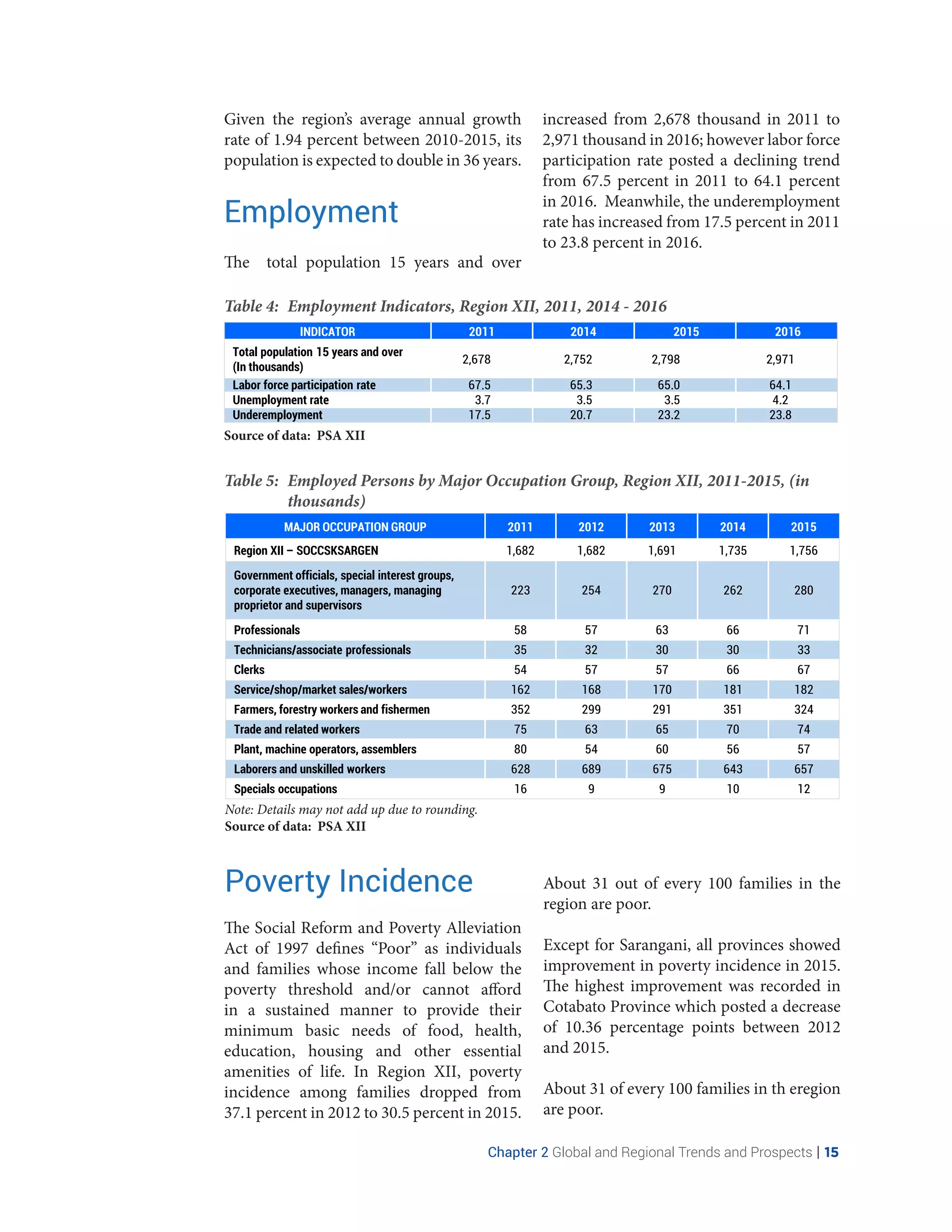
  • 182.
    Chapter 18 EnsuringSecurity, Public Order and Safety 151 • areas need to be addressed (maybe considered under infrastructure policy design before a concrete road / drainage system, there must be a provision for fire hydrants) • Absence of water impounding areas during fire operations Figure 23: Strategic Framework to Ensure Security, Public Order, and Safety, 2017 – 2022
  • 183.
    152 | SOCCSKSARGENRegional Development Plan 2017-2022 In building the public’s sense of safety and security Improved crime prevention strategy through: • Integrated Patrol - Checkpoint - Beat Patrol - Mobile Patrol - ComparativeStatistics(COMSTAT) activities with local stakeholders • Aggressive serving of Arrest Warrants and implementation of Search Warrants • Intensified Law Enforcement Operations - Illegal logging campaign - Illegal possession of firearms - llegal gambling campaign - Other special laws • Strengthen PNP Firearms Regulatory Control Program (Regulatory Function) • Strengthen security coverage during major/special events, and of dignitaries/ VIPs • Intensify PNP support role to the AFP Internal Security Operations (ISO) • Strengthen Customs, Intelligence, Quarantine, Security (CIQS) particularly in the coastal LGUs • Safety and Security of domestic and international tourists • Intensified case build-up against criminal gangs. • Target Hardening - fortifying security of vital installations and Target Personalities (Security Survey, Security Inspection, Threat Assessment) • Detection and monitoring of criminals, organized crime groups and threat groups • Recruitment and mobilization of Informants • Formulation of Local Anti-Criminality Action Plan and the Peace and Order and Public Safety Plan (POPSP) • Intensify law enforcement operations against cybercrime Improved crime control strategy through: • Establish Police Emergency Response System • Enrich Standard Investigative System and Procedures - Utilization of available investigative information systems (E-blotter, E-warrant, E-rogue gallery) - Adaptation of case management system Anti/Counter Illegal Drugs Campaign through • Supply and demand reduction of illegal drugs through the strict enforcement of RA 9165 (Comprehensive Dangerous Drugs Act of 2002) • Double Barrel Reloaded - Operation Plan (Oplan) Tokhang (Tuktok Hangyo)/ Taphang (Tapok Hangyo) - Oplan HVT (High Value Target)/ LVT (Low Value Target) • Demand reduction campaign - SustaintheimplementationofDrug Abuse Resistance Education (DARE) - Conduct of symposiums and pulong-pulong - Institutionalize Positive Life Skills Seminar - Intensify information dissemination campaign on drug abuse Priority Strategy
  • 184.
    Chapter 18 EnsuringSecurity, Public Order and Safety 153 specifically for students and out-of- school youth - Drug abuse awareness campaign, etc. • Implementation of the Mamayang Ayaw sa Anolmalya, Mamayang Ayaw sa Iligal na Droga (MASA MASID) Program - Accounting of drug surrenders - Assessment of drug surrenderees - Community-basedrehabilitationby enjoining City, Municipal and Barangay LGUs to implement sports development program and value formation activities for the youth. - Treatment and rehabilitation - After Care Projects - Project D.U.T.E.R.T.E. (Drug Use and Trafficking Elimination through Rehabilitation Training and Enforcement) In building public’s trust and confidence towards the government’s effort in improving peace and order Enrich community awareness and empowerment on public safety and security through: • Community-based awareness and empowerment campaign • School-based awareness and empowerment campaign Joint Government- Community Mobilization and Intervention Program through: • Organization of un-organized sectors of the community • Confederation and mobilization of empowered community organizations: - Continue operationalization of Force Multiplier System (FMS) to aid the regular law enforcement units to increase vigilance and monitoring of crimes. • Education and Training of Force Multipliers • Mobilization of empowered community Develop and maintain community and stakeholders support through: • Establish linkages with community and stakeholders support - Generate support from community and stakeholdersSupport to Peace Advocacy of socio-civic organizations (e.g. Lions, Rotary, Kiwanis, etc.) • Involve community and stakeholders in “bottom-up” planning on public safety and security. - BarangayAnti-DrugAbuseCouncil (BADAC), MASAMASID Program, PNP Advisory Council, etc. In ensuring the safety of the people • Strict compliance with RA 6975 in attaining the ideal 1:2,000 fireman to population ratio. • Construction of typical fire stations in municipalities with newly issued fire trucks • Procurement of fire trucks for clustered municipality of Lutayan and Magpet and other municipalities without fire stations. • Guarantee that response time to fire incidents within the seven (7) minute
  • 185.
    154 | SOCCSKSARGENRegional Development Plan 2017-2022 prescribed period. • Construction of Fire Sub-station (1 sub-station per City Fire Station). • Procurement of aerial ladder and tanker truck for city fire stations. • Upgrade Emergency Medical Service (EMS) capability of concerned entities such as forcible entry tools for extrication of vehicular accidents • Procurement of ambulance for city fire stations and 3 selected fire stations. • Procurement of motorcycles for city and municipal fire stations • Capability building for Disaster Risk Reduction Management Councils (DRRMCs) in emergency response and rescue operations. • Strengthen collaboration and partnership of LGU-volunteer organizations on disaster response. • Conduct Contingency Planning on maritime disasters and rescues, armed conflict, airport emergency (e.g. airport bush fires, plane crash) • RDRRMC XII aggressively cascading to Local DRRMOs on policy formulation, capability building (before, during and after assessment – Rapid Damage and Needs Assessment (DANA), ICS, Post- Disaster Needs Assessment (PDNA), Pre-Disaster Risk Assessment (PDRA), Contingency Planning, Community- based Disaster Risk Reduction Management (CBDRRM) Training). • Deployment of PDNA Teams within and outside of Region XII • Request DILG XII for the preparedness of LGUs in establishing the DRRM offices • Local DRRM officers and staff are on temporary status or job order. • Advocate the Core and Field Manual on Crisis Management which was provided by the National Security Council (NSC). Priority Legislative Agenda • National ID System • PNPReorganizationandModernization Law • BFP and BJMP Modernization Law • Death Penalty Law • Asset Forfeiture Law • RA 9160 (Anti-Money Laundering Act of 2001) to go after drug lords • RA 4200 (Anti-Wire Tapping Law of 1965) • Law imposing mandatory Drug Test in National High Schools, State Universities and Colleges (SUCs), LGUs, RLAs, and GOCCs • RA 10121 (PDRRM Act of 2010) by ensuring plantilla position for local DRRM personnel Results Matrix Ensuring security, safety, and public order is the foundation of the strategies in the RDP, 2017-2022; hence, it is accorded high priority by the administration. The accomplishment of this strategy is broken down into: (a) all forms of criminality and illegal drugs significantly reduced, and (b) public safety ensured.
  • 186.
    Chapter 18 EnsuringSecurity, Public Order and Safety 155 Table 53: Results Matrix to Ensure Security, Public Order and Safety, 2017-2022 INDICATOR BASELINE VALUE 2016 2017 2018 2019 2020 2021 2022 Societal Goal: To lay down the foundation for inclusive growth, a high trust and resilient society, and a globally-competitive knowledge economy Intermediate Goal: Cohesive, secure and progressive nation achieved Sector Outcome : Security, public order and safety ensured Sub-sector Outcome 1: All forms of criminality and illegal drugs significantly reduced Drug Abuse Awareness Campaigns increased 800 880 968 1,065 Increasing Development and management of crime prevention programs increased 90 101 104 107 110 113 116 Crime solution efficiency improved 45 46 47 48 49 50 52 Sub-sector Outcome 2: Public safety ensured Regional office building with fire sub-station completed 0 -- 1 -- -- -- -- 100% of the four (4) provincial fire offices completed 3 -- 1 -- -- -- -- Construction of Fire sub- station (1 sub-station per City Fire Station) completed -- -- 5 -- -- -- -- Construction of typical fire station in municipalities with newly issued fire trucks sustained 3 -- 10 2 -- -- -- Repair and rehabilitation of fire station maintained 4 5 7 4 6 5 5 Repair and rehabilitation of fire station maintained 4 5 6 12 6 5 5 Procurement of fire trucks for municipalities without fire stations maintained -- 2 2 -- -- -- -- Procurement of aerial ladder fire truck for city fire stations sustained -- 8 5 4 4 4 4 Procurement of tanker trucks for city fire stations completed -- -- 5 -- -- -- -- Installation/construction of antenna tower for base radio in selected fire stations sustained -- -- 15 6 6 Source of data: PNP XII/NAPOLCOM XII/PDEA XII/BFP XII
  • 187.
    156 | SOCCSKSARGENRegional Development Plan 2017-2022 Source of data: PNP XII/NAPOLCOM XII/PDEA XII/BFP XII Table 53: Results Matrix to Ensure Security, Public Order and Safety, 2017-2022 (Continuation) INDICATOR BASELINE VALUE 2016 2017 2018 2019 2020 2021 2022 Societal Goal: To lay down the foundation for inclusive growth, a high trust and resilient society, and a globally-competitive knowledge economy Intermediate Goal: Cohesive, secure and progressive nation achieved Sector Outcome : Security, public order and safety ensured Sub-sector Outcome 2: Public safety ensured Investigations conducted on causes and origin of destructive fires increased 300 349 383 422 464 510 562 Procurement of ambulance for city fire stations and 3 selected first class municipality maintained 2 8 6 4 4 4 4 Procurement of rescue truck (1 per city fire station) maintained -- -- 5 4 4 4 4 Procurement of motorcycle for city and municipal fire stations increased -- 10 55 -- -- -- -- Emergency medical and rescue services responded increased 210 231 254 279 307 338 372 Procurement of 50 sets Personal Protective Equipment(PPE) (Fire Man's suit -jacket and trouser), Fire Man's Helmet, Fire Man's Gloves, Fire Man's Boots) @P90,000.00 sustained -- 100 50 50 50 50 50 Procurement of forcible entry tools sustained 5 4 4 4 4 4 Procurement of Assorted Rescue Tools and Equipment sustained 14 5 4 4 4 4 Procurement of Self-Contained Breathing Apparatus (SCBA) and portable air compressor for refill sustained 24 sets of SCBA & 8 refill 35 sets & 8 refill 4 sets & 4 refill 4 sets & 4 refill 4 sets & 4 refill 4 sets & 4 refill
  • 188.
    Chapter 19 AcceleratedInfrastructure Development | 157
  • 189.
    158 | SOCCSKSARGENRegional Development Plan 2017-2022
  • 190.
    Chapter 19 AcceleratedInfrastructure Development | 159 Chapter 19 Accelerated Infrastructure Development Infrastructure, by definition, undergirds a country’s socioeconomic development. The more strategically distributed it is – both sectorally and spatially – the better it is for inclusive growth and sustainable development. Withagrowingeconomy,theregionrequiresmoreandbetterselectedinfrastructure investments, given its landscape, expanding population and rapid urbanization. To support a higher growth trajectory and improve the quality of life in both urban and rural communities, infrastructure development will remain among the top priorities of the region over the medium term. Spending on infrastructure has to be intensified while addressing persistent issues and challenges hampering implementation, so that the so-called “Golden Age of Infrastructure” will form part of a solid foundation for reaching the country’s Long-Term Vision 2040. Assessment Roads and Bridges The region recognizes the importance of improving the transportation sector to support its rapid and inclusive economic growth. Prudent strategies were pursued and strategic projects were implemented to accelerate the development of the sector’s safe, reliable, cost-effective, and sustainable infrastructure facilities to ensure the efficient transport of people and products. Adhering to the policy of full transparency and accountability to its people, the region engaged the general public to participate in the governance, monitoring and feedback in the implementation of infrastructure projects. The implementation of strategic road projects has enhanced the accessibility to production areas, major tourism destinations and basic service facilities like schools, hospitals, and attracted investments to the region. In terms of providing an integrated transport terminal in urban centers in the region, Koronadal City has an ongoing construction of an Integrated Transport Terminal project. Other cities have yet to establish one. INTEGRATED AND EFFECTIVE TRANSPORT SYSTEM
  • 191.
    160 | SOCCSKSARGENRegional Development Plan 2017-2022 Table 54: Roads and Bridges, 2011-2016 Note: ** Regional Office projects only Source of data: DPWH XII Table 55: Status of Kilos Abante Programs/Projects (KAPP), As of December 2016 Note: * Status as of November 30, 2016 ** Road length statistics for the entire Awang-Upi-Lebak-Kalamansig-Palimbang-Maitum Road. The road section from Awang-Upi-Lebak-Kalamansig is already paved. *** The northern portion of the circumferential road is now open to trafiic, while the construc tion of Banawalan Bridge 2 in the western section is still on-going and targeted to be completed in CY 2017. Once, completed, the western section can now be open to traffic. **** The total cost already includes the Construction of Access Road leading to Timako Seaport with New Bridge (Miwaroy Bridge) amounting to PhP 115.63 million but the project has not yet started. Source of data: DPWH XII INDICATORS/UNITS 2011 2012 2013 2014 2015 2016 ACTUAL ACTUAL ACTUAL TARGET ACTUAL TARGET ACTUAL TARGET ACTUAL** TARGET National roads rehabilitated/ improved (km) 17.369 33.15 39.445 39.160 23.285 27.314 19.425 17.641 - 11.420 National roads concreted/ widened (km) 5.51 10.54 151.053 116.71 80.949 101.801 128.732 177.433 27.713 164.82 National bridges constructed/ widened/completed (lm) 97.256 128.37 306 60 101 168 811 638 53 66 National bridges rehabilitated/ replaced (lm) 1.8 104.73 735 784 1,062 1,122 1,309 2,029 - 1,695 Increased percentage of permanent bridges along national roads (%) *89.98 (CY 2010) - 92.16 - 95.75 95.75 95.19 95.19 - 99.05 Foreign assisted projects (FAPs) implemented (km) 22.96 - - 17.190 - 11.80 - - - - Increased road pavement ratio (%) 90.48 72.38 71.86 71.91 75.79 76.80 79.44 82.56 83.76 90.27 Increased road density (length of national roads/ land area) 0.07763 0.07811 0.07812 - 0.07914 0.07763 0.07913 0.07763 0.07945 0.07763 ROAD NETWORK ROAD STATISTICS (IN KILOMETERS) NO. OF PROJECTS IMPLEMENTED (2011- 2015) TOTAL PROJECT COST (PHPM) PAVED UNPAVED LENGTH COMPLETED ON- GOING Marbel – Makar (Makar – Marbel) Road 58.906 0 58.906 32 3 1,300,792.50 Makilala – Allah Valley Road 34.238 0 34.238 26 1 847,939.00 Matalam – M’lang – Bagontapay Road 23.633 0 23.633 14 0 400,584.00 Sen. Ninoy Aquino (SNA) – Lebak – Kalamansig Road 11.432 49.965 61.397 11 8 869,706.00 Kalamansig – Palimbang – Maitum Road 109.738** 22.044** 131.782 ** 67 5 3,405,768.10 Surallah – Lake Sebu – Maitum Road 33.701 60.053 93.754 16 10 1,857,912.00 Maitum – Lake Sebu Road 11.481 11.987 23.468 5 2 630,494.00 Banisilan – Guiling – Alamada – Libungan Road 61.175 9.531 70.706 37 3 1,638,270.00 General Santos City Circumferential Road 19.633 0 19.633 *** *** 979,520.00 Cotabato City Circumferential Road **** 15.570 0 15.570 27 1 824,520.00
  • 192.
    Chapter 19 AcceleratedInfrastructure Development | 161 Figure 24: Kilos Abante Programs/Projects (KAPP), Roads
  • 193.
    162 | SOCCSKSARGENRegional Development Plan 2017-2022 Port development Seaports provide alternate amenities for the transport of people and products of the region.AsofDecember2015,variousprojects were undertaken for the improvement of major ports in the region. The Port of General Santos City, one of the leading modern ports in the country, is considered the gateway of SOCCSKSARGEN Region. It is a certified International Ship and Port Facility (ISPS) and it takes pride of an ISO-compliant cargo handling operator (ISO 901 and ISO 14001). Among the initiatives undertaken in response to the recommendations emanating from the 1st Makar Port Development Summit include the repair and replacement of Fendering and Mooring System at the Eastern Wharf which was completed at an amount of PhP 26,647,225.78. The rehabilitation and upgrading of the Western Wharf is on-going with a total cost of PhP 102,155,082.00. The Task Force on Makar Port Development under the umbrella of SOCSKSARGEN Area Development Board was created to regularly monitor the progress of project implementation. The extension of Glan Port wharf and the widening of its causeway were completed. The Construction of the Passenger Terminal Building is on-going with a total cost of PhP 7,780,170.58. About PhP90 Million from the Philippine Ports Authority (PPA) corporate funds was made available for the implementation of Timako Port Development Project Phase 1. The project involves the construction of rock causeway and a Roll On – Roll Off (RoRo) ramp. Cargo throughput at the General Santos Port reached 2.630 million metric tons in 2016 lower than the 2011 figure of 2.842 metric tons. This is due the reduction of the number of vessels in 2016 at 959 compared to 2011 at 1,648. Figure 25: Existing Seaport Project in Region XII, 2016
  • 194.
    Chapter 19 AcceleratedInfrastructure Development | 163 Airport development The General Santos City International Airport, which is classified by the Civil Aviation Authority of the Philippines (CAAP)asanalternateinternationalairport, mainly serves the air transport requirements of the city and nearby provinces of South Cotabato, Sultan Kudarat, and Sarangani. The annual domestic passengers in General Santos Airport posted an increasing trend which reached 363,527 incoming and 378,560 outgoing in 2015 compared to the 243, 512 incoming and 245,721 outgoing in 2011. The annual domestic cargo traffic in million kilograms was 7.74 incoming and 13.67 outgoing in 2015 higher the 2011 figure of 4.01 incoming and 7.02 outgoing. The annual domestic flights in thousands reached 6,994.6 incoming and 10,436.8 in the third quarter of 2016. On updates on the General Santos City Airport Improvement Project, the following projects were completed: Expansion of passenger terminal building amounting to PhP 25 million; Installation of a new carousel at PhP 20 million; and Expansion of vehicle parking area for PhP 10 million. Projects not yet started but already awarded to winning contractor are the: Rehabilitation and Expansion of GSC Airport Terminal Building amounting to PhP 434.292 million; and Expansion of Apron and Construction of Drainage System for PhP 54.371 million. Projects not yet started and funds to be downloaded by DOTr to CAAP-CO thru MOA are the following: Construction of Water Supply Facilities; Upgrading of Navigational Aids; Rehabilitation of Administration Building and Control Tower; Construction of Satellite Fire Station with Access Road; and, Upgrading of Power Plant and Rehabilitation of Airfield Lighting System. Cotabato City is currently served by the Cotabato (Awang) Airport located in Awang, Datu Odin Sinsuat, Maguindanao Province in the Autonomous Region in Muslim Mindanao (ARMM). Passengers from Cotabato Province would either access the services of the airports of General Santos and Cotabato or the Davao International Airport in Davao City. The annual domestic passenger traffic at Cotabato Airport reached 243,771 in 2015 higher compared the 191,780 in 2011. Annual domestic cargo traffic in million kilograms was 2.178 in 2015 as against the 1.516 in 2011. The annual domestic flights in thousand also increased from 2.828 in 2011 to 3.314 in 2015. There is an ongoing construction of Cargo Terminal Building under the Cotabato (Awang) Airport Improvement Project amounting to PhP 5.0 million. The Civil Aviation Security Service – Office for Transportation Security (CAS-OTS) provided the Cotabato Airport with the state-of-the-art security screening equipment composed of the following: x-ray machine, walk-through metal detector, handheld metal detector and closed-circuit television. The development of the Central Mindanao Airport (known as M’lang Airport) will be among the major support facilities in the region that will provide efficient access for various agricultural commodities to domestic and international market. The Airport is projected to be an alternate airport for Awang Airport and will also cater to the entire province of Cotabato and nearby municipalities of Sultan Kudarat, Maguindanao and South Cotabato. Under the Central Mindanao (M’lang) AirportDevelopmentProject,theexpansion of airport including the extension and widening of airport runway, concreting of apron, installation of fire station and construction of perimeter fence was completed with a cost of PhP 160 million. On the expansion of airport land area, the survey was already completed and the DOTr downloaded to Cotabato Province PhP10 M out of the PhP20 M budget for the project. The preparation of the Feasibility and Master Plan Study, and Environmental
  • 195.
    164 | SOCCSKSARGENRegional Development Plan 2017-2022 Impact Assessment was not yet started but already awarded to the winning bidder. The development of access road under the CY 2017 DPWH infrastructure program amounting to PhP100 million was not yet started. Figure 26: Existing Airport Improvement Projects, Region XII, 2016 The region continues to be confronted with an ineffective transport system due to the following: 1. Deteriorating road networks and absence of roads leading to productive and critical areas, especially in the interior areas. 2. Increasing flow of people and products has started traffic flow in some part of the region’s road networks. 3. Increasing use of energy-efficient and cheaper modes of transportation, such as bicycles and motorcycles that compete with the increasing larger vehicle traffic along the region’s major thoroughfares. 4. Lack of road signage and road safety structure in required sections of roads, particularly along accident prone areas. 5. Inadequate seaport and airport facilities that downscale their competitiveness to attract and handle more domestic and international passenger and cargo traffic. 6. No strict enforcement of anti- overloading law and lack of weigh bridges along arterial/national roads. Challenges
  • 196.
    Chapter 19 AcceleratedInfrastructure Development | 165 If is the objective to the sector to provide efficientandeffectiveinfrastructurefacilities and services. The provision of an integrated and effective transport system is expected to improve mobility and accessibility. The region shall sustain the implementation of road projects consistent with the thrust of the national government to concrete all national roads by the end of 2016. The following strategies shall be pursued: 1. Provision of an integrated and effective transportation system along production areas, potential economic corridors, roads that connect growth centers, and access roads leading to tourism sites and service centers. 2. Rehabilitation of deteriorated pavement along arterial and secondary national roads. 3. Restoration of dilapidated and installation of additional road signage and safety structures in required sections of roads, particularly, along accident-prone areas such as round about areas and dangerous curves. 4. Widening of arterial national roads and bridges to accommodate the increasing volume of traffic. The loads of vehicles shall be monitored by installing additional weighbridges in strategic areas. 5. Strict enforcement of 2007-01 of Department of the Interior and Local Government (DILG) banning tricycles and pedicabs to operate on national highways which are utilized by four- wheel vehicles greater than four tons and where normal speed exceeds 40 kilometers per hour. 6. Provision of bicycle and motorcycle lanes along major thoroughfares in highly urbanized and urbanizing cities. 7. Modernization, improvement, and upgrading of facilities of seaports and airports in the region to meet international standards. 8. Pursue and support the sustainable operation of Davao-GenSan-Bitung RORO Route. (ASEAN RORO) 9. Encourage airline companies to open flights between GSC airport and other domestic (Pagadian, Surigao, Clark, Cagayan, Tawi-Tawi, Jolo, Dipolog) and international (Manado) destinations. 10. Provision of weighbridges along arterial/national roads 11. Strict enforcement of anti-overloading law. 12. Improvement of law enforcement to address proliferation of illegal mode of transportation and cutthroat competition Priority Strategy 1. Legislation of measures to address road safety considering the high incidence of road accidents, e.g. Motorcycle Modification Law. 2. Formulation of Transport and Traffic Management Plan by local government units and improvement of Traffic System of urbanized cities in the region. 3. Review of policies/regulations in the utilization of Motor Vehicle Users’ Charge (MVUC) towards a more transparent, accessible and equitable share of Special Local Road Fund. Legislative Agenda
  • 197.
    166 | SOCCSKSARGENRegional Development Plan 2017-2022 Assessment WATER RESOURCES MANAGEMENT Ensuring sustainable supply of water resources is important for utilization in agriculture production, industry, and access by households to clean and safe water. The construction of flood control and drainage facilities provides a measure in mitigating vulnerability to disasters in flood-prone areas. Irrigation Increasing the areas covered with irrigation is important for agricultural productivity and rural development. To support the region’s agricultural development, the National Irrigation Administration (NIA) XII continue to implement irrigation projects in the region increasing its areas irrigated, restored and rehabilitated. As of 2016, the total potential irrigable area reached 192,173.14 hectares while the total irrigated area is 170,219 hectares. Of the 2,732 hectares targeted, only 871 hectares were generated from newly constructed national and communal irrigation projects. On the target of 314 hectares, about 458 hectares of irrigation systems were restored. And of the targeted 7,877 hectares, a total of 1,766 hectares of irrigation system restored Table 56: Major Programs/Projects/Activities Implemented, As of December 2016 Source of data: NIA XII NAME OF PROJECT STATUS TOTAL COST (PHP ‘000) MMIP Rehabilitation and Improvement of Maridagao River Irrigation System (MRIS) Completed * 305,000.00 MMIP Phase II Completion and Improvement of 1,611 has. Upper Malitubog Service Area (UMSA) Completed * 100,000.00 MMIP Phase II Construction of Irrigation and Drainage Facilities for Malitubog and Pagalungan Extension Area On-going * 3,091,350.00 (funds released from CY 2011-2016) MMIP Upper Malitubog Service Area Repair and Improvement Works (UMARIW) Completed * 46,075.00 Repair and Improvement of Right Main Canal -1 (RMC1) at Upper Malitubog Service Area (UMSA) On-going ** 100,000.00 CY 2016 Rehabilitation of Maridagao River Irrigation System On-going ** 16,000.00
  • 198.
    Chapter 19 AcceleratedInfrastructure Development | 167 Figure 27: Malitubog-Maridagao Irrigation Project (MMIP) II Figure 28: Status/Updates on Malitubog-Maridagao Irrigation Project (MMIP) II Source of data: NIA XII Source of data: NIA XII
  • 199.
    168 | SOCCSKSARGENRegional Development Plan 2017-2022 Figure 29: Status/Updates on Malitubog-Maridagao Irrigation Project (MMIP) II (2) Figure 30: Status/Updates on Malitubog-Maridagao Irrigation Project (MMIP) II (3) Source of data: NIA XII Source of data: NIA XII
  • 200.
    Chapter 19 AcceleratedInfrastructure Development | 169 Water supply Topromotethedevelopmentofwatersupply systems, the local government units (LGUs) in the region implement water supply projects benefiting its households. This will increase the number of households with access to safe water supply. The program on Sagana at Ligtas na Tubig sa Lahat (SALINTUBIG) is being implemented since 2012 to provide water supply systems to waterless municipalities, barangays, and resettlement sites with low service coverage. The program includes two thematic areas - the waterless barangays with high incidence of water-borne diseases and poverty and rural health centers without access to safe water. In Region XII, twenty-six (26) local government units were identified to receive PhP 143.7 million in grants for the construction of potable water systems and related projects. Flood control The region is most vulnerable to flooding due to several low-lying areas and those along major river systems. To address the problem on flooding in the region, the DPWH implemented mitigating measures, such as the dredging of the Rio Grande de Mindanao in Cotabato City and Simuay River in Sultan Kudarat, Maguindanao Province that affect the Cotabato City area. Based on the study for the Mindanao River Basin (MRB), the proposed doable Flood Management Projects are three (3) packages in Pulangi River amounting to PhP 1,069.23 Million, in Ambal-Simuay River amounting to PhP 1,870.00 Million, in Ala River amounting to PhP 620.00 Million, and in Rio Grande de Mindanao amounting to 4,696.00 Million. To address the problem of flooding in the region, local government units (LGUs) need to formulate their respective Flood Control Master Plan. To date, the City of Koronadal has already completed its Flood Control Master Plan. The table below presents the status of flood control projects in four major sub-basins in the region. Table 57: Status of Flood Control Projects in the Four Major Sub-basins in Region XII Source of data: DPWH Region XII NAME OF PROJECT NO. OF PROJECTS IMPLEMENTED / STATUS TOTAL COST (PHP ‘000) COMPLETED ON-GOING Construction of Flood Control Projects in the Cotabato and Lower Pulangi Sub-Basins 5 4 967,037.00 Construction of Flood Control Projects in the Ala Sub-Basin 11 3 1,332,000.00 Construction of Flood Control Projects in the Libungan Sub- Basin - 1 110,000.00 Construction of Flood Control Projects in the Banga Sub- Basin - 1 52,101.00
  • 201.
    170 | SOCCSKSARGENRegional Development Plan 2017-2022 Figure 31: Flood Control Projects along Rio Grande De Mindanao Figure 32: Flood Control Projects along Ala River Source of data: DPWH Region XII Source of data: DPWH Region XII
  • 202.
    Chapter 19 AcceleratedInfrastructure Development | 171 Challenges Lack of access to water resource facilities remain a concern of the region. 1. Low irrigation development of the 192,173.14 hectares of potential irrigable area based on 0-3 degree slope. The maintenance of irrigation facilities is poor. The completion of critical irrigation projects need to be fast tracked and there is a need to exert parallel efforts to protect watershed areas. 2. Absence of Potable Water Supply Master Plan and Sanitation Master Plan of most LGUs that has resulted to generally poor sanitation and some of its population with no access to safe drinking water. 3. Inadequate facilities to address domestic wastes. There is poor compliance with Republic Act 2003 thus the need to improve solid waste management facilities of local government units because these contribute to clogging of waterways. 4. Various areas in the region are still vulnerable to flooding and most local government units have no Flood Control and Drainage Master Plan all the more making them less ready to address calamities. There is also a need to regularly dredge or construct flood control structures along major rivers. The primary projects identified in the Mindanao River Basin Integrated Development Master Plan (MRBIDMP) should be started as soon as possible. Priority Strategy Irrigation 1. Construction and rehabilitation of high priority irrigation facilities like the MALMAR Irrigation Project and the Kabulnan 2 Multipurpose Irrigation and Power Project and Tulunan Small River Impounding Project (SRIP). 2. Implementation of Small Irrigation Projects (SIPs) and Small Water Impounding Project/ Rain Water Collection Systems. Advocacy activities shall be intensified among LGUs on the formulation of policy/guidelines on the conservation of water sources like flowing/springs and other water sources in their respective areas. Water supply 1. Expansion of service areas of water districts serving five (5) cities and twenty four (24) municipalities beyond the poblacion. 2. Implementation of water resource management measures/strategies towards conservation of water by major manufacturers/industries. Establishment of waste water and sanitation infrastructure facilities, like water treatment facilities and septage treatment plant. 3. Expanding the coverage of SALINTUBIG Program to include areas without safe water supply. Flood control 1. Formulation of Flood Control and Drainage Master Plan for each city/ municipality of the region. 2. Implementation of critical flood control projects identified in the Mindanao River Basin Integrated Management
  • 203.
    172 | SOCCSKSARGENRegional Development Plan 2017-2022 Legislative Agenda 1. LGUs are encouraged to come up with a study on ground water assessment and to prepare its master plan. 2. LGUs to pass an ordinance to regulate charcoal fuel activities. Target 1. Establishment of SOCCSKSARGEN Regional Hospital in Surallah, South Cotabato. 2. Upgrading the facilities of the five (5) State Colleges and Universities in the region. 3. Construction of a Two-Storey Jail Facility in Cotabato City. Assessment ADEQUATE AND RELIABLE ENERGY SUPPLY The Department of Energy (DOE), together with the energy family and stakeholders have strengthened the implementation of energy programs and projects to achieve the Philippine Energy Plan 2012-2030’s overall vision of providing “Energy Access for More” which are guided by the three pillars: 1) ensuring energy security through the development of indigenous energy; 2) achieving optimal energy pricing particularly in electricity and oil; and 3) developing a sustainable energy system through the formulation and update of national/regional plans and programs on energy development. Consistent with this, the energy sector continuously diversify various initiatives to ensure and secure the delivery of reliable and sustainable supply of energy. The development and optimal use of the country’s renewable energy (RE) resources has been a priority undertaking of the DOE. Since the passage of the RE Law in 2008, the DOE has awarded through the National Renewable Energy Program (NREP) a total of 657 Renewable Energy Service Contracts as of December 2015 for the development of 13,499.52 MW potential RE projects. The DOE, in partnership with the private sector continuously pursue and oversee the timely implementation of power generation projects to augment the tight supply of electricity in the country. Twenty three (23) additional power plants with aggregate capacity of 820.4 MW were commissioned in 2015 which boosted the existing grid capacity of 17,944 MW in 2014. The newly commissioned power plants have already exporting 196.4 MW (5 power plants) in Mindanao. This includes the 20.9 MW PSI Bunker/Diesel Internal Combustion Engine in General Santos City which was commissioned in January 2015. In CY 2015, on sitio electrification, 91% or 1,774 sitios of the 1,951 potential sitios in the region have access to electricity. On household electrification, on the other hand, 64.5% or 607,958 households of the 943,011 potential households have access to electricity. As of March 1, 2015, the Mindanao Power has a total rated capacity of 2,138.34 Megawatts (MW), system available capacity of 1,370.00 MW, and system peak demand
  • 204.
    Chapter 19 AcceleratedInfrastructure Development | 173 of 1,259.00 MW. The region’s renewable energy projects include geothermal, hydro, and solar power projects. Among the geothermal power projects are the Mt. APO Geothermal Production Field with a total installed capacityof108.48MegaWatts(MW)andthe Mt. Zion Geothermal Power Project with a potential capacity of 20 MW. Hydroelectric power projects include the Alamada, Kabulnan 2, Siguil (1, 2, 3), Kalaong (1, 2, 3), Lanon, Takbo, Magpet (1, 2), and Makilala 1 Hydro Power Projects with a total potential capacity of 186.8 MW, and Marbel 1 Hydro Power Project with a total installed capacity of 0.5 MW. Solar power projects include the Alabel, General Santos City (2, 3), Kalamansig, Maasim Hybrid, South Cotabato, and Gensan (Phase I, II) Solar Power Projects with a total potential capacity of 413 MW, and Centrala Solar Power Project with a total installed capacity of 6.23 MW. Priority Strategy The following strategies shall be pursued to ensure adequate and reliable energy supply for socio- economic and institutional development of the region. 1. Promotion and fast track the development of new mini hydro and solar power generation plants to meet the ever increasing demand for energy in Mindanao. 2. Advocacy and promotion to increase awareness on the benefits of LED for street lights (e.g. solar- powered), household use and other purposes. 3. Utilization of solar, micro, hydro and wind power where applicable as alternative sources of electricity in off-grid communities and areas not accessible through distribution lines. Legislative Agenda 1. Review and assessment of the implementation of RA 9136 or the EPIRA Law of 2001 to determine the extent it has improved power generation, transmission, distribution, and supply. 2. Review the EPIRA and the requirements/processes for approval of power projects. 3. Strict enforcement by local government units on the law requiring the replacement of all traditional bulbs with compact fluorescent lamps (CFLs) in their lighting fixtures and providing incentives to encourage consumers to give up the use of traditional bulbs.
  • 205.
    174 | SOCCSKSARGENRegional Development Plan 2017-2022 Assessment EFFECTIVE COMMUNICATIONS AND INFORMATION MANAGEMENT SYSTEM With the advancement in information and communications technology, existing telecommunication companies continue to provide cell sites in areas with poor or no Cellular Mobile Telephone System (CMTS) coverage and areas that have no broadband connections. It is the vision of the Department of Information and Communications Technology’s (DICT’s) to provide Internet for all, where no Juan is left behind. The DICT flagship project on Juan Konek! Free Public WiFi Internet Access in Public Places is being implemented and is expected to be completed in the next three (3) years. The DICT is likewise preparing for its Tech4ED project that aims to harness ICT to enable, empower and transform society by creating an inclusive, integrated and equitable countryside by providing opportunities for employment and empowering entrepreneurs. By giving the marginalized sector access to digital opportunities, Tech4ED will now make it possible for hundreds and thousands of people to start businesses, acquire education, gain employment, and take their first steps towards improving their families’ well-being, through a single ICT portal at a single center. The platforms of Tech4ED are: (1) E-Edu Skills, which aims to enable education seekers to gain a High School Diploma through informal education; (2) E-Assist, which aims to provide digital and employment opportunities to vulnerable groups and marginalized communities; (3) E-Agri, which aims to empower the farmers, cooperatives, agribusiness, and food processors by helping them obtain real time information price in the market, and; (4) E-Gov, which aims to provide citizens with the necessary government services and information. Table 58: CMTS and Broadband Coverage, as of June 2016 Source of data: NTC XII PROVINCE MUNICIPALITY BARANGAY PUBLIC HIGH SCHOOL PUBLIC ELEMENTARY SCHOOL MINIMUM EVALUATED BROADBAND SPEED (KBPS) WITH CMTS COVERAGE WITH BROAD BAND COVERAGE WITH CMTS COVERAGE WITH BROAD BAND COVERAGE WITH BROADBAND COVERAGE WITH BROADBAND COVERAGE Cotabato 18 15 521 456 170 589 5 Sarangani 8 7 153 145 98 276 10 South Cotabato 11 10 175 174 73 300 3.62 Sultan Kudarat 11 11 236 201 41 280 1.5 Grand Total 48 43 1085 976 382 1445 20.12
  • 206.
    Chapter 19 AcceleratedInfrastructure Development | 175 Table 59: Percentage of CMTS and Broadband Coverage, as of June 2016 Source of data: NTC XII Challenges 1. All cities and municipalities in the region are already interconnected by Cellular Mobile Telephone System (CMTS) and broadband connections but there remain areas within these cities and municipalities that have poor or no CMTS coverage and no broadband connections. Far-flung areas are not reached at all because they are not covered by electricity and hence, no communications systems can be established. 2. Lack of Policy/Congressional Law/ Franchise to tap the broadband connection of the BIMP-EAGA-Rink, which is being undertaken by the BEST Cable Corp. in ARMM to increase the broadband speed in the region and the country as a whole. Priority Strategy 1. Establishing cell sites in areas with poor or no Cellular Mobile Telephone System (CMTS) coverage and areas that have no broadband connections to facilitate integration of the region through digital infrastructure. 2. Increasing coverage of interior areas of the region in the electrification coverage. Target 1. Completion of the Implementation of the DICT flagship project on Juan Konek! Free Public WiFi Internet Access in Public Places. 2. Implementation of the Tech4ED project. Assessment ADEQUATE SOCIAL INFRASTRUCTURE PROVINCE MUNICIPALITY BARANGAY PUBLIC HIGH SCHOOL PUBLIC ELEMENTARY SCHOOL WITH CMTS COVERAGE WITH BROADBAND COVERAGE WITH CMTS COVERAGE WITH BROADBAND COVERAGE WITH BROADBAND COVERAGE WITH BROADBAND COVERAGE Cotabato 100% 83% 96% 84% 92% 86% Sarangani 100% 88% 92% 87% 92% 91% South Cotabato 100% 91% 88% 87% 82% 89% Sultan Kudarat 92% 92% 95% 81% 72% 81% Grand Total 98% 88.5% 93% 85% 84.5% 87%
  • 207.
    176 | SOCCSKSARGENRegional Development Plan 2017-2022 Table 60: Health-Related Infrastructure, 2011-2016 Note: • For CY 2011-2013, the classification were: Level 1-Infirmary, Level 2-Primary Care, Level 3-Secondary Care, Level 4-Tertiary Care • For CY 2014 to present – Hospitals – Level 1, Level 2, Level 3 Other Health Facilities – Primary Care Facility (PCF) with Beds – Infirmary (New Classification) Source of data: DOH XII Challenges 1. The region still needs additional classrooms to meet the standard classroom to student ratio (CSR) in the Philippines which is one classroom for every 45 students as prescribed by the Republic Act 7880. 2. Strengthening public health infrastructure remains a challenge in the region. Government hospitals and Barangay Health Stations still need to be upgraded/constructed. 3. Jail facilities are in dilapidated condition and pose a threat for possible outbreaks due to presence of high-profile inmates. Priority Strategy 1. Increasing allocation for the construction of education, health related infrastructure, housing, and jail facilities in the region. 2. Enjoining LGUs to enact policies for the provision of areas to serve burial grounds for Muslims. The region is in need of various social infrastructure facilities to enable agencies to effectively provide basic services such as health and education and ensure public safety through decent jail houses. Schools lack school building facilities since classroom-to-student ratio is beyond the standard of 1:45. Hospital occupancy rate is always higher than the bed capacity. The occupancy rate of jails reached 600 percent. Target 1. Construction of more School Building Facilities. 2. Construction of Health Facilities. 3. Construction of One Two-Storey Jail Facility in Cotabato City. INDICATORS/UNITS ACTUAL 2011 2012 2013 2014 2015 2016 Number of government hospitals Infirmary 0 0 0 17 16 17 Level 1 19 18 26 8 11 10 Level 2 6 7 1 0 0 0 Level 3 0 0 2 2 2 2 Level 4 0 2 0 - - - Total 25 27 29 29 29 29
  • 208.
    Chapter 19 AcceleratedInfrastructure Development | 177 Table 61: Priority Projects of Region XII PROJECT TITLE ESTIMATED PROJECT COST (PHP ’000) STATUS OF RDC XII ENDORSEMENT/ APPROVAL ROAD PROJECTS 1. Tupi – Malungon Road (Tupi-Miasong-Malandag- Malungon) with the following sections: • Malandag-Miasong Road involving the construction of concrete road including drainage at Sta. 37+920 – Sta. 66+310 with a total length of 28.39 km (Malungon, Sarangani) 1,000,000 Endorsed by RDC XII • NHW Junction Tupi- Jct Linan-Miasong Road involving the construction of concrete road including drainage at Sta. 16+380 – Sta. 45+260 with a total length of 37.92 km 1,341,000 Endorsed by RDC XII 2. Upgrading of Malapag-Tinimbacan-Banisilan Road * 669,471 Endorsed by RDC XII 3. Construction of Esperanza-Lebak Road * 7,000,000 Endorsed by RDC XII 4. Development of Cotabato City By-pass Road * 120,000 Endorsed by RDC XII 5. Development of Kidapawan-Magpet-Pangao-an Road (Pangao-an-Sallab-Don Panaca-Tambobong-Tambugan Section) 580,000 Endorsed by RDC XII 6. Koronadal By-pass Road (Construction of Libas- Tinongkop-Paraiso-Mambukal-Carpenter Hill-Saravia - Jct. Marbel-Makar National Road with a total length of 21.72 kms) 988,366 Endorsed by RDC XII 7. Datu Paglas-Columbio-Matanao Road (13.07 kms paved of the 29.76 kms total length) 433,940 Endorsed by RDC XII 8. Columbio-Lutayan-Koronadal City Road (12.16 kms paved of the 31.65 kms total length) 487,425 Endorsed by RDC XII 9. NHW Jct Pob. Malungon-Boundary Sta. Maria, Davao Occidental Road (has total length of 17.65 km based on initial survey) 2,860,010 (including Bridge) Endorsed by RDC XII 10. Banga-Tupi By-pass Road (19.46 km paved of the 37.8 km total length) 917,000 (including RROW) Endorsed by RDC XII 11. Surallah-T’boli-San Jose, Gen. Santos City Road (22.2 km. paved of the 65.9 km total length) 1,748,000 Endorsed by RDC XII 12. Upper Glad-Sadaan Road (Midsayap, Cotabato), 3.77 km (Still being finalized by DPWH XII Endorsed by RDC XII 13. Tacurong City East By-pass Road (12.60 km) 630,000 (including RROW) Endorsed by RDC XII 14. Ninoy Aquino By-pass Road 147,800 Endorsed by RDC XII 15. General Santos City Middle Ring Road (Alignment has yet to be finalized) Endorsed by RDC XII 16. Silway 8-Mabuhay-Conel-Olympog-Upper Labay Road (Survey has yet to be conducted) Endorsed by RDC XII 17. Balindog-Singao-San Vicente-Makilala Highway, Kidapawan City By-pass Road (Alignment has yet to be finalized) Endorsed by RDC XII 18. Nikaan-Kitub-Banisilan Road (54 km) 2,160,000 For endorsement of RDC XII; proposed by Cotabato Province FLOOD CONTROL PROJECTS 19. Flood Control projects for the four (4) priority river basins in Mindanao that traverse Region XII • Rio Grande de Mindanao 4,696,000 Endorsed by RDC XII • Pulangi River 1,069,260 Endorsed by RDC XII • Ala River 620,000 Endorsed by RDC XII • Ambal-Simuay River 1,870,000 Endorsed by RDC XII
  • 209.
    178 | SOCCSKSARGENRegional Development Plan 2017-2022 Table 61: Priority Projects of Region XII (Continuation) PROJECT TITLE ESTIMATED PROJECT COST (PHP ’000) STATUS OF RDC XII ENDORSEMENT/ APPROVAL HEALTH-RELATED INFRASTRUCTURE 20. Establishment of SOCCSKSARGEN Regional Hospital 154,074 Endorsed by RDC XII and being pushed by Region XII congresspersons EDUCATION-RELATED INFRASTRUCTURE 21. Upgrading of Facilities of Five (5) State Universities and Colleges (SUCs) in Region XII 198,609 Endorsed by RDC XII- Executive Committee OTHER INFRASTRUCTURE 22. Operationalization of Philippine Halal Laboratory and Halal Science Center in Koronadal City 307,000 Endorsed by RDC XII- Executive Committee 23. Construction of 2-Storey Jail Facility in Cotabato City 18,000 Endorsed by RDC XII Resolution No. 49, s. 2017 Figure 33: Strategic Framework to Accelerate Infrastructure Development, 2017 – 2022
  • 210.
    Chapter 19 AcceleratedInfrastructure Development | 179 Results Matrix Infrastructure development supports all three pillars and intermediate goals of the plan, as it is vital to enhancing the social fabric, reducing inequality, and increasing theregion’sgrowthpotential.Tothisend,the overarching objective for the infrastructure sector in the medium-term is to accelerate infrastructure development and ensure that operations of infrastructure systems and facilities will be sustained. To ensure effective and efficient intra- and interregional transport connectivity, the region aims to concrete all national roads in the region. This shall enhance the accessibility to production areas, major tourism destinations and basic service facilities like schools, hospitals, and attract investments to the region. Table 62: Results Matrix to Accelerate Infrastructure Development (Roads and Bridges), 2017-2022 Source of data: DPWH XII INDICATOR BASELINE ANNUAL PLAN TARGETS YEAR VALUE 2017 2018 2019 2020 2021 2022 Societal Goal: To lay down the foundation for inclusive growth, a high trust and resilient society, and a globally- competitive knowledge economy Chapter Outcome: Infrastructure development accelerated and operations sustained Subsector outcome: Increased access to economic opportunities ROADS AND BRIDGES National Roads Rehabilitated/ Improved (km) 2015 19.425 9.471 116.739 26.952 15.125 Increasing National Roads Concreted (km) 2016 27.713 76.647 86.921 13.978 Increasing National Roads Widened (km) 2016 68.45 186.183 130.770 105.132 83.491 67.978 42.579 National Bridges Constructed/Widened (lm) 2016 53 1,297 1,354 1,277 833 563 667 National Bridges Rehabilitated/Retrofitt ed/ Strengthened (lm) 2015 1,309 769 1,668 341 Increasing Road Density 2016 0.07945 Increasing Road Pavement Ratio 2016 83.76 Increasing Table 63: Results Matrix to Accelerate Infrastructure Development (Port), 2017-2022 Source of data: PPA Cotabato City PORT DEVELOPMENT Cargo throughput (in million metric tons per annum) *Aug 2016 *2.755 23,179 24,338 25,555 26,833 28,174 29,583 Number of vessels *2016 *1,019 27 29 30 31 32 34 Passenger capacity in port terminal building (in number of sitting capacity) *2016 *900 102 102 102 102 102 102 Number of ports certified to ISO standards on selected processes *2016 *1 1 1 1 1 1 1
  • 211.
    180 | SOCCSKSARGENRegional Development Plan 2017-2022 Table 64: Results Matrix to Accelerate Infrastructure Development (Airport), 2017-2022 Note: * Incoming ** Outgoing Source of data: CAAP-General Santos INDICATOR BASELINE ANNUAL PLAN TARGETS YEAR VALUE 2017 2018 2019 2020 2021 2022 AIRPORT DEVELOPMENT Annual domestic passenger traffic (in thousand) Sept 2016 *2.046 **2.046 *375.087 **402.106 *387.015 **427.117 *399.322 **453.684 *412.020 **481.903 *425.123 **511.877 *438.641 **543.716 Annual domestic cargo traffic (in million kg) Sept 2016 *0.302 **0.337 *8.288 **14.426 *8.875 **15.220 *9.503 **16.057 *10.176 **16.940 *10.897 **17.872 *11.668 **18.855 Annual domestic flights (in thousand) Sept 2016 *6,994.6 **10,436.8 *2,824 **2,824 *3,177 **3,177 *3,575 **3,575 *4,022 **4,022 *4,525 **4,525 *5,091 **5,091 INDICATOR BASELINE ANNUAL PLAN TARGETS YEAR VALUE 2017 2018 2019 2020 2021 2022 IRRIGATION FACILITIES Irrigation System Restored (ha) 2016 458 872 567 45 - 160 40 Irrigation System Rehabilitated (ha) 2016 1,766 14,867.75 12,537.95 7,825.25 11,095.00 10,605.00 9,933.00 Number of hectares generated from newly constructed national and communal irrigation projects (NIS, CIS) 2016 871 1,081.00 10,443.00 1,572.00 900.00 2,299.00 675.00 Table 65: Results Matrix to Accelerate Infrastructure Development (Irrigation), 2017- 2022 Source of data: NIA XII Table 66: Results Matrix to Accelerate Infrastructure Development (Health-Related Infrastructure), 2017-2022 Source of data: DOH XII HEALTH-RELATED INFRASTRUCTURE Number of government hospitals Level I 2016 17 Increasing Level II 2016 10 Increasing Level III 2016 2 Increasing
  • 212.
    Chapter 19 AcceleratedInfrastructure Development | 181 Table 67: Results Matrix to Accelerate Infrastructure Development (Information and Communications Technology), 2017-2022 Source of data: NTC XII INDICATOR BASELINE PLAN PERIOD 2017- 2022 YEAR VALUE INFORMATION AND COMMUNICATIONS TECHNOLOGY Percentage of CMTS and Broadband Coverage City/ Municipality with Broadband Coverage (%) June 2016 88.5 Increasing Barangay with CMTS Coverage (%) June 2016 93 Increasing Barangay with Broadband Coverage (%) June 2016 85 Increasing Public High School with Broadband Coverage (%) June 2016 84.5 Increasing Public Elementary School with Broadband Coverage (%) June 2016 87 Increasing INDICATOR BASELINE PLAN PERIOD 2017- 2022 YEAR VALUE ENERGY SUPPY Percentage of sitios energized (%) 2015 91 Increasing Number of households energized (%) 2015 64.5 Increasing Total Transformer Capacity, MVA 2012 361.00 Increasing Maximum Demand 2012 221.07 Increasing Table 68: Results Matrix to Accelerate Infrastructure Development (Energy Supply), 2017-2022 Source of data: DOE
  • 213.
    182 | SOCCSKSARGENRegional Development Plan 2017-2022
  • 214.
    Chapter 20 EnsuringEcological Integrity, Clean and Healthy Environment | 183
  • 215.
    184 | SOCCSKSARGENRegional Development Plan 2017-2022
  • 216.
    Chapter 20 EnsuringEcological Integrity, Clean and Healthy Environment | 185 Chapter 20 Ensuring Ecological Integrity, Clean and Healthy Environment The region strives to ensure that the environment and natural resources are pre- served, conserved and rehabilitated. Programs were implemented to manage and protect the forestland and forest resources, protected area and wildlife, coastal and marine resources, wetlands, ecotourism sites, and air and water quality. Cli- mate change mitigation and adaptation were also among the major concerns of the region. The environment and natural resources (ENR) sector is crucial to regional de- velopment. It provides the following ecosystem services: (a) provisioning (e.g., food, raw materials, freshwater); (b) regulating (e.g., local climate and air quality, carbon sequestration and storage, erosion prevention); (c) supporting (e.g., habitats for species, maintenance of genetic diversity);and (d) cultural(e.g., recreation, tourism). These ecosystem services support the growth and perfor- mance of other sectors, including agriculture, fisheries, industry and services, and provide livelihood, especially to resource dependent communities. Provision of these indispensable services, including the maintenance of a healthy and good quality environment, has been increasingly compromised due to mis- management, misuse, and overexploitation of the country’s ENR. It is critical that environmental health is improved and integrity ensured to support the acceler- ated economic growth that the administration aims to achieve, strengthen re- silience against the impact of climate change (CC) and disasters (natural and human induced), and improve the welfare of the poor and marginalized members of society. The Regional Development Plan (PDP) 2017-2022 shall pursue more aggressive strategies to rehabilitate and restore degraded natural resources, and protect the fragile ecosystems while improving the welfare of resource-dependent commu- nities. Assessment To support the conservation and rehabilitation of the region’s natural resources, the following programs were implemented for the period 2011-2015: agro-forestry development, national greening program (NGP) or the upland development program, watershed management, ecotourism development, forest protection, management of protected areas and coastal management. Specifically, about 480 hectares agro-forestry farms were developed in 2012, 350 hectares in 2013, 250 hectares in 2014 and 350 hectares in 2015. The development of agroforestry farms was aimed at addressing food supply while supporting sustainable development. The NGP was able to reforest 5,333 hectares in 2011 after its launching and 11,637 hectares in 2012. In 2013, the NGP reforested 21,840 hectares, 15,934 hectares in 2014 and another 18,657 hectares reforested in 2015. Watershed areas and river banks were planted with trees for their rehabilitation.
  • 217.
    186 | SOCCSKSARGENRegional Development Plan 2017-2022 About 3 ecotourism sites were developed by the end of 2015 while protection of natural resources remained enforced. The 30,547 hectares of untenured forestlands were steadily patrolled and maintained. The five identified protected areas of the region were managed by its corresponding Protected Area Management Board (PAMB). The protected areas are as follows: Allah Valley Protected Landscape, Mt. Matutum Protected Landscape, Sarangani Bay Protected Seascape, Mt. Apo Natural Park, and the Libungan-Alamada Natural Biotic Area. The 2,444 hectares untenured forestland along the coast are still protected and patrolled in coordination with the organized Municipal Coastal Law Enforcement Teams (MCLETs). Theregionalsoimplementedenvironmental laws relative to the preservation of the ecological integrity, such as the Environmental Education and Awareness Act of 2008 (RA 9512), Philippine Environmental Impact Statement System (PD 1586), Philippine Clean Air Act (RA 8749), Clean Water Act (RA 9275), Toxic Chemicals and Hazardous Waste and Nuclear Control Act (RA 6969), and the Ecological Solid Waste Management Act (RA 9003). The region maintained three (3) sampling stationstomonitortheairpollutionstatusand identify critical areas needing appropriate preventive measure. The sampling stations are located in Koronadal City, Tupi in South Cotabato, and General Santos City. The 2014 ambient air concentration monitoring in 3 stations resulted to “fair” condition for the particulate matter less than 10 microns in diameter (PM10), “good” condition for sulphur dioxide (SO2), and “good condition for the nitrogen oxide (NO2) based on the standards set by the DENR-National Ambient Air Quality Standards (NAAQS). SOCCSKSARGEN Region has 39 water bodies with 2 bays, 1 lake, 21 principal rivers, and 15 minor rivers that support the domestic and industrial water requirement in its service area. Monitoring results showed that these water bodies were able to maintain their status per their classification. Water quality monitoring was also conducted for the following parameters: hydrogen ion concentration (pH); dissolved oxygen (DO); biochemical oxygen demand (BOD); total suspended solids (TSS) and the total and faecal coliform. Generally, the region’s water quality is within the standard for the mentioned parameters, except for the TSS and BOD in some sampling points. The Taplan and Sefali Rivers in South Cotabato, recorded TSS levels higher than the standard of 95 mg/L for Class C category. Likewise, the Sarangani Bay was only 84 to 87 percent TSS compliant and Silway River exceeded the TSS standard particularly in the General Santos City area, which can be attributed to heavy siltation and solid waste accumulation. Silway River was only 87.5 percent BOD compliant as Class C water body. For other parameters (pH, DO, total and faecal coliform), Sarangani Bay and Silway River are 100 percent compliant for their given classifications. Challenges While efforts on conservation of natural resources were applied in the past years, still the region is faced with the following challenges: • Protection and rehabilitation of watersheds to ensure adequate supply of water for irrigation, domestic use and power generation. • Ensuring protection of existing forests including mangroves.
  • 218.
    Chapter 20 EnsuringEcological Integrity, Clean and Healthy Environment | 187 • Preventing conversion of forestlands to other unsustainable uses. • Meeting the increasing demand for round wood and fuel wood. • Reducing the impacts of climate change hazards (flooding, landslide, storm surge). • Strengthening stakeholders’ collaboration in the management of forest resources. • Management and protection of shared resources, e. g., Mt Apo and Liguasan Marsh. • Unsustainable small scale mining and mining in protected areas. • Disposal of solid waste in water bodies. Figure 34: Strategic Framework to Ensure Ecological Integrity, Clean and Healthy Environment, 2017 – 2022 Priority Strategy • Harmonize land uses from ridge to reef by integrating forest land use plans, watershed management plans, protected areas management plans, and other related forestry plans into the Comprehensive Land Use Plans (CLUPs) of the local government units. • Intensify coastal management through the National Coastal Greenbelt Program or the establishment of mangroves and
  • 219.
    188 | SOCCSKSARGENRegional Development Plan 2017-2022 beach forests to effectively mitigate the damaging impacts of waves and storm surges. • Integrate soil and water conservation measures in upland farming systems. • Identify areas vulnerable to climate change hazards and corresponding adaptation measures in collaboration with LGUs and other stakeholders. • Diversify livelihood sources of upland farmers through multi-storey agroforestry and partnership with private investors and forest products processors. • Coordinate with the neighboring region and LGUs for the protection of shared resources, e. g., Mt Apo and Liguasan Legislative Agenda • Resolution of land conflicts brought about by overlapping tenurial instruments issued by DENR, DAR and NCIP • Implementation of the National Coastal Greenbelt Program Target • Protect 492,852.75 hectares existing forests including mangroves • Develop agroforestry (8,503 hectares of bamboo plantation) • Formulate five (5) integrated watershed management plans • Formulate Forest Land Use Plan for 19 local government units • Establish 211,201 hectares as vegetative soil and water conservation measures • Conduct of vulnerability assessment in priority watersheds and 7 protected areas • Management of five (5) protected areas in the region Results Matrix To sustain biodiversity and functioning of ecosystem services, the forest cover will be increased, forestland will be protected and the quality of coastal and marine habitats will be improved. Improved environmental quality will be assessed using quality standards for air, water and soil, among others. For increased adaptive capacity and resilience of the ecosystem, vulnerability assessment of priority watersheds will be conducted. It is also expected that all local government units shall have their Comprehensive Land Use Plans (CLUPs) updated. Marsh. • Forge partnership between private investors and forest dependent communities in developing forest plantations. • Intensity information campaign and education on climate change and its impacts on forest ecosystems and communities. • Establish mining safeguards to prevent environmental hazard. • Strengthen implementation of RA 9512 (Environmental Education and Awareness Act of 2008) and RA 9003 (Ecological Solid Waste Management Act).
  • 220.
    Chapter 20 EnsuringEcological Integrity, Clean and Healthy Environment | 189 Table 69: Results Matrix to Ensure Ecological Integrity, Clean and Healthy Environment, 2017-2022 Source of data: DENR XII/EMB XII INDICATOR BASELINE END OF PLAN RESULT YEAR VALUE Societal Goal: To Lay Down the Foundation for Inclusive Growth, A High-Trust and Resilient Society, and a Globally- Competitive Knowledge Economy Sector Outcome: Ecological integrity ensured and socioeconomic condition of resource-based communities improved Subsector Outcome: Sustained biodiversity and functioning of ecosystem services Forest cover (%) 2014 37 Increasing Area planted under NGP (ha.) 2016 31,154 Increasing Untenured forestland patrolled/ protected (ha.) 2016 30,547 maintained Existing forests (including mangroves) protected (ha.) 2016 492,852.75 Increasing Adaptation planning conducted (no.) 2016 To be determined 14 watersheds and Protected Areas (PAs) Integrated Watershed Management Plan (IWMP) prepared 2016 1 IWMP 5 IWMP/PA plans Forest Land Use Plans (FLUPs) formulated 2016 To be determined 19 FLUPs Ecotourism Management Plans (EMPs) prepared 2016 1 EMP 100% of ecotourism sites with EMP Livelihood projects for Community-Based Forest Management (CBFM) People’s Organizations implemented 2016 7 CBFM 350 hectares Increasing Agroforestry (bamboo plantation) developed (ha.) 2016 8,503 Increasing Riverbank maintained/rehabilitated 2016 To be determined Increasing Coastal habitat and resources mapped and assessed (ha.) 2016 2,174 (in Sarangani Bay Protected Seascape) increasing
  • 221.
    190 | SOCCSKSARGENRegional Development Plan 2017-2022 Table 69: Results Matrix to Ensure Ecological Integrity, Clean and Healthy Environment, 2017-2022 (Continuation) Source of data: DENR XII/EMB XII INDICATOR BASELINE END OF PLAN RESULT YEAR VALUE Societal Goal: To Lay Down the Foundation for Inclusive Growth, A High-Trust and Resilient Society, and a Globally- Competitive Knowledge Economy Sector Outcome: Ecological integrity ensured and socioeconomic condition of resource-based communities improved Subsector Outcome 2: Improved environmental quality Number of ambient air sampling stations operated and maintained (No.) 2016 3 maintained Particulate matter less than 10 microns in diameter (PM10) assessed (µg/Ncm) 2016 “good” 0-54 µg/Ncm (‘good’ quality standard) • Station 1 (Tupi, So. Cot) 25.4 Improving • Station 2 (Koronadal City) 39.1 Improving • Station 3 (General Santos City) 37.6 Improving Private Emission Testing Centers (PETCs) monitored 2016 50 increasing Climate Change support activity – GHG inventory 2016 1 increasing Waterbodies monitored (no.) 2016 35 100% of priority waterbodies monitored Percentage of priority water bodies within water quality guidelines 2016 All waterbodies are 100% compliant with the water quality standard for pH, DO, BOD, TSS and faecal coliform • pH Compliant with the standard • DO (mg/L) Compliant • BOD (mg/L) Compliant • TSS (mg/L) Some with minimal exceedance • Faecal Coliform (MPN/100ml) Some exceeded the standard WQMA operationalized (No.) 2016 2 3 Number of compliant LGU (with SWM Plans, MRF, SLF/Environment Friendly waste disposal 2016 13 100% of LGUs are compliant with (RA 9003) Subsector Outcome: Increased adaptive capacity and resilience of ecosystems Vulnerability assessment (VA) completed 2016 1 VA conducted – 23,585 hectares 7 priority watersheds and PAs Number of reviewed CC/DRRM-enhanced plans 2016 • CLUPs – to be determined • LDRRMPs – to be determined • LCCAPs – to be determined 100 % of LGUs with updated CLUPs, LDRRMPs and LCCAPs
  • 222.
  • 223.
    186 | SOCCSKSARGENRegional Development Plan 2017-2022
  • 224.
    Chapter 21 PlanImplementation and Monitoring | 191
  • 225.
    192 | SOCCSKSARGENRegional Development Plan 2017-2022
  • 226.
    Chapter 21 PlanImplementation and Monitoring | 193 Chapter 21 Plan Implementation and Monitoring The SOCCSKSARGEN Regional Development Plan (RDP) 2017-2022 lays the foundation for truly inclusive growth, a high-trust society, and a globally competitive knowledge economy. The government will set the necessary policy and regulatory environment and provide public goods and services by Enhancing the social fabric (Malasakit), Reducing inequality (Pagbabago), and Increasing Potential Growth (Patuloy na Pag-unlad). The effective implementation of RDP calls for efficient coordination among government agencies at all levels, the private sector, civil society, and development partners. During the implementation period, the efficiency and effectiveness of the various strategies and programs discussed throughout the plan will be monitored. Efficiency will be determined in terms of how the activities of the government, the private sector, civil society, and development partners have been guided by the intended outcomes. Effectiveness will be evaluated in terms of the extent to which the quality of life of Filipinos, especially the poor and marginalized, has improved. Review, Approval and Adoption Process, Plan Consultation The formulation of the SOCCSKSARGEN RDP, 2017-2022 went through a series of workshops and presentations with the various stakeholders which included the RDC XII Sectoral/Planning Committees composed of LGUs, RLAs, academe, and private sector groups/NGOs for its enhancement. The draft plan was presented during the 56th Regular Meeting of RDC XII on 14 December 2016. The Full Council approved and adopted the RDP, 2017-2022 through Resolution No. 76, Series of 2016. Consultations shall be conducted with multi-sectoral stakeholders. Phasing of the Plan The RDP, 2017-2022 which covers a six-year planning period contains outcomes and strategies which will address the attainment of the region goal for the medium-term that is anchored on the Philippines’ long-term vision also known as AmBisyon Natin 2040.
  • 227.
    194 | SOCCSKSARGENRegional Development Plan 2017-2022 Integration of Plan and Planning Processes Horizontal Integration The implementation of the plan shall be built on the entire development planning and implementation machinery and process, with the Regional Development Council (RDC) XII as the central organizational structure that spearheads the planning process. This shall be pursued through the outcomes and strategies that are translated into priority programs and projects, identified by the RLAs, LGUs, SUCs and GOCCs approved and endorsed by the RDC XII Full Council and supported by the RDC XII Advisory Committee (AdCom) composed of nine (9) congresspersons from Region XII. The strategies contained in the RDP shall be translated into specific programs and projects which shall be then be consolidated into Regional Development and Investment Program (RDIP) 2017-2022. The RDIP shall likewise be the basis for the formulation of the Annual Investment Program (AIP) which serves as reference in the annual review of budget proposals of RLAs, SUCs and GOCCs. Vertical Integration Policy issues/concerns with national and/ or interregional implications contained in RDPs of all regions, shall be integrated in the PDP. At the sub-regional level, the RDP shall serve as the framework for the formulation or updating of the Comprehensive Development Plans (CDPs) of LGUs. The spatial component of the RDP which is found in Chapter 2 but comprehensively discussed in the Regional Spatial Development Framework (RSDF), 2015-2045 shall guide the formulation or updating of the Comprehensive Land Use Plans (CLUPs) of highly urbanized and independent cities and the Provincial Development and Physical Framework Plans (PDPFPs) of provinces of the region. Financing of the Plan The programs and projects identified In the RDIP are consistent with the mandates of the concerned agencies. These identified programs and projects would find their way in the agency regular budgets and shall be included in the yearly budget proposals of the agencies. Funds from ODA and other possible sources such as Public- Private Partnerships (PPPs) shall also be tapped, specifically for projects needing huge budgetary requirements and have potential of generating revenues which could significantly address the region’s development vision or possibly finance other high impact government projects with considerable development benefits to the populace. Monitoring and Evaluation The monitoring of plan implementation shall be done regularly. The Results Matrix/ Development Targets shall be used as reference in tracking the attainment of strategies and targets contained in the RDP. The Regional Project Monitoring and Evaluation System (RPMES), on the other hand, shall be used in monitoring programs
  • 228.
    Chapter 21 PlanImplementation and Monitoring | 195 and projects that shall be implemented within the plan period. At the regional level, the Regional Project Monitoring Committee spearheads the monitoring of ODA and other development programs and projects. Each RLA shall monitor and evaluate the implementation of their individualmandatedprogramsandprojects, particularly agencies with environmental and ecology concerns from which issues may need immediate actions. Under the system, the Regional Project Monitoring Committee (RPMC) is chaired by NEDA with DBM, DILG, OP-PMS and PSRs as members. At the local level, coordination will be undertaken by the Provincial/City Monitoring Committee. With the different PMCs already organized at the regional, as well as, at the sub-regional levels, what calls to be attended to is the strengthening of the said PMCs to enable them to perform as expected. Plan Advocacy To generate support for the implementation of the RDP, 2017-2022, RDC XII shall spearhead the conduct of advocacy activities during the plan period based on a Comprehensive Communication and Advocacy Program for the plan. The Region XII ICON which is under the supervision of the Philippine Information Agency (PIA) Xll shall be tapped to implement the CAP. Other activities that may be conducted to advocate the plan may include conduct of forum, uploading in RDC XII website or in social media account, preparation of flyers that contain major information of the plan for distribution, include plan information in agencies having regular radio/television programs, newsletters, and websites or sustain the presence in social media. SUSTAINING THE MOMENTUM TOWARDS AmBisyon Natin 2040 The RDP, 2017-2022 shall serve as the foundation for the next three (3) administrations. Thus, the attainment of AmBisyon Natin 2040 would be heavily reliant in the success of implementing the RDP under the Duterte Administration and for the period 2022-2028, 2028-2034 and 2034-2040. Below is the list of forward-looking infrastructure build-up and other long- term priority socio-economic projects for the region to sustain the momentum towards AmBisyon Natin 2040. The detailed information of each project could be found in the RDIP, 2017-2002 Road Network Widening/Construction/ Improvement/ Rehabilitation of the following roads: • Cotabato City Bypass Road • Cotabato City-Pagadian Road • Pinaring-Simsiman Road (Limbo, Sultan Kudarat, Maguindanao to Manuangan, Pigcawayan) • Butig–Buldon–Barira– Pigcawayan Road • Upper Glad-Sadaan Road • Malapag-Tinimbacan-Banisilan Road • Construction of the Ninoy Aquino (Kidapawan City) Bypass Road
  • 229.
    196 | SOCCSKSARGENRegional Development Plan 2017-2022 • Lomondao-Salaysay-Arakan Road Leading to Mt. Apo, Lumondao, Marilog, Davao City (Salaysay Section) • Puntian – Arakan Road • Datu Odin Sinsuat-Datu Blah Sinsuat- Lebak Road • Isulan-Bagumbayan-Sen. Ninoy- Kalamansig Road • Datu Paglas-Columbio-Matanao- Padada Road • Koronadal-Lutayan-Columbio- Matanao Road via Sitio Datalfitak • Banga-Tupi Bypass Road • Banga-T’boli-Koronadal Proper, Polomolok Road • New Iloilo-Paraiso-Sta. Cruz- Mambucal, Koronadal Road • Surallah-T’boli-San Jose Road • Silway 8 – Tinagacan Bypass Road • Tupi-Sarangani Road • Surallah-Lake Sebu-Maitum Road • Maitum-Lake Sebu Road • General Santos City Middle Ring Road • National Highway (NHW) Junction Poblacion Malungon, Sarangani- Boundary Sta. Maria Road, Davao Occidental Airport • Implementation of the General Santos Aerotropolis Master Plan • Completion/Continuing Development of Central Mindanao (Mlang) Airport • Improvement of the Cotabato (Awang) Airport Seaport • Upgrading of the Makar Port • Glan Port Development • Kalamansig Port Development • Construction of the Timako Port Railway • Establishment of the Mindanao Railway System (Phase 5: Cotabato City-General Santos City Corridor) Power • Southern Mindanao Coal-Fired Power Station • Mt. Apo Geothermal Project • Pulangi-348 MW Hydro Electric Power • Implementation of Off-Grid Energy Sources Project • Dendro Thermal Project Irrigation • Kabulnan 2 Multi-Purpose Irrigation and Power Project • Malitubog-Maridagao Irrigation Project (Phase II) • Malitubog-Libungan Transbasin Irrigation Project (MLTIP) Flood Control Implementation of the Priority Projects Indicated in the Mindanao River Basin Integrated and Development Master Plan: • Siltation Control and Management Project for Ala River System • Integrated Flood Control, River Bank and Rehabilitation Project for Ambal- Simuay River System • Siltation Control and Management Project for Buayan-Malungon River System • Siltation Control and Management Project for Rio Grande de Mindanao • Flood Control, River Bank Protection and Rehabilitation Project for Pulangi River • Development of Early Warning and Flood Forecasting System Project for the Mindanao and Malungon-Buayan River Systems • Rehabilitation of Existing Irrigation
  • 230.
    Chapter 21 PlanImplementation and Monitoring | 197 Projects in Region XII • Koronadal City Drainage and Flood Control Project Watershed Development • P r o t e c t i o n / R e h a b i l i t a t i o n / Conservation of River Basins through the implementation of major river basins priority projects in the Mindanao River Basin, Buayan-Malungon River Basin, Silway-Klinan River Basin, Allah Valley Protected Landscape and others Agriculture and Fisheries • General Santos City Integrated Economic Development for Regional Trade • Establishment of a Certifying Body for Organic Products in Mindanao Fish Port • Upgrading of the General Santos Fish Port Halal Industry • Philippine S&T Program for the Development of the Halal Industry D e v e l o p m e n t / Establishment of Industrial Centers and Ecozones • Sarangani Maasim-Kiamba-Maitum Industrial Triangle (MAKIMA-IT) • General Santos Mabuhay IT Park • Makar Freeport • Cotabato City Special Economic Zone Medical and Health Care Facilities • Modernization of the Cotabato Regional and Medical Center • Establishment of the SOCCSKSARGEN Regional Hospital • Establishment of the Sarangani Provincial Hospital Education • Establishment of Regional Education Learning Center Disaster Preparedness • Capacitating the LGUs in the following: - Formulation /Updating of Local Climate Change Action Plan (LCCAP); - Geographic Information System for Disaster Preparedness; - Disaster Preparedness Audit; - Advanced GIS - Mainstreaming DRR-CCA in the Comprehensive Development Plan - Monitoring Disaster thru CODIXCBDRRM • Equip LGUs with the necessary skills in disaster preparedness through Operation LISTO: - Evacuation and Search and Rescue Drills; - Organization of LDRRMO Federation LGU Enterprise Development • Ensure that cities and municipalities develop their economic plans and policies, structures, and systems that promotelocal growthanddevelopment: - Regulatory Simplification and ICT innovation for electronic BPLS (E-BPLS); - Promote Public-Private Partnership for the People (LGU P4) in LGUs; - Local Investment and Incentive
  • 231.
    198 | SOCCSKSARGENRegional Development Plan 2017-2022 Code, Local Revenue Code and Business Plan formulation; - Attract investments and ease the way of doing business in their localities • Capacitate provinces on the implementation and management of road projects at par with national standards • Assist waterless municipalities, waterless barangays and resettlement sites in providing safe and potable water to the people - SALINTUBIG Program implementation • Continue providing assistance to LGUs in the implementation of poverty reduction and development projects, as well as, to disadvantaged municipalities in the identification and implementation of need-based projects - Assistance to Disadvantaged Municipalities (ADM) Program implementation - BuB program implementation (continuing) • Provide assistance and monitor implementation and completion of infrastructure projects - KALSADA Program/Conditional Matching Grant to Provinces (CMGP) for Road Repair, Rehabilitation and Improvement