ENVIRONMENT IMPACT ASSESSMEMT
Presentation by
www.primaryinfo.com
POLLUTION INDEX
Function of the emissions – air pollutants
Effluents – water pollutants
Hazardous wastes generated
Consumption of resources
CATEGORIZATION
RED
ORANGE
GREEN
WHITE
CONSULTANTS
Accredited Consultants
Category
Accreditation
Scheme for Accreditation of
EIA Consultant Organization
REQUIREMENTS FOR ACCREDITATION
The accreditation requirements have been developed for EIA consultants with a view to have
system based approach for improving quality of EIAs.
The scheme specifies the following six essential requirements for accreditation:
i. Human resource
ii. Field investigation and laboratory arrangement
iii. Quality management system (QMS)
iv. Quality of EIA reports
v. Organizational commitment
vi. Compliance to conditions of accreditation/ improvements achieved
Areas of expertise
i. Land use LU
ii. Air pollution monitoring, prevention and control AP
iii. Meteorology, air quality modeling and prediction AQ
iv. Water pollution monitoring, prevention and control
WP
v. Ecology and biodiversity EB
vi. Noise and vibration# NV
vii. Socio- economics SE
viii. Hydrology, ground water and water conservation
HG
ix. Geology GEO
x. Soil conservation SC
xi. Risk assessment and hazards management RH
xii. Solid and hazardous waste management# SHW
(comprising hazardous wastes (HW), industrial solid
wastes (ISW) and municipal solid wastes (MSW)
#
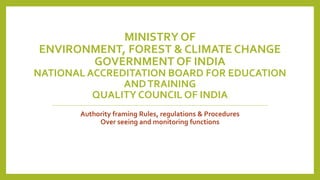
MINISTRY OF
ENVIRONMENT, FOREST & CLIMATE CHANGE
GOVERNMENT OF INDIA
NATIONAL ACCREDITATION BOARD FOR EDUCATION
ANDTRAINING
QUALITY COUNCIL OF INDIA
Authority framing Rules, regulations & Procedures
Over seeing and monitoring functions

Environment Impact Assessment - EIA Reports

  • 1.
  • 2.
    POLLUTION INDEX Function ofthe emissions – air pollutants Effluents – water pollutants Hazardous wastes generated Consumption of resources
  • 3.
  • 4.
  • 5.
    Scheme for Accreditationof EIA Consultant Organization REQUIREMENTS FOR ACCREDITATION The accreditation requirements have been developed for EIA consultants with a view to have system based approach for improving quality of EIAs. The scheme specifies the following six essential requirements for accreditation: i. Human resource ii. Field investigation and laboratory arrangement iii. Quality management system (QMS) iv. Quality of EIA reports v. Organizational commitment vi. Compliance to conditions of accreditation/ improvements achieved
  • 6.
    Areas of expertise i.Land use LU ii. Air pollution monitoring, prevention and control AP iii. Meteorology, air quality modeling and prediction AQ iv. Water pollution monitoring, prevention and control WP v. Ecology and biodiversity EB vi. Noise and vibration# NV vii. Socio- economics SE viii. Hydrology, ground water and water conservation HG ix. Geology GEO x. Soil conservation SC xi. Risk assessment and hazards management RH xii. Solid and hazardous waste management# SHW (comprising hazardous wastes (HW), industrial solid wastes (ISW) and municipal solid wastes (MSW) #
  • 7.
    MINISTRY OF ENVIRONMENT, FOREST& CLIMATE CHANGE GOVERNMENT OF INDIA NATIONAL ACCREDITATION BOARD FOR EDUCATION ANDTRAINING QUALITY COUNCIL OF INDIA Authority framing Rules, regulations & Procedures Over seeing and monitoring functions