BUSINESS PLAN
IMPLEMENTATION
STARTING AND OPERATING A
SIMPLE BUSINESS
• Even the most well-thought-out business plan is just a
piece of paper if it isn’t doesn’t have an
implementation plan. This is the portion of the
business plan where objectives are clarified, tasks are
assigned with deadlines, and the program is charted to
reach goals and milestone
Guidelines for successful business plan
implementation
Objectives
• The objectives should be crystal and clear
and specifically spelled out since it will be
used as building block for the rest of the
implementation plan
For example, assume the start-up is a small consulting firm. The objective
should be tough but reachable like the following example:-
• Secure office space and be open for business in three months
• -Sign three clients within first three months of operations
• -Sign 10 clients within the first year
Tasks
This part must be accomplished to achieve the objectives. You should
enumerate tasks and assignments ,with description specifically plainly and
generally stated.
Continuing with the above example, the tasks
section might read like this:
-Secure office space –real estate agent
-Obtain licenses and permits –you
-Set up office phones and computers –office manager
-Begin recruiting clients –sales manager
-Create marketing collaterals –marketing manager
-Solicit referrals from clients –relationship manager
Time Allocation
• Each task should be paired with an appropriate time frame for completion.
• The time allocation should be forceful but reasonable to ensure not just
completion but competent work.
• For assistance in framing this time scale, you may create your own Gantt
chart-a helpful tool that shows how long it will take to complete different
tasks sand in what order the tasks should be finished
Progress
• The overall management team leader needs to be in charge of monitoring
each task’s Progress and the completion percentage of each objective. When
delays occur, try to get to the root of the problem.
• Adjust the Gantt chart appropriately to account for the delay , and make a
note of the previous deadline and the reason it was missed.
Operating a Business
• Before starting a business aspiring entrepreneurs should seek professional
advice from small enterprise advisors, accountants or consultants on what is
the best type of enterprises to establish, as the varies according to the legal
frame work and economic structures prevailing at given time.
The following are the basic requirements to start
commencing a business in the Philippines:
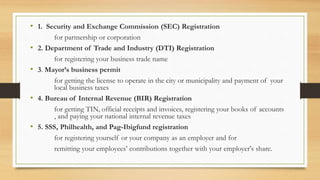
• 1. Security and Exchange Commission (SEC) Registration
for partnership or corporation
• 2. Department of Trade and Industry (DTI) Registration
for registering your business trade name
• 3. Mayor’s business permit
for getting the license to operate in the city or municipality and payment of your
local business taxes
• 4. Bureau of Internal Revenue (BIR) Registration
for getting TIN, official receipts and invoices, registering your books of accounts
, and paying your national internal revenue taxes
• 5. SSS, Philhealth, and Pag-Ibigfund registration
for registering yourself or your company as an employer and for
remitting your employees’ contributions together with your employer's share.
• Usually, the BIR and the City/Municipality Office
require the certificates of registration with the
SEC or DTI before a business can be registered
with these agencies. Thus, there is a need to
register through these offices to start the business
• A one-stop shop is available for entrepreneurs who need to
register with various government agencies, such as the DTI, SEC,
BIR, SSS, Pag-ibig Fund, and Philhealth. However, this service is
only available to a few cities in Metro Manila and is not yet
available nationwide.
• Aside from the basic requirements, there are also special licenses or registrations
that must be obtained by a business to start its operation, such as: banks, financing,
company, lending company, pawnshops, money changers, money remittance
businesses, and other financing institutions are required to be registered with
the Bangko Sentral ng Pilipinas (BSP)
• If you are manufacturing and selling products related to food and drugs, you also
have to register with the Bureau of Food and Drugs (BFAD)
• For schools and entities involved in providing education, they should register with
the Commission on Higher Education (CHED) and Department of Education (DepEd)
Other Steps to Follow Before Operating a
Business
1.Set up an accounting system or hire an
accountant.
• Knowing how the business is doing financially is
important for planning and survival. Using an
accounting software package will make tracking
business transactions easier.
2. Advertise the business.
• No one will buy the product for services if the
customers don’t know that the company exists. Create a
website and advertise in different media, such as
newspapers and radio. Ask customers for referrals.
Network with other business owners which will help in
the recognition and gain referrals for the new business.
3.Secure insurance for the business.
• Liability insurance protects the business in the vent
of litigation. You may consider life insurance and
health insurance if you are leasing an office or
storefront.
Selling the Product
Selling the Product
• Selling a product doesn’t have to be complicated.
• Beyond that, sales invoice remain focused on the details of the product and
customers.
• By observing these changes, you will be able to adjust the program and keep
the sales strong.
Method 1 – Showing Enthusiasm for the
Product
1. Study the Product
- To convey knowledge about the product and to answer customers’ questions
about the product, will project complete understanding of the product.
2. Emphasize the perks of the product to customers
- It is important to translate the product’s features into benefits as well as giving
good product information to the right people.
Think about things like:
 Will the product make the customer’s life easier?
 Will the product create a sense of luxury?
 Is the product something that can be enjoyed by many people?
 Is the product something that can be used for a long time?
3. Ensure that the product has been adequately explained
- In person-to-person sales there is a need to ensure that good product
information is supplied via retail packaging, point-of-purchase displays, and
any marketing materials.
• make sure that all product information is informative, true, and
complete.
• Make sure too, that the language on product packaging and marketing
materials is clear, direct, and easy to read.
• Invest time and money to ensure that the product, packaging, and
marketing materials look good- with high-quality photos, vivid colors,
etc.
Method 2 – connecting with the Buyer
1. Share your love of the product
- A good salesperson believes in the product that is being sold, and transfers
this enthusiasm to the customer.
2. Anticipate the customers’ motivations
- To be able to answer any questions that customers may have about a product,
it is important to anticipate those questions.
3. Practice breaking the ice with customers
- If working in direct sales, the way to connect with people is critical.
4. Convert the customer’s motivations into the product’s characteristics
- In marketing, this is known as “positioning”, and it consists of equating the
product with the customer’s hopes and desires.
5. Be honest about the product
- This means being transparent in the delivery of product information.
6. Close the sale
- There are many styles and methods of closing a sale, but one of the most
effective has the mnemonic, ABC: “Always Be Closing”.
7. Give customers time to consider
- Appearing overly pushy is a turn-off for many buyers.
- Allow customers to do so with the company’s enthusiastic and supportive
pitch in mind.
- Take note that the information you give matches what they read online.
- Give customers time to consider.
Method 3 – Selling Product as an Owner
Salesperson
1. Familiarize yourself with all aspects of the product
- This will feed into the end sale of a product.
2. Market the product
- It is important to make the product information available through as many
channels as possible.
3. Review the sales performance
- Analyze the sales at regular intervals.
Being able to answer these questions will help
maximize sales and keep sales growth steady:
• Is the product selling well?
• Is stock low or high?
• Is there a profit?
• How are the competitors performing?
4. Troubleshoot sales, if necessary
- If not selling well, there will be a need to enter into a problem-solving mode.
- Change the tactics periodically.
- Consider deleting a product from the line if it is not selling well.
- Review the target market and sharpen the sales focus.
- Change the price of the product.
- Sometimes controlling supply in this way increases demand and sales.
ENTREPRENEURSHIP: BUSINESS PLAN IMPLEMENTATION.pptx

ENTREPRENEURSHIP: BUSINESS PLAN IMPLEMENTATION.pptx

  • 1.
  • 2.
    STARTING AND OPERATINGA SIMPLE BUSINESS
  • 3.
    • Even themost well-thought-out business plan is just a piece of paper if it isn’t doesn’t have an implementation plan. This is the portion of the business plan where objectives are clarified, tasks are assigned with deadlines, and the program is charted to reach goals and milestone
  • 4.
    Guidelines for successfulbusiness plan implementation
  • 5.
    Objectives • The objectivesshould be crystal and clear and specifically spelled out since it will be used as building block for the rest of the implementation plan
  • 6.
    For example, assumethe start-up is a small consulting firm. The objective should be tough but reachable like the following example:- • Secure office space and be open for business in three months • -Sign three clients within first three months of operations • -Sign 10 clients within the first year
  • 7.
    Tasks This part mustbe accomplished to achieve the objectives. You should enumerate tasks and assignments ,with description specifically plainly and generally stated.
  • 8.
    Continuing with theabove example, the tasks section might read like this: -Secure office space –real estate agent -Obtain licenses and permits –you -Set up office phones and computers –office manager -Begin recruiting clients –sales manager -Create marketing collaterals –marketing manager -Solicit referrals from clients –relationship manager
  • 9.
    Time Allocation • Eachtask should be paired with an appropriate time frame for completion. • The time allocation should be forceful but reasonable to ensure not just completion but competent work. • For assistance in framing this time scale, you may create your own Gantt chart-a helpful tool that shows how long it will take to complete different tasks sand in what order the tasks should be finished
  • 10.
    Progress • The overallmanagement team leader needs to be in charge of monitoring each task’s Progress and the completion percentage of each objective. When delays occur, try to get to the root of the problem. • Adjust the Gantt chart appropriately to account for the delay , and make a note of the previous deadline and the reason it was missed.
  • 11.
    Operating a Business •Before starting a business aspiring entrepreneurs should seek professional advice from small enterprise advisors, accountants or consultants on what is the best type of enterprises to establish, as the varies according to the legal frame work and economic structures prevailing at given time.
  • 12.
    The following arethe basic requirements to start commencing a business in the Philippines:
  • 13.
    • 1. Securityand Exchange Commission (SEC) Registration for partnership or corporation • 2. Department of Trade and Industry (DTI) Registration for registering your business trade name • 3. Mayor’s business permit for getting the license to operate in the city or municipality and payment of your local business taxes • 4. Bureau of Internal Revenue (BIR) Registration for getting TIN, official receipts and invoices, registering your books of accounts , and paying your national internal revenue taxes • 5. SSS, Philhealth, and Pag-Ibigfund registration for registering yourself or your company as an employer and for remitting your employees’ contributions together with your employer's share.
  • 14.
    • Usually, theBIR and the City/Municipality Office require the certificates of registration with the SEC or DTI before a business can be registered with these agencies. Thus, there is a need to register through these offices to start the business
  • 15.
    • A one-stopshop is available for entrepreneurs who need to register with various government agencies, such as the DTI, SEC, BIR, SSS, Pag-ibig Fund, and Philhealth. However, this service is only available to a few cities in Metro Manila and is not yet available nationwide.
  • 16.
    • Aside fromthe basic requirements, there are also special licenses or registrations that must be obtained by a business to start its operation, such as: banks, financing, company, lending company, pawnshops, money changers, money remittance businesses, and other financing institutions are required to be registered with the Bangko Sentral ng Pilipinas (BSP) • If you are manufacturing and selling products related to food and drugs, you also have to register with the Bureau of Food and Drugs (BFAD) • For schools and entities involved in providing education, they should register with the Commission on Higher Education (CHED) and Department of Education (DepEd)
  • 17.
    Other Steps toFollow Before Operating a Business
  • 18.
    1.Set up anaccounting system or hire an accountant. • Knowing how the business is doing financially is important for planning and survival. Using an accounting software package will make tracking business transactions easier.
  • 19.
    2. Advertise thebusiness. • No one will buy the product for services if the customers don’t know that the company exists. Create a website and advertise in different media, such as newspapers and radio. Ask customers for referrals. Network with other business owners which will help in the recognition and gain referrals for the new business.
  • 20.
    3.Secure insurance forthe business. • Liability insurance protects the business in the vent of litigation. You may consider life insurance and health insurance if you are leasing an office or storefront.
  • 21.
  • 22.
    Selling the Product •Selling a product doesn’t have to be complicated. • Beyond that, sales invoice remain focused on the details of the product and customers. • By observing these changes, you will be able to adjust the program and keep the sales strong.
  • 23.
    Method 1 –Showing Enthusiasm for the Product 1. Study the Product - To convey knowledge about the product and to answer customers’ questions about the product, will project complete understanding of the product. 2. Emphasize the perks of the product to customers - It is important to translate the product’s features into benefits as well as giving good product information to the right people.
  • 24.
    Think about thingslike:  Will the product make the customer’s life easier?  Will the product create a sense of luxury?  Is the product something that can be enjoyed by many people?  Is the product something that can be used for a long time?
  • 25.
    3. Ensure thatthe product has been adequately explained - In person-to-person sales there is a need to ensure that good product information is supplied via retail packaging, point-of-purchase displays, and any marketing materials. • make sure that all product information is informative, true, and complete. • Make sure too, that the language on product packaging and marketing materials is clear, direct, and easy to read. • Invest time and money to ensure that the product, packaging, and marketing materials look good- with high-quality photos, vivid colors, etc.
  • 26.
    Method 2 –connecting with the Buyer 1. Share your love of the product - A good salesperson believes in the product that is being sold, and transfers this enthusiasm to the customer. 2. Anticipate the customers’ motivations - To be able to answer any questions that customers may have about a product, it is important to anticipate those questions.
  • 27.
    3. Practice breakingthe ice with customers - If working in direct sales, the way to connect with people is critical. 4. Convert the customer’s motivations into the product’s characteristics - In marketing, this is known as “positioning”, and it consists of equating the product with the customer’s hopes and desires. 5. Be honest about the product - This means being transparent in the delivery of product information. 6. Close the sale - There are many styles and methods of closing a sale, but one of the most effective has the mnemonic, ABC: “Always Be Closing”.
  • 28.
    7. Give customerstime to consider - Appearing overly pushy is a turn-off for many buyers. - Allow customers to do so with the company’s enthusiastic and supportive pitch in mind. - Take note that the information you give matches what they read online. - Give customers time to consider.
  • 29.
    Method 3 –Selling Product as an Owner Salesperson 1. Familiarize yourself with all aspects of the product - This will feed into the end sale of a product. 2. Market the product - It is important to make the product information available through as many channels as possible. 3. Review the sales performance - Analyze the sales at regular intervals.
  • 30.
    Being able toanswer these questions will help maximize sales and keep sales growth steady: • Is the product selling well? • Is stock low or high? • Is there a profit? • How are the competitors performing?
  • 31.
    4. Troubleshoot sales,if necessary - If not selling well, there will be a need to enter into a problem-solving mode. - Change the tactics periodically. - Consider deleting a product from the line if it is not selling well. - Review the target market and sharpen the sales focus. - Change the price of the product. - Sometimes controlling supply in this way increases demand and sales.