ENTREPRENEUR DNA
DOES IT EXIST?
THE HYPOTHESIS
Entrepreneurship requires a very unique skillset, and this skillset
can be identified by a standardized test.
Part 1The Test
CREATING THE TEST
The Founder Institute, a global startup
launch program, enlisted the services
of top social scientists to design a test
and evaluation system to both
identify and predict entrepreneurial
success.
The first test was created in 2009, and
it has since been amended several
times by a social scientist on staff.
CURRENT TEST STRUCTURE
One hour long battery of personality
and aptitude evaluations
Specifically focuses on measuring
Fluid Intelligence and other “Big Five”
personality traits
Localized for 10 different languages,
and delivered online
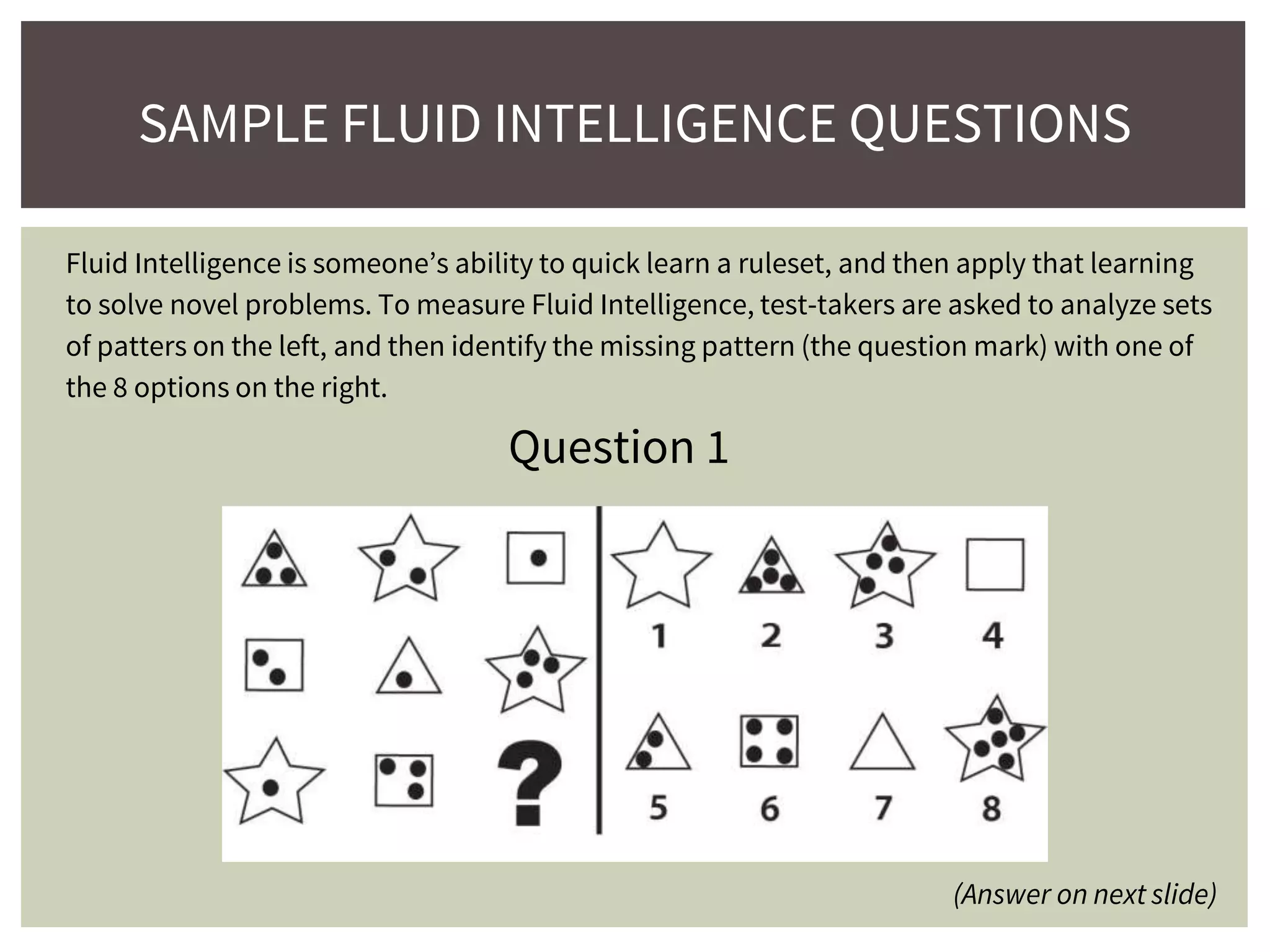
SAMPLE FLUID INTELLIGENCE QUESTIONS
Fluid Intelligence is someone’s ability to quick learn a ruleset, and then apply that learning
to solve novel problems. To measure Fluid Intelligence, test-takers are asked to analyze sets
of patters on the left, and then identify the missing pattern (the question mark) with one of
the 8 options on the right.
Question 1
(Answer on next slide)
SAMPLE FLUID INTELLIGENCE QUESTIONS
(Answer to Question 1: 5)
Question 2
SAMPLE FLUID INTELLIGENCE QUESTIONS
(Answer to Question 2: 5)
Question 3
SAMPLE FLUID INTELLIGENCE QUESTIONS
(Answer to Question 3: 3)
Question 4
SAMPLE PERSONALITY QUESTIONS
(Answer to Question 4: 2)
To measure “Big Five” personality traits, such as Openness, Extraversion, and Agreeableness,
test takers are presented with a series of questions, which have been designed through leading
social-science methods.
In the samples below, you are asked to select one choice from each series of answers that you
believe best describes you or your views.
(There are no “correct” answers to these questions)
Question 5:
a. Have a vivid imagination
b. Pay attention to details
Question 6:
a. Get excited by new ideas
b. Am not easily bothered by things
Question 7:
a. Believe that others have good intentions
b. Have a rich vocabulary
Question 8:
a. Make friends easily
b. Can say things beautifully
Part 2Entrepreneur DNA
ANALYZING THE RESULTS
Since 2009, the Founder Institute has collected test results from
thousands of entrepreneurs, and tracked their progress and
company performance in the real world.
METHODOLOGY FOR EVALUATION
By constantly feeding in
performance data from thousands
of real world entrepreneurs, and
comparing that data to the test
results, we have found a very strong
correlation between many traits
and positive (or negative)
entrepreneurial performance.
PROFESSIONAL EXPERIENCE
We find that many of our successful founders are over 28 years old
and have business experience.
HIGH FLUID INTELLIGENCE
Fluid intelligence, a combination of pattern recognition abilities
and abstract thinking skills, strongly correlates with success.
HIGH OPENNESS
Many successful founders are open to new ideas, with natural
curiosity and optimistic perspectives.
MODERATE AGREEABLENESS
Founders are more likely to succeed if they are agreeable, but not
too agreeable.
SURPRISING FINDINGS
Contrary to popular belief, IQ and Conscientiousness do not seem
to be relevant in predicting entrepreneurial success.
BAD FOUNDER DNA
Analysis of our test results revealed that certain personality traits
hinder founder success.
Part 3Entrepreneur Profiles
ENTREPRENEUR DNA PROFILES
We also worked with leading social
scientists to analyze the test data,
and identify “buckets” of common
personality trait combinations
exhibited by successful
entrepreneurs.
We we surprised to find six very
distinct “Entrepreneur DNA
Profiles”.
Part 4Comparing Geographies
How do founders in
different cities compare?
Part 5In Conclusion
There are great entrepreneurs
everywhere.
Great companies can be built
anywhere.
THANK YOU!
APPLY & TAKE THE TEST:
FI.co/join/dna
LEARN MORE ABOUT THE TEST:
FI.co/dna

Entrepreneur DNA - Does It Exist?

  • 1.
  • 2.
    THE HYPOTHESIS Entrepreneurship requiresa very unique skillset, and this skillset can be identified by a standardized test.
  • 3.
  • 4.
    CREATING THE TEST TheFounder Institute, a global startup launch program, enlisted the services of top social scientists to design a test and evaluation system to both identify and predict entrepreneurial success. The first test was created in 2009, and it has since been amended several times by a social scientist on staff.
  • 5.
    CURRENT TEST STRUCTURE Onehour long battery of personality and aptitude evaluations Specifically focuses on measuring Fluid Intelligence and other “Big Five” personality traits Localized for 10 different languages, and delivered online
  • 6.
    SAMPLE FLUID INTELLIGENCEQUESTIONS Fluid Intelligence is someone’s ability to quick learn a ruleset, and then apply that learning to solve novel problems. To measure Fluid Intelligence, test-takers are asked to analyze sets of patters on the left, and then identify the missing pattern (the question mark) with one of the 8 options on the right. Question 1 (Answer on next slide)
  • 7.
    SAMPLE FLUID INTELLIGENCEQUESTIONS (Answer to Question 1: 5) Question 2
  • 8.
    SAMPLE FLUID INTELLIGENCEQUESTIONS (Answer to Question 2: 5) Question 3
  • 9.
    SAMPLE FLUID INTELLIGENCEQUESTIONS (Answer to Question 3: 3) Question 4
  • 10.
    SAMPLE PERSONALITY QUESTIONS (Answerto Question 4: 2) To measure “Big Five” personality traits, such as Openness, Extraversion, and Agreeableness, test takers are presented with a series of questions, which have been designed through leading social-science methods. In the samples below, you are asked to select one choice from each series of answers that you believe best describes you or your views. (There are no “correct” answers to these questions) Question 5: a. Have a vivid imagination b. Pay attention to details Question 6: a. Get excited by new ideas b. Am not easily bothered by things Question 7: a. Believe that others have good intentions b. Have a rich vocabulary Question 8: a. Make friends easily b. Can say things beautifully
  • 11.
  • 12.
    ANALYZING THE RESULTS Since2009, the Founder Institute has collected test results from thousands of entrepreneurs, and tracked their progress and company performance in the real world.
  • 13.
    METHODOLOGY FOR EVALUATION Byconstantly feeding in performance data from thousands of real world entrepreneurs, and comparing that data to the test results, we have found a very strong correlation between many traits and positive (or negative) entrepreneurial performance.
  • 14.
    PROFESSIONAL EXPERIENCE We findthat many of our successful founders are over 28 years old and have business experience.
  • 15.
    HIGH FLUID INTELLIGENCE Fluidintelligence, a combination of pattern recognition abilities and abstract thinking skills, strongly correlates with success.
  • 16.
    HIGH OPENNESS Many successfulfounders are open to new ideas, with natural curiosity and optimistic perspectives.
  • 17.
    MODERATE AGREEABLENESS Founders aremore likely to succeed if they are agreeable, but not too agreeable.
  • 18.
    SURPRISING FINDINGS Contrary topopular belief, IQ and Conscientiousness do not seem to be relevant in predicting entrepreneurial success.
  • 19.
    BAD FOUNDER DNA Analysisof our test results revealed that certain personality traits hinder founder success.
  • 20.
  • 21.
    ENTREPRENEUR DNA PROFILES Wealso worked with leading social scientists to analyze the test data, and identify “buckets” of common personality trait combinations exhibited by successful entrepreneurs. We we surprised to find six very distinct “Entrepreneur DNA Profiles”.
  • 28.
  • 29.
    How do foundersin different cities compare?
  • 37.
  • 38.
    There are greatentrepreneurs everywhere. Great companies can be built anywhere.
  • 39.
    THANK YOU! APPLY &TAKE THE TEST: FI.co/join/dna LEARN MORE ABOUT THE TEST: FI.co/dna