1
UNIVERSITY OF GONDAR
INSTITUTE OF TECHNOLOGY
SCHOOL OF MECHANICAL & INDUSTRIAL ENGINEERING
BY: GASHAW. A
2013 E.C.
CHAPTER-ONE
Introduction to entrepreneurship
Outline
 Meaning of the terms entrepreneur, entrepreneurship and Intrapreneurs
 Entrepreneurial decision process
 Advantage and drawback of Entrepreneurship
 Creation and innovation
2
What is an Entrepreneur?
Entrepreneur is a person who
owns, organizes, manages and runs an enterprise assuming the risk of a business or
enterprise.
 who has the ability to see and evaluate business opportunities to gather the necessary
resources to take advantage of them, and to initiate appropriate action to ensure success.
(Meredith, 1982)
Has the ability to identify and pursue a business opportunity
Undertake a business venture
Raises the capital to finance it
Gathers the necessary resources
Set goals for himself/herself and others
Assumes major portion of the risk
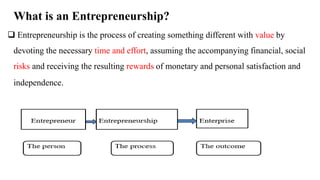
What is an Entrepreneurship?
 Entrepreneurship is the process of creating something different with value by
devoting the necessary time and effort, assuming the accompanying financial, social
risks and receiving the resulting rewards of monetary and personal satisfaction and
independence.
5
FORMS OF ENTREPRENEURSHIP
 Entrepreneurship can take three different forms
1. The individual entrepreneur
2. Intrapreneur: a person who does entrepreneurial work within large organization
3. Social Entrepreneur: People who drive social innovation and transformation in
various fields including education, health, environment and enterprise
development
ENTREPRENEURS Vs. INTRAPRENEURS
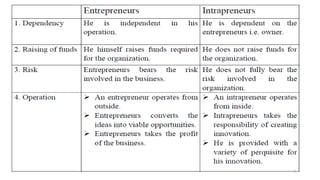
• The difference between an entrepreneur and Intrapreneur is that the former refers
to a person who starts his own business with a new idea or concept, the latter
represents an employee who promotes innovation within the limits of the
organization.
• Entrepreneurs are people that notice opportunities and take the initiative to mobilize
resources to make new goods and services.
• Intrapreneurs also notice opportunities and take initiative to mobilize resources,
however they work in large companies and contribute to the innovation of the firm.
• Intrapreneurs often become entrepreneurs.
6
7
Entrepreneurial Decision Process
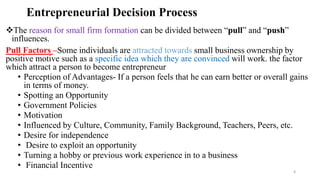
The reason for small firm formation can be divided between “pull” and “push”
influences.
Pull Factors –Some individuals are attracted towards small business ownership by
positive motive such as a specific idea which they are convinced will work. the factor
which attract a person to become entrepreneur
• Perception of Advantages- If a person feels that he can earn better or overall gains
in terms of money.
• Spotting an Opportunity
• Government Policies
• Motivation
• Influenced by Culture, Community, Family Background, Teachers, Peers, etc.
• Desire for independence
• Desire to exploit an opportunity
• Turning a hobby or previous work experience in to a business
• Financial Incentive
8
Push Factors
• Many people are pushed into founding a new enterprise by variety of factors including:
• Job Dissatisfaction
• Relocation
• Joblessness(Unemployment)
• Lay off
• Retirement
• Disagreement with previous employer
• Boredom- This is applicable to many ladies from well to do families. With their army of
servants to take care of home, they find an opportunity to keep the boredom away and start
ventures
9
Outcomes of Entrepreneurship
• Economic growth
• New industry formation
• Job creation
10
Advantages of Entrepreneurship
To an Individual
(a) Provides Self Employment for the entrepreneur
(b) Entrepreneur can provide employment for near & dear one
(c) Entrepreneurship often provides an employment and livelihood for
next generations
(d) Freedom to use own ideas – Innovation and creativity
(e) Unlimited income / higher retained income
(f) Independence
(g) Satisfaction 11
Cont…
To the nation
(a) Provides larger employment
(b) Results in wider distribution of wealth
(c) Mobilizes local resources, skills and savings
(d) Accelerates the speed of economic development
(e) Stimulates innovation & efficiency
12
Drawbacks of Entrepreneurship
• Uncertainty of income
Opening & running a business provides no guarantee that an entrepreneur will earn enough
money and survive
Engage in a wrong business & not able gain an advantage in the short run and eventually in
the long run can be disastrous.
Great effort , proper & effective management need to use in the beginning to ensure the
organization success.
13
Cont.…
• Risk of losing your entire investment
Small business have a high failure rate
Entrepreneurs must be prepared to face the consequence of failure
If the business fails the entrepreneur must have a contingency plan to
overcome a bankruptcy or personal failure
14
Cont.…
• Long Hours and Hard work
Entrepreneurs tend to be generally work long hours & under tremendous pressure
to produce the result they expect
Some even go to the extent of making big sacrifice & deprive themselves of a
personal life, wife & children and social and family associates.
15
Cont.…
• High level of Stress
Starting the business can be very rewarding experience, but it can be stressful
An Entrepreneur have left the comfort & security of secured job to venture in to their own
business.
 Failure in the business can bring about tremendous personal failure, & in turn creates
intense level of anxiety and stress.
Financial burden may increase & Entrepreneurs may face difficulty sustaining the business
or may decide to call it for day & wind up the business.
16
WHY ENTREPRENEUR FAIL?
Ten Deadly Mistakes of Entrepreneurs
• Business entrepreneurship fail because:
Management mistakes
Lack of experience
Poor financial control
Weak marketing efforts
Failure to develop a strategic & effective plan
Poor location
Improper inventory control
Incorrect or unsuitable price
The inability to move into entrepreneurial mindset & stick on previous traditional managerial
system
18
Cont.…
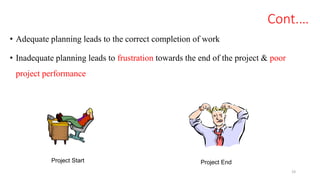
• Adequate planning leads to the correct completion of work
• Inadequate planning leads to frustration towards the end of the project & poor
project performance
19
Project Start Project End
ENTERPRISE
• Is a business or company that can provide satisfying rewards for those who
successfully establish them.
• The key difference between all types of enterprise lies in the rewards they
provide.
• Classification of Enterprise broadly Classified in to two:
Manufacturing Enterprise &
Service dealer Enterprise
20
A. Manufacturing Enterprises
• Food and kindred products
• Textile mill products
• Furniture and fixtures
• Printing, publishing and allied industries
• Chemicals and allied products
• Petroleum refining and related industries
• Rubber and miscellaneous plastic products
• Leather and leather products
• Stone, clay, glass and concrete products
• Primary metal industries
• Fabricated metal products
• Machinery
• Electrical and electronic machinery, equipment and supplies
• Transportation equipment
• Measuring, analyzing and controlling instruments (photographic, medical and optical goods; watches and
clocks)
• Miscellaneous manufacturing
21
b. Service Dealer Enterprises
• Hotels, boarding houses, camps and other lodging places
• Motor vehicle repairs, petrol station services and garages
• Personal services
• Amusements and recreation services
• Business services
• Miscellaneous repair services
• Motion pictures
• Health services
• Legal services 22
Cont...
• Educational services
• Social services
• Brokerage services
• Cosmetics/beauty care services
• Computer/office services
• Information technology services
• Security services
• Postal (mail/courier ) services
23
Rewards of being Entrepreneur
1. Self-actualization/ personal fulfillment
2. Feeling of freedom and independence
3. Providing jobs and benefits to others (investors, suppliers,
bankers, subcontractors, work force and customers)
4. Economic good (product/ service, incomes for workers, profit
for shareholders/ partners)
24
Creativity, Innovation & Entrepreneurship
 Creativity is the ability to develop new ideas & to discover new ways of looking at
problems & opportunities.
 Innovation is the ability to apply Creative solutions to those problems & opportunities
in order to enhance people’s lives or to enrich society.
 Entrepreneurship is the result of a disciplined, systematic process of applying
creativity & innovation to needs & opportunities in the market place.
25
Creative ideas are needed anywhere there are problems with unknown solutions
An entrepreneur’s creativity is often the difference between success and failure
in business.
To be creative, entrepreneurs need to keep their mind and eyes open to their
environment.
Some people believe that they are not creative. (Consider as a gift of God )
26
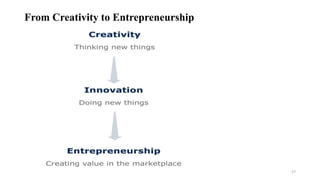
From Creativity to Entrepreneurship
27
Researchers believe that entrepreneurs succeed by thinking and doing new
things or old things in new ways .
Entrepreneurship = creativity + innovation
People can develop their creative potential through learning and practice.
28
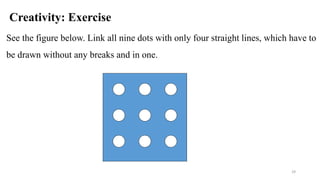
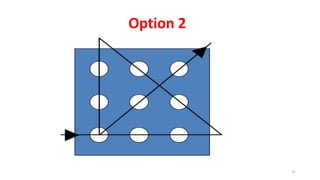
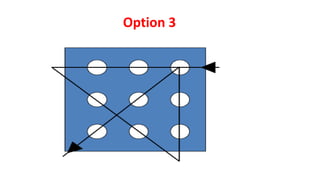
Creativity: Exercise
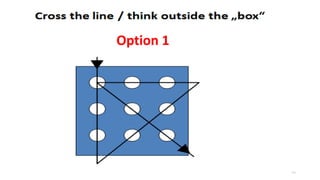
See the figure below. Link all nine dots with only four straight lines, which have to
be drawn without any breaks and in one.
29
30
Option 1
31
Option 2
32
Option 3
Techniques Used To Develop Creative Thinking
Increasing awareness of one’s environment
 Most people are in the habit of blocking out certain sights and sounds in order to
concentrate on one thing at a time
By paying attention to what we usually ignore, we can open our minds to new ways
of thinking.
Brain storming
 Ideas are never judged or criticized during brainstorming.
 Participants may combine and improve ideas during brainstorming
33
Changing existing ideas
 New and original ideas can be developed by using existing ideas as a starting point.
 Parts of existing ideas can be made bigger, made smaller, modified , rearranged,
reversed, substituted or combined.
 Products and services are often changed to make them more attractive by using this
simple technique
Help entrepreneurs make their working situations more pleasant and efficient.
34
End of The Chapter
Thank You
35

entrepreneur_.pptx

  • 1.
    1 UNIVERSITY OF GONDAR INSTITUTEOF TECHNOLOGY SCHOOL OF MECHANICAL & INDUSTRIAL ENGINEERING BY: GASHAW. A 2013 E.C.
  • 2.
    CHAPTER-ONE Introduction to entrepreneurship Outline Meaning of the terms entrepreneur, entrepreneurship and Intrapreneurs  Entrepreneurial decision process  Advantage and drawback of Entrepreneurship  Creation and innovation 2
  • 3.
    What is anEntrepreneur? Entrepreneur is a person who owns, organizes, manages and runs an enterprise assuming the risk of a business or enterprise.  who has the ability to see and evaluate business opportunities to gather the necessary resources to take advantage of them, and to initiate appropriate action to ensure success. (Meredith, 1982) Has the ability to identify and pursue a business opportunity Undertake a business venture Raises the capital to finance it Gathers the necessary resources Set goals for himself/herself and others Assumes major portion of the risk
  • 4.
    What is anEntrepreneurship?  Entrepreneurship is the process of creating something different with value by devoting the necessary time and effort, assuming the accompanying financial, social risks and receiving the resulting rewards of monetary and personal satisfaction and independence.
  • 5.
    5 FORMS OF ENTREPRENEURSHIP Entrepreneurship can take three different forms 1. The individual entrepreneur 2. Intrapreneur: a person who does entrepreneurial work within large organization 3. Social Entrepreneur: People who drive social innovation and transformation in various fields including education, health, environment and enterprise development
  • 6.
    ENTREPRENEURS Vs. INTRAPRENEURS •The difference between an entrepreneur and Intrapreneur is that the former refers to a person who starts his own business with a new idea or concept, the latter represents an employee who promotes innovation within the limits of the organization. • Entrepreneurs are people that notice opportunities and take the initiative to mobilize resources to make new goods and services. • Intrapreneurs also notice opportunities and take initiative to mobilize resources, however they work in large companies and contribute to the innovation of the firm. • Intrapreneurs often become entrepreneurs. 6
  • 7.
  • 8.
    Entrepreneurial Decision Process Thereason for small firm formation can be divided between “pull” and “push” influences. Pull Factors –Some individuals are attracted towards small business ownership by positive motive such as a specific idea which they are convinced will work. the factor which attract a person to become entrepreneur • Perception of Advantages- If a person feels that he can earn better or overall gains in terms of money. • Spotting an Opportunity • Government Policies • Motivation • Influenced by Culture, Community, Family Background, Teachers, Peers, etc. • Desire for independence • Desire to exploit an opportunity • Turning a hobby or previous work experience in to a business • Financial Incentive 8
  • 9.
    Push Factors • Manypeople are pushed into founding a new enterprise by variety of factors including: • Job Dissatisfaction • Relocation • Joblessness(Unemployment) • Lay off • Retirement • Disagreement with previous employer • Boredom- This is applicable to many ladies from well to do families. With their army of servants to take care of home, they find an opportunity to keep the boredom away and start ventures 9
  • 10.
    Outcomes of Entrepreneurship •Economic growth • New industry formation • Job creation 10
  • 11.
    Advantages of Entrepreneurship Toan Individual (a) Provides Self Employment for the entrepreneur (b) Entrepreneur can provide employment for near & dear one (c) Entrepreneurship often provides an employment and livelihood for next generations (d) Freedom to use own ideas – Innovation and creativity (e) Unlimited income / higher retained income (f) Independence (g) Satisfaction 11
  • 12.
    Cont… To the nation (a)Provides larger employment (b) Results in wider distribution of wealth (c) Mobilizes local resources, skills and savings (d) Accelerates the speed of economic development (e) Stimulates innovation & efficiency 12
  • 13.
    Drawbacks of Entrepreneurship •Uncertainty of income Opening & running a business provides no guarantee that an entrepreneur will earn enough money and survive Engage in a wrong business & not able gain an advantage in the short run and eventually in the long run can be disastrous. Great effort , proper & effective management need to use in the beginning to ensure the organization success. 13
  • 14.
    Cont.… • Risk oflosing your entire investment Small business have a high failure rate Entrepreneurs must be prepared to face the consequence of failure If the business fails the entrepreneur must have a contingency plan to overcome a bankruptcy or personal failure 14
  • 15.
    Cont.… • Long Hoursand Hard work Entrepreneurs tend to be generally work long hours & under tremendous pressure to produce the result they expect Some even go to the extent of making big sacrifice & deprive themselves of a personal life, wife & children and social and family associates. 15
  • 16.
    Cont.… • High levelof Stress Starting the business can be very rewarding experience, but it can be stressful An Entrepreneur have left the comfort & security of secured job to venture in to their own business.  Failure in the business can bring about tremendous personal failure, & in turn creates intense level of anxiety and stress. Financial burden may increase & Entrepreneurs may face difficulty sustaining the business or may decide to call it for day & wind up the business. 16
  • 17.
  • 18.
    Ten Deadly Mistakesof Entrepreneurs • Business entrepreneurship fail because: Management mistakes Lack of experience Poor financial control Weak marketing efforts Failure to develop a strategic & effective plan Poor location Improper inventory control Incorrect or unsuitable price The inability to move into entrepreneurial mindset & stick on previous traditional managerial system 18
  • 19.
    Cont.… • Adequate planningleads to the correct completion of work • Inadequate planning leads to frustration towards the end of the project & poor project performance 19 Project Start Project End
  • 20.
    ENTERPRISE • Is abusiness or company that can provide satisfying rewards for those who successfully establish them. • The key difference between all types of enterprise lies in the rewards they provide. • Classification of Enterprise broadly Classified in to two: Manufacturing Enterprise & Service dealer Enterprise 20
  • 21.
    A. Manufacturing Enterprises •Food and kindred products • Textile mill products • Furniture and fixtures • Printing, publishing and allied industries • Chemicals and allied products • Petroleum refining and related industries • Rubber and miscellaneous plastic products • Leather and leather products • Stone, clay, glass and concrete products • Primary metal industries • Fabricated metal products • Machinery • Electrical and electronic machinery, equipment and supplies • Transportation equipment • Measuring, analyzing and controlling instruments (photographic, medical and optical goods; watches and clocks) • Miscellaneous manufacturing 21
  • 22.
    b. Service DealerEnterprises • Hotels, boarding houses, camps and other lodging places • Motor vehicle repairs, petrol station services and garages • Personal services • Amusements and recreation services • Business services • Miscellaneous repair services • Motion pictures • Health services • Legal services 22
  • 23.
    Cont... • Educational services •Social services • Brokerage services • Cosmetics/beauty care services • Computer/office services • Information technology services • Security services • Postal (mail/courier ) services 23
  • 24.
    Rewards of beingEntrepreneur 1. Self-actualization/ personal fulfillment 2. Feeling of freedom and independence 3. Providing jobs and benefits to others (investors, suppliers, bankers, subcontractors, work force and customers) 4. Economic good (product/ service, incomes for workers, profit for shareholders/ partners) 24
  • 25.
    Creativity, Innovation &Entrepreneurship  Creativity is the ability to develop new ideas & to discover new ways of looking at problems & opportunities.  Innovation is the ability to apply Creative solutions to those problems & opportunities in order to enhance people’s lives or to enrich society.  Entrepreneurship is the result of a disciplined, systematic process of applying creativity & innovation to needs & opportunities in the market place. 25
  • 26.
    Creative ideas areneeded anywhere there are problems with unknown solutions An entrepreneur’s creativity is often the difference between success and failure in business. To be creative, entrepreneurs need to keep their mind and eyes open to their environment. Some people believe that they are not creative. (Consider as a gift of God ) 26
  • 27.
    From Creativity toEntrepreneurship 27
  • 28.
    Researchers believe thatentrepreneurs succeed by thinking and doing new things or old things in new ways . Entrepreneurship = creativity + innovation People can develop their creative potential through learning and practice. 28
  • 29.
    Creativity: Exercise See thefigure below. Link all nine dots with only four straight lines, which have to be drawn without any breaks and in one. 29
  • 30.
  • 31.
  • 32.
  • 33.
    Techniques Used ToDevelop Creative Thinking Increasing awareness of one’s environment  Most people are in the habit of blocking out certain sights and sounds in order to concentrate on one thing at a time By paying attention to what we usually ignore, we can open our minds to new ways of thinking. Brain storming  Ideas are never judged or criticized during brainstorming.  Participants may combine and improve ideas during brainstorming 33
  • 34.
    Changing existing ideas New and original ideas can be developed by using existing ideas as a starting point.  Parts of existing ideas can be made bigger, made smaller, modified , rearranged, reversed, substituted or combined.  Products and services are often changed to make them more attractive by using this simple technique Help entrepreneurs make their working situations more pleasant and efficient. 34

  • 35.
    End of TheChapter Thank You 35

Editor's Notes

  • #6 mmit
  • #29 Creativity is the ability to develop new ideas and to discover new ways of looking at problems and opportunities. Innovation is the ability to apply creative solutions to those problems and opportunities in order to enhance people’s lives or to enrich society