1. Introduction Part
2.Entrepreneurship
2.1. Definition
2.2. Types of Entrepreneurship
2.3. Characteristics of Entrepreneurs
2.4. Importance of Entrepreneurs
2.4. Entrepreneurship Mindset
3. Entrepreneurial Community
3.1. Qualities of Entrepreneurs
3.2. The Entrepreneurial Decision Process
3.3. Ethics and Social Responsibilities of Entrepreneurs
3.4. Role of Entrepreneurship in Economic Development
3.5. Entrepreneurship with Christian Value
4. Strategies to Build Entrepreneurial Community
3.
Entrepreneurship hasbecome increasingly important for
businesses of all sizes around the world. It is a powerful
economic growth tool for the global and local economies. It is
clearly observed that the world economy is undergoing a
transformation driven by entrepreneurs who create opportunity
for change and build new industries based on innovation and
global markets.
It opens new opportunities and possibilities for the businesses
to create values for themselves and for the society at large.
More than two-thirds of new jobs were created by
entrepreneurs between 1993 and 1996. This can make a
difference in the lives of the community.
4.
The needfor people to be able to generate their own jobs has been signaled by
the increasingly competitive labor market. This made a community-based
entrepreneurship to be regarded as an alternative solution to recover
community’s economic condition from the different challenges
Even more, it can be potential business venture to open more employment,
alleviate poverty, reduce urbanization and increase community’s life quality.
To increase productivity, response to more competitive business market and
sustainability, community entrepreneurs need to develop more skills, persist
positive business attitude and strong mentality.
Therefore. In this course, we will explore some of the major strategies on
building entrepreneurial community, sustainable business market in the
market filled with competition, ways to develop entrepreneurial mindset, etc.
5.
Learners will beable to:
Understand the meaning of entrepreneurship .
Identify the qualities of entrepreneurs .
Identify the contribution of entrepreneurship to the local
economy
Describe the importance of a strategic plan to further
entrepreneur-based economic goals.
Understand the important contribution of entrepreneurs and
business enterprises to the local economy and employment.
Distinguish the various stages of new venture development
Identify the importance of Christian Value in
Entrepreneurship.
6.
Anticipated Outcomes
Access todemographic profiles of their community,
identifying potential gaps and opportunities for
entrepreneurs
Utilize strategies that are most appropriate and will
have the greatest impact on the community
Develop a strategic plan to build an entrepreneur-
friendly community.
7.
Under this topic,we will explore the meaning of entrepreneurship, entrepreneur,
entrepreneurial organization and entrepreneurial community.
To date, several definitions have been used to describe an
entrepreneur. Some of them are mentioned herewith:
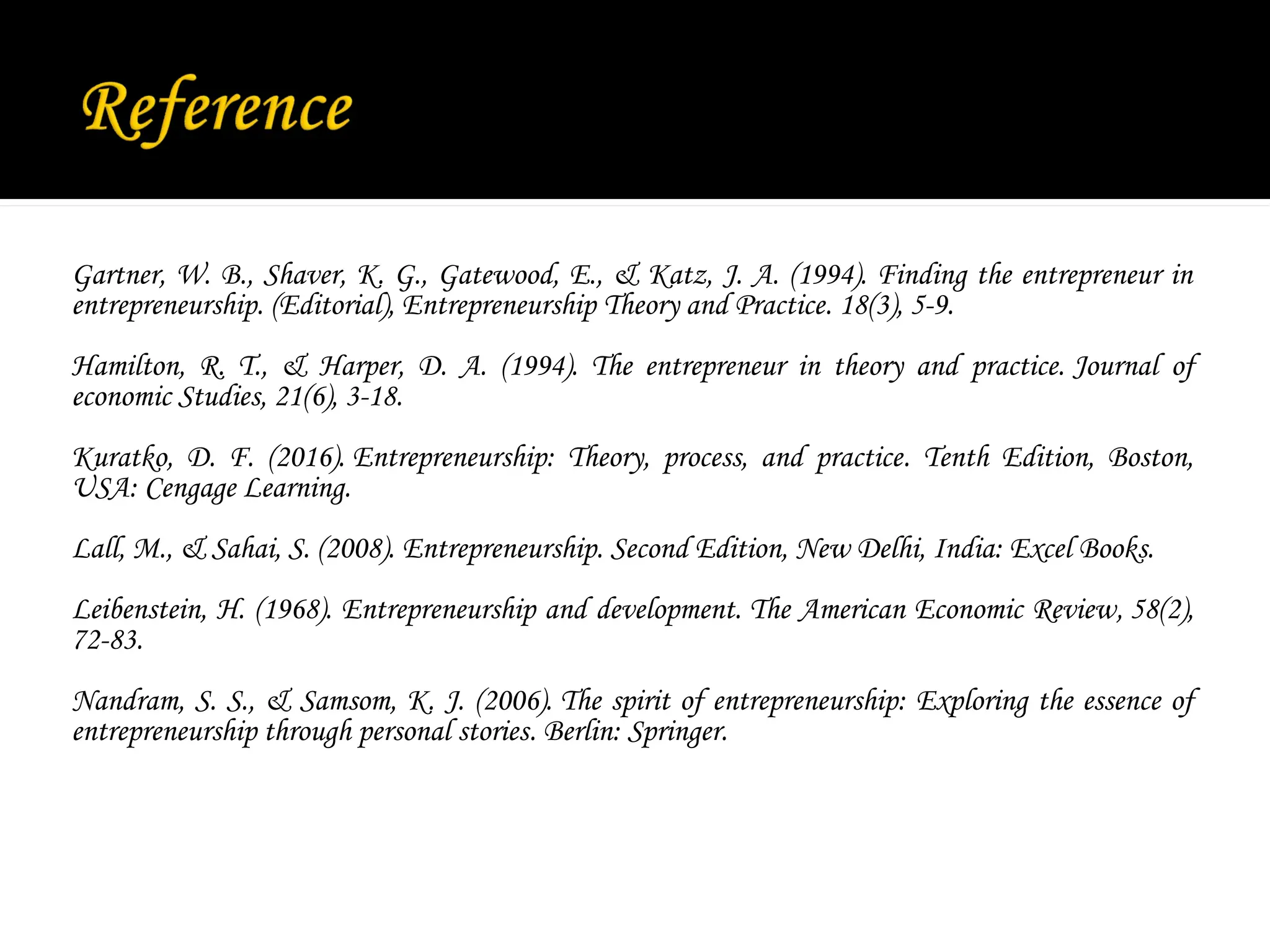
The word “entrepreneur” is descended from the Latin word,
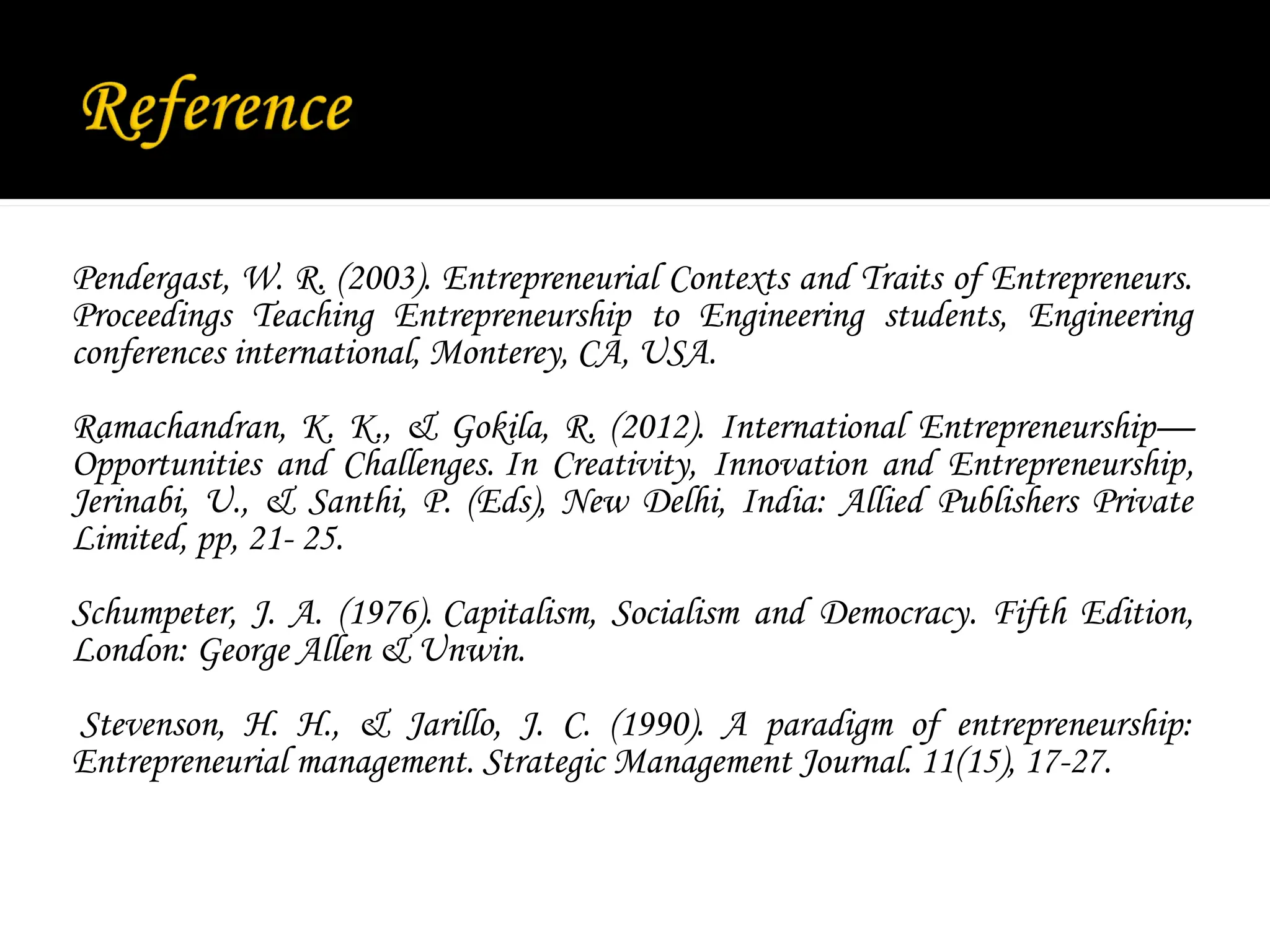
prendere, and later the French word prendre, which means “ to take,
to undertake, etc.” In a business context, it means to start a business.
The use of the term entrepreneur can be traced from 1755, wherein
an entrepreneur was described to “buy the country produce from
those who bring it or to order it to be brought on their account. They
pay a certain price to resell wholesale or retail at an uncertain price”
(Cantillon, 1931, p.51; Hamilton & Harper, 1994)
8.
Entrepreneurship isan “act of establishing a new venture”
Christensen, (2000, p.4)
Entrepreneurship is the ability to develop, organize and run a
business enterprise, along with any of its uncertainties in
order to make a profit. The most prominent example of
entrepreneurship is the starting of new businesses.
“Most of what you hear about entrepreneurship is all wrong.
It’s not magic; it’s not mysterious; and it has nothing to do
with genes. It’s a discipline and, like any discipline, it can be
learned.” Peter F. Drucker
9.
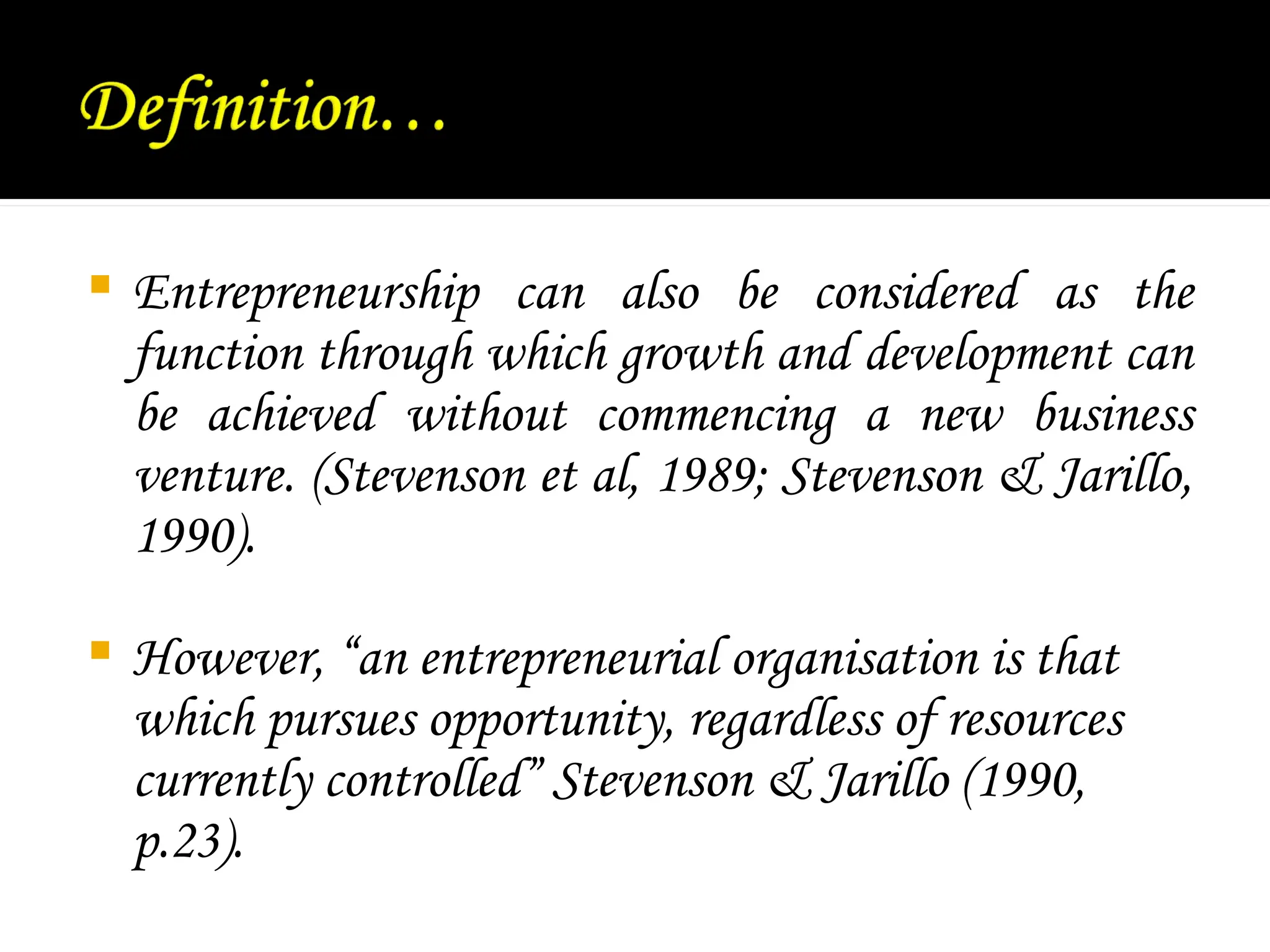
Entrepreneurship canalso be considered as the
function through which growth and development can
be achieved without commencing a new business
venture. (Stevenson et al, 1989; Stevenson & Jarillo,
1990).
However, “an entrepreneurial organisation is that
which pursues opportunity, regardless of resources
currently controlled” Stevenson & Jarillo (1990,
p.23).
10.
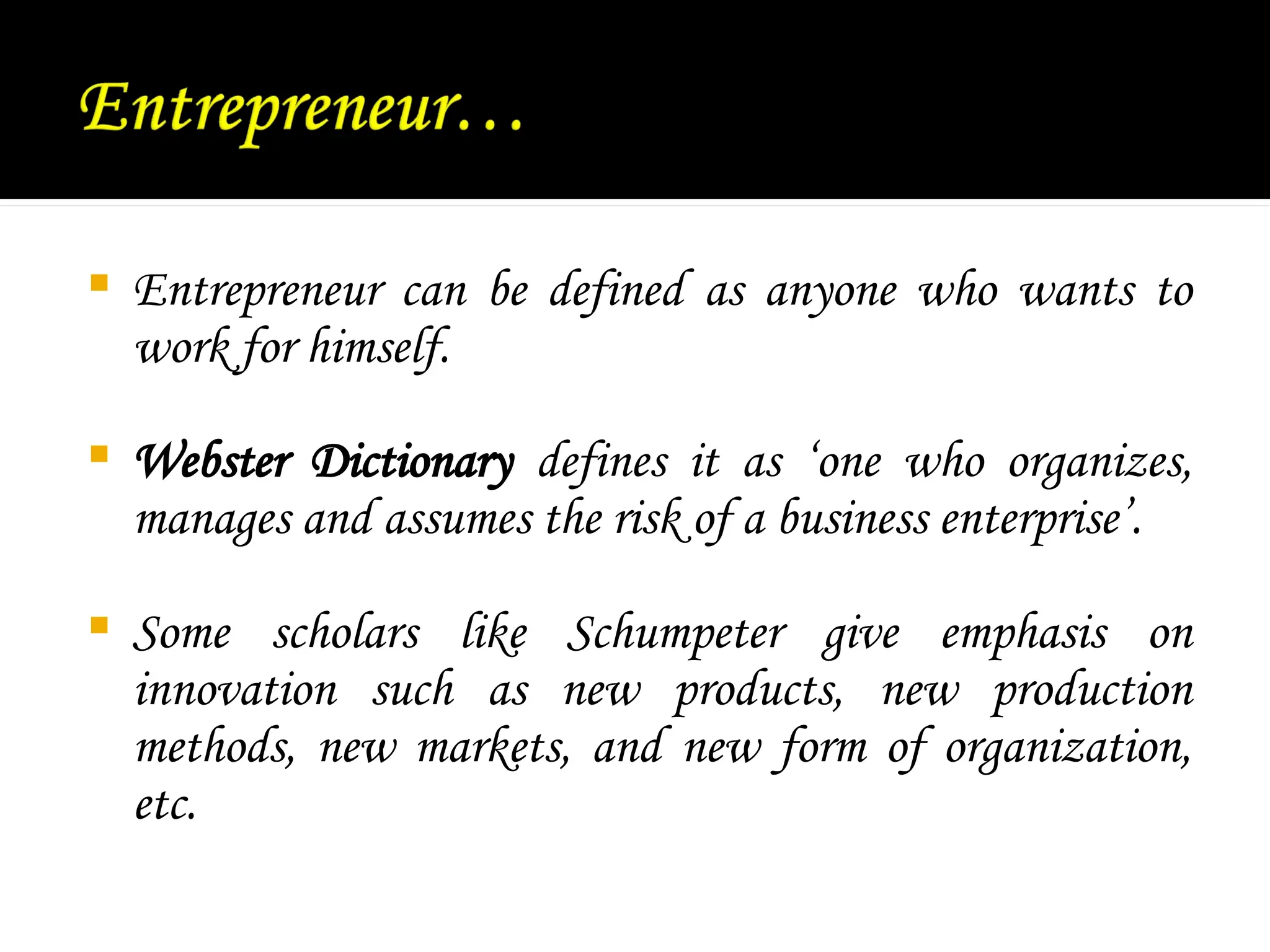
Entrepreneur canbe defined as anyone who wants to
work for himself.
Webster Dictionary defines it as ‘one who organizes,
manages and assumes the risk of a business enterprise’.
Some scholars like Schumpeter give emphasis on
innovation such as new products, new production
methods, new markets, and new form of organization,
etc.
11.
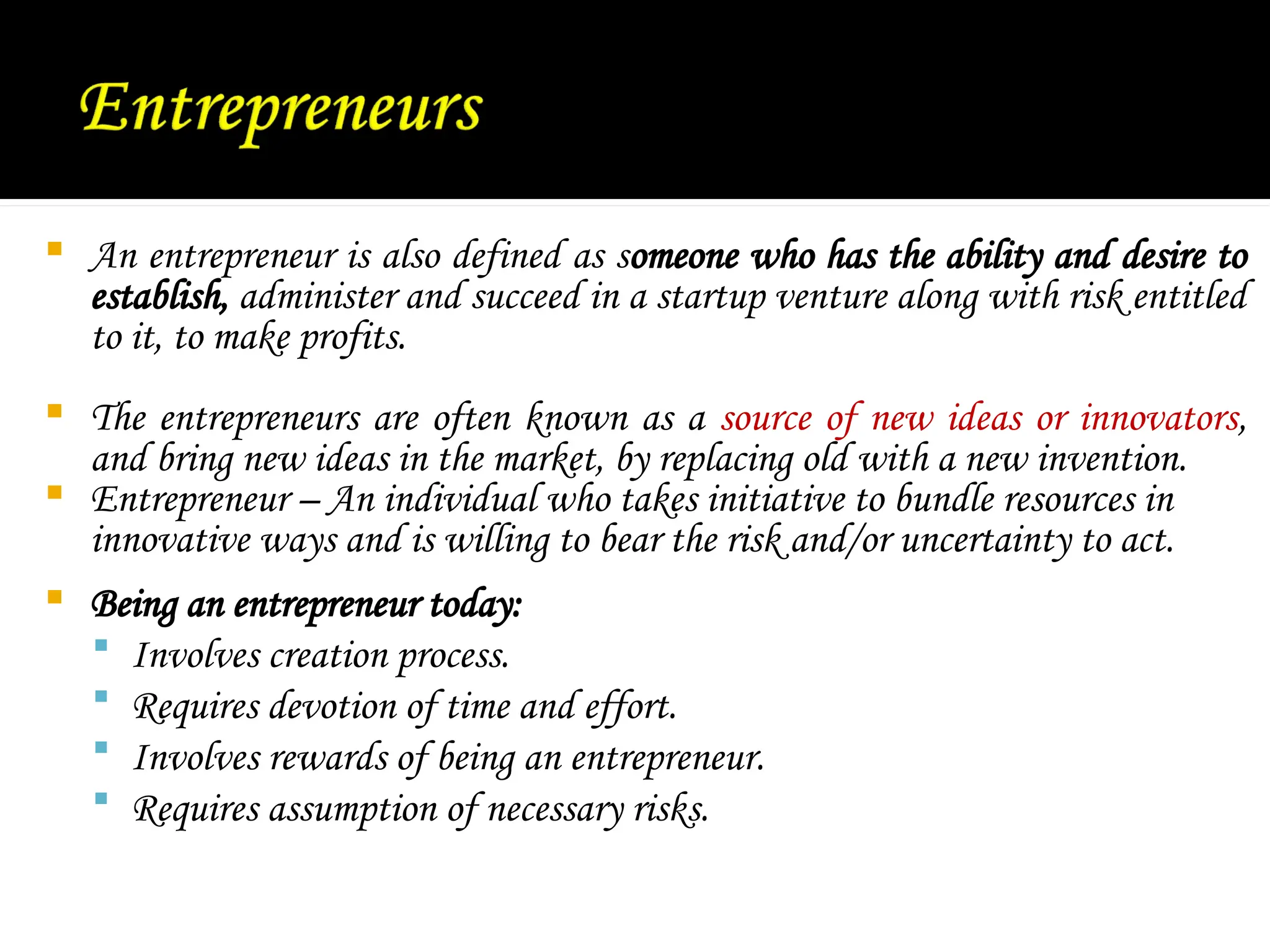
An entrepreneuris also defined as someone who has the ability and desire to
establish, administer and succeed in a startup venture along with risk entitled
to it, to make profits.
The entrepreneurs are often known as a source of new ideas or innovators,
and bring new ideas in the market, by replacing old with a new invention.
Entrepreneur – An individual who takes initiative to bundle resources in
innovative ways and is willing to bear the risk and/or uncertainty to act.
Being an entrepreneur today:
Involves creation process.
Requires devotion of time and effort.
Involves rewards of being an entrepreneur.
Requires assumption of necessary risks.
12.
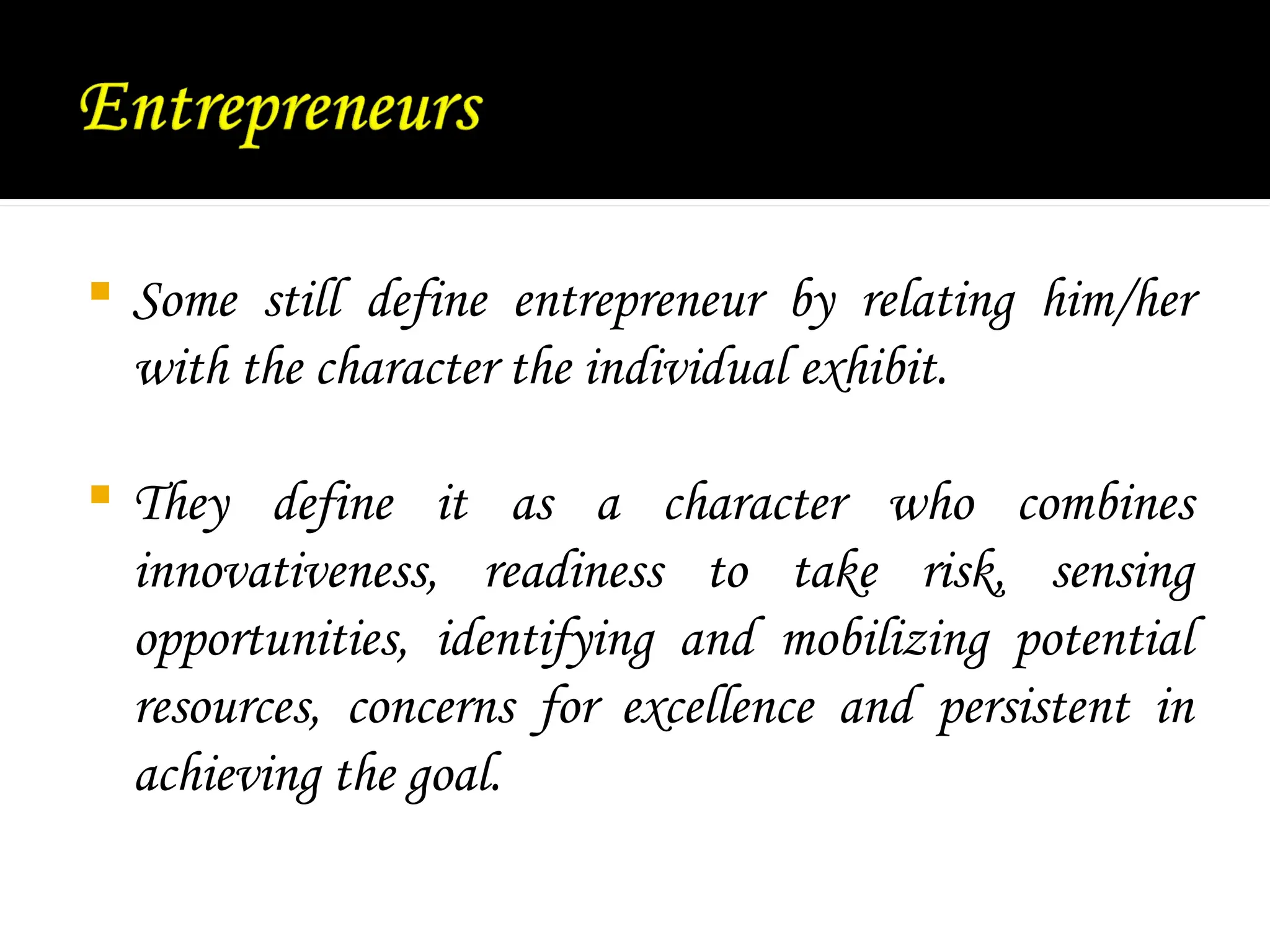
Some stilldefine entrepreneur by relating him/her
with the character the individual exhibit.
They define it as a character who combines
innovativeness, readiness to take risk, sensing
opportunities, identifying and mobilizing potential
resources, concerns for excellence and persistent in
achieving the goal.
13.
An entrepreneurialcommunity is a community that
intentionally acts to cultivate and support
entrepreneurs (They create convenient environment
where entrepreneurs can solve problems…)
They create easier paths for start-up capital and
long-term growth. They have a welcoming attitude
toward business, and work to support the dreams of
residents who are willing to take a risk
14.
Entrepreneurial Organizationis an organization
that places innovation and opportunism at its heart
in order to produce economic or social value.
Entrepreneurial organizations are structures that
promote the emergence and development of ideas from
all members of the firm.
An entrepreneurial organization encourages all the
employees to propose new ideas.
15.
It is classifiedinto the following types:
1. Small Business Entrepreneurship
These businesses are a hairdresser, grocery store, travel agent,
consultant, carpenter, plumber, electrician, etc. These people run
or own their own business and hire family members or local
employee.
For them, the profit would be able to feed their family and not
making 100 million business or taking over an industry. They fund
their business by taking small business loans or loans from friends
and family.
16.
2. Scalable StartupEntrepreneurship
This start-up entrepreneur starts a business knowing
that their vision can change the world.
They attract investors who think and encourage
people who think out of the box. They hire the best and
the brightest employees. They require more venture
capital to fuel and back their project or business.
17.
3. Large CompanyEntrepreneurship
These huge companies have defined life-cycle. Most of these
companies grow and sustain by offering new and innovative
products that revolve around their main products.
The change in technology, customer preferences, new
competition, etc., build pressure for large companies to create an
innovative product and sell it to the new set of customers in the
new market. To cope with the rapid technological changes, the
existing organizations either buy innovation enterprises or
attempt to construct the product internally.
18.
4. Social Entrepreneurship
Thistype of entrepreneurship focuses on producing product and
services that resolve social needs and problems. Their only motto
and goal is to work for society and not make any profits.
Create programs and resources that benefit the communities.
Need skills in planning their enterprise, marketing their product
or service, earning revenues or obtaining funding to keep the
organization financially solvent, and creating value.
19.
Not all entrepreneursare successful; but there are definite
characteristics that make entrepreneurs successful. A few of them are
as follow:
Ability to take a risk: Starting any new venture involves a
considerable amount of failure risk. Therefore, an entrepreneur needs to
be courageous and able to evaluate and take risks, which is an essential
part of being an entrepreneur.
Entrepreneurs risk not only their careers, but also their time and
money in order to achieve success in their business. To be successful in
self-employment, you should be comfortable taking reasonable risks.
Innovation/Creativity: Entrepreneurs should be highly innovative to
generate new ideas, start a company and earn profits out of it.
20.
To thinklike an entrepreneur means you have to get
creative. Many people like the sound of running their
own business, but need more creativity to develop the
ideas and strategies to gain and retain a customer
base.
Even if we are not serving a “creative” industry, our
choices, from our supply chain to our marketing can
capture the market attention if it's different from the
rest of the competitive landscape.
21.
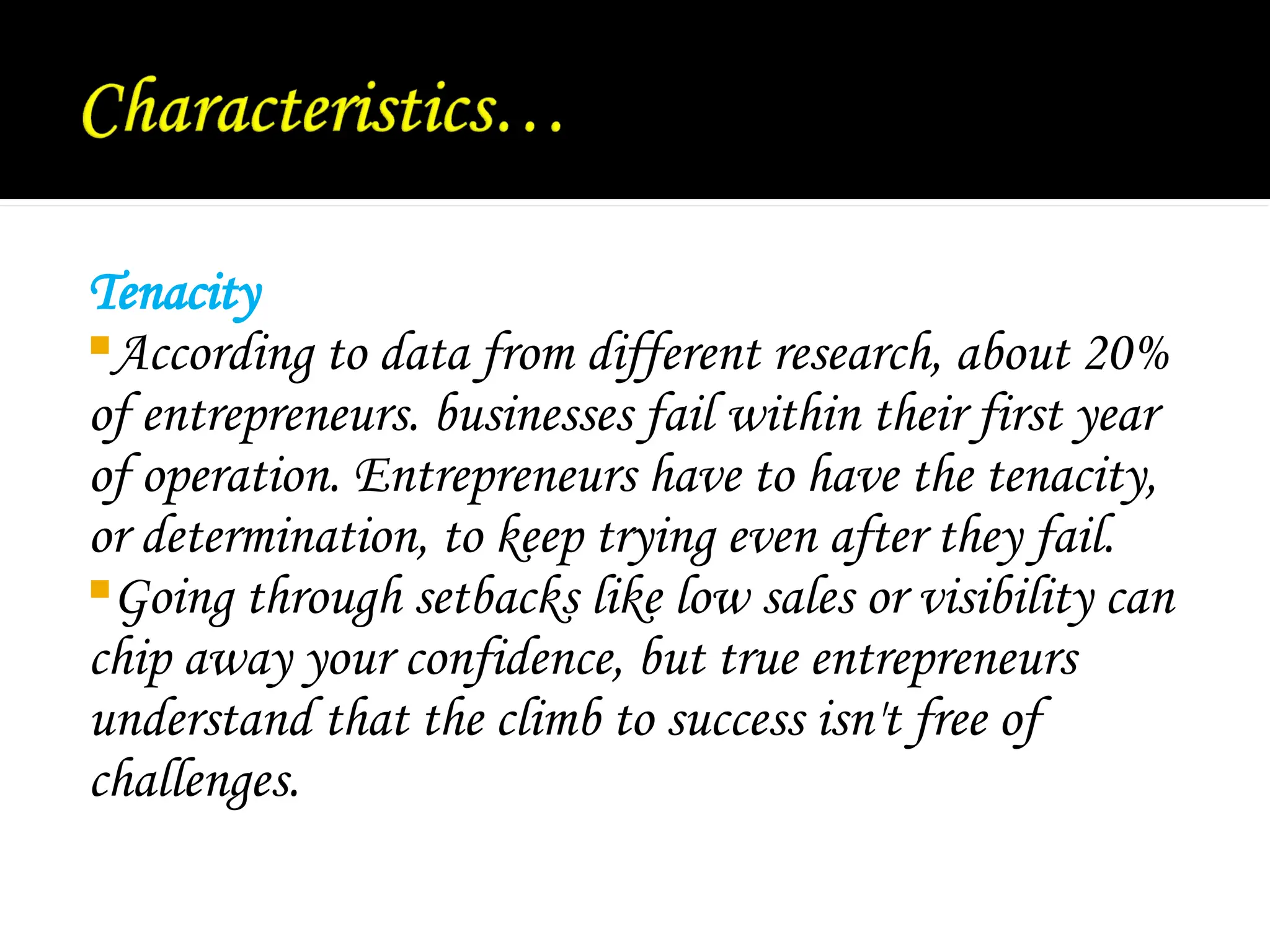
Tenacity
According to datafrom different research, about 20%
of entrepreneurs. businesses fail within their first year
of operation. Entrepreneurs have to have the tenacity,
or determination, to keep trying even after they fail.
Going through setbacks like low sales or visibility can
chip away your confidence, but true entrepreneurs
understand that the climb to success isn't free of
challenges.
22.
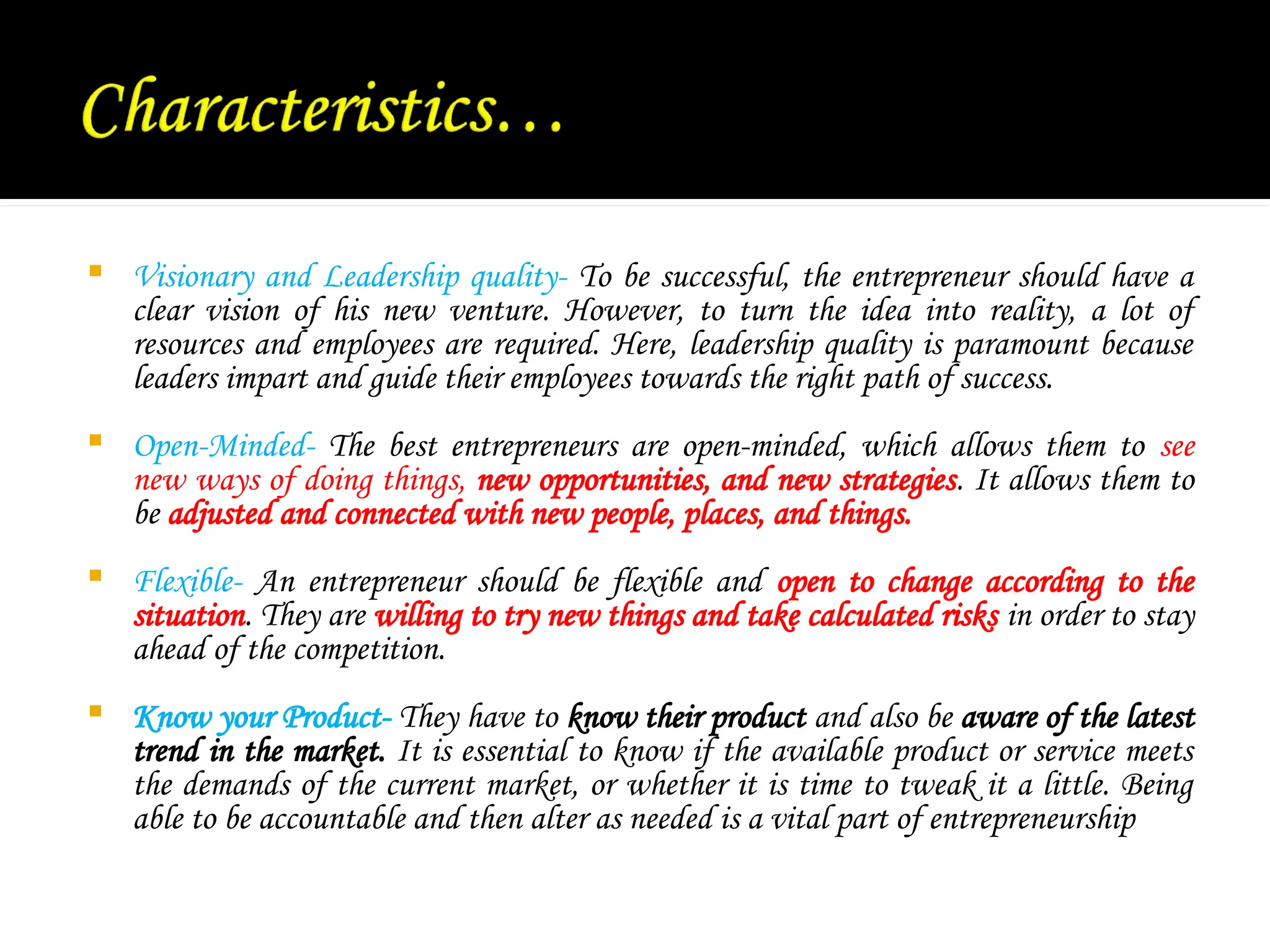
Visionary andLeadership quality- To be successful, the entrepreneur should have a
clear vision of his new venture. However, to turn the idea into reality, a lot of
resources and employees are required. Here, leadership quality is paramount because
leaders impart and guide their employees towards the right path of success.
Open-Minded- The best entrepreneurs are open-minded, which allows them to see
new ways of doing things, new opportunities, and new strategies. It allows them to
be adjusted and connected with new people, places, and things.
Flexible- An entrepreneur should be flexible and open to change according to the
situation. They are willing to try new things and take calculated risks in order to stay
ahead of the competition.
Know your Product- They have to know their product and also be aware of the latest
trend in the market. It is essential to know if the available product or service meets
the demands of the current market, or whether it is time to tweak it a little. Being
able to be accountable and then alter as needed is a vital part of entrepreneurship
23.
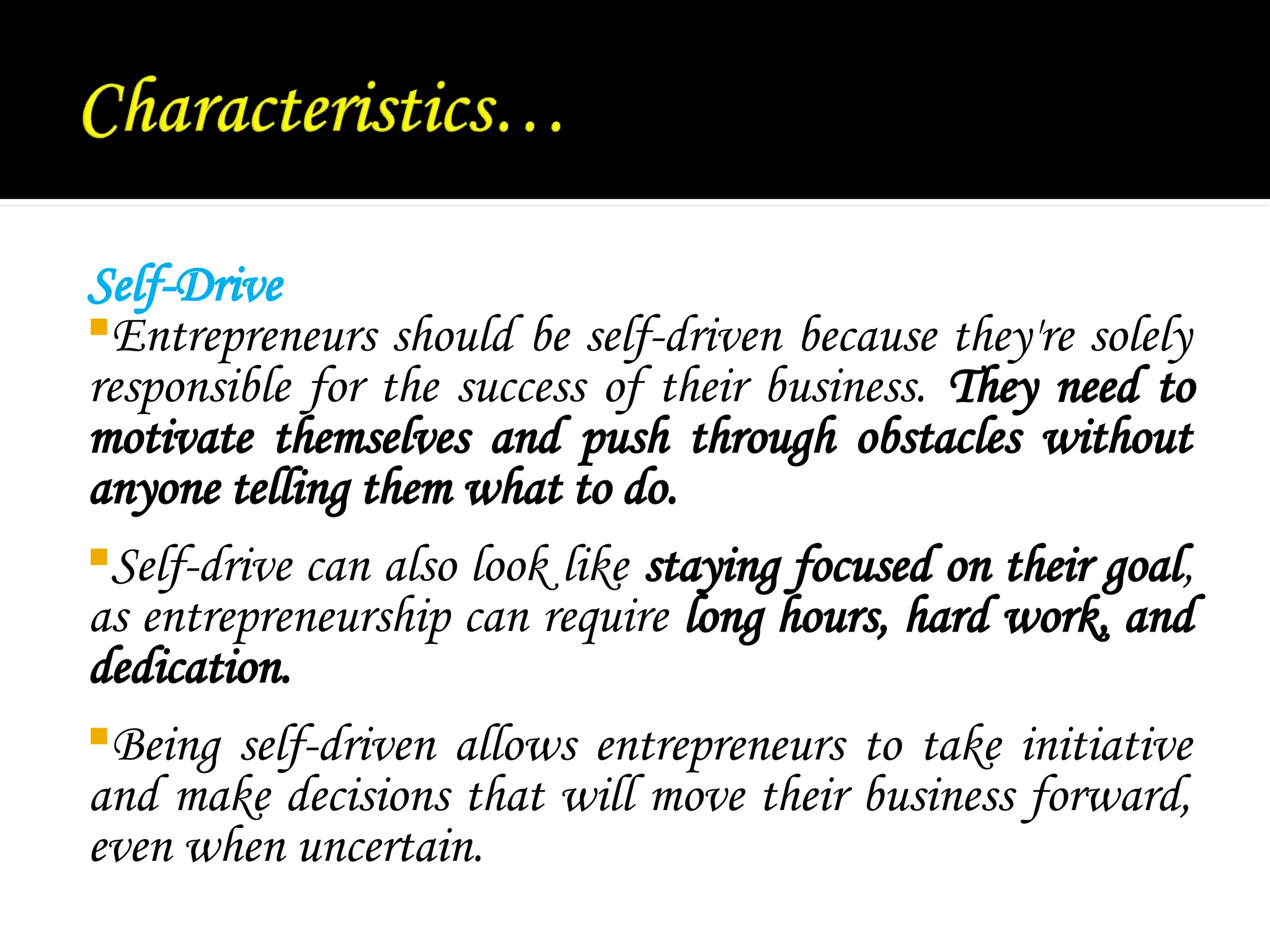
Self-Drive
Entrepreneurs should beself-driven because they're solely
responsible for the success of their business. They need to
motivate themselves and push through obstacles without
anyone telling them what to do.
Self-drive can also look like staying focused on their goal,
as entrepreneurship can require long hours, hard work, and
dedication.
Being self-driven allows entrepreneurs to take initiative
and make decisions that will move their business forward,
even when uncertain.
24.
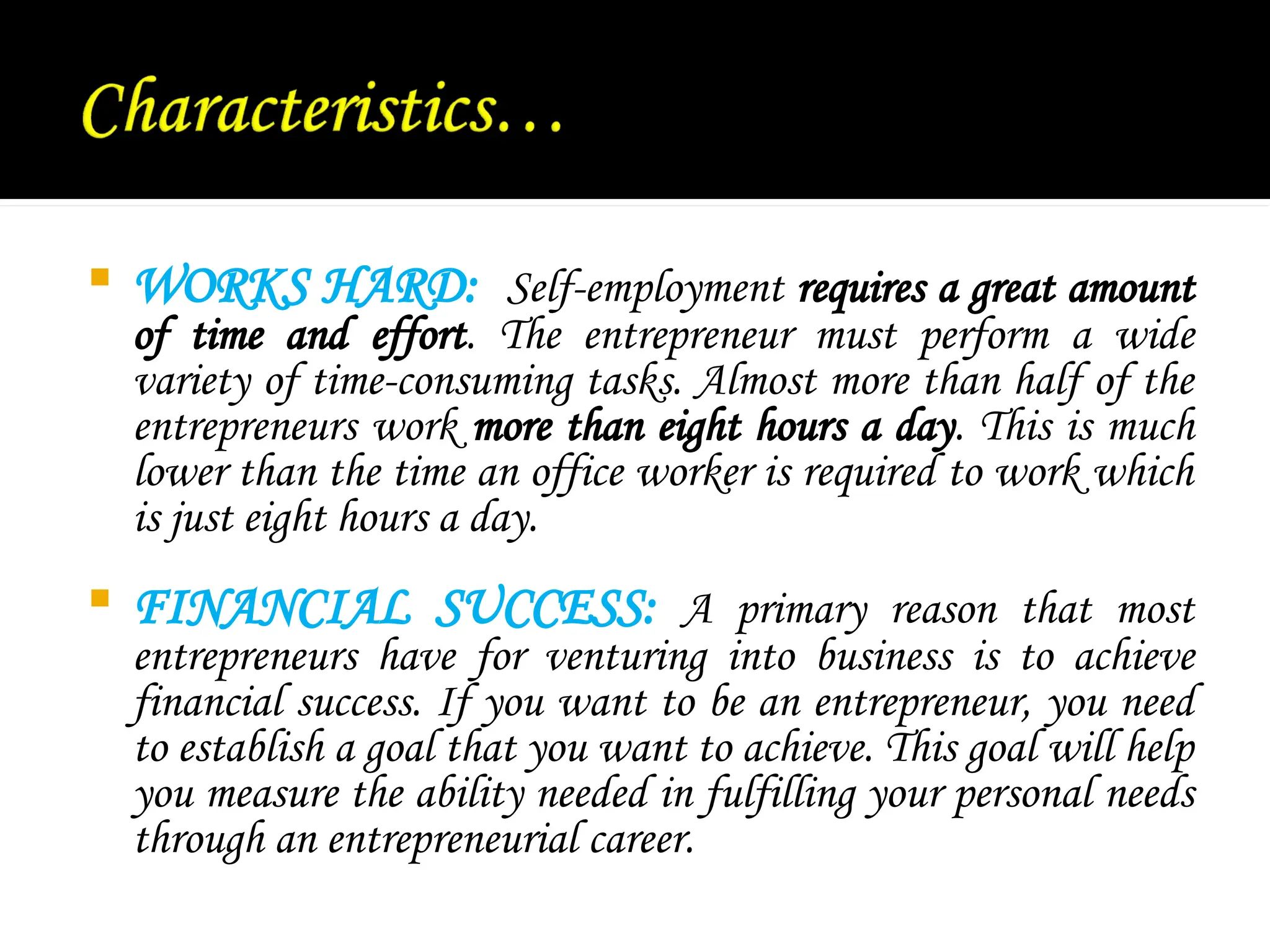
WORKS HARD:Self-employment requires a great amount
of time and effort. The entrepreneur must perform a wide
variety of time-consuming tasks. Almost more than half of the
entrepreneurs work more than eight hours a day. This is much
lower than the time an office worker is required to work which
is just eight hours a day.
FINANCIAL SUCCESS: A primary reason that most
entrepreneurs have for venturing into business is to achieve
financial success. If you want to be an entrepreneur, you need
to establish a goal that you want to achieve. This goal will help
you measure the ability needed in fulfilling your personal needs
through an entrepreneurial career.
25.
FAMILY SUPPORT:A successful entrepreneur needs family
support. People who are married must win the support of
his/her spouse because engaging in business entails a lot of
sacrifices in terms of time and money. The stress may create
disruptions in family relationships. The more positive support
you receive from your family, the more you can concentrate on
making the business a success.
ENERGETIC: Self-employment requires long working hours.
You will frequently be unable to control the number of hours
required to finish all the necessary tasks. The entrepreneur must
have the energy to respond to the job’s demand.
26.
AN INNERSENSE OF RESPONSIBILITY: A
successful entrepreneur has an inner sense of
responsibility in the outcome of a venture. He is
responsible for his action and the outcome of his decision.
SACRIFICES EMPLOYMENT BENEFITS: One of
the major realities of self-employment is that there is no
paycheck every month. A nice office, secretarial
assistance, equipment and other features of employment.
You have to provide all these for yourself.
27.
AN ACHIEVER:Entrepreneurs have a strong need for
achievement. They strive to shine and accomplish objectives even
though these are quite high. They should be willing to set high goals
for themselves and enjoy striving to achieve those goals.
INDEPENDENT: Entrepreneurs like to be independent and in
control of situations. Many people who become self-employed
consider the opportunity to be their own boss as one of the major
benefits of self-employment. Although being independent may not be
a major concern for you. It is certainly an aspect of self-employment
that you need to feel comfortable with. If you cannot afford to hire
other employees when you begin your business, you may at first be
lonely as a self-employed person.
28.
INTEGRITY: Peopleoften cite honesty and integrity as
characteristics of entrepreneurs. Customers do not want to deal
with business owners who are dishonest and unethical. You
should feel positive about your ethical treatment of people and
be committed conducting your business with the utmost
integrity.
DETERMINATION: One of the most important
characteristics of entrepreneurs is determination. This trait is
closely related to self-confidence. The more you believe in
yourself, the more likely you are to continue to struggle for
success when faced with tremendous obstacles. You need
determination in order to overcome the problems that beset
every new venture.
29.
ADAPTS TOCHANGE: A new business changes
rapidly, so an entrepreneur must be able to adapt to
change. Two primary skills are required for
adaptation to change: the capacity to solve problems
and the ability to make quick decisions. Another skill
is the ability to learn from your mistakes.
30.
Why do weneed to be entrepreneurs? What is the importance of entrepreneurship?
Entrepreneurs help bolster economic development, create jobs, and invent products or services that
can make the world a better place. Being a successful entrepreneur requires outside-the-box thinking
and larger-than-life ideas. Anyone can come up with a new idea, but building a successful business
around it is the entrepreneurial challenge. The entrepreneurial mindset is unique in that one must be
creative, communicative, and highly motivated to succeed, yet open to risk and failure.
Creation of Employment- Entrepreneurship generates employment. It provides an entry-level job,
required for gaining experience and training for unskilled workers.
Innovation- It is the hub of innovation that provides new product ventures, market, technology
and quality of goods, etc., and increase the standard of living of people.
Impact on Society and Community Development- A society becomes greater if the employment base
is large and diversified. It brings about changes in society and promotes facilities like higher
expenditure on education, better sanitation, fewer slums, a higher level of homeownership.
Therefore, entrepreneurship assists the organization towards a more stable and high quality of
community life.
31.
Increase Standardof Living- Entrepreneurship helps to
improve the standard of living of a person by increasing the
income. The standard of living means, increase in the
consumption of various goods and services by a household for a
particular period.
Supports research and development- New products and services
need to be researched and tested before launching in the market.
Therefore, an entrepreneur also dispenses finance for research
and development with research institutions and universities.
This promotes research, general construction, and development
in the economy.
Meaning of Mindset
Weall have a mindset, yet often we are not consciously
aware of it or the profound effect it has on our lives.
Our mindset is the underlying mechanism that can expose
opportunities and ignite our ambition, engaging our
faculties in ways that enable us to flourish and thrive. Yet,
our mindset can also blind us to opportunities and hinder
our ability to learn and grow, keeping us tethered to
familiar, yet unproductive patterns of thought and action.
35.
Mindsets caninfluence how people behave in a wide
range of situations in life. For example, as people
encounter different situations, their mind triggers a
specific mindset that then directly impacts their behavior
in that situation.
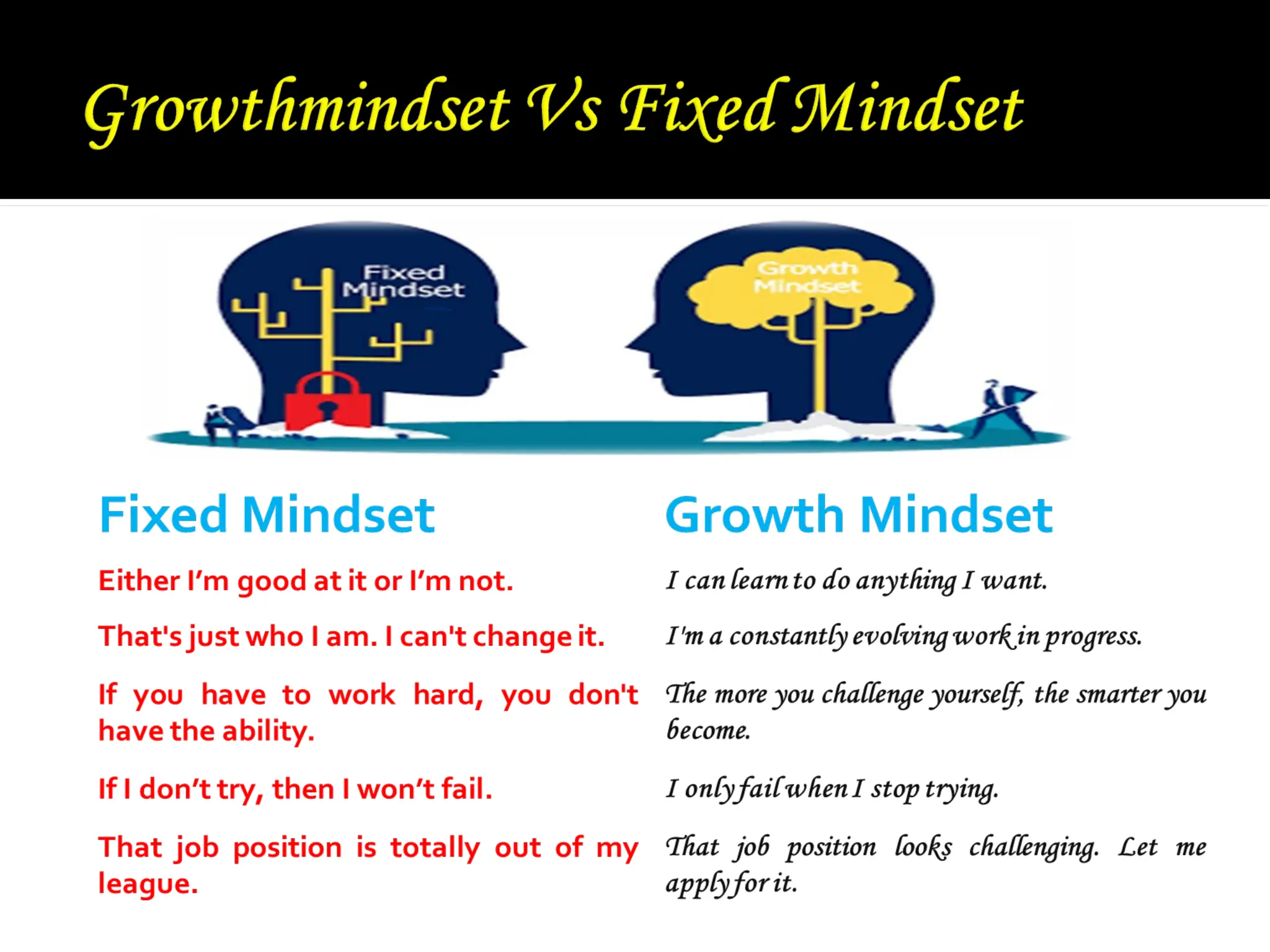
According to Dweck, there are two basic mindsets: fixed
and growth. If we have a fixed mindset, we believe our
abilities are fixed traits and therefore can't be changed.
We may also believe that our talent and intelligence
alone lead to success, and effort is not required.
36.
The entrepreneurialmindset is a frame of mind, beliefs,
and behaviors that drive entrepreneurial success. Most
entrepreneurs exhibit positive tendencies from this
mindset that help them overcome challenges, become more
decisive, and take charge of their businesses.
It‘s worth noting that the entrepreneur mindset isn’t
necessarily specific to entrepreneurs. Virtually anyone
can demonstrate it professionally — not just ambitious
budding-business owners. Here are some of the key
characteristics you'll grow in this mindset:
37.
On theflip side, if we have a growth mindset, we
believe that our talents and abilities can be developed
over time through effort and persistence.
People with this mindset don't necessarily believe
that everyone can become Einstein or Mozart just
because they try. They do, however, believe that
everyone can get smarter or more talented if they
work at it.
39.
Therefore, “GrowthMindset” is the belief that you
can cultivate and improve upon your abilities
through practice and effort.
This differs significantly from a “Fixed Mindset,”
which dictates that your ability is largely
predetermined and unchangeable.
40.
Mindset isa set of beliefs that shape how we make
sense of the world and ourselves. It influences how
we think, feel, and behave in any given situation. It
means that what we believe about ourselves impacts
our success or failure.
According to Stanford psychologist Carol Dweck, our
beliefs play a pivotal role in what we want and
whether we achieve it. Dweck has found that it is
our mindset that plays a significant role in
determining achievement and success.
41.
An entrepreneurialmindset is a set of skills that
enable people to identify and make the most of
opportunities, overcome and learn from setbacks, and
succeed in a variety of settings.
Research shows that an entrepreneurial mindset is
valued by employers, boosts educational attainment
and performance, and is crucial for creating new
businesses.
42.
Our thoughtprocesses can be positive, negative, or anywhere in between. A
negative mindset can blind you, clouding your judgment with doubt and
uncertainty, while a positive mindset opens your mind to the possibilities of a
situation. This gives you a more well-rounded view of a situation, helping you
adapt and approach things creatively.
An entrepreneurial mindset is a set of skills that relies very heavily on positive
and resilient thinking. People with this mind frame see new opportunities
where others only view risk. They’re constantly generating ideas to solve
everyday problems and are unafraid of advocating for their views or pursuing
their ideas on their own.
An entrepreneurial mindset is a set of mental habits that tend to optimize the
successful pursuit of opportunity. These include a passion for solving
problems worth solving, a willingness to test assumptions and change course,
and a relentless desire to create shared value.
43.
Entrepreneurship sparksinnovation, drives employment,
fuels economies, and offers solutions to a range of
environmental and societal challenges. But before those
sparks and drivers ignite, an entrepreneurial mindset
must be in place as a catalyst.
An entrepreneurial mindset helps leaders create value by
“recognizing and acting on opportunities, making
decisions with limited information, and remaining
adaptable and resilient in conditions that are uncertain
and complex,”
Rowena Barrett
44.
1. Solution Oriented
An entrepreneurial mindset is resilient, resourceful, and solutions-oriented — even when the
conditions say otherwise. People with these mindsets are lifelong knowledge-seekers who are
curious and creative, and they are critical thinkers, Barrett said.
Driven by a desire to solve problems worth solving
As Paul Graham wrote,
the best way to get startup ideas is to look for problems. Great
entrepreneurs fall in love with a problem worth solving, and that
passion then creates the unstoppable will that drives a startup
to success.
They're about looking to others, and the value you can create for others by solving problems
for others, and they surround themselves with an intentional community of positive
influence and critical guidance.
Entrepreneurial mindsets understand that pursuing and following through on something can
lead to unforeseen opportunities.
45.
2. Adaptable:
An entrepreneurialmindset embraces
change.
When change happens, an
entrepreneurial mindset keeps an eye on
the mission.
46.
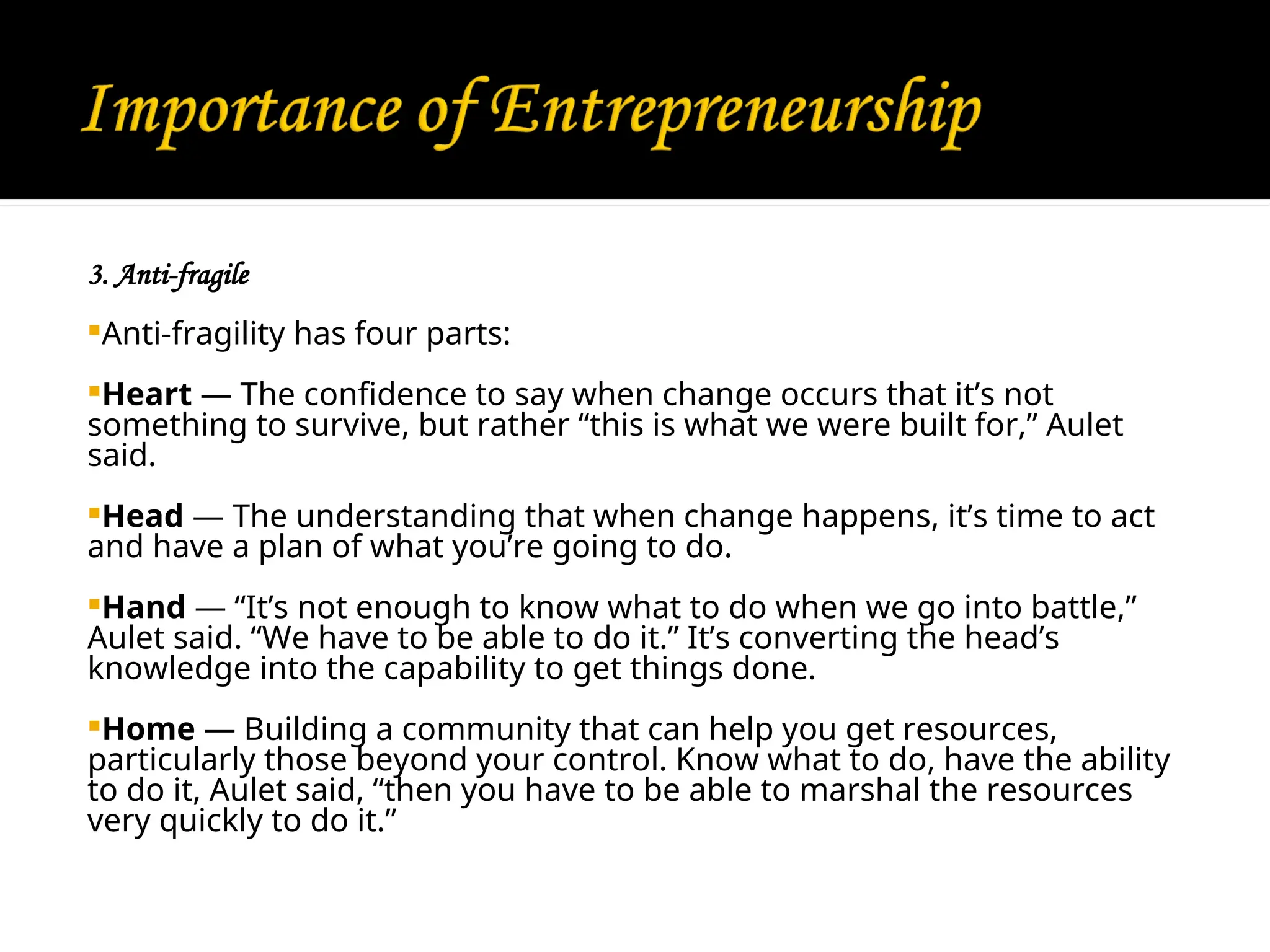
3. Anti-fragile
Anti-fragility hasfour parts:
Heart — The confidence to say when change occurs that it’s not
something to survive, but rather “this is what we were built for,” Aulet
said.
Head — The understanding that when change happens, it’s time to act
and have a plan of what you’re going to do.
Hand — “It’s not enough to know what to do when we go into battle,”
Aulet said. “We have to be able to do it.” It’s converting the head’s
knowledge into the capability to get things done.
Home — Building a community that can help you get resources,
particularly those beyond your control. Know what to do, have the ability
to do it, Aulet said, “then you have to be able to marshal the resources
very quickly to do it.”
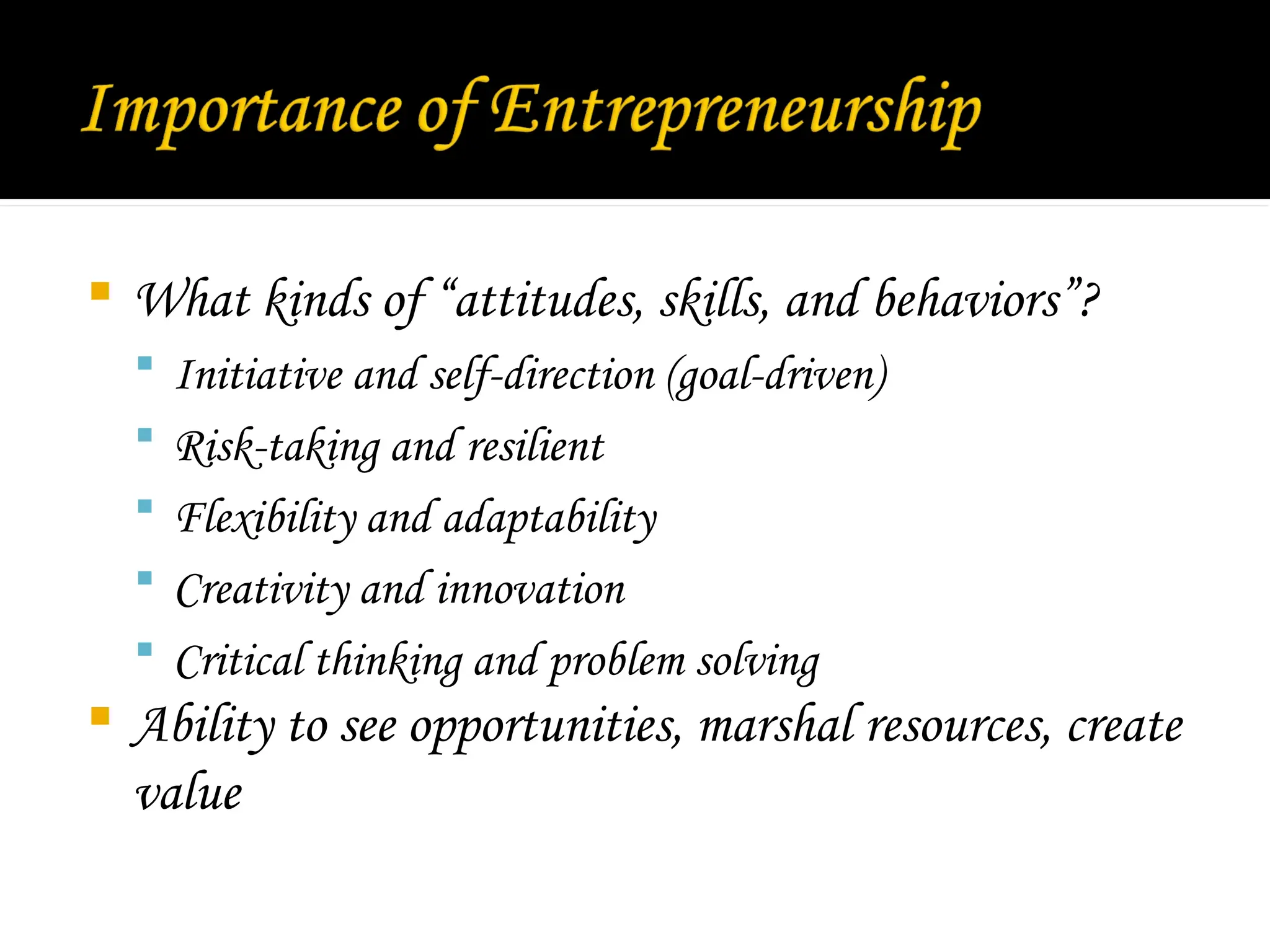
47.
What kindsof “attitudes, skills, and behaviors”?
Initiative and self-direction (goal-driven)
Risk-taking and resilient
Flexibility and adaptability
Creativity and innovation
Critical thinking and problem solving
Ability to see opportunities, marshal resources, create
value
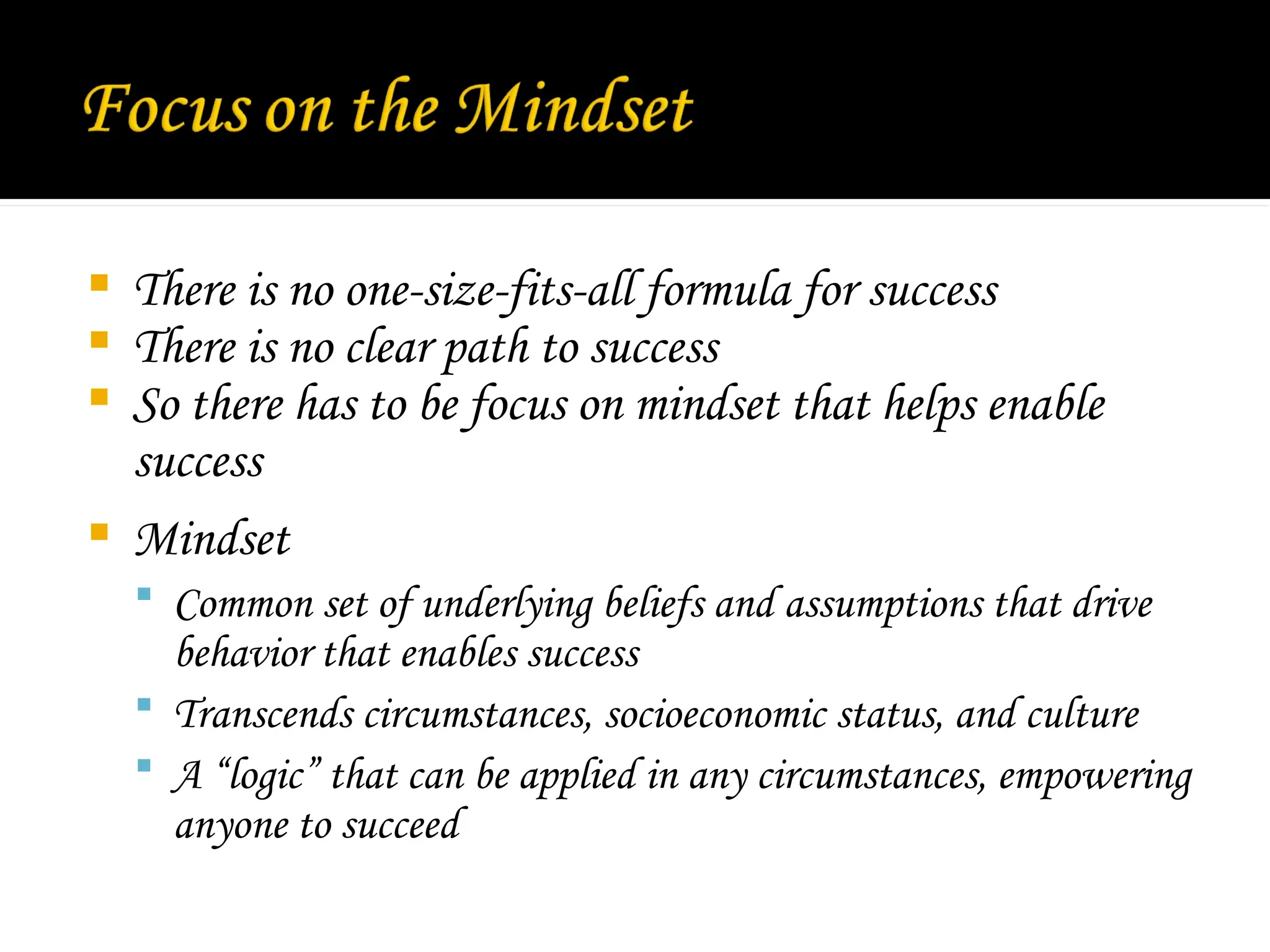
48.
There isno one-size-fits-all formula for success
There is no clear path to success
So there has to be focus on mindset that helps enable
success
Mindset
Common set of underlying beliefs and assumptions that drive
behavior that enables success
Transcends circumstances, socioeconomic status, and culture
A “logic” that can be applied in any circumstances, empowering
anyone to succeed
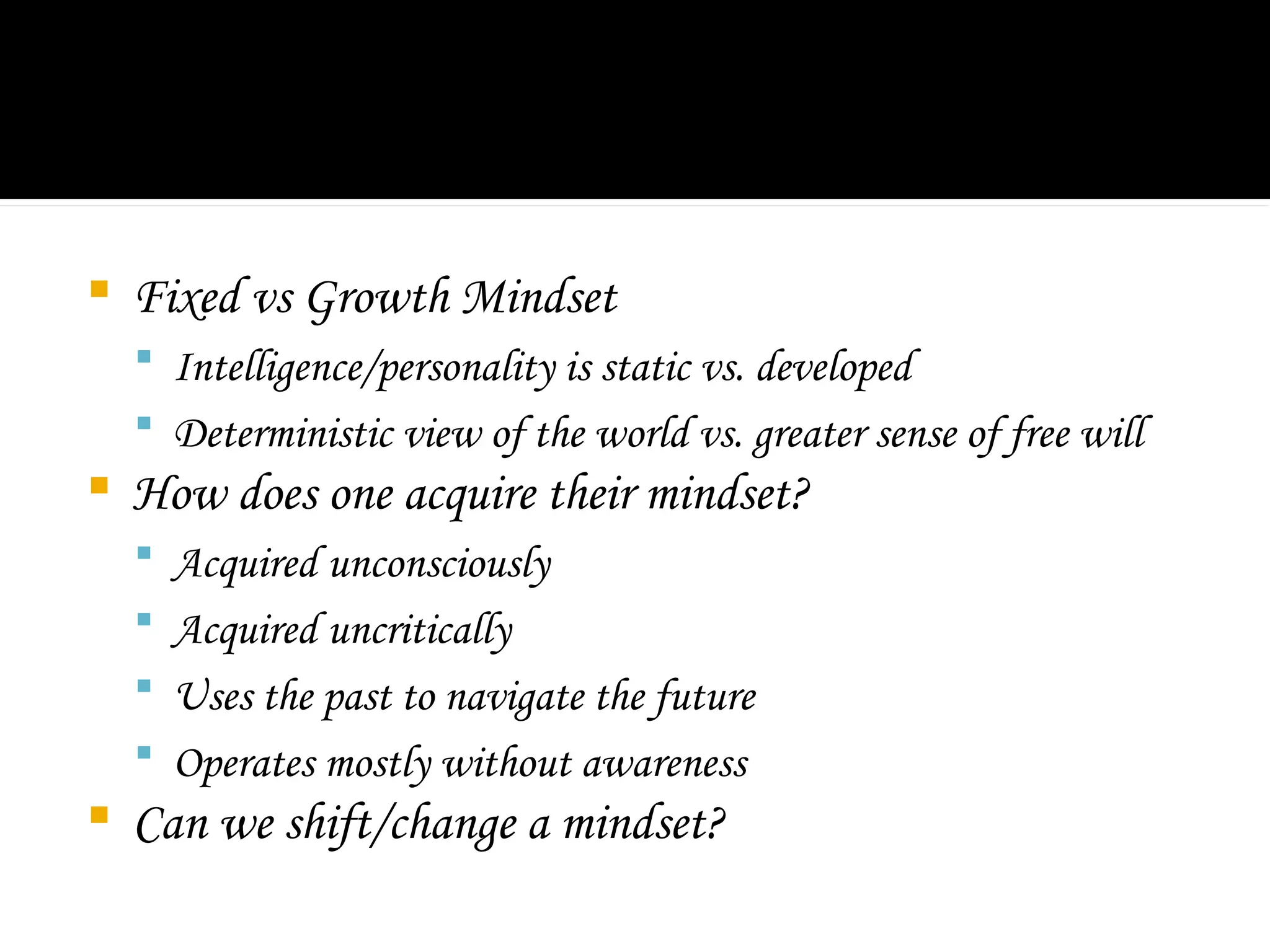
49.
Fixed vsGrowth Mindset
Intelligence/personality is static vs. developed
Deterministic view of the world vs. greater sense of free will
How does one acquire their mindset?
Acquired unconsciously
Acquired uncritically
Uses the past to navigate the future
Operates mostly without awareness
Can we shift/change a mindset?
50.
An entrepreneurshipmindset isn’t exclusive to high-level business
execs. This characteristic can benefit anyone, whether you’re
working at an entry-level role, are mid-career at a large corporation,
or striking out on your own.
Believe in their ability to succeed and influence their own outcomes,
empowering them to take ownership of their lives;
Have compelling goals that keep them future-focused and
intrinsically motivated, driving them to be self-directed, action-
oriented, and highly engaged;
Have an optimistic interpretation of adverse events and see problems
as potential opportunities, becoming highly resilient, resourceful,
and solution-oriented even within highly uncertain, resource
constrained environments;
51.
Be lifelongknowledge seekers with a focus on micro-
experiments as learning opportunities to test ideas,
cultivating curiosity, creativity, and critical thinking;
Display a high-level of reliability, understanding
that following through on simple solutions can lead to
unforeseen opportunity;
Have a humanistic outlook, being other-focused and
understanding that one creates value by looking to solve
problems for others; and
Surround themselves with an intentional community of
positive influence and critical guidance
52.
Opportunity identification- The process by which an
entrepreneur comes up with the opportunity for a new
venture. (Market Needs, Business Concept, Business
Plan, Business formed. Successful enterprise)
Market size and the length of the window of
opportunity- are the primary bases for determining risks
and rewards.
Window of opportunity - The time period available for
creating the new venture.
Business plan - The description of the future direction of
the business.
53.
Christian Entrepreneurshipmeans biblical
entrepreneurship. This involves moral obligations,
economic creativity, and productive aspects as well.
According to Doug Phillips (2006), the principle of
entrepreneurship is rooted on the dominion mandate
and the biblical doctrines of work, stewardship, and
fruitfulness.
54.
Biblical entrepreneurship incorporatesprinciples of biblical
patriarchy with its emphasis on multi generational faithfulness,
freedom in
Christ, inheritance, jurisdiction, and the household as a vibrant,
economically productive, God- ordained unit for cultural
transformation. It is impossible to have a full-orbed vision of
entrepreneurship without careful consideration for the scriptural
doctrine of the family.
Phillips also states that any approach to entrepreneurship which
is divorced of these considerations inevitably leads to the
idolatries of materialism, individualism, and the love of money.
55.
The mostimportant entrepreneurial characteristics
that Christian should have must be Trust in God,
Reasonable Risk-taking, Hardworking, Innovative,
Leadership, Positive thinker, and Decision maker.
Let us briefly review them.
56.
Trust in God
InHebrews 13:5, 6 we read, "Keep your lives free
from the love of money and be content with what you
have, because God has said, 'Never will I leave you;
never will I forsake you.'
So we say with confidence, 'The Lord is our helper; we
should not be afraid. What can man do to me?"
57.
A Christian shouldhave confidence in God because He is
the source of all knowledge, wisdom, power, and blessings.
The Bible tell the story of Goliath, who was a giant
Philistine and a champion warrior, who had great self-
confidence in his skills for the battle; but he was defeated
by David who was just a young boy, because David had
confidence in the Almighty God (1 Samuel 17). The history
of Solomon's confidence in God (1 Kings 3, 4, 5, 6, 7, 8, 9
and 10) is also an example.
58.
Christian Risk Takers
Theidea is that, as Christians, whatever business we
may set up should no be for personal aggrandizement
and pride, but to honor God and serve others.
Ultimately, our plans and actions should be based on
biblical values and allow us to be faithful witnesses for
God.
59.
There are manyadvantages of becoming an entrepreneur. According to
Orcullo (2004), when you are an entrepreneur you have an opportunity to
gain control over your own destiny, to reach your full potential, to benefit
financially and to contribute to society and be recognized for one's effort.
What stops us from taking risks as an entrepreneur? Fear. Fear in itself is
not bad, unless it keeps us from doing right. Among the people who will be
excluded from the New Jerusalem are the "cowardly" (Rev. 21 :8), referring
to those who let fear drive them away from believing in Christ.
For a Christian also, fear is dangerous. Any fear that keeps us from doing
the will of God puts us out of fellowship with him and forfeits his
blessing
60.
What empowersus to overcome fear? Faith. How
important is faith? "And without faith it is impossible to
please God, because anyone who comes to him must
believe that he exists and that he is rewards those who
earnestly seek him" (Heb. 11 :6).
God asks us to trust His integrity, His character, His
compassion, love, wisdom, and righteousness on our
behalf. He says, "I have loved you with an everlasting
love; I have drawn you with loving-kindness" (Jer.
31 :3). "Trust in him at all times, 0 people; pour out your
hearts to him, for God is our refuge" (Psalm 62:8).
61.
Hardworking
Proverbs 14:23 pointsout that, "all hard work brings a profit, but
mere talk leads only to poverty". "Lazy hands make a man poor,
but diligent hands bring wealth" (Prov. 10:4). "Sluggards do not
plow in season; so at harvest time they look but find nothing"
(Prov. 20:4). “
The cravings of sluggards will be the death of them, because their
hands refuse to work" (Prov. 21 :25). The Bible tells us that
wealth is obtained through hard work, diligence, sacrifice and
that failure to do those things will result in poverty. That's not to
say that all those who are poor or in
62.
Poverty aresluggards or refuse to work, but it does
tell us that those kinds of characteristics and flaws
will most often lead to poverty.
As Christian we believe that we should work but not
destroy our body by hardworking,
we should also have enough rest. We are God's
temple and God's Spirit lives in us and if anyone
destroys God's temple, God will destroy him (1
Corinthians 3:16-17).
63.
Innovative
As Fajardo(2007) confirms, entrepreneurs are creative. They do
things in new and different ways. For example, they create new
products or services, new methods of production, new markets,
and new sources of raw materials. They love to explore the
unknown, and to blaze new paths of progress. 1 Kings 6 tells us
how Solomon built the temple with very special innovation. One
of the qualities ascribed to Solomon is his wisdom. "The whole
world sought audience with Solomon to hear the wisdom God had
put in his heart" (1 Kings 10:24). He was an innovator and God
was the source of his innovation (1 King 3).
64.
poverty are sluggardsor refuse to work, but it does
tell us that those kinds of characteristics and
flaws will most often lead to poverty. As Christian
we believe that we should work but not destroy
our body by hardworking, we should also have
enough rest. We are God's temple and God's Spirit
lives in us and if anyone destroys God's temple,
God will destroy him (1 Corinthians 3:16-17).
65.
Leadership
According to Fajardo(2007), entrepreneurs are leaders by the very nature of
their functions. They are people who are task-oriented, effective planners,
organizers and implementers, and they are achievers. Among their essential
characteristics are selfless dedication, purpose and vision, courage,
enthusiasm, integrity tact, and hard work.
Christian colleges should give assignments and offer opportunities for
students to assume responsibilities. They should also provide mentors that
will counsel and guide them. Above all, students should be taught Christian
values by precept and example, which will make them true leaders. These
values are found in the teachings and example of Jesus, who summed them up
in Matthew 22: 37-39, "Love the Lord your God with all your heart and
with all your soul and with all your mind. This is the first and greatest
commandment. And the second is like it: Love thy neighbor as yourself."
66.
Please writethe different types of entrepreneurship
and write at least 500 words on the type that you
think most relevant to your context. For example,
which type of the entrepreneurship is most relevant
and important to your community? Why do you
think it is relevant? Submit before the next class.
67.
Baumol, W. J.(1968). Entrepreneurship in economic theory. The American economic
review, 58(2), 64-71.
Bull, I., & Willard, G. E. (1993). Towards a theory of entrepreneurship. Journal of
business venturing, 8(3), 183-195.
Cantillon, R. (1775). The circulation and exchange of goods and merchandise. Chapter 13
of Higgs, H. (Ed), Essai sur la Nature du Commerce en Général, Macmillan, London.
Carsrud, A. L., & Brännback, M. (2007). Entrepreneurship: Greenwood Guides to
Business. Westport, USA: Greenwood Press.
Christensen, P. V., Ulhøi, J. P., & Madsen, H. (2000). The entrepreneurial process in a
dynamic network perspective: a review and future directions for research. LOK Working
Paper No. 6-2000, Copenhagen: LOK Research Center.
Gartner, W. B. (1988). Who is the entrepreneur? Is the wrong question. In American
Journal of Small Business; Spring, 88, 12(4), 11-32.
68.
Gartner, W. B.,Shaver, K. G., Gatewood, E., & Katz, J. A. (1994). Finding the entrepreneur in
entrepreneurship. (Editorial), Entrepreneurship Theory and Practice. 18(3), 5-9.
Hamilton, R. T., & Harper, D. A. (1994). The entrepreneur in theory and practice. Journal of
economic Studies, 21(6), 3-18.
Kuratko, D. F. (2016). Entrepreneurship: Theory, process, and practice. Tenth Edition, Boston,
USA: Cengage Learning.
Lall, M., & Sahai, S. (2008). Entrepreneurship. Second Edition, New Delhi, India: Excel Books.
Leibenstein, H. (1968). Entrepreneurship and development. The American Economic Review, 58(2),
72-83.
Nandram, S. S., & Samsom, K. J. (2006). The spirit of entrepreneurship: Exploring the essence of
entrepreneurship through personal stories. Berlin: Springer.
69.
Pendergast, W. R.(2003). Entrepreneurial Contexts and Traits of Entrepreneurs.
Proceedings Teaching Entrepreneurship to Engineering students, Engineering
conferences international, Monterey, CA, USA.
Ramachandran, K. K., & Gokila, R. (2012). International Entrepreneurship—
Opportunities and Challenges. In Creativity, Innovation and Entrepreneurship,
Jerinabi, U., & Santhi, P. (Eds), New Delhi, India: Allied Publishers Private
Limited, pp, 21- 25.
Schumpeter, J. A. (1976). Capitalism, Socialism and Democracy. Fifth Edition,
London: George Allen & Unwin.
Stevenson, H. H., & Jarillo, J. C. (1990). A paradigm of entrepreneurship:
Entrepreneurial management. Strategic Management Journal. 11(15), 17-27.