http://www.cifor.org/library/6256/enhancing-transparency-in-the-land-use-sector-exploring-the-role-of-
independent-monitoring-approaches/
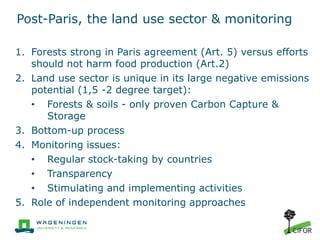
Post-Paris, the land use sector & monitoring
1. Forests strong in Paris agreement (Art. 5) versus efforts
should not harm food production (Art.2)
2. Land use sector is unique in its large negative emissions
potential (1,5 -2 degree target):
• Forests & soils - only proven Carbon Capture &
Storage
3. Bottom-up process
4. Monitoring issues:
• Regular stock-taking by countries
• Transparency
• Stimulating and implementing activities
5. Role of independent monitoring approaches
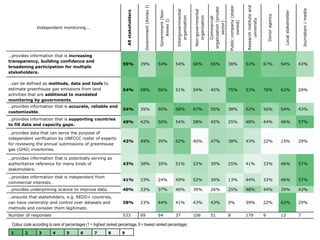
Independent monitoring...
Allstakeholders
Government(AnnexI)
Government(Non-
AnnexI)
Intergovernmental
organization
Non-governmental
organization
Commercial
organization(private
sector)
Publiccompany(state-
owned)
Researchinstituteand
university
Donoragency
Localstakeholder
Journalism/media
…provides information that is increasing
transparency, building confidence and
broadening participation for multiple
stakeholders.
55% 39% 54% 54% 68% 65% 38% 53% 67% 54% 43%
…can be defined as methods, data and tools to
estimate greenhouse gas emissions from land
activities that are additional to mandated
monitoring by governments.
54% 58% 56% 51% 54% 45% 75% 53% 78% 62% 29%
…provides information that is accurate, reliable and
customizable.
54% 35% 50% 68% 67% 55% 38% 52% 56% 54% 43%
…provides information that is supporting countries
to fill data and capacity gaps.
49% 42% 50% 54% 58% 45% 25% 48% 44% 46% 57%
…provides data that can serve the purpose of
independent verification by UNFCCC roster of experts
for reviewing the annual submissions of greenhouse
gas (GHG) inventories.
43% 49% 39% 62% 40% 47% 38% 43% 22% 15% 29%
…provides information that is potentially serving as
authoritative reference for many kinds of
stakeholders.
43% 38% 35% 51% 53% 39% 25% 41% 33% 46% 57%
…provides information that is independent from
commercial interests.
41% 33% 24% 49% 52% 39% 13% 44% 33% 46% 57%
…provides underpinning science to improve data. 40% 33% 37% 46% 39% 26% 25% 48% 44% 39% 43%
…ensures that stakeholders, e.g. REDD+ countries,
can have ownership and control over datasets and
methods and consider them legitimate.
38% 23% 44% 41% 43% 43% 0% 39% 22% 62% 29%
Number of responses 533 69 54 37 106 51 8 179 9 13 7
1 2 3 4 5 6 7 8 9
Colour code according to rank of percentages (1 = highest ranked percentage, 9 = lowest ranked percentage)
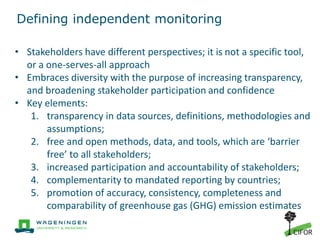
Defining independent monitoring
• Stakeholders have different perspectives; it is not a specific tool,
or a one-serves-all approach
• Embraces diversity with the purpose of increasing transparency,
and broadening stakeholder participation and confidence
• Key elements:
1. transparency in data sources, definitions, methodologies and
assumptions;
2. free and open methods, data, and tools, which are ‘barrier
free’ to all stakeholders;
3. increased participation and accountability of stakeholders;
4. complementarity to mandated reporting by countries;
5. promotion of accuracy, consistency, completeness and
comparability of greenhouse gas (GHG) emission estimates
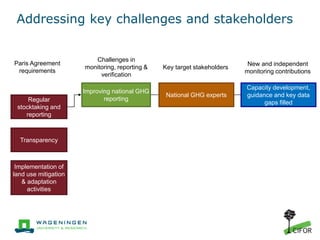
Regular
stocktaking and
reporting
Transparency
Implementation of
land use mitigation
& adaptation
activities
Paris Agreement
requirements
Challenges in
monitoring, reporting &
verification
Key target stakeholders
New and independent
monitoring contributions
Improving national GHG
reporting
National GHG experts
Capacity development,
guidance and key data
gaps filled
Addressing key challenges and stakeholders
Recommendations to countries and UNFCCC
• Transparency is a great opportunity: builds confidence
and legitimacy
• Transparency can cause (initial) frustration but will
enhance quality: things will become more serious and
be ready and open for surprises
• Transparency requires capacity : circumstances vary, and
enhancing transparency requires flexibility (step-wise)
• Transparency reduces ignorance: take advantage of the
diversity of (independent) datasets and approaches
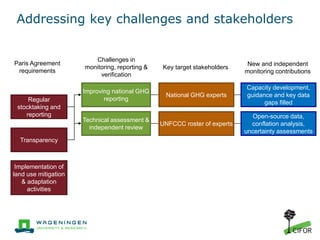
Regular
stocktaking and
reporting
Transparency
Implementation of
land use mitigation
& adaptation
activities
Paris Agreement
requirements
Challenges in
monitoring, reporting &
verification
Key target stakeholders
New and independent
monitoring contributions
Improving national GHG
reporting
National GHG experts
Capacity development,
guidance and key data
gaps filled
Technical assessment &
independent review
UNFCCC roster of experts
Open-source data,
conflation analysis,
uncertainty assessments
Addressing key challenges and stakeholders
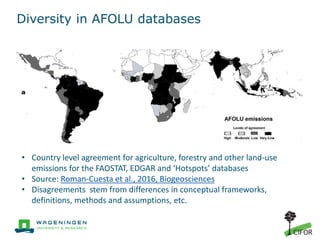
Diversity in AFOLU databases
• Country level agreement for agriculture, forestry and other land-use
emissions for the FAOSTAT, EDGAR and ‘Hotspots’ databases
• Source: Roman-Cuesta et al., 2016, Biogeosciences
• Disagreements stem from differences in conceptual frameworks,
definitions, methods and assumptions, etc.
Recommendations to expert communities
• Better dialog between communities involved in
producing emissions estimates in the land use sector
• Independent monitoring important for preparing
harmonized reference data for technical assessments
• International expert community need to develop better
guidance and training materials on how to use global
datasets (i.e. complementarity, uncertainties, etc.)
• IPCC Good practice guidelines need updates (i.e. land
representation, REDD+, use of remote sensing)
• Open source data and tools
Regular
stocktaking and
reporting
Transparency
Implementation of
land use mitigation
& adaptation
activities
Paris Agreement
requirements
Challenges in
monitoring, reporting &
verification
Key target stakeholders
New and independent
monitoring contributions
Improving national GHG
reporting
National GHG experts
Capacity development,
guidance and key data
gaps filled
Technical assessment &
independent review
UNFCCC roster of experts
Open-source data,
conflation analysis,
uncertainty assessments
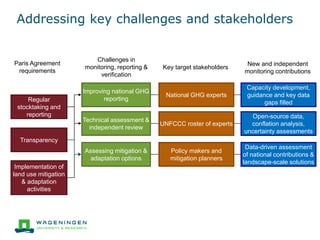
Assessing mitigation &
adaptation options
Policy makers and
mitigation planners
Data-driven assessment
of national contributions &
landscape-scale solutions
Addressing key challenges and stakeholders
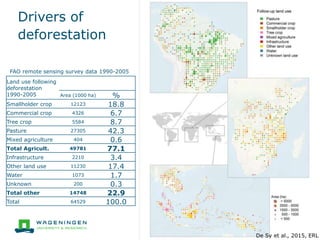
Drivers of
deforestation
Land use following
deforestation
1990-2005 Area (1000 ha) %
Smallholder crop 12123 18.8
Commercial crop 4326 6.7
Tree crop 5584 8.7
Pasture 27305 42.3
Mixed agriculture 404 0.6
Total Agricult. 49781 77.1
Infrastructure 2210 3.4
Other land use 11230 17.4
Water 1073 1.7
Unknown 200 0.3
Total other 14748 22.9
Total 64529 100.0
De Sy et al., 2015, ERL
FAO remote sensing survey data 1990-2005
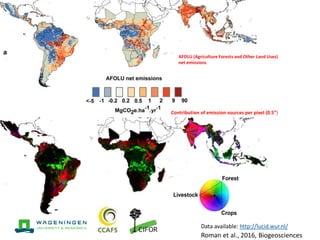
AFOLU (Agriculture Forests and Other Land Uses)
net emissions
Contribution of emission sources per pixel (0.5°)
Roman et al., 2016, Biogeosciences
Data available: http://lucid.wur.nl/
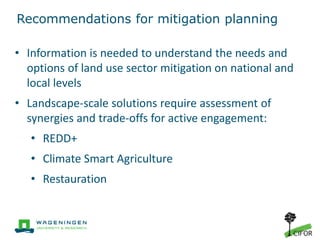
Recommendations for mitigation planning
• Information is needed to understand the needs and
options of land use sector mitigation on national and
local levels
• Landscape-scale solutions require assessment of
synergies and trade-offs for active engagement:
• REDD+
• Climate Smart Agriculture
• Restauration
Regular
stocktaking and
reporting
Transparency
Implementation of
land use mitigation
& adaptation
activities
Paris Agreement
Requirements
Challenges in
monitoring, reporting &
verification
Key target stakeholders
New and independent
monitoring contributions
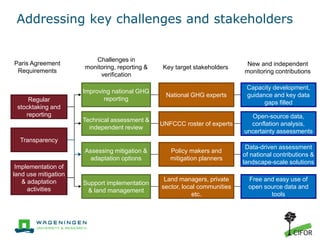
Improving national GHG
reporting
National GHG experts
Capacity development,
guidance and key data
gaps filled
Support implementation
& land management
Land managers, private
sector, local communities
etc.
Free and easy use of
open source data and
tools
Technical assessment &
independent review
UNFCCC roster of experts
Open-source data,
conflation analysis,
uncertainty assessments
Assessing mitigation &
adaptation options
Policy makers and
mitigation planners
Data-driven assessment
of national contributions &
landscape-scale solutions
Addressing key challenges and stakeholders
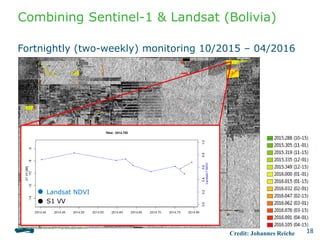
Combining Sentinel-1 & Landsat (Bolivia)
Fortnightly (two-weekly) monitoring 10/2015 – 04/2016
Landsat NDVI
S1 VV
18Credit: Johannes Reiche
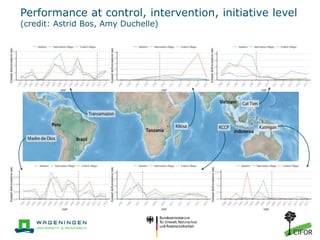
Performance at control, intervention, initiative level
(credit: Astrid Bos, Amy Duchelle)
Interactive monitoring system design
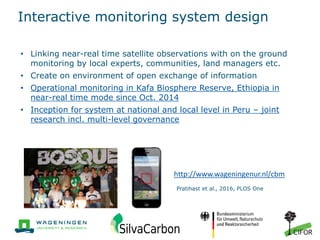
• Linking near-real time satellite observations with on the ground
monitoring by local experts, communities, land managers etc.
• Create on environment of open exchange of information
• Operational monitoring in Kafa Biosphere Reserve, Ethiopia in
near-real time mode since Oct. 2014
• Inception for system at national and local level in Peru – joint
research incl. multi-level governance
Pratihast et al., 2016, PLOS One
http://www.wageningenur.nl/cbm
Recommendations for implementation
• Independent monitoring is not a “system”, it is a variety
of practices
• A participatory and interactive environment creates
open exchange and partnership
• No dataset is perfect, but local activities are real ... use
as common ground
• Useful to be complementary to national reporting and
promote IPCC principles
• Transparency takes effort but can lead to
transformational changes
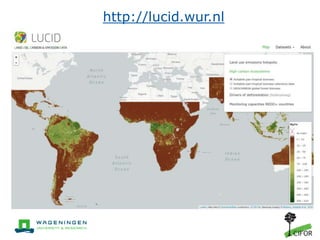
http://lucid.wur.nl

Enhancing transparency in the land use sector

  • 1.
  • 2.
    Post-Paris, the landuse sector & monitoring 1. Forests strong in Paris agreement (Art. 5) versus efforts should not harm food production (Art.2) 2. Land use sector is unique in its large negative emissions potential (1,5 -2 degree target): • Forests & soils - only proven Carbon Capture & Storage 3. Bottom-up process 4. Monitoring issues: • Regular stock-taking by countries • Transparency • Stimulating and implementing activities 5. Role of independent monitoring approaches
  • 3.
    Independent monitoring... Allstakeholders Government(AnnexI) Government(Non- AnnexI) Intergovernmental organization Non-governmental organization Commercial organization(private sector) Publiccompany(state- owned) Researchinstituteand university Donoragency Localstakeholder Journalism/media …provides informationthat is increasing transparency, building confidence and broadening participation for multiple stakeholders. 55% 39% 54% 54% 68% 65% 38% 53% 67% 54% 43% …can be defined as methods, data and tools to estimate greenhouse gas emissions from land activities that are additional to mandated monitoring by governments. 54% 58% 56% 51% 54% 45% 75% 53% 78% 62% 29% …provides information that is accurate, reliable and customizable. 54% 35% 50% 68% 67% 55% 38% 52% 56% 54% 43% …provides information that is supporting countries to fill data and capacity gaps. 49% 42% 50% 54% 58% 45% 25% 48% 44% 46% 57% …provides data that can serve the purpose of independent verification by UNFCCC roster of experts for reviewing the annual submissions of greenhouse gas (GHG) inventories. 43% 49% 39% 62% 40% 47% 38% 43% 22% 15% 29% …provides information that is potentially serving as authoritative reference for many kinds of stakeholders. 43% 38% 35% 51% 53% 39% 25% 41% 33% 46% 57% …provides information that is independent from commercial interests. 41% 33% 24% 49% 52% 39% 13% 44% 33% 46% 57% …provides underpinning science to improve data. 40% 33% 37% 46% 39% 26% 25% 48% 44% 39% 43% …ensures that stakeholders, e.g. REDD+ countries, can have ownership and control over datasets and methods and consider them legitimate. 38% 23% 44% 41% 43% 43% 0% 39% 22% 62% 29% Number of responses 533 69 54 37 106 51 8 179 9 13 7 1 2 3 4 5 6 7 8 9 Colour code according to rank of percentages (1 = highest ranked percentage, 9 = lowest ranked percentage)
  • 4.
    Defining independent monitoring •Stakeholders have different perspectives; it is not a specific tool, or a one-serves-all approach • Embraces diversity with the purpose of increasing transparency, and broadening stakeholder participation and confidence • Key elements: 1. transparency in data sources, definitions, methodologies and assumptions; 2. free and open methods, data, and tools, which are ‘barrier free’ to all stakeholders; 3. increased participation and accountability of stakeholders; 4. complementarity to mandated reporting by countries; 5. promotion of accuracy, consistency, completeness and comparability of greenhouse gas (GHG) emission estimates
  • 5.
    Regular stocktaking and reporting Transparency Implementation of landuse mitigation & adaptation activities Paris Agreement requirements Challenges in monitoring, reporting & verification Key target stakeholders New and independent monitoring contributions Improving national GHG reporting National GHG experts Capacity development, guidance and key data gaps filled Addressing key challenges and stakeholders
  • 6.
    Recommendations to countriesand UNFCCC • Transparency is a great opportunity: builds confidence and legitimacy • Transparency can cause (initial) frustration but will enhance quality: things will become more serious and be ready and open for surprises • Transparency requires capacity : circumstances vary, and enhancing transparency requires flexibility (step-wise) • Transparency reduces ignorance: take advantage of the diversity of (independent) datasets and approaches
  • 7.
    Regular stocktaking and reporting Transparency Implementation of landuse mitigation & adaptation activities Paris Agreement requirements Challenges in monitoring, reporting & verification Key target stakeholders New and independent monitoring contributions Improving national GHG reporting National GHG experts Capacity development, guidance and key data gaps filled Technical assessment & independent review UNFCCC roster of experts Open-source data, conflation analysis, uncertainty assessments Addressing key challenges and stakeholders
  • 8.
    Diversity in AFOLUdatabases • Country level agreement for agriculture, forestry and other land-use emissions for the FAOSTAT, EDGAR and ‘Hotspots’ databases • Source: Roman-Cuesta et al., 2016, Biogeosciences • Disagreements stem from differences in conceptual frameworks, definitions, methods and assumptions, etc.
  • 9.
    Recommendations to expertcommunities • Better dialog between communities involved in producing emissions estimates in the land use sector • Independent monitoring important for preparing harmonized reference data for technical assessments • International expert community need to develop better guidance and training materials on how to use global datasets (i.e. complementarity, uncertainties, etc.) • IPCC Good practice guidelines need updates (i.e. land representation, REDD+, use of remote sensing) • Open source data and tools
  • 10.
    Regular stocktaking and reporting Transparency Implementation of landuse mitigation & adaptation activities Paris Agreement requirements Challenges in monitoring, reporting & verification Key target stakeholders New and independent monitoring contributions Improving national GHG reporting National GHG experts Capacity development, guidance and key data gaps filled Technical assessment & independent review UNFCCC roster of experts Open-source data, conflation analysis, uncertainty assessments Assessing mitigation & adaptation options Policy makers and mitigation planners Data-driven assessment of national contributions & landscape-scale solutions Addressing key challenges and stakeholders
  • 11.
    Drivers of deforestation Land usefollowing deforestation 1990-2005 Area (1000 ha) % Smallholder crop 12123 18.8 Commercial crop 4326 6.7 Tree crop 5584 8.7 Pasture 27305 42.3 Mixed agriculture 404 0.6 Total Agricult. 49781 77.1 Infrastructure 2210 3.4 Other land use 11230 17.4 Water 1073 1.7 Unknown 200 0.3 Total other 14748 22.9 Total 64529 100.0 De Sy et al., 2015, ERL FAO remote sensing survey data 1990-2005
  • 12.
    AFOLU (Agriculture Forestsand Other Land Uses) net emissions Contribution of emission sources per pixel (0.5°) Roman et al., 2016, Biogeosciences Data available: http://lucid.wur.nl/
  • 13.
    Recommendations for mitigationplanning • Information is needed to understand the needs and options of land use sector mitigation on national and local levels • Landscape-scale solutions require assessment of synergies and trade-offs for active engagement: • REDD+ • Climate Smart Agriculture • Restauration
  • 14.
    Regular stocktaking and reporting Transparency Implementation of landuse mitigation & adaptation activities Paris Agreement Requirements Challenges in monitoring, reporting & verification Key target stakeholders New and independent monitoring contributions Improving national GHG reporting National GHG experts Capacity development, guidance and key data gaps filled Support implementation & land management Land managers, private sector, local communities etc. Free and easy use of open source data and tools Technical assessment & independent review UNFCCC roster of experts Open-source data, conflation analysis, uncertainty assessments Assessing mitigation & adaptation options Policy makers and mitigation planners Data-driven assessment of national contributions & landscape-scale solutions Addressing key challenges and stakeholders
  • 15.
    Combining Sentinel-1 &Landsat (Bolivia) Fortnightly (two-weekly) monitoring 10/2015 – 04/2016 Landsat NDVI S1 VV 18Credit: Johannes Reiche
  • 16.
    Performance at control,intervention, initiative level (credit: Astrid Bos, Amy Duchelle)
  • 17.
    Interactive monitoring systemdesign • Linking near-real time satellite observations with on the ground monitoring by local experts, communities, land managers etc. • Create on environment of open exchange of information • Operational monitoring in Kafa Biosphere Reserve, Ethiopia in near-real time mode since Oct. 2014 • Inception for system at national and local level in Peru – joint research incl. multi-level governance Pratihast et al., 2016, PLOS One http://www.wageningenur.nl/cbm
  • 18.
    Recommendations for implementation •Independent monitoring is not a “system”, it is a variety of practices • A participatory and interactive environment creates open exchange and partnership • No dataset is perfect, but local activities are real ... use as common ground • Useful to be complementary to national reporting and promote IPCC principles • Transparency takes effort but can lead to transformational changes
  • 19.

Editor's Notes

  • #18 Change detections per year, based on the BFAST timeseries analyses. Dotted lines are the start years of the interventions. Deforestation rates are based on forest masks, that were locally defined Work by: Ben DeVries, Mathieu Decuyper, Erik van Schaik, Tom Bewernick, Astrid Bos and others.