Agric Public Expenditure Reviews:
How Being Used?
How MakeThem More Useful?
Stephen D. Mink
IFPRI Consultant
Side-Event: Towards Strengthening Agriculture Public Expenditure
Analysis for Improved Decisions and Learning
September 1st
, 2015
Two Questions
• How have Government authorities and sector stakeholders used their
recent Ag PERs?
• Indications from responses to questions put to agriculture ministry contacts,
Ag PER national consultants and World Bank country staff.
• How make Ag PERs more useful?
• Preliminary observations drawn from a synthesis being prepared of a sample
of 19 Ag PERs
2
Uses of Ag PER
1. Improve Strategy Planning and Monitoring
• Foundation for strategic planning and strategy monitoring
• Identify policy-expenditure nexus where reform needed.
• Use in development of national agricultural investment plan
2. Improve Expenditure Levels and Composition
• Identification of underfunded sub-sectors.
• Substantiate claims for more public finance for the sector.
3
Uses of Ag PER
3. Strengthen Budget Processes for Better Expenditure Management
• Strengthening of budget management capacity.
• Baseline for annual updating as input to improved expenditure management.
• Baseline for transition to program budgeting.
• Identify need for follow-up specialized studies.
• Input to sector authorities’ own action plan.
4
Uses of Ag PER
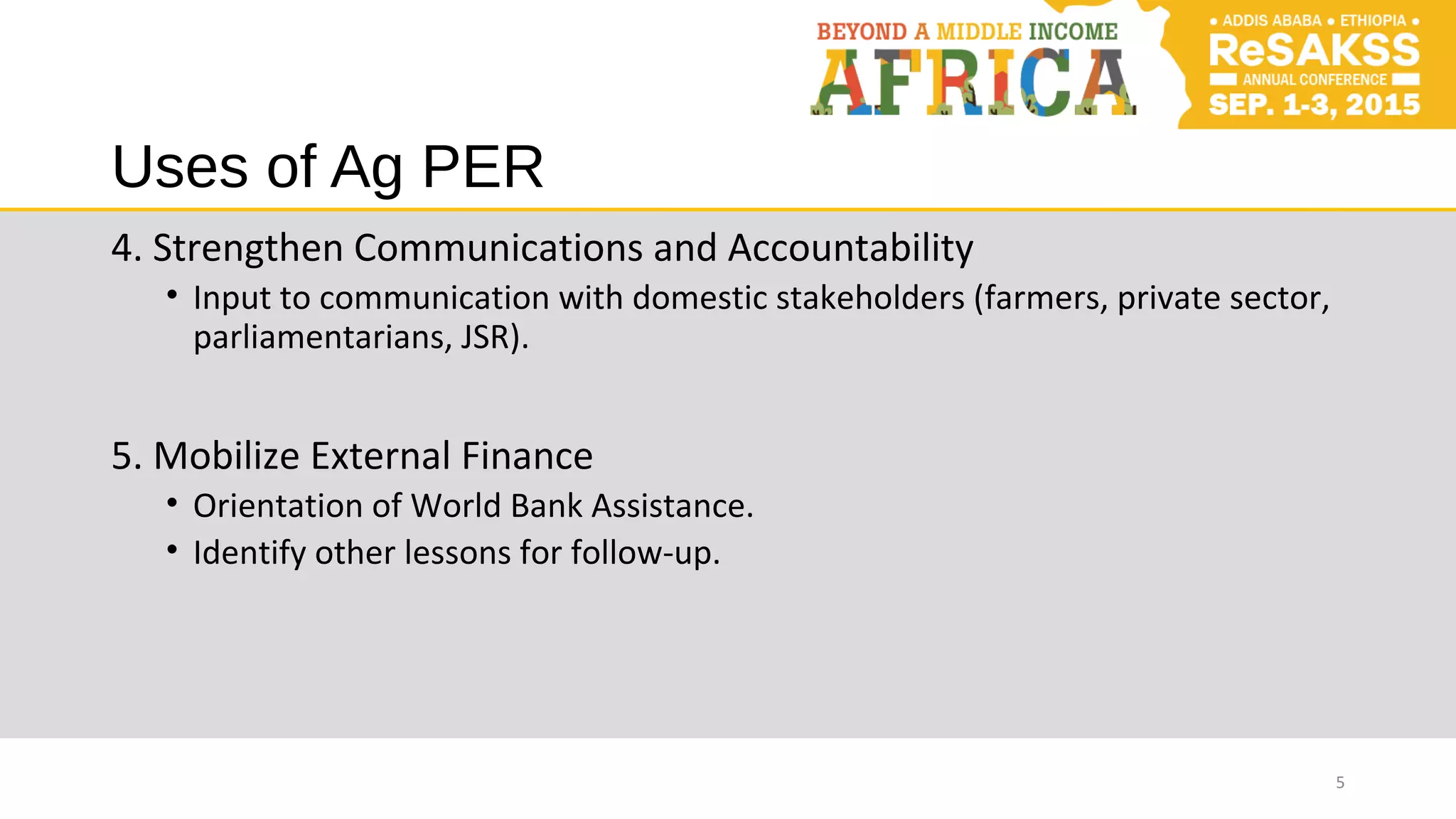
4. Strengthen Communications and Accountability
• Input to communication with domestic stakeholders (farmers, private sector,
parliamentarians, JSR).
5. Mobilize External Finance
• Orientation of World Bank Assistance.
• Identify other lessons for follow-up.
5
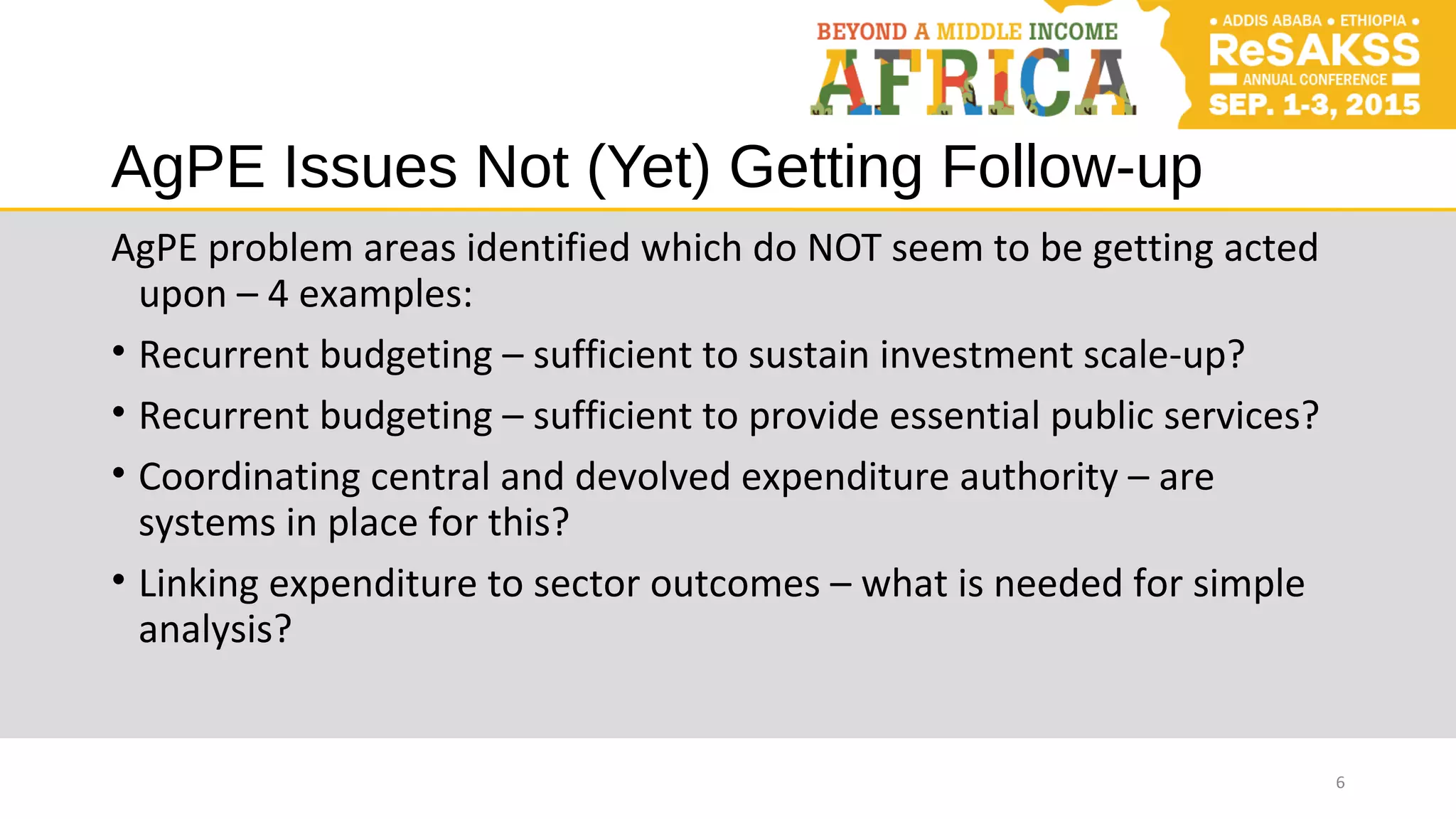
AgPE Issues Not (Yet) Getting Follow-up
AgPE problem areas identified which do NOT seem to be getting acted
upon – 4 examples:
• Recurrent budgeting – sufficient to sustain investment scale-up?
• Recurrent budgeting – sufficient to provide essential public services?
• Coordinating central and devolved expenditure authority – are
systems in place for this?
• Linking expenditure to sector outcomes – what is needed for simple
analysis?
6
Hi
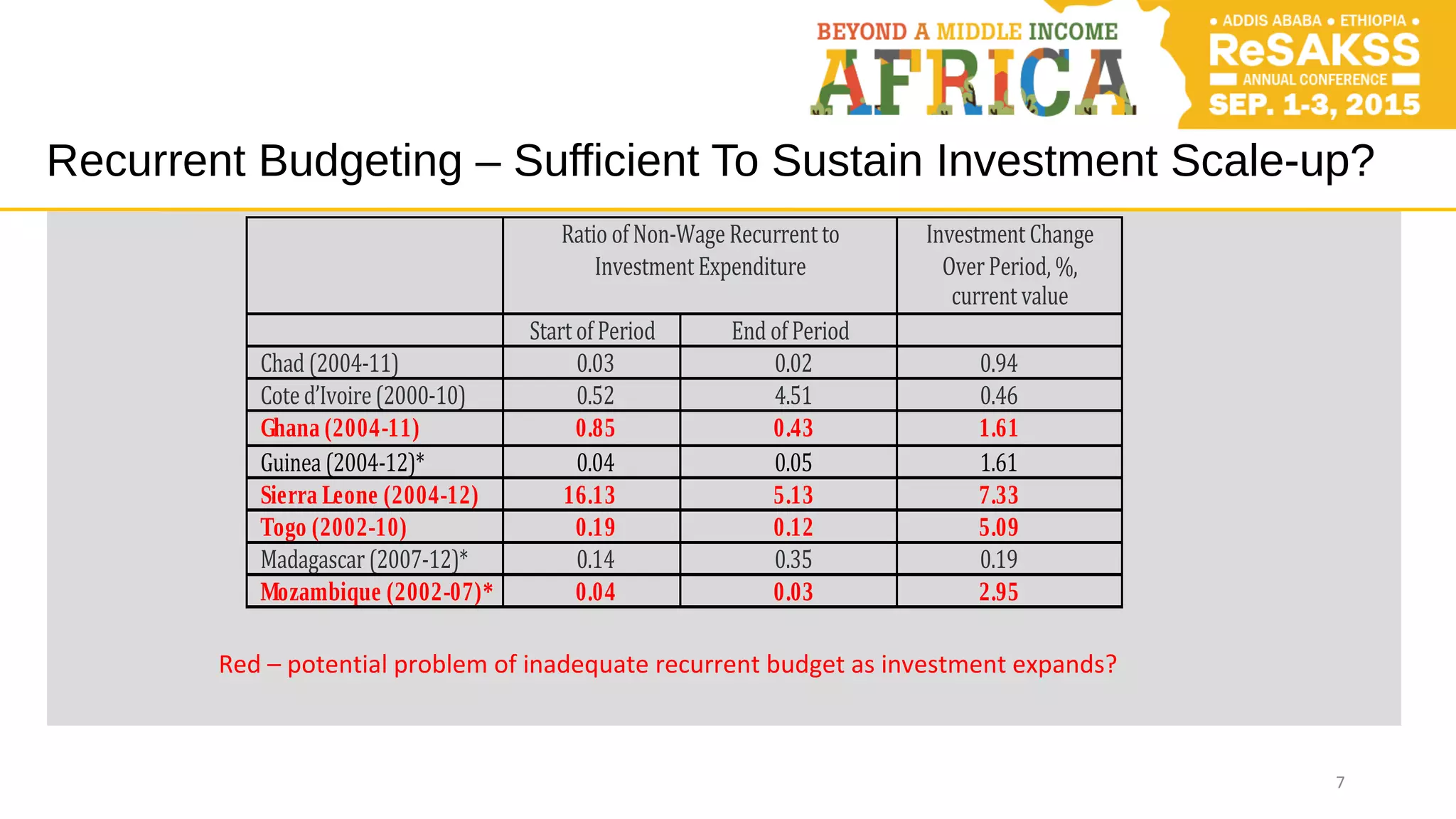
Recurrent Budgeting – Sufficient To Sustain Investment Scale-up?
7
Ratio of Non-Wage Recurrent to
Investment Expenditure
Investment Change
OverPeriod, %,
current value
Start of Period End of Period
Chad (2004-11) 0.03 0.02 0.94
Cote d’Ivoire(2000-10) 0.52 4.51 0.46
Ghana (2004-11) 0.85 0.43 1.61
Guinea (2004-12)* 0.04 0.05 1.61
Sierra Leone (2004-12) 16.13 5.13 7.33
Togo (2002-10) 0.19 0.12 5.09
Madagascar (2007-12)* 0.14 0.35 0.19
Mozambique (2002-07)* 0.04 0.03 2.95
Red – potential problem of inadequate recurrent budget as investment expands?
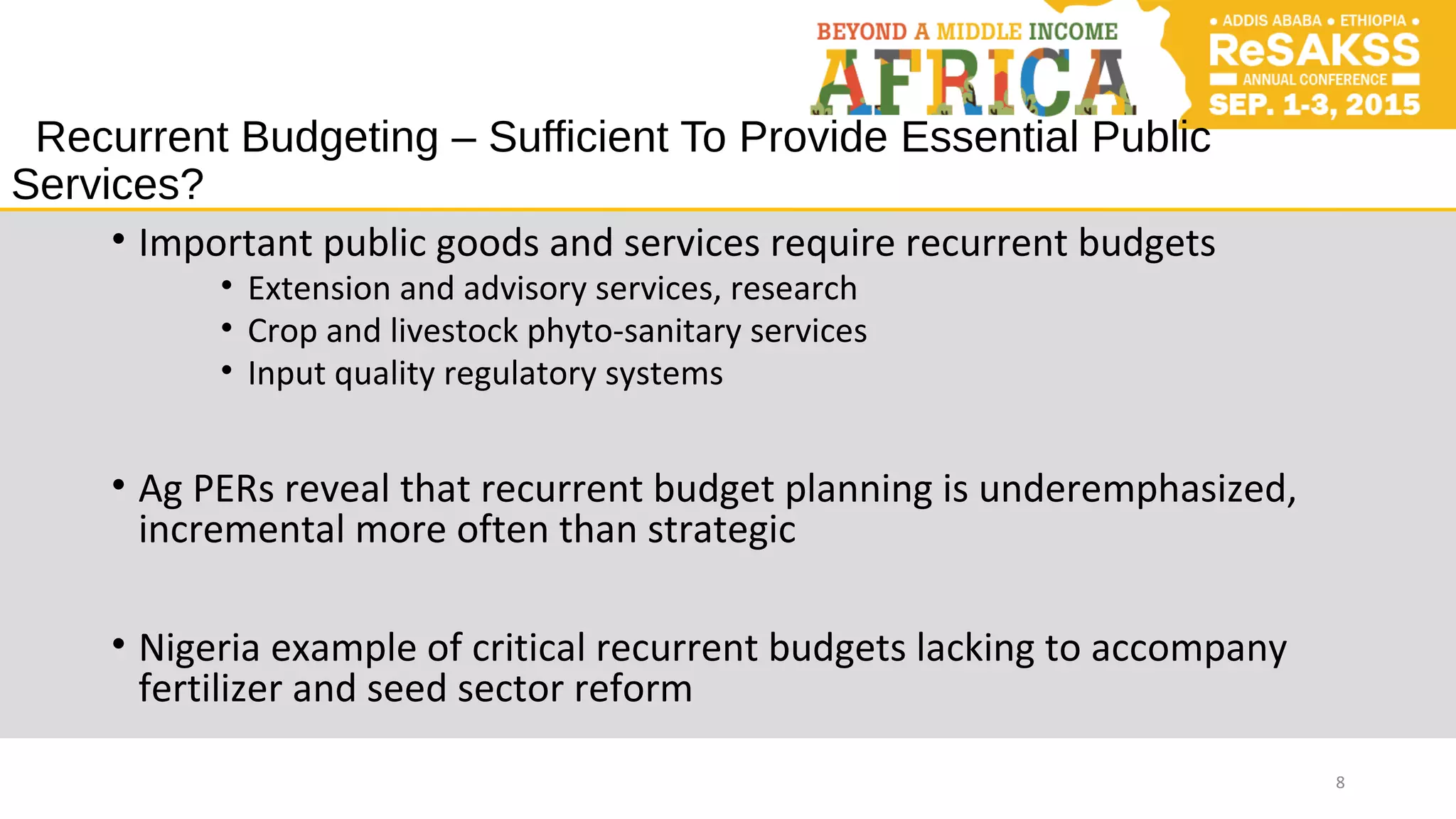
Recurrent Budgeting – Sufficient To Provide Essential Public
Services?
• Important public goods and services require recurrent budgets
• Extension and advisory services, research
• Crop and livestock phyto-sanitary services
• Input quality regulatory systems
• Ag PERs reveal that recurrent budget planning is underemphasized,
incremental more often than strategic
• Nigeria example of critical recurrent budgets lacking to accompany
fertilizer and seed sector reform
8
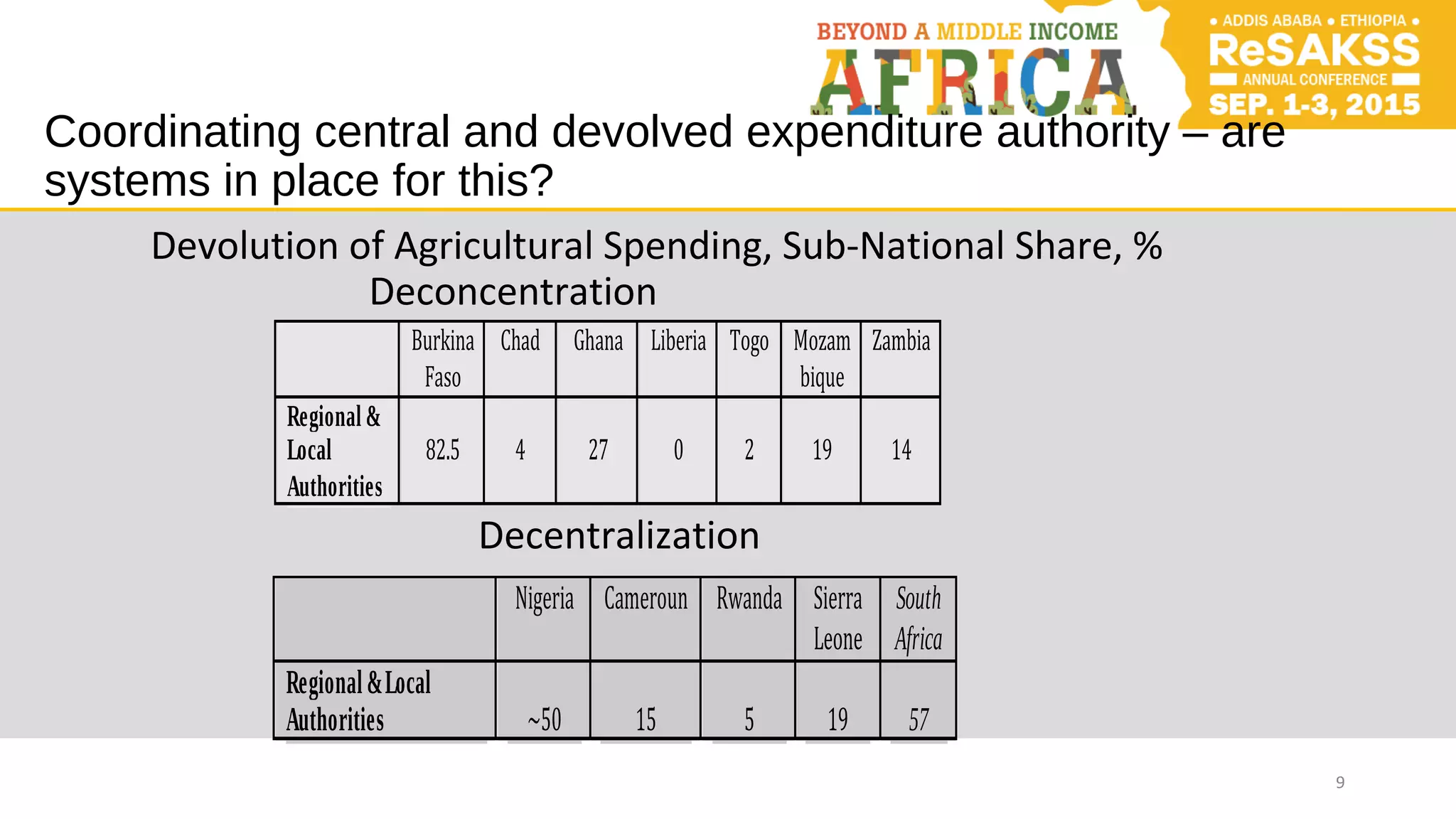
Coordinating central and devolved expenditure authority – are
systems in place for this?
Devolution of Agricultural Spending, Sub-National Share, %
Deconcentration
Decentralization
9
Burkina
Faso
Chad Ghana Liberia Togo Mozam
bique
Zambia
Regional &
Local
Authorities
82.5 4 27 0 2 19 14
Nigeria Cameroun Rwanda Sierra
Leone
South
Africa
Regional&Local
Authorities ~50 15 5 19 57
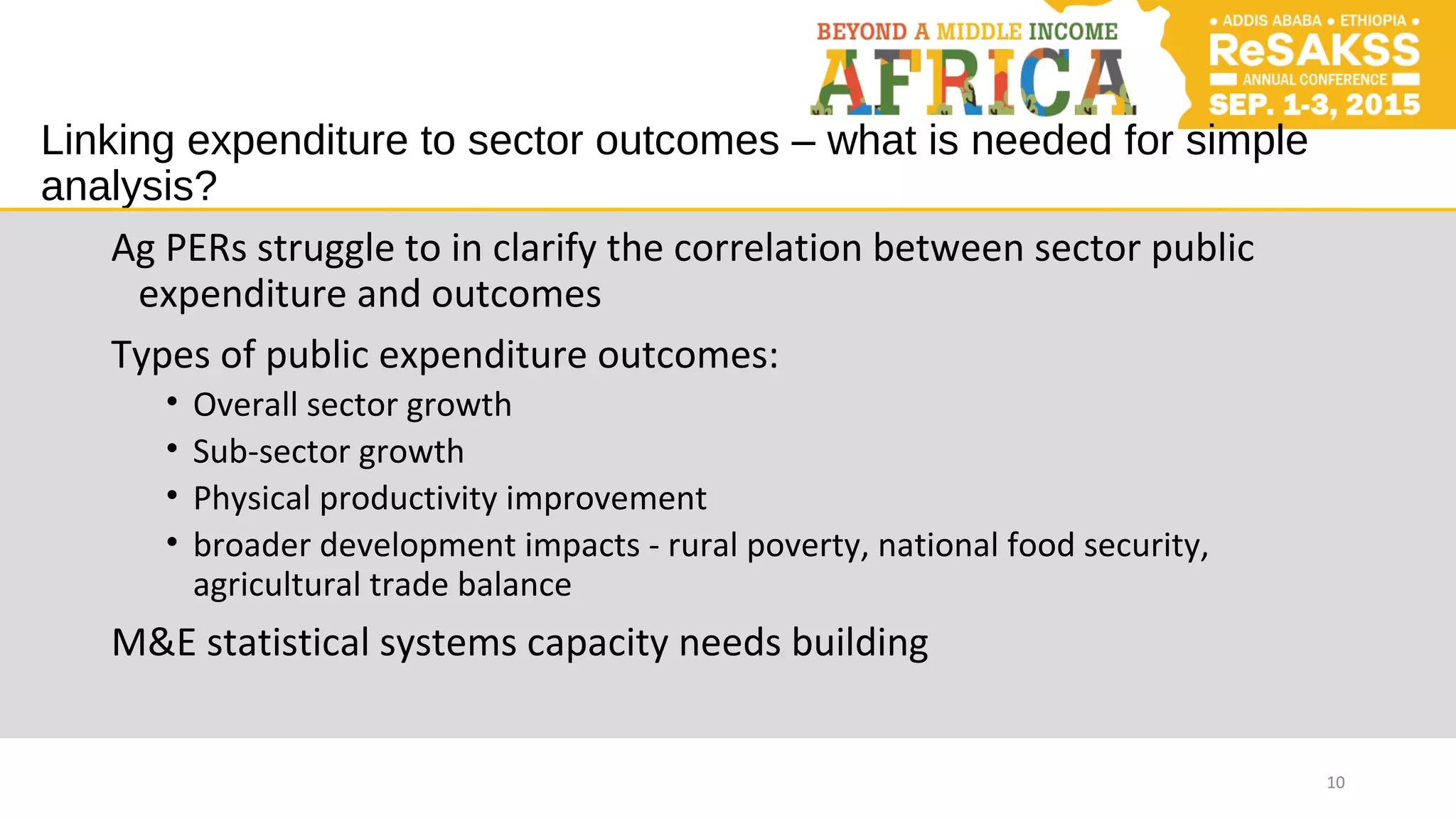
Linking expenditure to sector outcomes – what is needed for simple
analysis?
Ag PERs struggle to in clarify the correlation between sector public
expenditure and outcomes
Types of public expenditure outcomes:
• Overall sector growth
• Sub-sector growth
• Physical productivity improvement
• broader development impacts - rural poverty, national food security,
agricultural trade balance
M&E statistical systems capacity needs building
10
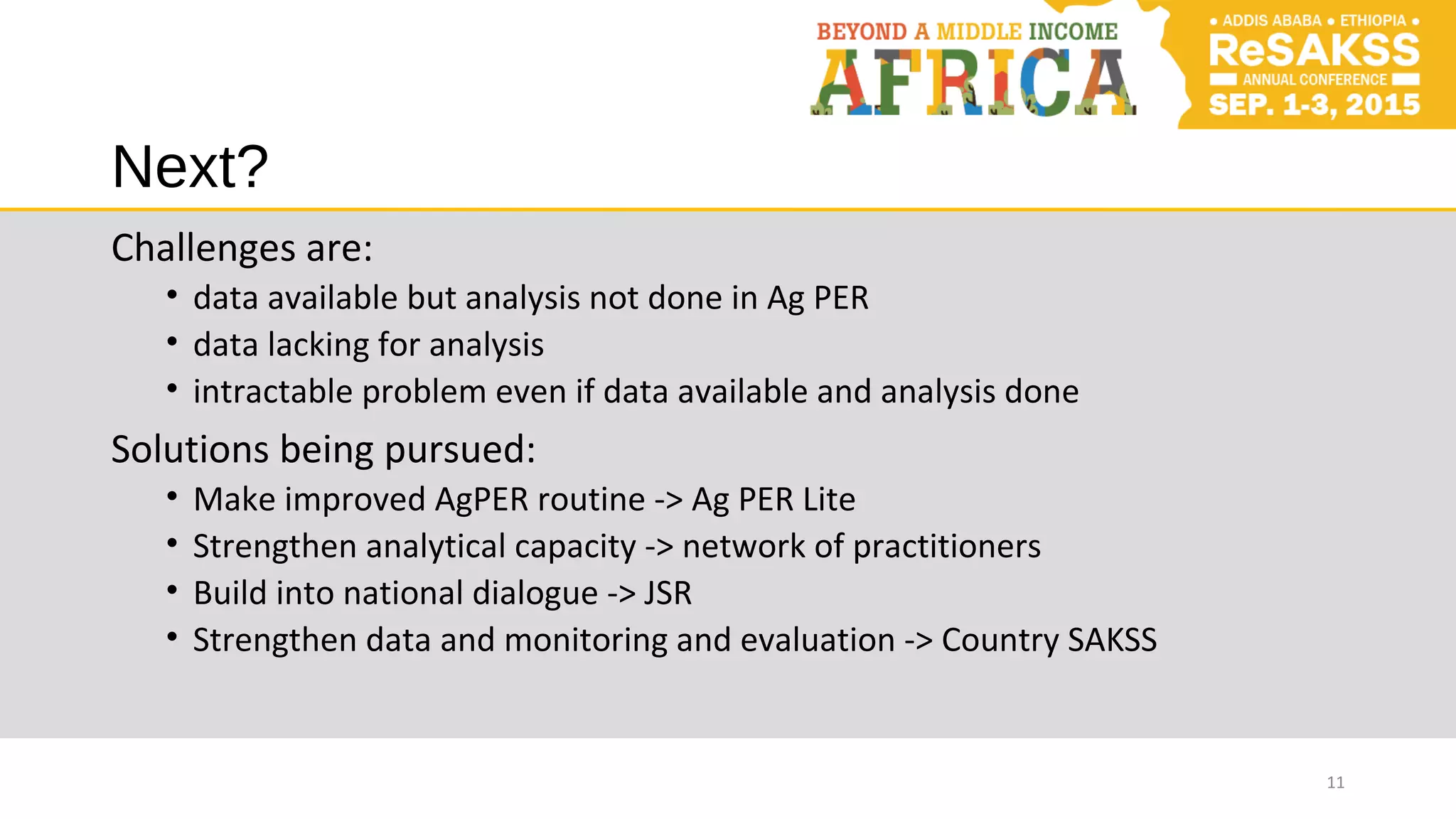
Next?
Challenges are:
• data available but analysis not done in Ag PER
• data lacking for analysis
• intractable problem even if data available and analysis done
Solutions being pursued:
• Make improved AgPER routine -> Ag PER Lite
• Strengthen analytical capacity -> network of practitioners
• Build into national dialogue -> JSR
• Strengthen data and monitoring and evaluation -> Country SAKSS
11

2015 ReSAKSS Conference – Day 1 - Stephen Mink

  • 1.
    Agric Public ExpenditureReviews: How Being Used? How MakeThem More Useful? Stephen D. Mink IFPRI Consultant Side-Event: Towards Strengthening Agriculture Public Expenditure Analysis for Improved Decisions and Learning September 1st , 2015
  • 2.
    Two Questions • Howhave Government authorities and sector stakeholders used their recent Ag PERs? • Indications from responses to questions put to agriculture ministry contacts, Ag PER national consultants and World Bank country staff. • How make Ag PERs more useful? • Preliminary observations drawn from a synthesis being prepared of a sample of 19 Ag PERs 2
  • 3.
    Uses of AgPER 1. Improve Strategy Planning and Monitoring • Foundation for strategic planning and strategy monitoring • Identify policy-expenditure nexus where reform needed. • Use in development of national agricultural investment plan 2. Improve Expenditure Levels and Composition • Identification of underfunded sub-sectors. • Substantiate claims for more public finance for the sector. 3
  • 4.
    Uses of AgPER 3. Strengthen Budget Processes for Better Expenditure Management • Strengthening of budget management capacity. • Baseline for annual updating as input to improved expenditure management. • Baseline for transition to program budgeting. • Identify need for follow-up specialized studies. • Input to sector authorities’ own action plan. 4
  • 5.
    Uses of AgPER 4. Strengthen Communications and Accountability • Input to communication with domestic stakeholders (farmers, private sector, parliamentarians, JSR). 5. Mobilize External Finance • Orientation of World Bank Assistance. • Identify other lessons for follow-up. 5
  • 6.
    AgPE Issues Not(Yet) Getting Follow-up AgPE problem areas identified which do NOT seem to be getting acted upon – 4 examples: • Recurrent budgeting – sufficient to sustain investment scale-up? • Recurrent budgeting – sufficient to provide essential public services? • Coordinating central and devolved expenditure authority – are systems in place for this? • Linking expenditure to sector outcomes – what is needed for simple analysis? 6
  • 7.
    Hi Recurrent Budgeting –Sufficient To Sustain Investment Scale-up? 7 Ratio of Non-Wage Recurrent to Investment Expenditure Investment Change OverPeriod, %, current value Start of Period End of Period Chad (2004-11) 0.03 0.02 0.94 Cote d’Ivoire(2000-10) 0.52 4.51 0.46 Ghana (2004-11) 0.85 0.43 1.61 Guinea (2004-12)* 0.04 0.05 1.61 Sierra Leone (2004-12) 16.13 5.13 7.33 Togo (2002-10) 0.19 0.12 5.09 Madagascar (2007-12)* 0.14 0.35 0.19 Mozambique (2002-07)* 0.04 0.03 2.95 Red – potential problem of inadequate recurrent budget as investment expands?
  • 8.
    Recurrent Budgeting –Sufficient To Provide Essential Public Services? • Important public goods and services require recurrent budgets • Extension and advisory services, research • Crop and livestock phyto-sanitary services • Input quality regulatory systems • Ag PERs reveal that recurrent budget planning is underemphasized, incremental more often than strategic • Nigeria example of critical recurrent budgets lacking to accompany fertilizer and seed sector reform 8
  • 9.
    Coordinating central anddevolved expenditure authority – are systems in place for this? Devolution of Agricultural Spending, Sub-National Share, % Deconcentration Decentralization 9 Burkina Faso Chad Ghana Liberia Togo Mozam bique Zambia Regional & Local Authorities 82.5 4 27 0 2 19 14 Nigeria Cameroun Rwanda Sierra Leone South Africa Regional&Local Authorities ~50 15 5 19 57
  • 10.
    Linking expenditure tosector outcomes – what is needed for simple analysis? Ag PERs struggle to in clarify the correlation between sector public expenditure and outcomes Types of public expenditure outcomes: • Overall sector growth • Sub-sector growth • Physical productivity improvement • broader development impacts - rural poverty, national food security, agricultural trade balance M&E statistical systems capacity needs building 10
  • 11.
    Next? Challenges are: • dataavailable but analysis not done in Ag PER • data lacking for analysis • intractable problem even if data available and analysis done Solutions being pursued: • Make improved AgPER routine -> Ag PER Lite • Strengthen analytical capacity -> network of practitioners • Build into national dialogue -> JSR • Strengthen data and monitoring and evaluation -> Country SAKSS 11