Enhancing the digital experience for skills learners
James Clay, Senior Co-Design Manager
23/01/2017
#codesign17
Co-design 2017
23/01/2017
Co-design consultation 2016-17
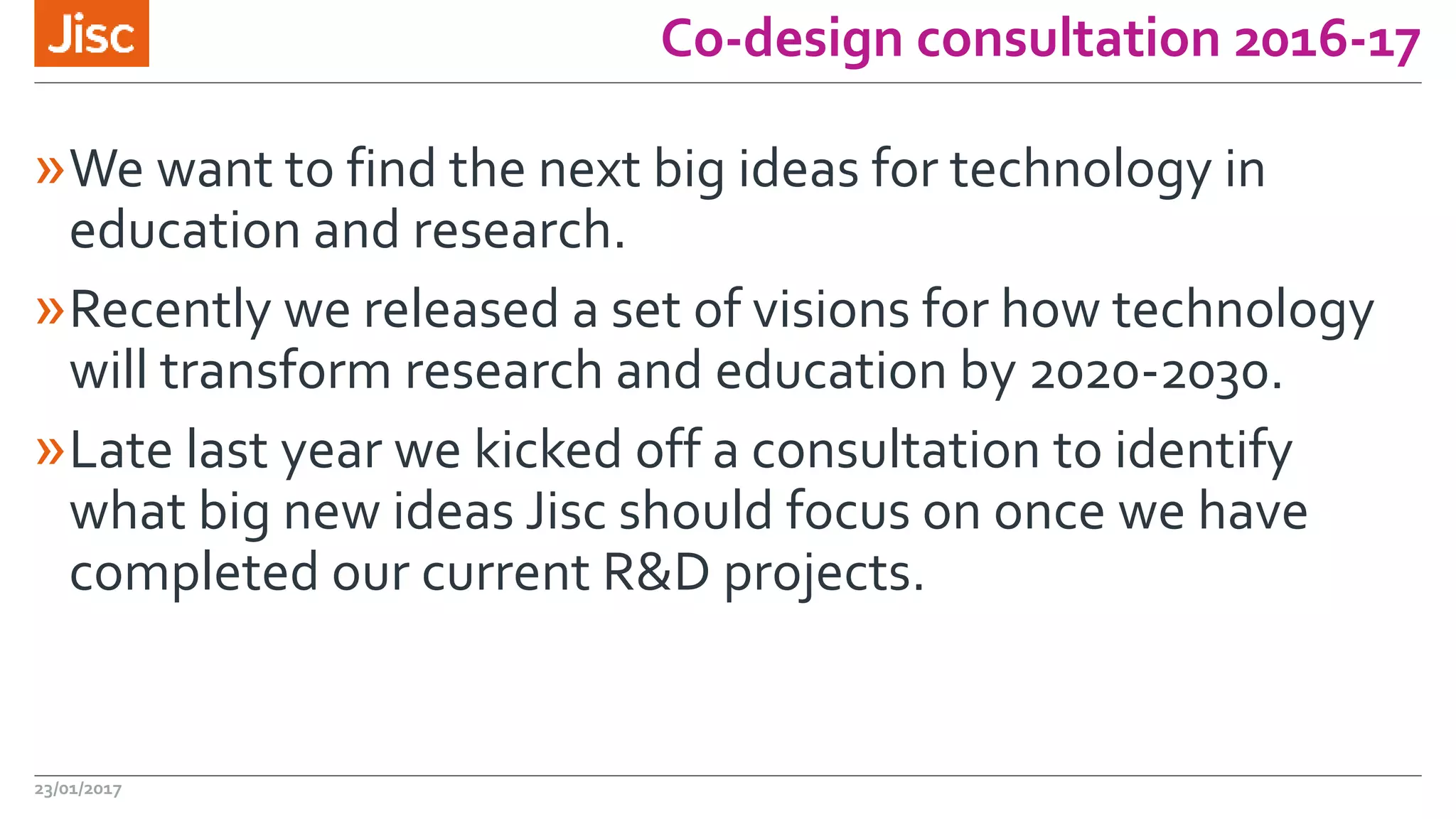
»We want to find the next big ideas for technology in
education and research.
»Recently we released a set of visions for how technology
will transform research and education by 2020-2030.
»Late last year we kicked off a consultation to identify
what big new ideas Jisc should focus on once we have
completed our current R&D projects.
23/01/2017
Co-design 2017
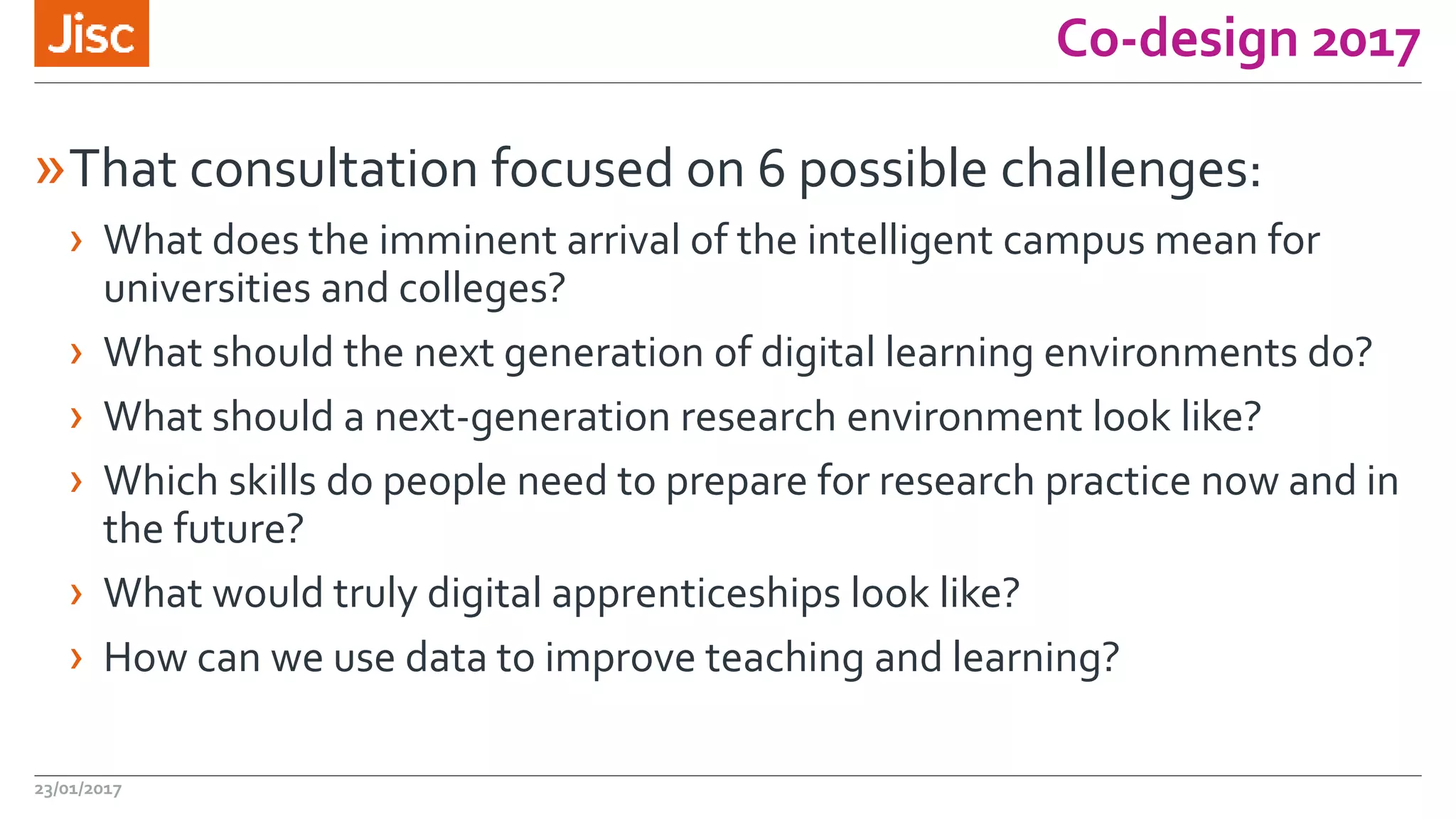
»That consultation focused on 6 possible challenges:
› What does the imminent arrival of the intelligent campus mean for
universities and colleges?
› What should the next generation of digital learning environments do?
› What should a next-generation research environment look like?
› Which skills do people need to prepare for research practice now and in
the future?
› What would truly digital apprenticeships look like?
› How can we use data to improve teaching and learning?
23/01/2017
Co-design 2017
What would truly digital
apprenticeships look like?
23/01/2017
Co-design 2017
»Could Jisc explore whether we could deliver tools,
resources, and data that anyone designing an
apprenticeship could use to develop a course that makes
effective use of technology and uses an appropriate
mixture of online, blended and face to face learning?
Delivery
23/01/2017 Building digital capability
Co-design 2017
»Could Jisc explore whether we could deliver tools,
resources, and data that anyone designing an
apprenticeship could use to develop a course that makes
effective use of technology and uses an appropriate
mixture of online, blended and face to face learning?
Assessment
23/01/2017 Building digital capability
Co-design 2017
»Could we explore a new type of tool that allows students
to easily curate and demonstrate the verified skills,
knowledge, experience and qualifications they have
gained, both formally and informally?To enable learners
to curate and showcase experiences and activities to
potential employers as they loop between study and
employment during their careers.
Employability and skills verification
23/01/2017 Building digital capability
Construction by James Clay CC BY-NC 2.0
Co-design 2017
»We are asking people to express support for any of the
ideas they particularly like.
»Please visit our co-design 2016-17 page to find out more.
»https://www.jisc.ac.uk/rd/how-we-innovate/co-design-
consultation-2016-17
»The feedback period closes on 30th January and we will
announce the ideas we are exploring in early February.
Next steps
23/01/2017 Building digital capability
Keyboard by James Clay CC BY-NC 2.0
Enhancing the digital experience for skills learners
Developing your digital
vision
23/01/2017
Enhancing the digital experience for skills learners
Building a robust digital
environment
23/01/2017
Enhancing the digital experience for skills learners
Developing staff digital
capabilities
23/01/2017
15
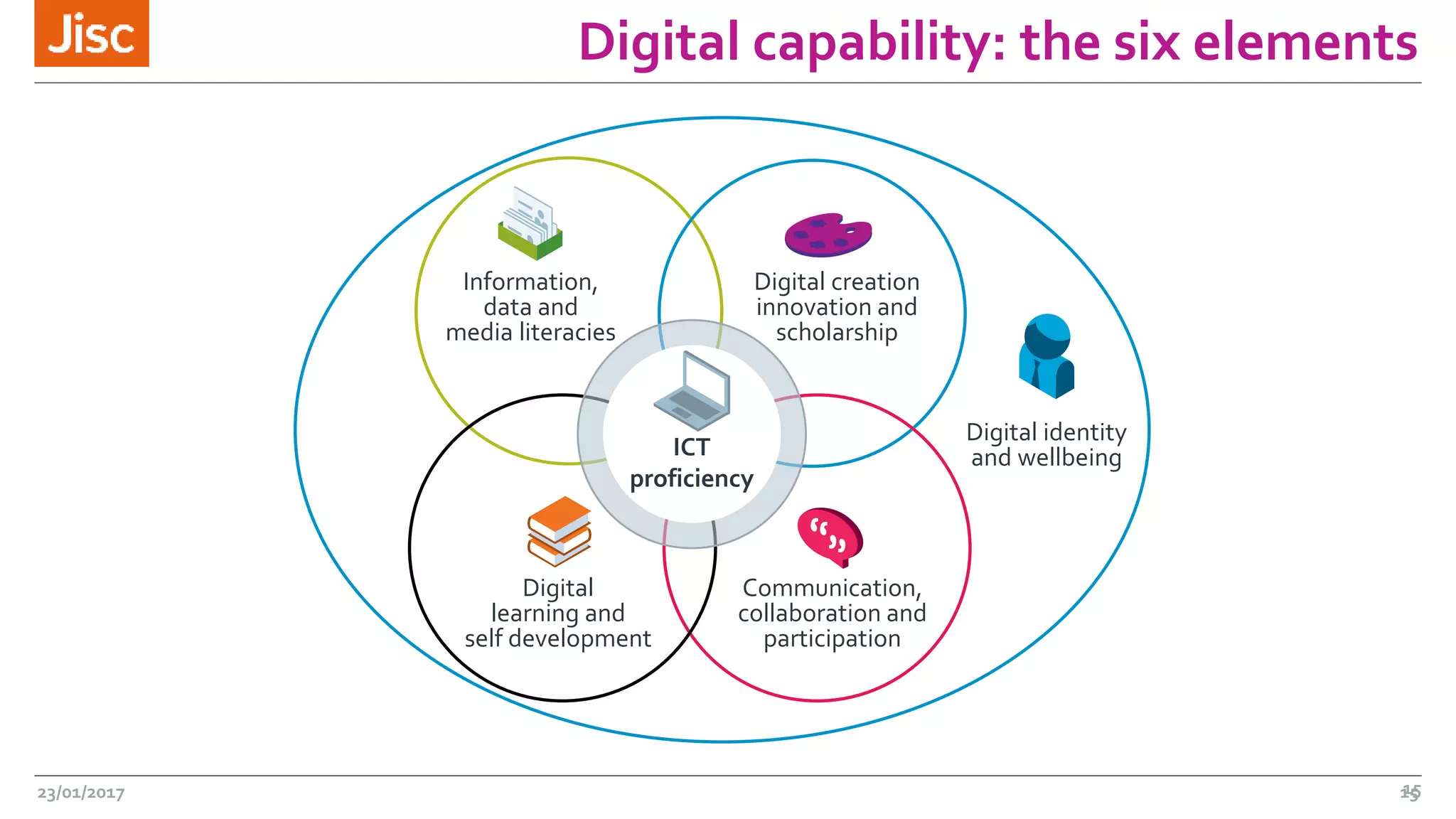
Digital capability: the six elements
23/01/2017 15
ICT
proficiency
Information,
data and
media literacies
Digital
learning and
self development
Digital creation
innovation and
scholarship
Communication,
collaboration and
participation
Digital identity
and wellbeing
Enhancing the digital experience for skills learners
Empowering and
engaging learners
23/01/2017
Enhancing the digital experience for skills learners
Embedding technology
within inclusive
curriculum and
assessment practices
23/01/2017
Construction by James Clay CC BY-NC 2.0
Blended learning
Training
23/01/2017
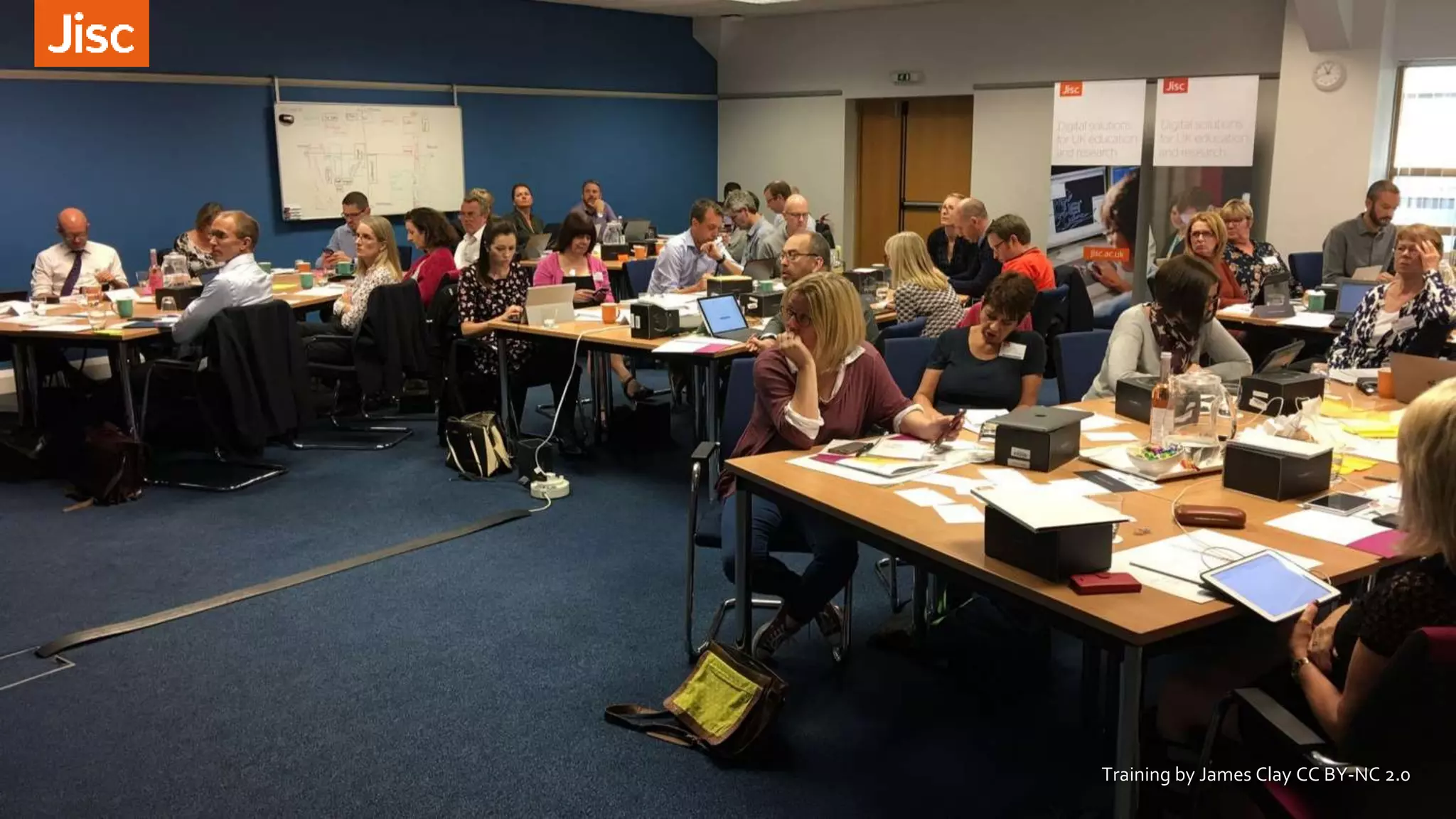
Training by James Clay CC BY-NC 2.0
Leadership
»Become a digitally-informed and empowered leader and
learn how to help your organisation respond more
effectively to technology-driven change.
»www.jisc.ac.uk/training/digital-leaders-programme
Digital leaders programme
21
Digital leaders programme
»Our four-day digital leaders programme will equip you
with the tools, knowledge and skills to:
› Become a more effective digital leader through your own personal and
professional development
› Explore how organisations can engage more effectively with the digital
technology at their disposal – at both strategic and operational levels
› Discover and reflect on how digital technology is changing the way your
organisation operates – creating new leadership challenges and strategic
opportunities
› Learn to lead, manage and influence digitally-driven change across
organisations, departments, services and teams
22
Construction by James Clay CC BY-NC 2.0
Enhancing the digital experience for skills learners
Consultancy
23/01/2017
Construction by James Clay CC BY-NC 2.0
jisc.ac.uk
Except where otherwise noted, this work
is licensed under CC-BY-NC-ND
Get in touch…
Co-Design 2017
James Clay
Senior Co-Design Manager
james.clay@jisc.ac.uk
23/01/2017 Building digital capability

Enhancing the digital experience for skills learners

  • 1.
    Enhancing the digitalexperience for skills learners James Clay, Senior Co-Design Manager 23/01/2017
  • 2.
  • 3.
    Co-design consultation 2016-17 »Wewant to find the next big ideas for technology in education and research. »Recently we released a set of visions for how technology will transform research and education by 2020-2030. »Late last year we kicked off a consultation to identify what big new ideas Jisc should focus on once we have completed our current R&D projects. 23/01/2017
  • 4.
    Co-design 2017 »That consultationfocused on 6 possible challenges: › What does the imminent arrival of the intelligent campus mean for universities and colleges? › What should the next generation of digital learning environments do? › What should a next-generation research environment look like? › Which skills do people need to prepare for research practice now and in the future? › What would truly digital apprenticeships look like? › How can we use data to improve teaching and learning? 23/01/2017
  • 5.
    Co-design 2017 What wouldtruly digital apprenticeships look like? 23/01/2017
  • 6.
    Co-design 2017 »Could Jiscexplore whether we could deliver tools, resources, and data that anyone designing an apprenticeship could use to develop a course that makes effective use of technology and uses an appropriate mixture of online, blended and face to face learning? Delivery 23/01/2017 Building digital capability
  • 7.
    Co-design 2017 »Could Jiscexplore whether we could deliver tools, resources, and data that anyone designing an apprenticeship could use to develop a course that makes effective use of technology and uses an appropriate mixture of online, blended and face to face learning? Assessment 23/01/2017 Building digital capability
  • 8.
    Co-design 2017 »Could weexplore a new type of tool that allows students to easily curate and demonstrate the verified skills, knowledge, experience and qualifications they have gained, both formally and informally?To enable learners to curate and showcase experiences and activities to potential employers as they loop between study and employment during their careers. Employability and skills verification 23/01/2017 Building digital capability
  • 9.
    Construction by JamesClay CC BY-NC 2.0
  • 10.
    Co-design 2017 »We areasking people to express support for any of the ideas they particularly like. »Please visit our co-design 2016-17 page to find out more. »https://www.jisc.ac.uk/rd/how-we-innovate/co-design- consultation-2016-17 »The feedback period closes on 30th January and we will announce the ideas we are exploring in early February. Next steps 23/01/2017 Building digital capability
  • 11.
    Keyboard by JamesClay CC BY-NC 2.0
  • 12.
    Enhancing the digitalexperience for skills learners Developing your digital vision 23/01/2017
  • 13.
    Enhancing the digitalexperience for skills learners Building a robust digital environment 23/01/2017
  • 14.
    Enhancing the digitalexperience for skills learners Developing staff digital capabilities 23/01/2017
  • 15.
    15 Digital capability: thesix elements 23/01/2017 15 ICT proficiency Information, data and media literacies Digital learning and self development Digital creation innovation and scholarship Communication, collaboration and participation Digital identity and wellbeing
  • 16.
    Enhancing the digitalexperience for skills learners Empowering and engaging learners 23/01/2017
  • 17.
    Enhancing the digitalexperience for skills learners Embedding technology within inclusive curriculum and assessment practices 23/01/2017
  • 18.
    Construction by JamesClay CC BY-NC 2.0
  • 19.
  • 20.
    Training by JamesClay CC BY-NC 2.0
  • 21.
    Leadership »Become a digitally-informedand empowered leader and learn how to help your organisation respond more effectively to technology-driven change. »www.jisc.ac.uk/training/digital-leaders-programme Digital leaders programme 21
  • 22.
    Digital leaders programme »Ourfour-day digital leaders programme will equip you with the tools, knowledge and skills to: › Become a more effective digital leader through your own personal and professional development › Explore how organisations can engage more effectively with the digital technology at their disposal – at both strategic and operational levels › Discover and reflect on how digital technology is changing the way your organisation operates – creating new leadership challenges and strategic opportunities › Learn to lead, manage and influence digitally-driven change across organisations, departments, services and teams 22
  • 23.
    Construction by JamesClay CC BY-NC 2.0
  • 24.
    Enhancing the digitalexperience for skills learners Consultancy 23/01/2017
  • 25.
    Construction by JamesClay CC BY-NC 2.0
  • 26.
    jisc.ac.uk Except where otherwisenoted, this work is licensed under CC-BY-NC-ND Get in touch… Co-Design 2017 James Clay Senior Co-Design Manager james.clay@jisc.ac.uk 23/01/2017 Building digital capability

Editor's Notes

  • #2 Welcome to this presentation on blended learning Image credit: Food mixer by Lesley Choa CC BY-NC-ND 2.0 https://flic.kr/p/93nbRW
  • #7 The consultation highlighted the need to move to different delivery models. National employers want national delivery and meeting increased government targets while maintaining high quality is infeasible without the use of technology. However this throws up questions about how to deliver effectively to a wide range of learner cohorts, from 16-18 years olds used to study to adults over 50 who have years of work experience but lack qualifications, or who are seeking career progression. Practitioners want to move to new models of delivery to meet the changing and demanding needs of the growth of apprenticeships. The challenge is, we assume that they know how to do this and have the necessary skills to embed digital technologies in the design and delivery. Could Jisc explore whether we could deliver tools, resources, and data that anyone designing an apprenticeship could use to develop a course that makes effective use of technology and uses an appropriate mixture of online, blended and face to face learning?
  • #8 Assessment Many people we talked to highlighted that there are significant challenges in assessment. The lack of approved awarding bodies in over 50% of apprentice standards and the move to end-point assessment and its separation from the delivery of training are two of the most pressing examples. We believe technology-enhanced approaches can offer cost benefits without losing validity and reliability – eg remote verification and online proctoring and that it is essential to incorporate formative checkpoints to prepare learners for end-point assessments. This area needs more detailed investigation before appropriate solutions can be found so we are proposing starting that exploration to identify the specific problems and explore how technology can address those problems.
  • #9 Not all apprenticeships lead to permanent roles. Some employers train for their supply chain, or their needs change during the apprenticeship. This will require learners to demonstrate their skills, qualifications and experience as they seek advancement and move between employers and training providers in order to progress to higher level apprenticeships. A related problem is that some potential apprentices struggle to find employers when transitioning from formal education to apprenticeships, as they need to be able to demonstrate suitability, often in vocational areas in order to engage relevant employers who can sometimes be small or even micro. The consultation uncovered that whilst the use of e-portfolios and VLEs was widespread to demonstrate skills, this didn’t support the learner when seeking employment. Learners need to be able to demonstrate verified vocational and employability skills, qualifications and experiences in one place, simplifying interactions with potential employers as they progress through their careers. Could we explore a new type of tool that allows students to easily curate and demonstrate the verified skills, knowledge, experience and qualifications they have gained, both formally and informally? To enable learners to curate and showcase experiences and activities to potential employers as they loop between study and employment during their careers.
  • #10 Image Credit: Construction by James Clay CC BY-NC 2.0
  • #12 Image Credit: Keyboard by James Clay CC BY-NC 2.0
  • #19 Image Credit: Construction by James Clay CC BY-NC 2.0
  • #21 Image Credit: Training by James Clay CC BY-NC 2.0
  • #24 Image Credit: Construction by James Clay CC BY-NC 2.0
  • #26 Image Credit: Construction by James Clay CC BY-NC 2.0