















Models
James Clay, Senior Co-Design Manager, Jisc
21/07/2016
Image Credit Fujimi 1/700 Taiho inbox by Marcin https://flic.kr/p/98RG2M CC BY-NC-SA 2.0
Building digital capability
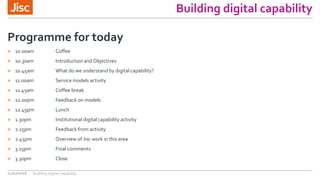
» 10.00am Coffee
» 10.30am Introduction and Objectives
» 10.45am What do we understand by digital capability?
» 11.00am Service models activity
» 11.45am Coffee break
» 12.00pm Feedback on models
» 12.45pm Lunch
» 1.30pm Institutional digital capability activity
» 2.15pm Feedback from activity
» 2.45pm Overview of Jisc work in this area
» 3.15pm Final comments
» 3.30pm Close
Programme for today
21/07/2016 Building digital capability
Question
What do we understand
by digital capability?
21/07/2016 Building digital capability
Building digital capability
»Assumption that staff have the digital capabilities to carry
out their role in a changing digital world.
»But do they?
»How would you know?
»How would they know?
»Who knows?
»Assumption that staff have the digital capabilities to carry
out their role anytime, any location, off or on campus?
21/07/2016 Building digital capability
Image Credit James Clay
Building digital capability
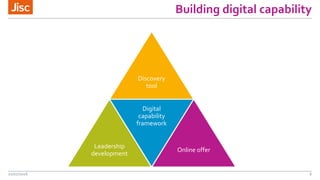
Discovery
tool
Leadership
development
Digital
capability
framework
Online offer
21/07/2016 6
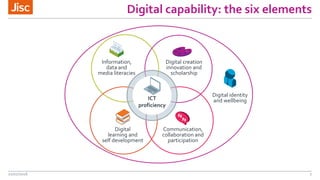
Digital capability: the six elements
21/07/2016 7
ICT
proficiency
Information,
data and
media literacies
Digital
learning and
self development
Digital creation
innovation and
scholarship
Communication,
collaboration and
participation
Digital identity
and wellbeing
Old Tools by arbyreed CC BY-NC-SA 2.0 https://flic.kr/p/hQQFyGOld
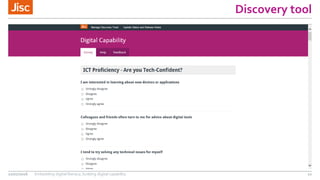
Discovery tool
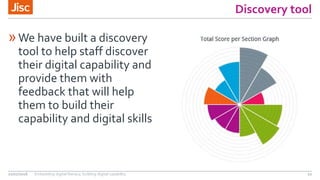
»We have built a discovery
tool to help staff discover
their digital capability and
provide them with
feedback that will help
them to build their
capability and digital skills
21/07/2016 Embedding digital literacy; building digital capability 10
Discovery tool
21/07/2016 Embedding digital literacy; building digital capability 11
Discovery tool pilots
»As well as large scale tests we have a number of
institutions, FE, HE and Skills who are undertaking small
scale pilots with groups of staff.
»In addition we have provided the Digital capability user
group of eighty plus institutions with a version of the tool
for them to test with small groups.
»As a result we have had further user feedback that will
inform development and functionality.
21/07/2016 12Embedding digital literacy; building digital capability
Image Credit James Clay
Digital Leadership Course
» The Jisc Digital Leaders programme has been designed
specifically to equip current and aspiring leaders and
managers with the tools and knowledge to inform their
digital practice, enabling them to:
› Become a more effective digital leader or manager
through personal and professional development
› Explore how their organisations can engage more
effectively with the technology at their disposal – at both
strategic and operational levels
› Lead, manage and influence digitally-driven strategy across
organisations, departments, services and teams
21/07/2016 14Emedding digital literacy; building digital capability
Digital Leadership Course
»The first paid for course will be run in October.
ȣ2,200 per person
21/07/2016 15Embedding digital literacy; building digital capability
Image by James Clay CC BY-NC 2.0
Online Offer
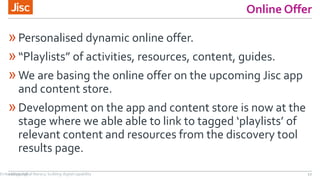
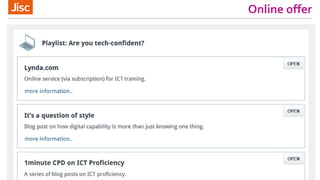
»Personalised dynamic online offer.
»“Playlists” of activities, resources, content, guides.
»We are basing the online offer on the upcoming Jisc app
and content store.
»Development on the app and content store is now at the
stage where we able able to link to tagged ‘playlists’ of
relevant content and resources from the discovery tool
results page.
21/07/2016 17Embedding digital literacy; building digital capability
Online offer
21/07/2016 Building digital capability 18
Image credit: Lego Color Bricks by Alan Chia CC BY-SA 2.0 https://commons.wikimedia.org/wiki/File:Lego_Color_Bricks.jpg via Wikimedia Commons
Building digital capability
Service models
21/07/2016 Building digital capability
Building digital capability
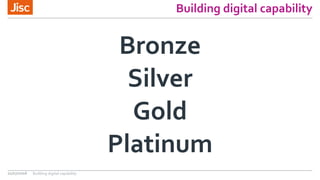
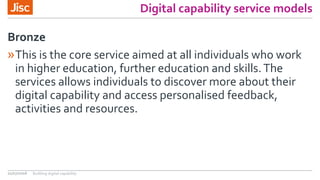
Bronze
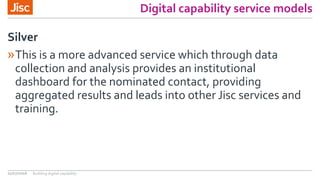
Silver
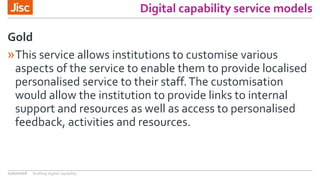
Gold
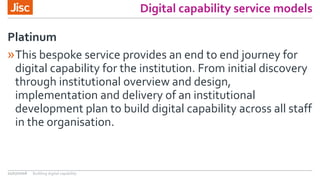
Platinum
21/07/2016 Building digital capability
Digital capability service models
»This is the core service aimed at all individuals who work
in higher education, further education and skills.The
services allows individuals to discover more about their
digital capability and access personalised feedback,
activities and resources.
Bronze
21/07/2016 Building digital capability
Digital capability service models
»This is a more advanced service which through data
collection and analysis provides an institutional
dashboard for the nominated contact, providing
aggregated results and leads into other Jisc services and
training.
Silver
21/07/2016 Building digital capability
Digital capability service models
»This service allows institutions to customise various
aspects of the service to enable them to provide localised
personalised service to their staff.The customisation
would allow the institution to provide links to internal
support and resources as well as access to personalised
feedback, activities and resources.
Gold
21/07/2016 Building digital capability
Digital capability service models
»This bespoke service provides an end to end journey for
digital capability for the institution. From initial discovery
through institutional overview and design,
implementation and delivery of an institutional
development plan to build digital capability across all staff
in the organisation.
Platinum
21/07/2016 Building digital capability
Building digital capability
Review the models and
provide feedback and
reflection
21/07/2016 Building digital capability
Question
What do we understand
by institutional digital
capability?
21/07/2016 Building digital capability
Twitter Bird by DryIcons with permission https://www.smashingmagazine.com/2008/09/practika-a-free-icon-set/
Image Copyright NERC
Image: Lawrie Phipps
Location independent working
Location, location,
location
21/07/2016 Building digital capability
Image: Lawrie Phipps
Location independent working
»Benefits to the individual
› Improve work-life balance
› Reduce commute time
› Reduce travel costs
› Remove unnecessary stress
21/07/2016 Building digital capability
Location independent working
»Benefits to the university
› Provide employees with flexibility regarding their
working hours and location
› Reduce the occupancy of University premises
› Improve employees’ work life balance and thereby
reduce levels of absenteeism and stress
› Reduce pressure on car parking facilities
› Position the University as an ’employer of choice’
21/07/2016 Building digital capability
But what else…
Capability
21/07/2016 Building digital capability
Location independent working
»Issues in terms of capabilities
› ICT proficiency
› Digital communication
› Digital collaboration
› Digital participation
› Digital wellbeing
21/07/2016 Building digital capability
Communication
…it’s not just about e-mail
21/07/2016 Building digital capability
Tools
»Yammer
»Slack
»Basecamp
»Jira
»Confluence
»CRM
»Sharepoint
»Google Apps
»Skype, Lync
»Google Hangouts
»Invision
»Scribblar
»Dropbox, Google Drive
»Trello
»Padlet
»Adobe Connect, Collaborate
21/07/2016 Building digital capability
Location independent working
Risk
21/07/2016 Building digital capability
Old Man's Desk by Daniel Hansson CC BY 2.0 https://flic.kr/p/2oeYqL
Location independent working
Presence
21/07/2016 Building digital capability
Location independent working
Outcomes
21/07/2016 Building digital capability
Things to think about
»Trust
»Responsibility
»Wellbeing
»Work-life balance
»Management
»Leadership
21/07/2016 Building digital capability
Image Credit James Clay
Building digital capability
Institutional
digital capability
21/07/2016 Building digital capability
Building institutional digital capability
»Effective use of digital technology by university and
college staff is vital in providing a compelling student
experience and in realising a good return on investment in
digital technology.
› Teaching & Learning
› Research
› Public Engagement
21/07/2016 Building digital capability
Building digital capability
What do you understand
by institutional digital
capability?
21/07/2016 Building digital capability
Institutional digital capability
»Infrastructure
»Organisation
»Development
»Data
»Resources
»Intelligent campus
»Content
21/07/2016 Building digital capability
Institutional digital capability
»Infrastructure
»Organisation
»Development
»Data
»Resources
»Intelligent campus
»Content
»IT Services
»People Services
»Organisation development
»Student records, MIS
»Finance
»Estates and facilities
»Library
21/07/2016 Building digital capability
Institutional digital capability
»Infrastructure
› Ubiquitous wifi, eduroam
› Access to hardware
› Virtual desktops
› Collaborative tools
› Remote working
› Utilisation
› Innovation
21/07/2016 Building digital capability
Institutional digital capability
»People services
› Job descriptions
› Skills analysis and audit
› Matrix working
› Appraisal or performance review
› Silo working
› Home working
› Communication
21/07/2016 Building digital capability
Building digital capability
Virtual Learning
Environment
21/07/2016 Building digital capability
Virtual learning environment
»Digital learning
21/07/2016 Building digital capability
Virtual learning environment
»Digital learning
»Digital communication
»Digital collaboration
»Digital participation
»Digital innovation
»Digital media literacy
»ICT proficiency
21/07/2016 Building digital capability
Virtual learning environment
»Now let’s throw in analytics
› Data literacies
› Information literacies
21/07/2016 Building digital capability
So…
Digital capability is core to:Teaching & Learning, Research
and Public Engagement
Dependent on the infrastructure, organisation,
development, data, resources, the campus and content.
Which are the domains of the different functions of the
organisation.
Who need to understand digital and the impact on the
organisation.
21/07/2016 Building digital capability
Image by Randy von Liski https://flic.kr/p/8pxy4r CC BY-NC-ND 2.0
Dashboard
»Bringing together information and aggregation of data
from usage of the discovery tool.
»We are currently designing the prototype institutional
dashboard based on our emerging understanding of what
the institutional leads want to know about their staff’s
results in the discovery tool.
»Link in with resources and services currently in use and
what is available.
21/07/2016 Building digital capability
Further development
»We know from the interest in the project among Jisc
member institutions, and from the reactions and
experiences from pilot sites, that we could usefully
expand the organisational capability side of the service to
help institutions ensure that they have all of the building
blocks in place for a fully digital capable organisation
21/07/2016 Embedding digital literacy; building digital capability 63
Image Credit: Moyan Brenn https://flic.kr/p/e7M5Qx CC BY 2.0
Image by James Clay CC BY-NC 2.0
»There is the main site on the
Jisc website.
»https://www.jisc.ac.uk/rd/proje
cts/building-digital-capability
Web site
»Follow the project on the blog.
»http://digitalcapability.jiscinvol
ve.org/wp/
Project Blog
21/07/2016 Building digital capability
Twitter
»Follow the community using
the hashtag #digitalcapability
»https://twitter.com/hashtag/di
gitalcapability?vertical=defaul
t&src=hash
Twitter
21/07/2016 Building digital capability
jisc.ac.uk
Except where otherwise noted, this work
is licensed under CC-BY-NC-ND
Get in touch…
Building digital capability
James Clay
Project manager
james.clay@jisc.ac.uk
21/07/2016
http://bit.ly/jiscdigcap
Building digital capability

Building Digital Capability - Service Modelling Workshop and Institutional Digital Capability

  • 1.
    Models James Clay, SeniorCo-Design Manager, Jisc 21/07/2016 Image Credit Fujimi 1/700 Taiho inbox by Marcin https://flic.kr/p/98RG2M CC BY-NC-SA 2.0
  • 2.
    Building digital capability »10.00am Coffee » 10.30am Introduction and Objectives » 10.45am What do we understand by digital capability? » 11.00am Service models activity » 11.45am Coffee break » 12.00pm Feedback on models » 12.45pm Lunch » 1.30pm Institutional digital capability activity » 2.15pm Feedback from activity » 2.45pm Overview of Jisc work in this area » 3.15pm Final comments » 3.30pm Close Programme for today 21/07/2016 Building digital capability
  • 3.
    Question What do weunderstand by digital capability? 21/07/2016 Building digital capability
  • 4.
    Building digital capability »Assumptionthat staff have the digital capabilities to carry out their role in a changing digital world. »But do they? »How would you know? »How would they know? »Who knows? »Assumption that staff have the digital capabilities to carry out their role anytime, any location, off or on campus? 21/07/2016 Building digital capability
  • 5.
  • 6.
  • 7.
    Digital capability: thesix elements 21/07/2016 7 ICT proficiency Information, data and media literacies Digital learning and self development Digital creation innovation and scholarship Communication, collaboration and participation Digital identity and wellbeing
  • 9.
    Old Tools byarbyreed CC BY-NC-SA 2.0 https://flic.kr/p/hQQFyGOld
  • 10.
    Discovery tool »We havebuilt a discovery tool to help staff discover their digital capability and provide them with feedback that will help them to build their capability and digital skills 21/07/2016 Embedding digital literacy; building digital capability 10
  • 11.
    Discovery tool 21/07/2016 Embeddingdigital literacy; building digital capability 11
  • 12.
    Discovery tool pilots »Aswell as large scale tests we have a number of institutions, FE, HE and Skills who are undertaking small scale pilots with groups of staff. »In addition we have provided the Digital capability user group of eighty plus institutions with a version of the tool for them to test with small groups. »As a result we have had further user feedback that will inform development and functionality. 21/07/2016 12Embedding digital literacy; building digital capability
  • 13.
  • 14.
    Digital Leadership Course »The Jisc Digital Leaders programme has been designed specifically to equip current and aspiring leaders and managers with the tools and knowledge to inform their digital practice, enabling them to: › Become a more effective digital leader or manager through personal and professional development › Explore how their organisations can engage more effectively with the technology at their disposal – at both strategic and operational levels › Lead, manage and influence digitally-driven strategy across organisations, departments, services and teams 21/07/2016 14Emedding digital literacy; building digital capability
  • 15.
    Digital Leadership Course »Thefirst paid for course will be run in October. »£2,200 per person 21/07/2016 15Embedding digital literacy; building digital capability
  • 16.
    Image by JamesClay CC BY-NC 2.0
  • 17.
    Online Offer »Personalised dynamiconline offer. »“Playlists” of activities, resources, content, guides. »We are basing the online offer on the upcoming Jisc app and content store. »Development on the app and content store is now at the stage where we able able to link to tagged ‘playlists’ of relevant content and resources from the discovery tool results page. 21/07/2016 17Embedding digital literacy; building digital capability
  • 18.
    Online offer 21/07/2016 Buildingdigital capability 18
  • 19.
    Image credit: LegoColor Bricks by Alan Chia CC BY-SA 2.0 https://commons.wikimedia.org/wiki/File:Lego_Color_Bricks.jpg via Wikimedia Commons
  • 20.
    Building digital capability Servicemodels 21/07/2016 Building digital capability
  • 21.
  • 22.
    Digital capability servicemodels »This is the core service aimed at all individuals who work in higher education, further education and skills.The services allows individuals to discover more about their digital capability and access personalised feedback, activities and resources. Bronze 21/07/2016 Building digital capability
  • 23.
    Digital capability servicemodels »This is a more advanced service which through data collection and analysis provides an institutional dashboard for the nominated contact, providing aggregated results and leads into other Jisc services and training. Silver 21/07/2016 Building digital capability
  • 24.
    Digital capability servicemodels »This service allows institutions to customise various aspects of the service to enable them to provide localised personalised service to their staff.The customisation would allow the institution to provide links to internal support and resources as well as access to personalised feedback, activities and resources. Gold 21/07/2016 Building digital capability
  • 25.
    Digital capability servicemodels »This bespoke service provides an end to end journey for digital capability for the institution. From initial discovery through institutional overview and design, implementation and delivery of an institutional development plan to build digital capability across all staff in the organisation. Platinum 21/07/2016 Building digital capability
  • 26.
    Building digital capability Reviewthe models and provide feedback and reflection 21/07/2016 Building digital capability
  • 27.
    Question What do weunderstand by institutional digital capability? 21/07/2016 Building digital capability
  • 28.
    Twitter Bird byDryIcons with permission https://www.smashingmagazine.com/2008/09/practika-a-free-icon-set/
  • 32.
  • 33.
  • 34.
    Location independent working Location,location, location 21/07/2016 Building digital capability
  • 35.
  • 36.
    Location independent working »Benefitsto the individual › Improve work-life balance › Reduce commute time › Reduce travel costs › Remove unnecessary stress 21/07/2016 Building digital capability
  • 37.
    Location independent working »Benefitsto the university › Provide employees with flexibility regarding their working hours and location › Reduce the occupancy of University premises › Improve employees’ work life balance and thereby reduce levels of absenteeism and stress › Reduce pressure on car parking facilities › Position the University as an ’employer of choice’ 21/07/2016 Building digital capability
  • 38.
    But what else… Capability 21/07/2016Building digital capability
  • 39.
    Location independent working »Issuesin terms of capabilities › ICT proficiency › Digital communication › Digital collaboration › Digital participation › Digital wellbeing 21/07/2016 Building digital capability
  • 41.
    Communication …it’s not justabout e-mail 21/07/2016 Building digital capability
  • 42.
    Tools »Yammer »Slack »Basecamp »Jira »Confluence »CRM »Sharepoint »Google Apps »Skype, Lync »GoogleHangouts »Invision »Scribblar »Dropbox, Google Drive »Trello »Padlet »Adobe Connect, Collaborate 21/07/2016 Building digital capability
  • 43.
  • 44.
    Old Man's Deskby Daniel Hansson CC BY 2.0 https://flic.kr/p/2oeYqL
  • 45.
  • 46.
  • 47.
    Things to thinkabout »Trust »Responsibility »Wellbeing »Work-life balance »Management »Leadership 21/07/2016 Building digital capability
  • 48.
  • 49.
    Building digital capability Institutional digitalcapability 21/07/2016 Building digital capability
  • 50.
    Building institutional digitalcapability »Effective use of digital technology by university and college staff is vital in providing a compelling student experience and in realising a good return on investment in digital technology. › Teaching & Learning › Research › Public Engagement 21/07/2016 Building digital capability
  • 51.
    Building digital capability Whatdo you understand by institutional digital capability? 21/07/2016 Building digital capability
  • 52.
  • 53.
    Institutional digital capability »Infrastructure »Organisation »Development »Data »Resources »Intelligentcampus »Content »IT Services »People Services »Organisation development »Student records, MIS »Finance »Estates and facilities »Library 21/07/2016 Building digital capability
  • 54.
    Institutional digital capability »Infrastructure ›Ubiquitous wifi, eduroam › Access to hardware › Virtual desktops › Collaborative tools › Remote working › Utilisation › Innovation 21/07/2016 Building digital capability
  • 55.
    Institutional digital capability »Peopleservices › Job descriptions › Skills analysis and audit › Matrix working › Appraisal or performance review › Silo working › Home working › Communication 21/07/2016 Building digital capability
  • 56.
    Building digital capability VirtualLearning Environment 21/07/2016 Building digital capability
  • 57.
    Virtual learning environment »Digitallearning 21/07/2016 Building digital capability
  • 58.
    Virtual learning environment »Digitallearning »Digital communication »Digital collaboration »Digital participation »Digital innovation »Digital media literacy »ICT proficiency 21/07/2016 Building digital capability
  • 59.
    Virtual learning environment »Nowlet’s throw in analytics › Data literacies › Information literacies 21/07/2016 Building digital capability
  • 60.
    So… Digital capability iscore to:Teaching & Learning, Research and Public Engagement Dependent on the infrastructure, organisation, development, data, resources, the campus and content. Which are the domains of the different functions of the organisation. Who need to understand digital and the impact on the organisation. 21/07/2016 Building digital capability
  • 61.
    Image by Randyvon Liski https://flic.kr/p/8pxy4r CC BY-NC-ND 2.0
  • 62.
    Dashboard »Bringing together informationand aggregation of data from usage of the discovery tool. »We are currently designing the prototype institutional dashboard based on our emerging understanding of what the institutional leads want to know about their staff’s results in the discovery tool. »Link in with resources and services currently in use and what is available. 21/07/2016 Building digital capability
  • 63.
    Further development »We knowfrom the interest in the project among Jisc member institutions, and from the reactions and experiences from pilot sites, that we could usefully expand the organisational capability side of the service to help institutions ensure that they have all of the building blocks in place for a fully digital capable organisation 21/07/2016 Embedding digital literacy; building digital capability 63
  • 64.
    Image Credit: MoyanBrenn https://flic.kr/p/e7M5Qx CC BY 2.0
  • 65.
    Image by JamesClay CC BY-NC 2.0
  • 66.
    »There is themain site on the Jisc website. »https://www.jisc.ac.uk/rd/proje cts/building-digital-capability Web site »Follow the project on the blog. »http://digitalcapability.jiscinvol ve.org/wp/ Project Blog 21/07/2016 Building digital capability
  • 67.
    Twitter »Follow the communityusing the hashtag #digitalcapability »https://twitter.com/hashtag/di gitalcapability?vertical=defaul t&src=hash Twitter 21/07/2016 Building digital capability
  • 68.
    jisc.ac.uk Except where otherwisenoted, this work is licensed under CC-BY-NC-ND Get in touch… Building digital capability James Clay Project manager james.clay@jisc.ac.uk 21/07/2016 http://bit.ly/jiscdigcap Building digital capability

Editor's Notes

  • #2 Welcome to this presentation Image Credit Fujimi 1/700 Taiho inbox by Marcin https://flic.kr/p/98RG2M CC BY-NC-SA 2.0 Effective use of digital technology by university and college staff is vital in providing a compelling student experience and in realising a good return on investment in digital technology. Our codesign work with stakeholders in universities, colleges and skills providers has highlighted that improving the digital skills of the workforce, particularly moving beyond the early adopters, is a key concern across the sectors, and something that they want Jisc to help them address.
  • #4 Asking the delegates what we mean when we say digital capability? The ability to live, work and learn in a digital world. The importance of a shared understanding.
  • #6 Image Credit James Clay
  • #7 Jisc are building a digital capability service, comprising initially of four key components. A digital capability framework which describes the skills needed by staff in a wide range of academic, administrative and professional roles to thrive in a digital environment. This provides a structure to help managers and individuals understand what is needed and supports the development of tools. The generic framework is complete and in use in the sector. A suite of discovery tools to help individuals and managers in a range of roles identify and reflect on current skills levels and digital capability, and make plans for how these can be improved. The discovery tool is currently in beta piloting. A digital leadership development programme to support leaders in developing strategy and plans for the kind of digital university or college they want theirs to become, and the workforce skills that will require. Tailored packages of online information and staff development resources.
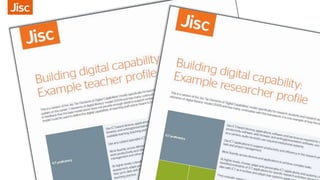
  • #8 We have published the framework, the background report, profiles… The Jisc '7 elements of digital literacy' model is well used and recognised (93% recognition from survey April 2015). Most other frameworks and definitions can be fitted comfortably into one or more of the elements as originally defined. However, since it was first devised, two issues have emerged as critical in living, learning and working effectively with technology: data literacy in an age of proliferating personal data, big/deep data and data hacking, and various aspects of 'well-being' (health, safety, work-life balance, relationships, personal safety and privacy) in an increasingly hybridised (real/virtual) environment. Some of the original elements also look a bit dated as digital practice has moved on and as discourse about digital literacy has become more nuanced and widely shared. The most significant change is to combine 'information' with 'media' literacies, as feedback suggests that users have difficulty distinguishing between the two. This version has been adapted considerably from an earlier version in response to detailed feedback from 16 stakeholders (over 40 were consulted over the initial version) and broad brush feedback from consultation events, which are ongoing. There was consensus over the need for shared language and an appetite for a shared framework, but one that was mapped carefully to other frameworks such as the SCONUL 7 pillars, CILIP, ANCIL, UK PSF, Vitae digital lens etc showing how and where these representations add detail to the broader picture. The framework was seen as most useful to: bridge staff and student digital capabilities (i.e. supporting discussion about and planning for both in departments and services) plan for embedding digital capabilities into specific subject areas (for which the 7 elements are already well used) map digital expertise across different staff
  • #9 Looking to create more profiles, encouraging organisations and sector bodies to create profiles.
  • #10 Image Credit Old Tools by arbyreed CC BY-NC-SA 2.0 https://flic.kr/p/hQQFyGOld
  • #11 An individual user will be provided with a link to help them understand their own and build their digital capability. This tool will help them discover their digital capabilities and assess what they can do to build your skills and experience across the six digital capabilities, broken down into twelve sub-elements. Having answered the questions in the tool the user is provided with a diagram which reflects their current level of digital capability, which they will be able to compare with others who are similar to them. They will be provided with a series of feedback statements across the twelve sub-elements of digital capability. The focus of the statements will be about helping them to help themselves to build their own digital capability.
  • #12 Screengrab of the beta version of the tool
  • #13 Pilots
  • #14 Image Credit James Clay
  • #15 The Jisc Digital Leaders programme has been designed specifically to equip current and aspiring leaders and managers with the tools and knowledge to inform their digital practice, enabling them to: Become a more effective digital leader or manager through personal and professional development Explore how their organisations can engage more effectively with the technology at their disposal – at both strategic and operational levels Lead, manage and influence digitally-driven strategy across organisations, departments, services and teams Strategic challenges across the higher and further education sectors, such as those posed by the FELTAG, Area Based Reviews, teaching excellence framework and open research agenda, need embedded, organisation-wide digital capability in order to successfully implement technology-driven responses. These responses might include, increased uptake of cloud and data-driven solutions, adoption of analytics for decision-making and learner-support or improving network and learning technology access for staff and students to enable blended learning to happen more effectively. Digitally-informed and empowered leaders not only embrace the innovation, collaboration and efficiency gains these bring to their organisation, but also create an environment where others can fully exploit and embed them in their practice.
  • #18 These playlists will be updated as new content and resources are published. Playlists will be personalised to sector, role, level and capability.
  • #20 Image credit: Lego Color Bricks by Alan Chia CC BY-SA 2.0 https://commons.wikimedia.org/wiki/File:Lego_Color_Bricks.jpg via Wikimedia Commons
  • #21 Asking the delegates what we mean when we say institutional digital capability? The ability to live, work and learn in a digital world. The importance of a shared understanding.
  • #22 Asking the delegates what we mean when we say institutional digital capability? The ability to live, work and learn in a digital world. The importance of a shared understanding.
  • #27 Asking the delegates to review the models and provide feedback and reflection
  • #28 Asking the delegates what we mean when we say institutional digital capability? The ability to live, work and learn in a digital world. The importance of a shared understanding.
  • #29 Twitter Bird by DryIcons with permission https://www.smashingmagazine.com/2008/09/practika-a-free-icon-set/
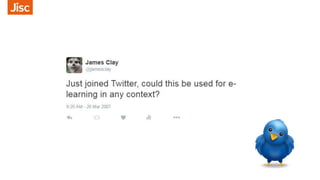
  • #30 This was my first ever tweet…
  • #31 How could I use Twitter? What was the point?
  • #32 HIV Clinic e-mail error A “mistake” resulted in the “leak” of 780 e-mail addresses of patients who attended an HIV clinic in London. The clinic blamed the breach on “human error”. There are some key digital capability lessons that come out from this incident. Why was “simple” e-mail been used to send out a newsletter, when there was a risk of a leak of sensitive data? The clinic were fined £180,000 Read more https://digitalcapability.jiscinvolve.org/wp/2015/09/03/focus-on-data-literacies-and-ict-proficiency-the-importance-of-digital-capabilities/
  • #33 NERC and BoatyMacBoatface Don’t ask the internet to name stuff, don’t expect them to take it seriously.
  • #34 Location independent working http://lawriephipps.co.uk/?p=8065 “Work is something you do, not somewhere you go!” Obviously this is not true for many people – from chefs to hospital staff, work is somewhere you obviously go. But in a connected world, it doesn’t need to be true for everyone. Moreover, now, it is not just something and somewhere, but also somewhen.
  • #36 Location independent working
  • #37 The insistence that the only legitimate place for work to take place is within an office or a building results in a situation where it can be difficult to parse out where physical presence is actually necessary, because the working assumption is that  it is always necessary.   Doing the iterative exploration allows people to figure out when face to face meetings are crucial, or can be substituted for with emails, Skype or phone calls, texting exchanges, or even social media DMs.   People can become more connected and communicative when allowed a wider range of possibilities, rather than locking communication into tethered channels, and mistaking physical location for presence or attention.
  • #39 The web affords us new ways of working, new opportunities to connect.  It furthermore allows for a richer experience of work and life, rather than forcing us to segregate our time from ourselves via physical location, allowing us to choose when and where we are most productive, and how to conserve our face to face energy for those times that truly require it. But we mustn’t assume that staff have the necessary digital capabilities to do so.
  • #43 There are various tools and services out there that can support location independent working as well as tools such as the VLE.
  • #44 So people can work anywhere, anytime…. Isn’t that risky? Yes. But similar risks exist when working in offices and physical locations. Presence doesn’t necessary mean productivity.
  • #45 Image Credit Old Man's Desk by Daniel Hansson CC BY 2.0 https://flic.kr/p/2oeYqL
  • #49 Image Credit James Clay
  • #58 Is capability to use the VLE just about digital learning capability?
  • #59 Often failure to make best use of the VLE is because of a lack of capability and training in a range of capabilities. Assumptions are made that people will be able to pick it up because they can use e-mail.
  • #60 Start to think about learning analytics, next generation learning environments and the importance of data and information literacy starts to come to the fore…
  • #65 Image Credit: Moyan Brenn https://flic.kr/p/e7M5Qx CC BY 2.0
  • #66 Image Credit https://flic.kr/p/b93YGx
  • #67 There is the main site on the Jisc website. https://www.jisc.ac.uk/rd/projects/building-digital-capability Follow the project on the blog. http://digitalcapability.jiscinvolve.org/wp/
  • #68 https://twitter.com/hashtag/digitalcapability?vertical=default&src=hash