ENGT 107: PRINCIPLES
OF HYDRAULICS AND
PNEUMATICS PROFESSOR JIM
EVANGELOS
Example ProblemsChapt. 2
Example Problems:
1 Example 2-4
2 Example 2-5
3 Example 2-6 & 2-6M
4 Example 2-7
5 Example 2-8
6 Example 2-9M
7 Example 2-12
8 Example 2-13
9 Example 2-17M
10 Example 2-19
11 Example 2-20
Example 2-4
Hydraulic Force Multiplication
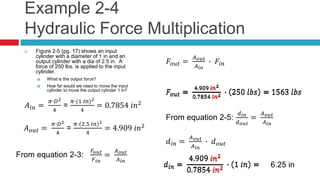
 Figure 2-5 (pg. 17) shows an input
cylinder with a diameter of 1 in and an
output cylinder with a dia of 2.5 in. A
force of 250 lbs. is applied to the input
cylinder.
 What is the output force?
 How far would we need to move the input
cylinder to move the output cylinder 1 in?
𝐴𝑖𝑛 =
𝜋∙𝐷2
4
=
𝜋∙(1 𝑖𝑛)2
4
= 0.7854 𝑖𝑛2
𝐴 𝑜𝑢𝑡 =
𝜋∙𝐷2
4
=
𝜋∙(2.5 𝑖𝑛)2
4
= 4.909 𝑖𝑛2
From equation 2-3:
𝐹𝑜𝑢𝑡
𝐹 𝑖𝑛
=
𝐴 𝑜𝑢𝑡
𝐴 𝑖𝑛
𝐹𝑜𝑢𝑡 =
𝐴 𝑜𝑢𝑡
𝐴 𝑖𝑛
∙ 𝐹𝑖𝑛
𝐹𝑜𝑢𝑡 =
4.909 𝑖𝑛2
0.7854 𝑖𝑛2 ∙ 250 𝑙𝑏𝑠 = 1563 𝑙𝑏𝑠
From equation 2-5:
𝑑𝑖𝑛
𝑑 𝑜𝑢𝑡
=
𝐴 𝑜𝑢𝑡
𝐴 𝑖𝑛
𝑑𝑖𝑛 =
𝐴 𝑜𝑢𝑡
𝐴 𝑖𝑛
∙ 𝑑 𝑜𝑢𝑡
𝑑𝑖𝑛 =
4.909 𝑖𝑛2
0.7854 𝑖𝑛2 ∙ 1 𝑖𝑛 =
𝐹𝑜𝑢𝑡 =
4.909 𝑖𝑛2
0.7854 𝑖𝑛2 ∙ 250 𝑙𝑏𝑠 = 1563 𝑙𝑏𝑠
𝑑𝑖𝑛 =
4.909 𝑖𝑛2
0.7854 𝑖𝑛2 ∙ 1 𝑖𝑛 = 6.25 in
Example 2-5
Velocity trade off
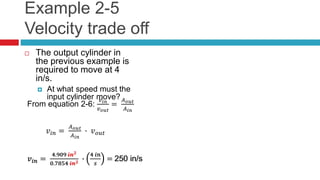
 The output cylinder in
the previous example is
required to move at 4
in/s.
 At what speed must the
input cylinder move?
𝑣𝑖𝑛 =
4.909 𝑖𝑛2
0.7854 𝑖𝑛2 ∙
4 𝑖𝑛
𝑠
= 250 in/s
From equation 2-6:
𝑣 𝑖𝑛
𝑣 𝑜𝑢𝑡
=
𝐴 𝑜𝑢𝑡
𝐴 𝑖𝑛
𝑣𝑖𝑛 =
𝐴 𝑜𝑢𝑡
𝐴 𝑖𝑛
∙ 𝑣 𝑜𝑢𝑡
𝑣𝑖𝑛 =
4.909 𝑖𝑛2
0.7854 𝑖𝑛2 ∙
4 𝑖𝑛
𝑠
= 250 in/s
Example 2-6 & 2-6M
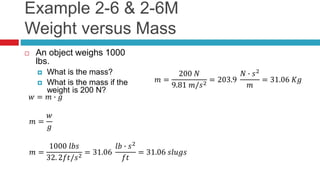
Weight versus Mass
 An object weighs 1000
lbs.
 What is the mass?
 What is the mass if the
weight is 200 N?
𝑤 = 𝑚 ∙ 𝑔
𝑚 =
𝑤
𝑔
𝑚 =
1000 𝑙𝑏𝑠
32. 2𝑓𝑡/𝑠2
= 31.06
𝑙𝑏 ∙ 𝑠2
𝑓𝑡
= 31.06 𝑠𝑙𝑢𝑔𝑠
𝑚 =
200 𝑁
9.81 𝑚/𝑠2 = 203.9
𝑁 ∙ 𝑠2
𝑚
= 31.06 𝐾𝑔
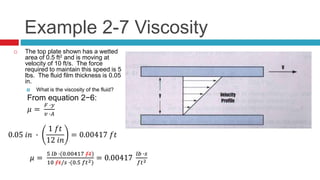
Example 2-7 Viscosity
 The top plate shown has a wetted
area of 0.5 ft2 and is moving at
velocity of 10 ft/s. The force
required to maintain this speed is 5
lbs. The fluid film thickness is 0.05
in.
 What is the viscosity of the fluid?
From equation 2−6:
𝜇 =
𝐹 ∙𝑦
𝑣 ∙𝐴
𝜇 =
5 𝑙𝑏 ∙(0.00417 𝑓𝑡)
10 𝑓𝑡/𝑠 ∙(0.5 𝑓𝑡2)
= 0.00417
𝑙𝑏 ∙𝑠
𝑓𝑡2
0.05 𝑖𝑛 ∙
1 𝑓𝑡
12 𝑖𝑛
= 0.00417 𝑓𝑡
𝜇 =
5 𝑙𝑏 ∙(0.00417 𝑓𝑡)
10 𝑓𝑡/𝑠 ∙(0.5 𝑓𝑡2)
= 0.00417
𝑙𝑏 ∙𝑠
𝑓𝑡2
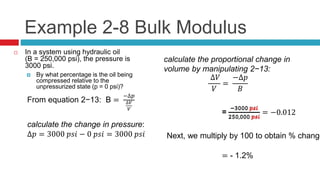
Example 2-8 Bulk Modulus
 In a system using hydraulic oil
(B = 250,000 psi), the pressure is
3000 psi.
 By what percentage is the oil being
compressed relative to the
unpressurized state (p = 0 psi)?
From equation 2−13: B =
−∆𝑝
∆𝑉
𝑉
calculate the change in pressure:
∆𝑝 = 3000 𝑝𝑠𝑖 − 0 𝑝𝑠𝑖 = 3000 𝑝𝑠𝑖
calculate the proportional change in
volume by manipulating 2−13:
∆𝑉
𝑉
=
−∆𝑝
𝐵
=
−3000 𝑝𝑠𝑖
250,000 𝑝𝑠𝑖
=
−3000 𝑝𝑠𝑖
250,000 𝑝𝑠𝑖
= −0.012
Next, we multiply by 100 to obtain % change
= - 1.2%
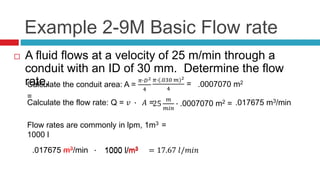
Example 2-9M Basic Flow rate
 A fluid flows at a velocity of 25 m/min through a
conduit with an ID of 30 mm. Determine the flow
rate.Calculate the conduit area: A =
𝜋∙𝐷2
4
=
𝜋∙(.030 𝑚)2
4
= .0007070 m2
Calculate the flow rate: Q = 𝑣 ∙ 𝐴 =25
𝑚
𝑚𝑖𝑛
∙ .0007070 m2 = .017675 m3/min
Flow rates are commonly in lpm, 1m3 =
1000 l
.017675 m3/min ∙ 1000 l/m3 = 17.67 𝑙/𝑚𝑖𝑛.017675 m3/min 1000 l/m3
Example 2-12 Continuity
Equation
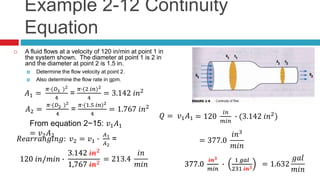
 A fluid flows at a velocity of 120 in/min at point 1 in
the system shown. The diameter at point 1 is 2 in
and the diameter at point 2 is 1.5 in.
 Determine the flow velocity at point 2.
 Also determine the flow rate in gpm.
𝐴1 =
𝜋∙(𝐷1 )2
4
=
𝜋∙(2 𝑖𝑛)2
4
= 3.142 𝑖𝑛2
𝐴2 =
𝜋∙(𝐷2 )2
4
=
𝜋∙(1.5 𝑖𝑛)2
4
= 1.767 𝑖𝑛2
From equation 2−15: 𝑣1 𝐴1
= 𝑣2 𝐴2
𝑅𝑒𝑎𝑟𝑟𝑎𝑛𝑔𝑖𝑛𝑔: 𝑣2 = 𝑣1 ∙
𝐴1
𝐴2
=
𝑄 = 𝑣1 𝐴1
120 𝑖𝑛/𝑚𝑖𝑛 ∙
3.142 𝑖𝑛2
1.767 𝑖𝑛2120 𝑖𝑛/𝑚𝑖𝑛 ∙
3.142 𝑖𝑛2
1,767 𝑖𝑛2
= 213.4
𝑖𝑛
𝑚𝑖𝑛
= 120
𝑖𝑛
𝑚𝑖𝑛
∙ (3.142 𝑖𝑛2
)
= 377.0
𝑖𝑛3
𝑚𝑖𝑛
377.0
𝑖𝑛3
𝑚𝑖𝑛
∙
1 𝑔𝑎𝑙
231 𝑖𝑛3377.0
𝑖𝑛3
𝑚𝑖𝑛
∙
1 𝑔𝑎𝑙
231 𝑖𝑛3
= 1.632
𝑔𝑎𝑙
𝑚𝑖𝑛
Example 2-13 Bernoulli’s
Equation
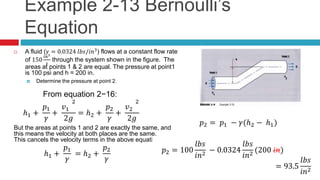
 A fluid (𝛾 = 0.0324 𝑙𝑏𝑠/𝑖𝑛3
) flows at a constant flow rate
of 150
𝑖𝑛3
𝑠
through the system shown in the figure. The
areas at points 1 & 2 are equal. The pressure at point1
is 100 psi and h = 200 in.
 Determine the pressure at point 2.
From equation 2−16:
ℎ1 +
𝑝1
𝛾
+
𝑣1
2
2𝑔
= ℎ2 +
𝑝2
𝛾
+
𝑣2
2
2𝑔
But the areas at points 1 and 2 are exactly the same, and
this means the velocity at both places are the same.
This cancels the velocity terms in the above equation:
ℎ1 +
𝑝1
𝛾
= ℎ2 +
𝑝2
𝛾
𝑝2 = 𝑝1 − 𝛾(ℎ2 − ℎ1)
𝑝2 = 100
𝑙𝑏𝑠
𝑖𝑛2
− 0.0324
𝑙𝑏𝑠
𝑖𝑛3
(200 𝑖𝑛)𝑝2 = 100
𝑙𝑏𝑠
𝑖𝑛2
− 0.0324
𝑙𝑏𝑠
𝑖𝑛2
(200 𝑖𝑛)
= 93.5
𝑙𝑏𝑠
𝑖𝑛2
Example 2-17M
 .
END OF LECTURE

ENGT_107 Lecture 02_Examples

  • 1.
    ENGT 107: PRINCIPLES OFHYDRAULICS AND PNEUMATICS PROFESSOR JIM EVANGELOS Example ProblemsChapt. 2
  • 2.
    Example Problems: 1 Example2-4 2 Example 2-5 3 Example 2-6 & 2-6M 4 Example 2-7 5 Example 2-8 6 Example 2-9M 7 Example 2-12 8 Example 2-13 9 Example 2-17M 10 Example 2-19 11 Example 2-20
  • 3.
    Example 2-4 Hydraulic ForceMultiplication  Figure 2-5 (pg. 17) shows an input cylinder with a diameter of 1 in and an output cylinder with a dia of 2.5 in. A force of 250 lbs. is applied to the input cylinder.  What is the output force?  How far would we need to move the input cylinder to move the output cylinder 1 in? 𝐴𝑖𝑛 = 𝜋∙𝐷2 4 = 𝜋∙(1 𝑖𝑛)2 4 = 0.7854 𝑖𝑛2 𝐴 𝑜𝑢𝑡 = 𝜋∙𝐷2 4 = 𝜋∙(2.5 𝑖𝑛)2 4 = 4.909 𝑖𝑛2 From equation 2-3: 𝐹𝑜𝑢𝑡 𝐹 𝑖𝑛 = 𝐴 𝑜𝑢𝑡 𝐴 𝑖𝑛 𝐹𝑜𝑢𝑡 = 𝐴 𝑜𝑢𝑡 𝐴 𝑖𝑛 ∙ 𝐹𝑖𝑛 𝐹𝑜𝑢𝑡 = 4.909 𝑖𝑛2 0.7854 𝑖𝑛2 ∙ 250 𝑙𝑏𝑠 = 1563 𝑙𝑏𝑠 From equation 2-5: 𝑑𝑖𝑛 𝑑 𝑜𝑢𝑡 = 𝐴 𝑜𝑢𝑡 𝐴 𝑖𝑛 𝑑𝑖𝑛 = 𝐴 𝑜𝑢𝑡 𝐴 𝑖𝑛 ∙ 𝑑 𝑜𝑢𝑡 𝑑𝑖𝑛 = 4.909 𝑖𝑛2 0.7854 𝑖𝑛2 ∙ 1 𝑖𝑛 = 𝐹𝑜𝑢𝑡 = 4.909 𝑖𝑛2 0.7854 𝑖𝑛2 ∙ 250 𝑙𝑏𝑠 = 1563 𝑙𝑏𝑠 𝑑𝑖𝑛 = 4.909 𝑖𝑛2 0.7854 𝑖𝑛2 ∙ 1 𝑖𝑛 = 6.25 in
  • 4.
    Example 2-5 Velocity tradeoff  The output cylinder in the previous example is required to move at 4 in/s.  At what speed must the input cylinder move? 𝑣𝑖𝑛 = 4.909 𝑖𝑛2 0.7854 𝑖𝑛2 ∙ 4 𝑖𝑛 𝑠 = 250 in/s From equation 2-6: 𝑣 𝑖𝑛 𝑣 𝑜𝑢𝑡 = 𝐴 𝑜𝑢𝑡 𝐴 𝑖𝑛 𝑣𝑖𝑛 = 𝐴 𝑜𝑢𝑡 𝐴 𝑖𝑛 ∙ 𝑣 𝑜𝑢𝑡 𝑣𝑖𝑛 = 4.909 𝑖𝑛2 0.7854 𝑖𝑛2 ∙ 4 𝑖𝑛 𝑠 = 250 in/s
  • 5.
    Example 2-6 &2-6M Weight versus Mass  An object weighs 1000 lbs.  What is the mass?  What is the mass if the weight is 200 N? 𝑤 = 𝑚 ∙ 𝑔 𝑚 = 𝑤 𝑔 𝑚 = 1000 𝑙𝑏𝑠 32. 2𝑓𝑡/𝑠2 = 31.06 𝑙𝑏 ∙ 𝑠2 𝑓𝑡 = 31.06 𝑠𝑙𝑢𝑔𝑠 𝑚 = 200 𝑁 9.81 𝑚/𝑠2 = 203.9 𝑁 ∙ 𝑠2 𝑚 = 31.06 𝐾𝑔
  • 6.
    Example 2-7 Viscosity The top plate shown has a wetted area of 0.5 ft2 and is moving at velocity of 10 ft/s. The force required to maintain this speed is 5 lbs. The fluid film thickness is 0.05 in.  What is the viscosity of the fluid? From equation 2−6: 𝜇 = 𝐹 ∙𝑦 𝑣 ∙𝐴 𝜇 = 5 𝑙𝑏 ∙(0.00417 𝑓𝑡) 10 𝑓𝑡/𝑠 ∙(0.5 𝑓𝑡2) = 0.00417 𝑙𝑏 ∙𝑠 𝑓𝑡2 0.05 𝑖𝑛 ∙ 1 𝑓𝑡 12 𝑖𝑛 = 0.00417 𝑓𝑡 𝜇 = 5 𝑙𝑏 ∙(0.00417 𝑓𝑡) 10 𝑓𝑡/𝑠 ∙(0.5 𝑓𝑡2) = 0.00417 𝑙𝑏 ∙𝑠 𝑓𝑡2
  • 7.
    Example 2-8 BulkModulus  In a system using hydraulic oil (B = 250,000 psi), the pressure is 3000 psi.  By what percentage is the oil being compressed relative to the unpressurized state (p = 0 psi)? From equation 2−13: B = −∆𝑝 ∆𝑉 𝑉 calculate the change in pressure: ∆𝑝 = 3000 𝑝𝑠𝑖 − 0 𝑝𝑠𝑖 = 3000 𝑝𝑠𝑖 calculate the proportional change in volume by manipulating 2−13: ∆𝑉 𝑉 = −∆𝑝 𝐵 = −3000 𝑝𝑠𝑖 250,000 𝑝𝑠𝑖 = −3000 𝑝𝑠𝑖 250,000 𝑝𝑠𝑖 = −0.012 Next, we multiply by 100 to obtain % change = - 1.2%
  • 8.
    Example 2-9M BasicFlow rate  A fluid flows at a velocity of 25 m/min through a conduit with an ID of 30 mm. Determine the flow rate.Calculate the conduit area: A = 𝜋∙𝐷2 4 = 𝜋∙(.030 𝑚)2 4 = .0007070 m2 Calculate the flow rate: Q = 𝑣 ∙ 𝐴 =25 𝑚 𝑚𝑖𝑛 ∙ .0007070 m2 = .017675 m3/min Flow rates are commonly in lpm, 1m3 = 1000 l .017675 m3/min ∙ 1000 l/m3 = 17.67 𝑙/𝑚𝑖𝑛.017675 m3/min 1000 l/m3
  • 9.
    Example 2-12 Continuity Equation A fluid flows at a velocity of 120 in/min at point 1 in the system shown. The diameter at point 1 is 2 in and the diameter at point 2 is 1.5 in.  Determine the flow velocity at point 2.  Also determine the flow rate in gpm. 𝐴1 = 𝜋∙(𝐷1 )2 4 = 𝜋∙(2 𝑖𝑛)2 4 = 3.142 𝑖𝑛2 𝐴2 = 𝜋∙(𝐷2 )2 4 = 𝜋∙(1.5 𝑖𝑛)2 4 = 1.767 𝑖𝑛2 From equation 2−15: 𝑣1 𝐴1 = 𝑣2 𝐴2 𝑅𝑒𝑎𝑟𝑟𝑎𝑛𝑔𝑖𝑛𝑔: 𝑣2 = 𝑣1 ∙ 𝐴1 𝐴2 = 𝑄 = 𝑣1 𝐴1 120 𝑖𝑛/𝑚𝑖𝑛 ∙ 3.142 𝑖𝑛2 1.767 𝑖𝑛2120 𝑖𝑛/𝑚𝑖𝑛 ∙ 3.142 𝑖𝑛2 1,767 𝑖𝑛2 = 213.4 𝑖𝑛 𝑚𝑖𝑛 = 120 𝑖𝑛 𝑚𝑖𝑛 ∙ (3.142 𝑖𝑛2 ) = 377.0 𝑖𝑛3 𝑚𝑖𝑛 377.0 𝑖𝑛3 𝑚𝑖𝑛 ∙ 1 𝑔𝑎𝑙 231 𝑖𝑛3377.0 𝑖𝑛3 𝑚𝑖𝑛 ∙ 1 𝑔𝑎𝑙 231 𝑖𝑛3 = 1.632 𝑔𝑎𝑙 𝑚𝑖𝑛
  • 10.
    Example 2-13 Bernoulli’s Equation A fluid (𝛾 = 0.0324 𝑙𝑏𝑠/𝑖𝑛3 ) flows at a constant flow rate of 150 𝑖𝑛3 𝑠 through the system shown in the figure. The areas at points 1 & 2 are equal. The pressure at point1 is 100 psi and h = 200 in.  Determine the pressure at point 2. From equation 2−16: ℎ1 + 𝑝1 𝛾 + 𝑣1 2 2𝑔 = ℎ2 + 𝑝2 𝛾 + 𝑣2 2 2𝑔 But the areas at points 1 and 2 are exactly the same, and this means the velocity at both places are the same. This cancels the velocity terms in the above equation: ℎ1 + 𝑝1 𝛾 = ℎ2 + 𝑝2 𝛾 𝑝2 = 𝑝1 − 𝛾(ℎ2 − ℎ1) 𝑝2 = 100 𝑙𝑏𝑠 𝑖𝑛2 − 0.0324 𝑙𝑏𝑠 𝑖𝑛3 (200 𝑖𝑛)𝑝2 = 100 𝑙𝑏𝑠 𝑖𝑛2 − 0.0324 𝑙𝑏𝑠 𝑖𝑛2 (200 𝑖𝑛) = 93.5 𝑙𝑏𝑠 𝑖𝑛2
  • 11.
  • 12.