English 1
First Semester
INTRODUCTION TO
GENRE
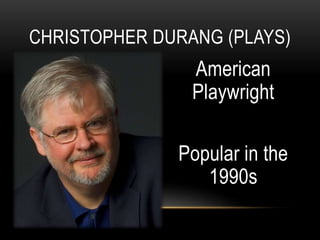
American
Playwright
Popular in the
1990s
CHRISTOPHER DURANG (PLAYS)
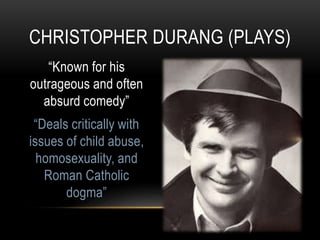
“Known for his
outrageous and often
absurd comedy”
“Deals critically with
issues of child abuse,
homosexuality, and
Roman Catholic
dogma”
CHRISTOPHER DURANG (PLAYS)
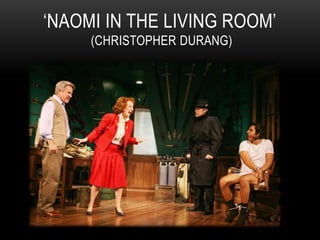
‘NAOMI IN THE LIVING ROOM’
(CHRISTOPHER DURANG)
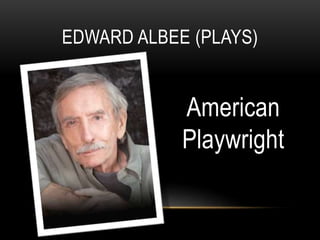
American
Playwright
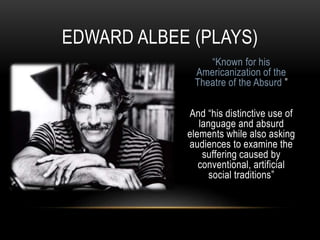
EDWARD ALBEE (PLAYS)
“Known for his
Americanization of the
Theatre of the Absurd ”
And “his distinctive use of
language and absurd
elements while also asking
audiences to examine the
suffering caused by
conventional, artificial
social traditions”
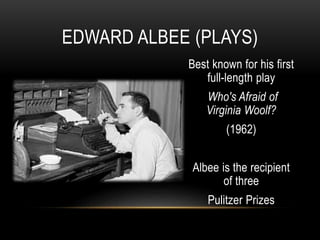
EDWARD ALBEE (PLAYS)
Best known for his first
full-length play
Who's Afraid of
Virginia Woolf?
(1962)
Albee is the recipient
of three
Pulitzer Prizes
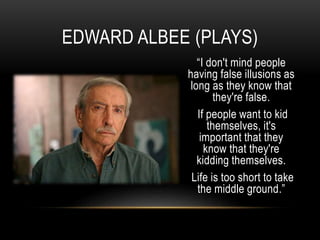
EDWARD ALBEE (PLAYS)
“I don't mind people
having false illusions as
long as they know that
they're false.
If people want to kid
themselves, it's
important that they
know that they're
kidding themselves.
Life is too short to take
the middle ground.”
EDWARD ALBEE (PLAYS)
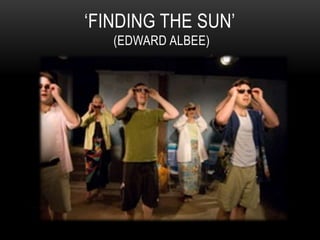
‘FINDING THE SUN’
(EDWARD ALBEE)
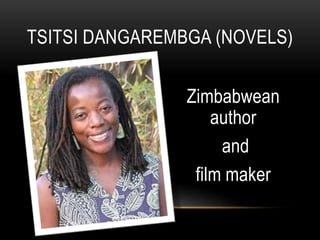
Zimbabwean
author
and
film maker
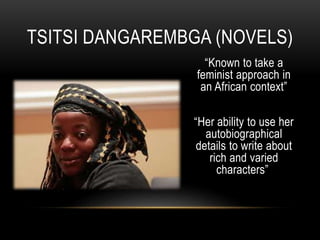
TSITSI DANGAREMBGA (NOVELS)
“Known to take a
feminist approach in
an African context”
“Her ability to use her
autobiographical
details to write about
rich and varied
characters”
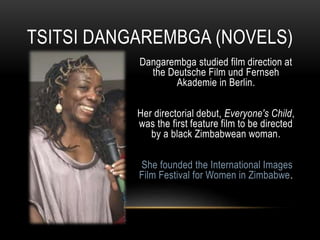
TSITSI DANGAREMBGA (NOVELS)
Dangarembga studied film direction at
the Deutsche Film und Fernseh
Akademie in Berlin.
Her directorial debut, Everyone's Child,
was the first feature film to be directed
by a black Zimbabwean woman.
She founded the International Images
Film Festival for Women in Zimbabwe.
TSITSI DANGAREMBGA (NOVELS)
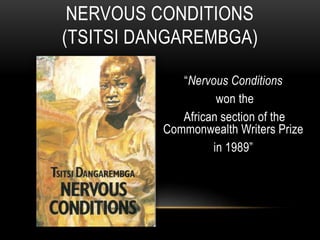
“Nervous Conditions
won the
African section of the
Commonwealth Writers Prize
in 1989”
NERVOUS CONDITIONS
(TSITSI DANGAREMBGA)
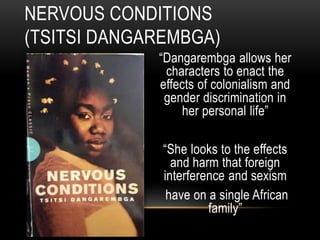
“Dangarembga allows her
characters to enact the
effects of colonialism and
gender discrimination in
her personal life”
“She looks to the effects
and harm that foreign
interference and sexism
have on a single African
family”
NERVOUS CONDITIONS
(TSITSI DANGAREMBGA)
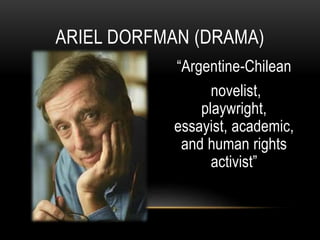
“Argentine-Chilean
novelist,
playwright,
essayist, academic,
and human rights
activist”
ARIEL DORFMAN (DRAMA)
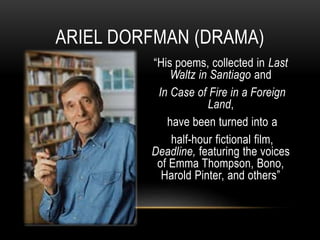
“His poems, collected in Last
Waltz in Santiago and
In Case of Fire in a Foreign
Land,
have been turned into a
half-hour fictional film,
Deadline, featuring the voices
of Emma Thompson, Bono,
Harold Pinter, and others”
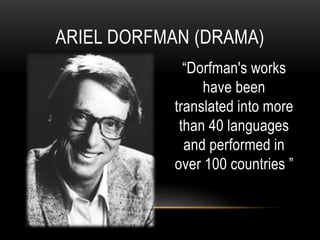
ARIEL DORFMAN (DRAMA)
“Dorfman's works
have been
translated into more
than 40 languages
and performed in
over 100 countries ”
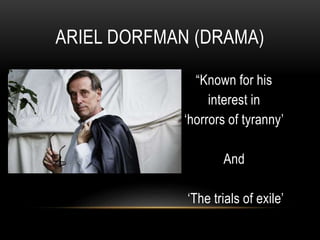
ARIEL DORFMAN (DRAMA)
“Known for his
interest in
‘horrors of tyranny’
And
‘The trials of exile’
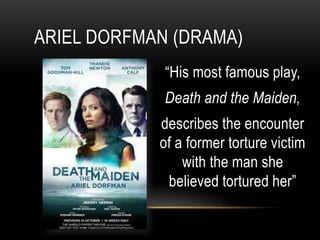
ARIEL DORFMAN (DRAMA)
“His most famous play,
Death and the Maiden,
describes the encounter
of a former torture victim
with the man she
believed tortured her”
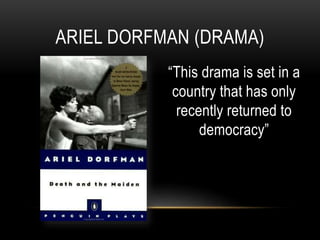
“This drama is set in a
country that has only
recently returned to
democracy”
ARIEL DORFMAN (DRAMA)
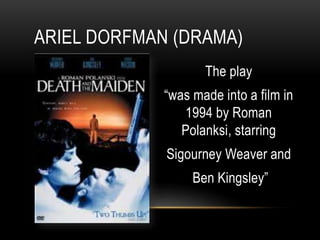
The play
“was made into a film in
1994 by Roman
Polanksi, starring
Sigourney Weaver and
Ben Kingsley”
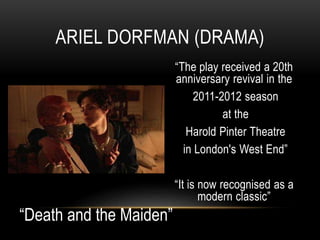
“The play received a 20th
anniversary revival in the
2011-2012 season
at the
Harold Pinter Theatre
in London's West End”
“It is now recognised as a
modern classic”
ARIEL DORFMAN (DRAMA)
“Death and the Maiden”
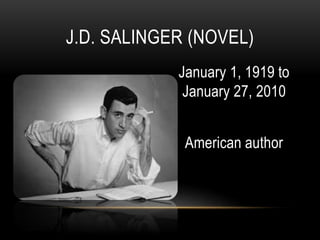
January 1, 1919 to
January 27, 2010
American author
J.D. SALINGER (NOVEL)
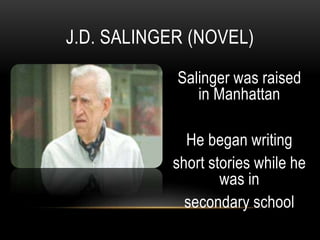
Salinger was raised
in Manhattan
He began writing
short stories while he
was in
secondary school
J.D. SALINGER (NOVEL)
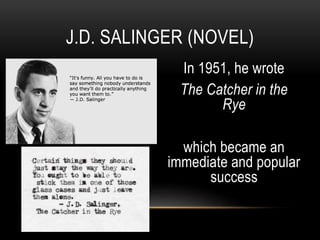
In 1951, he wrote
The Catcher in the
Rye
which became an
immediate and popular
success
J.D. SALINGER (NOVEL)
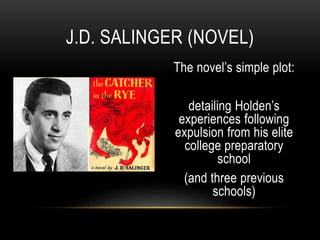
The novel’s simple plot:
detailing Holden’s
experiences following
expulsion from his elite
college preparatory
school
(and three previous
schools)
J.D. SALINGER (NOVEL)
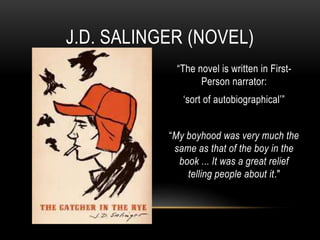
“The novel is written in First-
Person narrator:
‘sort of autobiographical’”
“My boyhood was very much the
same as that of the boy in the
book ... It was a great relief
telling people about it."
J.D. SALINGER (NOVEL)
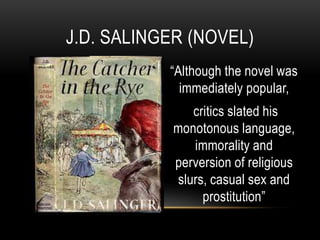
“Although the novel was
immediately popular,
critics slated his
monotonous language,
immorality and
perversion of religious
slurs, casual sex and
prostitution”
J.D. SALINGER (NOVEL)
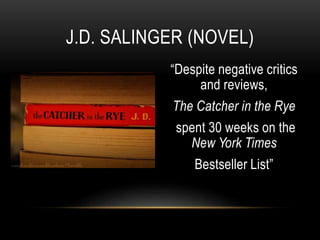
“Despite negative critics
and reviews,
The Catcher in the Rye
spent 30 weeks on the
New York Times
Bestseller List”
J.D. SALINGER (NOVEL)
English 2
First Semester
TRANSNATIONAL
LITERATURE
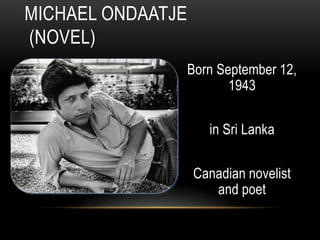
Born September 12,
1943
in Sri Lanka
Canadian novelist
and poet
MICHAEL ONDAATJE
(NOVEL)
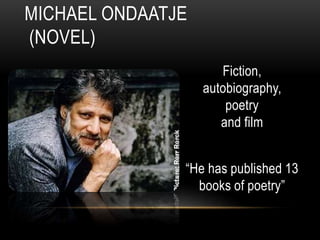
Fiction,
autobiography,
poetry
and film
“He has published 13
books of poetry”
MICHAEL ONDAATJE
(NOVEL)
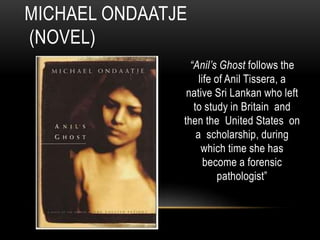
“Anil’s Ghost follows the
life of Anil Tissera, a
native Sri Lankan who left
to study in Britain and
then the United States on
a scholarship, during
which time she has
become a forensic
pathologist”
MICHAEL ONDAATJE
(NOVEL)
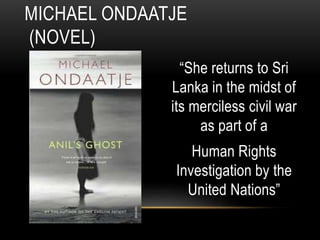
“She returns to Sri
Lanka in the midst of
its merciless civil war
as part of a
Human Rights
Investigation by the
United Nations”
MICHAEL ONDAATJE
(NOVEL)
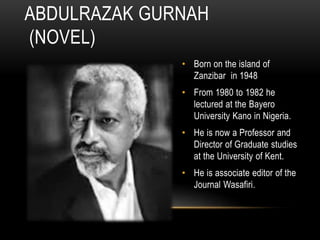
• Born on the island of
Zanzibar in 1948
• From 1980 to 1982 he
lectured at the Bayero
University Kano in Nigeria.
• He is now a Professor and
Director of Graduate studies
at the University of Kent.
• He is associate editor of the
Journal Wasafiri.
ABDULRAZAK GURNAH
(NOVEL)
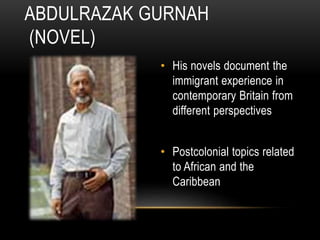
• His novels document the
immigrant experience in
contemporary Britain from
different perspectives
• Postcolonial topics related
to African and the
Caribbean
ABDULRAZAK GURNAH
(NOVEL)
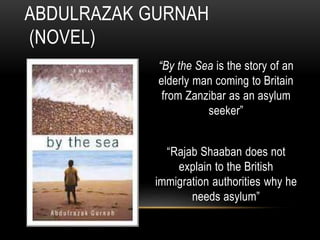
“By the Sea is the story of an
elderly man coming to Britain
from Zanzibar as an asylum
seeker”
“Rajab Shaaban does not
explain to the British
immigration authorities why he
needs asylum”
ABDULRAZAK GURNAH
(NOVEL)
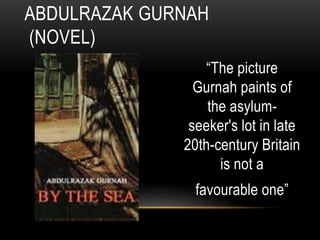
“The picture
Gurnah paints of
the asylum-
seeker's lot in late
20th-century Britain
is not a
favourable one”
ABDULRAZAK GURNAH
(NOVEL)
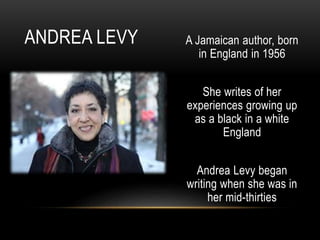
A Jamaican author, born
in England in 1956
She writes of her
experiences growing up
as a black in a white
England
Andrea Levy began
writing when she was in
her mid-thirties
ANDREA LEVY
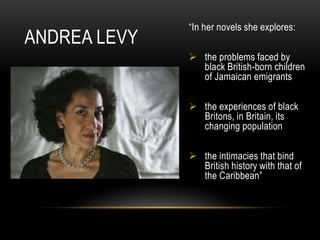
“In her novels she explores:
 the problems faced by
black British-born children
of Jamaican emigrants
 the experiences of black
Britons, in Britain, its
changing population
 the intimacies that bind
British history with that of
the Caribbean”
ANDREA LEVY
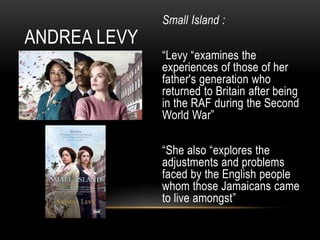
Small Island :
“Levy “examines the
experiences of those of her
father's generation who
returned to Britain after being
in the RAF during the Second
World War”
“She also “explores the
adjustments and problems
faced by the English people
whom those Jamaicans came
to live amongst”
ANDREA LEVY
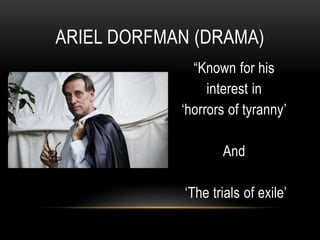
“Known for his
interest in
‘horrors of tyranny’
And
‘The trials of exile’
ARIEL DORFMAN (DRAMA)
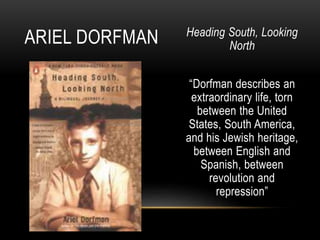
Heading South, Looking
North
“Dorfman describes an
extraordinary life, torn
between the United
States, South America,
and his Jewish heritage,
between English and
Spanish, between
revolution and
repression”
ARIEL DORFMAN
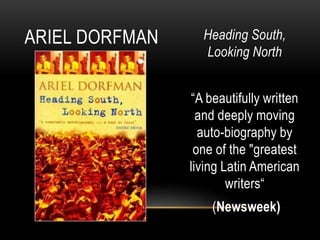
Heading South,
Looking North
“A beautifully written
and deeply moving
auto-biography by
one of the "greatest
living Latin American
writers“
(Newsweek)
ARIEL DORFMAN
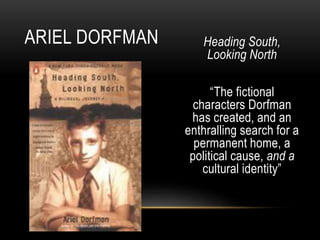
Heading South,
Looking North
“The fictional
characters Dorfman
has created, and an
enthralling search for a
permanent home, a
political cause, and a
cultural identity”
ARIEL DORFMAN
English 3
First Semester
EARLY MODERN
LITERATURE
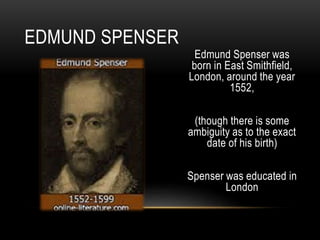
Edmund Spenser was
born in East Smithfield,
London, around the year
1552,
(though there is some
ambiguity as to the exact
date of his birth)
Spenser was educated in
London
EDMUND SPENSER
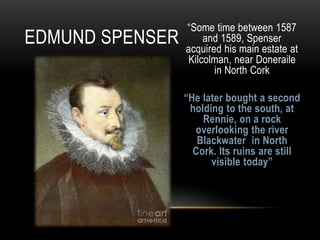
“Some time between 1587
and 1589, Spenser
acquired his main estate at
Kilcolman, near Doneraile
in North Cork
“He later bought a second
holding to the south, at
Rennie, on a rock
overlooking the river
Blackwater in North
Cork. Its ruins are still
visible today”
EDMUND SPENSER
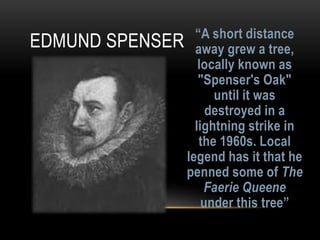
“A short distance
away grew a tree,
locally known as
"Spenser's Oak"
until it was
destroyed in a
lightning strike in
the 1960s. Local
legend has it that he
penned some of The
Faerie Queene
under this tree”
EDMUND SPENSER
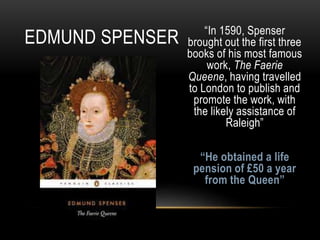
“In 1590, Spenser
brought out the first three
books of his most famous
work, The Faerie
Queene, having travelled
to London to publish and
promote the work, with
the likely assistance of
Raleigh”
“He obtained a life
pension of £50 a year
from the Queen”
EDMUND SPENSER
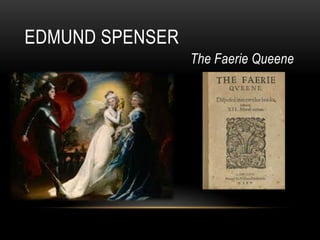
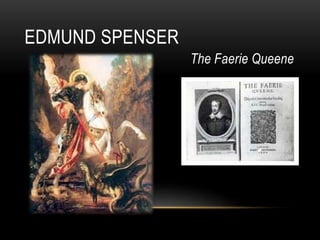
The Faerie Queene
EDMUND SPENSER
The Faerie Queene
EDMUND SPENSER
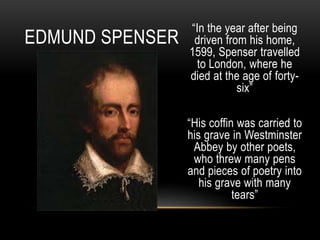
“In the year after being
driven from his home,
1599, Spenser travelled
to London, where he
died at the age of forty-
six”
“His coffin was carried to
his grave in Westminster
Abbey by other poets,
who threw many pens
and pieces of poetry into
his grave with many
tears”
EDMUND SPENSER
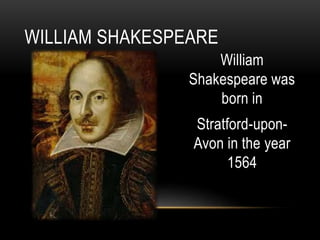
William
Shakespeare was
born in
Stratford-upon-
Avon in the year
1564
WILLIAM SHAKESPEARE
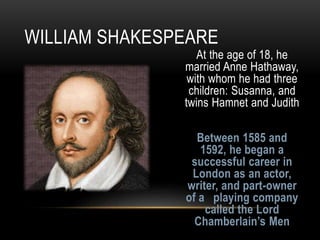
At the age of 18, he
married Anne Hathaway,
with whom he had three
children: Susanna, and
twins Hamnet and Judith
Between 1585 and
1592, he began a
successful career in
London as an actor,
writer, and part-owner
of a playing company
called the Lord
Chamberlain’s Men
WILLIAM SHAKESPEARE
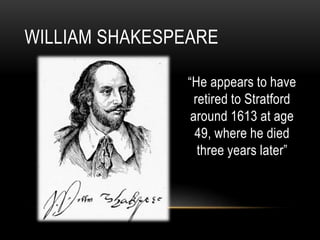
“He appears to have
retired to Stratford
around 1613 at age
49, where he died
three years later”
WILLIAM SHAKESPEARE
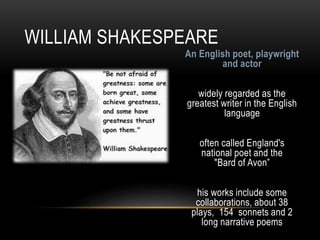
An English poet, playwright
and actor
widely regarded as the
greatest writer in the English
language
often called England's
national poet and the
"Bard of Avon”
his works include some
collaborations, about 38
plays, 154 sonnets and 2
long narrative poems
WILLIAM SHAKESPEARE
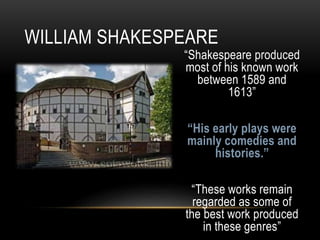
“Shakespeare produced
most of his known work
between 1589 and
1613”
“His early plays were
mainly comedies and
histories.”
“These works remain
regarded as some of
the best work produced
in these genres”
WILLIAM SHAKESPEARE
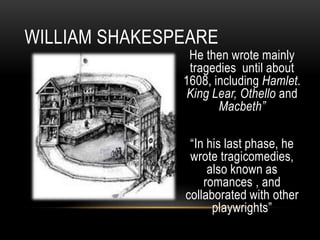
He then wrote mainly
tragedies until about
1608, including Hamlet.
King Lear, Othello and
Macbeth”
“In his last phase, he
wrote tragicomedies,
also known as
romances , and
collaborated with other
playwrights”
WILLIAM SHAKESPEARE
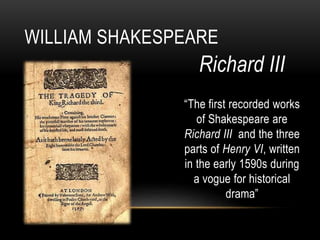
Richard III
“The first recorded works
of Shakespeare are
Richard III and the three
parts of Henry VI, written
in the early 1590s during
a vogue for historical
drama”
WILLIAM SHAKESPEARE
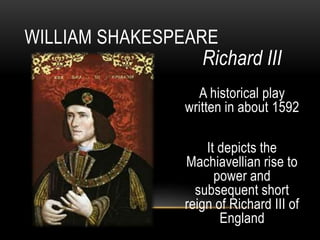
Richard III
A historical play
written in about 1592
It depicts the
Machiavellian rise to
power and
subsequent short
reign of Richard III of
England
WILLIAM SHAKESPEARE
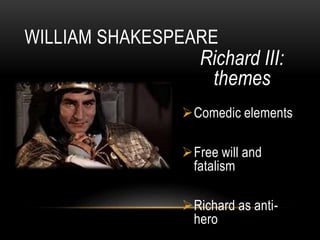
Richard III:
themes
Comedic elements
Free will and
fatalism
Richard as anti-
hero
WILLIAM SHAKESPEARE
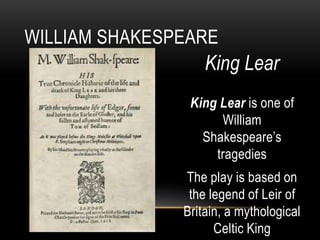
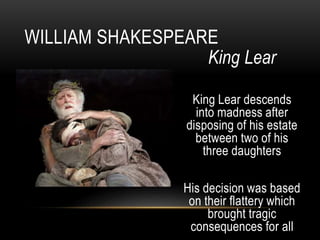
King Lear
King Lear is one of
William
Shakespeare’s
tragedies
The play is based on
the legend of Leir of
Britain, a mythological
Celtic King
WILLIAM SHAKESPEARE
King Lear
King Lear descends
into madness after
disposing of his estate
between two of his
three daughters
His decision was based
on their flattery which
brought tragic
consequences for all
WILLIAM SHAKESPEARE
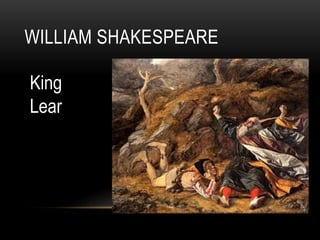
WILLIAM SHAKESPEARE
King
Lear
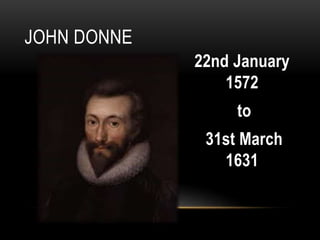
22nd January
1572
to
31st March
1631
JOHN DONNE
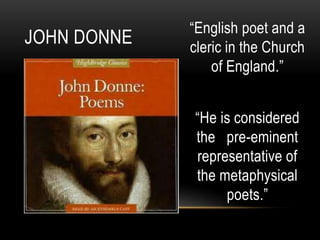
“English poet and a
cleric in the Church
of England.”
“He is considered
the pre-eminent
representative of
the metaphysical
poets.”
JOHN DONNE
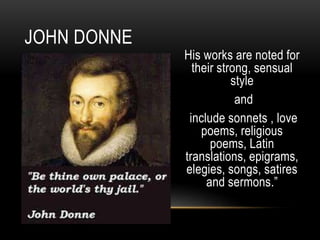
His works are noted for
their strong, sensual
style
and
include sonnets , love
poems, religious
poems, Latin
translations, epigrams,
elegies, songs, satires
and sermons.”
JOHN DONNE
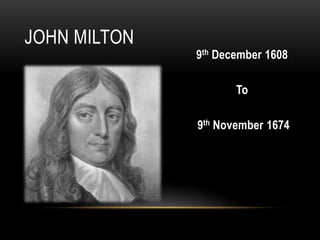
9th December 1608
To
9th November 1674
JOHN MILTON
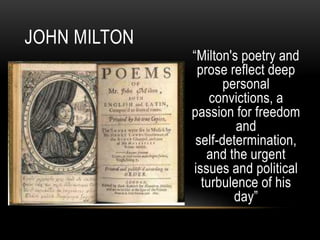
“Milton's poetry and
prose reflect deep
personal
convictions, a
passion for freedom
and
self-determination,
and the urgent
issues and political
turbulence of his
day”
JOHN MILTON
English 3
First Semester
ENCOUNTERING
AFRICAN LITERATURE
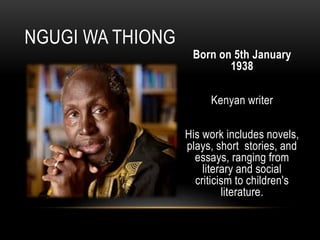
Born on 5th January
1938
Kenyan writer
His work includes novels,
plays, short stories, and
essays, ranging from
literary and social
criticism to children's
literature.
NGUGI WA THIONG
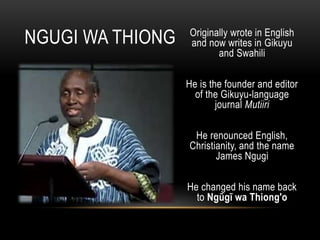
Originally wrote in English
and now writes in Gikuyu
and Swahili
He is the founder and editor
of the Gikuyu-language
journal Mutiiri
He renounced English,
Christianity, and the name
James Ngugi
He changed his name back
to Ngũgĩ wa Thiong'o
NGUGI WA THIONG
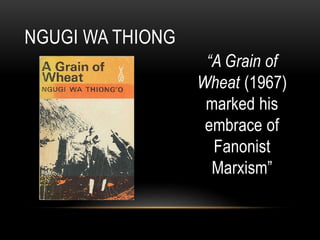
“A Grain of
Wheat (1967)
marked his
embrace of
Fanonist
Marxism”
NGUGI WA THIONG
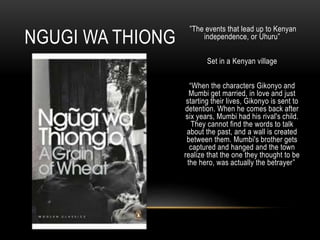
”The events that lead up to Kenyan
independence, or Uhuru”
Set in a Kenyan village
“When the characters Gikonyo and
Mumbi get married, in love and just
starting their lives, Gikonyo is sent to
detention. When he comes back after
six years, Mumbi had his rival's child.
They cannot find the words to talk
about the past, and a wall is created
between them. Mumbi's brother gets
captured and hanged and the town
realize that the one they thought to be
the hero, was actually the betrayer”
NGUGI WA THIONG
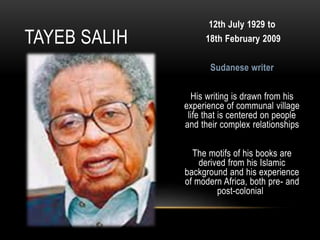
12th July 1929 to
18th February 2009
Sudanese writer
His writing is drawn from his
experience of communal village
life that is centered on people
and their complex relationships
The motifs of his books are
derived from his Islamic
background and his experience
of modern Africa, both pre- and
post-colonial
TAYEB SALIH
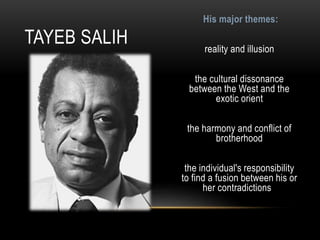
His major themes:
reality and illusion
the cultural dissonance
between the West and the
exotic orient
the harmony and conflict of
brotherhood
the individual's responsibility
to find a fusion between his or
her contradictions
TAYEB SALIH
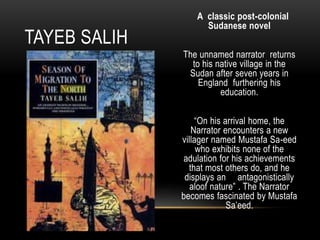
A classic post-colonial
Sudanese novel
The unnamed narrator returns
to his native village in the
Sudan after seven years in
England furthering his
education.
“On his arrival home, the
Narrator encounters a new
villager named Mustafa Sa-eed
who exhibits none of the
adulation for his achievements
that most others do, and he
displays an antagonistically
aloof nature” . The Narrator
becomes fascinated by Mustafa
Sa’eed.
TAYEB SALIH
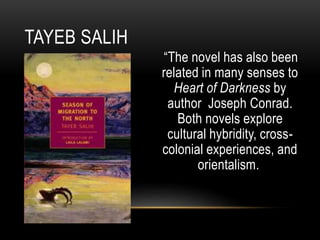
“The novel has also been
related in many senses to
Heart of Darkness by
author Joseph Conrad.
Both novels explore
cultural hybridity, cross-
colonial experiences, and
orientalism.
TAYEB SALIH
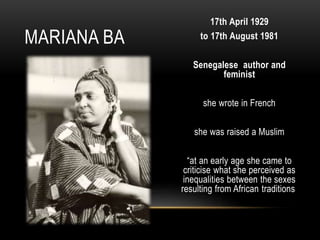
17th April 1929
to 17th August 1981
Senegalese author and
feminist
she wrote in French
she was raised a Muslim
“at an early age she came to
criticise what she perceived as
inequalities between the sexes
resulting from African traditions
MARIANA BA
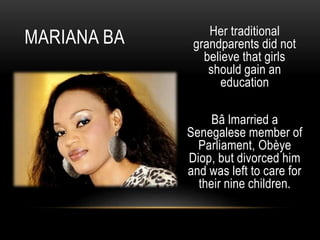
Her traditional
grandparents did not
believe that girls
should gain an
education
Bâ lmarried a
Senegalese member of
Parliament, Obèye
Diop, but divorced him
and was left to care for
their nine children.
MARIANA BA
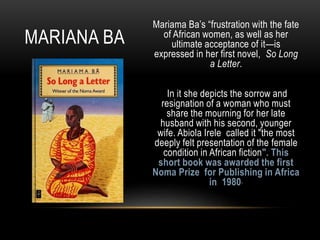
Mariama Ba’s “frustration with the fate
of African women, as well as her
ultimate acceptance of it—is
expressed in her first novel, So Long
a Letter.
In it she depicts the sorrow and
resignation of a woman who must
share the mourning for her late
husband with his second, younger
wife. Abiola Irele called it "the most
deeply felt presentation of the female
condition in African fiction". This
short book was awarded the first
Noma Prize for Publishing in Africa
in 1980”
MARIANA BA
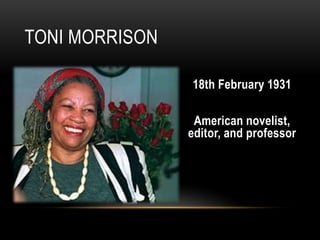
18th February 1931
American novelist,
editor, and professor
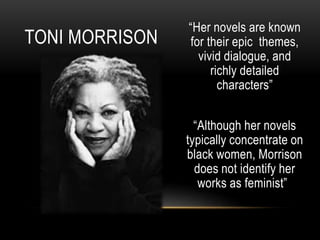
TONI MORRISON
“Her novels are known
for their epic themes,
vivid dialogue, and
richly detailed
characters”
“Although her novels
typically concentrate on
black women, Morrison
does not identify her
works as feminist”
TONI MORRISON
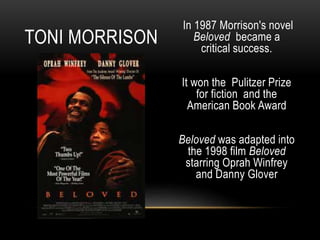
In 1987 Morrison's novel
Beloved became a
critical success.
It won the Pulitzer Prize
for fiction and the
American Book Award
Beloved was adapted into
the 1998 film Beloved
starring Oprah Winfrey
and Danny Glover
TONI MORRISON
Born 15 September 1977
Nigerian novelist and short
story writer
“She has been called "the
most prominent" of a
"procession of critically
acclaimed young anglophone
authors [that] is succeeding in
attracting a new generation of
readers to African Literature”
CHIMAMANDA NGOZI ADICHIE
"We should all be
feminists" was a TEDx
talk that was given by
Adichie in 2012. She
shared her experiences
of being an African
feminist, and her views
on gender construction
and sexuality. Adichie
believes that the problem
with gender is that it
shapes who we are”
CHIMAMANDA NGOZI ADICHIE
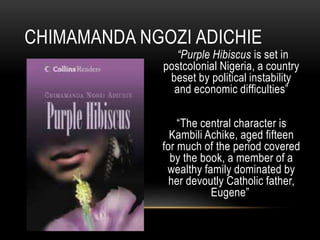
“Purple Hibiscus is set in
postcolonial Nigeria, a country
beset by political instability
and economic difficulties”
“The central character is
Kambili Achike, aged fifteen
for much of the period covered
by the book, a member of a
wealthy family dominated by
her devoutly Catholic father,
Eugene”
CHIMAMANDA NGOZI ADICHIE

English term 1

  • 1.
  • 2.
  • 3.
    “Known for his outrageousand often absurd comedy” “Deals critically with issues of child abuse, homosexuality, and Roman Catholic dogma” CHRISTOPHER DURANG (PLAYS)
  • 4.
    ‘NAOMI IN THELIVING ROOM’ (CHRISTOPHER DURANG)
  • 5.
  • 6.
    “Known for his Americanizationof the Theatre of the Absurd ” And “his distinctive use of language and absurd elements while also asking audiences to examine the suffering caused by conventional, artificial social traditions” EDWARD ALBEE (PLAYS)
  • 7.
    Best known forhis first full-length play Who's Afraid of Virginia Woolf? (1962) Albee is the recipient of three Pulitzer Prizes EDWARD ALBEE (PLAYS)
  • 8.
    “I don't mindpeople having false illusions as long as they know that they're false. If people want to kid themselves, it's important that they know that they're kidding themselves. Life is too short to take the middle ground.” EDWARD ALBEE (PLAYS)
  • 9.
  • 10.
  • 11.
    “Known to takea feminist approach in an African context” “Her ability to use her autobiographical details to write about rich and varied characters” TSITSI DANGAREMBGA (NOVELS)
  • 12.
    Dangarembga studied filmdirection at the Deutsche Film und Fernseh Akademie in Berlin. Her directorial debut, Everyone's Child, was the first feature film to be directed by a black Zimbabwean woman. She founded the International Images Film Festival for Women in Zimbabwe. TSITSI DANGAREMBGA (NOVELS)
  • 13.
    “Nervous Conditions won the Africansection of the Commonwealth Writers Prize in 1989” NERVOUS CONDITIONS (TSITSI DANGAREMBGA)
  • 14.
    “Dangarembga allows her charactersto enact the effects of colonialism and gender discrimination in her personal life” “She looks to the effects and harm that foreign interference and sexism have on a single African family” NERVOUS CONDITIONS (TSITSI DANGAREMBGA)
  • 15.
  • 16.
    “His poems, collectedin Last Waltz in Santiago and In Case of Fire in a Foreign Land, have been turned into a half-hour fictional film, Deadline, featuring the voices of Emma Thompson, Bono, Harold Pinter, and others” ARIEL DORFMAN (DRAMA)
  • 17.
    “Dorfman's works have been translatedinto more than 40 languages and performed in over 100 countries ” ARIEL DORFMAN (DRAMA)
  • 18.
    “Known for his interestin ‘horrors of tyranny’ And ‘The trials of exile’ ARIEL DORFMAN (DRAMA)
  • 19.
    ARIEL DORFMAN (DRAMA) “Hismost famous play, Death and the Maiden, describes the encounter of a former torture victim with the man she believed tortured her”
  • 20.
    “This drama isset in a country that has only recently returned to democracy” ARIEL DORFMAN (DRAMA)
  • 21.
    ARIEL DORFMAN (DRAMA) Theplay “was made into a film in 1994 by Roman Polanksi, starring Sigourney Weaver and Ben Kingsley”
  • 22.
    “The play receiveda 20th anniversary revival in the 2011-2012 season at the Harold Pinter Theatre in London's West End” “It is now recognised as a modern classic” ARIEL DORFMAN (DRAMA) “Death and the Maiden”
  • 23.
    January 1, 1919to January 27, 2010 American author J.D. SALINGER (NOVEL)
  • 24.
    Salinger was raised inManhattan He began writing short stories while he was in secondary school J.D. SALINGER (NOVEL)
  • 25.
    In 1951, hewrote The Catcher in the Rye which became an immediate and popular success J.D. SALINGER (NOVEL)
  • 26.
    The novel’s simpleplot: detailing Holden’s experiences following expulsion from his elite college preparatory school (and three previous schools) J.D. SALINGER (NOVEL)
  • 27.
    “The novel iswritten in First- Person narrator: ‘sort of autobiographical’” “My boyhood was very much the same as that of the boy in the book ... It was a great relief telling people about it." J.D. SALINGER (NOVEL)
  • 28.
    “Although the novelwas immediately popular, critics slated his monotonous language, immorality and perversion of religious slurs, casual sex and prostitution” J.D. SALINGER (NOVEL)
  • 29.
    “Despite negative critics andreviews, The Catcher in the Rye spent 30 weeks on the New York Times Bestseller List” J.D. SALINGER (NOVEL)
  • 30.
  • 31.
    Born September 12, 1943 inSri Lanka Canadian novelist and poet MICHAEL ONDAATJE (NOVEL)
  • 32.
    Fiction, autobiography, poetry and film “He haspublished 13 books of poetry” MICHAEL ONDAATJE (NOVEL)
  • 33.
    “Anil’s Ghost followsthe life of Anil Tissera, a native Sri Lankan who left to study in Britain and then the United States on a scholarship, during which time she has become a forensic pathologist” MICHAEL ONDAATJE (NOVEL)
  • 34.
    “She returns toSri Lanka in the midst of its merciless civil war as part of a Human Rights Investigation by the United Nations” MICHAEL ONDAATJE (NOVEL)
  • 35.
    • Born onthe island of Zanzibar in 1948 • From 1980 to 1982 he lectured at the Bayero University Kano in Nigeria. • He is now a Professor and Director of Graduate studies at the University of Kent. • He is associate editor of the Journal Wasafiri. ABDULRAZAK GURNAH (NOVEL)
  • 36.
    • His novelsdocument the immigrant experience in contemporary Britain from different perspectives • Postcolonial topics related to African and the Caribbean ABDULRAZAK GURNAH (NOVEL)
  • 37.
    “By the Seais the story of an elderly man coming to Britain from Zanzibar as an asylum seeker” “Rajab Shaaban does not explain to the British immigration authorities why he needs asylum” ABDULRAZAK GURNAH (NOVEL)
  • 38.
    “The picture Gurnah paintsof the asylum- seeker's lot in late 20th-century Britain is not a favourable one” ABDULRAZAK GURNAH (NOVEL)
  • 39.
    A Jamaican author,born in England in 1956 She writes of her experiences growing up as a black in a white England Andrea Levy began writing when she was in her mid-thirties ANDREA LEVY
  • 40.
    “In her novelsshe explores:  the problems faced by black British-born children of Jamaican emigrants  the experiences of black Britons, in Britain, its changing population  the intimacies that bind British history with that of the Caribbean” ANDREA LEVY
  • 41.
    Small Island : “Levy“examines the experiences of those of her father's generation who returned to Britain after being in the RAF during the Second World War” “She also “explores the adjustments and problems faced by the English people whom those Jamaicans came to live amongst” ANDREA LEVY
  • 42.
    “Known for his interestin ‘horrors of tyranny’ And ‘The trials of exile’ ARIEL DORFMAN (DRAMA)
  • 43.
    Heading South, Looking North “Dorfmandescribes an extraordinary life, torn between the United States, South America, and his Jewish heritage, between English and Spanish, between revolution and repression” ARIEL DORFMAN
  • 44.
    Heading South, Looking North “Abeautifully written and deeply moving auto-biography by one of the "greatest living Latin American writers“ (Newsweek) ARIEL DORFMAN
  • 45.
    Heading South, Looking North “Thefictional characters Dorfman has created, and an enthralling search for a permanent home, a political cause, and a cultural identity” ARIEL DORFMAN
  • 46.
  • 47.
    Edmund Spenser was bornin East Smithfield, London, around the year 1552, (though there is some ambiguity as to the exact date of his birth) Spenser was educated in London EDMUND SPENSER
  • 48.
    “Some time between1587 and 1589, Spenser acquired his main estate at Kilcolman, near Doneraile in North Cork “He later bought a second holding to the south, at Rennie, on a rock overlooking the river Blackwater in North Cork. Its ruins are still visible today” EDMUND SPENSER
  • 49.
    “A short distance awaygrew a tree, locally known as "Spenser's Oak" until it was destroyed in a lightning strike in the 1960s. Local legend has it that he penned some of The Faerie Queene under this tree” EDMUND SPENSER
  • 50.
    “In 1590, Spenser broughtout the first three books of his most famous work, The Faerie Queene, having travelled to London to publish and promote the work, with the likely assistance of Raleigh” “He obtained a life pension of £50 a year from the Queen” EDMUND SPENSER
  • 51.
  • 52.
  • 53.
    “In the yearafter being driven from his home, 1599, Spenser travelled to London, where he died at the age of forty- six” “His coffin was carried to his grave in Westminster Abbey by other poets, who threw many pens and pieces of poetry into his grave with many tears” EDMUND SPENSER
  • 54.
    William Shakespeare was born in Stratford-upon- Avonin the year 1564 WILLIAM SHAKESPEARE
  • 55.
    At the ageof 18, he married Anne Hathaway, with whom he had three children: Susanna, and twins Hamnet and Judith Between 1585 and 1592, he began a successful career in London as an actor, writer, and part-owner of a playing company called the Lord Chamberlain’s Men WILLIAM SHAKESPEARE
  • 56.
    “He appears tohave retired to Stratford around 1613 at age 49, where he died three years later” WILLIAM SHAKESPEARE
  • 57.
    An English poet,playwright and actor widely regarded as the greatest writer in the English language often called England's national poet and the "Bard of Avon” his works include some collaborations, about 38 plays, 154 sonnets and 2 long narrative poems WILLIAM SHAKESPEARE
  • 58.
    “Shakespeare produced most ofhis known work between 1589 and 1613” “His early plays were mainly comedies and histories.” “These works remain regarded as some of the best work produced in these genres” WILLIAM SHAKESPEARE
  • 59.
    He then wrotemainly tragedies until about 1608, including Hamlet. King Lear, Othello and Macbeth” “In his last phase, he wrote tragicomedies, also known as romances , and collaborated with other playwrights” WILLIAM SHAKESPEARE
  • 60.
    Richard III “The firstrecorded works of Shakespeare are Richard III and the three parts of Henry VI, written in the early 1590s during a vogue for historical drama” WILLIAM SHAKESPEARE
  • 61.
    Richard III A historicalplay written in about 1592 It depicts the Machiavellian rise to power and subsequent short reign of Richard III of England WILLIAM SHAKESPEARE
  • 62.
    Richard III: themes Comedic elements Freewill and fatalism Richard as anti- hero WILLIAM SHAKESPEARE
  • 63.
    King Lear King Learis one of William Shakespeare’s tragedies The play is based on the legend of Leir of Britain, a mythological Celtic King WILLIAM SHAKESPEARE
  • 64.
    King Lear King Leardescends into madness after disposing of his estate between two of his three daughters His decision was based on their flattery which brought tragic consequences for all WILLIAM SHAKESPEARE
  • 65.
  • 66.
  • 67.
    “English poet anda cleric in the Church of England.” “He is considered the pre-eminent representative of the metaphysical poets.” JOHN DONNE
  • 68.
    His works arenoted for their strong, sensual style and include sonnets , love poems, religious poems, Latin translations, epigrams, elegies, songs, satires and sermons.” JOHN DONNE
  • 69.
    9th December 1608 To 9thNovember 1674 JOHN MILTON
  • 70.
    “Milton's poetry and prosereflect deep personal convictions, a passion for freedom and self-determination, and the urgent issues and political turbulence of his day” JOHN MILTON
  • 71.
  • 72.
    Born on 5thJanuary 1938 Kenyan writer His work includes novels, plays, short stories, and essays, ranging from literary and social criticism to children's literature. NGUGI WA THIONG
  • 73.
    Originally wrote inEnglish and now writes in Gikuyu and Swahili He is the founder and editor of the Gikuyu-language journal Mutiiri He renounced English, Christianity, and the name James Ngugi He changed his name back to Ngũgĩ wa Thiong'o NGUGI WA THIONG
  • 74.
    “A Grain of Wheat(1967) marked his embrace of Fanonist Marxism” NGUGI WA THIONG
  • 75.
    ”The events thatlead up to Kenyan independence, or Uhuru” Set in a Kenyan village “When the characters Gikonyo and Mumbi get married, in love and just starting their lives, Gikonyo is sent to detention. When he comes back after six years, Mumbi had his rival's child. They cannot find the words to talk about the past, and a wall is created between them. Mumbi's brother gets captured and hanged and the town realize that the one they thought to be the hero, was actually the betrayer” NGUGI WA THIONG
  • 76.
    12th July 1929to 18th February 2009 Sudanese writer His writing is drawn from his experience of communal village life that is centered on people and their complex relationships The motifs of his books are derived from his Islamic background and his experience of modern Africa, both pre- and post-colonial TAYEB SALIH
  • 77.
    His major themes: realityand illusion the cultural dissonance between the West and the exotic orient the harmony and conflict of brotherhood the individual's responsibility to find a fusion between his or her contradictions TAYEB SALIH
  • 78.
    A classic post-colonial Sudanesenovel The unnamed narrator returns to his native village in the Sudan after seven years in England furthering his education. “On his arrival home, the Narrator encounters a new villager named Mustafa Sa-eed who exhibits none of the adulation for his achievements that most others do, and he displays an antagonistically aloof nature” . The Narrator becomes fascinated by Mustafa Sa’eed. TAYEB SALIH
  • 79.
    “The novel hasalso been related in many senses to Heart of Darkness by author Joseph Conrad. Both novels explore cultural hybridity, cross- colonial experiences, and orientalism. TAYEB SALIH
  • 80.
    17th April 1929 to17th August 1981 Senegalese author and feminist she wrote in French she was raised a Muslim “at an early age she came to criticise what she perceived as inequalities between the sexes resulting from African traditions MARIANA BA
  • 81.
    Her traditional grandparents didnot believe that girls should gain an education Bâ lmarried a Senegalese member of Parliament, Obèye Diop, but divorced him and was left to care for their nine children. MARIANA BA
  • 82.
    Mariama Ba’s “frustrationwith the fate of African women, as well as her ultimate acceptance of it—is expressed in her first novel, So Long a Letter. In it she depicts the sorrow and resignation of a woman who must share the mourning for her late husband with his second, younger wife. Abiola Irele called it "the most deeply felt presentation of the female condition in African fiction". This short book was awarded the first Noma Prize for Publishing in Africa in 1980” MARIANA BA
  • 83.
    18th February 1931 Americannovelist, editor, and professor TONI MORRISON
  • 84.
    “Her novels areknown for their epic themes, vivid dialogue, and richly detailed characters” “Although her novels typically concentrate on black women, Morrison does not identify her works as feminist” TONI MORRISON
  • 85.
    In 1987 Morrison'snovel Beloved became a critical success. It won the Pulitzer Prize for fiction and the American Book Award Beloved was adapted into the 1998 film Beloved starring Oprah Winfrey and Danny Glover TONI MORRISON
  • 86.
    Born 15 September1977 Nigerian novelist and short story writer “She has been called "the most prominent" of a "procession of critically acclaimed young anglophone authors [that] is succeeding in attracting a new generation of readers to African Literature” CHIMAMANDA NGOZI ADICHIE
  • 87.
    "We should allbe feminists" was a TEDx talk that was given by Adichie in 2012. She shared her experiences of being an African feminist, and her views on gender construction and sexuality. Adichie believes that the problem with gender is that it shapes who we are” CHIMAMANDA NGOZI ADICHIE
  • 88.
    “Purple Hibiscus isset in postcolonial Nigeria, a country beset by political instability and economic difficulties” “The central character is Kambili Achike, aged fifteen for much of the period covered by the book, a member of a wealthy family dominated by her devoutly Catholic father, Eugene” CHIMAMANDA NGOZI ADICHIE