How to become a good
Communicator?
Presented to: Ma’am Maria Khalid
Presented by: M.Mohsin
M.Aneeq Javed
Ghulam Hussain
M.Tayyab
Communication Skills
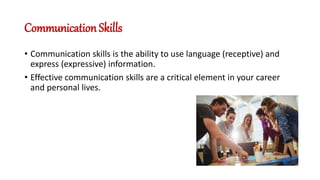
• Communication skills is the ability to use language (receptive) and
express (expressive) information.
• Effective communication skills are a critical element in your career
and personal lives.
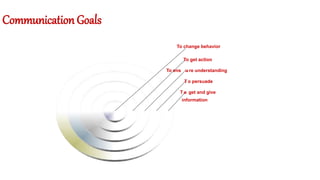
Communication Goals
T o get and give
information
T o persuade
To ens u re understanding
To get action
To change behavior
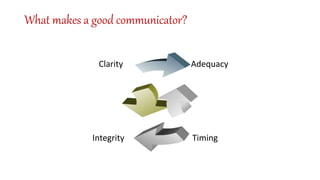
What makes a good communicator?
Clarity Adequacy
Integrity Timing
Tips to be a good communication skills
 Maintain eye contact with the audience
 Body awareness
 Gestures and expressions
 Convey one's thoughts
 Practice effective communication skills
 Be fully present. ...
 Talk with people, not at people. ...
 Be consistent, but don't repeat yourself too
much. ...
 Use your voice wisely. ...
 Make it about them. ...
 Be transparent. ...
 Ask open-ended questions. ...
 Let it go.
Effective Communication. . .
It is two way.
It involves active listening.
It reflects the accountability of speaker and listener.
It utilizes feedback.
It is free of stress.
It is clear.
.
Importance of effective communication
 Effective communication helps to understand a person or situation in a better
way.
 It enables us to solve the differences, build trust and respect in the organization.
 Sometimes our message is misunderstood or we misunderstand the received
message. Effective communication helps us to resolve problems from both
points of view.
 Effective communication helps us to connect well with colleagues, teachers,
parents, etc.
 It helps us in decision making.
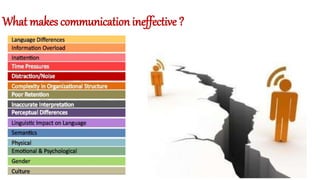
What makes communication ineffective ?
 Before learning to communicate effectively, we should learn which are the
barriers of communication that make communication ineffective:
Common barriers to effective communication
 Emotional barriers and taboos.
 Lack of attention, interest, distractions, or
irrelevance to the receiver.
 Physical disabilities such as hearing problems or
speech difficulties.
 Physical barriers to non-verbal communication.
 Language differences and the difficulty in
understanding unfamiliar accents, use of jargon.
 Expectations and prejudices which may lead to
false assumptions or stereotyping.
 Differences in perception and viewpoint, cultural differences.
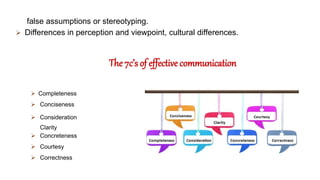
The 7c’s of effective communication
 Completeness
 Conciseness
 Consideration
Clarity
 Concreteness
 Courtesy
 Correctness
1.COMPLETENESS
• ·Message is complete when it contains all facts the reader or listener
needs for the reaction you desire.
• ·Communication senders need to assess their message through the
eyes of the receivers to be sure they have included all relevant
information.
• ·Provide all necessary information
2.CONCISENESS
• Eliminate wordy expressions. ·Include only relevant statements ·Be
focused.
• ·Shorten & avoid long explanations.
• ·Avoid gushing politeness.
• ·Avoid unnecessary repetitions:
• -Use short forms for the second time.
• -Use pronouns.
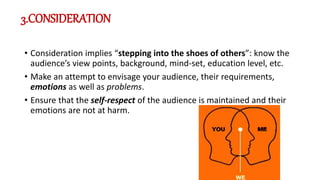
3.CONSIDERATION
• Consideration implies “stepping into the shoes of others”: know the
audience’s view points, background, mind-set, education level, etc.
• Make an attempt to envisage your audience, their requirements,
emotions as well as problems.
• Ensure that the self-respect of the audience is maintained and their
emotions are not at harm.
4.CLARITY
• Emphasize one specific message, goal or idea at a
time.
• ·Avoid vagueness.
• ·Avoid technical terms which may be hard to
understand.
• ·Avoid the possibility of misinterpretation. As much as
possible, your audience shouldn’t have to “read
between the lines”.
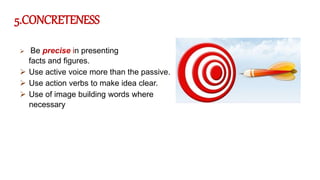
5.CONCRETENESS
 Be precise in presenting
facts and figures.
 Use active voice more than the passive.
 Use action verbs to make idea clear.
 Use of image building words where
necessary
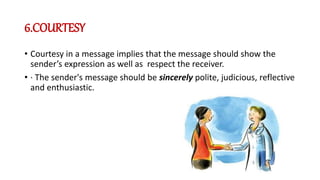
6.COURTESY
• Courtesy in a message implies that the message should show the
sender’s expression as well as respect the receiver.
• · The sender's message should be sincerely polite, judicious, reflective
and enthusiastic.
7.CORRECTNESS
At the core of correctness is proper grammar, punctuation and spelling.
The term correctness, as applied to effective communications also mean
three characteristics:
 Use the right level of language.
Check the accuracy of figures, facts and words.
Maintain acceptable writing mechanics
Strategies to apply seven C’s of communication
• Emotions should be managed in a conversation. If you are getting
angry, you have to calm yourself by:
• Speaking to the other person as if you were not angry.
• Avoid the use of the word “you” - this avoids blaming.
• Nod your head to assure the other person that you heard him.
• Maintain eye contact with him.
Thanks

English presentation.pptx

  • 1.
    How to becomea good Communicator? Presented to: Ma’am Maria Khalid Presented by: M.Mohsin M.Aneeq Javed Ghulam Hussain M.Tayyab
  • 2.
    Communication Skills • Communicationskills is the ability to use language (receptive) and express (expressive) information. • Effective communication skills are a critical element in your career and personal lives.
  • 3.
    Communication Goals T oget and give information T o persuade To ens u re understanding To get action To change behavior
  • 4.
    What makes agood communicator? Clarity Adequacy Integrity Timing
  • 5.
    Tips to bea good communication skills  Maintain eye contact with the audience  Body awareness  Gestures and expressions  Convey one's thoughts  Practice effective communication skills
  • 6.
     Be fullypresent. ...  Talk with people, not at people. ...  Be consistent, but don't repeat yourself too much. ...  Use your voice wisely. ...  Make it about them. ...  Be transparent. ...  Ask open-ended questions. ...  Let it go.
  • 7.
    Effective Communication. .. It is two way. It involves active listening. It reflects the accountability of speaker and listener. It utilizes feedback. It is free of stress. It is clear. .
  • 8.
    Importance of effectivecommunication  Effective communication helps to understand a person or situation in a better way.  It enables us to solve the differences, build trust and respect in the organization.  Sometimes our message is misunderstood or we misunderstand the received message. Effective communication helps us to resolve problems from both points of view.  Effective communication helps us to connect well with colleagues, teachers, parents, etc.  It helps us in decision making.
  • 9.
  • 10.
     Before learningto communicate effectively, we should learn which are the barriers of communication that make communication ineffective: Common barriers to effective communication  Emotional barriers and taboos.  Lack of attention, interest, distractions, or irrelevance to the receiver.  Physical disabilities such as hearing problems or speech difficulties.  Physical barriers to non-verbal communication.  Language differences and the difficulty in understanding unfamiliar accents, use of jargon.  Expectations and prejudices which may lead to
  • 11.
    false assumptions orstereotyping.  Differences in perception and viewpoint, cultural differences. The 7c’s of effective communication  Completeness  Conciseness  Consideration Clarity  Concreteness  Courtesy  Correctness
  • 12.
    1.COMPLETENESS • ·Message iscomplete when it contains all facts the reader or listener needs for the reaction you desire. • ·Communication senders need to assess their message through the eyes of the receivers to be sure they have included all relevant information. • ·Provide all necessary information
  • 13.
    2.CONCISENESS • Eliminate wordyexpressions. ·Include only relevant statements ·Be focused. • ·Shorten & avoid long explanations. • ·Avoid gushing politeness. • ·Avoid unnecessary repetitions: • -Use short forms for the second time. • -Use pronouns.
  • 14.
    3.CONSIDERATION • Consideration implies“stepping into the shoes of others”: know the audience’s view points, background, mind-set, education level, etc. • Make an attempt to envisage your audience, their requirements, emotions as well as problems. • Ensure that the self-respect of the audience is maintained and their emotions are not at harm.
  • 15.
    4.CLARITY • Emphasize onespecific message, goal or idea at a time. • ·Avoid vagueness. • ·Avoid technical terms which may be hard to understand. • ·Avoid the possibility of misinterpretation. As much as possible, your audience shouldn’t have to “read between the lines”.
  • 16.
    5.CONCRETENESS  Be precisein presenting facts and figures.  Use active voice more than the passive.  Use action verbs to make idea clear.  Use of image building words where necessary
  • 17.
    6.COURTESY • Courtesy ina message implies that the message should show the sender’s expression as well as respect the receiver. • · The sender's message should be sincerely polite, judicious, reflective and enthusiastic.
  • 18.
    7.CORRECTNESS At the coreof correctness is proper grammar, punctuation and spelling. The term correctness, as applied to effective communications also mean three characteristics:  Use the right level of language. Check the accuracy of figures, facts and words. Maintain acceptable writing mechanics
  • 19.
    Strategies to applyseven C’s of communication • Emotions should be managed in a conversation. If you are getting angry, you have to calm yourself by: • Speaking to the other person as if you were not angry. • Avoid the use of the word “you” - this avoids blaming. • Nod your head to assure the other person that you heard him. • Maintain eye contact with him.
  • 20.