BODEGAS ARGÜESOHISTORY, TRADITION & QUALITY
WE WILL SEE:Sherry WineHistoryBodegas Argüeso: History & TraditionManzanilla & Sherry WineManzanilla’sViticultureElaboration of ManzanillaTypes of Sherry Wine
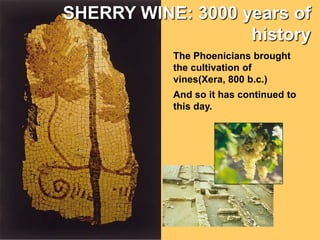
SHERRY WINE: 3000 years of historyThe Phoenicians brought the cultivation of vines(Xera, 800 b.c.)
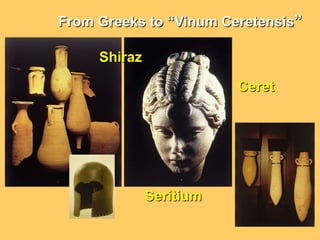
And so it has continued to this day.From Greeks to “VinumCeretensis”ShirazCeretSeritium
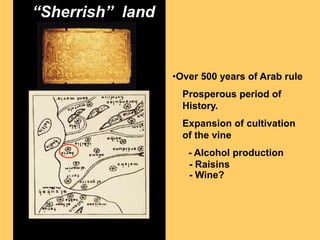
“Sherrish”  land Over 500 years of Arab rule
Prosperous period of History.
Expansion of cultivation of the vine- Alcohol production- Raisins- Wine?
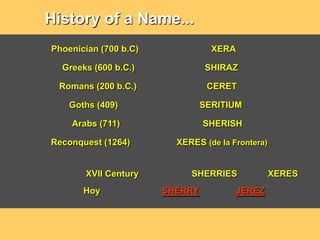
History of a Name...Phoenician (700 b.C)			XERAGreeks (600 b.C.)	       	      SHIRAZRomans (200 b.C.)		        CERETGoths (409)			 SERITIUM Arabs (711)			  SHERISHReconquest(1264)	 	XERES (de la Frontera)XVII Century	      	     SHERRIES	          XERES	Hoy	 	SHERRYJEREZ
2.- Bodegas ArgüesoHistory & Tradition
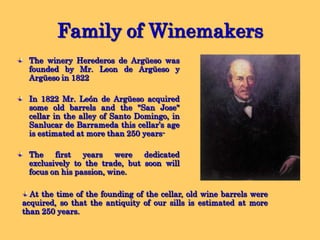
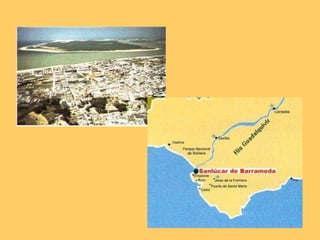
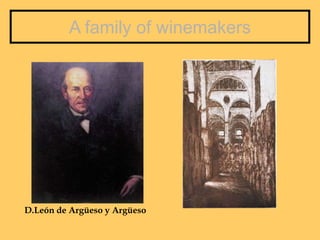
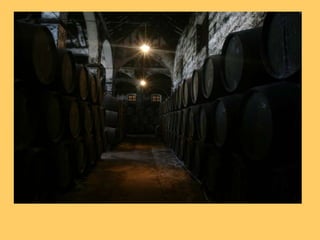
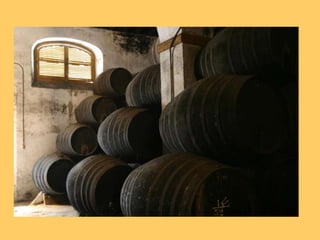
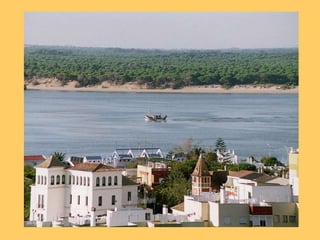
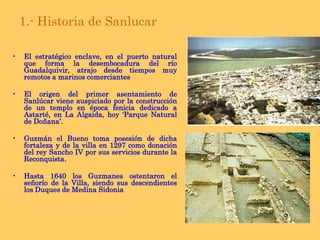
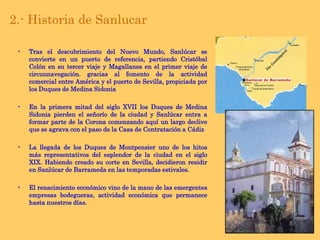
Family of WinemakersThe winery Herederos de Argüeso was founded by Mr. Leon de Argüeso y Argüeso in 1822In 1822 Mr. León de Argüeso acquired some old barrels and the "San Jose" cellar in the alley of Santo Domingo, in Sanlucar de Barrameda this cellar’s age is estimated at more than 250 years-The first years were dedicated exclusively to the trade, but soon will focus on his passion, wine.At the time of the founding of the cellar, old wine barrels were  acquired, so that the antiquity of our sills is estimated at more than 250 years.
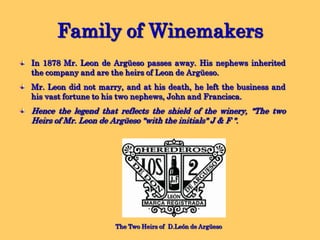
Family of WinemakersIn 1878 Mr. Leon de Argüeso passes away. His nephews inherited the company and are the heirs of Leon de Argüeso.Mr. Leon did not marry, and at his death, he left the business and his vast fortune to his two nephews, John and Francisca.Hence the legend that reflects the shield of the winery, "The two Heirs of Mr. Leon de Argüeso "with the initials" J & F ".TheTwoHeirs of  D.Leónde Argüeso
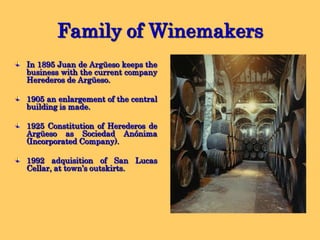
Family of WinemakersIn 1895 Juan de Argüesokeepsthebusinesswiththecurrentcompany Herederos de Argüeso.1905 anenlargement of the central buildingismade.1925 Constitution of Herederos de Argüesoas Sociedad Anónima (IncorporatedCompany).1992 adquisition of San Lucas Cellar, at town’soutskirts.
Family of WinemakersFor over 175 years, Argüeso is specialized in making and ageing sherry wines.And the exclusive Manzanilla from Sanlúcar de Barrameda, reaching a high recognition for its quality.
3.- Manzanilla and types of Sherry Wine
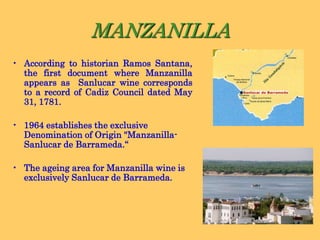
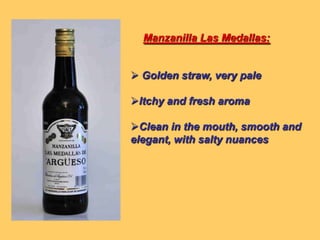
MANZANILLAA noble wine, produced only in Sanlucar de Barrameda, Andalucia, in southwestern Spain.
Made with very specific grape varieties, grown in a demarcated area of albariza soil and fortification with alcohol before the aging process.
Marketed with at least 3 years of aging in the mixing system called Solera & Criadera. MANZANILLAAccordingto historian Ramos Santana, thefirstdocumentwhere Manzanilla  appears as  Sanlucarwinecorrespondsto a record of Cadiz Council datedMay 31, 1781.1964 establishesthe exclusive Denomination of Origin "Manzanilla-Sanlucar de Barrameda.“Theageingareafor Manzanilla wineisexclusivelySanlucar de Barrameda.
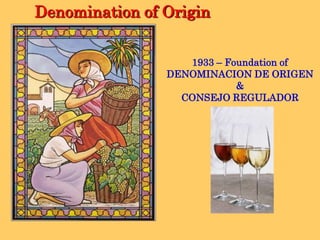
Denomination of Origin1933 – Foundation ofDENOMINACION DE ORIGEN&CONSEJO REGULADOR
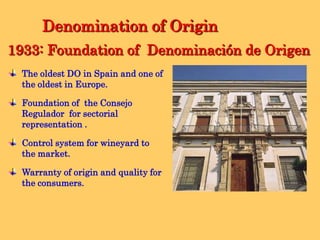
Denomination of Origin1933: Foundation of  Denominación deOrigenTheoldest DO in Spain and one of theoldest in Europe.Foundation of  the Consejo Regulador  for sectorial representation .Control systemforwineyardtothemarket.Warranty of origin and qualityfortheconsumers.
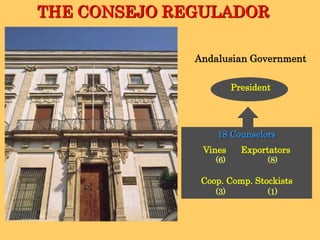
THE CONSEJO REGULADORAndalusian GovernmentPresident18 CounselorsVines      Exportators(6)                   (8)Coop. Comp. Stockists(3)                   (1)
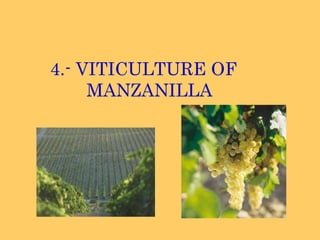
4.- VITICULTURE OF MANZANILLA
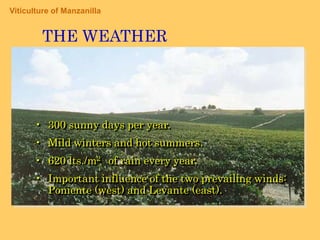
Viticulture of ManzanillaTHE WEATHER300 sunnydays per year.
Mildwinters and hotsummers.
620 lts./m2  of rain everyyear.
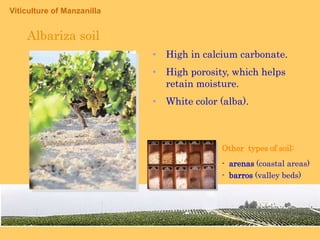
Important influence of the two prevailing winds: Poniente (west) and Levante (east).Viticulture of ManzanillaAlbariza soilHigh in calcium carbonate.
High porosity, which helps retain moisture.
White color (alba).Othertypes of soil:-  arenas(coastalareas)-  barros (valleybeds)
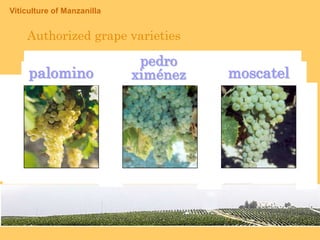
Viticulture of ManzanillaAuthorized grape varietiespedro ximénezmoscatel palomino
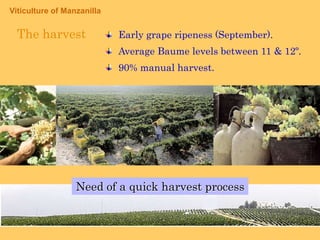
Viticulture of ManzanillaTheharvestEarly grape ripeness (September).AverageBaumelevelsbetween11 & 12º.90% manual harvest.Need of a quickharvestprocess
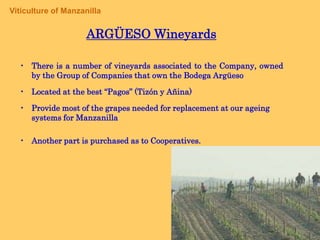
Viticulture of ManzanillaARGÜESO WineyardsThere is a number of vineyards associated to the Company, owned by the Group of Companies that own the Bodega ArgüesoLocated at thebest “Pagos” (Tizón y Añina)Provide most of the grapes needed for replacement at our ageing systems for ManzanillaAnother part is purchased as to Cooperatives.
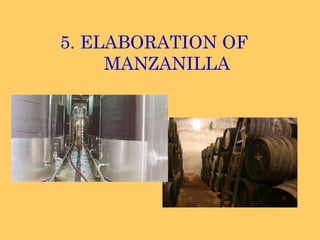
5. ELABORATION OF MANZANILLA
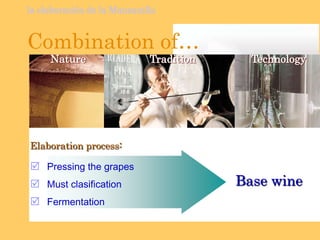
TraditionNatureTechnologyBase winela elaboración de la ManzanillaCombination of…Elaborationprocess:Pressing the grapes
Mustclasification
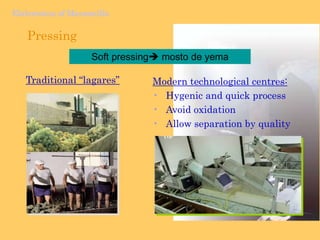
FermentationTraditional “lagares”Moderntechnological centres:Hygenic and quickprocess
Avoidoxidation
AllowseparationbyqualityElaboration of ManzanillaPressingSoft pressing mosto de yema
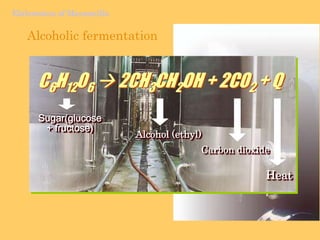
Sugar(glucose+ fructose)Alcohol (ethyl)CarbondioxideHeatElaboration of ManzanillaAlcoholicfermentationC6H1206 2CH3CH2OH + 2CO2 + Q
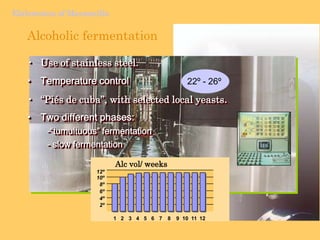
22º - 26ºTemperature control
Twodifferentphases:
“tumultuous” fermentation
slowfermentationAlcvol/ weeks12º10º8º6º4º2º123456789101112Elaboration of ManzanillaAlcoholicfermentationUse of stainlesssteel.
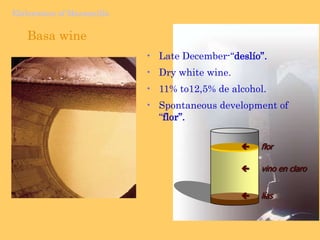
“Piés de cuba”, withselected local yeasts.Elaboration of ManzanillaBasa wineLate December-“deslío”.
Drywhitewine.
11% to12,5% de alcohol.
Spontaneousdevelopment of “flor”.
flor
vino en claro
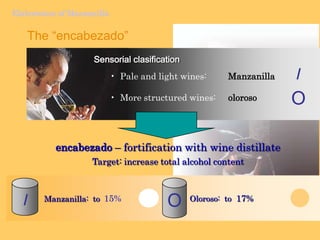
lías/Pale and light wines:ManzanillaOMore structuredwines:olorosoencabezado– fortificationwithwinedistillateTarget: increase total alcohol contentO/Manzanilla:  to15%Oloroso:  to 17%Elaboration of ManzanillaThe “encabezado”Sensorial clasification
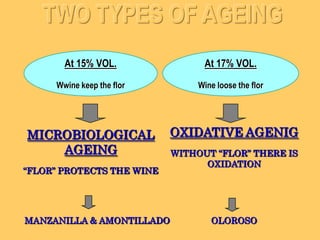
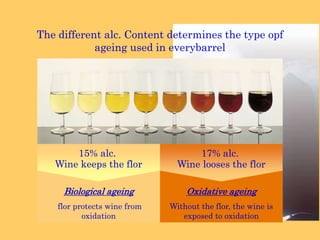
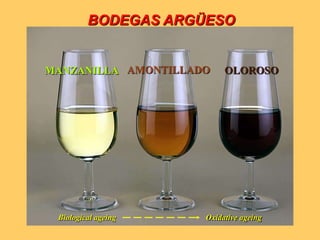
TWO TYPES OF AGEINGAt 15% VOL.Wwine keep the florAt 17% VOL.Wine loose the florOXIDATIVE AGENIGWITHOUT “FLOR” THERE IS OXIDATIONMICROBIOLOGICAL AGEING“FLOR” PROTECTS THE WINEMANZANILLA & AMONTILLADOOLOROSO
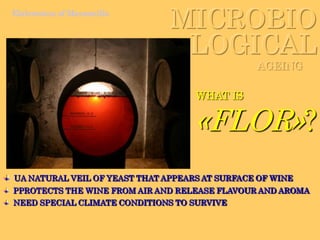
Elaboration of ManzanillaMICROBIOLOGICALAGEINGWHAT IS«FLOR»?UA NATURAL VEIL OF YEAST THAT APPEARS AT SURFACE OF WINEPPROTECTS THE WINE FROM AIR AND RELEASE FLAVOUR AND AROMANEED SPECIAL CLIMATE CONDITIONS TO SURVIVE
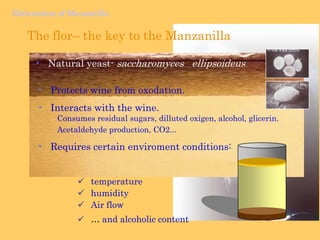
Natural yeast- saccharomycesellipsoideusElaboration of ManzanillaThe flor– thekeytothe ManzanillaProtectswinefromoxodation.
Interactswiththewine.Consumes residual sugars, dillutedoxigen, alcohol, glicerin.Acetaldehydeproduction, CO2...Requirescertainenviromentconditions:
temperature
humidity
Air flow
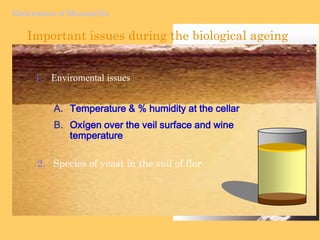
… and alcoholiccontentElaboration of ManzanillaImportantissuesduringthebiologicalageingEnviromentalissuesTemperature & % humidity at thecellarOxígenovertheveilsurface and winetemperatureSpecies of yeast in theveil of flor
Elaboration of ManzanillaEnviromentalissuesTemperature & % Humidity at thecellarMax. temperature= 25º CHumidity: over 65%
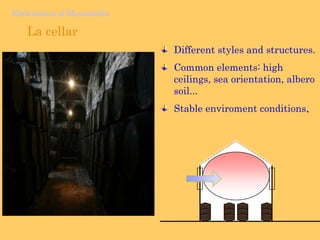
Elaboration of ManzanillaLa cellarDifferentstyles and structures.Commonelements: highceilings, sea orientation, albero soil...Stableenviromentconditions.
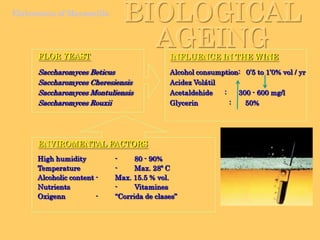
BIOLOGICAL AGEINGFLOR YEASTINFLUENCE IN THE WINESaccharomyces BeticusSaccharomyces CheresiensisSaccharomyces MontuliensisSaccharomyces RouxiiAlcohol consumption:   0’5 to 1’0% vol / yrAcidezVolátilAcetaldehide:      300 - 600 mg/l Glycerin	         :      50%ENVIROMENTAL FACTORSHigh humidity		-	80 - 90%Temperature		-	Max. 28º CAlcoholic content	-	Max. 15.5 % vol.Nutrients			-	VitaminesOxigenn		-	“Corrida de clases”Elaboration of Manzanilla
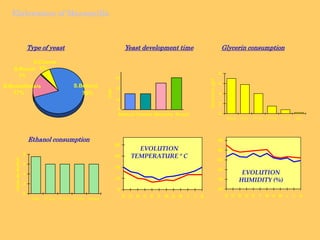
S.Cheres.6%Elaboration of ManzanillaType of yeastGlycerinconsumptionYeastdevelopment timeS.Rouxii1%30S.BeticusS.Montuliensis2017%76%Días100BeticusCherest.MontulieRouxiiEthanolconsumptionEVOLUTIONTEMPERATURE º CEVOLUTIONHUMIDITY (%)
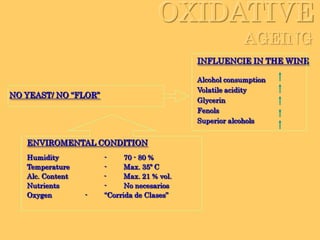
OXIDATIVE INFLUENCIE IN THE WINEAlcohol consumptionVolatile acidityGlycerinFenolsSuperior alcoholsNO YEAST/ NO “FLOR”ENVIROMENTAL CONDITIONHumidity			-	70 - 80 %Temperature		-	Max. 35º CAlc. Content                  -	Max. 21 % vol.Nutrients      		-	No necesariosOxygen		-	“Corrida de Clases”AGEING
15% alc.Winekeepsthe flor17% alc.Wineloosesthe florBiologicalageingflor protectswinefromoxidationOxidativeageingWithoutthe flor, thewineisexposedtooxidationThedifferentalc. Content determines thetypeopfageingused in everybarrel
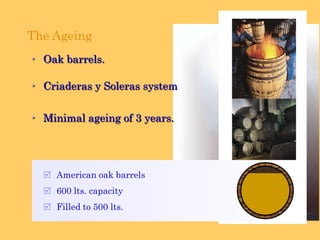
Oakbarrels.
American oakbarrels
600 lts. capacity
Filledto 500 lts.TheAgeingCriaderas y Soleras system
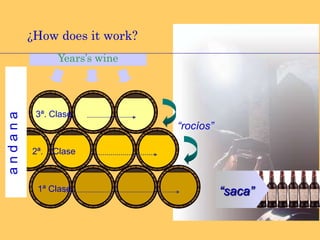
Minimalageing of 3 years.Years’swine3ª. Clase2ª.    Clase“saca” 1ª Clase¿Howdoesitwork?“rocíos”a n d a n a
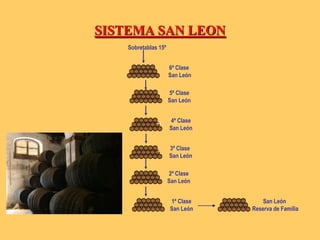
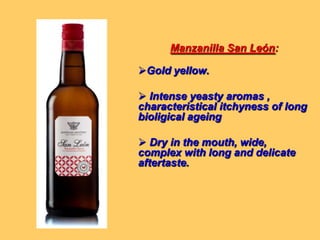
SISTEMA SAN LEONSobretablas 15º6ª Clase San León5ª ClaseSan León4ª ClaseSan León3ª Clase San Leónºº		º2ª ClaseSan León1ª ClaseSan LeónSan León Reserva de Familia
6. TYPES OF SHERRY WINE
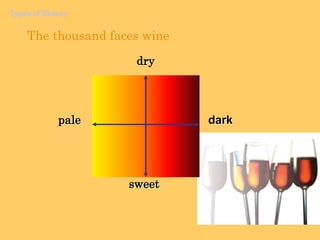
drypale darksweetTypes of SherryThethousand faces wine
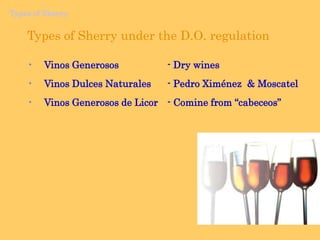
Types of SherryTypes of Sherry underthe D.O. regulationVinos Generosos					- Drywines
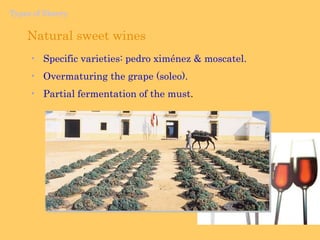
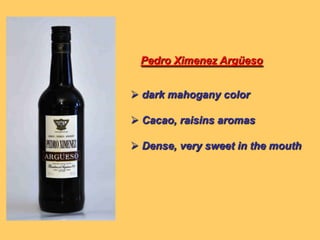
Vinos Dulces Naturales		- Pedro Ximénez & Moscatel
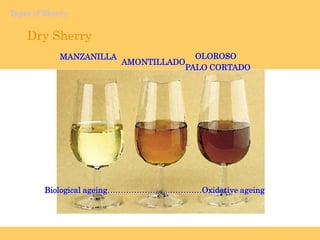
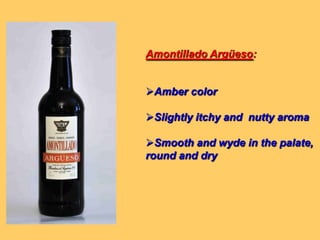
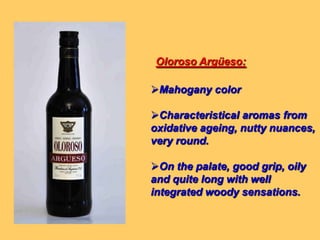
Vinos Generosos de Licor 	- Cominefrom “cabeceos”OLOROSOMANZANILLAAMONTILLADOPALO CORTADOBiologicalageing…………………...…………OxidativeageingTypes of SherryDry Sherry
Types of SherryNatural sweetwinesSpecificvarieties: pedroximénez& moscatel.
Overmaturingthe grape (soleo).
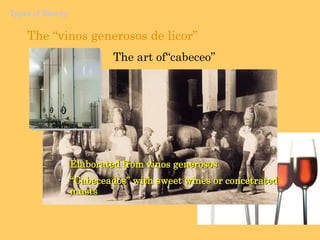
Partialfermentation of themust.Elaboratedfrom vinos generosos
“Cabeceados” withsweetwinesorconcetratedmustsTypes of SherryThe “vinos generosos de licor”The art of“cabeceo”
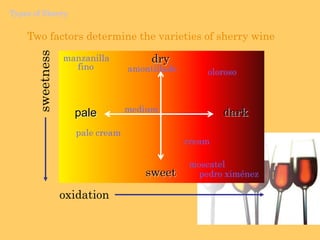
drymanzanillafinoamontilladoolorososweetnessEl grado de oxidaciónmediumEl grado dedulzordarkpalepale creamcreammoscatel		pedro ximénezsweetDeterminado por el tipo de crianza del vinoDeterminado por los azúcares residualesoxidationTypes of SherryTwofactors determine thevarieties of sherry wine
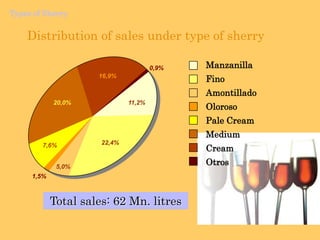
Types of SherryDistribution of sales undertype of sherryManzanillaFinoAmontilladoOlorosoPale CreamMediumCreamOtros0,9%16,9%11,2%20,0%22,4%7,6%5,0%1,5%Total sales: 62 Mn.litres

ENGLISH PRESENT ARGUESO EPS